

Neural general circulation models for weather and climate
Open accessThe DOI matches its Crossref record; 54 of the 57 references it cites were found in a registry or an index; 14 of the 26 sources its claims cite were checked for support.
Abstract
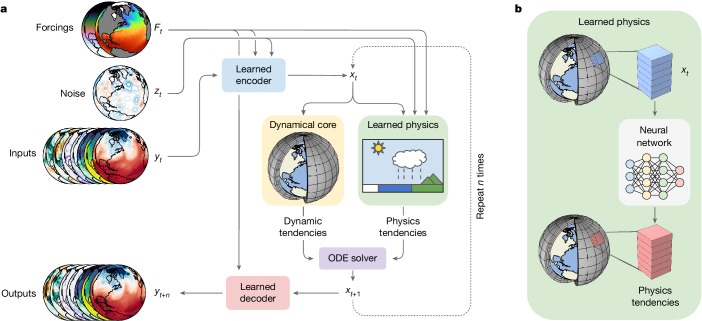
General circulation models (GCMs) are the foundation of weather and climate prediction. GCMs are physics-based simulators that combine a numerical solver for large-scale dynamics with tuned representations for small-scale processes such as cloud formation. Recently, machine-learning models trained on reanalysis data have achieved comparable or better skill than GCMs for deterministic weather forecasting. However, these models have not demonstrated improved ensemble forecasts, or shown sufficient stability for long-term weather and climate simulations. Here we present a GCM that combines a differentiable solver for atmospheric dynamics with machine-learning components and show that it can generate forecasts of deterministic weather, ensemble weather and climate on par with the best machine-learning and physics-based methods. NeuralGCM is competitive with machine-learning models for one- to ten-day forecasts, and with the European Centre for Medium-Range Weather Forecasts ensemble prediction for one- to fifteen-day forecasts. With prescribed sea surface temperature, NeuralGCM can accurately track climate metrics for multiple decades, and climate forecasts with 140-kilometre resolution show emergent phenomena such as realistic frequency and trajectories of tropical cyclones. For both weather and climate, our approach offers orders of magnitude computational savings over conventional GCMs, although our model does not extrapolate to substantially different future climate…
Overview
CoChat Summary
## TL;DR
NeuralGCM is a fully differentiable hybrid general circulation model trained on ERA5 weather trajectories that combines a physical dynamical core with learned parameterizations. It achieves competitive performance for weather forecasting and multi-decade climate simulation, while the paper notes it does not extrapolate to substantially different future climates.
## Key findings
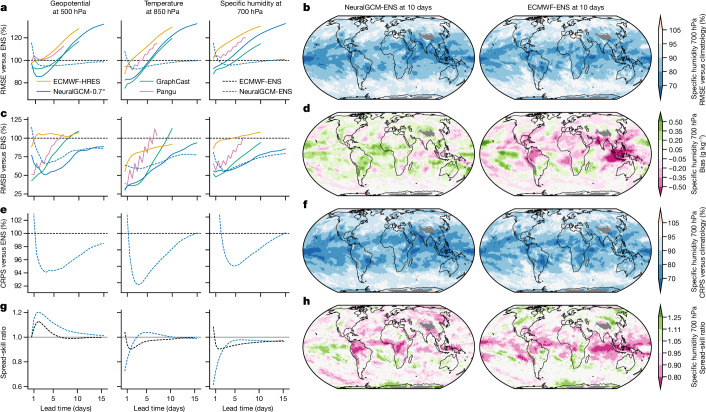
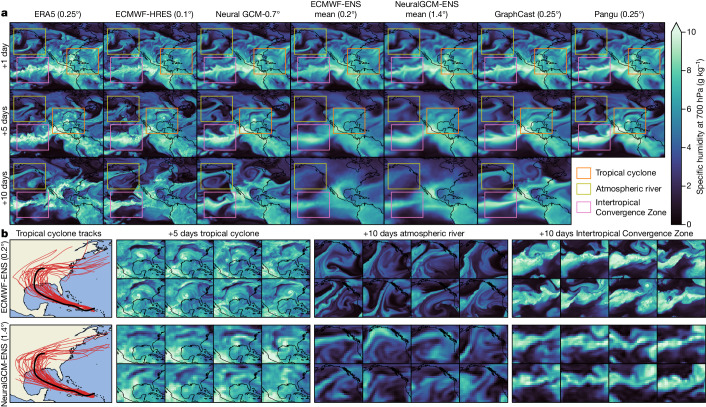
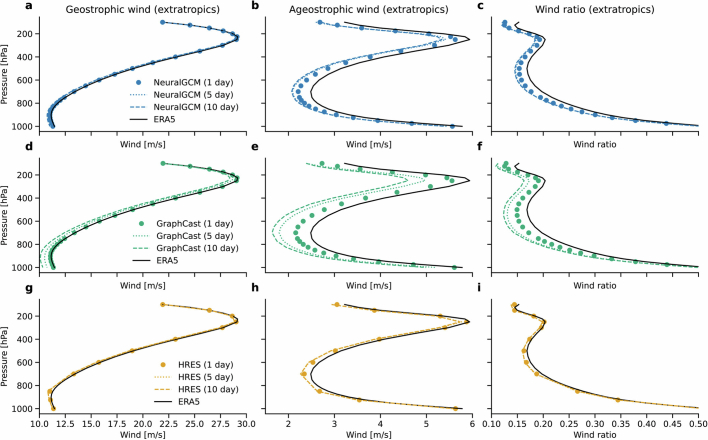
- On medium-range weather forecasting, NeuralGCM-0.7° and GraphCast achieved the best RMSE for the first 1–3 days (depending on variable), while NeuralGCM models compared favorably on persistent bias, including notably lower specific-humidity bias in the tropics.
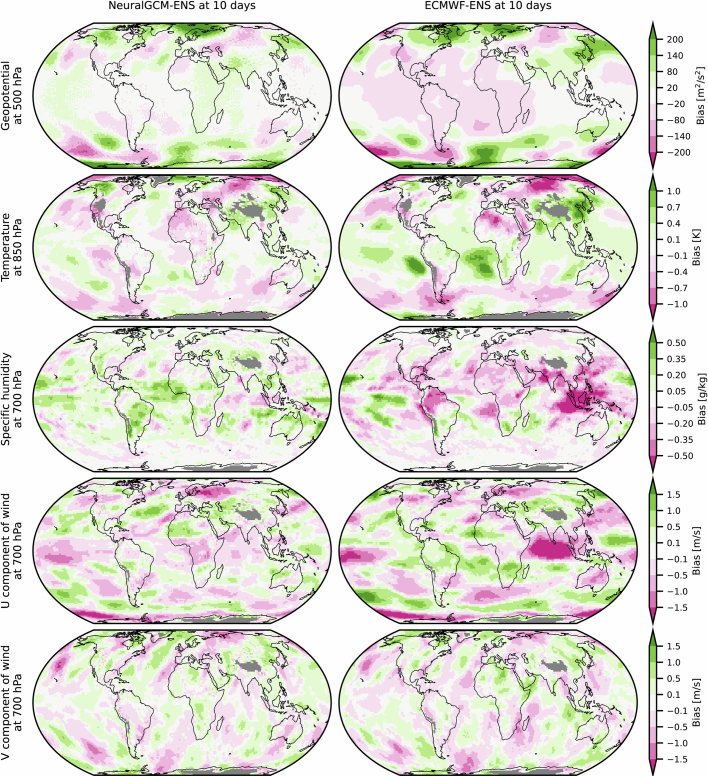
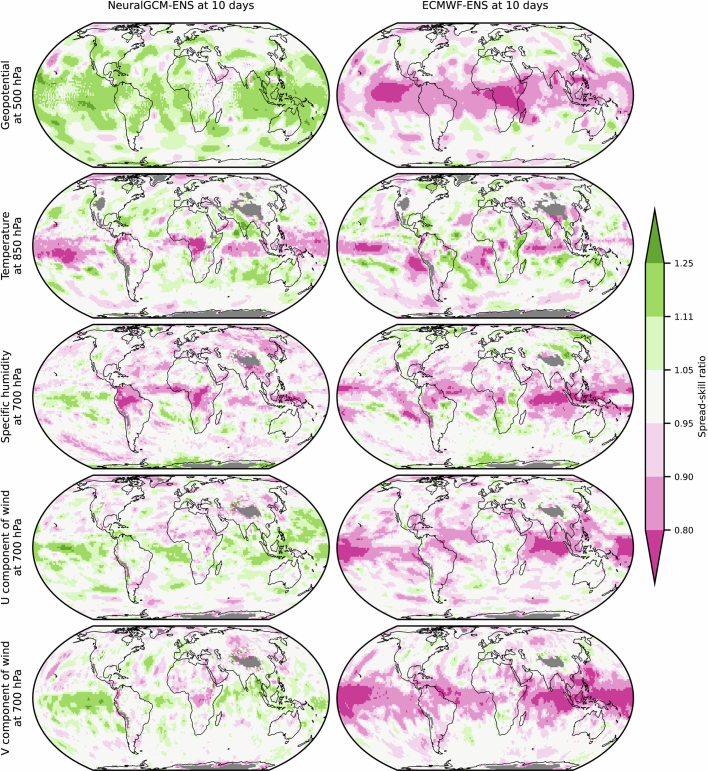
- The stochastic NeuralGCM-ENS at 1.4° had lower error than ECMWF-ENS across almost all variables, lead times, and vertical levels for ensemble-mean RMSE, RMSB, and CRPS; its spread-skill ratio was approximately 1.
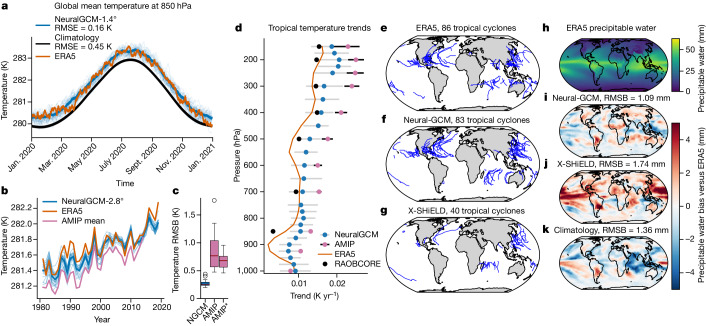
- In climate simulations with prescribed SST, NeuralGCM captured seasonal climate metrics and long-term warming trends: the ensemble-mean global temperature RMSE was 0.16 K versus 0.45 K for climatology, and all 22 stable 40-year NeuralGCM-2.8° runs had smaller spatial bias than the 22 CMIP6 AMIP runs.
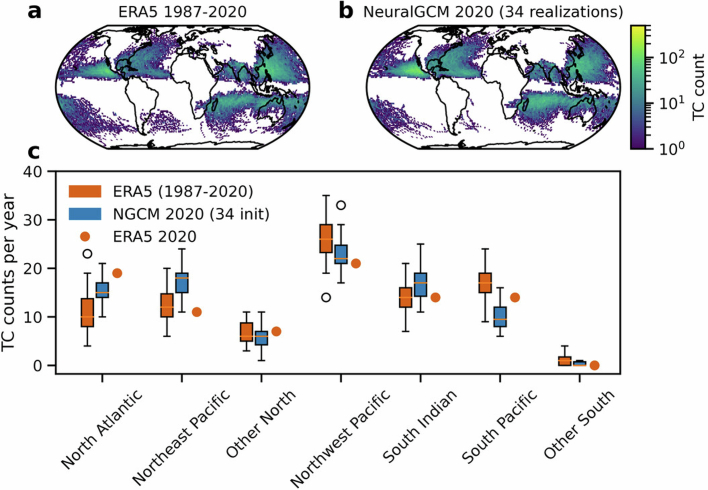
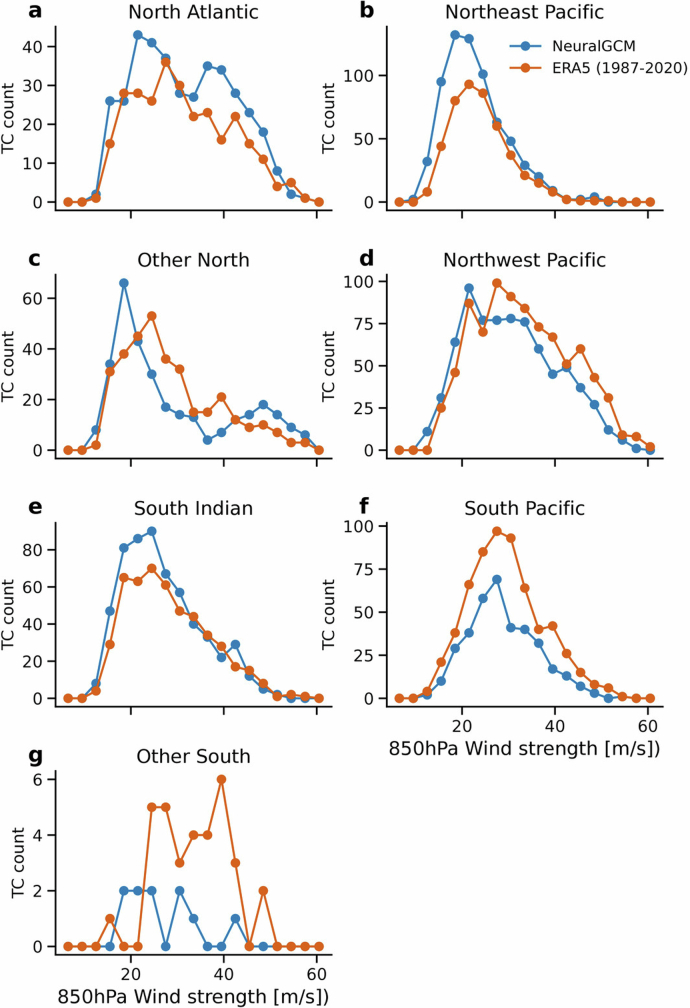
- For tropical cyclones, NeuralGCM at 1.4° produced 83 cyclones versus 86 in ERA5 for the corresponding period, while X-SHiELD produced 40 after regridding to 1.4°.
## Methods
- The model is a fully differentiable hybrid GCM with a JAX-implemented dynamical core solving the hydrostatic primitive equations with moisture on sigma coordinates, plus a learned physics module that operates on single atmospheric columns.
- Weather evaluation used 732 forecasts from noon and midnight UTC in 2020 (held out from training for machine-learning models), regridded to 1.5°, with comparisons against ERA5 or ECMWF operational analysis depending on the baseline.
- Deterministic models were trained with a combination of losses for accuracy, spectral matching, and bias; stochastic models used CRPS and injected Gaussian random fields, with two ensemble members per forecast for training.
- Climate experiments used deterministic models at 2.8° and 1.4° with prescribed historical SST and sea ice, including 37 initial conditions for 2-year seasonal-cycle runs and 37 initial conditions for 40-year AMIP-like runs, of which 35 and 22 were stable, respectively.
## Limitations
- The paper explicitly states that NeuralGCM does not extrapolate to substantially different future climates.
- The authors note that for more substantial SST increases (+4 K), NeuralGCM’s response diverges from expectations, and that AMIP simulations with increased SST show climate drift.
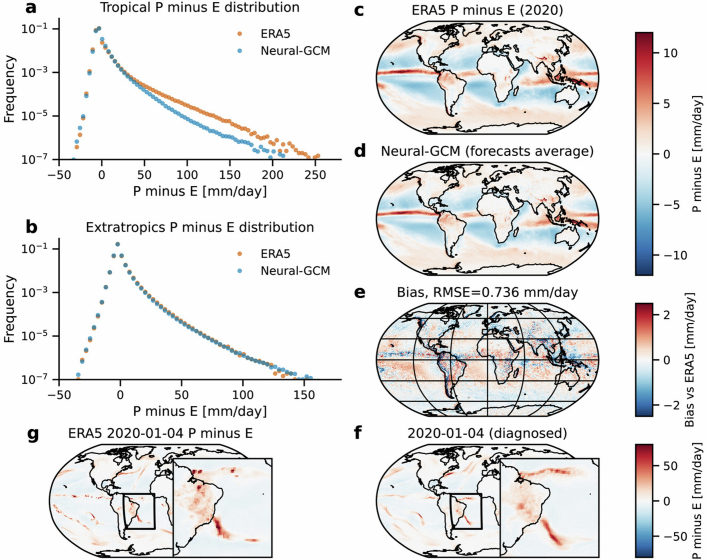
- The text makes evident that the current version cannot distinguish precipitation from evaporation because it directly predicts column tendencies; this is stated in the paper.
Model-written summary. Check it against the paper before relying on it.
Integrity signals
Registry
Cites
Statistics
Figures
Verification
Claims the paper makes
6 Valid · 2 Not valid · 9 Not checked · 53 Own results and interpretations
Some cited sources support this claim and some don’t — read each source’s verdict below.
In the paper
“Our results provide strong evidence for the disputed hypothesis37–39 that learning to predict short-term weather is an effective way to tune parameterizations for climate.”
§ Neural general circulation models for weather and climate > Discussion
What the sources say
- Partly supportedcites [37] Ruiz, J. J., Pulido, M. & Miyoshi, T. Estimating model parameters with ensemble-based data assimilation: a review. J. Meteorol. Soc. Jpn Ser. II 91, 79–99 (2013). 10.2151/jmsj.2013-201 sourceExperimental — accuracy not yet measured
The Conclusions (p. 98) do carry the substance attributed here — 'Parameter estimation also has the potential to improve model climatology... Model parameters can be trained during relatively short periods (i.e., a couple of years) using a data assimilation cycle, and then the estimated parameters can be used for climate simulations' — and the Introduction (p. 90) lists climate-model optimization among the applications of parameter estimation. But the source states this as a potential, not as demonstrated evidence: the Abstract (p. 89) and Section 3.4 (pp. 93-94) limit the paper's own results to a positive effect on short-to medium-range numerical weather prediction (RMSE/bias of 24-h precipitation, spread-error relationship), with no climate simulation performed, so 'strong evidence ... is an effective way to tune parameterizations for climate' overstates it, and nothing in our copy describes the hypothesis as disputed. (LLM, conf=0.75)
- Supportedcites [38] Schneider, T., Lan, S., Stuart, A. & Teixeira, J. Earth system modeling 2.0: a blueprint for models that learn from observations and targeted high-resolution simulations. Geophys. Res. Lett. 44, 12–396 (2017). 10.1002/2017GL076101 source
Section 2.1 (Information Sources for Parameterization Schemes) records that parameters in cloud, convection and precipitation schemes 'have been estimated by minimizing errors in short-term weather forecasts over time scales of hours or days', i.e. the hypothesis the citing sentence names. Section 2.3 (Objectives) shows it is indeed contested: 'This has given rise to hopes that it may suffice to evaluate objective functions by weather hindcasts over time scales of only hours ... But experience has shown that such short-term optimization may not always lead to the desired improvements in climate simulations (Schirber et al., 2013)', and the authors consequently choose accumulation windows wide compared with the O(10 days) forgetting time. The citation is attached only to the disputed hypothesis itself, not to the citing paper's claim that their results support it, so our copy supports what is attributed here. (LLM, conf=0.80)
- Disputedcites [39] Schneider, T., Leung, L. R. & Wills, R. C. J. Opinion: Optimizing climate models with process knowledge, resolution, and artificial intelligence. Atmos. Chem. Phys.24, 7041–7062 (2024). sourceExperimental — accuracy not yet measured
Our copy of Schneider et al. (2024) argues the opposite of what the claim attributes to it: in Sect. 5 ('AI for learning parameterizations') it states that supervised learning focused on the short-term residual has limitations, that 'focusing solely on minimizing the short-term residual ϵ' means the learned parameterization 'may not necessarily minimize the climate-relevant loss function... concerned with longer-term statistics,' and cites Schirber et al. (2013) as an example where 'short-term optimization over trajectories can lead to no improvement or even the degradation of the longer-term climate statistics.' The same section says holistic learning from data 'is more likely to be successful in weather prediction, where short-term accuracy is prioritized... In contrast, climate prediction faces two primary challenges,' and that learned parameterizations 'often struggle with conserving essential quantities such as energy and exhibit instabilities during extended integrations... because minimizing the short-term residual ϵ does not inherently ensure conservation or stability.' The paper also never frames this as a merely 'disputed hypothesis' but advocates process-based, online, climate-relevant-loss learning instead (Sect. 3 and Sect. 5). (LLM, conf=0.85)
Checked by a reasoning model — may be wrong.
boostedstates a cause- Asserted: passes — The authors put it forward as true.
- Checkable: passes — It can be checked against evidence.
- Load-bearing: passes — The paper’s conclusions depend on it.
- Based: passes — The paper gives a reason why it holds.
- Partly supported
The cited sources that could be checked couldn’t confirm or dispute this claim.
In the paper
“Overall, NeuralGCM demonstrates that incorporating machine learning is a viable alternative to building increasingly detailed physical models32 for improving GCMs.”
§ Neural general circulation models for weather and climate > Discussion
What the sources say
- Could not verifycites [32] Stevens, B. et al. DYAMOND: the dynamics of the atmospheric general circulation modeled on non-hydrostatic domains. Prog. Earth Planet. Sci. 6, 61 (2019). 10.1186/s40645-019-0304-z sourceExperimental — accuracy not yet measured
Our copy of DYAMOND (Stevens et al. 2019) never addresses machine learning: searches on 'machine learning', 'deep learning / neural network parameterization', and 'surrogate/emulator alternative to physical parameterization' returned only passages on global storm-resolving models, their grids, output volumes and diagnostics. The route to better GCMs that the paper does argue for is explicitly resolving convection at ~3 km to 'circumvent considerable, and seemingly intractable, problems arising from parameterizations' (Introduction, p. 2) and achieving higher throughput (Summary, p. 15) — a physical, not data-driven, alternative, and no passage credits or discusses ML methods, nor names a work to which the ML claim could be traced. Nothing in our copy either supports or contradicts the attributed claim, so it cannot be judged from this source. (LLM, conf=0.72)
boostedstates a cause- Asserted: passes — The authors put it forward as true.
- Checkable: passes — It can be checked against evidence.
- Load-bearing: passes — The paper’s conclusions depend on it.
- Based: passes — The paper gives a reason why it holds.
- Could not verify
The cited sources support only part of this claim — read each source’s verdict below.
In the paper
“Recently, machine-learning models trained on reanalysis data have achieved comparable or better skill than GCMs for deterministic weather forecasting3,4.”
§ Neural general circulation models for weather and climate > Abstract General circulation models (GCMs) are the foundation of weather and climate prediction1,2. GCMs are physics-based simulators that combine a numerical solver for large-scale dynamics with tuned representations for small-scale processes such as cloud formation. Recently, machine-learning models trained on reanalysis data have achieved comparable or better skill than GCMs for deterministic weather forecasting3,4. However, these models have not demonstrated improved ensemble forecasts, or shown sufficient stability for long-term weather and climate simulations. Here we present a GCM that combines a differentiable solver for atmospheric dynamics with machine-learning components and show that it can generate forecasts of deterministic weather, ensemble weather and climate on par with the best machine-learning and physics-based methods. NeuralGCM is competitive with machine-learning models for one- to ten-day forecasts, and with the European Centre for Medium-Range Weather Forecasts ensemble prediction for one- to fifteen-day forecasts. With prescribed sea surface temperature, NeuralGCM can accurately track climate metrics for multiple decades, and climate forecasts with 140-kilometre resolution show emergent phenomena such as realistic frequency and trajectories of tropical cyclones. For both weather and climate, our approach offers orders of magnitude computational savings over conventional GCMs, although our model does not extrapolate to substantially different future climates. Our results show that end-to-end deep learning is compatible with tasks performed by conventional GCMs and can enhance the large-scale physical simulations that are essential for understanding and predicting the Earth system.
What the sources say
- Supportedcites [3] Lam, R. et al. Learning skillful medium-range global weather forecasting. Science 382, 1416–1421 (2023). 37962497 10.1126/science.adi2336 source
The paper’s opening summary says GraphCast was trained on reanalysis data and significantly outperformed an operational deterministic forecasting system on 90% of 1,380 verification targets. The Conclusions also describe machine-learning weather prediction as competitive with traditional methods. The paper compares GraphCast specifically with HRES, rather than using the term “GCMs.” (LLM, conf=0.90)
- Partly supportedcites [4] Bi, K. et al. Accurate medium-range global weather forecasting with 3D neural networks. Nature 619, 533–538 (2023). 37407823 10.1038/s41586-023-06185-3 PMC10356604 sourceExperimental — accuracy not yet measured
The Discussion and Deterministic global weather forecast sections report that Pangu-Weather, trained on reanalysis data, achieved better deterministic forecast accuracy than ECMWF’s operational IFS. The paper identifies IFS as a numerical weather prediction system, however, and does not report a comparison with a system it calls a GCM. (LLM, conf=0.82)
plainstates an association- Asserted: passes — The authors put it forward as true.
- Checkable: passes — It can be checked against evidence.
- Load-bearing: passes — The paper’s conclusions depend on it.
- Based: passes — The paper gives a reason why it holds.
- Supported
Every source the paper cites for this claim was checked and supports it.
In the paper
“So far, hybrid models have mostly been limited to idealized scenarios such as aquaplanets22,23.”
§ Neural general circulation models for weather and climate > Main
What the sources say
- Supportedcites [22] Rasp, S., Pritchard, M. S. & Gentine, P. Deep learning to represent subgrid processes in climate models. Proc. Natl Acad. Sci. USA 115, 9684–9689 (2018). 30190437 10.1073/pnas.1810286115 PMC6166853 source
The Climate Model and Neural Network Setup section describes this hybrid model as using an aquaplanet setup. The Discussion calls its training climate idealized and says extending the method to a less idealized setup is an immediate follow-up task. The paper thus supports the cited example of the limitation, though it does not quantify how many hybrid models use such setups. (LLM, conf=0.87)
- Supportedcites [23] Yuval, J. & O’Gorman, P. A. Stable machine-learning parameterization of subgrid processes for climate modeling at a range of resolutions. Nat. Commun. 11, 3295 (2020). 32620769 10.1038/s41467-020-17142-3 PMC7335176 source
The Introduction describes earlier neural-network climate-model work in an aquaplanet configuration, and the Results state that this study also uses an aquaplanet configuration. The Discussion identifies training over land with topography as a challenge for future research, supporting the characterization of hybrid models as largely limited to idealized settings. (LLM, conf=0.86)
plain- Asserted: passes — The authors put it forward as true.
- Checkable: passes — It can be checked against evidence.
- Load-bearing: passes — The paper’s conclusions depend on it.
- Based: passes — The paper gives a reason why it holds.
- Supported
The cited sources support only part of this claim — read each source’s verdict below.
In the paper
“Deterministic machine-learning models using a mean-squared-error loss are rewarded for averaging over uncertainty, producing unrealistically blurry predictions when optimized for multi-day forecasts3,13.”
§ Neural general circulation models for weather and climate > Main
What the sources say
- Supportedcites [3] Lam, R. et al. Learning skillful medium-range global weather forecasting. Science 382, 1416–1421 (2023). 37962497 10.1126/science.adi2336 source
The Conclusions (p. 10) state that GraphCast’s MSE objective encourages it to express uncertainty by spatially blurring predictions. The paper also reports that training for longer forecast horizons produces blurrier forecasts at longer lead times. This supports the citing sentence’s account of why MSE-optimized deterministic forecasts can become blurry. (LLM, conf=0.90)
- Partly supportedcites [13] Keisler, R. Forecasting global weather with graph neural networks. Preprint at https://arxiv.org/abs/2202.07575 (2022). sourceExperimental — accuracy not yet measured
Keisler (2022) supplies the empirical setting and the observation but not the claimed mechanism. Section 3.3.3 (p. 5) confirms the model is trained with a mean-squared-error loss, and Section 3.3.2 (p. 5) confirms it is optimized for multi-day forecasts via a multi-step rollout loss (4-, 8-, 12-step, i.e. 1-3 day rollouts). Section 4.2 (p. 6) reports that over a 12-step (3-day) rollout 'the data-driven forecast does become smoother over time' — but the paper nowhere says the model is 'rewarded for averaging over uncertainty', never frames the smoothing as a consequence of irreducible forecast uncertainty under MSE, and never calls the predictions 'unrealistically blurry' (it treats the 3-day output as generally tracking large-scale flows, and its only degradation past ~6 days is hexagon-patterned instability, Section 4.3, p. 6). So the blur/averaging-over-uncertainty causal claim attributed here exceeds what this source states. (LLM, conf=0.72)
plainstates a cause- Asserted: passes — The authors put it forward as true.
- Checkable: passes — It can be checked against evidence.
- Load-bearing: passes — The paper’s conclusions depend on it.
- Based: passes — The paper gives a reason why it holds.
- Supported
29 more claims
Create a free account to see all 70 claims and to verify the 10 references still open.
- It may state two separate claims as one. 31
- Probably not a substantial claim. 6
Claims other papers make about this one
Each is checked against this paper’s own text: does it say what the citing paper says it does?
The cited source says what the claim attributes to it.
In the citing paper
“An exception is NeuralGCM20, a hybrid NWP–MLWP method, which combines the dynamical core of a traditional NWP with local ML-based parameterizations and shows competitive performance with operational ensemble forecasts.”
From Probabilistic weather forecasting with machine learning (2025) · cites this paper as [20]
Citations
Cites
Hersbach, H., Bell, B., Berrisford, P., Hirahara, S., Horányi, A., Muñoz‐Sabater, J., Nicolas, J., Peubey, C., Radu, R., Schepers, D., et al. (2020) · Quarterly Journal of the Royal Meteorological Society · doi:10.1002/qj.3803 · Cited by 31,882 · cited 1×
“These models rely solely on machine-learning techniques, using roughly 40 years of historical data from the European Center for Medium-Range Weather Forecasts (ECMWF) reanalysis v5 (ERA5) 14 for model training and forecast initialization.”
MethodSequence to Sequence Learning with Neural Networks
Sutskever, I., Vinyals, O., & Le, Q. V. (2014) · arXiv · doi:10.48550/arxiv.1409.3215 · Cited by 17,766
Eyring, V., Bony, S., Meehl, G. A., Senior, C. A., Stevens, B., Stouffer, R. J., & Taylor, K. E. (2016) · Geoscientific Model Development · doi:10.5194/gmd-9-1937-2016 · Cited by 11,981 · cited 3×
“34 and Supplementary Table 6.”
MethodInfluential(2012) · doi:10.1017/cbo9781139177245 · Cited by 7,236 · cited 1×
“The difficulty of reducing uncertainty in long-term climate projections 9 and estimating distributions of extreme weather events 10 presents major challenges for climate mitigation and adaptation 11 .”
BackgroundStrictly Proper Scoring Rules, Prediction, and Estimation
Gneiting, T., & Raftery, A. E. (2007) · Journal of the American Statistical Association · doi:10.1198/016214506000001437 · Cited by 5,793 · cited 10×
“Our stochastic loss is based on the CRPS 28,48,49 .”
BackgroundMethodInfluentialDeep learning and process understanding for data-driven Earth system science
Reichstein, M., Camps-Valls, G., Stevens, B., Jung, M., Denzler, J., Carvalhais, N., & Prabhat (2019) · Nature · doi:10.1038/s41586-019-0912-1 · Cited by 5,673 · cited 1×
“…longer timescales 17,18 , these models have not demonstrated the ability to outperform existing GCMs. Hybrid models that combine GCMs with machine learning are appealing because they build on the interpretability, extensibility and successful track record of traditional atmospheric models 19,20 .”
BackgroundThe quiet revolution of numerical weather prediction
Bauer, P., Thorpe, A., & Brunet, G. (2015) · Nature · doi:10.1038/nature14956 · Cited by 2,729
Accurate medium-range global weather forecasting with 3D neural networks
Bi, K., Xie, L., Zhang, H., Chen, X., Gu, X., & Tian, Q. (2023) · Nature · doi:10.1038/s41586-023-06185-3 · Cited by 1,670 · cited 4×
“Recent advances in machine learning have presented an alternative for weather forecasting 3,4,12,13 .”
BackgroundMethodInfluentialLearning skillful medium-range global weather forecasting
Lam, R., Sanchez-Gonzalez, A., Willson, M., Wirnsberger, P., Fortunato, M., Alet, F., Ravuri, S., Ewalds, T., Eaton-Rosen, Z., Hu, W., et al. (2023) · Science · doi:10.1126/science.adi2336 · Cited by 1,466 · cited 5×
“Specifically, we diagnose precipitation minus evaporation (Supplementary Information section H.5) rather than directly predicting these as in machine-learning-based approaches 3 .”
BackgroundMethodInfluentialSelf-citationMarine boundary layer clouds at the heart of tropical cloud feedback uncertainties in climate models
Bony, S., & Dufresne, J. (2005) · Geophysical Research Letters · doi:10.1029/2005gl023851 · Cited by 1,302 · cited 1×
“Tuning GCMs to match historical data remains a manual process 5 , and GCMs retain many persistent errors and biases 6–8 .”
Background
Research works printed but not linked: 1
- Holton, J. R. An introduction to Dynamic Meteorology 5th edn (Elsevier, 2004).
Cited by
Items 201–300 of 434
Digital Intelligent World: From Data-Driven AI to Knowledge-Enabled Intelligent Agents
Ge, X., Chen, Z., Yan, L., & Yang, Y. (2026) · IEEE Transactions on Knowledge and Data Engineering · doi:10.1109/tkde.2026.3651336 · Cited by 3
“Inclimateforecast-ing Inclimateforecast-ing,Google’sNeuralGCMintegratesmachinelearningwith atmosphericphysicsmodels,achievingfasterandmoreaccurate long-range predictions than traditional methods [93].”
Fard, B. J., Hasan, S. A., & Bell, J. E. (2026) · Sustainability · doi:10.3390/su18052445 · Cited by 3
“Initial advances focused on enhancing forecasting skill and spatial resolution through machine learning, deep learning, and geospatial foundation models [10], [11].”
Improving renewable energy forecasting with FuXi-Energy
Zhong, X., Chen, L., Li, H., Fan, X., Qian, W., Liu, J., Luo, E., & Wu, L. (2026) · Applied Energy · doi:10.1016/j.apenergy.2026.127657 · Cited by 4
Ma, J., Fu, H., Liu, Y., Shang, C., Dai, Y., & Jin, Y. Q. (2026) · The Innovation Informatics · doi:10.59717/j.xinn-inform.2026.100037 · Cited by 2
A Tutorial on Best Practices and Pitfalls in Applying Machine Learning to Environmental Research
Yan, Z., Li, J., Zhang, W., Wen, H., Yu, H., Yu, M., Liu, Q. S., & Jiang, G. (2026) · ACS Environmental Au · doi:10.1021/acsenvironau.6c00025 · Cited by 2
“22 However, when governing equations cannot be specified in advance, physical laws may instead be inferred from the data.”
Frolov, S., Garrett, K., Jankov, I., Kleist, D. T., Stewart, J. Q., & Hoeve, J. E. T. (2024) · Bulletin of the American Meteorological Society · doi:10.1175/bams-d-24-0062.1 · Cited by 6
Machine learning suggests climate and seasonal definitions should change under global warming
Speer, M. S., & Leslie, L. M. (2024) · Academia Environmental Sciences and Sustainability · doi:10.20935/acadenvsci7419 · Cited by 2
Du, S., & Zhang, R. (2025) · Ocean Modelling · doi:10.1016/j.ocemod.2025.102500 · Cited by 2
Machine Learned Empirical Numerical Integrator from Simulated Data
Chen, T., Penny, S. G., Smith, T. A., & Platt, J. A. (2025) · Artificial Intelligence for the Earth Systems · doi:10.1175/aies-d-23-0088.1 · Cited by 2
Zhang, Z., Cao, L., & Yin, J. (2025) · Frontiers in Marine Science · doi:10.3389/fmars.2025.1495822 · Cited by 2
CORRELATION ANALYSIS OF PARAMETERS OF CLIMATE GEOINFORMATION SYSTEMS FOR RENEWABLE ENERGY
Verpeta, V. (2025) · System Research in Energy · doi:10.15407/srenergy2025.02.091 · Cited by 2
Tesseract Core: Universal, autodiff-native software components for Simulation Intelligence
Häfner, D., & Lavin, A. (2025) · The Journal of Open Source Software · doi:10.21105/joss.08385 · Cited by 2
“…general—for example, when exploring the merits of hybrid AI-simulator systems in differentiable physics contexts (Avila Belbute-Peres et al., 2018; Kochkov et al., 2024; Um et al., 2020), or when using machine learning to augment existing simulation codes (Freitas et al., 2024; Shankar et al.,…”
Wang, F., Lin, D., Chen, B., Jing, G., Geng, Y., Ge, X., Wei, D., & Zhang, N. (2025) · Applied Sciences · doi:10.3390/app15158324 · Cited by 2
Song, Z., Jiang, Q., Zhang, S., Xia, Y., Li, L., & Liu, J. (2025) · Engineering Geology · doi:10.1016/j.enggeo.2025.108276 · Cited by 2
Interpretable Machine Learning‐Based Radiation Emulation for ICON
Hafner, K., Iglesias‐Suarez, F., Shamekh, S., Gentine, P., Giorgetta, M. A., Pincus, R. L., & Eyring, V. (2025) · Journal of Geophysical Research Machine Learning and Computation · doi:10.1029/2024jh000501 · Cited by 13
Lyu, G., Mu, L., Köhl, A., Li, N., Liang, X., & Liu, C. (2025) · Geoscientific model development · doi:10.5194/gmd-18-9451-2025 · Cited by 3
“More recently, machine learning (e.g., Brether-ton et al., 2022; Horvat and Roach, 2022; Kochkov et al., 2024) has been applied to develop the sub-grid parameterizations using high-resolution model simulations and reanalysis datasets .”
Morcrette, C. J., Cave, T., Reid, H., Rodrigues, J., Deveney, T., Kreußer, L. M., Weverberg, K. V., & Budd, C. J. (2024) · doi:10.22541/essoar.172462453.32373495/v1 · Cited by 2
Large AI models: Pioneering innovations in accurate weather forecasting
Zhang, F., Huang, X., Mu, M., Qin, B., & Li, J. (2024) · Chinese Science Bulletin (Chinese Version) · doi:10.1360/tb-2024-0543 · Cited by 3
Sha, J., Chang, Y., & Liu, Y. (2024) · Atmosphere · doi:10.3390/atmos15111348 · Cited by 1
Enriching Operational High-Resolution Ensemble Forecasts with StyleGAN-2
Brochet, C., Moldovan, G. I., Rabault, J., Regan, C., & Raynaud, L. (2025) · Artificial Intelligence for the Earth Systems · doi:10.1175/aies-d-24-0058.1 · Cited by 3
Mücke, N. T., & Sanderse, B. (2026) · Computers & Fluids · doi:10.1016/j.compfluid.2026.107098 · Cited by 15
Online Test of a Neural Network Deep Convection Parameterization in ARP-GEM1
Balogh, B., Saint‐Martin, D., & Geoffroy, O. (2025) · Artificial Intelligence for the Earth Systems · doi:10.1175/aies-d-24-0100.1 · Cited by 7
Migallón, V., Penadés, H., & Penadés, J. (2025) · Communications on Applied Mathematics and Computation · doi:10.1007/s42967-025-00490-6 · Cited by 5
“Recent advances in machine learning-based weather prediction have shown lower forecast errors compared to individual NWP simulations [14, 50, 52, 89].”
Vertically Recurrent Neural Networks for Sub‐Grid Parameterization
Ukkonen, P., & Chantry, M. (2025) · Journal of Advances in Modeling Earth Systems · doi:10.1029/2024ms004833 · Cited by 8
Li, Z., & Ding, J. (2025) · Physics of Fluids · doi:10.1063/5.0272154 · Cited by 1
Adaptive Weather Forecasting using Optimal Neural Network Model
Ma, W., & Gou, Z. (2025) · International Conference on Distributed Computing and Electrical Circuits and Electronics (ICDCECE) · doi:10.1109/icdcece65353.2025.11035955 · Cited by 1
“Weather prediction is an essential part of environmental surveillance, prevention of disasters, and management of resources [1].”
GDOSphere: A spherical graph neural network framework with neural operators for weather forecasting
Xu, Z., Pan, B., Wei, X., Li, H., Tian, D., & Li, Z. (2025) · Physica A Statistical Mechanics and its Applications · doi:10.1016/j.physa.2025.130772 · Cited by 1
Wang, Y., Zhang, Y., Han, Y., Xue, W., Chen, T., Zhou, Y., Li, X., & Chen, H. (2026) · Geoscientific model development · doi:10.5194/gmd-19-5553-2026 · Cited by 2
“The online learning strategy, which leverages differentiable numerical solvers to match model outputs with reference/observation datasets, has demonstrated promise in generating reasonably realistic climate simulations (Kochkov et al., 2024 .”
Huang, H., Deng, D., Hu, L., Chen, Y., & Sun, N. (2025) · Remote Sensing · doi:10.3390/rs17152675 · Cited by 4
Niu, Z., Tan, Z., Yu, H., Gu, J., Chen, G., & Huang, W. (2025) · Tropical Cyclone Research and Review · doi:10.1016/j.tcrr.2025.08.006 · Cited by 1
Forecasting Sea Surface Temperature from Satellite Images with Graph Neural Networks
Cuervo-Londoño, G. A., Sánchez, J., & Rodríguez-Santana, Á. (2025) · Lecture notes in computer science · doi:10.1007/978-3-032-05060-1_28 · Cited by 1
Sepaspour, R., Hajikarimi, P., & Nejad, F. M. (2025) · Theoretical and Applied Climatology · doi:10.1007/s00704-025-05795-3 · Cited by 1
AI-enhanced subseasonal forecasting of extreme temperature risks
Xing, J., Li, S., Zheng, S., Song, G., Dong, J., Ferrada, G. A., Liu, T., & Fu, J. S. (2025) · Intelligent Climate and Eco-Environment · doi:10.1016/j.icee.2025.100002 · Cited by 1
Can data-driven weather models accurately forecast atmospheric rivers?
López-Martí, F., Olivetti, L., Vallejo‐Bernal, S. M., Rutgersson, A., & Messori, G. (2025) · Environmental Research Letters · doi:10.1088/1748-9326/ae1e8e · Cited by 4
Enhancing multivariate weather forecasting via temporal attention and spatiotemporal fusion
Liu, J., Kong, Z., Wang, X., Wu, L., & Zhang, G. (2025) · Engineering Applications of Artificial Intelligence · doi:10.1016/j.engappai.2025.113133 · Cited by 1
Using artificial intelligence to identify CMIP6 models from daily SLP maps
Yiou, P., & Thao, S. (2025) · npj Climate and Atmospheric Science · doi:10.1038/s41612-025-01246-y · Cited by 1
“Another ambition that motivates the generation and use of those large climate datasets is to consider them as surrogates of the real world to learn how to forecast the weather 2 , or provide extreme event attribution statements 3 .”
Interdisciplinary innovation in ocean science and technology for sustainable development
Xu, Y. (2025) · Science China Earth Sciences · doi:10.1007/s11430-025-1747-y · Cited by 1
“This integration is expected to mark an important evolutionary direction for the next generation of intelligent ocean models (Dong et al., 2022; Kochkov et al., 2024).”
Global Ionospheric 4-D Tomography and Forecast Based on Multisource DMD Data Assimilation
Sui, Y., Fu, H., Dai, Y., et al. (2025) · IEEE Transactions on Geoscience and Remote Sensing · doi:10.1109/tgrs.2025.3633701 · Cited by 1
“In contrast, artificial intelligence (AI)-based models excel by autonomously learning patterns from large datasets, capturing nonlinear relationships, and reducing dependence on background models [23].”
Improving Kuroshio forecasts with an eddy-resolving AI prediction system
Qian, J., Wang, Q., Guo, W., Mo, H., & Zhang, H. (2025) · Ocean Modelling · doi:10.1016/j.ocemod.2025.102657 · Cited by 5
Multi-Scale Weather Forecasting Using Deep Learning Architectures With Chennai Climate Data
Pavithran, M. S., Sreeram, B., Pillai, A. V., & Jothi, R. (2025) · IEEE Access · doi:10.1109/access.2025.3640667 · Cited by 1
“Kochkov et al. [26] introduced NeuralGCM, a hybrid general circulation model.”
Onyutha, C. (2026) · Environmental Research Climate · doi:10.1088/2752-5295/ae2a60 · Cited by 3
Jain, P., Arora, R., Taneja, K., & Taneja, H. (2025) · Engineering Reports · doi:10.1002/eng2.70555 · Cited by 1
Artificial intelligence for the new power system: Trends and challenges
TianShu, B. I., ZhaoHao, D. I. N. G., Hong, R. A. O., & Nian, L. I. U. (2025) · Scientia Sinica Technologica · doi:10.1360/sst-2025-0167 · Cited by 1
“文献 [39] 66.7% [44] .”
InfluentialAccurate Sea Level Anomaly Forecast over North Pacific with Improved AI Training Strategies
He, J., Lu, W., Liu, Y., Yang, G., Jo, Y., & Lai, Z. (2025) · Ocean-Land-Atmosphere Research · doi:10.34133/olar.0128 · Cited by 1
FANO: Fourier Advection Neural Operator for Weather Prediction
Lin, K., Lin, H., Zhang, B., Ge, Y., Liu, D., Li, X., Ye, Y., & Luo, C. (2026) · IEEE Transactions on Geoscience and Remote Sensing · doi:10.1109/tgrs.2026.3655726 · Cited by 7
“NeuralGCM [39] develops a hybrid di ff erentiable general circulation model that unifies a di ff erentiable dynamical core for large-scale atmospheric flows with learned neural modules, achieving competitive performance in both deterministic weather and climate forecasting while maintaining end-to-end…”
Zhu, M., Wu, L., Qi, L., Wang, Z., Cao, W., Zhang, S., Pan, X., Li, J., Xin, J., Sun, Y., et al. (2026) · Journal of Environmental Sciences · doi:10.1016/j.jes.2026.01.080 · Cited by 1
Zhu, X., Qu, Y., & Shi, X. (2026) · Geoscientific model development · doi:10.5194/gmd-19-1103-2026 · Cited by 4
SolarFM: Spatio-temporal solar irradiance forecasting based on time series foundation model
Shan, S., Dou, W., Sreeram, V., Li, C., Wang, K., Zhang, K., & Wei, H. (2026) · Applied Energy · doi:10.1016/j.apenergy.2026.127532 · Cited by 4
Skillful subseasonal Indian Ocean marine heatwave forecasts using a neural network
Howard, L. J., Subramanian, A. C., Nadimpalli, J. R., Giglio, D., & Hoteit, I. (2026) · Environmental Data Science · doi:10.1017/eds.2026.10033 · Cited by 1
“Reanalyses are commonly used for training ML forecast tools (Ham et al., 2019; Liu et al., 2021; Kim et al., 2022; Taylor and Feng, 2022; Kochkov et al., 2024; Cui et al., 2025).”
Zhang, F., Yang, X., & He, G. (2026) · Journal of Computational Physics · doi:10.1016/j.jcp.2026.114835 · Cited by 7
Gu, R., Ding, Y., Li, J., et al. (2026) · Knowledge-Based Systems · doi:10.1016/j.knosys.2026.115776 · Cited by 1
“Time-series forecasting is widely applied in domains such as energy systems [1], traffic management [2], network planning [3], and climate modeling [4], where accurate long-horizon predictions are essential for reliable resource allocation, anomaly detection, and strategic planning.”
Breaking the computational barrier in high-resolution weather forecasting with decoupled training
Chen, K., Ling, F., Fei, B., Chen, H., Wang, S., Liu, L., Li, B., & Bai, L. (2026) · Atmospheric and Oceanic Science Letters · doi:10.1016/j.aosl.2026.100821 · Cited by 1
Yifan, H. U., Yin, F., Zhang, W., Ren, K., Song, J., & Deng, K. (2026) · npj Climate and Atmospheric Science · doi:10.1038/s41612-026-01374-z · Cited by 6
“Tosystematicallyevaluatethecontributionsofthedynamicalcoreanddata-drivenmodelwithinourhybridarchitecture,weconductedacomparative analysisbetweensphericalmultigridneuraloperator(SMgNO) 32 , Dinosaur 16 , and HMgNO across various metrics.”
InfluentialPrediction of Hurricane Helene Using Aurora Machine Learning Model
Lou, K. J., & Ballard, T. C. (2025) · IEEE International Conference on Future Machine Learning and Data Science (FMLDS) · doi:10.1109/fmlds67896.2025.00079 · Cited by 1
Bochow, N., Hess, P., & Robinson, A. (2026) · The Cryosphere · doi:10.5194/tc-20-1841-2026 · Cited by 4
Tang, J., Zhu, Q., & Yan, X. (2026) · Scientific Reports · doi:10.1038/s41598-026-49641-6 · Cited by 1
“…31 to better capture long-range dependencies; (3) combining physical knowledge by embedding dynamical constraints from meteorology (such as mass conservation and energy conservation) into pattern evolution prediction, enhancing the model’s interpretability and physical consistency 30,52 .”
Tong, R., Shi, Z., Wang, J., Huang, Y.-F., Wu, S.-C., Yuan, Y.-L., Zhao, Y. X., & Li, Z.-Y. (2026) · Measurement · doi:10.1016/j.measurement.2026.121667 · Cited by 1
Hybrid physics–data‐driven modeling for sea ice thermodynamics and transfer learning
Cillis, G. D., Carrassi, A., Brajard, J., Bertino, L., Broccoli, M., Iovino, D., Finn, T. S., & Bocquet, M. (2026) · Quarterly Journal of the Royal Meteorological Society · doi:10.1002/qj.70200 · Cited by 2
“Despite continuous progress, numerical weather and climate model predictions inevitably remain affected by systematic errors, due to discretization errors, imperfect subgrid-scale parametrizations or inaccurate boundary conditions, initial conditions, and forcings.”
Deep Learning for Short-Term Rainfall Forecasting in Indian Subcontinent Using ERA5-Land Data
Chatterjee, P., Bilgaiyan, S., Gourisaria, M. K., Jain, S., Desai, U., & Maddodi, B. S. (2026) · International Conference on Machine Learning and Autonomous Systems (ICMLAS) · doi:10.1109/icmlas67792.2026.11483717 · Cited by 1
“Recently, Kochkov et al. (2024) [10] showed promise with hybrid physics-ML models that combine data-driven learning with physical constraints.”
Hydrological Assessment of Climate Change Impacts on Streamflow Using Downscaled CMIP6 GCM Ensemble
Tayyeh, H. K., & Mohammed, R. (2026) · Water Resources Management · doi:10.1007/s11269-026-04693-1 · Cited by 1
“General Circulation Models (GCMs) are usually utilized to project climatic variables at various geographical and temporal dimensions and to anticipate future climate conditions (Alizadeh, 2022; Kochkov et al., 2024).”
Transitions of the Atlantic Ocean circulation
Dijkstra, H. A., Krauskopf, B., Börner, R., & van Westen, R. M. (2026) · Nature Reviews Physics · doi:10.1038/s42254-026-00945-6 · Cited by 5
“These models are either physics-based models, such as the ICON model 39 , or hybrid (physics-based and data-based) models 40 .”
Hu, W., Yang, Z., Baño‐Medina, J., Sengupta, A., Gorooh, V. A., & Monache, L. D. (2026) · Big Earth Data · doi:10.1080/20964471.2026.2665935 · Cited by 2
“…rapidly expanded, with studies exploring ensemble methods, uncertainty quantification, and calibration to improve forecast reliability and probability skill (Baño-Medina, Sengupta, Watson-Parris, et al., 2025; Graubner et al., n.d.; Kochkov et al., 2024; Scher & Messori, 2021; Weyn et al., 2021).”
Differentiable land model reveals global environmental controls on latent ecological functions
Fang, J., Bowman, K., Zhao, W., Lian, X., & Gentine, P. (2026) · Nature Communications · doi:10.1038/s41467-026-73395-4 · Cited by 13
“Furthermore, coupling differentiable land modelswith differentiable generalcirculation models, such as NeuralGCM 63 , opens a powerful future pathway for jointly learning biophysical and biogeochemical feedbacks between land and atmosphere across sub-seasonal to decadal timescales.”
Li, Q., & Zhao, T. (2026) · Stochastic Environmental Research and Risk Assessment · doi:10.1007/s00477-026-03271-6 · Cited by 4
“More recently, the hybrid NeuralGCM (Kochkov et al. 2024 ), the end-to-end Aardvark (Allen et al. 2025) and the foundation model Aurora (Bodnar et al. 2025) have been developed to further enhance forecasting capabilities.”
Swift: an autoregressive consistency model for efficient weather forecasting
Stock, J. G., Arcomano, T., & Kotamarthi, V. R. (2026) · Machine Learning Earth · doi:10.1088/3049-4753/ae802a · Cited by 21
“Comparisons used a reduced number of initial conditions and ensemble members due to computational and storage constraints; we expect improved performance by scaling both.”
A Novel ML–NWP Coupled Optimization Approach on a Reconstructed WRF Model
Chu, H., Cao, Y., Wang, R., Xu, J., Chen, L., Fan, X., Chen, S., Guo, J., & Wu, J. (2026) · 气象学报:英文版 · doi:10.1007/s13351-026-5154-1 · Cited by 2
“…to impose large-scale dynamic constraints, whereas a single-column neural network (NN) is employed to represent uncertainties arising from other physical parameterizations, marking one of the first attempts to directly embed physical equations into the AI model architecture (Kochkov et al., 2024).”
High-Order-Preserving Acceleration of a Shallow-Water Dynamical Core Using Tensor Units
Yao, J., Zhou, L., Li, H., et al. (2026) · Proceedings - IEEE International Parallel and Distributed Processing Symposium · doi:10.1109/ipdps65963.2026.00040 · Cited by 1
“Compared to leading differentiable dynamical cores (e.g., the spectral-based NeuralGCM [9]), HOPE is capable of conserving key physical quantities such as mass and momentum while NeuralGCM fails to do so.”
A deep learning model for predicting daily PM 2.5 concentration in response to emission reduction
Liu, S., Geng, G., Xiang, Y., Hu, H., Liu, X., Huang, X., & Zhang, Q. (2026) · Science Advances · doi:10.1126/sciadv.aef5759 · Cited by 3
“…emission-concentration relationships further undermines the predictive accuracy ( 11 – 13 Recent breakthroughs in artificial intelligence (AI) for weather forecasting ( 21 – 25 ) have demonstrated that deep neural networks can learn complex, high-dimensional dynamics at unprecedented speed.”
LangYa: a large AI model for global ocean forecasting
Yang, N., Wang, C., Zhao, Z., Zhao, M., Zheng, H., Zhang, B., Wang, F., & Li, X. (2026) · Science Bulletin · doi:10.1016/j.scib.2026.08.001 · Cited by 28
Operational tropical cyclone forecasting with AI
Alet, F., Andersson, T. R., Price, I., Markou, S., El-Kadi, A., Masters, D. A., Li, A., Merchant, S., Williams, N., Thornton, G., et al. (2026) · Nature · doi:10.1038/s41586-026-10953-2 · Cited by 17
“A number of other works have also included or modified the CRPS objective when training AI-based weather models 13,59,66,67 .”
Self-citationGao, Y., & Xi, D. (2026) · Geoscientific model development · doi:10.5194/gmd-19-7303-2026 · Cited by 1
“…and vorticity as primary criteria, and without imposing any minimum wind speed thresholds. this study, most parameter settings in TempestExtremes are similar with those in Kochkov et al. (2024), who ensures that the global frequency of identified TCs matches the counts obtained from the 0 .”
InfluentialEnhancing reproducibility in hybrid Earth system models
Chen, M., Zhu, Z., Wagener, T., Boers, N., Müller, R. D., Strobl, J., Camps‐Valls, G., Batty, M., Jakeman, A. J., Kolditz, O., et al. (2026) · Nature Machine Intelligence · doi:10.1038/s42256-026-01299-5 · Cited by 2
“Once continuous physical equations are converted into discrete numerical form, the model behaves as a non-linear system governed by feedback-dominated processes and long integration horizons 75 .”
Weather and climate predicted accurately — without using a supercomputer
Watt‐Meyer, O. (2024) · Nature · doi:10.1038/d41586-024-02558-4 · Cited by 2
Ebel, P., Schneider, R., Bonavita, M., Clare, M., Jungbluth, A., Pourshamsi, M., Chantry, M., Alexe, M., Sebastianelli, A., & Chrust, M. (2024) · npj Climate and Atmospheric Science · doi:10.1038/s41612-024-00757-4 · Cited by 3
Enforcing Equity in Neural Climate Emulators
Yik, W., & Silva, S. J. (2025) · Geophysical Research Letters · doi:10.1029/2024gl113050 · Cited by 2
A low-dimensional recursive deep learning model for El Niño-Southern Oscillation simulation
Ko, J., Shin, N.-Y., Kam, J., Ham, Y., & Kug, J. (2025) · npj Climate and Atmospheric Science · doi:10.1038/s41612-025-01053-5 · Cited by 2
Hypergraph Kolmogorov–Arnold Networks for station level meteorological forecasting
Tang, J., & Ma, K. (2025) · Physica A Statistical Mechanics and its Applications · doi:10.1016/j.physa.2025.130725 · Cited by 2
On Scientific Foundation Models:Rigorous Definitions, Key Applications, and a SurveyPreprint
Menon, S. S., Mondal, T., Brahmachary, S., Panda, A., Joshi, S. M., Kalyanaraman, K., & Jagtap, A. D. (2025) · SSRN Electronic Journal · doi:10.2139/ssrn.5409063 · Cited by 1
Machine Learning in Numerical Weather and Climate Models
Krasnopolsky, V. M. (2024) · Elsevier eBooks · doi:10.1016/b978-0-323-96026-7.00031-x
Google AI predicts long-term climate trends and weather — in minutes
Kudiabor, H. (2024) · Nature · doi:10.1038/d41586-024-02391-9
Efficient Fine-Tuning of 37-Level GraphCast with the Canadian Global Deterministic Analysis
Subich, C. J. (2025) · Artificial Intelligence for the Earth Systems · doi:10.1175/aies-d-24-0101.1 · Cited by 10
Dymchenko, S., Purandare, A., & Raffin, B. (2024) · International Conference for High Performance Computing, Networking, Storage and Analysis (SC) · doi:10.1109/scw63240.2024.00012
“Re-markable examples include molecule docking modeling (Al-phaFold 3 [1]) and weather forecasting (NeuralGCM [22], ClimaX [33], Aurora [5]).”
Comment on egusphere-2024-2539
Jendersie, R., Lessig, C., & Richter, T. (2024) · doi:10.5194/egusphere-2024-2539-rc1
Champenois, B., & Sapsis, T. P. (2025) · SSRN Electronic Journal · doi:10.2139/ssrn.5151600
Continuous-Discrete Differentiable Particle Filters for Irregular Time Series
Wen, H., Krause, P., & Gillam, L. (2025) · IEEE International Conference on Acoustics Speech and Signal Processing · doi:10.1109/icassp49660.2025.10889175
“Time series are ubiquitous in a variety of applications including traffic forecasting [1]–[3], weather and climate predictions [4]–[6], clinical decision-making [7]–[9], and the demand and supply of energy [10]–[12].”
Harnessing dynamic graph differential operators for efficient data-driven wind prediction
Wei, X., Xu, Z., Li, H., Hao, J., Yue, H., & Liu, C. (2025) · GeoInformatica · doi:10.1007/s10707-025-00542-2
“We compare the GDOPShere to the SOTA DDWP methods, including FourCastNet [12], Pangu [11], FengWu [34], Graphcast [20] and NeuralGCM [18].”
Liu, F., Wang, X., Wang, H., et al. (2025) · SSRN Electronic Journal · doi:10.2139/ssrn.5251779
Selective Enhanced Attention and Cross-Component Interaction for Long-Term Time Series Forecasting
Hao, H., Ren, S., Li, H., et al. (2025) · IEEE Signal Processing Letters · doi:10.1109/lsp.2025.3570679
“T IME series forecasting is critical across a range of high-impact fields, including climate prediction [1], [2], finan-cial market analysis [3], [4], energy demand forecasting [5], [6], [7], and traffic flow prediction [8], [9].”
Zhu, M., Wu, L., Bocquet, M., Cao, J., Kong, L., Zhang, S., Cao, W., Tang, X., Su, H., Zhu, J., et al. (2025) · Environmental Research Letters · doi:10.1088/1748-9326/ade606 · Cited by 1
Neural Networks Predicting Submesoscale Tracer Dispersion
Bijay, M. K., & Thomas, J. (2025) · Journal of Geophysical Research Machine Learning and Computation · doi:10.1029/2025jh000655
The Carbon Code: Decoding AI’s Role in Climate Mitigation
Vrana, V. G., & Mondal, S. R. (2025) · Springer eBooks · doi:10.1007/978-981-96-8015-3_1 · Cited by 1
Wilhelm, J., Quinting, J., Burba, M., Hollborn, S., Ehret, U., Sánchez, I. P., Lerch, S., Meyer, J., Verfürth, B., & Knippertz, P. (2025) · Journal of Advances in Modeling Earth Systems · doi:10.1029/2024ms004881
Lu, C. P., Jin, Y., Zhang, Z., Peng, X., & Chen, J. (2025) · Lecture notes in computer science · doi:10.1007/978-981-96-9875-2_27
Тезисы докладов, представленных на Десятой международной конференции по стохастическим методам
(2025) · Теория вероятностей и ее применения · doi:10.4213/tvp5846 · Cited by 1
A gated spatiotemporal fusion network for lightning forecasting based on weather foundation models
Li, Y., Li, Q., Zheng, D., Geng, Y., Guo, Z., Xu, L., Yao, W., & Lyu, W. (2025) · Science China Earth Sciences · doi:10.1007/s11430-025-1638-8 · Cited by 4
李, 怡., 李, 清., 郑, 栋., 耿, 阳., 郭, 志., 徐, 良., 姚, 雯., & 吕, 伟. (2025) · SCIENTIA SINICA Terrae · doi:10.1360/sste-2025-0001
Baba, Y., & Ujiie, M. (2025) · SOLA · doi:10.2151/sola.2025-047
AI-Enhanced Subseasonal Forecasting of Extreme Temperature RisksPreprint
Xing, J., Li, S., Zheng, S., et al. (2025) · Research Square · doi:10.21203/rs.3.rs-7314380/v1
‘Unprecedented’ climate extremes are everywhere. Our baselines for what’s normal will need to change
Speer, M. S., & Leslie, L. M. (2024) · doi:10.64628/aa.k33wcmrrk
Winters, P., & Jina, A. (2025) · The Conversation · doi:10.64628/aai.gg57xuyp9
Metadata
- Authors
- Kochkov, D., Yuval, J., Langmore, I., Norgaard, P., Smith, J., Mooers, G., Klöwer, M., Lottes, J., Rasp, S., Düben, P., Hatfield, S., Battaglia, P., Sanchez-Gonzalez, A., Willson, M., Brenner, M. P., & Hoyer, S.
- Affiliations
- Google (United States) (US)
- Massachusetts Institute of Technology (US)
- European Centre for Medium-Range Weather Forecasts (GB)
- Google DeepMind (United Kingdom) (GB)
- Corresponding author
- Kochkov, Dmitrii
- ORCID
- Venue
- Nature
- Published
- 2024-07-22
- Volume
- 632
- Issue
- 8027
- Pages
- 1060-1066
- ISSN
- 0028-0836 (ISSN-L)
- 1476-4687
- PMC
- PMC11357988
- OpenAlex
- W4400880443
- Cited by
- 454
- References
- 54
- Citations by year
- 2026: 188 · 2025: 209 · 2024: 57
- FWCI
- 82.79
- Type
- journal article
- Language
- en
- Open access
- hybrid
- doi.org
- Licence
- cc-by
- creativecommons.org/licenses/by/4.0 (tdm)
- creativecommons.org/licenses/by/4.0 (vor)
- Locations
- Nature (publishedVersion, cc-by)
- PubMed Central (publishedVersion, cc-by)
- PubMed (publishedVersion)
- arXiv (Cornell University) (submittedVersion)
- RePEc: Research Papers in Economics (submittedVersion)
- arXiv (Cornell University)
- Topics
- Physical Sciences › Earth and Planetary Sciences › Atmospheric Science › Meteorological Phenomena and Simulations
- Physical Sciences › Environmental Science › Global and Planetary Change › Climate variability and models
- Physical Sciences › Physics and Astronomy › Statistical and Nonlinear Physics › Model Reduction and Neural Networks
- Keywords
- weather forecasting, climate prediction, ensemble forecasting, tropical cyclones, long-term climate simulation, computational efficiency
About these checks
Registry, retraction, Cites and statistics results are computed, not judged, with one exception: a printed reference that no index lists is read once by a model before it counts as a citation error. Claims are extracted by a model and kept only when their quote appears verbatim in the text; each cited source is then checked, with a model’s help, for whether it says what the claim relies on. Those verdicts can be wrong — read the claim’s quote and the cited source before relying on one.
The claim verdicts this report counts are experimental: their accuracy is not yet measured.
A language model drew the claims from the paper on 2026-10-10, under version 3 of the claim definition (model deepseek-v4.1-flash, prompt extract-v3).
A second model labelled each claim on 2026-10-10 (model jev-1.13-20260917, definition revision gold-guideline-v0.2).
Cited sources are checked with a language model’s help (qwen3.8-omni-flash and gpt-6-sol).
Statistics and arithmetic are recomputed, not judged.
Confidence bands are shown only for fields calibrated on our annotated test set. None is calibrated yet, so no band is shown.
What counts as a claim ›How we measure confidence ›How we check this ›
Are you an author, or do you see a problem with this page? Request a review
Data sources
Bibliographic data: Semantic Scholar, OpenAlex, Crossref.
Contains information from the Semantic Scholar Academic Graph Datasets, made available under the ODC Attribution License (ODC-BY 1.0).
Semantic Scholar’s data is described in: Kinney, R., et al. (2023). The Semantic Scholar Open Data Platform. arXiv:2301.10140.
