

Connectome-constrained networks predict neural activity across the fly visual system
Open accessThe DOI matches its Crossref record; 74 of the 74 references it cites were found in a registry or an index; 27 of the 44 sources its claims cite were checked for support.
Abstract
With experimental measurements of only the connectivity of a biological neural network, we can predict the neural activity underlying a specified neural computation. We constructed a model neural network with the experimentally determined connectivity for 64 cell types in the motion pathways of the fruit fly optic lobe but with unknown parameters for the single-neuron and single-synapse properties, and task-optimized it on visual motion detection.
Overview
CoChat Summary
## TL;DR
The paper shows that a deep mechanistic network constrained only by the fly optic-lobe connectome and optimized for optic-flow computation can predict neural responses across the visual system, matching measurements from 26 prior studies. It also argues that sparse connectivity and task optimization are key to making single-neuron predictions from connectome data.
## Key findings
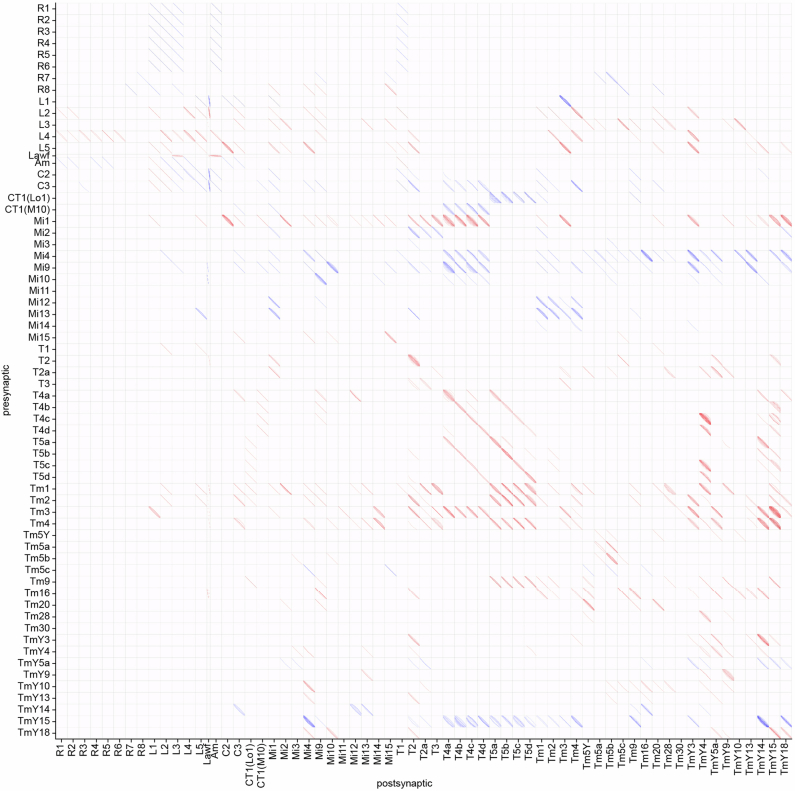
- The model includes 45,669 neurons, 1,513,231 connections, 64 cell types, and only 734 free parameters because cell-type parameters and synapse-count-based constraints are shared across the tiled hexagonal lattice.
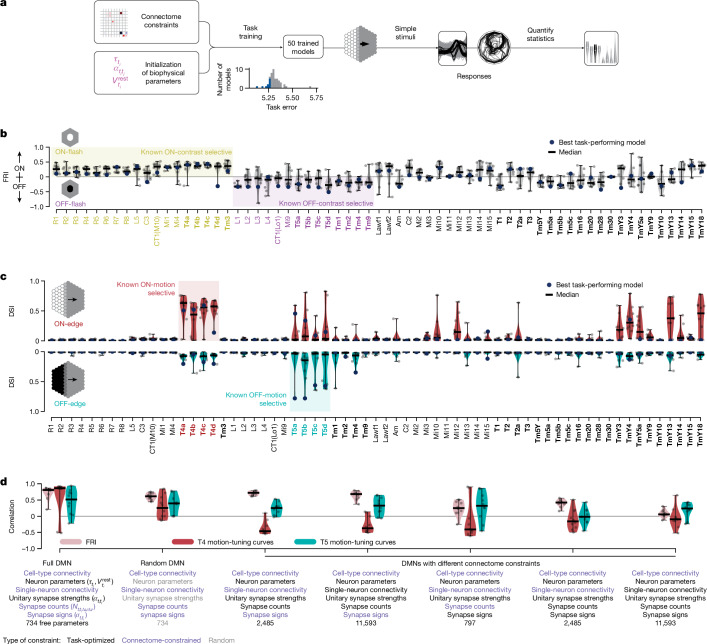
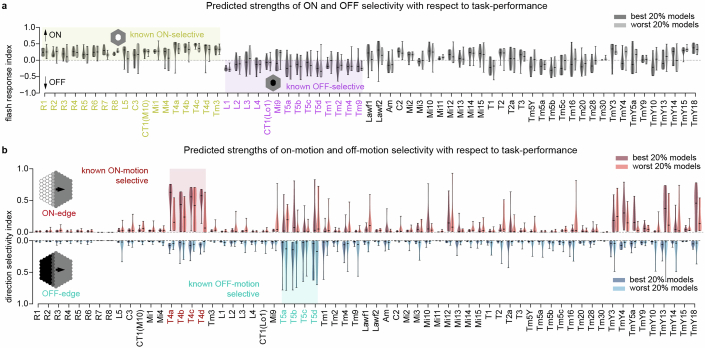
- In validation against prior physiology, the ensemble predicted the correct ON/OFF contrast selectivity for all 32 cell types with experimentally established contrast preferences; the best single model got 30 of 32 correct.
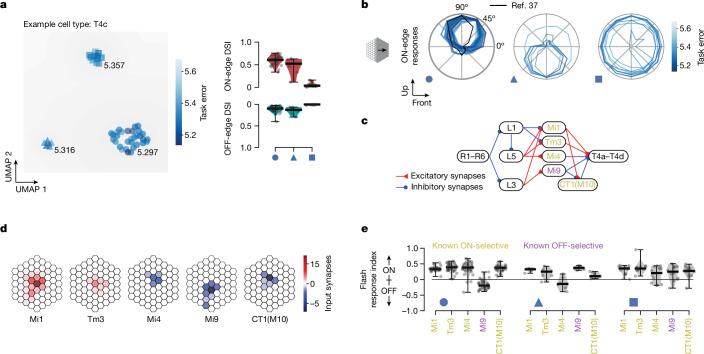
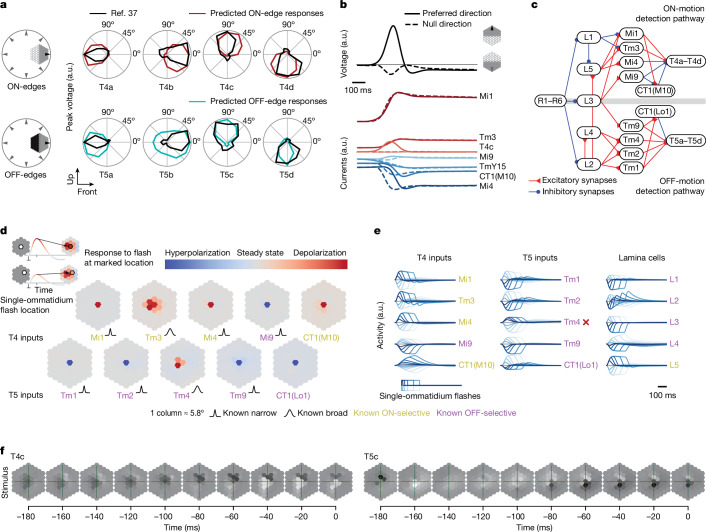
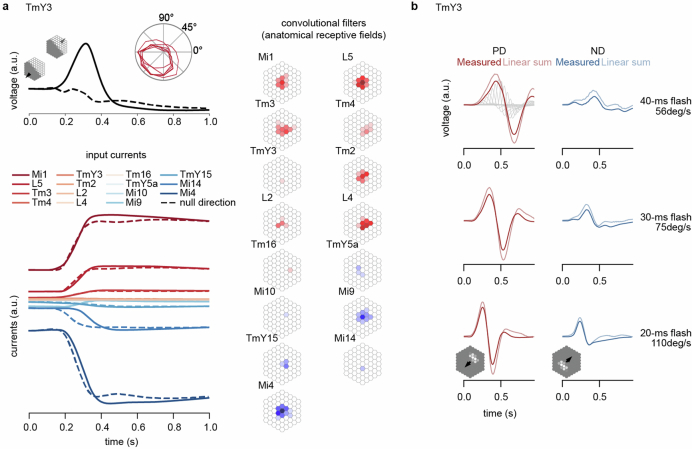
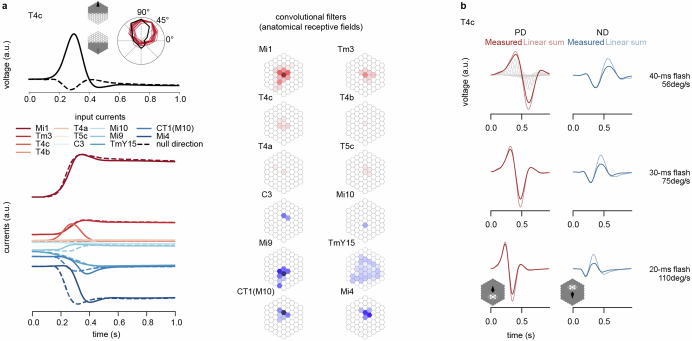
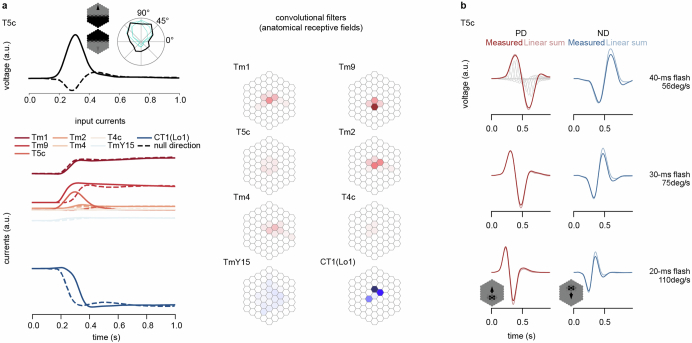
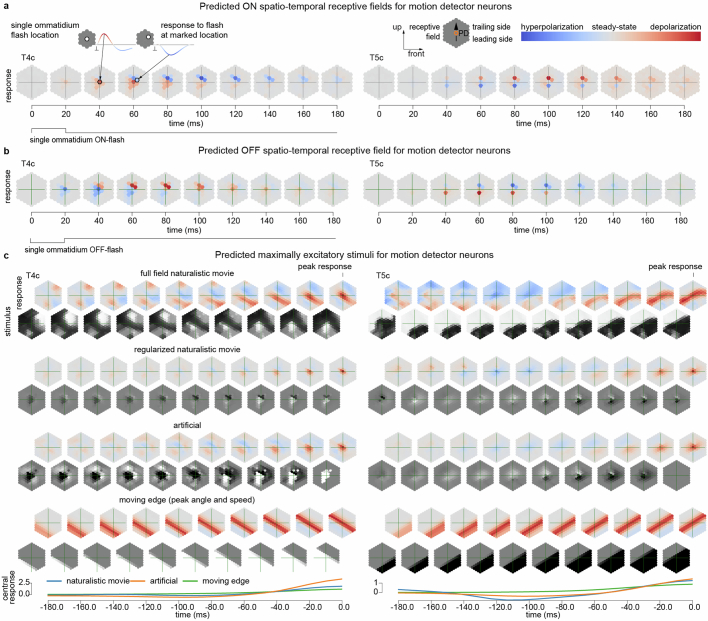
- For motion tuning, the ensemble correctly predicted that T4 neurons are ON-motion selective and T5 neurons are OFF-motion selective, and also predicted the lack of motion tuning in the listed input neurons to T4/T5.
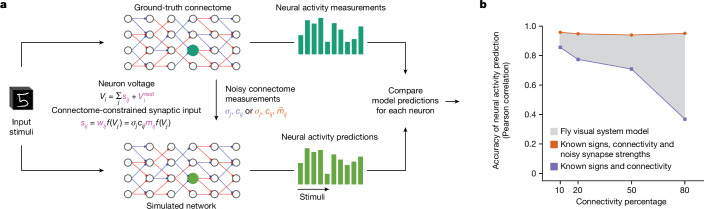
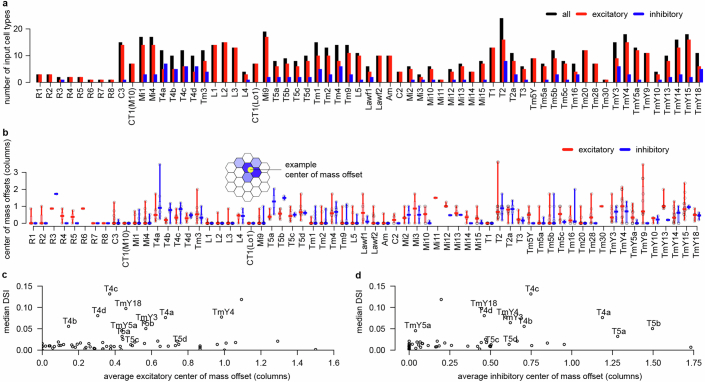
- In synthetic-connectome experiments, sparse networks improved prediction from connectivity alone: median Pearson correlation was 0.85 for 10% connectivity versus 0.38 for 80% connectivity; with connection-strength estimates, correlations were >0.9 across connectivities.
## Methods
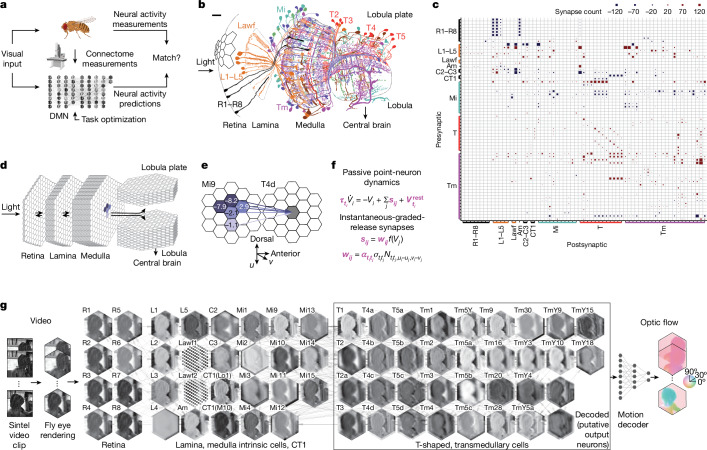
- Built a connectome-constrained, task-optimized deep mechanistic network (DMN) for the fly visual system using local reconstructions from FlyEM/FIB datasets, tiled into a spatially invariant hexagonal lattice.
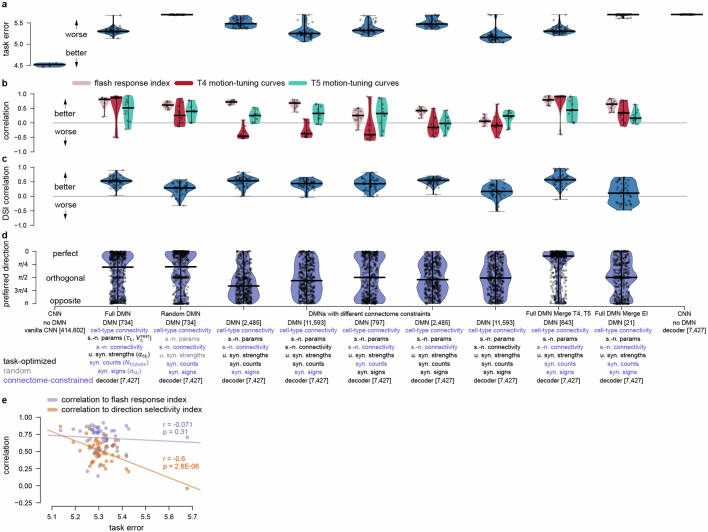
- Trained the model end-to-end on optic-flow prediction from 23 Sintel video sequences (with augmentations), using a recurrent DMN plus a feedforward decoder and backpropagation through time.
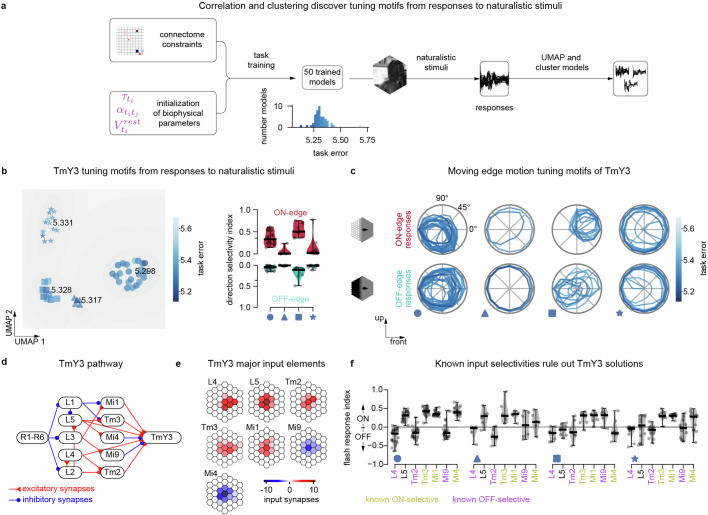
- Evaluated model predictions by simulating responses to flash stimuli, moving edges, and naturalistic video, then comparing predicted tuning to reported experimental data from 26 studies.
## Limitations
- The paper explicitly notes that the model is reductionist and cannot account for electrical synapses, nonlinear chemical synapses, neuromodulation, or glia.
- The connectome was approximated as perfectly periodic / translation invariant across the visual field; this is a modeling simplification stated in the paper.
- The text makes evident that the model is limited to the motion pathways and the optic-flow task only, so its scope does not cover all computations of the fly visual system.
Model-written summary. Check it against the paper before relying on it.
Integrity signals
Registry
Cites
Statistics
Figures
Verification
Claims the paper makes
16 Valid · 1 Not valid · 5 Not checked · 67 Own results and interpretations
Every source the paper cites for this claim was checked and supports it.
In the paper
“We found that our connectome-constrained and task-optimized DMN accurately predicts the separation of the visual system into light-increment (ON) and light-decrement (OFF) channels, as well as the generation of direction selectivity in the well-known T4 and T5 motion detector neurons24.”
§ Connectome-constrained networks predict neural activity across the fly visual system > Main Electrical signals propagating through networks of neurons form the basis of computations such as visual motion detection. The propagation of neural activity is shaped by both the functional properties of individual neurons and their synaptic connectivity. Additional factors10,13, including electrical synapses, neuromodulation and glia, are known to further influence neural activity on multiple timescales. Volume electron microscopy can now be used to comprehensively measure the connectivity of each neuron in a neural circuit, and even entire nervous systems1–9. However, we do not yet have the means to also comprehensively measure all other biological details, including the dynamical properties of every neuron and synapse in the same circuit13. For these reasons, there has been considerable debate about the utility of connectome measurements for understanding brain function14. It is unclear whether it is possible to use only measurements of connectivity to generate accurate predictions about how the neural circuit functions, especially in the absence of direct measurements of neural activity from a living brain. There is considerable evidence from computer science and neuroscience that there is not necessarily a strong link between the connectivity of a neural network and its computational function. Universal function approximation theorems for artificial neural networks15 imply that the same computational task can be performed by many different networks with very different neural connectivity. Empirically, there exist many classes of general-purpose artificial neural network architectures that can be trained to perform the same computational task11. Such differences in connectivity can correspond to qualitatively different computational mechanisms16. Similarly, in neuroscience there have been competing proposals for the same computation (for instance, the computation of visual motion)17,18. Furthermore, even circuits with the same connectivity can function differently19. Thus, neither the connectivity of a circuit alone, nor its computational task alone, can uniquely determine the mechanism of circuit function20. Here we show that the connectivity of a neural circuit, together with knowledge of its computational task, enables accurate predictions of the role played by individual neurons in the circuit in the computational task. We constructed a differentiable21 model neural network with a close correspondence to the brain, whose connectivity was given by connectome measurements and with unknown single-neuron and single-synapse parameters. We optimized the unknown parameters of the model using techniques from deep learning11, to enable the model to accomplish the computational task22. We call such models connectome-constrained and task-optimized deep mechanistic networks (DMNs) (Fig. 1a). We applied this approach to model the motion pathways in the optic lobe of the Drosophila visual system. We constructed a DMN with experimentally measured connectivity1–5, and unknown parameters for the single-neuron dynamics and the strength of a unitary synapse. We optimized the model parameters on the computer vision task of detecting motion in dynamic visual stimuli12. Visual motion computation in the fly and its mechanistic underpinnings have been extensively studied23. Thus, we were able to compare the detailed predictions of our model with experimental measurements of neural activity in response to visual stimuli, on a neuron-by-neuron basis. We found that our connectome-constrained and task-optimized DMN accurately predicts the separation of the visual system into light-increment (ON) and light-decrement (OFF) channels, as well as the generation of direction selectivity in the well-known T4 and T5 motion detector neurons24. We release our model as a resource for the community (https://github.com/TuragaLab/flyvis).
What the sources say
- Supportedcites [24] Currier, T. A., Pang, M. M. & Clandinin, T. R. Visual processing in the fly, from photoreceptors to behavior. Genetics 224, iyad064 (2023). 37128740 PMC10213501 source
In the section ‘The lobula complex performs directional motion computations’ (page unavailable), the review identifies T4 and T5 as motion detectors and says direction selectivity first emerges in their dendrites. This supports the biological point for which the citation is used; the DMN’s predictive accuracy is the citing authors’ own finding, not a result attributed to this review. (LLM, conf=0.90)
boostedstates a cause- Asserted: passes — The authors put it forward as true.
- Checkable: passes — It can be checked against evidence.
- Load-bearing: passes — The paper’s conclusions depend on it.
- Based: passes — The paper gives a reason why it holds.
- Rests on 4 assumptions not shown here.
- Supported
Every source the paper cites for this claim was checked and supports it.
In the paper
“We found that our connectome-constrained and task-optimized DMN accurately predicts the separation of the visual system into light-increment (ON) and light-decrement (OFF) channels, as well as the generation of direction selectivity in the well-known T4 and T5 motion detector neurons24.”
§ Connectome-constrained networks predict neural activity across the fly visual system > Main Electrical signals propagating through networks of neurons form the basis of computations such as visual motion detection. The propagation of neural activity is shaped by both the functional properties of individual neurons and their synaptic connectivity. Additional factors10,13, including electrical synapses, neuromodulation and glia, are known to further influence neural activity on multiple timescales. Volume electron microscopy can now be used to comprehensively measure the connectivity of each neuron in a neural circuit, and even entire nervous systems1–9. However, we do not yet have the means to also comprehensively measure all other biological details, including the dynamical properties of every neuron and synapse in the same circuit13. For these reasons, there has been considerable debate about the utility of connectome measurements for understanding brain function14. It is unclear whether it is possible to use only measurements of connectivity to generate accurate predictions about how the neural circuit functions, especially in the absence of direct measurements of neural activity from a living brain. There is considerable evidence from computer science and neuroscience that there is not necessarily a strong link between the connectivity of a neural network and its computational function. Universal function approximation theorems for artificial neural networks15 imply that the same computational task can be performed by many different networks with very different neural connectivity. Empirically, there exist many classes of general-purpose artificial neural network architectures that can be trained to perform the same computational task11. Such differences in connectivity can correspond to qualitatively different computational mechanisms16. Similarly, in neuroscience there have been competing proposals for the same computation (for instance, the computation of visual motion)17,18. Furthermore, even circuits with the same connectivity can function differently19. Thus, neither the connectivity of a circuit alone, nor its computational task alone, can uniquely determine the mechanism of circuit function20. Here we show that the connectivity of a neural circuit, together with knowledge of its computational task, enables accurate predictions of the role played by individual neurons in the circuit in the computational task. We constructed a differentiable21 model neural network with a close correspondence to the brain, whose connectivity was given by connectome measurements and with unknown single-neuron and single-synapse parameters. We optimized the unknown parameters of the model using techniques from deep learning11, to enable the model to accomplish the computational task22. We call such models connectome-constrained and task-optimized deep mechanistic networks (DMNs) (Fig. 1a). We applied this approach to model the motion pathways in the optic lobe of the Drosophila visual system. We constructed a DMN with experimentally measured connectivity1–5, and unknown parameters for the single-neuron dynamics and the strength of a unitary synapse. We optimized the model parameters on the computer vision task of detecting motion in dynamic visual stimuli12. Visual motion computation in the fly and its mechanistic underpinnings have been extensively studied23. Thus, we were able to compare the detailed predictions of our model with experimental measurements of neural activity in response to visual stimuli, on a neuron-by-neuron basis. We found that our connectome-constrained and task-optimized DMN accurately predicts the separation of the visual system into light-increment (ON) and light-decrement (OFF) channels, as well as the generation of direction selectivity in the well-known T4 and T5 motion detector neurons24. We release our model as a resource for the community (https://github.com/TuragaLab/flyvis).
What the sources say
- Supportedcites [24] Currier, T. A., Pang, M. M. & Clandinin, T. R. Visual processing in the fly, from photoreceptors to behavior. Genetics 224, iyad064 (2023). 37128740 PMC10213501 source
The Optic lobes section (Fig. 5 caption; page unavailable) describes distinct ON and OFF motion pathways leading to T4 and T5. The cited paper supports the visual-system organization used as a comparison; the DMN’s predictive accuracy is presented as the citing authors’ own finding, not a finding attributed to this source. (LLM, conf=0.90)
boostedstates a cause- Asserted: passes — The authors put it forward as true.
- Checkable: passes — It can be checked against evidence.
- Load-bearing: passes — The paper’s conclusions depend on it.
- Based: passes — The paper gives a reason why it holds.
- Rests on 4 assumptions not shown here.
- Supported
The sources with a verdict support this claim; the rest weren’t checked yet, have no full text we could read, or their verdicts aren’t rated yet.
In the paper
“Our reductionist model cannot, for example, account for the role played in this circuit by electrical synapses46, nonlinear chemical synapses47 and neuromodulation48.”
§ Connectome-constrained networks predict neural activity across the fly visual system > Discussion
What the sources say
- Not checked — no full text of the sourcecites [46] Ammer, G., Leonhardt, A., Bahl, A., Dickson, B. J. & Borst, A. Functional specialization of neural input elements to the Drosophila ON motion detector. Curr. Biol. 25, 2247–2253 (2015). 26234212 source
- Supportedcites [47] Groschner, L. N., Malis, J. G., Zuidinga, B. & Borst, A. A biophysical account of multiplication by a single neuron. Nature 603, 119–123 (2022). 35197635 PMC8891015 source
Citation 47 is attached to “nonlinear chemical synapses,” not to the citing authors’ statement about their model’s limitations. The source paper’s Main section describes a supralinear interaction between excitatory and inhibitory synaptic signals in the fruit-fly motion circuit; the Discussion calls it “multiplicative disinhibition.” Page numbers were not provided. (LLM, conf=0.90)
- Supportedcites [48] Strother, J. A. et al. Behavioral state modulates the ON visual motion pathway of Drosophila. Proc. Natl Acad. Sci. USA 115, E102–E111 (2018). 29255026 PMC5776785 source
Citation 48 is attached to neuromodulation, not to the other synapse types or the citing authors’ assessment of their model. The Discussion describes behavioral-state modulation in the ON motion pathway, and the Results report evidence that octopamine neurons mediate it, with especially substantial effects on Mi4 neurons. Page numbers are not provided in our copy. (LLM, conf=0.92)
plain- Asserted: passes — The authors put it forward as true.
- Checkable: passes — It can be checked against evidence.
- Load-bearing: unclear — It is unclear whether the paper’s conclusions depend on it.
- Based: passes — The paper gives a reason why it holds.
The sources with a verdict support this claim; the rest weren’t checked yet, have no full text we could read, or their verdicts aren’t rated yet.
In the paper
“We built a computational model of the fly visual system that is consistent with available connectome data1–5, has biophysically plausible neural dynamics, and can be computationally trained to solve an ethologically relevant behavioural task, namely the estimation of optic flow.”
§ Connectome-constrained networks predict neural activity across the fly visual system > Methods > Construction of spatially invariant connectome from local reconstructions
What the sources say
- Not checked — no full text of the sourcecites [1] Rivera-Alba, M. et al. Wiring economy and volume exclusion determine neuronal placement in the Drosophila brain. Curr. Biol. 21, 2000–2005 (2011). 22119527 PMC3244492 source
- Supportedcites [2] Takemura, S. et al. Synaptic circuits and their variations within different columns in the visual system of Drosophila. Proc. Natl Acad. Sci. USA 112, 13711–13716 (2015). 26483464 PMC4640747 source
The citation identifies a source of available connectome data, rather than attributing the citing authors’ model to this paper. The Results describe an EM reconstruction of seven fly medulla columns and a dataset of connections among 20 cell types, supporting its use as connectome data. (LLM, conf=0.87)
- Supportedcites [3] Takemura, S. et al. The comprehensive connectome of a neural substrate for ‘ON’ motion detection in Drosophila. eLife6, e24394 (2017). PMC5435463 28432786 source
The citation is attached to “available connectome data,” not to the citing authors’ assessment of their model. The source’s Materials and methods (Connectome reconstruction; page unavailable) describes reconstructed neurons, mapped synapses, and connectivity matrices, confirming that it supplies such data. It does not itself evaluate the citing authors’ model. (LLM, conf=0.88)
- Supportedcites [4] Shinomiya, K. et al. Comparisons between the ON- and OFF-edge motion pathways in the Drosophila brain. eLife 8, e40025 (2019). 30624205 PMC6338461 source
The citation identifies a source of fly visual-system connectome data. The Abstract reports a connectome with detailed connectivity information for inputs to both the T4 and T5 motion pathways in an optic-lobe EM dataset; the Introduction likewise describes its analysis of those pathways. This supports citing the paper as available connectome data used to constrain the model. (LLM, conf=0.90)
- Not checked — no full text of the sourcecites [5] Shinomiya, K., Nern, A., Meinertzhagen, I. A., Plaza, S. M. & Reiser, M. B. Neuronal circuits integrating visual motion information in Drosophila melanogaster. Curr. Biol. 32, 3529–3544 (2022). 35839763 source
plainstates an association- Asserted: passes — The authors put it forward as true.
- Checkable: passes — It can be checked against evidence.
- Load-bearing: passes — The paper’s conclusions depend on it.
- Based: passes — The paper gives a reason why it holds.
The cited sources support only part of this claim — read each source’s verdict below.
In the paper
“By contrast, every neuron and synapse in our connectome-constrained model49–53 has a direct correspondence to neurons and synapses in the brain.”
§ Connectome-constrained networks predict neural activity across the fly visual system > Discussion
What the sources say
- Partly supportedcites [49] Tschopp, F. D., Reiser, M. B. & Turaga, S. C. A connectome based hexagonal lattice convolutional network model of the Drosophila visual system. Preprint at https://arxiv.org/abs/1806.04793 (2018). sourceExperimental — accuracy not yet measured
The source does ground its model's neurons and edges in real connectome data: Section 2 (p. 2) states the model is built 'Based on publications of lamina [12-14] and medulla [9-11] connectomes... 43 neuron types', and Section 2.1 (p. 3) that 'we replaced all synapses counted between two connected distinct neurons in the connectome by a single synapse', weighted by the synapse count. But the absolute 'every neuron and synapse has a direct correspondence' overstates it: the locally described connectome is spatially repeated across the lattice (p. 2), morphology is deliberately ignored (p. 2), biases carry no connectome information and delays/decoder layers are assumed (Sections 2.1, 2.2, p. 3), weights are subsequently fine-tuned by backpropagation, and the Discussion (p. 11) concedes 'incomplete filters due to missing connectomic information', an assumed T5 configuration, and tangential neurons (Mt8, Mi11, Tm28) not included at all. (LLM, conf=0.72)
- Partly supportedcites [50] Mano, O., Creamer, M. S., Badwan, B. A. & Clark, D. A. Predicting individual neuron responses with anatomically constrained task optimization. Curr. Biol. 31, 4062–4075 (2021). 34324832 PMC8741219 sourceExperimental — accuracy not yet measured
The Introduction says connectomic constraints create an a priori correspondence between specific model nodes and individual biological neurons. But the Discussion’s “Circuit features neglected in these models” describes simplified inputs and omitted lateral and feedback connections; the paper does not establish a direct correspondence for every model synapse. (LLM, conf=0.86)
- Not matchedcites [51] Mi, L. et al. Connectome-constrained latent variable model of whole-brain neural activity. In Proc. International Conference on Learning Representations https://openreview.net/forum?id=CJzi3dRlJE- (2022).
Its entry has no title and year that we can search by.
- Supportedcites [52] Shiu, P. K. et al. A leaky integrate-and-fire computational model based on the connectome of the entire adult Drosophila brain reveals insights into sensorimotor processing. Preprint at bioRxiv10.1101/2023.05.02.539144 (2023). source
The Methods (Computational Model; page unavailable) state that all 127,400 proofread Flywire neurons are included and that connection weights come from Flywire synaptic connectivity. This supports direct correspondence between the model’s neurons and connections and the reconstructed brain connectome; it does not imply that the model reproduces every physiological property of those neurons or synapses. (LLM, conf=0.88)
- Partly supportedcites [53] Beiran, M. & Litwin-Kumar, A. Prediction of neural activity in connectome-constrained recurrent networks. Preprint at bioRxiv10.1101/2024.02.22.581667 (2024). PMC12648571 41145885 sourceExperimental — accuracy not yet measured
The Introduction says connectome-constrained models use structural connectivity, and the Discussion’s ‘Assessment of connectome-constrained solutions’ says they address the contribution of each specific neuron. But this paper studies simulated networks (Discussion, ‘Challenges for connectome-constrained neural networks’); it does not establish that every neuron and synapse in the citing authors’ model directly corresponds to one in a brain. Page numbers are unavailable in our copy. (LLM, conf=0.84)
plainstates an association- Asserted: passes — The authors put it forward as true.
- Checkable: passes — It can be checked against evidence.
- Load-bearing: passes — The paper’s conclusions depend on it.
- Based: passes — The paper gives a reason why it holds.
- Partly supported
46 more claims
Create a free account to see all 89 claims and to verify the 2 references still open.
- It may state two separate claims as one. 26
- Probably not a substantial claim. 18
Claims other papers make about this one
Each is checked against this paper’s own text: does it say what the citing paper says it does?
The source backs part of the claim, not all of it — or backs it for a different population, condition or comparison.
In the citing paper
“In previous studies, an absence of information across columns has necessitated treating each column as identical in simulations of the optic lobe85.”
From Neuronal wiring diagram of an adult brain (2024) · cites this paper as [85]
Experimental — accuracy not yet measuredThe source backs part of the claim, not all of it — or backs it for a different population, condition or comparison.
In the citing paper
“The Drosophila melanogaster central brain connectome, comprising more than 125,000 neurons and 50 million synaptic connections, allows brainwide analyses of how the fly processes sensory information1,2,11–16.”
From A Drosophila computational brain model reveals sensorimotor processing (2024) · cites this paper as [15]
Experimental — accuracy not yet measuredThe cited source says what the claim attributes to it.
In the citing paper
“Finally, the connectome now enables brain simulations—partial connectomes of the early visual system of the fly3 had already inspired simulations of visual processing85.”
From Neuronal wiring diagram of an adult brain (2024) · cites this paper as [85]
The check wasn’t confident either way, so it gives no verdict — never disputed.
In the citing paper
“Using this small number of neurons, flies can nevertheless generate complex behaviors including walking over complex terrain 30 , rapid corrective maneuvers during flight 31 , courtship sequences 32 , aggression towards competitors 33 , and learning 34 .”
From NeuroMechFly v2: simulating embodied sensorimotor control in adult Drosophila (2024) · cites this paper as [31]
Experimental — accuracy not yet measured
Self-check
Percentages, sums and reported differences re-computed from the paper’s own numbers.
Each contradiction between two passages listed here was confirmed by an independent check.
Rated minor: it would not touch a result — a value no result rests on, a p-value that stays on the same side of the significance level, or a conflict that is clerical, resolved elsewhere in the paper, or outside its own findings.
In the paper
§ Connectome-constrained networks predict neural activity across the fly visual system > DMN ensemble predicts known activity
“This is also the case for the model with the best task performance (task-optimal model), which correctly predicts the preferred contrast of 30 of 32 cells (Fig. 2b).”
§ Connectome-constrained networks predict neural activity across the fly visual system > DMN ensemble predicts known activity
“the median flash response index (FRI) across the ensemble predicts the correct ON- and OFF-preferred contrast selectivity for all 32 cell types for which contrast selectivity has been experimentally established”
Citations
Cites
Scikit-learn: Machine Learning in Python
Pedregosa, F., Varoquaux, G., Gramfort, A., Michel, V., Thirion, B., Grisel, O., Blondel, M., Müller, A., Nothman, J., Louppe, G., et al. (2012) · arXiv · doi:10.48550/arxiv.1201.0490 · Cited by 71,016
Learning representations by back-propagating errors
Rumelhart, D. E., Hinton, G. E., & Williams, R. J. (1986) · Nature · doi:10.1038/323533a0 · Cited by 31,892 · cited 1×
“…differentiable 61 DMN model of the fly visual system can be interpreted as a continuous-time neural ordinary differential equation 62 with a deep convolutional recurrent neural network 63 architecture that is trained to perform a computer vision task using backpropagation through time 64,65 .”
PyTorch: An Imperative Style, High-Performance Deep Learning Library
Paszke, A., Gross, S., Massa, F., Lerer, A., Bradbury, J., Chanan, G., Killeen, T., Lin, Z., Gimelshein, N., Antiga, L., et al. (2019) · arXiv · doi:10.48550/arxiv.1912.01703 · Cited by 31,473 · cited 5×
“The decoder uses PyTorch-native implementations for 2D convolutions, batch normalization, softplus activation and dropout.”
MethodInfluentialMultilayer feedforward networks are universal approximators
Hornik, K., Stinchcombe, M., & White, H. (1989) · Neural Networks · doi:10.1016/0893-6080(89)90020-8 · Cited by 21,728
Backpropagation Applied to Handwritten Zip Code Recognition
LeCun, Y., Boser, B., Denker, J. S., Henderson, D., Howard, R. E., Hubbard, W., & Jackel, L. D. (1989) · Neural Computation · doi:10.1162/neco.1989.1.4.541 · Cited by 11,891
Convolutional LSTM Network: A Machine Learning Approach for Precipitation Nowcasting
Shi, X., Chen, Z., Wang, H., Yeung, D.-Y., Wong, W.-K., & Woo, W.-C. (2015) · arXiv · doi:10.48550/arxiv.1506.04214 · Cited by 7,709 · cited 1×
“…differentiable 61 DMN model of the fly visual system can be interpreted as a continuous-time neural ordinary differential equation 62 with a deep convolutional recurrent neural network 63 architecture that is trained to perform a computer vision task using backpropagation through time 64,65 .”
Dimensionality reduction for visualizing single-cell data using UMAP
Becht, E., McInnes, L., Healy, J., Dutertre, C.-A., Kwok, I. W. H., Ng, L. G., Ginhoux, F., & Newell, E. W. (2019) · Nature Biotechnology · doi:10.1038/nbt.4314 · Cited by 5,358 · cited 1×
“…reduction to two dimensions using the UMAP (uniform manifold approximation and projection) algorithm, and fitted Gaussian mixtures of 2 to 5 components, with the number of components that minimize the Bayesian information criterion, using the Python libraries umap-learn and scikit-learn 38,74 .”
MethodBackpropagation through time: what it does and how to do it
Werbos, P. J. (1990) · Proceedings of the IEEE · doi:10.1109/5.58337 · Cited by 4,879 · cited 1×
“…differentiable 61 DMN model of the fly visual system can be interpreted as a continuous-time neural ordinary differential equation 62 with a deep convolutional recurrent neural network 63 architecture that is trained to perform a computer vision task using backpropagation through time 64,65 .”
Flownet: Learning optical flow with convolutional networks
Dosovitskiy, A., Fischer, P., Ilg, E., Hausser, P., Hazirbas, C., Golkov, V., Smagt, P. V. D., Cremers, D., & Brox, T. (2015) · 2015 IEEE International Conference on Computer Vision (ICCV) · doi:10.1109/iccv.2015.316 · Cited by 4,313 · cited 2×
“To rank models on the basis of their task performance, we computed the standard optic flow metric of average end-to-end point error (EPE) 72 , which calculates the average over all time steps and pixels (that is, here columns) of the error between predicted optic flow and ground-truth optic flow and averaged across th…”
MethodHierarchical models of object recognition in cortex
Riesenhuber, M., & Poggio, T. (1999) · Nature Neuroscience · doi:10.1038/14819 · Cited by 3,309
Research works printed but not linked: 6
- Goodfellow, I., Bengio, Y. & Courville, A. Deep Learning (MIT Press, 2016).
- Reichardt, W. in Sensory Communication (ed. Rosenblith, W. A.) Ch. 17 (MIT Press, 1961).
- Mi, L. et al. Connectome-constrained latent variable model of whole-brain neural activity. In Proc. International Conference on Learning Representations https://openreview.net/forum?id=CJzi3dRlJE- (2022).
- Chen, R. T. Q., Rubanova, Y., Bettencourt, J. & Duvenaud, D. K. Neural ordinary differential equations. In Proc. Advances in Neural Information Processing Systems Vol. 31 (eds Bengio, S. et al.) 6571–6583 (Curran Associates, 2018).
- Krizhevsky, A., Sutskever, I. & Hinton, G. E. ImageNet classification with deep convolutional neural networks. In Proc. Advances in Neural Information Processing Systems (eds Pereira, F. et al.) 1097–1105 (Curran Associates, 2012).
- Frankle, J. & Carbin, M. The lottery ticket hypothesis: finding sparse, trainable neural networks. In Proc. International Conference on Learning Representations https://openreview.net/forum?id=rJl-b3RcF7 (2018).
Cited by
Neuronal wiring diagram of an adult brain
Dorkenwald, S., Matsliah, A., Sterling, A. R., Schlegel, P., Yu, S.-C., McKellar, C. E., Lin, A., Costa, M., Eichler, K., Yin, Y., et al. (2024) · Nature · doi:10.1038/s41586-024-07558-y · Cited by 570
“Finally, the connectome now enables brain simulations—partial con-nectomes of the early visual system of the fly 3 had already inspired simulations of visual processing 85 .”
BackgroundMethodWhole-brain annotation and multi-connectome cell typing of Drosophila
Schlegel, P., Yin, Y., Bates, A. S., Dorkenwald, S., Eichler, K., Brooks, P., Han, D. S., Gkantia, M., dos Santos, M., Munnelly, E. J., et al. (2024) · Nature · doi:10.1038/s41586-024-07686-5 · Cited by 413
A Drosophila computational brain model reveals sensorimotor processing
Shiu, P. K., Sterne, G. R., Spiller, N., Franconville, R., Sandoval, A., Zhou, J., Simha, N., Kang, C. H., Yu, S., Kim, J. S., et al. (2024) · Nature · doi:10.1038/s41586-024-07763-9 · Cited by 97
“15), and need a clearly defined behavioural task.”
BackgroundNeuronal parts list and wiring diagram for a visual system
Matsliah, A., Yu, S.-C., Kruk, K., Bland, D., Burke, A. T., Gager, J., Hebditch, J., Silverman, B., Willie, K. P., Willie, R., et al. (2024) · Nature · doi:10.1038/s41586-024-07981-1 · Cited by 85
“The columns of the optic lobe form a hexagonal lattice, rather than the square lattice used in computer vision, but it is a highly regular lattice nonetheless, and the activities of the neurons in each cell type are analogous to a feature map in a convolutional net 67 .”
MethodDecoding the brain: From neural representations to mechanistic models
Mathis, M. W., Rotondo, A. P., Chang, E. F., Tolias, A. S., & Mathis, A. (2024) · Cell · doi:10.1016/j.cell.2024.08.051 · Cited by 132
Connectome-driven neural inventory of a complete visual system
Nern, A., Loesche, F., Takemura, S.-Y., Burnett, L. E., Dreher, M., Gruntman, E., Hoeller, J., Huang, G. B., Januszewski, M., Klapoetke, N. C., et al. (2025) · Nature · doi:10.1038/s41586-025-08746-0 · Cited by 93
Mapping model units to visual neurons reveals population code for social behaviour
Cowley, B. R., Calhoun, A. J., Rangarajan, N., Ireland, E., Turner, M. H., Pillow, J. W., & Murthy, M. (2024) · Nature · doi:10.1038/s41586-024-07451-8 · Cited by 55
Comparative connectomics of Drosophila descending and ascending neurons
Stürner, T., Brooks, P., Serratosa Capdevila, L., Morris, B. J., Javier, A., Fang, S., Gkantia, M., Cachero, S., Beckett, I. R., Marin, E. C., et al. (2025) · Nature · doi:10.1038/s41586-025-08925-z · Cited by 43
The fly connectome reveals a path to the effectome
Pospisil, D. A., Aragon, M. J., Dorkenwald, S., Matsliah, A., Sterling, A. R., Schlegel, P., Yu, S.-C., McKellar, C. E., Costa, M., Eichler, K., et al. (2024) · Nature · doi:10.1038/s41586-024-07982-0 · Cited by 36
Predicting modular functions and neural coding of behavior from a synaptic wiring diagram
Vishwanathan, A., Sood, A., Wu, J., Ramirez, A. D., Yang, R., Kemnitz, N., Ih, D., Turner, N., Lee, K., Tartavull, I., et al. (2024) · Nature Neuroscience · doi:10.1038/s41593-024-01784-3 · Cited by 36
Whole-body physics simulation of fruit fly locomotion
Vaxenburg, R., Siwanowicz, I., Merel, J., Robie, A. A., Morrow, C. M., Novati, G., Stefanidi, Z., Both, G., Card, G. M., Reiser, M. B., et al. (2025) · Nature · doi:10.1038/s41586-025-09029-4 · Cited by 111
“…term, combining our whole-body model with a complete nervous system connectome, comprehensive behavioural measurements and connectome-constrained deep neural network modelling 59,62 could enable the development of whole-animal models of the entire body and nervous system of the adult fruit fly.”
Predicting visual function by interpreting a neuronal wiring diagram
Seung, H. S. (2024) · Nature · doi:10.1038/s41586-024-07953-5 · Cited by 50
“Synapse counts are only crude estimates of physiological connection strength 14 , and unitary conductance can differ markedly between inhibitory and excitatory synapses 45 .”
NeuroMechFly v2: simulating embodied sensorimotor control in adult Drosophila
Wang-Chen, S., Stimpfling, V. A., Lam, T. K. C., Özdil, P. G., Genoud, L., Hurtak, F., & Ramdya, P. (2024) · Nature Methods · doi:10.1038/s41592-024-02497-y · Cited by 43
“We used the best-performing model reported in the visual system modeling study 31 rather than the whole ensemble of models.”
InfluentialWhole-body simulation of realistic fruit fly locomotion with deep reinforcement learningPreprint
Vaxenburg, R., Siwanowicz, I., Merel, J., Robie, A. A., Morrow, C. M., Novati, G., Stefanidi, Z., Both, G., Card, G. M., Reiser, M. B., et al. (2024) · bioRxiv (Cold Spring Harbor Laboratory) · doi:10.1101/2024.03.11.584515 · Cited by 23
Neuronal “parts list” and wiring diagram for a visual system
Matsliah, A., Yu, S.-C., Kruk, K., Bland, D., Burke, A., Gager, J., Hebditch, J., Silverman, B., Willie, K., Willie, R., et al. (2023) · bioRxiv (Cold Spring Harbor Laboratory) · doi:10.1101/2023.10.12.562119 · Cited by 21
NeuroMechFly v2, simulating embodied sensorimotor control in adult DrosophilaPreprint
Wang-Chen, S., Stimpfling, V. A., Lam, T. K. C., et al. (2024) · bioRxiv · doi:10.1101/2023.09.18.556649 · Cited by 27
“A “following” fly model controlled by a connectome-constrained visual system neural network [31], ascending motor feedback-based gaze stabilization, descending steering, and a hybrid locomotor controller with leg adhesion is tasked to follow a “leading” fly model across blocks terrain.”
BackgroundMethodInfluentialPrediction of neural activity in connectome-constrained recurrent networks
Beiran, M., & Litwin-Kumar, A. (2024) · doi:10.1101/2024.02.22.581667 · Cited by 16
Transforming memristor noises into computational innovations
Ding, C., Ren, Y., Liu, Z., & Wong, N. (2025) · Communications Materials · doi:10.1038/s43246-025-00876-2 · Cited by 31
“RC,evolvedfromrecurrentneuralnetworks(RNNs) 66 – 69 ,addressestraining dif fi culties related to vanishing and exploding gradients in RNNs 70 .”
Prediction of neural activity in connectome-constrained recurrent networks
Beirán, M., & Litwin-Kumar, A. (2025) · Nature Neuroscience · doi:10.1038/s41593-025-02080-4 · Cited by 39
“Recent studies have demonstrated above-chance prediction of function using uniform or random parameters in models of the Drosophila nervous system 14,19 .”
InfluentialMechanosensory Control of Locomotion in Animals and Robots: Moving Forward
Dallmann, C. J., Dickerson, B. H., Simpson, J. H., Wyart, C., & Jayaram, K. (2023) · Integrative and Comparative Biology · doi:10.1093/icb/icad057 · Cited by 15
Shiu, P. K., Sterne, G. R., Spiller, N., Franconville, R., Sandoval, A., Zhou, J., Simha, N., Kang, C. H., Yu, S., Kim, J. S., et al. (2023) · doi:10.1101/2023.05.02.539144 · Cited by 98
Synaptic-resolution connectomics: towards large brains and connectomic screening
Helmstaedter, M. N. (2025) · Nature reviews. Neuroscience · doi:10.1038/s41583-025-00998-z · Cited by 31
“The potential for constraining synaptic learning models from such large-scale connectomic snapshots may allow systematic approaches to determine where and under which sensory conditions individual imprinting of experience is directly shaping neuronal cortical circuits.”
2D Materials for Emerging Neuromorphic Vision: From Devices to In‐Sensor Computing
Xie, P., Li, D., Wang, W., & Ho, J. C. Y. (2025) · Small · doi:10.1002/smll.202503717 · Cited by 22
Infrequent strong connections constrain connectomic predictions of neuronal function
Currier, T. A., & Clandinin, T. R. (2025) · Cell · doi:10.1016/j.cell.2025.05.007 · Cited by 20
BIFROST: A method for registering diverse imaging datasets of the Drosophila brain
Brezovec, B. E., Berger, A. B., Hao, Y. A., Lin, A., Ahmed, O. M., Pacheco, D. A., Thiberge, S. Y., Murthy, M., & Clandinin, T. R. (2024) · Proceedings of the National Academy of Sciences · doi:10.1073/pnas.2322687121 · Cited by 17
Deistler, M., Kadhim, K. L., Pals, M., Beck, J., Huang, Z., Gloeckler, M., Lappalainen, J. K., Schröder, C., Berens, P., Gonçalves, P. J., et al. (2025) · Nature Methods · doi:10.1038/s41592-025-02895-w · Cited by 63
“Many models of neural systems, however, consist of multiple neurons, and datasets can contain thousands of stimulus–response pairs 7,29,30 .”
Boulanger-Weill, J., Kämpf, F., Schuhknecht, G. F. P., Schalek, R. L., Garza, R., Petkova, M. D., Vohra, S. K., Wu, Y., Savaliya, J. H., Tiller, R., et al. (2025) · bioRxiv (Cold Spring Harbor Laboratory) · doi:10.1101/2025.03.14.643363 · Cited by 11
“…optogenetics, and behavioral analysis, can refine models of neural networks (Turner-Evans et al. , 2020; Ammer et al. , 2023), predict neural dynamics (Lappalainen et al. , 2024; Shiu et al. , 2024), and elucidate the mechanistic basis of behavior (Dombrovski et al. , 2023; Shiu et al. , 2024).”
Artificial embodied circuits uncover neural architectures of vertebrate visuomotor behaviors
Liu, X., Loring, M. D., Zunino, L., Fouke, K. E., Longchamp, F. A., Bernardino, A., Ijspeert, A. J., & Naumann, E. A. (2025) · Science Robotics · doi:10.1126/scirobotics.adv4408 · Cited by 8
Connectome simulations identify a central pattern generator for fly walking
Pugliese, S. M., Chou, G. M., Abe, E. T. T., Turcu, D., Lancaster, J. K., Tuthill, J. C., & Brunton, B. W. (2026) · Nature · doi:10.1101/2025.09.12.675944 · Cited by 26
“We propose that this three-neuron circuit constitutes a core CPG for walking and other rhythmic leg movements in flies.”
The Developmental Origins of Behavioral Individuality
de Bivort, B. L. (2025) · Annual Review of Cell and Developmental Biology · doi:10.1146/annurev-cellbio-101323-025423 · Cited by 16
Centralized brain networks underlie body part coordination during groomingPreprint
Özdil, P. G., Arreguit, J., Scherrer, C., Ijspeert, A. J., & Ramdya, P. P. (2024) · bioRxiv (Cold Spring Harbor Laboratory) · doi:10.1101/2024.12.17.628844 · Cited by 8
Bridging the gap between the connectome and whole-brain activity in C. elegansPreprint
Creamer, M. S., Leifer, A. M., & Pillow, J. W. (2024) · bioRxiv (Cold Spring Harbor Laboratory) · doi:10.1101/2024.09.22.614271 · Cited by 14
Matching Sensing to Actuation and Dynamics in Distributed Sensorimotor Architectures
Turin, Z., Taylor, G. K., Krapp, H. G., Jensen, E., & Humbert, J. S. (2025) · IEEE Access · doi:10.1109/access.2025.3528343 · Cited by 6
“(LPTCs) respond to optic flow fields matched to specific self-motions [4], [5], forming the output layer of what is presently nature’s best-understood deep convolutional neural network [6], [7], [8].”
Neuronal differentiation and tissue engineering strategies for central nervous system injury repair
Xia, Z., Zhang, J., Ren, N., Wang, S., Zhang, C., Malek, N. A. N. N., Kamaruddin, W. H. A., Liu, C., Sun, C., & Wang, J. (2025) · BMEMat · doi:10.1002/bmm2.70044 · Cited by 10
Laasch, N., Braun, W., Knoff, L., Bielecki, J., & Hilgetag, C. C. (2024) · bioRxiv (Cold Spring Harbor Laboratory) · doi:10.1101/2024.02.05.578871 · Cited by 5
Broken time-reversal symmetry in visual motion detection
Wu, N., Zhou, B., Agrochão, M., & Clark, D. A. (2025) · Proceedings of the National Academy of Sciences · doi:10.1073/pnas.2410768122 · Cited by 7
“Prior work has shown that task optimization can recover features of the fly’s motion processing, especially when connectomic constraints are incorporated (34, 42).”
Sexual dimorphism in the complete Drosophila male central nervous system connectome
Berg, S., Beckett, I. R., Costa, M., Schlegel, P., Januszewski, M., Marin, E. C., Nern, A., Preibisch, S., Qiu, W., Takemura, S.-Y., et al. (2026) · Cell · doi:10.1016/j.cell.2026.08.015 · Cited by 145
Retinal processing of natural scenes: challenges ahead
Virgili, S., & Marre, O. (2026) · Vision Research · doi:10.1016/j.visres.2026.108763 · Cited by 6
What if eye...? Computationally recreating vision evolution
Tiwary, K., Young, A., Tasneem, Z., Klinghoffer, T., Dave, A., Poggio, T., Nilsson, D.-E., Cheung, B., & Raskar, R. (2025) · Science Advances · doi:10.1126/sciadv.ady2888 · Cited by 10
“For example, complex biological phenomena are poorly understood, such as eye genomics and development ( 34 , 35 ), biophysical models ( 36 ), or mechanistic neural circuits ( 11 ).”
Synaptic connectomics: status and prospects
Bock, D. D. (2025) · Nature reviews. Neuroscience · doi:10.1038/s41583-025-00957-8 · Cited by 7
“There is also an emerging interplay between connectomics and neuro-inspired artificial intelligence (AI), with AI techniques being used (for example) to determine electrophysiological parameters for whole-circuit simulations 5 , and connectomes being used to inspire new architectures for AI 6 .”
Laasch, N., Braun, W., Knoff, L., Bielecki, J., & Hilgetag, C. C. (2025) · Scientific Reports · doi:10.1038/s41598-025-88596-y · Cited by 12
“Typically, some parametric form of node dynamics (for example, linear dynamics with additive or diffusive coupling) is assumed 18,37 , and the connectivity estimation is carried out in a subsequent step.”
Wang, K., He, L., Liu, X., Fu, M., Li, M., Xu, Y., Qiu, J., Meng, S., & Mu, X. (2025) · Environmental Science & Technology · doi:10.1021/acs.est.5c08283 · Cited by 5
Fly navigational responses to odor motion and gradient cues are tuned to plume statisticsPreprint
Brudner, S. N., Zhou, B., Jayaram, V., Santana, G. M. T., Clark, D. A., & Emonet, T. (2025) · bioRxiv (Cold Spring Harbor Laboratory) · doi:10.1101/2025.03.31.646361 · Cited by 3
Attractor-based models for sequences and pattern generation in neural circuitsPreprint
Alvarez, J. L., Morrison, K., & Curto, C. (2025) · bioRxiv (Cold Spring Harbor Laboratory) · doi:10.1101/2025.03.07.642121 · Cited by 2
“TLNs have been widely used in computational neuroscience for modeling via fixed point attractors [26, 38, 39, 40, 41], and here we extend the framework to modeling rhythmic activity with dynamic attractors.”
Invariant synaptic density across speciesPreprint
Castro, A. F., & Cardona, A. (2024) · bioRxiv (Cold Spring Harbor Laboratory) · doi:10.1101/2024.07.18.604056 · Cited by 5
Biologically inspired deep neural network models for visual emotion processing
Liu, P., Bo, K., Chen, Y.-J., Keil, A., Ding, M., & Fang, R. (2026) · Network Neuroscience · doi:10.1162/netn.a.596 · Cited by 2
Multi-output computation by single neuron biophysics in a visual systemPreprint
Seung, H. S. (2025) · bioRxiv (Cold Spring Harbor Laboratory) · doi:10.1101/2025.02.02.636137 · Cited by 2
Constructing Biologically Constrained RNNs via Dale’s Backprop and Topologically-Informed PruningPreprint
Balwani, A., Wang, A. Q., Najafi, F., & Choi, H. (2025) · bioRxiv (Cold Spring Harbor Laboratory) · doi:10.1101/2025.01.09.632231 · Cited by 2
Duan, S., Dong, L. L., & Fiete, I. (2025) · neural information processing systems · doi:10.52202/085713-4273 · Cited by 10
Fly navigational responses exploit plume-specific odor motion and gradient cues
Brudner, S. N., Zhou, B., Jayaram, V., Santana, G. M., Crimaldi, J. P., Clark, D. A., & Emonet, T. (2026) · Proceedings of the National Academy of Sciences · doi:10.1073/pnas.2608896123 · Cited by 4
Eyewire II – A connectomic resource for resolving cell types and circuits of the mouse retinaPreprint
Ströh, S., Ebert, S., Fadjukov, J., Lause, J., Oesterle, J., Franke, K., Huang, Z., Lu, R., Matsliah, A., Berson, D. M., et al. (2026) · bioRxiv (Cold Spring Harbor Laboratory) · doi:10.64898/2026.05.28.727403 · Cited by 1
Medina, N. D., Gogola, J. V., Boergens, K. M., Yang, F., Meirovitch, Y., Lichtman, J. W., Kasthuri, N., & Wildenberg, G. A. (2026) · Cell Reports Methods · doi:10.1016/j.crmeth.2026.101429 · Cited by 2
“19,20 We sought to build upon this progress by exploring whether direct-to-silicon pickup methods could be further simplified by making section pickup cheaper and more easily customizable to accommodate future developments, all while maintaining the robustness necessary for scaling volumes.”
A central somatotopic map of the fly leg supports spatially targeted grooming
Elabbady, L., Chou, G. M., Sustar, A., Cook, A., Collman, F., & Tuthill, J. C. (2026) · Current Biology · doi:10.1016/j.cub.2026.03.045 · Cited by 4
Poleg-Polsky, A. (2026) · Nature Communications · doi:10.1038/s41467-026-70288-4 · Cited by 2
Linking Physiology to Behavioral Individuality in Drosophila melanogaster: Methods and Mechanisms.
Hong, C.-L., Huang, S.-Y., & Chan, C.-C. (2026) · Physiology and Behavior · doi:10.1016/j.physbeh.2026.115267 · Cited by 1
The organization of visual pathways in the Drosophila brainPreprint
Hoeller, J., Zhao, A., Nern, A., Rogers, E. M., Romani, S., & Reiser, M. B. (2025) · bioRxiv · doi:10.64898/2025.12.22.696097 · Cited by 3
“This approach complements recent dynamical simulations of connectome-constrained circuits 19,20 .”
Linking structure and function: biological insights from fly connectomes
Lin, A., & Murthy, M. (2025) · Nature Methods · doi:10.1038/s41592-025-02949-z · Cited by 2
Building the connectome of a small brain with a simple stochastic developmental generative model
Richter, O., & Schneidman, E. (2025) · Proceedings of the National Academy of Sciences · doi:10.1073/pnas.2504913122 · Cited by 9
Convergent multi-modular architecturefor adaptive learning in Drosophila and artificial intelligence
Wang, L., & Li, Q. (2025) · iScience · doi:10.1016/j.isci.2025.113799 · Cited by 3
Integrative models of visually guided steering in DrosophilaPreprint
Canelo, Á., Kim, H., Kim, Y., Park, J. M., & Kim, A. J. (2025) · eLife · doi:10.7554/elife.93487.2 · Cited by 1
Function aligns with geometry in locally connected neuronal networksPreprint
Légaré, A., Ribordy, O., Koninck, P. D., Allard, A., & Desrosiers, P. (2025) · bioRxiv (Cold Spring Harbor Laboratory) · doi:10.1101/2025.08.08.669348 · Cited by 3
“Anatomical wiring diagrams can predict patterns of coordinated activity across neurons 3;4;5 or brain regions 6 , and the three-dimensional organization of neural populations across gyri, sulci, and subcortical nuclei reflects their functional specialization 7 .”
Yu, S., Qin, Z., Liu, T., Xu, B., Vogelstein, R. J., Brown, J. I., & Vogelstein, J. T. (2025) · Lecture notes in computer science · doi:10.1007/978-3-032-00800-8_32 · Cited by 4
Partial recurrence enables robust and efficient computationPreprint
Ghosh, M., & Goodman, D. F. M. (2025) · bioRxiv (Cold Spring Harbor Laboratory) · doi:10.1101/2025.07.28.667142 · Cited by 1
“…essentially quantify how networks how networks process and retain information, they are likely to be relevant for many tasks in both neuroscience and machine learning, and could even be approximated from real circuits via connectome-based models (Lappalainen et al., 2024; Shiu et al., 2024).”
Predicting Neural Activity from Connectome Embedding SpacesPreprint
Zhang, Z., Zhang, H., & Mihalaş, Ş. (2025) · Research Square · doi:10.1101/2025.05.09.653224 · Cited by 3
Sen, S. (2025) · Royal Society Open Science · doi:10.1098/rsos.241977 · Cited by 5
The openretina Project: Collaborative Retina Modelling Across Datasets and SpeciesPreprint
D’Agostino, F., Zenkel, T., Lorenzi, B., Vystrčilová, M., Gonschorek, D., Suhai, S., Virgili, S., Ecker, A. S., Marre, O., Höfling, L., et al. (2025) · bioRxiv (Cold Spring Harbor Laboratory) · doi:10.1101/2025.03.07.642012 · Cited by 4
“…focuses on deep neural networks, which have demonstrated excellent predictive per-369 formance, but mechanistic models remain essential for understanding the retina’s computational principles ( Schröder et al., 2020 ; Lappalainen et al., 2024 ; Deistler et al., 2024 ; Idrees et al., 2024 ).”
Biomotion-Snn: Spiking Neural Network Modeling for Visual Motion ProcessingPreprint
Liu, Y., Mei, J., Feng, T., et al. (2025) · SSRN Electronic Journal · doi:10.2139/ssrn.5167425 · Cited by 1
Cascades and convergence: dynamic signal flow in a synapse-level brain networkPreprint
Betzel, R., Puxeddu, M. G., Seguin, C., et al. (2025) · bioRxiv · doi:10.1101/2024.12.04.624189 · Cited by 4
“Such models can support both structural analyses and simulations of network-constrained dynamics [21–24].”
Integrative models of visually guided steering in DrosophilaPreprint
Canelo, Á., Kim, H., Kim, Y., Park, J. M., & Kim, A. J. (2023) · bioRxiv (Cold Spring Harbor Laboratory) · doi:10.1101/2023.10.11.561122 · Cited by 1
“…direction-dependent motion computation, collision avoidance, stability reflex, object tracking, and navigation are under active investigation, and in-silico models for some of these sensory computations are already available (Borst and Weber, 2011; Gruntman et al., 2018; Lappalainen et al., 2024).”
Matyukhin, V. (2026) · Research Square · doi:10.21203/rs.3.rs-10982367/v1
The use of Drosophila to study sleep impairments in stimulant use disorder
Miles, M., Karatas, M., & Rothenfluh, A. (2026) · Frontiers in Cell and Developmental Biology · doi:10.3389/fcell.2026.1913395
“…leaky-integrate-and-fire model of neural circuits was used to predict the impact of taste neurons on neurons controlling feeding initiation (Shiu et al., 2024); similar neural network models have also been used to generate testable hypotheses within the fly visual system (Lappalainen et al., 2024).”
The organization of visual pathways in the Drosophila brain
Hoeller, J., Zhao, A., Nern, A., Rogers, E. M., Romani, S., & Reiser, M. B. (2026) · Cell · doi:10.1016/j.cell.2026.08.014 · Cited by 4
Li, Q., Ping, W., Zhang, K., & Wang, C. (2026) · bioRxiv (Cold Spring Harbor Laboratory) · doi:10.64898/2026.08.21.745055 · Cited by 2
“Task-driven models [45] recover weights sufficient for a behavioral objective, not weights consistent with the activity neurons actually exhibit.”
The rod bipolar cell pathway contributes to surround responses in OFF retinal ganglion cells
Spampinato, G. L. B., Trapani, F., Calbiague, V., Buffet, T., Orendorff, E., Sermet, B. S., Glaziou, G., Dalkara, D., Ronzitti, E., Papagiakoumou, E. I., et al. (2026) · Proceedings of the National Academy of Sciences · doi:10.1073/pnas.2532792123 · Cited by 2
Dhiman, N., & Panwar, S. (2026) · Neuroinformatics · doi:10.1007/s12021-026-09811-3
“…implements a connectome-constrained deep mechanistic network (DMN) for the fruit fly visual system, using measured optic-lobe connectivity together with learned cellular and synaptic parameters to predict neural activity across visual motion pathways (Lappalainen et al., 2024; TuragaLab, 2026).”
Bu, X., Jiang, H., Guo, T., Li, H., & Chen, Y. (2026) · Biomimetics · doi:10.3390/biomimetics11080569
“…in the Drosophila visual system, where a complete synapse-resolution connectome is available, this approach has shown that networks constrained by the optic lobe connectome can accurately predict neural responses across dozens of experimental conditions using only a handful of free parameters [90].”
Partial recurrence can enable robust and efficient computation
Ghosh, M., & Goodman, D. F. M. (2026) · Communications AI & Computing · doi:10.1038/s44488-026-00013-z · Cited by 2
The openretina Project: Collaborative Retina Modelling Across Datasets and SpeciesPreprint
D’Agostino, F., Zenkel, T., Lorenzi, B., Vystrčilová, M., Gonschorek, D., Suhai, S., Virgili, S., Ecker, A. S., Marre, O., Höfling, L., et al. (2026) · eLife · doi:10.7554/elife.111328.1
The openretina Project: Collaborative Retina Modelling Across Datasets and SpeciesPreprint
D’Agostino, F., Zenkel, T., Lorenzi, B., Vystrčilová, M., Gonschorek, D., Suhai, S., Virgili, S., Ecker, A. S., Marre, O., Höfling, L., et al. (2026) · eLife · doi:10.7554/elife.111328
The embodied brain: Bridging the brain, body, and behavior with biorealistic neuromechanical models
Wang, S., & Ramdya, P. P. (2026) · Current Opinion in Neurobiology · doi:10.1016/j.conb.2026.103244 · Cited by 6
“For example, Wang-Chen et al. [6] fit a neuromechanical model of the fly with a visual system model [20] based on the real fly’s brain connectome, enabling the inference of biologically plausible visual system responses which were then used to regulate simulated fly–fly chasing.”
Connectome quality converges predictably to reveal optimal stopping points during proofreadingPreprint
Martinez, H., Matelsky, J., Xenes, D., Merfeld, K., Cavanaugh, C. J., Rivlin, P. K., Smith, C. J., & Wester, B. A. (2026) · bioRxiv (Cold Spring Harbor Laboratory) · doi:10.64898/2026.06.30.735414
Zhou, M. G., & Hasler, J. (2026) · bioRxiv (Cold Spring Harbor Laboratory) · doi:10.64898/2026.06.10.731214 · Cited by 1
“The pretrained Flyvis ensemble (Lappalainen et al. (2024)) is available at https://github.com/ TuragaLab/flyvis .”
InfluentialAdvancements in the Implementation of Artificial Intelligence for Imaging and Image Analysis
Niz, M. D., Kirchenbüechler, D., Dluhy, P., Piguel, N. H., & Arvanitis, C. (2026) · Microscopy and Microanalysis · doi:10.1093/mam/ozag051
Rank Dependency of Rescaled Pruning in Recurrent Neural NetworksPreprint
Wang, A. Q., Kim, S. H., & Choi, H. (2026) · bioRxiv (Cold Spring Harbor Laboratory) · doi:10.64898/2026.05.30.728930
Wang, Y., Kuo, H.-C., Kuang, X., Yao, S., Lesnar, P., Ng, L., Li, Y., El-Hifnawi, L., Chen, N., Zhang, K., et al. (2026) · Cell Reports · doi:10.1016/j.celrep.2026.117469
Joshi, S., McLane-Svoboda, A. K., Navas-Zuloaga, M. G., Stout, C., Saha, D., & Bazhenov, M. (2026) · bioRxiv (Cold Spring Harbor Laboratory) · doi:10.64898/2026.05.22.727331
“May [Driscoll et al., 2024, Kim and Sejnowski, 2021, Lappalainen et al., 2024, Mante et al., 2013], our approach trains the network directly on in vivo recordings, allowing gradient-based optimization to determine connectivity weights, time constants, and biases within biologically motivated…”
BioNIC: Biologically inspired neural network for image classification using connectomics principles
Prasanth, D., & Tivnan, M. (2026) · Neurocomputing · doi:10.1016/j.neucom.2026.133978
Bradford, K. J. (2026) · Oxford University Press eBooks · doi:10.1093/9780197846032.003.0004
Developmental Plasticity, Ecology and Evolution
Bradford, K. J. (2026) · Oxford University Press eBooks · doi:10.1093/9780197846032.003.0007
Origin and Integration of Biological Processes
Bradford, K. J. (2026) · Oxford University Press eBooks · doi:10.1093/9780197846032.003.0003
Implications and Anticipations
Bradford, K. J. (2026) · Oxford University Press eBooks · doi:10.1093/9780197846032.003.0008
Bradford, K. J. (2026) · Oxford University Press eBooks · doi:10.1093/9780197846032.005.0001
Bradford, K. J. (2026) · Oxford University Press eBooks · doi:10.1093/9780197846032.002.0005
Bradford, K. J. (2026) · Oxford University Press eBooks · doi:10.1093/9780197846032.002.0006
Bradford, K. J. (2026) · Oxford University Press eBooks · doi:10.1093/9780197846032.003.0001
Albeck, J. G. (2026) · Oxford University Press eBooks · doi:10.1093/9780197846032.002.0004
Bradford, K. J. (2026) · Oxford University Press eBooks · doi:10.1093/9780197846032.003.0005
Population-based Threshold Models: Concepts and Features
Bradford, K. J. (2026) · Oxford University Press eBooks · doi:10.1093/9780197846032.003.0002
Bradford, K. J. (2026) · Oxford University Press eBooks · doi:10.1093/9780197846032.003.0006
Metadata
- Authors
- Lappalainen, J. K., Tschopp, F. D., Prakhya, S., McGill, M., Nern, A., Shinomiya, K., Takemura, S.-Y., Gruntman, E., Macke, J. H., & Turaga, S. C.
- Affiliations
- Howard Hughes Medical Institute (US)
- California Institute of Technology (US)
- Max Planck Institute for Intelligent Systems (DE)
- Corresponding author
- Turaga, Srinivas C.
- ORCID
- Venue
- Nature
- Published
- 2024-09-11
- Volume
- 634
- Issue
- 8036
- Pages
- 1132-1140
- ISSN
- 0028-0836 (ISSN-L)
- 1476-4687
- PMC
- PMC11525180
- OpenAlex
- W4402437891
- Cited by
- 128
- References
- 69
- Citations by year
- 2026: 64 · 2025: 44 · 2024: 17
- FWCI
- 30.28
- Type
- journal article
- Language
- en
- Open access
- hybrid
- doi.org
- Licence
- cc-by
- creativecommons.org/licenses/by/4.0 (tdm)
- creativecommons.org/licenses/by/4.0 (vor)
- Locations
- Nature (publishedVersion, cc-by)
- PubMed Central (publishedVersion, cc-by)
- PubMed (publishedVersion)
- RePEc: Research Papers in Economics (submittedVersion)
- Funders
- Howard Hughes Medical Institute
- International Max Planck Research School for Environmental, Cellular and Molecular Microbiology
- European Commission (101089288)
- Deutsche Forschungsgemeinschaft (206/4-1, CC BY 4.0, 390727645, SFB1233)
- Bundesministerium für Bildung und Forschung (01IS18039A, CC BY 4.0, FKZ: 01IS18039A)
- Topics
- Life Sciences › Neuroscience › Cognitive Neuroscience › Neural dynamics and brain function
- Life Sciences › Neuroscience › Cellular and Molecular Neuroscience › Neurobiology and Insect Physiology Research
- Life Sciences › Neuroscience › Cognitive Neuroscience › Visual perception and processing mechanisms
- Keywords
- connectome, neural network model, neural activity prediction, visual motion detection, sparse connectivity, neural circuit function, parameter optimization, deep learning, Drosophila
- MeSH terms
- Deep Learning, Animals, Drosophila melanogaster, Models, Neurological, Motion Perception, Nerve Net, Neurons, Optic Lobe, Nonmammalian, Synapses, Visual Pathways, Neural Networks, Computer, Connectome
About these checks
Registry, retraction, Cites and statistics results are computed, not judged, with one exception: a printed reference that no index lists is read once by a model before it counts as a citation error. Claims are extracted by a model and kept only when their quote appears verbatim in the text; each cited source is then checked, with a model’s help, for whether it says what the claim relies on. Those verdicts can be wrong — read the claim’s quote and the cited source before relying on one.
The claim verdicts this report counts are experimental: their accuracy is not yet measured.
A language model drew the claims from the paper on 2026-10-10, under version 3 of the claim definition (model deepseek-v4.1-flash, prompt extract-v3).
A second model labelled each claim on 2026-10-10 (model jev-1.13-20260917, definition revision gold-guideline-v0.2).
Cited sources are checked with a language model’s help (gpt-6-sol and qwen3.8-omni-flash).
Statistics and arithmetic are recomputed, not judged.
Confidence bands are shown only for fields calibrated on our annotated test set. None is calibrated yet, so no band is shown.
What counts as a claim ›How we measure confidence ›How we check this ›
Are you an author, or do you see a problem with this page? Request a review
Data sources
Bibliographic data: Semantic Scholar, OpenAlex, Crossref.
Contains information from the Semantic Scholar Academic Graph Datasets, made available under the ODC Attribution License (ODC-BY 1.0).
Semantic Scholar’s data is described in: Kinney, R., et al. (2023). The Semantic Scholar Open Data Platform. arXiv:2301.10140.
