

Connectome-constrained networks predict neural activity across the fly visual system
Open accessThe DOI matches its Crossref record; 72 of the 72 references it cites were found in a registry or an index; 27 of the 44 sources its claims cite were checked for support.
Abstract
With experimental measurements of only the connectivity of a biological neural network, we can predict the neural activity underlying a specified neural computation. We constructed a model neural network with the experimentally determined connectivity for 64 cell types in the motion pathways of the fruit fly optic lobe but with unknown parameters for the single-neuron and single-synapse properties, and task-optimized it on visual motion detection.
Overview
CoChat Summary
## TL;DR
The paper shows that a deep mechanistic network constrained only by the fly optic-lobe connectome and optimized for optic-flow computation can predict neural responses across the visual system, matching measurements from 26 prior studies. It also argues that sparse connectivity and task optimization are key to making single-neuron predictions from connectome data.
## Key findings
- The model includes 45,669 neurons, 1,513,231 connections, 64 cell types, and only 734 free parameters because cell-type parameters and synapse-count-based constraints are shared across the tiled hexagonal lattice.
- In validation against prior physiology, the ensemble predicted the correct ON/OFF contrast selectivity for all 32 cell types with experimentally established contrast preferences; the best single model got 30 of 32 correct.
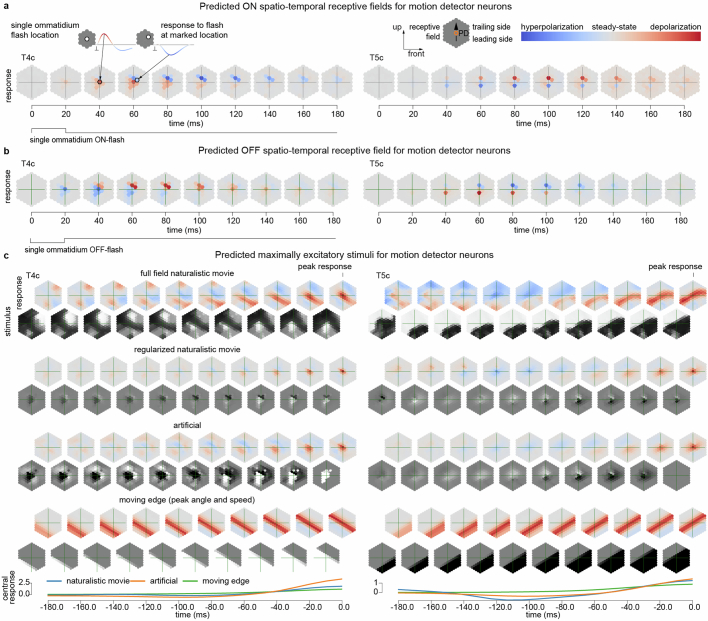
- For motion tuning, the ensemble correctly predicted that T4 neurons are ON-motion selective and T5 neurons are OFF-motion selective, and also predicted the lack of motion tuning in the listed input neurons to T4/T5.
- In synthetic-connectome experiments, sparse networks improved prediction from connectivity alone: median Pearson correlation was 0.85 for 10% connectivity versus 0.38 for 80% connectivity; with connection-strength estimates, correlations were >0.9 across connectivities.
## Methods
- Built a connectome-constrained, task-optimized deep mechanistic network (DMN) for the fly visual system using local reconstructions from FlyEM/FIB datasets, tiled into a spatially invariant hexagonal lattice.
- Trained the model end-to-end on optic-flow prediction from 23 Sintel video sequences (with augmentations), using a recurrent DMN plus a feedforward decoder and backpropagation through time.
- Evaluated model predictions by simulating responses to flash stimuli, moving edges, and naturalistic video, then comparing predicted tuning to reported experimental data from 26 studies.
## Limitations
- The paper explicitly notes that the model is reductionist and cannot account for electrical synapses, nonlinear chemical synapses, neuromodulation, or glia.
- The connectome was approximated as perfectly periodic / translation invariant across the visual field; this is a modeling simplification stated in the paper.
- The text makes evident that the model is limited to the motion pathways and the optic-flow task only, so its scope does not cover all computations of the fly visual system.
Model-written summary. Check it against the paper before relying on it.
Integrity signals
Registry
Cites
Statistics
Figures




Verification
Claims the paper makes
16 Valid · 1 Not valid · 5 Not checked · 67 Own results and interpretations
Every source the paper cites for this claim was checked and supports it.
In the paper
“We found that our connectome-constrained and task-optimized DMN accurately predicts the separation of the visual system into light-increment (ON) and light-decrement (OFF) channels, as well as the generation of direction selectivity in the well-known T4 and T5 motion detector neurons24.”
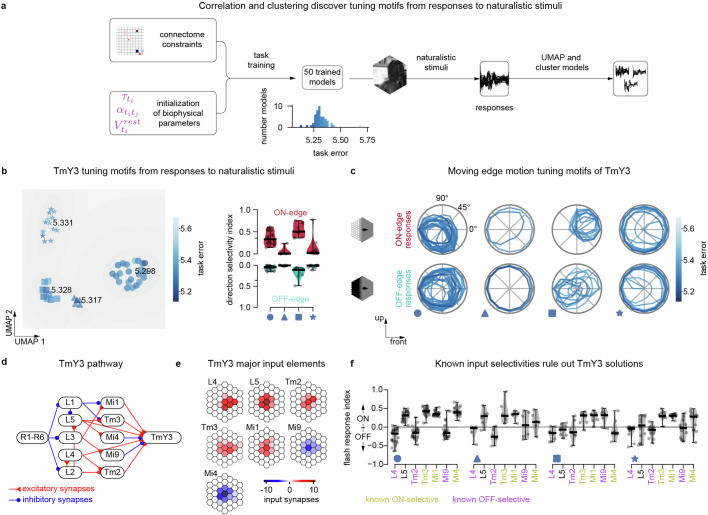
§ Connectome-constrained networks predict neural activity across the fly visual system > Main Electrical signals propagating through networks of neurons form the basis of computations such as visual motion detection. The propagation of neural activity is shaped by both the functional properties of individual neurons and their synaptic connectivity. Additional factors10,13, including electrical synapses, neuromodulation and glia, are known to further influence neural activity on multiple timescales. Volume electron microscopy can now be used to comprehensively measure the connectivity of each neuron in a neural circuit, and even entire nervous systems1–9. However, we do not yet have the means to also comprehensively measure all other biological details, including the dynamical properties of every neuron and synapse in the same circuit13. For these reasons, there has been considerable debate about the utility of connectome measurements for understanding brain function14. It is unclear whether it is possible to use only measurements of connectivity to generate accurate predictions about how the neural circuit functions, especially in the absence of direct measurements of neural activity from a living brain. There is considerable evidence from computer science and neuroscience that there is not necessarily a strong link between the connectivity of a neural network and its computational function. Universal function approximation theorems for artificial neural networks15 imply that the same computational task can be performed by many different networks with very different neural connectivity. Empirically, there exist many classes of general-purpose artificial neural network architectures that can be trained to perform the same computational task11. Such differences in connectivity can correspond to qualitatively different computational mechanisms16. Similarly, in neuroscience there have been competing proposals for the same computation (for instance, the computation of visual motion)17,18. Furthermore, even circuits with the same connectivity can function differently19. Thus, neither the connectivity of a circuit alone, nor its computational task alone, can uniquely determine the mechanism of circuit function20. Here we show that the connectivity of a neural circuit, together with knowledge of its computational task, enables accurate predictions of the role played by individual neurons in the circuit in the computational task. We constructed a differentiable21 model neural network with a close correspondence to the brain, whose connectivity was given by connectome measurements and with unknown single-neuron and single-synapse parameters. We optimized the unknown parameters of the model using techniques from deep learning11, to enable the model to accomplish the computational task22. We call such models connectome-constrained and task-optimized deep mechanistic networks (DMNs) (Fig. 1a). We applied this approach to model the motion pathways in the optic lobe of the Drosophila visual system. We constructed a DMN with experimentally measured connectivity1–5, and unknown parameters for the single-neuron dynamics and the strength of a unitary synapse. We optimized the model parameters on the computer vision task of detecting motion in dynamic visual stimuli12. Visual motion computation in the fly and its mechanistic underpinnings have been extensively studied23. Thus, we were able to compare the detailed predictions of our model with experimental measurements of neural activity in response to visual stimuli, on a neuron-by-neuron basis. We found that our connectome-constrained and task-optimized DMN accurately predicts the separation of the visual system into light-increment (ON) and light-decrement (OFF) channels, as well as the generation of direction selectivity in the well-known T4 and T5 motion detector neurons24. We release our model as a resource for the community (https://github.com/TuragaLab/flyvis).
What the sources say
- Supportedcites [24] Currier, T. A., Pang, M. M. & Clandinin, T. R. Visual processing in the fly, from photoreceptors to behavior. Genetics 224, iyad064 (2023). source
In the section ‘The lobula complex performs directional motion computations’ (page unavailable), the review identifies T4 and T5 as motion detectors and says direction selectivity first emerges in their dendrites. This supports the biological point for which the citation is used; the DMN’s predictive accuracy is the citing authors’ own finding, not a result attributed to this review. (LLM, conf=0.90)
boostedstates a cause- Asserted: passes — The authors put it forward as true.
- Checkable: passes — It can be checked against evidence.
- Load-bearing: passes — The paper’s conclusions depend on it.
- Based: passes — The paper gives a reason why it holds.
- Rests on 4 assumptions not shown here.
- Supported
Every source the paper cites for this claim was checked and supports it.
In the paper
“We found that our connectome-constrained and task-optimized DMN accurately predicts the separation of the visual system into light-increment (ON) and light-decrement (OFF) channels, as well as the generation of direction selectivity in the well-known T4 and T5 motion detector neurons24.”
§ Connectome-constrained networks predict neural activity across the fly visual system > Main Electrical signals propagating through networks of neurons form the basis of computations such as visual motion detection. The propagation of neural activity is shaped by both the functional properties of individual neurons and their synaptic connectivity. Additional factors10,13, including electrical synapses, neuromodulation and glia, are known to further influence neural activity on multiple timescales. Volume electron microscopy can now be used to comprehensively measure the connectivity of each neuron in a neural circuit, and even entire nervous systems1–9. However, we do not yet have the means to also comprehensively measure all other biological details, including the dynamical properties of every neuron and synapse in the same circuit13. For these reasons, there has been considerable debate about the utility of connectome measurements for understanding brain function14. It is unclear whether it is possible to use only measurements of connectivity to generate accurate predictions about how the neural circuit functions, especially in the absence of direct measurements of neural activity from a living brain. There is considerable evidence from computer science and neuroscience that there is not necessarily a strong link between the connectivity of a neural network and its computational function. Universal function approximation theorems for artificial neural networks15 imply that the same computational task can be performed by many different networks with very different neural connectivity. Empirically, there exist many classes of general-purpose artificial neural network architectures that can be trained to perform the same computational task11. Such differences in connectivity can correspond to qualitatively different computational mechanisms16. Similarly, in neuroscience there have been competing proposals for the same computation (for instance, the computation of visual motion)17,18. Furthermore, even circuits with the same connectivity can function differently19. Thus, neither the connectivity of a circuit alone, nor its computational task alone, can uniquely determine the mechanism of circuit function20. Here we show that the connectivity of a neural circuit, together with knowledge of its computational task, enables accurate predictions of the role played by individual neurons in the circuit in the computational task. We constructed a differentiable21 model neural network with a close correspondence to the brain, whose connectivity was given by connectome measurements and with unknown single-neuron and single-synapse parameters. We optimized the unknown parameters of the model using techniques from deep learning11, to enable the model to accomplish the computational task22. We call such models connectome-constrained and task-optimized deep mechanistic networks (DMNs) (Fig. 1a). We applied this approach to model the motion pathways in the optic lobe of the Drosophila visual system. We constructed a DMN with experimentally measured connectivity1–5, and unknown parameters for the single-neuron dynamics and the strength of a unitary synapse. We optimized the model parameters on the computer vision task of detecting motion in dynamic visual stimuli12. Visual motion computation in the fly and its mechanistic underpinnings have been extensively studied23. Thus, we were able to compare the detailed predictions of our model with experimental measurements of neural activity in response to visual stimuli, on a neuron-by-neuron basis. We found that our connectome-constrained and task-optimized DMN accurately predicts the separation of the visual system into light-increment (ON) and light-decrement (OFF) channels, as well as the generation of direction selectivity in the well-known T4 and T5 motion detector neurons24. We release our model as a resource for the community (https://github.com/TuragaLab/flyvis).
What the sources say
- Supportedcites [24] Currier, T. A., Pang, M. M. & Clandinin, T. R. Visual processing in the fly, from photoreceptors to behavior. Genetics 224, iyad064 (2023). source
The Optic lobes section (Fig. 5 caption; page unavailable) describes distinct ON and OFF motion pathways leading to T4 and T5. The cited paper supports the visual-system organization used as a comparison; the DMN’s predictive accuracy is presented as the citing authors’ own finding, not a finding attributed to this source. (LLM, conf=0.90)
boostedstates a cause- Asserted: passes — The authors put it forward as true.
- Checkable: passes — It can be checked against evidence.
- Load-bearing: passes — The paper’s conclusions depend on it.
- Based: passes — The paper gives a reason why it holds.
- Rests on 4 assumptions not shown here.
- Supported
The sources with a verdict support this claim; the rest weren’t checked yet, have no full text we could read, or their verdicts aren’t rated yet.
In the paper
“Our reductionist model cannot, for example, account for the role played in this circuit by electrical synapses46, nonlinear chemical synapses47 and neuromodulation48.”
§ Connectome-constrained networks predict neural activity across the fly visual system > Discussion
What the sources say
- Not checked — no full text of the sourcecites [46] Ammer, G., Leonhardt, A., Bahl, A., Dickson, B. J. & Borst, A. Functional specialization of neural input elements to the Drosophila ON motion detector. Curr. Biol. 25, 2247–2253 (2015). source
- Supportedcites [47] Groschner, L. N., Malis, J. G., Zuidinga, B. & Borst, A. A biophysical account of multiplication by a single neuron. Nature 603, 119–123 (2022). source
Citation 47 is attached to “nonlinear chemical synapses,” not to the citing authors’ statement about their model’s limitations. The source paper’s Main section describes a supralinear interaction between excitatory and inhibitory synaptic signals in the fruit-fly motion circuit; the Discussion calls it “multiplicative disinhibition.” Page numbers were not provided. (LLM, conf=0.90)
- Supportedcites [48] Strother, J. A. et al. Behavioral state modulates the ON visual motion pathway of Drosophila. Proc. Natl Acad. Sci. USA 115, E102–E111 (2018). source
Citation 48 is attached to neuromodulation, not to the other synapse types or the citing authors’ assessment of their model. The Discussion describes behavioral-state modulation in the ON motion pathway, and the Results report evidence that octopamine neurons mediate it, with especially substantial effects on Mi4 neurons. Page numbers are not provided in our copy. (LLM, conf=0.92)
plain- Asserted: passes — The authors put it forward as true.
- Checkable: passes — It can be checked against evidence.
- Load-bearing: unclear — It is unclear whether the paper’s conclusions depend on it.
- Based: passes — The paper gives a reason why it holds.
The sources with a verdict support this claim; the rest weren’t checked yet, have no full text we could read, or their verdicts aren’t rated yet.
In the paper
“We built a computational model of the fly visual system that is consistent with available connectome data1–5, has biophysically plausible neural dynamics, and can be computationally trained to solve an ethologically relevant behavioural task, namely the estimation of optic flow.”
§ Connectome-constrained networks predict neural activity across the fly visual system > Methods > Construction of spatially invariant connectome from local reconstructions
What the sources say
- Not checked — no full text of the sourcecites [1] Rivera-Alba, M. et al. Wiring economy and volume exclusion determine neuronal placement in the Drosophila brain. Curr. Biol. 21, 2000–2005 (2011). source
- Supportedcites [2] Takemura, S. et al. Synaptic circuits and their variations within different columns in the visual system of Drosophila. Proc. Natl Acad. Sci. USA 112, 13711–13716 (2015). source
The citation identifies a source of available connectome data, rather than attributing the citing authors’ model to this paper. The Results describe an EM reconstruction of seven fly medulla columns and a dataset of connections among 20 cell types, supporting its use as connectome data. (LLM, conf=0.87)
- Supportedcites [3] Takemura, S. et al. The comprehensive connectome of a neural substrate for ‘ON’ motion detection in Drosophila. eLife 6, e24394 (2017). source
The citation is attached to “available connectome data,” not to the citing authors’ assessment of their model. The source’s Materials and methods (Connectome reconstruction; page unavailable) describes reconstructed neurons, mapped synapses, and connectivity matrices, confirming that it supplies such data. It does not itself evaluate the citing authors’ model. (LLM, conf=0.88)
- Supportedcites [4] Shinomiya, K. et al. Comparisons between the ON- and OFF-edge motion pathways in the Drosophila brain. eLife 8, e40025 (2019). source
The citation identifies a source of fly visual-system connectome data. The Abstract reports a connectome with detailed connectivity information for inputs to both the T4 and T5 motion pathways in an optic-lobe EM dataset; the Introduction likewise describes its analysis of those pathways. This supports citing the paper as available connectome data used to constrain the model. (LLM, conf=0.90)
- Not checked — no full text of the sourcecites [5] Shinomiya, K., Nern, A., Meinertzhagen, I. A., Plaza, S. M. & Reiser, M. B. Neuronal circuits integrating visual motion information in Drosophila melanogaster. Curr. Biol. 32, 3529–3544 (2022). source
plainstates an association- Asserted: passes — The authors put it forward as true.
- Checkable: passes — It can be checked against evidence.
- Load-bearing: passes — The paper’s conclusions depend on it.
- Based: passes — The paper gives a reason why it holds.
The cited sources support only part of this claim — read each source’s verdict below.
In the paper
“By contrast, every neuron and synapse in our connectome-constrained model49–53 has a direct correspondence to neurons and synapses in the brain.”
§ Connectome-constrained networks predict neural activity across the fly visual system > Discussion
What the sources say
- Partly supportedcites [49] Tschopp, F. D., Reiser, M. B. & Turaga, S. C. A connectome based hexagonal lattice convolutional network model of the Drosophila visual system. Preprint at https://arxiv.org/abs/1806.04793 (2018). sourceExperimental — accuracy not yet measured
The source does ground its model's neurons and edges in real connectome data: Section 2 (p. 2) states the model is built 'Based on publications of lamina [12-14] and medulla [9-11] connectomes... 43 neuron types', and Section 2.1 (p. 3) that 'we replaced all synapses counted between two connected distinct neurons in the connectome by a single synapse', weighted by the synapse count. But the absolute 'every neuron and synapse has a direct correspondence' overstates it: the locally described connectome is spatially repeated across the lattice (p. 2), morphology is deliberately ignored (p. 2), biases carry no connectome information and delays/decoder layers are assumed (Sections 2.1, 2.2, p. 3), weights are subsequently fine-tuned by backpropagation, and the Discussion (p. 11) concedes 'incomplete filters due to missing connectomic information', an assumed T5 configuration, and tangential neurons (Mt8, Mi11, Tm28) not included at all. (LLM, conf=0.72)
- Partly supportedcites [50] Mano, O., Creamer, M. S., Badwan, B. A. & Clark, D. A. Predicting individual neuron responses with anatomically constrained task optimization. Curr. Biol. 31, 4062–4075 (2021). sourceExperimental — accuracy not yet measured
The Introduction says connectomic constraints create an a priori correspondence between specific model nodes and individual biological neurons. But the Discussion’s “Circuit features neglected in these models” describes simplified inputs and omitted lateral and feedback connections; the paper does not establish a direct correspondence for every model synapse. (LLM, conf=0.86)
- Not matchedcites [51] Mi, L. et al. Connectome-constrained latent variable model of whole-brain neural activity. In Proc. International Conference on Learning Representations https://openreview.net/forum?id=CJzi3dRlJE- (2022).
Its entry has no title and year that we can search by.
- Supportedcites [52] Shiu, P. K. et al. A leaky integrate-and-fire computational model based on the connectome of the entire adult Drosophila brain reveals insights into sensorimotor processing. Preprint at bioRxiv https://doi.org/10.1101/2023.05.02.539144 (2023). source
The Methods (Computational Model; page unavailable) state that all 127,400 proofread Flywire neurons are included and that connection weights come from Flywire synaptic connectivity. This supports direct correspondence between the model’s neurons and connections and the reconstructed brain connectome; it does not imply that the model reproduces every physiological property of those neurons or synapses. (LLM, conf=0.88)
- Partly supportedcites [53] Beiran, M. & Litwin-Kumar, A. Prediction of neural activity in connectome-constrained recurrent networks. Preprint at bioRxiv https://doi.org/10.1101/2024.02.22.581667 (2024). sourceExperimental — accuracy not yet measured
The Introduction says connectome-constrained models use structural connectivity, and the Discussion’s ‘Assessment of connectome-constrained solutions’ says they address the contribution of each specific neuron. But this paper studies simulated networks (Discussion, ‘Challenges for connectome-constrained neural networks’); it does not establish that every neuron and synapse in the citing authors’ model directly corresponds to one in a brain. Page numbers are unavailable in our copy. (LLM, conf=0.84)
plainstates an association- Asserted: passes — The authors put it forward as true.
- Checkable: passes — It can be checked against evidence.
- Load-bearing: passes — The paper’s conclusions depend on it.
- Based: passes — The paper gives a reason why it holds.
- Partly supported
46 more claims
Create a free account to see all 89 claims and every source verdict.
- It may state two separate claims as one. 26
- Probably not a substantial claim. 18
Claims other papers make about this one
Each is checked against this paper’s own text: does it say what the citing paper says it does?
The source backs part of the claim, not all of it — or backs it for a different population, condition or comparison.
In the citing paper
“In previous studies, an absence of information across columns has necessitated treating each column as identical in simulations of the optic lobe85.”
From Neuronal wiring diagram of an adult brain (2024) · cites this paper as [85]
Experimental — accuracy not yet measuredThe source backs part of the claim, not all of it — or backs it for a different population, condition or comparison.
In the citing paper
“The Drosophila melanogaster central brain connectome, comprising more than 125,000 neurons and 50 million synaptic connections, allows brainwide analyses of how the fly processes sensory information1,2,11–16.”
From A Drosophila computational brain model reveals sensorimotor processing (2024) · cites this paper as [15]
Experimental — accuracy not yet measuredThe cited source says what the claim attributes to it.
In the citing paper
“Finally, the connectome now enables brain simulations—partial connectomes of the early visual system of the fly3 had already inspired simulations of visual processing85.”
From Neuronal wiring diagram of an adult brain (2024) · cites this paper as [85]
The check wasn’t confident either way, so it gives no verdict — never disputed.
In the citing paper
“Using this small number of neurons, flies can nevertheless generate complex behaviors including walking over complex terrain 30 , rapid corrective maneuvers during flight 31 , courtship sequences 32 , aggression towards competitors 33 , and learning 34 .”
From NeuroMechFly v2: simulating embodied sensorimotor control in adult Drosophila (2024) · cites this paper as [31]
Experimental — accuracy not yet measured
Self-check
Percentages, sums and reported differences re-computed from the paper’s own numbers.
Each contradiction between two passages listed here was confirmed by an independent check.
Rated minor: it would not touch a result — a value no result rests on, a p-value that stays on the same side of the significance level, or a conflict that is clerical, resolved elsewhere in the paper, or outside its own findings.
In the paper
§ Connectome-constrained networks predict neural activity across the fly visual system > DMN ensemble predicts known activity
“This is also the case for the model with the best task performance (task-optimal model), which correctly predicts the preferred contrast of 30 of 32 cells (Fig. 2b).”
§ Connectome-constrained networks predict neural activity across the fly visual system > DMN ensemble predicts known activity
“the median flash response index (FRI) across the ensemble predicts the correct ON- and OFF-preferred contrast selectivity for all 32 cell types for which contrast selectivity has been experimentally established”
Citations
Cites
Scikit-learn: Machine Learning in Python
Pedregosa, F., Varoquaux, G., Gramfort, A., Michel, V., Thirion, B., Grisel, O., Blondel, M., Müller, A., Nothman, J., Louppe, G., et al. (2012) · arXiv · doi:10.48550/arxiv.1201.0490 · Cited by 71,016
Learning representations by back-propagating errors
Rumelhart, D. E., Hinton, G. E., & Williams, R. J. (1986) · Nature · doi:10.1038/323533a0 · Cited by 31,892 · cited 1×
“…differentiable 61 DMN model of the fly visual system can be interpreted as a continuous-time neural ordinary differential equation 62 with a deep convolutional recurrent neural network 63 architecture that is trained to perform a computer vision task using backpropagation through time 64,65 .”
PyTorch: An Imperative Style, High-Performance Deep Learning Library
Paszke, A., Gross, S., Massa, F., Lerer, A., Bradbury, J., Chanan, G., Killeen, T., Lin, Z., Gimelshein, N., Antiga, L., et al. (2019) · arXiv · doi:10.48550/arxiv.1912.01703 · Cited by 31,473 · cited 5×
“The decoder uses PyTorch-native implementations for 2D convolutions, batch normalization, softplus activation and dropout.”
MethodInfluentialMultilayer feedforward networks are universal approximators
Hornik, K., Stinchcombe, M., & White, H. (1989) · Neural Networks · doi:10.1016/0893-6080(89)90020-8 · Cited by 21,728
Backpropagation Applied to Handwritten Zip Code Recognition
LeCun, Y., Boser, B., Denker, J. S., Henderson, D., Howard, R. E., Hubbard, W., & Jackel, L. D. (1989) · Neural Computation · doi:10.1162/neco.1989.1.4.541 · Cited by 11,891
Convolutional LSTM Network: A Machine Learning Approach for Precipitation Nowcasting
Shi, X., Chen, Z., Wang, H., Yeung, D.-Y., Wong, W.-K., & Woo, W.-C. (2015) · arXiv · doi:10.48550/arxiv.1506.04214 · Cited by 7,709 · cited 1×
“…differentiable 61 DMN model of the fly visual system can be interpreted as a continuous-time neural ordinary differential equation 62 with a deep convolutional recurrent neural network 63 architecture that is trained to perform a computer vision task using backpropagation through time 64,65 .”
Dimensionality reduction for visualizing single-cell data using UMAP
Becht, E., McInnes, L., Healy, J., Dutertre, C.-A., Kwok, I. W. H., Ng, L. G., Ginhoux, F., & Newell, E. W. (2019) · Nature Biotechnology · doi:10.1038/nbt.4314 · Cited by 5,358 · cited 1×
“…reduction to two dimensions using the UMAP (uniform manifold approximation and projection) algorithm, and fitted Gaussian mixtures of 2 to 5 components, with the number of components that minimize the Bayesian information criterion, using the Python libraries umap-learn and scikit-learn 38,74 .”
MethodBackpropagation through time: what it does and how to do it
Werbos, P. J. (1990) · Proceedings of the IEEE · doi:10.1109/5.58337 · Cited by 4,879 · cited 1×
“…differentiable 61 DMN model of the fly visual system can be interpreted as a continuous-time neural ordinary differential equation 62 with a deep convolutional recurrent neural network 63 architecture that is trained to perform a computer vision task using backpropagation through time 64,65 .”
Flownet: Learning optical flow with convolutional networks
Dosovitskiy, A., Fischer, P., Ilg, E., Hausser, P., Hazirbas, C., Golkov, V., Smagt, P. V. D., Cremers, D., & Brox, T. (2015) · 2015 IEEE International Conference on Computer Vision (ICCV) · doi:10.1109/iccv.2015.316 · Cited by 4,313 · cited 2×
“To rank models on the basis of their task performance, we computed the standard optic flow metric of average end-to-end point error (EPE) 72 , which calculates the average over all time steps and pixels (that is, here columns) of the error between predicted optic flow and ground-truth optic flow and averaged across th…”
MethodHierarchical models of object recognition in cortex
Riesenhuber, M., & Poggio, T. (1999) · Nature Neuroscience · doi:10.1038/14819 · Cited by 3,309
Performance-optimized hierarchical models predict neural responses in higher visual cortex
Yamins, D. L. K., Hong, H., Cadieu, C. F., Solomon, E. A., Seibert, D., & DiCarlo, J. J. (2014) · Proceedings of the National Academy of Sciences · doi:10.1073/pnas.1403112111 · Cited by 1,924 · cited 2×
“Task-optimized artificial neural network models, for instance of mammalian visual pathways 22 , have previously demonstrated only a coarse correspondence of the population neural activity between model layers and brain regions.”
MethodA Naturalistic Open Source Movie for Optical Flow Evaluation
Butler, D. J., Wulff, J., Stanley, G. B., & Black, M. J. (2012) · Lecture Notes in Computer Science · doi:10.1007/978-3-642-33783-3_44 · Cited by 1,842 · cited 17×
“We used the same dataset (that is, hexagonal sequences and augmen-tations from Sintel) for training and validating the CNN as that used for training and validating the DMN, enabled by two custom modules mapping from the hexagonal lattice to a Cartesian map and back.”
MethodInfluentialThe mechanism of directionally selective units in rabbit's retina.
Barlow, H. B., & Levick, W. R. (1965) · The Journal of Physiology · doi:10.1113/jphysiol.1965.sp007638 · Cited by 1,576
A Complete Electron Microscopy Volume of the Brain of Adult Drosophila melanogaster
Zheng, Z., Lauritzen, J. S., Perlman, E., Robinson, C. G., Nichols, M., Milkie, D., Torrens, O., Price, J., Fisher, C. B., Sharifi, N., et al. (2018) · Cell · doi:10.1016/j.cell.2018.06.019 · Cited by 1,050
Neocognitron: A Self-Organizing Neural Network Model for a Mechanism of Visual Pattern Recognition
Fukushima, K., & Miyake, S. (1982) · Lecture Notes in Biomathematics · doi:10.1007/978-3-642-46466-9_18 · Cited by 991
Neuromodulation of neuronal circuits: back to the future
Marder, E. (2012) · Neuron · doi:10.1016/j.neuron.2012.09.010 · Cited by 904
The optic lobe of Drosophila melanogaster. I. A Golgi analysis of wild-type structure
Fischbach, K.-F., & Dittrich, A. P. M. (1989) · Cell and Tissue Research · doi:10.1007/bf00218858 · Cited by 709 · cited 2×
“Visual input from the photoreceptors is received by the lamina and medulla, which send projections to the lobula and lobula plate 25 (Fig.”
BackgroundNern, A., Pfeiffer, B. D., & Rubin, G. M. (2015) · Proceedings of the National Academy of Sciences · doi:10.1073/pnas.1506763112 · Cited by 584 · cited 2×
“We approximated the circuitry across the entire visual field as perfectly periodic 2,26 , and tiled this local connectivity architecture in a hexagonal lattice across retinotopic space to construct a consensus connectome for 64 cell types across the central visual field of the right eye (Fig.”
BackgroundMethodSelf-citationFrom the connectome to brain function
Bargmann, C. I., & Marder, E. (2013) · Nature Methods · doi:10.1038/nmeth.2451 · Cited by 561
Optomotorische Untersuchung des visuellen systems einiger Augenmutanten der Fruchtfliege Drosophila
Götz, K. G. (1964) · Kybernetik · doi:10.1007/bf00288561 · Cited by 467 · cited 1×
“In total, the connectome-constrained model comprises 45,669 neurons and 1,513,231 connections, across 64 cell types arranged in a hexagonal lattice consisting of 721 columns, modelling the central visual field of the roughly 700–900 ommatidia typically found in the fruit fly retina 31 .”
MethodMultiple models to capture the variability in biological neurons and networks
Marder, E., & Taylor, A. L. (2011) · Nature Neuroscience · doi:10.1038/nn.2735 · Cited by 451 · cited 1×
“As it is possible that these constraints might not uniquely constrain model parameters 32 , we generated an ensemble of 50 models, all constrained with the same connectome, and optimized to perform the same task.”
MethodThe connectome of an insect brain
Winding, M., Pedigo, B. D., Barnes, C. L., Patsolic, H. G., Park, Y., Kazimiers, T., Fushiki, A., Andrade, I. V., Khandelwal, A., Valdes-Aleman, J., et al. (2023) · Science · doi:10.1126/science.add9330 · Cited by 435 · cited 1×
“Whole-brain connectome projects have just been completed for the larval and adult fruit fly 7,8,55,56 , including two new connectomes of the entire fruit fly optic lobe 6,9 , and whole-mouse-brain connectome projects are now being discussed 57 .”
BackgroundPatterns of projection in the visual system of the fly. I. Retina-lamina projections
Braitenberg, V. (1967) · Experimental Brain Research · doi:10.1007/bf00235589 · Cited by 432 · cited 1×
“To model the hexagonal arrangement of photoreceptors in the fly retina, we developed a hexagonal convolutional neural network (CNN) in the widely used deep learning framework PyTorch 21 (ignoring neuronal superposition 70 ), which we used for simulation and optimization of the model.”
MethodA directional tuning map of Drosophila elementary motion detectors
Maisak, M. S., Haag, J., Ammer, G., Serbe, E., Meier, M., Leonhardt, A., Schilling, T., Bahl, A., Rubin, G. M., Nern, A., et al. (2013) · Nature · doi:10.1038/nature12320 · Cited by 390 · cited 2×
“In the task-optimal cluster, the four subtypes of the T4 neurons respond strongly to bright (ON) edges, and the four subtypes of the T5 neurons to dark (OFF) edges, moving in the four cardinal directions, in agreement with experimental findings 27,37,39,40 (Fig.”
BackgroundResultSelf-citationON and OFF pathways in Drosophila motion vision
Joesch, M., Schnell, B., Raghu, S. V., Reiff, D. F., & Borst, A. (2010) · Nature · doi:10.1038/nature09545 · Cited by 352 · cited 2×
“First, neural responses in the fly visual system are known to segregate into ON-and OFF-channels 33 defined by whether a neuron depolarizes more strongly to an increase or decrease in stimulus intensity, respectively, a hallmark of visual computation across species 34,35 .”
BackgroundA genetic, genomic, and computational resource for exploring neural circuit function
Davis, F. P., Nern, A., Picard, S., Reiser, M. B., Rubin, G. M., Eddy, S. R., & Henry, G. L. (2020) · eLife · doi:10.7554/elife.50901 · Cited by 268
Self-citationSynaptic circuits and their variations within different columns in the visual system of Drosophila
Takemura, S.-Y., Xu, C. S., Lu, Z., Rivlin, P. K., Parag, T., Olbris, D. J., Plaza, S., Zhao, T., Katz, W. T., Umayam, L., et al. (2015) · Proceedings of the National Academy of Sciences · doi:10.1073/pnas.1509820112 · Cited by 264
Self-citationProcessing properties of ON and OFF pathways for Drosophila motion detection
Behnia, R., Clark, D. A., Carter, A. G., Clandinin, T. R., & Desplan, C. (2014) · Nature · doi:10.1038/nature13427 · Cited by 262 · cited 2×
“…by single-ommatidium flashes and comparison with experimental measurements 28,43 . e , Single-ommatidium flash responses agree with experimental measurements 41,43 , with the exception of Tm4 (red cross). f , Stimulus sequence predicted to elicit the strongest responses in T4c and T5c cells.”
BackgroundSubcellular Imaging of Voltage and Calcium Signals Reveals Neural Processing In Vivo
Yang, H. H., St-Pierre, F., Sun, X., Ding, X., Lin, M. Z., & Clandinin, T. R. (2016) · Cell · doi:10.1016/j.cell.2016.05.031 · Cited by 252
Wiring Economy and Volume Exclusion Determine Neuronal Placement in the Drosophila Brain
Rivera-Alba, M., Vitaladevuni, S. N., Mishchenko, Y., Lu, Z., Takemura, S.-Y., Scheffer, L., Meinertzhagen, I. A., Chklovskii, D. B., & de Polavieja, G. G. (2011) · Current Biology · doi:10.1016/j.cub.2011.10.022 · Cited by 223
Self-citationCommon circuit design in fly and mammalian motion vision
Borst, A., & Helmstaedter, M. (2015) · Nature Neuroscience · doi:10.1038/nn.4050 · Cited by 220 · cited 1×
“First, neural responses in the fly visual system are known to segregate into ON-and OFF-channels 33 defined by whether a neuron depolarizes more strongly to an increase or decrease in stimulus intensity, respectively, a hallmark of visual computation across species 34,35 .”
BackgroundInception loops discover what excites neurons most using deep predictive models
Walker, E. Y., Sinz, F. H., Cobos, E., Muhammad, T., Froudarakis, E., Fahey, P. G., Ecker, A. S., Reimer, J., Pitkow, X., & Tolias, A. S. (2019) · Nature Neuroscience · doi:10.1038/s41593-019-0517-x · Cited by 215 · cited 1×
“In addition, we computed artificial maximally excitatory stimuli 75 .”
MethodThe comprehensive connectome of a neural substrate for ‘ON’ motion detection in Drosophila
Takemura, S.-Y., Nern, A., Chklovskii, D. B., Scheffer, L. K., Rubin, G. M., & Meinertzhagen, I. A. (2017) · eLife · doi:10.7554/elife.24394 · Cited by 210 · cited 8×
“1 and Supplementary Data files 1–3).”
MethodInfluentialSelf-citationRobust quantification of orientation selectivity and direction selectivity
Mazurek, M., Kager, M., & Van Hooser, S. D. (2014) · Frontiers in Neural Circuits · doi:10.3389/fncir.2014.00092 · Cited by 193
The Emergence of Directional Selectivity in the Visual Motion Pathway of Drosophila
Strother, J. A., Wu, S.-T., Wong, A. M., Nern, A., Rogers, E. M., Le, J. Q., Rubin, G. M., & Reiser, M. B. (2017) · Neuron · doi:10.1016/j.neuron.2017.03.010 · Cited by 188
Abbott, L. F., Bock, D. D., Callaway, E. M., Denk, W., Dulac, C., Fairhall, A. L., Fiete, I., Harris, K. M., Helmstaedter, M., Jain, V., et al. (2020) · Cell · doi:10.1016/j.cell.2020.08.010 · Cited by 172
Neuronal wiring diagram of an adult brain
Dorkenwald, S., Matsliah, A., Sterling, A. R., Schlegel, P., Yu, S.-C., McKellar, C. E., Lin, A., Costa, M., Eichler, K., Yin, Y., et al. (2023) · doi:10.1101/2023.06.27.546656 · Cited by 149 · cited 4×
“Whole-brain connectome projects have just been completed for the larval and adult fruit fly 7,8,55,56 , including two new connectomes of the entire fruit fly optic lobe 6,9 , and whole-mouse-brain connectome projects are now being discussed 57 .”
BackgroundMethodInfluentialComparisons between the ON- and OFF-edge motion pathways in the Drosophila brain
Shinomiya, K., Huang, G., Lu, Z., Parag, T., Xu, C. S., Aniceto, R., Ansari, N., Cheatham, N., Lauchie, S., Neace, E., et al. (2019) · eLife · doi:10.7554/elife.40025 · Cited by 140 · cited 2×
“The FIB-25 dataset volume comprises seven medulla columns and the FIB-19 dataset volume comprises the entire optic lobe and, in particular, detailed connectivity information for inputs to both the T4 and T5 pathways 2–4 .”
BackgroundMethodSelf-citationArenz, A., Drews, M. S., Richter, F. G., Ammer, G., & Borst, A. (2017) · Current Biology · doi:10.1016/j.cub.2017.01.051 · Cited by 137 · cited 3×
“In agreement with experimental findings 28,43 , the prediction of the DMNs is that Tm3 and Tm4 have broad spatial receptive fields (two-column radius, 11.6°), whereas Mi1, Mi4, Mi9, Tm1, Tm2, Tm9 and CT1 compartments in both medulla and lobula have narrow spatial receptive fields (single-column…”
BackgroundResultInfluentialDirect Observation of ON and OFF Pathways in the Drosophila Visual System
Strother, J. A., Nern, A., & Reiser, M. B. (2014) · Current Biology · doi:10.1016/j.cub.2014.03.017 · Cited by 136
Self-citationBenefits of Pathway Splitting in Sensory Coding
Gjorgjieva, J., Sompolinsky, H., & Meister, M. (2014) · The Journal of Neuroscience · doi:10.1523/jneurosci.1032-14.2014 · Cited by 132 · cited 1×
“First, neural responses in the fly visual system are known to segregate into ON-and OFF-channels 33 defined by whether a neuron depolarizes more strongly to an increase or decrease in stimulus intensity, respectively, a hallmark of visual computation across species 34,35 .”
BackgroundOrientation Selectivity Sharpens Motion Detection in Drosophila
Fisher, Y. E., Silies, M., & Clandinin, T. R. (2015) · Neuron · doi:10.1016/j.neuron.2015.09.033 · Cited by 117 · cited 2×
“In the task-optimal cluster, the four subtypes of the T4 neurons respond strongly to bright (ON) edges, and the four subtypes of the T5 neurons to dark (OFF) edges, moving in the four cardinal directions, in agreement with experimental findings 27,37,39,40 (Fig.”
ResultHow fly neurons compute the direction of visual motion
Borst, A., Haag, J., & Mauss, A. S. (2020) · Journal of Comparative Physiology A · doi:10.1007/s00359-019-01375-9 · Cited by 109 · cited 2×
“Motion computation in the fly visual system and its mechanistic underpinnings have been extensively studied 23 .”
BackgroundWhole-brain annotation and multi-connectome cell typing quantifies circuit stereotypy in Drosophila
Schlegel, P., Yin, Y., Bates, A. S., Dorkenwald, S., Eichler, K., Brooks, P., Han, D. S., Gkantia, M., dos Santos, M., Munnelly, E. J., et al. (2023) · doi:10.1101/2023.06.27.546055 · Cited by 102 · cited 3×
“Whole-brain connectome projects have just been completed for the larval and adult fruit fly 7,8,55,56 , including two new connectomes of the entire fruit fly optic lobe 6,9 , and whole-mouse-brain connectome projects are now being discussed 57 .”
BackgroundMethodConnectome-driven neural inventory of a complete visual system
Nern, A., Loesche, F., Takemura, S.-Y., Burnett, L. E., Dreher, M., Gruntman, E., Hoeller, J., Huang, G. B., Januszewski, M., Klapoetke, N. C., et al. (2024) · doi:10.1101/2024.04.16.589741 · Cited by 98 · cited 1×
“Whole-brain connectome projects have just been completed for the larval and adult fruit fly 7,8,55,56 , including two new connectomes of the entire fruit fly optic lobe 6,9 , and whole-mouse-brain connectome projects are now being discussed 57 .”
BackgroundSelf-citationShiu, P. K., Sterne, G. R., Spiller, N., Franconville, R., Sandoval, A., Zhou, J., Simha, N., Kang, C. H., Yu, S., Kim, J. S., et al. (2023) · doi:10.1101/2023.05.02.539144 · Cited by 98 · cited 1×
“Large-scale whole-nervous-system models 51,52,58 will be of critical importance for integrating connectomic, a b Ground-truth connectome For each ground-truth connectome network, we simulated connectome measurements and constructed a connectome-constrained and task-optimized the unknown parameters…”
MethodA Drosophila computational brain model reveals sensorimotor processing
Shiu, P. K., Sterne, G. R., Spiller, N., Franconville, R., Sandoval, A., Zhou, J., Simha, N., Kang, C. H., Yu, S., Kim, J. S., et al. (2024) · Nature · doi:10.1038/s41586-024-07763-9 · Cited by 97
AlQuraishi, M., & Sorger, P. K. (2021) · Nature Methods · doi:10.1038/s41592-021-01283-4 · Cited by 96 · cited 1×
“Our end-to-end differentiable 61 DMN model of the fly visual system can be interpreted as a continuous-time neural ordinary differential equation 62 with a deep convolutional recurrent neural network 63 architecture that is trained to perform a computer vision task using backpropagation through…”
MethodA biophysical account of multiplication by a single neuron
Groschner, L. N., Malis, J. G., Zuidinga, B., & Borst, A. (2022) · Nature · doi:10.1038/s41586-022-04428-3 · Cited by 94 · cited 1×
“Our reductionist model cannot, for example, account for the role played in this circuit by electrical synapses 46 , nonlinear chemical synapses 47 and neuromodulation 48 .”
MethodConnectome-driven neural inventory of a complete visual system
Nern, A., Loesche, F., Takemura, S.-Y., Burnett, L. E., Dreher, M., Gruntman, E., Hoeller, J., Huang, G. B., Januszewski, M., Klapoetke, N. C., et al. (2025) · Nature · doi:10.1038/s41586-025-08746-0 · Cited by 93
Self-citationGruntman, E., Romani, S., & Reiser, M. B. (2018) · Nature Neuroscience · doi:10.1038/s41593-017-0046-4 · Cited by 92 · cited 6×
“7a), we found that fast excitatory input and offset delayed inhibitory input currents enable T4 in the model to detect motion, in agreement with experimental findings 27 .”
BackgroundMethodResultInfluentialSelf-citationNeuroMechFly, a neuromechanical model of adult Drosophila melanogaster
Lobato-Rios, V., Ramalingasetty, S. T., Özdil, P. G., Arreguit, J., Ijspeert, A. J., & Ramdya, P. (2022) · Nature Methods · doi:10.1038/s41592-022-01466-7 · Cited by 88 · cited 1×
“Furthermore, with the recent development of detailed biomechanical body models for the fruit fly 59,60 , we can now contemplate constructing whole-animal models spanning brain and body.”
BackgroundNeuronal parts list and wiring diagram for a visual system
Matsliah, A., Yu, S.-C., Kruk, K., Bland, D., Burke, A. T., Gager, J., Hebditch, J., Silverman, B., Willie, K. P., Willie, R., et al. (2024) · Nature · doi:10.1038/s41586-024-07981-1 · Cited by 85
Behavioral state modulates the ON visual motion pathway of Drosophila
Strother, J. A., Wu, S.-T., Rogers, E. M., Eliason, J. L. M., Wong, A. M., Nern, A., & Reiser, M. B. (2018) · Proceedings of the National Academy of Sciences · doi:10.1073/pnas.1703090115 · Cited by 82 · cited 1×
“Our reductionist model cannot, for example, account for the role played in this circuit by electrical synapses 46 , nonlinear chemical synapses 47 and neuromodulation 48 .”
MethodSelf-citationMathematical Equivalence of Two Common Forms of Firing Rate Models of Neural Networks
Miller, K. D., & Fumarola, F. (2011) · Neural Computation · doi:10.1162/neco_a_00221 · Cited by 79
Extreme Compartmentalization in a Drosophila Amacrine Cell
Meier, M., & Borst, A. (2019) · Current Biology · doi:10.1016/j.cub.2019.03.070 · Cited by 69 · cited 4×
“In agreement with experimental findings 28,43 , the prediction of the DMNs is that Tm3 and Tm4 have broad spatial receptive fields (two-column radius, 11.6°), whereas Mi1, Mi4, Mi9, Tm1, Tm2, Tm9 and CT1 compartments in both medulla and lobula have narrow spatial receptive fields (single-column…”
BackgroundMethodResultInfluentialNeuronal circuits integrating visual motion information in Drosophila melanogaster
Shinomiya, K., Nern, A., Meinertzhagen, I. A., Plaza, S. M., & Reiser, M. B. (2022) · Current Biology · doi:10.1016/j.cub.2022.06.061 · Cited by 64
Self-citationVisual processing in the fly, from photoreceptors to behavior
Currier, T. A., Pang, M. M., & Clandinin, T. R. (2023) · GENETICS · doi:10.1093/genetics/iyad064 · Cited by 63 · cited 2×
“We found that our connectome-constrained and task-optimized DMN accurately predicts the separation of the visual system into light-increment (ON) and light-decrement (OFF) channels, as well as the generation of direction selectivity in the well-known T4 and T5 motion detector neurons 24 .”
BackgroundMethodFunctional Specialization of Neural Input Elements to the Drosophila ON Motion Detector
Ammer, G., Leonhardt, A., Bahl, A., Dickson, B. J., & Borst, A. (2015) · Current Biology · doi:10.1016/j.cub.2015.07.014 · Cited by 61 · cited 1×
“Our reductionist model cannot, for example, account for the role played in this circuit by electrical synapses 46 , nonlinear chemical synapses 47 and neuromodulation 48 .”
MethodMapping model units to visual neurons reveals population code for social behaviour
Cowley, B. R., Calhoun, A. J., Rangarajan, N., Ireland, E., Turner, M. H., Pillow, J. W., & Murthy, M. (2024) · Nature · doi:10.1038/s41586-024-07451-8 · Cited by 55 · cited 1×
“3), or indeed directly fitted to measured neural activity 51 and behaviour 54 .”
BackgroundThe computation of directional selectivity in the drosophila off motion pathway
Gruntman, E., Romani, S., & Reiser, M. B. (2019) · eLife · doi:10.7554/elife.50706 · Cited by 42 · cited 3×
“In the task-optimal cluster, the four subtypes of the T4 neurons respond strongly to bright (ON) edges, and the four subtypes of the T5 neurons to dark (OFF) edges, moving in the four cardinal directions, in agreement with experimental findings 27,37,39,40 (Fig.”
BackgroundResultSelf-citationConnectomic features underlying diverse synaptic connection strengths and subcellular computation
Liu, T. X., Davoudian, P. A., Lizbinski, K. M., & Jeanne, J. M. (2022) · Current Biology · doi:10.1016/j.cub.2021.11.056 · Cited by 39
Prediction of neural activity in connectome-constrained recurrent networks
Beirán, M., & Litwin-Kumar, A. (2025) · Nature Neuroscience · doi:10.1038/s41593-025-02080-4 · Cited by 39
Geometric framework to predict structure from function in neural networks
Biswas, T., & Fitzgerald, J. E. (2022) · Physical Review Research · doi:10.1103/physrevresearch.4.023255 · Cited by 28 · cited 1×
“Flashes were ON ( I = 1) or OFF ( I = 0) on a grey ( I = 0.5) background and presented for [5, 20, 50, 100, 200, 300] ms after 2 s of grey-screen stimulation and followed by 5 s of grey-screen stimulation.”
BackgroundInfluentialA connectome is not enough – what is still needed to understand the brain of Drosophila?
Scheffer, L. K., & Meinertzhagen, I. A. (2021) · Journal of Experimental Biology · doi:10.1242/jeb.242740 · Cited by 27 · cited 1×
“transcriptomic, neural activity and animal behaviour measurements across laboratories, scales and the nervous system 13 .”
BackgroundThe physiological basis for contrast opponency in motion computation in Drosophila
Ramos-Traslosheros, G., & Silies, M. (2021) · Nature Communications · doi:10.1038/s41467-021-24986-w · Cited by 25 · cited 1×
“These input neurons have been the focus of multiple experimental studies of the motion detection pathways 28,41–45 (Fig.”
BackgroundPredicting individual neuron responses with anatomically constrained task optimization
Mano, O., Creamer, M. S., Badwan, B. A., & Clark, D. A. (2021) · Current Biology · doi:10.1016/j.cub.2021.06.090 · Cited by 24 · cited 1×
“Flashes were ON ( I = 1) or OFF ( I = 0) on a grey ( I = 0.5) background and presented for [5, 20, 50, 100, 200, 300] ms after 2 s of grey-screen stimulation and followed by 5 s of grey-screen stimulation.”
BackgroundInfluentialA Connectome Based Hexagonal Lattice Convolutional Network Model of the Drosophila Visual System
Tschopp, F. D., Reiser, M. B., & Turaga, S. C. (2018) · arXiv · doi:10.48550/arxiv.1806.04793 · Cited by 24
Self-citationWhole-body simulation of realistic fruit fly locomotion with deep reinforcement learningPreprint
Vaxenburg, R., Siwanowicz, I., Merel, J., Robie, A. A., Morrow, C. M., Novati, G., Stefanidi, Z., Both, G., Card, G. M., Reiser, M. B., et al. (2024) · bioRxiv (Cold Spring Harbor Laboratory) · doi:10.1101/2024.03.11.584515 · Cited by 23 · cited 1×
“Furthermore, with the recent development of detailed biomechanical body models for the fruit fly 59,60 , we can now contemplate constructing whole-animal models spanning brain and body.”
BackgroundNeuronal “parts list” and wiring diagram for a visual system
Matsliah, A., Yu, S.-C., Kruk, K., Bland, D., Burke, A., Gager, J., Hebditch, J., Silverman, B., Willie, K., Willie, R., et al. (2023) · bioRxiv (Cold Spring Harbor Laboratory) · doi:10.1101/2023.10.12.562119 · Cited by 21 · cited 2×
“Whole-brain connectome projects have just been completed for the larval and adult fruit fly 7,8,55,56 , including two new connectomes of the entire fruit fly optic lobe 6,9 , and whole-mouse-brain connectome projects are now being discussed 57 .”
BackgroundMethodPrediction of neural activity in connectome-constrained recurrent networks
Beiran, M., & Litwin-Kumar, A. (2024) · doi:10.1101/2024.02.22.581667 · Cited by 16
The Virtual Patch Clamp: Imputing C. elegans Membrane Potentials from Calcium ImagingPreprint
Warrington, A., Spencer, A., & Wood, F. (2019) · arXiv (Cornell University) · doi:10.48550/arxiv.1907.11075 · Cited by 2
Research works printed but not linked: 7
- Goodfellow, I., Bengio, Y. & Courville, A. Deep Learning (MIT Press, 2016).
- Raghu, M., Unterthiner, T., Kornblith, S., Zhang, C. & Dosovitskiy, A. Do vision transformers see like convolutional neural networks? Adv. Neural Inf. Process. Syst. 34, 12116–12128 (2021).
- Reichardt, W. in Sensory Communication (ed. Rosenblith, W. A.) Ch. 17 (MIT Press, 1961).
- Mi, L. et al. Connectome-constrained latent variable model of whole-brain neural activity. In Proc. International Conference on Learning Representations https://openreview.net/forum?id=CJzi3dRlJE- (2022).
- Chen, R. T. Q., Rubanova, Y., Bettencourt, J. & Duvenaud, D. K. Neural ordinary differential equations. In Proc. Advances in Neural Information Processing Systems Vol. 31 (eds Bengio, S. et al.) 6571–6583 (Curran Associates, 2018).
- Krizhevsky, A., Sutskever, I. & Hinton, G. E. ImageNet classification with deep convolutional neural networks. In Proc. Advances in Neural Information Processing Systems (eds Pereira, F. et al.) 1097–1105 (Curran Associates, 2012).
- Frankle, J. & Carbin, M. The lottery ticket hypothesis: finding sparse, trainable neural networks. In Proc. International Conference on Learning Representations https://openreview.net/forum?id=rJl-b3RcF7 (2018).
Cited by
Neuronal wiring diagram of an adult brain
Dorkenwald, S., Matsliah, A., Sterling, A. R., Schlegel, P., Yu, S.-C., McKellar, C. E., Lin, A., Costa, M., Eichler, K., Yin, Y., et al. (2024) · Nature · doi:10.1038/s41586-024-07558-y · Cited by 570
“Finally, the connectome now enables brain simulations—partial con-nectomes of the early visual system of the fly 3 had already inspired simulations of visual processing 85 .”
BackgroundMethodWhole-brain annotation and multi-connectome cell typing of Drosophila
Schlegel, P., Yin, Y., Bates, A. S., Dorkenwald, S., Eichler, K., Brooks, P., Han, D. S., Gkantia, M., dos Santos, M., Munnelly, E. J., et al. (2024) · Nature · doi:10.1038/s41586-024-07686-5 · Cited by 413
A Drosophila computational brain model reveals sensorimotor processing
Shiu, P. K., Sterne, G. R., Spiller, N., Franconville, R., Sandoval, A., Zhou, J., Simha, N., Kang, C. H., Yu, S., Kim, J. S., et al. (2024) · Nature · doi:10.1038/s41586-024-07763-9 · Cited by 97
“15), and need a clearly defined behavioural task.”
BackgroundNeuronal parts list and wiring diagram for a visual system
Matsliah, A., Yu, S.-C., Kruk, K., Bland, D., Burke, A. T., Gager, J., Hebditch, J., Silverman, B., Willie, K. P., Willie, R., et al. (2024) · Nature · doi:10.1038/s41586-024-07981-1 · Cited by 85
“The columns of the optic lobe form a hexagonal lattice, rather than the square lattice used in computer vision, but it is a highly regular lattice nonetheless, and the activities of the neurons in each cell type are analogous to a feature map in a convolutional net 67 .”
MethodDecoding the brain: From neural representations to mechanistic models
Mathis, M. W., Rotondo, A. P., Chang, E. F., Tolias, A. S., & Mathis, A. (2024) · Cell · doi:10.1016/j.cell.2024.08.051 · Cited by 130
Metadata
- Authors
- Lappalainen, J. K., Tschopp, F. D., Prakhya, S., McGill, M., Nern, A., Shinomiya, K., Takemura, S.-Y., Gruntman, E., Macke, J. H., & Turaga, S. C.
- Affiliations
- Howard Hughes Medical Institute (US)
- California Institute of Technology (US)
- Max Planck Institute for Intelligent Systems (DE)
- Corresponding author
- Turaga, Srinivas C.
- ORCID
- Venue
- Nature
- Published
- 2024-09-11
- Volume
- 634
- Issue
- 8036
- Pages
- 1132-1140
- ISSN
- 0028-0836 (ISSN-L)
- 1476-4687
- PMC
- PMC11525180
- OpenAlex
- W4402437891
- Cited by
- 128
- References
- 69
- Citations by year
- 2026: 64 · 2025: 44 · 2024: 17
- FWCI
- 30.28
- Type
- journal article
- Language
- en
- Open access
- hybrid
- doi.org
- Licence
- cc-by
- creativecommons.org/licenses/by/4.0 (tdm)
- creativecommons.org/licenses/by/4.0 (vor)
- Locations
- Nature (publishedVersion, cc-by)
- PubMed Central (publishedVersion, cc-by)
- PubMed (publishedVersion)
- RePEc: Research Papers in Economics (submittedVersion)
- Funders
- Howard Hughes Medical Institute
- International Max Planck Research School for Environmental, Cellular and Molecular Microbiology
- European Commission (101089288)
- Deutsche Forschungsgemeinschaft (206/4-1, CC BY 4.0, 390727645, SFB1233)
- Bundesministerium für Bildung und Forschung (01IS18039A, CC BY 4.0, FKZ: 01IS18039A)
- Topics
- Life Sciences › Neuroscience › Cognitive Neuroscience › Neural dynamics and brain function
- Life Sciences › Neuroscience › Cellular and Molecular Neuroscience › Neurobiology and Insect Physiology Research
- Life Sciences › Neuroscience › Cognitive Neuroscience › Visual perception and processing mechanisms
- Keywords
- connectome, neural network model, neural activity prediction, visual motion detection, sparse connectivity, neural circuit function, parameter optimization, deep learning, Drosophila
- MeSH terms
- Deep Learning, Animals, Drosophila melanogaster, Models, Neurological, Motion Perception, Nerve Net, Neurons, Optic Lobe, Nonmammalian, Synapses, Visual Pathways, Neural Networks, Computer, Connectome
About these checks
Registry, retraction, Cites and statistics results are computed, not judged, with one exception: a printed reference that no index lists is read once by a model before it counts as a citation error. Claims are extracted by a model and kept only when their quote appears verbatim in the text; each cited source is then checked, with a model’s help, for whether it says what the claim relies on. Those verdicts can be wrong — read the claim’s quote and the cited source before relying on one.
The claim verdicts this report counts are experimental: their accuracy is not yet measured.
A language model drew the claims from the paper on 2026-10-10, under version 3 of the claim definition (model deepseek-v4.1-flash, prompt extract-v3).
A second model labelled each claim on 2026-10-10 (model jev-1.13-20260917, definition revision gold-guideline-v0.2).
Cited sources are checked with a language model’s help (gpt-6-sol and qwen3.8-omni-flash).
Statistics and arithmetic are recomputed, not judged.
Confidence bands are shown only for fields calibrated on our annotated test set. None is calibrated yet, so no band is shown.
What counts as a claim ›How we measure confidence ›How we check this ›
Are you an author, or do you see a problem with this page? Request a review
Data sources
Bibliographic data: Semantic Scholar, OpenAlex, Crossref.
Contains information from the Semantic Scholar Academic Graph Datasets, made available under the ODC Attribution License (ODC-BY 1.0).
Semantic Scholar’s data is described in: Kinney, R., et al. (2023). The Semantic Scholar Open Data Platform. arXiv:2301.10140.
