

Earliest modern human genomes constrain timing of Neanderthal admixture
Open accessThe DOI matches its Crossref record; 69 of the 69 references it cites were found in a registry or an index.
Abstract
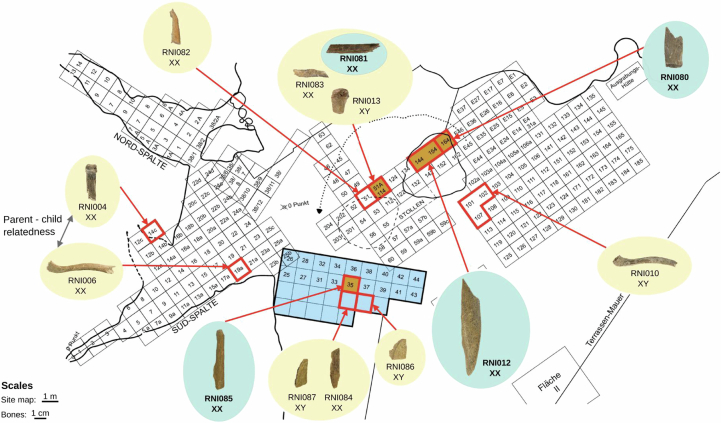
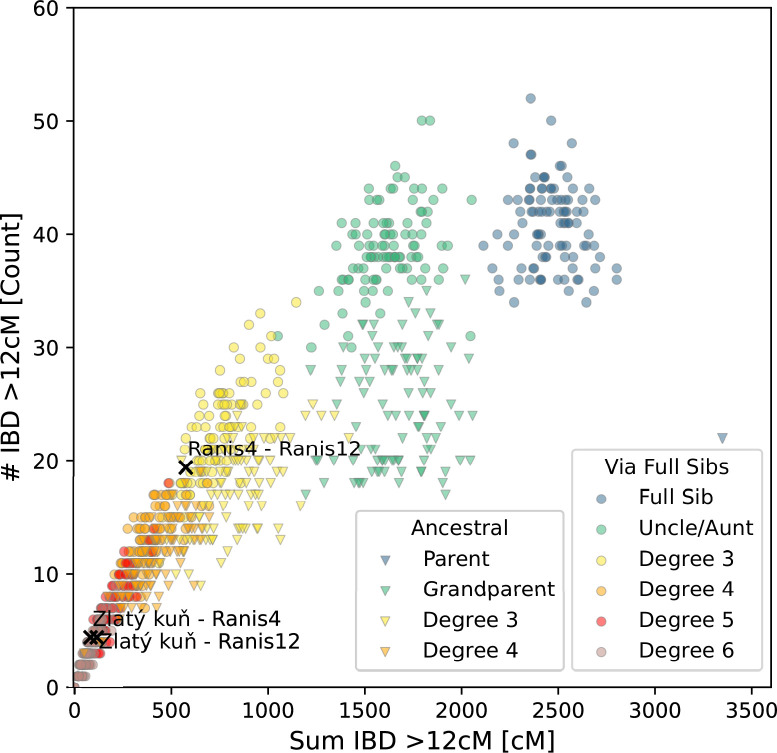
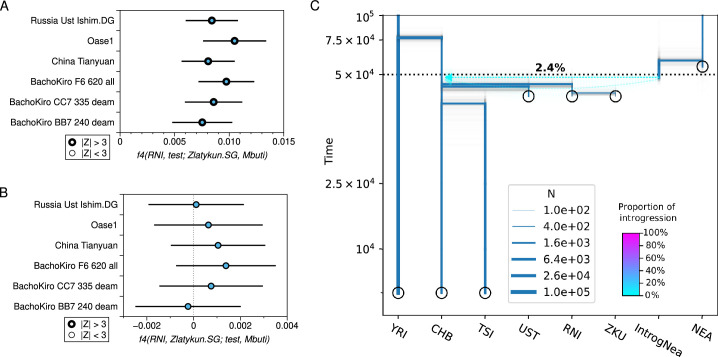
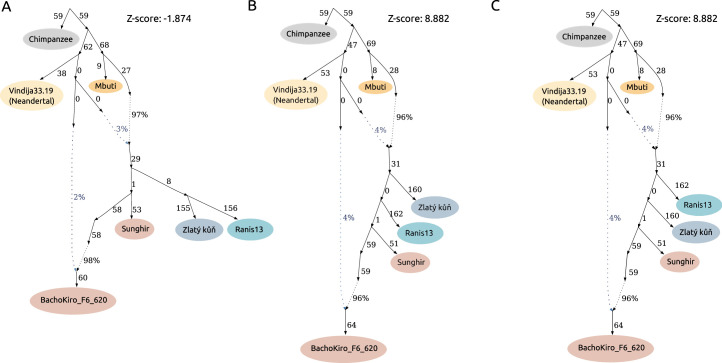
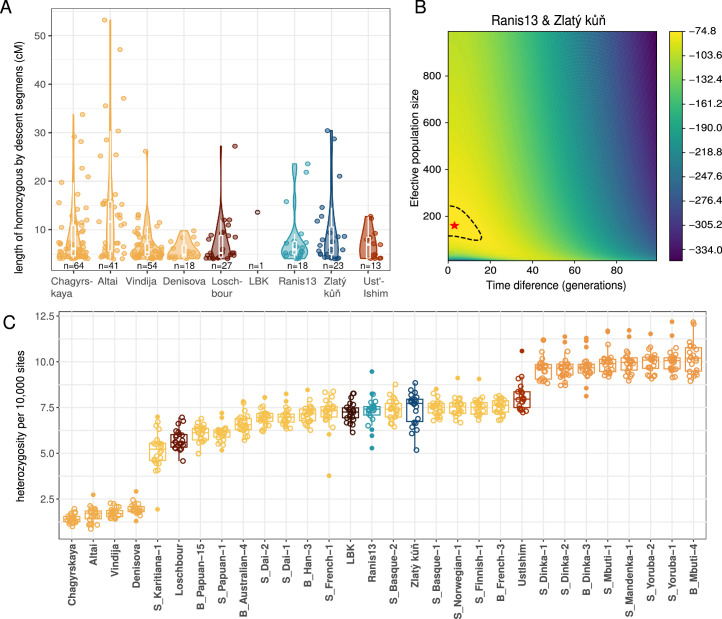
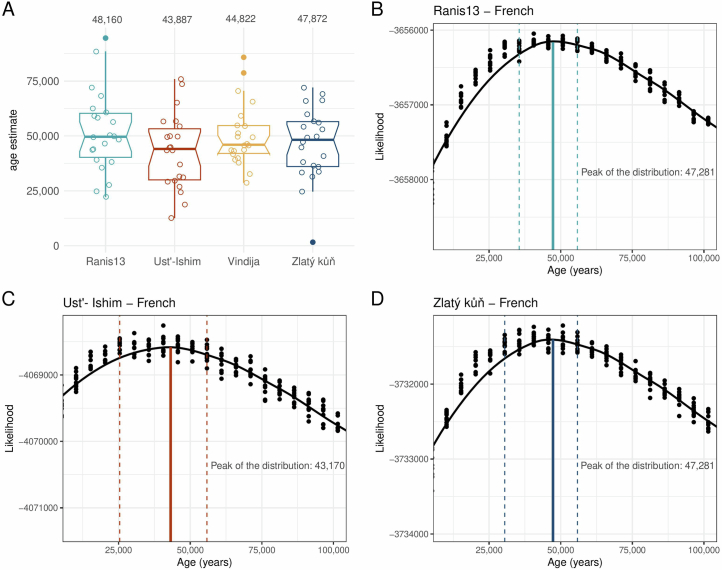
Modern humans arrived in Europe more than 45,000 years ago, overlapping at least 5,000 years with Neanderthals 1–4. Limited genomic data from these early modern humans have shown that at least two genetically distinct groups inhabited Europe, represented by Zlatý kůň, Czechia 3 and Bacho Kiro, Bulgaria 2. Here we deepen our understanding of early modern humans by analysing one high-coverage genome and five low-coverage genomes from approximately 45,000-year-old remains from Ilsenhöhle in Ranis, Germany 4, and a further high-coverage genome from Zlatý kůň. We show that distant familial relationships link the Ranis and Zlatý kůň individuals and that they were part of the same small, isolated population that represents the deepest known split from the Out-of-Africa lineage. Ranis genomes harbour Neanderthal segments that originate from a single admixture event shared with all non-Africans that we date to approximately 45,000–49,000 years ago. This implies that ancestors of all non-Africans sequenced so far resided in a common population at this time, and further suggests that modern human remains older than 50,000 years from outside Africa represent different non-African populations.
Overview
The claims and statistics of this paper haven’t been checked yet.
Free: it reads the open-access text and checks the first 5 claims that cite a source we can check. Create a free account to check every claim.
Integrity signals
Registry
Cites
Statistics
Figures
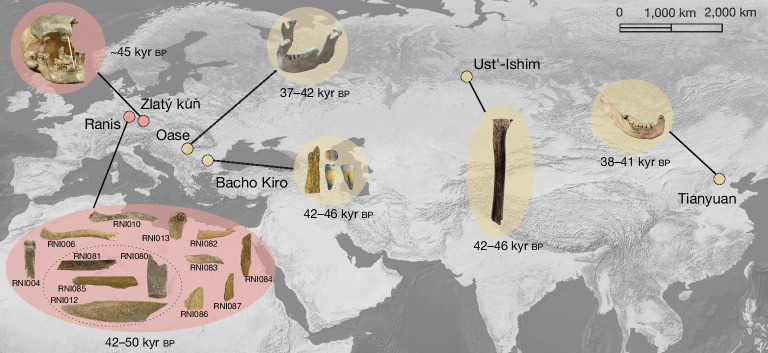
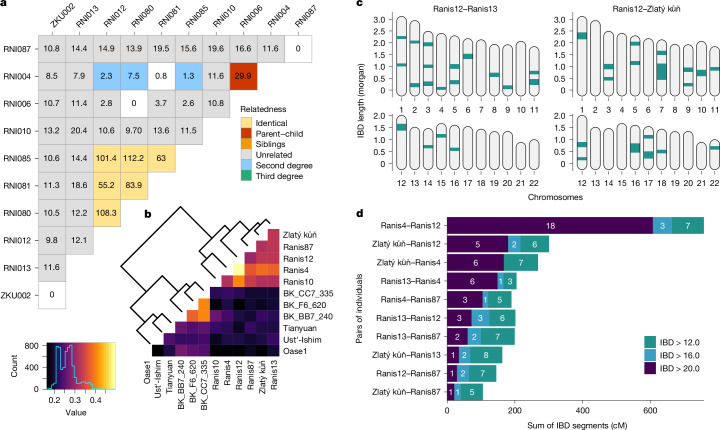
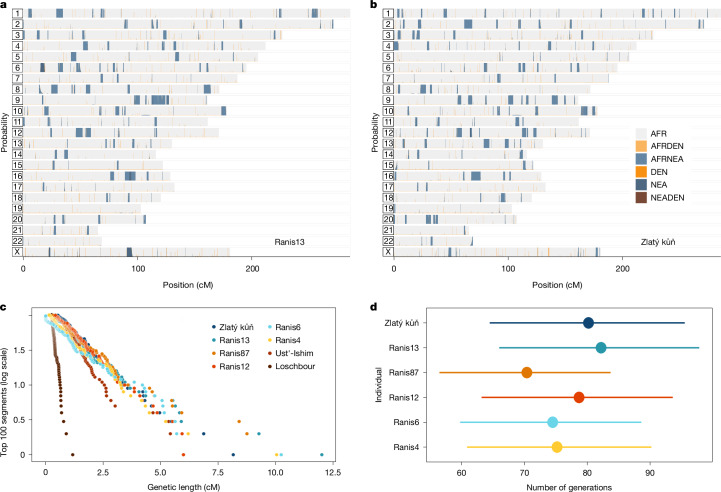
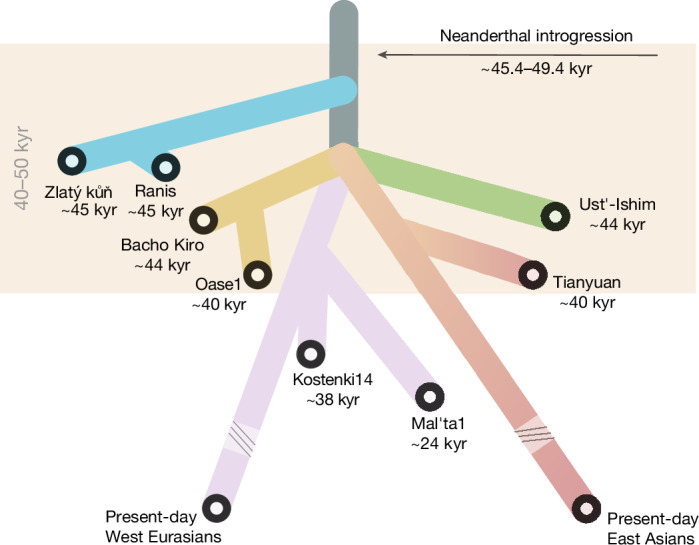
Verification
Claims the paper makes
The claims and statistics of this paper haven’t been checked yet.
Free: it reads the open-access text and checks the first 5 claims that cite a source we can check. Create a free account to check every claim.
Claims other papers make about this one
Each is checked against this paper’s own text: does it say what the citing paper says it does?
The check wasn’t confident either way, so it gives no verdict — never disputed.
In the citing paper
“Population Z separated from XYND 1-3 Ma ago in the reconstruction of Fan et al. 7 , ∼ 1.5 Ma in that of Cousins et al. 3 , over 500 ka in that of Zhang et al. 32 and 1.3 Ma (95% CI: 1.181-1.428) in ours, assuming generations of 29 y.”
From The Genetic Legacy of Introgression from Two Deeply Divergent Lineages in the Genus Homo (2026) · cites this paper as [32]
Experimental — accuracy not yet measured
Self-check
Percentages, sums and reported differences re-computed from the paper’s own numbers.
The self-check needs the paper’s full text.
Citations
Cites
The Sequence Alignment/Map format and SAMtools
Li, H., Handsaker, B., Wysoker, A., Fennell, T., Ruan, J., Homer, N., Marth, G., Abecasis, G., Durbin, R., & 1000 Genome Project Data Processing Subgroup (2009) · Bioinformatics · doi:10.1093/bioinformatics/btp352 · Cited by 62,041
Fast and accurate short read alignment with Burrows-Wheeler transform
Li, H., & Durbin, R. (2009) · Bioinformatics · doi:10.1093/bioinformatics/btp324 · Cited by 58,607
Fast gapped-read alignment with Bowtie 2
Langmead, B., & Salzberg, S. L. (2012) · Nature Methods · doi:10.1038/nmeth.1923 · Cited by 56,400
The Genome Analysis Toolkit: A MapReduce framework for analyzing next-generation DNA sequencing data
McKenna, A., Hanna, M., Banks, E., Sivachenko, A., Cibulskis, K., Kernytsky, A., Garimella, K., Altshuler, D., Gabriel, S., Daly, M., et al. (2010) · Genome Research · doi:10.1101/gr.107524.110 · Cited by 27,895
BEDTools: a flexible suite of utilities for comparing genomic features
Quinlan, A. R., & Hall, I. M. (2010) · Bioinformatics · doi:10.1093/bioinformatics/btq033 · Cited by 27,437
Tandem repeats finder: a program to analyze DNA sequences
Benson, G. (1999) · Nucleic Acids Research · doi:10.1093/nar/27.2.573 · Cited by 9,374 · cited 1×
“Following previous approaches 6,27,32 , we applied further filters to remove sites that fall within the 2.5% extremes of the GC-corrected coverage distribution, and removed tandem repeats 59 and sites called as indels.”
InfluentialAncient Admixture in Human History
Patterson, N., Moorjani, P., Luo, Y., Mallick, S., Rohland, N., Zhan, Y., Genschoreck, T., Webster, T., & Reich, D. (2012) · Genetics · doi:10.1534/genetics.112.145037 · Cited by 2,848 · cited 12×
“3) (Supplementary Information 17).”
InfluentialInference of human population history from individual whole-genome sequences
Li, H., & Durbin, R. (2011) · Nature · doi:10.1038/nature10231 · Cited by 2,590 · cited 3×
“Several measures can be informative about the effective population sizes, corresponding to the number of breeding individuals per generation, at different times in an individual’s past 25,26 .”
The complete genome sequence of a Neanderthal from the Altai Mountains
Prüfer, K., Racimo, F., Patterson, N., Jay, F., Sankararaman, S., Sawyer, S., Heinze, A., Renaud, G., Sudmant, P. H., de Filippo, C., et al. (2014) · Nature · doi:10.1038/nature12886 · Cited by 2,254
Self-citationA high-coverage genome sequence from an archaic denisovan individual
Meyer, M., Kircher, M., Gansauge, M.-T., Li, H., Racimo, F., Mallick, S., Schraiber, J. G., Jay, F., Prüfer, K., de Filippo, C., et al. (2012) · Science · doi:10.1126/science.1224344 · Cited by 1,967
Self-citation
Research works printed but not linked: 1
- Ringbauer, H. et al. Accurate detection of identity-by-descent segments in human ancient DNA. Nat. Genet. 56, 143–151 (2024). 38123640 PMC10786714 · DOI · Paper page
Cited by
Yuan, Y., Yu, L.-L., Bi, C., Huang, L., Su, B., Nie, J., Dou, Z., Yang, S., & Li, Y. (2025) · Chinese Medicine · doi:10.1186/s13020-025-01075-4 · Cited by 47
Major expansion in the human niche preceded out of Africa dispersal
Hallett, E. Y., Leonardi, M., Cerasoni, J. N., Will, M., Beyer, R. M., Krapp, M., Kandel, A. W., Manica, A., & Scerri, E. M. L. (2025) · Nature · doi:10.1038/s41586-025-09154-0 · Cited by 42
A high-coverage genome from a 200,000-year-old DenisovanPreprint
Peyrégne, S., Massilani, D., Swiel, Y., Boyle, M. J., Iasi, L. N. M., Sümer, A. P., Mesa, A. B., de Filippo, C., Viola, B., Essel, E., et al. (2025) · bioRxiv (Cold Spring Harbor Laboratory) · doi:10.1101/2025.10.20.683404 · Cited by 37
Self-citationCosnefroy, Q., Crevecoeur, I., Semal, P., Hajdinjak, M., Mesa, A. B., Krause, J., Gnecchi-Ruscone, G., Posth, C., Bocherens, H., Devièse, T., et al. (2025) · Scientific Reports · doi:10.1038/s41598-025-24460-3 · Cited by 7
“Indeed, even if Homo sapiens groups are not (yet) documented in the region at the same time as Neandertals are at Goyet, they are present roughly contemporaneously at Ranis, Germany, about 600 km to the east 80–82 .”
Self-citationXiong, Z., Li, Y., Liu, X., Lu, H., Hysi, P. G., Pardo, L. M., Uitterlinden, A. G., Rivadeneira, F., Ikram, M. A., Ghanbari, M., et al. (2025) · Nature Communications · doi:10.1038/s41467-025-61761-7 · Cited by 16
“The Vindija sample is expected to be the best representative of the introgression population, as suggested by Reilly et al. 12 and recent studies have proposed a narrow time range (~45 – 49 kya BP) for the introgression period 70,71 .”
Genomic evidence supports the “long chronology” for the peopling of Sahul
Gandini, F., Almeida, M., Foody, M. G. B., Nagle, N., Bergström, A., Olivieri, A., Rodrigues, S., Fichera, A., Oteo‐García, G., Torroni, A., et al. (2025) · Science Advances · doi:10.1126/sciadv.ady9493 · Cited by 17
“On the other hand, recent estimates using recombinational dating, based on introgressed Neanderthal segments in Upper Paleolithic modern humans, imply dates as low as ~ 40 ka ( 39 , 40 ).”
Interbreeding between Neanderthals and modern humans was strongly sex biased
Platt, A., Harris, D., & Tishkoff, S. A. (2026) · Science · doi:10.1126/science.aea6774 · Cited by 11
Genetic diversity of late Neanderthals in northwestern Europe
Mesa, A. B., Essel, E., Peyrégne, S., Sümer, A. P., Iasi, L. N. M., Heide, C., Popli, D., de Filippo, C., Gansauge, M.-T., Gerullat, L., et al. (2026) · Nature · doi:10.1038/s41586-026-10625-1 · Cited by 9
“We found that most of the newly reconstructed mtDNA genomes fall within a large clade consisting of late Neanderthals from southern and western Europe, as well as Mezmaiskaya 2 from Russia 34 (Fig.”
InfluentialSelf-citationBone Adhered Sediments as a Source of Target and Environmental DNA and Proteins
de-Dios, T., Bonucci, B., Barbieri, R., Kushniarevich, A., D’Atanasio, E., Dittmar, J. M., Cessford, C., Solnik, A., Robb, J., Warinner, C., et al. (2025) · Molecular Biology and Evolution · doi:10.1093/molbev/msaf202 · Cited by 6
Galtier, A., Warinner, C., & Velsko, I. M. (2026) · Genome Biology and Evolution · doi:10.1093/gbe/evag136 · Cited by 7
Ex Oriente Lux? A quantitative comparison between northern Ahmarian and Protoaurignacian
Falcucci, A., & Kuhn, S. L. (2025) · Journal of Human Evolution · doi:10.1016/j.jhevol.2025.103744 · Cited by 6
Recent DNA Studies Question a 65 kya Arrival of Humans in Sahul
Allen, J., & O’Connell, J. F. (2025) · Archaeology in Oceania/Archæology & physical anthropology in Oceania · doi:10.1002/arco.70002 · Cited by 6
Bon, C. (2025) · médecine/sciences · doi:10.1051/medsci/2025042 · Cited by 5
Not Just N e N e -More: New Applications for SMC from Ecology to Phylogenies
Peede, D., Cousins, T., Durvasula, A., Ignatieva, A., Kovacs, T. G. L., Nieto, A., Puckett, E. E., & Chevy, E. T. (2025) · Genome Biology and Evolution · doi:10.1093/gbe/evaf229 · Cited by 7
Bachellerie, F., Gravina, B., Rigaud, S., Dayet, L., Thomas, M., Lebreton, L., Morin, E., Lesage, C., Falguères, C., Bard, É., et al. (2025) · Proceedings of the National Academy of Sciences · doi:10.1073/pnas.2508014122 · Cited by 5
“Associated with different initial or early Upper Paleolithic techno - complexes, during a period when Neanderthal groups were still present (i.e. between 55 - 42 ka) (1, 104–107), these events potentially involved intragroup interactions with varying degrees of intensity (1, 108, 109).”
Self-citationAmos, W., & Elhaik, E. (2025) · bioRxiv (Cold Spring Harbor Laboratory) · doi:10.1101/2024.12.31.630954 · Cited by 4
Recent advances in methods to characterize archaic introgression in modern humans
Peede, D., Bañuelos, M. M., Tretmanis, J. M., Miyagi, M., & Huerta‐Sánchez, E. (2026) · Genome Research · doi:10.1101/gr.278993.124 · Cited by 5
“…Steinrücken et al. 2018; Jacobs et al. 2019; Villanea and Schraiber 2019; Massilani et al. 2020; Carlhoff et al. 2021; Choin et al. 2021; Iasi et al. 2021; Larena et al. 2021; Yuan et al. 2021; Chintalapati et al. 2022; Iasi et al. 2024; Li et al. 2024; Kerdoncuff et al. 2025; Sümer et al. 2025).”
Evidence from Buhais Rockshelter for human settlement in Arabia between 60,000 and 16,000 years ago
Bretzke, K., Kim, S., Jasim, S. A., Yousif, E., Preusser, F., Preston, G. W., Pallottino, F., & Parker, A. G. (2026) · Nature Communications · doi:10.1038/s41467-026-70681-z · Cited by 4
Ancient human genomes offer clues about the earliest migrations out of Africa
Martinón‐Torres, M., & Lalueza‐Fox, C. (2025) · Nature · doi:10.1038/d41586-025-00182-4 · Cited by 3
Goovaerts, S., Devine, J., Claessens, N., Gabbita, S., Deprest, J., Pauwels, K., Herrick, N., Mohammed, J., Mounier, A., Sofer, T., et al. (2025) · bioRxiv (Cold Spring Harbor Laboratory) · doi:10.64898/2025.12.29.696848 · Cited by 3
Zhou, Y., Lan, X., Shen, Z., Yang, R., Li, D., Guibert, J., Pérez-Balarezo, A., Zeitoun, V., & Forestier, H. (2025) · L Anthropologie · doi:10.1016/j.anthro.2025.103406 · Cited by 2
Pathways at the Iberian crossroads: Dynamic modeling of the middle–upper paleolithic transition
Shao, Y., Klein, K. M., Wegener, C., & Weniger, G. (2025) · PLoS ONE · doi:10.1371/journal.pone.0339184 · Cited by 3
“Genomic and anthropological evidence confirms interbreeding between NEAs and AMHs in regions such as southwestern Asia and eastern Europe [15,16,27–29], but whether such interactions occurred on the Iberian Peninsula remains uncertain.”
InfluentialA stable environmental niche for humans in the southern Levant 70–40 ka
Abbas, M., Lai, Z., Tu, H., Ou, X., Carling, P. A., Lin, P., Alqudah, M., Al-Saqarat, B., Qiu, T., Petraglia, M. D., et al. (2026) · Quaternary Science Reviews · doi:10.1016/j.quascirev.2026.109855 · Cited by 5
Blinkhorn, J., Groucutt, H. S., Carleton, W. C., Andrieux, E., Armitage, S. J., Shipton, C., Breeze, P. S., Drake, N., Al-Omari, A., Al‐Jibreen, F., et al. (2026) · Quaternary Science Reviews · doi:10.1016/j.quascirev.2026.110196 · Cited by 3
Increased signaling of the Neanderthal growth hormone receptor
Kanis, P., Berreiter, M., Sieme, D., Wootton, O., Ju, X.-C., Holzwart, N. E., Hu, D. Z., Tadaka, S., Taira, M., Kinoshita, K., et al. (2026) · Current Biology · doi:10.1016/j.cub.2026.07.025 · Cited by 3
Self-citationThe Neanderthal population history and the introgression landscape inferred from the UK BiobankPreprint
Morez, A., Soltantouyeh, A., Zeloni, R., Carollo, F., Mezzavilla, M., Marnetto, D., & Pagani, L. (2026) · bioRxiv (Cold Spring Harbor Laboratory) · doi:10.64898/2026.04.03.716297 · Cited by 2
Human evolution, migration, and adaptation in the Last Glacial environments
Fu, Q. (2025) · Chinese Science Bulletin (Chinese Version) · doi:10.1360/csb-2025-5524 · Cited by 2
Piccirilli, E., Sorrentino, R., Seghi, F., Vazzana, A., Belcastro, M. G., Talamo, S., Harvati, K., Bettuzzi, M., Morigi, M. P., Weber, G. W., et al. (2025) · American Journal of Biological Anthropology · doi:10.1002/ajpa.70188 · Cited by 1
Upper Paleolithic: Causes of the Middle Sapienses' Revolution
Rozov, N. S. (2026) · World-systems evolution and global futures · doi:10.1007/978-3-032-06466-0_17 · Cited by 1
Aguado, S., & Hernández, C. L. (2026) · Evolutionary Anthropology Issues News and Reviews · doi:10.1002/evan.70025 · Cited by 1
“Some crucial events inferred using those reference panels include large‐ scale migrations and local gene flow, interbreeding with archaic hominins, inbreeding in population isolates or natural selection effects in populations inhabiting specific environments ([118–123], among many others).”
Burke, A. M., Pomeroy, E., Poisot, T., Albouy, B., & Paquin, S. (2026) · Quaternary Science Reviews · doi:10.1016/j.quascirev.2026.109850 · Cited by 3
Lithic Miniaturization Provides a Signature of an MIS4‐3 Southern Dispersal of Homo sapiens
Shipton, C. (2026) · Evolutionary Anthropology Issues News and Reviews · doi:10.1002/evan.70027 · Cited by 1
Ancient DNA and Human Physiology
Bayarsaikhan, M., Boyle, M. J., Demers, P., Habeck, E. W., IV, Bonczarowska, J. H., Silverman, S., & Massilani, D. (2026) · Physiology · doi:10.1152/physiol.00047.2025 · Cited by 1
Revolution, modernity, and the dispersal of Homo sapiens beyond Africa
Groucutt, H. S. (2026) · Quaternary Science Reviews · doi:10.1016/j.quascirev.2026.109981 · Cited by 1
Martin, N., Velemínský, P., Urciuoli, A., Varadzinová, L., Honegger, M., Ambrose, S. H., Antoine, D. J., Brandt, S. A., Brůžek, J., Cauliez, J., et al. (2026) · Nature Communications · doi:10.1038/s41467-026-76423-5 · Cited by 2
Self-citationZollikofer, C. P. E., de León, M. S. P., Uriarte, M. H., López-Martínez, M., Ortega, J., Kondo, O., Akazawa, T., & WALKER, M. J. (2026) · Proceedings of the National Academy of Sciences · doi:10.1073/pnas.2535303123 · Cited by 1
“Ancient DNA analyses indicate several periods of interaction and hybridization between Neanderthal and early modern human populations, spanning several millennia and leaving enduring genomic traces in present - day humans (73–75).”
Neanderthals and humans interbred more recently than scientists thought
Kreier, F. (2024) · Nature · doi:10.1038/d41586-024-04065-y · Cited by 1
Ferrando-Bernal, M., & Capra, J. A. (2026) · bioRxiv (Cold Spring Harbor Laboratory) · doi:10.64898/2026.09.06.747930 · Cited by 1
The Genetic Legacy of Introgression from Two Deeply Divergent Lineages in the Genus Homo
Rogers, A. R., Islam, M. T., Brand, C. M., & Webster, T. H. (2026) · bioRxiv · doi:10.64898/2026.03.22.713509
“This separation probably happened about 50 ka ago, a date supported both by archaelogical and genetic data [e.g. 13, 32].”
Hublin, J., & Savatier, F. (2025) · Pour la Science · doi:10.3917/pls.569.0060
Self-citationAncient DNA reveals ancient kinship and social structures
Qi, Y., Yin, Z., & Wang, K. (2025) · Chinese Science Bulletin (Chinese Version) · doi:10.1360/csb-2025-0332
Do Recent DNA Studies Refute a 65 kya Arrival of Humans in Sahul?
Veth, P., Matisoo‐Smith, L., Brumm, A., Groucutt, H. S., & Scerri, E. M. L. (2025) · Archaeology in Oceania/Archæology & physical anthropology in Oceania · doi:10.1002/arco.70005
Allen, J., & O’Connell, J. F. (2025) · Archaeology in Oceania/Archæology & physical anthropology in Oceania · doi:10.1002/arco.70004
Villalba‐Mouco, V., & Sümer, A. P. (2025) · Cell · doi:10.1016/j.cell.2025.06.043
Self-citationLe Paléolithique moyen à l’est de la Mer Noire
Otte, M. (2025) · L Anthropologie · doi:10.1016/j.anthro.2025.103387
The Early Upper Palaeolithic in British caves: problems and potential
Dinnis, R. (2025) · Journal of the Royal Anthropological Institute · doi:10.1111/1467-9655.14313
Les groupes sanguins d’Homo sapiens éclairent les raisons de son succès évolutif
Mazières, S. (2025) · The Conversation · doi:10.64628/aak.eytxf9wac
Vázquez‐Coto, D., Clemente, M. M. G., Hermida-Valverde, T., Albaiceta, G. M., Amado‐Rodríguez, L., Vega-Prado, L. M., García-Lago, C., Herrero, P., Martínez-Borra, J., Lorca, R., et al. (2025) · Life · doi:10.3390/life15111733
“The comparison of the Human reference genome (NCBI build GRCh38/hg38) and the Neanderthal genome showed that currently living individuals of European ancestry harbor approximately 2–5% of Neanderthal-introgressed sequences [4–10].”
Laval, G., Decugis, A., Parasayan, O., Patin, É., Quintana‐Murci, L., & Chiaroni, J. (2025) · bioRxiv (Cold Spring Harbor Laboratory) · doi:10.64898/2025.12.25.695976
“…with an onset of selection in a time frame overlapping with the estimated ages of the Out-of-Arica dispersal of modern humans into Eurasia, 40-60 kya (Gravel et al. 2011; Malaspinas et al. 2016; Mallick et al. 2016; Bergstrom et al. 2020; Choin et al. 2021; Ragsdale et al. 2023; Sümer et al. 2025).”
Ramachandran, S., & Rosenberg, N. A. (2026) · Genetics · doi:10.1093/genetics/iyaf273 · Cited by 1
Tracing Neanderthal ancestry patterns through successive population expansions in Europe
Tsoupas, A., Quilodrán, C. S., Rio, J., & Currat, M. (2026) · Science Advances · doi:10.64898/2026.02.20.706963
Kim, K., Pfennig, A., Syed, S. A., Moskwa, N. L., Oliveira, N. A. D. J., Pham, Q.-M., Hallast, P., Yilmaz, F., McDonough, J. A., Norton, H., et al. (2026) · bioRxiv (Cold Spring Harbor Laboratory) · doi:10.64898/2026.03.18.712481
Canessa, T., & de la Peña, P. (2026) · PLoS ONE · doi:10.1371/journal.pone.0345202
“However, available evidence also suggests that these early dispersals constituted small, potentially isolated populations that left no genetic trace in later hunter-gatherer groups [2–4].”
Energetic-demographic thresholds for collective intelligence
Belter, P. (2026) · Biosystems · doi:10.2139/ssrn.6553446 · Cited by 1
Imputation and Maximum Likelihood Haplotype Refinement of Simulated Ancient Mitochondrial GenomesPreprint
Plummer, N., Cozzarelli, A., Ghafoor, S., Murray, N. J., Shamoon‐Pour, M., Spake, L., & Emery, M. V. (2026) · Research Square · doi:10.21203/rs.3.rs-9406784/v1
Rmoutilová, R., Malá, P. Z., Thottungal, R. R., Daynes, E., Dupej, J., Kleisner, K., Pokorný, Š., Velemínský, P., Brůžek, J., & Velemínská, J. (2026) · npj Heritage Science · doi:10.1038/s40494-026-02612-6
“Such a reconstruction was fi nalized with skin texture and implantation of natural hair, providing a hyperrealistic appearanceofskinandcoloration 58,61 involvingscienti fi cevidenceaboutZK dark eyes, hair, and skin 26,27 .”
InfluentialSelf-citationKern, O. A., Dallmeyer, A., Maier, A., Schlüter, P., Vogel, A., & Vercauteren, N. (2026) · Journal of Quaternary Science · doi:10.1002/jqs.70134 · Cited by 1
The reliability of inferred archaic segments
Bird, N., Walker, E., & Hellenthal, G. (2026) · Human Population Genetics and Genomics · doi:10.47248/hpgg2606020007
Recent progress in studies of the last million years of human physical and behavioural evolution
Cole, J., Scerri, E. M. L., Hajdinjak, M., & Stringer, C. B. (2026) · Journal of the Royal Anthropological Institute · doi:10.1111/1467-9655.70141
Self-citationDer moderne Mensch: Homo sapiens
Graw, J. (2026) · Springer eBooks · doi:10.1007/978-3-662-72246-6_3
Mitotree: The Universal Human Mitochondrial Reference Phylogeny at 10× the ResolutionPreprint
Maier, P. A., Runfeldt, G., Estes, R. J., Goloboff, P. A., Detsikas, J., Burke, A. M., Sager, M. T., & Vilar, M. G. (2026) · bioRxiv (Cold Spring Harbor Laboratory) · doi:10.64898/2026.05.28.728540 · Cited by 1
Regulation of NAT1 activity in modern humans by a novel phosphorylation site
Fast, L., Alberro, M. L., Rakava, E., Ågren, R., Riesenberg, S., Huttner, W. Β., Kelso, J. F., Pääbo, S., & Zeberg, H. (2026) · Science Advances · doi:10.1126/sciadv.ady1666
Self-citationKaharudin, H. A. F., O’Connor, S., & Kealy, S. (2026) · Journal of Archaeological Research · doi:10.1007/s10814-026-09224-5
Limited Selection on Neanderthal DNA in 30,780 Recently Admixed Genomes with African-like Ancestry
Pfennig, A., & Lachance, J. (2026) · Molecular Biology and Evolution · doi:10.1093/molbev/msag136
Jarl, J., Blinnikov, M., Lordkipanidze, D., Smith, A., Tushabramishvili, N., & Adler, D. S. (2026) · Palaeogeography Palaeoclimatology Palaeoecology · doi:10.1016/j.palaeo.2026.113990
Investigating ancient human DNA preservation on cave walls and in rock art
Mesa, A. B., Essel, E., Jáuregui, L., Galtier, A., Zavala, E. I., Nota, K., Szymanski, M., Zorn, J., Gomes, H., Nash, G., et al. (2026) · Nature Communications · doi:10.1038/s41467-026-74234-2
Self-citationThe Evolution of Molecular Clocks: Concepts, Calibrations, and Challenges
Soares, P. A., & Rito, T. (2026) · Biology · doi:10.3390/biology15151329
Sümer, A. P., Iasi, L. N. M., Mesa, A. B., Slon, V., Essel, E., Hajdinjak, M., Zorn, J., Schmidt, A., Nagel, S., Nickel, B., et al. (2026) · bioRxiv (Cold Spring Harbor Laboratory) · doi:10.64898/2026.08.10.743885
“Because males and females carry different numbers of X-chromosomes, this ratio can be used to determine the sex of the individual 53 .”
Self-citationMicroevolution of human toll-like receptors in central Asia during Bronze and Iron ages
Clements-Copeland, N. S., Glantz, M., Villanea, F., Pante, M., & Montgomery, T. (2026) · doi:10.25675/3.027346
The Dentition of the Aurignacian Mandible Les Rois 2, France: New Data and Taxonomic Reassessment
de Beauchaine, J. I., Becam, G., Détroit, F., Rozzi, F. V. R., Grimaud-Hervé, D., & Verna, C. (2026) · American Journal of Biological Anthropology · doi:10.1002/ajpa.70354
Neanderthal Teeth: Morphology, Development, and Significance//
Panov, V. (2026) · Journal of Medical and Dental Practice · doi:10.18044/medinform.2026132.2440
Garcia-Calleja, J., Fortes‐Lima, C., Macià, M. C., Lao, Ó., & Bosch, E. (2026) · bioRxiv (Cold Spring Harbor Laboratory) · doi:10.64898/2026.09.23.753770
“Neanderthal admixture out of Africa was set to 0.02 at 47 kya 15,72 .”
InfluentialHominin dispersals: causes, conditions, and outcomes
Foley, R., & Lahr, M. M. (2026) · Journal of the Royal Anthropological Institute · doi:10.1111/1467-9655.70215
Tasarımın semantik gücü: Mizanpaj üzerinden inceleme
Aksaray, M. E. (2025) · Yildiz Technical University - AVESIS
Cultural and social drivers of human genetic variation
Platt, A., & Tishkoff, S. A. (2026) · Clinical and Translational Medicine · doi:10.1002/ctm2.70883
Quantifying the human-environment interaction in the northern European Upper Palaeolithic
Böckenförde, T. (2026) · Quaternary Environments and Humans · doi:10.1016/j.qeh.2026.100126
Metadata
- Authors
- Sümer, A. P., Rougier, H., Villalba-Mouco, V., Huang, Y., Iasi, L. N. M., Essel, E., Bossoms Mesa, A., Furtwaengler, A., Peyrégne, S., de Filippo, C., Rohrlach, A. B., Pierini, F., Mafessoni, F., Fewlass, H., Zavala, E. I., Mylopotamitaki, D., Bianco, R. A., Schmidt, A., Zorn, J., Nickel, B., Patova, A., Posth, C., Smith, G. M., Ruebens, K., Sinet-Mathiot, V., Stoessel, A., Dietl, H., Orschiedt, J., Kelso, J., Zeberg, H., Bos, K. I., Welker, F., Weiss, M., McPherron, S. P., Schüler, T., Hublin, J.-J., Velemínský, P., Brůžek, J., Peter, B. M., Meyer, M., Meller, H., Ringbauer, H., Hajdinjak, M., Prüfer, K., & Krause, J.
- Affiliations
- Max Planck Institute for Evolutionary Anthropology (DE)
- California State University, Northridge (US)
- Weizmann Institute of Science (IL)
- The Francis Crick Institute (GB)
- Collège de France (FR)
- University of Tübingen (DE)
- Landesamt für Denkmalpflege und Archäologie Sachsen-Anhalt (DE)
- Karolinska Institutet (SE)
- University of Copenhagen (DK)
- Friedrich-Alexander-Universität Erlangen-Nürnberg (DE)
- Thüringer Landesamt für Denkmalpflege und Archäologie (DE)
- Centre National de la Recherche Scientifique (FR)
- National Museum (CZ)
- Charles University (CZ)
- Corresponding author
- Sümer, Arev P.
- Prüfer, Kay
- Krause, Johannes
- ORCID
- Sümer, Arev P.
- Rougier, Hélène
- Villalba-Mouco, Vanessa
- Huang, Yilei
- Iasi, Leonardo N. M.
- Essel, Elena
- Bossoms Mesa, Alba
- Peyrégne, Stéphane
- Rohrlach, Adam B.
- Pierini, Federica
- Mafessoni, Fabrizio
- Fewlass, Helen
- Zavala, Elena I.
- Mylopotamitaki, Dorothea
- Bianco, Raffaela A.
- Posth, Cosimo
- Smith, Geoff M.
- Ruebens, Karen
- Sinet-Mathiot, Virginie
- Stoessel, Alexander
- Orschiedt, Jörg
- Kelso, Janet
- Zeberg, Hugo
- Bos, Kirsten I.
- Welker, Frido
- Weiss, Marcel
- McPherron, Shannon P.
- Schüler, Tim
- Hublin, Jean-Jacques
- Velemínský, Petr
- Brůžek, Jaroslav
- Peter, Benjamin M.
- Meyer, Matthias
- Meller, Harald
- Ringbauer, Harald
- Hajdinjak, Mateja
- Prüfer, Kay
- Krause, Johannes
- Venue
- Nature
- Published
- 2024-12-12
- Volume
- 638
- Issue
- 8051
- Pages
- 711-717
- ISSN
- 0028-0836 (ISSN-L)
- 1476-4687
- PMC
- PMC11839475
- OpenAlex
- W4405302027
- Cited by
- 58
- References
- 66
- Citations by year
- 2026: 30 · 2025: 27 · 2024: 1
- FWCI
- 101.15
- Type
- journal article
- Language
- en
- Open access
- hybrid
- doi.org
- Licence
- cc-by
- creativecommons.org/licenses/by/4.0 (tdm)
- creativecommons.org/licenses/by/4.0 (vor)
- Locations
- Nature (publishedVersion, cc-by)
- PubMed Central (publishedVersion, cc-by)
- PubMed (publishedVersion)
- Research at the University of Copenhagen (University of Copenhagen) (publishedVersion, cc-by)
- CentAUR (University of Reading) (acceptedVersion)
- DIGITAL.CSIC (Spanish National Research Council (CSIC)) (acceptedVersion, other-oa)
- UCL Discovery (University College London) (submittedVersion)
- HAL (submittedVersion, cc-by)
- RePEc: Research Papers in Economics (submittedVersion)
- ArTS Archivio della ricerca di Trieste (University of Trieste https://www.units.it/) (submittedVersion, cc-by)
- MPG.PuRe (Max Planck Society) (submittedVersion, cc-by)
- Refubium (Universitätsbibliothek der Freien Universität Berlin) (submittedVersion, cc-by)
- Explore Bristol Research (submittedVersion, cc-by)
- Universitätsbibliothek der FU Berlin Hochschulschriftenstelle u. Dokumentenserver (cc-by)
- Funders
- Grantová Agentura České Republiky (GA23-06822S)
- Knut och Alice Wallenbergs Stiftelse
- Vetenskapsrådet
- Topics
- Social Sciences › Anthropology › Pleistocene-Era Hominins and Archaeology
- Life Sciences › Biochemistry, Genetics and Molecular Biology › Genetics › Forensic and Genetic Research
- Life Sciences › Biochemistry, Genetics and Molecular Biology › Genetics › Genetic diversity and population structure
- Keywords
- Neanderthal admixture
- MeSH terms
- DNA, Ancient, Human Genetics, Animals, Europe, Biological Evolution, Female, Fossils, Germany, Humans, Male, Phylogeny, Time Factors, Genome, Human, History, Ancient, Neanderthals, Human Migration
About these checks
Registry, retraction, Cites and statistics results are computed, not judged, with one exception: a printed reference that no index lists is read once by a model before it counts as a citation error. Claims are extracted by a model and kept only when their quote appears verbatim in the text; each cited source is then checked, with a model’s help, for whether it says what the claim relies on. Those verdicts can be wrong — read the claim’s quote and the cited source before relying on one.
Statistics and arithmetic are recomputed, not judged.
Confidence bands are shown only for fields calibrated on our annotated test set. None is calibrated yet, so no band is shown.
What counts as a claim ›How we measure confidence ›How we check this ›
Are you an author, or do you see a problem with this page? Request a review
Data sources
Bibliographic data: Semantic Scholar, OpenAlex, Crossref.
Contains information from the Semantic Scholar Academic Graph Datasets, made available under the ODC Attribution License (ODC-BY 1.0).
Semantic Scholar’s data is described in: Kinney, R., et al. (2023). The Semantic Scholar Open Data Platform. arXiv:2301.10140.
