

A foundation model to predict and capture human cognition
Open accessThe DOI matches its Crossref record; 67 of the 68 references it cites were found in a registry or an index.
Abstract
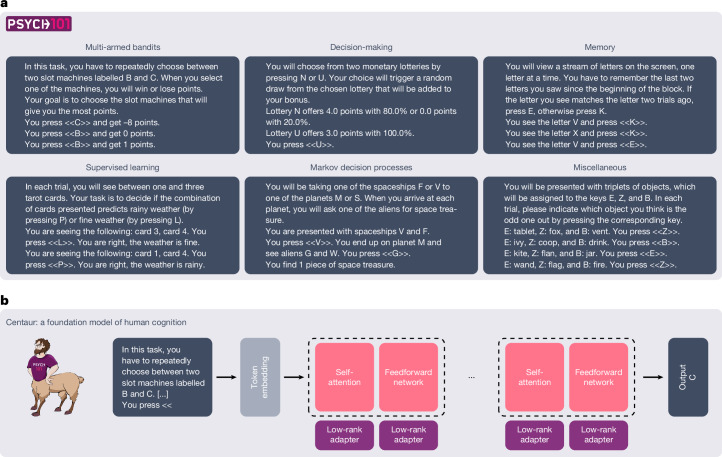
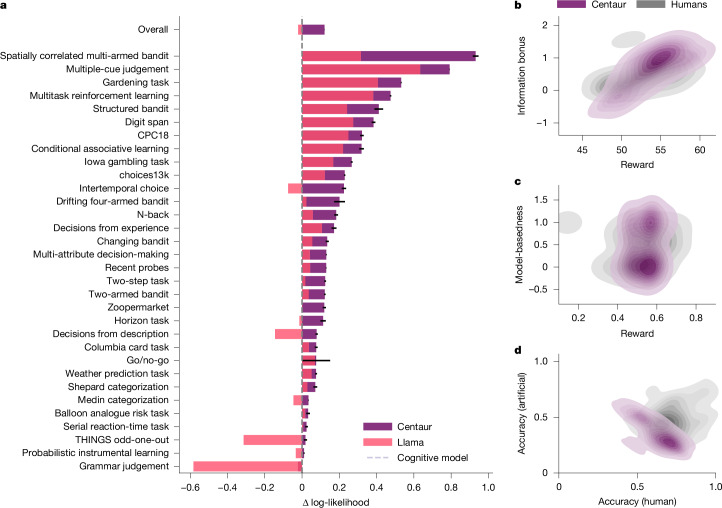
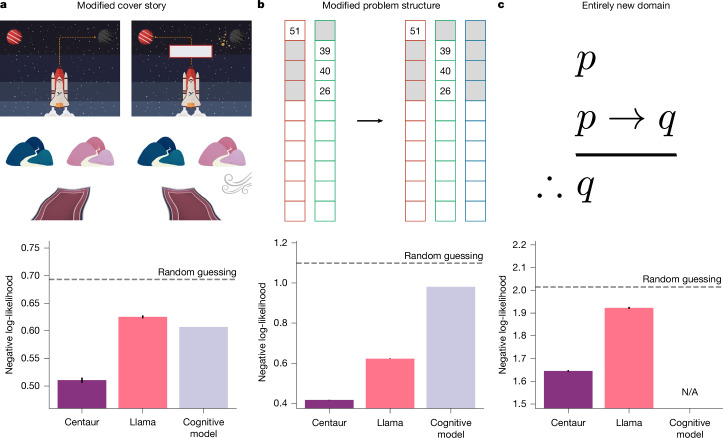
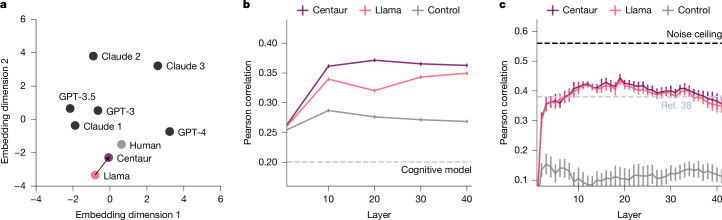
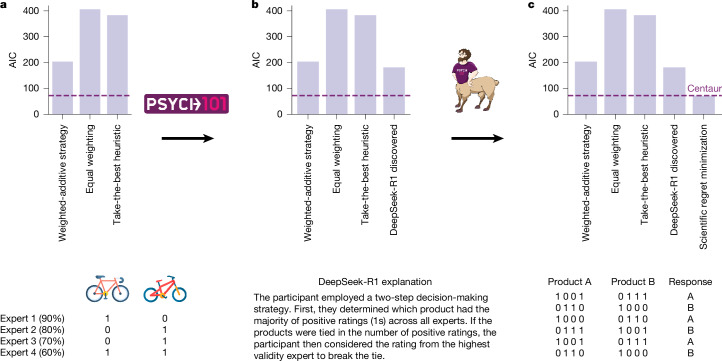
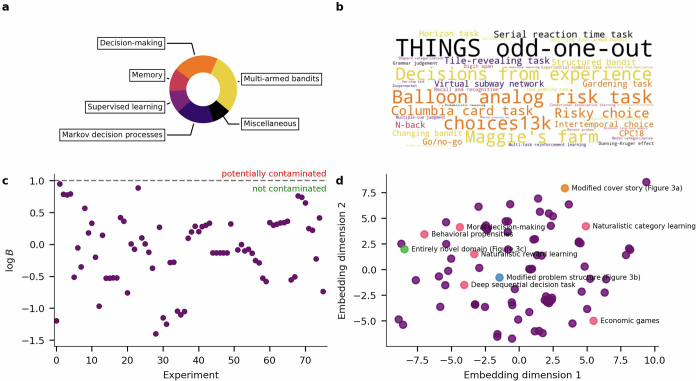
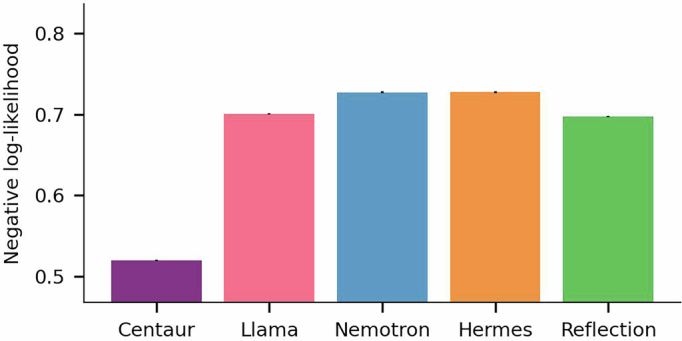
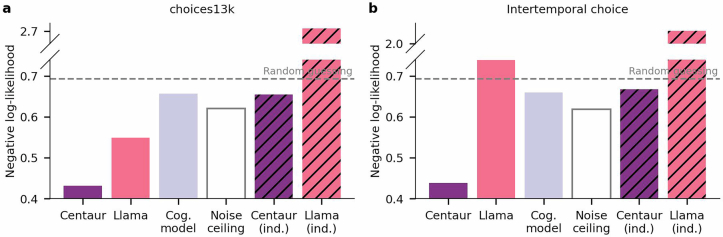
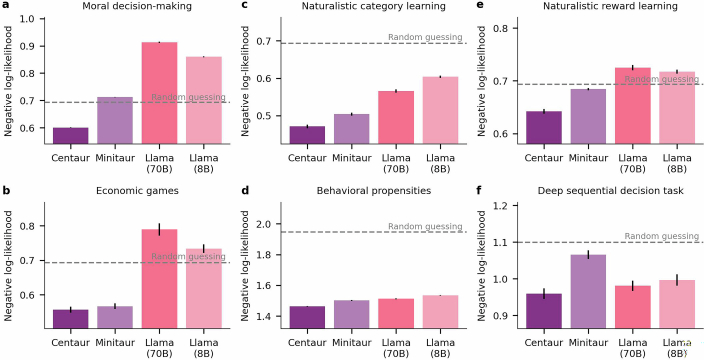
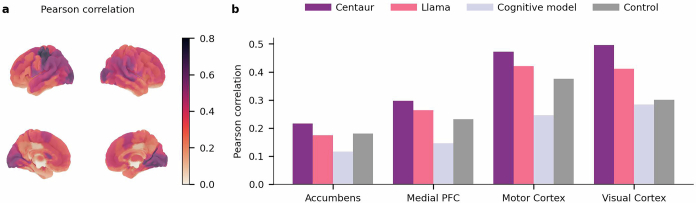
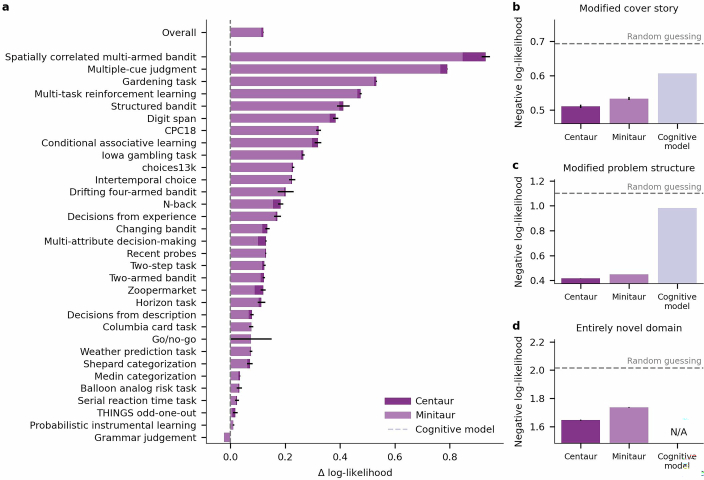
Establishing a unified theory of cognition has been an important goal in psychology 1,2 . A first step towards such a theory is to create a computational model that can predict human behaviour in a wide range of settings. Here we introduce Centaur, a computational model that can predict and simulate human behaviour in any experiment expressible in natural language. We derived Centaur by fine-tuning a state-of-the-art language model on a large-scale dataset called Psych-101. Psych-101 has an unprecedented scale, covering trial-by-trial data from more than 60,000 participants performing in excess of 10,000,000 choices in 160 experiments. Centaur not only captures the behaviour of held-out participants better than existing cognitive models, but it also generalizes to previously unseen cover stories, structural task modifications and entirely new domains. Furthermore, the model’s internal representations become more aligned with human neural activity after fine-tuning. Taken together, our results demonstrate that it is possible to discover computational models that capture human behaviour across a wide range of domains. We believe that such models provide tremendous potential for guiding the development of cognitive theories, and we present a case study to demonstrate this.
Overview
The claims and statistics of this paper haven’t been checked yet.
Free: it reads the open-access text and checks the first 5 claims that cite a source we can check. Create a free account to check every claim.
Integrity signals
Registry
Cites
Statistics
Figures
Verification
Claims the paper makes
The claims and statistics of this paper haven’t been checked yet.
Free: it reads the open-access text and checks the first 5 claims that cite a source we can check. Create a free account to check every claim.
Claims other papers make about this one
Each is checked against this paper’s own text: does it say what the citing paper says it does?
In the citing paper
“LLMs can produce outputs similar to those of humans in structured tasks (8), but the similarity concerns results, not the process.”
From The simulation of judgment in LLMs (2025) · cites this paper as [8]
Self-check
Percentages, sums and reported differences re-computed from the paper’s own numbers.
The self-check needs the paper’s full text.
Citations
Cites
Vaswani, A., Shazeer, N., Parmar, N., Uszkoreit, J., Jones, L., Gomez, A. N., Kaiser, L., & Polosukhin, I. (2017) · arXiv · doi:10.48550/arxiv.1706.03762 · Cited by 120,404
DeepSeek-R1: Incentivizing Reasoning Capability in LLMs via Reinforcement Learning
DeepSeek-AI, Guo, D., Yang, D., Zhang, H., Song, J., Wang, P., Zhu, Q., Xu, R., Zhang, R., Ma, S., et al. (2025) · arXiv · doi:10.48550/arxiv.2501.12948 · Cited by 18,918
Self-citationMastering the game of Go without human knowledge
Silver, D., Schrittwieser, J., Simonyan, K., Antonoglou, I., Huang, A., Guez, A., Hubert, T., Baker, L., Lai, M., Bolton, A., et al. (2017) · Nature · doi:10.1038/nature24270 · Cited by 9,084
The combination of estimates from different experiments
Cochran, W. G. (1954) · Biometrics · doi:10.2307/3001666 · Cited by 5,380 · cited 1×
“We performed an inverse-weighted meta-analysis 39 on the difference in correlations between Centaur and Llama, and this indicated that there was a significant benefit of fine-tuning when pooling across layers ( β = 0.007, 95% confidence interval [0.0002, 0.013], P = 0.045).”
InfluentialfMRIPrep: A robust preprocessing pipeline for functional MRI
Esteban, O., Markiewicz, C. J., Blair, R. W., Moodie, C. A., Isik, A. I., Erramuzpe, A., Kent, J. D., Goncalves, M., DuPre, E., Snyder, M., et al. (2019) · Nature Methods · doi:10.1038/s41592-018-0235-4 · Cited by 3,905 · cited 1×
“63).”
Local-global parcellation of the human cerebral cortex from intrinsic functional connectivity MRI
Schaefer, A., Kong, R., Gordon, E. M., Laumann, T. O., Zuo, X.-N., Holmes, A. J., Eickhoff, S. B., & Yeo, B. T. T. (2018) · Cerebral Cortex · doi:10.1093/cercor/bhx179 · Cited by 3,657 · cited 4×
“Reported Pearson correlation coefficients correspond to the average across all ROIs.”
InfluentialHenrich, J., Heine, S. J., & Norenzayan, A. (2010) · Nature · doi:10.1038/466029a · Cited by 3,441 · cited 1×
“Finally, although we have already included some cross-cultural and meta-studies 52–55 , the current iteration still has a strong bias towards a Western, educated, industrialized, rich and democratic (WEIRD) population 56 .”
Prospect Theory: An Analysis of Decision Under Risk
Kahneman, D., & Tversky, A. (2013) · World Scientific Handbook in Financial Economics Series · doi:10.1142/9789814417358_0006 · Cited by 3,091
Human-level concept learning through probabilistic program induction
Lake, B. M., Salakhutdinov, R., & Tenenbaum, J. B. (2015) · Science · doi:10.1126/science.aab3050 · Cited by 2,817
On the Opportunities and Risks of Foundation Models
Bommasani, R., Hudson, D. A., Adeli, E., Altman, R., Arora, S., von Arx, S., Bernstein, M. S., Bohg, J., Bosselut, A., Brunskill, E., et al. (2021) · arXiv · doi:10.48550/arxiv.2108.07258 · Cited by 2,676
Research works printed but not linked: 9
- 1. Anderson, J. The Architecture of Cognition (Harvard Univ. Press, 1983).
- 2. Newell, A. Unified Theories of Cognition (Harvard Univ. Press, 1990).
- 13. Binz, M. & Schulz, E. Turning large language models into cognitive models. In Proc. 12th International Conference on Learning Representations (ICLR, 2024).
- 16. Dettmers, T., Pagnoni, A., Holtzman, A. & Zettlemoyer, L. QLORA: efficient finetuning of quantized LLMs. In Proc. Advances in Neural Information Processing Systems 36 (eds Oh, A. et al.) (NeurIPS, 2023).
- 29. Demircan, C. et al. Evaluating alignment between humans and neural network representations in image-based learning tasks. In Proc. Advances in Neural Information Processing Systems 37 (eds Globerson, A. et al.) (NeurIPS, 2024).
- 34. Kipnis, A., Voudouris, K., Schulze Buschoff, L. M. & Schulz, E. metabench -a sparse benchmark of reasoning and knowledge in large language models. In Proc. 13th International Conference on Learning Representations (ICLR, 2025).
- 48. Huben, R., Cunningham, H., Smith, L. R., Ewart, A. & Sharkey, L. Sparse autoencoders find highly interpretable features in language models. In Proc. 12th International Conference on Learning Representations (ICLR, 2024).
- 61. Loshchilov, I. & Hutter, F. Decoupled weight decay regularization. In Proc. 7th International Conference on Learning Representations (ICLR, 2019).
- 65. Friston, K. J., Ashburner, J. T., Kiebel, S. J., Nichols, T. E. & Penny, W. D. (eds) Statistical Parametric Mapping: The Analysis of Functional Brain Images (Elsevier, 2011).
Cited by
Items 201–300 of 338
He, H., Du, C., Lu, Y., Huang, Z., Sun, Y., Zhou, Z., & Qin, S. (2025) · Research Square · doi:10.21203/rs.3.rs-7545984/v1
Atari, M., Seker, F., & Zewail, A. (2026) · Cambridge University Press eBooks · doi:10.1017/9781009639057.008 · Cited by 1
Kong, X., Zhu, H., Sun, H., Guo, Z., Gu, J., Ni, X., Zhang, W., Liu, S., & Song, S. (2025) · AAAI Publications (The Association for the Advancement of Artificial Intelligence (AAAI)) · doi:10.48550/arxiv.2508.00205
Setting up for failure: automatic discovery of the neural mechanisms of cognitive errors
Radmard, P., Bays, P. M., & Lengyel, M. (2026) · International Conference on Learning Representations · doi:10.48550/arxiv.2512.04808
Epitome: Pioneering an Experimental Platform for AI-Social Science IntegrationPreprint
Qu, J., Hu, K., Zhu, J., Ye, Y., Li, W., Wang, T., Chen, Z., Lu, C., Zhou, A., Wang, X., et al. (2025) · arXiv (Cornell University) · doi:10.48550/arxiv.2507.01061
From Brain to Binary: The Neuroscience Behind Writing and Understanding Code
Ahmed, R. (2025) · Journal of Political Stability Archive · doi:10.63468/jpsa.3.3.110
ZHANG, H., & Hanting, F. A. N. G. (2025) · Zhongguo ruankexue · doi:10.3724/1005-0566.20250903
Not playing around: Why neuroscience needs toy models
Ghosh, M. (2025) · The Transmitter · doi:10.53053/wusl4267
Bernays, F., Pereira, M. H., & Menges, J. I. (2026) · arXiv (Cornell University) · doi:10.48550/arxiv.2601.05104
Semantic Vector Space Models in Psycholinguistics
Đurđević, D. F. (2026) · Elsevier eBooks · doi:10.1016/b978-0-323-95504-1.00978-9
When LLM Agents Disagree, Do Humans Mirror? Behavioral Comparisons on Moral Dilemmas
Deng, H., Wang, S., Wang, R., Wei, X., Wei, C., & Liu, Q. (2025) · International Conference on Machine Intelligence and Nature-Inspired Computing (MIND) · doi:10.1109/mind67540.2025.11351781
Ardağ, M. M., & Öney, B. (2026) · Elsevier eBooks · doi:10.1016/b978-0-443-26629-4.00257-4
Snake Oil or Panacea? How to Misuse AI in Scientific Inquiries of the Human Mind
Schlegelmilch, R., & Dome, L. (2026) · Behavioral Sciences · doi:10.3390/bs16020219
Composite Model Architecture: A New Approach to Language Model Assembly
Jovanović, M., & Campbell, M. (2026) · Computer · doi:10.1109/mc.2025.3633826
Yan, H., Chater, N., & Sanborn, A. N. (2026) · arXiv (Cornell University) · doi:10.48550/arxiv.2602.03882
From Chaos to Innovation: Understanding Products and People in a Non‐Deterministic World
Johnson, K., Becker, L., PRAT, L. D., Goel, M., & Lew, G. (2025) · Ethnographic Praxis in Industry Conference Proceedings · doi:10.1111/epic.70006
Beyond single-channel agentic benchmarkingPreprint
Radpour, N. D. (2026) · arXiv (Cornell University) · doi:10.48550/arxiv.2602.18456
Ahn, C., Do, Q. H., Bakst, L., Pascale, M. P., McGuire, J. T., Hasselmo, M. E., & Stern, C. E. (2026) · arXiv (Cornell University) · doi:10.48550/arxiv.2602.22408
Cognitive grounding improves LLM simulation of collective human behavior
Zhu, H., & Heydari, B. (2026) · Nature Computational Science · doi:10.2139/ssrn.6277139
Li, X., Angele, B., & 陈宝国 (2026) · Psychonomic Bulletin & Review · doi:10.3758/s13423-026-03033-z
From Tokens To Agents: A Researcher's Guide To Understanding Large Language ModelsPreprint
Barolo, D. (2026) · arXiv (Cornell University) · doi:10.48550/arxiv.2603.19269
Renegade AI: Catalyst for Human Cognitive EvolutionPreprint
Han, B. (2026) · SSRN Electronic Journal · doi:10.2139/ssrn.6453762
Are they human? Detecting large language models by probing human memory constraintsPreprint
Schug, S., & Lake, B. M. (2026) · arXiv (Cornell University) · doi:10.48550/arxiv.2604.00016
Ibrahim, A. A. A., Htet, H., & Asahi, R. (2026) · Materials & Design · doi:10.1016/j.matdes.2026.115960
Toward a foundational brain model of intelligence
Wang, X. (2026) · Current Opinion in Neurobiology · doi:10.1016/j.conb.2026.103198
General-purpose LLMs as Models of Human Driver Behavior: The Case of Simplified MergingPreprint
Mohammad, S. H. A., Mooi, W., & Zgonnikov, A. (2026) · arXiv (Cornell University) · doi:10.48550/arxiv.2604.09609
Yoshino, S. (n.d.) · PhilPapers (PhilPapers Foundation)
The vexatious black box of psychiatry may be smaller because of this issue
Grimes, T. (2026) · Current research in psychiatry · doi:10.46439/psychiatry.6.044
「わからない」を哲学する:ChatGPTと対話をする日常をつづったエッセイ
Nobata, T. (2026) · Institutional Repositories DataBase (IRDB)
Thinking, Fast and Slow in AI Agents for Personalized Decision-makingPreprint
Yang, H., Zhao, Y., Lin, Y., & Igusa, T. (2026) · Research Square · doi:10.21203/rs.3.rs-9361638/v1
Miklian, J., Hoelscher, K., & Katsos, J. (2026) · SSRN Electronic Journal · doi:10.2139/ssrn.6644227
Dehaene, I. (2026) · Nomos Verlagsgesellschaft mbH & Co. KG eBooks · doi:10.5771/9783748966609-289
Pelo, M. D., Donvito, A., Frongia, C., Salis, P., & Lieto, A. (2026) · Research Square · doi:10.21203/rs.3.rs-9575224/v1
Al-Qazzaz, A., Qutub, A., Shukri, A. K., Safar, M., & Qasim, M. N. (2026) · Mathematical Modelling and Engineering Problems · doi:10.18280/mmep.130305
LLMs Should Not Yet Be Credited with Decision ExplanationPreprint
Wang, W. (2026) · arXiv (Cornell University) · doi:10.48550/arxiv.2605.01164
Process Matters more than Output for Distinguishing Humans from MachinesPreprint
Rmus, M., Hardy, M. D., Griffiths, T. L., & Agrawal, M. (2026) · arXiv (Cornell University) · doi:10.48550/arxiv.2605.06524 · Cited by 1
Self-citationProspective Compression in Human Abstraction LearningPreprint
Cano, L., Zareski, I., Amouri, L. E., Zhao, P., Mascini, M., Sansone, E., Pu, Y., Zhao, B., & Kryven, M. (2026) · arXiv (Cornell University) · doi:10.48550/arxiv.2605.09985
AI-Augmented Computational Modeling of Human Behavior
Zhang, G., Zhang, S., & Wu, H. (2026) · Springer eBooks · doi:10.1007/978-981-95-3658-0_111
Modeling Pathology-Like Behavioral Patterns in Language Models Through Behavioral Fine-TuningPreprint
Milano, N., & Marocco, D. (2026) · arXiv (Cornell University) · doi:10.48550/arxiv.2605.22356
Cognitwin: A Neuro-Digital Synthesis for Predictive Decision Intelligence in Smart Ecosystems
Helen, F. R., Sudhakar, K., Kodamanchili, R., Bansal, M., Sanku, N. K., & Maguluri, L. P. (2026) · International Conference on Artificial Intelligence and Machine Learning Applications Theme: Healthcare and Internet of Things (AIMLA) · doi:10.1109/aimla67915.2026.11522513
Dialogue between mind and algorithm: Deep symbiosis of psychology and artificial intelligence
Xiaolan, F. U., & Yan, Z. (2026) · Zhongguo Kexueyuan yuankan · doi:10.3724/j.issn.1000-3045.20260402003
MindAlign: Bridging EEG, Vision, and Language for Zero-Shot Visual DecodingPreprint
Chen, Z., Liu, S., Lu, R., Qi, H., Woolgar, A., Wang, X. V., & Wang, L. (2026) · arXiv (Cornell University) · doi:10.48550/arxiv.2605.24523
Building an Atlas of Social Experiments to Link Studies, Reconcile Conflicts, and Bridge GapsPreprint
Zhang, J., Bao, H., Wang, P., Yan, A. X., Liu, X. Y., & Evans, J. A. (2026) · arXiv (Cornell University) · doi:10.48550/arxiv.2605.27153
Integrating theory-driven and data-driven computational psychiatry
Mombelli, S., Zanjani, S., Godhwani, K., Voppel, A., Aiyaar, A., Zamorano, T., Friesen, T., Choucroun, A., Guigon, V., Charpentier, C. J., et al. (2026) · Journal of Psychiatry and Neuroscience · doi:10.1139/jpn-2026-0082
Immune BioGraphy: A tale of graphical approaches in systems and virtual immunology
Keshari, S., Chakraborty, T., & Das, J. (2026) · Cell Systems · doi:10.1016/j.cels.2026.101618
Yang, Y., Spektor, M., Thoma, A., Hertwig, R., & Wulff, D. (2026) · MPG.PuRe (Max Planck Society)
Self-citationCan LLMs Acquire Human-Like World Models?
Teoharie, C. (2026) · Philosophies · doi:10.3390/philosophies11030094
Investigating the Neural Overlap of Actions and Physics
Liu, S. (2026) · Digital Access to Scholarship at Harvard (DASH) (Harvard University)
ESPOSITO, N., Tricarico, A., Porzio, L., Ardebili, A. A., & Stella, M. (2026) · SSRN Electronic Journal · doi:10.2139/ssrn.6955453
Subtext and semantics: ChatGPT and the study of Japanese political rhetoric
Kinoshita, K., & Feldman, O. (2026) · Asian Journal of Political Science · doi:10.1080/02185377.2026.2693845
Five Educational-Psychology Lenses for Training and Evaluating AI Models
Wang, P., & PAAS, F. G. W. C. (2026) · Educational Psychology Review · doi:10.1007/s10648-026-10195-8
Mori, R., Harada, K., Mizuno, S., Onishi, T., Horiguchi, I., Sakamoto, K., Horibe, K., Kojima, T., Matsuo, Y., & Iwasawa, Y. (2026) · Transactions of the Japanese Society for Artificial Intelligence · doi:10.1527/tjsai.41-4_an40-g
Non-literal Meaning Representation in the Brain during Naturalistic Listening
Ma, Z., Huang, Y., Wang, C., & Li, J. (2026) · Society for Computation in Linguistics (SCiL) · doi:10.18653/v1/2026.scil-main.22
Proposed new words and collective identity in human and language model agent groups
Ito, K., Nagai, H., Wakamiya, S., & Aramaki, E. (2026) · Scientific Reports · doi:10.21203/rs.3.rs-9900202/v1
Siddique, A., & Farooq, M. (2026) · Journal of Humanities and Social Thought · doi:10.21474/jnhst01/123
Kirti (2026) · Advances in computational intelligence and robotics book series · doi:10.4018/979-8-2600-2900-8.ch002
Chen, J., & Xiao, W. (2026) · SSRN Electronic Journal · doi:10.2139/ssrn.6994358
From Nexus to the Tower of Babel: On Truly Human Psychology in the Dawn of AI
Krpan, D. (2026) · Review of General Psychology · doi:10.1177/10892680261470738
The Anthropological Turn in Human Activity: Challenges and Strategies of Modernity
Rybka, N. M. (2026) · Anthropological Measurements of Philosophical Research · doi:10.15802/ampr.v0i29.365909
Predicting Program Comprehension with Foundation Models of Human CognitionPreprint
Lehmen, Y., Wyrich, M., Maurer, A.-M., Peitek, N., & Apel, S. (2026) · arXiv (Cornell University) · doi:10.48550/arxiv.2607.11372
A Diagnostic Framework for AI Agent BehaviorPreprint
Zhang, X., Zhang, Y., & Sun, T. R. (2026) · arXiv (Cornell University) · doi:10.48550/arxiv.2607.17149
Theory of mind beyond beliefs: Testing attention-based social micro-processes in LLMsPreprint
Muchovej, J., Rubio‐Fernández, P., & Jara‐Ettinger, J. (2026) · PsyArXiv (OSF Preprints) · doi:10.31234/osf.io/v82a7_v1
Edmonds, B. (2026) · Springer proceedings in complexity · doi:10.1007/978-3-032-31712-4_9
Dubey, M., Rubavicius, R., Siddharth, N., & Ramamoorthy, S. (2026) · arXiv (Cornell University) · doi:10.48550/arxiv.2607.28894
Zhang, Z., Tang, D., Ji, Z., Chen, Y., Wang, W., & Wang, P. (2026) · International Journal of Electrical Power & Energy Systems · doi:10.1016/j.ijepes.2026.112095
PhDGPT: Measuring bias in academic mental health across quantised and uncensored LLMs
Duro, E. S. D., Taietta, E., D’Alfonso, S., Bentenuto, A., Rossetti, G., & Stella, M. (2026) · Information Processing & Management · doi:10.1016/j.ipm.2026.105173
AI In the Dock: Can an AI Meet the Legal Stndard of "Intent" to Commit a Crime?Preprint
Taylor, R. D. (2026) · SSRN Electronic Journal · doi:10.2139/ssrn.7244729
Mind the Gaps: Mixture-of-Minds for Human SimulationPreprint
Dahiya, P. (2026) · arXiv (Cornell University) · doi:10.48550/arxiv.2608.06115
Bojić, L., Matic, L., Matthes, J., Čabarkapa, M., Dinić, B. M., & Wang, J. (2026) · arXiv (Cornell University) · doi:10.48550/arxiv.2608.07498
Riding the Fire Horse: culture change and Philippine readiness in the Intelligence Age
Taduran, R. J. O. (2026) · AI & Society · doi:10.1007/s00146-026-03315-z
Orr, M., Cranford, E. A., Ford, K., Gluck, K. A., Hancock, W., Lebiere, C., Pirolli, P. L. T., Ritter, F. E., & Stocco, A. (2026) · arXiv (Cornell University) · doi:10.48550/arxiv.2608.12396
Understanding user responses to incentives in shared micromobility with LLM-based digital twins
Guan, R., De, A., & Zhou, Y. (2026) · Transportation Research Part A Policy and Practice · doi:10.1016/j.tra.2026.105205
Tran, H., Bui, V., & Mai, T. (2026) · arXiv (Cornell University) · doi:10.48550/arxiv.2608.15339
Structured Generative Media for Guided STEM Learning: Rethinking Evaluation in the GenAI Era
Liu, J., Zhu, M., & Fu, R. (2026) · International Conference on Information Technology and Education Technology (ITET) · doi:10.1109/itet70052.2026.11650972
Process-Constituted Intelligence: A Shared Criterion for Humans and MachinesPreprint
Richardson, M. J., Varlet, M., Alhasan, A., Crone, C. L., Monfort, M., Nalepka, P., Dras, M., Kallen, R., & Kaplan, D. (2026) · arXiv.org · doi:10.48550/arxiv.2608.16213
How AI Prompts Can Teach Us About the Structure of Human BehaviorPreprint
Jackson, M. O., Manning, B. S., Xie, Y., Yuan, W., & Mei, Q. (2026) · SSRN Electronic Journal · doi:10.2139/ssrn.7308598
Use of symbolic inductive biases for few-shot learning in humans and machines
Marupudi, V., & Piantadosi, S. T. (2026) · eScholarship (California Digital Library)
More accurate behavioral predictions with hybrid Bayesian-connectionist modelsPreprint
Lake, B. M., Jagadish, A. K., & Jiang, G. (2026) · arXiv (Cornell University) · doi:10.48550/arxiv.2608.22154
Self-citationEmergent Goal-Directed Attention in Large Vision-Language ModelsPreprint
Zhang, H. (2026) · arXiv (Cornell University) · doi:10.48550/arxiv.2609.05517
The Economics of Trust: AI, Consumer Confidence, and Market Behavior
Silvia, C., Kopczynski, K., & Patavino, G. (2026) · Modern Economy · doi:10.4236/me.2026.178053
Zhao, L., Zheng, H., Zhu, B., & Liu, C. (2026) · Decision Support Systems · doi:10.1016/j.dss.2026.114761 · Cited by 1
TPvG: A Moral Decision Framework for Large Language Models from One-Shot to Sequential FeedbackPreprint
Zhang, F., Yu, D., & Liu, P. (2026) · arXiv (Cornell University) · doi:10.48550/arxiv.2608.28610
Human-like meaning maps from single-prompt VLM ratings of local scene meaningPreprint
Jurewicz, K., Berreby, Y.-E., & Krishna, B. S. (2026) · bioRxiv (Cold Spring Harbor Laboratory) · doi:10.64898/2026.08.30.748100
Perry, A., & Cameron, C. D. (2026) · Cambridge University Press eBooks · doi:10.1017/9781009639057.002
Hung, H. T., Midha, N., Wu, V. Y., & Zhang, Y. (2026) · arXiv (Cornell University) · doi:10.48550/arxiv.2609.04243
A structured framework for human–AI resemblance: Evidence, inference and perception
Wang, P., Law, E. L., Zou, L., Jiang, Y., Hertwig, R., PAAS, F. G. W. C., & Laureys, S. (2026) · Physics of Life Reviews · doi:10.1016/j.plrev.2026.09.003
Depression risk associated with idealized sentiment toward urban places on social media
Yuan, C., Zhang, X., Tang, L., Xu, D., & Yang, H. (2026) · Nature Cities · doi:10.1038/s44284-026-00516-x
Scaling Multi-Agent Systems with Prospect-State Propagation
Chen, Z., Chen, M., & Karray, F. (2026) · Findings of the Association for Computational Linguistics: EMNLP (Findings of EMNLP) · doi:10.18653/2026.findings-emnlp.1585
Sparks of In Silico Cognitive Science: Theories from Simulated Data Can Generalize to HumansPreprint
Jagadish, A. K., Strittmatter, Y., Jacoby, N., Schulz, E., Daw, N. D., Griffiths, T. L., & Chandramouli, S. (2026) · arXiv · doi:10.48550/arxiv.2609.08003
Self-citationUna lettura metascientifica del problema della plausibilità cognitiva dei sistemi artificiali
Donvito, A., & Lieto, A. (2026) · PhilPapers (PhilPapers Foundation)
Synthetic TLX: Forecasting Human Workload Using Agent SimulationPreprint
Kuo, T.-S., Cai, C. J., Morris, M. R., & Terry, M. (2026) · arXiv (Cornell University) · doi:10.48550/arxiv.2609.12273
Dynamics and geometry of emotion and cognition: an interpretable model of individual human behaviorPreprint
Hong, J., Nester, E. M., Varisa, L., Wróbel, Z., Rains, K. P., Umesh, T., Schneider, T. R., Lisanby, S. H., Roberts, N. A., Turaga, P., et al. (2026) · bioRxiv (Cold Spring Harbor Laboratory) · doi:10.64898/2026.09.08.749516
Time Machine Experiments: Using Historically-Bounded AI for Inquiry into the Human MindPreprint
Yakura, H., Schimmelpfennig, R., Lopez-Lopez, E., Artiles, A. H., Brinkmann, L. U. L., Bonnefon, J., Shariff, A., & Rahwan, I. (2026) · arXiv (Cornell University) · doi:10.48550/arxiv.2609.15468
Collective Illusions of Understanding in NeuroAI
Ludwig, C. J. H., Tsetsos, K., & Bowers, J. S. (2026) · Computational Brain & Behavior · doi:10.1007/s42113-026-00321-8
It is a moral imperative to bring sentience to medical large language models
Cordeiro‐Rodrigues, L., & Bie, J. (2026) · AI Magazine · doi:10.1002/aaai.70070
Mechanistic control of large language models as simulated participants via linear representation
Zhang, R., Xu, T., Xu, D., Zhao, S., Hang, Y., Wu, W., & Chen, E.-H. (2026) · npj Artificial Intelligence · doi:10.1038/s44387-026-00160-9
Methodological transitions in mental health research driven by machine learning
Fu, H., Zhao, X., & Chen, F. (2026) · BJPsych Open · doi:10.1192/bjo.2026.12101
Are Human-Aligned Models Models of Humans? A Turing-Test Gap in Preference AlignmentPreprint
Yuan, S., Lin, R., Li, M., Hong, G., Gu, J., Feng, L., Russell, C., & Liu, T. (2026) · arXiv (Cornell University) · doi:10.48550/arxiv.2609.23640
Tipping Points in LLM-Based Multi-Agent Systems: Stance on Climate Change ActionPreprint
Altunyan, A., & Edelman, S. (2026) · arXiv (Cornell University) · doi:10.48550/arxiv.2609.25432
Metadata
- Authors
- Binz, M., Akata, E., Bethge, M., Brändle, F., Callaway, F., Coda-Forno, J., Dayan, P., Demircan, C., Eckstein, M. K., Éltető, N., Griffiths, T. L., Haridi, S., Jagadish, A. K., Ji-An, L., Kipnis, A., Kumar, S., Ludwig, T., Mathony, M., Mattar, M., Modirshanechi, A., Nath, S. S., Peterson, J. C., Rmus, M., Russek, E. M., Saanum, T., Schubert, J. A., Schulze Buschoff, L. M., Singhi, N., Sui, X., Thalmann, M., Theis, F. J., Truong, V., Udandarao, V., Voudouris, K., Wilson, R., Witte, K., Wu, S., Wulff, D. U., Xiong, H., & Schulz, E.
- Affiliations
- Helmholtz Munich (DE)
- University of Tübingen (DE)
- University of Oxford (GB)
- New York University (US)
- Max Planck Institute for Biological Cybernetics (DE)
- Google DeepMind (United Kingdom) (GB)
- Princeton University (US)
- University of California San Diego (US)
- Boston University (US)
- Technische Universität Darmstadt (DE)
- University of Cambridge (GB)
- Georgia Institute of Technology (US)
- University of Basel (CH)
- Corresponding author
- Binz, Marcel
- ORCID
- Binz, Marcel
- Akata, Elif
- Bethge, Matthias
- Brändle, Franziska
- Dayan, Peter
- Eckstein, Maria K.
- Éltető, Noémi
- Griffiths, Thomas L.
- Haridi, Susanne
- Jagadish, Akshay K.
- Kumar, Sreejan
- Ludwig, Tobias
- Mathony, Marvin
- Mattar, Marcelo
- Modirshanechi, Alireza
- Nath, Surabhi S.
- Peterson, Joshua C.
- Rmus, Milena
- Russek, Evan M.
- Sui, Xin
- Thalmann, Mirko
- Theis, Fabian J.
- Truong, Vuong
- Voudouris, Konstantinos
- Witte, Kristin
- Wu, Shuchen
- Wulff, Dirk U.
- Schulz, Eric
- Venue
- Nature
- Published
- 2025-07-02
- Volume
- 644
- Issue
- 8078
- Pages
- 1002-1009
- ISSN
- 0028-0836 (ISSN-L)
- 1476-4687
- PMC
- PMC12390832
- OpenAlex
- W4411932262
- Semantic Scholar
- a4e64dee0d0f284edc160a9a8bc2b4385577249a
- Cited by
- 119
- References
- 57
- Citations by year
- 2026: 84 · 2025: 34
- FWCI
- 66.94
- Type
- journal article
- Language
- en
- Open access
- hybrid
- doi.org
- Licence
- cc-by
- creativecommons.org/licenses/by/4.0 (tdm)
- creativecommons.org/licenses/by/4.0 (vor)
- Locations
- Nature (publishedVersion, cc-by)
- PubMed Central (publishedVersion, cc-by)
- PubMed (publishedVersion)
- MPG.PuRe (Max Planck Society) (submittedVersion, cc-by-nd)
- Apollo (University of Cambridge) (submittedVersion, cc-by)
- MPG.PuRe (Max Planck Society) (submittedVersion)
- Funders
- DeepMind
- Volkswagen Foundation
- Max-Planck-Gesellschaft
- NOMIS Stiftung
- Helmholtz Zentrum München
- Topics
- Life Sciences › Neuroscience › Cognitive Neuroscience › Cognitive Science and Education Research
- Social Sciences › Decision Sciences › General Decision Sciences › Decision-Making and Behavioral Economics
- Physical Sciences › Computer Science › Artificial Intelligence › Psychiatry, Mental Health, Neuroscience
- Keywords
- centaurs, computational cognitive model, human behavior prediction, language model fine-tuning, generalization to unseen tasks
- MeSH terms
- Choice Behavior, Cognition, Computer Simulation, Humans, Language, Male, Models, Psychological
About these checks
Registry, retraction, Cites and statistics results are computed, not judged, with one exception: a printed reference that no index lists is read once by a model before it counts as a citation error. Claims are extracted by a model and kept only when their quote appears verbatim in the text; each cited source is then checked, with a model’s help, for whether it says what the claim relies on. Those verdicts can be wrong — read the claim’s quote and the cited source before relying on one.
Statistics and arithmetic are recomputed, not judged.
Confidence bands are shown only for fields calibrated on our annotated test set. None is calibrated yet, so no band is shown.
What counts as a claim ›How we measure confidence ›How we check this ›
Are you an author, or do you see a problem with this page? Request a review
Data sources
Bibliographic data: Semantic Scholar, OpenAlex, Crossref.
Contains information from the Semantic Scholar Academic Graph Datasets, made available under the ODC Attribution License (ODC-BY 1.0).
Semantic Scholar’s data is described in: Kinney, R., et al. (2023). The Semantic Scholar Open Data Platform. arXiv:2301.10140.
