

A foundation model to predict and capture human cognition
Open accessThe DOI matches its Crossref record; 67 of the 68 references it cites were found in a registry or an index.
Abstract
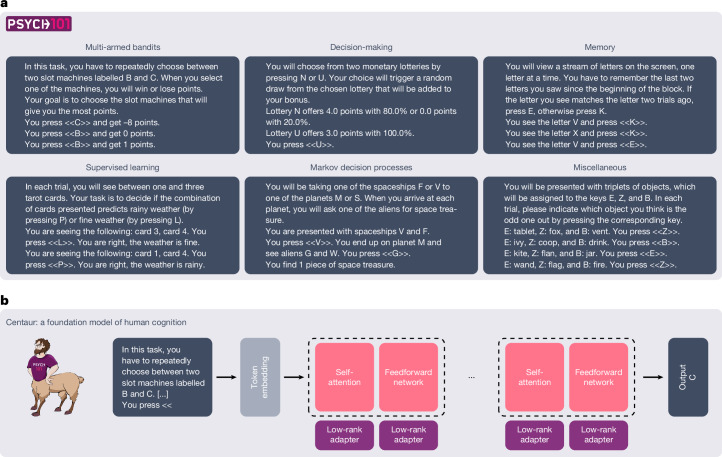
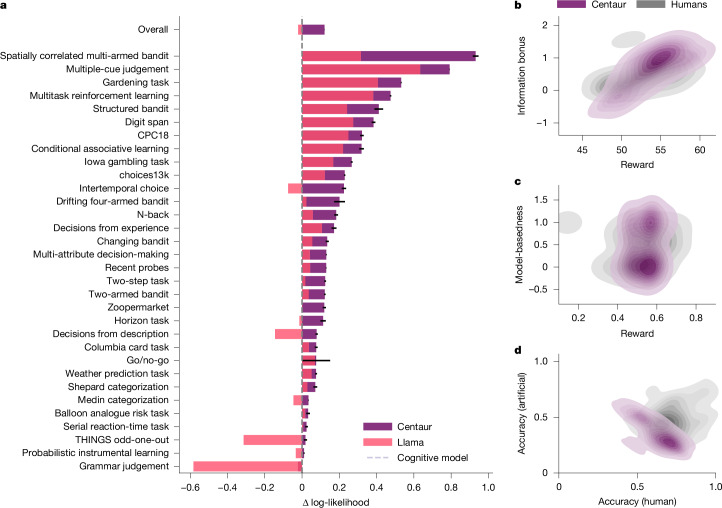
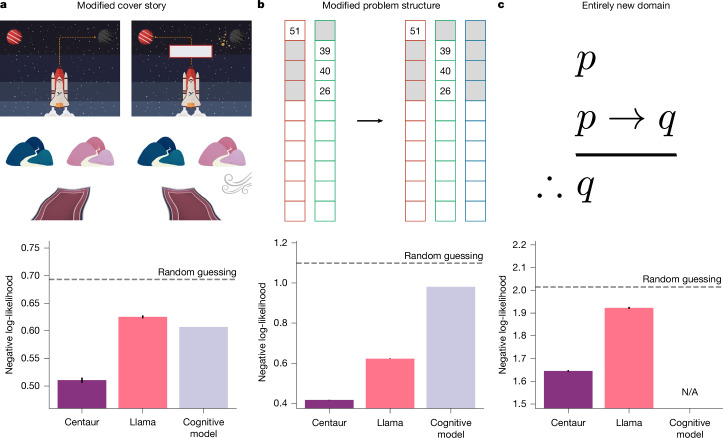
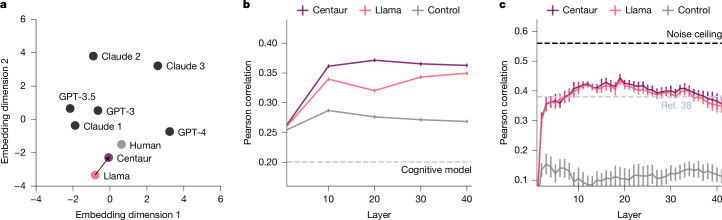
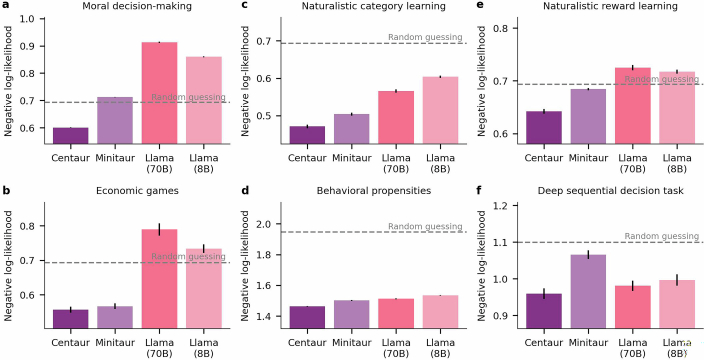
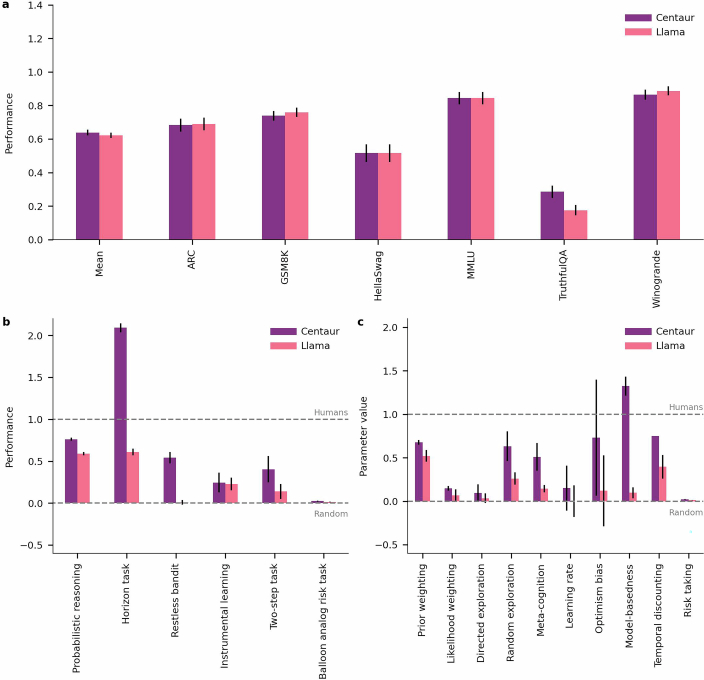
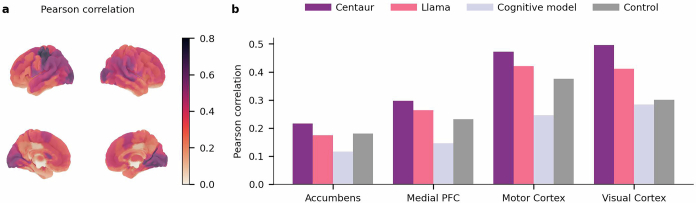
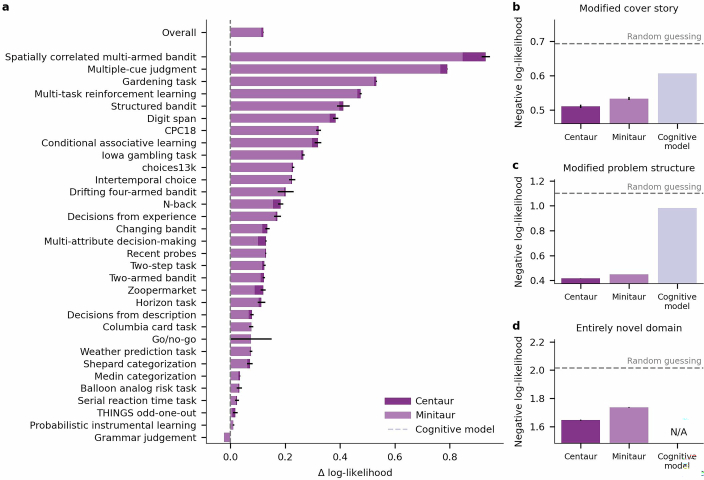
Establishing a unified theory of cognition has been an important goal in psychology 1,2 . A first step towards such a theory is to create a computational model that can predict human behaviour in a wide range of settings. Here we introduce Centaur, a computational model that can predict and simulate human behaviour in any experiment expressible in natural language. We derived Centaur by fine-tuning a state-of-the-art language model on a large-scale dataset called Psych-101. Psych-101 has an unprecedented scale, covering trial-by-trial data from more than 60,000 participants performing in excess of 10,000,000 choices in 160 experiments. Centaur not only captures the behaviour of held-out participants better than existing cognitive models, but it also generalizes to previously unseen cover stories, structural task modifications and entirely new domains. Furthermore, the model’s internal representations become more aligned with human neural activity after fine-tuning. Taken together, our results demonstrate that it is possible to discover computational models that capture human behaviour across a wide range of domains. We believe that such models provide tremendous potential for guiding the development of cognitive theories, and we present a case study to demonstrate this.
Overview
The claims and statistics of this paper haven’t been checked yet.
Free: it reads the open-access text and checks the first 5 claims that cite a source we can check. Create a free account to check every claim.
Integrity signals
Registry
Cites
Statistics
Figures
Verification
Claims the paper makes
The claims and statistics of this paper haven’t been checked yet.
Free: it reads the open-access text and checks the first 5 claims that cite a source we can check. Create a free account to check every claim.
Claims other papers make about this one
Each is checked against this paper’s own text: does it say what the citing paper says it does?
In the citing paper
“LLMs can produce outputs similar to those of humans in structured tasks (8), but the similarity concerns results, not the process.”
From The simulation of judgment in LLMs (2025) · cites this paper as [8]
Self-check
Percentages, sums and reported differences re-computed from the paper’s own numbers.
The self-check needs the paper’s full text.
Citations
Cites
Vaswani, A., Shazeer, N., Parmar, N., Uszkoreit, J., Jones, L., Gomez, A. N., Kaiser, L., & Polosukhin, I. (2017) · arXiv · doi:10.48550/arxiv.1706.03762 · Cited by 120,404
DeepSeek-R1: Incentivizing Reasoning Capability in LLMs via Reinforcement Learning
DeepSeek-AI, Guo, D., Yang, D., Zhang, H., Song, J., Wang, P., Zhu, Q., Xu, R., Zhang, R., Ma, S., et al. (2025) · arXiv · doi:10.48550/arxiv.2501.12948 · Cited by 18,918
Self-citationMastering the game of Go without human knowledge
Silver, D., Schrittwieser, J., Simonyan, K., Antonoglou, I., Huang, A., Guez, A., Hubert, T., Baker, L., Lai, M., Bolton, A., et al. (2017) · Nature · doi:10.1038/nature24270 · Cited by 9,084
The combination of estimates from different experiments
Cochran, W. G. (1954) · Biometrics · doi:10.2307/3001666 · Cited by 5,380 · cited 1×
“We performed an inverse-weighted meta-analysis 39 on the difference in correlations between Centaur and Llama, and this indicated that there was a significant benefit of fine-tuning when pooling across layers ( β = 0.007, 95% confidence interval [0.0002, 0.013], P = 0.045).”
InfluentialfMRIPrep: A robust preprocessing pipeline for functional MRI
Esteban, O., Markiewicz, C. J., Blair, R. W., Moodie, C. A., Isik, A. I., Erramuzpe, A., Kent, J. D., Goncalves, M., DuPre, E., Snyder, M., et al. (2019) · Nature Methods · doi:10.1038/s41592-018-0235-4 · Cited by 3,905 · cited 1×
“63).”
Local-global parcellation of the human cerebral cortex from intrinsic functional connectivity MRI
Schaefer, A., Kong, R., Gordon, E. M., Laumann, T. O., Zuo, X.-N., Holmes, A. J., Eickhoff, S. B., & Yeo, B. T. T. (2018) · Cerebral Cortex · doi:10.1093/cercor/bhx179 · Cited by 3,657 · cited 4×
“Reported Pearson correlation coefficients correspond to the average across all ROIs.”
InfluentialHenrich, J., Heine, S. J., & Norenzayan, A. (2010) · Nature · doi:10.1038/466029a · Cited by 3,441 · cited 1×
“Finally, although we have already included some cross-cultural and meta-studies 52–55 , the current iteration still has a strong bias towards a Western, educated, industrialized, rich and democratic (WEIRD) population 56 .”
Prospect Theory: An Analysis of Decision Under Risk
Kahneman, D., & Tversky, A. (2013) · World Scientific Handbook in Financial Economics Series · doi:10.1142/9789814417358_0006 · Cited by 3,091
Human-level concept learning through probabilistic program induction
Lake, B. M., Salakhutdinov, R., & Tenenbaum, J. B. (2015) · Science · doi:10.1126/science.aab3050 · Cited by 2,817
On the Opportunities and Risks of Foundation Models
Bommasani, R., Hudson, D. A., Adeli, E., Altman, R., Arora, S., von Arx, S., Bernstein, M. S., Bohg, J., Bosselut, A., Brunskill, E., et al. (2021) · arXiv · doi:10.48550/arxiv.2108.07258 · Cited by 2,676
Research works printed but not linked: 9
- 1. Anderson, J. The Architecture of Cognition (Harvard Univ. Press, 1983).
- 2. Newell, A. Unified Theories of Cognition (Harvard Univ. Press, 1990).
- 13. Binz, M. & Schulz, E. Turning large language models into cognitive models. In Proc. 12th International Conference on Learning Representations (ICLR, 2024).
- 16. Dettmers, T., Pagnoni, A., Holtzman, A. & Zettlemoyer, L. QLORA: efficient finetuning of quantized LLMs. In Proc. Advances in Neural Information Processing Systems 36 (eds Oh, A. et al.) (NeurIPS, 2023).
- 29. Demircan, C. et al. Evaluating alignment between humans and neural network representations in image-based learning tasks. In Proc. Advances in Neural Information Processing Systems 37 (eds Globerson, A. et al.) (NeurIPS, 2024).
- 34. Kipnis, A., Voudouris, K., Schulze Buschoff, L. M. & Schulz, E. metabench -a sparse benchmark of reasoning and knowledge in large language models. In Proc. 13th International Conference on Learning Representations (ICLR, 2025).
- 48. Huben, R., Cunningham, H., Smith, L. R., Ewart, A. & Sharkey, L. Sparse autoencoders find highly interpretable features in language models. In Proc. 12th International Conference on Learning Representations (ICLR, 2024).
- 61. Loshchilov, I. & Hutter, F. Decoupled weight decay regularization. In Proc. 7th International Conference on Learning Representations (ICLR, 2019).
- 65. Friston, K. J., Ashburner, J. T., Kiebel, S. J., Nichols, T. E. & Penny, W. D. (eds) Statistical Parametric Mapping: The Analysis of Functional Brain Images (Elsevier, 2011).
Cited by
Items 301–338 of 338
Hemmatian, B., Hadjarab, S., Chen, J., & Kurdi, B. (2026) · arXiv (Cornell University) · doi:10.48550/arxiv.2609.27059
AnthroDial: Benchmarking LLM Anthropomorphism in Autonomous Social InteractionPreprint
Liu, W., Chen, X., Song, S., Yuan, B., Zhang, Y., Zhuotong, Z., Zhou, J., Feng, G., Hu, S., Wang, T., et al. (2026) · arXiv (Cornell University) · doi:10.48550/arxiv.2609.37853
Ma, J., Yu, R., Tang, T., & Li, X. (2026) · arXiv (Cornell University) · doi:10.48550/arxiv.2609.37009
Science of Intelligence: Entwicklung neuer Perspektiven zum Verständnis von Intelligenz
Brock, O., Krause, J., Steinhardt, S., Rahman, R. A., Battaje, A., Bartashevich, P., Bierbach, D., Brass, M., Mollo, D. C., Gallego, G., et al. (2026) · DepositOnce · doi:10.14279/depositonce-26348
Unifying research on biological and artificial intelligence
Brock, O., Brass, M., Haun, D., Krause, J., & Romańczuk, P. (2026) · DepositOnce · doi:10.14279/depositonce-26443
Storer, G. W., & Zimmerman, J. W. (2026) · arXiv (Cornell University) · doi:10.48550/arxiv.2610.00840
Hypothesis-guided discovery of cognitive algorithms via program refinementPreprint
Yang, H. A., Ho, M. K., & Thompson, B. (2026) · arXiv (Cornell University) · doi:10.48550/arxiv.2610.02523
Towards natural behaviour processing for the representation and prediction of digital behaviour
Stachl, C., Davidson, B. I., & Harari, G. M. (2026) · Current Opinion in Psychology · doi:10.31234/osf.io/mdkjn_v2
Executive functions as a transdiagnostic endophenotype in developmental psychopathology
Braithwaite, E., Fielder, J. C., & Steinbeis, N. (2026) · Molecular Psychiatry · doi:10.1038/s41380-026-03916-6
Benchmarking Psychological Dynamics in Generative AgentsPreprint
Vaid, S. S., & Whillans, A. V. (2026) · arXiv (Cornell University) · doi:10.48550/arxiv.2610.04246
Deng, Z., Li, D., Ge, S., Zhang, Z., Zhang, Y., & Jiang, R. (2026) · arXiv (Cornell University) · doi:10.48550/arxiv.2610.08328
HouseholdBench: Evaluating Large Language Models as Predictors of Household Economic Behavior
Huang, J., Garrucho, D. F., Xie, Y., Yuan, W. M., Mei, Q., Lian, C., & Hazell, J. (2026) · National Bureau of Economic Research · doi:10.3386/w35927
Terada, K., Correia da Fonseca, H., de Melo, C. M., Coricelli, G., & Gratch, J. (2026) · Proceedings of the AAAI/ACM Conference on AI, Ethics, and Society · doi:10.1609/aies.v9i4.43327
A small cognitive core explains human behavior at scalePreprint
Binz, M., & Schulz, E. (2026) · arXiv (Cornell University) · doi:10.48550/arxiv.2610.13603
Self-citationProbable but Not Valid: A Psychometric Audit of Decision Models as Synthetic Survey Respondents
Lukauskas, M., & Šarkauskaitė, V. (2026) · arXiv · doi:10.48550/arxiv.2610.14912
Just a Simulation? A Review of Large Language Models as Subjects in Experimental EconomicsPreprint
Kitadai, A., & Nishino, N. (2026) · SSRN Electronic Journal · doi:10.2139/ssrn.7613458
Mechanist: AI as a Scientific Instrument for Discovering the Mechanisms of IntelligencePreprint
Zhang, N., Wang, M., Fang, J., Qiao, S., Xu, Z., Xu, H., Wang, H., Deng, S., Yang, L., Xu, X., et al. (2026) · Research Square · doi:10.21203/rs.3.rs-11364432/v1
Chen, X., Li, X., Yin, L., Zhu, H., Xiao, Z., & Peng, Y. J. (2026) · Systems · doi:10.3390/systems14101327
Latent Representation of Psychological Constructs in Large Language ModelsPreprint
Chen, J. (2026) · SSRN Electronic Journal · doi:10.2139/ssrn.7652158
From authenticity ecosystems to human–AI hybrid societies
Tchernichovski, O., & Jacoby, N. (2026) · Proceedings of the National Academy of Sciences · doi:10.1073/pnas.2631482123
Silicon Samples Match the Answers but Not the RespondentsPreprint
Kumagae, Y., & Kaneko, M. (2026) · arXiv (Cornell University) · doi:10.48550/arxiv.2610.30900
Multitask Interactions in Recurrent Dynamics across 100 Cognitive TasksPreprint
García-Hernández, S., Hamid, L., & Brenner, M. (2026) · arXiv (Cornell University) · doi:10.48550/arxiv.2610.33926
Synthetic Child-Adult Interactions Are Not Developmentally PlausiblePreprint
Bunzeck, B., & Padovani, F. (2026) · arXiv (Cornell University) · doi:10.48550/arxiv.2610.35029
Words or Deeds? How LLMs Predict Users' Decisions in Human-Agent DialoguePreprint
Zhang, B., Ma, S., Liao, Z., Zhou, C., 王健树, Zhao, Y., Zhang, C., 司同军, Tang, Y., Li, X., et al. (2026) · arXiv (Cornell University) · doi:10.48550/arxiv.2610.36813
CogArena: Benchmarking Multimodal Agents on Interactive Behavioral ExperimentsPreprint
Fernandez, K., Chen, C., Zhou, J., Sadowski, B., Miceli, A. C., & Krajbich, I. M. (2026) · arXiv (Cornell University) · doi:10.48550/arxiv.2610.36484
Using Generative AI for Behavioural Research Effectively and Responsibly: a BR-UK Statement
Yang, G., Rodger, A., Delaney, L. D., Hastings, J., Schomerus, M., West, R., & Michie, S. (2026) · Wellcome Open Research · doi:10.12688/wellcomeopenres.27597.1
Wyrwa, M. (2026) · Nauka · doi:10.24425/nauka.2026.7492
The (non-)alienness-dilemma in the use of simulated research subjects in psychological research
Abel, L. (2026) · Philosophical Psychology · doi:10.1080/09515089.2026.2752237
When Accuracy Aligns and Fails: Diagnosing Human–LLM Response Alignment at Population Scale
Park, S., Choi, H., An, S., Wang, X., Kim, H., Kang, J., & Kim, H. (2026) · Conference on Empirical Methods in Natural Language Processing (EMNLP) · doi:10.18653/2026.emnlp-main.1944
The data-driven shift in modeling human reward learning
Eckstein, M. K. (2026) · Current Opinion in Behavioral Sciences · doi:10.1016/j.cobeha.2026.101696
Self-citationAligning MLLMs with the Latent Structure of Human Cognition via Behavior-Derived Semantic DimensionsPreprint
Ning, E., Du, C., Lu, Y., & He, H. (2026) · arXiv (Cornell University) · doi:10.48550/arxiv.2610.41951
S1CogBench: What System One Decision Models Can and Cannot Do on Cognitive ExperimentsPreprint
Hou, D., & Yamada, K. D. (2026) · arXiv (Cornell University) · doi:10.48550/arxiv.2611.00911
Decision Models as Scalable Economic Surrogates that Capture Human VariationPreprint
Saxena, M., Caccioli, F., & del Rio-Chanona, R. M. (2026) · arXiv (Cornell University) · doi:10.48550/arxiv.2611.05553
Synthesizing symbolic models of human and machine reasoning at scalePreprint
LeGris, S., Mondorf, P., Jin, J., Jagadish, A. K., Lake, B. M., & Gureckis, T. M. (2026) · arXiv (Cornell University) · doi:10.48550/arxiv.2611.07088
Self-citationRisks of omission and commission errors when using generative AI in behavioral science research
Jörling, M., Roggenkamp, H., & Tomaino, G. (2026) · Current Opinion in Psychology · doi:10.1016/j.copsyc.2026.102492
Executable Human Study Programs with Silicon ParticipantsPreprint
Liu, X., Shang, H., Feng, Y., Chu, S.-Y., Li, Q., Shrestha, Y. R., & Jin, H. (2026) · arXiv (Cornell University) · doi:10.48550/arxiv.2611.11969
Beyer, S., & Sander, P. (2026) · MedienPädagogik Zeitschrift für Theorie und Praxis der Medienbildung · doi:10.21240/mpaed/73/2026.11.12.x
The Limits of Behavioral Simulation With AI
Graeber, T. W., & Roth, C. (2026) · CESifo Working Papers · doi:10.65864/upkfydxfud
Metadata
- Authors
- Binz, M., Akata, E., Bethge, M., Brändle, F., Callaway, F., Coda-Forno, J., Dayan, P., Demircan, C., Eckstein, M. K., Éltető, N., Griffiths, T. L., Haridi, S., Jagadish, A. K., Ji-An, L., Kipnis, A., Kumar, S., Ludwig, T., Mathony, M., Mattar, M., Modirshanechi, A., Nath, S. S., Peterson, J. C., Rmus, M., Russek, E. M., Saanum, T., Schubert, J. A., Schulze Buschoff, L. M., Singhi, N., Sui, X., Thalmann, M., Theis, F. J., Truong, V., Udandarao, V., Voudouris, K., Wilson, R., Witte, K., Wu, S., Wulff, D. U., Xiong, H., & Schulz, E.
- Affiliations
- Helmholtz Munich (DE)
- University of Tübingen (DE)
- University of Oxford (GB)
- New York University (US)
- Max Planck Institute for Biological Cybernetics (DE)
- Google DeepMind (United Kingdom) (GB)
- Princeton University (US)
- University of California San Diego (US)
- Boston University (US)
- Technische Universität Darmstadt (DE)
- University of Cambridge (GB)
- Georgia Institute of Technology (US)
- University of Basel (CH)
- Corresponding author
- Binz, Marcel
- ORCID
- Binz, Marcel
- Akata, Elif
- Bethge, Matthias
- Brändle, Franziska
- Dayan, Peter
- Eckstein, Maria K.
- Éltető, Noémi
- Griffiths, Thomas L.
- Haridi, Susanne
- Jagadish, Akshay K.
- Kumar, Sreejan
- Ludwig, Tobias
- Mathony, Marvin
- Mattar, Marcelo
- Modirshanechi, Alireza
- Nath, Surabhi S.
- Peterson, Joshua C.
- Rmus, Milena
- Russek, Evan M.
- Sui, Xin
- Thalmann, Mirko
- Theis, Fabian J.
- Truong, Vuong
- Voudouris, Konstantinos
- Witte, Kristin
- Wu, Shuchen
- Wulff, Dirk U.
- Schulz, Eric
- Venue
- Nature
- Published
- 2025-07-02
- Volume
- 644
- Issue
- 8078
- Pages
- 1002-1009
- ISSN
- 0028-0836 (ISSN-L)
- 1476-4687
- PMC
- PMC12390832
- OpenAlex
- W4411932262
- Semantic Scholar
- a4e64dee0d0f284edc160a9a8bc2b4385577249a
- Cited by
- 119
- References
- 57
- Citations by year
- 2026: 84 · 2025: 34
- FWCI
- 66.94
- Type
- journal article
- Language
- en
- Open access
- hybrid
- doi.org
- Licence
- cc-by
- creativecommons.org/licenses/by/4.0 (tdm)
- creativecommons.org/licenses/by/4.0 (vor)
- Locations
- Nature (publishedVersion, cc-by)
- PubMed Central (publishedVersion, cc-by)
- PubMed (publishedVersion)
- MPG.PuRe (Max Planck Society) (submittedVersion, cc-by-nd)
- Apollo (University of Cambridge) (submittedVersion, cc-by)
- MPG.PuRe (Max Planck Society) (submittedVersion)
- Funders
- DeepMind
- Volkswagen Foundation
- Max-Planck-Gesellschaft
- NOMIS Stiftung
- Helmholtz Zentrum München
- Topics
- Life Sciences › Neuroscience › Cognitive Neuroscience › Cognitive Science and Education Research
- Social Sciences › Decision Sciences › General Decision Sciences › Decision-Making and Behavioral Economics
- Physical Sciences › Computer Science › Artificial Intelligence › Psychiatry, Mental Health, Neuroscience
- Keywords
- centaurs, computational cognitive model, human behavior prediction, language model fine-tuning, generalization to unseen tasks
- MeSH terms
- Choice Behavior, Cognition, Computer Simulation, Humans, Language, Male, Models, Psychological
About these checks
Registry, retraction, Cites and statistics results are computed, not judged, with one exception: a printed reference that no index lists is read once by a model before it counts as a citation error. Claims are extracted by a model and kept only when their quote appears verbatim in the text; each cited source is then checked, with a model’s help, for whether it says what the claim relies on. Those verdicts can be wrong — read the claim’s quote and the cited source before relying on one.
Statistics and arithmetic are recomputed, not judged.
Confidence bands are shown only for fields calibrated on our annotated test set. None is calibrated yet, so no band is shown.
What counts as a claim ›How we measure confidence ›How we check this ›
Are you an author, or do you see a problem with this page? Request a review
Data sources
Bibliographic data: Semantic Scholar, OpenAlex, Crossref.
Contains information from the Semantic Scholar Academic Graph Datasets, made available under the ODC Attribution License (ODC-BY 1.0).
Semantic Scholar’s data is described in: Kinney, R., et al. (2023). The Semantic Scholar Open Data Platform. arXiv:2301.10140.
