

A foundation model to predict and capture human cognition
Open accessThe DOI matches its Crossref record; 67 of the 68 references it cites were found in a registry or an index.
Abstract
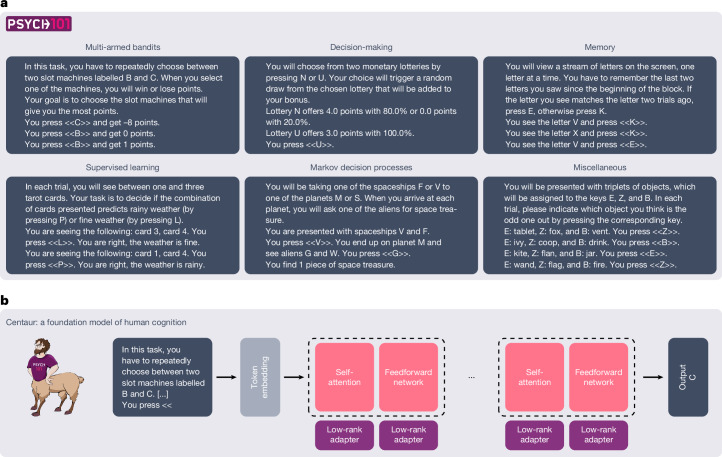
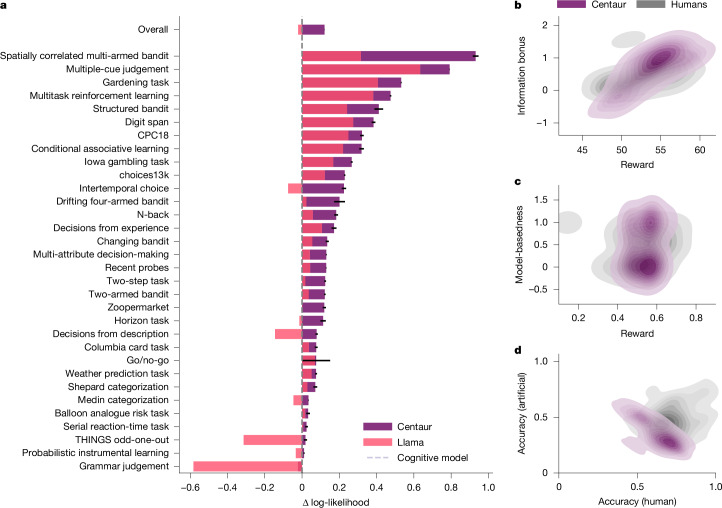
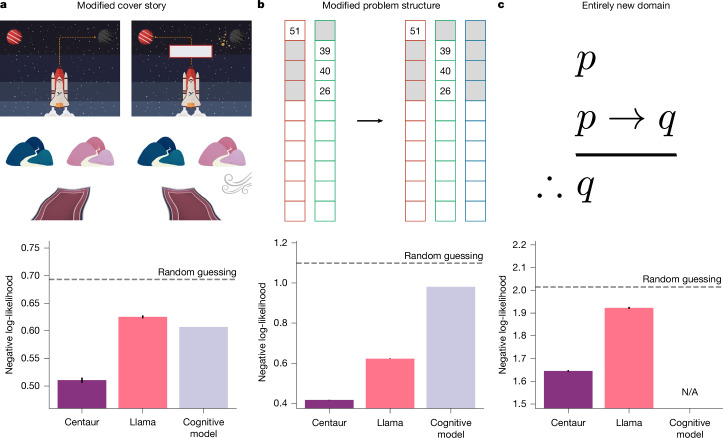
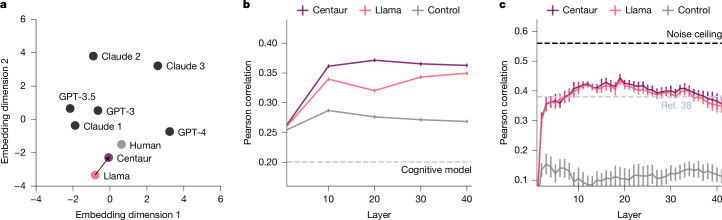
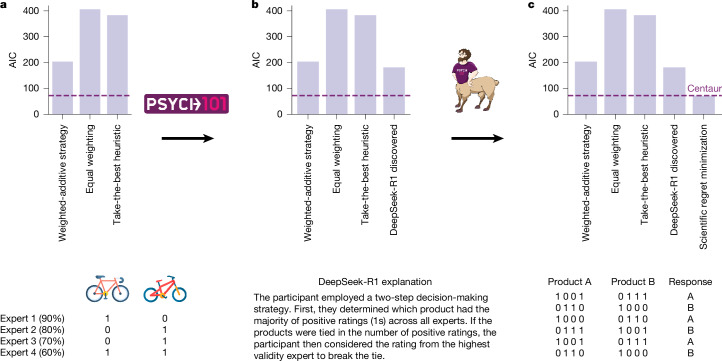
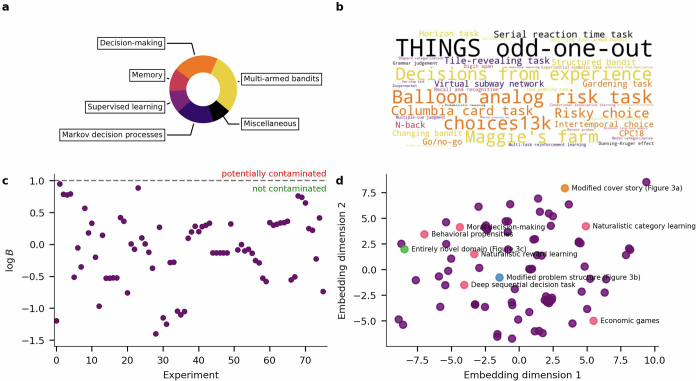
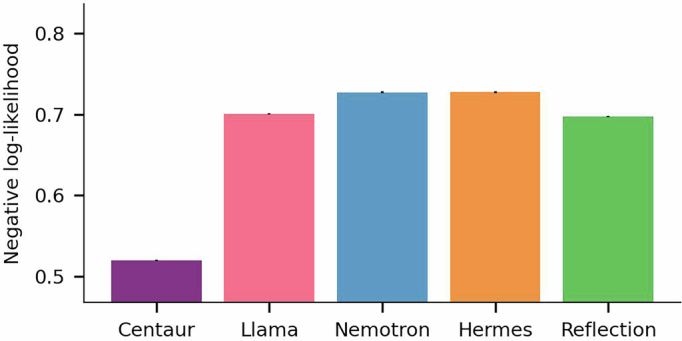
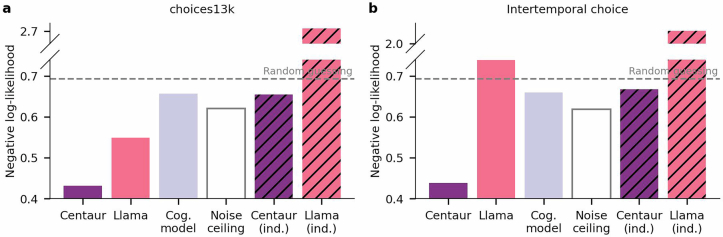
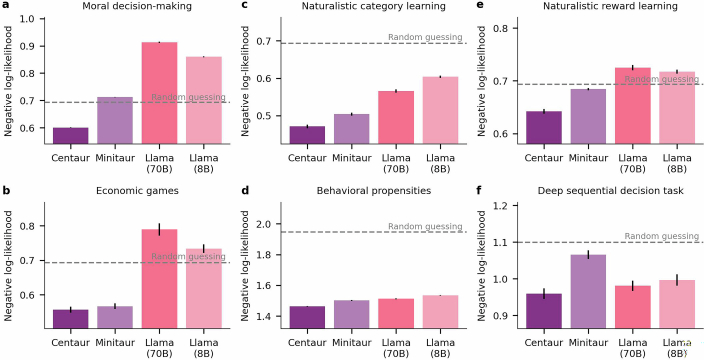
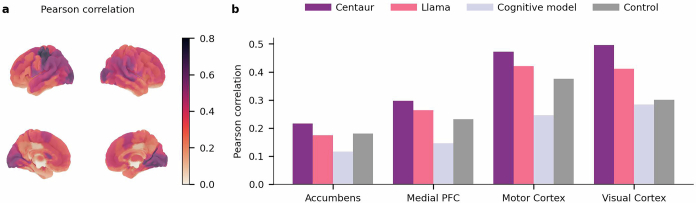
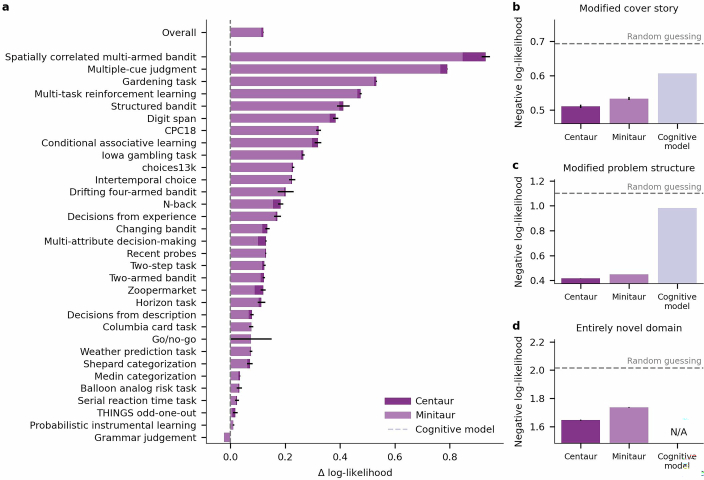
Establishing a unified theory of cognition has been an important goal in psychology 1,2 . A first step towards such a theory is to create a computational model that can predict human behaviour in a wide range of settings. Here we introduce Centaur, a computational model that can predict and simulate human behaviour in any experiment expressible in natural language. We derived Centaur by fine-tuning a state-of-the-art language model on a large-scale dataset called Psych-101. Psych-101 has an unprecedented scale, covering trial-by-trial data from more than 60,000 participants performing in excess of 10,000,000 choices in 160 experiments. Centaur not only captures the behaviour of held-out participants better than existing cognitive models, but it also generalizes to previously unseen cover stories, structural task modifications and entirely new domains. Furthermore, the model’s internal representations become more aligned with human neural activity after fine-tuning. Taken together, our results demonstrate that it is possible to discover computational models that capture human behaviour across a wide range of domains. We believe that such models provide tremendous potential for guiding the development of cognitive theories, and we present a case study to demonstrate this.
Overview
The claims and statistics of this paper haven’t been checked yet.
Free: it reads the open-access text and checks the first 5 claims that cite a source we can check. Create a free account to check every claim.
Integrity signals
Registry
Cites
Statistics
Figures
Verification
Claims the paper makes
The claims and statistics of this paper haven’t been checked yet.
Free: it reads the open-access text and checks the first 5 claims that cite a source we can check. Create a free account to check every claim.
Claims other papers make about this one
Each is checked against this paper’s own text: does it say what the citing paper says it does?
In the citing paper
“LLMs can produce outputs similar to those of humans in structured tasks (8), but the similarity concerns results, not the process.”
From The simulation of judgment in LLMs (2025) · cites this paper as [8]
Self-check
Percentages, sums and reported differences re-computed from the paper’s own numbers.
The self-check needs the paper’s full text.
Citations
Cites
Vaswani, A., Shazeer, N., Parmar, N., Uszkoreit, J., Jones, L., Gomez, A. N., Kaiser, L., & Polosukhin, I. (2017) · arXiv · doi:10.48550/arxiv.1706.03762 · Cited by 120,404
DeepSeek-R1: Incentivizing Reasoning Capability in LLMs via Reinforcement Learning
DeepSeek-AI, Guo, D., Yang, D., Zhang, H., Song, J., Wang, P., Zhu, Q., Xu, R., Zhang, R., Ma, S., et al. (2025) · arXiv · doi:10.48550/arxiv.2501.12948 · Cited by 18,918
Self-citationMastering the game of Go without human knowledge
Silver, D., Schrittwieser, J., Simonyan, K., Antonoglou, I., Huang, A., Guez, A., Hubert, T., Baker, L., Lai, M., Bolton, A., et al. (2017) · Nature · doi:10.1038/nature24270 · Cited by 9,084
The combination of estimates from different experiments
Cochran, W. G. (1954) · Biometrics · doi:10.2307/3001666 · Cited by 5,380 · cited 1×
“We performed an inverse-weighted meta-analysis 39 on the difference in correlations between Centaur and Llama, and this indicated that there was a significant benefit of fine-tuning when pooling across layers ( β = 0.007, 95% confidence interval [0.0002, 0.013], P = 0.045).”
InfluentialfMRIPrep: A robust preprocessing pipeline for functional MRI
Esteban, O., Markiewicz, C. J., Blair, R. W., Moodie, C. A., Isik, A. I., Erramuzpe, A., Kent, J. D., Goncalves, M., DuPre, E., Snyder, M., et al. (2019) · Nature Methods · doi:10.1038/s41592-018-0235-4 · Cited by 3,905 · cited 1×
“63).”
Local-global parcellation of the human cerebral cortex from intrinsic functional connectivity MRI
Schaefer, A., Kong, R., Gordon, E. M., Laumann, T. O., Zuo, X.-N., Holmes, A. J., Eickhoff, S. B., & Yeo, B. T. T. (2018) · Cerebral Cortex · doi:10.1093/cercor/bhx179 · Cited by 3,657 · cited 4×
“Reported Pearson correlation coefficients correspond to the average across all ROIs.”
InfluentialHenrich, J., Heine, S. J., & Norenzayan, A. (2010) · Nature · doi:10.1038/466029a · Cited by 3,441 · cited 1×
“Finally, although we have already included some cross-cultural and meta-studies 52–55 , the current iteration still has a strong bias towards a Western, educated, industrialized, rich and democratic (WEIRD) population 56 .”
Prospect Theory: An Analysis of Decision Under Risk
Kahneman, D., & Tversky, A. (2013) · World Scientific Handbook in Financial Economics Series · doi:10.1142/9789814417358_0006 · Cited by 3,091
Human-level concept learning through probabilistic program induction
Lake, B. M., Salakhutdinov, R., & Tenenbaum, J. B. (2015) · Science · doi:10.1126/science.aab3050 · Cited by 2,817
On the Opportunities and Risks of Foundation Models
Bommasani, R., Hudson, D. A., Adeli, E., Altman, R., Arora, S., von Arx, S., Bernstein, M. S., Bohg, J., Bosselut, A., Brunskill, E., et al. (2021) · arXiv · doi:10.48550/arxiv.2108.07258 · Cited by 2,676
Research works printed but not linked: 9
- 1. Anderson, J. The Architecture of Cognition (Harvard Univ. Press, 1983).
- 2. Newell, A. Unified Theories of Cognition (Harvard Univ. Press, 1990).
- 13. Binz, M. & Schulz, E. Turning large language models into cognitive models. In Proc. 12th International Conference on Learning Representations (ICLR, 2024).
- 16. Dettmers, T., Pagnoni, A., Holtzman, A. & Zettlemoyer, L. QLORA: efficient finetuning of quantized LLMs. In Proc. Advances in Neural Information Processing Systems 36 (eds Oh, A. et al.) (NeurIPS, 2023).
- 29. Demircan, C. et al. Evaluating alignment between humans and neural network representations in image-based learning tasks. In Proc. Advances in Neural Information Processing Systems 37 (eds Globerson, A. et al.) (NeurIPS, 2024).
- 34. Kipnis, A., Voudouris, K., Schulze Buschoff, L. M. & Schulz, E. metabench -a sparse benchmark of reasoning and knowledge in large language models. In Proc. 13th International Conference on Learning Representations (ICLR, 2025).
- 48. Huben, R., Cunningham, H., Smith, L. R., Ewart, A. & Sharkey, L. Sparse autoencoders find highly interpretable features in language models. In Proc. 12th International Conference on Learning Representations (ICLR, 2024).
- 61. Loshchilov, I. & Hutter, F. Decoupled weight decay regularization. In Proc. 7th International Conference on Learning Representations (ICLR, 2019).
- 65. Friston, K. J., Ashburner, J. T., Kiebel, S. J., Nichols, T. E. & Penny, W. D. (eds) Statistical Parametric Mapping: The Analysis of Functional Brain Images (Elsevier, 2011).
Cited by
Items 101–200 of 338
LLM-Based Educational Simulation: Evaluating Temporal Student Persona Stability Across ADHD ProfilesPreprint
Gonnermann-Müller, J., Haase, J., Leins, N., Kosch, T., & Pokutta, S. (2026) · arXiv (Cornell University) · doi:10.48550/arxiv.2605.06307 · Cited by 4
Modular Cognitive Architecture Emerges in Large Language ModelsPreprint
Han, P., Andreas, J., Fedorenko, E. G., & de Varda, A. G. (2026) · arXiv (Cornell University) · doi:10.48550/arxiv.2608.13567 · Cited by 4
When Can AI Models Explain Learning? Validity Criteria for AI as Cognitive Models in Education
Wang, P., Viberg, O., Law, E. L.-C., & Greiff, S. (2026) · Educational Psychology Review · doi:10.1007/s10648-026-10202-y · Cited by 3
“…neural networks (Cichy & Kaiser, 2019 ), reinforcement learning agents (Sutton & Barto, 1998 ), cognitive architectures, and large language models (Binz et al., 2025 ; Binz & Schulz, 2023 ), substantially expand the space of testable learning theories by enabling researchers to instantiate…”
Chen, S., Wanke, P. A. N., & Chuan-Peng, H. (2025) · Advances in Psychological Science · doi:10.3724/sp.j.1042.2025.2043 · Cited by 3
Ge, H., Feng, T., Wu, H., Hu, H., Li, J., & Wu, X. (2026) · Intensive and Critical Care Nursing · doi:10.1016/j.iccn.2025.104329 · Cited by 3
Large Language Models Persuade Without Planning Theory of Mind
Moore, J., Overmark, R., Cooper, N., Cibralic, B., Haber, N., & Jones, C. R. (2026) · Cognitive Science · doi:10.1111/cogs.70259 · Cited by 4
Blocking the Reflection: Milestones and Hurdles for Digital Twins in Mental Health
Verhees, F. G., Wiest, I. C., Kather, J. N., Kambeitz, J., & Mikoláš, P. (2026) · Pharmacopsychiatry · doi:10.1055/a-2816-2869 · Cited by 3
Leveraging Large Language Models for Agent‐Based Simulation of Human‐Water System Interactions
Yang, Y. E., & Chiou, W. (2026) · Water Resources Research · doi:10.1029/2025wr042111 · Cited by 3
Advancing NeuroAI through developmental alignment
Ayzenberg, V., Bonner, M., & Bayet, L. (2026) · Neuron · doi:10.1016/j.neuron.2026.07.003 · Cited by 4
The Judgment-Consequence Gap: LLM Moral Reasoning in Healthcare Decisions
Hosseini, H., Khanna, S., & Pierce, L. (2026) · Proceedings of the AAAI/ACM Conference on AI Ethics and Society · doi:10.1609/aies.v9i2.43223 · Cited by 3
An Airplane or a Perpetual-Motion Machine: Why Safe AGI Can Never Be Built
Landry, F. (2026) · doi:10.67291/sowv6394 · Cited by 3
Measuring Reasoning Quality in LLMs: A Multi-Dimensional Behavioral Framework
Şenol, A., Agrawal, G., & Liu, H. (2026) · Big Data and Cognitive Computing · doi:10.3390/bdcc10090300 · Cited by 3
Artificially intelligent agents in the social and behavioral sciences: A history and outlookPreprint
Holme, P., & Tsvetkova, M. (2025) · arXiv (Cornell University) · doi:10.48550/arxiv.2510.05743 · Cited by 3
Large Language Models for the Simulation of Human BehaviorPreprint
Bernard, N., Balog, K., Zerhoudi, S., & Zhai, C. (2026) · HAL · Cited by 3
The Third Ambition: Artificial Intelligence and the Science of Human BehaviorPreprint
Neuman, W. R., & Coleman, C. (2026) · arXiv (Cornell University) · doi:10.48550/arxiv.2603.07329 · Cited by 3
From Demographics to Survey Anchors: Evaluating LLM Agents for Modeling Retirement AttitudesPreprint
Garzón, R., Baron, P., Grari, V., Kamphorst, J., Bernstein, M. S., & Detyniecki, M. (2026) · arXiv (Cornell University) · doi:10.48550/arxiv.2605.16303 · Cited by 4
Mechanist: AI as a Scientific Instrument for Discovering the Mechanisms of IntelligencePreprint
Wang, M., Fang, J., Qiao, S., Xu, Z., Xu, H., Wang, H., Deng, S., Yang, L., Xu, X., Yao, Y., et al. (2026) · arXiv (Cornell University) · doi:10.48550/arxiv.2608.12036 · Cited by 4
Wang, S., Hunt, K., Tang, S., & Joseph, K. (2026) · arXiv (Cornell University) · doi:10.48550/arxiv.2609.07987 · Cited by 3
Synthetic Participants Generated by Large Language Models: A Systematic Literature Review
Kuric, E., Demcak, P., & Krajcovic, M. (2026) · doi:10.21203/rs.3.rs-9057643/v1 · Cited by 2
Large language models accurately identify decision reasons in verbal reports
Fuławka, K., Hertwig, R., & Wulff, D. U. (2026) · Proceedings of the National Academy of Sciences · doi:10.1073/pnas.2526798123 · Cited by 2
Self-citationLagrangian–Eulerian learning of flow field and trajectories with TrajectoryFlowNet
Wan, J., Wang, H., Liu, B., Yang, X., Hu, X., Cai, S., He, G., & Liu, Y. (2026) · Nature Machine Intelligence · doi:10.1038/s42256-026-01316-7 · Cited by 2
Солдатова, Г., Чигарькова, С. В., & Ilyukhina, S. N. (2025) · Behavioral Sciences · doi:10.3390/bs15111487 · Cited by 2
Exploring the Link Between the Emotional Recall Task and Mental Health in Humans and LLMs
Carini, A., Taietta, E., & Stella, M. (2025) · Information · doi:10.3390/info16121057 · Cited by 2
Can Centaur truly simulate human cognition? The fundamental limitation of instruction understanding
Liu, W., & Ding, N. (2025) · National Science Open · doi:10.1360/nso/20250053 · Cited by 2
Large AI Models Have a Prioritization Problem: Policy Implications and Solutions
Jackson, J. C., Liu, Y., Wang, Z., & Brady, W. J. (2025) · Policy Insights from the Behavioral and Brain Sciences · doi:10.1177/23727322251408311 · Cited by 2
AI-Augmented Computational Modeling of Human Behavior
Zhang, G., Zhang, S., & Wu, H. (2025) · Springer eBooks · doi:10.1007/978-981-97-8440-0_111-1 · Cited by 2
Multilingual large language models do not comprehend all natural languages to equal degrees
Moskvina, N., Montero, R., Yoshida, M., Hubers, F., Morosi, P., Irhaymi, W., Yan, J., Serrano, T., Pagliarini, E., Günther, F., et al. (2026) · Scientific Reports · doi:10.1038/s41598-026-69546-8 · Cited by 2
The ‘neat’ and ‘messy’ in task-dependent neural geometry and computation
Xue, C., & Okazawa, G. (2026) · Trends in Neurosciences · doi:10.1016/j.tins.2026.04.012 · Cited by 2
Generative AI as a transformational logic for cognitive neuroscience
Beste, C., & Safavi, S. (2026) · Communications Biology · doi:10.1038/s42003-026-10642-w · Cited by 2
Panfilova, A. S., Bolshev, V., Mozikov, M., Латынов, В. В., Vanin, A. V., Nestik, T. A., Kozin, M., Serohvostov, A., Tarasova, E., & Nikolenko, S. I. (2026) · IEEE Access · doi:10.1109/access.2026.3711753 · Cited by 2
Good practices for Bayesian inference in statistical learning
Kovács, T., & Lengyel, M. (2026) · Current Opinion in Neurobiology · doi:10.1016/j.conb.2026.103262 · Cited by 2
Persona-prompted LLM agents achieve modest but genuine prediction of human social media reactions
Bojić, L., Felfernig, A., Dinić, B. M., Ilić, V., Rettinger, A., Mevorah, V., & Trilling, D. (2026) · Scientific Reports · doi:10.1038/s41598-026-66277-8 · Cited by 2
Do LLMs Choose Like Humans? Using Cognitive Theory to Evaluate LLM Decision-Making
Sun, J., Shleifer, A., & Belinkov, Y. (2026) · Findings of the Association for Computational Linguistics: EMNLP (Findings of EMNLP) · doi:10.18653/2026.findings-emnlp.2177 · Cited by 2
This AI ‘thinks’ like a human — after training on 160 psychology studies
Naddaf, M. (2025) · Nature · doi:10.1038/d41586-025-02095-8 · Cited by 2
AI Surrogacy in Psychological ResearchPreprint
D’Alessandro, W., & Thompson, J. A. F. (2025) · PsyArXiv (OSF Preprints) · doi:10.31234/osf.io/6emg9_v1 · Cited by 2
Validating Generative Agent-Based Models for Logistics and Supply Chain Management ResearchPreprint
Castillo, V. E. (2025) · SSRN Electronic Journal · doi:10.2139/ssrn.5407742 · Cited by 2
Invisible Architectures of Thought: Toward a New Science of AI as Cognitive InfrastructurePreprint
Riva, G. (2025) · PsyArXiv (OSF Preprints) · doi:10.31234/osf.io/7zduk_v3 · Cited by 2
Centaur May Have Learned a Shortcut that Explains Away Psychological TasksPreprint
Xie, H., & Zhu, J.-Q. (2025) · PsyArXiv (OSF Preprints) · doi:10.31234/osf.io/u7z4t_v2 · Cited by 2
Improving Behavioral Alignment in LLM Social Simulations via Context Formation and NavigationPreprint
Kong, L., Qianran, Jin, & Zhang, R. (2026) · arXiv (Cornell University) · doi:10.48550/arxiv.2601.01546 · Cited by 2
The Psychological Science of Artificial Intelligence: A Rapidly Emerging Field of PsychologyPreprint
Yan, Z., & Zhang, R. (2026) · arXiv · doi:10.48550/arxiv.2601.19338 · Cited by 2
Hierarchy in Neuronal Representations of Multiple Tasks in Prefrontal CortexPreprint
Sheng, Q., Luo, S., Li, D., Jia, J., Fan, Z., He, Z., Wang, F., Chen, Y., Yuan, S., Cheng, Z., et al. (2026) · bioRxiv (Cold Spring Harbor Laboratory) · doi:10.64898/2026.02.10.705211 · Cited by 2
Language Model Goal Selection Differs from Humans' in a Self-Directed Learning TaskPreprint
Molinaro, G., August, D., Perszyk, D., & Collins, A. G. E. (2026) · arXiv (Cornell University) · doi:10.48550/arxiv.2603.03295 · Cited by 2
"Dark Triad" Model Organisms of Misalignment: Narrow Fine-Tuning Mirrors Human Antisocial BehaviorPreprint
Lulla, R., Collins, F., Parekh, S., Hagendorff, T., & Kaplan, J. (2026) · arXiv (Cornell University) · doi:10.17605/osf.io/rfymg · Cited by 2
SYN-DIGITS: A Synthetic Control Framework for Calibrated Digital Twin SimulationPreprint
Fan, G. J., Huang, C., Peng, T., Wang, K., & Wu, Y. (2026) · arXiv (Cornell University) · doi:10.48550/arxiv.2604.07513 · Cited by 2
We Need Strong Preconditions For Using Simulations In PolicyPreprint
Luo, S., Arora, S., & Guirado, C. (2026) · arXiv (Cornell University) · doi:10.48550/arxiv.2604.07838 · Cited by 2
SYN-DIGITS: A Synthetic Control Framework for Calibrated Digital Twin SimulationPreprint
Fan, G. J., Huang, C., Peng, T., Wang, K., & Wu, Y. (2026) · SSRN Electronic Journal · doi:10.2139/ssrn.6569001 · Cited by 2
Understanding the Mechanism of Altruism in Large Language ModelsPreprint
Zhang, S., Wang, S., Yao, Z., Li, C., Wang, X., Zhong, S., & Liu, T. X. (2026) · arXiv (Cornell University) · doi:10.48550/arxiv.2604.19260 · Cited by 2
Culturally uneven urban perception in large language modelsPreprint
Zhao, R., Liu, W., Sha, Z., Su, N., Zhang, Y., & Long, Y. (2026) · arXiv (Cornell University) · doi:10.48550/arxiv.2604.20048 · Cited by 2
An Experimental Method to Study Opinion Diffusion in Human-AI Hybrid SocietiesPreprint
Gaubert, L., Devaux, R., Çelen, E., Marjieh, R., Mangalagiu, D., Jardin, A., & Jacoby, N. (2026) · arXiv (Cornell University) · doi:10.48550/arxiv.2605.09197 · Cited by 2
Simulating population compliance with pandemic interventions using large language modelsPreprint
Liu, R., Jong, C., Li, H., Cao, Y., Yao, Q., Yamana, T. K., Pei, S., & Du, H. (2026) · medRxiv · doi:10.64898/2026.05.12.26352942 · Cited by 2
Wang, T., Li, J., & Lin, J. (2026) · arXiv (Cornell University) · doi:10.48550/arxiv.2605.17079 · Cited by 2
Using Cognitive Models to Improve Language Model Simulation of Human Persuasion GamesPreprint
Cheng, Z., Shen, Z., Griffiths, T. L., & Henderson, P. (2026) · arXiv (Cornell University) · doi:10.48550/arxiv.2606.17657 · Cited by 2
Self-citationAgentSociety 2: An Integrated Research Environment for Executable Social SciencePreprint
Piao, J., Zhang, J., Huang, H., Zhang, K., Wang, J. Y., Zhao, X., Li, S., Sun, B., Chang, J., Xu, F., et al. (2026) · arXiv (Cornell University) · doi:10.48550/arxiv.2607.11895 · Cited by 2
Tsvilodub, P., Carcassi, F., & Franke, M. (2026) · arXiv (Cornell University) · doi:10.48550/arxiv.2607.18443 · Cited by 2
A persistent accuracy ceiling in automated verbal deception detectionPreprint
Loconte, R., Festor, J., Fatjanova, Z., Bolkvadze, M., & Kleinberg, B. (2026) · arXiv (Cornell University) · doi:10.48550/arxiv.2610.12118 · Cited by 2
Could machine learning help to build a unified theory of cognition?
Baggio, G. (2025) · Nature · doi:10.1038/d41586-025-02353-9 · Cited by 1
AI-gile: Revisiting Agile principles in the era of AI
Pileggi, S. F., & Bharathy, G. K. (2026) · Information and Software Technology · doi:10.1016/j.infsof.2026.108073 · Cited by 1
Auditing Partial Dataset Usage in Large Language Models via Fuzzy Membership Aggregation
Zhu, H.-Y., Liang, S.-C., Chen, B.-F., Wang, S.-L., Zhang, Z.-S., & Ding, W.-P. (2026) · IEEE transactions on fuzzy systems · doi:10.1109/tfuzz.2026.3665818
Towards ecologically meaningful foundation models
Gardiner, R. J., Cerbone, H., Akande, H. A., Batist, C., Cowans, A., Felsinger, S., Gill, P., Kapoor, T., Miller, E., Oyanedel, R., et al. (2026) · Nature Machine Intelligence · doi:10.1038/s42256-026-01317-6 · Cited by 1
Characterizing AI Manipulation Risks in Brazilian YouTube Climate Discourse
Dong, W., Locatelli, M. S., Almeida, V., & Cha, M. (2026) · Proceedings of the AAAI Conference on Artificial Intelligence · doi:10.1609/aaai.v40i45.41180 · Cited by 1
Exploring attribution bias in LLMs: Social influences and prompt-based mitigation
Jiang, L., Cao, J., Zhu, G., & Wang, Y. (2026) · Technology in Society · doi:10.1016/j.techsoc.2026.103361 · Cited by 1
Synthetic AI Agents for Experimental Social Science
Henning, T. L., & Camerer, C. F. (2026) · EPiC series in technology · doi:10.29007/xj88 · Cited by 1
Pelo, M. D., Donvito, A., Frongia, C., Salis, P., & Lieto, A. (2026) · Minds and Machines · doi:10.48550/arxiv.2604.27927 · Cited by 1
Li, X., Zhao, X., & Chen, B. (2026) · Journal of Memory and Language · doi:10.1016/j.jml.2026.104766 · Cited by 1
Nguyen, H. S., & Cao, J. (2026) · Journal of Science Education and Technology · doi:10.1007/s10956-026-10333-5 · Cited by 2
Large language models as experimental systems in human psychopathology: a modelling study
Wekenborg, M., Michels, E. A. M., Kurze, G. F., Kropp, M. L., Wolf, F., Harzbecker, J., Wiest, I. C., & Kather, J. N. (2026) · The Lancet Digital Health · doi:10.1016/j.landig.2026.101014 · Cited by 1
Guo, X., & Zhou, R. (2026) · International Journal of Human-Computer Interaction · doi:10.1080/10447318.2026.2679614 · Cited by 2
Song, K., Jennings, J. M., & Davis‐Stober, C. P. (2026) · Computational Brain & Behavior · doi:10.21203/rs.3.rs-10119008/v1 · Cited by 1
Quo Vadis? Scientific Discovery in the Age of Artificial Intelligence
Jedlička, P. (2026) · Teorie vědy / Theory of Science · doi:10.46938/tv.2026.728 · Cited by 1
Arnold, W., Herman, J. D., Giuliani, M., & Castelletti, A. F. (2026) · Environmental Research Letters · doi:10.1088/1748-9326/ae9ee0 · Cited by 1
Moghaddam, M. T., & Alipour, M. (2026) · Companion Publication of the 28th International Conference on Multimodal Interaction · doi:10.1145/3776591.3837048 · Cited by 1
The recipe for intelligence in natural and artificial systems
Summerfield, C., & Stachenfeld, K. (2026) · Neuron · doi:10.1016/j.neuron.2026.08.013 · Cited by 1
Which AI? A Comparative Evaluation of Generative AI and Neuro‐Symbolic AI for Silicon Sampling
Zahradníčková, K., Polišenský, J., Lukeš, M., Hranický, R., & Pouč, P. (2026) · Psychology and Marketing · doi:10.1002/mar.70272 · Cited by 1
Artificial Intelligence and Human Language Cognition: An Integrative Comparative Framework
Ishfaq, A., & Sultan, N. (2025) · Critical Review of Social Sciences and Humanities · Cited by 1
Chen, F., Wang, Q., Wang, L., & Bhatia, S. (2026) · Nature Human Behaviour · doi:10.1038/s41562-026-02611-4 · Cited by 1
Qian, P., & Ullman, T. D. (2025) · Open Mind · doi:10.1162/opmi.a.277 · Cited by 1
Bazac, A. (2025) · Qeios · doi:10.32388/n8ju5j · Cited by 1
Karami, B., Zandi, F., & Hatami, J. (2025) · Research Square · doi:10.21203/rs.3.rs-8270539/v1 · Cited by 1
DfE-DB: A systematic database of 3.8 million human decisions across experience-based tasksPreprint
Yang, Y., Spektor, M. S., Thoma, A. I., Hertwig, R., & Wulff, D. U. (2025) · bioRxiv (Cold Spring Harbor Laboratory) · doi:10.64898/2025.12.12.693971 · Cited by 1
Self-citationHuman-computer interactions predict mental healthPreprint
Weilnhammer, V., Ortega, J., & Whitney, D. (2025) · arXiv (Cornell University) · doi:10.48550/arxiv.2511.20179 · Cited by 1
Computational Modeling of Behavior as a Window on Psychological Traits and States
da Fonseca, M., & Hyafil, A. (2026) · European Journal of Psychological Assessment · doi:10.1027/1015-5759/a000940 · Cited by 1
Miklian, J., Hoelscher, K., & Katsos, J. E. (2026) · SSRN Electronic Journal · doi:10.2139/ssrn.6210099 · Cited by 1
Clark, T. H., Arriaga, C., Conde, J., Martínez, G., & Reviriego, P. (2026) · arXiv (Cornell University) · doi:10.48550/arxiv.2603.12105 · Cited by 1
Do LLMs have core beliefs?Preprint
Chawla, N. V., Sokol, A. A., & Ganapini, M. B. (2026) · Research Square · doi:10.21203/rs.3.rs-9013372/v1 · Cited by 1
Large Language Models Align with the Human Brain during Creative ThinkingPreprint
Ismayilzada, M., Luchini, S. A., Gökce, A., AlKhamissi, B., Bosselut, A., Laverghetta, A., van der Plas, L., & Beaty, R. E. (2026) · arXiv (Cornell University) · doi:10.48550/arxiv.2604.03480 · Cited by 1
Automated Adversarial Collaboration for Advancing Theory Building in the Cognitive SciencesPreprint
Chandramouli, S., Kachergis, G., & Jagadish, A. (2026) · arXiv (Cornell University) · doi:10.48550/arxiv.2604.25521 · Cited by 1
Self-citationESPOSITO, N., Tricarico, A., Porzio, L., Ardebili, A. A., & Stella, M. (2026) · arXiv (Cornell University) · doi:10.48550/arxiv.2604.27618 · Cited by 1
Toward an AI-Powered Computational Testbed for Workforce PolicyPreprint
Vaid, S. S., & Whillans, A. V. (2026) · arXiv (Cornell University) · doi:10.48550/arxiv.2605.19064 · Cited by 1
Franchino, E., Rizzi, R., Duro, E. S. D., Ardebili, A. A., & Stella, M. (2026) · Research Square · doi:10.21203/rs.3.rs-10091363/v1 · Cited by 1
NeuroCogMap Reveals Cognitive Organization of Large Language ModelsPreprint
Sun, Z. X., Ҫirkinoğlu, H. O., Ma, Q. L., Li, Q., Wang, Q., Pang, L., Liu, C., Li, Q., Sun, H., Wang, K., et al. (2026) · arXiv (Cornell University) · doi:10.48550/arxiv.2607.00397 · Cited by 1
Comparing Semantic Navigation in Humans and Large Language Models using Natural Language ProcessingPreprint
Paris-Colombo, G., Carvalho, R., & Toro-Hernández, F. D. (2026) · arXiv (Cornell University) · doi:10.48550/arxiv.2607.12195 · Cited by 1
CogBattery: Human-Referenced Evaluation of Cognitive Task Behavior and Structure in Language ModelsPreprint
Hou, D., Jiang, L., Lin, F., & Yamada, K. D. (2026) · arXiv (Cornell University) · doi:10.48550/arxiv.2607.24999 · Cited by 1
Ahn, D., Mao, C., & Lee, D. (2026) · arXiv (Cornell University) · doi:10.48550/arxiv.2608.29455 · Cited by 2
Consequential Behaviour and Representational Fairness in the Validation of Synthetic ResearchPreprint
Kutzner, F., Kacperski, C., de Molière, L., Chidichimo, E., Jung, M. J., Wallis, F. P. S., & He, J. K. (2026) · arXiv (Cornell University) · doi:10.48550/arxiv.2609.27690 · Cited by 1
Behavioral History Outperforms Descriptions of the Person for LLM Synthetic PersonasPreprint
Pourtaheri, K., & Zareei, A. (2026) · SSRN Electronic Journal · doi:10.2139/ssrn.7546841 · Cited by 2
Understanding large language models demands distinguishing human projection from machine cognition
Li, L., Teng, Y., Wang, Y., & Hu, X. (2026) · Communications Psychology · doi:10.1038/s44271-026-00508-6
“The model is treated as a tractable proxy for human as a cognitive model whose behavior is fi t to and used to predict human data 44,45 .”
When Your AI Agent Succumbs to Peer-Pressure: Studying Opinion-Change Dynamics of LLMs
Mehdizadeh, A., & Hilbert, M. (2025) · arXiv · doi:10.48550/arxiv.2510.19107
“As such, we do not study and do not make any claims about how humans act, as we are not assuming that AI-agents mirror human behavior perfectly – at least not the AIs we consult, while other specialized AIs might be a better mirror of human behavior [39].”
The Potential of Synthetic Twin Agents for Personalized Behavioural Interventions at ScalePreprint
Ustiyanovych, J., & Krpan, D. (2025) · PsyArXiv (OSF Preprints) · doi:10.31234/osf.io/vs2mk_v1
The Potential of Synthetic Twin Agents for Personalized Behavioural Interventions at ScalePreprint
Ustiyanovych, J., & Krpan, D. (2025) · PsyArXiv (OSF Preprints) · doi:10.31234/osf.io/vs2mk_v2
Bowers, J. S. (2025) · PsyArXiv (OSF Preprints) · doi:10.31234/osf.io/5wt9m_v2
Metadata
- Authors
- Binz, M., Akata, E., Bethge, M., Brändle, F., Callaway, F., Coda-Forno, J., Dayan, P., Demircan, C., Eckstein, M. K., Éltető, N., Griffiths, T. L., Haridi, S., Jagadish, A. K., Ji-An, L., Kipnis, A., Kumar, S., Ludwig, T., Mathony, M., Mattar, M., Modirshanechi, A., Nath, S. S., Peterson, J. C., Rmus, M., Russek, E. M., Saanum, T., Schubert, J. A., Schulze Buschoff, L. M., Singhi, N., Sui, X., Thalmann, M., Theis, F. J., Truong, V., Udandarao, V., Voudouris, K., Wilson, R., Witte, K., Wu, S., Wulff, D. U., Xiong, H., & Schulz, E.
- Affiliations
- Helmholtz Munich (DE)
- University of Tübingen (DE)
- University of Oxford (GB)
- New York University (US)
- Max Planck Institute for Biological Cybernetics (DE)
- Google DeepMind (United Kingdom) (GB)
- Princeton University (US)
- University of California San Diego (US)
- Boston University (US)
- Technische Universität Darmstadt (DE)
- University of Cambridge (GB)
- Georgia Institute of Technology (US)
- University of Basel (CH)
- Corresponding author
- Binz, Marcel
- ORCID
- Binz, Marcel
- Akata, Elif
- Bethge, Matthias
- Brändle, Franziska
- Dayan, Peter
- Eckstein, Maria K.
- Éltető, Noémi
- Griffiths, Thomas L.
- Haridi, Susanne
- Jagadish, Akshay K.
- Kumar, Sreejan
- Ludwig, Tobias
- Mathony, Marvin
- Mattar, Marcelo
- Modirshanechi, Alireza
- Nath, Surabhi S.
- Peterson, Joshua C.
- Rmus, Milena
- Russek, Evan M.
- Sui, Xin
- Thalmann, Mirko
- Theis, Fabian J.
- Truong, Vuong
- Voudouris, Konstantinos
- Witte, Kristin
- Wu, Shuchen
- Wulff, Dirk U.
- Schulz, Eric
- Venue
- Nature
- Published
- 2025-07-02
- Volume
- 644
- Issue
- 8078
- Pages
- 1002-1009
- ISSN
- 0028-0836 (ISSN-L)
- 1476-4687
- PMC
- PMC12390832
- OpenAlex
- W4411932262
- Semantic Scholar
- a4e64dee0d0f284edc160a9a8bc2b4385577249a
- Cited by
- 119
- References
- 57
- Citations by year
- 2026: 84 · 2025: 34
- FWCI
- 66.94
- Type
- journal article
- Language
- en
- Open access
- hybrid
- doi.org
- Licence
- cc-by
- creativecommons.org/licenses/by/4.0 (tdm)
- creativecommons.org/licenses/by/4.0 (vor)
- Locations
- Nature (publishedVersion, cc-by)
- PubMed Central (publishedVersion, cc-by)
- PubMed (publishedVersion)
- MPG.PuRe (Max Planck Society) (submittedVersion, cc-by-nd)
- Apollo (University of Cambridge) (submittedVersion, cc-by)
- MPG.PuRe (Max Planck Society) (submittedVersion)
- Funders
- DeepMind
- Volkswagen Foundation
- Max-Planck-Gesellschaft
- NOMIS Stiftung
- Helmholtz Zentrum München
- Topics
- Life Sciences › Neuroscience › Cognitive Neuroscience › Cognitive Science and Education Research
- Social Sciences › Decision Sciences › General Decision Sciences › Decision-Making and Behavioral Economics
- Physical Sciences › Computer Science › Artificial Intelligence › Psychiatry, Mental Health, Neuroscience
- Keywords
- centaurs, computational cognitive model, human behavior prediction, language model fine-tuning, generalization to unseen tasks
- MeSH terms
- Choice Behavior, Cognition, Computer Simulation, Humans, Language, Male, Models, Psychological
About these checks
Registry, retraction, Cites and statistics results are computed, not judged, with one exception: a printed reference that no index lists is read once by a model before it counts as a citation error. Claims are extracted by a model and kept only when their quote appears verbatim in the text; each cited source is then checked, with a model’s help, for whether it says what the claim relies on. Those verdicts can be wrong — read the claim’s quote and the cited source before relying on one.
Statistics and arithmetic are recomputed, not judged.
Confidence bands are shown only for fields calibrated on our annotated test set. None is calibrated yet, so no band is shown.
What counts as a claim ›How we measure confidence ›How we check this ›
Are you an author, or do you see a problem with this page? Request a review
Data sources
Bibliographic data: Semantic Scholar, OpenAlex, Crossref.
Contains information from the Semantic Scholar Academic Graph Datasets, made available under the ODC Attribution License (ODC-BY 1.0).
Semantic Scholar’s data is described in: Kinney, R., et al. (2023). The Semantic Scholar Open Data Platform. arXiv:2301.10140.
