

The DOI matches its Crossref record; 77 of the 77 references it cites were found in a registry or an index; 6 of the 43 sources its claims cite were checked for support.
Disruption of chromatin folding domains by somatic genomic rearrangements in human cancer
Open accessPublished version of a preprint
Abstract
Chromatin is folded into successive layers to organize linear DNA. Genes within the same topologically associating domains (TADs) demonstrate similar expression and histone-modification profiles, and boundaries separating different domains have important roles in reinforcing the stability of these features. Indeed, domain disruptions in human cancers can lead to misregulation of gene expression. However, the frequency of domain disruptions in human cancers remains unclear. Here, as part of the Pan-Cancer Analysis of Whole Genomes (PCAWG) Consortium of the International Cancer Genome Consortium (ICGC) and The Cancer Genome Atlas (TCGA), which aggregated whole-genome sequencing data from 2,658 cancers across 38 tumor types, we analyzed 288,457 somatic structural variations (SVs) to understand the distributions and effects of SVs across TADs. Notably, SVs can lead to the fusion of discrete TADs, and complex rearrangements markedly change chromatin folding maps in the cancer genomes. Notably, only 14% of the boundary deletions resulted in a change in expression in nearby genes of more than twofold.
Overview
AI snapshot
Written from the paper’s full text.
TL;DR
This pan-cancer PCAWG analysis examined 288,457 somatic structural variations across 2,658 cancers and found that TAD boundaries are recurrently disrupted in cancer-type-specific patterns, with duplications enriched at boundaries and deletions depleted. Although boundary-affecting SVs can alter chromatin folding and occasionally gene expression, only 14% of boundary deletions coincided with more than twofold expression changes.
Key findings
- Across 2,658 cancers and 38 tumor types, 5.0% of deletions, 8.5% of inversions, 12.8% of duplications and 19.9% of complex events were boundary-affecting (BA); BA-duplications were enriched 1.43-fold (P < 10⁻⁴), while BA-deletions were depleted (0.87-fold, P = 0.052).
- Most BA-SVs affected a single boundary: 74% of BA-deletions, 65% of BA-inversions, 71% of BA-duplications and 64% of BA-complex events; 98.4% of boundaries were affected in cancer genomes. Germline deletions affecting boundaries were rare (<0.1%; 6 of 924) versus somatic deletions (4.1%).
- BA-SV burden varied by histology: leiomyosarcoma averaged 25 BA-SVs per sample, uterus adenocarcinoma 22, ovarian 20, esophageal 19 and breast adenocarcinoma 18, compared with a median of about 7 across all cancer samples; hematopoietic cancers had the lowest rates, and CNS-GBM showed lower-than-expected BA-SVs (P < 10⁻³).
- Only 14% of all BA-deletions coincided with a twofold expression change; 25% of BA-deletions between repressed and active domains did so. Examples included 37-fold WNT4 upregulation, 26-fold SLC22A2 upregulation, 1.10-fold SLC2A10 change and sevenfold TRIM42 upregulation. In Hi-C data from four cancer cell lines, >90% of BA-SVs showed altered folding, and break-ends had 14.6-fold stronger contact frequency in cancer cells.
Methods
- Used ICGC/TCGA PCAWG whole-genome sequencing data from 2,658 cancers across 38 tumor types and 288,457 high-confidence somatic SVs; classified deletions, inversions, duplications and complex rearrangements, focusing on short-range SVs (<2 Mb) and defining BA-SVs as those spanning a TAD boundary (~75 kb).
- Called TAD boundaries from 25-kb-binned Hi-C data for GM12878, HMEC, IMR90, HUVEC and NHEK using an insulation-score approach, yielding 2,477 common boundaries; compared these with K562 and MCF7 boundaries and annotated domains using Roadmap Epigenome chromatin states, constitutive LADs and GTEx/ICGC expression data.
- Generated high-resolution Hi-C data for four cancer cell lines (SW480, SNU-C1, HCC1954, OE33), integrated WGS SV calls, and analyzed contact maps, TAD fusions and neo-TAD formation.
Limitations
- The paper states that cancer genomes may have other alterations affecting observed gene expression, including copy-number alterations and dysregulation of transcription factors, chromatin regulators or cis-regulatory elements, and that histology-specific matched control samples with WGS and chromatin organization data are needed.
- The paper states that it focused on short-range SVs (<2 Mb) and intra-chromosomal events, excluding inter-chromosomal translocations; long-range SVs were not the main focus.
- Evident from the text: Hi-C validation was limited to four cancer cell lines, and expression comparisons used the rest of the same cancer study samples rather than matched normal controls, so the functional impact of many BA-SVs remains uncertain.
Model-written summary. Check it against the paper before relying on it.
Integrity signals
Registry
Cites
Statistics
Figures
Verification
Claims the paper makes
70 Own result · 21 Not checked yet · 20 Own interpretation · 10 Own method · 1 Supported · 1 Supported so far · 1 Partly supported · 1 No basis given · accuracy not yet measured
The sources with a verdict support this claim; the rest weren’t checked yet, have no full text we could read, or their verdicts aren’t rated yet.
In the paper
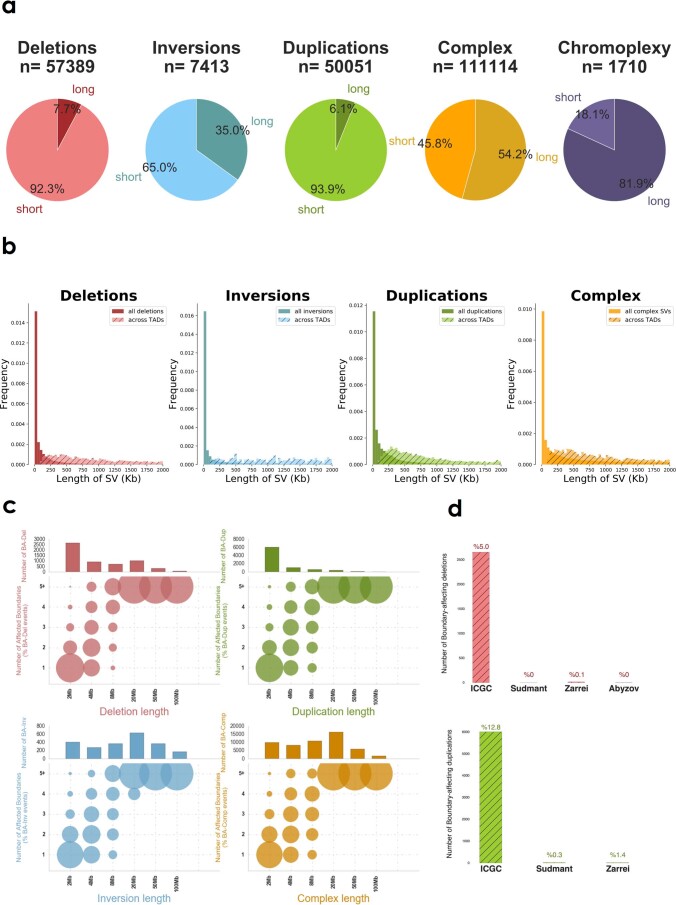
“Interestingly, TAD boundaries are significantly less likely (P < 0.02) to be affected by known deletion and duplication polymorphisms derived from genomes of healthy human populations25–27 (Extended Data Fig. 2d).”
§ Disruption of chromatin folding domains by somatic genomic rearrangements in human cancer > Results > TAD boundaries are affected by different types of somatic SV in cancer genomes
What the sources say
- Not checked yetcites [25] Zarrei, M., MacDonald, J. R., Merico, D. & Scherer, S. W. A copy number variation map of the human genome. Nat. Rev. Genet. 16, 172–183 (2015). source
- Supportedcites [26] Abyzov, A. et al. Analysis of deletion breakpoints from 1,092 humans reveals details of mutation mechanisms. Nat. Commun. 6, 7256 (2015). source
The citation identifies a source of human deletion polymorphisms, rather than attributing the TAD-boundary analysis to this paper. The Introduction describes a dataset of 8,943 deletion breakpoints from 1,092 individuals, and the Results (‘Deriving the confident set of breakpoints’) describe their frequencies across those individuals. The P < 0.02 finding is presented as the citing paper’s own Extended Data result. (LLM, conf=0.88)
- Supportedcites [27] Sudmant, P. H. et al. Global diversity, population stratification, and selection of human copy-number variation. Science 349, aab3761 (2015). source
The citation identifies a source of human deletion and duplication polymorphisms, not the source of the TAD-boundary test, which the citing sentence assigns to its own Extended Data Fig. 2d. In Results > CNV discovery, Sudmant et al. report discovering copy-number variants in 236 genomes representing 125 human populations; the paper also describes its focus as the normal pattern of human copy-number variation. (LLM, conf=0.88)
plain- Asserted: passes — The authors put it forward as true.
- Checkable: passes — It can be checked against evidence.
- Load-bearing: passes — The paper’s conclusions depend on it.
- Based: passes — The paper gives a reason why it holds.
Every source the paper cites for this claim was checked and supports it.
In the paper
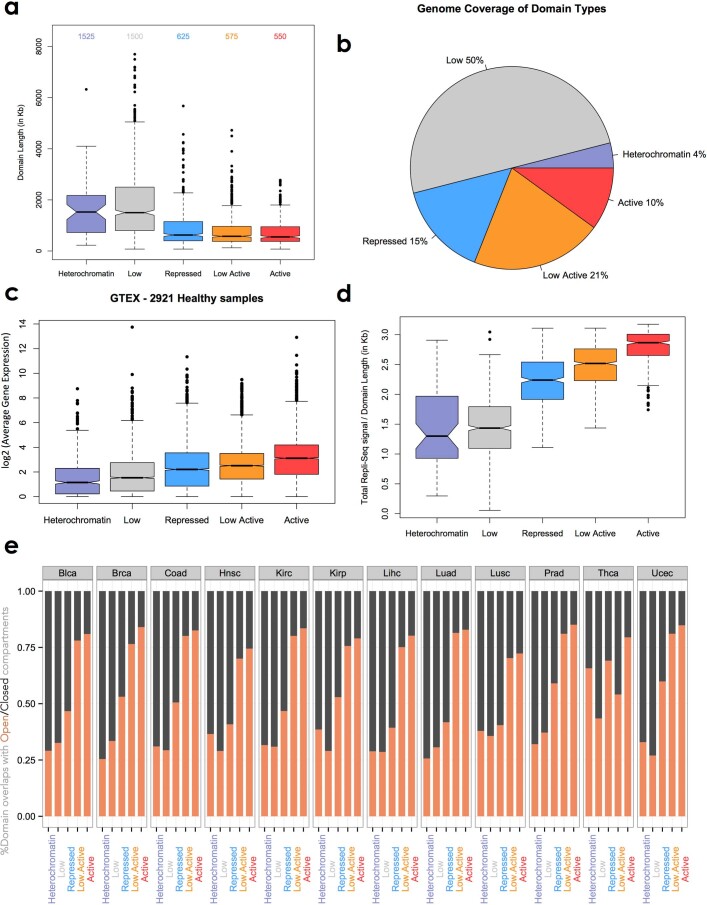
“Furthermore, distributions of replication timing for various cell types and open/closed chromatin compartment calls from TCGA data37 corroborated the data of the annotated domains (Extended Data Fig. 7d,e).”
§ Disruption of chromatin folding domains by somatic genomic rearrangements in human cancer > Results > Most domain disruptions do not result in marked gene-expression changes
What the sources say
- Supportedcites [37] Fortin, J.-P. & Hansen, K. D. Reconstructing A/B compartments as revealed by Hi-C using long-range correlations in epigenetic data. Genome Biol. 16, 180 (2015). source
The citation identifies the source of the TCGA compartment calls, not the citing authors’ comparison with their annotated domains. In Materials and methods > Data (page unavailable), Fortin and Hansen state that they estimated compartments from TCGA cancer data and made those estimates available in Additional file 2. The corroboration is attributed to the citing document’s own Extended Data Fig. 7d,e. (LLM, conf=0.91)
plaincorrelational- Asserted: passes — The authors put it forward as true.
- Checkable: passes — It can be checked against evidence.
- Load-bearing: unclear — It is unclear whether the paper’s conclusions depend on it.
- Based: passes — The paper gives a reason why it holds.
- Supported
The cited sources support only part of this claim — read each source’s verdict below.
In the paper
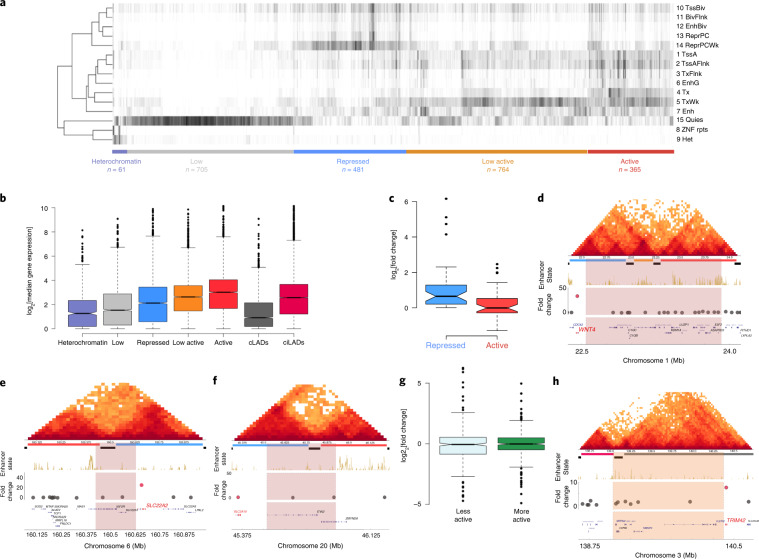
“The obtained matrix was grouped using the k-means clustering approach and five distinct groups of TADs were identified similar to a previous classification of chromatin domains17,19,33. These groups comprised heterochromatin (61), low/quiescent (705), repressed (481), low-active (764) and active (365) domains (Fig. 4a, Supplementary Table 4).”
§ Disruption of chromatin folding domains by somatic genomic rearrangements in human cancer > Results > Most domain disruptions do not result in marked gene-expression changes
What the sources say
- Partly supportedcites [17] Rao, S. S. P. et al. A 3D map of the human genome at kilobase resolution reveals principles of chromatin looping. Cell 159, 1665–1680 (2014). sourceExperimental — accuracy not yet measured
In Results, under “There are at least six nuclear subcompartments with distinct patterns of histone modifications” (page unavailable), Rao et al. describe an earlier classification into five subcompartments and include K-means among the methods used. That supports the cited comparison, but their categories were defined by long-range contact patterns, not chromatin-state coverage, and the paper does not report the five named TAD groups or counts in the citing sentence. (LLM, conf=0.87)
- Supportedcites [19] Ho, J. W. K. et al. Comparative analysis of metazoan chromatin organization. Nature 512, 449–452 (2014). source
The paper describes topological domains whose interiors generally have relatively uniform active, Polycomb-repressed, heterochromatic, or low-signal chromatin states. This supports its citation as a previous, similar classification of chromatin domains. The five TAD groups and their counts are presented as the citing authors’ own results, not as results attributed to this source. (LLM, conf=0.88)
- Supportedcites [33] Libbrecht, M. W. et al. Joint annotation of chromatin state and chromatin conformation reveals relationships among domain types and identifies domains of cell-type-specific expression. Genome Res. 25, 544–557 (2015). source
The Results section ('Joint domain annotation of chromatin state and chromatin conformation captures previously described domain types'; page unavailable) identifies five domain types, supporting the citation’s role as a previous, similar classification. The k-means grouping and counts are presented as the citing authors’ own results, not as findings of this source. (LLM, conf=0.88)
plain- Asserted: passes — The authors put it forward as true.
- Checkable: passes — It can be checked against evidence.
- Load-bearing: passes — The paper’s conclusions depend on it.
- Based: passes — The paper gives a reason why it holds.
- Partly supported
None of the sources cited for this claim have been checked yet.
In the paper
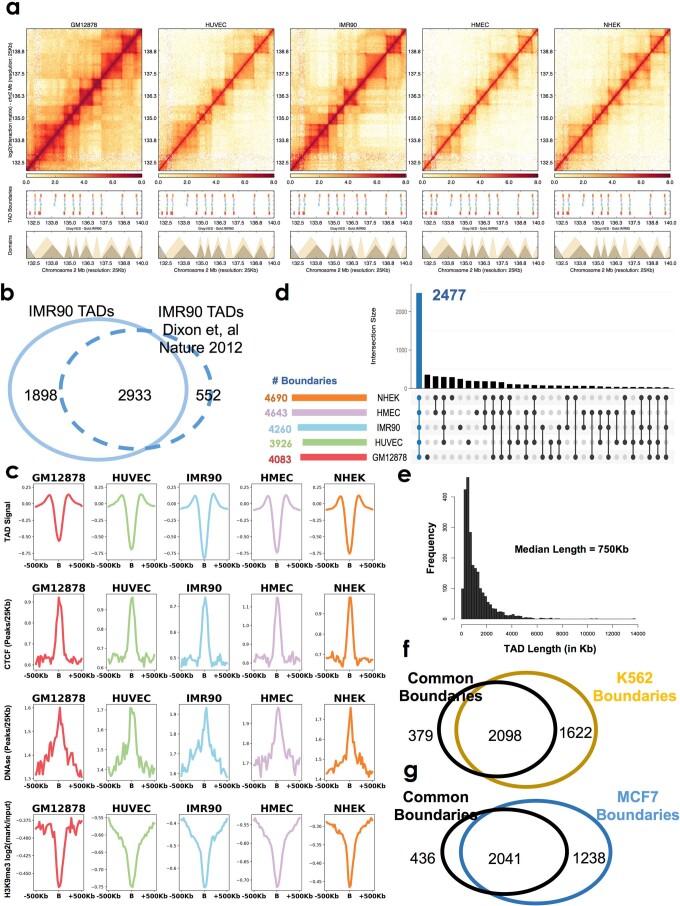
“We observed a high overlap with boundaries from a leukemia cell line K562 (ref. 17) and a breast cancer cell line MCF7 (ref. 20) (85% and 83.4%, respectively; Extended Data Fig. 1f,g).”
§ Disruption of chromatin folding domains by somatic genomic rearrangements in human cancer > Results > TAD boundaries are affected by different types of somatic SV in cancer genomes
What the sources say
- Not checked yetcites [17] Rao, S. S. P. et al. A 3D map of the human genome at kilobase resolution reveals principles of chromatin looping. Cell 159, 1665–1680 (2014). source
- Not checked yetcites [20] Barutcu, A. R. et al. Chromatin interaction analysis reveals changes in small chromosome and telomere clustering between epithelial and breast cancer cells. Genome Biol. 16, 214 (2015). source
plaincorrelational- Asserted: passes — The authors put it forward as true.
- Checkable: passes — It can be checked against evidence.
- Load-bearing: passes — The paper’s conclusions depend on it.
- Based: passes — The paper gives a reason why it holds.
A result the paper reports from its own data — it cites no other source for it, so there is none to check. The quote shows it is in the paper.
In the paper
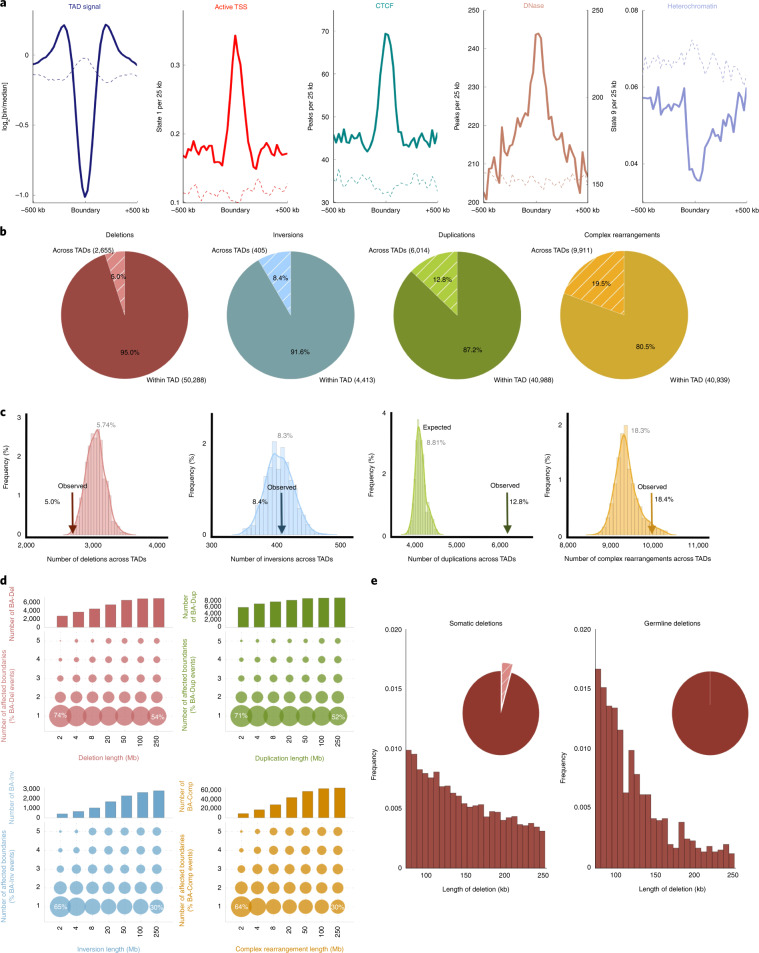
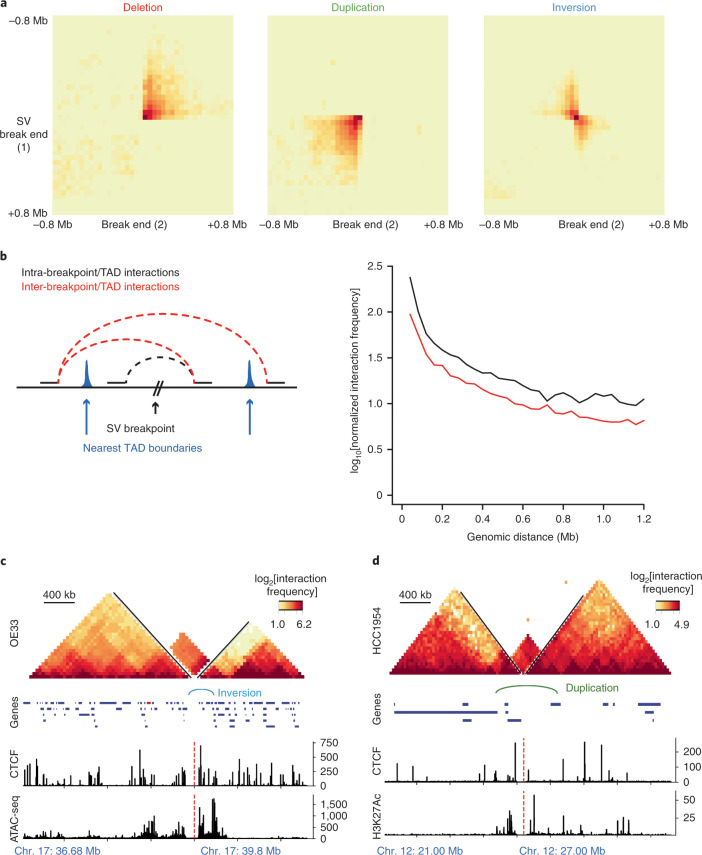
“Compared with the expected number of boundary disruptions based on randomly shuffled boundaries, these ratios are strongly enriched in BA-duplications (P < 10−4, 1.43-fold enrichment).”
§ Disruption of chromatin folding domains by somatic genomic rearrangements in human cancer > Results > TAD boundaries are affected by different types of somatic SV in cancer genomes
boostedcorrelational- Asserted: passes — The authors put it forward as true.
- Checkable: passes — It can be checked against evidence.
- Load-bearing: passes — The paper’s conclusions depend on it.
- Based: passes — The paper gives a reason why it holds.
A result the paper reports from its own data — it cites no other source for it, so there is none to check. The quote shows it is in the paper.
In the paper
“Across all cell types, we identified a common set of 2,477 boundaries (Supplementary Table 1, Extended Data Fig. 1d).”
§ Disruption of chromatin folding domains by somatic genomic rearrangements in human cancer > Results > TAD boundaries are affected by different types of somatic SV in cancer genomes
plain- Asserted: passes — The authors put it forward as true.
- Checkable: passes — It can be checked against evidence.
- Load-bearing: passes — The paper’s conclusions depend on it.
- Based: passes — The paper gives a reason why it holds.
A result the paper reports from its own data — it cites no other source for it, so there is none to check. The quote shows it is in the paper.
In the paper
“The number of affected boundaries did not markedly change with the minimum length of the SVs (Fig. 1d, Extended Data Fig. 2c).”
§ Disruption of chromatin folding domains by somatic genomic rearrangements in human cancer > Results > TAD boundaries are affected by different types of somatic SV in cancer genomes
plain- Asserted: passes — The authors put it forward as true.
- Checkable: passes — It can be checked against evidence.
- Load-bearing: unclear — It is unclear whether the paper’s conclusions depend on it.
- Based: passes — The paper gives a reason why it holds.
A result the paper reports from its own data — it cites no other source for it, so there is none to check. The quote shows it is in the paper.
In the paper
“There was a significant (P < 10−6) overlap (a 50-kb distance was allowed) between TAD boundaries among all profiled cell types.”
§ Disruption of chromatin folding domains by somatic genomic rearrangements in human cancer > Results > TAD boundaries are affected by different types of somatic SV in cancer genomes
plaincorrelational- Asserted: passes — The authors put it forward as true.
- Checkable: passes — It can be checked against evidence.
- Load-bearing: passes — The paper’s conclusions depend on it.
- Based: passes — The paper gives a reason why it holds.
None of the sources cited for this claim have been checked yet.
In the paper
“The median distance between the common boundaries was approximately 750 kb, consistent with the reported median TAD size in human cells4,19 (Extended Data Fig. 1e).”
§ Disruption of chromatin folding domains by somatic genomic rearrangements in human cancer > Results > TAD boundaries are affected by different types of somatic SV in cancer genomes
What the sources say
- Not checked yetcites [4] Dixon, J. R. et al. Topological domains in mammalian genomes identified by analysis of chromatin interactions. Nature 485, 376–380 (2012). source
- Not checked yetcites [19] Ho, J. W. K. et al. Comparative analysis of metazoan chromatin organization. Nature 512, 449–452 (2014). source
plain- Asserted: passes — The authors put it forward as true.
- Checkable: passes — It can be checked against evidence.
- Load-bearing: unclear — It is unclear whether the paper’s conclusions depend on it.
- Based: passes — The paper gives a reason why it holds.
A result the paper reports from its own data — it cites no other source for it, so there is none to check. The quote shows it is in the paper.
In the paper
“In contrast, we observed a depletion (0.87-fold enrichment, P = 0.052) in BA-deletions, whereas BA-inversions and BA-complex events occurred at expected levels (P > 0.05) compared with the shuffled TAD boundaries (Fig. 1c).”
§ Disruption of chromatin folding domains by somatic genomic rearrangements in human cancer > Results > TAD boundaries are affected by different types of somatic SV in cancer genomes
plain- Asserted: passes — The authors put it forward as true.
- Checkable: passes — It can be checked against evidence.
- Load-bearing: passes — The paper’s conclusions depend on it.
- Based: passes — The paper gives a reason why it holds.
- Probably not a substantial claim. 17
- The quote only partly states this claim. 1
- It may state two separate claims as one. 26
A result the paper reports from its own data — it cites no other source for it, so there is none to check. The quote shows it is in the paper.
In the paper
“Length distributions of the BA-SVs were uniformly distributed (Extended Data Fig. 2b).”
§ Disruption of chromatin folding domains by somatic genomic rearrangements in human cancer > Results > TAD boundaries are affected by different types of somatic SV in cancer genomes
plain- Asserted: passes — The authors put it forward as true.
- Checkable: passes — It can be checked against evidence.
- Load-bearing: fails — The paper’s conclusions may not depend on it.
- Based: passes — The paper gives a reason why it holds.
Probably not a substantial claim. The paper’s conclusions may not depend on it.
A result the paper reports from its own data — it cites no other source for it, so there is none to check. The quote shows it is in the paper.
In the paper
“As a result, a number of boundaries, which ranged from 3,926 to 4,690, were found for different cell types.”
§ Disruption of chromatin folding domains by somatic genomic rearrangements in human cancer > Results > TAD boundaries are affected by different types of somatic SV in cancer genomes
plainn = 5- Asserted: passes — The authors put it forward as true.
- Checkable: passes — It can be checked against evidence.
- Load-bearing: unclear — It is unclear whether the paper’s conclusions depend on it.
- Based: passes — The paper gives a reason why it holds.
The quote only partly states this claim.
A result the paper reports from its own data — it cites no other source for it, so there is none to check. The quote shows it is in the paper.
In the paper
“In contrast, we observed a depletion (0.87-fold enrichment, P = 0.052) in BA-deletions, whereas BA-inversions and BA-complex events occurred at expected levels (P > 0.05) compared with the shuffled TAD boundaries (Fig. 1c).”
§ Disruption of chromatin folding domains by somatic genomic rearrangements in human cancer > Results > TAD boundaries are affected by different types of somatic SV in cancer genomes
plain- Asserted: passes — The authors put it forward as true.
- Checkable: passes — It can be checked against evidence.
- Load-bearing: passes — The paper’s conclusions depend on it.
- Based: passes — The paper gives a reason why it holds.
It may state two separate claims as one.
A result the paper reports from its own data — it cites no other source for it, so there is none to check. The quote shows it is in the paper.
In the paper
“Most of the BA-SVs targeted a single boundary; 74% of BA-deletions, 65% of BA-inversions, 71% of BA-duplications and 64% of BA-complex events affected a single boundary per variant (Fig. 1d).”
§ Disruption of chromatin folding domains by somatic genomic rearrangements in human cancer > Results > TAD boundaries are affected by different types of somatic SV in cancer genomes
plain- Asserted: passes — The authors put it forward as true.
- Checkable: passes — It can be checked against evidence.
- Load-bearing: passes — The paper’s conclusions depend on it.
- Based: passes — The paper gives a reason why it holds.
It may state two separate claims as one.
A result the paper reports from its own data — it cites no other source for it, so there is none to check. The quote shows it is in the paper.
In the paper
“As a result, 5.0%, 8.5%, 12.8% and 19.9% of all deletions, inversions, duplications and complex events were called BA events, respectively (Fig. 1b).”
§ Disruption of chromatin folding domains by somatic genomic rearrangements in human cancer > Results > TAD boundaries are affected by different types of somatic SV in cancer genomes
plain- Asserted: passes — The authors put it forward as true.
- Checkable: passes — It can be checked against evidence.
- Load-bearing: passes — The paper’s conclusions depend on it.
- Based: passes — The paper gives a reason why it holds.
It may state two separate claims as one.
A result the paper reports from its own data — it cites no other source for it, so there is none to check. The quote shows it is in the paper.
In the paper
“We observed that CTCF-binding sites and active promoter marks were enriched, whereas the heterochromatin state was depleted at the boundaries.”
§ Disruption of chromatin folding domains by somatic genomic rearrangements in human cancer > Results > TAD boundaries are affected by different types of somatic SV in cancer genomes
plaincorrelational- Asserted: passes — The authors put it forward as true.
- Checkable: passes — It can be checked against evidence.
- Load-bearing: passes — The paper’s conclusions depend on it.
- Based: passes — The paper gives a reason why it holds.
It may state two separate claims as one.
A result the paper reports from its own data — it cites no other source for it, so there is none to check. The quote shows it is in the paper.
In the paper
“The majority (98.4%) of the boundaries were affected in cancer genomes, although a few boundaries were located in the low-mappability regions of the genome.”
§ Disruption of chromatin folding domains by somatic genomic rearrangements in human cancer > Results > TAD boundaries are affected by different types of somatic SV in cancer genomes
plain- Asserted: passes — The authors put it forward as true.
- Checkable: passes — It can be checked against evidence.
- Load-bearing: passes — The paper’s conclusions depend on it.
- Based: passes — The paper gives a reason why it holds.
It may state two separate claims as one.
A result the paper reports from its own data — it cites no other source for it, so there is none to check. The quote shows it is in the paper.
In the paper
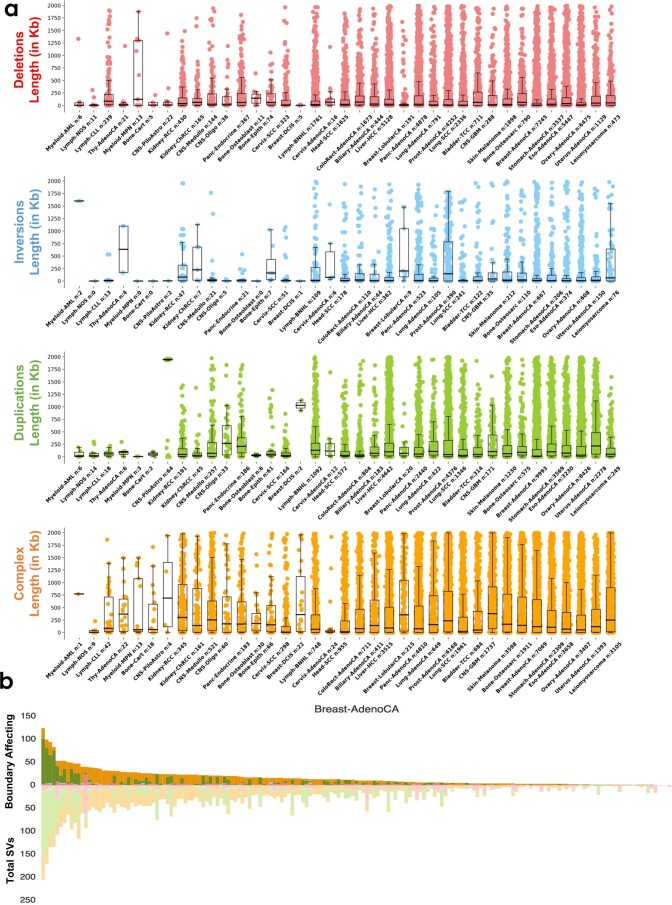
“The majority of deletions, inversions and duplications could be categorized as short-range; however, complex events tended to be longer in length (Extended Data Fig. 2a).”
§ Disruption of chromatin folding domains by somatic genomic rearrangements in human cancer > Results > TAD boundaries are affected by different types of somatic SV in cancer genomes
hedgedcorrelational- Asserted: passes — The authors put it forward as true.
- Checkable: passes — It can be checked against evidence.
- Load-bearing: passes — The paper’s conclusions depend on it.
- Based: passes — The paper gives a reason why it holds.
It may state two separate claims as one.
A result the paper reports from its own data — it cites no other source for it, so there is none to check. The quote shows it is in the paper.
In the paper
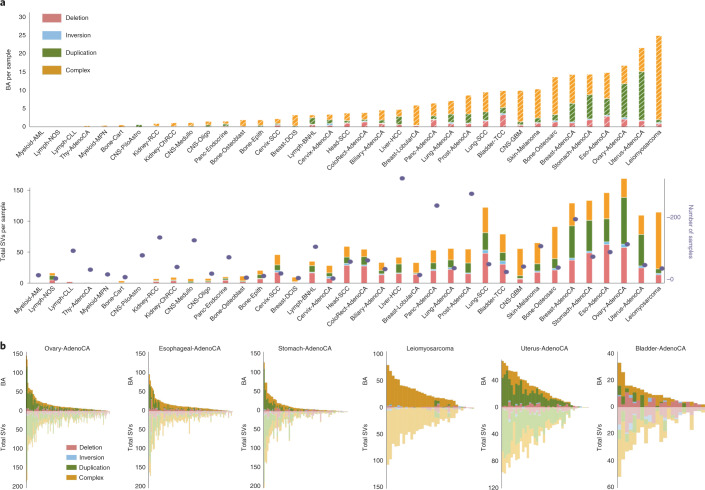
“For instance, leiomyosarcoma and esophageal adenocarcinoma had a higher complex SV burden and, as a result, observed BA events were also mostly complex rearrangements (Fig. 2b)”
§ Disruption of chromatin folding domains by somatic genomic rearrangements in human cancer > Results > Chromatin folding disruptions are specific to histological subtypes
plaindirect- Asserted: passes — The authors put it forward as true.
- Checkable: passes — It can be checked against evidence.
- Load-bearing: passes — The paper’s conclusions depend on it.
- Based: passes — The paper gives a reason why it holds.
It may state two separate claims as one.
A result the paper reports from its own data — it cites no other source for it, so there is none to check. The quote shows it is in the paper.
In the paper
“Ovarian, esophageal and breast adenocarcinomas also contained high numbers of BA-SVs with—on average—20, 19 and 18 BA-SVs per sample, respectively.”
§ Disruption of chromatin folding domains by somatic genomic rearrangements in human cancer > Results > Chromatin folding disruptions are specific to histological subtypes
plain- Asserted: passes — The authors put it forward as true.
- Checkable: passes — It can be checked against evidence.
- Load-bearing: unclear — It is unclear whether the paper’s conclusions depend on it.
- Based: passes — The paper gives a reason why it holds.
It may state two separate claims as one.
A result the paper reports from its own data — it cites no other source for it, so there is none to check. The quote shows it is in the paper.
In the paper
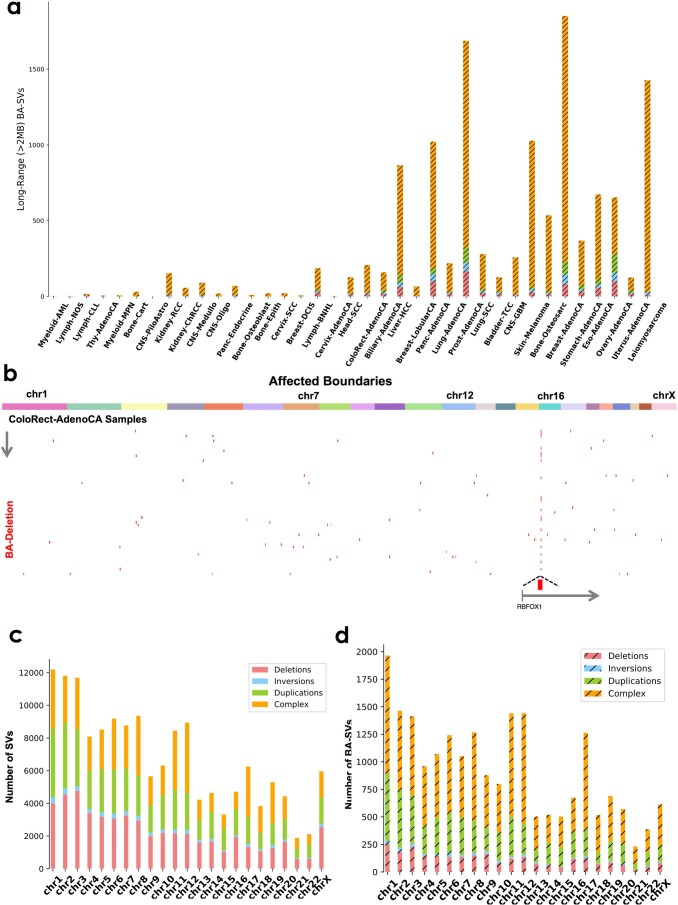
“We surveyed the BA-SV distributions on individual chromosomes and observed a positive correlation with the number of boundaries (r2 = 0.68–0.92) and gene density (r2 = 0.7–0.85) on a given chromosome (Extended Data Fig. 4c,d).”
§ Disruption of chromatin folding domains by somatic genomic rearrangements in human cancer > Results > Recurrently affected boundaries in specific cancer types
plaincorrelational- Asserted: passes — The authors put it forward as true.
- Checkable: passes — It can be checked against evidence.
- Load-bearing: unclear — It is unclear whether the paper’s conclusions depend on it.
- Based: passes — The paper gives a reason why it holds.
It may state two separate claims as one.
A result the paper reports from its own data — it cites no other source for it, so there is none to check. The quote shows it is in the paper.
In the paper
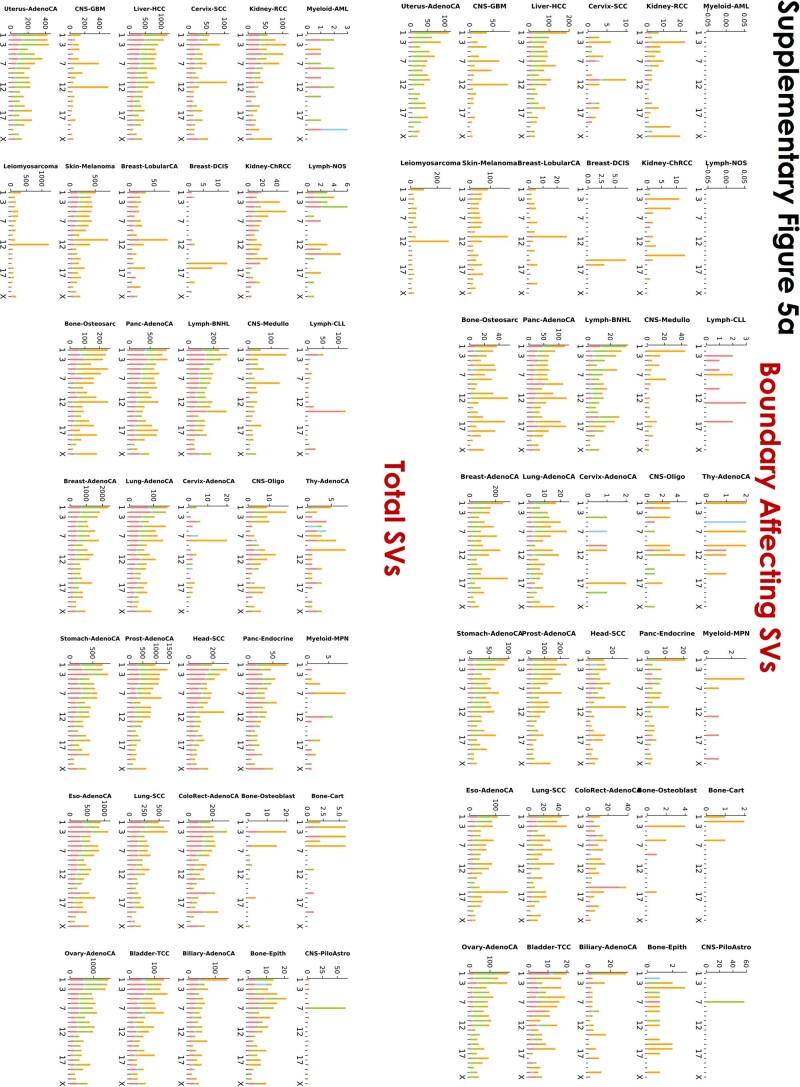
“Again, leiomyosarcoma and breast adenocarcinoma contained a higher number of BA-SVs compared with other cancer types, whereas leukemia samples had no BA-SVs per sample (Extended Data Fig. 4a).”
§ Disruption of chromatin folding domains by somatic genomic rearrangements in human cancer > Results > Chromatin folding disruptions are specific to histological subtypes
plaincorrelational- Asserted: passes — The authors put it forward as true.
- Checkable: passes — It can be checked against evidence.
- Load-bearing: passes — The paper’s conclusions depend on it.
- Based: passes — The paper gives a reason why it holds.
It may state two separate claims as one.
A result the paper reports from its own data — it cites no other source for it, so there is none to check. The quote shows it is in the paper.
In the paper
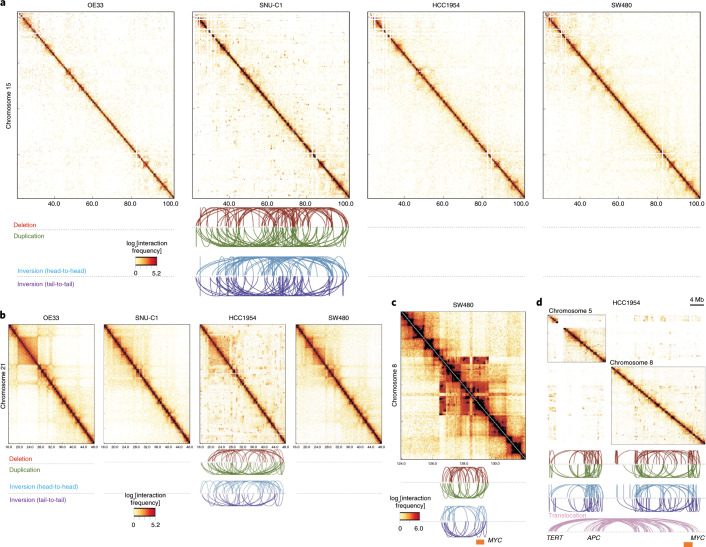
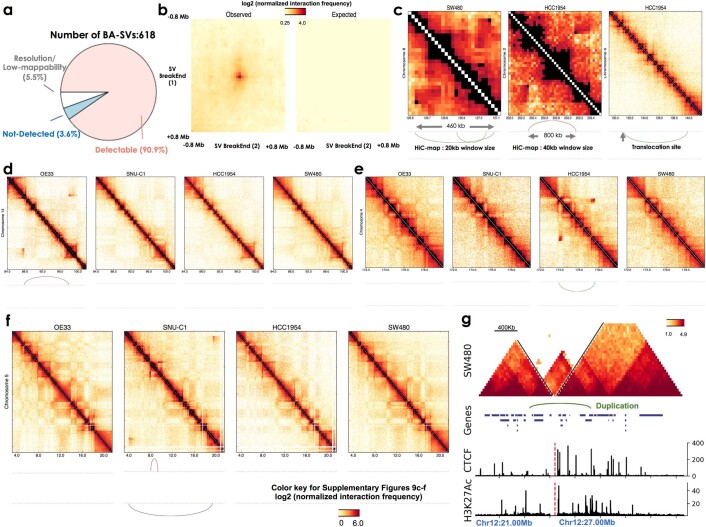
“By contrast, we observed several discrepancies between SVs detected in WGS data and Hi-C maps. These SV break-ends tended to be located in repetitive regions of the genome or overlapped with inter-chromosomal translocations (Extended Data Fig. 9a,c).”
§ Disruption of chromatin folding domains by somatic genomic rearrangements in human cancer > Results > Cell-type-specific alterations in chromatin folding patterns by different SV types
plaincorrelational- Asserted: passes — The authors put it forward as true.
- Checkable: passes — It can be checked against evidence.
- Load-bearing: unclear — It is unclear whether the paper’s conclusions depend on it.
- Based: passes — The paper gives a reason why it holds.
It may state two separate claims as one.
A result the paper reports from its own data — it cites no other source for it, so there is none to check. The quote shows it is in the paper.
In the paper
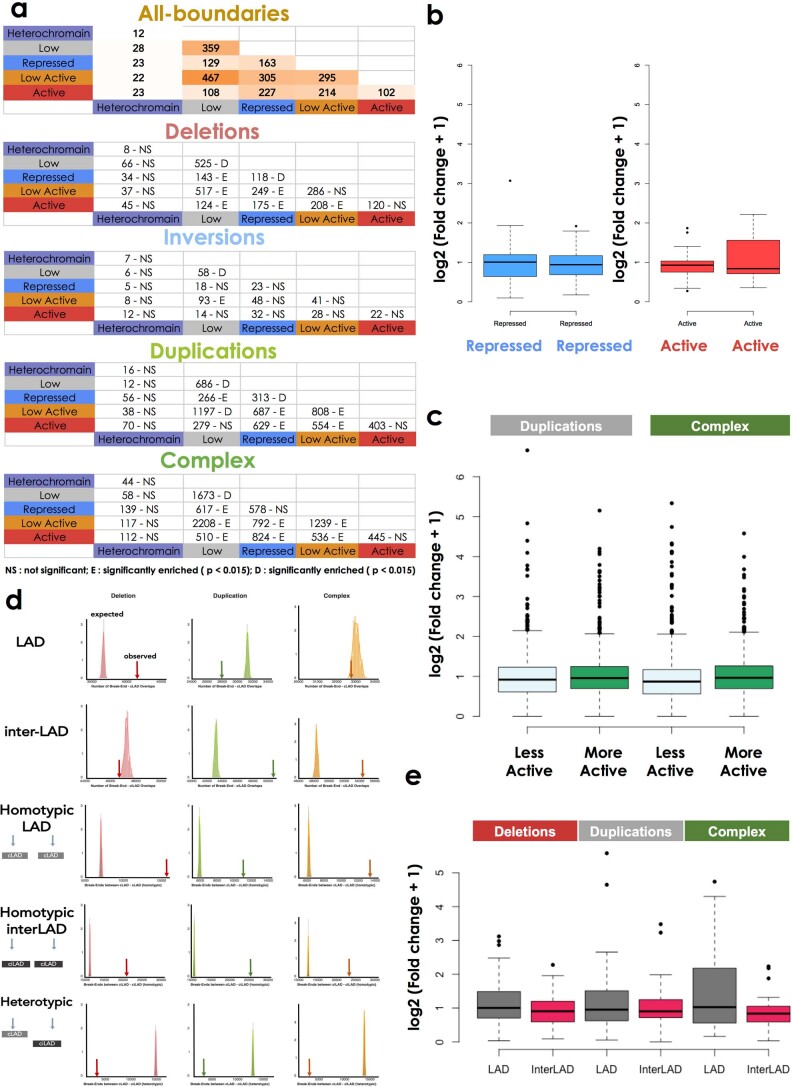
“We observed that deletions significantly occurred in LADs and duplications in inter-LADs, whereas SVs were less likely to occur between LADs and inter-LADs (Extended Data Fig. 8d).”
§ Disruption of chromatin folding domains by somatic genomic rearrangements in human cancer > Results > Most domain disruptions do not result in marked gene-expression changes
plaincorrelational- Asserted: passes — The authors put it forward as true.
- Checkable: passes — It can be checked against evidence.
- Load-bearing: unclear — It is unclear whether the paper’s conclusions depend on it.
- Based: passes — The paper gives a reason why it holds.
It may state two separate claims as one.
None of the sources cited for this claim have been checked yet.
In the paper
“Repressed domains were larger in size and covered the majority of the genome compared with active domains, in agreement with previous TAD annotations19,35 (Extended Data Fig. 7a,b).”
§ Disruption of chromatin folding domains by somatic genomic rearrangements in human cancer > Results > Most domain disruptions do not result in marked gene-expression changes
What the sources say
- Not checked yetcites [19] Ho, J. W. K. et al. Comparative analysis of metazoan chromatin organization. Nature 512, 449–452 (2014). source
- Not checked yetcites [35] Sexton, T. & Yaffe, E. Chromosome folding: driver or passenger of epigenetic state? Cold Spring Harb. Perspect. Biol. 7, a018721 (2015). source
plaincorrelational- Asserted: passes — The authors put it forward as true.
- Checkable: passes — It can be checked against evidence.
- Load-bearing: unclear — It is unclear whether the paper’s conclusions depend on it.
- Based: passes — The paper gives a reason why it holds.
It may state two separate claims as one.
A result the paper reports from its own data — it cites no other source for it, so there is none to check. The quote shows it is in the paper.
In the paper
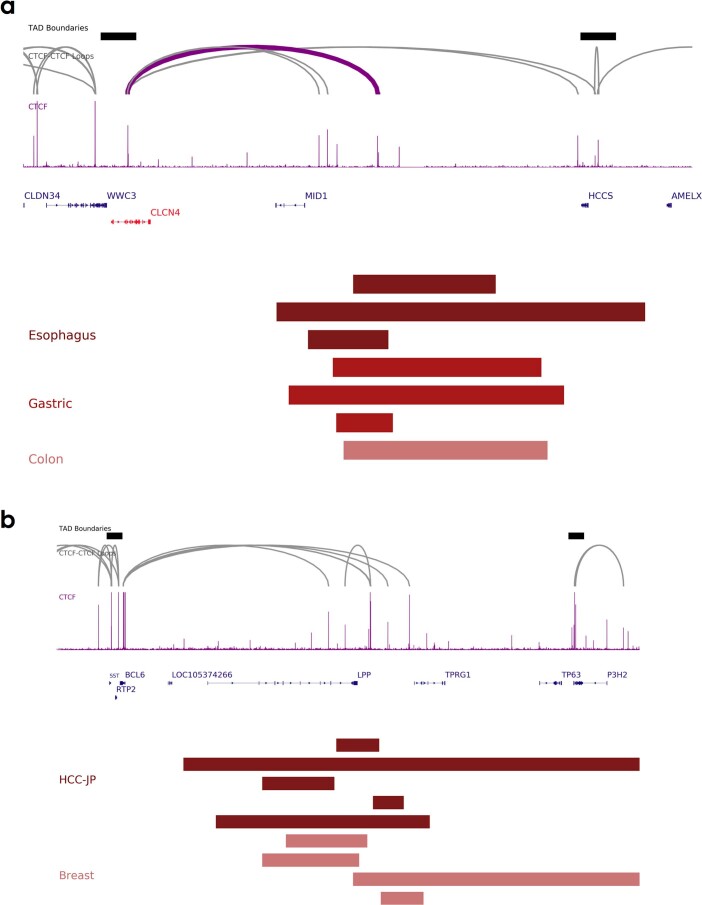
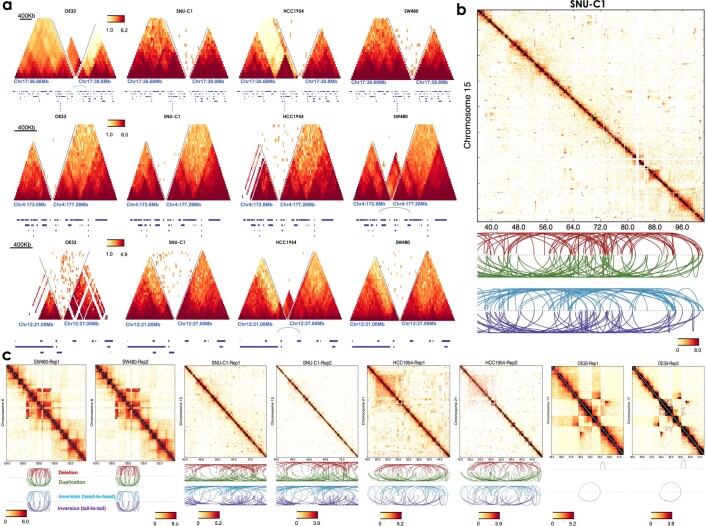
“Other potentially altered loops include a CTCF site near BCL6 in hepatocellular carcinoma and breast adenocarcinoma, and CLCN4 in colorectal adenocarcinomas (Extended Data Fig. 6a,b).”
§ Disruption of chromatin folding domains by somatic genomic rearrangements in human cancer > Results > Recurrently affected boundaries in specific cancer types
hedgedcorrelational- Asserted: passes — The authors put it forward as true.
- Checkable: passes — It can be checked against evidence.
- Load-bearing: unclear — It is unclear whether the paper’s conclusions depend on it.
- Based: passes — The paper gives a reason why it holds.
It may state two separate claims as one.
A result the paper reports from its own data — it cites no other source for it, so there is none to check. The quote shows it is in the paper.
In the paper
“Notably, distributions of BA-SVs per chromosome were generally specific to the histology subtype; for example, chromosome 17 was affected predominantly by BA-complex events in breast and esophageal adenocarcinoma samples (Extended Data Fig. 5a,b).”
§ Disruption of chromatin folding domains by somatic genomic rearrangements in human cancer > Results > Recurrently affected boundaries in specific cancer types
plaincorrelational- Asserted: passes — The authors put it forward as true.
- Checkable: passes — It can be checked against evidence.
- Load-bearing: unclear — It is unclear whether the paper’s conclusions depend on it.
- Based: passes — The paper gives a reason why it holds.
It may state two separate claims as one.
A result the paper reports from its own data — it cites no other source for it, so there is none to check. The quote shows it is in the paper.
In the paper
“duplications tended to span TADs and generally occurred within inter-LAD regions”
§ Disruption of chromatin folding domains by somatic genomic rearrangements in human cancer > Discussion
plaincorrelational- Asserted: passes — The authors put it forward as true.
- Checkable: passes — It can be checked against evidence.
- Load-bearing: passes — The paper’s conclusions depend on it.
- Based: passes — The paper gives a reason why it holds.
It may state two separate claims as one.
- Rests on an assumption: TAD boundaries identified in normal cell lines are representative of TAD boundaries in cancer cells.
A result the paper reports from its own data — it cites no other source for it, so there is none to check. The quote shows it is in the paper.
In the paper
“We noticed that the number of BA-SVs present in germline deletions and duplications was low and these events happened less than expected by chance, which was estimated using a bootstrapping method.”
§ Disruption of chromatin folding domains by somatic genomic rearrangements in human cancer > Methods > Structural alterations
hedged- Asserted: passes — The authors put it forward as true.
- Checkable: passes — It can be checked against evidence.
- Load-bearing: unclear — It is unclear whether the paper’s conclusions depend on it.
- Based: passes — The paper gives a reason why it holds.
It may state two separate claims as one.
None of the sources cited for this claim have been checked yet.
In the paper
“The disruption of domain boundaries can result in ectopic interactions between neighboring domains and affect the regulation of nearby genes5,9.”
§ Disruption of chromatin folding domains by somatic genomic rearrangements in human cancer > Main
What the sources say
- Not checked yetcites [5] Nora, E. P. et al. Spatial partitioning of the regulatory landscape of the X-inactivation centre. Nature 485, 381–385 (2012). source
- Not checked yetcites [9] Lupiáñez, D. G. et al. Disruptions of topological chromatin domains cause pathogenic rewiring of gene-enhancer interactions. Cell 161, 1012–1025 (2015). source
plaindirect- Asserted: passes — The authors put it forward as true.
- Checkable: passes — It can be checked against evidence.
- Load-bearing: passes — The paper’s conclusions depend on it.
- Based: passes — The paper gives a reason why it holds.
It may state two separate claims as one.
None of the sources cited for this claim have been checked yet.
In the paper
“TADs are considered to represent functional domains because a given TAD encompasses the regulatory elements for the genes inside the same domain6,7.”
§ Disruption of chromatin folding domains by somatic genomic rearrangements in human cancer > Main
What the sources say
- Not checked yetcites [6] de Laat, W. & Duboule, D. Topology of mammalian developmental enhancers and their regulatory landscapes. Nature 502, 499–506 (2013). source
- Not checked yetcites [7] Vietri Rudan, M. et al. Comparative Hi-C reveals that CTCF underlies evolution of chromosomal domain architecture. Cell Rep. 10, 1297–1309 (2015). source
plaindirect- Asserted: passes — The authors put it forward as true.
- Checkable: passes — It can be checked against evidence.
- Load-bearing: passes — The paper’s conclusions depend on it.
- Based: passes — The paper gives a reason why it holds.
Probably not a substantial claim.
None of the sources cited for this claim have been checked yet.
In the paper
“Several other studies have reported the deregulation of chromatin folding structures in different cancer types11,15,16.”
§ Disruption of chromatin folding domains by somatic genomic rearrangements in human cancer > Main
What the sources say
- Not checked yetcites [11] Weischenfeldt, J. et al. Pan-cancer analysis of somatic copy-number alterations implicates IRS4 and IGF2 in enhancer hijacking. Nat. Genet. 49, 65–74 (2017). source
- Not checked yetcites [15] Hnisz, D. et al. Activation of proto-oncogenes by disruption of chromosome neighborhoods. Science 351, 1454–1458 (2016). source
- Not checked yetcites [16] Flavahan, W. A. et al. Insulator dysfunction and oncogene activation in IDH mutant gliomas. Nature 529, 110–114 (2016). source
plain- Asserted: passes — The authors put it forward as true.
- Checkable: passes — It can be checked against evidence.
- Load-bearing: fails — The paper’s conclusions may not depend on it.
- Based: passes — The paper gives a reason why it holds.
Probably not a substantial claim. The paper’s conclusions may not depend on it.
A conclusion the paper draws from its own results — it cites no other source for it, so there is none to check. The quote shows it is in the paper.
In the paper
“Overall, these results suggest that deletions tended to occur within the same TAD, whereas duplications tended to span regions across different TADs.”
§ Disruption of chromatin folding domains by somatic genomic rearrangements in human cancer > Results > TAD boundaries are affected by different types of somatic SV in cancer genomes
hedgedcorrelational- Asserted: passes — The authors put it forward as true.
- Checkable: passes — It can be checked against evidence.
- Load-bearing: passes — The paper’s conclusions depend on it.
- Based: passes — The paper gives a reason why it holds.
It may state two separate claims as one.
A conclusion the paper draws from its own results — it cites no other source for it, so there is none to check. The quote shows it is in the paper.
In the paper
“Taken together, our findings show that the impact of BA-SVs is varied substantially across tumor types and these events were reflective of overall SV burden and type.”
§ Disruption of chromatin folding domains by somatic genomic rearrangements in human cancer > Results > Chromatin folding disruptions are specific to histological subtypes
plaincorrelational- Asserted: passes — The authors put it forward as true.
- Checkable: passes — It can be checked against evidence.
- Load-bearing: passes — The paper’s conclusions depend on it.
- Based: passes — The paper gives a reason why it holds.
It may state two separate claims as one.
In the paper
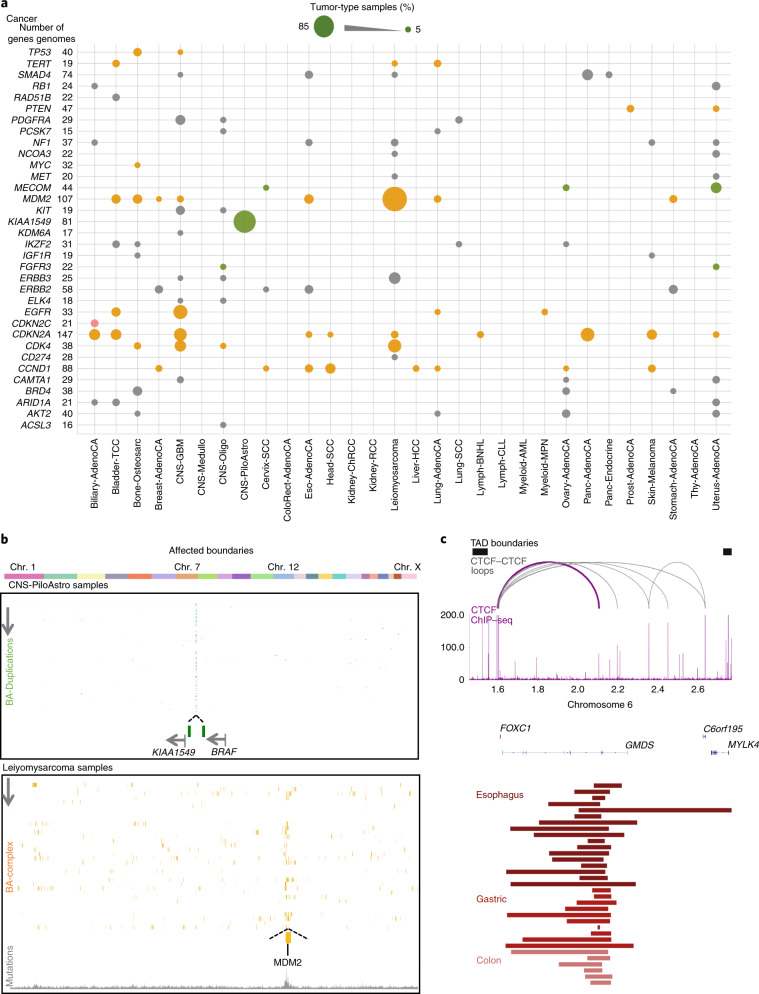
“This region has previously been implicated in pilocytic astrocytoma, producing an oncogenic fusion between the aforementioned genes30.”
§ Disruption of chromatin folding domains by somatic genomic rearrangements in human cancer > Results > Recurrently affected boundaries in specific cancer types
What the sources say
- Not checked yetcites [30] Jones, D. T. W. et al. Tandem duplication producing a novel oncogenic BRAF fusion gene defines the majority of pilocytic astrocytomas. Cancer Res. 68, 8673–8677 (2008). source
plaindirect- Asserted: passes — The authors put it forward as true.
- Checkable: passes — It can be checked against evidence.
- Load-bearing: fails — The paper’s conclusions may not depend on it.
- Based: passes — The paper gives a reason why it holds.
Probably not a substantial claim. The paper’s conclusions may not depend on it.
A conclusion the paper draws from its own results — it cites no other source for it, so there is none to check. The quote shows it is in the paper.
In the paper
“These findings emphasize the cancer specificity of BA-SVs, in which active mechanisms lead to the overall SV burden and type in different tumor types yield potential changes in TAD structures, especially around cancer driver genes.”
§ Disruption of chromatin folding domains by somatic genomic rearrangements in human cancer > Results > Recurrently affected boundaries in specific cancer types
hedgeddirect- Asserted: passes — The authors put it forward as true.
- Checkable: passes — It can be checked against evidence.
- Load-bearing: passes — The paper’s conclusions depend on it.
- Based: passes — The paper gives a reason why it holds.
It may state two separate claims as one.
None of the sources cited for this claim have been checked yet.
In the paper
“Furthermore, it has also been suggested that SVs could lead to TAD fusions40 (also referred to as neo-TADs3,4);”
§ Disruption of chromatin folding domains by somatic genomic rearrangements in human cancer > Results > Cell-type-specific alterations in chromatin folding patterns by different SV types
What the sources say
- Not checked yetcites [40] Dixon, J. R. et al. Integrative detection and analysis of structural variation in cancer genomes. Nat. Genet. 50, 1388–1398 (2018). source
- Not checked yetcites [3] Guelen, L. et al. Domain organization of human chromosomes revealed by mapping of nuclear lamina interactions. Nature 453, 948–951 (2008). source
- Not checked yetcites [4] Dixon, J. R. et al. Topological domains in mammalian genomes identified by analysis of chromatin interactions. Nature 485, 376–380 (2012). source
hedgeddirect- Asserted: passes — The authors put it forward as true.
- Checkable: passes — It can be checked against evidence.
- Load-bearing: passes — The paper’s conclusions depend on it.
- Based: passes — The paper gives a reason why it holds.
Probably not a substantial claim.
A conclusion the paper draws from its own results — it cites no other source for it, so there is none to check. The quote shows it is in the paper.
In the paper
“Therefore, chromatin folding perturbations can occur at various scales, include TADs and CTCF–CTCF chromatin loops in cancer genomes and recurrently altered boundaries are generally cancer-type specific.”
§ Disruption of chromatin folding domains by somatic genomic rearrangements in human cancer > Results > Recurrently affected boundaries in specific cancer types
plaincorrelational- Asserted: passes — The authors put it forward as true.
- Checkable: passes — It can be checked against evidence.
- Load-bearing: passes — The paper’s conclusions depend on it.
- Based: passes — The paper gives a reason why it holds.
It may state two separate claims as one.
In the paper
“This observation of specific changes in Hi-C maps due to different SV types is consistent with findings from a recent study40.”
§ Disruption of chromatin folding domains by somatic genomic rearrangements in human cancer > Results > Cell-type-specific alterations in chromatin folding patterns by different SV types
What the sources say
- Not checked yetcites [40] Dixon, J. R. et al. Integrative detection and analysis of structural variation in cancer genomes. Nat. Genet. 50, 1388–1398 (2018). source
plaincorrelational- Asserted: passes — The authors put it forward as true.
- Checkable: passes — It can be checked against evidence.
- Load-bearing: fails — The paper’s conclusions may not depend on it.
- Based: passes — The paper gives a reason why it holds.
Probably not a substantial claim. The paper’s conclusions may not depend on it.
A conclusion the paper draws from its own results — it cites no other source for it, so there is none to check. The quote shows it is in the paper.
In the paper
“These observations suggest that gene regulation in cancer genomes is multifactorial, although disruptions in chromatin folding domains may contribute to expression levels in certain cases, the effects of disruption do not always coincide with the expression changes.”
§ Disruption of chromatin folding domains by somatic genomic rearrangements in human cancer > Results > Most domain disruptions do not result in marked gene-expression changes
hedgedconditional- Asserted: passes — The authors put it forward as true.
- Checkable: passes — It can be checked against evidence.
- Load-bearing: passes — The paper’s conclusions depend on it.
- Based: passes — The paper gives a reason why it holds.
It may state two separate claims as one.
What the paper did — it cites no source for this, so there is none to check. The quote shows it is in the paper.
In the paper
“SV breaks-ends reported by two different callers were included in this analysis.”
§ Disruption of chromatin folding domains by somatic genomic rearrangements in human cancer > Methods > WGS data analysis of cancer cell lines
plain- Asserted: passes — The authors put it forward as true.
- Checkable: passes — It can be checked against evidence.
- Load-bearing: fails — The paper’s conclusions may not depend on it.
- Based: passes — The paper gives a reason why it holds.
Probably not a substantial claim. The paper’s conclusions may not depend on it.
What the paper did — it cites no source for this, so there is none to check. The quote shows it is in the paper.
In the paper
“We filtered the genes with low expression values (<0.1 FPKM), as fold changes with those genes would be seemingly high for even small fluctuations.”
§ Disruption of chromatin folding domains by somatic genomic rearrangements in human cancer > Methods > Structural alterations
plain- Asserted: passes — The authors put it forward as true.
- Checkable: passes — It can be checked against evidence.
- Load-bearing: passes — The paper’s conclusions depend on it.
- Based: passes — The paper gives a reason why it holds.
Probably not a substantial claim.
What the paper did — it cites no source for this, so there is none to check. The quote shows it is in the paper.
In the paper
“We could detect the changes in biological Hi-C replicates, suggesting that these BA-SV effects are reproducible”
§ Disruption of chromatin folding domains by somatic genomic rearrangements in human cancer > Results > Complex rearrangements markedly change chromatin folding maps in the cancer genomes
hedgedcorrelational- Asserted: passes — The authors put it forward as true.
- Checkable: passes — It can be checked against evidence.
- Load-bearing: passes — The paper’s conclusions depend on it.
- Based: passes — The paper gives a reason why it holds.
It may state two separate claims as one.
- Rests on an assumption: Hi-C data from cancer cell lines accurately reflect chromatin folding in the corresponding primary tumors.
What the paper did — it cites no source for this, so there is none to check. The quote shows it is in the paper.
In the paper
“Hi-C was performed using the in situ Hi-C protocol as previously described17 using 2–5 million cells per experiment that were digested with the MboI restriction enzyme and analyzed in duplicate.”
§ Disruption of chromatin folding domains by somatic genomic rearrangements in human cancer > Methods > Cancer cell line Hi-C assay and analysis
plain- Asserted: passes — The authors put it forward as true.
- Checkable: passes — It can be checked against evidence.
- Load-bearing: fails — The paper’s conclusions may not depend on it.
- Based: passes — The paper gives a reason why it holds.
Probably not a substantial claim. The paper’s conclusions may not depend on it.
In the paper
“cancer genomes may have other alterations that could affect the observed gene expression patterns, including copy-number alterations, dysregulation of transcription factors, chromatin regulators or cis-regulatory elements44.”
§ Disruption of chromatin folding domains by somatic genomic rearrangements in human cancer > Discussion
What the sources say
- Not checked yetcites [44] Lee, T. I. & Young, R. A. Transcriptional regulation and its misregulation in disease. Cell 152, 1237–1251 (2013). source
hedgedconditional- Asserted: passes — The authors put it forward as true.
- Checkable: passes — It can be checked against evidence.
- Load-bearing: fails — The paper’s conclusions may not depend on it.
- Based: passes — The paper gives a reason why it holds.
Probably not a substantial claim. The paper’s conclusions may not depend on it.
What the paper did — it cites no source for this, so there is none to check. The quote shows it is in the paper.
In the paper
“we truncated the default 2-Mb window if there was another SV to avoid biases introduced by complex variants.”
§ Disruption of chromatin folding domains by somatic genomic rearrangements in human cancer > Methods > Cancer cell line Hi-C assay and analysis
plaindirect- Asserted: passes — The authors put it forward as true.
- Checkable: passes — It can be checked against evidence.
- Load-bearing: fails — The paper’s conclusions may not depend on it.
- Based: passes — The paper gives a reason why it holds.
Probably not a substantial claim. The paper’s conclusions may not depend on it.
What the paper did — it cites no source for this, so there is none to check. The quote shows it is in the paper.
In the paper
“We removed cases in which copy numbers are more than four for either the upstream or the downstream genes.”
§ Disruption of chromatin folding domains by somatic genomic rearrangements in human cancer > Methods > Structural alterations
plain- Asserted: passes — The authors put it forward as true.
- Checkable: passes — It can be checked against evidence.
- Load-bearing: passes — The paper’s conclusions depend on it.
- Based: passes — The paper gives a reason why it holds.
Probably not a substantial claim.
What the paper did — it cites no source for this, so there is none to check. The quote shows it is in the paper.
In the paper
“we excluded regions for which the scaling factor was less than 0.1 to remove potential false-positive calls.”
§ Disruption of chromatin folding domains by somatic genomic rearrangements in human cancer > Methods > Cancer cell line Hi-C assay and analysis
plain- Asserted: passes — The authors put it forward as true.
- Checkable: passes — It can be checked against evidence.
- Load-bearing: passes — The paper’s conclusions depend on it.
- Based: passes — The paper gives a reason why it holds.
Probably not a substantial claim.
What the paper did — it cites no source for this, so there is none to check. The quote shows it is in the paper.
In the paper
“we removed genes that were distal to the break-ends by more than 1 Mb.”
§ Disruption of chromatin folding domains by somatic genomic rearrangements in human cancer > Methods > Structural alterations
plain- Asserted: passes — The authors put it forward as true.
- Checkable: passes — It can be checked against evidence.
- Load-bearing: passes — The paper’s conclusions depend on it.
- Based: passes — The paper gives a reason why it holds.
Probably not a substantial claim.
None of the sources cited for this claim have been checked yet.
In the paper
“which is consistent with the findings of recent studies42,43”
§ Disruption of chromatin folding domains by somatic genomic rearrangements in human cancer > Discussion
What the sources say
- Not checked yetcites [42] Ghavi-Helm, Y. et al. Highly rearranged chromosomes reveal uncoupling between genome topology and gene expression. Nat. Genet. 51, 1272–1282 (2019). source
- Not checked yetcites [43] Despang, A. et al. Functional dissection of the Sox9–Kcnj2 locus identifies nonessential and instructive roles of TAD architecture. Nat. Genet. 51, 1263–1271 (2019). source
plain- Asserted: passes — The authors put it forward as true.
- Checkable: passes — It can be checked against evidence.
- Load-bearing: fails — The paper’s conclusions may not depend on it.
- Based: passes — The paper gives a reason why it holds.
Probably not a substantial claim. The paper’s conclusions may not depend on it.
A conclusion the paper draws from its own results — it cites no other source for it, so there is none to check. The quote shows it is in the paper.
In the paper
“Our analysis revealed that intra-TAD/SV interactions were stronger than the inter-TAD/SV interactions, when controlling for genomic distance effects, which suggests that the SVs can lead to cross-boundary interactions and potentially the formation of new chromatin folding domains based on the location of existing nearby TAD boundaries (Fig. 5b).”
§ Disruption of chromatin folding domains by somatic genomic rearrangements in human cancer > Results > Cell-type-specific alterations in chromatin folding patterns by different SV types
hedgedconditional- Asserted: passes — The authors put it forward as true.
- Checkable: passes — It can be checked against evidence.
- Load-bearing: passes — The paper’s conclusions depend on it.
- Based: passes — The paper gives a reason why it holds.
It may state two separate claims as one.
A conclusion the paper draws from its own results — it cites no other source for it, so there is none to check. The quote shows it is in the paper.
In the paper
“Disruption of folding domains could result in aberrant interactions between flanking domains and potentially contribute to the re-shaping of gene expression around the affected regions.”
§ Disruption of chromatin folding domains by somatic genomic rearrangements in human cancer > Discussion
hedgedconditional- Asserted: passes — The authors put it forward as true.
- Checkable: passes — It can be checked against evidence.
- Load-bearing: passes — The paper’s conclusions depend on it.
- Based: passes — The paper gives a reason why it holds.
Probably not a substantial claim. It may state two separate claims as one.
- Rests on an assumption: TAD boundaries identified in normal cell lines are representative of TAD boundaries in cancer cells.
What the paper did — it cites no source for this, so there is none to check. The quote shows it is in the paper.
In the paper
“These cell lines were authenticated by comparing SV results from previous WGS datasets from the same cancer lines.”
§ Disruption of chromatin folding domains by somatic genomic rearrangements in human cancer > Methods > Cancer cell lines
plain- Asserted: passes — The authors put it forward as true.
- Checkable: passes — It can be checked against evidence.
- Load-bearing: fails — The paper’s conclusions may not depend on it.
- Based: passes — The paper gives a reason why it holds.
Probably not a substantial claim. The paper’s conclusions may not depend on it.
The paper relies on this without support.
The frequency of domain disruptions in human cancers remains unclear.
“However, the frequency of domain disruptions in human cancers remains unclear.”
“Despite these recent examples of SVs that result in altered local enhancer–promoter landscapes, the frequency of such regulatory architecture rearrangements in cancer genomes remains unclear.”
The paper relies on this without support.
Whether there are loci affected by potential changes in regulatory structure outside of those currently reported in the literature is unknown.
“Similarly, whether there are loci affected by potential changes in regulatory structure outside of those currently reported in the literature is unknown.”
The paper relies on this without support.
TAD boundaries identified in normal cell lines are representative of TAD boundaries in cancer cells.
“Common TAD boundaries were identified for boundaries of all five cell-types (GM12878, HUVEC, IMR90, HMEC and NHEK) that occurred within two Hi-C bins or 50 kb in genomic range.”
The paper relies on this without support.
Hi-C data from cancer cell lines accurately reflect chromatin folding in the corresponding primary tumors.
“The colon cancer cell lines (SW480, SNU-C1) and breast adenocarcinoma cancer cell line (HCC1954) were obtained from the American Type Culture Collection and the esophageal adenocarcinoma (OE33) cell line was obtained from Sigma-Aldrich.”
The paper relies on this without support.
The nearest genes to SV break-ends are the genes whose expression is affected by the SV.
“We identified the nearest genes to the break-ends of BA-SVs as the nearest RefSeq genes that did not overlap with the break-ends.”
Claims other papers make about this one
Each is checked against this paper’s own text: does it say what the citing paper says it does?
The source backs part of the claim, not all of it — or backs it for a different population, condition or comparison.
In the citing paper
“However, as shown in Extended Data Fig. 3c, the majority of TAD alterations did not affect the expression of genes, consistent with a recent study in multiple cancer types26.”
From Subtype-specific 3D genome alteration in acute myeloid leukaemia (2022) · cites this paper as [26]
Experimental — accuracy not yet measured
Self-check
Percentages, sums and reported differences re-computed from the paper’s own numbers.
Each contradiction between two passages listed here was confirmed by an independent check.
Rated major: it would touch a result — a value a result rests on, reported and recomputed p-values on opposite sides of the significance level, two passages that conflict with no sign which is right, or a cited work retracted before this paper was published.
In the paper
“germline deletions that affected TAD boundaries were rare (less than 0.1%; 6 affected out of total 924 deletions)”
§ Disruption of chromatin folding domains by somatic genomic rearrangements in human cancer > Results > TAD boundaries are affected by different types of somatic SV in cancer genomes
Reported 0.1 · recomputed 0.649351
Rated major: it would touch a result — a value a result rests on, reported and recomputed p-values on opposite sides of the significance level, two passages that conflict with no sign which is right, or a cited work retracted before this paper was published.
In the paper
§ Disruption of chromatin folding domains by somatic genomic rearrangements in human cancer > Results > Most domain disruptions do not result in marked gene-expression changes
“The median expression of genes within each domain was calculated for 2,921 cancer-free samples from 45 different tissues (GTEx consortium)36”
§ Disruption of chromatin folding domains by somatic genomic rearrangements in human cancer > Methods > Hi-C data analysis
“we downloaded normalized gene expression values for 2,663 different cancer-free samples from the GTEx Portal36 (v.1.6)”
Rated minor: it would not touch a result — a value no result rests on, a p-value that stays on the same side of the significance level, or a conflict that is clerical, resolved elsewhere in the paper, or outside its own findings.
In the paper
§ Disruption of chromatin folding domains by somatic genomic rearrangements in human cancer > Results > Most domain disruptions do not result in marked gene-expression changes
“The fold change in expression of SLC2A10 was 1.10 in a uterus adenocarcinoma sample with a BA-deletion compared with the rest of uterus tumor samples (Fig. 4f).”
§ Disruption of chromatin folding domains by somatic genomic rearrangements in human cancer > Results > Most domain disruptions do not result in marked gene-expression changes
“an ovarian adenocarcinoma sample harboring a BA-deletion near SLC2A10 (f).”
Citations
Cites
Aligning sequence reads, clone sequences and assembly contigs with BWA-MEMPreprint
Li, H. (2013) · arXiv (Cornell University) · doi:10.48550/arxiv.1303.3997 · Cited by 10,846
Self-citationA 3D Map of the Human Genome at Kilobase Resolution Reveals Principles of Chromatin Looping
Rao, S. S. P., Huntley, M. H., Durand, N. C., Stamenova, E. K., Bochkov, I. D., Robinson, J. T., Sanborn, A. L., Machol, I., Omer, A. D., Lander, E. S., et al. (2014) · Cell · doi:10.1016/j.cell.2014.11.021 · Cited by 9,212
Self-citationTopological domains in mammalian genomes identified by analysis of chromatin interactions
Dixon, J. R., Selvaraj, S., Yue, F., Kim, A., Li, Y., Shen, Y., Hu, M., Liu, J. S., & Ren, B. (2012) · Nature · doi:10.1038/nature11082 · Cited by 6,829
Self-citationIntegrative analysis of 111 reference human epigenomes
Roadmap Epigenomics Consortium, Kundaje, A., Meuleman, W., Ernst, J., Bilenky, M., Yen, A., Heravi-Moussavi, A., Kheradpour, P., Zhang, Z., Wang, J., et al. (2015) · Nature · doi:10.1038/nature14248 · Cited by 6,368
Self-citationThe Genotype-Tissue Expression (GTEx) pilot analysis: Multitissue gene regulation in humans
The GTEx Consortium, Ardlie, K. G., Deluca, D. S., Segrè, A. V., Sullivan, T. J., Young, T. R., Gelfand, E. T., Trowbridge, C. A., Maller, J. B., Tukiainen, T., et al. (2015) · Science · doi:10.1126/science.1262110 · Cited by 5,062
Sensitive detection of somatic point mutations in impure and heterogeneous cancer samples
Cibulskis, K., Lawrence, M. S., Carter, S. L., Sivachenko, A., Jaffe, D. B., Sougnez, C. L., Gabriel, S., Meyerson, M. M., Lander, E. S., & Getz, G. A. (2013) · Nature Biotechnology · doi:10.1038/nbt.2514 · Cited by 4,965
Self-citationRecurrent Fusion of TMPRSS2 and ETS Transcription Factor Genes in Prostate Cancer
Tomlins, S. A., Rhodes, D. R., Perner, S., Dhanasekaran, S. M., Mehra, R., Sun, X.-W., Varambally, S., Cao, X., Tchinda, J., Kuefer, R., et al. (2005) · Science · doi:10.1126/science.1117679 · Cited by 3,846
Self-citationA census of human cancer genes
Futreal, P. A., Coin, L., Marshall, M., Down, T., Hubbard, T., Wooster, R., Rahman, N., & Stratton, M. R. (2004) · Nature Reviews Cancer · doi:10.1038/nrc1299 · Cited by 3,184
Self-citationPan-cancer analysis of whole genomes
The ICGC/TCGA Pan-Cancer Analysis of Whole Genomes Consortium, Aaltonen, L. A., Abascal, F., Abeshouse, A., Aburatani, H., Adams, D. J., Agrawal, N., Ahn, K. S., Ahn, S.-M., Aikata, H., et al. (2020) · Nature · doi:10.1038/s41586-020-1969-6 · Cited by 3,064
Self-citationSpatial partitioning of the regulatory landscape of the X-inactivation centre
Nora, E. P., Lajoie, B. R., Schulz, E. G., Giorgetti, L., Okamoto, I., Servant, N., Piolot, T., van Berkum, N. L., Meisig, J., Sedat, J., et al. (2012) · Nature · doi:10.1038/nature11049 · Cited by 2,895
Cited by
Sorted by citations
Pan-cancer analysis of whole genomes
The ICGC/TCGA Pan-Cancer Analysis of Whole Genomes Consortium, Aaltonen, L. A., Abascal, F., Abeshouse, A., Aburatani, H., Adams, D. J., Agrawal, N., Ahn, K. S., Ahn, S.-M., Aikata, H., et al. (2020) · Nature · doi:10.1038/s41586-020-1969-6 · Cited by 3,064
Self-citationPatterns of somatic structural variation in human cancer genomes
Li, Y., Roberts, N. D., Wala, J. A., Shapira, O., Schumacher, S. E., Kumar, K., Khurana, E., Waszak, S., Korbel, J. O., Haber, J. E., et al. (2020) · Nature · doi:10.1038/s41586-019-1913-9 · Cited by 867
Self-citationAnticancer drug resistance: An update and perspective
Nussinov, R., Tsai, C., & Jang, H. (2021) · Drug Resistance Updates · doi:10.1016/j.drup.2021.100796 · Cited by 410
Recommendations for clinical interpretation of variants found in non-coding regions of the genome
Ellingford, J. M., Ahn, J. W., Bagnall, R. D., Baralle, D., Barton, S., Campbell, C., Downes, K., Ellard, S., Duff‐Farrier, C. R. A., FitzPatrick, D. R., et al. (2022) · Genome Medicine · doi:10.1186/s13073-022-01073-3 · Cited by 274
DNA double-strand breaks induce H2Ax phosphorylation domains in a contact-dependent manner
Collins, P. L., Purman, C. E., Porter, S. I., Nganga, V. K., Saini, A., Hayer, K. E., Gurewitz, G. L., Sleckman, B. P., Bednarski, J. J., Bassing, C. H., et al. (2020) · Nature Communications · doi:10.1038/s41467-020-16926-x · Cited by 231
Metadata
- Authors
- Akdemir, K. C., Le, V. T., Chandran, S., Li, Y., Verhaak, R. G., Beroukhim, R., Campbell, P. J., Chin, L., Dixon, J. R., Futreal, P. A., PCAWG Structural Variation Working Group, Akdemir, K. C., Alvarez, E. G., Baez-Ortega, A., Boutros, P. C., Bowtell, D. D. L., Brors, B., Burns, K. H., Campbell, P. J., Chan, K., Chen, K., Cortés-Ciriano, I., Dueso-Barroso, A., Dunford, A. J., Edwards, P. A., Estivill, X., Etemadmoghadam, D., Feuerbach, L., Fink, J. L., Frenkel-Morgenstern, M., Garsed, D. W., Gerstein, M., Gordenin, D. A., Haan, D., Haber, J. E., Hess, J. M., Hutter, B., Imielinski, M., Jones, D. T. W., Ju, Y. S., Kazanov, M. D., Klimczak, L. J., Koh, Y., Korbel, J. O., Kumar, K., Lee, E. A., Lee, J. J.-K., Li, Y., Lynch, A. G., Macintyre, G., Markowetz, F., Martincorena, I., Martinez-Fundichely, A., Meyerson, M., Miyano, S., Nakagawa, H., Navarro, F. C. P., Ossowski, S., Park, P. J., Pearson, J. V., Puiggròs, M., Rippe, K., Roberts, N. D., Roberts, S. A., Rodriguez-Martin, B., Schumacher, S. E., Scully, R., Shackleton, M., Sidiropoulos, N., Sieverling, L., Stewart, C., Torrents, D., Tubio, J. M. C., Villasante, I., Waddell, N., Wala, J. A., Weischenfeldt, J., Yang, L., Yao, X., Yoon, S.-S., Zamora, J., Zhang, C.-Z., PCAWG Consortium, Aaltonen, L. A., Abascal, F., Abeshouse, A., Aburatani, H., Adams, D. J., Agrawal, N., Ahn, K. S., Ahn, S.-M., Aikata, H., Akbani, R., Akdemir, K. C., Al-Ahmadie, H., Al-Sedairy, S. T., Al-Shahrour, F., Alawi, M., Albert, M., Aldape, K., Alexandrov, L. B., Ally, A., Alsop, K., Alvarez, E. G., Amary, F., Amin, S. B., Aminou, B., Ammerpohl, O., Anderson, M. J., Ang, Y., Antonello, D., Anur, P., Aparicio, S., Appelbaum, E. L., Arai, Y., Aretz, A., Arihiro, K., Ariizumi, S.-I., Armenia, J., Arnould, L., Asa, S., Assenov, Y., Atwal, G., Aukema, S., Auman, J. T., Aure, M. R. R., Awadalla, P., Aymerich, M., Bader, G. D., Baez-Ortega, A., Bailey, M. H., Bailey, P. J., Balasundaram, M., Balu, S., Bandopadhayay, P., Banks, R. E., Barbi, S., Barbour, A. P., Barenboim, J., Barnholtz-Sloan, J., Barr, H., Barrera, E., Bartlett, J., Bartolome, J., Bassi, C., Bathe, O. F., Baumhoer, D., Bavi, P., Baylin, S. B., Bazant, W., Beardsmore, D., Beck, T. A., Behjati, S., Behren, A., Niu, B., Bell, C., Beltran, S., Benz, C., Berchuck, A., Bergmann, A. K., Bergstrom, E. N., Berman, B. P., Berney, D. M., Bernhart, S. H., Beroukhim, R., Berrios, M., Bersani, S., Bertl, J., Betancourt, M., Bhandari, V., Bhosle, S. G., Biankin, A. V., Bieg, M., Bigner, D., Binder, H., Birney, E., Birrer, M., Biswas, N. K., Bjerkehagen, B., Bodenheimer, T., Boice, L., Bonizzato, G., De Bono, J. S., Boot, A., Bootwalla, M. S., Borg, A., Borkhardt, A., Boroevich, K. A., Borozan, I., Borst, C., Bosenberg, M., Bosio, M., Boultwood, J., Bourque, G., Boutros, P. C., Bova, G. S., Bowen, D. T., Bowlby, R., Bowtell, D. D. L., Boyault, S., Boyce, R., Boyd, J., Brazma, A., Brennan, P., Brewer, D. S., Brinkman, A. B., Bristow, R. G., Broaddus, R. R., Brock, J. E., Brock, M., Broeks, A., Brooks, A. N., Brooks, D., Brors, B., Brunak, S., Bruxner, T. J. C., Bruzos, A. L., Buchanan, A., Buchhalter, I., Buchholz, C., Bullman, S., Burke, H., Burkhardt, B., Burns, K. H., Busanovich, J., Bustamante, C. D., Butler, A. P., Butte, A. J., Byrne, N. J., Børresen-Dale, A.-L., Caesar-Johnson, S. J., Cafferkey, A., Cahill, D., Calabrese, C., Caldas, C., Calvo, F., Camacho, N., Campbell, P. J., Campo, E., Cantù, C., Cao, S., Carey, T. E., Carlevaro-Fita, J., Carlsen, R., Cataldo, I., Cazzola, M., Cebon, J., Cerfolio, R., Chadwick, D. E., Chakravarty, D., Chalmers, D., Chan, C. W. Y., Chan, K., Chan-Seng-Yue, M., Chandan, V. S., Chang, D. K., Chanock, S. J., Chantrill, L. A., Chateigner, A., Chatterjee, N., Chayama, K., Chen, H.-W., Chen, J., Chen, K., Chen, Y., Chen, Z., Cherniack, A. D., Chien, J., Chiew, Y.-E., Chin, S.-F., Cho, J., Cho, S., Choi, J. K., Choi, W., Chomienne, C., Chong, Z., Choo, S. P., Chou, A., Christ, A. N., Christie, E. L., Chuah, E., Cibulskis, C., Cibulskis, K., Cingarlini, S., Clapham, P., Claviez, A., Cleary, S., Cloonan, N., Cmero, M., Collins, C. C., Connor, A. A., Cooke, S. L., Cooper, C. S., Cope, L., Corbo, V., Cordes, M. G., Cordner, S. M., Cortés-Ciriano, I., Covington, K., Cowin, P. A., Craft, B., Craft, D., Creighton, C. J., Cun, Y., Curley, E., Cutcutache, I., Czajka, K., Czerniak, B., Dagg, R. A., Danilova, L., Davi, M. V., Davidson, N. R., Davies, H., Davis, I. J., Davis-Dusenbery, B. N., Dawson, K. J., De La Vega, F. M., De Paoli-Iseppi, R., Defreitas, T., Tos, A. P. D., Delaneau, O., Demchok, J. A., Demeulemeester, J., Demidov, G. M., Demircioğlu, D., Dennis, N. M., Denroche, R. E., Dentro, S. C., Desai, N., Deshpande, V., Deshwar, A. G., Desmedt, C., Deu-Pons, J., Dhalla, N., Dhani, N. C., Dhingra, P., Dhir, R., DiBiase, A., Diamanti, K., Ding, L., Ding, S., Dinh, H. Q., Dirix, L., Doddapaneni, H., Donmez, N., Dow, M. T., Drapkin, R., Drechsel, O., Drews, R. M., Serge, S., Dudderidge, T., Dueso-Barroso, A., Dunford, A. J., Dunn, M., Dursi, L. J., Duthie, F. R., Dutton-Regester, K., Eagles, J., Easton, D. F., Edmonds, S., Edwards, P. A., Edwards, S. E., Eeles, R. A., Ehinger, A., Eils, J., Eils, R., El-Naggar, A., Eldridge, M., Ellrott, K., Erkek, S., Escaramis, G., Espiritu, S. M. G., Estivill, X., Etemadmoghadam, D., Eyfjord, J. E., Faltas, B. M., Fan, D., Fan, Y., Faquin, W. C., Farcas, C., Fassan, M., Fatima, A., Favero, F., Fayzullaev, N., Felau, I., Fereday, S., Ferguson, M. L., Ferretti, V., Feuerbach, L., Field, M. A., Fink, J. L., Finocchiaro, G., Fisher, C., Fittall, M. W., Fitzgerald, A., Fitzgerald, R. C., Flanagan, A. M., Fleshner, N. E., Flicek, P., Foekens, J. A., Fong, K. M., Fonseca, N. A., Foster, C. S., Fox, N. S., Fraser, M., Frazer, S., Frenkel-Morgenstern, M., Friedman, W., Frigola, J., Fronick, C. C., Fujimoto, A., Fujita, M., Fukayama, M., Fulton, L. A., Fulton, R. S., Furuta, M., Futreal, P. A., Füllgrabe, A., Gabriel, S. B., Gallinger, S., Gambacorti-Passerini, C., Gao, J., Gao, S., Garraway, L., Garred, Ø., Garrison, E., Garsed, D. W., Gehlenborg, N., Gelpi, J. L. L., George, J., Gerhard, D. S., Gerhauser, C., Gershenwald, J. E., Gerstein, M., Gerstung, M., Getz, G., Ghori, M., Ghossein, R., Giama, N. H., Gibbs, R. A., Gibson, B., Gill, A. J., Gill, P., Giri, D. D., Glodzik, D., Gnanapragasam, V. J., Goebler, M. E., Goldman, M. J., Gomez, C., Gonzalez, S., Gonzalez-Perez, A., Gordenin, D. A., Gossage, J., Gotoh, K., Govindan, R., Grabau, D., Graham, J. S., Grant, R. C., Green, A. R., Green, E., Greger, L., Grehan, N., Grimaldi, S., Grimmond, S. M., Grossman, R. L., Grundhoff, A., Gundem, G., Guo, Q., Gupta, M., Gupta, S., Gut, I. G., Gut, M., Göke, J., Ha, G., Haake, A., Haan, D., Haas, S., Haase, K., Haber, J. E., Habermann, N., Hach, F., Haider, S., Hama, N., Hamdy, F. C., Hamilton, A., Hamilton, M. P., Han, L., Hanna, G. B., Hansmann, M., Haradhvala, N. J., Harismendy, O., Harliwong, I., Harmanci, A. O., Harrington, E., Hasegawa, T., Haussler, D., Hawkins, S., Hayami, S., Hayashi, S., Hayes, D. N., Hayes, S. J., Hayward, N. K., Hazell, S., He, Y., Heath, A. P., Heath, S. C., Hedley, D., Hegde, A. M., Heiman, D. I., Heinold, M. C., Heins, Z., Heisler, L. E., Hellstrom-Lindberg, E., Helmy, M., Heo, S. G., Hepperla, A. J., Heredia-Genestar, J. M., Herrmann, C., Hersey, P., Hess, J. M., Hilmarsdottir, H., Hinton, J., Hirano, S., Hiraoka, N., Hoadley, K. A., Hobolth, A., Hodzic, E., Hoell, J. I., Hoffmann, S., Hofmann, O., Holbrook, A., Holik, A. Z., Hollingsworth, M. A., Holmes, O., Holt, R. A., Hong, C., Hong, E. P., Hong, J. H., Hooijer, G. K., Hornshøj, H., Hosoda, F., Hou, Y., Hovestadt, V., Howat, W., Hoyle, A. P., Hruban, R. H., Hu, J., Hu, T., Hua, X., Huang, K.-L., Huang, M., Huang, M. N., Huang, V., Huang, Y., Huber, W., Hudson, T. J., Hummel, M., Hung, J. A., Huntsman, D., Hupp, T. R., Huse, J., Huska, M. R., Hutter, B., Hutter, C. M., Hübschmann, D., Iacobuzio-Donahue, C. A., Imbusch, C. D., Imielinski, M., Imoto, S., Isaacs, W. B., Isaev, K., Ishikawa, S., Iskar, M., Islam, S. M. A., Ittmann, M., Ivkovic, S., Izarzugaza, J. M. G., Jacquemier, J., Jakrot, V., Jamieson, N. B., Jang, G. H., Jang, S. J., Jayaseelan, J. C., Jayasinghe, R., Jefferys, S. R., Jegalian, K., Jennings, J. L., Jeon, S.-H., Jerman, L., Ji, Y., Jiao, W., Johansson, P. A., Johns, A. L., Johns, J., Johnson, R., Johnson, T. A., Jolly, C., Joly, Y., Jonasson, J. G., Jones, C. D., Jones, D. R., Jones, D. T. W., Jones, N., Jones, S. J. M., Jonkers, J., Ju, Y. S., Juhl, H., Jung, J., Juul, M., Juul, R. I., Juul, S., Jäger, N., Kabbe, R., Kahles, A., Kahraman, A., Kaiser, V. B., Kakavand, H., Kalimuthu, S., von Kalle, C., Kang, K. J., Karaszi, K., Karlan, B., Karlić, R., Karsch, D., Kasaian, K., Kassahn, K. S., Katai, H., Kato, M., Katoh, H., Kawakami, Y., Kay, J. D., Kazakoff, S. H., Kazanov, M. D., Keays, M., Kebebew, E., Kefford, R. F., Kellis, M., Kench, J. G., Kennedy, C. J., Kerssemakers, J. N. A., Khoo, D., Khoo, V., Khuntikeo, N., Khurana, E., Kilpinen, H., Kim, H. K., Kim, H.-L., Kim, H.-Y., Kim, H., Kim, J., Kim, J., Kim, J. K., Kim, Y., King, T. A., Klapper, W., Kleinheinz, K., Klimczak, L. J., Knappskog, S., Kneba, M., Knoppers, B. M., Koh, Y., Komorowski, J., Komura, D., Komura, M., Kong, G., Kool, M., Korbel, J. O., Korchina, V., Korshunov, A., Koscher, M., Koster, R., Kote-Jarai, Z., Koures, A., Kovacevic, M., Kremeyer, B., Kretzmer, H., Kreuz, M., Krishnamurthy, S., Kube, D., Kumar, K., Kumar, P., Kumar, S., Kumar, Y., Kundra, R., Kübler, K., Küppers, R., Lagergren, J., Lai, P. H., Laird, P. W., Lakhani, S. R., Lalansingh, C. M., Lalonde, E., Lamaze, F. C., Lambert, A., Lander, E., Landgraf, P., Landoni, L., Langerød, A., Lanzós, A., Larsimont, D., Larsson, E., Lathrop, M., Lau, L. M. S., Lawerenz, C., Lawlor, R. T., Lawrence, M. S., Lazar, A. J., Lazic, A. M., Le, X., Lee, D., Lee, D., Lee, E. A., Lee, H. J., Lee, J. J.-K., Lee, J.-Y., Lee, J., Lee, M. T. M., Lee-Six, H., Lehmann, K.-V., Lehrach, H., Lenze, D., Leonard, C. R., Leongamornlert, D. A., Leshchiner, I., Letourneau, L., Letunic, I., Levine, D. A., Lewis, L., Ley, T., Li, C., Li, C. H., Li, H. I., Li, J., Li, L., Li, S., Li, S., Li, X., Li, X., Li, X., Li, Y., Liang, H., Liang, S.-B., Lichter, P., Lin, P., Lin, Z., Linehan, W. M., Lingjærde, O. C., Liu, D., Liu, E. M., Liu, F.-F. F., Liu, F., Liu, J., Liu, X., Livingstone, J., Livitz, D., Livni, N., Lochovsky, L., Loeffler, M., Long, G. V., Lopez-Guillermo, A., Lou, S., Louis, D. N., Lovat, L. B., Lu, Y., Lu, Y.-J., Lu, Y., Luchini, C., Lungu, I., Luo, X., Luxton, H. J., Lynch, A. G., Lype, L., López, C., López-Otín, C., Ma, E. Z., Ma, Y., MacGrogan, G., MacRae, S., Macintyre, G., Madsen, T., Maejima, K., Mafficini, A., Maglinte, D. T., Maitra, A., Majumder, P. P., Malcovati, L., Malikic, S., Malleo, G., Mann, G. J., Mantovani-Löffler, L., Marchal, K., Marchegiani, G., Mardis, E. R., Margolin, A. A., Marin, M. G., Markowetz, F., Markowski, J., Marks, J., Marques-Bonet, T., Marra, M. A., Marsden, L., Martens, J. W. M., Martin, S., Martin-Subero, J. I., Martincorena, I., Martinez-Fundichely, A., Maruvka, Y. E., Mashl, R. J., Massie, C. E., Matthew, T. J., Matthews, L., Mayer, E., Mayes, S., Mayo, M., Mbabaali, F., McCune, K., McDermott, U., McGillivray, P. D., McLellan, M. D., McPherson, J. D., McPherson, J. R., McPherson, T. A., Meier, S. R., Meng, A., Meng, S., Menzies, A., Merrett, N. D., Merson, S., Meyerson, M., Meyerson, W., Mieczkowski, P. A., Mihaiescu, G. L., Mijalkovic, S., Mikkelsen, T., Milella, M., Mileshkin, L., Miller, C. A., Miller, D. K., Miller, J. K., Mills, G. B., Milovanovic, A., Minner, S., Miotto, M., Arnau, G. M., Mirabello, L., Mitchell, C., Mitchell, T. J., Miyano, S., Miyoshi, N., Mizuno, S., Molnár-Gábor, F., Moore, M. J., Moore, R. A., Morganella, S., Morris, Q. D., Morrison, C., Mose, L. E., Moser, C. D., Muiños, F., Mularoni, L., Mungall, A. J., Mungall, K., Musgrove, E. A., Mustonen, V., Mutch, D., Muyas, F., Muzny, D. M., Muñoz, A., Myers, J., Myklebost, O., Möller, P., Nagae, G., Nagrial, A. M., Nahal-Bose, H. K., Nakagama, H., Nakagawa, H., Nakamura, H., Nakamura, T., Nakano, K., Nandi, T., Nangalia, J., Nastic, M., Navarro, A., Navarro, F. C. P., Neal, D. E., Nettekoven, G., Newell, F., Newhouse, S. J., Newton, Y., Ng, A. W. T., Ng, A., Nicholson, J., Nicol, D., Nie, Y., Nielsen, G. P., Nielsen, M. M., Nik-Zainal, S., Noble, M. S., Nones, K., Northcott, P. A., Notta, F., O’Connor, B. D., O’Donnell, P., O’Donovan, M., O’Meara, S., O’Neill, B. P., O’Neill, J. R., Ocana, D., Ochoa, A., Oesper, L., Ogden, C., Ohdan, H., Ohi, K., Ohno-Machado, L., Oien, K. A., Ojesina, A. I., Ojima, H., Okusaka, T., Omberg, L., Ong, C. K., Ossowski, S., Ott, G., Ouellette, B. F. F., P’ng, C., Paczkowska, M., Paiella, S., Pairojkul, C., Pajic, M., Pan-Hammarström, Q., Papaemmanuil, E., Papatheodorou, I., Paramasivam, N., Park, J. W., Park, J.-W., Park, K., Park, K., Park, P. J., Parker, J. S., Parsons, S. L., Pass, H., Pasternack, D., Pastore, A., Patch, A.-M., Pauporté, I., Pea, A., Pearson, J. V., Pedamallu, C. S., Pedersen, J. S., Pederzoli, P., Peifer, M., Pennell, N. A., Perou, C. M., Perry, M. D., Petersen, G. M., Peto, M., Petrelli, N., Petryszak, R., Pfister, S. M., Phillips, M., Pich, O., Pickett, H. A., Pihl, T. D., Pillay, N., Pinder, S., Pinese, M., Pinho, A. V., Pitkänen, E., Pivot, X., Piñeiro-Yáñez, E., Planko, L., Plass, C., Polak, P., Pons, T., Popescu, I., Potapova, O., Prasad, A., Preston, S. R., Prinz, M., Pritchard, A. L., Prokopec, S. D., Provenzano, E., Puente, X. S., Puig, S., Puiggròs, M., Pulido-Tamayo, S., Pupo, G. M., Purdie, C. A., Quinn, M. C., Rabionet, R., Rader, J. S., Radlwimmer, B., Radovic, P., Raeder, B., Raine, K. M., Ramakrishna, M., Ramakrishnan, K., Ramalingam, S., Raphael, B. J., Rathmell, W. K., Rausch, T., Reifenberger, G., Reimand, J., Reis-Filho, J., Reuter, V., Reyes-Salazar, I., Reyna, M. A., Reynolds, S. M., Rheinbay, E., Riazalhosseini, Y., Richardson, A. L., Richter, J., Ringel, M., Ringnér, M., Rino, Y., Rippe, K., Roach, J., Roberts, L. R., Roberts, N. D., Roberts, S. A., Robertson, A. G., Robertson, A. J., Rodriguez, J. B., Rodriguez-Martin, B., Rodríguez-González, F. G., Roehrl, M. H. A., Rohde, M., Rokutan, H., Romieu, G., Rooman, I., Roques, T., Rosebrock, D., Rosenberg, M., Rosenstiel, P. C., Rosenwald, A., Rowe, E. W., Royo, R., Rozen, S. G., Rubanova, Y., Rubin, M. A., Rubio-Perez, C., Rudneva, V. A., Rusev, B. C., Ruzzenente, A., Rätsch, G., Sabarinathan, R., Sabelnykova, V. Y., Sadeghi, S., Sahinalp, S. C., Saini, N., Saito-Adachi, M., Saksena, G., Salcedo, A., Salgado, R., Salichos, L., Sallari, R., Saller, C., Salvia, R., Sam, M., Samra, J. S., Sanchez-Vega, F., Sander, C., Sanders, G., Sarin, R., Sarrafi, I., Sasaki-Oku, A., Sauer, T., Sauter, G., Saw, R. P. M., Scardoni, M., Scarlett, C. J., Scarpa, A., Scelo, G., Schadendorf, D., Schein, J. E., Schilhabel, M. B., Schlesner, M., Schlomm, T., Schmidt, H. K., Schramm, S.-J., Schreiber, S., Schultz, N., Schumacher, S. E., Schwarz, R. F., Scolyer, R. A., Scott, D., Scully, R., Seethala, R., Segre, A. V., Selander, I., Semple, C. A., Senbabaoglu, Y., Sengupta, S., Sereni, E., Serra, S., Sgroi, D. C., Shackleton, M., Shah, N. C., Shahabi, S., Shang, C. A., Shang, P., Shapira, O., Shelton, T., Shen, C., Shen, H., Shepherd, R., Shi, R., Shi, Y., Shiah, Y.-J., Shibata, T., Shih, J., Shimizu, E., Shimizu, K., Shin, S. J., Shiraishi, Y., Shmaya, T., Shmulevich, I., Shorser, S. I., Short, C., Shrestha, R., Shringarpure, S. S., Shriver, C., Shuai, S., Sidiropoulos, N., Siebert, R., Sieuwerts, A. M., Sieverling, L., Signoretti, S., Sikora, K. O., Simbolo, M., Simon, R., Simons, J. V., Simpson, J. T., Simpson, P. T., Singer, S., Sinnott-Armstrong, N., Sipahimalani, P., Skelly, T. J., Smid, M., Smith, J., Smith-McCune, K., Socci, N. D., Sofia, H. J., Soloway, M. G., Song, L., Sood, A. K., Sothi, S., Sotiriou, C., Soulette, C. M., Span, P. N., Spellman, P. T., Sperandio, N., Spillane, A. J., Spiro, O., Spring, J., Staaf, J., Stadler, P. F., Staib, P., Stark, S. G., Stebbings, L., Stefánsson, Ó. A., Stegle, O., Stein, L. D., Stenhouse, A., Stewart, C., Stilgenbauer, S., Stobbe, M. D., Stratton, M. R., Stretch, J. R., Struck, A. J., Stuart, J. M., Stunnenberg, H. G., Su, H., Su, X., Sun, R. X., Sungalee, S., Susak, H., Suzuki, A., Sweep, F., Szczepanowski, M., Sültmann, H., Yugawa, T., Tam, A., Tamborero, D., Tan, B. K. T., Tan, D., Tan, P., Tanaka, H., Taniguchi, H., Tanskanen, T. J., Tarabichi, M., Tarnuzzer, R., Tarpey, P., Taschuk, M. L., Tatsuno, K., Tavaré, S., Taylor, D. F., Taylor-Weiner, A., Teague, J. W., Teh, B. T., Tembe, V., Temes, J., Thai, K., Thayer, S. P., Thiessen, N., Thomas, G., Thomas, S., Thompson, A., Thompson, A. M., Thompson, J. F. F., Thompson, R. H., Thorne, H., Thorne, L. B., Thorogood, A., Tiao, G., Tijanic, N., Timms, L. E., Tirabosco, R., Tojo, M., Tommasi, S., Toon, C. W., Toprak, U. H., Torrents, D., Tortora, G., Tost, J., Totoki, Y., Townend, D., Traficante, N., Treilleux, I., Trotta, J.-R., Trümper, L. H. P., Tsao, M., Tsunoda, T., Tubio, J. M. C., Tucker, O., Turkington, R., Turner, D. J., Tutt, A., Ueno, M., Ueno, N. T., Umbricht, C., Umer, H. M., Underwood, T. J., Urban, L., Urushidate, T., Ushiku, T., Uusküla-Reimand, L., Valencia, A., Van Den Berg, D. J., Van Laere, S., Van Loo, P., Van Meir, E. G., Van den Eynden, G. G., Van der Kwast, T., Vasudev, N., Vazquez, M., Vedururu, R., Veluvolu, U., Vembu, S., Verbeke, L. P. C., Vermeulen, P., Verrill, C., Viari, A., Vicente, D., Vicentini, C., VijayRaghavan, K., Viksna, J., Vilain, R. E., Villasante, I., Vincent-Salomon, A., Visakorpi, T., Voet, D., Vyas, P., Vázquez-García, I., Waddell, N. M., Waddell, N., Wadelius, C., Wadi, L., Wagener, R., Wala, J. A., Wang, J., Wang, J., Wang, L., Wang, Q., Wang, W., Wang, Y., Wang, Z., Waring, P. M., Warnatz, H.-J., Warrell, J., Warren, A. Y., Waszak, S. M., Wedge, D. C., Weichenhan, D., Weinberger, P., Weinstein, J. N., Weischenfeldt, J., Weisenberger, D. J., Welch, I., Wendl, M. C., Werner, J., Whalley, J. P., Wheeler, D. A., Whitaker, H. C., Wigle, D., Wilkerson, M. D., Williams, A., Wilmott, J. S., Wilson, G. W., Wilson, J. M., Wilson, R. K., Winterhoff, B., Wintersinger, J. A., Wiznerowicz, M., Wolf, S., Wong, B. H., Wong, T., Wong, W., Woo, Y., Wood, S., Wouters, B. G., Wright, A. J., Wright, D. W., Wright, M. H., Wu, C.-L., Wu, D.-Y., Wu, G., Wu, J., Wu, K., Wu, Y., Wu, Z., Xi, L., Xia, T., Xiang, Q., Xiao, X., Xing, R., Xiong, H., Xu, Q., Xu, Y., Xue, H., Yachida, S., Yakneen, S., Yamaguchi, R., Yamaguchi, T. N., Yamamoto, M., Yamamoto, S., Yamaue, H., Yang, F., Yang, H., Yang, J. Y., Yang, L., Yang, L., Yang, S., Yang, T.-P., Yang, Y., Yao, X., Yaspo, M.-L., Yates, L., Yau, C., Ye, C., Ye, K., Yellapantula, V. D., Yoon, C. J., Yoon, S.-S., Yousif, F., Yu, J., Yu, K., Yu, W., Yu, Y., Yuan, K., Yuan, Y., Yuen, D., Yung, C. K., Zaikova, O., Zamora, J., Zapatka, M., Zenklusen, J. C., Zenz, T., Zeps, N., Zhang, C.-Z., Zhang, F., Zhang, H., Zhang, H., Zhang, H., Zhang, J., Zhang, J., Zhang, J., Zhang, X., Zhang, X., Zhang, Y., Zhang, Z., Zhao, Z., Zheng, L., Zheng, X., Zhou, W., Zhou, Y., Zhu, B., Zhu, H., Zhu, J., Zhu, S., Zou, L., Zou, X., deFazio, A., van As, N., van Deurzen, C. H. M., van de Vijver, M. J., van’t Veer, L., & von Mering, C.
- Affiliations
- Salk Institute for Biological Studies (US)
- The Jackson Laboratory for Genomic Medicine (US)
- The University of Texas MD Anderson Cancer Center (US)
- The University of Melbourne (AU)
- University of Cambridge (GB)
- Universidade de Vigo (ES)
- Harvard University (US)
- Dana-Farber Cancer Institute (US)
- Barcelona Supercomputing Center (ES)
- The University of Queensland (AU)
- Broad Institute (US)
- University of California, Los Angeles (US)
- Institució Catalana de Recerca i Estudis Avançats (ES)
- National Center for Tumor Diseases (DE)
- Weill Cornell Medicine (US)
- Johns Hopkins University (US)
- Washington State University (US)
- University of Ottawa (CA)
- Charité – Universitätsmedizin Berlin (DE)
- University of Chicago (US)
- Heidelberg University (DE)
- German Cancer Research Center (DE)
- Bar-Ilan University (IL)
- Yale University (US)
- University of California, Santa Cruz (US)
- Brandeis University (US)
- Universitat Pompeu Fabra (ES)
- Massachusetts General Hospital (US)
- Wellcome Sanger Institute (GB)
- Korea Advanced Institute of Science and Technology (KR)
- Boston Children's Hospital (US)
- Dmitry Rogachev National Research Center of Pediatric Hematology, Oncology and Immunology (RU)
- National Institute of Environmental Health Sciences (US)
- Seoul National University (KR)
- European Molecular Biology Laboratory (DE)
- University of St Andrews (GB)
- RIKEN Center for Integrative Medical Sciences (JP)
- Institute of Medical Science, The University of Tokyo (JP)
- Beth Israel Deaconess Medical Center (US)
- University of Copenhagen (DK)
- ORCID
- Chandran, Sahaana
- Verhaak, Roel G.
- Dixon, Jesse R.
- Aaltonen, Lauri A.
- Abascal, Federico
- Aburatani, Hiroyuki
- Adams, David J.
- Agrawal, Nishant
- Ahn, Keun Soo
- Ahn, Sung-Min
- Aikata, Hiroshi
- Akbani, Rehan
- Alawi, Malik
- Aldape, Kenneth
- Alexandrov, Ludmil B.
- Alsop, Kathryn
- Amary, Fernanda
- Amin, Samirkumar B.
- Ammerpohl, Ole
- Anderson, Matthew J.
- Ang, Yeng
- Antonello, Davide
- Aparicio, Samuel
- Arai, Yasuhito
- Arihiro, Koji
- Ariizumi, Shun-ichi
- Armenia, Joshua
- Arnould, Laurent
- Asa, Sylvia
- Assenov, Yassen
- Atwal, Gurnit
- Aukema, Sietse
- Auman, J. Todd
- Aure, Miriam R. R.
- Awadalla, Philip
- Aymerich, Marta
- Bader, Gary D.
- Bailey, Peter J.
- Bandopadhayay, Pratiti
- Banks, Rosamonde E.
- Barbour, Andrew P.
- Barr, Hugh
- Barrera, Elisabet
- Bartlett, John
- Bassi, Claudio
- Bathe, Oliver F.
- Baumhoer, Daniel
- Bavi, Prashant
- Behjati, Sam
- Behren, Andreas
- Niu, Beifang
- Benz, Christopher
- Berchuck, Andrew
- Bergmann, Anke K.
- Bergstrom, Erik N.
- Berman, Benjamin P.
- Berney, Daniel M.
- Bersani, Samantha
- Bertl, Johanna
- Bhandari, Vinayak
- Bhosle, Shriram G.
- Biankin, Andrew V.
- Bieg, Matthias
- Bigner, Darell
- Binder, Hans
- Birney, Ewan
- Birrer, Michael
- Biswas, Nidhan K.
- Bjerkehagen, Bodil
- Boot, Arnoud
- Borkhardt, Arndt
- Boroevich, Keith A.
- Borozan, Ivan
- Bosenberg, Marcus
- Bosio, Mattia
- Boultwood, Jacqueline
- Bourque, Guillaume
- Bowen, David T.
- Boyault, Sandrine
- Brennan, Paul
- Brewer, Daniel S.
- Brinkman, Arie B.
- Bristow, Robert G.
- Broaddus, Russell R.
- Brock, Jane E.
- Broeks, Annegien
- Brooks, Angela N.
- Brunak, Søren
- Bruxner, Timothy J. C.
- Bruzos, Alicia L.
- Buchhalter, Ivo
- Bullman, Susan
- Burkhardt, Birgit
- Bustamante, Carlos D.
- Butte, Atul J.
- Cafferkey, Andy
- Cahill, Declan
- Calabrese, Claudia
- Caldas, Carlos
- Calvo, Fabien
- Camacho, Niedzica
- Cao, Shaolong
- Carey, Thomas E.
- Cataldo, Ivana
- Cazzola, Mario
- Cebon, Jonathan
- Cerfolio, Robert
- Chakravarty, Dimple
- Chan, Calvin Wing Yiu
- Chandan, Vishal S.
- Chang, David K.
- Chanock, Stephen J.
- Chateigner, Aurélien
- Chatterjee, Nilanjan
- Chayama, Kazuaki
- Chen, Jieming
- Chen, Yiwen
- Chen, Zhaohong
- Cherniack, Andrew D.
- Chien, Jeremy
- Chiew, Yoke-Eng
- Chin, Suet-Feung
- Cho, Sunghoon
- Choi, Jung Kyoon
- Chomienne, Christine
- Chong, Zechen
- Choo, Su Pin
- Chou, Angela
- Christ, Angelika N.
- Christie, Elizabeth L.
- Cibulskis, Carrie
- Cibulskis, Kristian
- Cingarlini, Sara
- Claviez, Alexander
- Cleary, Sean
- Cloonan, Nicole
- Cmero, Marek
- Collins, Colin C.
- Connor, Ashton A.
- Cope, Leslie
- Corbo, Vincenzo
- Covington, Kyle
- Craft, Brian
- Craft, David
- Creighton, Chad J.
- Cun, Yupeng
- Cutcutache, Ioana
- Czerniak, Bogdan
- Dagg, Rebecca A.
- Danilova, Ludmila
- Davidson, Natalie R.
- Davis, Ian J.
- Tos, Angelo P. Dei
- Delaneau, Olivier
- Demeulemeester, Jonas
- Demidov, German M.
- Demircioğlu, Deniz
- Dennis, Nening M.
- Denroche, Robert E.
- Dentro, Stefan C.
- Desai, Nikita
- Deshpande, Vikram
- Deshwar, Amit G.
- Desmedt, Christine
- Deu-Pons, Jordi
- Dhani, Neesha C.
- Dhingra, Priyanka
- Dhir, Rajiv
- Diamanti, Klev
- Ding, Li
- Dinh, Huy Q.
- Dirix, Luc
- Doddapaneni, HarshaVardhan
- Drapkin, Ronny
- Drechsel, Oliver
- Drews, Ruben M.
- Dudderidge, Tim
- Dunn, Michael
- Dursi, Lewis Jonathan
- Eagles, Jenna
- Easton, Douglas F.
- Edwards, Sandra E.
- Eeles, Rosalind A.
- Ehinger, Anna
- Eils, Roland
- Eldridge, Matthew
- Ellrott, Kyle
- Erkek, Serap
- Espiritu, Shadrielle M. G.
- Faltas, Bishoy M.
- Fan, Daiming
- Fan, Yu
- Faquin, William C.
- Fassan, Matteo
- Favero, Francesco
- Felau, Ina
- Ferguson, Martin L.
- Ferretti, Vincent
- Field, Matthew A.
- Finocchiaro, Gaetano
- Fisher, Cyril
- Fittall, Matthew W.
- Fitzgerald, Rebecca C.
- Flanagan, Adrienne M.
- Fleshner, Neil E.
- Flicek, Paul
- Fong, Kwun M.
- Fonseca, Nuno A.
- Foster, Christopher S.
- Fox, Natalie S.
- Fraser, Michael
- Fronick, Catrina C.
- Fujita, Masashi
- Fukayama, Masashi
- Fulton, Robert S.
- Füllgrabe, Anja
- Gabriel, Stacey B.
- Gambacorti-Passerini, Carlo
- Gao, Jianjiong
- Gao, Shengjie
- Garraway, Levi
- Garred, Øystein
- Garrison, Erik
- Gehlenborg, Nils
- George, Joshy
- Gershenwald, Jeffrey E.
- Gerstung, Moritz
- Getz, Gad
- Ghori, Mohammed
- Ghossein, Ronald
- Gibbs, Richard A.
- Gill, Anthony J.
- Giri, Dilip D.
- Gnanapragasam, Vincent J.
- Goldman, Mary J.
- Gossage, James
- Gotoh, Kunihito
- Govindan, Ramaswamy
- Grant, Robert C.
- Green, Anthony R.
- Green, Eric
- Greger, Liliana
- Grimaldi, Sonia
- Grimmond, Sean M.
- Grossman, Robert L.
- Grundhoff, Adam
- Gundem, Gunes
- Guo, Qianyun
- Gupta, Manaswi
- Gupta, Shailja
- Gut, Ivo G.
- Göke, Jonathan
- Ha, Gavin
- Haas, Siegfried
- Haase, Kerstin
- Hach, Faraz
- Hamdy, Freddie C.
- Hamilton, Anne
- Hamilton, Mark P.
- Han, Leng
- Hanna, George B.
- Haradhvala, Nicholas J.
- Harismendy, Olivier
- Harliwong, Ivon
- Harmanci, Arif O.
- Harrington, Eoghan
- Hasegawa, Takanori
- Haussler, David
- Hayami, Shinya
- Hayashi, Shuto
- Hayes, Stephen J.
- Hayward, Nicholas K.
- He, Yao
- Heath, Allison P.
- Heath, Simon C.
- Hedley, David
- Hegde, Apurva M.
- Heiman, David I.
- Heins, Zachary
- Heisler, Lawrence E.
- Helmy, Mohamed
- Heo, Seong Gu
- Hepperla, Austin J.
- Herrmann, Carl
- Hinton, Jonathan
- Hirano, Satoshi
- Hiraoka, Nobuyoshi
- Hoadley, Katherine A.
- Hobolth, Asger
- Hodzic, Ermin
- Hoell, Jessica I.
- Hoffmann, Steve
- Hofmann, Oliver
- Hollingsworth, Michael A.
- Holmes, Oliver
- Holt, Robert A.
- Hooijer, Gerrit K.
- Hornshøj, Henrik
- Hou, Yong
- Hovestadt, Volker
- Howat, William
- Hoyle, Alan P.
- Hruban, Ralph H.
- Hua, Xing
- Huang, Kuan-lin
- Huang, Mei
- Huang, Mi Ni
- Huang, Vincent
- Huber, Wolfgang
- Hudson, Thomas J.
- Hummel, Michael
- Huntsman, David
- Hupp, Ted R.
- Huse, Jason
- Huska, Matthew R.
- Hübschmann, Daniel
- Imbusch, Charles David
- Imoto, Seiya
- Isaev, Keren
- Ishikawa, Shumpei
- Iskar, Murat
- Islam, S. M. Ashiqul
- Ittmann, Michael
- Jakrot, Valerie
- Jamieson, Nigel B.
- Jang, Gun Ho
- Jang, Se Jin
- Jayasinghe, Reyka
- Jerman, Lara
- Ji, Yuan
- Johansson, Peter A.
- Johns, Amber L.
- Johnson, Todd A.
- Jolly, Clemency
- Joly, Yann
- Jonasson, Jon G.
- Jones, Corbin D.
- Jones, Nic
- Jones, Steven J. M.
- Jonkers, Jos
- Juhl, Hartmut
- Juul, Malene
- Juul, Randi Istrup
- Jäger, Natalie
- Kabbe, Rolf
- Kahraman, Abdullah
- Kaiser, Vera B.
- Kakavand, Hojabr
- Kalimuthu, Sangeetha
- Kang, Koo Jeong
- Karlan, Beth
- Karlić, Rosa
- Kassahn, Karin S.
- Katai, Hitoshi
- Kato, Mamoru
- Katoh, Hiroto
- Kazakoff, Stephen H.
- Keays, Maria
- Kebebew, Electron
- Kellis, Manolis
- Kench, James G.
- Kennedy, Catherine J.
- Kerssemakers, Jules N. A.
- Khoo, Vincent
- Khuntikeo, Narong
- Khurana, Ekta
- Kilpinen, Helena
- Kim, Hark Kyun
- Kim, Hyung-Lae
- Kim, Hyung-Yong
- Kim, Jaegil
- Kim, Jihoon
- King, Tari A.
- Klapper, Wolfram
- Kleinheinz, Kortine
- Knappskog, Stian
- Knoppers, Bartha M.
- Komura, Daisuke
- Kong, Gu
- Kool, Marcel
- Korchina, Viktoriya
- Korshunov, Andrey
- Koster, Roelof
- Kretzmer, Helene
- Kreuz, Markus
- Krishnamurthy, Savitri
- Kube, Dieter
- Kumar, Pardeep
- Kumar, Sushant
- Kumar, Yogesh
- Kundra, Ritika
- Kübler, Kirsten
- Küppers, Ralf
- Lagergren, Jesper
- Laird, Peter W.
- Lakhani, Sunil R.
- Lalansingh, Christopher M.
- Lalonde, Emilie
- Lamaze, Fabien C.
- Lander, Eric
- Landgraf, Pablo
- Landoni, Luca
- Lanzós, Andrés
- Larsimont, Denis
- Lathrop, Mark
- Lau, Loretta M. S.
- Lawlor, Rita T.
- Lawrence, Michael S.
- Lazar, Alexander J.
- Lee, Hee Jin
- Lee, Jeong-Yeon
- Lee, Ming Ta Michael
- Lee-Six, Henry
- Lehmann, Kjong-Van
- Leonard, Conrad R.
- Leongamornlert, Daniel A.
- Leshchiner, Ignaty
- Levine, Douglas A.
- Li, Chang
- Li, Constance H.
- Li, Jun
- Li, Lin
- Li, Shantao
- Li, Siliang
- Li, Xiaobo
- Li, Xiaotong
- Li, Xinyue
- Liang, Han
- Liang, Sheng-Ben
- Lin, Pei
- Lin, Ziao
- Linehan, W. M.
- Lingjærde, Ole Christian
- Liu, Dongbing
- Liu, Eric Minwei
- Liu, Fenglin
- Liu, Jia
- Liu, Xingmin
- Livingstone, Julie
- Livitz, Dimitri
- Lochovsky, Lucas
- Long, Georgina V.
- Lou, Shaoke
- Louis, David N.
- Lovat, Laurence B.
- Lu, Yiling
- Lu, Yong-Jie
- Lu, Youyong
- Luchini, Claudio
- Lungu, Ilinca
- Luo, Xuemei
- Luxton, Hayley J.
- López, Cristina
- Madsen, Tobias
- Mafficini, Andrea
- Maglinte, Dennis T.
- Maitra, Arindam
- Majumder, Partha P.
- Malcovati, Luca
- Malleo, Giuseppe
- Mann, Graham J.
- Marchegiani, Giovanni
- Mardis, Elaine R.
- Marin, Maximillian G.
- Markowski, Julia
- Marks, Jeffrey
- Marra, Marco A.
- Martens, John W. M.
- Martin, Sancha
- Maruvka, Yosef E.
- Mashl, R. Jay
- Matthews, Lucy
- Mayer, Erik
- Mayo, Michael
- McDermott, Ultan
- McGillivray, Patrick D.
- McLellan, Michael D.
- McPherson, John D.
- Meier, Samuel R.
- Meng, Alice
- Menzies, Andrew
- Merrett, Neil D.
- Mieczkowski, Piotr A.
- Mikkelsen, Tom
- Mileshkin, Linda
- Miller, Christopher A.
- Miller, Jessica K.
- Mills, Gordon B.
- Milovanovic, Ana
- Minner, Sarah
- Miotto, Marco
- Arnau, Gisela Mir
- Mirabello, Lisa
- Miyoshi, Naoki
- Mizuno, Shinichi
- Moore, Malcolm J.
- Moore, Richard A.
- Morganella, Sandro
- Muiños, Ferran
- Mularoni, Loris
- Mungall, Andrew J.
- Mustonen, Ville
- Mutch, David
- Muyas, Francesc
- Muzny, Donna M.
- Myklebost, Ola
- Möller, Peter
- Nagae, Genta
- Nagrial, Adnan M.
- Nahal-Bose, Hardeep K.
- Nakamura, Hiromi
- Nakano, Kaoru
- Nandi, Tannistha
- Nangalia, Jyoti
- Navarro, Arcadi
- Neal, David E.
- Newell, Felicity
- Newhouse, Steven J.
- Newton, Yulia
- Ng, Alvin Wei Tian
- Nicol, David
- Nie, Yongzhan
- Nielsen, Morten Muhlig
- Noble, Michael S.
- Northcott, Paul A.
- Notta, Faiyaz
- O’Connor, Brian D.
- O’Donnell, Peter
- O’Donovan, Maria
- O’Neill, Brian Patrick
- O’Neill, J. Robert
- Ochoa, Angelica
- Oesper, Layla
- Ohdan, Hideki
- Oien, Karin A.
- Ojesina, Akinyemi I.
- Ojima, Hidenori
- Okusaka, Takuji
- Omberg, Larsson
- Ong, Choon Kiat
- Ott, German
- Ouellette, B. F. Francis
- Paiella, Salvatore
- Pajic, Marina
- Papaemmanuil, Elli
- Papatheodorou, Irene
- Paramasivam, Nagarajan
- Park, Ji Wan
- Park, Keunchil
- Pass, Harvey
- Pastore, Alessandro
- Patch, Ann-Marie
- Pea, Antonio
- Pedamallu, Chandra Sekhar
- Pedersen, Jakob Skou
- Peifer, Martin
- Pennell, Nathan A.
- Perou, Charles M.
- Perry, Marc D.
- Petersen, Gloria M.
- Petrelli, Nicholas
- Petryszak, Robert
- Pfister, Stefan M.
- Phillips, Mark
- Pich, Oriol
- Pickett, Hilda A.
- Pihl, Todd D.
- Pillay, Nischalan
- Pinder, Sarah
- Pinho, Andreia V.
- Piñeiro-Yáñez, Elena
- Plass, Christoph
- Polak, Paz
- Pons, Tirso
- Popescu, Irinel
- Potapova, Olga
- Prasad, Aparna
- Preston, Shaun R.
- Prinz, Manuel
- Pritchard, Antonia L.
- Prokopec, Stephenie D.
- Provenzano, Elena
- Pulido-Tamayo, Sergio
- Pupo, Gulietta M.
- Purdie, Colin A.
- Quinn, Michael C.
- Rabionet, Raquel
- Rader, Janet S.
- Radlwimmer, Bernhard
- Raeder, Benjamin
- Raine, Keiran M.
- Ramakrishna, Manasa
- Ramakrishnan, Kamna
- Raphael, Benjamin J.
- Rathmell, W. Kimryn
- Rausch, Tobias
- Reifenberger, Guido
- Reimand, Jüri
- Reis-Filho, Jorge
- Reyes-Salazar, Iker
- Reyna, Matthew A.
- Rheinbay, Esther
- Riazalhosseini, Yasser
- Richardson, Andrea L.
- Richter, Julia
- Ringel, Matthew
- Ringnér, Markus
- Rino, Yasushi
- Roach, Jeffrey
- Roberts, Lewis R.
- Robertson, Alan J.
- Rodríguez-González, F. Germán
- Roehrl, Michael H. A.
- Rohde, Marius
- Rokutan, Hirofumi
- Rooman, Ilse
- Roques, Tom
- Rosebrock, Daniel
- Rosenberg, Mara
- Rosenstiel, Philip C.
- Rosenwald, Andreas
- Rowe, Edward W.
- Royo, Romina
- Rubanova, Yulia
- Rubin, Mark A.
- Rudneva, Vasilisa A.
- Rusev, Borislav C.
- Ruzzenente, Andrea
- Rätsch, Gunnar
- Sabarinathan, Radhakrishnan
- Sabelnykova, Veronica Y.
- Sadeghi, Sara
- Saini, Natalie
- Saito-Adachi, Mihoko
- Saksena, Gordon
- Salcedo, Adriana
- Salgado, Roberto
- Salichos, Leonidas
- Sallari, Richard
- Salvia, Roberto
- Samra, Jaswinder S.
- Sander, Chris
- Sarin, Rajiv
- Sauer, Torill
- Sauter, Guido
- Saw, Robyn P. M.
- Scarlett, Christopher J.
- Scarpa, Aldo
- Schadendorf, Dirk
- Schlesner, Matthias
- Schlomm, Thorsten
- Schramm, Sarah-Jane
- Schreiber, Stefan
- Schultz, Nikolaus
- Schwarz, Roland F.
- Scolyer, Richard A.
- Semple, Colin A.
- Sengupta, Subhajit
- Serra, Stefano
- Sgroi, Dennis C.
- Shah, Nimish C.
- Shang, Catherine A.
- Shang, Ping
- Shen, Ciyue
- Shen, Hui
- Shepherd, Rebecca
- Shi, Yan
- Shiah, Yu-Jia
- Shih, Juliann
- Shimizu, Eigo
- Shin, Seung Jun
- Shiraishi, Yuichi
- Shmaya, Tal
- Shrestha, Raunak
- Shringarpure, Suyash S.
- Shriver, Craig
- Shuai, Shimin
- Siebert, Reiner
- Sieuwerts, Anieta M.
- Signoretti, Sabina
- Sikora, Katarzyna O.
- Simbolo, Michele
- Simon, Ronald
- Simpson, Jared T.
- Simpson, Peter T.
- Singer, Samuel
- Sinnott-Armstrong, Nasa
- Smid, Marcel
- Socci, Nicholas D.
- Sofia, Heidi J.
- Sood, Anil K.
- Sotiriou, Christos
- Soulette, Cameron M.
- Span, Paul N.
- Spellman, Paul T.
- Spillane, Andrew J.
- Staaf, Johan
- Stadler, Peter F.
- Stark, Stefan G.
- Stefánsson, Ólafur Andri
- Stegle, Oliver
- Stein, Lincoln D.
- Stilgenbauer, Stephan
- Stobbe, Miranda D.
- Stratton, Michael R.
- Stretch, Jonathan R.
- Struck, Adam J.
- Stuart, Joshua M.
- Stunnenberg, Henk G.
- Su, Hong
- Su, Xiaoping
- Sun, Ren X.
- Sweep, Fred
- Szczepanowski, Monika
- Sültmann, Holger
- Tam, Angela
- Tamborero, David
- Tan, Benita Kiat Tee
- Tan, Patrick
- Tanaka, Hiroko
- Taniguchi, Hirokazu
- Tanskanen, Tomas J.
- Tarabichi, Maxime
- Tarnuzzer, Roy
- Tarpey, Patrick
- Taschuk, Morgan L.
- Tatsuno, Kenji
- Tavaré, Simon
- Taylor-Weiner, Amaro
- Teague, Jon W.
- Teh, Bin Tean
- Temes, Javier
- Thai, Kevin
- Thayer, Sarah P.
- Thomas, Gilles
- Thompson, Alan
- Thompson, Alastair M.
- Thompson, John F. F.
- Thorne, Heather
- Thorogood, Adrian
- Tirabosco, Roberto
- Tommasi, Stefania
- Toon, Christopher W.
- Toprak, Umut H.
- Tortora, Giampaolo
- Tost, Jörg
- Totoki, Yasushi
- Townend, David
- Traficante, Nadia
- Treilleux, Isabelle
- Trotta, Jean-Rémi
- Tsao, Ming
- Tsunoda, Tatsuhiko
- Turkington, Richard
- Tutt, Andrew
- Ueno, Naoto T.
- Umbricht, Christopher
- Umer, Husen M.
- Urban, Lara
- Ushiku, Tetsuo
- Uusküla-Reimand, Liis
- Valencia, Alfonso
- Vasudev, Naveen
- Vedururu, Ravikiran
- Vermeulen, Peter
- Verrill, Clare
- Viari, Alain
- Vicente, David
- Vicentini, Caterina
- Visakorpi, Tapio
- Vyas, Paresh
- Wadelius, Claes
- Wadi, Lina
- Wagener, Rabea
- Wang, Jian
- Wang, Jiayin
- Wang, Linghua
- Wang, Qi
- Wang, Wenyi
- Wang, Yumeng
- Wang, Zhining
- Waring, Paul M.
- Warnatz, Hans-Jörg
- Warrell, Jonathan
- Warren, Anne Y.
- Waszak, Sebastian M.
- Wedge, David C.
- Weichenhan, Dieter
- Weinberger, Paul
- Weinstein, John N.
- Weisenberger, Daniel J.
- Wendl, Michael C.
- Werner, Johannes
- Whalley, Justin P.
- Wheeler, David A.
- Whitaker, Hayley C.
- Wigle, Dennis
- Wilkerson, Matthew D.
- Wilmott, James S.
- Wilson, Gavin W.
- Wilson, Julie M.
- Winterhoff, Boris
- Wiznerowicz, Maciej
- Wong, Bernice H.
- Wong, Tina
- Wong, Winghing
- Wood, Scott
- Wouters, Bradly G.
- Wright, Mark H.
- Wu, Chin-Lee
- Wu, Dai-Ying
- Wu, Guanming
- Wu, Jianmin
- Wu, Kui
- Wu, Yang
- Xia, Tian
- Xiao, Xiao
- Xing, Rui
- Xue, Hong
- Yachida, Shinichi
- Yakneen, Sergei
- Yamaguchi, Takafumi N.
- Yamamoto, Masakazu
- Yamamoto, Shogo
- Yamaue, Hiroki
- Yang, Fan
- Yang, Huanming
- Yang, Jean Y.
- Yang, Liming
- Yang, Tsun-Po
- Yang, Yang
- Yaspo, Marie-Laure
- Yates, Lucy
- Yau, Christina
- Ye, Chen
- Ye, Kai
- Yellapantula, Venkata D.
- Yoon, Christopher J.
- Yu, Jun
- Yu, Kaixian
- Yu, Willie
- Yu, Yingyan
- Yuan, Ke
- Yuan, Yuan
- Yuen, Denis
- Yung, Christina K.
- Zaikova, Olga
- Zapatka, Marc
- Zenklusen, Jean C.
- Zenz, Thorsten
- Zeps, Nikolajs
- Zhang, Fan
- Zhang, Hailei
- Zhang, Hongwei
- Zhang, Hongxin
- Zhang, Jiashan
- Zhang, Jing
- Zhang, Junjun
- Zhang, Xiuqing
- Zhang, Xuanping
- Zhang, Yan
- Zhang, Zemin
- Zhao, Zhongming
- Zheng, Liangtao
- Zhou, Wanding
- Zhou, Yong
- Zhu, Bin
- Zhu, Jingchun
- Zhu, Shida
- Zou, Xueqing
- deFazio, Anna
- Venue
- Nature Genetics
- Published
- 2020-02-05
- Volume
- 52
- Issue
- 3
- Pages
- 294-305
- ISSN
- 1061-4036 (ISSN-L)
- 1546-1718
- PMC
- PMC7058537
- OpenAlex
- W3004613412
- Semantic Scholar
- e893e2a1e7f6f04cc9647d57e541b9fc2f97c23b
- Cited by
- 283
- References
- 76
- Citations by year
- 2026: 23 · 2025: 36 · 2024: 43 · 2023: 43 · 2022: 53 · 2021: 64 · 2020: 17
- FWCI
- 15.01
- Type
- journal article
- Language
- en
- Update notices
- correction (2023-03-21)
- Open access
- hybrid
- doi.org
- Locations
- Nature Genetics (publishedVersion, cc-by)
- bioRxiv (Cold Spring Harbor Laboratory) (acceptedVersion, cc-by-nc-nd)
- PubMed Central (publishedVersion, cc-by)
- PubMed (publishedVersion)
- Research Publications (Maastricht University) (publishedVersion, cc-by)
- Research at the University of Copenhagen (University of Copenhagen) (publishedVersion, other-oa)
- Repositori digital de la UPF (Universitat Pompeu Fabra) (publishedVersion, cc-by)
- Minerva Access (University of Melbourne) (submittedVersion, cc-by)
- BOA (University of Milano-Bicocca) (submittedVersion, cc-by)
- Dépôt institutionnel de l'Université libre de Bruxelles (Université Libre de Bruxelles) (submittedVersion, other-oa)
- UCL Discovery (University College London) (submittedVersion)
- eScholarship (California Digital Library) (submittedVersion)
- eScholarship (California Digital Library) (submittedVersion, cc-by)
- Informationszentrum Lebenswissenschaften (ZB MED) (submittedVersion, cc-by)
- Lund University Publications (Lund University) (submittedVersion)
- The Mouseion at the JAXlibrary (Jackson Laboratory) (submittedVersion, cc-by)
- The Mouseion at the JAXlibrary (Jackson Laboratory) (submittedVersion)
- Rare & Special e-Zone (The Hong Kong University of Science and Technology) (submittedVersion)
- Radboud Repository (Radboud University) (submittedVersion)
- St Andrews Research Repository (St Andrews Research Repository) (submittedVersion, cc-by)
- Apollo (University of Cambridge) (submittedVersion, cc-by)
- Padua Research Archive (University of Padova) (submittedVersion, cc-by)
- Apollo (cc-by)
- Funders
- Cancer Prevention and Research Institute of Texas (R1205)
- Welch Foundation (G-0040)
- Topics
- Life Sciences › Biochemistry, Genetics and Molecular Biology › Molecular Biology › Genomics and Chromatin Dynamics
- Life Sciences › Biochemistry, Genetics and Molecular Biology › Molecular Biology › Chromatin Remodeling and Cancer
- Life Sciences › Biochemistry, Genetics and Molecular Biology › Genetics › Genomic variations and chromosomal abnormalities
- Keywords
- chromatin folding, topologically associating domains, somatic structural variants, chromatin boundaries, cancer genomics
- MeSH terms
- Chromatin, Humans, Neoplasms, Gene Rearrangement, Genome, Human, Gene Expression Regulation, Neoplastic, Genomic Structural Variation
About these checks
Registry, retraction, Cites and statistics results are computed, not judged, with one exception: a printed reference that no index lists is read once by a model before it counts as a citation error. Claims are extracted by a model and kept only when their quote appears verbatim in the text; each cited source is then checked, with a model’s help, for whether it says what the claim relies on. Those verdicts can be wrong — read the claim’s quote and the cited source before relying on one.
A language model drew the claims from the paper on 2026-10-10, under version 3 of the claim definition (model deepseek-v4.1-flash, prompt extract-v3).
A second model labelled each claim on 2026-10-10 (model jev-1.13-20260917, definition revision gold-guideline-v0.2).
Cited sources are checked with a language model’s help (gpt-6-sol).
Statistics and arithmetic are recomputed, not judged.
Confidence bands are shown only for fields calibrated on our annotated test set. None is calibrated yet, so no band is shown.
What counts as a claim ›How we measure confidence ›How we check this ›
Are you an author, or do you see a problem with this page? Request a review
