

Elranatamab in relapsed or refractory multiple myeloma: phase 2 MagnetisMM-3 trial results
Open accessThe DOI matches its Crossref record; 37 of the 38 references it cites were found in a registry or an index; 28 of the 69 sources its claims cite were checked for support.
Abstract
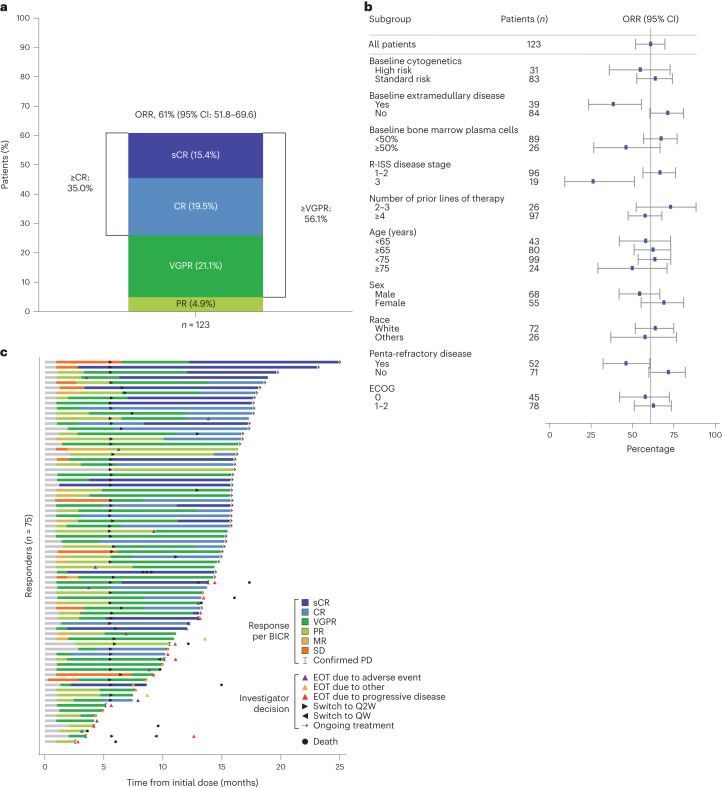
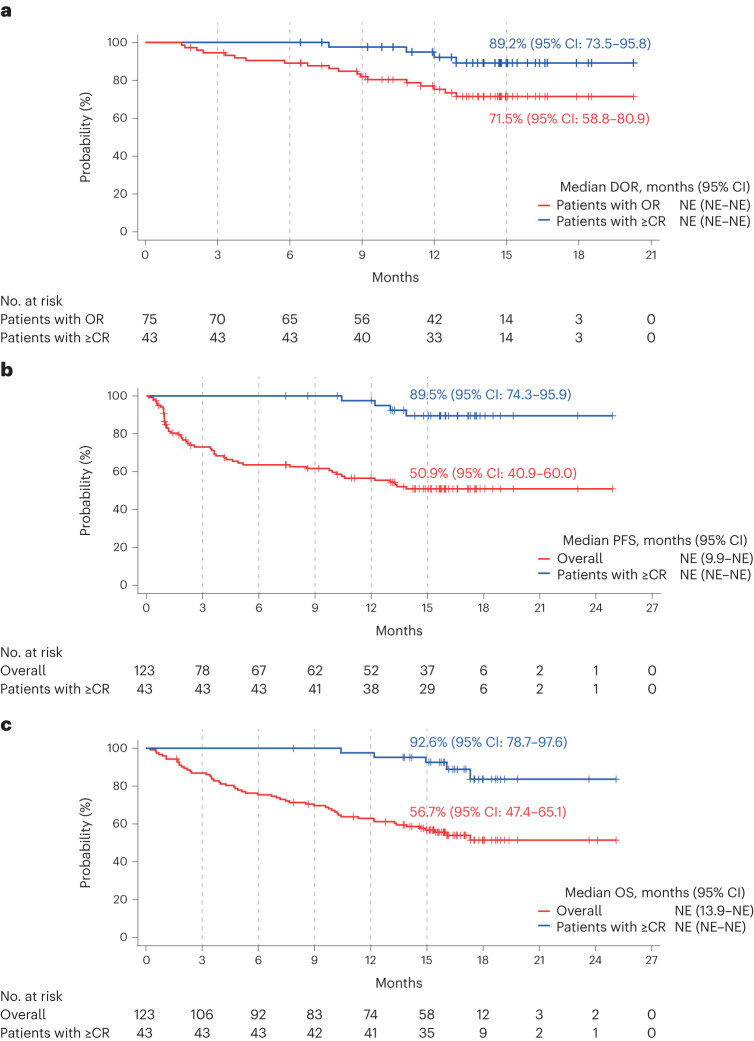
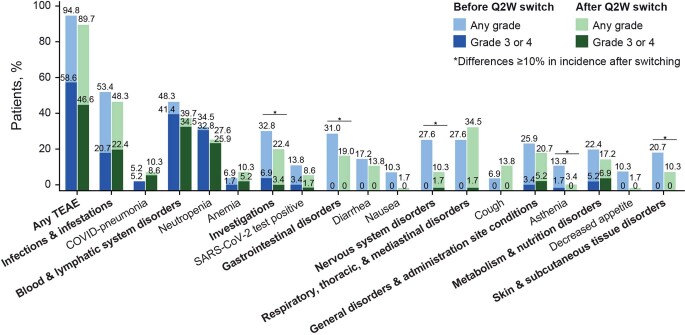
Elranatamab is a humanized B-cell maturation antigen (BCMA)-CD3 bispecific antibody. In the ongoing phase 2 MagnetisMM-3 trial, patients with relapsed or refractory multiple myeloma received subcutaneous elranatamab once weekly after two step-up priming doses. After six cycles, persistent responders switched to biweekly dosing. Results from cohort A, which enrolled patients without prior BCMA-directed therapy (n = 123) are reported. The primary endpoint of confirmed objective response rate (ORR) by blinded independent central review was met with an ORR of 61.0% (75/123); 35.0% ≥complete response. Fifty responders switched to biweekly dosing, and 40 (80.0%) improved or maintained their response for ≥6 months. With a median follow-up of 14.7 months, median duration of response, progression-free survival and overall survival (secondary endpoints) have not been reached. Fifteen-month rates were 71.5%, 50.9% and 56.7%, respectively. Common adverse events (any grade; grade 3-4) included infections (69.9%, 39.8%), cytokine release syndrome (57.7%, 0%), anemia (48.8%, 37.4%), and neutropenia (48.8%, 48.8%). With biweekly dosing, grade 3-4 adverse events decreased from 58.6% to 46.6%. Elranatamab induced deep and durable responses with a manageable safety profile. Switching to biweekly dosing may improve long-term safety without compromising efficacy. ClinicalTrials.gov identifier: NCT04649359 .
Overview
CoChat Summary
TL;DR
Elranatamab monotherapy in the phase 2 MagnetisMM-3 cohort A produced a 61.0% confirmed objective response rate in 123 patients with relapsed or refractory multiple myeloma who had no prior BCMA-directed therapy. Responses were often deep and durable, with 35.0% achieving ≥CR, 60.5% of those ≥CR being MRD-negative, and safety being manageable though infections, CRS, and cytopenias were common.
Key findings
- In 123 treated patients, the confirmed objective response rate by blinded independent central review was 61.0% (75/123; 95% CI 51.8–69.6).
- Deep responses were frequent: 35.0% achieved ≥CR, 56.1% achieved VGPR or better, and among patients with ≥CR and evaluable MRD (n = 29), 89.7% were MRD-negative, corresponding to 60.5% of all patients with ≥CR.
- With median follow-up of 14.7 months, median duration of response, progression-free survival, and overall survival were not reached; 15-month estimates were 71.5% for maintaining response, 50.9% for PFS, and 56.7% for OS.
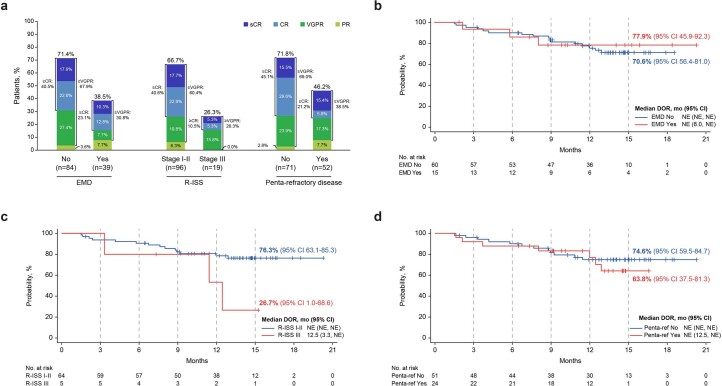
- Among 50 responders who switched to biweekly dosing at least 6 months before data cutoff, 80.0% maintained or improved response ≥6 months after the switch, and 40.0% deepened response, including 38.0% who improved to ≥CR.
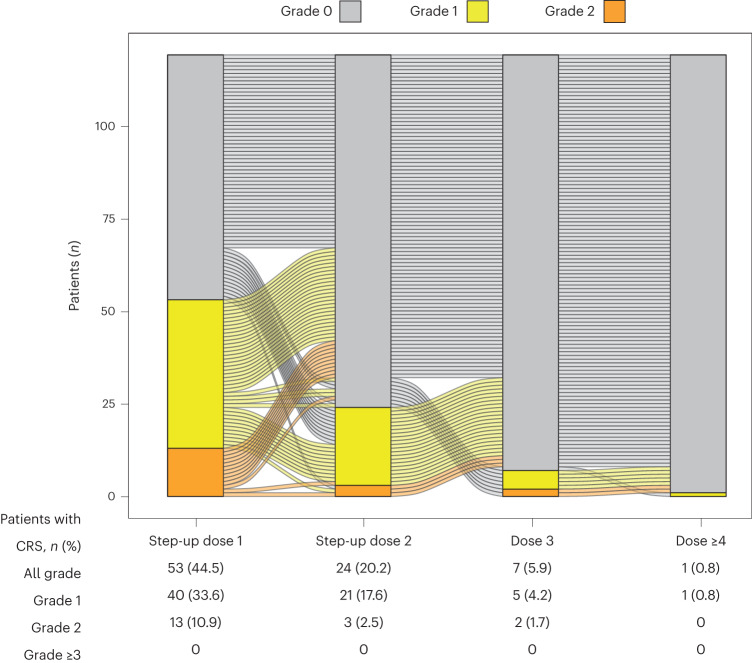
- Safety: all 123 patients had treatment-emergent AEs; 70.7% had grade 3 or 4 events. Common AEs included infections (69.9%; 39.8% grade 3–4), CRS (57.7%; 0% grade 3–4), anemia (48.8%; 37.4% grade 3–4), and neutropenia (48.8%; 48.8% grade 3–4).
Methods
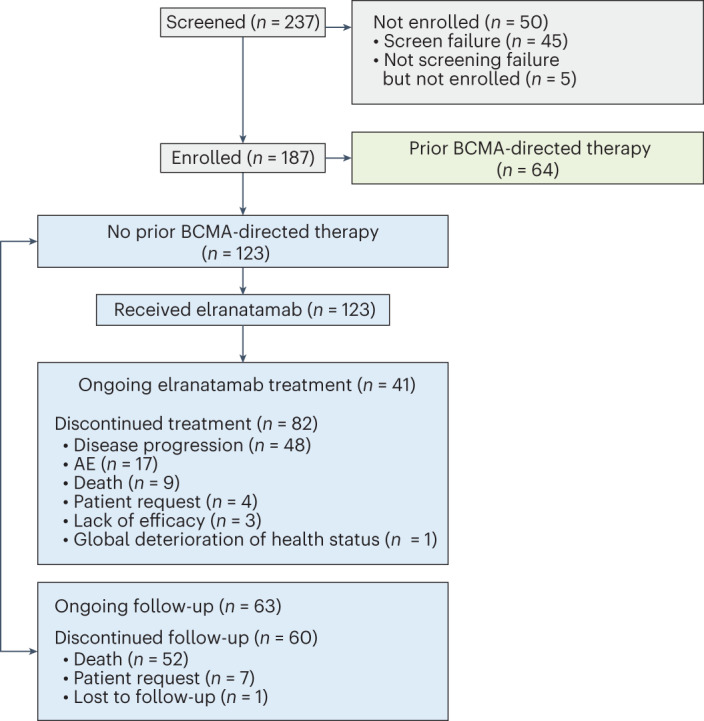
- Ongoing multicenter, open-label, single-arm phase 2 MagnetisMM-3 study of elranatamab monotherapy in relapsed or refractory multiple myeloma; this report covers cohort A (no prior BCMA-directed therapy), with 123 enrolled and treated patients across 47 sites in 10 countries.
- Eligible patients were adults with measurable disease, ECOG ≤2, adequate organ function, and disease refractory to at least one proteasome inhibitor, one immunomodulatory drug, and one anti-CD38 antibody; treatment was subcutaneous elranatamab 76 mg weekly after 12 mg and 32 mg step-up doses, with responders switching to biweekly dosing after 6 cycles if PR or better persisted for at least 2 months.
- Primary endpoint was confirmed ORR by BICR; secondary endpoints included CR rate, MRD negativity, TTR, DOR, PFS, OS, safety, pharmacokinetics, and immunogenicity; analyses were descriptive with Kaplan–Meier methods for time-to-event outcomes.
Limitations
- The paper states the main limitations are the single-arm design, lack of direct comparison with other treatments, small sample sizes in some subgroups, and the need for longer follow-up to confirm DOR, PFS, and OS benefits.
- Evident from the text: results for biweekly dosing are not from a randomized QW comparator, so the authors note the safety change after switching cannot be cleanly interpreted.
- Evident from the text: the cohort reported here excludes patients with prior BCMA-directed therapy, so the findings do not address that population.
Model-written summary. Check it against the paper before relying on it.
Integrity signals
Registry
Cites
Statistics
Figures
Verification
Claims the paper makes
13 Valid · 1 Not valid · 10 Not checked · 88 Own results and interpretations
The cited sources support only part of this claim — read each source’s verdict below.
In the paper
“Elranatamab is a humanized B-cell maturation antigen (BCMA)-CD3 bispecific antibody.”
- Also stated in: § Main · plain
“Elranatamab (PF-06863135) is a humanized bispecific antibody that targets both BCMA (on myeloma cells) and CD3 (on T cells)3.”
§ Elranatamab in relapsed or refractory multiple myeloma: phase 2 MagnetisMM-3 trial results > Abstract
What the sources say
- Partly supportedcites [3] Shah, N., Chari, A., Scott, E., Mezzi, K. & Usmani, S. Z. B-cell maturation antigen (BCMA) in multiple myeloma: rationale for targeting and current therapeutic approaches. Leukemia 34, 985–1005 (2020). 32055000 PMC7214244 sourceExperimental — accuracy not yet measured
The Bispecific antibody constructs section describes PF-06863135 (PF-3135) as a humanized antibody with anti-BCMA and anti-CD3 arms. Our copy does not name elranatamab or identify it as PF-06863135, so it does not establish that the description applies to elranatamab. (LLM, conf=0.78)
plain- Asserted: passes — The authors put it forward as true.
- Checkable: passes — It can be checked against evidence.
- Load-bearing: passes — The paper’s conclusions depend on it.
- Based: passes — The paper gives a reason why it holds.
- Also stated in: § Main · plain
Every source the paper cites for this claim was checked and supports it.
In the paper
“outcomes for patients with disease progression after these agents remain poor with a median progression-free survival (PFS) of 4.6 months and median overall survival (OS) of 12.4 months with a standard of care therapy, highlighting an unmet medical need in the relapsed or refractory multiple myeloma population1.”
§ Elranatamab in relapsed or refractory multiple myeloma: phase 2 MagnetisMM-3 trial results > Main
What the sources say
- Supportedcites [1] Mateos, M. V. et al. LocoMMotion: a prospective, non-interventional, multinational study of real-life current standards of care in patients with relapsed and/or refractory multiple myeloma. Leukemia 36, 1371–1376 (2022). 35332278 PMC9061296 source
The Introduction identifies the study population as patients with relapsed or refractory multiple myeloma previously treated with a proteasome inhibitor, an immunomodulatory drug, and an anti-CD38 antibody. The Results (Efficacy) report median progression-free survival of 4.6 months and median overall survival of 12.4 months with real-life standard-of-care therapy; the Discussion describes these outcomes as poor. (LLM, conf=0.94)
plain- Asserted: passes — The authors put it forward as true.
- Checkable: passes — It can be checked against evidence.
- Load-bearing: passes — The paper’s conclusions depend on it.
- Based: passes — The paper gives a reason why it holds.
- Supported
The cited sources support only part of this claim — read each source’s verdict below.
In the paper
“Similarly, patients with advanced disease stage (R-ISS stage III) have consistently shown poorer outcomes irrespective of the therapy received4–6,19–22.”
§ Elranatamab in relapsed or refractory multiple myeloma: phase 2 MagnetisMM-3 trial results > Discussion
What the sources say
- Partly supportedcites [4] Moreau, P. et al. Teclistamab in relapsed or refractory multiple myeloma. N. Engl. J. Med. 387, 495–505 (2022). 35661166 PMC10587778 sourceExperimental — accuracy not yet measured
The Results (Efficacy; page not provided) report lower response rates among patients with stage III disease receiving teclistamab. However, the Results (Patients) identify the staging measure as the International Staging System, not R-ISS, and the Discussion notes that this small subgroup had wide confidence intervals. This single-treatment finding does not establish consistently poorer outcomes irrespective of therapy. (LLM, conf=0.88)
- Could not verifycites [5] Munshi, N. C. et al. Idecabtagene vicleucel in relapsed and refractory multiple myeloma. N. Engl. J. Med. 384, 705–716 (2021). 33626253 sourceExperimental — accuracy not yet measured
The Efficacy section and subgroup figure include R-ISS stage III patients, but the available text does not establish that they had poorer outcomes than patients at other stages. The paper reports outcomes after ide-cel, not a consistent pattern irrespective of therapy; searches for stage-specific outcomes and therapy-independent prognosis found no supporting passage. Page numbers were not available in our copy. (LLM, conf=0.74)
- Not checked — no full text of the sourcecites [6] Berdeja, J. G. et al. Ciltacabtagene autoleucel, a B-cell maturation antigen-directed chimeric antigen receptor T-cell therapy in patients with relapsed or refractory multiple myeloma (CARTITUDE-1): a phase 1b/2 open-label study. Lancet 398, 314–324 (2021). 34175021 source
- Not checked — no full text of the sourcecites [19] Lonial, S. et al. Belantamab mafodotin for relapsed or refractory multiple myeloma (DREAMM-2): a two-arm, randomised, open-label, phase 2 study. Lancet Oncol. 21, 207–221 (2020). 31859245 source
- Could not verifycites [20] Blade, J. et al. Extramedullary disease in multiple myeloma: a systematic literature review. Blood Cancer J. 12, 45 (2022). 35314675 PMC8938478 sourceExperimental — accuracy not yet measured
The Results > Incidence section mentions revised stage III only as a reason to suspect extramedullary disease and consider PET/CT. Results > Treatment outcomes discusses poorer outcomes for patients with extramedullary disease, but does not compare outcomes by R-ISS stage or establish that stage III patients fare worse regardless of therapy. Searches for “R-ISS,” “stage III,” and therapy-independent outcomes found no supporting passage. (LLM, conf=0.76)
- Supportedcites [21] Palumbo, A. et al. Revised international staging system for multiple myeloma: a report from International Myeloma Working Group. J. Clin. Oncol. 33, 2863–2869 (2015). 26240224 PMC4846284 source
The Results (Combined ISS, CA and LDH; page not provided) show that R-ISS stage III had the poorest overall and progression-free survival. The subgroup analysis reports that R-ISS remained prognostic among patients who did and did not receive ASCT, proteasome inhibitors, or IMIDs; the Discussion describes its impact on overall survival as independent of therapy. (LLM, conf=0.92)
- Could not verifycites [22] Gill, S. K. et al. I-OPen: inferior outcomes of penta-refractory compared to penta-exposed multiple myeloma patients. Blood Cancer J. 12, 138 (2022). 36151090 PMC9508328 sourceExperimental — accuracy not yet measured
The To the Editor section reports poorer outcomes for quad- or penta-refractory patients than for exposed patients, but it does not establish outcomes by R-ISS stage or across therapies. Searches for “R-ISS,” “stage III,” and staging-related survival findings found no passage addressing the claim about R-ISS stage III. (LLM, conf=0.74)
boostedstates an association- Asserted: passes — The authors put it forward as true.
- Checkable: passes — It can be checked against evidence.
- Load-bearing: unclear — It is unclear whether the paper’s conclusions depend on it.
- Based: passes — The paper gives a reason why it holds.
- Partly supported
The cited sources support only part of this claim — read each source’s verdict below.
In the paper
“In comparison to other BCMA-targeted T-cell-redirecting therapies, the rate of hematologic AEs with elranatamab was similar or lower after a similar follow-up4–6.”
§ Elranatamab in relapsed or refractory multiple myeloma: phase 2 MagnetisMM-3 trial results > Discussion
What the sources say
- Partly supportedcites [4] Moreau, P. et al. Teclistamab in relapsed or refractory multiple myeloma. N. Engl. J. Med. 387, 495–505 (2022). 35661166 PMC10587778 sourceExperimental — accuracy not yet measured
The Results > Safety passage reports hematologic adverse-event rates for teclistamab, and Results > Efficacy gives a median follow-up of 14.1 months. These provide comparator data, but this paper does not report elranatamab rates or establish that they were similar or lower after a similar follow-up. Page numbers are unavailable in our copy. (LLM, conf=0.84)
- Partly supportedcites [5] Munshi, N. C. et al. Idecabtagene vicleucel in relapsed and refractory multiple myeloma. N. Engl. J. Med. 384, 705–716 (2021). 33626253 sourceExperimental — accuracy not yet measured
The Safety section and Table 2 report hematologic adverse-event rates for idecabtagene vicleucel, providing data for one therapy in the comparison. This paper does not report elranatamab outcomes or establish that its rates were similar or lower after a similar follow-up. (LLM, conf=0.86)
- Not checked — no full text of the sourcecites [6] Berdeja, J. G. et al. Ciltacabtagene autoleucel, a B-cell maturation antigen-directed chimeric antigen receptor T-cell therapy in patients with relapsed or refractory multiple myeloma (CARTITUDE-1): a phase 1b/2 open-label study. Lancet 398, 314–324 (2021). 34175021 source
plain- Asserted: passes — The authors put it forward as true.
- Checkable: passes — It can be checked against evidence.
- Load-bearing: unclear — It is unclear whether the paper’s conclusions depend on it.
- Based: passes — The paper gives a reason why it holds.
- Partly supported
The cited sources support only part of this claim — read each source’s verdict below.
In the paper
“BCMA-targeted T-cell-redirecting therapies have been linked to a heightened susceptibility to infectious complications due to their mechanism of action30–33.”
§ Elranatamab in relapsed or refractory multiple myeloma: phase 2 MagnetisMM-3 trial results > Discussion
What the sources say
- Partly supportedcites [30] Sim, B. Z. et al. Infectious complications of bispecific antibody therapy in patients with multiple myeloma. Blood Cancer J. 13, 34 (2023). 36894539 PMC9998258 sourceExperimental — accuracy not yet measured
The Discussion reports substantial infection rates in trials of T-cell/BCMA-targeting bispecific antibodies, supporting the link to infectious complications. It does not establish that their mechanism of action causes heightened susceptibility; the authors also note that infection rates in their heavily treated cohort were comparable to those with other therapies. No page number is available in our copy. (LLM, conf=0.84)
- Partly supportedcites [31] Mazahreh, F. et al. Risk of infections associated with the use of bispecific antibodies in multiple myeloma: a pooled analysis. Blood Adv. 7, 3069–3074 (2023). 36857755 PMC10331406 sourceExperimental — accuracy not yet measured
The Results report more severe infections with BCMA-targeting than non-BCMA bispecific antibodies, and the Discussion describes treatment-related immune changes that increase infection risk. However, the Discussion says infections may be related to the underlying myeloma, prior therapies, and/or the antibodies’ mechanism of action; it does not establish that the mechanism is the cause. Page numbers were not supplied in our copy. (LLM, conf=0.84)
- Partly supportedcites [32] Kambhampati, S. et al. Infectious complications in patients with relapsed refractory multiple myeloma after BCMA CAR T-cell therapy. Blood Adv. 6, 2045–2054 (2022). 34543400 PMC9006279 sourceExperimental — accuracy not yet measured
The Abstract reports infections in 29 of 55 patients after BCMA CAR-T, and the Introduction lists infections among CAR-T-associated toxicities. But the study concerns BCMA CAR-T specifically, not all BCMA-targeted T-cell-redirecting therapies, and it does not establish that their mechanism of action caused heightened infection susceptibility. Page numbers were not available in our copy. (LLM, conf=0.86)
- Partly supportedcites [33] Mikkilineni, L. et al. Infectious complications of CAR T-cell therapy across novel antigen targets in the first 30 days. Blood Adv. 5, 5312–5322 (2021). 34619768 PMC9153053 sourceExperimental — accuracy not yet measured
Our copy supports only the association half, and weakly: the Abstract reports BCMA CAR T cells had the second-highest infection proportion (9/24; 37.5%) after CD22 (43.4%), with grade 4 infections rare (2.5%) and the overall 32.7% rate 'comparable to published studies of infection with CD19 CAR' (Discussion). The Discussion explicitly attributes the myeloma/BCMA infections to host factors — 'MM leads to longterm immunocompromise in patients' — and to prior lines of therapy, not to the BCMA-targeting mechanism; the Introduction even states 'the impact and interplay of CAR T-cell induced CRS on host mechanisms to fight foreign pathogens is unknown,' and no passage discusses on-target/off-tumor plasma-cell or immunoglobulin depletion (searched: hypogammaglobulinemia, immunoglobulin, plasma cell aplasia, on-target off-tumor, B-cell aplasia). The mechanistic causal attribution ('due to their mechanism of action') and the extension beyond CAR T to all 'T-cell-redirecting therapies' (e.g., bispecific antibodies) are not supported by this source, which studied only five phase 1 CAR T trials (BCMA cohort NCT02215967, MM adults). (LLM, conf=0.75)
plainstates an association- Asserted: passes — The authors put it forward as true.
- Checkable: passes — It can be checked against evidence.
- Load-bearing: unclear — It is unclear whether the paper’s conclusions depend on it.
- Based: passes — The paper gives a reason why it holds.
- Partly supported
53 more claims · 2 with their cited sources checked
Create a free account to see all 112 claims and to verify the 2 references still open.
- Probably not a substantial claim. 21
- It may state two separate claims as one. 42
Claims other papers make about this one
Each is checked against this paper’s own text: does it say what the citing paper says it does?
The source backs part of the claim, not all of it — or backs it for a different population, condition or comparison.
In the citing paper
“The objective response rate of Elranatamab reach to 61.0% (75 out of 123 patients); with 35.0%≥CR, and 80.0% of patients maintained their response for at least 6 months [211].”
From Multiple myeloma: signaling pathways and targeted therapy (2024) · cites this paper as [211]
Experimental — accuracy not yet measured
Citations
Cites
Lee, D. W., Santomasso, B. D., Locke, F. L., Ghobadi, A., Turtle, C. J., Brudno, J. N., Maus, M. V., Park, J. H., Mead, E., Pavletic, S., et al. (2019) · Biology of Blood and Marrow Transplantation · doi:10.1016/j.bbmt.2018.12.758 · Cited by 3,675
Kumar, S., Paiva, B., Anderson, K. C., Durie, B., Landgren, O., Moreau, P., Munshi, N., Lonial, S., Bladé, J., Mateos, M.-V., et al. (2016) · The Lancet Oncology · doi:10.1016/s1470-2045(16)30206-6 · Cited by 3,061
A Phase 2 Study of Bortezomib in Relapsed, Refractory Myeloma
Richardson, P. G., Barlogie, B., Berenson, J., Singhal, S., Jagannath, S., Irwin, D., Rajkumar, S. V., Srkalovic, G., Alsina, M., Alexanian, R., et al. (2003) · New England Journal of Medicine · doi:10.1056/nejmoa030288 · Cited by 2,632
Idecabtagene Vicleucel in Relapsed and Refractory Multiple Myeloma.
Munshi, N. C., Anderson, L. D., Shah, N., Madduri, D., Berdeja, J., Lonial, S., Raje, N., Lin, Y., Siegel, D., Oriol, A., et al. (2021) · New England Journal of Medicine · doi:10.1056/nejmoa2024850 · Cited by 2,560
Self-citationPalumbo, A., Avet-Loiseau, H., Oliva, S., Lokhorst, H. M., Goldschmidt, H., Rosinol, L., Richardson, P., Caltagirone, S., Lahuerta, J. J., Facon, T., et al. (2015) · Journal of Clinical Oncology · doi:10.1200/jco.2015.61.2267 · Cited by 2,210
Berdeja, J. G., Madduri, D., Usmani, S. Z., Jakubowiak, A., Agha, M., Cohen, A. D., Stewart, A. K., Hari, P., Htut, M., Lesokhin, A., et al. (2021) · The Lancet · doi:10.1016/s0140-6736(21)00933-8 · Cited by 1,756
Self-citationTeclistamab in Relapsed or Refractory Multiple Myeloma
Moreau, P., Garfall, A. L., van de Donk, N. W. C. J., Nahi, H., San-Miguel, J. F., Oriol, A., Nooka, A. K., Martin, T., Rosinol, L., Chari, A., et al. (2022) · New England Journal of Medicine · doi:10.1056/nejmoa2203478 · Cited by 1,269 · cited 2×
“Includes t(4;14), t(14;16) and del(17p) chromosomal abnormalities.”
BackgroundSelf-citationLonial, S., Lee, H. C., Badros, A., Trudel, S., Nooka, A. K., Chari, A., Abdallah, A.-O., Callander, N., Lendvai, N., Sborov, D., et al. (2020) · The Lancet Oncology · doi:10.1016/s1470-2045(19)30788-0 · Cited by 812
Self-citationTalquetamab, a T-Cell–Redirecting GPRC5D Bispecific Antibody for Multiple Myeloma
Chari, A., Minnema, M. C., Berdeja, J. G., Oriol, A., van de Donk, N. W. C. J., Rodríguez-Otero, P., Askari, E., Mateos, M.-V., Costa, L. J., Caers, J., et al. (2022) · New England Journal of Medicine · doi:10.1056/nejmoa2204591 · Cited by 744
Self-citationMartin, T., Usmani, S. Z., Berdeja, J. G., Agha, M., Cohen, A. D., Hari, P., Avigan, D., Deol, A., Htut, M., Lesokhin, A., et al. (2023) · Journal of Clinical Oncology · doi:10.1200/jco.22.00842 · Cited by 663
Self-citation
Cited by
Items 201–300 of 650
Smits, F., Groen, K., Korst, C. L. B. M., Frerichs, K. A., Kuipers, I., Kruyswijk, S., de Ruijter, M. E. M., Nasserinejad, K., Zweegman, S., & van de Donk, N. W. C. J. (2026) · Blood Cancer Journal · doi:10.1038/s41408-026-01451-9 · Cited by 13
“Various BsAbs have been developed, targeting different myeloma-associated antigens, including B-cell maturation antigen (BCMA) [1 – 3], G protein-coupled receptor GPRC5D [4], and FcRH5 [5, 6].”
Cani, L., Parikh, R., Joseph, N. S., Gupta, V. A., Hofmeister, C. C., Kaufman, J. L., Nooka, A. K., Lonial, S., & Mina, R. (2026) · Clinical Lymphoma Myeloma & Leukemia · doi:10.1016/j.clml.2026.03.003 · Cited by 8
Self-citationProteasome Inhibitors in Multiple Myeloma
Mitsiades, C. S. (2024) · Hematology/Oncology Clinics of North America · doi:10.1016/j.hoc.2023.12.016 · Cited by 10
A year in pharmacology: new drugs approved by the US Food and Drug Administration in 2023
Kayki‐Mutlu, G., Aksoyalp, Z. Ş., Wojnowski, L., & Michel, M. C. (2024) · Naunyn-Schmiedeberg s Archives of Pharmacology · doi:10.1007/s00210-024-03063-1 · Cited by 9
“Elranatamab is well tolerated, and the most common non-hematologic treat-ment-emergent AE are cytokine release syndrome, diarrhea, tiredness, loss of appetite, and fever (Lesokhin et al. 2023).”
BackgroundKowalski, A., Lykon, J., Diamond, B. T., Coffey, D. G., Kaddoura, M., Maura, F., Hoffman, J. E., Kazandjian, D. G., & Landgren, O. (2024) · Blood Cancer Discovery · doi:10.1158/2643-3230.bcd-23-0228 · Cited by 9
Ye, J. C., Biran, N., Nair, S. C., Lin, X., Qi, K., Londhe, A., Ammann, E. M., Renaud, T. M., Kane, C. M., Parekh, T. V., et al. (2024) · Clinical Lymphoma Myeloma & Leukemia · doi:10.1016/j.clml.2024.08.003 · Cited by 7
Zolnowski, D., Karp, S., Warncke, P., Zinn, J., Pannach, M., Herbst, R., Hänel, A., Morgner, A., Ibach, S., Fricke, S., et al. (2024) · Journal of Cancer Research and Clinical Oncology · doi:10.1007/s00432-024-05993-y · Cited by 7
“…on bispecific antibodies and chimeric antigen receptor (CAR) T cells in pts with relapsed/refractory MM (Berdeja et al. 2021; Krishnan et al. 2023; Lesokhin et al. 2023; Moreau et al. 2022; Munshi et al. 2021; Schinke et al. 2023), the outcomes of these innovative cellular and immunotherapies in…”
BackgroundEncinas, C., Lozano, V., Hlavacek, P., Llinares, J., Toribio-Castelló, S., Carcedo, D., Asís-Montalt, J., & Martínez‐López, J. (2025) · Oncology and Therapy · doi:10.1007/s40487-025-00333-7 · Cited by 7
Self-citationMol, I., Hu, Y., LeBlanc, T. W., Cappelleri, J. C., Chu, H., Nador, G., Aydin, D., Perez-Cruz, I., & Hlavacek, P. (2025) · Journal of Blood Medicine · doi:10.2147/jbm.s507550 · Cited by 7
Lund, T., Khandanpour, C., Anguille, S., Kisro, J., Krauth, M. T., Lund, J., Nijhof, I. S., Ocio, E. M., Zamagni, E., Javelot, M., et al. (2025) · European Journal Of Haematology · doi:10.1111/ejh.14444 · Cited by 9
Borrelli, R., Brussino, L., Negrini, S., & Brizzi, M. F. (2025) · Pharmacological Research · doi:10.1016/j.phrs.2025.108000 · Cited by 7
Zhou, X., Waldschmidt, J. M., & Einsele, H. (2025) · Blood Reviews · doi:10.1016/j.blre.2025.101342 · Cited by 11
Terpos, E., Gavriatopoulou, M., Ntanasis‐Stathopoulos, I., Malandrakis, P., Fotiou, D., Kanellias, N., Migkou, M., Theodorakakou, F., Spiliopoulou, V., Solia, E., et al. (2025) · Blood · doi:10.1182/blood.2025031629 · Cited by 7
The evolution to hepta-refractory myeloma involves sequential loss of CD38, BCMA and GPRC5D
Riedhammer, C., Truger, M. S., Lee, H., Leypoldt, L. B., Meggendorfer, M., Hütter, S., Müller, H., Mersi, J., Kadel, S., BUCHWALD, T., et al. (2026) · Leukemia · doi:10.1038/s41375-026-02889-3 · Cited by 11
Self-citationPortuguese, A. J., Davis, J. A., Raza, S., Puglianini, O. A. C., Freeman, C., Alsina, M., Wright, C., Blue, B. J., Baz, R. C., Shain, K. H., et al. (2026) · Blood Cancer Journal · doi:10.1038/s41408-026-01477-z · Cited by 10
Elranatamab vs. teclistamab: battle of the BCMA bispecifics in relapsed/refractory multiple myeloma
Moore, D. C., Granger, K., Hill, H., Karabinos, A., & Davis, J. A. (2024) · Expert Review of Hematology · doi:10.1080/17474086.2024.2353751 · Cited by 11
“These CAR T therapies and the more recent approvals of CD3/BCMA-directed BsAbs elranatamab and teclistamab provide clinicians a plethora of BCMA-directed therapeutic options for patients with this once dismal prognosis [4–6].”
BackgroundMidha, S., Hartley-Brown, M. A., Mo, C. C., Hossain, S., Nadeem, O., O’Donnell, E., Bianchi, G., Sperling, A. S., Laubach, J. P., & Richardson, P. G. G. (2023) · Expert Opinion on Drug Safety · doi:10.1080/14740338.2023.2274420 · Cited by 8
“%) where required [81,84–87 ,92 ,97 ,99].”
BackgroundPuttkammer, J. R., Barreto, J. N., Jensen, C. J., Nedved, A. N., Wilson-Miller, J. L., Mara, K. C., Holmes, L. M., Kosobud, A. R., Kapoor, P., Gertz, M. A., et al. (2025) · JCO Oncology Practice · doi:10.1200/op-24-00930 · Cited by 6
Belantamab mafodotin in patients with relapsed/refractory multiple myeloma: a real-world experience
Hultcrantz, M. L., Derkach, A., Hassoun, H., Korde, N., Maclachlan, K. H., Mailankody, S., Patel, D., Shah, U. A., Tan, C. R. C., Chung, D. J., et al. (2025) · Blood Neoplasia · doi:10.1016/j.bneo.2025.100103 · Cited by 18
Self-citationMancuso, K., Talarico, M., Manzato, E., Barbato, S., Tacchetti, P., Zamagni, E., & Cavo, M. (2025) · Cancers · doi:10.3390/cancers17091514 · Cited by 12
“Conversely, subsequent data on el-ranatamab showed grade 5 infections in 6.5% of patients in MagnetisMM-3, which enrolled patients after the pandemic (February 2021–January 2022), with 1.6% of deaths caused by COVID-19 [5].”
InfluentialWu, D., Huang, L., Gaowa, N., Zhang, R., Gong, S., Wu, X., & Wu, C. (2025) · Molecular Cancer Therapeutics · doi:10.1158/1535-7163.mct-24-0846 · Cited by 6
Ogiya, D., Suzuki, R., Goto, S., Nakagawa, Y., Nasukawa, M., Iwata, S., Kawai, H., Toyosaki, M., Machida, S., Onizuka, M., et al. (2025) · Annals of Hematology · doi:10.1007/s00277-025-06689-0 · Cited by 7
“Nevertheless, ESRD patients on hemodialysis (HD) often exhibit reduced organ reserve and hemodynamic instability, making them more susceptible to treatment-related complications such as cytokine release syndrome (CRS) and immune effector cell-associated neurotoxicity syndrome (ICANS) [ 3, 7].”
Sithara, A. A., Kapustová, V., Žihala, D., Venglár, O., Bilek, D., Helal, M., John, M., Radova, E., Broskevičová, L., Vrana, J., et al. (2025) · Blood Cancer Discovery · doi:10.1158/2643-3230.bcd-25-0170 · Cited by 11
Piron, B., Rodrigo, L., Tessoulin, B., Gastinne, T., Dubruille, V., Letailleur, V., Antier, C., Lok, A., Leroy, E., Moreau, P., et al. (2025) · Clinical Lymphoma Myeloma & Leukemia · doi:10.1016/j.clml.2025.10.024 · Cited by 12
Self-citationMoore, D. C., Elsey, G., McElwee, J., & Atrash, S. (2025) · Expert Opinion on Biological Therapy · doi:10.1080/14712598.2025.2595122 · Cited by 7
Extramedullary Disease—Achilles Heel in Myeloma?
Kumar, S. K., Richter, J. R., Usmani, S. Z., Cohen, Y. C., Ye, J. C., Mateos, M., Hungria, V., & Zamagni, E. (2025) · American Journal of Hematology · doi:10.1002/ajh.70138 · Cited by 10
“%) in patients with EMD (true EMD and/or PMD) compared with those without [120].”
Muth, A., Holzem, A. M. E., Neumann, A.-S., Bücklein, V., Subklewe, M. S., & Philipp, N. (2026) · Med · doi:10.1016/j.medj.2026.101031 · Cited by 9
Wang, M., Wang, C., Deng, J., Wang, H., Sun, C., Luo, S., & Hu, Y. (2024) · Frontiers in Bioscience-Landmark · doi:10.31083/j.fbl2906216 · Cited by 9
“ICANS is also a common side effect, and has been documented with the use of elranatamab [36], teclistamab [42], linvoseltamab [57], tal-quetamab [134] and cevostamab [127].”
BackgroundShaver, J., Horton, D., & Halford, Z. (2024) · Annals of Pharmacotherapy · doi:10.1177/10600280241271192 · Cited by 7
“44 Despite the encouraging efficacy results demonstrated by these innovative immune effector cell therapies, the optimal timing, sequencing, and treatment combinations involving these agents in R/R MM are unknown.”
Wei, W., & Sulea, T. I. (2024) · mAbs · doi:10.1080/19420862.2024.2404064 · Cited by 11
Qureshi, Z. A., Jamil, A. R., Altaf, F., Siddique, R., & Ahmed, F. (2024) · Annals of Hematology · doi:10.1007/s00277-024-06078-z · Cited by 8
Goel, U., Zanwar, S., Cowan, A. J., Banerjee, R. K., Khouri, J., & Dima, D. (2025) · Cancer Management and Research · doi:10.2147/cmar.s510408 · Cited by 8
“63,82,83 However, patients who are selected and ultimately infused with CAR T tend to have a slower disease tempo and otherwise favorable performance status, which limits direct comparisons of these trials.”
Talquetamab in heavily pretreated patients with multiple myeloma, including BCMA-refractory
Vegel, A. J., Loeffler, B. T., Lochner, J. S., Friend, R. N., Habib, A., McKenna, M., Snyder, J. A., Green, K., Dileo, R., Patrus, G., et al. (2025) · Blood Immunology & Cellular Therapy · doi:10.1016/j.bict.2025.100001 · Cited by 7
Targeting GPRC5D in multiple myeloma
Elemian, S., & Hadidi, S. A. (2024) · Expert Review of Anticancer Therapy · doi:10.1080/14737140.2024.2343114 · Cited by 7
SOHO State of the Art Updates and Next Questions: Will CAR-T Replace ASCT in NDMM
Jurgens, E. M., & Usmani, S. Z. (2024) · Clinical Lymphoma Myeloma & Leukemia · doi:10.1016/j.clml.2024.01.001 · Cited by 6
Mol, I., Hu, Y., LeBlanc, T. W., Cappelleri, J. C., Chu, H., Nador, G., Aydin, D., Perez-Cruz, I., & Hlavacek, P. (2025) · Journal of Comparative Effectiveness Research · doi:10.57264/cer-2024-0236 · Cited by 7
“Elranatamab, a bispecific antibody targeting B-cell maturation antigen (BCMA) and CD3 receptors, received FDA and EMA approval in 2023 for the treatment of adult patients with TCE / R MM based on the results of the MagnetisMM-3 trial (NCT04649359) [5 , 6] .”
Martino, E. A., Caridà, G., Lofaro, D., Bruzzese, A., Labanca, C., Mendicino, F., Lucia, E., Olivito, V., Puccio, N., Neri, A., et al. (2025) · ESMO Open · doi:10.1016/j.esmoop.2025.105514 · Cited by 7
Chen, W., Cai, Z., Chim, C. S., Chng, W. J., Du, J., Fu, C., Gao, W., Hanamura, I., Hou, J. M., Huang, J., et al. (2025) · Clinical Hematology International · doi:10.46989/001c.141401 · Cited by 6
“129 , 131 , 144 While CAR-T and BsAbs offer deeper responses, they are associated with cytokine release syndrome, neurotoxicity, and infection risks, requiring specialized care.”
Poels, K. E., Elmeliegy, M. A., Hibma, J. E., Wang, D., Musante, C. J., & Shtylla, B. (2025) · npj Systems Biology and Applications · doi:10.1038/s41540-025-00585-z · Cited by 11
“Theenrollmentcriteria for this arm were the same as those from the MagnetisMM-1 QW and MagnetisMM-3 Cohort A studies.”
InfluentialSelf-citationEinsele, H., Moreau, P., Bahlis, N. J., Bhutani, M., Vincent, L., Karlin, L., Perrot, A., Goldschmidt, H., van de Donk, N. W. C. J., Ocio, E. M., et al. (2025) · Advances in Therapy · doi:10.1007/s12325-025-03409-y · Cited by 6
“T cell and bispecific antibodies, have fur‑ ther expanded the treatment landscape of MM but have created a need for therapies targeting novel antigens, both before and after exposure to BCMA‑targeted therapies [1, 10–14].”
Self-citationIrfan, S., Ayoobkhan, F. S., Vojjala, N., Qureshi, R., Rahman, R. L., Kamboj, I., Abdallah, A.-O. A., McGuirk, J. P., Mahmoudjafari, Z., Lutfi, F. U., et al. (2025) · Transplantation and Cellular Therapy · doi:10.1016/j.jtct.2025.12.947 · Cited by 6
Korst, C. L. B. M., Plattel, W. J., de Kort, E., Smits, F., Croockewit, A. J., Levin, M., Westerman, M., de Weerdt, O., Nijhof, I. S., Wegman, J. J., et al. (2026) · The Lancet Haematology · doi:10.1016/s2352-3026(25)00298-4 · Cited by 7
Landscape of T-cell engagers in solid tumors
Garcia-Lorenzo, E., Dorta, M., Doger, B., Pedregal, M., & Moreno, V. (2026) · The Oncologist · doi:10.1093/oncolo/oyag129 · Cited by 6
“13,14,16,33 Nevertheless, most TCE candidates remain in early-phase trials (phase 1-2 trials) where safety and dose optimization are the primary endpoints.”
Chen, L., Aleman, A., Larráyoz, M., Chiu, H., Zhao, J., Oekelen, O. V., Kelly, G., Kim‐Schulze, S., Laganà, A., Jagannath, S., et al. (2026) · Blood · doi:10.1182/blood.2025030891 · Cited by 8
Bispecific antibodies for multiple myeloma: past, present and future
Ochi, T., Konishi, T., & Takenaka, K. (2024) · International Journal of Hematology · doi:10.1007/s12185-024-03766-4 · Cited by 7
“The duration of response (DOR), progression-free survival (PFS), and overall survival (OS) at the 15-month follow-up point were 71.5%, 50.9%, and 56.7%, respectively [23].”
InfluentialLee, J. H., Choi, J., Min, C., Park, S., Jo, J., Lee, Y. J., Kim, J. S., Eom, H., Jung, J., Moon, J. H., et al. (2024) · Haematologica · doi:10.3324/haematol.2024.285534 · Cited by 7
Multiple myeloma and infections in the era of novel treatment modalities
Akhmedov, M., Zeynalova, P. A., & Феденко, А. А. (2024) · Leukemia Research · doi:10.1016/j.leukres.2024.107544 · Cited by 8
Cicala, G., Russo, G., Santoro, V., Franchina, T., Silvestris, N., Santarpía, M., Spina, E., & Barbieri, M. A. (2024) · Pharmaceuticals · doi:10.3390/ph17101266 · Cited by 5
Measurable Residual Disease Testing in Multiple Myeloma Following T-Cell Redirecting Therapies
Shim, K. G., & Fonseca, R. (2024) · Cancers · doi:10.3390/cancers16193288 · Cited by 6
“%) were found to be MRD-negative at any point in the study [60,61].”
BackgroundAre we there yet? CAR ‐T therapy in multiple myeloma
Mirvis, E., & Benjamin, R. (2024) · British Journal of Haematology · doi:10.1111/bjh.19896 · Cited by 9
“130,131 There is, therefore, a role for BCMA x CD3 BiTEs in the setting of BCMA CAR-T relapse; however, it is not clear how this approach would compare with targeting a different MM antigen with CAR-T, BiTE or other therapy.”
Extramedullary myeloma in the era of CAR T-cell and bispecific antibody therapies
Sanchez, L. J., & Richard, S. (2025) · Seminars in Hematology · doi:10.1053/j.seminhematol.2025.02.001 · Cited by 6
Approaches To Managing Relapsed Myeloma: Switching Drug Class or Retreatment With Same Drug Class?
Vijjhalwar, R., Kannan, A., Fuentes-Lacouture, M. C., & Ramasamy, K. (2025) · Indian Journal of Hematology and Blood Transfusion · doi:10.1007/s12288-025-02008-9 · Cited by 6
“Other BsAbs, such as Elranatamab and linvoseltamab, have shown encouraging PFS rates of 51% at 15 months and 69% at 12 months, respectively [79, 80].”
Emerging therapeutic agents in multiple myeloma: highlights from the 2024 ASH annual meeting
Zhang, Q., Song, Y., Zhou, K., et al. (2025) · Biomarker Research · doi:10.1186/s40364-025-00803-0 · Cited by 5
Considerations for next therapy after anti-CD38 monoclonal antibodies used as first line
Hartley-Brown, M. A., & Zinkeng, A. (2023) · Hematology · doi:10.1182/hematology.2023000444 · Cited by 5
Tryggestad, S. S., Roseth, I. A., Aass, K. R., Ørning, N. E. H., Mjelle, R., Hella, H., & Standal, T. (2024) · Frontiers in Immunology · doi:10.3389/fimmu.2024.1393906 · Cited by 7
“Bispeci fi c T-cell engagers (BiTEs) targeting BCMA and CD3 have also shown great promise (8 – 10).”
Treatment of AL amyloidosis in the era of novel immune and cellular therapies
Sarubbi, C., Abowali, H., Varga, C., & Landau, H. J. (2024) · Frontiers in Oncology · doi:10.3389/fonc.2024.1425521 · Cited by 8
“…targeting CD3 expressed on the surface of T cells and BCMA expressed on MM cells represent another effective T cell redirecting strategy that has demonstrated promising results in MM, leading to the FDA approval of two commercially available products, teclistimab and elranatamab (36, 37).”
BackgroundPrecision medicine for multiple myeloma: The case for translocation (11;14)
Bazarbachi, A. H., Avet‐Loiseau, H., Harousseau, J., Bazarbachi, A., & Mohty, M. (2024) · Cancer Treatment Reviews · doi:10.1016/j.ctrv.2024.102823 · Cited by 5
Self-citationAntibody-Based Therapies for Peripheral T-Cell Lymphoma
Shafagati, N., Paul, S., Rozati, S., & Sterling, C. H. (2024) · Cancers · doi:10.3390/cancers16203489 · Cited by 8
“In addition to seven FDA-approved BsAbs for the treatment of B-cell malignancies [42–48], these therapies are now being used in solid malignancies as well, including uveal melanoma [49], small cell lung cancer [50], and EGFR exon 20 insertion-mutated non-small cell lung cancer [51].”
BackgroundAdvancements in bispecific antibodies for multiple myeloma: What's new and what lies ahead
Mouhieddine, T. H., Costa, B. A., & Richter, J. R. (2024) · Seminars in Hematology · doi:10.1053/j.seminhematol.2024.12.001 · Cited by 9
Improving CD3 bispecific antibody therapy in solid tumors using combination strategies
Lloyd, K. A., Middelburg, J., Ovcinnikovs, V., Pencheva, N., Kemper, K., & van Hall, T. (2025) · Frontiers in Oncology · doi:10.3389/fonc.2025.1548446 · Cited by 6
Wu, H., Qin, R., Li, W., Liu, J.-N., Deng, C., Zheng, Z., Zheng, J.-P., Liu, Y., Meng, Y.-F., Tang, C. X., et al. (2025) · Acta Pharmacologica Sinica · doi:10.1038/s41401-025-01500-2 · Cited by 5
“Besides, other novel targets in the treatment of MM have been indicated, such as the humanized B-cell maturation antigen (BCMA)-CD3 bispeci fi c antibody [49].”
Wang, L., Zeng, Y., Gao, W., Shen, P., Han, P., & Zhang, Z. (2025) · BioDrugs · doi:10.1007/s40259-025-00718-0 · Cited by 5
“…corticosteroid-induced osteoporosis (denosumab, anti-RANKL, Amgen 2010) [1], coronary artery disease (evo-locumab, anti-PCSK9, Amgen 2015) [2], severe asthma (tezepelumab, anti-TSLP, AstraZeneca 2021) [3], and relapsed or refractory multiple myeloma (elranatamab, anti-CD3*BCMA, Pfizer 2023) [4].”
Kegyes, D., Moisoiu, V., Constantinescu, C. S., Tănase, A., Ghiaur, G., Einsele, H., Tomuleasa, C., Lazarus, H. M., & Gale, R. P. (2024) · Blood Reviews · doi:10.1016/j.blre.2024.101254 · Cited by 7
Yadav, R., Chaudary, J. K., Bisht, K., Dhamija, P., Chaudhary, P. K., Nath, U. K., & Jain, N. K. (2025) · Seminars in Oncology · doi:10.1016/j.seminoncol.2025.152390 · Cited by 7
Molecular and immunological determinants of long-term survival in multiple myeloma
Kasomva, K., Yadav, K., Janz, S., Dhakal, B., & Rao, S. (2025) · Blood Advances · doi:10.1182/bloodadvances.2025016829 · Cited by 4
“20,23,61 This redirection of cytotoxic T cells enables potent, antigen-specific killing independent of native TCR specificity.”
Therapeutic options for extramedullary involvement in multiple myeloma
Zhao, J., Cui, Y., & Fang, B. (2025) · Clinical and Experimental Medicine · doi:10.1007/s10238-025-01821-w · Cited by 9
“Compared with other emerging therapies, single-agent belantamab demonstrated activity comparable to BsAbs but lower than CAR-T cell therapy in patients with EMD [88, 91].”
Cazaubiel, T., Decaux, O., Royer, B., Caillot, D., Bobin, A., Belhadj‐Merzoug, K., Macro, M., Vincent, L., Perrot, A., Mohty, M., et al. (2025) · Clinical Hematology International · doi:10.46989/001c.143641 · Cited by 4
Self-citationPredictors of Delayed Responses to Teclistamab in Multiple Myeloma After Initial Non‐Response
Banerjee, R. K., Kaur, G., Razzo, B. M., et al. (2025) · American Journal of Hematology · doi:10.1002/ajh.70108 · Cited by 4
“To the Editor, In trials of bispecific antibodies (bsAbs) targeting B-cell maturation antigen (BCMA) in multiple myeloma (MM) such as te-clistamab, the median time to initial response is almost always 30–40 days [1–3].”
Jurgens, E. M., Shekarkhand, T., Rueda, C., Nemirovsky, D., Derkach, A., Firestone, R., Miller, K. W. P., Costa, B. A., Rajeeve, S., Lesokhin, A. M., et al. (2025) · Blood Cancer Journal · doi:10.1038/s41408-025-01393-8 · Cited by 4
Self-citationTang, T. F., Cheong, C. S., Looi, C. Y., Wong, W. F., & Gan, G. G. (2025) · Medicina · doi:10.3390/medicina61122113 · Cited by 7
“The trial demonstrated an ORR of 61%, with very good partial response (VGPR) and better in 36% and MRD negativity in 31% of responders [33,34,41].”
Talquetamab in Japanese patients with relapsed/refractory multiple myeloma in the MonumenTAL-1 study
Ito, S., Kuroda, Y., Sunami, K., Matsue, K., Imada, K., Tamura, H., Fujikawa, E., Yamazaki, H., Takamoto, M., Pei, L., et al. (2025) · International Journal of Hematology · doi:10.1007/s12185-025-04134-6 · Cited by 4
“[19, 33, 46].”
Zhou, K., Ebben, L., Dhakal, B. B., & Vallatharasu, Y. (2026) · JCO Oncology Practice · doi:10.1200/op-25-00748 · Cited by 6
Segers, F., & Delforge, M. (2026) · Targeted Oncology · doi:10.1007/s11523-025-01189-7 · Cited by 4
“…l a n t a m a b a r e fr o m [ 19 , 22 , 26 , 27 ] , f o r t ec li s t a m a b a r e fr o m [ 39 ] , f o r e l r a n a t a m a b a r e fr o m [ 54 , 55 ] , f o r i d e - ce l a r e fr o m [ 77 , 78 ] , f o r c ilt a - ce l a r e fr o m [ 75 , 98 ] f o r t a l qu e t a m a b a r e fr o m [ 118 ] G…”
InfluentialKawatsuki, A., Kobayashi, H., Kimura, S., et al. (2026) · Journal of the Japan Society of the Reticuloendothelial System · doi:10.3960/jslrt.25065 · Cited by 4
Novel drugs approved by the EMA, the FDA and the MHRA in 2025: A year in review
Papapetropoulos, A., Topouzis, S., Alexander, S. P. H., Cortese-Krott, M. M., Helyes, Z., Martemyanov, K. A., Mauro, C., Nagercoil, N., Panettieri, R., Patel, H. H., et al. (2026) · British Journal of Pharmacology · doi:10.1111/bph.70376 · Cited by 5
FcRH5×CD3 bispecific antibody cevostamab in relapsed or refractory multiple myeloma: a phase 1 trial
Cohen, A. D., Richter, J. R., Trudel, S., Lesokhin, A. M., Laubach, J. P., Thomas, S. K., Harrison, S. J., Costa, L. J., Spencer, A. G., Fonseca, R., et al. (2026) · Nature Medicine · doi:10.1038/s41591-026-04522-3 · Cited by 9
“In addition, the management of infection risk remains a key consideration for BCMA-targeted T cell-redirecting agents 3,5–7 , while GPRC5D-targeted agents may be compromised by on-target, off-tumor toxicities 4 .”
Self-citationRegulatory Approval of CAR‐T Cell and BsAb Products for Lymphoid Neoplasms in the US, EU, and Japan
Matsuda, K., Nonami, A., Shinohara, K., & Nagai, S. (2025) · Clinical Pharmacology & Therapeutics · doi:10.1002/cpt.3645 · Cited by 4
SOHO State of the Art Updates and Next Questions | Late/Deferred ASCT in Myeloma
Mo, C. C., Liu, Y., Hartley-Brown, M. A., Nadeem, O., Midha, S., & Richardson, P. G. G. (2025) · Clinical Lymphoma Myeloma & Leukemia · doi:10.1016/j.clml.2025.06.003 · Cited by 4
Tsang, C., O’Reilly, J. E., Carpenter, L., Duffield, C., Tunaru, F., Wallis, J., Perkins, A., Price, T., Wood, S., & Ramasamy, K. (2025) · BMC Cancer · doi:10.1186/s12885-025-14624-9 · Cited by 5
“All patients in the MagnetisMM-3 cohort received elranatamab as per the trial protocol [9, 12].”
Nishimura, N., Nakashima, H., Yoshikuni, K., Numata, A., & Ogawa, R. (2025) · Journal of Pharmaceutical Health Care and Sciences · doi:10.1186/s40780-025-00506-6 · Cited by 5
Understanding Infection Risk with Anti-BCMA Bispecific Antibodies
Garfall, A. L., & Stadtmauer, E. A. (2023) · Blood Cancer Discovery · doi:10.1158/2643-3230.bcd-23-0157 · Cited by 7
Davis, J. A., McGann, M., Marini, J., & Hashmi, H. (2024) · Expert Review of Anticancer Therapy · doi:10.1080/14737140.2024.2344650 · Cited by 4
“…vicleucel (ide-cel), ciltacabtagene autoleucel (cilta-cel), teclistamab, and elranatamab are the current BCMA-directed immune effector cell therapies approved by the United States Food and Drug Administration (FDA) and European Medicines Agency (EMA) for treatment of patients with RRMM [1–4].”
BackgroundGezer, D., Nogueira, M. S., Kirschner, M., Brümmendorf, T. H., Müller‐Tidow, C., Goldschmidt, H., Raab, M. S., & Giesen, N. (2024) · European Journal Of Haematology · doi:10.1111/ejh.14254 · Cited by 4
“9 – 15 Furthermore, treatment with CAR-T cells or bispecifics is very resource-intensive and is currently not widely available to all patients in every healthcare setting.”
Self-citationInjection site reaction to teclistamab in a patient with multiple myeloma
Yoon, I. C., Do, N., Vazquez, T., et al. (2024) · JAAD Case Reports · doi:10.1016/j.jdcr.2024.10.013 · Cited by 4
Preclinical evaluation of the CD38‐targeting engineered toxin body MT‐0169 against multiple myeloma
Bruins, W. S. C., Rentenaar, R., Newcomb, J. R., Zheng, W., Ruiter, R. W. J., Baardemans, T., Poma, E., Moore, C., Robinson, G. L., Lublinsky, A., et al. (2024) · HemaSphere · doi:10.1002/hem3.70039 · Cited by 5
Optimizing treatment sequencing in multiple myeloma: a novel model to predict survival outcomes
Petrucci, M. T., Bringhen, S., Cerezo, C. E., Mendes, J., & Armeni, P. (2024) · Hematology · doi:10.1080/16078454.2024.2432815 · Cited by 4
“…antibodies (e.g. daratumumab [7], elotuzumab [8], isatuxi-mab [9], teclistamab [10], talquetamab [11], belantamab mafodotin [12], and elranatamab [13]) and T-cell therapies (e.g. ciltacabtagene autoleucel [14] and idecabtagene vicleucel [15]), has resulted in a steady improvement in outcomes,…”
Xing, R., Wang, M., Wang, L., Pan, M., Wang, Y., & Zhou, H. (2024) · International Journal of Molecular Medicine · doi:10.3892/ijmm.2024.5468 · Cited by 8
“Further clinical trials should be performed to observe the AEs and efficacy of elranatamab given at a biweekly dose, aiming for it to maintain its high efficacy while minimizing AEs (77,78).”
Mancuso, K., Barbato, S., Talarico, M., Tacchetti, P., Zamagni, E., & Cavo, M. (2024) · Expert Opinion on Biological Therapy · doi:10.1080/14712598.2024.2433518 · Cited by 5
“Conversely, 21% of cilta-cel infused patients developed ICANS (about 10% of grade ≥ 3) [74].”
Treatment of elderly and frail myeloma patients
Shih, S. C.-M., Visram, A., & Mian, H. S. (2024) · La Presse Médicale · doi:10.1016/j.lpm.2024.104266 · Cited by 4
Practical insights into bispecific antibody therapy in multiple myeloma
Kawasaki, Y., Winger, S., Esteghamat, N., Rosenberg, A. S., & Beechinor, R. J. (2024) · Expert Review of Anticancer Therapy · doi:10.1080/14737140.2024.2445145 · Cited by 8
“[18].”
Testa, U., & Leone, G. G. M. (2024) · Mediterranean Journal of Hematology and Infectious Diseases · doi:10.4084/mjhid.2025.005 · Cited by 7
An evaluation of linvoseltamab for treatment of relapsed/refractory multiple myeloma
Avigan, Z. M., Rattu, M. A., & Richter, J. R. (2025) · Expert Opinion on Biological Therapy · doi:10.1080/14712598.2025.2465825 · Cited by 4
“…antibodies approved by the US Food and Drug Administration (FDA) and the European Medicines Agency (EMA) for use in RRMM: teclistamab and elranatamab targeting B-cell maturation antigen (BCMA) [9,10], and talquetamab targeting G protein-coupled receptor class C group 5 member D (GPRC5D) [11].”
InfluentialAbayasiriwardana, K. S., Wu, L., Laklai, H., Nocula‐Ługowska, M., Tchistiakova, L., Narula, J., Jackson-Fisher, A. J., Golas, J., Lam, M., Grinstein, V., et al. (2025) · Molecular Cancer Therapeutics · doi:10.1158/1535-7163.mct-24-0379 · Cited by 4
Wonnaparhown, A. M., Hilal, T., Chong, A. C., & Fonseca, R. (2025) · Blood Reviews · doi:10.1016/j.blre.2025.101316 · Cited by 6
Wang, Z., Song, Y., Guo, H., Yan, Y., Ma, L., & Liu, B. (2025) · Current Treatment Options in Oncology · doi:10.1007/s11864-025-01290-z · Cited by 4
“Phase 2 MagnetisMM-3 trial [38] evaluated the clinical efficacy and safety of elranatamab monotherapy in patients with RRMM.”
Sackstein, R., & Duarte, P. J. (2025) · Blood Global Hematology · doi:10.1016/j.bglo.2025.100007 · Cited by 5
BCMA-targeted therapies in multiple myeloma: advances, challenges and future prospects
Amin, R., Dey, B. K., Ronald Darwin, C., Cho, W. C. S., Sharifi‐Rad, J., & Călina, D. C. (2025) · Medical Oncology · doi:10.1007/s12032-025-02753-x · Cited by 7
BCMA CAR-T: From Multiple Myeloma to Light-Chain Amyloidosis
Lewis, E., & Jimenez-Zepeda, V. H. (2025) · Current Oncology · doi:10.3390/curroncol32080418 · Cited by 4
“In a small case series, all eight patients achieved at least a very good partial response (VGPR), with responses sustained at a median follow-up of 13 Elranatamab, another approved bispecific T-cell engager developed for RRMM, received approval based on findings from the MagnetisMM-3 study [43].”
Liegel, J. J., Stroopinsky, D., Cheloni, G., Karagkouni, D., Nahas, M. R., Ma, Y., Torres, D., Saldarriaga, I., Wang, S., de amaral, A. A., et al. (2025) · Blood Advances · doi:10.1182/bloodadvances.2024015449 · Cited by 6
Talarico, M., Barbato, S., Maisnar, V., Delimpasi, S., Puppi, M., Rizzello, I., Pantani, L., Tacchetti, P., Martello, M., Vigliotta, I., et al. (2025) · Journal of Cancer Research and Clinical Oncology · doi:10.1007/s00432-025-06326-3 · Cited by 4
“…et al. 2021; Martin et al. 2023; Rodriguez-Otero et al. 2023; Ailawadhi et al. 2024; San-Miguel et al. 2023; Moreau et al. 2022; Garfall et al. 2024; Lesokhin et al. 2023; Miles Prince et al. 2024; Bumma et al. 2024; Chari et al. 2022; Chari et al. 2025; Mancuso et al. 2025a, 2025b), thus…”
Metadata
- Authors
- Lesokhin, A. M., Tomasson, M. H., Arnulf, B., Bahlis, N. J., Miles Prince, H., Niesvizky, R., Rodrίguez-Otero, P., Martinez-Lopez, J., Koehne, G., Touzeau, C., Jethava, Y., Quach, H., Depaus, J., Yokoyama, H., Gabayan, A. E., Stevens, D. A., Nooka, A. K., Manier, S., Raje, N., Iida, S., Raab, M.-S., Searle, E., Leip, E., Sullivan, S. T., Conte, U., Elmeliegy, M., Czibere, A., Viqueira, A., & Mohty, M.
- Affiliations
- Memorial Sloan Kettering Cancer Center (US)
- University of Iowa (US)
- Hôpital Saint-Louis (FR)
- University of Calgary (CA)
- Centre Hospitalier Universitaire de Nantes (FR)
- The University of Melbourne (AU)
- UCLouvain (BE)
- Tohoku University (JP)
- Beverly Hills Cancer Center (US)
- Norton Healthcare (US)
- Winship Cancer Institute (US)
- Inserm (FR)
- Harvard University (US)
- Nagoya City University (JP)
- University Hospital Heidelberg (DE)
- University of Manchester (GB)
- Pfizer (United States) (US)
- Pfizer (Spain) (ES)
- Corresponding author
- Lesokhin, Alexander M.
- ORCID
- Lesokhin, Alexander M.
- Tomasson, Michael H.
- Arnulf, Bertrand
- Bahlis, Nizar J.
- Miles Prince, H.
- Martinez-Lopez, Joaquin
- Koehne, Guenther
- Touzeau, Cyrille
- Jethava, Yogesh
- Quach, Hang
- Yokoyama, Hisayuki
- Nooka, Ajay K.
- Manier, Salomon
- Raje, Noopur
- Iida, Shinsuke
- Raab, Marc-Steffen
- Searle, Emma
- Sullivan, Sharon T.
- Elmeliegy, Mohamed
- Mohty, Mohamad
- Venue
- Nature Medicine
- Published
- 2023-08-15
- Volume
- 29
- Issue
- 9
- Pages
- 2259-2267
- ISSN
- 1078-8956 (ISSN-L)
- 1546-170X
- PMC
- PMC10504075
- OpenAlex
- W4385839624
- Semantic Scholar
- a55507ebe804052e3b521e7acb8f3139db15bbe0
- Cited by
- 664
- References
- 38
- Citations by year
- 2026: 213 · 2025: 242 · 2024: 181 · 2023: 28
- FWCI
- 136.62
- Type
- journal article
- Language
- en
- Open access
- hybrid
- doi.org
- Licence
- cc-by
- creativecommons.org/licenses/by/4.0 (tdm)
- creativecommons.org/licenses/by/4.0 (vor)
- Locations
- Nature Medicine (publishedVersion, cc-by)
- PubMed Central (publishedVersion, cc-by)
- PubMed (publishedVersion)
- Research Explorer (The University of Manchester) (publishedVersion, other-oa)
- HAL (submittedVersion)
- Digital Access to Libraries (submittedVersion, other-oa)
- Minerva Access (University of Melbourne) (submittedVersion, cc-by)
- Scholarly Commons - Baptist Health South Florida (Baptist Health South Florida) (submittedVersion, cc-by)
- Funders
- Pfizer
- Topics
- Health Sciences › Medicine › Hematology › Multiple Myeloma Research and Treatments
- Life Sciences › Immunology and Microbiology › Immunology › Monoclonal and Polyclonal Antibodies Research
- Health Sciences › Medicine › Oncology › CAR-T cell therapy research
- Keywords
- elranatamab, relapsed/refractory multiple myeloma, BCMA-CD3 bispecific antibody, BCMA, subcutaneous dosing, biweekly dosing, objective response rate, progression-free survival, overall survival, cytokine release syndrome, adverse events
- MeSH terms
- Progression-Free Survival, Humans, Multiple Myeloma, Remission Induction, B-Cell Maturation Antigen
About these checks
Registry, retraction, Cites and statistics results are computed, not judged, with one exception: a printed reference that no index lists is read once by a model before it counts as a citation error. Claims are extracted by a model and kept only when their quote appears verbatim in the text; each cited source is then checked, with a model’s help, for whether it says what the claim relies on. Those verdicts can be wrong — read the claim’s quote and the cited source before relying on one.
The claim verdicts this report counts are experimental: their accuracy is not yet measured.
A language model drew the claims from the paper on 2026-10-10, under version 3 of the claim definition (model deepseek-v4.1-flash, prompt extract-v3).
A second model labelled each claim on 2026-10-10 (model jev-1.13-20260917, definition revision gold-guideline-v0.2).
Cited sources are checked with a language model’s help (gpt-6-sol and qwen3.8-omni-flash).
Statistics and arithmetic are recomputed, not judged.
Confidence bands are shown only for fields calibrated on our annotated test set. None is calibrated yet, so no band is shown.
What counts as a claim ›How we measure confidence ›How we check this ›
Are you an author, or do you see a problem with this page? Request a review
Data sources
Bibliographic data: Semantic Scholar, OpenAlex, Crossref.
Contains information from the Semantic Scholar Academic Graph Datasets, made available under the ODC Attribution License (ODC-BY 1.0).
Semantic Scholar’s data is described in: Kinney, R., et al. (2023). The Semantic Scholar Open Data Platform. arXiv:2301.10140.
