

Highly accurate blood test for Alzheimer's disease is similar or superior to clinical cerebrospinal fluid tests
Open accessThe DOI matches its Crossref record; 72 of the 73 references it cites were found in a registry or an index, and 1 are not checked yet; 55 of the 70 sources its claims cite were checked for support.
Abstract
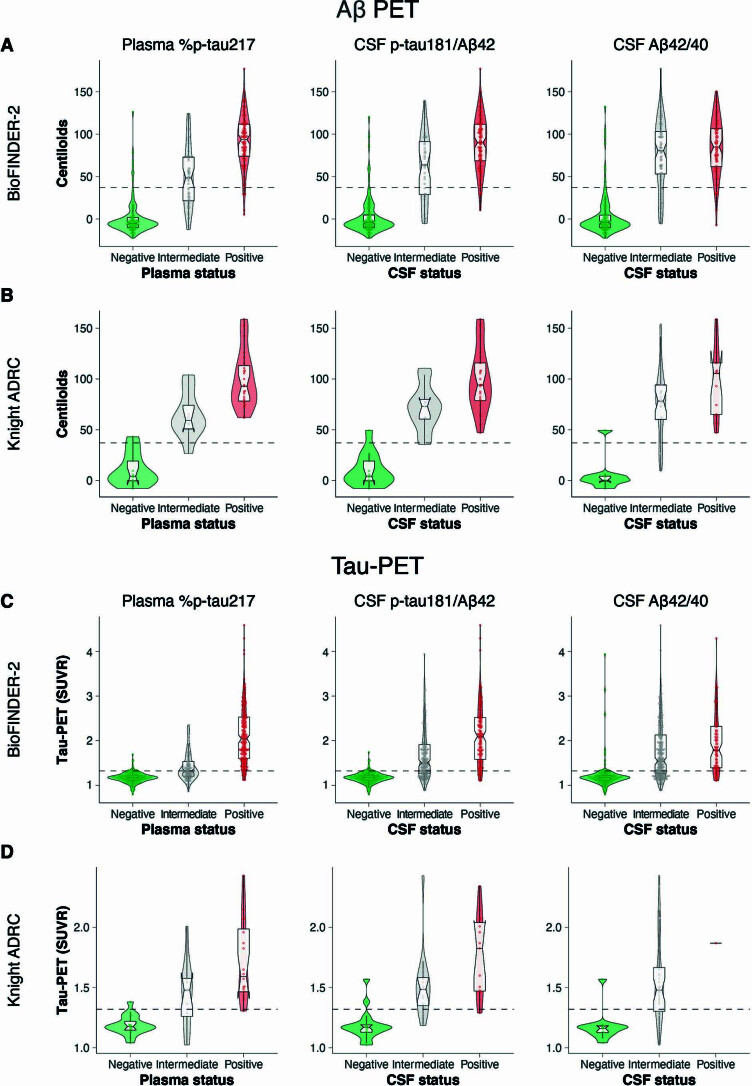
With the emergence of Alzheimer's disease (AD) disease-modifying therapies, identifying patients who could benefit from these treatments becomes critical. In this study, we evaluated whether a precise blood test could perform as well as established cerebrospinal fluid (CSF) tests in detecting amyloid-β (Aβ) plaques and tau tangles. Plasma %p-tau217 was analyzed by mass spectrometry in the Swedish BioFINDER-2 cohort (n=1,422) and the US Knight ADRC cohort (n=337). Matched CSF samples were analyzed with clinically used and FDA-approved automated immunoassays for Aβ42/40 and p-tau181/Aβ42.
Verified 2026-11-25 · 1 reference not checked yet
Overview
CoChat Summary
TL;DR
Plasma %p-tau217, measured by mass spectrometry, performed as well as or better than clinically used FDA-approved CSF tests for identifying Aβ and tau PET positivity in two independent cohorts. In cognitively impaired participants, performance improved further with a two-cutoffs approach, reaching about 95% accuracy/PPV for Aβ status in most patients.
Key findings
- In the full cohorts, plasma %p-tau217 classified Aβ PET status with very high accuracy: AUC 0.97 in BioFINDER-2 and 0.97 in Knight ADRC, clinically equivalent to CSF biomarker ratios.
- For tau PET status, plasma %p-tau217 was superior to CSF tests in the full cohorts: AUC 0.95 vs 0.93/0.88 in BioFINDER-2 and 0.98 vs 0.96/0.90 in Knight ADRC.
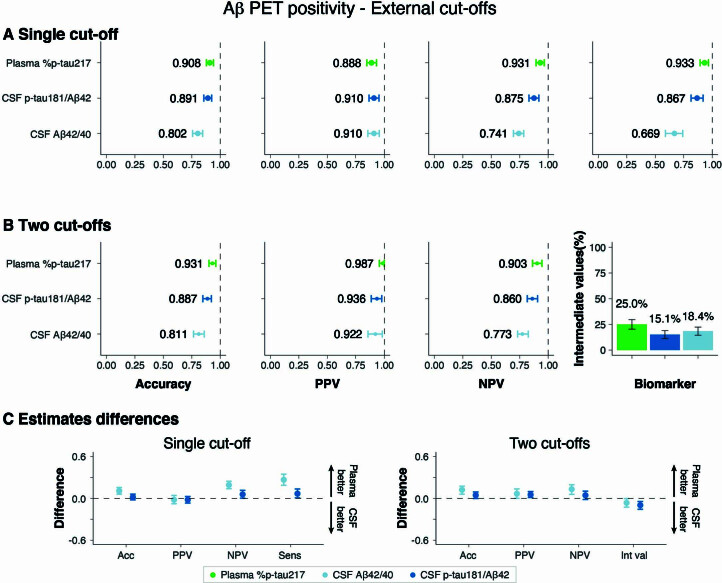
- In cognitively impaired participants, plasma %p-tau217 predicted Aβ PET status with 90% accuracy in BioFINDER-2 and 94% accuracy in Knight ADRC, with PPV/NPV around 89%/89% or higher; it was clinically equivalent to CSF tests for Aβ.
- Using two cutoffs improved Aβ PET prediction in cognitively impaired BioFINDER-2 participants to 95% accuracy, 95% PPV, and 96% NPV for plasma %p-tau217, with 16% intermediate values; for tau PET, plasma %p-tau217 reached 94% accuracy and was superior to CSF tests.
Methods
- Observational comparison across two independent cohorts: BioFINDER-2 (n = 1,422) in Sweden and Knight ADRC (n = 337) in the US; main analyses focused on cognitively impaired participants, including MCI and dementia.
- Plasma %p-tau217 was measured by LC–MS/HRMS; CSF biomarkers were measured with clinical/FDA-approved automated immunoassays (Roche Elecsys in BioFINDER-2, Fujirebio Lumipulse in Knight ADRC).
- Diagnostic performance was evaluated against Aβ PET positivity, tau PET positivity, and clinical AD diagnosis using ROC curves/AUC, plus accuracy, PPV, and NPV; equivalence was defined by 95% CI of the mean difference including zero.
Limitations
- The paper states that the Knight ADRC cognitive-impairment subgroup was relatively small, and there was no sufficiently large group with both antemortem biomarker data and postmortem data.
- The paper states that minoritized populations were not well enough represented, and that future studies should test broader primary care populations.
- Evident from the text: the study is observational and uses PET/clinical diagnosis as reference standards, so it does not test whether using the blood assay improves patient outcomes.
Model-written summary. Check it against the paper before relying on it.
Integrity signals
Registry
Cites
Statistics
Figures
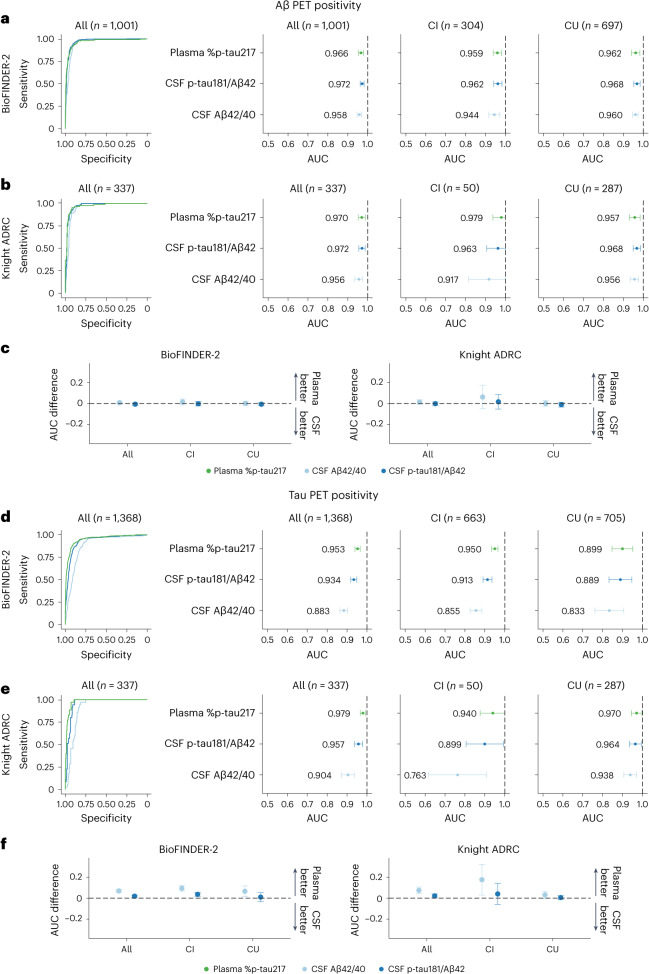
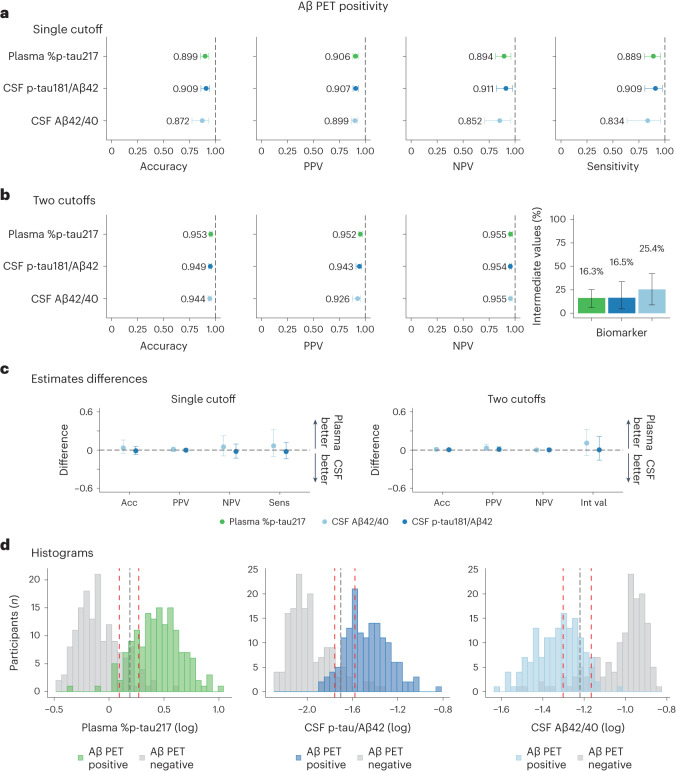
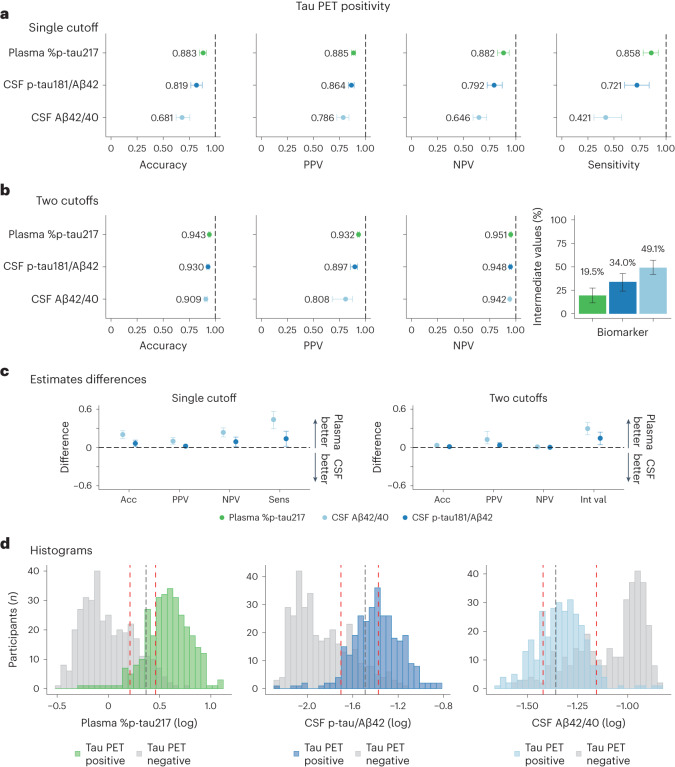
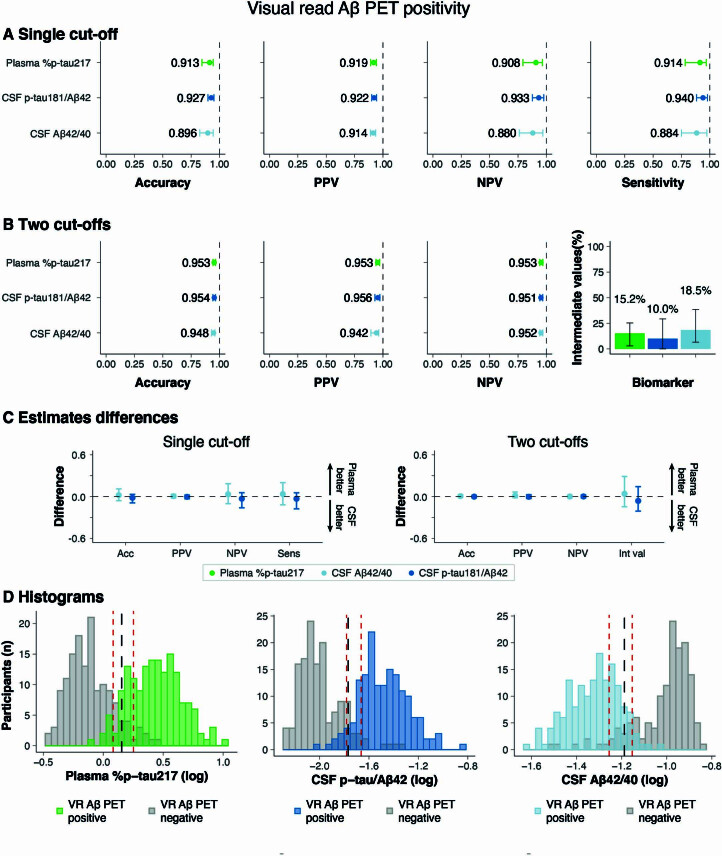
Verification
Claims the paper makes
26 Valid · 2 Not valid · 3 Not checked · 66 Own results and interpretations
The cited sources support only part of this claim — read each source’s verdict below.
In the paper
“Additionally, PET and CSF can identify cognitively unimpaired individuals at high risk of future cognitive decline and progression to AD dementia14,15.”
§ Highly accurate blood test for Alzheimer’s disease is similar or superior to clinical cerebrospinal fluid tests > Main
What the sources say
- Partly supportedcites [14] Donohue MC Association between elevated brain amyloid and subsequent cognitive decline among cognitively normal persons JAMA 2017 317 2305–2316 10.1001/jama.2017.6669 28609533 PMC5736301 sourceExperimental — accuracy not yet measured
The Methods and Discussion (page numbers unavailable) show that PET or CSF amyloid measures identified cognitively normal people more likely to experience subsequent cognitive decline. The measured progression outcomes were cognitive symptoms and MCI, not AD dementia; the Discussion says predictive value for the dementia stage requires further follow-up. (LLM, conf=0.88)
- Not checked — no full text of the sourcecites [15] Fagan AM Cerebrospinal fluid tau/β-amyloid42 ratio as a prediction of cognitive decline in nondemented older adults Arch. Neurol. 2007 64 343–349 10.1001/archneur.64.3.noc60123 17210801 source
plainstates an association- Asserted: passes — The authors put it forward as true.
- Checkable: passes — It can be checked against evidence.
- Load-bearing: unclear — It is unclear whether the paper’s conclusions depend on it.
- Based: passes — The paper gives a reason why it holds.
- Partly supported
The cited sources support only part of this claim — read each source’s verdict below.
In the paper
“The presence of Aβ pathology can be determined by positron emission tomography (PET), which visualizes Aβ deposition in the brain, or cerebrospinal fluid (CSF) assays, which measure CSF levels of Aβ42 as a ratio with Aβ40, phosphorylated tau (p-tau) or total tau4,9–11.”
§ Highly accurate blood test for Alzheimer’s disease is similar or superior to clinical cerebrospinal fluid tests > Main
What the sources say
- Not checked — no full text of the sourcecites [4] Hansson O Biomarkers for neurodegenerative diseases Nat. Med. 2021 27 954 963 10.1038/s41591-021-01382-x 34083813 source
- Partly supportedcites [9] Shaw LM Appropriate use criteria for lumbar puncture and cerebrospinal fluid testing in the diagnosis of Alzheimer’s disease Alzheimers Dement. 2018 14 1505 1521 10.1016/j.jalz.2018.07.220 30316776 PMC10013957 sourceExperimental — accuracy not yet measured
The Discussion of the evidence (section 3.5; page unavailable) says amyloid PET assesses brain amyloid status and that the CSF Aβ42/Aβ40 ratio can identify or rule out brain amyloidosis. It also reports results for tau measured in ratios with Aβ42, but does not establish that p-tau or total tau alone determines the presence of Aβ pathology; it describes those markers as reflecting tangles and neuronal injury, respectively. (LLM, conf=0.83)
- Partly supportedcites [10] Johnson, K. A. et al. Appropriate use criteria for amyloid PET: a report of the Amyloid Imaging Task Force, the Society of Nuclear Medicine and Molecular Imaging, and the Alzheimer’s Association. Alzheimers Dement.9, e1–e16 (2013). PMC3733252 23360977 sourceExperimental — accuracy not yet measured
Section 11.2 says that CSF measures of amyloid peptides and tau have been investigated to establish the presence of Alzheimer’s pathology; the paper also addresses amyloid PET as an imaging method. It does not specify an Aβ42/Aβ40 ratio or distinguish phosphorylated from total tau as the citing sentence does. The indexed passage has no page number. (LLM, conf=0.86)
- Supportedcites [11] Schindler SE Atri A The role of cerebrospinal fluid and other biomarker modalities in the Alzheimer’s disease diagnostic revolution Nat. Aging 2023 3 460 462 10.1038/s43587-023-00400-6 37202514 PMC10720501 source
The “Roles of molecular imaging, BBBM, and CSF biomarkers” section says PET radioligands visualize amyloid pathology in the brain. The “Clinical use of CSF testing” section describes CSF tests measuring Aβ42, Aβ40, total tau and p-tau181, and says ratios including Aβ42 predict amyloid PET status. (LLM, conf=0.91)
plainstates an association- Asserted: passes — The authors put it forward as true.
- Checkable: passes — It can be checked against evidence.
- Load-bearing: passes — The paper’s conclusions depend on it.
- Based: passes — The paper gives a reason why it holds.
The cited sources support only part of this claim — read each source’s verdict below.
In the paper
“Notably, Aβ PET and tau PET are not perfectly accurate in detection of neuropathology45,46”
§ Highly accurate blood test for Alzheimer’s disease is similar or superior to clinical cerebrospinal fluid tests > Discussion
What the sources say
- Partly supportedcites [45] Bucci M A multisite analysis of the concordance between visual image interpretation and quantitative analysis of [18F]flutemetamol amyloid PET images Eur. J. Nucl. Med. Mol. Imaging 2021 48 2183 2199 10.1007/s00259-021-05311-5 33844055 PMC8175298 sourceExperimental — accuracy not yet measured
The Introduction (page unavailable) reports that [18F]flutemetamol amyloid PET was validated against pathology measures, with sensitivity and specificity over 90%—high, but not perfect. The paper does not address tau PET accuracy, so it supports only the amyloid PET part of the claim. (LLM, conf=0.90)
- Partly supportedcites [46] Chen CD Comparing tau PET visual interpretation with tau PET quantification, cerebrospinal fluid biomarkers, and longitudinal clinical assessment J. Alzheimers Dis. 2023 93 765 77 10.3233/JAD-230032 37092225 PMC10200228 sourceExperimental — accuracy not yet measured
The Results > Conclusions (page unavailable) describe limitations of 18F-flortaucipir tau PET: some NFT deposition may be missed by SUVR quantification, and non-AD conditions can produce uptake. The Aβ PET Methods section describes how scans were acquired and quantified but does not assess their accuracy against neuropathology. The paper therefore supports the tau PET part, not the claim about Aβ PET. (LLM, conf=0.83)
plain- Asserted: passes — The authors put it forward as true.
- Checkable: passes — It can be checked against evidence.
- Load-bearing: passes — The paper’s conclusions depend on it.
- Based: passes — The paper gives a reason why it holds.
- Partly supported
Every source the paper cites for this claim was checked and supports it.
In the paper
“but in one large study the test classified Aβ PET status with an AUC of 0.97 (ref. 44).”
§ Highly accurate blood test for Alzheimer’s disease is similar or superior to clinical cerebrospinal fluid tests > Discussion
What the sources say
- Supportedcites [44] Barthélemy NR CSF tau phosphorylation occupancies at T217 and T205 represent improved biomarkers of amyloid and tau pathology in Alzheimer’s disease Nat. Aging 2023 3 391 401 10.1038/s43587-023-00380-7 37117788 PMC10154225 source
The CSF measures and amyloid PET section describes a large cohort (n = 750). The paper reports that Lumipulse CSF Aβ42/Aβ40 distinguished amyloid PET status with an AUC of 0.97. The printed citing sentence attributes that study result to the source; it does not attribute the FDA-approval description to it. (LLM, conf=0.94)
plainstates an association- Asserted: passes — The authors put it forward as true.
- Checkable: passes — It can be checked against evidence.
- Load-bearing: unclear — It is unclear whether the paper’s conclusions depend on it.
- Based: passes — The paper gives a reason why it holds.
- Supported
The cited sources support only part of this claim — read each source’s verdict below.
In the paper
“Despite BBMs being used in clinical practice in some countries, including the United States, they have not been recommended as standalone diagnostic tests due to a lack of studies demonstrating their equivalence to clinically used CSF and PET methods16,35–37.”
§ Highly accurate blood test for Alzheimer’s disease is similar or superior to clinical cerebrospinal fluid tests > Main
What the sources say
- Partly supportedcites [16] Hampel H Blood-based biomarkers for Alzheimer’s disease: current state and future use in a transformed global healthcare landscape Neuron 2023 111 2781 2799 10.1016/j.neuron.2023.05.017 37295421 PMC10720399 sourceExperimental — accuracy not yet measured
The paper’s Future directions and conclusions section says blood-based biomarkers do not currently provide a standalone AD diagnosis. Its Diagnosis section discusses comparisons with CSF and PET, but the cited passages do not say that a lack of studies demonstrating equivalence is the reason standalone tests have not been recommended. (LLM, conf=0.85)
- Supportedcites [35] Hansson, O. et al. The Alzheimer’s Association appropriate use recommendations for blood biomarkers in Alzheimer’s disease. Alzheimers Dement.18, 2669–2686 (2022). PMC10087669 35908251 source
In its research priorities for specialized memory clinics (page unavailable), the paper says studies are still needed to determine whether BBM-based approaches are non-inferior to CSF and PET and can be used alone to support an Alzheimer’s diagnosis. Its clinical-practice section also says BBMs should be an adjunct to, not a substitute for, clinical evaluation. This supports the claim about not recommending BBMs as standalone diagnostic tests, although the paper reports promising performance for some individual biomarkers. (LLM, conf=0.86)
- Could not verifycites [36] Hu Y Assessment of a plasma amyloid probability score to estimate amyloid positron emission tomography findings among adults with cognitive impairment JAMA Netw. Open 2022 5 e228392 10.1001/jamanetworkopen.2022.8392 35446396 PMC9024390 sourceExperimental — accuracy not yet measured
The Discussion uses amyloid PET as the study’s reference standard, and the Conclusions say the blood test could aid physicians evaluating patients. Neither section addresses recommendations against standalone blood-biomarker diagnosis or attributes such recommendations to a lack of studies showing equivalence to CSF and PET methods. Searches for standalone use, recommendations, and equivalence found no passage making that point. (LLM, conf=0.73)
- Could not verifycites [37] Monane M A blood biomarker test for brain amyloid impacts the clinical evaluation of cognitive impairment Ann. Clin. Transl. Neurol. 2023 10 1738 1748 10.1002/acn3.51863 37550958 PMC10578891 sourceExperimental — accuracy not yet measured
The Introduction reports studies comparing a blood biomarker test with amyloid PET, and the Discussion describes its potential to support clinical diagnosis. Neither section states that blood biomarkers are not recommended as standalone diagnostic tests or attributes such a recommendation to a lack of equivalence studies with CSF and PET. Searches for standalone-use recommendations and equivalence found no passage addressing that claim. (LLM, conf=0.74)
plain- Asserted: passes — The authors put it forward as true.
- Checkable: passes — It can be checked against evidence.
- Load-bearing: passes — The paper’s conclusions depend on it.
- Based: passes — The paper gives a reason why it holds.
- Partly supported
51 more claims · 6 with their cited sources checked
Create a free account to see all 97 claims and to verify the 6 references still open.
- Probably not a substantial claim. 20
- It may state two separate claims as one. 26
Claims other papers make about this one
Each is checked against this paper’s own text: does it say what the citing paper says it does?
The source backs part of the claim, not all of it — or backs it for a different population, condition or comparison.
In the citing paper
“Research has shown, however, that plasma biomarkers tend to differentiate AD cases and controls less effectively than CSF biomarkers, with the exception of some recent highly accurate tests, which means further research is required to identify potentially clinically relevant plasma biomarkers.”
From A genetic and proteomic comparison of key AD biomarkers across tissues (2024) · cites this paper as [9]
Experimental — accuracy not yet measured
Self-check
Percentages, sums and reported differences re-computed from the paper’s own numbers.
Each contradiction between two passages listed here was confirmed by an independent check.
Rated major: it would touch a result — a value a result rests on, reported and recomputed p-values on opposite sides of the significance level, two passages that conflict with no sign which is right, or a cited work retracted before this paper was published.
In the paper
§ Highly accurate blood test for Alzheimer’s disease is similar or superior to clinical cerebrospinal fluid tests > Results > Study participants
“702 (49.3%) were cognitively impaired as defined by either MCI or dementia”
§ Highly accurate blood test for Alzheimer’s disease is similar or superior to clinical cerebrospinal fluid tests > Abstract
“In cognitively impaired subcohorts (BioFINDER-2: n = 720; Knight ADRC: n = 50), plasma %p-tau217 had an accuracy, a positive predictive value and a negative predictive value of 89–90% for Aβ PET and 87–88% for tau PET status,”
Citations
Cites
Diagnostic and Statistical Manual of Mental Disorders
American Psychiatric Association (2013) · doi:10.1176/appi.books.9780890425596 · Cited by 116,369
McKhann, G. M., Knopman, D. S., Chertkow, H., Hyman, B. T., Jack, C. R., Kawas, C. H., Klunk, W. E., Koroshetz, W. J., Manly, J. J., Mayeux, R., et al. (2011) · Alzheimer's & Dementia · doi:10.1016/j.jalz.2011.03.005 · Cited by 18,657 · cited 1×
“Participants were assessed with the Clinical Dementia Rating (CDR) 60 , and individuals included in the current study were either cognitively unimpaired (CDR = 0) or cognitively impaired (CDR > 0) with a clinical syndrome typical of AD (either MCI or dementia) based on standard criteria 61 .”
MethodSelf-citationpROC: an open-source package for R and S+ to analyze and compare ROC curves
Robin, X., Turck, N., Hainard, A., Tiberti, N., Lisacek, F., Sanchez, J.-C., & Müller, M. (2011) · BMC Bioinformatics · doi:10.1186/1471-2105-12-77 · Cited by 13,697 · cited 1×
“To evaluate the performance of the three fluid biomarkers in predicting the main outcomes (Aβ and tau PET status and clinical AD diagnosis), we used receiver operating characteristic (ROC) curves ( pROC package 72 ).”
MethodThe Clinical Dementia Rating (CDR): Current version and scoring rules
Morris, J. C. (1993) · Neurology · doi:10.1212/wnl.43.11.2412-a · Cited by 9,882
Self-citationLecanemab in early Alzheimer's disease
van Dyck, C. H., Swanson, C. J., Aisen, P., Bateman, R. J., Chen, C., Gee, M., Kanekiyo, M., Li, D., Reyderman, L., Cohen, S., et al. (2023) · New England Journal of Medicine · doi:10.1056/nejmoa2212948 · Cited by 5,678 · cited 2×
“Recently, lecanemab received traditional approval from the US Food & Drug Administration (FDA) for treatment of patients with MCI and mild dementia with biomarker-proven Aβ pathology 8 , and other immunotherapies are expected to follow.”
BackgroundSelf-citationDonanemab in Early Symptomatic Alzheimer Disease: The TRAILBLAZER-ALZ 2 Randomized Clinical Trial
Sims, J. R., Zimmer, J. A., Evans, C. D., Lu, M., Ardayfio, P., Sparks, J., Wessels, A. M., Shcherbinin, S., Wang, H., Monkul Nery, E. S., et al. (2023) · JAMA · doi:10.1001/jama.2023.13239 · Cited by 2,932 · cited 3×
“Secondary outcomes included the classification of brain tau aggregates as determined by tau PET imaging, which has also been used by some trials in the selection of patients suitable for anti-amyloid immunotherapy 7,38 , and agreement with a clinical AD diagnosis.”
MethodInfluentialSelf-citationNichols, E., Szoeke, C. E. I., Vollset, S. E., Abbasi, N., Abd-Allah, F., Abdela, J., Aichour, M. T. E., Akinyemi, R. O., Alahdab, F., Asgedom, S. W., et al. (2019) · The Lancet Neurology · doi:10.1016/s1474-4422(18)30403-4 · Cited by 2,412
Donanemab in Early Alzheimer’s Disease
Mintun, M. A., Lo, A. C., Duggan Evans, C., Wessels, A. M., Ardayfio, P. A., Andersen, S. W., Shcherbinin, S., Sparks, J., Sims, J. R., Brys, M., et al. (2021) · New England Journal of Medicine · doi:10.1056/nejmoa2100708 · Cited by 1,728
Improvements on Cross-Validation: The 632+ Bootstrap Method
Efron, B., & Tibshirani, R. (1997) · Journal of the American Statistical Association · doi:10.1080/01621459.1997.10474007 · Cited by 1,636
Palmqvist, S., Janelidze, S., Quiroz, Y. T., Zetterberg, H., Lopera, F., Stomrud, E., Su, Y., Chen, Y., Serrano, G. E., Leuzy, A., et al. (2020) · JAMA · doi:10.1001/jama.2020.12134 · Cited by 1,603 · cited 5×
“Plasma levels of p-tau are strongly associated with PET and CSF biomarkers of AD pathology 19–25 , neuropathological changes associated with AD 20,23,26,27 and the subsequent development of AD dementia 20,23,28 .”
BackgroundMethodInfluentialSelf-citation
Cited by
Blood Biomarkers to Detect Alzheimer Disease in Primary Care and Secondary Care
Palmqvist, S., Tideman, P., Mattsson-Carlgren, N., Schindler, S. E., Smith, R., Ossenkoppele, R., Calling, S., West, T., Monane, M., Verghese, P. B., et al. (2024) · JAMA · doi:10.1001/jama.2024.13855 · Cited by 416
Self-citationAlzheimer’s disease: insights into pathology, molecular mechanisms, and therapy
Zheng, Q., & Wang, X. (2025) · Protein & Cell · doi:10.1093/procel/pwae026 · Cited by 410
Pathogenesis, diagnostics, and therapeutics for Alzheimer's disease: Breaking the memory barrier
Kamatham, P. T., Shukla, R., Khatri, D. K., & Vora, L. K. (2024) · Ageing Research Reviews · doi:10.1016/j.arr.2024.102481 · Cited by 371
Schindler, S. E., Galasko, D., Pereira, A. C., Rabinovici, G. D., Salloway, S., Suárez-Calvet, M., Khachaturian, A. S., Mielke, M. M., Udeh-Momoh, C., Weiss, J., et al. (2024) · Nature Reviews Neurology · doi:10.1038/s41582-024-00977-5 · Cited by 290
“In particular, assays of plasma levels of p-tau217 or the ratio of p-tau217 to non-phosphorylated tau have AUCs of 0.92–0.98, which is similar to those of CSF tests for classifying amyloid PET status 48,58–61 .”
InfluentialSelf-citationDonanemab: Appropriate use recommendations
Rabinovici, G. D., Selkoe, D. J., Schindler, S. E., Aisen, P., Apostolova, L. G., Atri, A., Greenberg, S. M., Hendrix, S. B., Petersen, R. C., Weiner, M., et al. (2025) · The Journal of Prevention of Alzheimer's Disease · doi:10.1016/j.tjpad.2025.100150 · Cited by 278
“Similarly, the Work Group recommends excluding patients with Down syndrome related AD, who also show a higher prevalence and severity of CAA compared to patients with sporadic AD [ 19 , 21 ].”
Self-citationHead‐to‐head comparison of leading blood tests for Alzheimer's disease pathology
(2024) · doi:10.1002/alz.14315 · Cited by 199
“9 14 Glial fibrillary acidic protein (GFAP), a biomarker of astrocytic activation, is also elevated in amyloid positive individuals, likely indicating a response to amyloid pathology.”
Self-citationPalmqvist, S., Warmenhoven, N., Anastasi, F., Pilotto, A., Janelidze, S., Tideman, P., Stomrud, E., Mattsson-Carlgren, N., Smith, R., Ossenkoppele, R., et al. (2025) · Nature Medicine · doi:10.1038/s41591-025-03622-w · Cited by 194
“Some studies suggest that MS-based assays have high accuracy, comparable to US Food and Drug Administration (FDA)-approved cerebrospinal fluid (CSF) assays 4,8 , but their use is currently restricted to highly specialized laboratories.”
Self-citationAlzheimer's disease drug development pipeline: 2025
Cummings, J. L., Zhou, Y., Lee, G., Zhong, K., Fonseca, J., Leisgang‐Osse, A. M., & Cheng, F. (2025) · Alzheimer's & Dementia: Translational Research & Clinical Interventions · doi:10.1002/trc2.70098 · Cited by 190
Alzheimer’s Disease: Exploring the Landscape of Cognitive Decline
Tenchov, R., Sasso, J. M., & Zhou, Q. A. (2024) · ACS Chemical Neuroscience · doi:10.1021/acschemneuro.4c00339 · Cited by 170
Palmqvist, S., Whitson, H. E., Allen, L. A., Suarez‐Calvet, M., Galasko, D., Karikari, T. K., Okrahvi, H. R., Paczynski, M., Schindler, S. E., Teunissen, C. E., et al. (2025) · Alzheimer's & Dementia · doi:10.1002/alz.70535 · Cited by 167
Self-citationNew landscape of the diagnosis of Alzheimer’s disease
Frisoni, G. B., Hansson, O., Nichols, E., Garibotto, V., Schindler, S. E., van der Flier, W. M., Jessen, F., Villain, N., Arenaza-Urquijo, E. M., Crivelli, L., et al. (2025) · The Lancet · doi:10.1016/s0140-6736(25)01294-2 · Cited by 143
Self-citationKoszła, O., & Sołek, P. (2024) · Cell Communication and Signaling · doi:10.1186/s12964-024-01791-8 · Cited by 178
“Alzheimer’s disease (AD) stands as the predominant form of dementia, representing 60–70% of documented cases [4].”
BackgroundChallenges in the practical implementation of blood biomarkers for Alzheimer’s disease
Schöll, M., Verberk, I. M. W., del Campo, M., Delaby, C., Therriault, J., Chong, J. R., Palmqvist, S., & Alcolea, D. A. (2024) · The Lancet Healthy Longevity · doi:10.1016/j.lanhl.2024.07.013 · Cited by 164
Self-citationA comprehensive head-to-head comparison of key plasma phosphorylated tau 217 biomarker tests
Warmenhoven, N., Salvadó, G., Janelidze, S., Mattsson, N., Bali, D., Dolado, A. O., Kolb, H. C., Triana‐Baltzer, G., Barthélemy, N. R., Schindler, S. E., et al. (2024) · Brain · doi:10.1093/brain/awae346 · Cited by 166
“…plasma %p-tau217 WashU performance was non-inferior or even superior to FDA-approved CSF measures across all analyses, as previously shown for A β - and tau-PET status, 7 but we now also show similar findings for either PET load or cognitive function both cross-sectionally and longitudinally.”
Self-citationDiagnosis of Alzheimer's disease using plasma biomarkers adjusted to clinical probability
Therriault, J., Janelidze, S., Benedet, A. L., Ashton, N. J., Arranz Martínez, J., Gonzalez-Escalante, A., Bellaver, B., Alcolea, D., Vrillon, A., Karim, H., et al. (2024) · Nature Aging · doi:10.1038/s43587-024-00731-y · Cited by 131
Self-citationJanelidze, S., Barthélemy, N. R., Salvadó, G., Schindler, S. E., Palmqvist, S., Mattsson, N., Braunstein, J. B., Ovod, V., Bollinger, J. G., He, Y., et al. (2024) · JAMA Neurology · doi:10.1001/jamaneurol.2024.2619 · Cited by 146
Self-citationPlasma MTBR-tau243 biomarker identifies tau tangle pathology in Alzheimer’s disease
Horie, K., Salvadó, G., Koppisetti, R. K., Janelidze, S., Barthélemy, N. R., He, Y., Sato, C., Gordon, B. A., Jiang, H., Benzinger, T. L. S., et al. (2025) · Nature Medicine · doi:10.1038/s41591-025-03617-7 · Cited by 182
“11) at Washington University, using the previously reported method with IP–MS 12 .”
Self-citationAggregation-Induced Emission Luminogen: Role in Biopsy for Precision Medicine
Duo, Y., Han, L., Yang, Y., Wang, Z., Wang, L., Chen, J., Xiang, Z., Yoon, J., Luo, G., & Tang, B. Z. (2024) · Chemical Reviews · doi:10.1021/acs.chemrev.4c00244 · Cited by 126
Alzheimer disease blood biomarkers: considerations for population-level use
Mielke, M. M., & Fowler, N. R. (2024) · Nature Reviews Neurology · doi:10.1038/s41582-024-00989-1 · Cited by 149
“In addition to p-tau181 and p-tau217 measurements, the ratio of p-tau217 to non-phosphorylated tau has also shown high accuracy for the prediction of brain amyloid, as measured using amyloid PET or CSF Aβ 42:40 and p-tau181:Aβ 42 ratios 23 .”
Sperling, R. A., Donohue, M., Rissman, R. A., Johnson, K. A., Rentz, D. M., Grill, J. D., Heidebrink, J. L., Jenkins, C., Jimenez‐Maggiora, G. A., Langford, O., et al. (2024) · The Journal of Prevention of Alzheimer s Disease · doi:10.14283/jpad.2024.122 · Cited by 140
“Since the launch of the A4 Study in 2014, which relied on amyloid PET to determine trial eligibility, there has been remarkable progress in blood-based biomarkers to detect evidence of AD pathology (6).”
Wang, J., Huang, S., Lan, G., Lai, Y., Wang, Q., Chen, Y., Xiao, Z., Chen, X., Bu, X., Liu, Y., et al. (2025) · Alzheimer s & Dementia · doi:10.1002/alz.70038 · Cited by 137
“22,23,38 Similarly, the plasma p-tau217/A β 42 ratio reduced the intermediate percentages from 13.0% to 10.7% in the clinical cohort was meaningful in the latter.”
InfluentialTau in neurodegenerative diseases: molecular mechanisms, biomarkers, and therapeutic strategies
Zhang, X., Wang, J., Zhang, Z., & Ye, K. (2024) · Translational Neurodegeneration · doi:10.1186/s40035-024-00429-6 · Cited by 126
“The blood p-tau217 test is comparable or superior to the CSF p-tau217 test in the detection of AD pathology [195, 196].”
Alzheimer's disease outlook: controversies and future directions
Frisoni, G. B., Aho, E., Brayne, C., Ciccarelli, O., Dubois, B., Fox, N. C., Frederiksen, K. S., Gabay, C., Garibotto, V., Hofmarcher, T., et al. (2025) · The Lancet · doi:10.1016/s0140-6736(25)01389-3 · Cited by 135
Self-citationPassive anti-amyloid β immunotherapy in Alzheimer's disease—opportunities and challenges
Heneka, M. T., Morgan, D., & Jessen, F. (2024) · The Lancet · doi:10.1016/s0140-6736(24)01883-x · Cited by 126
Therriault, J., Brum, W. S., Trudel, L., Macedo, A. C., Bitencourt, F. V., Martins, C. C., Nakouzi, M., Pola, I., Wong, M. W. K., Kac, P. R., et al. (2025) · The Lancet Neurology · doi:10.1016/s1474-4422(25)00227-3 · Cited by 143
Self-citationConsiderations in the clinical use of amyloid PET and CSF biomarkers for Alzheimer's disease
Leuzy, A., Bollack, A., Pellegrino, D., Teunissen, C. E., Joie, R. L., Rabinovici, G. D., Franzmeier, N., Johnson, K. A., Barkhof, F., Shaw, L. M. J., et al. (2025) · Alzheimer s & Dementia · doi:10.1002/alz.14528 · Cited by 126
Self-citationPlasma p‐tau immunoassays in clinical research for Alzheimer's disease
Teunissen, C. E., Kolster, R., Triana‐Baltzer, G., Janelidze, S., Zetterberg, H., & Kolb, H. C. (2024) · Alzheimer s & Dementia · doi:10.1002/alz.14397 · Cited by 103
Self-citationLista, S., Imbimbo, B. P., Grasso, M., Fidilio, A., Emanuele, E., Minoretti, P., López-Ortiz, S., Martín-Hernández, J., Gabelle, A., Caruso, G., et al. (2024) · Journal of Neuroinflammation · doi:10.1186/s12974-024-03163-y · Cited by 81
“Plasma levels of hyperphosphorylated tau at position 217 (p-tau 217 ) have demonstrated clinical performance that is equivalent to or superior to the FDA-approved CSF tests in detecting brain Aβ pathology [15, 16].”
MethodP-tau217 as a Reliable Blood-Based Marker of Alzheimer’s Disease
Lai, R., Li, B., & Bishnoi, R. J. (2024) · Biomedicines · doi:10.3390/biomedicines12081836 · Cited by 89
Zhong, X., Wang, Q., Yang, M., Lin, G., Yao, K., Wu, Z., Xu, D., Zhou, H., Chen, B., Shi, H., et al. (2025) · Alzheimer s & Dementia · doi:10.1002/alz.14536 · Cited by 91
“23 Brum et al. 45 proposed that combining plasma p-tau217, age, and APOE status could improve the AUC to 0.89 to 0.94 in determining A β PET status.”
InfluentialAshton, N. J., Keshavan, A., Brum, W. S., Andréasson, U., Arslan, B., Droescher, M., Barghorn, S., Vanbrabant, J., Lambrechts, C., Loo, M. V., et al. (2025) · Alzheimer s & Dementia · doi:10.1002/alz.14508 · Cited by 109
“18,38 Here, AUCs for AD pathology were also similar between plasma and CSF assays.”
Self-citationKhalafi, M., Dartora, W. J., McIntire, L. B., Butler, T., Wartchow, K. M., Hojjati, S. H., Razlighi, Q. R., Shirbandi, K., Zhou, L., Chen, K., et al. (2024) · Alzheimer s & Dementia · doi:10.1002/alz.14458 · Cited by 99
Self-citationNoh, M., Kwon, H. S., Kwon, M., Nahm, M., Jin, H. K., Bae, J., & Kim, S. H. (2025) · Molecular Neurodegeneration · doi:10.1186/s13024-025-00867-4 · Cited by 98
“…ratio of p-tau217 to non-phosphorylated tau (%p-tau217)—has demonstrated superior diagnostic accuracy than other plasma biomarkers, including p-tau181, p-tau231, GFAP, NfL, and Aβ42/40 [308], and has performed comparably or better than FDA-approved CSF assays for Aβ status classification [309].”
Atri, A., Dickerson, B. C., Clevenger, C. K., Karlawish, J. H., Knopman, D. S., Lin, P., Norman, M., Onyike, C. U., Sano, M., Scanland, S., et al. (2024) · Alzheimer s & Dementia · doi:10.1002/alz.14333 · Cited by 111
Quantitative Assessment of the Effect of Chronic Kidney Disease on Plasma P-Tau217 Concentrations
Bornhorst, J. A., Lundgreen, C. S., Weigand, S. D., Figdore, D. J., Wiste, H. J., Griswold, M. E., Vemuri, P., Graff‐Radford, J., Knopman, D. S., Cogswell, P., et al. (2025) · Neurology · doi:10.1212/wnl.0000000000210287 · Cited by 84
Plasma Phosphorylated Tau 217 to Identify Preclinical Alzheimer Disease
Salvadó, G., Janelidze, S., Bali, D., Dolado, A. O., Therriault, J., Brum, W. S., Binette, A. P., Stomrud, E., Mattsson, N., Palmqvist, S., et al. (2025) · JAMA Neurology · doi:10.1001/jamaneurol.2025.3217 · Cited by 100
Self-citationMolecular Biomarkers in Neurological Diseases: Advances in Diagnosis and Prognosis
Myrou, A. D., Barmpagiannos, K., Ioakimidou, A., & Savopoulos, C. G. (2025) · International Journal of Molecular Sciences · doi:10.3390/ijms26052231 · Cited by 72
Fluid-based biomarkers for neurodegenerative diseases
Cao, Y., Xu, Y., Cao, M., Chen, N., Zeng, Q., Lai, M. K. P., Fan, D., Sethi, G., & Cao, Y. (2025) · Ageing Research Reviews · doi:10.1016/j.arr.2025.102739 · Cited by 69
Alzheimer’s disease biomarkers and their current use in clinical research and practice
Hunter, T., Santos, L. E., Tovar-Moll, F. F., & Felice, F. G. D. (2024) · Molecular Psychiatry · doi:10.1038/s41380-024-02709-z · Cited by 90
“In fact, plasma %p-tau217 (p-tau217/non-phosphorylated tau) analyzed by MS was equivalent to FDA-approved CSF tests in determining amyloid PET and superior in determining tau PET [111].”
Plasma pTau217 predicts continuous brain amyloid levels in preclinical and early Alzheimer's disease
Devanarayan, V., Doherty, T., Charil, A., Sachdev, P., Ye, Y., Murali, L. K., Llano, D. A., Zhou, J., Reyderman, L., Hampel, H., et al. (2024) · Alzheimer's & Dementia · doi:10.1002/alz.14073 · Cited by 57
Clinical value of plasma ALZpath pTau217 immunoassay for assessing mild cognitive impairment
Lehmann, S., Schraen‐Maschke, S., Vidal, J., Delaby, C., Buée, L., Blanc, F., Paquet, C., Allinquant, B., Bombois, S., Gabelle, A., et al. (2024) · Journal of Neurology Neurosurgery & Psychiatry · doi:10.1136/jnnp-2024-333467 · Cited by 63
“33 This suggests that blood tests are comparable to or may even be more accurate than CSF tests.”
BackgroundNanopore sensing of protein and peptide conformation for point-of-care applications
Ratinho, L. R., Meyer, N., Greive, S. J., Cressiot, B., & Pelta, J. (2025) · Nature Communications · doi:10.1038/s41467-025-58509-8 · Cited by 79
Insights into the use of biomarkers in clinical trials in Alzheimer's disease
Pascoal, T. A., Aguzzoli, C. S., Lussier, F. Z., Crivelli, L., Suemoto, C. K., Fortea, J., Rosa‐Neto, P., Zimmer, E. R., Ferreira, P. C. L., & Bellaver, B. (2024) · EBioMedicine · doi:10.1016/j.ebiom.2024.105322 · Cited by 68
“31 It is important to emphasise that the T+ status discussed in this review is determined by biomarkers that identify AD-related tau pathology and would not consider tau biomarkers speci fi c to other tauopathies.”
Lehmann, S., Gabelle, A., Duchiron, M., Busto, G. U., Morchikh, M., Delaby, C., Hirtz, C., Mondésert, E., Cristol, J., Barnier-Figue, G., et al. (2025) · EBioMedicine · doi:10.1016/j.ebiom.2025.105805 · Cited by 67
“43 We compared in ALZAN the ability of plasma biomarkers to detect brain amyloidosis (A β +), as defined by the CSF A β 42/40 ratio.”
The glymphatic system clears amyloid beta and tau from brain to plasma in humans
Dagum, P., Elbert, D. L., Giovangrandi, L., Singh, T., Venkatesh, V., Corbellini, A., Kaplan, R. M., Levendovszky, S. R., Ludington, E., Yarasheski, K. E., et al. (2026) · Nature Communications · doi:10.1038/s41467-026-68374-8 · Cited by 113
“Plasma p-tau217 levels were measured but excluded from analysis because a large proportion (9 out of 49) of these cognitively-intact individuals exhibited plasma p-tau217 levels below the limit of detection for the assay, consistent with prior study fi ndings 34,35 .”
Du, L., Langhough, R. E., Wilson, R. E., Reyes, R. E. R., Hermann, B. P., Jonaitis, E. M., Betthauser, T. J., Chin, N. A., Christian, B., Chaby, L., et al. (2024) · Alzheimer's & Dementia · doi:10.1002/alz.14100 · Cited by 46
“3,4 Compared to positron emission tomography (PET) or cerebrospinal fluid (CSF)– based biomarkers, the scalability of BBMs including cost-effectiveness and ease of collection, 5–7 will make them attractive front-line tools for assessing AD proteinopathy and progression, addressing the urgent need…”
BackgroundSystemic determinants of brain health in ageing
Smith, E. E., Biessels, G. J., Gao, V., Gottesman, R. F., Liesz, A., Parikh, N. S., & Iadecola, C. (2024) · Nature Reviews Neurology · doi:10.1038/s41582-024-01016-z · Cited by 60
“Because biomarkers of Alzheimer disease can now be measured accurately in peripheral blood 192 , the determination of whether peripheral organ disease or dysfunction is associated with Alzheimer disease pathophysiology is increasingly feasible in cohort studies with stored blood samples.”
Yakoub, Y., González‐Ortiz, F., Ashton, N. J., Déry, C., Strikwerda‐Brown, C., St‐Onge, F., Ourry, V., Schöll, M., Geddes, M. R., Ducharme, S., et al. (2025) · Alzheimer s & Dementia · doi:10.1002/alz.14537 · Cited by 64
Reparaz-Escudero, I., Izquierdo, M., Bischoff-Ferrari, H. A., Martínez-Lage, P., & Sáez de Asteasu, M. L. (2024) · Ageing Research Reviews · doi:10.1016/j.arr.2024.102463 · Cited by 45
Global Diseases Deserve Global Solutions: Alzheimer’s Disease
Twiss, E., McPherson, C., & Weaver, D. F. (2025) · Neurology International · doi:10.3390/neurolint17060092 · Cited by 71
“For instance, a test measuring serum phosphorylated tau (p-tau) concentrations appears to be as accurate as cerebrospinal fluid biomarkers [65], and may be 90% accurate in identifying AD, compared to a specialist performing a cognitive evaluation or interpreting imaging, which is 63–73% accurate…”
A head‐to‐head comparison of plasma biomarkers to detect Alzheimer's disease in a memory clinic
Anastasi, F., Fernández‐Lebrero, A., Ashton, N. J., Ortiz‐Romero, P., Torres‐Torronteras, J., González‐Escalante, A., Milà‐Alomà, M., Contador, J., García‐Escobar, G., Manero-Borràs, R. M., et al. (2025) · Alzheimer s & Dementia · doi:10.1002/alz.14609 · Cited by 56
Hu, Y., Cho, M., Sachdev, P., Dage, J., Hendrix, S., Hansson, O., Bateman, R. J., & Hampel, H. (2024) · Med · doi:10.1016/j.medj.2024.08.004 · Cited by 42
Self-citationHuang, Z., Zhang, L., Dou, Y., Liu, X., Song, S., Jiang, H., & Fan, C. (2024) · Analytical Chemistry · doi:10.1021/acs.analchem.4c01278 · Cited by 43
Advances in blood biomarkers for Alzheimer disease ( AD ): A review
Assfaw, A. D., Schindler, S. E., & Morris, J. C. (2024) · The Kaohsiung Journal of Medical Sciences · doi:10.1002/kjm2.12870 · Cited by 47
“23,51 Additionally, blood tests can be performed multiple times without substantial difficulty, allowing for repetitive monitoring of AD biomarkers over time.”
Self-citationSchöll, M., Vrillon, A., Ikeuchi, T., Quevenco, F. C., Iaccarino, L., Vasileva-Metodiev, S. Z., Burnham, S. C., Hendrix, J. A., Epelbaum, S., Zetterberg, H., et al. (2025) · The Journal of Prevention of Alzheimer s Disease · doi:10.1016/j.tjpad.2024.100056 · Cited by 54
Self-citation(2024) · doi:10.1101/2024.05.31.24308264 · Cited by 41
Heo, G., Xu, Y., Wang, E., Ali, M., Oh, H. S., Losada, P. M., Anastasi, F., Escalante, A. G., Puerta, R., Song, S., et al. (2025) · Nature Aging · doi:10.1038/s43587-025-00872-8 · Cited by 69
“Plasma p-tau217 shows strong predictive power for amyloid positivity 27 , but this biomarker has been shown to be a proxy for brain amyloidosis and not overall dementia.”
Self-citationPlasma tau biomarkers for biological staging of Alzheimer’s disease
Montoliu‐Gaya, L., Salvadó, G., Therriault, J., Nilsson, J., Janelidze, S., Weiner, S., Ashton, N. J., Benedet, A. L., Rahmouni, N., Lantero‐Rodriguez, J., et al. (2025) · Nature Aging · doi:10.1038/s43587-025-00951-w · Cited by 58
“The model was also tested using concentrations instead of MS ratios, as they may offer greater applicability and translational potential in clinical settings without greatly diminishing accuracy 41,42 .”
Self-citationDing, J., Zhao, C., Hao, X., & Jiao, H. (2025) · Alzheimer s & Dementia · doi:10.1002/alz.70709 · Cited by 60
Predicting onset of symptomatic Alzheimerʼs disease with plasma p-tau217 clocks
Petersen, K. K., Milà‐Alomà, M., Li, Y., Du, L., Xiong, C., Tosun, D., Saef, B. A., Saad, Z. S., Du‐Cuny, L., Coomaraswamy, J., et al. (2026) · Nature Medicine · doi:10.1038/s41591-026-04206-y · Cited by 66
“Importantly, plasma measures of p-tau217 and %p-tau217 have high associations not only with amyloid PET 22,24–28 but also with tau PET 24,25,29 , brain volumes 23 and cognition 23,28 .”
Self-citationMachine learning prediction of tau‐PET in Alzheimer's disease using plasma, MRI, and clinical data
Karlsson, L., Vogel, J., Arvidsson, I., Åström, K., Strandberg, O., Seidlitz, J., Bethlehem, R. A. I., Stomrud, E., Ossenkoppele, R., Ashton, N. J., et al. (2025) · Alzheimer's & Dementia · doi:10.1002/alz.14600 · Cited by 43
Self-citationIbáñez, L., Liu, M., Beric, A., Timsina, J., Kohlfeld, P., Bergmann, K., Lowery, J., Sykora, N., Montejo, B. S., Brock, W., et al. (2024) · Alzheimer s & Dementia · doi:10.1002/alz.14413 · Cited by 47
Self-citationInfluence of medical conditions on the diagnostic accuracy of plasma p‐tau217 and p‐tau217/Aβ42
Olvera‐Rojas, M., Sewell, K. R., Karikari, T. K., Huang, H., Oberlin, L. E., Zeng, X., Morris, J. K., Collins, A. M., Drake, J. A., Sutton, B. P., et al. (2024) · Alzheimer s & Dementia · doi:10.1002/alz.14430 · Cited by 43
“6 Plasma levels of amyloid beta (A β ) and phosphorylated tau (p-tau) reflect brain amyloidosis pathology, 5,7 while neurofilament light (NfL) and glial fibrillary acidic protein (GFAP) are indicators of neurodegenerative processes and astrocytic reactivity, respectively.”
Self-citationClinical use of biomarkers in the era of Alzheimer's disease treatments
VandeVrede, L. A., & Schindler, S. E. (2024) · Alzheimer s & Dementia · doi:10.1002/alz.14201 · Cited by 44
Self-citationSong, J., Cho, E., Lee, H., Lee, S., Kim, S., & Kim, J. (2025) · Biosensors · doi:10.3390/bios15020102 · Cited by 47
“The levels and ratio of amyloid beta 42 and amyloid beta 40 in CSF are used to diagnose AD and PD [29,38,42,43,46,60–62].”
A comparison of p‐tau assays for the specificity to detect tau changes in Alzheimer's disease
Janelidze, S., Ashton, N. J., Dolado, A. O., Nordström, U., Bali, D., Forsberg, K., Keskin, I., Mastrangelo, A., Vacchiano, V., Liguori, R., et al. (2025) · Alzheimer s & Dementia · doi:10.1002/alz.70208 · Cited by 42
Self-citationADNI Biomarker Core: A review of progress since 2004 and future challenges
Shaw, L. M. J., Korecka, M., Lee, E. B., Cousins, K. A. Q., Vanderstichele, H., Schindler, S. E., Tosun, D., DeMarco, M. L., Brylska, M., Wan, Y., et al. (2024) · Alzheimer s & Dementia · doi:10.1002/alz.14264 · Cited by 48
“76,77,79 The emergence of p-tau217 as the best of these for early indication of AD pathology has convincingly been confirmed in many studies and is included in the “core” “T” (tau) analytes in the newrevisedAlzheimer’sAssociationAmyloid/Tau/Neurodegeneration (ATN) Guidelines 76,77,80 and,…”
Self-citationJarek, D. J., Mizerka, H., Nuszkiewicz, J., & Szewczyk‐Golec, K. (2024) · Biomedicines · doi:10.3390/biomedicines12040786 · Cited by 44
“The higher cost of mass spectrometry tests, which have shown the best performance compared to currently used immunoassays, has also been indicated [94].”
BackgroundArnsten, A. F. T., Tredici, K. D., Barthélemy, N. R., Gabitto, M. I., van Dyck, C. H., Lein, E. S., Braak, H., & Datta, D. (2025) · Alzheimer s & Dementia · doi:10.1002/alz.70404 · Cited by 41
Self-citationZheng, H., Wu, Z., Mielke, M. M., Murray, A. M., & Ryan, J. L. (2024) · The Journal of Prevention of Alzheimer s Disease · doi:10.14283/jpad.2024.142 · Cited by 32
“The findings from multiple studies have demonstrated the utility of these biomarkers to aid in the diagnosis of AD (5, 6) and to predict cognitive decline (7, 8) and the risk of AD.”
BackgroundDiagnostic performance of plasma p‐tau217 and Aβ42/40 biomarkers in the outpatient memory clinic
Piura, Y. D., Figdore, D. J., Lachner, C., Bornhorst, J. A., Algeciras‐Schimnich, A., Graff‐Radford, N. R., & Day, G. S. (2025) · Alzheimer s & Dementia · doi:10.1002/alz.70316 · Cited by 44
Liu, R., Nie, Q., Wang, Y., et al. (2024) · Chemical Engineering Journal · doi:10.1016/j.cej.2024.155207 · Cited by 29
Vanderlip, C. R., Stark, C. E. L., & Initiative, A. D. N. (2024) · Alzheimer s & Dementia · doi:10.1002/alz.14154 · Cited by 27
Zheng, J., Jiang, X., Bai, S., Lai, M., Yu, J., Chen, M., Zhou, R., Jia, Y., Yan, H., Liang, Z., et al. (2025) · Advanced Materials · doi:10.1002/adma.202505262 · Cited by 34
Baiardi, S., Hansson, O., Levin, J., & Parchi, P. (2024) · Alzheimer s & Dementia · doi:10.1002/alz.14039 · Cited by 30
Self-citationCognitive modeling of the Mnemonic Similarity Task as a digital biomarker for Alzheimer's disease
Vanderlip, C. R., Lee, M. D., & Stark, C. E. L. (2024) · Alzheimer s & Dementia · doi:10.1002/alz.14163 · Cited by 31
Campbell, J., Lavoie, L., Farraia, M., Huelin, R., Zhang, Q., & Monfared, A. A. T. (2024) · Neurology and Therapy · doi:10.1007/s40120-024-00676-9 · Cited by 35
The immunology of stroke and dementia
Iadecola, C., & Anrather, J. (2025) · Immunity · doi:10.1016/j.immuni.2024.12.008 · Cited by 42
Antonioni, A., Raho, E. M., Lorenzo, F. D., Manzoli, L., Flacco, M. E., & Koch, G. (2025) · Journal of Neurology · doi:10.1007/s00415-025-12996-3 · Cited by 36
Selma‐González, J., Rubio‐Guerra, S., Castro, J. G., Vera-Campuzano, E., Sala, I., Sánchez‐Saudinós, M. B., Zhu, N., Arranz, J., Arriola‐Infante, J. E., Rodríguez‐Baz, Í., et al. (2025) · Neurology · doi:10.1212/wnl.0000000000213769 · Cited by 28
Huber, H., Montoliu‐Gaya, L., Brum, W. S., Vávra, J., Yakoub, Y., Weninger, H., Braun-Wohlfahrt, L. S., Simrén, J., Boada, M., Ruiz, A., et al. (2026) · Nature Medicine · doi:10.1038/s41591-025-04080-0 · Cited by 46
Self-citationKrawczuk, D., Kulczyńska‐Przybik, A., & Mroczko, B. (2024) · International Journal of Molecular Sciences · doi:10.3390/ijms25158132 · Cited by 30
“Furthermore, among MCI and mild dementia patients, plasma %pTau-217 classified A β PET status with an accuracy of approximately 90% [58].”
BackgroundSattarov, R., Havers, M., Orbjörn, C., Stomrud, E., Janelidze, S., Laurell, T., & Mattsson, N. (2024) · Scientific Reports · doi:10.1038/s41598-024-75406-0 · Cited by 33
“Cut-points for P-tau181 ( > 50 ng/l) and Aβ42/Aβ40 ratio ( < 0.089) have been defined previously 12 .”
MethodInfluentialSelf-citationAdvancements and challenges in mouse models of Alzheimer’s disease
Qian, Z., Li, Y., & Ye, K. (2024) · Trends in Molecular Medicine · doi:10.1016/j.molmed.2024.10.010 · Cited by 37
Self-citationKubota, M., Bun, S., Takahata, K., Kurose, S., Momota, Y., Iwabuchi, Y., Tezuka, T., Tabuchi, H., Seki, M., Yamamoto, Y., et al. (2025) · Alzheimer s Research & Therapy · doi:10.1186/s13195-025-01778-8 · Cited by 42
“…0.937) are comparable to those reported for other advanced platforms—Lumipulse® p-tau217 (0.92– 0.97) [34–37], IP-MS %p-tau217 (approximately 0.95) [38], and Lumipulse® Aβ42/40 (0.81–0.92) [35, 39]— inidicating that diagnostic accuracy remains clinically similar across different assay technologies.”
InfluentialRecent advances in neuroimaging of Alzheimer's disease and related dementias
Ottoy, J., Owsicki, N., Bilgel, M., Binette, A. P., Salvadó, G., Kang, M. S., Cash, D. M., Ewers, M., Joie, R. L., Wisse, L. E. M., et al. (2025) · Alzheimer s & Dementia · doi:10.1002/alz.70648 · Cited by 40
“28 Plasmap-tau217hasalsoshownutilityinprimaryandsec-ondary care settings 29 and across diverse populations from different ethno-racial backgrounds, 30,31 underscoring its real-world clinicalutil-ity.”
Self-citationPáez, A., Gillman, S. O., Dogaheh, S. B., Carnes, A., Dakterzada, F., Barbé, F., Dang‐Vu, T. T., & Ripoll, G. P. (2025) · Alzheimer s & Dementia · doi:10.1002/alz.14424 · Cited by 38
Lan, G., Wang, M., González‐Ortiz, F., Zhang, L., Li, A., Li, B., Jiang, M., Yang, J., Chen, X., Shi, D., et al. (2025) · Nature Aging · doi:10.1038/s43587-025-00904-3 · Cited by 38
“In particular, plasma p-tau217 exhibited very high performance in diagnosing and differentiating AD from other neurodegenerative disorders 17–19 , which is similar or superior to FDA-approved CSF tests when using the MS-based plasma ratio of p-tau217 to nonphosphorylated tau (%p-tau217) 20,21 .”
InfluentialKorologou‐Linden, R., Kalsi, J., Kafetsouli, D., Olawale, A., Wingfield, D., Mummery, D., Hayhoe, B. W. J., Robinson, O., Majeed, A., & Middleton, L. T. (2024) · The Journal of Prevention of Alzheimer s Disease · doi:10.14283/jpad.2024.83 · Cited by 28
González‐Escalante, A., Milà‐Alomà, M., Brum, W. S., Ashton, N. J., Ortiz-Romero, P. L., Shekari, M., del Campo, M., Anastasi, F., Quijano‐Rubio, C., Kollmorgen, G., et al. (2025) · EBioMedicine · doi:10.1016/j.ebiom.2025.105741 · Cited by 35
“First, the performance of blood-based biomarkers immunoassays in the preclinical stage is not as high as compared to the clinical stage, with, perhaps, the exception of Immunoprecipitation-Mass Spectrometry (IP-MS) methods, 13 – 19 which are expensive and less scalable.”
Pini, L., Lista, S., Griffa, A., Allali, G., & Imbimbo, B. P. (2024) · Brain Communications · doi:10.1093/braincomms/fcae460 · Cited by 25
A clinical perspective on the revised criteria for diagnosis and staging of Alzheimer’s disease
Hansson, O., & Jack, C. R. (2024) · Nature Aging · doi:10.1038/s43587-024-00675-3 · Cited by 26
Self-citationChlamydia pneumoniae in Alzheimer's disease pathology
Subedi, L., Gaire, B. P., Koronyo, Y., Koronyo‐Hamaoui, M., & Crother, T. R. (2024) · Frontiers in Neuroscience · doi:10.3389/fnins.2024.1393293 · Cited by 27
Wang, J., Lu, X., & He, Y. (2025) · Biosensors · doi:10.3390/bios15020085 · Cited by 26
“Research by Shorena Janelidze’s team has demonstrated that MS-based detection of plasma p-tau217 outperforms p-tau181 and p-tau231 in predicting A β status and tracking preclinical AD progression [52,53].”
Self-citationSarkar, S., Bhui, U., Kumar, B., Ashique, S., Kumar, P., Sharma, H., Bhowmick, M., Pal, R., & Kumar, T. (2024) · Current Psychiatry Research and Reviews · doi:10.2174/0126660822329981241007105405 · Cited by 31
Martínez‐Dubarbie, F., Guerra-Ruiz, A. R., López‐García, S., Lage, C., Fernández‐Matarrubia, M., Infante, J., Pozueta‐Cantudo, A., García‐Martínez, M., Corrales‐Pardo, A., Bravo, M., et al. (2024) · The Journal of Prevention of Alzheimer s Disease · doi:10.14283/jpad.2024.152 · Cited by 20
Eastwood, S., Meyer, M. R., Kirmess, K. M., Wente‐Roth, T. L., Irvin, F., Holubasch, M. S., Verghese, P. B., West, T., Braunstein, J. B., Yarasheski, K. E., et al. (2024) · Diagnostics · doi:10.3390/diagnostics14161739 · Cited by 24
“…(p-tau217) and the concentrations ratio of p-tau217 to non-phosphorylated-tau217 (np-tau217) expressed as a percentage (%p-tau217) further improves the diagnostic performance of BBMs (A β 42/40 and others) for detecting brain amyloid and, potentially, brain neurofibrillary tau tangles [9–11].”
BackgroundResultSarto, J., Esteller, D., Guillén, N., Falgàs, N., Borrego‐Écija, S., Massons, M., Fernández‐Villullas, G., González, Y., Tort‐Merino, A., Bosch, B., et al. (2025) · Journal of Neurology · doi:10.1007/s00415-025-12897-5 · Cited by 25
Cerebrospinal fluid proteomics identification of biomarkers for amyloid and tau PET stages
Wang, Z., Chen, Y., Gong, K., Zhao, B., Ning, Y., Chen, M., Li, Y., Ali, M., Timsina, J., Liu, M., et al. (2025) · Cell Reports Medicine · doi:10.1016/j.xcrm.2025.102031 · Cited by 31
Self-citationHazan, J., Liu, K. Y., Isaacs, J. D., & Howard, R. J. (2025) · Alzheimer s & Dementia · doi:10.1002/alz.70113 · Cited by 25
Metadata
- Authors
- Barthélemy, N. R., Salvadó, G., Schindler, S. E., He, Y., Janelidze, S., Collij, L. E., Saef, B., Henson, R. L., Chen, C. D., Gordon, B. A., Li, Y., La Joie, R., Benzinger, T. L. S., Morris, J. C., Mattsson-Carlgren, N., Palmqvist, S., Ossenkoppele, R., Rabinovici, G. D., Stomrud, E., Bateman, R. J., & Hansson, O.
- Affiliations
- Washington University in St. Louis (US)
- Lund University (SE)
- University of California, San Francisco (US)
- Corresponding author
- Bateman, Randall J.
- Hansson, Oskar
- ORCID
- Barthélemy, Nicolas R.
- Salvadó, Gemma
- Schindler, Suzanne E.
- He, Yingxin
- Janelidze, Shorena
- Collij, Lyduine E.
- Henson, Rachel L.
- Chen, Charles D.
- Gordon, Brian A.
- Li, Yan
- La Joie, Renaud
- Benzinger, Tammie L. S.
- Morris, John C.
- Palmqvist, Sebastian
- Ossenkoppele, Rik
- Rabinovici, Gil D.
- Stomrud, Erik
- Bateman, Randall J.
- Hansson, Oskar
- Venue
- Nature Medicine
- Published
- 2024-02-21
- Volume
- 30
- Issue
- 4
- Pages
- 1085-1095
- ISSN
- 1078-8956 (ISSN-L)
- 1546-170X
- PMC
- PMC11031399
- OpenAlex
- W4392013406
- Semantic Scholar
- 30c842d7a3873b47def3250ca4bbf53b864d4a67
- Cited by
- 448
- References
- 72
- Citations by year
- 2026: 146 · 2025: 197 · 2024: 105
- FWCI
- 131.02
- Type
- journal article
- Language
- en
- Open access
- hybrid
- doi.org
- Licence
- cc-by
- creativecommons.org/licenses/by/4.0 (tdm)
- creativecommons.org/licenses/by/4.0 (vor)
- Locations
- Nature Medicine (publishedVersion, cc-by)
- PubMed Central (publishedVersion, cc-by)
- PubMed (publishedVersion)
- Pure Amsterdam UMC (publishedVersion, cc-by)
- eScholarship (California Digital Library) (submittedVersion, cc-by)
- Digital Commons@Becker (Washington University School of Medicine) (submittedVersion, cc-by)
- Lund University Publications (Lund University) (submittedVersion)
- Amsterdam UMC (VU Amsterdam) - Institutional Repository (submittedVersion, other-oa)
- Funders
- Alzheimer's Association (AARF-22-972612, ZEN24-1069572, AARF-22, ZEN-21-848216, SG-23-1061717)
- Cure Alzheimer's Fund
- Australian Government (2022-Projekt0080)
- GHR Foundation (2022-00775)
- Alzheimer's Research Trust
- European Commission (HORIZON2020)
- Lunds Universitet (AF-980907)
- Knut och Alice Wallenbergs Stiftelse ((2022-0231), 2022-Projekt0080, 2022-00775, AF-980907, 2022-1259, FO2021-0293, 2020-O000028, 1412/22)
- Vetenskapsrådet (ERAPERMED2021-184, 2022-00775, 2022-Projekt0080, FO2021-0293, AF-980907, 1412/22, 2020-O000028, 2022-1259)
- Konung Gustaf V:s och Drottning Victorias Frimurarestiftelse (2020-O000028)
- Alzheimerfonden (AF-980942, AF‐980907)
- Skånes universitetssjukhus (2022-1259, 2020-O000028, 2022-Projekt0080)
- National Institutes of Health
- Parkinsonfonden (1412/22)
- Avid Radiopharmaceuticals
- Charles F. and Joanne Knight Alzheimer Disease Research Center, Washington University in St. Louis (P30 AG066444, P01AG003991, P01AG026276)
- National Institute on Aging (AG057195, U01AG057195, R56AG061900, P01AG003991, AG062422, RF1AG061900, P30AG066444, P30AG062422, R01AG083740, R35AG072362, R01AG070941, P01AG026276)
- HORIZON EUROPE Marie Sklodowska-Curie Actions (101061836)
- HORIZON EUROPE European Research Council (101096455)
- Topics
- Health Sciences › Medicine › Psychiatry and Mental health › Dementia and Cognitive Impairment Research
- Life Sciences › Neuroscience › Cellular and Molecular Neuroscience › Alzheimer's disease research and treatments
- Health Sciences › Medicine › Clinical Neurology › Cerebrospinal fluid and hydrocephalus
- Keywords
- Alzheimer's disease, blood biomarkers, plasma p-tau217, cerebrospinal fluid biomarkers, amyloid-beta, tau pathology, amyloid PET, tau PET, mild cognitive impairment, mild dementia, diagnostic accuracy
- MeSH terms
- Alzheimer Disease, Hematologic Tests, Humans, Biomarkers, Amyloid beta-Peptides, tau Proteins, Positron-Emission Tomography, Cognitive Dysfunction
About these checks
Registry, retraction, Cites and statistics results are computed, not judged, with one exception: a printed reference that no index lists is read once by a model before it counts as a citation error. Claims are extracted by a model and kept only when their quote appears verbatim in the text; each cited source is then checked, with a model’s help, for whether it says what the claim relies on. Those verdicts can be wrong — read the claim’s quote and the cited source before relying on one.
The claim verdicts this report counts are experimental: their accuracy is not yet measured.
A language model drew the claims from the paper on 2026-10-10, under version 3 of the claim definition (model deepseek-v4.1-flash, prompt extract-v3).
A second model labelled each claim on 2026-10-10 (model jev-1.13-20260917, definition revision gold-guideline-v0.2).
Cited sources are checked with a language model’s help (gpt-6-sol).
Statistics and arithmetic are recomputed, not judged.
Confidence bands are shown only for fields calibrated on our annotated test set. None is calibrated yet, so no band is shown.
What counts as a claim ›How we measure confidence ›How we check this ›
Are you an author, or do you see a problem with this page? Request a review
Data sources
Bibliographic data: Semantic Scholar, OpenAlex, Crossref.
Contains information from the Semantic Scholar Academic Graph Datasets, made available under the ODC Attribution License (ODC-BY 1.0).
Semantic Scholar’s data is described in: Kinney, R., et al. (2023). The Semantic Scholar Open Data Platform. arXiv:2301.10140.
