

The DOI matches its Crossref record; 57 of the 63 references it cites were found in a registry or an index; 7 of the 57 sources its claims cite were checked for support.
A foundation model for clinician-centered drug repurposing
Open accessPublished version of a preprint
Abstract
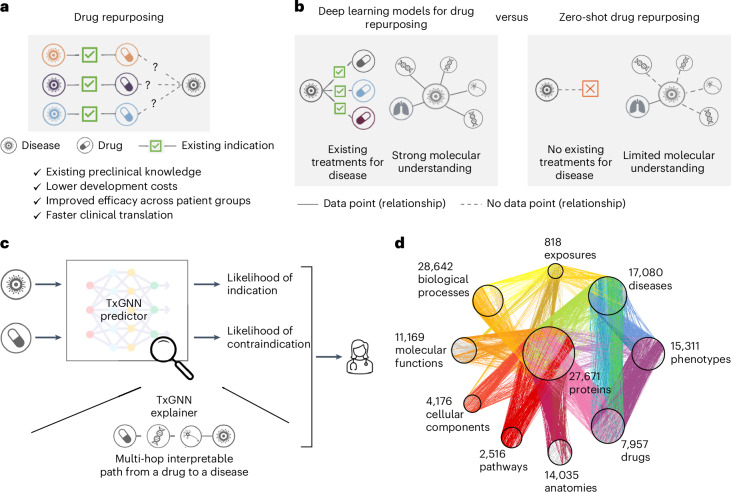
Drug repurposing – identifying new therapeutic uses for approved drugs – is often serendipitous and opportunistic, expanding the use of drugs for new diseases. The clinical utility of drug repurposing AI models remains limited because the models focus narrowly on diseases for which some drugs already exist. Here, we introduce T x GNN, a graph foundation model for zero-shot drug repurposing, identifying therapeutic candidates even for diseases with limited treatment options or no existing drugs. Trained on a medical knowledge graph, T x GNN utilizes a graph neural network and metric-learning module to rank drugs as potential indications and contraindications across 17,080 diseases. When benchmarked against eight methods, T x GNN improves prediction accuracy for indications by 49.2% and contraindications by 35.1% under stringent zero-shot evaluation. To facilitate model interpretation, T x GNN’s Explainer module offers transparent insights into multi-hop medical knowledge paths that form T x GNN’s predictive rationales. Human evaluation of T x GNN’s Explainer showed that T x GNN’s predictions and explanations perform encouragingly on multiple axes of performance beyond accuracy. Many of T x GNN’s novel predictions align with off-label prescriptions clinicians make in a large healthcare system. T x GNN’s drug repurposing predictions are accurate, consistent with off-label drug use, and can be investigated by human experts through multi-hop interpretable rationales.
Overview
AI snapshot
Written from the paper’s full text.
TL;DR
TxGNN is a graph foundation model for zero-shot drug repurposing that predicts indications and contraindications across 17,080 diseases, including diseases with no approved drugs. It combines a graph neural network with disease-similarity metric learning and a GraphMask-based explainer, and its predictions align with off-label prescribing in a large health system.
Key findings
- Under stringent zero-shot evaluation, TxGNN improved prediction accuracy for indications by 49.2% and contraindications by 35.1% versus 8 benchmarked methods.
- In a zero-shot holdout where diseases had no approved drugs during training, TxGNN surpassed the best baseline by up to 19% for indications and 23.9% for contraindications.
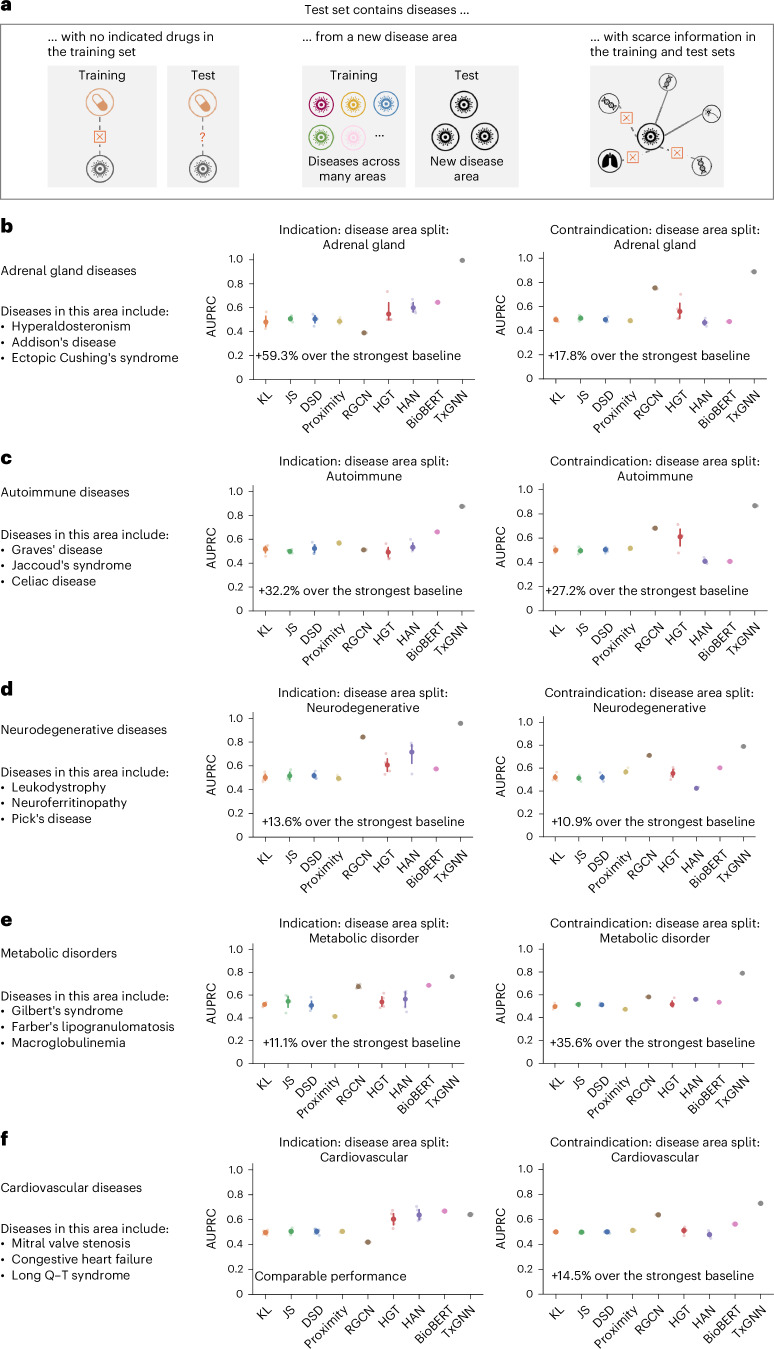
- Across 9 disease-area holdouts, TxGNN achieved relative AUPRC gains of 0.5–59.3% (average 25.72%) for indications and 11.8–35.6% (average 18.67%) for contraindications.
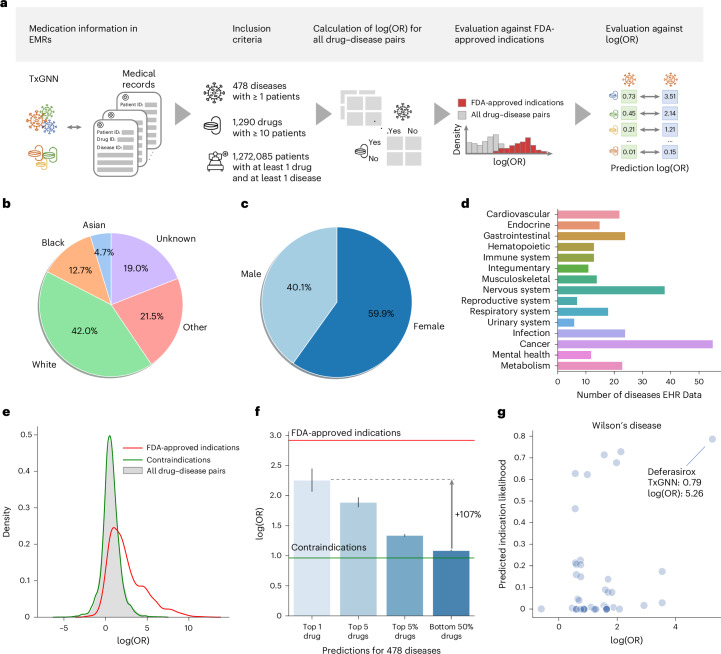
- In EMR analysis, top-ranked predicted drugs had on average 107% higher log(OR) than bottom-50% predictions; the top candidate had log(OR) 2.26 versus 2.92 for FDA-approved indications.
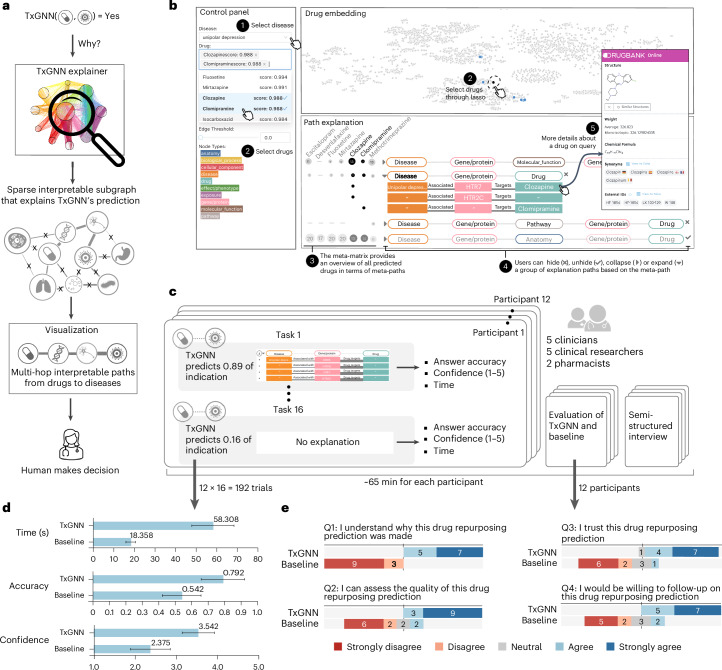
- In a human study with 12 experts and 192 trials, explanations improved accuracy (+46%, P = 0.0443) and confidence (+49%, P = 0.0041) versus predictions alone.
Methods
- TxGNN is trained on a heterogeneous medical knowledge graph with 123,527 nodes and 8,063,026 edges, covering 17,080 diseases, 7,957 drugs, 9,388 indications, and 30,675 contraindications.
- The model uses a heterogeneous GNN encoder, disease-similarity metric learning with disease pooling, pretraining across all relationships, fine-tuning on drug–disease relationships, and a GraphMask explainer for multi-hop rationales.
- Evaluation used AUPRC against 8 methods with five random data splits; additional analyses included 9 disease-area holdouts, a 12-participant human usability study, and Mount Sinai EMR data from 1,272,085 adults across 478 diseases and 1,290 drugs.
Limitations
- The paper states TxGNN depends on medical KG quality, which may lack host–pathogen interaction data and genetic-variant pathogenicity information, and may contain data biases or outdated information.
- The paper states the human evaluation was a pilot with a small number of experts (n = 12), and EMR analyses may be limited by unaccounted confounders and selection biases.
- The paper states predicted drugs would need extensive screening to establish safety, efficacy, dosage, and treatment timing; no prospective clinical validation is reported.
Model-written summary. Check it against the paper before relying on it.
Integrity signals
Registry
Cites
Statistics
Figures
Verification
Claims the paper makes
51 Own result · 33 Own interpretation · 32 Not checked yet · 14 Own method · 8 No basis given · 1 Partly supported · accuracy not yet measured
None of the sources cited for this claim have been checked yet.
In the paper
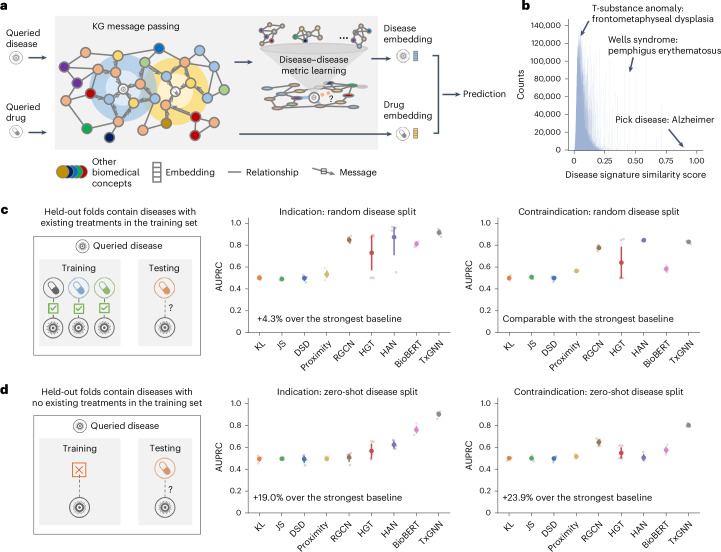
“Unfortunately, the ability of existing machine learning models to identify therapeutic candidates for diseases with incomplete, sparse data and zero-known therapies drops drastically16,22 (as we demonstrate across eight benchmarks in Fig. 2c,d).”
§ A foundation model for clinician-centered drug repurposing > Main
What the sources say
- Could not verifycites [16] Gysi, D. M. et al. Network medicine framework for identifying drug-repurposing opportunities for Covid-19. Proc. Natl Acad. Sci. USA 118, e2025581118 (2021). sourceExperimental — accuracy not yet measured
The Results sections on experimental validation and multimodal drug repurposing report that predictive performance varies across datasets and that no individual pipeline performs best for every outcome (page unavailable). Searches for sparse or incomplete data and zero known therapies found no passage showing that machine-learning performance drops drastically under those conditions. (LLM, conf=0.72)
- Not checked yetcites [22] Guney, E. Reproducible drug repurposing: when similarity does not suffice. In Pacific Symposium on Biocomputing 132–143 (World Scientific, 2017).
boosteddirect- Asserted: passes — The authors put it forward as true.
- Checkable: passes — It can be checked against evidence.
- Load-bearing: passes — The paper’s conclusions depend on it.
- Based: passes — The paper gives a reason why it holds.
- Could not verify
The paper states this without a source or data behind it here, so there is nothing to check it against. The quote shows it is in the paper.
In the paper
“Many of TxGNN’s new predictions align well with off-label prescriptions that clinicians previously made in a large healthcare system.”
- Also stated in: § Main · boosted
“Many of TxGNN’s predictions have shown alignment with off-label prescriptions made by clinicians in a large healthcare system”
§ A foundation model for clinician-centered drug repurposing > Abstract
boostedcorrelational- Asserted: passes — The authors put it forward as true.
- Checkable: passes — It can be checked against evidence.
- Load-bearing: passes — The paper’s conclusions depend on it.
- Based: passes — The paper gives a reason why it holds.
- Also stated in: § Main · boosted
The paper states this without a source or data behind it here, so there is nothing to check it against. The quote shows it is in the paper.
In the paper
“Once trained, TxGNN performs zero-shot inference on new diseases without additional parameters or fine-tuning.”
§ A foundation model for clinician-centered drug repurposing > Main
plaindirect- Asserted: passes — The authors put it forward as true.
- Checkable: passes — It can be checked against evidence.
- Load-bearing: passes — The paper’s conclusions depend on it.
- Based: passes — The paper gives a reason why it holds.
A result the paper reports from its own data — it cites no other source for it, so there is none to check. The quote shows it is in the paper.
In the paper
“92% of 17,080 diseases examined in our study have no indications.”
§ A foundation model for clinician-centered drug repurposing > Main
plain- Asserted: passes — The authors put it forward as true.
- Checkable: passes — It can be checked against evidence.
- Load-bearing: passes — The paper’s conclusions depend on it.
- Based: passes — The paper gives a reason why it holds.
None of the sources cited for this claim have been checked yet.
In the paper
“The gold standard labels for evaluating such a model come from our previously curated medical KG9 (Fig. 1d and Supplementary Tables 4 and 5), which consists of 9,388 indications and 30,675 contraindications23.”
§ A foundation model for clinician-centered drug repurposing > Results > Overview of TxGNN zero-shot drug-repurposing model
What the sources say
- Not checked yetcites [9] Chandak, P., Huang, K. & Zitnik, M. Building a knowledge graph to enable precision medicine. Sci. Data 10, 67 (2023). source
- Not checked yetcites [23] Avram, S. et al. DrugCentral 2021 supports drug discovery and repositioning. Nucleic Acids Res. 49, D1160–D1169 (2021). source
plain- Asserted: passes — The authors put it forward as true.
- Checkable: passes — It can be checked against evidence.
- Load-bearing: passes — The paper’s conclusions depend on it.
- Based: passes — The paper gives a reason why it holds.
The paper states this without a source or data behind it here, so there is nothing to check it against. The quote shows it is in the paper.
In the paper
“TxGNN’s predictive rationales are consistent with medical reasoning.”
§ A foundation model for clinician-centered drug repurposing > Main
plaincorrelational- Asserted: passes — The authors put it forward as true.
- Checkable: passes — It can be checked against evidence.
- Load-bearing: passes — The paper’s conclusions depend on it.
- Based: passes — The paper gives a reason why it holds.
- Rests on an assumption: Human experts seek to understand the reasoning behind model predictions to validate the model’s hypotheses and better understand candidate treatment mechanisms.
The paper states this without a source or data behind it here, so there is nothing to check it against. The quote shows it is in the paper.
In the paper
“To facilitate model interpretation, TxGNN’s Explainer module offers transparent insights into multi-hop medical knowledge paths that form TxGNN’s predictive rationales.”
§ A foundation model for clinician-centered drug repurposing > Abstract
plaindirect- Asserted: passes — The authors put it forward as true.
- Checkable: passes — It can be checked against evidence.
- Load-bearing: passes — The paper’s conclusions depend on it.
- Based: passes — The paper gives a reason why it holds.
- Rests on an assumption: Human experts seek to understand the reasoning behind model predictions to validate the model’s hypotheses and better understand candidate treatment mechanisms.
A result the paper reports from its own data — it cites no other source for it, so there is none to check. The quote shows it is in the paper.
In the paper
“The top-ranked (top one) predicted drugs had, on average, a 107% higher log(OR) than the mean log(OR) of the bottom 50% predictions.”
§ A foundation model for clinician-centered drug repurposing > Results > Evaluation of TxGNN using EMRs
plaincorrelational- Asserted: passes — The authors put it forward as true.
- Checkable: passes — It can be checked against evidence.
- Load-bearing: passes — The paper’s conclusions depend on it.
- Based: passes — The paper gives a reason why it holds.
A result the paper reports from its own data — it cites no other source for it, so there is none to check. The quote shows it is in the paper.
In the paper
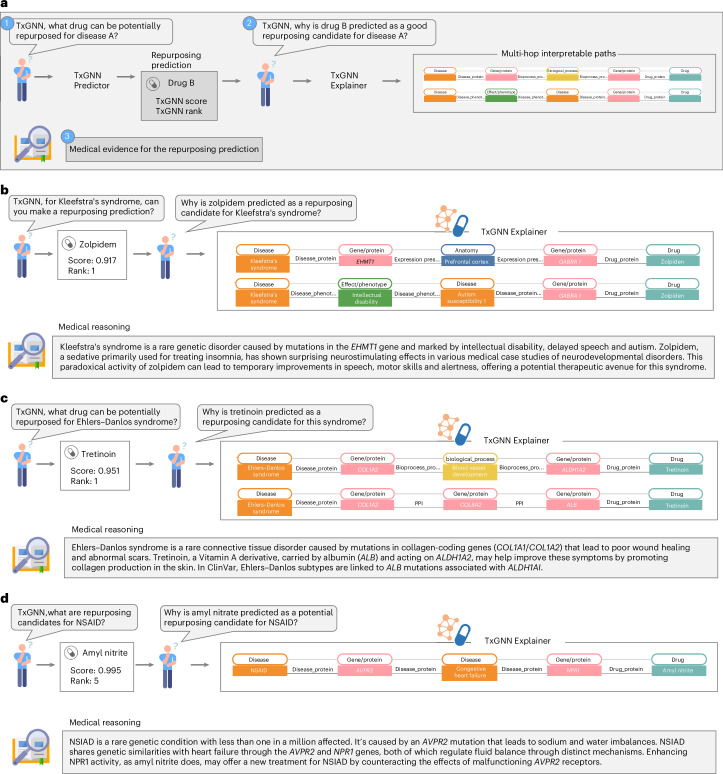
“TxGNN Explainer suggested that the relationship between NSIAD and amyl nitrite passes through AVPR2, congestive heart failure and NPR1.”
§ A foundation model for clinician-centered drug repurposing > Results > Aligning TxGNN’s predictive rationales with medical evidence
hedgeddirect- Asserted: passes — The authors put it forward as true.
- Checkable: passes — It can be checked against evidence.
- Load-bearing: passes — The paper’s conclusions depend on it.
- Based: passes — The paper gives a reason why it holds.
A result the paper reports from its own data — it cites no other source for it, so there is none to check. The quote shows it is in the paper.
In the paper
“Ablation analyses confirmed that each component of the TxGNN Predictor is essential for its performance (Supplementary Fig. 12).”
§ A foundation model for clinician-centered drug repurposing > Results > Zero-shot drug-repurposing evaluation across disease areas
boosteddirect- Asserted: passes — The authors put it forward as true.
- Checkable: passes — It can be checked against evidence.
- Load-bearing: unclear — It is unclear whether the paper’s conclusions depend on it.
- Based: passes — The paper gives a reason why it holds.
- Probably not a substantial claim. 32
- It may state two separate claims as one. 41
- The quote only partly states this claim. 1
The cited sources support only part of this claim — read each source’s verdict below.
In the paper
“This evaluation method aligns with the approach predominantly used in the literature12,14–16,18–20.”
§ A foundation model for clinician-centered drug repurposing > Results > Treatment matching and zero-shot drug repurposing
What the sources say
- Supportedcites [12] Ruiz, C., Zitnik, M. & Leskovec, J. Identification of disease treatment mechanisms through the multiscale interactome. Nat. Commun. 12, 1–15 (2021). source
The Methods section, “Evaluating predictions of what drugs will treat a disease” (page not provided), describes the paper’s drug-ranking evaluation and explicitly says its assumption about drugs not approved for a disease is consistent with prior literature. That supports the cited sentence’s claim of alignment with an established evaluation approach. (LLM, conf=0.84)
- Could not verifycites [14] Baraba´si, A.-L., Gulbahce, N. & Loscalzo, J. Network medicine: a network-based approach to human disease. Nat. Rev. Genet. 12, 56–68 (2011). sourceExperimental — accuracy not yet measured
The Network pharmacology section discusses network-based drug discovery and drug-target networks, but does not describe a standard benchmarking strategy for drug-repurposing AI models or say which evaluation approach predominates in the literature. A search for benchmarking, validation, and predictive-performance approaches found no passage addressing that claim. (LLM, conf=0.76)
- Could not verifycites [15] Li, M. M., Huang, K. & Zitnik, M. Graph representation learning in biomedicine and healthcare. Nat. Biomed. Eng. 6, 1353–1369 (2022). sourceExperimental — accuracy not yet measured
The ‘Graph representation learning for therapeutics’ section discusses methods for predicting drug–disease associations and ranking repurposing candidates, but it does not describe a standard benchmarking strategy for evaluating those models. Searches for evaluation protocols, benchmarks, and prevalent practice found no passage establishing that the citing paper’s unspecified evaluation method is predominantly used in the literature. The retrieved passages have no page numbers in our copy. (LLM, conf=0.72)
- Partly supportedcites [16] Gysi, D. M. et al. Network medicine framework for identifying drug-repurposing opportunities for Covid-19. Proc. Natl Acad. Sci. USA 118, e2025581118 (2021). sourceExperimental — accuracy not yet measured
The Abstract says that repurposing algorithms typically validate only a small subset of top-ranked candidates, supporting the claim that a common evaluation practice exists. But it argues that reliable comparison requires testing a wider, rank-independent set of drugs; it does not establish that the citing paper’s unspecified evaluation method aligns with the predominant practice. (LLM, conf=0.78)
- Partly supportedcites [18] Zitnik, M., Agrawal, M. & Leskovec, J. Modeling polypharmacy side effects with graph convolutional networks. Bioinformatics 34, i457–i466 (2018). sourceExperimental — accuracy not yet measured
The Experimental setup section (page unavailable) describes evaluating the model with training, validation, and test splits and reporting AUROC, AUPRC, and AP@50. This supports the paper as an example of an AI-model evaluation approach, but it does not establish that the citing paper’s unspecified method is the approach predominantly used in drug-repurposing literature. (LLM, conf=0.76)
- Partly supportedcites [19] Guney, E., Menche, J., Vidal, M. & Bara´basi, A.-L. Network-based in silico drug efficacy screening. Nat. Commun. 7, 1–13 (2016). sourceExperimental — accuracy not yet measured
The Methods section (‘Area under ROC curve and optimal proximity cutoff analysis’; page unavailable) describes evaluating drug–disease predictions with ROC-AUC, using known associations as positives and unknown associations as proxy negatives. This establishes that the paper uses an evaluation approach of that kind, but it does not establish that the approach is predominant in the literature. (LLM, conf=0.83)
- Not checked yetcites [20] Cheng, F., Kova´cs, I. A. & Baraba´si, A.-L. Network-based prediction of drug combinations. Nat. Commun. 10, 1–11 (2019). source
plaincorrelational- Asserted: passes — The authors put it forward as true.
- Checkable: passes — It can be checked against evidence.
- Load-bearing: fails — The paper’s conclusions may not depend on it.
- Based: passes — The paper gives a reason why it holds.
Probably not a substantial claim. The paper’s conclusions may not depend on it.
- Supported
A result the paper reports from its own data — it cites no other source for it, so there is none to check. The quote shows it is in the paper.
In the paper
“Here we introduce TxGNN, a graph foundation model for zero-shot drug repurposing, identifying therapeutic candidates even for diseases with limited treatment options or no existing drugs.”
- Also stated in: § Main · plain
“In the present study, we introduced TxGNN, a graph foundation model for multi-disease, zero-shot drug repurposing that predicts drug-repurposing candidates across 17,080 diseases, including diseases without treatments (Fig. 1c).”
§ A foundation model for clinician-centered drug repurposing > Abstract
plain- Asserted: passes — The authors put it forward as true.
- Checkable: passes — It can be checked against evidence.
- Load-bearing: passes — The paper’s conclusions depend on it.
- Based: passes — The paper gives a reason why it holds.
It may state two separate claims as one.
- The authors state this as an assumption: Effective drugs directly target disease-perturbed networks or indirectly propagate therapeutic effects through disease-associated networks.
- Also stated in: § Main · plain
The paper states this without a source or data behind it here, so there is nothing to check it against. The quote shows it is in the paper.
In the paper
“Foundation models like TxGNN are transforming deep learning: instead of training disease-specific models for every disease, TxGNN is a single pretrained model that adapts across many diseases.”
§ A foundation model for clinician-centered drug repurposing > Main
plaindirect- Asserted: passes — The authors put it forward as true.
- Checkable: passes — It can be checked against evidence.
- Load-bearing: passes — The paper’s conclusions depend on it.
- Based: passes — The paper gives a reason why it holds.
It may state two separate claims as one.
A result the paper reports from its own data — it cites no other source for it, so there is none to check. The quote shows it is in the paper.
In the paper
“When benchmarked against 8 methods, TxGNN improves prediction accuracy for indications by 49.2% and contraindications by 35.1% under stringent zero-shot evaluation.”
§ A foundation model for clinician-centered drug repurposing > Abstract
plaindirect- Asserted: passes — The authors put it forward as true.
- Checkable: passes — It can be checked against evidence.
- Load-bearing: passes — The paper’s conclusions depend on it.
- Based: passes — The paper gives a reason why it holds.
It may state two separate claims as one.
A result the paper reports from its own data — it cites no other source for it, so there is none to check. The quote shows it is in the paper.
In the paper
“Human evaluation of TxGNN’s Explainer showed that TxGNN’s predictions and explanations perform encouragingly on multiple axes of performance beyond accuracy.”
- Also stated in: § Main · plain
“Our human evaluation of TxGNN’s Explainer showed that TxGNN’s explanations perform encouragingly on multiple axes of performance, including accuracy, trust, usefulness and time efficiency.”
§ A foundation model for clinician-centered drug repurposing > Abstract
plain- Asserted: passes — The authors put it forward as true.
- Checkable: passes — It can be checked against evidence.
- Load-bearing: passes — The paper’s conclusions depend on it.
- Based: passes — The paper gives a reason why it holds.
The quote only partly states this claim.
- Rests on an assumption: Human experts seek to understand the reasoning behind model predictions to validate the model’s hypotheses and better understand candidate treatment mechanisms.
- Also stated in: § Main · plain
A result the paper reports from its own data — it cites no other source for it, so there is none to check. The quote shows it is in the paper.
In the paper
“BioBERT performed best for indication prediction in seven of nine disease areas, whereas RGCN was the best baseline for contraindications in eight of nine.”
§ A foundation model for clinician-centered drug repurposing > Results > Zero-shot drug-repurposing evaluation across disease areas
plaincorrelational- Asserted: passes — The authors put it forward as true.
- Checkable: passes — It can be checked against evidence.
- Load-bearing: unclear — It is unclear whether the paper’s conclusions depend on it.
- Based: passes — The paper gives a reason why it holds.
It may state two separate claims as one.
The paper states this without a source or data behind it here, so there is nothing to check it against. The quote shows it is in the paper.
In the paper
“Although established methods achieved satisfactory results in conventional drug-repurposing evaluations, they often fell short in challenging settings.”
§ A foundation model for clinician-centered drug repurposing > Results > Treatment matching and zero-shot drug repurposing
plain- Asserted: passes — The authors put it forward as true.
- Checkable: passes — It can be checked against evidence.
- Load-bearing: passes — The paper’s conclusions depend on it.
- Based: passes — The paper gives a reason why it holds.
It may state two separate claims as one.
A result the paper reports from its own data — it cites no other source for it, so there is none to check. The quote shows it is in the paper.
In the paper
“TxGNN achieved relative AUPRC gains of 0.5–59.3% (average 25.72%) across 9 disease areas for indications and 11.8–35.6% (average 18.67%) for contraindications.”
§ A foundation model for clinician-centered drug repurposing > Results > Zero-shot drug-repurposing evaluation across disease areas
plaindirect- Asserted: passes — The authors put it forward as true.
- Checkable: passes — It can be checked against evidence.
- Load-bearing: passes — The paper’s conclusions depend on it.
- Based: passes — The paper gives a reason why it holds.
It may state two separate claims as one.
A result the paper reports from its own data — it cites no other source for it, so there is none to check. The quote shows it is in the paper.
In the paper
“However, TxGNN Explainer indicated that zolpidem’s action on GABRG2 might reduce autism susceptibility and improve prefrontal cortex function.”
§ A foundation model for clinician-centered drug repurposing > Results > Aligning TxGNN’s predictive rationales with medical evidence
hedgedconditional- Asserted: passes — The authors put it forward as true.
- Checkable: passes — It can be checked against evidence.
- Load-bearing: passes — The paper’s conclusions depend on it.
- Based: passes — The paper gives a reason why it holds.
It may state two separate claims as one.
A result the paper reports from its own data — it cites no other source for it, so there is none to check. The quote shows it is in the paper.
In the paper
“Tretinoin, transported by albumin (ALB) and targeting ALDH1A2, helps mitigate collagen loss and inflammation, as highlighted in TxGNN’s predictive rationale (Fig. 5c), indicating that TxGNN’s predictive rationale is aligned with medical reasoning.”
§ A foundation model for clinician-centered drug repurposing > Results > Aligning TxGNN’s predictive rationales with medical evidence
plaindirect- Asserted: passes — The authors put it forward as true.
- Checkable: passes — It can be checked against evidence.
- Load-bearing: passes — The paper’s conclusions depend on it.
- Based: passes — The paper gives a reason why it holds.
It may state two separate claims as one.
In the paper
“Focusing on the most predictive relationships (that is, edges with importance scores >0.5, representing an average of 14.9% of edges from the KG), the model’s performance showed a slight reduction from AUPRC = 0.890 (s.d. 0.006) to AUPRC = 0.886 (s.d. 0.005), indicating that TxGNN’s Explainer effectively identifies key associations34 and explanations accurately reflect TxGNN’s internal reasoning.”
§ A foundation model for clinician-centered drug repurposing > Results > TxGNN’s explanations reflect model’s predictive rationales
What the sources say
- Not checked yetcites [34] Agarwal, C., Queen, O., Lakkaraju, H. & Zitnik, M. Evaluating explainability for graph neural networks. Sci. Data 10, 144 (2023). source
hedgeddirect- Asserted: passes — The authors put it forward as true.
- Checkable: passes — It can be checked against evidence.
- Load-bearing: passes — The paper’s conclusions depend on it.
- Based: passes — The paper gives a reason why it holds.
It may state two separate claims as one.
A result the paper reports from its own data — it cites no other source for it, so there is none to check. The quote shows it is in the paper.
In the paper
“Our experimental results in this setting concur, with three of eight existing methods achieving AUPRC > 0.80 and HAN as the best at 0.873 AUPRC.”
§ A foundation model for clinician-centered drug repurposing > Results > Treatment matching and zero-shot drug repurposing
plain- Asserted: passes — The authors put it forward as true.
- Checkable: passes — It can be checked against evidence.
- Load-bearing: unclear — It is unclear whether the paper’s conclusions depend on it.
- Based: passes — The paper gives a reason why it holds.
It may state two separate claims as one.
A result the paper reports from its own data — it cites no other source for it, so there is none to check. The quote shows it is in the paper.
In the paper
“Although the average log(OR) stands at 1.09, the top therapeutic candidate predicted by TxGNN had a log(OR) of 2.26, approaching the average log(OR) of 2.92 for FDA-approved indications, indicating the enrichment of off-label drug prescriptions among TxGNN’s top-ranked predictions.”
§ A foundation model for clinician-centered drug repurposing > Results > Evaluation of TxGNN using EMRs
plain- Asserted: passes — The authors put it forward as true.
- Checkable: passes — It can be checked against evidence.
- Load-bearing: passes — The paper’s conclusions depend on it.
- Based: passes — The paper gives a reason why it holds.
It may state two separate claims as one.
A result the paper reports from its own data — it cites no other source for it, so there is none to check. The quote shows it is in the paper.
In the paper
“The medical KG covers 17,080 diseases, 92% lacking FDA-approved drugs, covering rare and less-understood complex diseases.”
§ A foundation model for clinician-centered drug repurposing > Results > Overview of TxGNN zero-shot drug-repurposing model
plain- Asserted: passes — The authors put it forward as true.
- Checkable: passes — It can be checked against evidence.
- Load-bearing: unclear — It is unclear whether the paper’s conclusions depend on it.
- Based: passes — The paper gives a reason why it holds.
It may state two separate claims as one.
A result the paper reports from its own data — it cites no other source for it, so there is none to check. The quote shows it is in the paper.
In the paper
“TxGNN substantially improves over the next best method in predicting indications (19.0% AUPRC gain) and contraindications (23.9% AUPRC gain).”
§ A foundation model for clinician-centered drug repurposing > Results > Treatment matching and zero-shot drug repurposing
plaindirect- Asserted: passes — The authors put it forward as true.
- Checkable: passes — It can be checked against evidence.
- Load-bearing: passes — The paper’s conclusions depend on it.
- Based: passes — The paper gives a reason why it holds.
It may state two separate claims as one.
A result the paper reports from its own data — it cites no other source for it, so there is none to check. The quote shows it is in the paper.
In the paper
“TxGNN consistently ranked newly introduced drugs favorably and, in two instances, placed the newly approved medications within the top 5% of predicted drugs.”
§ A foundation model for clinician-centered drug repurposing > Results > Evaluation of TxGNN using EMRs
plaincorrelational- Asserted: passes — The authors put it forward as true.
- Checkable: passes — It can be checked against evidence.
- Load-bearing: passes — The paper’s conclusions depend on it.
- Based: passes — The paper gives a reason why it holds.
It may state two separate claims as one.
A result the paper reports from its own data — it cites no other source for it, so there is none to check. The quote shows it is in the paper.
In the paper
“However, TxGNN outperformed all methods across all nine disease areas for both tasks, demonstrating its broad generalizability and accuracy in zero-shot drug repurposing.”
§ A foundation model for clinician-centered drug repurposing > Results > Zero-shot drug-repurposing evaluation across disease areas
boosteddirect- Asserted: passes — The authors put it forward as true.
- Checkable: passes — It can be checked against evidence.
- Load-bearing: passes — The paper’s conclusions depend on it.
- Based: passes — The paper gives a reason why it holds.
It may state two separate claims as one.
The paper states this without a source or data behind it here, so there is nothing to check it against. The quote shows it is in the paper.
In the paper
“As most diseases do not share underlying pathology, they have low similarity scores.”
§ A foundation model for clinician-centered drug repurposing > Results > Overview of TxGNN zero-shot drug-repurposing model
plaindirect- Asserted: passes — The authors put it forward as true.
- Checkable: passes — It can be checked against evidence.
- Load-bearing: fails — The paper’s conclusions may not depend on it.
- Based: fails — The paper may give no reason why it holds.
Probably not a substantial claim. The paper’s conclusions may not depend on it. The paper may give no reason why it holds.
A result the paper reports from its own data — it cites no other source for it, so there is none to check. The quote shows it is in the paper.
In the paper
“Finally, we used parameter search and found optimal λ = 0.7.”
§ A foundation model for clinician-centered drug repurposing > Methods > Embedding-based disease similarity search
plain- Asserted: passes — The authors put it forward as true.
- Checkable: passes — It can be checked against evidence.
- Load-bearing: fails — The paper’s conclusions may not depend on it.
- Based: passes — The paper gives a reason why it holds.
Probably not a substantial claim. The paper’s conclusions may not depend on it.
In the paper
“Drug repurposing leverages existing safety and efficacy data of approved drugs, allowing for faster translation to the clinic and reduced development costs compared to developing new drugs from scratch4 (Fig. 1a).”
§ A foundation model for clinician-centered drug repurposing > Main
What the sources say
- Not checked yetcites [4] Pushpakom, S. et al. Drug repurposing: progress, challenges and recommendations. Nat. Rev. Drug Discov. 18, 41–58 (2019). source
plaindirect- Asserted: passes — The authors put it forward as true.
- Checkable: passes — It can be checked against evidence.
- Load-bearing: passes — The paper’s conclusions depend on it.
- Based: passes — The paper gives a reason why it holds.
It may state two separate claims as one.
None of the sources cited for this claim have been checked yet.
In the paper
“There is a pressing need to develop therapies for many diseases that currently lack treatments1,2.”
§ A foundation model for clinician-centered drug repurposing > Main
What the sources say
plain- Asserted: passes — The authors put it forward as true.
- Checkable: fails — It may be too vague to check against evidence.
- Load-bearing: passes — The paper’s conclusions depend on it.
- Based: passes — The paper gives a reason why it holds.
Probably not a substantial claim. It may be too vague to check against evidence.
In the paper
“Of over 7,000 rare diseases worldwide, only 5–7% have Food and Drug Administration (FDA)-approved drugs3.”
§ A foundation model for clinician-centered drug repurposing > Main
What the sources say
- Not checked yetcites [3] Rare Disease Day 2021. US Food and Drug Administration fda.gov/news-events/fda-voices/rare-disease-day-2021-fda-shows-sustained-support-rare-disease-product-development-during-public (2023).
plain- Asserted: passes — The authors put it forward as true.
- Checkable: passes — It can be checked against evidence.
- Load-bearing: fails — The paper’s conclusions may not depend on it.
- Based: passes — The paper gives a reason why it holds.
Probably not a substantial claim. The paper’s conclusions may not depend on it.
In the paper
“Approximately 30% of FDA-approved drugs are issued at least one new post-approval indication and many drugs have accrued over ten indications over the years6.”
§ A foundation model for clinician-centered drug repurposing > Main
What the sources say
- Not checked yetcites [6] Sahragardjoonegani, B., Beall, R. F., Kesselheim, A. S. & Hollis, A. Repurposing existing drugs for new uses: a cohort study of the frequency of FDA-granted new indication exclusivities since 1997. J. Pharm. Policy Pract. 14, 3 (2021). source
plain- Asserted: passes — The authors put it forward as true.
- Checkable: passes — It can be checked against evidence.
- Load-bearing: fails — The paper’s conclusions may not depend on it.
- Based: passes — The paper gives a reason why it holds.
Probably not a substantial claim. The paper’s conclusions may not depend on it. It may state two separate claims as one.
In the paper
“Moreover, around 95% of rare diseases have no FDA-approved drugs and up to 85% of rare diseases do not have even one drug developed that would show promise in rare disease treatment, diagnosis or prevention21.”
§ A foundation model for clinician-centered drug repurposing > Main
What the sources say
- Not checked yetcites [21] Fermaglich, L. J. & Miller, K. L. A comprehensive study of the rare diseases and conditions targeted by orphan drug designations and approvals over the forty years of the orphan drug act. Orphanet J. Rare Dis. 18, 1–8 (2023). source
plain- Asserted: passes — The authors put it forward as true.
- Checkable: passes — It can be checked against evidence.
- Load-bearing: passes — The paper’s conclusions depend on it.
- Based: passes — The paper gives a reason why it holds.
It may state two separate claims as one.
In the paper
“Originally developed to help with morning sickness during pregnancy, thalidomide was repurposed in 1964 for an autoimmune complication of leprosy and again in 2006 for multiple myeloma8.”
§ A foundation model for clinician-centered drug repurposing > Main
What the sources say
- Not checked yetcites [8] Jourdan, J.-P., Bureau, R., Rochais, C. & Dallemagne, P. Drug repositioning: a brief overview. J. Pharm. Pharmacol. 72, 1145–1151 (2020). source
plain- Asserted: passes — The authors put it forward as true.
- Checkable: passes — It can be checked against evidence.
- Load-bearing: unclear — It is unclear whether the paper’s conclusions depend on it.
- Based: passes — The paper gives a reason why it holds.
It may state two separate claims as one.
None of the sources cited for this claim have been checked yet.
In the paper
“Machine learning has been used to analyze high-throughput molecular interactomes to unravel genetic architecture perturbed in disease12,13 and help design therapies to target them14.”
§ A foundation model for clinician-centered drug repurposing > Main
What the sources say
- Not checked yetcites [12] Ruiz, C., Zitnik, M. & Leskovec, J. Identification of disease treatment mechanisms through the multiscale interactome. Nat. Commun. 12, 1–15 (2021). source
- Not checked yetcites [13] Goh, K.-I. et al. The human disease network. Proc. Natl Acad. Sci. USA 104, 8685–8690 (2007). source
- Not checked yetcites [14] Baraba´si, A.-L., Gulbahce, N. & Loscalzo, J. Network medicine: a network-based approach to human disease. Nat. Rev. Genet. 12, 56–68 (2011). source
plaindirect- Asserted: passes — The authors put it forward as true.
- Checkable: passes — It can be checked against evidence.
- Load-bearing: fails — The paper’s conclusions may not depend on it.
- Based: passes — The paper gives a reason why it holds.
Probably not a substantial claim. The paper’s conclusions may not depend on it. It may state two separate claims as one.
None of the sources cited for this claim have been checked yet.
In the paper
“These strategies identify therapeutic candidates based on their impact on cell signaling, gene expression and disease phenotypes5,10–12.”
§ A foundation model for clinician-centered drug repurposing > Main
What the sources say
- Not checked yetcites [5] Abdelsayed, M., Kort, E. J., Jovinge, S. & Mercola, M. Repurposing drugs to treat cardiovascular disease in the era of precision medicine. Nat. Rev. Cardiol. 19, 751–764 (2022). source
- Not checked yetcites [10] Menche, J. et al. Uncovering disease-disease relationships through the incomplete interactome. Science 347, 1257601 (2015). source
- Not checked yetcites [11] Zitnik, M. et al. Evolution of resilience in protein interactomes across the tree of life. Proc. Natl Acad. Sci. USA 116, 4426–4433 (2019). source
- Not checked yetcites [12] Ruiz, C., Zitnik, M. & Leskovec, J. Identification of disease treatment mechanisms through the multiscale interactome. Nat. Commun. 12, 1–15 (2021). source
plaindirect- Asserted: passes — The authors put it forward as true.
- Checkable: passes — It can be checked against evidence.
- Load-bearing: fails — The paper’s conclusions may not depend on it.
- Based: passes — The paper gives a reason why it holds.
Probably not a substantial claim. The paper’s conclusions may not depend on it.
In the paper
“However, Duran et al.30 reasoned that these models make predictions for a disease by retrieving drugs from the dataset that appear similar to existing treatments.”
§ A foundation model for clinician-centered drug repurposing > Results > Treatment matching and zero-shot drug repurposing
What the sources say
- Not checked yetcites Duran et al.30 Duran-Frigola, M. et al. Extending the small-molecule similarity principle to all levels of biology with the chemical checker. Nat. Biotechnol. 38, 1087–1096 (2020). source
plaindirect- Asserted: fails — The authors may not put it forward as true.
- Checkable: passes — It can be checked against evidence.
- Load-bearing: passes — The paper’s conclusions depend on it.
- Based: passes — The paper gives a reason why it holds.
Probably not a substantial claim. The authors may not put it forward as true.
In the paper
“AVPR2 and NPR1 genes play pivotal roles in regulating fluid and electrolyte balance via complementary but distinct pathways. AVPR2 contributes to water retention and urine concentration, whereas NPR1 facilitates vasodilatation, lowers blood pressure and enhances water excretion47.”
§ A foundation model for clinician-centered drug repurposing > Results > Aligning TxGNN’s predictive rationales with medical evidence
What the sources say
- Not checked yetcites [47] Wishart, D. S. et al. DrugBank 5.0: a major update to the DrugBank database for 2018. Nucleic Acids Res. 46, D1074–D1082 (2018). source
plaindirect- Asserted: passes — The authors put it forward as true.
- Checkable: passes — It can be checked against evidence.
- Load-bearing: passes — The paper’s conclusions depend on it.
- Based: passes — The paper gives a reason why it holds.
It may state two separate claims as one.
None of the sources cited for this claim have been checked yet.
In the paper
“Furthermore, some subtypes of Ehlers–Danlos syndrome have been associated with a pathogenic mutation in the ALB gene in ref. 42 and weakly linked to ALDH1AI in ref. 43.”
§ A foundation model for clinician-centered drug repurposing > Results > Aligning TxGNN’s predictive rationales with medical evidence
What the sources say
- Not checked yetcites [42] Landrum, M. J. et al. Clinvar: improvements to accessing data. Nucleic Acids Res. 48, D835–D844 (2020). source
- Not checked yetcites [43] Javed, S. et al. ALDH1 & CD133 in invasive cervical carcinoma & their association with the outcome of chemoradiation therapy. Indian J. Med. Res. 154, 367 (2021). source
plaincorrelational- Asserted: passes — The authors put it forward as true.
- Checkable: passes — It can be checked against evidence.
- Load-bearing: passes — The paper’s conclusions depend on it.
- Based: passes — The paper gives a reason why it holds.
It may state two separate claims as one.
None of the sources cited for this claim have been checked yet.
In the paper
“This phenomenon is known as shortcut learning31 and underlies many deep-learning failures32.”
§ A foundation model for clinician-centered drug repurposing > Results > Zero-shot drug-repurposing evaluation across disease areas
What the sources say
- Not checked yetcites [31] Bickel, S., Brückner, M. & Scheffer, T. Discriminative learning under covariate shift. J. Mach. Learn. Res. 10, 2137–2155 (2009).
- Not checked yetcites [32] Niven, T. & Kao, H.-Y. Probing neural network comprehension of natural language arguments. In Proc. of the 57th Annual Meeting of the Association for Computational Linguistics 4658–4664 (ACL, 2019). source
plaindirect- Asserted: passes — The authors put it forward as true.
- Checkable: passes — It can be checked against evidence.
- Load-bearing: fails — The paper’s conclusions may not depend on it.
- Based: passes — The paper gives a reason why it holds.
Probably not a substantial claim. The paper’s conclusions may not depend on it.
In the paper
“the literature indicates that it may effectively eliminate hepatic iron48.”
§ A foundation model for clinician-centered drug repurposing > Results > Evaluation of TxGNN using EMRs
What the sources say
- Not checked yetcites [48] Seetharaman, J. & Sarma, M. S. Chelation therapy in liver diseases of childhood: current status and response. World J. Hepatol. 13, 1552 (2021). source
hedgedconditional- Asserted: passes — The authors put it forward as true.
- Checkable: passes — It can be checked against evidence.
- Load-bearing: fails — The paper’s conclusions may not depend on it.
- Based: passes — The paper gives a reason why it holds.
Probably not a substantial claim. The paper’s conclusions may not depend on it.
In the paper
“Surprisingly, zolpidem has shown stimulative effects in neurological conditions, temporarily awakening underactive neurons, suggesting a potential therapeutic use for neurodevelopmental disorders39.”
§ A foundation model for clinician-centered drug repurposing > Results > Aligning TxGNN’s predictive rationales with medical evidence
What the sources say
- Not checked yetcites [39] Bomalaski, M. N., Claflin, E. S., Townsend, W. & Peterson, M. D. Zolpidem for the treatment of neurologic disorders: a systematic review. JAMA Neurol. 74, 1130–1139 (2017). source
hedgeddirect- Asserted: passes — The authors put it forward as true.
- Checkable: passes — It can be checked against evidence.
- Load-bearing: passes — The paper’s conclusions depend on it.
- Based: passes — The paper gives a reason why it holds.
It may state two separate claims as one.
In the paper
“Shortcut decision rules tend to perform well on standard benchmarks but fail on challenging conditions33, such as predicting drugs for rare diseases with no treatment options or subtypes of complex diseases with distinct disease mechanisms.”
§ A foundation model for clinician-centered drug repurposing > Results > Zero-shot drug-repurposing evaluation across disease areas
What the sources say
- Not checked yetcites [33] Geirhos, R. et al. Shortcut learning in deep neural networks. Nat. Mach. Intell. 2, 665–673 (2020). source
plaindirect- Asserted: passes — The authors put it forward as true.
- Checkable: passes — It can be checked against evidence.
- Load-bearing: passes — The paper’s conclusions depend on it.
- Based: passes — The paper gives a reason why it holds.
It may state two separate claims as one.
A conclusion the paper draws from its own results — it cites no other source for it, so there is none to check. The quote shows it is in the paper.
In the paper
“Amyl nitrite, which targets the NPR1 gene, emerges as a potential therapeutic option for NSIAD, confirming the consistency of TxGNN’s explanations with medical evidence.”
§ A foundation model for clinician-centered drug repurposing > Results > Aligning TxGNN’s predictive rationales with medical evidence
hedgedconditional- Asserted: passes — The authors put it forward as true.
- Checkable: passes — It can be checked against evidence.
- Load-bearing: passes — The paper’s conclusions depend on it.
- Based: passes — The paper gives a reason why it holds.
It may state two separate claims as one.
What the paper did — it cites no source for this, so there is none to check. The quote shows it is in the paper.
In the paper
“It is important to note that the weights in the decoder, specifically for DistMult, wr, are reinitialized before fine-tuning to mitigate the risk of negative knowledge transfer.”
§ A foundation model for clinician-centered drug repurposing > Methods > Pretraining TxGNN model
plaindirect- Asserted: passes — The authors put it forward as true.
- Checkable: passes — It can be checked against evidence.
- Load-bearing: fails — The paper’s conclusions may not depend on it.
- Based: fails — The paper may give no reason why it holds.
Probably not a substantial claim. The paper’s conclusions may not depend on it. The paper may give no reason why it holds.
What the paper did — it cites no source for this, so there is none to check. The quote shows it is in the paper.
In the paper
“We have complied with all relevant ethical regulations.”
§ A foundation model for clinician-centered drug repurposing > Methods > Inclusion and ethics statement
plain- Asserted: passes — The authors put it forward as true.
- Checkable: passes — It can be checked against evidence.
- Load-bearing: fails — The paper’s conclusions may not depend on it.
- Based: fails — The paper may give no reason why it holds.
Probably not a substantial claim. The paper’s conclusions may not depend on it. The paper may give no reason why it holds.
What the paper did — it cites no source for this, so there is none to check. The quote shows it is in the paper.
In the paper
“The variant with the highest validation performance was selected for test set evaluation and downstream analyses.”
§ A foundation model for clinician-centered drug repurposing > Methods > Fine-tuning TxGNN model
plain- Asserted: passes — The authors put it forward as true.
- Checkable: passes — It can be checked against evidence.
- Load-bearing: passes — The paper’s conclusions depend on it.
- Based: passes — The paper gives a reason why it holds.
Probably not a substantial claim.
A conclusion the paper draws from its own results — it cites no other source for it, so there is none to check. The quote shows it is in the paper.
In the paper
“TxGNN streamlines drug-repurposing prediction, especially when the limited availability of disease-specific datasets hinders drug development.”
§ A foundation model for clinician-centered drug repurposing > Discussion
plaindirect- Asserted: passes — The authors put it forward as true.
- Checkable: passes — It can be checked against evidence.
- Load-bearing: passes — The paper’s conclusions depend on it.
- Based: passes — The paper gives a reason why it holds.
Probably not a substantial claim.
In the paper
“Despite this, rare diseases often offer extensive opportunities for therapeutic advancements3.”
§ A foundation model for clinician-centered drug repurposing > Methods > Embedding-based disease similarity search
What the sources say
- Not checked yetcites [3] Rare Disease Day 2021. US Food and Drug Administration fda.gov/news-events/fda-voices/rare-disease-day-2021-fda-shows-sustained-support-rare-disease-product-development-during-public (2023).
plain- Asserted: passes — The authors put it forward as true.
- Checkable: fails — It may be too vague to check against evidence.
- Load-bearing: fails — The paper’s conclusions may not depend on it.
- Based: passes — The paper gives a reason why it holds.
Probably not a substantial claim. It may be too vague to check against evidence. The paper’s conclusions may not depend on it.
What the paper did — it cites no source for this, so there is none to check. The quote shows it is in the paper.
In the paper
“Our pilot human evaluation engaged a small number (n = 12) of clinicians and scientists and prioritized an in-depth analysis with a small but qualified group of human experts over a broader study with a larger, potentially less specialized, participant pool.”
§ A foundation model for clinician-centered drug repurposing > Discussion
plainn = 12- Asserted: passes — The authors put it forward as true.
- Checkable: passes — It can be checked against evidence.
- Load-bearing: fails — The paper’s conclusions may not depend on it.
- Based: passes — The paper gives a reason why it holds.
Probably not a substantial claim. The paper’s conclusions may not depend on it. It may state two separate claims as one.
A conclusion the paper draws from its own results — it cites no other source for it, so there is none to check. The quote shows it is in the paper.
In the paper
“TxGNN is a unified model for predicting indications and contraindications across 17,080 diseases, suitable for early drug repurposing beyond single therapeutic areas.”
§ A foundation model for clinician-centered drug repurposing > Discussion
plain- Asserted: passes — The authors put it forward as true.
- Checkable: passes — It can be checked against evidence.
- Load-bearing: passes — The paper’s conclusions depend on it.
- Based: passes — The paper gives a reason why it holds.
It may state two separate claims as one.
What the paper did — it cites no source for this, so there is none to check. The quote shows it is in the paper.
In the paper
“Informed consent was waived for analyzing EMRs retrospectively.”
§ A foundation model for clinician-centered drug repurposing > Methods
plain- Asserted: passes — The authors put it forward as true.
- Checkable: passes — It can be checked against evidence.
- Load-bearing: passes — The paper’s conclusions depend on it.
- Based: passes — The paper gives a reason why it holds.
Probably not a substantial claim.
What the paper did — it cites no source for this, so there is none to check. The quote shows it is in the paper.
In the paper
“Appropriate provisions were taken to ensure the safety and well-being of all participants involved.”
§ A foundation model for clinician-centered drug repurposing > Methods > Inclusion and ethics statement
plain- Asserted: passes — The authors put it forward as true.
- Checkable: fails — It may be too vague to check against evidence.
- Load-bearing: fails — The paper’s conclusions may not depend on it.
- Based: fails — The paper may give no reason why it holds.
Probably not a substantial claim. It may be too vague to check against evidence. The paper’s conclusions may not depend on it. The paper may give no reason why it holds.
What the paper did — it cites no source for this, so there is none to check. The quote shows it is in the paper.
In the paper
“Despite the promising performance of TxGNN’s predictions on medical records, unaccounted confounders and selection biases might have limited the ability to draw conclusions from the calculated drug enrichment scores.”
§ A foundation model for clinician-centered drug repurposing > Discussion
hedgedconditional- Asserted: passes — The authors put it forward as true.
- Checkable: passes — It can be checked against evidence.
- Load-bearing: fails — The paper’s conclusions may not depend on it.
- Based: fails — The paper may give no reason why it holds.
Probably not a substantial claim. The paper’s conclusions may not depend on it. The paper may give no reason why it holds.
A conclusion the paper draws from its own results — it cites no other source for it, so there is none to check. The quote shows it is in the paper.
In the paper
“Multi-hop interpretable predictive rationales can enhance transparent use of TxGNN, fostering trust and aiding human experts.”
§ A foundation model for clinician-centered drug repurposing > Discussion
plaindirect- Asserted: passes — The authors put it forward as true.
- Checkable: fails — It may be too vague to check against evidence.
- Load-bearing: fails — The paper’s conclusions may not depend on it.
- Based: fails — The paper may give no reason why it holds.
Probably not a substantial claim. It may be too vague to check against evidence. The paper’s conclusions may not depend on it. The paper may give no reason why it holds. It may state two separate claims as one.
A conclusion the paper draws from its own results — it cites no other source for it, so there is none to check. The quote shows it is in the paper.
In the paper
“TxGNN generalizes to diseases with few treatment options by modeling latent relationships between diseases and performing zero-shot inference for diseases that the model never encountered during training.”
§ A foundation model for clinician-centered drug repurposing > Discussion
plaindirect- Asserted: passes — The authors put it forward as true.
- Checkable: passes — It can be checked against evidence.
- Load-bearing: passes — The paper’s conclusions depend on it.
- Based: unclear — It is unclear why the paper says it holds.
It may state two separate claims as one.
A conclusion the paper draws from its own results — it cites no other source for it, so there is none to check. The quote shows it is in the paper.
In the paper
“Use of a learnable attention mechanism is ineffective, because it overvalues the original embeddings for well-represented diseases, neglecting the auxiliary embedding.”
§ A foundation model for clinician-centered drug repurposing > Methods > Embedding-based disease similarity search
plaindirect- Asserted: passes — The authors put it forward as true.
- Checkable: passes — It can be checked against evidence.
- Load-bearing: passes — The paper’s conclusions depend on it.
- Based: unclear — It is unclear why the paper says it holds.
It may state two separate claims as one.
A conclusion the paper draws from its own results — it cites no other source for it, so there is none to check. The quote shows it is in the paper.
In the paper
“Special consideration is needed because, for well-represented diseases in the KG, the disease–disease metric learning embedding might be unnecessary and could bias the disease embedding.”
§ A foundation model for clinician-centered drug repurposing > Methods > Embedding-based disease similarity search
hedgedconditional- Asserted: passes — The authors put it forward as true.
- Checkable: passes — It can be checked against evidence.
- Load-bearing: passes — The paper’s conclusions depend on it.
- Based: passes — The paper gives a reason why it holds.
It may state two separate claims as one.
What the paper did — it cites no source for this, so there is none to check. The quote shows it is in the paper.
In the paper
“The sequence in which predictions were presented, along with the conditions (TxGNN Explorer or the baseline approach), were randomized and counterbalanced across participants and tasks.”
§ A foundation model for clinician-centered drug repurposing > Methods > Pilot usability evaluation of TxGNN with medical experts
plain- Asserted: passes — The authors put it forward as true.
- Checkable: passes — It can be checked against evidence.
- Load-bearing: fails — The paper’s conclusions may not depend on it.
- Based: passes — The paper gives a reason why it holds.
Probably not a substantial claim. The paper’s conclusions may not depend on it.
A conclusion the paper draws from its own results — it cites no other source for it, so there is none to check. The quote shows it is in the paper.
In the paper
“These objectives inherently entail a tradeoff: increasing the extent of masking tends to enlarge the discrepancy between the updated and original predictions.”
§ A foundation model for clinician-centered drug repurposing > Methods > Generating multi-hop interpretable explanations
plaindirect- Asserted: passes — The authors put it forward as true.
- Checkable: passes — It can be checked against evidence.
- Load-bearing: passes — The paper’s conclusions depend on it.
- Based: passes — The paper gives a reason why it holds.
Probably not a substantial claim.
In the paper
“The findings from this comparison motivated the adoption of path-based explanations, which were preferred based on user feedback.”
§ A foundation model for clinician-centered drug repurposing > Methods > Pilot usability evaluation of TxGNN with medical experts
What the sources say
- Not checked yetcites [25] Wang, Q., Huang, K., Chandak, P., Zitnik, M. & Gehlenborg, N. Extending the nested model for user-centric XAI: a design study on gnn-based drug repurposing. IEEE Trans. Vis. Comput. Graph. 29, 1266–1276 (2023). source
plaindirect- Asserted: passes — The authors put it forward as true.
- Checkable: passes — It can be checked against evidence.
- Load-bearing: passes — The paper’s conclusions depend on it.
- Based: passes — The paper gives a reason why it holds.
It may state two separate claims as one.
A conclusion the paper draws from its own results — it cites no other source for it, so there is none to check. The quote shows it is in the paper.
In the paper
“Given the insufficiency of disease representations produced solely by GNNs, these representations are not ideal for direct similarity computations.”
§ A foundation model for clinician-centered drug repurposing > Methods > Embedding-based disease similarity search
plain- Asserted: passes — The authors put it forward as true.
- Checkable: passes — It can be checked against evidence.
- Load-bearing: passes — The paper’s conclusions depend on it.
- Based: unclear — It is unclear why the paper says it holds.
It may state two separate claims as one.
A conclusion the paper draws from its own results — it cites no other source for it, so there is none to check. The quote shows it is in the paper.
In the paper
“Using a model to extract predictive information from similar but better-represented diseases in the KG, the target disease embedding can be enriched, improving model performance for the disease.”
§ A foundation model for clinician-centered drug repurposing > Methods > Embedding-based disease similarity search
plaindirect- Asserted: passes — The authors put it forward as true.
- Checkable: passes — It can be checked against evidence.
- Load-bearing: passes — The paper’s conclusions depend on it.
- Based: unclear — It is unclear why the paper says it holds.
It may state two separate claims as one.
- Rests on an assumption: Human physiology is an interconnected system where diseases exhibit similarities.
What the paper did — it cites no source for this, so there is none to check. The quote shows it is in the paper.
In the paper
“All internal EMRs were deidentified before computational analysis and model development.”
§ A foundation model for clinician-centered drug repurposing > Methods
plain- Asserted: passes — The authors put it forward as true.
- Checkable: passes — It can be checked against evidence.
- Load-bearing: passes — The paper’s conclusions depend on it.
- Based: passes — The paper gives a reason why it holds.
Probably not a substantial claim.
What the paper did — it cites no source for this, so there is none to check. The quote shows it is in the paper.
In the paper
“Our research did not result in stigmatization, incrimination, discrimination or personal risk to participants.”
§ A foundation model for clinician-centered drug repurposing > Methods > Inclusion and ethics statement
plain- Asserted: passes — The authors put it forward as true.
- Checkable: passes — It can be checked against evidence.
- Load-bearing: fails — The paper’s conclusions may not depend on it.
- Based: fails — The paper may give no reason why it holds.
Probably not a substantial claim. The paper’s conclusions may not depend on it. The paper may give no reason why it holds. It may state two separate claims as one.
A conclusion the paper draws from its own results — it cites no other source for it, so there is none to check. The quote shows it is in the paper.
In the paper
“TxGNN’s zero-shot drug-repurposing capability allows the model to predict drugs for diseases with limited treatment options and scarce information.”
§ A foundation model for clinician-centered drug repurposing > Discussion
plaindirect- Asserted: passes — The authors put it forward as true.
- Checkable: passes — It can be checked against evidence.
- Load-bearing: passes — The paper’s conclusions depend on it.
- Based: fails — The paper may give no reason why it holds.
Probably not a substantial claim. The paper may give no reason why it holds.
In the paper
“For instance, the molecular basis of many rare diseases remains poorly understood21.”
§ A foundation model for clinician-centered drug repurposing > Methods > Embedding-based disease similarity search
What the sources say
- Not checked yetcites [21] Fermaglich, L. J. & Miller, K. L. A comprehensive study of the rare diseases and conditions targeted by orphan drug designations and approvals over the forty years of the orphan drug act. Orphanet J. Rare Dis. 18, 1–8 (2023). source
plain- Asserted: passes — The authors put it forward as true.
- Checkable: passes — It can be checked against evidence.
- Load-bearing: fails — The paper’s conclusions may not depend on it.
- Based: passes — The paper gives a reason why it holds.
Probably not a substantial claim. The paper’s conclusions may not depend on it.
A conclusion the paper draws from its own results — it cites no other source for it, so there is none to check. The quote shows it is in the paper.
In the paper
“After the training process is complete, edges (i, j, r) for which = 0 can be removed. The remaining edges serve as explanations for the model’s predictions.”
§ A foundation model for clinician-centered drug repurposing > Methods > Generating multi-hop interpretable explanations
plaindirect- Asserted: passes — The authors put it forward as true.
- Checkable: passes — It can be checked against evidence.
- Load-bearing: passes — The paper’s conclusions depend on it.
- Based: passes — The paper gives a reason why it holds.
It may state two separate claims as one.
What the paper did — it cites no source for this, so there is none to check. The quote shows it is in the paper.
In the paper
“The Mount Sinai Institutional Review Board approved the study, ensuring that all clinical data were deidentified.”
§ A foundation model for clinician-centered drug repurposing > Methods > Analysis of medical records from a large healthcare system
plaindirect- Asserted: passes — The authors put it forward as true.
- Checkable: passes — It can be checked against evidence.
- Load-bearing: passes — The paper’s conclusions depend on it.
- Based: passes — The paper gives a reason why it holds.
Probably not a substantial claim. It may state two separate claims as one.
In the paper
“Previous research has emphasized KG completion, optimizing models across the entire spectrum of relationships within a KG58.”
§ A foundation model for clinician-centered drug repurposing > Methods > Training TxGNN deep graph models
What the sources say
- Not checked yetcites [58] Lin, Y., Liu, Z., Sun, M., Liu, Y. & Zhu, X. Learning entity and relation embeddings for knowledge graph completion. In Proc. of the 29th AAAI Conference on Artificial Intelligence Vol. 29, 2181–2187 (2015). source
plain- Asserted: passes — The authors put it forward as true.
- Checkable: passes — It can be checked against evidence.
- Load-bearing: passes — The paper’s conclusions depend on it.
- Based: passes — The paper gives a reason why it holds.
Probably not a substantial claim.
A conclusion the paper draws from its own results — it cites no other source for it, so there is none to check. The quote shows it is in the paper.
In the paper
“A higher degree indicated that the disease was better represented in the knowledge and had a denser local network neighborhood, suggesting a reduced reliance on the disease–disease metric learning embedding and vice versa.”
§ A foundation model for clinician-centered drug repurposing > Methods > Embedding-based disease similarity search
hedgeddirect- Asserted: passes — The authors put it forward as true.
- Checkable: passes — It can be checked against evidence.
- Load-bearing: passes — The paper’s conclusions depend on it.
- Based: passes — The paper gives a reason why it holds.
It may state two separate claims as one.
A conclusion the paper draws from its own results — it cites no other source for it, so there is none to check. The quote shows it is in the paper.
In the paper
“Predicted drugs align with off-label prescription rates in EMRs and match with the medical consensus of human experts.”
§ A foundation model for clinician-centered drug repurposing > Discussion
plaincorrelational- Asserted: passes — The authors put it forward as true.
- Checkable: passes — It can be checked against evidence.
- Load-bearing: passes — The paper’s conclusions depend on it.
- Based: unclear — It is unclear why the paper says it holds.
It may state two separate claims as one.
What the paper did — it cites no source for this, so there is none to check. The quote shows it is in the paper.
In the paper
“Two-sided Bonferroni’s correction was applied to the P values using the statsmodels Python library’s multi-test function, identifying statistically significant drug–disease pairs as those with P < 0.005.”
§ A foundation model for clinician-centered drug repurposing > Methods > Analysis of medical records from a large healthcare system
plainn = 1,272,085- Asserted: passes — The authors put it forward as true.
- Checkable: passes — It can be checked against evidence.
- Load-bearing: passes — The paper’s conclusions depend on it.
- Based: passes — The paper gives a reason why it holds.
Probably not a substantial claim. It may state two separate claims as one.
What the paper did — it cites no source for this, so there is none to check. The quote shows it is in the paper.
In the paper
“The Institutional Review Board at Mount Sinai, New York City, USA, approved the retrospective analysis of internal EMRs.”
§ A foundation model for clinician-centered drug repurposing > Methods
plain- Asserted: passes — The authors put it forward as true.
- Checkable: passes — It can be checked against evidence.
- Load-bearing: passes — The paper’s conclusions depend on it.
- Based: passes — The paper gives a reason why it holds.
Probably not a substantial claim.
What the paper did — it cites no source for this, so there is none to check. The quote shows it is in the paper.
In the paper
“Predictions were generated for 1,363 diseases, identified by training a KG on 5% of randomly selected drug–disease pairs, serving as a validation set for early stopping.”
§ A foundation model for clinician-centered drug repurposing > Methods > Analysis of medical records from a large healthcare system
plainn = 1,272,085- Asserted: passes — The authors put it forward as true.
- Checkable: passes — It can be checked against evidence.
- Load-bearing: passes — The paper’s conclusions depend on it.
- Based: passes — The paper gives a reason why it holds.
Probably not a substantial claim. It may state two separate claims as one.
The authors state this as an assumption.
Effective drugs directly target disease-perturbed networks or indirectly propagate therapeutic effects through disease-associated networks.
“Our model for zero-shot drug-repurposing TxGNN (Methods and Supplementary Fig. 2) operates on the principle that effective drugs directly target disease-perturbed networks or indirectly propagate therapeutic effects through disease-associated networks.”
The paper relies on this without support.
Human experts seek to understand the reasoning behind model predictions to validate the model’s hypotheses and better understand candidate treatment mechanisms.
“Human experts seek to understand the reasoning behind these predictions to validate the model’s hypotheses and better understand candidate treatment mechanisms.”
The paper relies on this without support.
Off-label drug prescription is a longstanding clinical practice.
“Recognizing the longstanding clinical practice of off-label drug prescription, we used the enrichment of disease–drug pair co-occurrence in a health system’s electronic medical records (EMRs) as a proxy measure for being a potential indication.”
The paper relies on this without support.
There is no established gold standard against which to validate drugs not yet clinically approved for a disease.
“As these therapies have not yet been approved for treatment, there is no established gold standard against which to validate them.”
The paper relies on this without support.
Kleefstra's syndrome is caused by mutations in the EHMT1 gene and leads to speech delays, autism spectrum disorder and childhood hypotonia, often featuring underdeveloped brains with dormant neuronal pathways.
“First, we examined TxGNN’s predictions for Kleefstra’s syndrome, a rare disease caused by mutations in the EHMT1 gene. This condition leads to speech delays, autism spectrum disorder and childhood hypotonia, often featuring underdeveloped brains with dormant neuronal pathways.”
The paper relies on this without support.
Ehlers-Danlos syndrome results from mutations in collagen-coding genes (COL1A1 and COL1A2) and is characterized by impaired wound healing and atypical scars.
“This disorder results from mutations in collagen-coding genes (COL1A1 and COL1A2) and is characterized by impaired wound healing and atypical scars.”
The paper relies on this without support.
Tretinoin stimulates collagen production in the skin.
“as a result of its ability to stimulate collagen production in the skin.”
The paper relies on this without support.
NSIAD is characterized by water and sodium imbalance caused by a mutation in the AVPR2 gene.
“This disease is characterized by water and sodium imbalance caused by a mutation in the AVPR2 gene.”
The paper relies on this without support.
Wilson's disease causes excessive copper accumulation that frequently instigates liver cirrhosis in children.
“Wilson’s disease, a rare disease causing excessive copper accumulation that frequently instigates liver cirrhosis in children (Fig. 6g)”
The paper relies on this without support.
Human physiology is an interconnected system where diseases exhibit similarities.
“Human physiology is an interconnected system where diseases exhibit similarities.”
The paper relies on this without support.
Drug–disease interactions are governed by complex biological mechanisms.
“Given that drug–disease interactions are governed by complex biological mechanisms, the extensive range of biomedical relationships in a KG can offer a comprehensive view of biological systems.”
The paper relies on this without support.
The extensive range of biomedical relationships in a KG can offer a comprehensive view of biological systems.
“Given that drug–disease interactions are governed by complex biological mechanisms, the extensive range of biomedical relationships in a KG can offer a comprehensive view of biological systems.”
Statistics recomputed
Every reported test result, recomputed from its test statistic and degrees of freedom. A result shows as not adding up only once an independent check has confirmed it.
- Consistentt(11) = 3.64reported p < .01 · recomputed p = .004
“t(11) = 3.64, p < .01”
Self-check
Percentages, sums and reported differences re-computed from the paper’s own numbers.
Rated minor: it would not touch a result — a value no result rests on, a p-value that stays on the same side of the significance level, or a conflict that is clerical, resolved elsewhere in the paper, or outside its own findings.
In the paper
“without explanations, 8 of 12 (75.0%) disagreed or strongly disagreed with relying on TxGNN’s predictions”
§ A foundation model for clinician-centered drug repurposing > Results > Human-centric evaluation of TxGNN’s drug candidates
Reported 75 · recomputed 66.666667
Citations
Cites
DrugBank 5.0: a major update to the DrugBank database for 2018
Wishart, D. S., Feunang, Y. D., Guo, A. C., Lo, E. J., Marcu, A., Grant, J. R., Sajed, T., Johnson, D., Li, C., Sayeeda, Z., et al. (2018) · Nucleic Acids Research · doi:10.1093/nar/gkx1037 · Cited by 8,404 · cited 1×
“AVPR2 contributes to water retention and urine concentration, whereas NPR1 facilitates vasodilatation, lowers blood pressure and enhances water excretion 47 .”
BackgroundBioBERT: a pre-trained biomedical language representation model for biomedical text mining
Lee, J., Yoon, W., Kim, S., Kim, D., Kim, S., So, C. H., & Kang, J. (2020) · Bioinformatics · doi:10.1093/bioinformatics/btz682 · Cited by 7,218 · cited 3×
“BioBERT performed best for indication prediction in seven of nine disease areas, whereas RGCN was the best baseline for contraindications in eight of nine.”
BackgroundModeling Relational Data with Graph Convolutional Networks
Schlichtkrull, M., Kipf, T. N., Bloem, P., van den Berg, R., Titov, I., & Welling, M. (2018) · Lecture Notes in Computer Science · doi:10.1007/978-3-319-93417-4_38 · Cited by 5,570 · cited 1×
“Due to the lack of understanding of these diseases, machine learning predictions have become more important than ever.”
BackgroundNetwork medicine: a network-based approach to human disease
Barabási, A.-L., Gulbahce, N., & Loscalzo, J. (2011) · Nature Reviews Genetics · doi:10.1038/nrg2918 · Cited by 5,034 · cited 4×
“These label-efficient and clinician-centered learning systems pave the way for improvements for many therapeutic tasks.”
BackgroundInfluentialDrug repurposing: progress, challenges and recommendations
Pushpakom, S., Iorio, F., Eyers, P. A., Escott, K. J., Hopper, S., Wells, A., Doig, A., Guilliams, T., Latimer, J., McNamee, C., et al. (2019) · Nature Reviews Drug Discovery · doi:10.1038/nrd.2018.168 · Cited by 4,718 · cited 7×
“To generate the dataset for negative samples, 𝒟𝒟 − , we used a sampling technique detailed in Supplementary Notes 4 and 3, creating counterparts for each positive pair.”
BackgroundMethodInfluentialComparing Individual Means in the Analysis of Variance
Tukey, J. W. (1949) · Biometrics · doi:10.2307/3001913 · Cited by 4,302 · cited 1×
“Participants expressed significantly more confidence in correct predictions made by TxGNN when the TxGNN Explainer was included ( t (11) = 3.64 , P 0.01, using a two-sided Tukey’s honestly significant difference (HSD) test 38 ).”
MethodInfluentialLearning Entity and Relation Embeddings for Knowledge Graph Completion
Lin, Y., Liu, Z., Sun, M., Liu, Y., & Zhu, X. (2015) · Proceedings of the AAAI Conference on Artificial Intelligence · doi:10.1609/aaai.v29i1.9491 · Cited by 3,749 · cited 1×
“The training loss is then calculated using the binary crossentropy loss formula: Previous research has emphasized KG completion, optimizing models across the entire spectrum of relationships within a KG 58 .”
MethodGoh, K.-I., Cusick, M. E., Valle, D., Childs, B., Vidal, M., & Barabási, A.-L. (2007) · Proceedings of the National Academy of Sciences · doi:10.1073/pnas.0701361104 · Cited by 3,242 · cited 1×
“Machine learning has been used to analyze high-throughput molecular interactomes to unravel genetic architecture perturbed in disease 12,13 and help design therapies to target them 14 .”
MethodHeterogeneous Graph Attention Network
Wang, X., Ji, H., Shi, C., Wang, B., Ye, Y., Cui, P., & Yu, P. S. (2019) · The World Wide Web Conference · doi:10.1145/3308558.3313562 · Cited by 3,191 · cited 1×
“…, diffusion state distance (DSD) 17 , state-of-the-art GNN methods, including relational graph convolutional networks (RGCNs) 18,26 , heterogeneous graph transformer (HGT) 27 and heterogeneous attention networks (HANs) 28 and a natural language-processing model, BioBERT 29 (Supplementary Note 4).”
BackgroundShortcut learning in deep neural networks
Geirhos, R., Jacobsen, J.-H., Michaelis, C., Zemel, R., Brendel, W., Bethge, M., & Wichmann, F. A. (2020) · Nature Machine Intelligence · doi:10.1038/s42256-020-00257-z · Cited by 2,224 · cited 1×
“Shortcut decision rules tend to perform well on standard benchmarks but fail on challenging conditions 33 , such as predicting drugs for rare diseases with no treatment options or subtypes of complex diseases with distinct disease mechanisms.”
Background
Research works printed but not linked: 6
- Schlichtkrull, M. S., De Cao, N. & Titov, I. Interpreting graph neural networks for NLP with differentiable edge masking. In International Conference on Learning Representations (2021).
- Sundararajan, M., Taly, A. & Yan, Q. Axiomatic attribution for deep networks. In Proc. of the International Conference on Machine Learning 3319–3328 (PMLR, 2017).
- Cheng, J., Dasoulas, G., He, H., Agarwal, C. & Zitnik, M. GNNDelete: a general strategy for unlearning in graph neural networks. In Proc. of the International Conference on Learning Representations (2023).
- Huang, K., Jin, Y., Candes, E. & Leskovec, J. Uncertainty quantification over graph with conformalized graph neural networks. Adv. Neural Inf. Process. Syst. 36, 26699–26721 (2024).
- Gilmer, J., Schoenholz, S. S., Riley, P. F., Vinyals, O. & Dahl, G. E. Neural message passing for quantum chemistry. In Proc. of the International Conference on Machine Learning 70, 1263–1272 (PMLR, 2017).
- Yang, B., Yih, S. W. T., He, X., Gao, J. & Deng, L. Embedding entities and relations for learning and inference in knowledge bases. In Proc. of the International Conference on Learning Representations (2015).
Cited by
Sorted by citations
Items 201–239 of 239
Anderson, M., Wong, L., & Lee, S. (2025) · International Journal of Pharmaceutical and Phytopharmacological Research · doi:10.51847/mjhdttrbdk
Guo, K.-X., Hu, H.-X., Cheng, Z., Zhang, J., Zhu, F.-D., ZHANG, Y., Guo, C.-Y., Wu, K.-X., Cai, H., Hong, H.-R., et al. (2026) · PLoS Pathogens · doi:10.1371/journal.ppat.1014242
Simon, E., & Bankapur, S. S. (2026) · Chemical Biology & Drug Design · doi:10.1111/cbdd.70358
Hassan, L., Khalaf, O., & Jaber, R. (2026) · International Journal of Pharmaceutical and Phytopharmacological Research · doi:10.51847/5tffxnr14x
From stasis to systematics: deciphering the pathophysiology of secondary lymphedema through omics
Stull-Lane, A. R., Chen, X., Book, A. J., Kratchmarov, R., Pal, S., Shin, J. Y., Ashokan, G., Hespe, G. E., Mehrara, B. J., & Kataru, R. P. (2026) · Frontiers in Immunology · doi:10.3389/fimmu.2026.1850725
“AIDD could be particularly useful in secondary LE because no approved pharmacologic cure exists and candidate mechanisms span immune, fi brotic, adipose, vascular, and metabolic biology (127, 128).”
Wang, B., Wu, T., Shou, Y., Ma, Y. X., Ren, M., Gago-Ferrero, P., Schlenk, D., & Fang, M. (2026) · Environmental Science & Technology · doi:10.1021/acs.est.5c17092
Machine Learning in Drug Repurposing
Amin, S. A., Sessa, L., Sottile, E., Concilio, S., & Piotto, S. (2026) · Royal Society of Chemistry eBooks · doi:10.1039/9781837070206-00490
Shakeri, E., & Far, B. H. (2026) · Intelligence-Based Medicine · doi:10.1016/j.ibmed.2026.100442 · Cited by 3
A Survey on Foundation Models for Structured Data: Tabular, Time Series, and Graphs
Sun, Q., Yuan, H., Huang, Y., Zhang, Z., Fu, X., Wang, R. T., Zhou, H., Li, J., Wu, J., & Yu, P. S. (2026) · IEEE Transactions on Knowledge and Data Engineering · doi:10.1109/tkde.2026.3717198 · Cited by 1
“TxGNN [146] provides an early foundation for zero-shot drug repurposing over medical knowledge graphs.”
Artificial Intelligence-Based Prediction of Drug-Target Interactions in Mental Illnesses
Fang, H. (2026) · ITM Web of Conferences · doi:10.1051/itmconf/20268801019
“There are still undiscovered DTIs in the existing knowledge graphs, and the current knowledge graphs are more biased towards including popular diseases and their related drugs, while lacking data on some rare diseases and some disease subtypes [10].”
Xie, S., & Jing, F. S. (2026) · International Conference on Bioinformatics and Computational Biology (ICBCB) · doi:10.1109/icbcb69424.2026.11621420
“This shift from manual feature engineering to representation learning drives recent successes in drug repurposing [19].”
Li, M., Wei, J., Niu, S., Kang, L., Zhu, P., Herrman, J., Xu, X., & Tao, C. (2026) · Research Square · doi:10.21203/rs.3.rs-10594011/v1
Carnoli, A., Padilla-González, F., van den Bulk, L. M., et al. (2026) · Analytical Chemistry · doi:10.1021/acs.analchem.6c01825
Khan, S., Samuelsson, J. G., Cai, X., Natarajan, K., & Madhavan, S. (2026) · Drug Discovery Today · doi:10.1016/j.drudis.2026.104754
A Comprehensive Survey on Computational Approaches in Drug Repurposing
Dande, J., Rudraraju, N., Petkar, R., Naringe, P., Deshpande, P., & Gadkari, R. (2026) · Lecture notes in networks and systems · doi:10.1007/978-3-032-27705-3_34
Kern, D. M., Bohn, J. A., Gilbert, J. P., Knoll, C., & Ryan, P. B. (2026) · Journal of the American Medical Informatics Association · doi:10.1093/jamia/ocag137
Papadourakis, M., Amaxopoulou, E. E., & Matsoukas, M. (2026) · Expert Opinion on Drug Discovery · doi:10.1080/17460441.2026.2712551
“A major limitation, especially in rare diseases, is that most models assume existing drugs or targets, yet ~92% of diseases lack these [183].”
Industry Practitioners Developing or Implementing AI Platforms for Healthcare and Life Sciences
Atul Kumar Dnyaan Prasad Global University, Pulatov, M., Rejabbayevich, N. D., Almat, S., Рустамович, Х. Т., & Mardonovich, N. A. (2026) · Advances in computational intelligence and robotics book series · doi:10.4018/979-8-3373-8904-2.ch017
Wang, Y., Hansen, K., Diarra, M., et al. (2024) · Pharmacophore · doi:10.51847/rwq6jo8bqu
Zhu, X., Wang, L., Tang, R., Huang, Z.-A., Huang, Y.-A., Tan, F., Hu, L., You, Z., & Hu, P. (2026) · Bioinformatics · doi:10.1093/bioinformatics/btag553 · Cited by 1
“Drug repositioning reduces development cycles and clinical risks by predicting new therapeutic indications for approved drugs (Huang et al .”
Stankova, E., Brown, C., Aisyah, S., & Durand, O. (2025) · Pharmacophore · doi:10.51847/enwqtllm3h
Costa, R., Watson, E., Benziane, K., & Silva, A. (2025) · Pharmacophore · doi:10.51847/49pn9gi36y
Ahmad, A., Ehrenstein, S., Thomas, I., & Oudeh, N. (2026) · IEEE International Conference on Healthcare Informatics (ICHI) · doi:10.1109/ichi69079.2026.00089
“…machine learning approaches for drug repurposing, including predictive models for drug–target or drug–disease association [6], similarity driven inference methods [7], and deep learning based discovery models [8], remain difficult to integrate into translational decision making workflows [9], [10].”
Phenotype Reliability Weighting for Knowledge Graph-Based Drug Repurposing
Kumar, A. (2026) · IEEE International Conference on Healthcare Informatics (ICHI) · doi:10.1109/ichi69079.2026.00196
“We evaluate PPV weighting on three architecturally distinct models across two KGs: TxGNN [1] (GNN with metric learning) and BioPathNet [15] (path-based reasoning via the neural Bellman-Ford network), both on PrimeKG [2], and DREAMwalk [3] (random-walk embeddings) on Hetionet [4].”
InfluentialWalker, J., Harris, O., & Wilson, G. (2026) · Pharmacophore · doi:10.51847/44vwgwgyvz
Du, H., Chen, N., & Sun, Y. (2026) · Targetome · doi:10.48130/targetome-0026-0036
AI-Driven Drug–Target Interaction Prediction: From Data Representation to Model Design
Hu, J., Wu, L., He, S., Bo, X., & Lu, J. (2026) · Journal of Chemical Information and Modeling · doi:10.1021/acs.jcim.6c01920
Large language models in bioinformatics: a comprehensive survey
Meng, Z., Yang, Z., Zhu, M., & Xu, J. (2026) · Frontiers in Genetics · doi:10.3389/fgene.2026.1797863
“Recent SOTA methods include TxGNN (Huang et al., 2024), ChatDrug (Liu et al., 2023), and BioMedGPT (Luo et al., 2023).”
AI-powered medicinal chemistry and translational drug development
Kaicheng, U., Zhang, S. M., Yu, Z., Zhang, Z., Zhang, J., He, C., Liu, A., Chen, R., Wang, S., Yan, L., et al. (2026) · Chemical Society Reviews · doi:10.1039/d5cs01469g
Advances in Multimodal Deep Learning for Drug Repurposing
Zhang, Y.-L., Qian, M.-Y., Wang, C.-Y., & Chen, Z. (2026) · AI · doi:10.3390/ai7090335
“TxGNN compared predictions with off-label drug–disease co-occurrence in one health system, using retrospective association as a proxy for clinical use rather than prospective efficacy [15].”
InfluentialEvery Cure Knowledge Graph: A Unified Biomedical Knowledge Graph for Drug RepurposingPreprint
Kaniewski, P., Carter, K., Rhodes, D. R., Lim, E. M., Li, J., Vergine, J., Matentzoglu, N., Schaper, K., Reilly, J., Sundar, S., et al. (2026) · bioRxiv (Cold Spring Harbor Laboratory) · doi:10.64898/2026.08.26.747253
Using Biological Networks to Guide Biomedical Prediction
Zhao, X., Kong, J., Pu, K., Churas, C., Parker, J. A., & Ideker, T. (2026) · Methods in molecular biology · doi:10.1007/978-1-0716-5408-8_3
The data that biomedical AI still needs
Glicksberg, B. S. (2026) · Frontiers in Science · doi:10.3389/fsci.2026.1913108
“…data to clinical records have powered case-control genetic discoveries that can nominate new therapeutic targets (4), while models trained on linked clinical and molecular data can suggest drug-repurposing candidates for thousands of diseases, including those with few existing treatments (5).”
Self-citationArtificial intelligence-guided engineering of precision ocular therapeutics.
Sayana, R., Wang, S. K., Ting, D., & Guo, L. Y. (2026) · Current Opinion in Ophthalmology · doi:10.1097/icu.0000000000001251
Amiri, S. (2026) · Springer eBooks · doi:10.1007/978-3-032-31497-0_12
Generating Meta-Paths for Drug Repurposing via Latent Diffusion
Zhang, Y., Qu, B., Liu, M., et al. (2026) · International Conference on Big Data and Information Analytics (BigDIA) · doi:10.1109/bigdia71496.2026.11684545
“We evaluate LaMP on three HINs: Hetionet [5], DRKG 1 , and PrimeKG [20].”
Big Problems, Big Data, Big Answers
Rider, N. L. (2026) · Immunology and Allergy Clinics of North America · doi:10.1016/j.iac.2026.08.010
Hazra, M., & Anandaram, H. (2026) · Frontiers in Pharmacology · doi:10.3389/fphar.2026.1915973
“…completion model for drug repurposing (Jiménez et al., 2024), and Huang et al. (2024) proposed a foundation model trained on a large medical knowledge graph (KGs) for therapeutic indication and contraindication prediction, which can generate explanatory paths with multi-hop (Huaneg et al., 2024).”
InfluentialArtificial Intelligence as a Catalyst for Novel Therapeutic Opportunities in Precision Oncology
Papavassiliou, K. A., Sofianidi, A. A., Margoni, A., et al. (2026) · International Journal of Molecular Sciences · doi:10.3390/ijms27198489
Metadata
- Authors
- Huang, K., Chandak, P., Wang, Q., Havaldar, S., Vaid, A., Leskovec, J., Nadkarni, G. N., Glicksberg, B. S., Gehlenborg, N., & Zitnik, M.
- Affiliations
- Harvard University (US)
- Harvard–MIT Division of Health Sciences and Technology (US)
- Icahn School of Medicine at Mount Sinai (US)
- Stanford University (US)
- ORCID
- Venue
- Nature Medicine
- Published
- 2024-09-25
- Volume
- 30
- Issue
- 12
- Pages
- 3601-3613
- ISSN
- 1078-8956 (ISSN-L)
- 1546-170X
- PMC
- PMC11645266
- OpenAlex
- W4402827768
- Semantic Scholar
- 50b7ffc1793e7fffe937cab79d1c122111a4db12
- Cited by
- 249
- References
- 63
- Citations by year
- 2026: 126 · 2025: 110 · 2024: 11
- FWCI
- 52.35
- Type
- journal article
- Language
- en
- Open access
- hybrid
- doi.org
- Licence
- Locations
- Nature Medicine (publishedVersion, cc-by-nc-nd)
- medRxiv (acceptedVersion, cc-by)
- PubMed Central (publishedVersion, cc-by-nc-nd)
- PubMed (publishedVersion)
- PubMed Central (submittedVersion, cc-by)
- Funders
- National Science Foundation (2339524, 2030459, CAREER)
- U.S. Department of Defense (FA8702-15-D-0001)
- Pfizer
- AstraZeneca
- Sanofi
- Harvard University
- National Institutes of Health (-0001)
- U.S. Air Force (FA8702‐15‐D‐0001)
- Harvard Data Science Initiative, Harvard University
- Eunice Kennedy Shriver National Institute of Child Health and Human Development (R01HD108794)
- Topics
- Life Sciences › Pharmacology, Toxicology and Pharmaceutics › Drug Discovery › Computational Drug Discovery Methods
- Physical Sciences › Computer Science › Artificial Intelligence › Machine Learning in Healthcare
- Health Sciences › Medicine › Health Informatics › Biomedical Text Mining and Ontologies
- Keywords
- drug repurposing, graph foundation models, graph neural networks, medical knowledge graph, drug contraindications, explainable AI, off-label drug use
About these checks
Registry, retraction, Cites and statistics results are computed, not judged, with one exception: a printed reference that no index lists is read once by a model before it counts as a citation error. Claims are extracted by a model and kept only when their quote appears verbatim in the text; each cited source is then checked, with a model’s help, for whether it says what the claim relies on. Those verdicts can be wrong — read the claim’s quote and the cited source before relying on one.
A language model drew the claims from the paper on 2026-10-09, under version 3 of the claim definition (model deepseek-v4.1-flash, prompt extract-v3).
A second model labelled each claim on 2026-10-09 (model jev-1.13-20260917, definition revision gold-guideline-v0.2).
Cited sources are checked with a language model’s help (gpt-6-sol).
Statistics and arithmetic are recomputed, not judged.
Confidence bands are shown only for fields calibrated on our annotated test set. None is calibrated yet, so no band is shown.
What counts as a claim ›How we measure confidence ›How we check this ›
Are you an author, or do you see a problem with this page? Request a review
