

Causal identification of single-cell experimental perturbation effects with CINEMA-OT
Open accessPublished version of a preprint
The DOI matches its Crossref record; 85 of the 85 references it cites were found in a registry or an index; 19 of the 39 sources its claims cite were checked for support.
Abstract
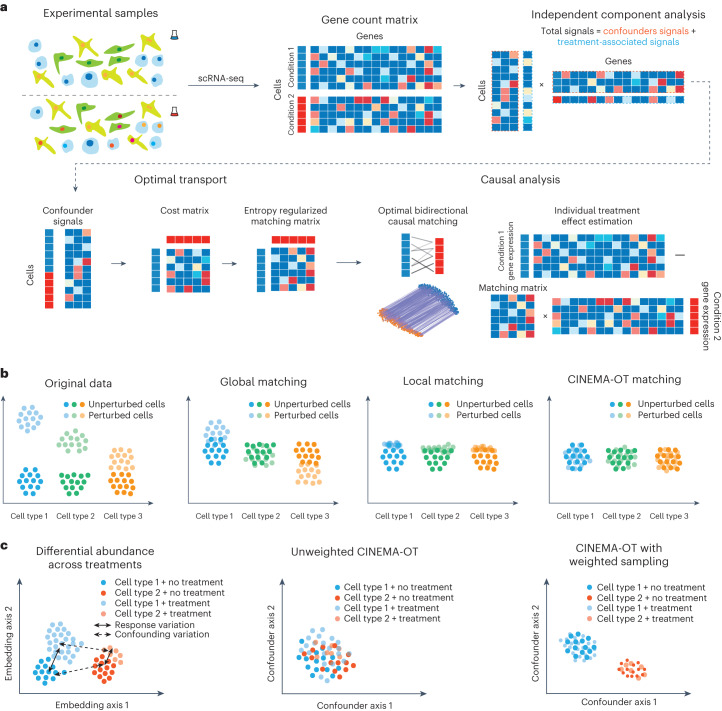
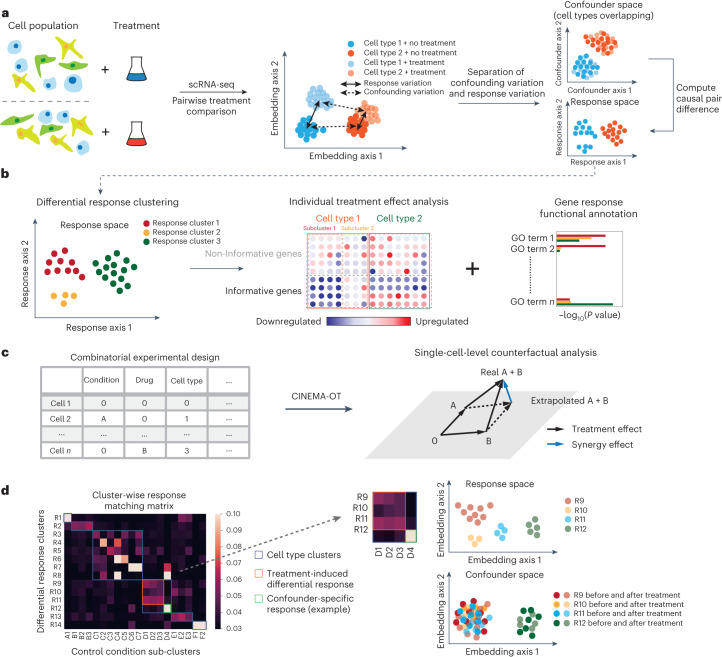
Recent advancements in single-cell technologies allow characterization of experimental perturbations at single-cell resolution. While methods have been developed to analyze such experiments, the application of a strict causal framework has not yet been explored for the inference of treatment effects at the single-cell level. Here we present a causal-inference-based approach to single-cell perturbation analysis, termed CINEMA-OT (causal independent effect module attribution + optimal transport). CINEMA-OT separates confounding sources of variation from perturbation effects to obtain an optimal transport matching that reflects counterfactual cell pairs. These cell pairs represent causal perturbation responses permitting a number of novel analyses, such as individual treatment-effect analysis, response clustering, attribution analysis, and synergy analysis. We benchmark CINEMA-OT on an array of treatment-effect estimation tasks for several simulated and real datasets and show that it outperforms other single-cell perturbation analysis methods. Finally, we perform CINEMA-OT analysis of two newly generated datasets: (1) rhinovirus and cigarette-smoke-exposed airway organoids, and (2) combinatorial cytokine stimulation of immune cells. In these experiments, CINEMA-OT reveals potential mechanisms by which cigarette-smoke exposure dulls the airway antiviral response, as well as the logic that governs chemokine secretion and peripheral immune cell recruitment.
Overview
CoChat Summary
TL;DR
CINEMA-OT is a causal-inference framework for single-cell perturbation analysis that separates confounding variation from treatment-associated variation using ICA and then matches counterfactual cell pairs via entropy-regularized optimal transport. It benchmarks favorably against existing methods and reveals heterogeneous, synergistic responses in airway organoids exposed to rhinovirus and cigarette smoke and in cytokine-stimulated immune cells.
Key findings
- CINEMA-OT identifies confounder signals with ICA and a Chatterjee’s coefficient-based test, then uses weighted optimal transport to generate causal counterfactual cell pairs and individual treatment effects (ITEs).
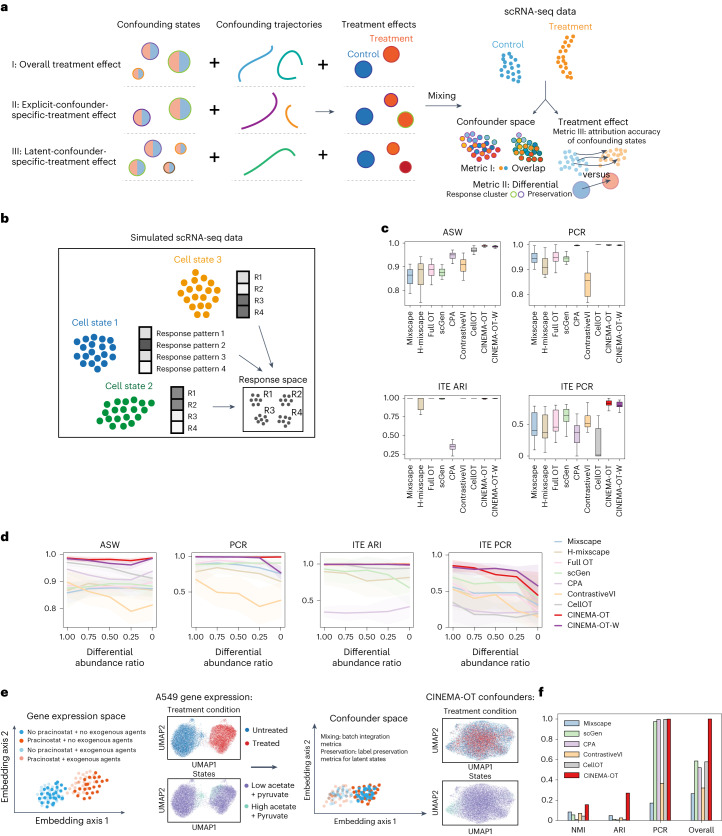
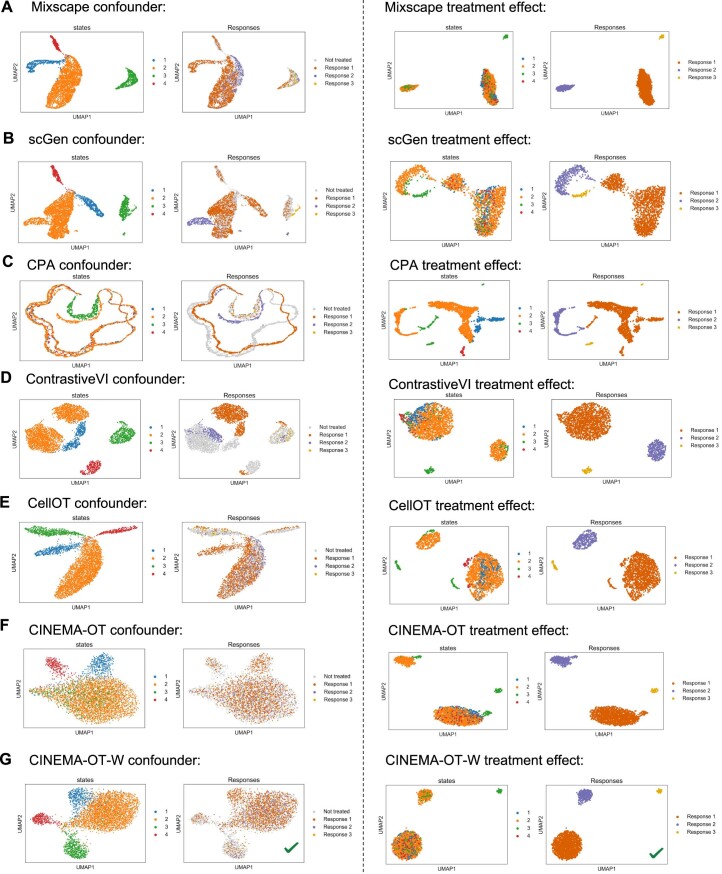
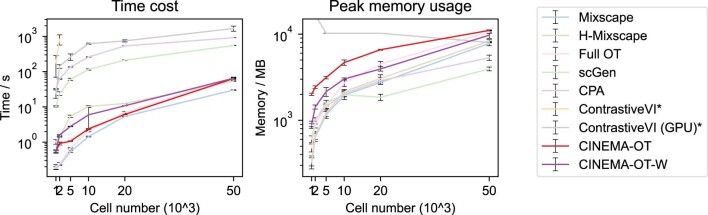
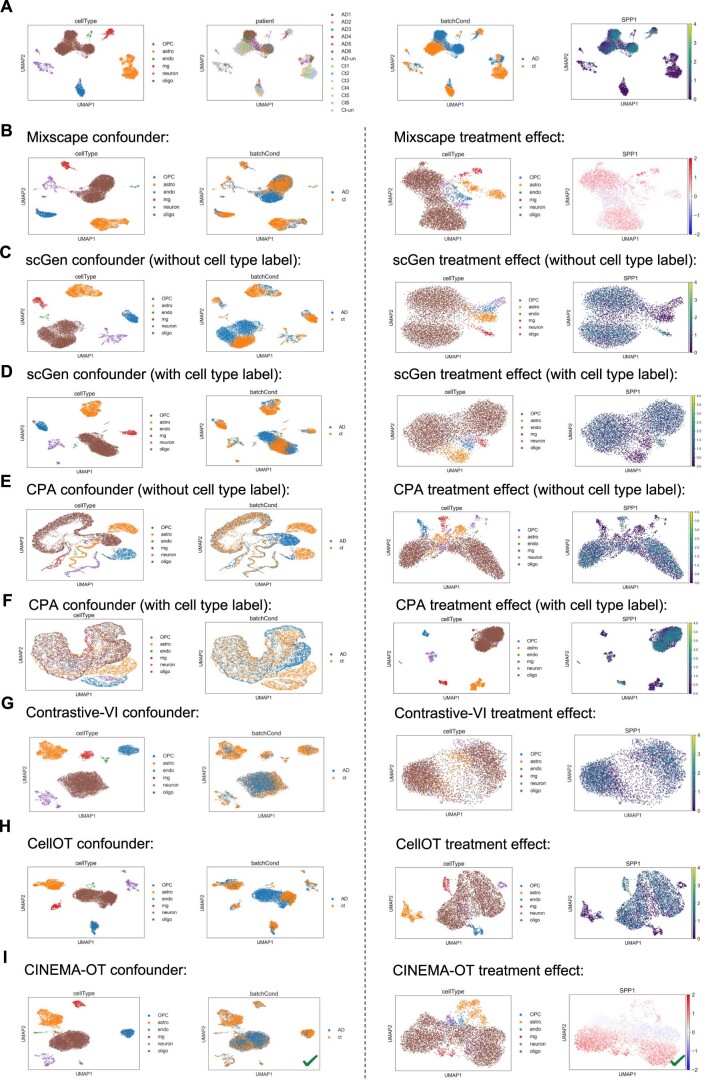
- In simulated and real benchmarks, CINEMA-OT outperformed Mixscape, Harmony-Mixscape, scGen, CPA, ContrastiveVI, CellOT, and Full OT in treatment-effect attribution and batch mixing, while preserving differential-response clusters; it ran in approximately 1 min for 50,000 cells and used less than 12 GB memory.
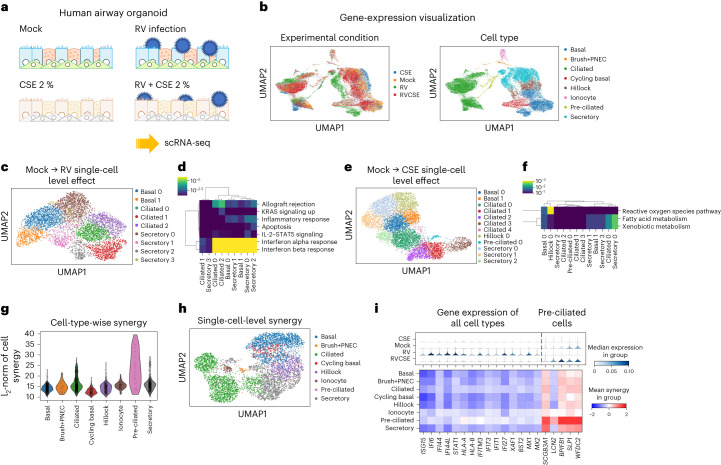
- In human airway organoids (26,420 cells across mock, RV, CSE, and RVCSE), CINEMA-OT found that cigarette-smoke exposure broadly reduced interferon-stimulated gene responses to rhinovirus, while pre-ciliated cells showed synergistic induction of secretory genes such as SCGB3A1, LCN2, BPIFB1, SLPI, and WFDC2.
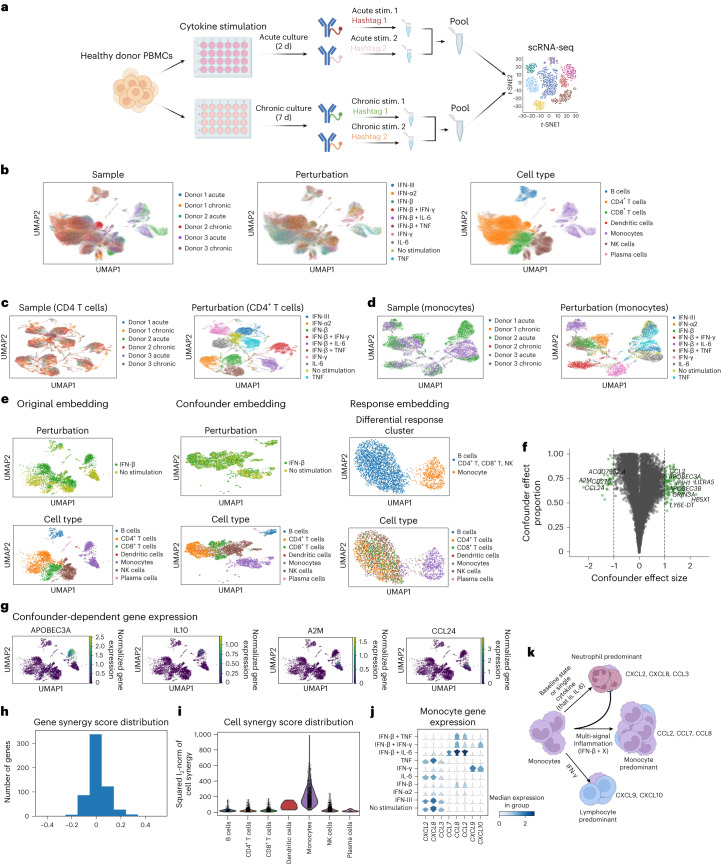
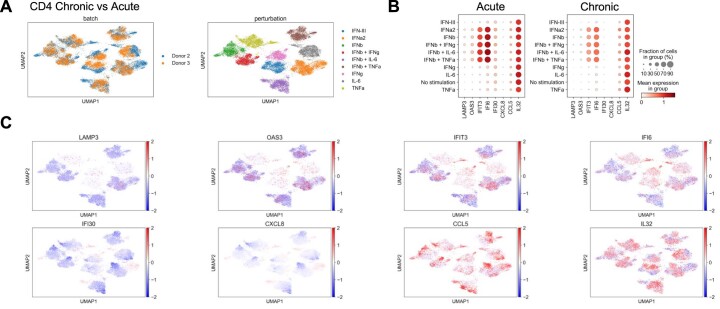
- In combinatorial cytokine stimulation of PBMCs, CINEMA-OT identified monocyte-enriched synergistic chemokine programs, including inhibition of baseline neutrophil chemotactic signaling and induction of monocyte chemotactic signaling with IFN-β + IL-6, and lymphocyte-predominant chemokines with added IFN-γ.
Methods
- CINEMA-OT is an unsupervised method: PCA embedding, FastICA decomposition, Chatterjee’s cross-rank coefficient to separate confounder versus treatment-associated independent components, and entropy-regularized optimal transport solved by Sinkhorn–Knopp to match cells across conditions.
- Benchmarks used simulated scRNA-seq data (1,000 genes × 5,000 cells with 2–5 cell states), the Alzheimer’s entorhinal cortex dataset, and the sci-Plex drug perturbation dataset; comparisons included Mixscape, Harmony-Mixscape, scGen, CPA, ContrastiveVI, CellOT, and Full OT.
- New datasets included primary human bronchial organoids infected with mock or rhinovirus with/without 2% cigarette-smoke extract (26,420 cells, four samples) and PBMCs from three healthy donors stimulated acutely (2 d) or chronically (7 d) with type I, II, and III IFNs and combinations with TNF or IL-6.
Limitations
- Stated: CINEMA-OT faces bias–variance trade-offs in optimal transport smoothness; too much smoothing can create false positives, while too little harms stability and increases variance.
- Stated: CINEMA-OT cannot extrapolate to unmeasured perturbation–cell pairs, is not designed for cases where changes in confounder distributions are the primary effect of interest, and its current implementation does not perform count modeling, so gene-level differential expression may still be affected by substantial batch effects.
- Stated: CINEMA-OT-W addresses differential abundance but its theoretical foundation no longer holds under differential abundance, and selecting its clustering resolution may require prior biological knowledge; the text also notes that CINEMA-OT can tolerate only moderate differential abundance without CINEMA-OT-W.
Model-written summary. Check it against the paper before relying on it.
Integrity signals
Registry
Cites
Statistics
Figures

Verification
Claims the paper makes
10 Valid · 2 Not valid · 11 Not checked · 88 Own results and interpretations
At least one cited source doesn’t support this claim or points to a different paper, and none confirmed it — see the verdicts below.
In the paper
“Previous studies of viral infection using this model considered gene expression in each cell type, but not heterogeneous response patterns, which may be of biological and clinical relevance in understanding the tissue response to respiratory virus infections44,45.”
§ Causal identification of single-cell experimental perturbation effects with CINEMA-OT > Main > Results
What the sources say
- Disputedcites [44] Cheemarla NR Dynamic innate immune response determines susceptibility to SARS-CoV-2 infection and early replication kinetics J. Exp. Med. 2021 218 e20210583 10.1084/jem.20210583 34128960 PMC8210587 sourceExperimental — accuracy not yet measured
Our copy of Cheemarla et al. shows the study did both things the citing sentence separates: it annotated scRNA-seq clusters to the seven major airway epithelial cell groups (Materials and methods, 'Experimental model and subject details'), and it explicitly examined heterogeneous, cell-by-cell response patterns — Results, 'RV induces an IFN response in bystander cells' states they 'performed scRNA-seq ... to evaluate the host ISG response at single-cell resolution', finding RV RNA in only 70 of 4,200 cells (1.67%), predominantly ciliated cells but spanning all major cell types, with ISGs elevated in uninfected bystander cells. The first half of the characterization (gene expression per cell type) is accurate, but the attributed gap — that heterogeneous response patterns were not considered — is contrary to what the paper reports. (LLM, conf=0.70)
Checked by a reasoning model — may be wrong.
- Disputedcites [45] Ravindra NG Single-cell longitudinal analysis of SARS-CoV-2 infection in human airway epithelium identifies target cells, alterations in gene expression, and cell state changes PLoS Biol. 2021 19 e3001143 10.1371/journal.pbio.3001143 33730024 PMC8007021 sourceExperimental — accuracy not yet measured
Our copy of Ravindra et al. (2021) is a single-cell longitudinal scRNA-seq study of SARS-CoV-2 in HBEC air–liquid interface cultures, and it explicitly resolves heterogeneous responses within each cell type rather than ignoring them: the Results section 'Differentially expressed genes in response to SARS-CoV-2 infection' analyses DEGs 'between infected and uninfected bystander cells of a given cell type' for ciliated, basal, club and BC/club cells. The 'Innate immune response to SARS-CoV-2 infection' section likewise reports cell-intrinsic IFN/IL-6 induction in infected but not bystander cells of the same populations, with ISGs spreading in trans, and the Methods ('scRNA-seq data analysis') define a per-cell MELD metric of transcriptomic similarity to infected cells (−1 bystander to +1 infected) precisely to capture per-cell variation. So the source contradicts the attributed characterization that it considered gene expression per cell type 'but not heterogeneous response patterns'; at most it supports the per-cell-type gene-expression half of the sentence. (LLM, conf=0.78)
Checked by a reasoning model — may be wrong.
plain- Asserted: passes — The authors put it forward as true.
- Checkable: passes — It can be checked against evidence.
- Load-bearing: passes — The paper’s conclusions depend on it.
- Based: passes — The paper gives a reason why it holds.
- Disputed
The cited sources support only part of this claim — read each source’s verdict below.
In the paper
“A key difficulty for applying the potential outcome framework for our task is ‘the mixing of confounders with outcomes’.”
§ Causal identification of single-cell experimental perturbation effects with CINEMA-OT > Main > Results
What the sources say
- Partly supportedcites [19] Squires C Uhler C Causal structure learning: A combinatorial perspective Found. Comput. Math. 2023 23 1781 1815 10.1007/s10208-022-09581-9 PMC9342837 35935470 sourceExperimental — accuracy not yet measured
The “Graphical Representations for Latent Confounding” section says latent confounders must be accounted for to learn causal structure accurately. The cited passages do not describe a difficulty in applying the potential outcome framework or say that confounders are mixed with outcomes; searches for those terms found no such passage. Page numbers were unavailable in our copy. (LLM, conf=0.78)
plainstates an association- Asserted: passes — The authors put it forward as true.
- Checkable: passes — It can be checked against evidence.
- Load-bearing: passes — The paper’s conclusions depend on it.
- Based: passes — The paper gives a reason why it holds.
- Partly supported
The cited sources that could be checked couldn’t confirm or dispute this claim.
In the paper
“A great deal of variability in cellular responses to treatment may be attributable to underlying confounding variation10.”
§ Causal identification of single-cell experimental perturbation effects with CINEMA-OT > Main
What the sources say
- Could not verifycites [10] VanderWeele TJ Shpitser I On the definition of a confounder Ann. Stat. 2013 41 196 10.1214/12-AOS1058 25544784 PMC4276366 sourceExperimental — accuracy not yet measured
The Introduction defines confounding in terms of exposure and counterfactual outcomes, while Section 3 discusses bias in estimates of causal effects. Neither passage addresses cellular responses or suggests that confounding variation accounts for a great deal of their variability; searches for cellular response variability and heterogeneous treatment effects found no such passage. No page numbers were available in our copy. (LLM, conf=0.76)
hedgedstates a possible cause- Asserted: passes — The authors put it forward as true.
- Checkable: passes — It can be checked against evidence.
- Load-bearing: passes — The paper’s conclusions depend on it.
- Based: passes — The paper gives a reason why it holds.
- Could not verify
The cited sources support only part of this claim — read each source’s verdict below.
In the paper
“There are a number of existing methods that perform perturbation-effect analysis in single-cell omics data, but none of them achieve guaranteed confounder identification, which is a necessary condition for interpretable causal-effect estimation.”
§ Causal identification of single-cell experimental perturbation effects with CINEMA-OT > Main > Results
What the sources say
- Partly supportedcites [3] Adamson B A multiplexed single-cell CRISPR screening platform enables systematic dissection of the unfolded protein response Cell 2016 167 1867 1882 10.1016/j.cell.2016.11.048 27984733 PMC5315571 sourceExperimental — accuracy not yet measured
The Introduction (page unavailable) describes Perturb-seq as a method for analyzing single-cell perturbation responses and says its pipeline isolates those responses from confounding effects such as cell cycle. It does not claim that existing methods lack guaranteed confounder identification or that such a guarantee is necessary for interpretable causal-effect estimation. (LLM, conf=0.86)
- Not checked yetcites [4] Dixit A Perturb-seq: dissecting molecular circuits with scalable single-cell rna profiling of pooled genetic screens ell 2016 167 1853 1866 PMC5181115 27984732
- Partly supportedcites [5] Yang L scMAGeCK links genotypes with multiple phenotypes in single-cell CRISPR screens Genome Biol. 2020 21 19 10.1186/s13059-020-1928-4 31980032 PMC6979386 sourceExperimental — accuracy not yet measured
The Results section, “Comparisons with clustering analysis and other algorithms” (page unavailable), describes several methods for analyzing perturbation effects in single-cell CRISPR data. Neither that comparison nor the additional passages retrieved addresses guaranteed confounder identification or says it is necessary for interpretable causal-effect estimation. (LLM, conf=0.85)
- Partly supportedcites [6] Duan B Model-based understanding of single-cell CRISPR screening Nat. Commun. 2019 10 2233 10.1038/s41467-019-10216-x 31110232 PMC6527552 sourceExperimental — accuracy not yet measured
The Discussion (page unavailable) describes MUSIC as a method for estimating and prioritizing perturbation effects in single-cell CRISPR screening, supporting the claim that such analysis methods exist. The Introduction and Methods discuss analytical challenges and perturbation-effect calculations, but our copy does not say that existing methods lack guaranteed confounder identification or that such identification is necessary for interpretable causal-effect estimation (searched: confounder identification, confounding, causal inference). (LLM, conf=0.83)
- Partly supportedcites [7] Jin X In vivo Perturb-seq reveals neuronal and glial abnormalities associated with autism risk genes Science 2020 370 eaaz6063 10.1126/science.aaz6063 33243861 PMC7985844 sourceExperimental — accuracy not yet measured
The Methods Summary (Perturb-Seq analysis; page unavailable) describes a method for testing perturbation effects in single-cell data, including adjustments for batch and gene count. The paper does not establish that no existing method guarantees confounder identification or that such identification is necessary for interpretable causal-effect estimation. (LLM, conf=0.84)
- Partly supportedcites [11] Papalexi E Characterizing the molecular regulation of inhibitory immune checkpoints with multimodal single-cell screens Nat. Genet. 2021 53 322 331 10.1038/s41588-021-00778-2 33649593 PMC8011839 sourceExperimental — accuracy not yet measured
The section “Perturbation signature removes confounding variation” (page not given) describes a single-cell method for analyzing perturbation effects and mitigating confounding variation. The Discussion (page not given) says the method can remove confounding variation even when its sources are unknown. The paper does not establish that no existing method guarantees confounder identification or that such identification is necessary for interpretable causal-effect estimation. (LLM, conf=0.85)
- Not checked yetcites [22] Lotfollahi M Wolf FA Theis FJ scGen predicts single-cell perturbation responses Nat. Methods 2019 16 715 721 10.1038/s41592-019-0494-8 31363220 source
- Partly supportedcites [23] Lotfollahi M Predicting cellular responses to complex perturbations in high‐throughput screens Mol. Syst. Biol. 2023 19 e11517 10.15252/msb.202211517 37154091 PMC10258562 sourceExperimental — accuracy not yet measured
The Introduction discusses existing methods for modeling single-cell perturbations, supporting the claim that such methods exist. Neither the Introduction nor the searched passages on covariates and counterfactual predictions address guaranteed confounder identification or say it is necessary for interpretable causal-effect estimation. (LLM, conf=0.78)
- Not checked yetcites [24] Weinberger E Lin C Lee SI Isolating salient variations of interest in single-cell data with contrastiveVI Nat. Methods 2023 20 1336 1345 10.1038/s41592-023-01955-3 37550579 source
- Not checked yetcites [25] Bunne, C., Stark, S. G., Gut, G. et al. Learning single-cell perturbation responses using neural optimal transport. Nat. Methods (in the press). PMC10630137 37770709
plain- Asserted: passes — The authors put it forward as true.
- Checkable: passes — It can be checked against evidence.
- Load-bearing: passes — The paper’s conclusions depend on it.
- Based: passes — The paper gives a reason why it holds.
- Partly supported
Every source the paper cites for this claim was checked and supports it.
In the paper
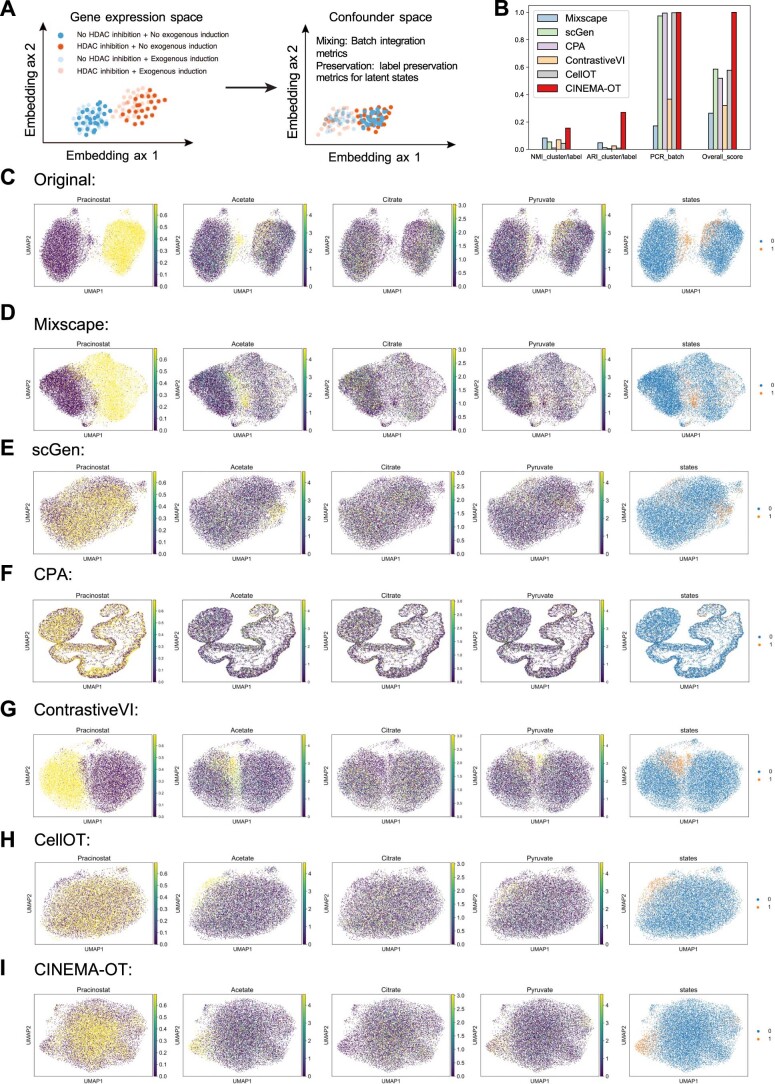
“As HDAC inhibitors act partly through the deprivation of acetyl-CoA, we expect that the relative abundance of acetyl-CoA precursors within a cell would modulate the effect of HDAC inhibitor exposure, and acetyl-CoA precursors can be considered confounders8 (Fig. 3e).”
§ Causal identification of single-cell experimental perturbation effects with CINEMA-OT > Main > Results
What the sources say
- Supportedcites [8] Srivatsan SR Massively multiplex chemical transcriptomics at single-cell resolution Science 2020 367 45 51 10.1126/science.aax6234 31806696 PMC7289078 source
The Results section 'Inference of chemical and mechanistic properties of HDAC inhibitors' states that HDAC inhibition induces 'an acetyl-CoA-deprived state' and that supplementing acetyl-CoA precursors (acetate, pyruvate, citrate) or inhibiting ACLY/ACSS2/PDH shifted cells along the HDAC-inhibitor pseudodose trajectory — i.e. precursor abundance modulates the effect of HDAC inhibitor exposure. The Discussion adds that 'variation in cells' acetate reservoirs is a potential explanation for their heterogeneous responses to HDAC inhibitors', which is the source's version of treating precursors as a confounding variable. The word 'confounder' itself does not appear in our copy; that label is the citing authors' framing of the source's finding. (LLM, conf=0.82)
plainstates a cause- Asserted: passes — The authors put it forward as true.
- Checkable: passes — It can be checked against evidence.
- Load-bearing: passes — The paper’s conclusions depend on it.
- Based: passes — The paper gives a reason why it holds.
- Supported
45 more claims · 2 with their cited sources checked
Create a free account to see all 111 claims and to verify the 20 references still open.
- Probably not a substantial claim. 35
- It may state two separate claims as one. 35
Claims other papers make about this one
Each is checked against this paper’s own text: does it say what the citing paper says it does?
In the citing paper
“CINEMA-OT [40] is a framework for causal learning and optimal transport that aids in distinguishing between intrinsic cell-state effects (confounders) and perturbation effects for scRNA-seq datasets.”
From A mini-review on perturbation modelling across single-cell omic modalities (2024) · cites this paper as [40]
In the citing paper
“CINEMA-OT can be applied for individual treatment-effect analysis, response clustering, attribution analysis, and synergy analysis.”
From A mini-review on perturbation modelling across single-cell omic modalities (2024) · cites this paper as [40]
Self-check
Percentages, sums and reported differences re-computed from the paper’s own numbers.
Each contradiction between two passages listed here was confirmed by an independent check.
Rated major: it would touch a result — a value a result rests on, reported and recomputed p-values on opposite sides of the significance level, two passages that conflict with no sign which is right, or a cited work retracted before this paper was published.
In the paper
§ Causal identification of single-cell experimental perturbation effects with CINEMA-OT > Main > Results
“we subjected peripheral blood mononuclear cells (PBMCs) from multiple healthy donors to acute (2 d) or chronic (7 d) stimulation with type I, type II, and type III IFNs”
§ Causal identification of single-cell experimental perturbation effects with CINEMA-OT > Methods > Interferon treatment data
“and combinatorial cytokines IFN-β + IL-6, IFN-β + TNF, IFN-β + IFN-γ at indicated concentrations above for up to 48 h.”
Rated minor: it would not touch a result — a value no result rests on, a p-value that stays on the same side of the significance level, or a conflict that is clerical, resolved elsewhere in the paper, or outside its own findings.
In the paper
§ Causal identification of single-cell experimental perturbation effects with CINEMA-OT > Main > Results
“f, Two diverging patterns among CINEMA-OT identified synergistic genes, visualized by stacked violin plots and dot plots.”
§ Causal identification of single-cell experimental perturbation effects with CINEMA-OT > Main > Results
“f, Gene set enrichment analysis of mock to CSE response clusters identified by CINEMA-OT, colored by adjusted P value.”
Rated minor: it would not touch a result — a value no result rests on, a p-value that stays on the same side of the significance level, or a conflict that is clerical, resolved elsewhere in the paper, or outside its own findings.
In the paper
§ Causal identification of single-cell experimental perturbation effects with CINEMA-OT > Methods > Rhinovirus infection data
“We annotated eight cell clusters on the basis of known cell-type markers of airway epithelial cells66: cycling basal, basal, hillock, secretory, pre-ciliated, ciliated, ionocyte, PNECs, and brush cells.”
§ Causal identification of single-cell experimental perturbation effects with CINEMA-OT > Main > Results
“We first performed preprocessing of the dataset and annotated eight cell clusters in total, including major cell types in the airway (basal, secretory, ciliated) and other rare (ionocyte, pulmonary neuroendocrine cells (PNECs), and brush) or transitional (hillock and pre-ciliated) cell types (Fig. 4b).”
Citations
Cites
Scikit-learn: Machine Learning in Python
Pedregosa, F., Varoquaux, G., Gramfort, A., Michel, V., Thirion, B., Grisel, O., Blondel, M., Müller, A., Nothman, J., Louppe, G., et al. (2012) · arXiv · doi:10.48550/arxiv.1201.0490 · Cited by 71,016
Subramanian, A., Tamayo, P., Mootha, V. K., Mukherjee, S., Ebert, B. L., Gillette, M. A., Paulovich, A., Pomeroy, S. L., Golub, T. R., Lander, E. S., et al. (2005) · Proceedings of the National Academy of Sciences · doi:10.1073/pnas.0506580102 · Cited by 53,625 · cited 1×
“We may also employ clustering techniques, such as Leiden clustering [23] to group cells by similarity of treatment responses.”
Robinson, M. D., McCarthy, D. J., & Smyth, G. K. (2010) · Bioinformatics · doi:10.1093/bioinformatics/btp616 · Cited by 41,364
limma powers differential expression analyses for RNA-sequencing and microarray studies
Ritchie, M. E., Phipson, B., Wu, D., Hu, Y., Law, C. W., Shi, W., & Smyth, G. K. (2015) · Nucleic Acids Research · doi:10.1093/nar/gkv007 · Cited by 40,458 · cited 1×
“[9–13] 2.”
Enrichr: a comprehensive gene set enrichment analysis web server 2016 update
Kuleshov, M. V., Jones, M. R., Rouillard, A. D., Fernandez, N. F., Duan, Q., Wang, Z., Koplev, S., Jenkins, S. L., Jagodnik, K. M., Lachmann, A., et al. (2016) · Nucleic Acids Research · doi:10.1093/nar/gkw377 · Cited by 10,799 · cited 1×
“These genes are input into GSEApy for analysis by functional signatures [52, 53].”
Fast, sensitive and accurate integration of single-cell data with Harmony
Korsunsky, I., Millard, N., Fan, J., Slowikowski, K., Zhang, F., Wei, K., Baglaenko, Y., Brenner, M., Loh, P.-R., & Raychaudhuri, S. (2019) · Nature Methods · doi:10.1038/s41592-019-0619-0 · Cited by 10,488
UMAP: Uniform Manifold Approximation and Projection
McInnes, L., Healy, J., Saul, N., & Großberger, L. (2018) · Journal of Open Source Software · doi:10.21105/joss.00861 · Cited by 9,826
Estimating causal effects of treatments in randomized and nonrandomized studies
Rubin, D. B. (1974) · Journal of Educational Psychology · doi:10.1037/h0037350 · Cited by 9,436 · cited 1×
“To perform causal single-cell perturbation effect inference, we have adopted the potential outcome causal framework [22, 26].”
SCANPY: large-scale single-cell gene expression data analysis
Wolf, F. A., Angerer, P., & Theis, F. J. (2018) · Genome Biology · doi:10.1186/s13059-017-1382-0 · Cited by 8,881 · cited 1×
“Prior to FastICA, input data is PCA-transformed using scanpy [48].”
UMAP: Uniform Manifold Approximation and Projection for Dimension Reduction
McInnes, L., Healy, J., & Melville, J. (2018) · arXiv · doi:10.48550/arxiv.1802.03426 · Cited by 7,101
Research works printed but not linked: 2
- Cuturi, M. Sinkhorn distances: lightspeed computation of optimal transport. In Advances in Neural Information Processing Systems Vol. 26 (eds Burges, C. J. et al.) (2013).
- Dong, M. & Kluger, Y. GEASS: neural causal feature selection for high-dimensional biological data. In 11th International Conference on Learning Representations (ICLR, 2023).
Cited by
Mapping cells through time and space with moscot
Klein, D., Palla, G., Lange, M., Klein, M., Piran, Z., Gander, M., Meng-Papaxanthos, L., Sterr, M., Saber, L., Jing, C., et al. (2025) · Nature · doi:10.1038/s41586-024-08453-2 · Cited by 279
“…mapping cells across time points 2,50–52,54–57 , mapping cells from molecular to physical space 3 , aligning spatial transcriptomic samples 4 , integrating data across molecular modalities 49,52 , learning patient manifolds 58 or mapping cells across different experimental perturbations 53,59 .”
Zhang, J., Ubas, A. A., de Borja, R., Svensson, V., Thomas, N., Thakar, N., Lai, I., Winters, A., Khan, U., Jones, M. G., et al. (2025) · bioRxiv (Cold Spring Harbor Laboratory) · doi:10.1101/2025.02.20.639398 · Cited by 106
Rood, J. E., Hupalowska, A., & Regev, A. (2024) · Cell · doi:10.1016/j.cell.2024.07.035 · Cited by 139
Qi, X., Zhao, L., Tian, C., Li, Y., Chen, Z.-L., Huo, P., Chen, R., Liu, X., Wan, B., Yang, S., et al. (2024) · Nature Communications · doi:10.1038/s41467-024-53457-1 · Cited by 131
Immune digital twins for complex human pathologies: applications, limitations, and challenges
Niarakis, A., Laubenbacher, R., An, G. C., Ilan, Y., Fisher, J., Flobak, Å., Reiche, K., Martínez, M. R., Geris, L., Ladeira, L., et al. (2024) · npj Systems Biology and Applications · doi:10.1038/s41540-024-00450-5 · Cited by 128
Cell2Sentence: Teaching Large Language Models the Language of BiologyPreprint
Levine, D. M., Rizvi, S. A., Lévy, S., Pallikkavaliyaveetil, N., Zhang, D., Chen, X., Ghadermarzi, S., Wu, R., Zheng, Z., Vrkic, I., et al. (2023) · bioRxiv (Cold Spring Harbor Laboratory) · doi:10.1101/2023.09.11.557287 · Cited by 124
“We also evaluate all models on a human PBMC single-cell dataset treated with various combinatorial cytokine stimulations (Dong et al., 2023), as a third benchmark dataset.”
MethodInfluentialSelf-citationPertpy: an end-to-end framework for perturbation analysis
Heumos, L., Ji, Y., May, L. T., Green, T. D., Peidli, S., Zhang, X., Wu, X., Ostner, J., Schumacher, A., Hrovatin, K., et al. (2025) · Nature Methods · doi:10.1038/s41592-025-02909-7 · Cited by 112
“CINEMA-OT 41 , via scalable pertpy implementation, extends this concept by distinguishing between confounding variations and the effect of perturbations, achieving an optimal transport match that mirrors counterfactual cell pairings (Methods).”
InfluentialSelf-citationPredicting cellular responses to perturbation across diverse contexts with State
Adduri, A. K., Gautam, D., Bevilacqua, B., Naghipourfar, M., Imran, A., Shah, R., Teyssier, N., Verma, R., Carpenter, C., Eraslan, B., et al. (2026) · Cell · doi:10.1016/j.cell.2026.07.052 · Cited by 100
Self-citationAdvances and applications in single-cell and spatial genomics
Wang, J., Ye, F., Chai, H., Jiang, Y., Wang, T., Ran, X., Xia, Q., Xu, Z., Fu, Y., Zhang, G., et al. (2024) · Science China Life Sciences · doi:10.1007/s11427-024-2770-x · Cited by 79
Scaling Large Language Models for Next-Generation Single-Cell AnalysisPreprint
Rizvi, S. A., Levine, D., Patel, A. M., Zhang, S., Wang, E., Perry, C. J., Vrkic, I., Constante, N. M., Fu, Z., He, S., et al. (2025) · bioRxiv (Cold Spring Harbor Laboratory) · doi:10.1101/2025.04.14.648850 · Cited by 76
“This includes apoptosis for L1000 [44] and interferon response for Dong et al. [45].”
Self-citationDecoding heterogeneous single-cell perturbation responses
Song, B., Liu, D., Dai, W., McMyn, N. F., Wang, Q., Yang, D., Krejčí, A., Vasilyev, A., Untermoser, N., Loregger, A., et al. (2025) · Nature Cell Biology · doi:10.1038/s41556-025-01626-9 · Cited by 58
GENOT: Entropic (Gromov) Wasserstein Flow Matching with Applications to Single-Cell Genomics
Klein, D., Uscidda, T., Theis, F. J., & Cuturi, M. (2024) · neural information processing systems · doi:10.52202/079017-3301 · Cited by 58
“For example, it is standard practice to leverage the framework of OT to reconstruct cellular trajectories across developmental time points [72] and to study the response of cells to external perturbations like drugs or gene knockouts [18].”
A mini-review on perturbation modelling across single-cell omic modalities
Gavriilidis, G. I., Vasileiou, V., Orfanou, A., Ishaque, N., & Psomopoulos, F. (2024) · Computational and Structural Biotechnology Journal · doi:10.1016/j.csbj.2024.04.058 · Cited by 54
“CINEMA-OT [40] is a framework for causal learning and optimal transport that aids in distinguishing between intrinsic cell-state effects (confounders) and perturbation effects for scRNA-seq datasets.”
BackgroundAdvances and challenges in single-cell RNA sequencing data analysis: a comprehensive review
Nesari, A. M., MotieGhader, H., & Ghorbian, . (2026) · Briefings in Bioinformatics · doi:10.1093/bib/bbaf723 · Cited by 58
“CINEMA-OT combines optimal transport with causal graphs to predict CRISPR knockout effects, identifying STAT1 as a key regulator of T-cell exhaustion [108].”
Mapping effective connectivity by virtually perturbing a surrogate brain
Luo, Z., Peng, K., Liang, Z., Cai, S., Xu, C., Li, D., Hu, Y., Zhou, C., & Liu, Q. (2025) · Nature Methods · doi:10.1038/s41592-025-02654-x · Cited by 54
“Perturbation analysis in ANN presents a promising avenue for investigating causality, where modulating input variables and observing subsequent output changes allow for the elucidation of causal relationships tied to specific inputs and their effects [18, 19].”
Stack: In-Context Learning of Single-Cell BiologyPreprint
Dong, M., Adduri, A., Gautam, D., Wu, L., Kernick, C., Coons, M. M., Chih, Y.-C., Carpenter, C., Shah, R. M., Ricci-Tam, C., et al. (2026) · bioRxiv (Cold Spring Harbor Laboratory) · doi:10.64898/2026.01.09.698608 · Cited by 50
“The competitive performance of Stack on unseen prompts and queries (Dong et al., 2023; Wells et al., 2025; Consortium* et al., 2022), novel perturbations (Luecken et al., 2025), and cell types and tissues beyond peripheral blood (De Boer et al., 2021; Li et al., 2025; Edgar et al., 2025; Sikkema et…”
InfluentialSelf-citationEmbeddings from language models are good learners for single-cell data analysis
Liu, T., Chen, T., Zheng, W., Luo, X., Chen, Y. T., & Zhao, H. (2026) · Patterns · doi:10.1016/j.patter.2025.101431 · Cited by 44
“We evaluated three representative tasks: (1) causal factor analysis using CINEMA-OT, 55 (2) gene expression prediction under chemical perturbation using CPA, 56 and (3) gene expression prediction under gene-level perturbation using GEARS.”
InfluentialAdvancing biological understanding of cellular senescence with computational multiomics
Li, S., Agudelo Garcia, P. A., Aliferis, C., Becich, M. J., Calyeca, J., Cosgrove, B. D., Elisseeff, J., Farzad, N., Fertig, E. J., Glass, C., et al. (2025) · Nature Genetics · doi:10.1038/s41588-025-02314-y · Cited by 40
Self-citationJiang, J., Chen, S., Tsou, T., McGinnis, C. S., Khazaei, T., Zhu, Q., Park, J. H., Strazhnik, I.-M., Vielmetter, J., Gong, Y., et al. (2026) · Cell · doi:10.1016/j.cell.2026.04.028 · Cited by 37
Liu, S. J., Zou, C., Pak, J., Morse, A. P., Pang, D., Casey-Clyde, T., Borah, A. A., Wu, D., Seo, K., O’Loughlin, T., et al. (2024) · Genome biology · doi:10.1186/s13059-024-03404-6 · Cited by 37
“…and radiation treatment, we used CIN-EMA-OT (causal independent effect module attribution with optimal transport), a method that separates treatment and confounder effects using independent component analysis and then matches cells across treated/untreated conditions using optimal transport [45].”
MethodIn silico biological discovery with large perturbation models
Miladinovic, D., Höppe, T., Chevalley, M., Georgiou, A., Stuart, L., Mehrjou, A., Bantscheff, M., Schölkopf, B., & Schwab, P. (2025) · Nature Computational Science · doi:10.1038/s43588-025-00870-1 · Cited by 38
“While their encoder-based approach offers a compelling advantage — the ability to make predictions for previously unseen contexts by extracting contextual information from gene expression profiles — it faces two significant limitations.”
Interpretation, extrapolation and perturbation of single cells
Dimitrov, D., Schrod, S., Rohbeck, M., & Stegle, O. (2026) · Nature Reviews Genetics · doi:10.1038/s41576-025-00920-4 · Cited by 39
GenePert: Leveraging GenePT Embeddings for Gene Perturbation PredictionPreprint
Chen, Y. T., & Zou, J. (2024) · bioRxiv (Cold Spring Harbor Laboratory) · doi:10.1101/2024.10.27.620513 · Cited by 31
“While a few computational methods perturbation effects on a single-cell resolution [Lotfollahi et al., 2020, Dong et al., 2023, Bunne et al., 2023], most prediction and benchmarking efforts have focused on estimating the average perturbation effect, defined as ¯ X p − ¯ X c .”
BackgroundSIMVI disentangles intrinsic and spatial-induced cellular states in spatial omics data
Dong, M., Su, D. G., Kluger, H. M., Fan, R., & Kluger, Y. (2025) · Nature Communications · doi:10.1038/s41467-025-58089-7 · Cited by 28
“A relatedtasktooursisthetreatmenteffectestimationproblemforsingle-cell RNA-seq data 77,78 ; however, a key distinction in our case is that the “ treatment ” , namely SIMVI spatial variation, is inferred from the model.”
Self-citationWang, C., Karimzadeh, M., Ravindra, N. G., Bounds, L. R., Alerasool, N., Huang, A., Ma, S., Gulbranson, D. R., Cui, H., Lee, Y., et al. (2026) · bioRxiv (Cold Spring Harbor Laboratory) · doi:10.64898/2026.03.18.712807 · Cited by 28
Self-citationBenchmarking AI Models for In Silico Gene Perturbation of Cells
Li, C., Gao, H., She, Y., Bian, H., Chen, Q., Liu, K., Wei, L., & Zhang, X. (2024) · doi:10.1101/2024.12.20.629581 · Cited by 24
Jiang, J., Chen, S., Tsou, T., McGinnis, C. S., Khazaei, T., Zhu, Q., Park, J. H., Strazhnik, I.-M., Vielmetter, J., Gong, Y., et al. (2023) · doi:10.1101/2023.04.19.537364 · Cited by 21
Gao, Y., Wei, Z., Dong, K., Chen, K., Yang, J., Chuai, G., & Liu, Q. (2024) · Nature Computational Science · doi:10.1038/s43588-024-00698-1 · Cited by 21
“However, this approach is primarily applicable when the GIs are additive, where they are referred to as additive interactions 33 (Supplementary Note 13).”
InfluentialPredicting drug responses of unseen cell types through transfer learning with foundation models
Wang, Y., Liu, X., Fan, Y., Xie, B., Cheng, J. S.-C., Wong, K. C., Cheung, P. P., King, I., & Li, Y. (2025) · Nature Computational Science · doi:10.1038/s43588-025-00887-6 · Cited by 20
“Second, recent strategies such as neural optimal transport and causal inference have shown promise 19,42 .”
Single‐Cell and Spatial Omics: Methods and Applications
Cen, X., Huang, X., Deng, E., Gong, X., Tan, N., Ye, J. T., Wang, Y., Eils, R., Luo, Q., Li, Y., et al. (2026) · MedComm · doi:10.1002/mco2.70713 · Cited by 18
“…transport to reveal mechanisms of environmental exposure, for example, diminished antiviral responses following cigarette-smoke stimulation [ 369 ]. scCausalVI employed causality-aware generative modeling to identify treatment-responsive cell populations and their underlying molecular…”
Littman, R., Levine, J., Maleki, S., Lee, Y., Ermakov, V. Y., Qiu, L., Wu, A. P., Huang, K., Lopez, R., Scalia, G., et al. (2025) · bioRxiv (Cold Spring Harbor Laboratory) · doi:10.1101/2025.06.03.657653 · Cited by 19
Xu, Y., Zhang, Y., Song, K., Liu, J., Zhao, R., Zhang, X., Pei, L., Li, M., Chen, Z., Zhang, C., et al. (2024) · Nucleic Acids Research · doi:10.1093/nar/gkae994 · Cited by 14
Chen, Y., Hu, Z., Chen, W., & Huang, H. (2025) · Bioinformatics · doi:10.1093/bioinformatics/btaf253 · Cited by 14
“However, CINEMA-OT is designed to model existing perturbation data with a discrete OT formulation and thus cannot be used for prediction tasks.”
A primer on optimal transport for causal inference with observational dataPreprint
Gunsilius, F. F. (2025) · RePEc: Research Papers in Economics · doi:10.48550/arxiv.2503.07811 · Cited by 12
“Many related methods have been influential in this area [e.g. 66, 78], and classic optimal transportation is beginning to be used in related methods [e.g. 46, 143].”
CODEX: COunterfactual Deep learning for the in silico EXploration of cancer cell line perturbations
Schrod, S., Zacharias, H. U., Beißbarth, T., Hauschild, A.-C., & Altenbuchinger, M. (2024) · Bioinformatics · doi:10.1093/bioinformatics/btae261 · Cited by 10
“In this direction, e.g. Bunne et al. (2023) and Dong et al. (2023), attempt to identify counterfactual cell pairs using optimal transport.”
BackgroundComputational modeling of single-cell dynamics data
Guo, W., Chen, Z., & Gu, J. (2025) · Briefings in Bioinformatics · doi:10.1093/bib/bbaf305 · Cited by 10
“OT-based models (such as Waddington-OT [32], CINEMA-OT [33], Perturb-OT [ 34],scStateDynamics ,[35],and Moscot [36]) compute the “transport plan,” which minimizes the cost of aligning cells from one time point to the next [Fig.”
JoyAgent-JDGenie: Technical Report on the GAIAPreprint
Liu, J., Xu, S., Liu, S., Li, Y., Liu, W., Liu, M., Zhou, X., Wang, H., Jia, S., Wang, Z., et al. (2025) · arXiv (Cornell University) · doi:10.48550/arxiv.2510.00510 · Cited by 11
scCausalVI disentangles single-cell perturbation responses with causality-aware generative model
An, S., Cho, J.-W., Cao, K., Xiong, J., Hemberg, M., & Wan, L. (2025) · Cell Systems · doi:10.1016/j.cels.2025.101443 · Cited by 9
Uncovering causal relationships in single-cell omic studies with causarray
Du, J., Shen, M., Mathys, H., & Roeder, K. (2026) · Briefings in Bioinformatics · doi:10.1093/bib/bbag175 · Cited by 9
“Existing methods for causal estimation, such as CoCoA-diff [7] and CINEMA-O T [20], rely on matching techniques that assume the causal structure is transferable between treatment and control groups.”
InfluentialGuo, W., Li, X., Wang, D., Yan, N., Hu, Q., Yang, F., Zhang, X., Yao, J., & Gu, J. (2024) · Genome biology · doi:10.1186/s13059-024-03436-y · Cited by 8
“More recently, data-driven strategies have also been developed to cope with the uncertainty of cell fate trajectories when analyzing perturbation responses under diverse stimulation conditions (such as cytokines, drugs, etc.) [17, 18].”
Chi, C., Xia, J., Huang, Y., Ouyang, Z., Tan, C., Liu, Y., Zhou, J., Yu, C., Yuan, L., Li, S., et al. (2026) · International Conference on Learning Representations · doi:10.48550/arxiv.2506.21107 · Cited by 8
“A.10 O THER R ELATED W ORK Although (Bunne et al., 2023; Dong et al., 2023) also address unpaired data, their task assumes access to both pre-and post-perturbation cells and focuses on finding optimal pairings between them.”
scTREAT: Latent Diffusion for Single-Cell Drug-Response PredictionPreprint
Liang, Z., Zhuang, S., Jiao, X., Mao, W., Chen, H., & Shen, C. (2025) · arXiv (Cornell University) · doi:10.48550/arxiv.2510.11726 · Cited by 8
“As an alternative to latent generative modeling, optimal-transport (OT) methods formulate control to perturbation alignment from unpaired observations to capture population-level shifts (Bunne et al., 2023; Dong et al., 2023).”
(2025) · doi:10.18653/v1/2025.acl-long.26 · Cited by 7
MapPFN: Learning Causal Perturbation Maps in ContextPreprint
Sextro, M., Kłos, W., & Dernbach, G. (2026) · arXiv (Cornell University) · doi:10.48550/arxiv.2601.21092 · Cited by 7
“These methods learn a transport map between the pre-and post-perturbation cell distributions, conditioned on a treatment or covariates (Bunne et al., 2023; Dong et al., 2023).”
Guo, W., Chen, Z., Li, X., Huang, J., Hu, Q., & Gu, J. (2025) · Cell Systems · doi:10.1016/j.cels.2025.101398 · Cited by 5
Spatial and single-cell transcriptomics landscape of adenomyosis
Yang, X., Li, C., He, J., Xie, B., Lv, L., Xu, J., Lin, Y., Zhou, C., Li, M., Zeng, Z. R., et al. (2025) · Journal of Advanced Research · doi:10.1016/j.jare.2025.12.042 · Cited by 5
“Using the CINEMA-OT tool[19], we further assessed the influence of the ade-nomyosis and complications on specific cell types.”
InfluentialAn expanded role for single-cell chemical genomics profiling in drug discovery
Wyatt, A., Hoffer-Hawlik, K., Giglio, R. M., Azizi, E., & McFaline‐Figueroa, J. L. (2026) · Biochemical Journal · doi:10.1042/bcj20253273 · Cited by 4
Sierra-Porta, D. (2024) · Advances in Space Research · doi:10.1016/j.asr.2024.10.065 · Cited by 4
Decoding cell fate: integrated experimental and computational analysis at the single-cell level
Zhou, Y., Hou, S., Miao, X., Zhang, G., Li, Z., Zhang, D., Lin, Y., & Lin, Y. (2025) · Bioinformatics · doi:10.1093/bioinformatics/btaf603 · Cited by 4
“…been developed to analyze perturbation effects, with targets ranging from quantifying perturbation magnitude (Dixit et al. 2016, Yang et al. 2020, Dong et al. 2023), ranking the perturbation effects (Duan et al. 2019, Yang et al. 2020), and finding optimal perturbation strategy (Zhang et al.…”
Correlational Lagrangian Schrödinger Bridge: Learning Dynamics with Population-Level RegularizationPreprint
You, Y., Zhou, R., & Shen, Y. (2024) · arXiv (Cornell University) · doi:10.48550/arxiv.2402.10227 · Cited by 4
“The application encompasses modeling cellular systems in response to perturbations c such as drug treatments or more (Srivatsan et al., 2020; Dong et al., 2023).”
BackgroundCaLMFlow: Volterra Flow Matching using Causal Language ModelsPreprint
He, S., Levine, D., Vrkic, I., Bressana, M. F., Zhang, D. D., Rizvi, S. A., Zhang, Y. P., Zappala, E., & van Dijk, D. (2024) · arXiv (Cornell University) · doi:10.48550/arxiv.2410.05292 · Cited by 4
“We apply CaLMFlow to immune tissue single-cell expression data (Dong et al., 2023) to demonstrate its effectiveness in both unconditional and conditional generation of complex, high-dimensional real-world data.”
MethodLearning Identifiable Factorized Causal Representations of Cellular ResponsesPreprint
Mao, H., Lopez, R., Liu, K., Hütter, J.-C., Richmond, D., Benos, P. V., & Qiu, L. (2024) · arXiv (Cornell University) · doi:10.48550/arxiv.2410.22472 · Cited by 5
Artificial intelligence for drug target identification
Li, Y., Huang, J., Sheng, Y., Wei, C., Liu, M., Wang, X., Chen, Y., Li, X., & Zheng, M. (2025) · Annual reports in medicinal chemistry · doi:10.1016/bs.armc.2025.08.002 · Cited by 3
SDMap: a comprehensive database of spatial drug perturbation maps
Li, F., Chen, Z., Zhang, Y., Ye, X., Fan, W., 康安辉, Song, X., Pei, L., Quan, Q., Liu, W., et al. (2025) · Nucleic Acids Research · doi:10.1093/nar/gkaf1046 · Cited by 3
Single-cell–level digital twins for preterm birth prevention strategies
Einhaus, J. F., Neidlinger, P., Fondeur, O., Masaki, S., Anronikov, S., Miyazaki, K., Maechler, A., Amar, J. N., Ando, K., Badea, V., et al. (2026) · Science Advances · doi:10.1126/sciadv.aed2741 · Cited by 3
“While OT methods have seen growing use in basic science applications such as trajectory inference ( 63 – 65 ) and perturbation modeling ( 66 – 68 ), their adoption in translational research remains limited.”
Scaling deep identifiable models enables zero-shot characterization of single-cell biological statesPreprint
Dong, M., Agrawal, K., Fan, R., Sefik, E., Flavell, R. A., & Kluger, Y. (2023) · bioRxiv (Cold Spring Harbor Laboratory) · doi:10.1101/2023.11.11.566161 · Cited by 3
“In order to account the differential response across cell types to a perturbation, for the evaluation of the biological represenation, we selected cell types with shared response patterns according to the results established in original works (See Methods) [26, 50].”
InfluentialSelf-citationCoverage correlation: detecting singular dependencies between random variablesPreprint
Yang, X., Azadkia, M., & Wang, T. (2025) · arXiv (Cornell University) · doi:10.48550/arxiv.2508.06402 · Cited by 3
“…(Chatterjee, 2021) has seen remarkably rapid adoption in practice, particularly in fields such as bioinformatics, where uncovering complex and potentially nonlinear associations in high-dimensional data is a central challenge (e.g. Dong et al., 2023; Suo et al., 2024; Sansalone et al., 2024).”
pertTF: context-aware AI modeling for genome-scale and cross-system perturbation predictionPreprint
Su, Y., Liu, D., Menon, V. K., Song, B., Boccara, S., Zhang, N., Zhao, H., Zhao, J. H., Wang, L., Hu, N., et al. (2026) · bioRxiv (Cold Spring Harbor Laboratory) · doi:10.64898/2026.03.12.711379 · Cited by 3
“In the first dataset 19 , primary human islet scRNA-seq datasets from non-diabetic, pre–Type 2 Diabetes, and T2D donors were downloaded from the Gene Expression Omnibus (GEO) accession number GSE200044.”
Mechanisms Matter: Transportability of Cellular Perturbation EffectsPreprint
Qi, S.-A., & Chapfuwa, P. (2026) · bioRxiv (Cold Spring Harbor Laboratory) · doi:10.64898/2026.05.08.723625 · Cited by 3
“…effects [Lotfollahi et al., 2023, Piran et al., 2024, Zhang et al., 2024], matching distributions [Lotfollahi et al., 2019, Bunne et al., 2023, Dong et al., 2023, Adduri et al., 2026, Lorch et al., 2026, Klein et al., 2025, Palla et al., 2026], and incorporating biological priors [Roohani et…”
Disrupted developmental signaling induces novel transcriptional states
Patel, A. L., Gonzalez, V., Menon, T., Shvartsman, S. Y., Burdine, R. D., & Avdeeva, M. (2025) · Proceedings of the National Academy of Sciences · doi:10.1073/pnas.2418351122 · Cited by 2
Multi‐omics–driven precision medicine
Li, H., Zhao, Z., Zhang, Y., Ma, Y., Hu, G., Zeng, M., Yang, Z., Zhao, Z., Zhou, X., Hu, W., et al. (2026) · iMeta · doi:10.1002/imt2.70165 · Cited by 2
Single-cell morphological profiling reveals insights into programmed cell death
Frey, B. E., Holmberg, D., Bystrom, P., Bergman, E., Georgiev, P., Johansson, M. M., Hennig, P., Rietdijk, J., Rosén, D., Puigvert, J. C., et al. (2026) · Artificial Intelligence in the Life Sciences · doi:10.1016/j.ailsci.2026.100181 · Cited by 2
Network Biology: Current Status, Applications, Challenges, and Future Prospects
Li, X., Zhang, L., Ding, Y., Li, K., Chang, S., Pei, L., Li, Z., & Chen, Z. (2026) · MedComm · doi:10.1002/mco2.71065 · Cited by 2
“Directionality and causality should be treated as distinct evi-dentiary stages [ 214 ].”
Kawamura, Y., Johnson, C. W., DeLong, J. H., Camillo, L. P. D. L., Velazquez, S. E., Takahashi, M., Beatty, H. E., Hebert, R., Cord, B. J., Matouk, C. C., et al. (2026) · Journal of Cerebral Blood Flow & Metabolism · doi:10.1177/0271678x261471282 · Cited by 2
“We therefore employed perturbation analysis to perform causal inference 24 on genes that were responsible for driving shifts in distribution between shared monocytes (Monos 1–2, 5–11) and hematoma-enriched monocytes (Mono 12).”
Inference of heterogeneous effects in single-cell genetic perturbation screensPreprint
Fu, Z., & Hou, L. (2024) · bioRxiv (Cold Spring Harbor Laboratory) · doi:10.1101/2024.05.28.596224 · Cited by 2
Learning Adaptive Perturbation-Conditioned Contexts for Robust Transcriptional Response PredictionPreprint
Piao, Y., Kim, H., Kim, S., Oh, Y., Jeon, J., Hwang, S.-Y., Lim, J., Kim, W. Y., Park, C., & Ahn, S. (2026) · arXiv (Cornell University) · doi:10.48550/arxiv.2602.18885 · Cited by 2
“Optimal-transport–based methods such as (Bunne et al., 2023; Chen et al., 2025) and causal transport models like (Dong et al., 2023) aim to align control and perturbed cell populations at the distribution level.”
Cho, J. (2026) · Scientific Reports · doi:10.1038/s41598-026-54526-9 · Cited by 1
“However, some gold standard approaches exist for validation, such as discriminating against infected cells or those not infected by viruses or bacteria using their transcripts from each cell, receptor phosphorylation, or barcode detection of guide RNA from CRISPR screening 3,16,20–23 , 26 .”
InfluentialWang, X., Liu, M., Jia, M., Wang, Q., Li, X., Zou, Q., Huang, X., Zhang, L., Lv, X., Wang, J., et al. (2026) · The Innovation Oncology · doi:10.59717/j.xinn-oncol.2026.100027 · Cited by 1
Comparison of cell type and disease subset chromatin modifications in SLE
Beigel, K., Wang, X., Song, L., Maurer, K., Breen, C., Taylor, D. M., GOLDMAN, D. W., Petri, M., & Sullivan, K. E. (2024) · Clinical Epigenetics · doi:10.1186/s13148-024-01754-3 · Cited by 1
Luo, Y., Liu, L., Fu, Y., Deng, Y. X., & Tang, L. (2025) · Journal of Biomedical Informatics · doi:10.1016/j.jbi.2025.104915 · Cited by 1
Deep generative framework for modeling single-cell drug perturbation response
Zhang, Y., Wu, C., Li, T., Zhou, Z., Huang, Z., Zhang, A., & Wang, Z. (2026) · Neural Networks · doi:10.1016/j.neunet.2026.109005 · Cited by 1
DataXflowGen for GenAI-driven model generation
Crouch, S. A. W., & Breitenbach, T. (2026) · Scientific Reports · doi:10.1038/s41598-026-56492-8 · Cited by 1
Sun, J., Stojanov, P., & Zhang, K. (2026) · Briefings in Bioinformatics · doi:10.1101/2025.11.21.689783 · Cited by 1
“…(rather than uni-dimensional clustering) downstream analysis for elucidating the biological heterogeneity of perturbation responses, we analyzed the same scRNA-seq dataset of rhinovirus (RV) and cigarette-smoke extract (CSE) exposure in primary human bronchial organoids as CINEMA-OT [4].”
InfluentialTang, M. (2025) · bioRxiv (Cold Spring Harbor Laboratory) · doi:10.1101/2025.04.02.646761 · Cited by 1
Accurate, scalable, and unified single-cell atlas integration with scBIOTPreprint
Zhang, H., & Qin, P. (2026) · Research Square · doi:10.21203/rs.3.rs-8310482/v1 · Cited by 1
scCBGM: Interpretable Single-Cell Counterfactual Editing
Andersson, A., Ismail, A. A., Brouwer, E. D., Haviv, D., Biancalani, T., Cho, K., Scalia, G., BenTaieb, A., & Bravo, H. C. (2026) · International Conference on Machine Learning · doi:10.48550/arxiv.2606.07760 · Cited by 1
Unbalanced Perturbation Dynamics For Cell Fate DesignPreprint
Peng, Q., Wang, Y., Li, J., Wang, X., Xiao, Y., & Zhou, P. (2026) · bioRxiv (Cold Spring Harbor Laboratory) · doi:10.64898/2026.06.30.735555 · Cited by 1
Zeng, Q., Cai, W., Tian, R., Wang, Q., Zhou, D., Pan, M., Yang, H. Y., Liu, Z., Lin, G. N., & Wang, Z. (2026) · bioRxiv (Cold Spring Harbor Laboratory) · doi:10.64898/2026.07.15.738608 · Cited by 1
“Robust evaluation therefore requires response-focused metrics alongside global similarity, explicit assessment of expression direction and magnitude, and clear separation between predictive associations and experimentally established causal effects [29].”
Li, Q., Chi, Y., Song, L., Zhang, H., Li, J., Xi, X., Wei, C., Sun, Y., Chen, Y., Liu, X., et al. (2026) · arXiv (Cornell University) · doi:10.48550/arxiv.2608.06824 · Cited by 1
“Optimal-transport methods construct population couplings without cell-level correspondences: CellOT and CMonge learn conditional control-to-treatment maps, while CINEMA-OT reduces treatment-associated variation before matching (Bunne et al. 2023; Driessen et al. 2026; Dong et al. 2023).”
CauTrigger: deciphering biological system state transitions by hierarchical causal decomposition
Zhang, C., Cai, D., Aihara, K., & Chen, L. (2026) · Nature Methods · doi:10.1038/s41592-026-03274-9
A review on single-cell perturbation data analysis
Fu, Z., Yang, M., & Hou, L. (2025) · Scientia Sinica Mathematica · doi:10.1360/ssm-2024-0315
Mitigating Cell Cycle Effects in Multi‐Omics Data: Solutions and Analytical Frameworks
Nie, R., Zheng, C., Ren, L., Teng, Y., Sun, Y., Wang, L., Li, J., & Cai, J. (2025) · Advanced Science · doi:10.1002/advs.202505823
Advances in single-cell perturbation modeling
Qi, X., Zhao, L., Chen, R., & Zhao, Y. C. (2025) · Chinese Science Bulletin (Chinese Version) · doi:10.1360/csb-2025-0682
DELPHAI, AI Agent for Predicting Drug Response and ResistancePreprint
Peng, T., Wu, H., Liu, H., & Zhang, X. (2025) · bioRxiv (Cold Spring Harbor Laboratory) · doi:10.1101/2025.09.12.675826
Cheng, Y., & Zhang, X. (2025) · bioRxiv (Cold Spring Harbor Laboratory) · doi:10.1101/2025.09.19.677191
Hu, C., & Chen, C. Y. (2025) · arXiv (Cornell University) · doi:10.48550/arxiv.2510.12498
“…data supervise L cross [59–64]; latent conditional generators such as scGen/CPA and causal matching as in CINEMA-OT supervise L pert [70–72]; and large-scale morphological perturbation imaging resources (e.g., JUMP-CP/CPJUMP1) are not one-to-one image–transcriptome pairs but provide…”
Cui, Y., Blandin, J., Weiskopf, K., & Sun, N. (2025) · bioRxiv (Cold Spring Harbor Laboratory) · doi:10.64898/2025.12.08.693051
Perry, C., Frey, A., Fei, Y., Wang, J., Costa, P., Amin, H. N., Ghadermarzi, S., Levine, D., Tong, W., Koda, A., et al. (2025) · bioRxiv (Cold Spring Harbor Laboratory) · doi:10.64898/2025.12.09.693245
Self-citationDirect detection of CRISPR mutations and transcriptional responses at single cell resolution in vivoPreprint
Hawkins, J. A., Redhai, S., Leible, S., Lopez, M. O., Ozgur, H., Wang, T., Holzem, M., Boutros, M., & Stegle, O. (2025) · bioRxiv (Cold Spring Harbor Laboratory) · doi:10.64898/2025.12.23.696319
Instrumental Variable Methoden für Sequentielles Experiment-Design
Ailer, E. (2026) · mediaTUM (Technical University of Munich)
Fu, X., Yang, C., Cui, C., Geng, A., Sun, Y., Zha, C., Cui, F., Wei, L., Zou, Q., Gao, X.-J., et al. (2026) · Genome Research · doi:10.1101/gr.281523.125
Sakuma, T. (2026) · Research Square · doi:10.21203/rs.3.rs-9218378/v1
Wang, Y., Zhao, T., Sun, Y., Liu, R., Zhang, L., Zhang, C., Jia, Y., Cheng, L., & Wang, G. (2026) · Research Square · doi:10.21203/rs.3.rs-9068677/v1
Jain, A., & Sharma, U. (2026) · arXiv (Cornell University) · doi:10.48550/arxiv.2604.02511
“…with Harmony and found to be minimal (3-iteration convergence), so batch correction was not applied to the data used for DE. Future work could apply more sophisticated methods such as mixscape (Papalexi et al., 2021) or CINEMA-OT (Dong et al., 2023) for improved perturbation effect estimation.”
IMAS resolves perturbation-sensitive regulatory architectures from matched tumour multiomicsPreprint
Deyang, W., Yamashiro, T., & Inubushi, T. (2026) · bioRxiv (Cold Spring Harbor Laboratory) · doi:10.64898/2026.04.09.717444
Duan, J., Kang, H., & Keleş, S. (2026) · bioRxiv (Cold Spring Harbor Laboratory) · doi:10.64898/2026.05.21.726924
AURA: Active-Response Attribution under Treatment Ambiguity in Bacterial Cytological ProfilingPreprint
Jhawar, K., Deshpande, M., Moreira, W., Bazan, G. C., & Wang, L. (2026) · arXiv (Cornell University) · doi:10.48550/arxiv.2606.16477
“CINEMA-OT [33] uses causal optimal transport to disentangle and attribute treatmenteffectsfromconfoundersatsingle-cellresolutionin transcriptomics.”
Hu, C., Xiao, B., & Chen, C. Y. (2026) · bioRxiv (Cold Spring Harbor Laboratory) · doi:10.64898/2026.06.16.732528
“This places the approach alongside single-cell drug-repurposing and perturbation-response methods [12–14], while extending the use case to a fixed natural-product perturbation bank and paired patient recovery trajectories.”
Chem2Gen-Bench: Benchmarking Chemical-to-Genetic Translation in Perturbation Response SpacePreprint
Lin, Y., & Chen, Y. (2026) · arXiv (Cornell University) · doi:10.48550/arxiv.2606.21109
“Causal and statistical analyses of single-cell perturbation atlases further emphasize that measured perturbation effects can depend on confounding structure, power, and effect-size heterogeneity Dong et al. [2023], Nadig et al. [2025].”
Huminiecki, Ł. (2026) · International Journal of Molecular Sciences · doi:10.3390/ijms27135700
“Rank-based methods provide scalable screening under sparse expression, whereas kernel and graph-based approaches are useful when inference depends on neighborhood structure, pseudotime, or spatial proximity [53–55].”
Metadata
- Authors
- Dong, M., Wang, B., Wei, J., de O. Fonseca, A. H., Perry, C. J., Frey, A., Ouerghi, F., Foxman, E. F., Ishizuka, J. J., Dhodapkar, R. M., & van Dijk, D.
- Affiliations
- Yale University (US)
- University of Southern California (US)
- Corresponding author
- Foxman, Ellen F.
- Ishizuka, Jeffrey J.
- Dhodapkar, Rahul M.
- ORCID
- Venue
- Nature Methods
- Published
- 2023-11
- Volume
- 20
- Issue
- 11
- Pages
- 1769-1779
- ISSN
- 1548-7091 (ISSN-L)
- 1548-7105
- PMC
- PMC10630139
- OpenAlex
- W4388217091
- Semantic Scholar
- be687744152afab7c2ddb01709a001ccb60917bb
- Cited by
- 94
- References
- 81
- Citations by year
- 2026: 37 · 2025: 33 · 2024: 17 · 2023: 7
- FWCI
- 8.35
- Type
- journal article
- Language
- en
- Open access
- hybrid
- doi.org
- Licence
- cc-by
- creativecommons.org/licenses/by/4.0 (tdm)
- creativecommons.org/licenses/by/4.0 (vor, 1 d)
- Locations
- Nature Methods (publishedVersion, cc-by)
- bioRxiv (Cold Spring Harbor Laboratory) (acceptedVersion, cc-by-nc-nd)
- PubMed Central (publishedVersion, cc-by)
- PubMed (publishedVersion)
- Funders
- U.S. Department of Health & Human Services | NIH | National Institute of General Medical Sciences (5R35GM143072)
- U.S. Department of Health & Human Services | NIH | National Institute of Allergy and Infectious Diseases (3R01AI157488)
- Topics
- Life Sciences › Biochemistry, Genetics and Molecular Biology › Molecular Biology › Single-cell and spatial transcriptomics
- Physical Sciences › Mathematics › Statistics and Probability › Advanced Causal Inference Techniques
- Life Sciences › Biochemistry, Genetics and Molecular Biology › Molecular Biology › Gene Regulatory Network Analysis
- Keywords
- causal inference, optimal transport, confounding, treatment effect estimation, synergy analysis, attribution analysis, airway organoids, rhinovirus, cigarette smoke, chemokine secretion, immune cell recruitment, cytokine induction
- MeSH terms
- Motion Pictures, Cytokines
About these checks
Registry, retraction, Cites and statistics results are computed, not judged, with one exception: a printed reference that no index lists is read once by a model before it counts as a citation error. Claims are extracted by a model and kept only when their quote appears verbatim in the text; each cited source is then checked, with a model’s help, for whether it says what the claim relies on. Those verdicts can be wrong — read the claim’s quote and the cited source before relying on one.
The claim verdicts this report counts are experimental: their accuracy is not yet measured.
A language model drew the claims from the paper on 2026-10-05, under version 3 of the claim definition (model deepseek-v4.1-flash, prompt extract-v3).
A second model labelled each claim on 2026-10-05 (model jev-1.13-20260917, definition revision gold-guideline-v0.2).
Cited sources are checked with a language model’s help (qwen3.8-omni-flash and gpt-6-sol).
Statistics and arithmetic are recomputed, not judged.
Confidence bands are shown only for fields calibrated on our annotated test set. None is calibrated yet, so no band is shown.
What counts as a claim ›How we measure confidence ›How we check this ›
Are you an author, or do you see a problem with this page? Request a review
Data sources
Bibliographic data: Semantic Scholar, OpenAlex, Crossref.
Contains information from the Semantic Scholar Academic Graph Datasets, made available under the ODC Attribution License (ODC-BY 1.0).
Semantic Scholar’s data is described in: Kinney, R., et al. (2023). The Semantic Scholar Open Data Platform. arXiv:2301.10140.
