

The DOI matches its Crossref record; 50 of the 50 references it cites were found in a registry or an index; 4 of the 18 sources its claims cite were checked for support.
Predicting cellular responses to complex perturbations in high‐throughput screens
Open accessAbstract
Recent advances in multiplexed single‐cell transcriptomics experiments facilitate the high‐throughput study of drug and genetic perturbations. However, an exhaustive exploration of the combinatorial perturbation space is experimentally unfeasible. Therefore, computational methods are needed to predict, interpret, and prioritize perturbations. Here, we present the compositional perturbation autoencoder (CPA), which combines the interpretability of linear models with the flexibility of deep‐learning approaches for single‐cell response modeling. CPA learns to in silico predict transcriptional perturbation response at the single‐cell level for unseen dosages, cell types, time points, and species. Using newly generated single‐cell drug combination data, we validate that CPA can predict unseen drug combinations while outperforming baseline models. Additionally, the architecture's modularity enables incorporating the chemical representation of the drugs, allowing the prediction of cellular response to completely unseen drugs. Furthermore, CPA is also applicable to genetic combinatorial screens. We demonstrate this by imputing in silico 5,329 missing combinations (97.6% of all possibilities) in a single‐cell Perturb‐seq experiment with diverse genetic interactions. We envision CPA will facilitate efficient experimental design and hypothesis generation by enabling in silico response prediction at the single‐cell level and thus accelerate therapeutic applications using single‐cell technologies.
Overview
CoChat Summary
TL;DR
The paper introduces the compositional perturbation autoencoder (CPA), a deep-learning model that learns disentangled, additive latent embeddings of perturbations and covariates to predict single-cell transcriptional responses to unseen drug, dose, time, species, and genetic combinations. CPA is validated on multiple public datasets and a newly generated drug-combination dataset, and extended by chemCPA to predict responses to completely unseen drugs using chemical descriptors.
Key findings
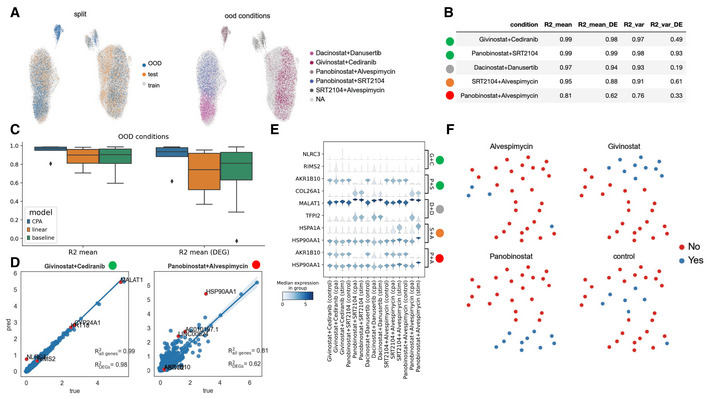
- CPA predicted unseen drug combinations in a new A549 combination dataset (combosciplex, n = 63,378 cells, 32 perturbation/combination conditions), including a held-out Panobinostat + Alvespimycin combination with an R2 of 0.81; it outperformed a random baseline and a linear model.
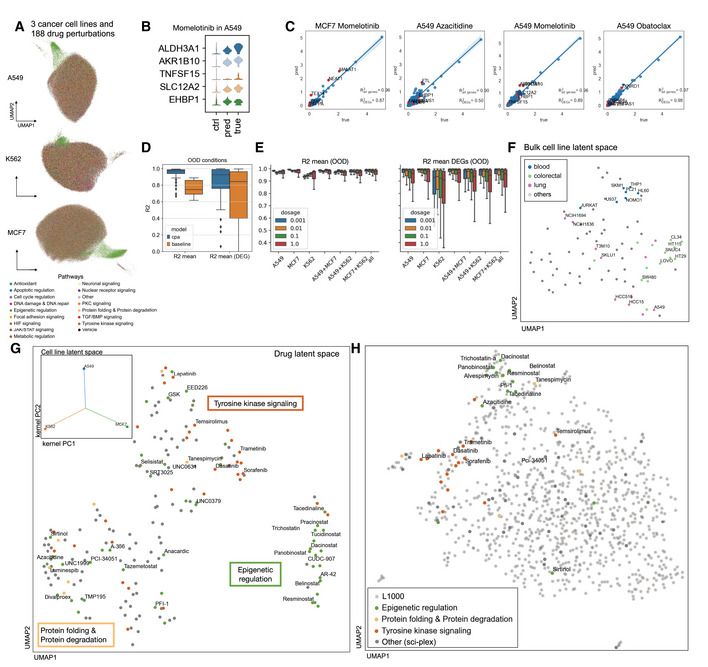
- On sci-Plex3 (n = 290,889 cells; 188 compounds; A549, K562, MCF7; four doses), CPA outperformed scGen by 1.54% on mean prediction and 35.85% on variance prediction, and learned drug embeddings that clustered compounds by mechanism, including epigenetic, tyrosine kinase signaling, and protein formation/degradation pathways.
- In a Perturb-seq genetic screen (108,497 cells; 284 conditions; 131 unique double-gene combinations), CPA imputed 5,329 missing combinations (97.6% of all possibilities); however, a simple baseline performed on par with CPA and linear models for mean whole-transcriptome prediction, suggesting limited nonlinear effects at that level.
- chemCPA, which incorporates chemical descriptors, improved prediction for unseen drugs and combinations; when single-drug Panobinostat observations were held out, median R2 on DEGs dropped from 0.85 to 0.38, but the single-drug Panobinostat effect could still be predicted with high accuracy.
Methods
- CPA is an autoencoder that encodes gene expression into a basal latent state, adversarially removes perturbation and covariate information from that state, then additively composes learned perturbation and covariate embeddings with nonlinear dose/time scalers before decoding to gene expression.
- The model was trained and evaluated on six public datasets plus a newly generated A549 drug-combination dataset; datasets included Kang et al. PBMCs, sci-Plex2, sci-Plex3, Hagai et al. cross-species LPS phagocytes, Norman et al. Perturb-seq, and L1000 bulk data.
- Evaluation used train/test/out-of-distribution splits, R2 on means and variances, Wasserstein distance, clustering metrics, and a distance-based uncertainty score; benchmarks included random baseline, linear baseline, and scGen.
Limitations
- The paper states that CPA will fail if test data are very different from training data, that predictions cannot replace experimental validation, and that the uncertainty score is a condition-level heuristic rather than a cell-specific or Bayesian uncertainty estimate.
- The paper notes that CPA is deterministic, uses gene expression alone, cannot directly capture post-transcriptional, signaling, or cell-communication effects, and may require systematic hyperparameter sweeping for best performance.
- The text makes evident that CPA cannot predict completely unseen drugs without an extension such as chemCPA, and that some held-out combinations, such as Alvespimycin + Panobinostat, showed distribution shifts that neither CPA nor chemCPA fully identified (R2 about 0.3 on DEGs).
Model-written summary. Check it against the paper before relying on it.
Integrity signals
Registry
Cites
Statistics
Figures



Verification
Claims the paper makes
4 Valid · 0 Not valid · 11 Not checked · 91 Own results and interpretations
The cited sources support only part of this claim — read each source’s verdict below.
In the paper
“We further evaluated CPA to predict a previously reported (Norman et al, 2019) genetic epistatic interaction between DUSP9 and ETS1, leading to domination of the DUSP9 phenotype in doubly perturbed cells (Fig 5C).”
§ Predicting cellular responses to complex perturbations in high‐throughput screens > Results > CPA allows modeling combinatorial genetic perturbations
What the sources say
- Partly supportedcites Norman et al, 2019 sourceExperimental — accuracy not yet measured
In “Ordering genes into linear pathways using Perturb-seq” (Fig. 5A; page not provided), the source reports that the DUSP9 phenotype dominated in a double perturbation, but the partner was ETS2, not ETS1. The sentence’s statement about what CPA predicted is the citing authors’ own result, not a finding attributed to this source. (LLM, conf=0.88)
plainstates a cause- Asserted: passes — The authors put it forward as true.
- Checkable: passes — It can be checked against evidence.
- Load-bearing: passes — The paper’s conclusions depend on it.
- Based: passes — The paper gives a reason why it holds.
- Partly supported
Every source the paper cites for this claim was checked and supports it.
In the paper
“Furthermore, we observed that chemCPA generalized particularly well for compounds that belonged to the histone deacetylation pathway (Fig 4C), which is in line with the original sci‐Plex publication (Srivatsan et al, 2020) and general support within this perturbation dataset.”
§ Predicting cellular responses to complex perturbations in high‐throughput screens > Results > CPA is an extensible framework for predicting single‐cell perturbations
What the sources say
- Supportedcites Srivatsan et al, 2020 source
The cited sci-Plex paper does not evaluate chemCPA; the citing authors present that as their own observation. The citation supports the stated alignment with sci-Plex: the Results section, “Inference of chemical and mechanistic properties of HDAC inhibitors” (page not available), identifies HDAC inhibitors as the most prominent compound-response group across three cell lines and describes a consensus response trajectory. (LLM, conf=0.87)
boostedstates an association- Asserted: passes — The authors put it forward as true.
- Checkable: passes — It can be checked against evidence.
- Load-bearing: unclear — It is unclear whether the paper’s conclusions depend on it.
- Based: passes — The paper gives a reason why it holds.
- Supported
Every source the paper cites for this claim was checked and supports it.
In the paper
“Overexpression of both CBL and CNN1 up‐regulate known gene markers (Norman et al, 2019) such as hemoglobins (see HBA1/2 and HBG1/2 in Fig 5B).”
§ Predicting cellular responses to complex perturbations in high‐throughput screens > Results > CPA allows modeling combinatorial genetic perturbations
What the sources say
- Supportedcites Norman et al, 2019 source
The section 'Constructing a GI manifold reveals biological processes driving GIs' (p. ~4) states that overexpression of CBL and CNN1 caused strong induction of canonical erythroid markers, specifically hemoglobin genes (6-39-fold), plus SLC25A37 and GYPA. This matches the claim that overexpressing CBL and CNN1 up-regulates known gene markers such as hemoglobins; the same passage also notes the effect in the HUDEP2 erythroid progenitor model. (LLM, conf=0.92)
plainstates a cause- Asserted: passes — The authors put it forward as true.
- Checkable: passes — It can be checked against evidence.
- Load-bearing: passes — The paper’s conclusions depend on it.
- Based: passes — The paper gives a reason why it holds.
- Supported
A result the paper states — it cites no source for it, so there is none to check. The quote shows it is in the paper.
In the paper
“Crucially, the latent representation that the CPA encoder learns about a cell's basal state is disentangled from (does not contain information about) the embeddings corresponding to the perturbation and the covariates.”
§ Predicting cellular responses to complex perturbations in high‐throughput screens > Results > Compositional perturbation autoencoder (CPA)
plain- Asserted: passes — The authors put it forward as true.
- Checkable: passes — It can be checked against evidence.
- Load-bearing: passes — The paper’s conclusions depend on it.
- Based: passes — The paper gives a reason why it holds.
- Rests on an assumption not shown here.
A result the paper reports from its own data — it cites no other source for it, so there is none to check. The quote shows it is in the paper.
In the paper
“Compositional perturbation autoencoder performs worse when predicting experiments with more unseen covariates.”
§ Predicting cellular responses to complex perturbations in high‐throughput screens > Results > CPA finds interpretable latent spaces in large‐scale single‐cell high‐throughput screens
plainstates a causen = 3- Asserted: passes — The authors put it forward as true.
- Checkable: passes — It can be checked against evidence.
- Load-bearing: passes — The paper’s conclusions depend on it.
- Based: passes — The paper gives a reason why it holds.
53 more claims
Create a free account to see all 106 claims and to verify the 12 references still open.
- It may state two separate claims as one. 37
- Probably not a substantial claim. 13
Claims other papers make about this one
Each is checked against this paper’s own text: does it say what the citing paper says it does?
The source backs part of the claim, not all of it — or backs it for a different population, condition or comparison.
In the citing paper
“There are a number of existing methods that perform perturbation-effect analysis in single-cell omics data, but none of them achieve guaranteed confounder identification, which is a necessary condition for interpretable causal-effect estimation.”
From Causal identification of single-cell experimental perturbation effects with CINEMA-OT (2023) · cites this paper as [23]
Experimental — accuracy not yet measuredThe check wasn’t confident either way, so it gives no verdict — never disputed.
In the citing paper
“We acknowledge a lack of strong correlation between the magnitude of PICALM alteration and its functional effects in CRISPR-engineered iMGs, probably due to technical variations in iMG differentiation and/or the nonlinear relationship between gene expression and cellular phenotypes due to epistasis and systems buffering54,55.”
From PICALM Alzheimer’s risk allele causes aberrant lipid droplets in microglia (2025) · cites this paper as [55]
Experimental — accuracy not yet measuredIn the citing paper
“An extension of CPA called chemCPA [54] introduces into the autoencoder architecture a perturbation network that encodes small molecules using their known chemical descriptors, thus enabling extrapolations to unseen drugs.”
From A mini-review on perturbation modelling across single-cell omic modalities (2024) · cites this paper as [54]
Self-check
Percentages, sums and reported differences re-computed from the paper’s own numbers.
Each contradiction between two passages listed here was confirmed by an independent check.
Rated minor: it would not touch a result — a value no result rests on, a p-value that stays on the same side of the significance level, or a conflict that is clerical, resolved elsewhere in the paper, or outside its own findings.
In the paper
“Using the same set of compounds tested in the sci‐Plex dataset together with 853 other compounds (for a total of 1,000 compounds)”
§ Predicting cellular responses to complex perturbations in high‐throughput screens > Results > CPA finds interpretable latent spaces in large‐scale single‐cell high‐throughput screens
Reported 1000 · recomputed 1041
Rated minor: it would not touch a result — a value no result rests on, a p-value that stays on the same side of the significance level, or a conflict that is clerical, resolved elsewhere in the paper, or outside its own findings.
In the paper
§ Predicting cellular responses to complex perturbations in high‐throughput screens > Materials and Methods > Methods and Protocols
“We generated a novel validation dataset of 32 samples containing combinations of 13 compounds selected from the 188 compounds in sci‐Plex 2 (Srivatsan et al, 2020).”
§ Predicting cellular responses to complex perturbations in high‐throughput screens > Results > CPA allows predictive and exploratory analyses of single‐cell perturbation experiments
“Sciplex2 from Srivatsan et al (2020) contains measurements of a human lung adenocarcinoma cell line (A549) treated with four drug perturbations at increasing dosages (Appendix Fig S4A).”
Rated minor: it would not touch a result — a value no result rests on, a p-value that stays on the same side of the significance level, or a conflict that is clerical, resolved elsewhere in the paper, or outside its own findings.
In the paper
§ Predicting cellular responses to complex perturbations in high‐throughput screens > Results > CPA finds interpretable latent spaces in large‐scale single‐cell high‐throughput screens
“UMAP representation of sci‐Plex samples (n = 290,889) of A549, K562, and MCF7 cell‐lines”
§ Predicting cellular responses to complex perturbations in high‐throughput screens > Materials and Methods > Methods and Protocols
“The data was subset to half its size, reducing it to 290,888 cells.”
Citations
Cites
(2008) · Journal of Machine Learning Research · Cited by 33,051
Distributed Representations of Words and Phrases and their Compositionality
Mikolov, T., Sutskever, I., Chen, K., Corrado, G., & Dean, J. (2013) · arXiv · doi:10.48550/arxiv.1310.4546 · Cited by 24,533 · cited 1×
“We introduce the CPA (see Materials and Methods), a method combining ideas from natural language processing (preprint: Mikolov et al , 2013) and computer vision (preprint: Radford et al , 2015; Lample et al , 2017) to predict the effects of combinations of perturbations on single-cell gene…”
MethodComprehensive Integration of Single-Cell Data
Stuart, T., Butler, A., Hoffman, P., Hafemeister, C., Papalexi, E., Mauck, W. M., Hao, Y., Stoeckius, M., Smibert, P., & Satija, R. (2019) · Cell · doi:10.1016/j.cell.2019.05.031 · Cited by 15,453
Advances in Neural Information Processing Systems 29
Teymur, O., Zygalakis, K., & Calderhead, B. (2016) · Cited by 13,887
Unsupervised representation learning with deep convolutional generative adversarial networks
Radford, A., Metz, L., & Chintala, S. (2015) · arXiv · doi:10.48550/arxiv.1511.06434 · Cited by 12,235
UMAP: Uniform Manifold Approximation and Projection
McInnes, L., Healy, J., Saul, N., & Großberger, L. (2018) · Journal of Open Source Software · doi:10.21105/joss.00861 · Cited by 9,826
SCANPY: large-scale single-cell gene expression data analysis
Wolf, F. A., Angerer, P., & Theis, F. J. (2018) · Genome Biology · doi:10.1186/s13059-017-1382-0 · Cited by 8,881
Self-citationUMAP: Uniform Manifold Approximation and Projection for Dimension Reduction
McInnes, L., Healy, J., & Melville, J. (2018) · arXiv · doi:10.48550/arxiv.1802.03426 · Cited by 7,101
Deep generative modeling for single-cell transcriptomics
Lopez, R., Regier, J., Cole, M. B., Jordan, M. I., & Yosef, N. (2018) · Nature Methods · doi:10.1038/s41592-018-0229-2 · Cited by 2,530
Slide-seq: A scalable technology for measuring genome-wide expression at high spatial resolution
Rodriques, S. G., Stickels, R. R., Goeva, A., Martin, C. A., Murray, E., Vanderburg, C. R., Welch, J., Chen, L. M., Chen, F., & Macosko, E. Z. (2019) · Science · doi:10.1126/science.aaw1219 · Cited by 2,424
Research works printed but not linked: 6
- Gal Y, Ghahramani Z (2016) Dropout as a bayesian approximation: representing model uncertainty in deep learning. In International Conference on Machine Learning, pp 1050–1059. PMLR
- Goodfellow I, Bengio Y, Courville A, Bengio Y (2016) Deep learning. Cambridge: MIT Press
- Hetzel L, Böhm S, Kilbertus N, Günnemann S, Lotfollahi M, Theis FJ (2022) Predicting cellular responses to novel drug perturbations at a single‐cell resolution. In NeurIPS 2022
- Landrum G (2006) RDKit: Open source cheminformatics https://www.rdkit.org
- Sohn K, Lee H, Yan X (2015) Learning structured output representation using deep conditional generative models. In Advances in Neural Information Processing Systems 28, Cortes C, Lawrence ND, Lee DD, Sugiyama M, Garnett R (eds), pp 3483–3491. New York, NY: Curran Associates, Inc
- Zhao J, Kim Y, Zhang K, Rush A, LeCun Y (2018) Adversarially regularized autoencoders. In International Conference on Machine Learning, pp 5902–5911. PMLR
Cited by
scGPT: Towards Building a Foundation Model for Single-Cell Multi-omics Using Generative AI
Cui, H., Wang, C., Maan, H., Pang, K., Luo, F., & Wang, B. (2023) · doi:10.1101/2023.04.30.538439 · Cited by 1,694
“We conducted a performance comparison between scGPT and two other recent methods, GEARS [38] and CPA [39].”
MethodInfluentialBest practices for single-cell analysis across modalities
Heumos, L., Schaar, A. C., Lance, C., Litinetskaya, A., Drost, F., Zappia, L., Lücken, M. D., Strobl, D. C., Henao, J., Curion, F., et al. (2023) · Nature Reviews Genetics · doi:10.1038/s41576-023-00586-w · Cited by 1,051
Self-citationLarge-scale foundation model on single-cell transcriptomics
Hao, M., Gong, J., Zeng, X., Liu, C., Guo, Y., Cheng, X., Wang, T., Ma, J., Zhang, X., & Song, L. (2024) · Nature Methods · doi:10.1038/s41592-024-02305-7 · Cited by 628
How to build the virtual cell with artificial intelligence: Priorities and opportunities
Bunne, C., Roohani, Y., Rosen, Y., Gupta, A., Zhang, X., Roed, M., Alexandrov, T., AlQuraishi, M., Brennan, P., Burkhardt, D. B., et al. (2024) · Cell · doi:10.1016/j.cell.2024.11.015 · Cited by 393
Self-citationPredicting transcriptional outcomes of novel multigene perturbations with GEARS
Roohani, Y., Huang, K., & Leskovec, J. (2024) · Nature Biotechnology · doi:10.1038/s41587-023-01905-6 · Cited by 355
Metadata
- Authors
- Lotfollahi, M., Klimovskaia Susmelj, A., De Donno, C., Hetzel, L., Ji, Y., Ibarra, I. L., Srivatsan, S. R., Naghipourfar, M., Daza, R. M., Martin, B., Shendure, J., McFaline‐Figueroa, J. L., Boyeau, P., Wolf, F. A., Yakubova, N., Günnemann, S., Trapnell, C., Lopez‐Paz, D., & Theis, F. J.
- Affiliations
- Wellcome Sanger Institute (GB)
- Helmholtz Munich (DE)
- University of Washington (US)
- University of California, Berkeley (US)
- Howard Hughes Medical Institute (US)
- Technical University of Munich (DE)
- Corresponding author
- Theis, Fabian J
- ORCID
- Venue
- Molecular Systems Biology
- Published
- 2023-05-08
- Volume
- 19
- Issue
- 6
- Pages
- e11517-e11517
- ISSN
- 1744-4292 (ISSN-L)
- PMC
- PMC10258562
- OpenAlex
- W4375955255
- Cited by
- 307
- References
- 50
- Citations by year
- 2026: 118 · 2025: 97 · 2024: 71 · 2023: 19
- FWCI
- 26.94
- Type
- journal article
- Language
- en
- Open access
- gold
- doi.org
- Licence
- other-oa
- creativecommons.org/licenses/by/4.0/ (tdm)
- creativecommons.org/licenses/by/4.0/ (vor)
- Locations
- Molecular Systems Biology (publishedVersion, other-oa)
- PubMed Central (publishedVersion, cc-by)
- PubMed (publishedVersion)
- eScholarship (California Digital Library) (submittedVersion, other-oa)
- DOAJ (DOAJ: Directory of Open Access Journals) (submittedVersion, cc-by-sa)
- PuSH - Publication Server of Helmholtz Zentrum München (submittedVersion, cc-by)
- Funders
- Bundesministerium für Bildung und Forschung (L031L0214A, 01IS18036A, 01IS18053A)
- Chan Zuckerberg Initiative (2018‐182835, 2019‐207271)
- EC | Horizon 2020 Framework Programme (874656)
- Helmholtz Association (ZT‐I‐0007, ZT‐I‐PF‐5‐01)
- Topics
- Life Sciences › Biochemistry, Genetics and Molecular Biology › Molecular Biology › Single-cell and spatial transcriptomics
- Life Sciences › Biochemistry, Genetics and Molecular Biology › Molecular Biology › Gene Regulatory Network Analysis
- Life Sciences › Pharmacology, Toxicology and Pharmaceutics › Drug Discovery › Computational Drug Discovery Methods
- Keywords
- single-cell transcriptomics, Perturb-seq, chemical representation
- MeSH terms
- Single-Cell Gene Expression Analysis, Computational Biology, Gene Expression Profiling, High-Throughput Screening Assays
About these checks
Registry, retraction, Cites and statistics results are computed, not judged, with one exception: a printed reference that no index lists is read once by a model before it counts as a citation error. Claims are extracted by a model and kept only when their quote appears verbatim in the text; each cited source is then checked, with a model’s help, for whether it says what the claim relies on. Those verdicts can be wrong — read the claim’s quote and the cited source before relying on one.
The claim verdicts this report counts are experimental: their accuracy is not yet measured.
A language model drew the claims from the paper on 2026-10-05, under version 3 of the claim definition (model deepseek-v4.1-flash, prompt extract-v3).
A second model labelled each claim on 2026-10-05 (model jev-1.13-20260917, definition revision gold-guideline-v0.2).
Cited sources are checked with a language model’s help (gpt-6-sol and qwen3.8-omni-flash).
Statistics and arithmetic are recomputed, not judged.
Confidence bands are shown only for fields calibrated on our annotated test set. None is calibrated yet, so no band is shown.
What counts as a claim ›How we measure confidence ›How we check this ›
Are you an author, or do you see a problem with this page? Request a review
How to cite
Cite CoChat for the checks on this page, and the paper for its own findings.
- This page
- CoChat. (2026). Citation check: Predicting cellular responses to complex perturbations in high‐throughput screens. https://app.cochat.ai/papers/10.15252/msb.202211517
- The paper
- Lotfollahi, M., Klimovskaia Susmelj, A., De Donno, C., Hetzel, L., Ji, Y., Ibarra, I. L., Srivatsan, S. R., Naghipourfar, M., Daza, R. M., Martin, B., Shendure, J., McFaline‐Figueroa, J. L., Boyeau, P., Wolf, F. A., Yakubova, N., Günnemann, S., Trapnell, C., Lopez‐Paz, D., & Theis, F. J. (2023). Predicting cellular responses to complex perturbations in high‐throughput screens. Molecular Systems Biology. https://doi.org/10.15252/msb.202211517
Data sources
Bibliographic data: Semantic Scholar, OpenAlex, Crossref.
Contains information from the Semantic Scholar Academic Graph Datasets, made available under the ODC Attribution License (ODC-BY 1.0).
Semantic Scholar’s data is described in: Kinney, R., et al. (2023). The Semantic Scholar Open Data Platform. arXiv:2301.10140.
