

Multimodal cue integration and learning in a neural representation of head direction
Open accessThe DOI matches its Crossref record; 71 of the 74 references it cites were found in a registry or an index; 38 of the 68 sources its claims cite were checked for support.
Abstract
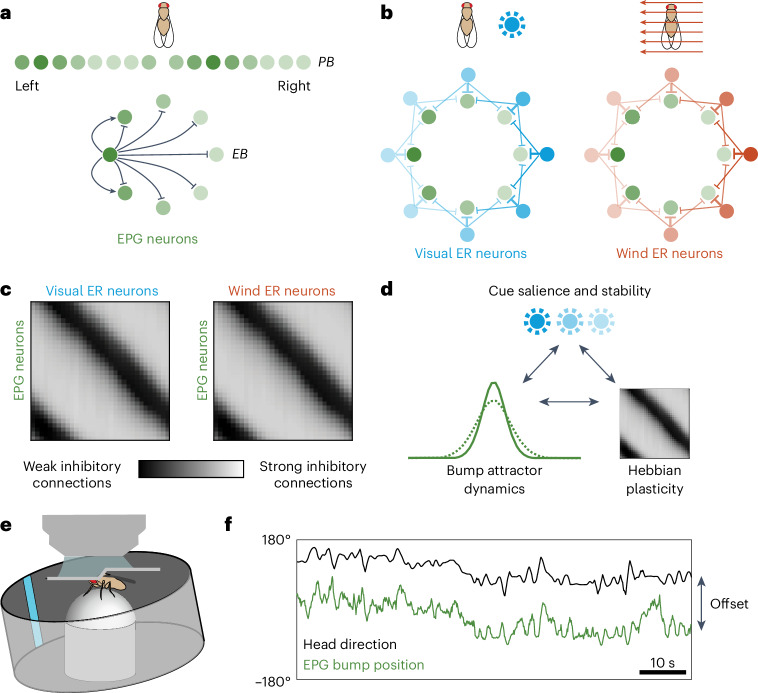
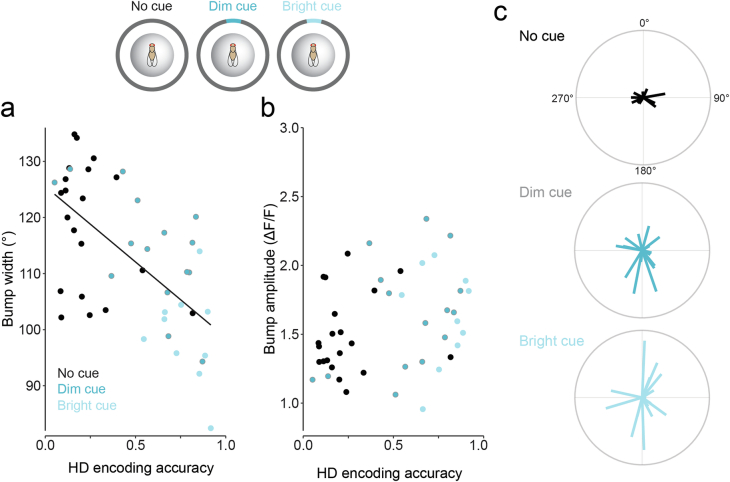
Navigation requires us to take account of multiple spatial cues with varying levels of informativeness and learn their spatial relationships. Here we investigate this process in the Drosophila head direction system, which functions as a ring attractor and a topographic map of head direction. Using population calcium imaging and multimodal virtual reality environments, we show that increasing cue informativeness improves encoding accuracy and produces a narrower and higher bump of activity. When cues conflict, the more informative cue exerts more weight. A familiar cue is weighted more heavily and used to guide the remapping of a less familiar cue. When a cue is less informative, it is remapped more readily in response to cue conflict. All these results can be explained by an attractor model with plastic sensory synapses. Our findings provide a mechanistic explanation for how the brain assembles spatial representations through inference and learning.
Overview
CoChat Summary
TL;DR
In the Drosophila head direction system, increasing cue intensity improves HD encoding accuracy and changes the bump profile, while more informative or familiar cues are weighted more heavily and guide remapping of less familiar cues. A ring attractor model with plastic sensory synapses reproduces these effects and highlights a stability–flexibility tradeoff.
Key findings
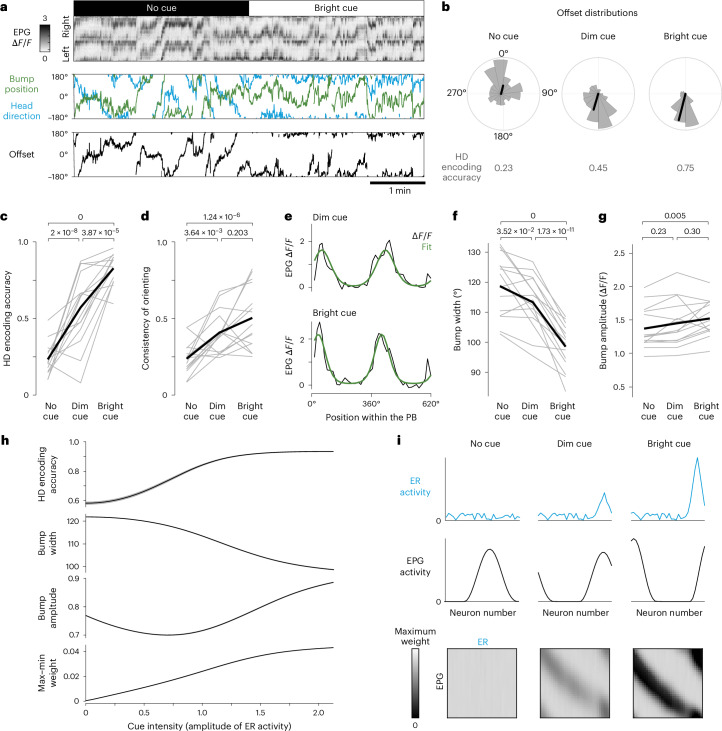
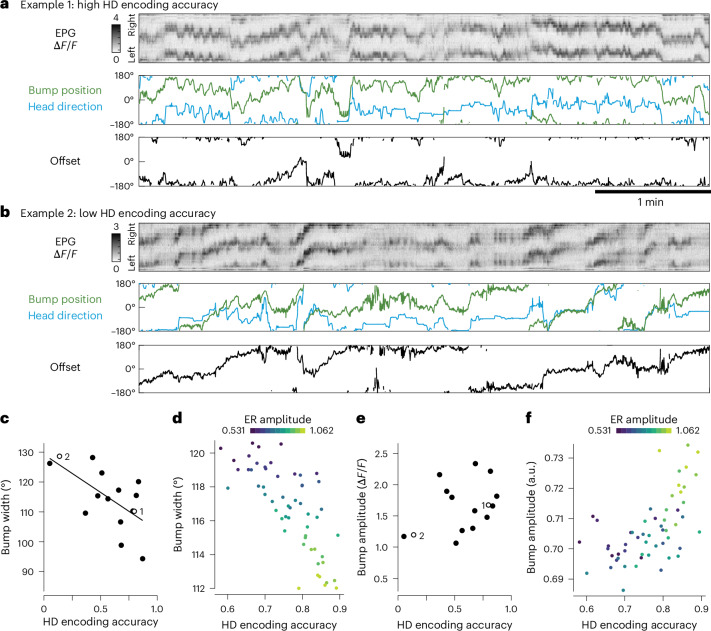
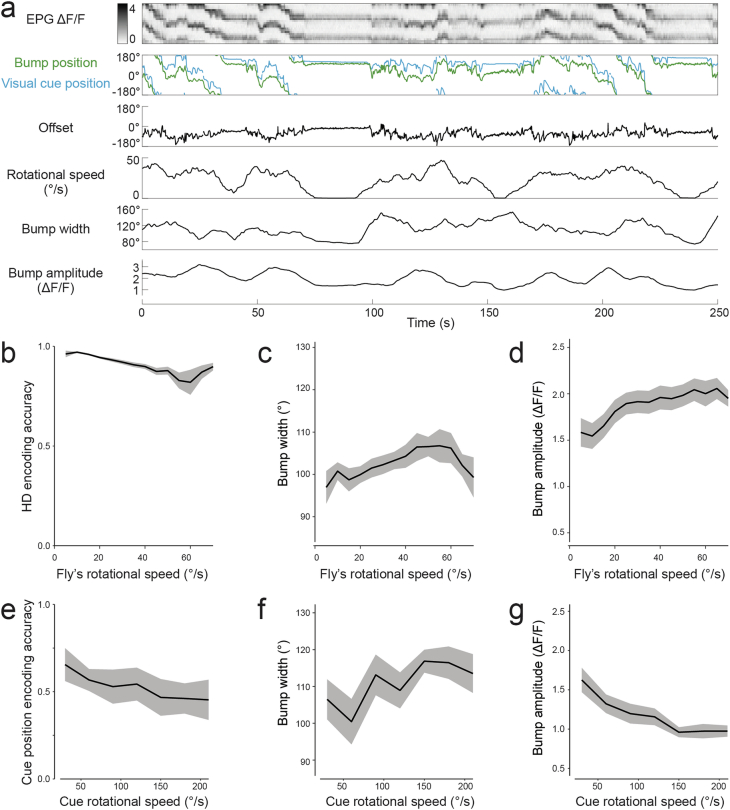
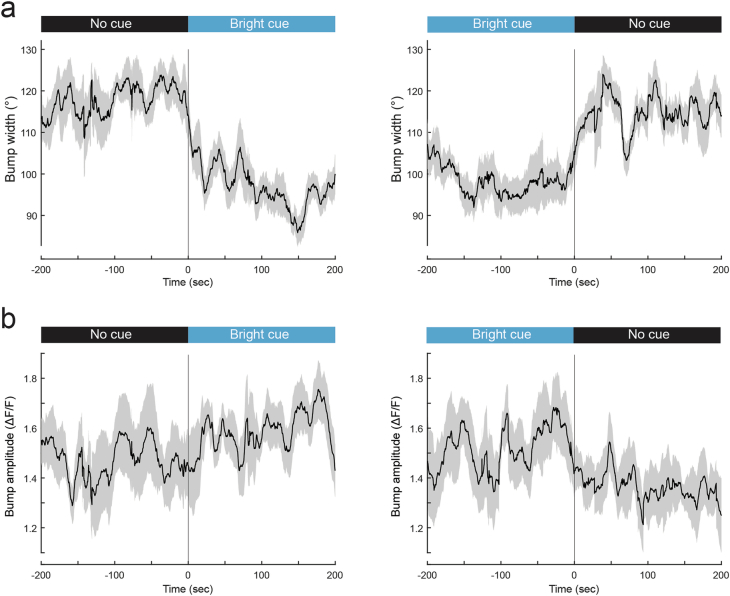
- Increasing visual cue intensity progressively improved HD encoding accuracy, narrowed the EPG bump, and increased bump amplitude at the highest intensity (15 flies); the model explains this via inhibitory ER input plus a Hebbian LTD notch in ER→EPG weights.
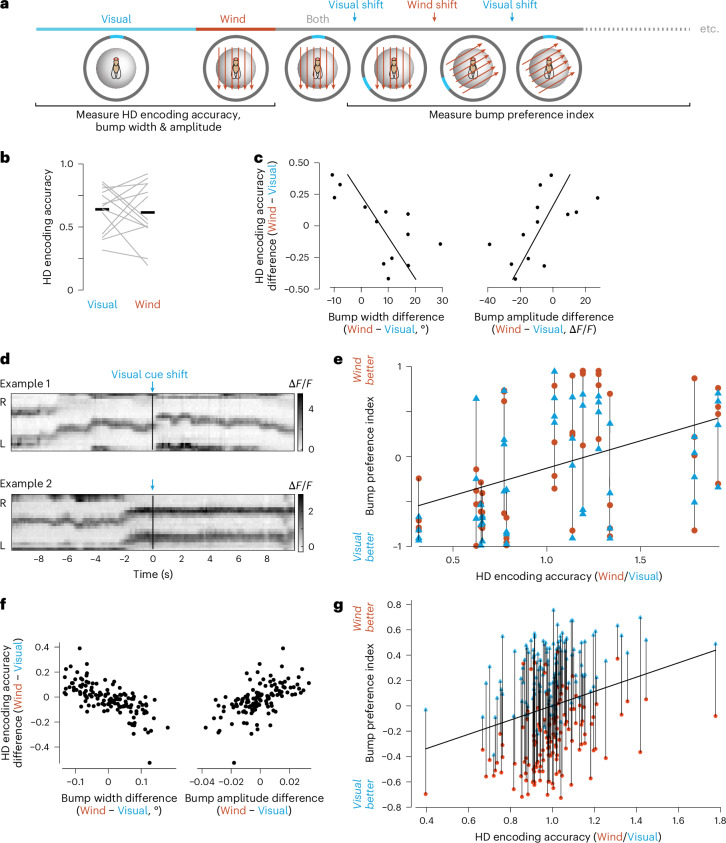
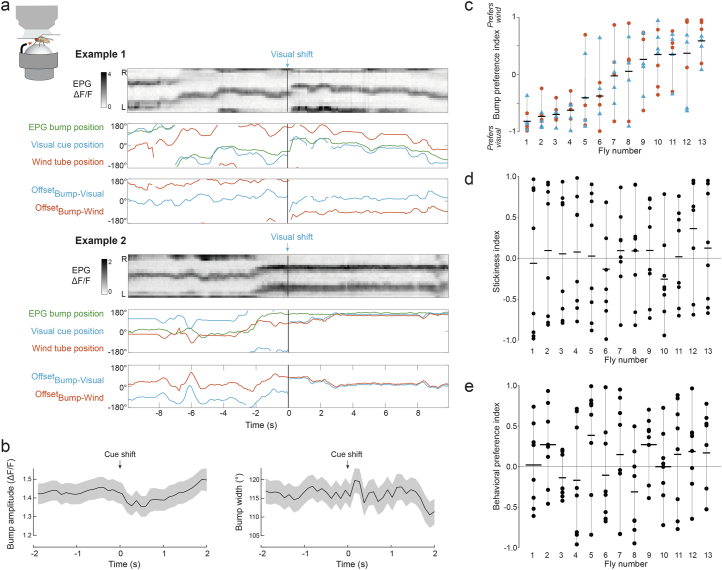
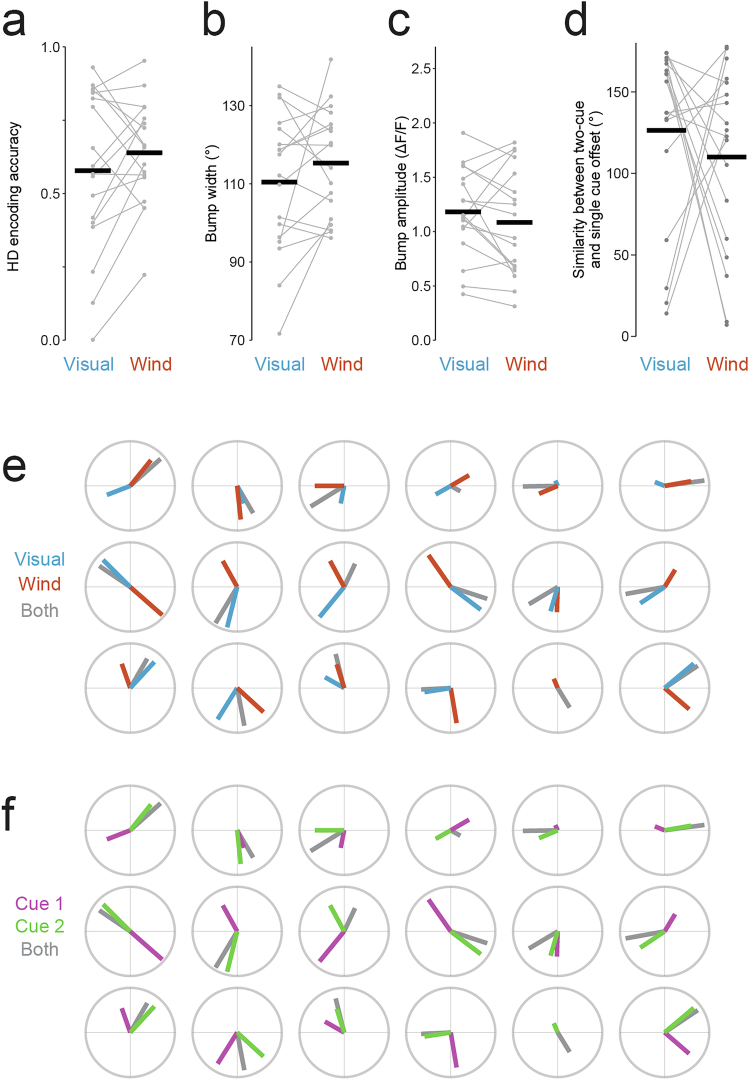
- With conflicting visual and wind cues, the cue that produced better HD encoding when presented alone was generally weighted more. Across 13 flies, mean single-cue accuracy was similar (P = 0.76), but accuracy differences correlated with bump width differences (R² = −0.68, P = 0.01) and bump amplitude differences (R² = 0.58, P = 0.04); bump preference index correlated with relative HD encoding accuracy (P = 0.03).
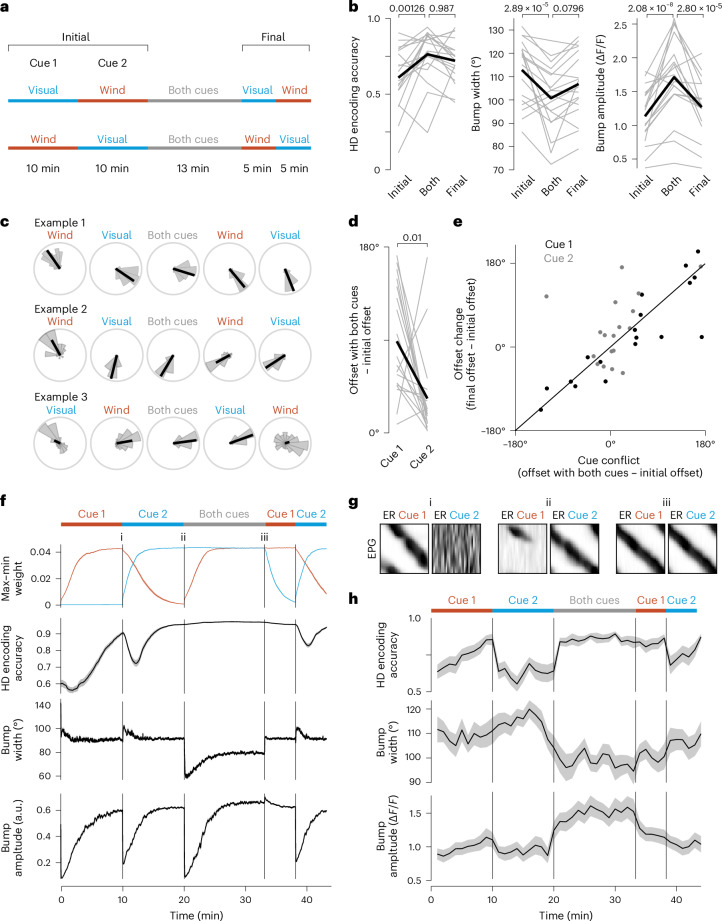
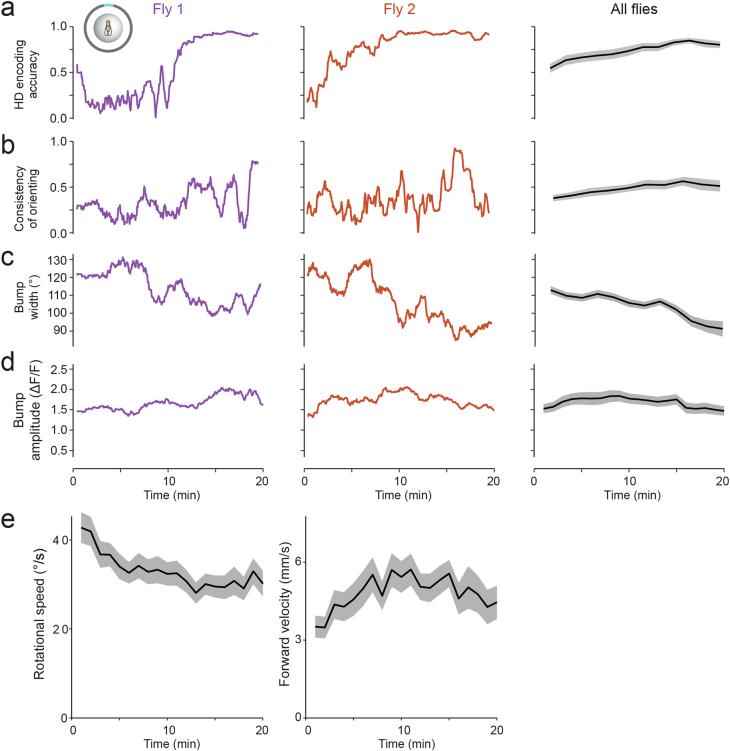
- A stable two-cue configuration (18 flies) increased HD encoding accuracy and produced a narrower, higher-amplitude bump; the more recently familiar cue retained its offset and instructed remapping of the less familiar cue, with offset change predicted by cue conflict.
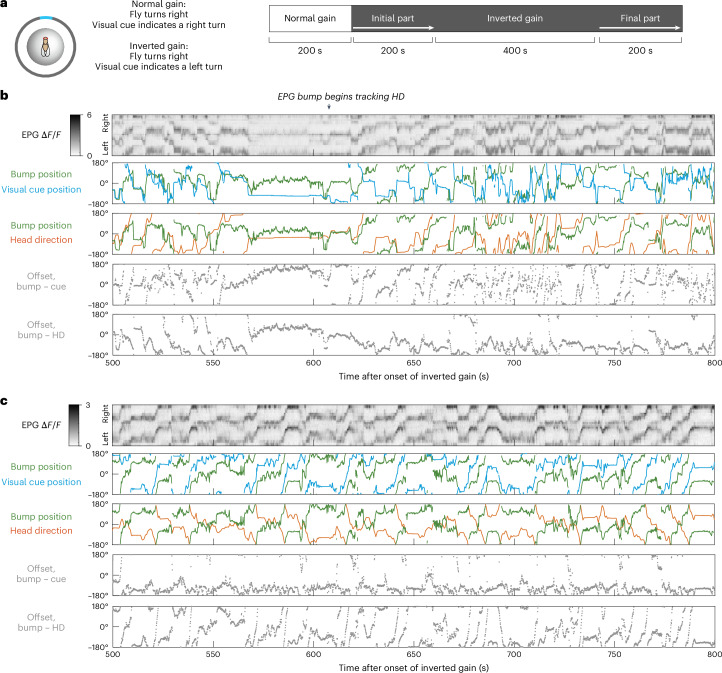
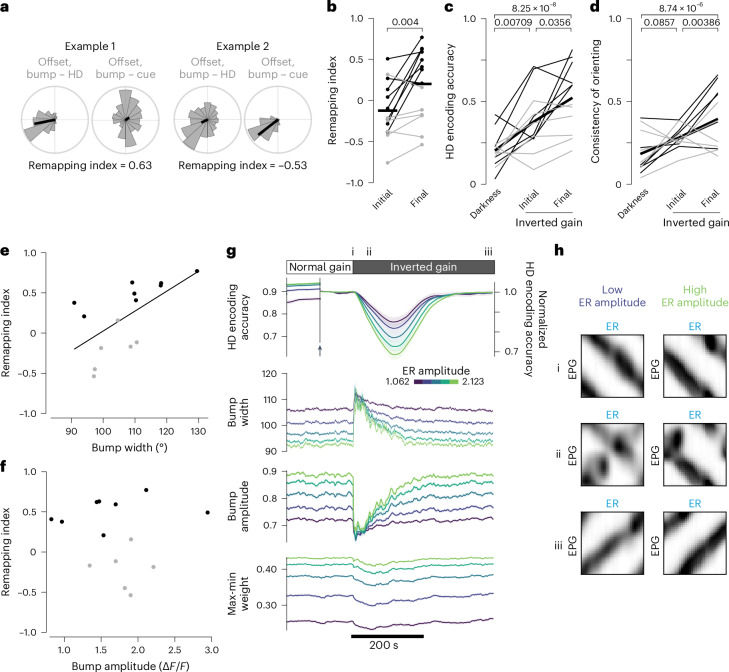
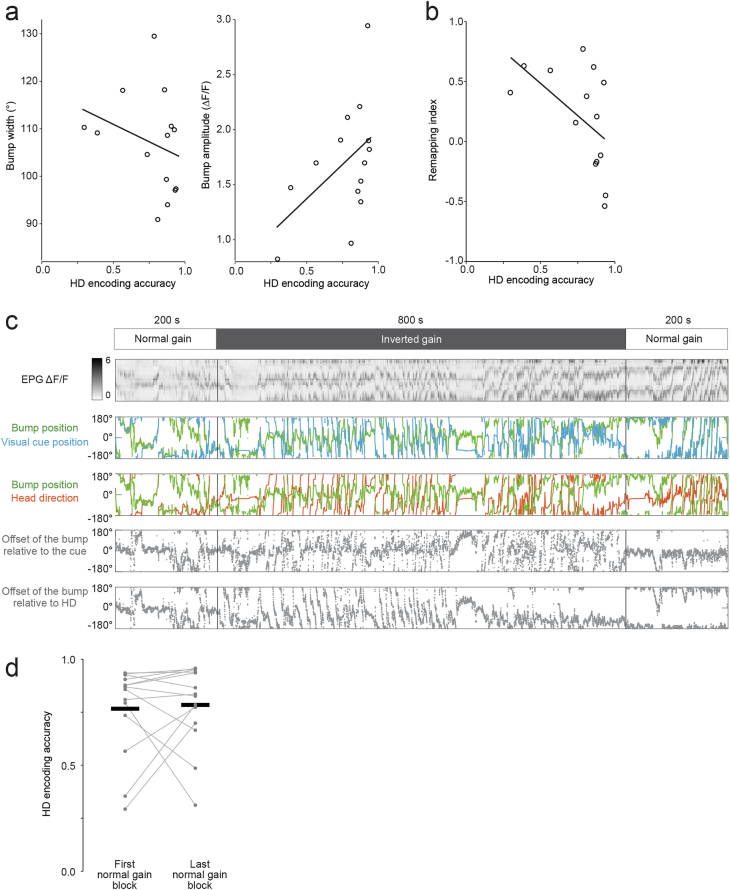
- In an inverted-gain task, some flies learned to invert the visual cue mapping; remapping index was higher in the final versus initial inverted-gain block, and final remapping was predicted by wider bumps in the preceding normal-gain block (P = 0.02) but not by bump amplitude (P = 0.79) (14 flies; 12 for accuracy/orientation because two lacked a darkness trial).
Methods
- Head-fixed Drosophila melanogaster (1-day-old virgin females) expressing jGCaMP7f in EPG neurons were imaged with two-photon calcium imaging while walking on a spherical treadmill; visual cues were presented on a 360° LED panorama and wind cues via a rotating air nozzle in closed loop.
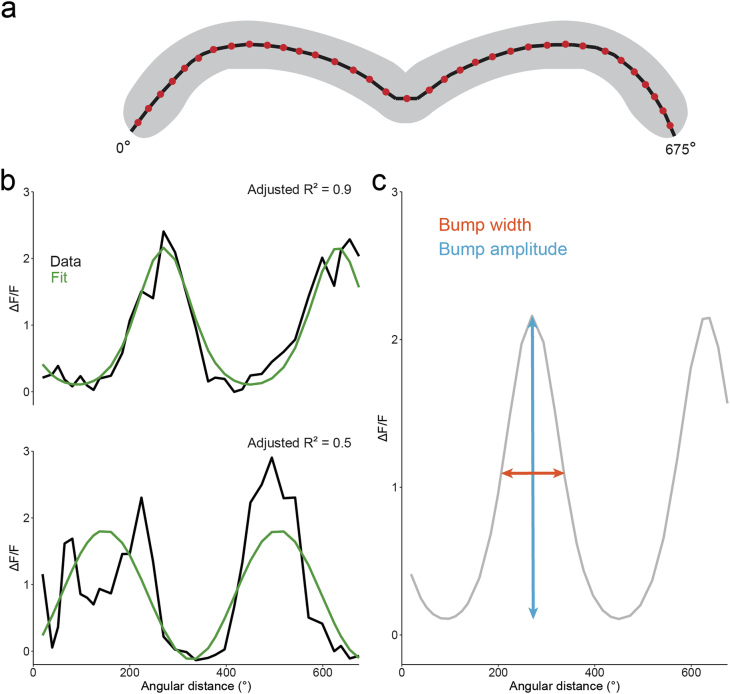
- Bump position, width, and amplitude were estimated with von Mises fits; HD encoding accuracy was defined as 1 − circular variance of the bump–HD offset. Analyses used linear mixed-effects models with Tukey/Bonferroni corrections, Wilcoxon tests, Pearson correlations, and Bayesian fitting for offset changes.
- A ring attractor model with ER→EPG synaptic plasticity (associative LTD and nonassociative LTP) was simulated, with variations in ER input amplitude used to reproduce individual differences and remapping behavior.
Limitations
- Stated in the paper: synaptic weights cannot be observed directly and are inferred from bump position and amplitude; the model cannot perform optimal Bayesian inference and does not store certainty about HD, with data implying no persistent bump-amplitude boost after an informative cue. Sample sizes were not predetermined, the experimenter was not blind for the randomized brightness-block order, normality was not formally tested for Tukey/Pearson tests, and starvation times varied by experiment.
- Evident from the text: individual differences and model fits are correlational, with no direct causal manipulation of ER amplitude or synaptic weights; sample sizes are limited (12–18 flies in key experiments), and some effects are trends or non-significant.
Model-written summary. Check it against the paper before relying on it.
Integrity signals
Registry
Cites
Statistics
Figures
Verification
Claims the paper makes
13 Valid · 2 Not valid · 6 Not checked · 104 Own results and interpretations
The cited sources support only part of this claim — read each source’s verdict below.
In the paper
“Here, behavioral reorientation into the wind is likely mediated by pathways for orientation control that bypass the HD system32,33,44”
§ Multimodal cue integration and learning in a neural representation of head direction > Results > More informative cues are accorded more weight
What the sources say
- Partly supportedcites [32] Giraldo, Y. M. et al. Sun navigation requires compass neurons in Drosophila. Curr. Biol. 28, 2845–2852.e4 (2018). 30174187 PMC7301569 sourceExperimental — accuracy not yet measured
The Discussion (page unavailable) proposes that reflexive phototaxis may not require central-complex compass circuitry, and the Results report that flies with silenced E-PG compass neurons could still fixate visual stimuli frontally. This supports the possibility of compass-independent orientation, but the paper does not test reorientation into the wind or identify the pathways mediating it. (LLM, conf=0.82)
- Could not verifycites [33] Green, J., Vijayan, V., Mussells Pires, P., Adachi, A. & Maimon, G. A neural heading estimate is compared with an internal goal to guide oriented navigation. Nat. Neurosci. 22, 1460–1468 (2019). 31332373 PMC7688015 sourceExperimental — accuracy not yet measured
The Introduction and Results describe heading-neuron-dependent orientation to visual stimuli, not reorientation into the wind. Searches for wind reorientation and pathways bypassing the heading-direction system found no passage addressing either point. (LLM, conf=0.77)
- Partly supportedcites [44] Rayshubskiy, A. et al. Neural circuit mechanisms for steering control in walking Drosophila. eLife 13, RP102230 (2025). 40690376 PMC12279373 sourceExperimental — accuracy not yet measured
The Results (‘Converging brain pathways onto DNa02’; page unavailable) describe stimulus-directed steering pathways outside the central complex, supporting the possibility of orientation control outside the head-direction pathway. But the paper does not examine reorientation into wind or establish that this behavior bypasses the head-direction system. (LLM, conf=0.82)
hedgedstates a possible cause- Asserted: passes — The authors put it forward as true.
- Checkable: passes — It can be checked against evidence.
- Load-bearing: unclear — It is unclear whether the paper’s conclusions depend on it.
- Based: passes — The paper gives a reason why it holds.
- Partly supported
Every source the paper cites for this claim was checked and supports it.
In the paper
“P{R60D05-Gal4}attP2 drives Gal4 expression in EPG neurons, as reported previously34,41, and its construction was described previously61.”
§ Multimodal cue integration and learning in a neural representation of head direction > Methods > Experimental model and subject details
What the sources say
- Supportedcites [34] Seelig, J. D. & Jayaraman, V. Neural dynamics for landmark orientation and angular path integration. Nature 521, 186–191 (2015). 25971509 PMC4704792 source
The Methods (Data analysis) state that the R60D05-Gal4 line labels the EBw.s neurons studied, and the Fly stocks section confirms its use in the imaging experiments. The paper uses the name EBw.s for this neuronal class; the citing sentence attributes the line’s expression pattern, not its construction, to this source. (LLM, conf=0.87)
- Supportedcites [41] Wolff, T., Iyer, N. A. & Rubin, G. M. Neuroarchitecture and neuroanatomy of the Drosophila central complex: a GAL4-based dissection of protocerebral bridge neurons and circuits. J. Comp. Neurol. 523, 997–1037 (2015). 25380328 PMC4407839 source
Table 4 (Results, “Unusual PB cell types”) lists R60D05 as a GAL4 line labeling neurons that connect the protocerebral bridge, ellipsoid body, and gall—the cells described in the claim as EPG neurons. The Figure 9 caption also identifies labeled cells of this type in brains from line R60D05. The paper uses its anatomical cell-type name rather than the abbreviation EPG. (LLM, conf=0.88)
plainstates a cause- Asserted: passes — The authors put it forward as true.
- Checkable: passes — It can be checked against evidence.
- Load-bearing: passes — The paper’s conclusions depend on it.
- Based: passes — The paper gives a reason why it holds.
- Supported
The sources with a verdict support this claim; the rest weren’t checked yet, have no full text we could read, or their verdicts aren’t rated yet.
In the paper
“Importantly, individual variation is not specific to flies; human subjects also show marked idiosyncratic differences in cue weighting during navigation14,55–58.”
§ Multimodal cue integration and learning in a neural representation of head direction > Discussion
What the sources say
- Not checked — no full text of the sourcecites [14] Chen, X., McNamara, T. P., Kelly, J. W. & Wolbers, T. Cue combination in human spatial navigation. Cogn. Psychol. 95, 105–144 (2017). 28478330 source
- Supportedcites [55] Scherer, J. et al. Not seeing the forest for the trees: combination of path integration and landmark cues in human virtual navigation. Front. Behav. Neurosci. 18, 1399716 (2024). 38835838 PMC11148297 source
The Discussion (§4.3) reports large inter-individual differences in how human participants used available objects for navigation. The Conclusion (§4.6) says individual differences in cue use were decisive in high-clutter environments, supporting the claim of marked variation, although the paper does not establish each participant’s exact cue weights. (LLM, conf=0.92)
- Not checked — no full text of the sourcecites [56] Weisberg, S. M. & Newcombe, N. S. How do (some) people make a cognitive map? Routes, places, and working memory. J. Exp. Psychol. Learn. Mem. Cogn. 42, 768–785 (2016). 26595065 source
- Not checked — no full text of the sourcecites [57] Blajenkova, O., Motes, M. A. & Kozhevnikov, M. Individual differences in the representations of novel environments. J. Environ. Psychol. 25, 97–109 (2005). source
- Not checked — no full text of the sourcecites [58] Weisberg, S. M., Schinazi, V. R., Newcombe, N. S., Shipley, T. F. & Epstein, R. A. Variations in cognitive maps: understanding individual differences in navigation. J. Exp. Psychol. Learn. Mem. Cogn. 40, 669–682 (2014). 24364725 source
plain- Asserted: passes — The authors put it forward as true.
- Checkable: passes — It can be checked against evidence.
- Load-bearing: unclear — It is unclear whether the paper’s conclusions depend on it.
- Based: passes — The paper gives a reason why it holds.
The sources with a verdict support this claim; the rest weren’t checked yet, have no full text we could read, or their verdicts aren’t rated yet.
In the paper
“Optimal inference would require the network to store the certainty associated with the network’s HD estimate, for example through some mechanism of persistent activity that boosts bump amplitude after an informative cue is presented, such that bump amplitude remains persistently high for some time after the cue disappears49,50.”
§ Multimodal cue integration and learning in a neural representation of head direction > Discussion
What the sources say
- Supportedcites [49] Kutschireiter, A., Basnak, M. A. & Drugowitsch, J. Bayesian inference in ring attractor networks. Proc. Natl Acad. Sci. USA 120, e2210622120 (2022). PMC9992764 36812206 source
The Discussion says bump amplitude represents certainty in the network’s HD estimate and grows when recent HD observations are more reliable. The Results (Neural Network Implementation of the Circular Kalman Filter) explain that, when new HD observations are unavailable, the bump amplitude decays slowly rather than immediately returning to baseline. This supports the proposed persistence after an informative cue disappears, though the amplitude gradually declines. (LLM, conf=0.90)
- Not checked yetcites [50] Carroll, S., Josić, K. & Kilpatrick, Z. P. Encoding certainty in bump attractors. J. Comput. Neurosci. 37, 29–48 (2014). 24271061 source
Checked before — its earlier verdict is held back until a new check runs.
hedgedstates a possible cause- Asserted: passes — The authors put it forward as true.
- Checkable: passes — It can be checked against evidence.
- Load-bearing: passes — The paper’s conclusions depend on it.
- Based: passes — The paper gives a reason why it holds.
- Supported
The cited sources support only part of this claim — read each source’s verdict below.
In the paper
“Together, these results provide concrete evidence for the theoretical proposal20,21,26–31 that Hebbian plasticity can endow an attractor with the flexibility it needs to support learning about the relative positions of environmental cues and the stability of those cues.”
§ Multimodal cue integration and learning in a neural representation of head direction > Discussion
What the sources say
- Not checked — no full text of the sourcecites [20] Skaggs, W. E., Knierim, J. J., Kudrimoti, H. S. & McNaughton, B. L. A model of the neural basis of the rat’s sense of direction. Adv. Neural Inf. Process. Syst. 7, 173–180 (1995). 11539168
- Supportedcites [21] Page, H. J. I. et al. A theoretical account of cue averaging in the rodent head direction system. Philos. Trans. R. Soc. Lond. B Biol. Sci. 369, 20130283 (2014). 24366143 PMC3866453 source
Split into 2 atoms — 2 confirmed, 0 partially supported, 0 disputed, 0 misattributed, 0 unverifiable. Expand the claim to see per-atom verdicts.
- Partly supportedcites [26] Cope, A. J., Sabo, C., Vasilaki, E., Barron, A. B. & Marshall, J. A. A computational model of the integration of landmarks and motion in the insect central complex. PLoS ONE 12, e0172325 (2017). 28241061 PMC5328262 sourceExperimental — accuracy not yet measured
Split into 2 atoms — 0 confirmed, 2 partially supported, 0 disputed, 0 misattributed, 0 unverifiable. Expand the claim to see per-atom verdicts.
- Partly supportedcites [27] Mitchell, R., Shaverdian, S., Dacke, M. & Webb, B. A model of cue integration as vector summation in the insect brain. Proc. Biol. Sci. 290, 20230767 (2023). 37357865 PMC10291719 sourceExperimental — accuracy not yet measured
The Results section (‘Weight and reliability may independently affect cue influence’; page unavailable) reports that the model’s plastic connections learned the spatial offset between cues. It does not show that they learned cue stability: noise degraded the learned mapping without substantially changing connection strength, and the authors say cue weight does not emerge from reliability. The paper offers modelling results, not direct evidence that a biological attractor learns both properties. (LLM, conf=0.86)
- Not checked yetcites [28] Zhang, K. Representation of spatial orientation by the intrinsic dynamics of the head-direction cell ensemble: a theory. J. Neurosci. 16, 2112–2126 (1996). 8604055 PMC6578512 source
Checked before — its earlier verdict is held back until a new check runs.
- Supportedcites [29] Mulas, M., Waniek, N. & Conradt, J. Hebbian plasticity realigns grid cell activity with external sensory cues in continuous attractor models. Front. Comput. Neurosci. 10, 13 (2016). 26924979 PMC4756165 source
The Introduction (page not provided) reports that the simulations associate a grid pattern with a specific environment and that Hebbian learning can assess the stability of sensory information encoding landmarks. The Discussion (page not provided) describes plastic connections that use location-specific landmark information to correct and realign grid-cell activity. These findings support the attributed theoretical proposal in the context of this computational model. (LLM, conf=0.87)
- Partly supportedcites [30] Keinath, A. T., Epstein, R. A. & Balasubramanian, V. Environmental deformations dynamically shift the grid cell spatial metric. eLife 7, e38169 (2018). 30346272 PMC6203432 sourceExperimental — accuracy not yet measured
The Results (no page supplied) describe a grid-cell attractor model in which Hebbian learning links border inputs to grid phase, allowing familiar phase relationships to be reinstated when a boundary moves. That supports flexibility in representing boundary positions, but the paper does not show learning about the stability of environmental cues. The Discussion also notes that the observed shifts can be reproduced without plasticity, so the results are not concrete evidence that Hebbian plasticity causes those shifts. (LLM, conf=0.85)
- Not checked yetcites [31] Ocko, S. A., Hardcastle, K., Giocomo, L. M. & Ganguli, S. Emergent elasticity in the neural code for space. Proc. Natl Acad. Sci. USA 115, E11798–E11806 (2018). 30482856 PMC6294895 source
Checked before — its earlier verdict is held back until a new check runs.
boostedstates a cause- Asserted: passes — The authors put it forward as true.
- Checkable: passes — It can be checked against evidence.
- Load-bearing: passes — The paper’s conclusions depend on it.
- Based: passes — The paper gives a reason why it holds.
68 more claims
Create a free account to see all 125 claims and to verify the 10 references still open.
- It may state two separate claims as one. 38
- Probably not a substantial claim. 20
Self-check
Percentages, sums and reported differences re-computed from the paper’s own numbers.
Each contradiction between two passages listed here was confirmed by an independent check.
Rated minor: it would not touch a result — a value no result rests on, a p-value that stays on the same side of the significance level, or a conflict that is clerical, resolved elsewhere in the paper, or outside its own findings.
In the paper
“R2 = −0.68, P = 0.01, Pearson correlation”
§ Multimodal cue integration and learning in a neural representation of head direction > Results > More informative cues are accorded more weight
Reported -0.68 · recomputed 0.4624
Rated minor: it would not touch a result — a value no result rests on, a p-value that stays on the same side of the significance level, or a conflict that is clerical, resolved elsewhere in the paper, or outside its own findings.
In the paper
“11 values of from 0 to 1 in steps of 0.05”
§ Multimodal cue integration and learning in a neural representation of head direction > Methods > Network model
Reported 11 · recomputed 20
Rated minor: it would not touch a result — a value no result rests on, a p-value that stays on the same side of the significance level, or a conflict that is clerical, resolved elsewhere in the paper, or outside its own findings.
In the paper
§ Multimodal cue integration and learning in a neural representation of head direction > Methods > Fly selection and housing
“Before the experiment, flies were starved for 0–24 h on a piece of damp laboratory tissue (Kimtech).”
§ Multimodal cue integration and learning in a neural representation of head direction > Methods > Fly selection and housing
“Figs. 6 and 7 and Extended Data Fig. 6: 18–27 h”
Citations
Cites
Stan : A Probabilistic Programming Language
Carpenter, B., Gelman, A., Hoffman, M. D., Lee, D., Goodrich, B., Betancourt, M., Brubaker, M., Guo, J., Li, P., & Riddell, A. (2017) · Journal of Statistical Software · doi:10.18637/jss.v076.i01 · Cited by 7,754
Humans integrate visual and haptic information in a statistically optimal fashion
Ernst, M. O., & Banks, M. S. (2002) · Nature · doi:10.1038/415429a · Cited by 4,844
Simultaneous localization and mapping: part I
Durrant-Whyte, H., & Bailey, T. (2006) · IEEE Robotics & Automation Magazine · doi:10.1109/mra.2006.1638022 · Cited by 4,199
The Ventriloquist Effect Results from Near-Optimal Bimodal Integration
Alais, D., & Burr, D. (2004) · Current Biology · doi:10.1016/j.cub.2004.01.029 · Cited by 1,936
A GAL4-Driver Line Resource for Drosophila Neurobiology
Jenett, A., Rubin, G. M., Ngo, T.-T. B., Shepherd, D., Murphy, C., Dionne, H., Pfeiffer, B. D., Cavallaro, A., Hall, D., Jeter, J., et al. (2012) · Cell Reports · doi:10.1016/j.celrep.2012.09.011 · Cited by 1,449
ScanImage: Flexible software for operating laser scanning microscopes
Pologruto, T. A., Sabatini, B. L., & Svoboda, K. (2003) · BioMedical Engineering OnLine · doi:10.1186/1475-925x-2-13 · Cited by 1,294
High-performance calcium sensors for imaging activity in neuronal populations and microcompartments
Dana, H., Sun, Y., Mohar, B., Hulse, B. K., Kerlin, A. M., Hasseman, J. P., Tsegaye, G., Tsang, A., Wong, A., Patel, R., et al. (2019) · Nature Methods · doi:10.1038/s41592-019-0435-6 · Cited by 1,182 · cited 1×
“40) in HD cells (equivalence potential gradient (EPG) neurons) under Gal4–UAS control 41 and we imaged the EPG ensemble using a two-photon microscope as the fly walked freely on a spherical treadmill (Fig.”
Compte, A. (2000) · Cerebral Cortex · doi:10.1093/cercor/10.9.910 · Cited by 1,143
Synaptic reverberation underlying mnemonic persistent activity
Wang, X.-J. (2001) · Trends in Neurosciences · doi:10.1016/s0166-2236(00)01868-3 · Cited by 1,059
NoRMCorre: An online algorithm for piecewise rigid motion correction of calcium imaging data
Pnevmatikakis, E. A., & Giovannucci, A. (2017) · Journal of Neuroscience Methods · doi:10.1016/j.jneumeth.2017.07.031 · Cited by 1,007
Zhang, K. (1996) · The Journal of Neuroscience · doi:10.1523/jneurosci.16-06-02112.1996 · Cited by 1,001 · cited 1×
“It has been proposed that the sensory weights onto these ring attractors might be dynamically adjusted according to a Hebbian learning rule 20–28 .”
Neural dynamics for landmark orientation and angular path integration
Seelig, J. D., & Jayaraman, V. (2015) · Nature · doi:10.1038/nature14446 · Cited by 718 · cited 3×
“All the HD cells in this network can be imaged simultaneously as a head-fixed fly navigates in a virtual reality environment 33,34 .”
Place cells, head direction cells, and the learning of landmark stability
Knierim, J., Kudrimoti, H., & McNaughton, B. (1995) · The Journal of Neuroscience · doi:10.1523/jneurosci.15-03-01648.1995 · Cited by 608 · cited 1×
“Moreover, neurophysiological studies in rats and mice have shown that salient or stable and familiar cues exert the strongest influence over the neurons in the brain’s navigation centers 15–17 .”
Ring attractor dynamics in the Drosophila central brain
Kim, S. S., Rouault, H., Druckmann, S., & Jayaraman, V. (2017) · Science · doi:10.1126/science.aal4835 · Cited by 417
(1995) · PubMed · Cited by 411
Hulse, B. K., Haberkern, H., Franconville, R., Turner-Evans, D., Takemura, S.-Y., Wolff, T., Noorman, M., Dreher, M., Dan, C., Parekh, R., et al. (2021) · eLife · doi:10.7554/elife.66039 · Cited by 392
Hulse, B. K., Haberkern, H., Franconville, R., Turner-Evans, D. B., Takemura, S., Wolff, T., Noorman, M., Dreher, M., Dan, C., Parekh, R., et al. (2020) · doi:10.1101/2020.12.08.413955 · Cited by 392 · cited 1×
“In these experiments, we used intensity as a proxy for salience; we switched among a bright cue, a dim cue and no cue in randomized data 35 .”
A coupled attractor model of the rodent head direction system
Redish, A. D., Elga, A. N., & Touretzky, D. S. (1996) · Network: Computation in Neural Systems · doi:10.1088/0954-898x_7_4_004 · Cited by 344
A neural circuit architecture for angular integration in Drosophila
Green, J., Adachi, A., Shah, K. K., Hirokawa, J. D., Magani, P. S., & Maimon, G. (2017) · Nature · doi:10.1038/nature22343 · Cited by 331 · cited 1×
“The bump’s position changes smoothly as the fly rotates, reflecting the influence of self-motion cues 37,38 and external sensory inputs 34,39 (Fig.”
Bayesian integration of spatial information.
Cheng, K., Shettleworth, S. J., Huttenlocher, J., & Rieser, J. J. (2007) · Psychological Bulletin · doi:10.1037/0033-2909.133.4.625 · Cited by 326
Feature detection and orientation tuning in the Drosophila central complex
Seelig, J. D., & Jayaraman, V. (2013) · Nature · doi:10.1038/nature12601 · Cited by 290
Wolff, T., Iyer, N. A., & Rubin, G. M. (2015) · Journal of Comparative Neurology · doi:10.1002/cne.23705 · Cited by 286 · cited 1×
“40) in HD cells (equivalence potential gradient (EPG) neurons) under Gal4–UAS control 41 and we imaged the EPG ensemble using a two-photon microscope as the fly walked freely on a spherical treadmill (Fig.”
Angular velocity integration in a fly heading circuit
Turner-Evans, D., Wegener, S., Rouault, H., Franconville, R., Wolff, T., Seelig, J. D., Druckmann, S., & Jayaraman, V. (2017) · eLife · doi:10.7554/elife.23496 · Cited by 281 · cited 1×
“The bump’s position changes smoothly as the fly rotates, reflecting the influence of self-motion cues 37,38 and external sensory inputs 34,39 (Fig.”
A modular display system for insect behavioral neuroscience
Reiser, M. B., & Dickinson, M. H. (2008) · Journal of Neuroscience Methods · doi:10.1016/j.jneumeth.2007.07.019 · Cited by 280 · cited 2×
“A ball bearing (McMaster-Carr, 5908K19) was used to create a smoothly rotating interface between the top and bottom pieces.”
InfluentialVariations in cognitive maps: Understanding individual differences in navigation.
Weisberg, S. M., Schinazi, V. R., Newcombe, N. S., Shipley, T. F., & Epstein, R. A. (2014) · Journal of Experimental Psychology: Learning, Memory, and Cognition · doi:10.1037/a0035261 · Cited by 270
Toward a principled Bayesian workflow in cognitive science.
Schad, D. J., Betancourt, M., & Vasishth, S. (2021) · Psychological Methods · doi:10.1037/met0000275 · Cited by 252
Head direction cell activity monitored in a novel environment and during a cue conflict situation
Taube, J. S., & Burton, H. L. (1995) · Journal of Neurophysiology · doi:10.1152/jn.1995.74.5.1953 · Cited by 242 · cited 1×
“Moreover, neurophysiological studies in rats and mice have shown that salient or stable and familiar cues exert the strongest influence over the neurons in the brain’s navigation centers 15–17 .”
Distinct Dopamine Receptor Pathways Underlie the Temporal Sensitivity of Associative Learning
Handler, A., Graham, T. G. W., Cohn, R., Morantte, I., Siliciano, A. F., Zeng, J., Li, Y., & Ruta, V. (2019) · Cell · doi:10.1016/j.cell.2019.05.040 · Cited by 232
Attractor Dynamics of Spatially Correlated Neural Activity in the Limbic System
Knierim, J. J., & Zhang, K. (2012) · Annual Review of Neuroscience · doi:10.1146/annurev-neuro-062111-150351 · Cited by 222 · cited 1×
“The brain’s navigation centers are thought to be organized around attractor networks (that is, networks with multiple stable states) 18 .”
How do (some) people make a cognitive map? Routes, places, and working memory.
Weisberg, S. M., & Newcombe, N. S. (2016) · Journal of Experimental Psychology: Learning, Memory, and Cognition · doi:10.1037/xlm0000200 · Cited by 219
Behavioral idiosyncrasy reveals genetic control of phenotypic variability
Ayroles, J. F., Buchanan, S. M., O’Leary, C., Skutt-Kakaria, K., Grenier, J. K., Clark, A. G., Hartl, D. L., & de Bivort, B. L. (2015) · Proceedings of the National Academy of Sciences · doi:10.1073/pnas.1503830112 · Cited by 218
Landmark stability is a prerequisite for spatial but not discrimination learning
Biegler, R., & Morris, R. G. M. (1993) · Nature · doi:10.1038/361631a0 · Cited by 181
Neuronal control of locomotor handedness in Drosophila
Buchanan, S. M., Kain, J. S., & de Bivort, B. L. (2015) · Proceedings of the National Academy of Sciences · doi:10.1073/pnas.1500804112 · Cited by 179
Generation of stable heading representations in diverse visual scenes
Kim, S. S., Hermundstad, A. M., Romani, S., Abbott, L. F., & Jayaraman, V. (2019) · Nature · doi:10.1038/s41586-019-1767-1 · Cited by 172 · cited 2×
“…and differences in experienced cue intensity, we varied the ER amplitude (11 values of ˜ A k from 0 to 1 in steps of 0.05) of one ER population while holding the ER amplitude of the other ER population constant (ER amplitude scale set to 0.75) and vice versa, producing 22 ER amplitude pairs.”
InfluentialSensorimotor experience remaps visual input to a heading-direction network
Fisher, Y. E., Lu, J., D’Alessandro, I., & Wilson, R. I. (2019) · Nature · doi:10.1038/s41586-019-1772-4 · Cited by 165
Self-citationSun Navigation Requires Compass Neurons in Drosophila
Giraldo, Y. M., Leitch, K. J., Ros, I. G., Warren, T. L., Weir, P. T., & Dickinson, M. H. (2018) · Current Biology · doi:10.1016/j.cub.2018.07.002 · Cited by 161
FicTrac: A visual method for tracking spherical motion and generating fictive animal paths
Moore, R. J. D., Taylor, G. J., Paulk, A. C., Pearson, T., van Swinderen, B., & Srinivasan, M. V. (2014) · Journal of Neuroscience Methods · doi:10.1016/j.jneumeth.2014.01.010 · Cited by 138
Mapping the navigational knowledge of individually foraging ants,Myrmecia croslandi
Narendra, A., Gourmaud, S., & Zeil, J. (2013) · Proceedings of the Royal Society B: Biological Sciences · doi:10.1098/rspb.2013.0683 · Cited by 137
A neural heading estimate is compared with an internal goal to guide oriented navigation
Green, J., Vijayan, V., Mussells Pires, P., Adachi, A., & Maimon, G. (2019) · Nature Neuroscience · doi:10.1038/s41593-019-0444-x · Cited by 137 · cited 3×
“All the HD cells in this network can be imaged simultaneously as a head-fixed fly navigates in a virtual reality environment 33,34 .”
Optimal cue integration in ants
Wystrach, A., Mangan, M., & Webb, B. (2015) · Proceedings of the Royal Society B: Biological Sciences · doi:10.1098/rspb.2015.1484 · Cited by 128
Double-ring network model of the head-direction system
Xie, X., Hahnloser, R. H. R., & Seung, H. S. (2002) · Physical Review E · doi:10.1103/physreve.66.041902 · Cited by 124
Cue combination in human spatial navigation
Chen, X., McNamara, T. P., Kelly, J. W., & Wolbers, T. (2017) · Cognitive Psychology · doi:10.1016/j.cogpsych.2017.04.003 · Cited by 122 · cited 2×
“Not surprisingly, behavioral studies have shown that navigating animals generally ascribe more weight to external cues that appear to be more stable and familiar, just as they ascribe more weight to cues that are more salient 3–14 .”
A Neural Network for Wind-Guided Compass Navigation
Okubo, T. S., Patella, P., D’Alessandro, I., & Wilson, R. I. (2020) · Neuron · doi:10.1016/j.neuron.2020.06.022 · Cited by 114 · cited 1×
“The bump’s position changes smoothly as the fly rotates, reflecting the influence of self-motion cues 37,38 and external sensory inputs 34,39 (Fig.”
Self-citationUncertainty about nest position influences systematic search strategies in desert ants
Merkle, T., Knaden, M., & Wehner, R. (2006) · Journal of Experimental Biology · doi:10.1242/jeb.02395 · Cited by 113
Wind and sky as compass cues in desert ant navigation
Müller, M., & Wehner, R. (2007) · Naturwissenschaften · doi:10.1007/s00114-007-0232-4 · Cited by 108
The effect of a single light cue on homing behaviour of the golden hamster
Etienne, A. S., Teroni, E., Hurni, C., & Portenier, V. (1990) · Animal Behaviour · doi:10.1016/s0003-3472(05)80723-7 · Cited by 105 · cited 1×
“Not surprisingly, behavioral studies have shown that navigating animals generally ascribe more weight to external cues that appear to be more stable and familiar, just as they ascribe more weight to cues that are more salient 3–14 .”
Legge, E. L. G., Wystrach, A., Spetch, M. L., & Cheng, K. (2014) · Journal of Experimental Biology · doi:10.1242/jeb.107862 · Cited by 93
Learning of landmark stability and instability by hippocampal place cells
Jeffery, K. J. (1998) · Neuropharmacology · doi:10.1016/s0028-3908(98)00053-7 · Cited by 81
Emergent elasticity in the neural code for space
Ocko, S. A., Hardcastle, K., Giocomo, L. M., & Ganguli, S. (2018) · Proceedings of the National Academy of Sciences · doi:10.1073/pnas.1805959115 · Cited by 76 · cited 1×
“Although this model was originally proposed to explain HD cells, it has also been extended to explain grid cells 29–31 .”
Landmark stability: further studies pointing to a role in spatial learning.
(1996) · PubMed · doi:10.1080/713932636 · Cited by 74
Multimodal cue integration in the dung beetle compass
Dacke, M., Bell, A. T. A., Foster, J. J., Baird, E. J., Strube-Bloss, M. F., Byrne, M. J., & el Jundi, B. (2019) · Proceedings of the National Academy of Sciences · doi:10.1073/pnas.1904308116 · Cited by 73
Environmental deformations dynamically shift the grid cell spatial metric
Keinath, A. T., Epstein, R. A., & Balasubramanian, V. (2018) · eLife · doi:10.7554/elife.38169 · Cited by 67
Dopamine promotes head direction plasticity during orienting movements
Fisher, Y. E., Marquis, M., D’Alessandro, I., & Wilson, R. I. (2022) · Nature · doi:10.1038/s41586-022-05485-4 · Cited by 67 · cited 1×
“The pattern of connection weights from sensory cells onto HD cells can change during spatial learning according to a Hebbian learning rule, allowing this system to learn the pattern of visual cues in the current environment 22–24 (Fig.”
Self-citationIndividual differences in the representations of novel environments
Blajenkova, O., Motes, M. A., & Kozhevnikov, M. (2005) · Journal of Environmental Psychology · doi:10.1016/j.jenvp.2004.12.003 · Cited by 64
Multiple Systems for Spatial Learning: Dead Reckoning and Beacon Homing in Rats.
Shettleworth, S. J., & Sutton, J. E. (2005) · Journal of Experimental Psychology: Animal Behavior Processes · doi:10.1037/0097-7403.31.2.125 · Cited by 64
Weighted cue integration in the rodent head direction system
Knight, R., Piette, C. E., Page, H., Walters, D., Marozzi, E., Nardini, M., Stringer, S., & Jeffery, K. J. (2014) · Philosophical Transactions of the Royal Society B: Biological Sciences · doi:10.1098/rstb.2012.0512 · Cited by 58
Desert ants compensate for navigation uncertainty
Wolf, H., & Wehner, R. (2005) · Journal of Experimental Biology · doi:10.1242/jeb.01905 · Cited by 57
A computational model of the integration of landmarks and motion in the insect central complex
Cope, A. J., Sabo, C., Vasilaki, E., Barron, A. B., & Marshall, J. A. R. (2017) · PLOS ONE · doi:10.1371/journal.pone.0172325 · Cited by 51
Bayesian inference in ring attractor networks
Kutschireiter, A., Basnak, M. A., Wilson, R. I., & Drugowitsch, J. (2023) · Proceedings of the National Academy of Sciences · doi:10.1073/pnas.2210622120 · Cited by 36
Self-citationMulas, M., Waniek, N., & Conradt, J. (2016) · Frontiers in Computational Neuroscience · doi:10.3389/fncom.2016.00013 · Cited by 28 · cited 1×
“Although this model was originally proposed to explain HD cells, it has also been extended to explain grid cells 29–31 .”
Neural circuit mechanisms for steering control in walking Drosophila
Rayshubskiy, A., Holtz, S. L., Bates, A. S., Vanderbeck, Q. X., Serratosa Capdevila, L., Rockwell, V., & Wilson, R. (2025) · eLife · doi:10.7554/elife.102230 · Cited by 27
Self-citationSutton, J. E. (2002) · Journal of Comparative Psychology · doi:10.1037/0735-7036.116.4.391 · Cited by 24
Encoding certainty in bump attractors
Carroll, S., Josić, K., & Kilpatrick, Z. P. (2014) · Journal of Computational Neuroscience · doi:10.1007/s10827-013-0486-0 · Cited by 23 · cited 1×
“Unless otherwise mentioned, we simulated a network with N = M = 32 EPG and ER neurons (per external input) and used the following parameters: EPG network time constant τ = 50 ms, local excitation α = − 8 .”
A theoretical account of cue averaging in the rodent head direction system
Page, H. J. I., Walters, D. M., Knight, R., Piette, C. E., Jeffery, K. J., & Stringer, S. M. (2014) · Philosophical Transactions of the Royal Society B: Biological Sciences · doi:10.1098/rstb.2013.0283 · Cited by 21
Maintaining a stable head direction representation in naturalistic visual environments
Haberkern, H., Chitnis, S. S., Hubbard, P. M., Goulet, T., Hermundstad, A. M., & Jayaraman, V. (2022) · doi:10.1101/2022.05.17.492284 · Cited by 21
A model of cue integration as vector summation in the insect brain
Mitchell, R., Shaverdian, S., Dacke, M., & Webb, B. (2023) · Proceedings of the Royal Society B: Biological Sciences · doi:10.1098/rspb.2023.0767 · Cited by 13
Weighted cue integration for straight-line orientation
Shaverdian, S., Dirlik, E., Mitchell, R., Tocco, C., Webb, B., & Dacke, M. (2022) · iScience · doi:10.1016/j.isci.2022.105207 · Cited by 9
Scherer, J., Müller, M. M., Unterbrink, P., Meier, S., Egelhaaf, M., Bertrand, O. J. N., & Boeddeker, N. (2024) · Frontiers in Behavioral Neuroscience · doi:10.3389/fnbeh.2024.1399716 · Cited by 8
Scherer, J., Müller, M. M., Unterbrink, P., et al. (2023) · bioRxiv (Cold Spring Harbor Laboratory) · doi:10.1101/2023.10.25.563902 · Cited by 3
Basnak et al., network simulation data
Drugowitsch, J., Chen, A., & Kutschireiter, A. (2024) · Figshare · doi:10.6084/m9.figshare.26510239 · Cited by 1
Self-citationAnalysis code for Basnak et al. Nature Neuroscience 2025
Basnak, M. A. (2025) · Zenodo (CERN European Organization for Nuclear Research) · doi:10.5281/zenodo.15733532 · Cited by 1
Self-citationDrugowitschLab/MultimodalHDCueIntegrationSims: Code as used in manuscript
Drugowitsch, J. (2024) · Zenodo (CERN European Organization for Nuclear Research) · doi:10.5281/zenodo.13270652 · Cited by 1
Self-citationDrugowitschLab/MultimodalHDCueIntegrationSims: Code as used in manuscript
Drugowitsch, J. (2024) · Zenodo · doi:10.5281/zenodo.13270653
Self-citationAnalysis code for Basnak et al. Nature Neuroscience 2025
Basnak, M. (2025) · Zenodo · doi:10.5281/zenodo.15733533
Self-citation
Research works printed but not linked: 1
- Touretzky, D. S. in Head Direction Cells and the Neural Mechanisms of Spatial Orientation (eds Wiener, S. I. & Taube, J. S.) Ch. 18 (MIT Press, 2005).
Cited by
Feng (2024) · doi:10.1101/2024.06.27.601106 · Cited by 18
Functional Logic of a Cognitive Brain System for Navigation
Maimon, G., & Abbott, L. F. (2026) · Annual Review of Neuroscience · doi:10.1146/annurev-neuro-112723-062711 · Cited by 3
The neurobiology of bee dance communication
Webb, B. H. (2026) · Current Opinion in Neurobiology · doi:10.1016/j.conb.2026.103176 · Cited by 1
Uncovering persistent biases in human path integration by separating left and right trials
Scherer, J., Müller, M. M., Kroehnert, A., Egelhaaf, M., Bertrand, O. J. N., & Boeddeker, N. (2026) · Scientific Reports · doi:10.1038/s41598-026-44217-w · Cited by 1
Scherer, J., Kroehnert, A., Egelhaaf, M., & Boeddeker, N. (2025) · bioRxiv (Cold Spring Harbor Laboratory) · doi:10.1101/2025.11.05.686699
“This aligns with recent findings in Drosophila , where individ-490 ual differences in the trade-off between stability and flexibility of spatial representations argue against the assumption of consistently optimal navigation [65].”
Metadata
- Authors
- Basnak, M. A., Kutschireiter, A., Okubo, T. S., Chen, A., Gorelik, P., Drugowitsch, J., & Wilson, R. I.
- Affiliations
- Harvard University (US)
- Corresponding author
- Wilson, Rachel I.
- ORCID
- Venue
- Nature Neuroscience
- Published
- 2025-07-23
- Volume
- 28
- Issue
- 8
- Pages
- 1729-1740
- ISSN
- 1097-6256 (ISSN-L)
- 1546-1726
- PMC
- PMC12321575
- OpenAlex
- W4412589641
- Semantic Scholar
- 75b08757aeccd204be22781fc2296cb5575601bb
- Cited by
- 13
- References
- 70
- Citations by year
- 2026: 11 · 2025: 2
- FWCI
- 7.36
- Type
- journal article
- Language
- en
- Open access
- hybrid
- doi.org
- Licence
- cc-by
- creativecommons.org/licenses/by/4.0 (tdm)
- creativecommons.org/licenses/by/4.0 (vor)
- Locations
- Nature Neuroscience (publishedVersion, cc-by)
- PubMed Central (publishedVersion, cc-by)
- PubMed (publishedVersion)
- Funders
- Foundation for the National Institutes of Health (U19NS104655, P40OD018537, U19NS118246)
- Howard Hughes Medical Institute (n/a)
- Schweizerischer Nationalfonds zur Förderung der Wissenschaftlichen Forschung (P2ZHP2_184213, P400PB_199242)
- Warren Alpert Foundation (n/a)
- National Science Foundation (DGE2140743)
- Topics
- Life Sciences › Neuroscience › Cognitive Neuroscience › Memory and Neural Mechanisms
- Life Sciences › Neuroscience › Cellular and Molecular Neuroscience › Neurobiology and Insect Physiology Research
- Social Sciences › Psychology › Experimental and Cognitive Psychology › Spatial Cognition and Navigation
- Keywords
- head direction system, ring attractor, topographic map, multimodal cue integration, cue conflict, attractor model, spatial navigation, Drosophila, virtual reality navigation, spatial representation learning
- MeSH terms
- Virtual Reality, Animals, Brain, Cues, Drosophila, Head, Learning, Neurons, Space Perception, Spatial Navigation
About these checks
Registry, retraction, Cites and statistics results are computed, not judged, with one exception: a printed reference that no index lists is read once by a model before it counts as a citation error. Claims are extracted by a model and kept only when their quote appears verbatim in the text; each cited source is then checked, with a model’s help, for whether it says what the claim relies on. Those verdicts can be wrong — read the claim’s quote and the cited source before relying on one.
The claim verdicts this report counts are experimental: their accuracy is not yet measured.
A language model drew the claims from the paper on 2026-10-10, under version 3 of the claim definition (model deepseek-v4.1-flash, prompt extract-v3).
A second model labelled each claim on 2026-10-10 (model jev-1.13-20260917, definition revision gold-guideline-v0.2).
Cited sources are checked with a language model’s help (gpt-6-sol).
Statistics and arithmetic are recomputed, not judged.
Confidence bands are shown only for fields calibrated on our annotated test set. None is calibrated yet, so no band is shown.
What counts as a claim ›How we measure confidence ›How we check this ›
Are you an author, or do you see a problem with this page? Request a review
Data sources
Bibliographic data: Semantic Scholar, OpenAlex, Crossref.
Contains information from the Semantic Scholar Academic Graph Datasets, made available under the ODC Attribution License (ODC-BY 1.0).
Semantic Scholar’s data is described in: Kinney, R., et al. (2023). The Semantic Scholar Open Data Platform. arXiv:2301.10140.
