

Bimodal electroencephalography-functional magnetic resonance imaging dataset for inner-speech recognition
Open accessThe DOI matches its Crossref record; 68 of the 68 references it cites were found in a registry or an index.
Abstract
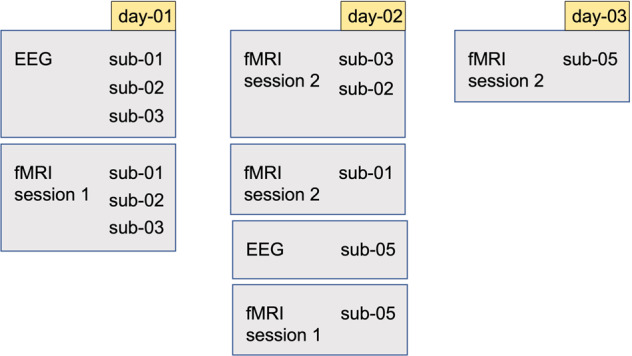
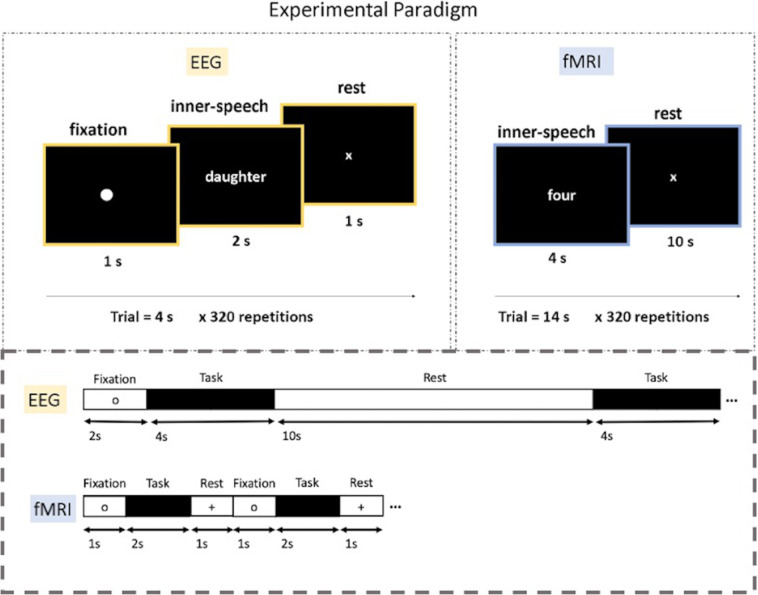
The recognition of inner speech, which could give a ‘voice’ to patients that have no ability to speak or move, is a challenge for brain-computer interfaces (BCIs). A shortcoming of the available datasets is that they do not combine modalities to increase the performance of inner speech recognition. Multimodal datasets of brain data enable the fusion of neuroimaging modalities with complimentary properties, such as the high spatial resolution of functional magnetic resonance imaging (fMRI) and the temporal resolution of electroencephalography (EEG), and therefore are promising for decoding inner speech. This paper presents the first publicly available bimodal dataset containing EEG and fMRI data acquired nonsimultaneously during inner-speech production. Data were obtained from four healthy, right-handed participants during an inner-speech task with words in either a social or numerical category. Each of the 8-word stimuli were assessed with 40 trials, resulting in 320 trials in each modality for each participant. The aim of this work is to provide a publicly available bimodal dataset on inner speech, contributing towards speech prostheses.
Overview
The claims and statistics of this paper haven’t been checked yet.
Free: it reads the open-access text and checks the first 5 claims that cite a source we can check. Create a free account to check every claim.
Integrity signals
Registry
Cites
Statistics
Figures
Verification
Claims the paper makes
The claims and statistics of this paper haven’t been checked yet.
Free: it reads the open-access text and checks the first 5 claims that cite a source we can check. Create a free account to check every claim.
Claims other papers make about this one
Each is checked against this paper’s own text: does it say what the citing paper says it does?
The cited source says what the claim attributes to it.
In the citing paper
“Training brain-computer interface systems on word classification holds particular promise for speech prosthesis and neuropsychological rehabilitation [88], particularly when based on methods such as electrocorticography [89] and the use of bimodal datasets (e.g., fMRI combined with EEG) [90].”
From Inner speech as language process and cognitive tool (2023) · cites this paper as [89]
Self-check
Percentages, sums and reported differences re-computed from the paper’s own numbers.
The self-check needs the paper’s full text.
Citations
Cites
Delorme, A., & Makeig, S. (2004) · Journal of Neuroscience Methods · doi:10.1016/j.jneumeth.2003.10.009 · Cited by 24,371
Power, J. D., Barnes, K. A., Snyder, A. Z., Schlaggar, B. L., & Petersen, S. E. (2012) · NeuroImage · doi:10.1016/j.neuroimage.2011.10.018 · Cited by 7,429
Deep learning with convolutional neural networks for EEG decoding and visualization
Schirrmeister, R. T., Springenberg, J. T., Fiederer, L. D. J., Glasstetter, M., Eggensperger, K., Tangermann, M., Hutter, F., Burgard, W., & Ball, T. (2017) · Human Brain Mapping · doi:10.1002/hbm.23730 · Cited by 3,751
Gorgolewski, K. J., Auer, T., Calhoun, V. D., Craddock, R. C., Das, S., Duff, E. P., Flandin, G., Ghosh, S. S., Glatard, T., Halchenko, Y. O., et al. (2016) · Scientific Data · doi:10.1038/sdata.2016.44 · Cited by 1,775
The Science of Mind Wandering: Empirically Navigating the Stream of Consciousness
Smallwood, J., & Schooler, J. W. (2015) · Annual Review of Psychology · doi:10.1146/annurev-psych-010814-015331 · Cited by 1,685
Natural speech reveals the semantic maps that tile human cerebral cortex
Huth, A. G., de Heer, W. A., Griffiths, T. L., Theunissen, F. E., & Gallant, J. L. (2016) · Nature · doi:10.1038/nature17637 · Cited by 1,504
Identifying natural images from human brain activity
Kay, K. N., Naselaris, T., Prenger, R. J., & Gallant, J. L. (2008) · Nature · doi:10.1038/nature06713 · Cited by 1,286
The mental prosthesis: assessing the speed of a P300-based brain-computer interface
Donchin, E., Spencer, K. M., & Wijesinghe, R. (2000) · IEEE Transactions on Rehabilitation Engineering · doi:10.1109/86.847808 · Cited by 1,222
Predicting Human Brain Activity Associated with the Meanings of Nouns
Mitchell, T. M., Shinkareva, S. V., Carlson, A., Chang, K.-M., Malave, V. L., Mason, R. A., & Just, M. A. (2008) · Science · doi:10.1126/science.1152876 · Cited by 1,180
Selective averaging of rapidly presented individual trials using fMRI
Dale, A. M., & Buckner, R. L. (1997) · Human Brain Mapping · doi:10.1002/(sici)1097-0193(1997)5:5<329::aid-hbm1>3.0.co;2-5 · Cited by 1,026
A comprehensive review of EEG-based brain–computer interface paradigms
Abiri, R., Borhani, S., Sellers, E. W., Jiang, Y., & Zhao, X. (2019) · Journal of Neural Engineering · doi:10.1088/1741-2552/aaf12e · Cited by 946
Inner Speech: Development, Cognitive Functions, Phenomenology, and Neurobiology
Alderson-Day, B., & Fernyhough, C. (2015) · Psychological Bulletin · doi:10.1037/bul0000021 · Cited by 864
Devlin, J. T., Matthews, P. M., & Rushworth, M. F. S. (2003) · Journal of Cognitive Neuroscience · doi:10.1162/089892903321107837 · Cited by 576
Miyawaki, Y., Uchida, H., Yamashita, O., Sato, M.-A., Morito, Y., Tanabe, H. C., Sadato, N., & Kamitani, Y. (2008) · Neuron · doi:10.1016/j.neuron.2008.11.004 · Cited by 543
Generic decoding of seen and imagined objects using hierarchical visual features
Horikawa, T., & Kamitani, Y. (2017) · Nature Communications · doi:10.1038/ncomms15037 · Cited by 516
Martínez-Sancho, E., Slámová, L., Morganti, S., Grefen, C., Carvalho, B., Dauphin, B., Rellstab, C., Gugerli, F., Opgenoorth, L., Heer, K., et al. (2020) · Scientific Data · doi:10.1038/s41597-019-0340-y · Cited by 496
Sequential Processing of Lexical, Grammatical, and Phonological Information Within Broca’s Area
Sahin, N. T., Pinker, S., Cash, S. S., Schomer, D., & Halgren, E. (2009) · Science · doi:10.1126/science.1174481 · Cited by 452
EEG-BIDS, an extension to the brain imaging data structure for electroencephalography
Pernet, C. R., Appelhoff, S., Gorgolewski, K. J., Flandin, G., Phillips, C., Delorme, A., & Oostenveld, R. (2019) · Scientific Data · doi:10.1038/s41597-019-0104-8 · Cited by 443
The ontogeny of the cortical language network
Skeide, M. A., & Friederici, A. D. (2016) · Nature Reviews Neuroscience · doi:10.1038/nrn.2016.23 · Cited by 391
Speech production: Wernicke, Broca and beyond
Blank, S. C. (2002) · Brain · doi:10.1093/brain/awf191 · Cited by 342
Perrone-Bertolotti, M., Rapin, L., Lachaux, J.-P., Baciu, M., & Lœvenbruck, H. (2014) · Behavioural Brain Research · doi:10.1016/j.bbr.2013.12.034 · Cited by 317
Deep image reconstruction from human brain activity
Shen, G., Horikawa, T., Majima, K., & Kamitani, Y. (2019) · PLOS Computational Biology · doi:10.1371/journal.pcbi.1006633 · Cited by 315
Brain-to-text: decoding spoken phrases from phone representations in the brain
Herff, C., Heger, D., de Pesters, A., Telaar, D., Brunner, P., Schalk, G., & Schultz, T. (2015) · Frontiers in Neuroscience · doi:10.3389/fnins.2015.00217 · Cited by 297
Conversion of EEG activity into cursor movement by a brain-computer interface (BCI)
Fabiani, G. E., McFarland, D. J., Wolpaw, J. R., & Pfurtscheller, G. (2004) · IEEE Transactions on Neural Systems and Rehabilitation Engineering · doi:10.1109/tnsre.2004.834627 · Cited by 292
Inferring imagined speech using EEG signals: a new approach using Riemannian manifold features
Nguyen, C. H., Karavas, G. K., & Artemiadis, P. (2018) · Journal of Neural Engineering · doi:10.1088/1741-2552/aa8235 · Cited by 289
Universal brain signature of proficient reading: Evidence from four contrasting languages
Rueckl, J. G., Paz-Alonso, P. M., Molfese, P. J., Kuo, W.-J., Bick, A., Frost, S. J., Hancock, R., Wu, D. H., Mencl, W. E., Duñabeitia, J. A., et al. (2015) · Proceedings of the National Academy of Sciences · doi:10.1073/pnas.1509321112 · Cited by 267
Brain–computer interface using fMRI: spatial navigation by thoughts
Yoo, S.-S., Fairneny, T., Chen, N.-K., Choo, S.-E., Panych, L. P., Park, H., Lee, S.-Y., & Jolesz, F. A. (2004) · NeuroReport · doi:10.1097/01.wnr.0000133296.39160.fe · Cited by 252
An investigation across 45 languages and 12 language families reveals a universal language network
Malik-Moraleda, S., Ayyash, D., Gallée, J., Affourtit, J., Hoffmann, M., Mineroff, Z., Jouravlev, O., & Fedorenko, E. (2022) · Nature Neuroscience · doi:10.1038/s41593-022-01114-5 · Cited by 245
McGuire, P. K., Silbersweig, D. A., Wright, I., Murray, R. M., Frackowiak, R. S. J., & Frith, C. D. (1996) · British Journal of Psychiatry · doi:10.1192/bjp.169.2.148 · Cited by 240
Signal processing techniques for motor imagery brain computer interface: A review
Aggarwal, S., & Chugh, N. (2019) · Array · doi:10.1016/j.array.2019.100003 · Cited by 223
An event-related fMRI study of overt and covert word stem completion
Palmer, E. D., Rosen, H. J., Ojemann, J. G., Buckner, R. L., Kelley, W. M., & Petersen, S. E. (2001) · NeuroImage · doi:10.1006/nimg.2001.0779 · Cited by 216
Classifying phonological categories in imagined and articulated speech
Zhao, S., & Rudzicz, F. (2015) · 2015 IEEE International Conference on Acoustics, Speech and Signal Processing (ICASSP) · doi:10.1109/icassp.2015.7178118 · Cited by 182
The neural correlates of inner speech defined by voxel-based lesion-symptom mapping
Geva, S., Jones, P. S., Crinion, J. T., Price, C. J., Baron, J.-C., & Warburton, E. A. (2011) · Brain · doi:10.1093/brain/awr232 · Cited by 173
Visual and kinesthetic modes affect motor imagery classification in untrained subjects
Chholak, P., Niso, G., Александрович, М. В., Kurkin, S., Frolov, N. S., Николаевна, П. Е., Hramov, A. E., & Pisarchik, A. N. (2019) · Scientific Reports · doi:10.1038/s41598-019-46310-9 · Cited by 171
He, B., Yuan, H., Meng, J., & Gao, S. (2020) · Springer eBooks · doi:10.1007/978-3-030-43395-6_4 · Cited by 168
ECoG factors underlying multimodal control of a brain-computer interface
Wilson, J. A., Felton, E. A., Garell, P. C., Schalk, G., & Williams, J. C. (2006) · IEEE Transactions on Neural Systems and Rehabilitation Engineering · doi:10.1109/tnsre.2006.875570 · Cited by 163
Decoding Covert Speech From EEG-A Comprehensive Review
Panachakel, J. T., & Ramakrishnan, A. G. (2021) · Frontiers in Neuroscience · doi:10.3389/fnins.2021.642251 · Cited by 156
Thinking out loud, an open-access EEG-based BCI dataset for inner speech recognition
Nieto, N., Peterson, V., Rufiner, H. L., Kamienkowski, J. E., & Spies, R. D. (2022) · Scientific Data · doi:10.1038/s41597-022-01147-2 · Cited by 153
Probabilistic atlas for the language network based on precision fMRI data from >800 individuals
Lipkin, B., Tuckute, G., Affourtit, J., Small, H., Mineroff, Z., Kean, H., Jouravlev, O., Rakocevic, L., Pritchett, B., Siegelman, M., et al. (2022) · Scientific Data · doi:10.1038/s41597-022-01645-3 · Cited by 141
Angrick, M., Ottenhoff, M. C., Diener, L., Ivucic, D., Ivucic, G., Goulis, S., Saal, J., Colon, A. J., Wagner, L., Krusienski, D. J., et al. (2021) · Communications Biology · doi:10.1038/s42003-021-02578-0 · Cited by 125
Decoding Imagined and Spoken Phrases From Non-invasive Neural (MEG) Signals
Dash, D., Ferrari, P., & Wang, J. (2020) · Frontiers in Neuroscience · doi:10.3389/fnins.2020.00290 · Cited by 124
Hartwigsen, G., Weigel, A., Schuschan, P., Siebner, H. R., Weise, D., Claßen, J., & Saur, D. (2015) · Cerebral Cortex · doi:10.1093/cercor/bhv092 · Cited by 122
Open access database of EEG signals recorded during imagined speech
Coretto, G. A. P., Gareis, I. E., & Rufiner, H. L. (2017) · Proceedings of SPIE, the International Society for Optical Engineering/Proceedings of SPIE · doi:10.1117/12.2255697 · Cited by 115
Decoding Inner Speech Using Electrocorticography: Progress and Challenges Toward a Speech Prosthesis
Martin, S., Iturrate, I., Millán, J. D. R., Knight, R. T., & Pasley, B. N. (2018) · Frontiers in Neuroscience · doi:10.3389/fnins.2018.00422 · Cited by 115
Neurophysiological evidence of efference copies to inner speech
Whitford, T. J., Jack, B. N., Pearson, D., Griffiths, O., Luque, D., Harris, A. W., Spencer, K. M., & Le Pelley, M. E. (2017) · eLife · doi:10.7554/elife.28197 · Cited by 106
Cooney, C., Folli, R., & Coyle, D. (2019) · 2019 IEEE International Conference on Systems, Man and Cybernetics (SMC) · doi:10.1109/smc.2019.8914246 · Cited by 95
Barber, L., Reniers, R. L. E. P., & Upthegrove, R. (2021) · Translational Psychiatry · doi:10.1038/s41398-021-01670-7 · Cited by 81
Unimodal Versus Bimodal EEG-fMRI Neurofeedback of a Motor Imagery Task
Perronnet, L., Lécuyer, A., Mano, M., Bannier, É., Lotte, F., Clerc, M., & Barillot, C. (2017) · Frontiers in Human Neuroscience · doi:10.3389/fnhum.2017.00193 · Cited by 74
Development of a ternary hybrid fNIRS-EEG brain–computer interface based on imagined speech
Sereshkeh, A. R., Yousefi, R., Wong, A. T., Rudzicz, F., & Chau, T. T. (2019) · Brain-Computer Interfaces · doi:10.1080/2326263x.2019.1698928 · Cited by 73
A Bimodal Deep Learning Architecture for EEG-fNIRS Decoding of Overt and Imagined Speech
Cooney, C., Folli, R., & Coyle, D. (2021) · IEEE Transactions on Biomedical Engineering · doi:10.1109/tbme.2021.3132861 · Cited by 70
Inner Speech during Silent Reading Reflects the Reader's Regional Accent
Filik, R., & Barber, E. (2011) · PLoS ONE · doi:10.1371/journal.pone.0025782 · Cited by 62
Inner Speech Classification using EEG Signals: A Deep Learning Approach
van den Berg, B., van Donkelaar, S., & Alimardani, M. (2021) · IEEE International Conference on Human-Machine Systems (ICHMS) · doi:10.1109/ichms53169.2021.9582457 · Cited by 60
Open multimodal iEEG-fMRI dataset from naturalistic stimulation with a short audiovisual film
Berezutskaya, J., Vansteensel, M. J., Aarnoutse, E. J., Freudenburg, Z. V., Piantoni, G., Branco, M. P., & Ramsey, N. F. (2022) · Scientific Data · doi:10.1038/s41597-022-01173-0 · Cited by 56
Lioi, G., Cury, C., Perronnet, L., Mano, M., Bannier, E., Lécuyer, A., & Barillot, C. (2020) · Scientific Data · doi:10.1038/s41597-020-0498-3 · Cited by 52
Katz, C. N., Patel, K., Talakoub, O., Groppe, D. M., Hoffman, K. L., & Valiante, T. A. (2020) · Cerebral Cortex · doi:10.1093/cercor/bhaa132 · Cited by 49
Concentration on performance with P300-based BCI systems: A matter of interface features
da Silva‐Sauer, L., Aguayo, L. V., de la Torre‐Luque, A., Ron-Angevín, R., & Varona-Moya, S. (2015) · Applied Ergonomics · doi:10.1016/j.apergo.2015.08.002 · Cited by 45
Villena‐González, M., López, V., & Rodríguez, E. (2016) · NeuroImage · doi:10.1016/j.neuroimage.2016.02.013 · Cited by 45
Killiany, R. J., Moss, M. B., Nicholson, T., Jolesz, F., & Sandor, T. (1997) · Human Brain Mapping · doi:10.1002/(sici)1097-0193(1997)5:5<355::aid-hbm4>3.0.co;2-2 · Cited by 44
When Is Simultaneous Recording Necessary? A Guide for Researchers Considering Combined EEG-fMRI
Scrivener, C. L. (2021) · Frontiers in Neuroscience · doi:10.3389/fnins.2021.636424 · Cited by 38
Real-Time Decoding of Brain Responses to Visuospatial Attention Using 7T fMRI
Andersson, P., Pluim, J. P. W., Siero, J. C. W., Klein, S., Viergever, M. A., & Ramsey, N. F. (2011) · PLoS ONE · doi:10.1371/journal.pone.0027638 · Cited by 37
MEG Sensor Selection for Neural Speech Decoding
Dash, D., Wisler, A., Ferrari, P., Davenport, E. M., Maldjian, J., & Wang, J. (2020) · IEEE Access · doi:10.1109/access.2020.3028831 · Cited by 37
Rhythm‐based features for classification of focal and non‐focal EEG signals
Bajaj, V., Rai, K., Kumar, A., Sharma, D., & Singh, G. K. (2017) · IET Signal Processing · doi:10.1049/iet-spr.2016.0435 · Cited by 24
Kamavuako, E. N., Sheikh, U. A., Gilani, S. O., Jamil, M., & Niazi, I. K. (2018) · Sensors · doi:10.3390/s18092989 · Cited by 15
Imagined, Intended, and Spoken Speech Envelope Synthesis from Neuromagnetic Signals
Dash, D., Ferrari, P., Berstis, K., & Wang, J. (2021) · Lecture notes in computer science · doi:10.1007/978-3-030-87802-3_13 · Cited by 9
Bimodal dataset on Inner speech
Liwicki, F., Gupta, V., Saini, R., De, K., Abid, N., Rakesh, S., Wellington, S., Wilson, H., Liwicki, M., & Eriksson, J. (2023) · OpenNeuro · doi:10.18112/openneuro.ds004196.v2.0.0 · Cited by 3
Self-citationInner Speech in Portuguese: Acquisition Methods, Database and First Results
Ferreira, C., Sayal, A., Direito, B., Simões, M. A., Martins, P., Oliveira, C., Castelo-Branco, M. S., & Teixeira, A. J. S. (2018) · Lecture notes in computer science · doi:10.1007/978-3-319-99722-3_44 · Cited by 1
Neural correlates of inner speaking, imitating and hearing: an fMRI study
Lœvenbruck, H., Grandchamp, R., Rapin, L., Perrone‐Bertolotti, M., Pichat, C., Haldin, C., Cousin, É., Lachaux, J.-P., Dohen, M., Perrier, P., et al. (2019) · HAL · Cited by 1
Liwicki, F., Gupta, V., Saini, R., De, K., Abid, N., Rakesh, S., Wellington, S., Wilson, H., Liwicki, M., & Eriksson, J. (2022) · OpenNeuro · doi:10.18112/openneuro.ds004197.v1.0.2 · Cited by 1
Self-citation
Research works printed but not linked: 1
- Penny, W. D., Friston, K. J., Ashburner, J. T., Kiebel, S. J. & Nichols, T. E. Statistical parametric mapping: the analysis of functional brain images (Elsevier, 2011).
Cited by
Inner speech as language process and cognitive tool
Fernyhough, C., & Borghi, A. M. (2023) · Trends in Cognitive Sciences · doi:10.1016/j.tics.2023.08.014 · Cited by 101
Exploring Inner Speech Recognition via Cross-Perception Approach in EEG and fMRI
Qin, J., Zong, L., & Liu, F. (2024) · Applied Sciences · doi:10.3390/app14177720 · Cited by 26
Zhang, W., Jiang, M., Teo, C., Bhuvanakantham, R., Zoey, F. L., Sim, W. K. J., Guo, Z., Foo, C. H. V., Chua, R. H. J., Padmanabhan, P., et al. (2024) · NeuroImage · doi:10.1016/j.neuroimage.2024.120629 · Cited by 22
Dahò, M., & Monzani, D. (2025) · Cognitive Neuropsychology · doi:10.1080/02643294.2025.2527983 · Cited by 19
Imagined Speech Reconstruction From Neural Signals—An Overview of Sources and Methods
Tang, J., Chen, J., Xu, X., Liu, A., & Chen, X. (2024) · IEEE Transactions on Instrumentation and Measurement · doi:10.1109/tim.2024.3472830 · Cited by 19
Metadata
- Authors
- Simistira Liwicki, F., Gupta, V., Saini, R., De, K., Abid, N., Rakesh, S., Wellington, S., Wilson, H., Liwicki, M., & Eriksson, J.
- Affiliations
- Luleå University of Technology (SE)
- University of Bath (GB)
- Umeå University (SE)
- ORCID
- Venue
- Scientific Data
- Published
- 2023-06-13
- Volume
- 10
- Issue
- 1
- Pages
- 378-378
- ISSN
- 2052-4463 (ISSN-L)
- PMC
- PMC10264396
- OpenAlex
- W4380577383
- Cited by
- 28
- References
- 68
- Citations by year
- 2026: 9 · 2025: 8 · 2024: 10 · 2023: 1
- Type
- data paper
- Language
- en
- Open access
- gold
- doi.org
- Licence
- cc-by
- creativecommons.org/licenses/by/4.0 (tdm)
- creativecommons.org/licenses/by/4.0 (vor)
- Locations
- Scientific Data (publishedVersion, cc-by)
- bioRxiv (Cold Spring Harbor Laboratory) (acceptedVersion, cc-by-nc-nd)
- PubMed Central (publishedVersion, cc-by)
- PubMed (publishedVersion)
- Epubl LTU (submittedVersion, other-oa)
- KTH Publication Database DiVA (KTH Royal Institute of Technology) (submittedVersion, other-oa)
- DiVA at Umeå University (Umeå University) (submittedVersion, other-oa)
- DOAJ (DOAJ: Directory of Open Access Journals) (submittedVersion, cc-by-sa)
- Funders
- Grants for Excellent Research Projects Proposals of SRT.ai 2022
- Topics
- Life Sciences › Neuroscience › Cognitive Neuroscience › EEG and Brain-Computer Interfaces
- Life Sciences › Neuroscience › Cognitive Neuroscience › Neurobiology of Language and Bilingualism
- Life Sciences › Neuroscience › Cognitive Neuroscience › Tactile and Sensory Interactions
- Keywords
- EEG-fMRI fusion, brain-computer interface, word production, social words
- MeSH terms
- Brain, Electroencephalography, Humans, Magnetic Resonance Imaging, Speech, Speech Perception
About these checks
Registry, retraction, Cites and statistics results are computed, not judged, with one exception: a printed reference that no index lists is read once by a model before it counts as a citation error. Claims are extracted by a model and kept only when their quote appears verbatim in the text; each cited source is then checked, with a model’s help, for whether it says what the claim relies on. Those verdicts can be wrong — read the claim’s quote and the cited source before relying on one.
Statistics and arithmetic are recomputed, not judged.
Confidence bands are shown only for fields calibrated on our annotated test set. None is calibrated yet, so no band is shown.
What counts as a claim ›How we measure confidence ›How we check this ›
Are you an author, or do you see a problem with this page? Request a review
Data sources
Bibliographic data: Semantic Scholar, OpenAlex, Crossref.
Contains information from the Semantic Scholar Academic Graph Datasets, made available under the ODC Attribution License (ODC-BY 1.0).
Semantic Scholar’s data is described in: Kinney, R., et al. (2023). The Semantic Scholar Open Data Platform. arXiv:2301.10140.
