

Droplet Digital PCR versus qPCR for gene expression analysis with low abundant targets: from variable nonsense to publication quality data
Open accessThe DOI matches its Crossref record; 24 of the 25 references it cites were found in a registry or an index; 19 of the 23 sources its claims cite were checked for support.
Abstract
Quantitative PCR (qPCR) has become the gold standard technique to measure cDNA and gDNA levels but the resulting data can be highly variable, artifactual and non-reproducible without appropriate verification and validation of both samples and primers. The root cause of poor quality data is typically associated with inadequate dilution of residual protein and chemical contaminants that variably inhibit Taq polymerase and primer annealing. The most susceptible, frustrating and often most interesting samples are those containing low abundant targets with small expression differences of 2-fold or lower. Here, Droplet Digital PCR (ddPCR) and qPCR platforms were directly compared for gene expression analysis using low amounts of purified, synthetic DNA in well characterized samples under identical reaction conditions. We conclude that for sample/target combinations with low levels of nucleic acids (Cq ≥ 29) and/or variable amounts of chemical and protein contaminants, ddPCR technology will produce more precise, reproducible and statistically significant results required for publication quality data. A stepwise methodology is also described to choose between these complimentary technologies to obtain the best results for any experiment.
Overview
CoChat Summary
TL;DR
In a direct comparison using synthetic DNA and controlled RT-mix contamination, ddPCR produced more precise, reproducible, and statistically significant quantification than qPCR for low-abundance targets. The authors conclude that for samples with Cq ≥ 29 and/or variable contaminants, ddPCR is preferable for publication-quality gene expression data.
Key findings
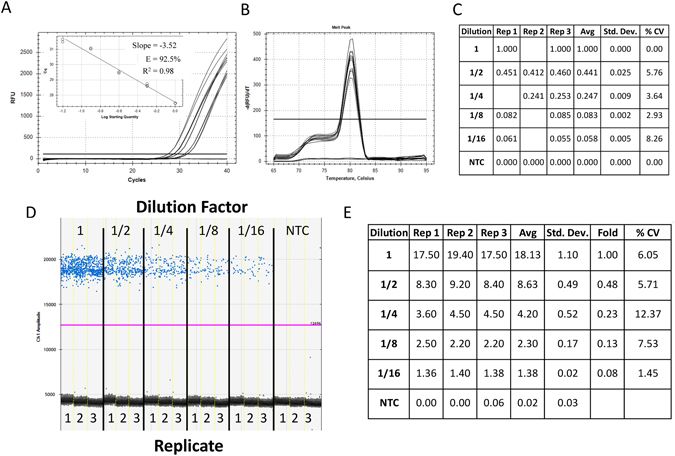
- With clean 1/2 serial dilutions in water, both platforms performed similarly: qPCR efficiencies were 90–110%, with a single melt peak and <15% CV; ddPCR showed good droplet separation and 2-fold dilution correlation.
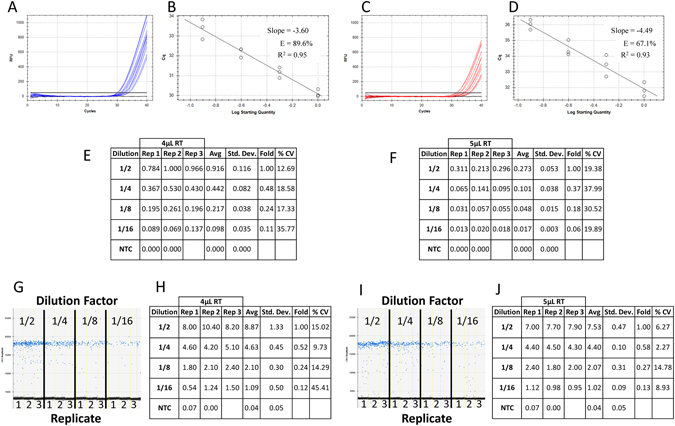
- With RT-mix contamination, qPCR efficiency fell to ~89.6% with 4 µL and 67.1% with 5 µL, producing an ~2 Cq shift and a perceived ~4-fold reduction in average relative quantity at each DNA dilution; ddPCR average absolute concentrations remained similar across contamination levels.
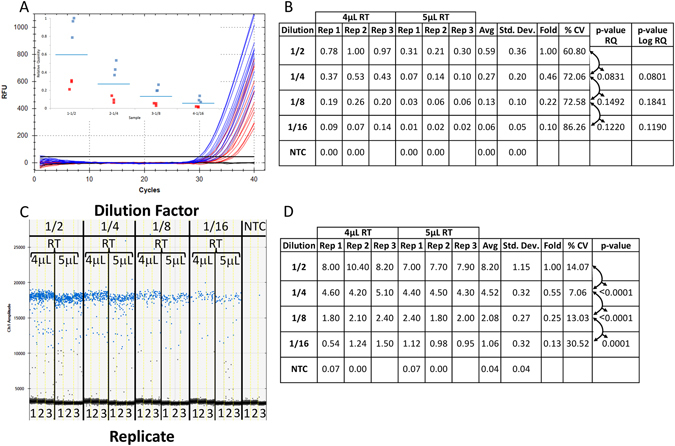
- Combining variable RT contamination (4 vs 5 µL) without normalization, qPCR %CV was 60–87% with p-values 0.0831–0.1492 (log-transformed 0.0801–0.1841), while ddPCR %CV was 7–30% with p < 0.0002 between dilutions.
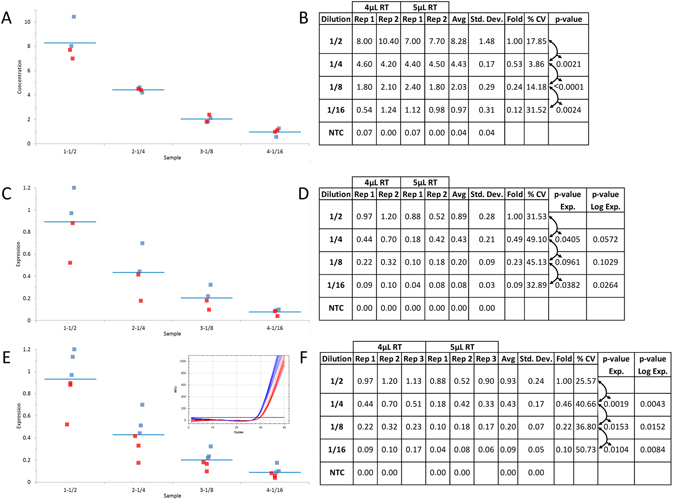
- Reference-gene normalization: qPCR reference shifted from 28.5 to 30.0 Cq (~2.8-fold/280% contamination effect); ddPCR showed 34.0 vs 32.0 copies/µL (5.9% difference, no significant contamination effect). Normalization tightened qPCR six-replicate data from ~4-fold to ~1.5-fold, but p-values remained mostly >0.008; ddPCR gave p ≤ 0.0024 for the small set and close to or below 0.001 without normalization.
Methods
- Synthetic DNA template and primers from the EvaGreen ddPCR Demonstration Kit; template diluted ~400-fold, then 1/2 serial dilutions; iScript RT mix added at 4 or 5 µL to create contamination; a single reaction mix was split 20 µL each to qPCR (CFX96 Touch) and ddPCR (QX200).
- Cycling was identical for both platforms: 95 °C for 5 min, then 40 cycles of 95 °C for 30 s and 60 °C for 1 min; ddPCR used a 2 °C/s ramp, qPCR used maximum ramp; qPCR included a melt curve from 65 °C to 95 °C.
- qPCR relative/normalized data were processed with CFX Manager v3.1; ddPCR copies/µL with QuantaSoft v1.7.4; statistical analysis used Excel with Analyze-it v2.20, Shapiro-Wilk normality tests, Student’s t-tests, and %CV; log-transformed normalized qPCR data were also tested.
Limitations
- No formal limitations section is included; evident from the text: experiments used synthetic DNA and a single primer/template system from a demonstration kit, not complex biological RNA/cDNA samples, so generalizability to real gene expression, miRNA, or mRNA studies is limited.
- Evident from the text: contamination was modeled only with reverse transcription mix; other protein/chemical inhibitors and variable reverse transcription efficiency were not tested.
- Stated: ddPCR did not require reference-gene normalization in this experiment because contamination had virtually no effect and a measured amount of DNA was applied, but the authors state reference-gene normalization is always recommended for gene expression analysis with ddPCR.
Model-written summary. Check it against the paper before relying on it.
Integrity signals
Registry
Cites
Statistics
Figures
Verification
Claims the paper makes
11 Valid · 1 Not valid · 1 Not checked · 26 Own results and interpretations
Some cited sources support this claim and some don’t — read each source’s verdict below.
In the paper
“The root cause of poor quality data is typically associated with inadequate dilution of residual protein and chemical contaminants that variably inhibit Taq polymerase and primer annealing.”
§ Droplet Digital PCR versus qPCR for gene expression analysis with low abundant targets: from variable nonsense to publication quality data > Abstract
What the sources say
- Partly supportedcites [18] Suslov O Steindler DA PCR inhibition by reverse transcriptase leads to an overestimation of amplification efficiency Nucleic Acids Res 2005 33 e181 e181 10.1093/nar/gni176 16314311 PMC1298932 sourceExperimental — accuracy not yet measured
The Discussion (page unavailable) says residual reverse transcriptase can inhibit PCR and that dilution reduces this inhibition, supporting the concern about insufficient dilution of residual protein. It does not establish that this is typically the root cause of poor-quality qPCR data, or that chemical contaminants variably inhibit primer annealing. (LLM, conf=0.86)
- Partly supportedcites [19] Huggett JF Differential susceptibility of PCR reactions to inhibitors: an important and unrecognised phenomenon BMC Res Notes 2008 1 70 10.1186/1756-0500-1-70 18755023 PMC2564953 sourceExperimental — accuracy not yet measured
The Background (page unavailable) says PCR inhibitors can increase error and produce false results; the Discussion (page unavailable) says co-purified inhibitors affect reactions differently and that reducing the amount of DNA template can help. The paper does not establish that inadequate dilution is typically the root cause of poor-quality data, identify residual protein as the culprit, or show that the inhibitors act by inhibiting Taq polymerase and primer annealing. (LLM, conf=0.87)
- Disputedcites [20] Karlen Y McNair A Perseguers S Mazza C Mermod N Statistical significance of quantitative PCR BMC Bioinformatics 2007 8 131 10.1186/1471-2105-8-131 17445280 PMC1868764 sourceExperimental — accuracy not yet measured
The Discussion (‘Factors affecting the efficiency value’; page unavailable) acknowledges that undiluted samples can reduce qPCR efficiency, but explicitly says that, under the study’s conditions, chemical contaminants were not the primary source of variation. The Results (‘Experimental parameters influencing efficiency determination’; page unavailable) identify the amplicon, rather than dilution, as the main determinant of efficiency. The paper therefore contradicts the claim that inadequate dilution of contaminants is typically the root cause. (LLM, conf=0.88)
Checked by a reasoning model — may be wrong.
plainstates a cause- Asserted: passes — The authors put it forward as true.
- Checkable: passes — It can be checked against evidence.
- Load-bearing: passes — The paper’s conclusions depend on it.
- Based: passes — The paper gives a reason why it holds.
- Partly supported
The cited sources support only part of this claim — read each source’s verdict below.
In the paper
“However, in the case of miRNA and mRNA, the components of the reverse transcription (RT) reaction can also act as inhibitors of Taq polymerase, altering reaction efficiency and the associated Cq values to give artifactual qPCR data if not adequately diluted (Fig. 2)18.”
§ Droplet Digital PCR versus qPCR for gene expression analysis with low abundant targets: from variable nonsense to publication quality data > Discussion > qPCR and ddPCR technologies give comparable results for identical samples with low levels of contamination
What the sources say
- Partly supportedcites [18] Suslov O Steindler DA PCR inhibition by reverse transcriptase leads to an overestimation of amplification efficiency Nucleic Acids Res 2005 33 e181 e181 10.1093/nar/gni176 16314311 PMC1298932 sourceExperimental — accuracy not yet measured
The Introduction (page not available) says RT reaction components inhibit PCR and that extensive dilution is intended to minimize the effect. The Results (page not available) report altered Ct values in unpurified RT samples, and the Discussion links inhibition to misleading amplification efficiencies. The paper examines mRNA transcripts but does not establish the claim specifically for miRNA assays. (LLM, conf=0.86)
plainstates a cause- Asserted: passes — The authors put it forward as true.
- Checkable: passes — It can be checked against evidence.
- Load-bearing: passes — The paper’s conclusions depend on it.
- Based: passes — The paper gives a reason why it holds.
- Rests on an assumption not shown here.
- Partly supported
The cited sources support only part of this claim — read each source’s verdict below.
In the paper
“Poorly optimized reactions can result in artifactual Cq values and misinterpreted data that are difficult or even impossible to reproduce2, 3.”
§ Droplet Digital PCR versus qPCR for gene expression analysis with low abundant targets: from variable nonsense to publication quality data > Introduction
What the sources say
- Partly supportedcites [2] Dijkstra JR van Kempen LC Nagtegaal ID Bustin SA Critical appraisal of quantitative PCR results in colorectal cancer research: can we rely on published qPCR results? Mol Oncol 2014 8 813 818 10.1016/j.molonc.2013.12.016 24423493 PMC5528534 sourceExperimental — accuracy not yet measured
The Introduction says qPCR parameters must be optimized for meaningful, reproducible results and that inefficient assays increase variability. It also discusses variations in Cq values, while the Discussion warns that inadequate methods can lead to incorrect conclusions. Our copy does not specifically say that poor optimization produces artifactual Cq values or makes the resulting data impossible to reproduce; it says many published results cannot be reliably assessed. (LLM, conf=0.83)
- Not checked yetcites [3] Bustin SA The need for transparency and good practices in the qPCR literature Nat Methods 2013 10 1063 1067 10.1038/nmeth.2697 24173381 source
Checked before — its earlier verdict is held back until a new check runs.
plainstates a cause- Asserted: passes — The authors put it forward as true.
- Checkable: passes — It can be checked against evidence.
- Load-bearing: passes — The paper’s conclusions depend on it.
- Based: passes — The paper gives a reason why it holds.
- Partly supported
The cited sources support only part of this claim — read each source’s verdict below.
In the paper
“Thereby, ddPCR technology can be used for extremely low-target quantitation from variably contaminated samples where the sample dilution requirements to assure consistent and acceptable reaction efficiency, primer annealing and Cq values for qPCR would likely lead to undetectable target levels11, 15.”
§ Droplet Digital PCR versus qPCR for gene expression analysis with low abundant targets: from variable nonsense to publication quality data > Introduction
What the sources say
- Partly supportedcites [11] Racki N Dreo T Gutierrez-Aguirre I Blejec A Ravnikar M Reverse transcriptase droplet digital PCR shows high resilience to PCR inhibitors from plant, soil and water samples Plant Methods 2014 10 42 10.1186/s13007-014-0042-6 25628753 PMC4307183 sourceExperimental — accuracy not yet measured
The Background says diluting sample matrix is a way to reduce qPCR inhibition, while the Results and Discussion report that RT-ddPCR tolerates some inhibition and quantifies low target concentrations with greater precision. The paper does not show that the dilution needed for qPCR would make those targets undetectable; that specific scenario is an extrapolation. Page numbers are not provided in our copy. (LLM, conf=0.84)
- Partly supportedcites [15] Verhaegen, B. et al. Comparison of Droplet Digital PCR and qPCR for the Quantification of Shiga Toxin-Producing Escherichia coli in Bovine Feces. Toxins (Basel)8 (2016). PMC4885071 27213452 sourceExperimental — accuracy not yet measured
The Results (section 2.1, p. 2) show that ddPCR quantified the lowest tested target concentration, and the Discussion (p. 5) reports no ddPCR inhibition in the tested natural samples. But the Discussion (pp. 5–6) says qPCR inhibition could be overcome with a suitable master mix and that both techniques had similar limits of quantification. The paper does not establish that qPCR required dilution that would make low-level targets undetectable. (LLM, conf=0.87)
hedgedstates a cause- Asserted: passes — The authors put it forward as true.
- Checkable: passes — It can be checked against evidence.
- Load-bearing: passes — The paper’s conclusions depend on it.
- Based: passes — The paper gives a reason why it holds.
- Partly supported
The cited sources support only part of this claim — read each source’s verdict below.
In the paper
“Therefore, all reactions for the study were pipetted into a single 96-well plate each for ddPCR and qPCR technologies.”
- Also stated in: § Experimental design to assess data quality between the qPCR and ddPCR acquisition platforms · plain
“Since qPCR is a sample interdependent technology where the relative quantity and normalized gene expression data rely on ΔCq values, the analysis from a single plate assures the best quality results by eliminating any bias from inter-plate variability16, 17.”
§ Droplet Digital PCR versus qPCR for gene expression analysis with low abundant targets: from variable nonsense to publication quality data > Results > Experimental design to assess data quality between the qPCR and ddPCR acquisition platforms
What the sources say
- Partly supportedcites [16] Genovesi LA Anderson D Carter KW Giles KM Dallas PB Identification of suitable endogenous control genes for microRNA expression profiling of childhood medulloblastoma and human neural stem cells BMC Research Notes 2012 5 507 507 10.1186/1756-0500-5-507 22980291 PMC3531299 sourceExperimental — accuracy not yet measured
The Results section on inter-card variation reports significant differences between some replicates on separate TLDA cards and minimal variation within a card, supporting the rationale for limiting inter-plate variability (page unavailable). The Methods section describes RT-qPCR on TLDA cards, not ddPCR or reactions pipetted into single 96-well plates; the paper does not establish that the citing study used those plates. (LLM, conf=0.86)
- Partly supportedcites [17] Dijkstra JR Mekenkamp LJ Teerenstra S De Krijger I Nagtegaal ID MicroRNA expression in formalin-fixed paraffin embedded tissue using real time quantitative PCR: the strengths and pitfalls J Cell Mol Med 2012 16 683 690 10.1111/j.1582-4934.2011.01467.x 22003827 PMC3822839 sourceExperimental — accuracy not yet measured
The Quantitative real-time reverse transcription PCR section says that inter-plate variability can increase variation and that keeping the relevant qRT-PCR assays or samples on one plate removes the need for inter-plate correction. It does not say that this study pipetted all reactions into single 96-well plates, or extend the advice to ddPCR. No page number is available in our copy. (LLM, conf=0.85)
plainstates a cause- Asserted: passes — The authors put it forward as true.
- Checkable: passes — It can be checked against evidence.
- Load-bearing: passes — The paper’s conclusions depend on it.
- Based: passes — The paper gives a reason why it holds.
- Also stated in: § Experimental design to assess data quality between the qPCR and ddPCR acquisition platforms · plain
14 more claims · 1 with their cited sources checked
Create a free account to see all 39 claims and to verify the 3 references still open.
- Probably not a substantial claim. 3
- It may state two separate claims as one. 18
Claims other papers make about this one
Each is checked against this paper’s own text: does it say what the citing paper says it does?
In the citing paper
“Compared to qPCR, ddPCR does not require a standard curve and measures the endpoint of PCR cycles, exhibiting less sensitivity to variable replication efficiency.82”
From Analytical methods for process and product characterization of recombinant adeno-associated virus-based gene therapies (2021) · cites this paper as [82]
Citations
Cites
The MIQE guidelines: minimum information for publication of quantitative real-time PCR experiments
Bustin, S. A., Benes, V., Garson, J. A., Hellemans, J., Huggett, J., Kubista, M., Mueller, R., Nolan, T., Pfaffl, M. W., Shipley, G. L., et al. (2009) · Clinical Chemistry · doi:10.1373/clinchem.2008.112797 · Cited by 16,303 · cited 1×
“(5) Primers that fail optimization using ddPCR technology should either be redesigned or the experimental design and samples should be re-assessed and undergo troubleshooting7.”
BackgroundHigh-throughput droplet digital PCR system for absolute quantitation of DNA copy number
Hindson, B. J., Ness, K. D., Masquelier, D. A., Belgrader, P., Heredia, N. J., Makarewicz, A. J., Bright, I. J., Lucero, M. Y., Hiddessen, A. L., Legler, T. C., et al. (2011) · Analytical Chemistry · doi:10.1021/ac202028g · Cited by 2,792
Absolute quantification by droplet digital PCR versus analog real-time PCR
Hindson, C. M., Chevillet, J. R., Briggs, H. A., Gallichotte, E. N., Ruf, I. K., Hindson, B. J., Vessella, R. L., & Tewari, M. (2013) · Nature Methods · doi:10.1038/nmeth.2633 · Cited by 1,488 · cited 1×
“Droplet Digital PCR (ddPCR) is a recent technology that has become commercially available since 2011 9, 10 .”
BackgroundAn investigation of the false discovery rate and the misinterpretation of p -values
Colquhoun, D. (2014) · Royal Society Open Science · doi:10.1098/rsos.140216 · Cited by 792
A practical approach to RT-qPCR—Publishing data that conform to the MIQE guidelines
Taylor, S., Wakem, M., Dijkman, G., Alsarraj, M., & Nguyen, M. (2010) · Methods · doi:10.1016/j.ymeth.2010.01.005 · Cited by 776
Self-citationReal-Time Quantitative RT-PCR: Design, Calculations, and Statistics
Rieu, I., & Powers, S. J. (2009) · The Plant Cell · doi:10.1105/tpc.109.066001 · Cited by 451
Statistical significance of quantitative PCR
Karlen, Y., McNair, A., Perseguers, S., Mazza, C., & Mermod, N. (2007) · BMC Bioinformatics · doi:10.1186/1471-2105-8-131 · Cited by 373
The need for transparency and good practices in the qPCR literature
Bustin, S. A., Benes, V., Garson, J., Hellemans, J., Huggett, J., Kubista, M., Mueller, R., Nolan, T., Pfaffl, M. W., Shipley, G., et al. (2013) · Nature Methods · doi:10.1038/nmeth.2697 · Cited by 281 · cited 1×
“Poorly optimized reactions can result in artifactual Cq values and misinterpreted data that are difficult or even impossible to reproduce 2, 3 .”
BackgroundRački, N., Dreo, T., Gutierrez-Aguirre, I., Blejec, A., & Ravnikar, M. (2014) · Plant Methods · doi:10.1186/s13007-014-0042-6 · Cited by 257 · cited 2×
“…ddPCR technology can be used for extremely low-target quantitation from variably contaminated samples where the sample dilution requirements to assure consistent and acceptable reaction efficiency, primer annealing and Cq values for qPCR would likely lead to undetectable target levels 11, 15 .”
BackgroundMethodDifferential susceptibility of PCR reactions to inhibitors: an important and unrecognised phenomenon
Huggett, J. F., Novak, T., Garson, J. A., Green, C., Morris-Jones, S. D., Miller, R. F., & Zumla, A. (2008) · BMC Research Notes · doi:10.1186/1756-0500-1-70 · Cited by 250 · cited 1×
“However, there are frequently subtle differences in the level of impurities between samples even under highly rigorous RNA extraction procedures that can alter Taq activity, imparting gross variability on the resulting data 18, 19 .”
Background
Cited by
The Ultimate qPCR Experiment: Producing Publication Quality, Reproducible Data the First Time
Taylor, S. C., Nadeau, K., Abbasi, M., Lachance, C., Nguyen, M., & Fenrich, J. (2019) · Trends in Biotechnology · doi:10.1016/j.tibtech.2018.12.002 · Cited by 830
Self-citationRapid pathogen detection by metagenomic next-generation sequencing of infected body fluids
Gu, W., Deng, X., Lee, M., Sucu, Y. D., Arevalo, S., Stryke, D., Federman, S., Gopez, A., Reyes, K., Zorn, K., et al. (2021) · Nature Medicine · doi:10.1038/s41591-020-1105-z · Cited by 689
Quan, P.-L., Sauzade, M., & Brouzes, E. (2018) · Sensors · doi:10.3390/s18041271 · Cited by 664
“While false positives can be minimized by proper assay design and optimization [44], false negative or molecular dropout are less tractable.”
BackgroundDroplet digital PCR of viral DNA/RNA, current progress, challenges, and future perspectives
Kojabad, A. A., Farzanehpour, M., Galeh, H. E. G., Dorostkar, R., Jafarpour, A., Bolandian, M., & Nodooshan, M. M. (2021) · Journal of Medical Virology · doi:10.1002/jmv.26846 · Cited by 297
“The tolerance to PCR inhibitors is enhanced in ddPCR.(19) it can help evaluate viral infection in some inhibition‐prone samples, including stool, sputum, and tissue,(55) as well as in the direct quantification of viral acid nucleic without the need an RNA isolation.”
BackgroundIwu, C. D., Korsten, L., & Okoh, A. I. (2020) · MicrobiologyOpen · doi:10.1002/mbo3.1035 · Cited by 241
Review of COVID-19 testing and diagnostic methods
Filchakova, O., Dossym, D., Ilyas, A., Kuanysheva, T., Abdizhamil, A., & Bukasov, R. (2022) · Talanta · doi:10.1016/j.talanta.2022.123409 · Cited by 226
“ddPCR can be used for very low-target quantitation from variably contaminated samples [84].”
Volckmar, A., Sültmann, H., Riediger, A., Fioretos, T., Schirmacher, P., Endris, V., Stenzinger, A., & Dietz, S. (2018) · Genes, Chromosomes and Cancer · doi:10.1002/gcc.22517 · Cited by 207
Current and emerging trends in techniques for plant pathogen detection
Venbrux, M., Crauwels, S., & Rediers, H. (2023) · Frontiers in Plant Science · doi:10.3389/fpls.2023.1120968 · Cited by 204
“point detection, this technique is less reliant on the amplification efficiency of the PCR reaction itself, as is the case with qPCR (Taylor et al., 2017).”
BackgroundMethodEnvironmental RNA: A Revolution in Ecological Resolution?
Yates, M. C., Derry, A. M., & Cristescu, M. E. (2021) · Trends in Ecology & Evolution · doi:10.1016/j.tree.2021.03.001 · Cited by 181
Gimpel, A. L., Katsikis, G., Sha, S., Maloney, A. J., Hong, M. S., Nguyen, T. N. T., Wolfrum, J., Springs, S. L., Sinskey, A. J., Manalis, S. R., et al. (2021) · Molecular Therapy - Methods & Clinical Development · doi:10.1016/j.omtm.2021.02.010 · Cited by 185
“Compared to qPCR, ddPCR does not require a standard curve and measures the endpoint of PCR cycles, exhibiting less sensitivity to variable replication efficiency.(82) Thus, ddPCR is significantly more precise than qPCR—at repeatability of 2%–10% CV and intermediate precision of 3%–8% CV—and more tolerant to matrix eff…”
BackgroundRNA transcripts stimulate homologous recombination by forming DR-loops
Ouyang, J., Yadav, T., Zhang, J.-M., Yang, H., Rheinbay, E., Guo, H., Haber, D. A., Lan, L., & Zou, L. (2021) · Nature · doi:10.1038/s41586-021-03538-8 · Cited by 165
Lentiviral Vector Bioprocessing
Perry, C., & Rayat, A. C. M. E. (2021) · Viruses · doi:10.3390/v13020268 · Cited by 170
“Such technology has been utilised with LV [257], can provide results even if templates are very low in abundance [258] and can be utilised to calculate the number of vector copies in recipient cells [259].”
MethodMinimal Residual Disease Detection in Acute Lymphoblastic Leukemia
Kruse, A., Abdel-Azim, N., Kim, H. N., Ruan, Y., Phan, V., Ogana, H., Wang, W., Lee, R., Gang, E. J., Khazal, S., et al. (2020) · International Journal of Molecular Sciences · doi:10.3390/ijms21031054 · Cited by 158
“Like RQ-PCR, ddPCR uses Taq polymerase in DNA amplification techniques, and fluorescent probes are used to target DNA sequences in a sample; however, RQ-PCR provides only relative quantification, while dPCR provides absolute quantification of target DNA samples [69].”
MethodEstrogen receptor profiles across tissues from male and female Rattus norvegicus
Hutson, D. D., Gurrala, R., Ogola, B. O., Zimmerman, M. A., Mostany, R., Satou, R., & Lindsey, S. H. (2019) · Biology of Sex Differences · doi:10.1186/s13293-019-0219-9 · Cited by 152
Demeke, T., & Dobnik, D. (2018) · Analytical and Bioanalytical Chemistry · doi:10.1007/s00216-018-1010-1 · Cited by 150
“For samples or target combinations with low levels of nucleic acids and/or variable amounts of chemical and protein contaminants, ddPCR produced more precise and reproducible results compared with qPCR [68].”
ResultWaterborne pathogens detection technologies: advances, challenges, and future perspectives
Oon, Y.-L., Oon, Y.-S., Ayaz, M., Deng, M., Li, L., & Song, K. (2023) · Frontiers in Microbiology · doi:10.3389/fmicb.2023.1286923 · Cited by 167
Molecular Detection Methods in HPV-Related Cancers
Williams, J., Kostiuk, M. A., & Biron, V. L. (2022) · Frontiers in Oncology · doi:10.3389/fonc.2022.864820 · Cited by 138
Keenum, I. M., Liguori, K., Calarco, J., Davis, B. C., Milligan, E., Harwood, V. J., & Pruden, A. J. (2022) · Critical Reviews in Environmental Science and Technology · doi:10.1080/10643389.2021.2024739 · Cited by 137
“Droplet digital PCR (ddPCR) promises to eliminate many of standardization variables that plague qPCR reporting; such as standard curves, melt curves analysis, and run variation, to yield more sensitive, precise, and reproducible measurements (Taylor et al., 2017).”
BackgroundCiesielski, M., Blackwood, A. D., Clerkin, T. J., González, R., Thompson, H., Larson, A., & Noble, R. T. (2021) · Journal of Virological Methods · doi:10.1016/j.jviromet.2021.114230 · Cited by 108
“Though RT-ddPCR displayed a greater analytical sensitivity, RT-qPCR offers the advantage of working within a wider dynamic range and has a relatively rapid turnaround time from sample collection to reporting output (Taylor et al., 2017).”
MacAulay, S., Ellison, A., Kille, P., & Cable, J. (2022) · Reviews in Aquaculture · doi:10.1111/raq.12674 · Cited by 129
“136,137 Fluorescent readings of these droplets identify the target using dye-labelled probes.”
Li, L., & Sun, Y. (2024) · MedComm · doi:10.1002/mco2.766 · Cited by 138
“76 Building on this foundation, researchers have developed “TriMeth,” a tumor-agnostic digital PCR assay targeting three CRC-specific methylation markers (C9orf50, CLIP4, KCNQ5), demonstrating high specificity and sensitivity in a cohort of patients undergoing surgery for colorectal liver…”
BackgroundDigital PCR as a tool to measure HIV persistence
Rutsaert, S., Bosman, K. J., Trypsteen, W., Nijhuis, M., & Vandekerckhove, L. (2018) · Retrovirology · doi:10.1186/s12977-018-0399-0 · Cited by 100
“As long as end-point fluorescence remains above the assigned threshold and the ratio between positive and negative fraction of droplets is unaltered, mismatches between assay and target are allowed as they do not affect the quantification outcome [16, 29, 30].”
BackgroundNassar, F. J., Msheik, Z. S., Nasr, R., & Temraz, S. N. (2021) · Clinical Epigenetics · doi:10.1186/s13148-021-01095-5 · Cited by 95
“be more sensitive than real time PCR for detection of low abundant targets such as methylated ctDNA with higher precision, greater accuracy, and technical simplicity [111].”
BackgroundDroplet digital PCR applications in the tuberculosis world
Nyaruaba, R., Mwaliko, C., Kering, K., & Wei, H. (2019) · Tuberculosis · doi:10.1016/j.tube.2019.07.001 · Cited by 84
An IoT Framework for Screening of COVID-19 Using Real-Time Data from Wearable Sensors
Mukhtar, H., Rubaiee, S., Krichen, M., & Alroobaea, R. (2021) · International Journal of Environmental Research and Public Health · doi:10.3390/ijerph18084022 · Cited by 89
“…namely polymerase chain-reaction (PCR)-based techniques:(Real-time PCR [30,31], TaqMan probe-based Real-Time PCR [32], and Droplet Digital-PCR [33,34]), and non-PCR-based techniques (e.g., nucleic acid sequence based amplification, and real-time quantitative loop-mediated isothermal amplification…”
MethodDigital Sensing and Molecular Computation by an Enzyme-Free DNA Circuit
Arter, W. E., Yusim, Y., Peter, Q. A. E., Taylor, C. G., Klenerman, D., Keyser, U. F., & Knowles, T. P. J. (2020) · ACS Nano · doi:10.1021/acsnano.0c00628 · Cited by 75
Macrophage Coordination of the Interferon Lambda Immune Response
Read, S. A., Wijaya, R. S., Ramezani–Moghadam, M., Tay, E. S. E., Schibeci, S., Liddle, C., Lam, V. W. T., Yuen, L., Douglas, M. W., Booth, D. R., et al. (2019) · Frontiers in Immunology · doi:10.3389/fimmu.2019.02674 · Cited by 75
“DdPCR enables the precise quantification of RNA transcripts by performing the PCR reaction within >10,000 oil droplets, and calculating transcript copies using Poisson’s law of small numbers (34).”
MethodCurrent Trends of Microfluidic Single-Cell Technologies
Shinde, P., Mohan, L., Kumar, A. S., Dey, K., Maddi, A., Patananan, A. N., Tseng, F., Chang, H., Nagai, M., & Santra, T. S. (2018) · International Journal of Molecular Sciences · doi:10.3390/ijms19103143 · Cited by 85
Challenges Using Droplet Digital PCR for Environmental Samples
Kokkoris, V., Vukicevich, E., Richards, A., Thomsen, C., & Hart, M. M. (2021) · Applied Microbiology · doi:10.3390/applmicrobiol1010007 · Cited by 92
Recent Advances in Monitoring, Sampling, and Sensing Techniques for Bioaerosols in the Atmosphere
Kabir, E., Azzouz, A., Raza, N., Bhardwaj, S. K., Kim, K., Tabatabaei, M., & Kukkar, D. (2020) · ACS Sensors · doi:10.1021/acssensors.9b02585 · Cited by 69
ddPCR surpasses classical qPCR technology in quantitating bacteria and fungi in the environment
Wang, D., Wang, S., Du, X., He, Q., Liu, Y., Wang, Z., Feng, K., Li, Y., & Deng, Y. (2022) · Molecular Ecology Resources · doi:10.1111/1755-0998.13644 · Cited by 89
“Fluorescence signals were detected by BioRad's QX200 Droplet Reader, and data analysis was performed by the QuantaSoft software (Taylor et al., 2017).”
MethodLiang, Z., Zhu, N., Mai, K. K. K., Liu, Z., Tzeng, D. T. W., Osteryoung, K. W., Zhong, S., Staehelin, L. A., & Kang, B. (2018) · The Plant Cell · doi:10.1105/tpc.17.00972 · Cited by 74
“This method is more reliable than quantitative RT-PCR because it does not require external reference genes for measuring amounts of target DNA templates in reaction mixes and has been shown to be more accurate and reproducible (Hindson et al., 2013; Taylor et al., 2017).”
MethodDigital PCR as an Emerging Tool for Monitoring of Microbial Biodegradation
Cao, Y., Miao, Y., Dong, G., Chen, B., & Zhang, B. (2020) · Molecules · doi:10.3390/molecules25030706 · Cited by 88
“When no effect of measured amount of DNA/RNA is applied to each sample, RT-dPCR can realize directly absolute quantification without normalization [101,102].”
MethodCoronavirus in water media: Analysis, fate, disinfection and epidemiological applications
Buonerba, A., Corpuz, M. V. A., Ballesteros, F., Choo, K., Hasan, S. W., Korshin, G. V., Belgiorno, V., Barceló, ., & Naddeo, V. (2021) · Journal of Hazardous Materials · doi:10.1016/j.jhazmat.2021.125580 · Cited by 65
Advances in diagnostic microfluidics
Burklund, A., Tadimety, A., Nie, Y., Hao, N., & Zhang, J. X. J. (2020) · Advances in clinical chemistry · doi:10.1016/bs.acc.2019.08.001 · Cited by 76
Biosecurity implications of drifting marine plastic debris: Current knowledge and future research
Audrézet, F., Zaiko, A., Lear, G., Wood, S. A., Tremblay, L. A., & Pochon, X. (2020) · Marine Pollution Bulletin · doi:10.1016/j.marpolbul.2020.111835 · Cited by 72
Critical review of antibiotic resistance genes in the atmosphere
Kormos, D. A., Lin, K., Pruden, A. J., & Marr, L. C. (2022) · Environmental Science Processes & Impacts · doi:10.1039/d2em00091a · Cited by 74
Somatic mutation: The hidden genetics of brain malformations and focal epilepsies
Ye, Z., McQuillan, L., Poduri, A., Green, T. E., Matsumoto, N., Mefford, H. C., Scheffer, I. E., Berkovic, S. F., & Hildebrand, M. S. (2019) · Epilepsy Research · doi:10.1016/j.eplepsyres.2019.106161 · Cited by 66
Chen, L., Zhang, Y., Cheng, Y., Zhang, D., Zhu, S., & Ma, X. (2018) · Gene · doi:10.1016/j.gene.2018.09.029 · Cited by 64
Comparison of current methods used to detect Cryptosporidium oocysts in stools
Ahmed, S. A. A., & Karanis, P. (2018) · International Journal of Hygiene and Environmental Health · doi:10.1016/j.ijheh.2018.04.006 · Cited by 77
Quantifying the Detection Sensitivity and Precision of qPCR and ddPCR Mechanisms for eDNA Samples
Guri, G., Ray, J. L., Shelton, A. O., Kelly, R. P., Præbel, K., Allan, E. A., Yoccoz, N. G., Johansen, T., Wangensteen, O. S., Hanebrekke, T., et al. (2024) · Ecology and Evolution · doi:10.1002/ece3.70678 · Cited by 66
“These quantitation techniques have diverse applications such as molecular biology (Taylor, Laperriere, and Germain 2017), epidemiology (Schneider et al. 2016) and environmental DNA studies (Dimond et al. 2022).”
Biomarkers for Cancer Cachexia: A Mini Review
Cao, Z., Zhao, K., Jose, I., Hoogenraad, N. J., & Osellame, L. D. (2021) · International Journal of Molecular Sciences · doi:10.3390/ijms22094501 · Cited by 61
“In comparison, digital PCR is able to provide an absolute and ultrasensitive quantification of nucleic acid [120], which is the preferred method for practical use and could set a cut-off value for nucleic acid-based biomarker due to its absolute quantification.”
MethodZhu, L., Nazeri, A., Pacia, C. P., Yue, Y., & Chen, H. (2020) · PLoS ONE · doi:10.1371/journal.pone.0234182 · Cited by 54
“The acoustic pressure output of the FUS transducer was calibrated using a fiber-optic hydrophone following our previously published method (Fig 1C) [33,34]. eGFP mRNA was selected as a representative tumor-specific nucleic acid biomarker because it is highly specific to our tumor model, mRNA is more abundant in the pl…”
BackgroundInfluentialDufourd, T., Robil, N., Mallet, D., Carcenac, C., Boulet, S., Brishoual, S., Rabois, E., Houéto, J., de la Grange, P., & Carnicella, S. (2019) · Biology Methods and Protocols · doi:10.1093/biomethods/bpz006 · Cited by 73
Research needs for optimising wastewater-based epidemiology monitoring for public health protection
Robins, K., Leonard, A. F. C., Farkas, K., Graham, D. W., Jones, D. L., Kasprzyk‐Hordern, B., Bunce, J. T., Grimsley, J. M. S., Wade, M. J., Zealand, A. M., et al. (2022) · Journal of Water and Health · doi:10.2166/wh.2022.026 · Cited by 55
Assessment of quality attributes for adeno‐associated viral vectors
Tustian, A. D., & Bak, H. (2021) · Biotechnology and Bioengineering · doi:10.1002/bit.27905 · Cited by 55
“In recent years, ddPCR has become the industry standard, as the technique has several advantages over the traditional technique qPCR, including reduced susceptibility to sample matrix interference and the ability for absolute quantification without a standard curve (Taylor et al., 2017).”
MethodReliable and robust droplet digital PCR (ddPCR) and RT-ddPCR protocols for mouse studies
Lindner, L., Cayrou, P., Jacquot, S., Birling, M., Hérault, Y., & Pavlovic, G. (2020) · Methods · doi:10.1016/j.ymeth.2020.07.004 · Cited by 47
“Gene expression quantification is prone to errors due to pipetting errors and variations in yield and efficiency during RNA isolation, reverse transcription and, to a much lesser extent, due to ddPCR amplification [5].”
Nitrospira in wastewater treatment: applications, opportunities and research gaps
Latocheski, E. C., da Rocha, M. C. V., & Braga, M. C. B. (2022) · Reviews in Environmental Science and Bio/Technology · doi:10.1007/s11157-022-09634-z · Cited by 60
Selvaraj, V., Maheshwari, Y., Hajeri, S., Chen, J., McCollum, T. G., & Yokomi, R. K. (2018) · PLoS ONE · doi:10.1371/journal.pone.0197184 · Cited by 55
SHORTROOT-Mediated Intercellular Signals Coordinate Phloem Development in Arabidopsis Roots
Kim, H., Zhou, J., Kumar, D., Jang, G., Ryu, K. H., Sebastián, J., Miyashima, S., Helariutta, Y., & Lee, J. (2020) · The Plant Cell · doi:10.1105/tpc.19.00455 · Cited by 44
“SND2 cDNAwas amplified by RT-PCR and then cloned into pDONR221, and NARS1 cDNA was cloned into both pDONR221 and pDONR P2R_P3 by a BP reaction.”
MethodInfluentialTiwari, P., Sharma, A., Bose, S. K., & Gautam, A. (2024) · Horticulturae · doi:10.3390/horticulturae10020152 · Cited by 73
“Droplet polymerase chain reaction (dPCR) is an innovative PCR-based disease diagnosis technique that utilizes the Taq DNA polymerase to unwind targeted DNA sequences from a complex test through a pre-validated primer/probe test [127].”
MethodCharacterization of mRNA therapeutics
Guimaraes, G. J., Kim, J., & Bartlett, M. G. (2024) · Mass Spectrometry Reviews · doi:10.1002/mas.21856 · Cited by 44
Maggi, R. G., Richardson, T., Breitschwerdt, E. B., & Miller, J. C. (2020) · Journal of Microbiological Methods · doi:10.1016/j.mimet.2020.106022 · Cited by 59
Droplet digital PCR enabled by microfluidic impact printing for absolute gene quantification
Pan, Y., Ma, T., Meng, Q., Mao, Y., Chu, K., Men, Y., Pan, T., Li, B., & Chu, J. (2019) · Talanta · doi:10.1016/j.talanta.2019.120680 · Cited by 46
“Using digital PCR, the target molecules are extremely diluted and dispersed into different reaction chambers for single molecule amplification, thus the copies of the target gene can be calculated directly by counting the positive reaction chambers [8,9], which is independent of the amplification efficiency [10,11].”
MethodCheevarungnapakul, K., Khaksar, G., Panpetch, P., Boonjing, P., & Sirikantaramas, S. (2019) · Frontiers in Plant Science · doi:10.3389/fpls.2019.00968 · Cited by 44
Hajji, I., Serra, M., Gérémie, L., Ferrante, I., Renault, R., Viovy, J., Descroix, S., & Ferraro, D. (2019) · Sensors and Actuators B Chemical · doi:10.1016/j.snb.2019.127171 · Cited by 45
Engineered yeast for efficient de novo synthesis of 7‐dehydrocholesterol
Qu, L., Xiu, X., Sun, G., Zhang, C., Yang, H., Liu, Y., Li, J., Du, G., Lv, X., & Liu, L. (2022) · Biotechnology and Bioengineering · doi:10.1002/bit.28055 · Cited by 46
“RNA extraction was conducted by using an RNA prep Pure Kit (Tiangen Biotech,) according to the manufacturer's instructions, followed by genomic DNA elimination and reverse transcription by using a PrimeScript™ RT‐PCR Kit (Takara; Taylor et al., 2017).”
MethodQuantification of eDNA to Map the Distribution of Cold-Water Coral Reefs
Kutti, T., Johnsen, I. A., Skaar, K. S., et al. (2020) · Frontiers in Marine Science · doi:10.3389/fmars.2020.00446 · Cited by 43
“Several studies have documented the ability of both qPCR and ddPCR to accurately determine DNA levels in target solutions but with ddPCR providing more precise and reliable results at low DNA concentrations (Zhao et al., 2013; Arvia et al., 2017; Taylor et al., 2017; Link-Lenczowska et al., 2018).”
BackgroundDong, J., Jan, Y. J., Cheng, J., Zhang, R. Y., Meng, M., Smalley, M. D., Chen, P., Tang, X., Tseng, P., Bao, L., et al. (2019) · Science Advances · doi:10.1126/sciadv.aav9186 · Cited by 45
On-Site Bioaerosol Sampling and Airborne Microorganism Detection Technologies
Rastmanesh, A., Boruah, J. S., Lee, M.-S., & Park, S. (2024) · Biosensors · doi:10.3390/bios14030122 · Cited by 57
“Similarly, for low levels of nucleic acids (Cq ≥ 29) and protein contaminants, this technology is considered to be highly precise, providing reproducible results [101].”
BackgroundChin, N. A., Salihah, N. T., Shivanand, P., & Ahmed, M. U. (2021) · Journal of Food Science and Technology · doi:10.1007/s13197-021-05280-5 · Cited by 48
Mulero, S., Boissier, J., Allienne, J., Quilichini, Y., Foata, J., Pointier, J.-P., & Rey, O. (2019) · Environmental DNA · doi:10.1002/edn3.53 · Cited by 42
“…is generally argued as very sensitive and accurate even for the amplification of low quality DNA samples (e.g., high amount of inhibitors and/or untargeted DNA; Hindson et al., 2011; Taylor et al., 2017), we predict that the ddPCR will be increasingly used for detecting eDNA in the next few years.”
MethodWang, W., Zheng, C., Liu, Z., Tan, Y., Chen, X., Zhao, B., Li, G., Xu, Z., Ren, F., Zhang, Y. F., et al. (2018) · European Journal Of Haematology · doi:10.1111/ejh.13084 · Cited by 40
The downstream bioprocess toolbox for therapeutic viral vectors
Kilgore, R., Minzoni, A., Shastry, S., Smith, W. K., Barbieri, E., Wu, Y., LeBarre, J. P., Chu, W., O'Brien, J., & Menegatti, S. (2023) · Journal of Chromatography A · doi:10.1016/j.chroma.2023.464337 · Cited by 41
Liquid Biopsy in Hepatocellular Carcinoma: Opportunities and Challenges for Immunotherapy
Maravelia, P., Silva, D. N., Rovesti, G., Chrobok, M., Stal, P. I., Lu, Y., & Pasetto, A. (2021) · Cancers · doi:10.3390/cancers13174334 · Cited by 41
Recent developments in quantitative PCR for monitoring harmful marine microalgae
Pearson, L. A., D’Agostino, P. M., & Neilan, B. A. (2021) · Harmful Algae · doi:10.1016/j.hal.2021.102096 · Cited by 44
Novel RT-ddPCR assays for measuring the levels of subgenomic and genomic SARS-CoV-2 transcripts
Telwatte, S., Martin, H. A., Marczak, R. J., Fozouni, P., Vallejo-Gracia, A., Kumar, G. R., Murray, V., Lee, S. A., Ott, M., Wong, J. K., et al. (2021) · Methods · doi:10.1016/j.ymeth.2021.04.011 · Cited by 41
“By partitioning PCR reactions into thousands of individual droplets prior to amplification and acquiring data at the reaction end point, ddPCR permits absolute quantification of targets independent of standard curves, which leads to higher precision and reproducibility compared to quantitative PCR [10].”
Tieng, F. Y. F., Abu, N., Lee, L., & Mutalib, N. A. (2021) · Diagnostics · doi:10.3390/diagnostics11030544 · Cited by 38
Vegesna, R., Tomaszkiewicz, M., Ryder, O. A., Campos-Sánchez, R., Medvedev, P., DeGiorgio, M., & Makova, K. D. (2020) · Genome Biology and Evolution · doi:10.1093/gbe/evaa088 · Cited by 20
Determination of Lentiviral Infectious Titer by a Novel Droplet Digital PCR Method
Wang, Y., Bergelson, S., & Feschenko, M. S. (2018) · Human Gene Therapy Methods · doi:10.1089/hgtb.2017.198 · Cited by 37
“13 Indeed, ddPCR is significantly more sensitive and precise than qPCR when analyzing complex samples, 14–17 which was not observed in this study probably because only purified DNA was tested.”
Hickin, M. L., Kakumanu, M. L., & Schal, C. (2022) · Scientific Reports · doi:10.1038/s41598-022-14505-2 · Cited by 34
Episome-Based Gene Expression Modulation Platform in the Model Diatom Phaeodactylum tricornutum
Kassaw, T. K., Paton, A. J., & Peers, G. (2022) · ACS Synthetic Biology · doi:10.1021/acssynbio.1c00367 · Cited by 38
Mavridis, K., Papapostolou, K. M., Riga, M., Ilias, A., Michaelidou, K., Bass, C., Leeuwen, T. V., Tsagkarakou, A., & VONTAS, J. G. (2021) · Pest Management Science · doi:10.1002/ps.6632 · Cited by 35
Quijada, N. M., Schmitz‐Esser, S., Zwirzitz, B., Guse, C., Strachan, C. R., Wagner, M., Wetzels, S. U., Selberherr, E., & Dzieciol, M. (2020) · Foods · doi:10.3390/foods9121851 · Cited by 33
“Previous studies highlighted the greater efficiency of dPCR, especially when low numbers of target molecules occur in the samples [60].”
BackgroundHuang, X., Huang, D. S., Liang, Y., Zhang, L., Yang, G., Liu, B., Peng, Y., Deng, W., & Dong, L. (2020) · Parasites & Vectors · doi:10.1186/s13071-020-04195-y · Cited by 30
Effect of Ataluren on dystrophin mutations
Berger, J., Li, M., Berger, S., et al. (2020) · Journal of Cellular and Molecular Medicine · doi:10.1111/jcmm.15319 · Cited by 34
Schwentner, R., Kolenová, A., Jug, G., et al. (2018) · Pediatric Research · doi:10.1038/s41390-018-0238-y · Cited by 34
Song, Y., Lim, S., Kim, Y. T., Park, Y. M., Jo, D. A., Bae, N. H., Lee, S. J., Choi, B. G., Im, S. G., Kim, H. U., et al. (2022) · Sensors and Actuators B Chemical · doi:10.1016/j.snb.2022.133241 · Cited by 35
Progression of LAMP as a Result of the COVID-19 Pandemic: Is PCR Finally Rivaled?
Mannier, C., & Yoon, J. (2022) · Biosensors · doi:10.3390/bios12070492 · Cited by 33
Ishak, A., AlRawashdeh, M. M., Esagian, S. M., & Nikas, I. P. (2021) · Journal of Clinical Medicine · doi:10.3390/jcm10235712 · Cited by 34
“This is because PCR inhibitors are diluted following the compartmentalization of the initial PCR reaction mixture into multiple reactions before the amplification step [16,17].”
BackgroundInfluentialPark, S., Rana, A., Sung, W., & Munir, M. (2021) · Applied Microbiology · doi:10.3390/applmicrobiol1030028 · Cited by 40
Pratt, E. D., Cowan, R. W., Manning, S. L., Qiao, E. M., Cameron, H., Schradle, K. A., Simeone, D. M., & Zhen, D. B. (2019) · Analytical Chemistry · doi:10.1021/acs.analchem.8b01605 · Cited by 36
van Zogchel, L. M. J., Lak, N. S. M., Verhagen, O. J. H. M., Tissoudali, A., Nuru, M. G., Gelineau, N. U., Zappeij‐Kannegieter, L., Javadi, A., Zijtregtop, E. A. M., Merks, J. H. M., et al. (2021) · JCO Precision Oncology · doi:10.1200/po.21.00130 · Cited by 33
“In our previous study, the majority of positive samples could not be quantified reliably by qPCR, whereas ddPCR technology is adept for precise quantification of low abundant targets.(46) Furthermore, like in many other widely used methods to analyze DNA methylation, cfDNA samples in the qPCR study were bisulfite conv…”
MethodA review on current diagnostic techniques for COVID-19
Jaddaoui, I. E., Allali, M., Raoui, S., Sehli, S., Habib, N., Chaouni, B., Idrissi, N. A., Benslima, N., Maher, W., Benrahma, H., et al. (2021) · Expert Review of Molecular Diagnostics · doi:10.1080/14737159.2021.1886927 · Cited by 33
Lee, N. Y. (2018) · Microchimica Acta · doi:10.1007/s00604-018-2791-9 · Cited by 32
Hickerson, B. T., Petrovskaya, S. N., Dickensheets, H. L., Donnelly, R. P., Ince, W. L., & Ilyushina, N. A. (2023) · Journal of Virology · doi:10.1128/jvi.00154-23 · Cited by 34
“of the total virus population in a clinical isolate (22, 23).”
BackgroundSensitive detection and quantification of SARS-CoV-2 in saliva
Abasiyanik, M. F., Flood, B. A., Lin, J., Özcan, Ş., Rouhani, S. J., Pyzer, A. R., Trujillo, J., Zhen, C., Wu, P., Jumic, S., et al. (2021) · Scientific Reports · doi:10.1038/s41598-021-91835-7 · Cited by 49
A Comprehensive Review on Circulating cfRNA in Plasma: Implications for Disease Diagnosis and Beyond
Zhong, P., Bai, L., Hong, M., Ouyang, J., Wang, R., Zhang, X., & Chen, P. (2024) · Diagnostics · doi:10.3390/diagnostics14101045 · Cited by 39
“…absolute quantification [85], rare copy detection [86], copy number variation analysis [87], and the determination of gene expression levels [88]. ddPCR provides more accurate quantitative information, particularly for low-copy-number RNA detection, making it suitable for rare events…”
BackgroundMolecular Diagnostic Tools Applied for Assessing Microbial Water Quality
Paruch, L. (2022) · International Journal of Environmental Research and Public Health · doi:10.3390/ijerph19095128 · Cited by 45
“Droplet digital PCR provides more sensitive, precise, and reproducible data than qPCR and exhibits more tolerance to PCR inhibitory substances as usually present in environmental samples [113].”
BackgroundSARS-CoV-2 RNA Quantification Using Droplet Digital RT-PCR
Kinloch, N. N., Ritchie, G., Dong, W. W. Y., Cobarrubias, K. D., Sudderuddin, H., Lawson, T., Matic, N., Montaner, J. S. G., Leung, V. C. M., Romney, M. G., et al. (2021) · Journal of Molecular Diagnostics · doi:10.1016/j.jmoldx.2021.04.014 · Cited by 31
The breast is yet to come: current and future utility of circulating tumour DNA in breast cancer
Davidson, B. A., Croessmann, S., & Park, B. H. (2021) · British Journal of Cancer · doi:10.1038/s41416-021-01422-w · Cited by 31
Kimbell, L. K., LaMartina, E. L., Kappell, A. D., Huo, J., Wang, Y., Newton, R. J., & McNamara, P. J. (2021) · Environmental Science Water Research & Technology · doi:10.1039/d0ew01059f · Cited by 38
Jain, A., Sarsaiya, S., Chen, J., Wu, Q., Lu, Y., & Shi, J. (2020) · Bioengineered · doi:10.1080/21655979.2020.1853447 · Cited by 32
“The polymerase chain response (PCR) is the foremost well known in vitro nucleic-acid amplification approach [40].”
BackgroundSommerová, L., Anton, M., Bouchalová, P., Jasickova, H., Rak, V., Jandáková, E., Selingerová, I., Bartošík, M., Vojtěšek, B., & Hrstka, R. (2019) · Antiviral Research · doi:10.1016/j.antiviral.2019.01.019 · Cited by 30
Gudrā, D., Dejus, S., Bartkevičs, V., Roga, A., Kalniņa, I., Strods, M., Rayan, A., Kokina, K., Zajakina, A., Dumpis, U., et al. (2022) · The Science of The Total Environment · doi:10.1016/j.scitotenv.2022.153775 · Cited by 30
Epigenetic therapy of novel tumour suppressor ZAR1 and its cancer biomarker function
Deutschmeyer, V. E., Breuer, J., Walesch, S. K., Sokòl, A. M., Graumann, J., Bartkuhn, M., Boettger, T., Roßbach, O., & Richter, A. M. (2019) · Clinical Epigenetics · doi:10.1186/s13148-019-0774-2 · Cited by 29
Haddadi, P., Larkan, N. J., & Borhan, M. H. (2019) · Scientific Reports · doi:10.1038/s41598-019-43419-9 · Cited by 30
Kršek, A., Batičić, L., Tokmadžić, V. S., & Braut, T. (2024) · Diagnostics · doi:10.3390/diagnostics14131448 · Cited by 33
“By encasing the target nucleic acid molecules in discrete, precisely defined water-in-oil droplet partitions, ddPCR measures the absolute number of these molecules [127,130].”
BackgroundCNS cell-derived exosome signatures as blood-based biomarkers of neurodegenerative diseases
Park, C., Weerakkody, J. S., Schneider, R., Miao, S., & Pitt, D. (2024) · Frontiers in Neuroscience · doi:10.3389/fnins.2024.1426700 · Cited by 36
“Moreover, sequencing results can be validated using digital PCR (dPCR) and droplet digital PCR (ddPCR), which offer more precision and reproducibility of measurements compared to standard qPCR for low starting levels of RNA (Vogelstein and Kinzler, 1999; Taylor et al., 2017).”
BackgroundHorizon scan of DNA-based methods for quality control and monitoring of herbal preparations
Raclariu-Manolică, A. C., Mauvisseau, Q., & de Boer, H. (2023) · Frontiers in Pharmacology · doi:10.3389/fphar.2023.1179099 · Cited by 34
“One of the most promising of these is perhaps ddPCR, which enables the absolute quantification of DNA in samples and could be used to calibrate and quantify the amount of DNA from both intended and unwanted ingredients (Taylor et al., 2017; Xu et al., 2022; Yu et al., 2022).”
Background
Metadata
- Authors
- Taylor, S. C., Laperriere, G., & Germain, H.
- Affiliations
- Bio-Rad (United States) (US)
- Université du Québec à Trois-Rivières (CA)
- Corresponding author
- Taylor, Sean C.
- Venue
- Scientific Reports
- Published
- 2017-05-25
- Volume
- 7
- Issue
- 1
- Pages
- 2409-2409
- ISSN
- 2045-2322 (ISSN-L)
- PMC
- PMC5445070
- OpenAlex
- W2615046465
- Semantic Scholar
- 9cb275387e4274fe46e787ddbb808dd18fc0d3f3
- Cited by
- 638
- References
- 25
- Citations by year
- 2026: 59 · 2025: 75 · 2024: 83 · 2023: 92 · 2022: 97 · 2021: 84 · 2020: 74 · 2019: 40 · 2018: 32 · 2017: 2
- FWCI
- 14.52
- Type
- journal article
- Language
- en
- Open access
- gold
- doi.org
- Licence
- cc-by
- creativecommons.org/licenses/by/4.0 (tdm)
- creativecommons.org/licenses/by/4.0 (vor)
- Locations
- Scientific Reports (publishedVersion, cc-by)
- Europe PMC (PubMed Central) (publishedVersion, cc-by)
- PubMed Central (publishedVersion, cc-by)
- PubMed (publishedVersion)
- Le dépôt institutionnel (Université du Québec à Trois-Rivières) (acceptedVersion)
- DOAJ (DOAJ: Directory of Open Access Journals) (submittedVersion, cc-by-sa)
- Topics
- Life Sciences › Biochemistry, Genetics and Molecular Biology › Molecular Biology › Molecular Biology Techniques and Applications
- Life Sciences › Biochemistry, Genetics and Molecular Biology › Molecular Biology › Gene expression and cancer classification
- Physical Sciences › Chemical Engineering › Fluid Flow and Transfer Processes › Innovative Microfluidic and Catalytic Techniques Innovation
- Keywords
- droplet digital PCR, real-time PCR, gene expression analysis, primer annealing, primer design, reproducibility, data quality, synthetic DNA, primer validation
- MeSH terms
- Gene Expression Regulation, Humans, Reference Standards, Gene Dosage, Gene Expression Profiling, Real-Time Polymerase Chain Reaction
About these checks
Registry, retraction, Cites and statistics results are computed, not judged, with one exception: a printed reference that no index lists is read once by a model before it counts as a citation error. Claims are extracted by a model and kept only when their quote appears verbatim in the text; each cited source is then checked, with a model’s help, for whether it says what the claim relies on. Those verdicts can be wrong — read the claim’s quote and the cited source before relying on one.
The claim verdicts this report counts are experimental: their accuracy is not yet measured.
A language model drew the claims from the paper on 2026-10-10, under version 3 of the claim definition (model deepseek-v4.1-flash, prompt extract-v3).
A second model labelled each claim on 2026-10-10 (model jev-1.13-20260917, definition revision gold-guideline-v0.2).
Cited sources are checked with a language model’s help (gpt-6-sol).
Statistics and arithmetic are recomputed, not judged.
Confidence bands are shown only for fields calibrated on our annotated test set. None is calibrated yet, so no band is shown.
What counts as a claim ›How we measure confidence ›How we check this ›
Are you an author, or do you see a problem with this page? Request a review
Data sources
Bibliographic data: Semantic Scholar, OpenAlex, Crossref.
Contains information from the Semantic Scholar Academic Graph Datasets, made available under the ODC Attribution License (ODC-BY 1.0).
Semantic Scholar’s data is described in: Kinney, R., et al. (2023). The Semantic Scholar Open Data Platform. arXiv:2301.10140.
