

Cognitive performance in healthy older adults relates to spontaneous switching between states of functional connectivity during rest
Open accessThe DOI matches its Crossref record; 74 of the 74 references it cites were found in a registry or an index.
Abstract
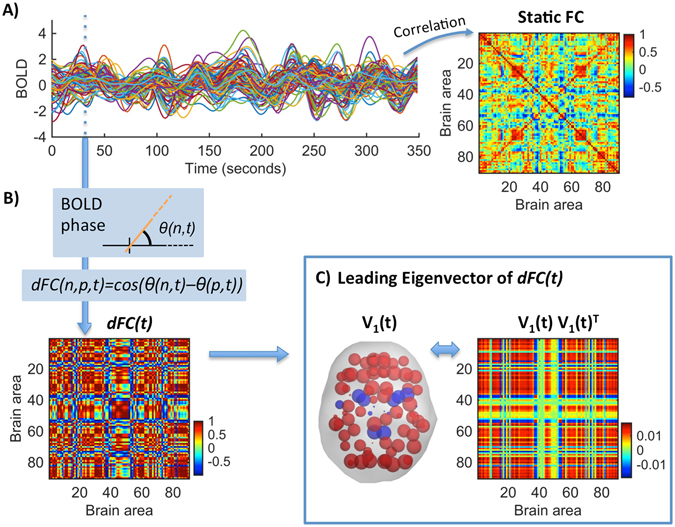
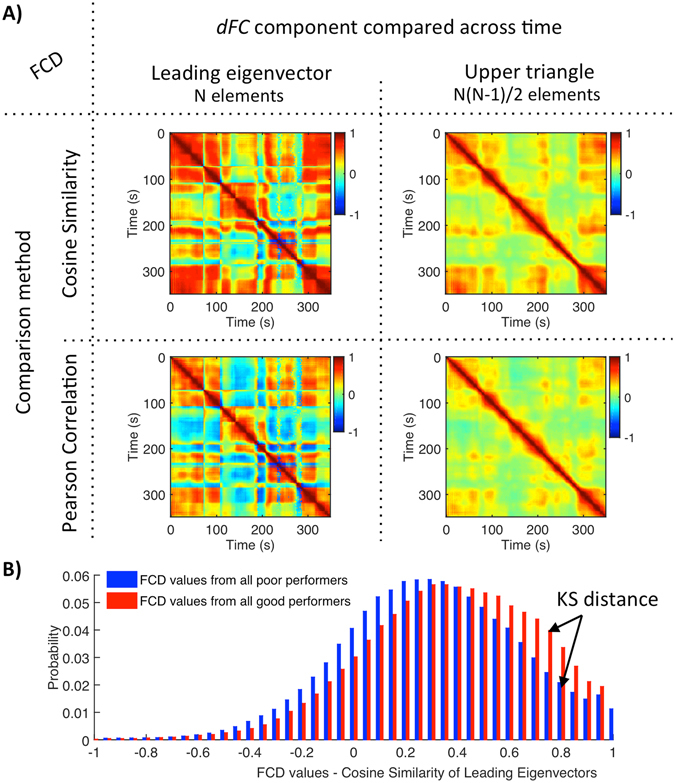
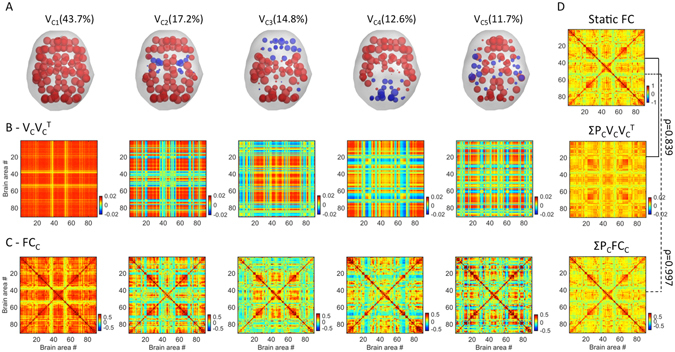
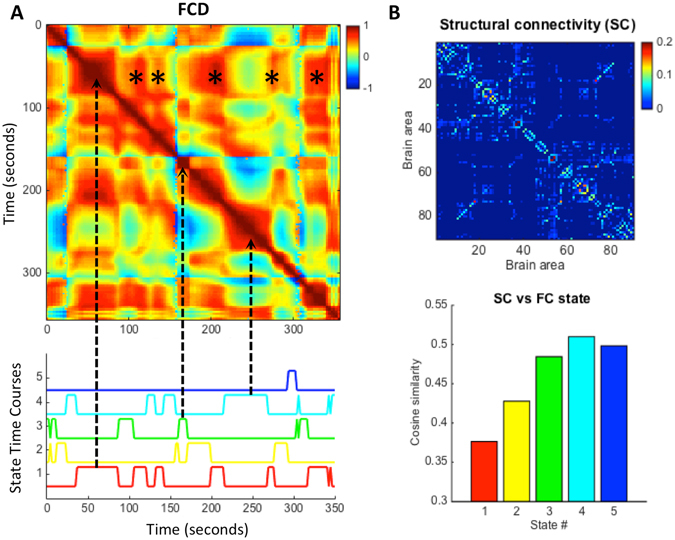
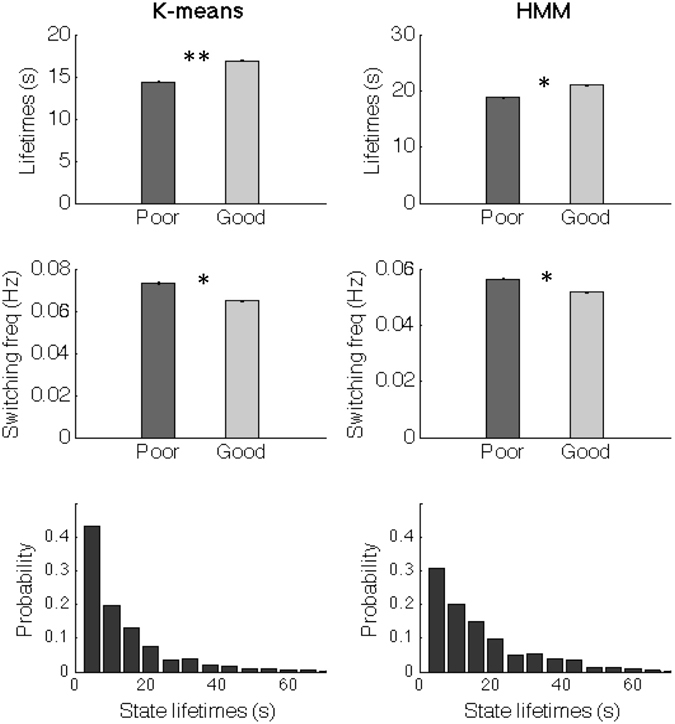
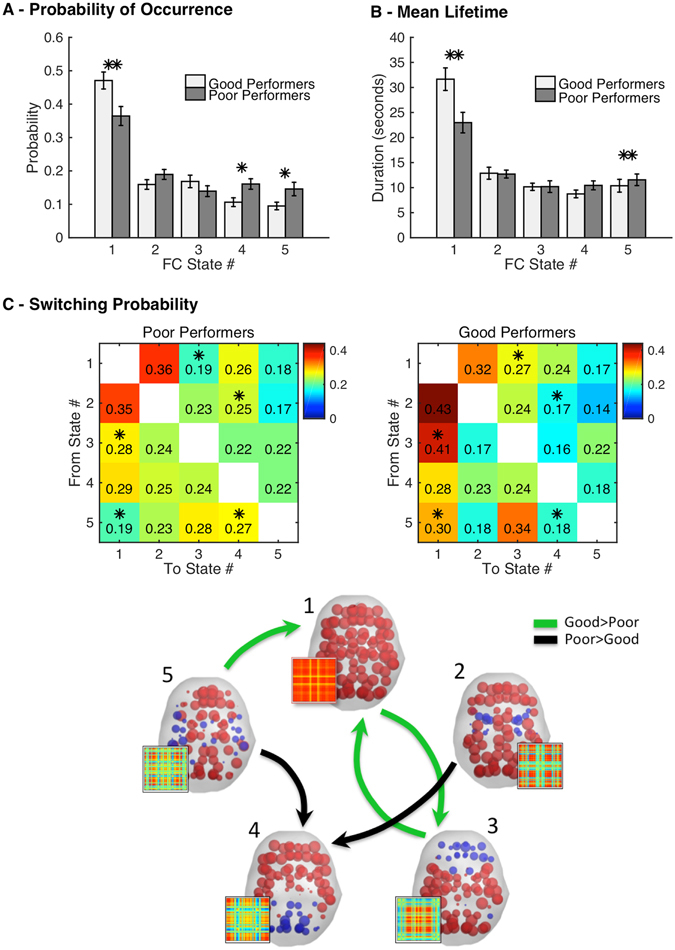
Growing evidence has shown that brain activity at rest slowly wanders through a repertoire of different states, where whole-brain functional connectivity (FC) temporarily settles into distinct FC patterns. Nevertheless, the functional role of resting-state activity remains unclear. Here, we investigate how the switching behavior of resting-state FC relates with cognitive performance in healthy older adults. We analyse resting-state fMRI data from 98 healthy adults previously categorized as being among the best or among the worst performers in a cohort study of >1000 subjects aged 50+ who underwent neuropsychological assessment. We use a novel approach focusing on the dominant FC pattern captured by the leading eigenvector of dynamic FC matrices. Recurrent FC patterns – or states – are detected and characterized in terms of lifetime, probability of occurrence and switching profiles. We find that poorer cognitive performance is associated with weaker FC temporal similarity together with altered switching between FC states. These results provide new evidence linking the switching dynamics of FC during rest with cognitive performance in later life, reinforcing the functional role of resting-state activity for effective cognitive processing.
Overview
The claims and statistics of this paper haven’t been checked yet.
Free: it reads the open-access text and checks the first 5 claims that cite a source we can check. Create a free account to check every claim.
Integrity signals
Registry
Cites
Statistics
Figures
Verification
Claims the paper makes
The claims and statistics of this paper haven’t been checked yet.
Free: it reads the open-access text and checks the first 5 claims that cite a source we can check. Create a free account to check every claim.
Claims other papers make about this one
Each is checked against this paper’s own text: does it say what the citing paper says it does?
The source backs part of the claim, not all of it — or backs it for a different population, condition or comparison.
In the citing paper
“Ease of transitions between brain states distinguishes younger from older individuals, and is further linked with executive function indexed by the D-KEFS.”
From Cognitive and behavioural flexibility: Neural mechanisms and clinical considerations (2021) · cites this paper as [51]
Experimental — accuracy not yet measuredThe cited source says what the claim attributes to it.
In the citing paper
“Older adults who performed more poorly on a battery of cognitive tests exhibited greater frequency of switching between dynamic brain states, whereas high performers exhibited a tendency to be in a state characterized by global coherence (108).”
From Brain Mechanisms Supporting Flexible Cognition and Behavior in Adolescents With Autism Spectrum Disorder (2021) · cites this paper as [108]
In the citing paper
“older adults performing well on a cognitive test battery were found to exhibit brain states characterized by global coherence, whereas those performing poorly exhibited greater frequency of switching between dynamic brain states51.”
From Cognitive and behavioural flexibility: Neural mechanisms and clinical considerations (2021) · cites this paper as [51]
Self-check
Percentages, sums and reported differences re-computed from the paper’s own numbers.
The self-check needs the paper’s full text.
Citations
Cites
Tzourio-Mazoyer, N., Landeau, B., Papathanassiou, D., Crivello, F., Etard, O., Delcroix, N., Mazoyer, B., & Joliot, M. (2002) · NeuroImage · doi:10.1006/nimg.2001.0978 · Cited by 16,319
Advances in functional and structural MR image analysis and implementation as FSL
Smith, S. M., Jenkinson, M., Woolrich, M. W., Beckmann, C. F., Behrens, T. E. J., Johansen-Berg, H., Bannister, P. R., De Luca, M., Drobnjak, I., Flitney, D. E., et al. (2004) · NeuroImage · doi:10.1016/j.neuroimage.2004.07.051 · Cited by 13,630
Jenkinson, M., Bannister, P., Brady, M., & Smith, S. (2002) · NeuroImage · doi:10.1006/nimg.2002.1132 · Cited by 11,888
Jenkinson, M., Beckmann, C. F., Behrens, T. E. J., Woolrich, M. W., & Smith, S. M. (2012) · NeuroImage · doi:10.1016/j.neuroimage.2011.09.015 · Cited by 11,314
Fast robust automated brain extraction
Smith, S. M. (2002) · Human Brain Mapping · doi:10.1002/hbm.10062 · Cited by 10,496
Functional connectivity in the resting brain: a network analysis of the default mode hypothesis
Greicius, M. D., Krasnow, B., Reiss, A. L., & Menon, V. (2003) · Proceedings of the National Academy of Sciences · doi:10.1073/pnas.0135058100 · Cited by 6,358
A Fuzzy Relative of the ISODATA Process and Its Use in Detecting Compact Well-Separated Clusters
Dunn, J. C. (1973) · Journal of Cybernetics · doi:10.1080/01969727308546046 · Cited by 5,049
Finding community structure in networks using the eigenvectors of matrices
Newman, M. E. J. (2006) · Physical Review E · doi:10.1103/physreve.74.036104 · Cited by 4,761
Consistent resting-state networks across healthy subjects
Damoiseaux, J. S., Rombouts, S. A. R. B., Barkhof, F., Scheltens, P., Stam, C. J., Smith, S. M., & Beckmann, C. F. (2006) · Proceedings of the National Academy of Sciences · doi:10.1073/pnas.0601417103 · Cited by 4,326
Andersson, J. L. R., & Sotiropoulos, S. N. (2016) · NeuroImage · doi:10.1016/j.neuroimage.2015.10.019 · Cited by 3,500
Cited by
REBUS and the anarchic brain: Toward a unified model of the brain action of psychedelics
Carhart-Harris, R. L., & Friston, K. J. (2019) · Pharmacological Reviews · doi:10.1124/pr.118.017160 · Cited by 1,180
Cognitive and behavioural flexibility: Neural mechanisms and clinical considerations
Uddin, L. Q. (2021) · Nature Reviews Neuroscience · doi:10.1038/s41583-021-00428-w · Cited by 698
Capturing the spatiotemporal dynamics of self-generated, task-initiated thoughts with EEG and fMRI
Bréchet, L., Brunet, D., Birot, G., Gruetter, R., Michel, C. M., & Jorge, J. (2019) · NeuroImage · doi:10.1016/j.neuroimage.2019.03.029 · Cited by 329
“Time-resolved fMRI studies previously demonstrated that the RSNs spontaneously fluctuate in and out of spatially and temporally overlapping correlations (Cabral et al., 2017; Cole et al., 2014; Cole et al., 2013; de Pasquale et al., 2017; Hutchinson and Raff, 2014; Karahanoglu and Van De Ville, 2015; Power et al., 201…”
Behavior needs neural variability
Waschke, L., Kloosterman, N. A., Obleser, J., & Garrett, D. D. (2021) · Neuron · doi:10.1016/j.neuron.2021.01.023 · Cited by 308
Dynamic coupling of whole-brain neuronal and neurotransmitter systems
Kringelbach, M. L., Cruzat, J., Cabral, J., Knudsen, G. M., Carhart-Harris, R., Whybrow, P. C., Logothetis, N. K., & Deco, G. (2020) · Proceedings of the National Academy of Sciences · doi:10.1073/pnas.1921475117 · Cited by 284
Self-citationAwakening: Predicting external stimulation to force transitions between different brain states
Deco, G., Cruzat, J., Cabral, J., Tagliazucchi, E., Laufs, H., Logothetis, N. K., & Kringelbach, M. L. (2019) · Proceedings of the National Academy of Sciences · doi:10.1073/pnas.1905534116 · Cited by 263
“The first step of our analysis has been to identify the PMS space, by using the leading eigenvector dynamics analysis (LEiDA) method (27), described in detail in Materials and Methods and in Fig.”
MethodSelf-citationBrain States and Transitions: Insights from Computational Neuroscience
Kringelbach, M. L., & Deco, G. (2020) · Cell Reports · doi:10.1016/j.celrep.2020.108128 · Cited by 252
Self-citationHigh-amplitude cofluctuations in cortical activity drive functional connectivity
Zamani Esfahlani, F., Jo, Y., Faskowitz, J., Byrge, L., Kennedy, D. P., Sporns, O., & Betzel, R. F. (2020) · Proceedings of the National Academy of Sciences · doi:10.1073/pnas.2005531117 · Cited by 247
“Indeed, comparable results have been reported using similar methods (15, 17, 20, 36, 38, 42, 56–58).”
Dynamical exploration of the repertoire of brain networks at rest is modulated by psilocybin
Lord, L.-D., Expert, P., Atasoy, S., Roseman, L., Rapuano, K., Lambiotte, R., Nutt, D. J., Deco, G., Carhart-Harris, R. L., Kringelbach, M. L., et al. (2019) · NeuroImage · doi:10.1016/j.neuroimage.2019.05.060 · Cited by 224
“To characterize the evolution of the dPL matrix over time with reduced dimensionality, we employed a method termed Leading Eigenvector Dynamics Analysis (LEiDA) (Cabral et al., 2017b; Figueroa et al., 2019).”
BackgroundMethodResultInfluentialSelf-citationHeritability and interindividual variability of regional structure-function coupling
Gu, Z., Jamison, K. W., Sabuncu, M. R., & Kuceyeski, A. (2021) · Nature Communications · doi:10.1038/s41467-021-25184-4 · Cited by 216
Tools of the trade: estimating time-varying connectivity patterns from fMRI data
Iraji, A., Faghiri, A., Lewis, N., Fu, Z., Rachakonda, S., & Calhoun, V. D. (2020) · Social Cognitive and Affective Neuroscience · doi:10.1093/scan/nsaa114 · Cited by 174
Singleton, S. P., Luppi, A. I., Carhart-Harris, R. L., Cruzat, J., Roseman, L., Nutt, D. J., Deco, G., Kringelbach, M. L., Stamatakis, E. A., & Kuceyeski, A. F. (2022) · Nature Communications · doi:10.1038/s41467-022-33578-1 · Cited by 172
Self-citationCornblath, E. J., Ashourvan, A., Kim, J. Z., Betzel, R. F., Ćirić, R., Adebimpe, A., Baum, G. L., He, X., Ruparel, K., Moore, T. M., et al. (2020) · Communications Biology · doi:10.1038/s42003-020-0961-x · Cited by 156
“[4] Cabral J, Vidaurre D, Marques P, Magalhães R, Silva Moreira P, Miguel Soares J, Deco G, Sousa N, and Kringelbach ML: Cognitive performance in healthy older adults relates to spontaneous switching between states of functional connectivity during rest.”
BackgroundDynamic functional connectivity changes in dementia with Lewy bodies and Alzheimer's disease
Schumacher, J., Peraza, L. R., Firbank, M., Thomas, A. J., Kaiser, M., Gallagher, P., O'Brien, J. T., Blamire, A. M., & Taylor, J. (2019) · NeuroImage Clinical · doi:10.1016/j.nicl.2019.101812 · Cited by 139
“, 2013) and cognitive performance in healthy older adults (Cabral et al., 2017).”
BackgroundVohryzek, J., Deco, G., Cessac, B., Kringelbach, M. L., & Cabral, J. (2020) · Frontiers in Systems Neuroscience · doi:10.3389/fnsys.2020.00020 · Cited by 133
Self-citationChaudhari, N. M., Overholt, W. A., Figueroa-Gonzalez, P. A., Taubert, M., Bornemann, T. L. V., Probst, A. J., Hölzer, M., Marz, M., & Küsel, K. (2021) · Environmental Microbiome · doi:10.1186/s40793-021-00395-w · Cited by 119
Uddin, L. Q. (2021) · Biological Psychiatry · doi:10.1016/j.biopsych.2020.05.010 · Cited by 116
Tewarie, P. K. B., Liuzzi, L., O’Neill, G. C., Quinn, A. J., Griffa, A., Woolrich, M. W., Stam, C. J., Hillebrand, A., & Brookes, M. J. (2019) · NeuroImage · doi:10.1016/j.neuroimage.2019.06.006 · Cited by 117
“Note that we do not use recurrence plots computed after estimation of dynamic functional connectivity data as in (Cabral et al., 2017), but rather use recurrence plots based on the amplitudes envelopes as input to inform dynamic connectivity estimation.”
MethodBattaglia, D. A., Boudou, T., Hansen, E. C. A., Lombardo, D., Chettouf, S., Daffertshofer, A., McIntosh, A. R., Zimmermann, J., Ritter, P., & Jirsa, V. (2020) · NeuroImage · doi:10.1016/j.neuroimage.2020.117156 · Cited by 115
“…(FC; Tagliazucchi et al., 2012; Allen et al., 2012; Liu and Duyn, 2013; Hutchison et al., 2013; Chen et al., 2015; Preti et al., 2017; Gonzalez-Castillo and Bandettini, 2018), whose study is the defining focus of a research direction recently designated as “chronnectomics” (Calhoun et al., 2014).”
BackgroundMetastability demystified — the foundational past, the pragmatic present and the promising future
Hancock, F., Rosas, F. E., Luppi, A. I., Zhang, M., Mediano, P. A. M., Cabral, J., Deco, G., Kringelbach, M. L., Breakspear, M. J., Kelso, J. A. S., et al. (2024) · Nature reviews. Neuroscience · doi:10.1038/s41583-024-00883-1 · Cited by 118
“…of individual regions to phase alignment is captured in the leading eigenvector (or first principal component) of the functional connectivity matrix 78 , and thus the temporal variance of its entries (and not the eigenvalues as in std-SPECT) captures the flexibility of each brain region to modify…”
Self-citationBrain network dynamics in schizophrenia: Reduced dynamism of the default mode network
Kottaram, A., Johnston, L. A., Cocchi, L., Ganella, E. P., Everall, I., Pantelis, C., Ramamohanarao, K., & Zalesky, A. (2019) · Human Brain Mapping · doi:10.1002/hbm.24519 · Cited by 112
“…Elvevåg & Goldberg, 2000), and cognition is thought to emerge from the dynamic interactions among distributed brain regions (Bressler & Menon, 2010; Cabral et al., 2017; Cabral, Kringelbach & Deco 2017; Cocchi, Harding et al., 2014; Cole, Ito, Bas- sett, & Schultz, 2016), we hypothesized that…”
BackgroundMenon, S. S., & Krishnamurthy, K. (2019) · Scientific Reports · doi:10.1038/s41598-019-42090-4 · Cited by 108
Figueroa, C. A., Cabral, J., Mocking, R. J. T., Rapuano, K. M., van Hartevelt, T. J., Deco, G., Expert, P., Schene, A. H., Kringelbach, M. L., & Ruhé, H. G. (2019) · Human Brain Mapping · doi:10.1002/hbm.24559 · Cited by 104
“…high frequency components associated with cardiac and respiratory signals (>0.1 Hz), and focusing on the most meaningful frequency range of resting-state fluctuations (Biswal, Yetkin, Haughton, & Hyde, 1995; Cabral, Vidaurre, et al., 2017; Glerean, Salmi, Lahnakoski, Jaaskelainen, & Sams, 2012).”
BackgroundInfluentialSelf-citationDynamic effective connectivity
Zarghami, T. S., & Friston, K. J. (2019) · NeuroImage · doi:10.1016/j.neuroimage.2019.116453 · Cited by 106
Tapping into Multi-Faceted Human Behavior and Psychopathology Using fMRI Brain Dynamics
Bolton, T. A. W., Morgenroth, E., Preti, M. G., & Ville, D. V. D. (2020) · Trends in Neurosciences · doi:10.1016/j.tins.2020.06.005 · Cited by 100
França, L. G. S., Ciarrusta, J., Gale‐Grant, O., Fenn‐Moltu, S., Fitzgibbon, S. P., Chew, A. T. M., Falconer, S., Dimitrova, R., Cordero‐Grande, L., Price, A. N., et al. (2024) · Nature Communications · doi:10.1038/s41467-023-44050-z · Cited by 97
“We then obtain a lower-dimensional representation with the LEiDA approach 28,29 , whereby the LEiDA vector corresponds to the fi rst eigenvector of the decomposition of the matrix Δ φ ij ( t ).”
InfluentialSelf-citationBrain Connectivity Networks and the Aesthetic Experience of Music
Reybrouck, M., Vuust, P., & Brattico, E. (2018) · Brain Sciences · doi:10.3390/brainsci8060107 · Cited by 99
“Recent methodologies allow the tracking of how connectivity states dynamically change over time during the course of music listening [72].”
BackgroundHabitual coffee drinkers display a distinct pattern of brain functional connectivity
Magalhães, R. J. D. S., Picó‐Pérez, M., Esteves, M., Vieira, R., Castanho, T. C., Amorim, L., Sousa, M. M., Coelho, A., Fernandes, H. M., Cabral, J., et al. (2021) · Molecular Psychiatry · doi:10.1038/s41380-021-01075-4 · Cited by 90
“dynamics [30] to compare FC and its dynamics between habitual and non-habitual coffee consumers.”
BackgroundMethodSelf-citationCabral, J., Fernandes, F. F., & Shemesh, N. (2023) · Nature Communications · doi:10.1038/s41467-023-36025-x · Cited by 85
Self-citationA complex systems perspective on psychedelic brain action
Girn, M., Rosas, F. E., Daws, R. E., Gallen, C. L., Gazzaley, A. H., & Carhart-Harris, R. L. (2023) · Trends in Cognitive Sciences · doi:10.1016/j.tics.2023.01.003 · Cited by 84
“These include independent component analysis (ICA), seed-based FC, interregional FC, and themore recently developed leading eigenvector dynamics analysis (LEiDA) [114] (see [115] for an overview of resting-state network analytic approaches).”
MethodSubcortical-cortical dynamical states of the human brain and their breakdown in stroke
Favaretto, C., Allegra, M., Deco, G., Metcalf, N. V., Griffis, J. C., Shulman, G. L., Brovelli, A., & Corbetta, M. (2022) · Nature Communications · doi:10.1038/s41467-022-32304-1 · Cited by 83
Self-citationAltered brain dynamic in major depressive disorder: state and trait features
Javaheripour, N., Čolić, L., Opel, N., Li, M., Balajoo, S. M., Chand, T., van der Meer, J. N., Krylova, M., Izyurov, I., Meller, T., et al. (2023) · Translational Psychiatry · doi:10.1038/s41398-023-02540-0 · Cited by 79
Living on the edge: network neuroscience beyond nodes
Betzel, R. F., Faskowitz, J., & Sporns, O. (2023) · Trends in Cognitive Sciences · doi:10.1016/j.tics.2023.08.009 · Cited by 80
“Methodologically, multiplication of temporal derivatives (MTD) [97], coactivation patterns (CAPs) [48], and leading eigenvector dynamics analysis (LEiDA) [98] are related to eTS.”
Dynamic functional connectivity markers of objective trait mindfulness
Lim, J., Teng, J., Patanaik, A., Tandi, J., & Massar, S. A. A. (2018) · NeuroImage · doi:10.1016/j.neuroimage.2018.04.056 · Cited by 77
Whole-Brain Network Models: From Physics to Bedside
Pathak, A., Roy, D., & Banerjee, A. (2022) · Frontiers in Computational Neuroscience · doi:10.3389/fncom.2022.866517 · Cited by 74
“…neuroimaging data, and therefore, have advocated the use of dynamic measures of functional connectivity (dFC) (Hutchison et al., 2013; Preti et al., 2017). dFC may be estimated through a windowed manner, or through techniques not requiring arbitrarily chosen temporal windows (Cabral et al., 2017).”
MethodAlonso, S., Deco, G., Horst, G. J. T., & Cabral, J. (2020) · Frontiers in Neural Circuits · doi:10.3389/fncir.2020.570583 · Cited by 72
Self-citationNeuronal and behavioral effects of multi-day brain stimulation and memory training
Antonenko, D., Külzow, N., Sousa, A., Prehn, K., Grittner, U., & Flöel, A. (2018) · Neurobiology of Aging · doi:10.1016/j.neurobiolaging.2017.09.017 · Cited by 70
Model-based whole-brain effective connectivity to study distributed cognition in health and disease
Gilson, M., Zamora‐López, G., Pallarés, V., Adhikari, M. H., Senden, M., Campo, A. T., Mantini, D., Corbetta, M., Deco, G., & Insabato, A. (2019) · Network Neuroscience · doi:10.1162/netn_a_00117 · Cited by 69
“Recently, fMRI studies for both rest and tasks have also evolved to incorporate the temporal structure of BOLD signals in their analysis (Cabral et al., 2017; Ciuciu, Abry, & He, 2014; Gilson, Moreno-Bote, Ponce-Alvarez, Ritter, & Deco, 2016; Gonzalez-Castillo & Bandettini, 2017; B. J.”
BackgroundMethodInfluentialSelf-citationIndividualized event structure drives individual differences in whole-brain functional connectivity
Betzel, R. F., Cutts, S. A., Greenwell, S. A., Faskowitz, J., & Sporns, O. (2022) · NeuroImage · doi:10.1016/j.neuroimage.2022.118993 · Cited by 69
Temporally Unconstrained Decoding Reveals Consistent but Time-Varying Stages of Stimulus Processing
Vidaurre, D., Myers, N. E., Stokes, M. G., Nobre, A. C., & Woolrich, M. W. (2018) · Cerebral Cortex · doi:10.1093/cercor/bhy290 · Cited by 65
“Other possibilities are to use information of phase only (Cabral et al., 2017) or power only (Baker et al., 2014).”
BackgroundSelf-citationA synergetic turn in cognitive neuroscience of brain diseases
Ibanez, A., Kringelbach, M. L., & Deco, G. (2024) · Trends in Cognitive Sciences · doi:10.1016/j.tics.2023.12.006 · Cited by 65
Self-citationDynamic Functional Connectivity Patterns in Schizophrenia and the Relationship With Hallucinations
Weber, S., Johnsen, E., Kroken, R. A., Løberg, E., Kandilarova, S., Stoyanov, D., Kompus, K., & Hugdahl, K. (2020) · Frontiers in Psychiatry · doi:10.3389/fpsyt.2020.00227 · Cited by 67
“First, while dynamic FC corresponds to fluctuations in cognitive states (14, 16) and stable inter-individual cognitive differences (17), the interpretations of the single FC states with respect to underlying cognitive processes are still largely unclear.”
BackgroundGeorge, J., Sanders, T., Timmermann, V., Potočić, N., & Lang, M. (2022) · Scientific Reports · doi:10.1038/s41598-022-08825-6 · Cited by 62
Power shift and connectivity changes in healthy aging during resting-state EEG
Perinelli, A., Assecondi, S., Tagliabue, C. F., & Mazza, V. (2022) · NeuroImage · doi:10.1016/j.neuroimage.2022.119247 · Cited by 62
Abnormal meta-state activation of dynamic brain networks across the Alzheimer spectrum
Nùñez, P., Poza, J., Gómez, C., Rodríguez-González, V., Hillebrand, A., Tewarie, P. K. B., Tola-Arribas, M. Á., Cano, M., & Hornero, R. (2021) · NeuroImage · doi:10.1016/j.neuroimage.2021.117898 · Cited by 62
Functional harmonics reveal multi-dimensional basis functions underlying cortical organization
Glomb, K., Kringelbach, M. L., Deco, G., Hagmann, P., Pearson, J., & Atasoy, S. (2021) · Cell Reports · doi:10.1016/j.celrep.2021.109554 · Cited by 56
Self-citationVidaurre, D. (2021) · PLoS Computational Biology · doi:10.1371/journal.pcbi.1008580 · Cited by 53
“Alternatives to Pearson’s correlation include phase coherence [12, 13], and the angle [14] or covariance [15] between the signal gradients; these have been shown to necessitate shorter windows but might however be more sensitive to high-frequency noise artefacts.”
BackgroundSelf-citationChallenges in the measurement and interpretation of dynamic functional connectivity
Laumann, T. O., Snyder, A. Z., & Gratton, C. (2024) · Imaging Neuroscience · doi:10.1162/imag_a_00366 · Cited by 52
Prefrontal contributions to the stability and variability of thought and conscious experience
Zamani, A., Carhart-Harris, R. L., & Christoff, K. (2021) · Neuropsychopharmacology · doi:10.1038/s41386-021-01147-7 · Cited by 51
“This perspective has become prevalent in the field of cognitive neuroscience over the past decade, with work increasingly focusing on major scale brain networks [2, 3], brain activity configuration states [99, 107, 108], and whole-brain information dynamics [75–78, 97].”
BackgroundLarge-scale cortical functional networks are organized in structured cycles
van Es, M. W. J., Higgins, C., Gohil, C., Quinn, A. J., Vidaurre, D., & Woolrich, M. W. (2025) · Nature Neuroscience · doi:10.1038/s41593-025-02052-8 · Cited by 52
“…recorded in wakeful rest using magnetoencephalography (MEG), electroencephalography 1,11–13 and functional magnetic resonance imaging (fMRI) 14–16 has shown that transitions between cortical networks in wakeful rest, or resting state, networks are nonrandom and different levels of…”
Self-citationWhole-Brain Dynamics in Aging: Disruptions in Functional Connectivity and the Role of the Rich Club
Escrichs, A., Biarnés, C., Garre‐Olmo, J., Fernández‐Real, J. M., Ramos, R., Pamplona, R., Brugada, R., Serena, J. L., Ramió‐Torrentà, L., de Tuero, G. C., et al. (2020) · Cerebral Cortex · doi:10.1093/cercor/bhaa367 · Cited by 51
Self-citationFasano, M. C., Cabral, J., Stevner, A. B. A., Vuust, P., Cantou, P., Brattico, E., & Kringelbach, M. L. (2022) · Human Brain Mapping · doi:10.1002/hbm.26060 · Cited by 49
“Leading Eigenvector of BOLD Phase-Locking To characterize the evolution of the dPL matrix over time, we employed the Leading Eigenvector Dynamics Analysis (LEiDA) method which captures the temporal evolution of phase-locking patterns with reduced dimensionality (Cabral et al., 2017b).”
BackgroundMethodInfluentialSelf-citationLuppi, A. I., Cabral, J., Cofré, R., Mediano, P. A. M., Rosas, F. E., Qureshi, A. Y., Kuceyeski, A. F., Tagliazucchi, E., Raimondo, F., Deco, G., et al. (2023) · NeuroImage · doi:10.1016/j.neuroimage.2023.120162 · Cited by 47
“…patients with psychiatric symptoms ( Zarghami and Friston, 2020 ; Alonso Martínez et al., 2020 ; Farinha et al., 2022 ), between cognitive traits ( Cabral et al., 2017b ; Vidaurre et al., 2017 ; Uddin et al., 2021 ), and in psychedelic-induced altered states of consciousness ( Lord et al., 2019 ;…”
BackgroundSelf-citationBrain dynamics predictive of response to psilocybin for treatment-resistant depression
Vohryzek, J., Cabral, J., Lord, L.-D., Fernandes, H. M., Roseman, L., Nutt, D. J., Carhart-Harris, R. L., Deco, G., & Kringelbach, M. L. (2024) · Brain Communications · doi:10.1093/braincomms/fcae049 · Cited by 49
Self-citationInter-regional BOLD signal variability is an organizational feature of functional brain networks
Baracchini, G., Mišić, B., Setton, R., Mwilambwe-Tshilobo, L., Girn, M., Nomi, J. S., Uddin, L. Q., Turner, G. R., & Spreng, R. N. (2021) · NeuroImage · doi:10.1016/j.neuroimage.2021.118149 · Cited by 47
“Similarly, in resting-state fMRI, BOLD signal dynamics have been found to follow a unimodal-heteromodal hierarchical organization (e.g., Müller et al., 2020 ; Shafiei et al., 2020 ; Vidaurre et al., 2017 ).”
Anderson, E. D., & Barbey, A. K. (2022) · Human Brain Mapping · doi:10.1002/hbm.26164 · Cited by 49
“, 2000b) and dynamics (Cabral et al., 2017; Shine et al., 2016; Sporns et al., 2000a), rather than relying solely on a specific brain region or primary network.”
BackgroundValsasina, P., de la Cruz, M. H., Filippi, M., & Rocca, M. A. (2019) · Frontiers in Neuroscience · doi:10.3389/fnins.2019.00618 · Cited by 46
Transient neural network dynamics in cognitive ageing
Tibon, R., Tsvetanov, K. A., Price, D., Nesbitt, D., Can, C., & Henson, R. N. (2021) · Neurobiology of Aging · doi:10.1016/j.neurobiolaging.2021.01.035 · Cited by 46
Petkoski, S., Ritter, P., & Jirsa, V. (2023) · Cerebral Cortex · doi:10.1093/cercor/bhac500 · Cited by 45
“In all the cases, by keeping the interval between two consecutive FC network time-resolved estimations constant, higher and lower correlations of the FCD can naturally be interpreted as associated to a slower or faster speed of dFC reconfiguration (Battaglia et al.,2020).”
BackgroundInfluentialEvolutionarily conserved fMRI network dynamics in the mouse, macaque, and human brain
Gutierrez‐Barragan, D., Ramirez, J. S. B., Panzeri, S., Xu, T., & Gozzi, A. (2024) · Nature Communications · doi:10.1038/s41467-024-52721-8 · Cited by 46
Recurrence quantification analysis of dynamic brain networks
Lopes, M. A., Zhang, J., Krzemiński, D., Hamandi, K., Chen, Q., Livi, L., & Masuda, N. (2020) · European Journal of Neuroscience · doi:10.1111/ejn.14960 · Cited by 45
“Other recent approaches have used distance matrices to evaluate dFNs from fMRI (Cabral et al., 2017) and dynamic correlation matrices from scalp EEG (Rosch, Baldeweg, Moeller, & Baier, 2018).”
MethodDynamic functional connectivity patterns associated with dementia risk
Dautricourt, S., Gonneaud, J., Landeau, B., Calhoun, V. D., de Florès, R., Poisnel, G., Bougacha, S., Ourry, V., Touron, E., Kuhn, E., et al. (2022) · Alzheimer s Research & Therapy · doi:10.1186/s13195-022-01006-7 · Cited by 44
“Interestingly, the lower number of transitions was associated with poorer cognitive performance in cognitively unimpaired older adults in a previous study [54].”
BackgroundMulti-modal and multi-model interrogation of large-scale functional brain networks
Castaldo, F., dos Santos, F. P., Timms, R. C., Cabral, J., Vohryzek, J., Deco, G., Woolrich, M. W., Friston, K. J., Verschure, P. F. M. J., & Litvak, V. (2023) · NeuroImage · doi:10.1016/j.neuroimage.2023.120236 · Cited by 43
Self-citationTransient brain networks underlying interpersonal strategies during synchronized action
Heggli, O. A., Konvalinka, I., Cabral, J., Brattico, E., Kringelbach, M. L., & Vuust, P. (2020) · Social Cognitive and Affective Neuroscience · doi:10.1093/scan/nsaa056 · Cited by 42
“To investigate the temporal dynamics of the dPL we adapted the LEiDA method (Cabral et al., 2017).”
MethodSelf-citationWhen the time is right: Temporal dynamics of brain activity in healthy aging and dementia
Courtney, S. M., & Hinault, T. (2020) · Progress in Neurobiology · doi:10.1016/j.pneurobio.2021.102076 · Cited by 42
Hancock, F., Cabral, J., Luppi, A. I., Rosas, F. E., Mediano, P. A. M., Dipasquale, O., & Turkheimer, F. (2022) · NeuroImage · doi:10.1016/j.neuroimage.2022.119433 · Cited by 43
“previous published works applying the same LEiDA methods to datasets in different conditions (Cabral et al., 2017; Farinha et al., 2022; Figueroa et al., 2019; Lord et al., 2019), and more generally to canonical resting-state networks or intrinsic connectivity”
BackgroundMethodInfluentialSelf-citationOlsen, A. S., Lykkebo-Valløe, A., Ozenne, B., Madsen, M. K., Stenbæk, D. S., Armand, S., Mørup, M., Ganz, M., Knudsen, G. M., & Fisher, P. M. (2022) · NeuroImage · doi:10.1016/j.neuroimage.2022.119716 · Cited by 42
“characterized by all elements having the same sign (Cabral et al., 2017; Escrichs et al., 2021; Farinha et al., 2022; Figueroa et al., 2019; Larabi et al., 2020; Lord et al., 2019; Stark et al., 2021; Vohryzek et al., 2020).”
InfluentialData and model considerations for estimating time-varying functional connectivity in fMRI
Ahrends, C., Stevner, A. B. A., Pervaiz, U., Kringelbach, M., Vuust, P., Woolrich, M. W., & Vidaurre, D. (2022) · NeuroImage · doi:10.1016/j.neuroimage.2022.119026 · Cited by 41
Self-citationIncreased Excursions to Functional Networks in Schizophrenia in the Absence of Task
Farinha, M., Amado, C., Morgado, P. F., & Cabral, J. (2022) · Frontiers in Neuroscience · doi:10.3389/fnins.2022.821179 · Cited by 42
“, V1(t) represents the main orientation of the phases over all brain areas (Cabral et al., 2017).”
BackgroundMethodInfluentialSelf-citationWhat Can Computational Models Contribute to Neuroimaging Data Analytics?
Popovych, O. V., Manos, T., Hoffstaedter, F., & Eickhoff, S. B. (2019) · Frontiers in Systems Neuroscience · doi:10.3389/fnsys.2018.00068 · Cited by 40
“…below, and the static description of FC matrix obtained over long epochs ( ≥ 5 min) is distinguished by so-called dynamic FC reflecting time variations of correlations and characterized by the ongoing switching of network patterns (Hutchison et al., 2013; Allen et al., 2014; Cabral et al., 2017b).”
BackgroundThe Power of Smiling: The Adult Brain Networks Underlying Learned Infant Emotionality
Stark, E. A., Cabral, J., Riem, M. M. E., van IJzendoorn, M. H., Stein, A. L., & Kringelbach, M. L. (2019) · Cerebral Cortex · doi:10.1093/cercor/bhz219 · Cited by 39
Self-citationMascaro, A. L. A., Falotico, E., Petkoski, S., Pasquini, M., Vannucci, L., Tort‐Colet, N., Conti, E., Resta, F., Spalletti, C., Ramalingasetty, S. T., et al. (2020) · Frontiers in Systems Neuroscience · doi:10.3389/fnsys.2020.00031 · Cited by 38
“…group dynamics of weakly coupled oscillators (Pikovsky et al., 2001) is well-suited for assessing how the connectome governs the brain oscillatory dynamics that can be reflected in different neuroimaging modalities (Schmidt et al., 2014; Váša et al., 2015; Cabral et al., 2017; Petkoski et al., 2018).”
BackgroundVohryzek, J., Cabral, J., Castaldo, F., Perl, Y. S., Lord, L.-D., Fernandes, H. M., Litvak, V., Kringelbach, M. L., & Deco, G. (2022) · Computational and Structural Biotechnology Journal · doi:10.1016/j.csbj.2022.11.060 · Cited by 38
“This has been achieved by using an unsupervised clustering algorithm on the leading eigenvectors, derived from the instantaneous phase coherence matrices at every time point [27,32].”
MethodSelf-citationAbreu, R., Leal, A., & Figueiredo, P. (2019) · Scientific Reports · doi:10.1038/s41598-018-36976-y · Cited by 37
Singleton, S. P., Luppi, A. I., Carhart-Harris, R. L., Cruzat, J., Roseman, L., Nutt, D. J., Deco, G., Kringelbach, M. L., Stamatakis, E. A., & Kuceyeski, A. F. (2021) · bioRxiv (Cold Spring Harbor Laboratory) · doi:10.1101/2021.05.14.444193 · Cited by 36
Self-citationNonequilibrium physics of brain dynamics
Nartallo-Kaluarachchi, R., Kringelbach, M. L., Deco, G., Lambiotte, R., & Goriely, A. (2025) · Physics Reports · doi:10.1016/j.physrep.2025.10.003 · Cited by 35
“The primary assumption of NFT is that the cortex can be modelled as a continuous space with the level of activity as position 𝑥 and at time 𝑡 represented by a spatiotemporal function 𝑢(𝑥,𝑡) [182,183].”
Self-citationNetwork analysis of whole-brain fMRI dynamics: A new framework based on dynamic communicability
Gilson, M., Kouvaris, N. E., Deco, G., Mangin, J., Poupon, C., Lefranc, S., Rivière, D., & Zamora‐López, G. (2019) · NeuroImage · doi:10.1016/j.neuroimage.2019.116007 · Cited by 35
“Other alternatives to define states and transitions between them has used clustering techniques on the instantaneous phases obtained from the Hilbert transform [75] or HMMs to generate BOLD activation levels [26].”
MethodSelf-citationModes of cognition: Evidence from metastable brain dynamics
Capouskova, K., Kringelbach, M. L., & Deco, G. (2022) · NeuroImage · doi:10.1016/j.neuroimage.2022.119489 · Cited by 36
“The leading eigenvector method (LEIDA) for dimension reduction as a proposed plan to overcome multidimensional issues (Cabral et al., 2017) is, in DADA, replaced by a more sophisticated non-linear dimension reduction autoencoder algorithm (Hinton and Salakhutdinov, 2006).”
Self-citationUnderstanding cognitive control in aging: A brain network perspective
Xia, H., He, Q., & Chen, A. (2022) · Frontiers in Aging Neuroscience · doi:10.3389/fnagi.2022.1038756 · Cited by 36
“Besides, aging-related changes in dynamic functional connectivity have been verified (Cabral et al., 2017; Viviano et al., 2017).”
BackgroundDonnelly-Kehoe, P. A., Saenger, V. M., Lisofsky, N., Kühn, S., Kringelbach, M. L., Schwarzbach, J. V., Lindenberger, U., & Deco, G. (2019) · Human Brain Mapping · doi:10.1002/hbm.24572 · Cited by 34
Self-citationCastro, P., Luppi, A. I., Tagliazucchi, E., Perl, Y. S., Naçi, L., Owen, A. M., Sitt, J. D., Destexhe, A., & Cofré, R. (2024) · Communications Biology · doi:10.1038/s42003-024-06858-3 · Cited by 34
“To circumvent the issue of arbitrarily choosing the time window and overlapping in capturing temporal oscillations employing a sliding-window methodology 12,29,41,42 , the use of phase-based dynamic functional coordination was preferred 13,43,44 .”
MethodMetastability as a candidate neuromechanistic biomarker of schizophrenia pathology
Hancock, F., Rosas, F. E., McCutcheon, R. A., Cabral, J., Dipasquale, O., & Turkheimer, F. (2023) · PLoS ONE · doi:10.1371/journal.pone.0282707 · Cited by 34
“When averaged over a sufficiently long-time window, phase-locking values provide a close approximation to Pearson correlation, varying within the same range of values [54, 109].”
BackgroundMethodResultInfluentialSelf-citationHabenula deep brain stimulation for refractory bipolar disorder
Zhang, C., Kim, S., Li, D., Zhang, Y., Li, Y., Husch, A., Hertel, F., Yan, F., Voon, V., & Sun, B. (2019) · Brain stimulation · doi:10.1016/j.brs.2019.05.010 · Cited by 34
Hubbard, R. J., & Federmeier, K. D. (2021) · Cerebral Cortex · doi:10.1093/cercor/bhab087 · Cited by 33
Kurtin, D. L., Giunchiglia, V., Vohryzek, J., Cabral, J., Skeldon, A. C., & Violante, I. R. (2023) · NeuroImage · doi:10.1016/j.neuroimage.2023.120042 · Cited by 33
Self-citationToward stability of dynamic FC estimates in neuroimaging and electrophysiology: Solutions and limits
Alonso, S., & Vidaurre, D. (2023) · Network Neuroscience · doi:10.1162/netn_a_00331 · Cited by 33
“The HMM was modeled with K = 12 states, as in Vidaurre et al. (2017); here each state represents a reoccurring pattern of FC.”
BackgroundMethodInfluentialSelf-citationLarabi, D. I., Renken, R. J., Cabral, J., Marsman, J.-B. C., Aleman, A., & Ćurĉić‐Blake, B. (2020) · NeuroImage · doi:10.1016/j.neuroimage.2020.116896 · Cited by 34
Self-citationToward a Comprehensive Delineation of White Matter Tract-Related Deformation
Zhou, Z., Li, X., Liu, Y., Fahlstedt, M., Georgiadis, M., Zhan, X., Raymond, S., Grant, G. A., Kleiven, S., Camarillo, D. B., et al. (2021) · Journal of Neurotrauma · doi:10.1089/neu.2021.0195 · Cited by 33
Fu, Z., Sui, J., Iraji, A., Liu, J., & Calhoun, V. D. (2024) · Molecular Psychiatry · doi:10.1038/s41380-024-02683-6 · Cited by 33
“FC alterations have been linked to changes in cognitive performances [3], sex-related differences [4], and many brain diseases [5, 6].”
Capouskova, K., Zamora‐López, G., Kringelbach, M. L., & Deco, G. (2023) · Human Brain Mapping · doi:10.1002/hbm.26511 · Cited by 32
“In our analyses, the processes of integration and segregation are presented in a timeframe which we call a state (Cabral et al., 2017; Capouskova et al., 2022; Vila-Vidal et al., 2019).”
Self-citationSpatiotemporal whole-brain activity and functional connectivity of melodies recognition
Bonetti, L., Brattico, E., Carlomagno, F., Cabral, J., Stevner, A. B. A., Deco, G., Whybrow, P. C., Pearce, M. T., Pantazis, D., Vuust, P., et al. (2024) · Cerebral Cortex · doi:10.1093/cercor/bhae320 · Cited by 32
Self-citationOptimizing EEG Source Reconstruction with Concurrent fMRI-Derived Spatial Priors
Abreu, R., Soares, J. F., Lima, A. C., Sousa, L., Batista, S., Castelo-Branco, M. S., & Duarte, J. V. (2022) · Brain Topography · doi:10.1007/s10548-022-00891-3 · Cited by 31
“Because the dFC states are column vectors, rather than square matrices representing a connectivity matrix as required for the modularity analysis, such connectivity matrix of a given dFC state di ∈ ℝN×1 was first reconstructed by computing the outer product of the dFC state, (Cabral et al., 2017).”
BackgroundMethodHancock, F., Rosas, F. E., Mediano, P. A. M., Luppi, A. I., Cabral, J., Dipasquale, O., & Turkheimer, F. (2022) · Journal of The Royal Society Interface · doi:10.1098/rsif.2022.0214 · Cited by 31
“Phase-locking has been used to identify community structure in fMRI resting state data through dynamic FC [59,144].”
MethodSelf-citationMulti-metric evaluations of acute psychedelic effects on fMRI brain entropy
McCulloch, D. E.-W., Olsen, A. S., Ozenne, B., Larsen, K. O., Stenbæk, D. S., Armand, S., Madsen, M. K., Knudsen, G. M., & Fisher, P. M. (2026) · Nature Communications · doi:10.1038/s41467-026-74215-5 · Cited by 31
“For each scan session, Leading Eigenvector Dynamics Analysis (LEiDA) 83 was applied to the time-series of 90 AAL atlas regions 84 .”
Chaos versus noise as drivers of multistability in neural networks
Orio, P., Gatica, M., Herzog, R. A., Maidana, J. P., Castro, S., & Xu, K. (2018) · Chaos An Interdisciplinary Journal of Nonlinear Science · doi:10.1063/1.5043447 · Cited by 30
Unveiling whole‐brain dynamics in normal aging through Hidden Markov Models
Moretto, M., Silvestri, E., Zangrossi, A., Corbetta, M., & Bertoldo, A. (2021) · Human Brain Mapping · doi:10.1002/hbm.25714 · Cited by 30
“…is well in line with previous studies, which observed an increased SR in healthy elderly subjects (Malagurski, Liem, Oschwald, Mérillat, & Jäncke, 2020) or a significant association between aging and SR increase in less performant older adults with low cognitive performances (Cabral et al., 2017).”
ResultLi, D., Vlisides, P. E., & Mashour, G. A. (2022) · NeuroImage · doi:10.1016/j.neuroimage.2022.118891 · Cited by 30
Uncovering individual differences in fine-scale dynamics of functional connectivity
Cutts, S. A., Faskowitz, J., Betzel, R. F., & Sporns, O. (2022) · Cerebral Cortex · doi:10.1093/cercor/bhac214 · Cited by 29
Hinault, T., Larcher, K. M.-H., Bherer, L., Courtney, S. M., & Dagher, A. (2019) · Neurobiology of Aging · doi:10.1016/j.neurobiolaging.2019.06.013 · Cited by 29
Mariani, B., Nicoletti, G., Bisio, M., Maschietto, M., Oboe, R., Leparulo, A., Suweis, S. S., & Vassanelli, S. (2021) · Frontiers in Systems Neuroscience · doi:10.3389/fnsys.2021.709677 · Cited by 29
Metadata
- Authors
- Cabral, J., Vidaurre, D., Marques, P., Magalhães, R., Silva Moreira, P., Miguel Soares, J., Deco, G., Sousa, N., & Kringelbach, M. L.
- Affiliations
- Aarhus University (DK)
- University of Oxford (GB)
- Clinical Academic Center of Braga (PT)
- Institució Catalana de Recerca i Estudis Avançats (ES)
- Corresponding author
- Cabral, Joana
- ORCID
- Venue
- Scientific Reports
- Published
- 2017-07-11
- Volume
- 7
- Issue
- 1
- Pages
- 5135-5135
- ISSN
- 2045-2322 (ISSN-L)
- PMC
- PMC5506029
- OpenAlex
- W2726287250
- Cited by
- 386
- References
- 74
- Citations by year
- 2026: 37 · 2025: 75 · 2024: 50 · 2023: 55 · 2022: 58 · 2021: 42 · 2020: 32 · 2019: 26 · 2018: 9 · 2017: 2
- FWCI
- 10.83
- Type
- journal article
- Language
- en
- Open access
- gold
- doi.org
- Licence
- cc-by
- creativecommons.org/licenses/by/4.0 (tdm)
- creativecommons.org/licenses/by/4.0 (vor)
- Locations
- Scientific Reports (publishedVersion, cc-by)
- PubMed Central (publishedVersion, cc-by)
- PubMed (publishedVersion)
- RECERCAT (Consorci de Serveis Universitaris de Catalunya) (publishedVersion, cc-by)
- Monash University Research Portal (Monash University) (submittedVersion, other-oa)
- DOAJ (DOAJ: Directory of Open Access Journals) (submittedVersion, cc-by-sa)
- Scopus (Elsevier) (submittedVersion)
- MPG.PuRe (Max Planck Society) (submittedVersion, other-oa)
- Repositori digital de la UPF (Universitat Pompeu Fabra) (submittedVersion, cc-by)
- Portuguese National Funding Agency for Science, Research and Technology (RCAAP Project by FCT) (submittedVersion, other-oa)
- Funders
- Wellcome Trust (098369/Z/12/Z, 098369)
- European Commission (HBP SGA1, NORTE-01-0145-FEDER-000013, 720270, HORIZON2020, NORTE2020)
- National Research Foundation (DNRF117)
- Danmarks Grundforskningsfond (615539, DNRF117)
- Fundação para a Ciência e a Tecnologia (PDE/BDE/113604/2015, 01-0145, COMPETE, FCOMP-01-0124-FEDER-037298, NORTE-01–0145-FEDER-000013, PDE/BDE/113601/2015, PORTUGAL 2020, NORTE2020, NORTE-01-0145, FCOMP-01-0124-FEDER)
- European Regional Development Fund (COMPETE, 01-0145-FEDER-000013, FCOMP‐01‐0124‐FEDER‐037298, 01-0145, NORTE-01-0145-FEDER-000013, 720270, NORTE-2020)
- Agencia Estatal de Investigación (PSI2016-75688-P)
- FP7 Ideas: European Research Council (295129)
- Topics
- Life Sciences › Neuroscience › Cognitive Neuroscience › Functional Brain Connectivity Studies
- Life Sciences › Neuroscience › Cognitive Neuroscience › Neural dynamics and brain function
- Health Sciences › Medicine › Radiology, Nuclear Medicine and Imaging › Advanced MRI Techniques and Applications
- Keywords
- resting-state functional connectivity, cognitive performance, older adults, aging, dynamic functional connectivity, leading eigenvector, healthy aging
- MeSH terms
- Aged, Brain, Cognition, Female, Humans, Magnetic Resonance Imaging, Male, Middle Aged, Neuropsychological Tests, Rest, Cohort Studies, Connectome, Healthy Volunteers
About these checks
Registry, retraction, Cites and statistics results are computed, not judged, with one exception: a printed reference that no index lists is read once by a model before it counts as a citation error. Claims are extracted by a model and kept only when their quote appears verbatim in the text; each cited source is then checked, with a model’s help, for whether it says what the claim relies on. Those verdicts can be wrong — read the claim’s quote and the cited source before relying on one.
Statistics and arithmetic are recomputed, not judged.
Confidence bands are shown only for fields calibrated on our annotated test set. None is calibrated yet, so no band is shown.
What counts as a claim ›How we measure confidence ›How we check this ›
Are you an author, or do you see a problem with this page? Request a review
Data sources
Bibliographic data: Semantic Scholar, OpenAlex, Crossref.
Contains information from the Semantic Scholar Academic Graph Datasets, made available under the ODC Attribution License (ODC-BY 1.0).
Semantic Scholar’s data is described in: Kinney, R., et al. (2023). The Semantic Scholar Open Data Platform. arXiv:2301.10140.
