

Cognitive performance in healthy older adults relates to spontaneous switching between states of functional connectivity during rest
Open accessThe DOI matches its Crossref record; 74 of the 74 references it cites were found in a registry or an index.
Abstract
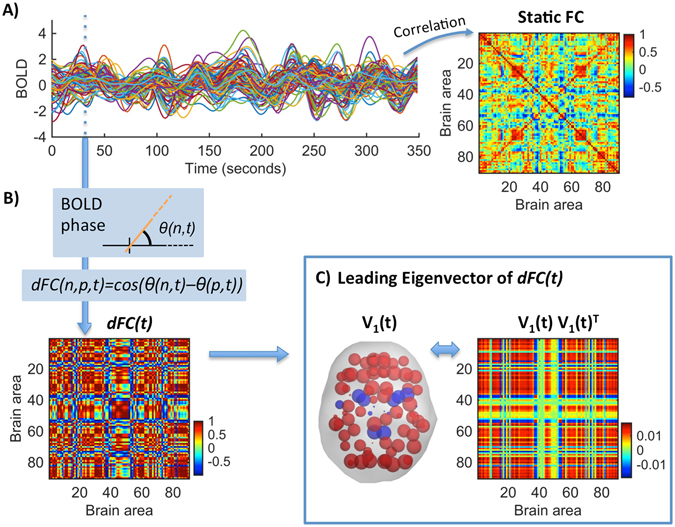
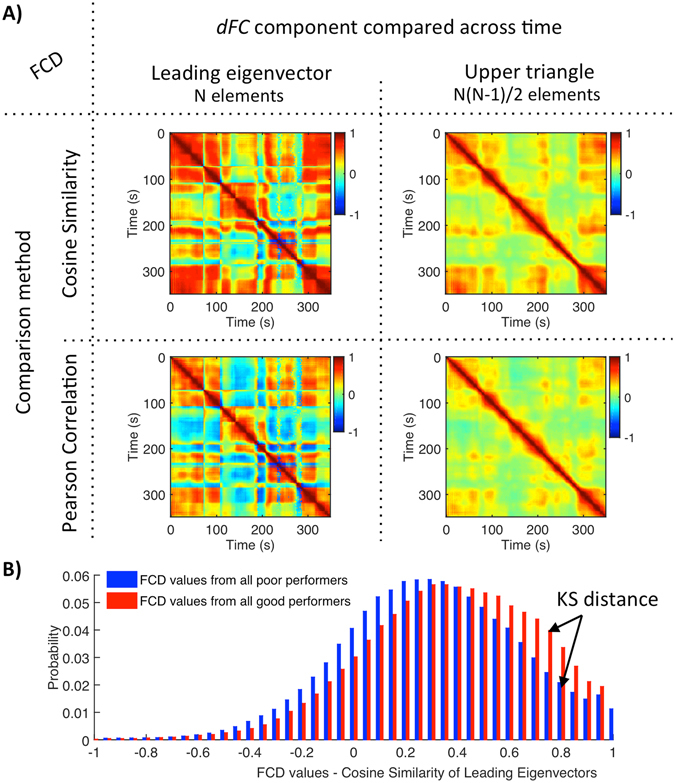
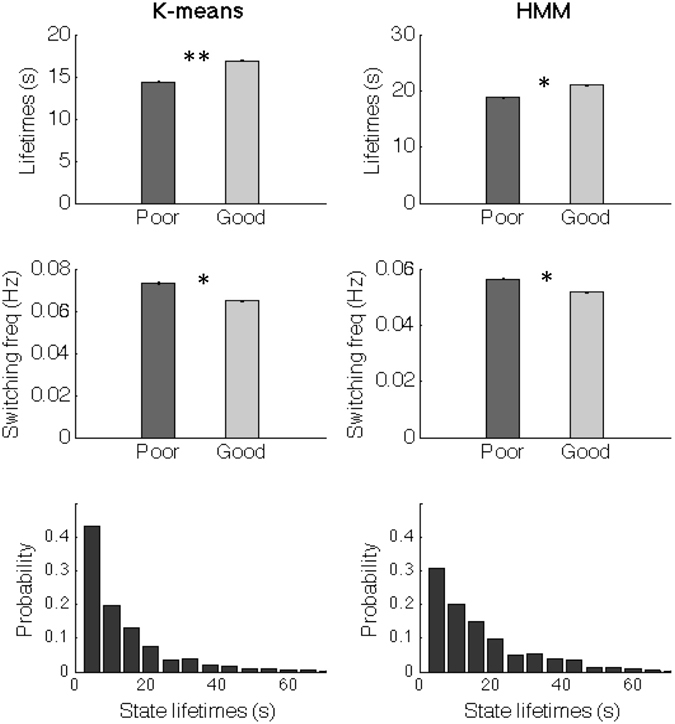
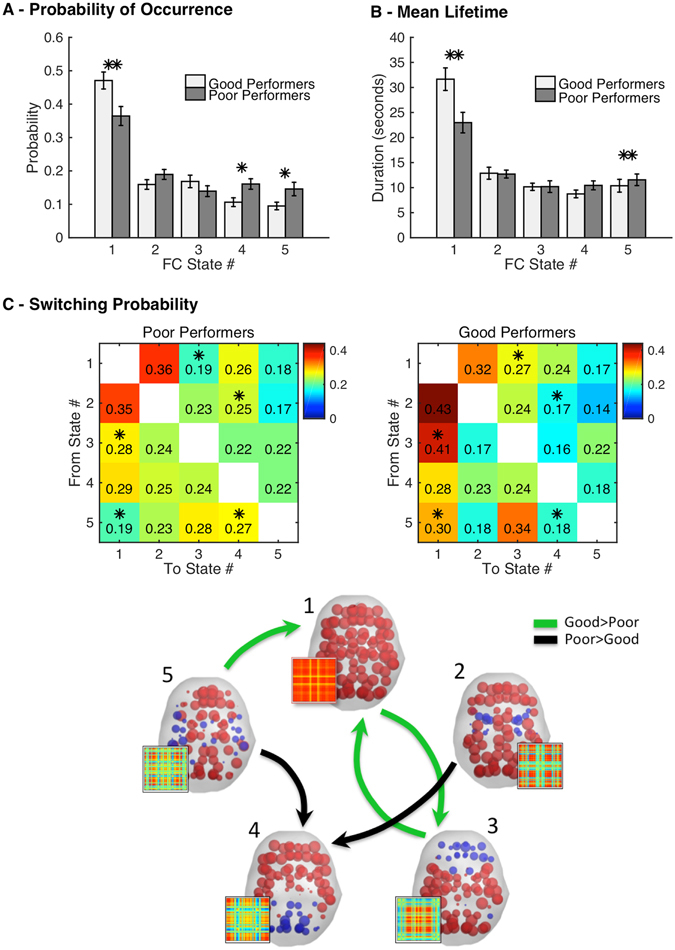
Growing evidence has shown that brain activity at rest slowly wanders through a repertoire of different states, where whole-brain functional connectivity (FC) temporarily settles into distinct FC patterns. Nevertheless, the functional role of resting-state activity remains unclear. Here, we investigate how the switching behavior of resting-state FC relates with cognitive performance in healthy older adults. We analyse resting-state fMRI data from 98 healthy adults previously categorized as being among the best or among the worst performers in a cohort study of >1000 subjects aged 50+ who underwent neuropsychological assessment. We use a novel approach focusing on the dominant FC pattern captured by the leading eigenvector of dynamic FC matrices. Recurrent FC patterns – or states – are detected and characterized in terms of lifetime, probability of occurrence and switching profiles. We find that poorer cognitive performance is associated with weaker FC temporal similarity together with altered switching between FC states. These results provide new evidence linking the switching dynamics of FC during rest with cognitive performance in later life, reinforcing the functional role of resting-state activity for effective cognitive processing.
Overview
The claims and statistics of this paper haven’t been checked yet.
Free: it reads the open-access text and checks the first 5 claims that cite a source we can check. Create a free account to check every claim.
Integrity signals
Registry
Cites
Statistics
Figures
Verification
Claims the paper makes
The claims and statistics of this paper haven’t been checked yet.
Free: it reads the open-access text and checks the first 5 claims that cite a source we can check. Create a free account to check every claim.
Claims other papers make about this one
Each is checked against this paper’s own text: does it say what the citing paper says it does?
The source backs part of the claim, not all of it — or backs it for a different population, condition or comparison.
In the citing paper
“Ease of transitions between brain states distinguishes younger from older individuals, and is further linked with executive function indexed by the D-KEFS.”
From Cognitive and behavioural flexibility: Neural mechanisms and clinical considerations (2021) · cites this paper as [51]
Experimental — accuracy not yet measuredThe cited source says what the claim attributes to it.
In the citing paper
“Older adults who performed more poorly on a battery of cognitive tests exhibited greater frequency of switching between dynamic brain states, whereas high performers exhibited a tendency to be in a state characterized by global coherence (108).”
From Brain Mechanisms Supporting Flexible Cognition and Behavior in Adolescents With Autism Spectrum Disorder (2021) · cites this paper as [108]
In the citing paper
“older adults performing well on a cognitive test battery were found to exhibit brain states characterized by global coherence, whereas those performing poorly exhibited greater frequency of switching between dynamic brain states51.”
From Cognitive and behavioural flexibility: Neural mechanisms and clinical considerations (2021) · cites this paper as [51]
Self-check
Percentages, sums and reported differences re-computed from the paper’s own numbers.
The self-check needs the paper’s full text.
Citations
Cites
Tzourio-Mazoyer, N., Landeau, B., Papathanassiou, D., Crivello, F., Etard, O., Delcroix, N., Mazoyer, B., & Joliot, M. (2002) · NeuroImage · doi:10.1006/nimg.2001.0978 · Cited by 16,319
Advances in functional and structural MR image analysis and implementation as FSL
Smith, S. M., Jenkinson, M., Woolrich, M. W., Beckmann, C. F., Behrens, T. E. J., Johansen-Berg, H., Bannister, P. R., De Luca, M., Drobnjak, I., Flitney, D. E., et al. (2004) · NeuroImage · doi:10.1016/j.neuroimage.2004.07.051 · Cited by 13,630
Jenkinson, M., Bannister, P., Brady, M., & Smith, S. (2002) · NeuroImage · doi:10.1006/nimg.2002.1132 · Cited by 11,888
Jenkinson, M., Beckmann, C. F., Behrens, T. E. J., Woolrich, M. W., & Smith, S. M. (2012) · NeuroImage · doi:10.1016/j.neuroimage.2011.09.015 · Cited by 11,314
Fast robust automated brain extraction
Smith, S. M. (2002) · Human Brain Mapping · doi:10.1002/hbm.10062 · Cited by 10,496
Functional connectivity in the resting brain: a network analysis of the default mode hypothesis
Greicius, M. D., Krasnow, B., Reiss, A. L., & Menon, V. (2003) · Proceedings of the National Academy of Sciences · doi:10.1073/pnas.0135058100 · Cited by 6,358
A Fuzzy Relative of the ISODATA Process and Its Use in Detecting Compact Well-Separated Clusters
Dunn, J. C. (1973) · Journal of Cybernetics · doi:10.1080/01969727308546046 · Cited by 5,049
Finding community structure in networks using the eigenvectors of matrices
Newman, M. E. J. (2006) · Physical Review E · doi:10.1103/physreve.74.036104 · Cited by 4,761
Consistent resting-state networks across healthy subjects
Damoiseaux, J. S., Rombouts, S. A. R. B., Barkhof, F., Scheltens, P., Stam, C. J., Smith, S. M., & Beckmann, C. F. (2006) · Proceedings of the National Academy of Sciences · doi:10.1073/pnas.0601417103 · Cited by 4,326
Andersson, J. L. R., & Sotiropoulos, S. N. (2016) · NeuroImage · doi:10.1016/j.neuroimage.2015.10.019 · Cited by 3,500
Cited by
Items 101–200 of 435
The effect of external stimulation on functional networks in the aging healthy human brain
Escrichs, A., Perl, Y. S., Martínez‐Molina, N., Biarnés, C., Garre‐Olmo, J., Fernández‐Real, J. M., Ramos, R., Martí‐Lluch, R., Pamplona, R., Brugada, R., et al. (2022) · Cerebral Cortex · doi:10.1093/cercor/bhac064 · Cited by 28
Self-citationInferring the dynamical effects of stroke lesions through whole-brain modeling
Idesis, S., Favaretto, C., Metcalf, N. V., Griffis, J. C., Shulman, G. L., Corbetta, M., & Deco, G. (2022) · NeuroImage Clinical · doi:10.1016/j.nicl.2022.103233 · Cited by 28
Self-citationRamírez-Mahaluf, J. P., Medel, V., Tepper, Á., Alliende, L. M., Sato, J. R., Ossandón, T., & Crossley, N. A. (2020) · NeuroImage · doi:10.1016/j.neuroimage.2020.117027 · Cited by 28
“Similarly, cognitive impairment associated with brain ageing has been linked to brain dynamics remaining shorter periods in states characterized by strong global connectivity (Cabral et al., 2017).”
Determination of Dynamic Brain Connectivity via Spectral Analysis
Robinson, P. A., Henderson, J. A., Gabay, N. C., Aquino, K. M., Babaie-Janvier, T., & Gao, X. (2021) · Frontiers in Human Neuroscience · doi:10.3389/fnhum.2021.655576 · Cited by 26
Using in silico perturbational approach to identify critical areas in schizophrenia
Mana, L., Vila‐Vidal, M., Köckeritz, C., Aquino, K. M., Fornito, A., Kringelbach, M. L., & Deco, G. (2023) · Cerebral Cortex · doi:10.1093/cercor/bhad067 · Cited by 26
Self-citationdos Santos, F. P., Vohryzek, J., & Verschure, P. F. M. J. (2023) · PLoS Computational Biology · doi:10.1371/journal.pcbi.1011279 · Cited by 25
Stability of sensorimotor network sculpts the dynamic repertoire of resting state over lifespan
Sastry, N. C., Roy, D., & Banerjee, A. (2022) · Cerebral Cortex · doi:10.1093/cercor/bhac133 · Cited by 27
“2017), HMM (Vidaurre et al. 2016; Cabral et al. 2017; Vidaurre et al. 2017; Quinn et al. 2018), suggestive of stability of functional architecture of the brain.”
InfluentialMeijer, A., Königs, M., Pouwels, P. J. W., Smith, J., Visscher, C., Bosker, R., Hartman, E., & Oosterlaan, J. (2022) · Psychophysiology · doi:10.1111/psyp.14034 · Cited by 24
“, 2009) and is related to neurocognitive functioning in children (Cabral et al., 2017; Gutierrez- Colina et al., 2020; Laird et al., 2011; Rubia, 2013).”
BackgroundPerceived stress modulates the activity between the amygdala and the cortex
Caetano, I., Ferreira, S., Coelho, A., Amorim, L., Castanho, T. C., Portugal‐Nunes, C., Soares, J. M., Gonçalves, N., Sousa, R., Reis, J. S., et al. (2022) · Molecular Psychiatry · doi:10.1038/s41380-022-01780-8 · Cited by 24
Self-citationThe complexity of the stream of consciousness
Coppola, P., Allanson, J., Naçi, L., Ram, A., Finoia, P., Williams, G. B., Pickard, J. D., Owen, A. M., Menon, D. K., & Stamatakis, E. A. (2022) · Communications Biology · doi:10.1038/s42003-022-04109-x · Cited by 24
Dynamic functional connectivity in pediatric mild traumatic brain injury
van der Horn, H. J., Ling, J. M., Wick, T. V., Dodd, A. B., Robertson-Benta, C. R., McQuaid, J. R., Zotev, V., Vakhtin, A. A., Ryman, S. G., Cabral, J., et al. (2024) · NeuroImage · doi:10.1016/j.neuroimage.2023.120470 · Cited by 23
“…in different brain regions (i.e., dFC), using, for example, correlation or phase coherence measures, clustering methods can be used to detect time-varying, and recurrent, spatial FC patterns that are known as dynamic brain states (Cabral, Kringelbach, et al., 2017; Calhoun et al., 2014).”
MethodSelf-citationInformal sector employment and the health outcomes of older workers in India
Chowdhury, P., Mohanty, I., Singh, A., & Niyonsenga, T. (2023) · PLoS ONE · doi:10.1371/journal.pone.0266576 · Cited by 23
“Then, a principal component analysis (PCA) is applied to create a composite score of cognitive functioning, where minimum score represents poor cognitive while higher score reflects better cognitive functioning [71, 72].”
MethodBrain state dynamics differ between eyes open and eyes closed rest
Ingram, B. T., Mayhew, S. D., & Bagshaw, A. P. (2024) · Human Brain Mapping · doi:10.1002/hbm.26746 · Cited by 23
“As a data reduction step for the fMRI HMM analysis (Ahrends et al., 2022; Vidaurre, Abeysuriya, et al., 2018; Vidaurre et al., 2017), HMM training.”
MethodFunctional connectivity in mild cognitive impairment with Lewy bodies
Schumacher, J., Taylor, J., Hamilton, C. A., Firbank, M., Donaghy, P. C., Roberts, G., Allan, L. M., Durcan, R., Barnett, N. A., O'Brien, J. T., et al. (2021) · Journal of Neurology · doi:10.1007/s00415-021-10580-z · Cited by 24
The metastable brain associated with autistic-like traits of typically developing individuals
Sase, T., & Kitajo, K. (2021) · PLoS Computational Biology · doi:10.1371/journal.pcbi.1008929 · Cited by 22
“Similar dynamics were previously observed in the restingstate neural signals of EEG [26, 28, 29], fMRI [89], and functional multineuron calcium PLOS COMPUTATIONAL BIOLOGY Metastability in the brain and autistic-like traits”
BackgroundResultLinking fast and slow: The case for generative models
Medrano, J., Friston, K. J., & Zeidman, P. (2024) · Network Neuroscience · doi:10.1162/netn_a_00343 · Cited by 23
“The resulting models are known as Hidden Markov Models (HMMs) and are popular devices in modelling time series (Baker et al., 2014; Bishop & Nasrabadi, 2006; Cabral et al., 2017; Rabiner, 1989; Vidaurre et al., 2016; Vidaurre, Smith, & Woolrich, 2017).”
MethodWhole-brain dynamical modelling for classification of Parkinson’s disease
Jung, K., Florin, E., Patil, K. R., Caspers, J., Rubbert, C., Eickhoff, S. B., & Popovych, O. V. (2022) · Brain Communications · doi:10.1093/braincomms/fcac331 · Cited by 21
“6,13,24,29,30 On that account, it is necessary to investigate, which parameter points of a given dynamical mode and which model fitting modalities are the most suitable to answer a given research question by the modelling approach.”
Dagnino, P. C., Escrichs, A., López‐González, A., Gosseries, O., Annen, J., Perl, Y. S., Kringelbach, M. L., Laureys, S., & Deco, G. (2024) · PLoS Computational Biology · doi:10.1371/journal.pcbi.1011350 · Cited by 21
Self-citationVolpi, T., Silvestri, E., Aiello, M., Lee, J. J., Vlassenko, A. G., Goyal, M. S., Corbetta, M., & Bertoldo, A. (2024) · Journal of Cerebral Blood Flow & Metabolism · doi:10.1177/0271678x241237974 · Cited by 21
“37 Overall, this wide range of functional metrics were selected to represent the majority of known properties of the rs-fMRI signal and its FC.”
Forrester, M., Petros, S., Cattell, O., Lai, Y. M., O’Dea, R. D., Sotiropoulos, S. N., & Coombes, S. (2024) · PLoS Computational Biology · doi:10.1371/journal.pcbi.1012647 · Cited by 20
Bai, Y., Belardinelli, P., & Ziemann, U. (2021) · Brain stimulation · doi:10.1016/j.brs.2021.12.002 · Cited by 20
“Such inherent transient states define spontaneous modes driven by oscillatory power, information flow and regional domination [11], and interact with task/stimulus-related neuronal activity [12-15].”
A systematic approach to brain dynamics: cognitive evolution theory of consciousness
Yurchenko, S. B. (2022) · Cognitive Neurodynamics · doi:10.1007/s11571-022-09863-6 · Cited by 20
“For example, CQ should be lower in mind-wandering resulting from the computational ruminations running on autopilot (Christoff 2012; Maillet and Schacter 2016), but higher in cognitive performance accompanied with switches in functional connectivity of N (Cabral et al. 2017).”
BackgroundWong, W.-W., Cabral, J., Rane, R., Ly, R., Kringelbach, M. L., & Feusner, J. D. (2021) · Neuropsychopharmacology · doi:10.1038/s41386-021-01039-w · Cited by 20
“The dynamic properties of recurrent FC states, using LEiDA, have been associated with cognitive performance [39] and with psychedelic experiences [43] in healthy participants.”
BackgroundMethodInfluentialSelf-citationTask-based differences in brain state dynamics and their relation to cognitive ability
Kurtin, D. L., Scott, G., Hebron, H., Skeldon, A. C., & Violante, I. R. (2023) · NeuroImage · doi:10.1016/j.neuroimage.2023.119945 · Cited by 19
Ragone, E., Tanner, J., Jo, Y., Esfahlani, F. Z., Faskowitz, J., Pope, M., Coletta, L., Gozzi, A., & Betzel, R. F. (2024) · Communications Biology · doi:10.1038/s42003-024-05766-w · Cited by 19
Vohryzek, J., Cabral, J., Timmermann, C., Atasoy, S., Roseman, L., Nutt, D. J., Carhart-Harris, R. L., Deco, G., & Kringelbach, M. L. (2024) · National Science Review · doi:10.1093/nsr/nwae124 · Cited by 20
“…connectivity in terms of sliding-window analysis [37 ], by considering the most salient events in the time-series [38 ,39 ] constrained by structural connectivity [40 ,41 ], as a temporal process of hidden states [42 ,43 ] or as a temporal trajectory in a landscape of attractors [44 ,45 ].”
MethodSelf-citationNùñez, P., Gómez, C., Rodríguez-González, V., Hillebrand, A., Tewarie, P. K. B., Gómez‐Pilar, J., Molina, V., Hornero, R., & Poza, J. (2022) · Journal of Neural Engineering · doi:10.1088/1741-2552/ac514e · Cited by 21
Asendorf, A. L., Theis, H., Tittgemeyer, M., Timmermann, L., Fink, G., Drzezga, A., Eggers, C., Ruppert-Junck, M., Pedrosa, D., Hoenig, M., et al. (2024) · bioRxiv · doi:10.1002/hbm.26776 · Cited by 17
“In healthy subjects, cognitive performance (Cabral et al., 2017) and flexibility (Nomi et al., 2017) have been associated with the ability to switch dynamically between states.”
BackgroundWiafe, S.-L., Asante, N. O., Calhoun, V. D., & Faghiri, A. (2025) · Brain Connectivity · doi:10.1177/21580014251376733 · Cited by 18
Small variation in dynamic functional connectivity in cerebellar networks
Fernandez-Iriondo, I., Jiménez-Marín, A., Diez, I. P., Bonifazi, P., Swinnen, S. P., Muñoz, M. A., & Cortés, J. M. (2021) · Neurocomputing · doi:10.1016/j.neucom.2020.09.092 · Cited by 19
“[43] Joana Cabral, Diego Vidaurre, Paulo Marques, Ricardo Magalhães,”
BackgroundMethodJachs, B. (2021) · Apollo (University of Cambridge) · doi:10.17863/cam.80153 · Cited by 19
Advances in fetal and neonatal neuroimaging and everyday exposures
Lautarescu, A., Bonthrone, A. F., Bos, B., Barratt, B., & Counsell, S. J. (2024) · Pediatric Research · doi:10.1038/s41390-024-03294-1 · Cited by 17
Lee, S., Bijsterbosch, J. D., Alfaro‐Almagro, F., Elliott, L. T., McCarthy, P., Taschler, B., Sala‐Llonch, R., Beckmann, C. F., Duff, E. P., Smith, S. M., et al. (2022) · NeuroImage · doi:10.1016/j.neuroimage.2022.119779 · Cited by 17
Spontaneous network activity <35 Hz accounts for variability in stimulus-induced gamma responses
Hirschmann, J. V., Baillet, S., Woolrich, M. W., Schnitzler, A., Vidaurre, D., & Florin, E. (2019) · NeuroImage · doi:10.1016/j.neuroimage.2019.116374 · Cited by 17
“HMMs and other whole-brain models have also been applied to describe dynamic connectivity in fMRI data (Cabral et al., 2017; Vidaurre et al., 2017).”
MethodSelf-citationZarghami, T. S., Hossein‐Zadeh, G., & Bahrami, F. (2020) · Frontiers in Neuroscience · doi:10.3389/fnins.2020.00214 · Cited by 17
Predicting time‐resolved electrophysiological brain networks from structural eigenmodes
Tewarie, P. K. B., Prasse, B., Meier, J. M., Mandke, K. N., Warrington, S., Stam, C. J., Brookes, M. J., Mieghem, P. V., Sotiropoulos, S. N., & Hillebrand, A. (2022) · Human Brain Mapping · doi:10.1002/hbm.25967 · Cited by 18
“…by individual structural eigenmodes, we reanalysed the structure–function mappings by denoising time-varying phase connectivity by using only the first 10 eigenmodes of the time-varying functional networks instead of the complete FC connectivity matrix, similarly as in Cabral et al. (2017b).”
BackgroundMethodBridging the gap between single receptor type activity and whole‐brain dynamics
Jancke, D., Herlitze, S., Kringelbach, M. L., & Deco, G. (2021) · FEBS Journal · doi:10.1111/febs.15855 · Cited by 17
Self-citationThe dynamics of the improvising brain: a study of musical creativity using jazz improvisationPreprint
Mota, P. A. D., Fernandes, H. M., Stark, E. A., Cabral, J., Heggli, O. A., Sousa, N., Kringelbach, M. L., & Vuust, P. (2020) · bioRxiv (Cold Spring Harbor Laboratory) · doi:10.1101/2020.01.29.924415 · Cited by 17
Self-citationJensen, K. H. R., McCulloch, D. E.-W., Olsen, A. S., Bruzzone, S. E. P., Larsen, S. V., Fisher, P. M., & Frøkjær, V. G. (2022) · Frontiers in Neuroscience · doi:10.3389/fnins.2022.855582 · Cited by 16
Fransson, P., & Strindberg, M. (2023) · NeuroImage · doi:10.1016/j.neuroimage.2023.119890 · Cited by 16
Long-term mindfulness meditation increases occurrence of sensory and attention brain states
Panitz, D. Y., Mendelsohn, A., Cabral, J., & Berkovich‐Ohana, A. (2025) · Frontiers in Human Neuroscience · doi:10.3389/fnhum.2024.1482353 · Cited by 16
Self-citationCharting higher-order models of brain function beyond pairwise interactions
Santoro, A., Neri, M., Poetto, S., Orsenigo, D., Diano, M., Gatica, M., & Petri, G. (2026) · Nature Communications · doi:10.1038/s41467-026-75959-w · Cited by 17
Synchronous Brain Dynamics Establish Brief States of Communality in Distant Neuronal Populations
Seeber, M., & Michel, C. M. (2021) · eNeuro · doi:10.1523/eneuro.0005-21.2021 · Cited by 16
Inferring Brain State Dynamics Underlying Naturalistic Stimuli Evoked Emotion Changes With dHA-HMM
Tan, C., Liu, X., & Zhang, G. (2022) · Neuroinformatics · doi:10.1007/s12021-022-09568-5 · Cited by 16
“In probabilistic graphical models, such as the Gaussian HMM, the expectation maximum (EM) algorithm is commonly used to iteratively estimate the parameter hidden variable Z (Vidaurre et al., 2017).”
MethodComparison of Resting-State Functional MRI Methods for Characterizing Brain Dynamics
Maltbie, E. A., Yousefi, B., Zhang, X., Kashyap, A., & Keilholz, S. D. (2022) · Frontiers in Neural Circuits · doi:10.3389/fncir.2022.681544 · Cited by 16
Cahart, M., Dell’Acqua, F., Giampietro, V., Cabral, J., Timmers, M., Streffer, J. R., Einstein, S. G., Zelaya, F. O., Williams, S., & O’Daly, O. (2022) · Frontiers in Human Neuroscience · doi:10.3389/fnhum.2022.980280 · Cited by 16
“The cerebellar ROIs were not included in line with previous work (Cabral et al., 2017) due to the absence of cerebellar networks in the Yeo parcellation used as part of our analyses (Yeo et al.”
BackgroundMethodInfluentialSelf-citationModulation of limbic resting-state networks by subthalamic nucleus deep brain stimulation
Eraifej, J., Cabral, J., Fernandes, H. M., Kahan, J., He, S., Mancini, L., Thornton, J. S., White, M. J., Yousry, T. A., Zrinzo, L. U., et al. (2023) · Network Neuroscience · doi:10.1162/netn_a_00297 · Cited by 17
Self-citationTang, X., Zhang, J., Liu, L., Yang, M., Li, S., Chen, J., Ma, Y., Zhang, J., Liu, H., Lu, C., et al. (2023) · NeuroImage · doi:10.1016/j.neuroimage.2023.120359 · Cited by 16
“These indices have been widely used in previous studies that applied brain state analysis (Cabral et al., 2017; Deco et al., 2019; Meer et al., 2020; Vidaurre et al., 2017).”
A Closer Look at Transitions between the Generative and Evaluative Phases of Creative Thought
Zamani, A., Mills, C., Girn, M., & Christoff, K. (2023) · Routledge eBooks · doi:10.4324/9781003009351-29 · Cited by 16
Chen, X., Ren, H., Tang, Z., Zhou, K., Zhou, L., Zuo, Z., Cui, X., Chen, X., Liu, Z., He, Y., et al. (2023) · Communications Biology · doi:10.1038/s42003-023-05262-7 · Cited by 15
“Each connectivity state differs from the other in terms of the overall connectivity pattern 64 or dominant connectivity modes quanti fi ed by leading eigenvectors 65,67 .”
Qian, S., Yang, Q., Cai, C., Dong, J., & Cai, S. (2024) · Brain Sciences · doi:10.3390/brainsci14050507 · Cited by 15
“The state switching rate (SR) was the transition rate between two states, indicating the stability of each subject’s brain dynamics [47].”
BackgroundAn EEG-Based Seizure Prediction Model Encoding Brain Network Temporal Dynamics
Liao, J., Chen, Y., He, Y., Zhang, K., Ma, T., Wang, Y., & Shao, X. (2025) · IEEE Journal of Biomedical and Health Informatics · doi:10.1109/jbhi.2025.3584861 · Cited by 15
“Following [31], we utilized instantaneous phase locking to construct the dynamic functional brain network.”
Tibon, R., Cam‐CAN, & Tsvetanov, K. A. (2022) · Frontiers in Aging Neuroscience · doi:10.3389/fnagi.2021.746236 · Cited by 15
Ferré, P., Benhajali, Y., Steffener, J., Stern, Y., Joanette, Y., & Bellec, P. (2019) · Language Cognition and Neuroscience · doi:10.1080/23273798.2019.1608072 · Cited by 15
“…analysis (Andrews-Hanna et al., 2007; Jockwitz et al., 2017; Stern, Gazes, Razlighi, Ste ff ener, & Habeck, 2018), dynamic functional connectivity (Cabral et al., 2017; Shine et al., 2016) or multivariate methods (Battaglia et al., 2017; Samu et al., 2017; Schultz & Cole, 2016) have been pointed…”
MethodBattaglia, D. A., Boudou, T., Hansen, E. C. A., Lombardo, D., Chettouf, S., Daffertshofer, A., McIntosh, A. R., Zimmermann, J., Ritter, P., & Jirsa, V. (2017) · bioRxiv (Cold Spring Harbor Laboratory) · doi:10.1101/107243 · Cited by 15
DySCo: A general framework for dynamic functional connectivity
de Alteriis, G., Sherwood, O., Ciaramella, A., Leech, R., Cabral, J., Turkheimer, F., & Expert, P. (2025) · PLoS Computational Biology · doi:10.1371/journal.pcbi.1012795 · Cited by 14
Self-citationShi, Y., Li, Y., Ci, R., Yan, S., Tian, T., Zheng, N., Zhu, W., & Qin, Y. (2025) · Alzheimer s Research & Therapy · doi:10.1186/s13195-025-01898-1 · Cited by 14
“For the analysis of dynamic connectivity, we used LEiDA codes developed by Cabral et al. [28] ( h t t p s : / / g i t h u b . c o m / P S Y M A R K E R / l e i d a - p y t h o n), which we adapted to our data, with an additional 5 time points removed during the automated processing stage.”
Dyconnmap: Dynamic connectome mapping—A neuroimaging python module
Marimpis, A. D., Dimitriadis, S. I., & Goebel, R. (2021) · Human Brain Mapping · doi:10.1002/hbm.25589 · Cited by 14
“Since then, many methods have been proposed to mine temporal networks that lead to brain states and their temporal evolution following a whole-brain procedure (Cabral et al., 2017; Deco et al., 2019).”
BackgroundMethodThe role of neural flexibility in cognitive aging
Varangis, E. M. L., Qi, W., Stern, Y., & Lee, S. (2021) · NeuroImage · doi:10.1016/j.neuroimage.2021.118784 · Cited by 14
Bai, Y., Xuan, J., Jia, S., & Ziemann, U. (2023) · Brain stimulation · doi:10.1016/j.brs.2023.10.008 · Cited by 14
“Transient brain states interact with task/stimulus-related neuronal activity [23-26], but the extent to which TMS-EEG responses are influenced by ongoing fluctuations of transient brain states has as of yet not been probed.”
BackgroundNuzzi, D., Pellicoro, M., Angelini, L., Marinazzo, D., & Stramaglia, S. (2020) · Network Neuroscience · doi:10.1162/netn_a_00146 · Cited by 14
State-Dependent Effective Connectivity in Resting-State fMRI
Park, H., Eo, J., Pae, C., Son, J., Park, S., & Kang, J. (2021) · Frontiers in Neural Circuits · doi:10.3389/fncir.2021.719364 · Cited by 15
“For example, spontaneous switching between the states of functional connectivity is associated with cognitive performance in healthy older adults (Cabral et al., 2017).”
Background28th Annual Computational Neuroscience Meeting: CNS*2019
Goncharenko, I., Kros, L., Maex, R., Davey, N., Metzner, C., Zeeuw, C. I. D., Hoebeek, F. E., & Steuber, V. (2019) · BMC Neuroscience · doi:10.1186/s12868-019-0538-0 · Cited by 15
Yang, Y., Tang, S., Wang, X., Zhen, Y., Zheng, Y., Zheng, H., Liu, L., & Zheng, Z. (2023) · Communications Biology · doi:10.1038/s42003-023-05497-4 · Cited by 14
“Furthermore, several previous studies have demonstrated correlations between the structure – function coupling relationship and inter-individual variability in cognitive traits 20,67 – 69 .”
BackgroundExamining Neural Connectivity in Schizophrenia Using Task-Based EEG: A Graph Theory Approach
Iglesias‐Parro, S., Soriano, M. F., Ibáñez-Molina, A. J., Pérez-Matres, A. V., & de Miras, J. R. (2023) · Sensors · doi:10.3390/s23218722 · Cited by 13
“The dynamics associated with this functional repertoire are believed to be fundamental for cognition [71] and are proposed to mirror the functional potential of a neural system [70,71].”
Backgroundde Alteriis, G., MacNicol, E., Hancock, F., Ciaramella, A., Cash, D., Expert, P., & Turkheimer, F. (2024) · Imaging Neuroscience · doi:10.1162/imag_a_00113 · Cited by 13
“Moreover, once the clusters are computed, it is possible to use synthetic measures of the duration of modes (the same defined in LEiDA ( Cabral et al., 2017; Figueroa et al., 2019; Lord et al., 2019; Martínez et al., 2020; Vohryzek et al., 2020), in particular: 1) The Fractional Occurrence of a…”
BackgroundMethodInfluentialEEG dynamical network analysis method reveals the neural signature of visual-motor coordination
Li, X., Mota, B., Kondo, T., Nasuto, S. J., & Hayashi, Y. (2020) · PLoS ONE · doi:10.1371/journal.pone.0231767 · Cited by 13
“[46], they used cosine of phase difference as the phase-locking measurement, which can only detect in-phase and antiphase synchrony.”
BackgroundMethodInfluentialValidating dynamicity in resting state fMRI with activation‐informed temporal segmentation
Duda, M., Koutra, D., & Sripada, C. (2021) · Human Brain Mapping · doi:10.1002/hbm.25649 · Cited by 13
“Furthermore, it has been shown that other characteristics such as the amount of time spent in specific states and the number of transitions between states vary with meaningful individual differences such as age (Cabral et al., 2017; Hutchison & Morton, 2015; Marusak et al., 2016), sex (Mao et al.”
BackgroundCombining electro- and magnetoencephalography data using directional archetypal analysis
Olsen, A. S., Høegh, R. M. T., Hinrich, J. L., Madsen, K. H., & Mørup, M. (2022) · Frontiers in Neuroscience · doi:10.3389/fnins.2022.911034 · Cited by 13
“In functional magnetic resonance imaging (fMRI) literature, dynamic functional connectivity has revealed brain connectivity states using unsupervised machine learning methods (Cabral et al., 2017; Preti et al., 2017), and elucidated how the activity of these states varies following perturbations to the resting state,…”
BackgroundMethodMenon, S. S., & Krishnamurthy, K. (2019) · Entropy · doi:10.3390/e21100995 · Cited by 13
“Another approach is to use the BOLD phase coherence connectivity (PCC) [7–9].”
MethodInfluentialSastry, N. C., & Banerjee, A. (2024) · Translational Psychiatry · doi:10.1038/s41398-024-02929-5 · Cited by 12
“Toestimate the temporal stability of dFC, researchers often employ methods like K-means clustering [22, 23] or Hidden Markov models [24] to identify discrete brain states and measure the switching rate or fl exibility between these states.”
BackgroundMethodBROAD‐NESS Uncovers Dual‐Stream Mechanisms Underlying Predictive Coding in Auditory Memory Networks
Bonetti, L., Fernández‐Rubio, G., Andersen, M. H., Malvaso, C., Carlomagno, F., Testa, C. M., Vuust, P., Kringelbach, M. L., & Rosso, M. (2025) · Advanced Science · doi:10.1002/advs.202507878 · Cited by 12
Self-citationEffect of LSD and music on the time-varying brain dynamics
Adamska-Stolarczyk, I., & Finc, K. (2023) · Psychopharmacology · doi:10.1007/s00213-023-06394-8 · Cited by 12
“Even though studies have shown evidence for recurrent states in resting state (Cabral et al. 2017; Cornblath et al. 2020; Vid-aurre et al. 2017), it was Singleton et al. (2022) who also showed that the brain manifests recurrent states of brain network activity under LSD influence.”
Altered dynamical integration/segregation balance during anesthesia-induced loss of consciousness
Lord, L.-D., Carletti, T., Fernandes, H. M., Turkheimer, F., & Expert, P. (2023) · Frontiers in Network Physiology · doi:10.3389/fnetp.2023.1279646 · Cited by 12
“long-distance interactions between brain regions displaying scaling behaviour in time and space across a range of imaging modalities) (30, 31), as well as by the dynamic exploration of a diverse and flexible repertoire of functional brain configurations (32-34).”
BackgroundSurrogate data analyses of the energy landscape analysis of resting-state brain activity
Hosaka, Y., Hieda, T., Li, R., Hayashi, K., Jimura, K., & Matsui, T. (2025) · Frontiers in Neural Circuits · doi:10.3389/fncir.2025.1500227 · Cited by 12
Karash, S., Jiang, T., & Kwon, Y. M. (2022) · BMC Genomic Data · doi:10.1186/s12863-022-01069-3 · Cited by 11
Blair, D. S., Miller, R. L., & Calhoun, V. D. (2024) · Entropy · doi:10.3390/e26070545 · Cited by 11
Brain dynamics alterations induced by partial sleep deprivation: An energy landscape study
Wu, Y., Fan, L., Chen, W., Su, X., An, S., Yao, N., Zhu, Q., Huang, Z., & Li, Y. (2025) · NeuroImage · doi:10.1016/j.neuroimage.2025.121108 · Cited by 11
“Many approaches have been used to investigate the whole-brain dynamics, including sliding-window correlation (SWC) (Li et al., 2019), co-activation patterns (Liu and Duyn, 2013; Liu et al., 2018b), and leading eigenvector dynamics analysis (Cabral et al., 2017).”
Identifying dynamic reproducible brain states using a predictive modelling approach
O’Connor, D. A., Horien, C. L., Mandino, F., & Constable, R. T. (2025) · Imaging Neuroscience · doi:10.1162/imag_a_00540 · Cited by 11
Review of Dynamic Resting‐State Methods in Neuroimaging: Applications to Depression and Rumination
Peterson, E. C., Smolker, H. R., Moser, A. D., & Kaiser, R. H. (2025) · Human Brain Mapping · doi:10.1002/hbm.70377 · Cited by 11
“Leading Eigenvector Dynamics Analysis (LEiDA) is one method that identifies a set of framewise states (for more details, see Cabral et al. 2017), using the Hilbert transform to compute the instantaneous phase of all brain regions in a volume.”
Tuulari, J. J., Rajasilta, O., Cabral, J., Kringelbach, M. L., Karlsson, L., & Karlsson, H. (2023) · Stress · doi:10.1080/10253890.2023.2275207 · Cited by 11
Self-citationBauer, L. G. M., Hirsch, F., Jones, C., Hollander, M., Grohs, P., Anand, A., Plant, C., & Wohlschläger, A. M. (2022) · Frontiers in Computational Neuroscience · doi:10.3389/fncom.2022.729556 · Cited by 11
(2021) · doi:10.1101/2021.07.28.454258 · Cited by 11
Beyond networks: Toward adaptive models of biological complexity
Pessoa, L. (2025) · Physics of Life Reviews · doi:10.1016/j.plrev.2025.11.007 · Cited by 10
Liu, B., Chen, C., Cai, P., Zhang, J., Yang, L., Chen, X., Ma, X., Jiang, X., Zhang, A., Song, L., et al. (2026) · Frontiers in Aging Neuroscience · doi:10.3389/fnagi.2025.1716076 · Cited by 10
Enhanced simulations of whole-brain dynamics using hybrid resting-state structural connectomes
Manos, T., Diaz-Pier, S., Fortel, I., Driscoll, I. F., Zhan, L., & Leow, A. (2023) · Frontiers in Computational Neuroscience · doi:10.3389/fncom.2023.1295395 · Cited by 10
“Notably, the matrix dFC serves as the foundation of Leading Eigenvector Dynamic Analysis (LEiDA) which has been used to detect subtle FC patterns that distinguish between healthy and diseased BOLD signals (Cabral et al., 2017; Hancock et al., 2022).”
MethodInfluentialDagnino, P. C., Galadí, J. A., Càmara, E., Deco, G., & Escrichs, A. (2024) · Network Neuroscience · doi:10.1162/netn_a_00366 · Cited by 10
“Optimal transition was detected for the bifurcation parameter that gave the minimum KL distance between the perturbed modeled PMS, and the empirical PMS. pattern at each time point t , representing the contribution of each brain area to the whole structure (Cabral et al., 2017).”
BackgroundMethodInfluentialSelf-citationMusic listening as adaptive behaviour: Enaction meets neuroscience
Reybrouck, M. (2020) · Lirias · doi:10.25364/24.10:2020.1.3 · Cited by 10
Carotenuto, A., Valsasina, P., de la Cruz, M. H., Cacciaguerra, L., Preziosa, P., Marchesi, O., Filippi, M., & Rocca, M. A. (2022) · Molecular Psychiatry · doi:10.1038/s41380-021-01401-w · Cited by 10
“As better cognitive performances were associated with a lower frequency of switching among FC patterns in healthy older adults [40], we may hypothesize that higher TVC between posterior thalamic subregions and associative/visual/salience regions impede the coupling/decoupling dynamic among these networks with quicker…”
BackgroundNavigating Pubertal Goldilocks: The Optimal Pace for Hierarchical Brain Organization
Szakács, H., Mutlu, M. C., Balestrieri, G., Gombos, F., Braun, J., Kringelbach, M. L., Deco, G., & Kovács, I. (2024) · Advanced Science · doi:10.1002/advs.202308364 · Cited by 9
“After preprocessing, Leading Eigenvector Dynamics Analysis (LEiDA) 75 , adapted to EEG data by our group, was employed to analyse dynamic functional connectivity 69,73 in the developing brain.”
MethodSelf-citationTransient destabilization of whole brain dynamics induced by N,N-Dimethyltryptamine (DMT)
Piccinini, J., Perl, Y. S., Pallavicini, C., Deco, G., Kringelbach, M. L., Nutt, D. J., Carhart-Harris, R. L., Timmermann, C., & Tagliazucchi, E. (2025) · Communications Biology · doi:10.1038/s42003-025-07576-0 · Cited by 9
Self-citationVolpi, T., Lee, J. J., Vlassenko, A. G., Goyal, M. S., Corbetta, M., & Bertoldo, A. (2025) · Journal of Cerebral Blood Flow & Metabolism · doi:10.1177/0271678x251329707 · Cited by 9
“46 This wide range of functional metrics were selected to represent most known properties of the rs-fMRI signal and its FC.”
Wang, Y., Xian, J., Chen, Y., & Yan, Y. (2025) · Frontiers in Human Neuroscience · doi:10.3389/fnhum.2025.1607941 · Cited by 9
Multiscale Brain Network Models and Their Applications in Neuropsychiatric Diseases
Lu, M., Guo, Z., Gao, Z., Cao, Y., & Fu, J. (2022) · Electronics · doi:10.3390/electronics11213468 · Cited by 9
Static and Dynamic Dysconnectivity in Early Psychosis: Relationship With Symptom Dimensions
Cattarinussi, G., Grimaldi, D. A., Aarabi, M. H., & Sambataro, F. (2024) · Schizophrenia Bulletin · doi:10.1093/schbul/sbae142 · Cited by 9
Toffoli, L., Zdorovtsova, N., Epihova, G., Duma, G. M., Cristaldi, F. D. P., Pastore, M., Astle, D. E., & Mento, G. (2024) · Human Brain Mapping · doi:10.1002/hbm.70011 · Cited by 9
“Again, previous studies present divergent findings; some indicate positive associations (Taghia et al., 2018; Zdorovtsova et al., 2023) while others report negative relationships (Cabral et al., 2017) between SRs and cognitive performance.”
BackgroundResultInfluentialTorres, F. A., Otero, M., Lea‐Carnall, C., Cabral, J., Weinstein, A., & El‐Deredy, W. (2024) · Scientific Reports · doi:10.1038/s41598-024-80510-2 · Cited by 10
Self-citationMultilayer network analysis across cortical depths in 7-T resting-state fMRI
Kotlarz, P. L., Lankinen, K., Hakonen, M., Turpin, T., Polimeni, J. R., & Ahveninen, J. (2025) · Network Neuroscience · doi:10.1162/netn_a_00436 · Cited by 9
“Cosine similarity was shown to distinguish between matrices better than traditionally used Pearson correlation (Cabral et al., 2017; Menon & Krishnamurthy, 2019).”
Meijer, A., Königs, M., Pouwels, P. J. W., Smith, J., Visscher, C., Bosker, R., Hartman, E., & Oosterlaan, J. (2022) · Child Development · doi:10.1111/cdev.13759 · Cited by 9
Strindberg, M., Fransson, P., Cabral, J., & Ådén, U. (2021) · NeuroImage · doi:10.1016/j.neuroimage.2021.118287 · Cited by 9
Self-citation
Metadata
- Authors
- Cabral, J., Vidaurre, D., Marques, P., Magalhães, R., Silva Moreira, P., Miguel Soares, J., Deco, G., Sousa, N., & Kringelbach, M. L.
- Affiliations
- Aarhus University (DK)
- University of Oxford (GB)
- Clinical Academic Center of Braga (PT)
- Institució Catalana de Recerca i Estudis Avançats (ES)
- Corresponding author
- Cabral, Joana
- ORCID
- Venue
- Scientific Reports
- Published
- 2017-07-11
- Volume
- 7
- Issue
- 1
- Pages
- 5135-5135
- ISSN
- 2045-2322 (ISSN-L)
- PMC
- PMC5506029
- OpenAlex
- W2726287250
- Semantic Scholar
- 86766b967738ff8cd83700173b478d53cd3810c9
- Cited by
- 386
- References
- 74
- Citations by year
- 2026: 37 · 2025: 75 · 2024: 50 · 2023: 55 · 2022: 58 · 2021: 42 · 2020: 32 · 2019: 26 · 2018: 9 · 2017: 2
- FWCI
- 10.83
- Type
- journal article
- Language
- en
- Open access
- gold
- doi.org
- Licence
- cc-by
- creativecommons.org/licenses/by/4.0 (tdm)
- creativecommons.org/licenses/by/4.0 (vor)
- Locations
- Scientific Reports (publishedVersion, cc-by)
- PubMed Central (publishedVersion, cc-by)
- PubMed (publishedVersion)
- RECERCAT (Consorci de Serveis Universitaris de Catalunya) (publishedVersion, cc-by)
- Monash University Research Portal (Monash University) (submittedVersion, other-oa)
- DOAJ (DOAJ: Directory of Open Access Journals) (submittedVersion, cc-by-sa)
- Scopus (Elsevier) (submittedVersion)
- MPG.PuRe (Max Planck Society) (submittedVersion, other-oa)
- Repositori digital de la UPF (Universitat Pompeu Fabra) (submittedVersion, cc-by)
- Portuguese National Funding Agency for Science, Research and Technology (RCAAP Project by FCT) (submittedVersion, other-oa)
- Funders
- Wellcome Trust (098369/Z/12/Z, 098369)
- European Commission (HBP SGA1, NORTE-01-0145-FEDER-000013, 720270, HORIZON2020, NORTE2020)
- National Research Foundation (DNRF117)
- Danmarks Grundforskningsfond (615539, DNRF117)
- Fundação para a Ciência e a Tecnologia (PDE/BDE/113604/2015, 01-0145, COMPETE, FCOMP-01-0124-FEDER-037298, NORTE-01–0145-FEDER-000013, PDE/BDE/113601/2015, PORTUGAL 2020, NORTE2020, NORTE-01-0145, FCOMP-01-0124-FEDER)
- European Regional Development Fund (COMPETE, 01-0145-FEDER-000013, FCOMP‐01‐0124‐FEDER‐037298, 01-0145, NORTE-01-0145-FEDER-000013, 720270, NORTE-2020)
- Agencia Estatal de Investigación (PSI2016-75688-P)
- FP7 Ideas: European Research Council (295129)
- Topics
- Life Sciences › Neuroscience › Cognitive Neuroscience › Functional Brain Connectivity Studies
- Life Sciences › Neuroscience › Cognitive Neuroscience › Neural dynamics and brain function
- Health Sciences › Medicine › Radiology, Nuclear Medicine and Imaging › Advanced MRI Techniques and Applications
- Keywords
- resting-state functional connectivity, cognitive performance, older adults, aging, dynamic functional connectivity, leading eigenvector, healthy aging
- MeSH terms
- Aged, Brain, Cognition, Female, Humans, Magnetic Resonance Imaging, Male, Middle Aged, Neuropsychological Tests, Rest, Cohort Studies, Connectome, Healthy Volunteers
About these checks
Registry, retraction, Cites and statistics results are computed, not judged, with one exception: a printed reference that no index lists is read once by a model before it counts as a citation error. Claims are extracted by a model and kept only when their quote appears verbatim in the text; each cited source is then checked, with a model’s help, for whether it says what the claim relies on. Those verdicts can be wrong — read the claim’s quote and the cited source before relying on one.
Statistics and arithmetic are recomputed, not judged.
Confidence bands are shown only for fields calibrated on our annotated test set. None is calibrated yet, so no band is shown.
What counts as a claim ›How we measure confidence ›How we check this ›
Are you an author, or do you see a problem with this page? Request a review
Data sources
Bibliographic data: Semantic Scholar, OpenAlex, Crossref.
Contains information from the Semantic Scholar Academic Graph Datasets, made available under the ODC Attribution License (ODC-BY 1.0).
Semantic Scholar’s data is described in: Kinney, R., et al. (2023). The Semantic Scholar Open Data Platform. arXiv:2301.10140.
