

Visuo-acoustic stimulation that helps you to relax: A virtual reality setup for patients in the intensive care unit
Open accessThe DOI matches its Crossref record; 66 of the 66 references it cites were found in a registry or an index.
Abstract
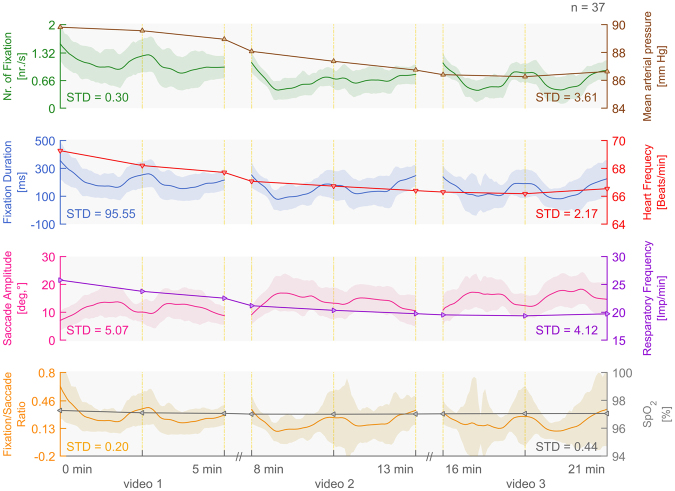
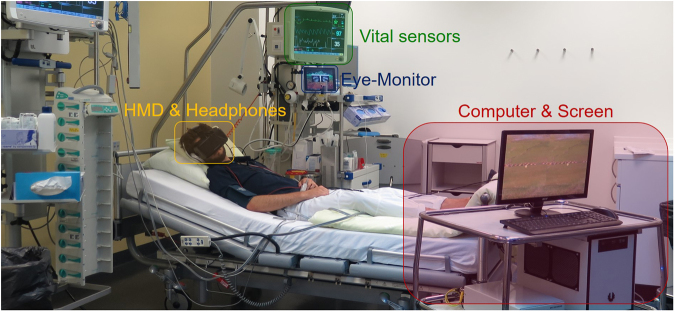
After prolonged stay in an intensive care unit (ICU) patients often complain about cognitive impairments that affect health-related quality of life after discharge. The aim of this proof-of-concept study was to test the feasibility and effects of controlled visual and acoustic stimulation in a virtual reality (VR) setup in the ICU. The VR setup consisted of a head-mounted display in combination with an eye tracker and sensors to assess vital signs. The stimulation consisted of videos featuring natural scenes and was tested in 37 healthy participants in the ICU. The VR stimulation led to a reduction of heart rate (p = 0. 049) and blood pressure (p = 0.044). Fixation/saccade ratio (p < 0.001) was increased when a visual target was presented superimposed on the videos (reduced search activity), reflecting enhanced visual processing. Overall, the VR stimulation had a relaxing effect as shown in vital markers of physical stress and participants explored less when attending the target. Our study indicates that VR stimulation in ICU settings is feasible and beneficial for critically ill patients.
Overview
The claims and statistics of this paper haven’t been checked yet.
Free: it reads the open-access text and checks the first 5 claims that cite a source we can check. Create a free account to check every claim.
Integrity signals
Registry
Cites
Statistics
Figures
Verification
Claims the paper makes
The claims and statistics of this paper haven’t been checked yet.
Free: it reads the open-access text and checks the first 5 claims that cite a source we can check. Create a free account to check every claim.
Claims other papers make about this one
Each is checked against this paper’s own text: does it say what the citing paper says it does?
The source backs part of the claim, not all of it — or backs it for a different population, condition or comparison.
In the citing paper
“We used a natural VR landscape experience since previous research studies have suggested that visual exposure to natural environments has a relaxing effect on patients and can protect against environmental stressors.13, 31”
From Feasibility of a virtual reality intervention in the intensive care unit (2021) · cites this paper as [31]
Experimental — accuracy not yet measuredThe source backs part of the claim, not all of it — or backs it for a different population, condition or comparison.
In the citing paper
“In our review of the literature for various studies, the risk of cybersickness and major adverse events reported is minimal and is in line with the findings of our study.7, 31”
From Feasibility of a virtual reality intervention in the intensive care unit (2021) · cites this paper as [31]
Experimental — accuracy not yet measuredThe cited source says what the claim attributes to it.
In the citing paper
“Contrary to the desktop screen, HMD provides a more natural visual exploration and allows for greater immersion.31”
From Feasibility of a virtual reality intervention in the intensive care unit (2021) · cites this paper as [31]
Self-check
Percentages, sums and reported differences re-computed from the paper’s own numbers.
The self-check needs the paper’s full text.
Citations
Cites
A general and simple method for obtaining R 2 from generalized linear mixed‐effects models
Nakagawa, S., & Schielzeth, H. (2013) · Methods in Ecology and Evolution · doi:10.1111/j.2041-210x.2012.00261.x · Cited by 10,356
SUS: A 'Quick and Dirty' Usability Scale
(1996) · Usability Evaluation In Industry · doi:10.1201/9781498710411-35 · Cited by 8,989
Measuring Presence in Virtual Environments: A Presence Questionnaire
Witmer, B. G., & Singer, M. J. (1998) · Presence: Teleoperators and Virtual Environments · doi:10.1162/105474698565686 · Cited by 6,371
Stress recovery during exposure to natural and urban environments
Ulrich, R. S., Simons, R. F., Losito, B. D., Fiorito, E., Miles, M. A., & Zelson, M. (1991) · Journal of Environmental Psychology · doi:10.1016/s0272-4944(05)80184-7 · Cited by 5,990
Simulator Sickness Questionnaire: An Enhanced Method for Quantifying Simulator Sickness
Kennedy, R. S., Lane, N. E., Berbaum, K. S., & Lilienthal, M. G. (1993) · The International Journal of Aviation Psychology · doi:10.1207/s15327108ijap0303_3 · Cited by 5,457
Physiology and neurobiology of stress and adaptation: central role of the brain
McEwen, B. S. (2007) · Physiological Reviews · doi:10.1152/physrev.00041.2006 · Cited by 5,429
Usability Evaluation In Industry
(1996) · CRC Press eBooks · doi:10.1201/9781498710411 · Cited by 4,354
Long-term cognitive impairment after critical illness
Pandharipande, P. P., Girard, T. D., Jackson, J. C., Morandi, A., Thompson, J. L., Pun, B. T., Brummel, N. E., Hughes, C. G., Vasilevskis, E. E., Shintani, A. K., et al. (2013) · New England Journal of Medicine · doi:10.1056/nejmoa1301372 · Cited by 2,842
The cognitive benefits of interacting with nature.
Berman, M. G., Jonides, J., & Kaplan, S. (2008) · Psychological Science · doi:10.1111/j.1467-9280.2008.02225.x · Cited by 2,535
Ely, E. W., Truman, B., Shintani, A., Thomason, J. W. W., Wheeler, A. P., Gordon, S., Francis, J., Speroff, T., Gautam, S., Margolin, R., et al. (2003) · JAMA · doi:10.1001/jama.289.22.2983 · Cited by 1,707
Cited by
Items 101–151 of 151
Bian, Y., Liu, J., Lin, Y., Liu, W., Zhang, Y., Qu, T., Li, S., Pan, Z., Liu, W., Huang, W., et al. (2025) · IEEE Transactions on Visualization and Computer Graphics · doi:10.1109/tvcg.2025.3549874 · Cited by 3
“VRtechnology allows patients to interact with the virtual environment via VR Head-Mounted Display (HMD) directly on the bed [13].”
Kim, J., Patel, S., Nam, H., Cho, J., & Kim, K. (2025) · IEEE Transactions on Visualization and Computer Graphics · doi:10.1109/tvcg.2025.3616762 · Cited by 4
“Gerber et al. [25] measured heart rate, mean arterial pressure, and eye-tracking, finding that VR nature scenes reduced physiological arousal and promoted sustained visual engagement.”
Stahmann, P., Rodda, A., Nebel, M., van der Staay, A., Janiesch, C., & Teuteberg, F. (2025) · Journal of Decision System · doi:10.1080/12460125.2025.2593245 · Cited by 7
“Besides directly measurable metrics, the voluntary metrics include the fixation-saccade-ratio, which shows the relation between search and information processing activity (e.g. ( Gerber et al., 2017; Kristóf & Haidegger, 2024).”
Chou, C.-C., Lin, J., Yu, C.-P., Chen, C., Yeh, A.-Y., & Lin, Y.-K. (2026) · JMIR Aging · doi:10.2196/87861 · Cited by 5
Oliveira, I. C. T. S., Torneiro, A., Ferreira‐Coimbra, J., Sampaio, A. C. S., Morgenstern, N. A., Oliveira, E., Coelho, A. F., & Rodrigues, N. F. (2026) · Biomedicines · doi:10.3390/biomedicines14020464 · Cited by 3
“Quantitative methods were used in 9 studies [1,7,9–12,15 Common safety-related exclusion criteria included severe visual/hearing impairment [5,7,15,16,21], delirium [1,7,12,15,16], neurological or psychiatric disorders [1,7,11,15,16], and cases requiring external oxygen support [7,12,15,21].”
A systematic review on mindfulness-based immersive interventions in depressive disorders
Tan, P., Wu, Y., Chen, X., Chen, J., Guo, Z., Lu, X., Chen, J., & Zhang, H. (2026) · npj Mental Health Research · doi:10.1038/s44184-026-00205-6 · Cited by 3
A Hybrid Method Using Gaze and Controller for Targeting Tiny Targets in VR While Lying down
Abe, K., Ishikawa, H., & Manabe, H. (2023) · Communications in computer and information science · doi:10.1007/978-3-031-36004-6_19 · Cited by 4
Use of Family Photographs Reduces Restlessness in Neurocritical Care Patients
Givens, C., Nairon, E. B., Jackson, M. K., Vashisht, A., & Olson, D. M. (2023) · Journal of Neuroscience Nursing · doi:10.1097/jnn.0000000000000725 · Cited by 3
Lessons Learned: Medical Library Pilot Testing of a Virtual Reality Anatomy Lab
Weyant, E. C., Carroll, M., & Walden, R. (2021) · Journal of Electronic Resources in Medical Libraries · doi:10.1080/15424065.2021.1882920 · Cited by 3
Temporal Trend Analysis on Virtual Reality Using Social Media Mining
Shen, C.-W., Ho, J.-T., & Ma, H.-W. (2019) · Springer proceedings in complexity · doi:10.1007/978-3-030-30809-4_18 · Cited by 3
Araujo, J. D. F. O., Ribeiro, E. H., Guimarães, M. D. P., Brega, J. R. F., Brandão, A. F., & Dias, D. R. C. (2021) · Iberian Conference on Information Systems and Technologies (CISTI) · doi:10.23919/cisti52073.2021.9476311 · Cited by 3
Knobel, S. E. J., Gyger, N. T., Nyffeler, T., Cazzoli, D., Müri, R. M., & Nef, T. (2020) · Annual International Conference of the IEEE Engineering in Medicine and Biology Society (EMBC) · doi:10.1109/embc44109.2020.9176516 · Cited by 3
“This subset was already used in recent studies by Gerber et al. [18, 19].”
MethodResultSelf-citationHuette, P., Malaquin, S., Lefebvre, T., Devos, C., Ibrahima, A., Daumin, C., Coupez, A., Josse, E., Besserve, P., Haye, G., et al. (2025) · BMJ Open · doi:10.1136/bmjopen-2025-101243 · Cited by 2
Sadowski, I., Gagnon-Mailhot, M., Seu, J., Batcho, C. S., Laberge, M., Khoury, B., Tremblay, G., Dubé, O., Goyette, C., Rheault, A., et al. (2026) · Frontiers in Pain Research · doi:10.3389/fpain.2026.1734386 · Cited by 4
Eremita, M. D. S., & Chitra, J. (2024) · Archives of Medicine and Health Sciences · doi:10.4103/amhs.amhs_149_23 · Cited by 3
Paslı, S., Yılmaz, N. S., Kırımlı, E. N., İmamoğlu, M., Beşer, M. F., Şahin, A. S., & Yadigaroğlu, M. (2025) · Internal and Emergency Medicine · doi:10.1007/s11739-025-03947-x · Cited by 2
“The immersive nature of virtual reality promotes a sense of presence in a virtual environment, which, through controlled visual and acoustic stimulation, is associated with physiological relaxation and stress reduction, similar to the restorative effects of natural environments [17].”
Laker, C., Knight-Davidson, P., & McVicar, A. J. (2025) · Nursing Reports · doi:10.3390/nursrep15050157 · Cited by 4
“Through such immersion, immediate therapeutic effects, such as improvement in mood [5,7] and reduction in psychological stress [8,9], have been achieved.”
Greco, F., & D’Onofrio, G. (2021) · IntechOpen eBooks · doi:10.5772/intechopen.92630 · Cited by 5
The effect of an audio-video stimulation on emotions: a virtual reality study
Burattini, C., Bisegna, F., D’Aurizio, G., & Curcio, G. (2023) · Immersive and 3D Audio: from Architecture to Automotive (I3DA) · doi:10.1109/i3da57090.2023.10289416 · Cited by 2
Ghatnekar, P., & Esfahani, M. S. (2022) · doi:10.2196/preprints.43370 · Cited by 2
Evaluating Constrained Users Ability to Interact with Virtual Reality Applications
Ribeiro, T., Henriques, P. R., Oliveira, E., & Rodrigues, N. F. (2024) · SeGAH ... IEEE ... International Conference on Serious Games and Applications for Health/IEEE International Conference on Serious Games and Applications for Health · doi:10.1109/segah61285.2024.10639581 · Cited by 3
“Virtual Reality (VR) interventions have shown promise in the ICU context, offering potential benefits in reducing pain, anxiety, and delirium [11], [12].”
BackgroundEffect of Virtual Zen Garden on Quality of Life of Residents in Long-Term Care Home
Yuen, I., & Kwok, T. C. Y. (2025) · International Journal of Environmental Research and Public Health · doi:10.3390/ijerph22040510 · Cited by 2
Samimi, M., Manzari, Z. S., & Heydari, A. (2025) · BMC Anesthesiology · doi:10.1186/s12871-025-03437-9 · Cited by 2
“The country of study varied with studies taking place in Switzerland [36, 48, 51], China [52], USA [47, 49, 50], and Spain [42].”
InfluentialWu, F., Wu, Y., Xing, Y., Cai, W., & Zhang, R. (2025) · Journal of Medical Internet Research · doi:10.2196/81865 · Cited by 3
The synergistic application of virtual reality and music therapy: a scoping review
Li, A., & Jian, F. (2026) · Frontiers in Psychiatry · doi:10.3389/fpsyt.2026.1824248 · Cited by 1
Image Segmentation and Emotional Analysis of Virtual and Augmented Reality Urban Scenes
Stancato, G., & Piga, B. E. A. (2023) · Digital innovations in architecture, engineering and construction · doi:10.1007/978-3-031-36155-5_28 · Cited by 3
Franěk, M., & Petružálek, J. (2024) · Music & Science · doi:10.1177/20592043241291757 · Cited by 5
“Clearly, presentations of virtual natural environments bene fi ted from the abovementioned soundscape research and associated virtual visual nature with natural sounds to increase the positive effect (e.g., Gerber et al., 2017; Jeon & Jo, 2020; Jo & Jeon, 2022; Xu et al., 2020).”
Analgesia-sedazione in terapia intensiva (rianimazione) negli adulti
Chanques, G., Capdevila, M., Degravi, L., Monet, C., Aarab, Y., & Jaber, S. (2022) · EMC - Anestesia-Rianimazione · doi:10.1016/s1283-0771(21)46022-6
Analgesia y sedación en cuidados intensivos (reanimación) en el paciente adulto
Chanques, G., Capdevila, M., Degravi, L., Monet, C., Aarab, Y., & Jaber, S. (2022) · EMC - Anestesia-Reanimación · doi:10.1016/s1280-4703(21)45951-7 · Cited by 2
Merliot‐Gailhoustet, L., Raimbert, C., Garnier, O., Carr, J., JONG, A. D., Molinari, N., Jaber, S., & Chanques, G. (2022) · Research Square · doi:10.21203/rs.3.rs-1768651/v1
Anesthesia in the critical care unit and pain management
Beckerman, D., Destine, H., & Pierre, E. J. (2023) · Elsevier eBooks · doi:10.1016/b978-0-323-69787-3.00136-2 · Cited by 3
Knobel, S. E. J., Oberson, R., Räber, J., Schütz, N., Botros, A., Gerber, S., Nef, T., & Heydrich, L. (2023) · doi:10.2196/preprints.52340
Self-citationEvaluation of Rural Healing Landscape Design Based on VR and EEGPreprint
Ren, H., Wang, X. Z., Zhang, J., Wang, Q., & Zhang, L. (2023) · SSRN Electronic Journal · doi:10.2139/ssrn.4643900
Exposure to Immersive Relaxing Virtual Environments for Hospitalized Patients
Pereira, M., Oliveira, P., Gomes, M. E., & de Sousa, S. (2023) · Advances in medical technologies and clinical practice book series · doi:10.4018/978-1-6684-9251-2.ch006
Luo, J., Xu, N., Chen, F., Zhang, F., Li, S., Dong, J., & Jiang, Z. (2024) · Research Square · doi:10.21203/rs.3.rs-3888245/v1
Designing immersive interfaces for clinical applicationsPreprint
Chenais, N. A. L., & Görgen, A. (2024) · doi:10.31219/osf.io/gvs9d
Virtual Reality und künstliche Intelligenz – (R)Evolution auf der Intensivstation
Kober, D. (2024) · intensiv · doi:10.1055/a-2345-5718
“Studien haben gezeigt, dass das Auftreten von uner-wünschten Wirkungen im Intensiv-Setting eher selten ist [24][25][48].”
Oliveira, I., Torneiro, A., Reis, R. L., Oliveira, E., Ferreira‐Coimbra, J., Paredes, H., Brugada-Ramentol, V., Morgenstern, N. A., Coelho, A. F., & Rodrigues, N. F. (2024) · SSRN Electronic Journal · doi:10.2139/ssrn.4949548
Effectiveness of imagery technique supported by Virtual Reality among athletes
Márkus, P., Csukonyi, C., Tibor, I., & Köröndi, P. (2024) · IEEE International Conference on Cognitive Infocommunications · doi:10.1109/coginfocom63007.2024.10894723
Wu, F., Wu, Y., Xing, Y., Zhang, R., & Cai, W. (2025) · doi:10.2196/preprints.81865
Sousa, A. P. M. C., Oliveira, T. U. D. M., de Lucena, A. B., & Ferreira, L. T. T. (2025) · Revista Multidisciplinar do Nordeste Mineiro · doi:10.61164/9rtbpc07
Gilfriche, P. (2019) · theses.fr (ABES) · doi:10.70675/8a64ffbez9b87z4145zbc1eze0f5ea941017 · Cited by 1
Interfacial electronic modulation in Au–tungstic acid for enhanced PEC performance
Do, T. A. T., & Mẫn, M. T. (2026) · Journal of Materials Chemistry A · doi:10.1039/d5ta07736b
Savoric, T., Savoric, N., Antlej, K., Arnab, S., Ashwin, S., Cann, B., Devine, J., Hirst, A., Huynh, K., Watson, K., et al. (2026) · Internal Medicine Journal · doi:10.1111/imj.70453
Stanojević, Č., Bennett, C. C., Manupati, S., Yuan, S., Moothkuri, S., Abbott, N., Li, F., Murphy, A., & Zaidi, F. (2026) · International Journal of Disability Development and Education · doi:10.1080/1034912x.2026.2666512
Gascón-Tomás, L., Hoyo, S. G., Martínez-Orellana, M., Ramos-Puig, J. M., García-López, L., Serrano-Jaureguizar, S., Puig-Aragón, A., Mensa, M. C., & Via-Clavero, G. (2026) · Enfermería Intensiva · doi:10.1016/j.enfi.2026.500614
Gascón-Tomás, L., Hoyo, S. G., Martínez-Orellana, M., Ramos-Puig, J. M., García-López, L., Serrano-Jaureguizar, S., Puig-Aragón, A., Mensa, M. C., & Via-Clavero, G. (2026) · Enfermería Intensiva (English ed ) · doi:10.1016/j.enfie.2026.500614
Theriault, R., Mesia, F., Sullivan, C., Rojas-Rincón, J., Chang, R., & Porras-García, B. (2026) · Lecture notes in computer science · doi:10.1007/978-3-032-31421-5_25
Via, L. L., Cuttone, G., Misseri, G., Testa, T. S., Paternò, D. S., Pappalardo, F., & Patroniti, N. (2026) · Respiration · doi:10.1159/000550984
Guemann, M., Bergeron, V., Boulain, T., Fossat, G., Legouge, M. L., & Genève, C. (2026) · Australian Critical Care · doi:10.1016/j.aucc.2026.101697
Karamanlı, H. Y., & Dayapoğlu, N. (2026) · TURKISH JOURNAL OF MEDICAL SCIENCES · doi:10.55730/1300-0144.6399
Metadata
- Authors
- Gerber, S. M., Jeitziner, M.-M., Wyss, P., Chesham, A., Urwyler, P., Müri, R. M., Jakob, S. M., & Nef, T.
- Affiliations
- University of Bern (CH)
- Corresponding author
- Nef, Tobias
- ORCID
- Venue
- Scientific Reports
- Published
- 2017-10-16
- Volume
- 7
- Issue
- 1
- Pages
- 13228-13228
- ISSN
- 2045-2322 (ISSN-L)
- PMC
- PMC5643433
- OpenAlex
- W2762490179
- Semantic Scholar
- bad70521bd67e10e368b11e112f07e77c97dff55
- Cited by
- 151
- References
- 66
- Citations by year
- 2026: 14 · 2025: 16 · 2024: 23 · 2023: 24 · 2022: 21 · 2021: 27 · 2020: 14 · 2019: 11 · 2018: 1
- FWCI
- 8.80
- Type
- journal article
- Language
- en
- Open access
- gold
- doi.org
- Licence
- cc-by
- creativecommons.org/licenses/by/4.0 (tdm)
- creativecommons.org/licenses/by/4.0 (vor)
- Locations
- Scientific Reports (publishedVersion, cc-by)
- Europe PMC (PubMed Central) (publishedVersion, cc-by)
- PubMed Central (publishedVersion, cc-by)
- PubMed (publishedVersion)
- BORIS (University Library Bern) (submittedVersion, cc-by)
- DOAJ (DOAJ: Directory of Open Access Journals) (submittedVersion, cc-by-sa)
- Open Access CRIS of the University of Bern
- Funders
- University of Bern
- Inselspital, Universitätsspital Bern
- Topics
- Physical Sciences › Computer Science › Human-Computer Interaction › Virtual Reality Applications and Impacts
- Health Sciences › Medicine › Critical Care and Intensive Care Medicine › Intensive Care Unit Cognitive Disorders
- Social Sciences › Psychology › Social Psychology › Music Therapy and Health
- Keywords
- virtual reality, intensive care unit, relaxation, head-mounted displays, eye tracking, heart rate, blood pressure, vital signs, visual processing, cognitive impairment, critically ill patients, stress reduction
- MeSH terms
- Virtual Reality, Acoustic Stimulation, Adult, Aged, Aged, 80 and over, Critical Care, Feasibility Studies, Female, Humans, Intensive Care Units, Male, Middle Aged, Photic Stimulation, Surveys and Questionnaires, Relaxation Therapy, Time Factors, Young Adult, Vital Signs
About these checks
Registry, retraction, Cites and statistics results are computed, not judged, with one exception: a printed reference that no index lists is read once by a model before it counts as a citation error. Claims are extracted by a model and kept only when their quote appears verbatim in the text; each cited source is then checked, with a model’s help, for whether it says what the claim relies on. Those verdicts can be wrong — read the claim’s quote and the cited source before relying on one.
Statistics and arithmetic are recomputed, not judged.
Confidence bands are shown only for fields calibrated on our annotated test set. None is calibrated yet, so no band is shown.
What counts as a claim ›How we measure confidence ›How we check this ›
Are you an author, or do you see a problem with this page? Request a review
Data sources
Bibliographic data: Semantic Scholar, OpenAlex, Crossref.
Contains information from the Semantic Scholar Academic Graph Datasets, made available under the ODC Attribution License (ODC-BY 1.0).
Semantic Scholar’s data is described in: Kinney, R., et al. (2023). The Semantic Scholar Open Data Platform. arXiv:2301.10140.
