

Visuo-acoustic stimulation that helps you to relax: A virtual reality setup for patients in the intensive care unit
Open accessThe DOI matches its Crossref record; 66 of the 66 references it cites were found in a registry or an index.
Abstract
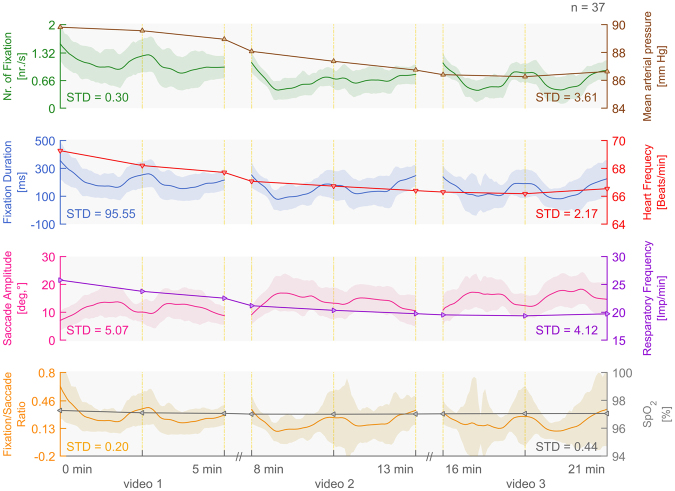
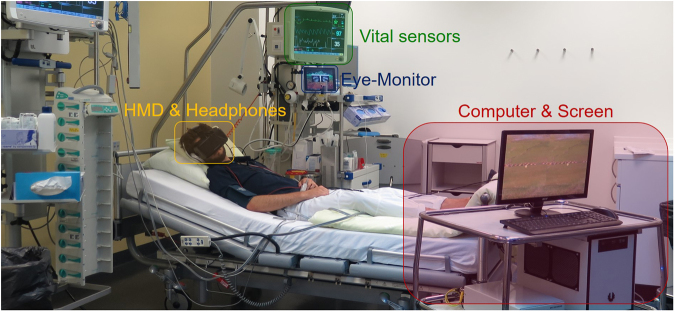
After prolonged stay in an intensive care unit (ICU) patients often complain about cognitive impairments that affect health-related quality of life after discharge. The aim of this proof-of-concept study was to test the feasibility and effects of controlled visual and acoustic stimulation in a virtual reality (VR) setup in the ICU. The VR setup consisted of a head-mounted display in combination with an eye tracker and sensors to assess vital signs. The stimulation consisted of videos featuring natural scenes and was tested in 37 healthy participants in the ICU. The VR stimulation led to a reduction of heart rate (p = 0. 049) and blood pressure (p = 0.044). Fixation/saccade ratio (p < 0.001) was increased when a visual target was presented superimposed on the videos (reduced search activity), reflecting enhanced visual processing. Overall, the VR stimulation had a relaxing effect as shown in vital markers of physical stress and participants explored less when attending the target. Our study indicates that VR stimulation in ICU settings is feasible and beneficial for critically ill patients.
Overview
The claims and statistics of this paper haven’t been checked yet.
Free: it reads the open-access text and checks the first 5 claims that cite a source we can check. Create a free account to check every claim.
Integrity signals
Registry
Cites
Statistics
Figures
Verification
Claims the paper makes
The claims and statistics of this paper haven’t been checked yet.
Free: it reads the open-access text and checks the first 5 claims that cite a source we can check. Create a free account to check every claim.
Claims other papers make about this one
Each is checked against this paper’s own text: does it say what the citing paper says it does?
The source backs part of the claim, not all of it — or backs it for a different population, condition or comparison.
In the citing paper
“We used a natural VR landscape experience since previous research studies have suggested that visual exposure to natural environments has a relaxing effect on patients and can protect against environmental stressors.13, 31”
From Feasibility of a virtual reality intervention in the intensive care unit (2021) · cites this paper as [31]
Experimental — accuracy not yet measuredThe source backs part of the claim, not all of it — or backs it for a different population, condition or comparison.
In the citing paper
“In our review of the literature for various studies, the risk of cybersickness and major adverse events reported is minimal and is in line with the findings of our study.7, 31”
From Feasibility of a virtual reality intervention in the intensive care unit (2021) · cites this paper as [31]
Experimental — accuracy not yet measuredThe cited source says what the claim attributes to it.
In the citing paper
“Contrary to the desktop screen, HMD provides a more natural visual exploration and allows for greater immersion.31”
From Feasibility of a virtual reality intervention in the intensive care unit (2021) · cites this paper as [31]
Self-check
Percentages, sums and reported differences re-computed from the paper’s own numbers.
The self-check needs the paper’s full text.
Citations
Cites
A general and simple method for obtaining R 2 from generalized linear mixed‐effects models
Nakagawa, S., & Schielzeth, H. (2013) · Methods in Ecology and Evolution · doi:10.1111/j.2041-210x.2012.00261.x · Cited by 10,356
SUS: A 'Quick and Dirty' Usability Scale
(1996) · Usability Evaluation In Industry · doi:10.1201/9781498710411-35 · Cited by 8,989
Measuring Presence in Virtual Environments: A Presence Questionnaire
Witmer, B. G., & Singer, M. J. (1998) · Presence: Teleoperators and Virtual Environments · doi:10.1162/105474698565686 · Cited by 6,371
Stress recovery during exposure to natural and urban environments
Ulrich, R. S., Simons, R. F., Losito, B. D., Fiorito, E., Miles, M. A., & Zelson, M. (1991) · Journal of Environmental Psychology · doi:10.1016/s0272-4944(05)80184-7 · Cited by 5,990
Simulator Sickness Questionnaire: An Enhanced Method for Quantifying Simulator Sickness
Kennedy, R. S., Lane, N. E., Berbaum, K. S., & Lilienthal, M. G. (1993) · The International Journal of Aviation Psychology · doi:10.1207/s15327108ijap0303_3 · Cited by 5,457
Physiology and neurobiology of stress and adaptation: central role of the brain
McEwen, B. S. (2007) · Physiological Reviews · doi:10.1152/physrev.00041.2006 · Cited by 5,429
Usability Evaluation In Industry
(1996) · CRC Press eBooks · doi:10.1201/9781498710411 · Cited by 4,354
Long-term cognitive impairment after critical illness
Pandharipande, P. P., Girard, T. D., Jackson, J. C., Morandi, A., Thompson, J. L., Pun, B. T., Brummel, N. E., Hughes, C. G., Vasilevskis, E. E., Shintani, A. K., et al. (2013) · New England Journal of Medicine · doi:10.1056/nejmoa1301372 · Cited by 2,842
The cognitive benefits of interacting with nature.
Berman, M. G., Jonides, J., & Kaplan, S. (2008) · Psychological Science · doi:10.1111/j.1467-9280.2008.02225.x · Cited by 2,535
Ely, E. W., Truman, B., Shintani, A., Thomason, J. W. W., Wheeler, A. P., Gordon, S., Francis, J., Speroff, T., Gautam, S., Margolin, R., et al. (2003) · JAMA · doi:10.1001/jama.289.22.2983 · Cited by 1,707
A discussion of cybersickness in virtual environments
LaViola, J. J. (2000) · ACM SIGCHI Bulletin · doi:10.1145/333329.333344 · Cited by 1,426
Long-Term Cognitive Impairment After Critical Illness
Pandharipande, P. P., Girard, T. D., Jackson, J. C., Morandi, A., Thompson, J. L., Pun, B. T., Brummel, N. E., Hughes, C. G., Vasilevskis, E. E., Shintani, A. K., et al. (2014) · Survey of Anesthesiology · doi:10.1097/sa.0000000000000071 · Cited by 1,114
Effects of mental fatigue on attention: An ERP study
Boksem, M. A. S., Meijman, T. F., & Lorist, M. M. (2005) · Cognitive Brain Research · doi:10.1016/j.cogbrainres.2005.04.011 · Cited by 1,088
Computer interface evaluation using eye movements: methods and constructs
Goldberg, J. H., & Kotval, X. P. (1999) · International Journal of Industrial Ergonomics · doi:10.1016/s0169-8141(98)00068-7 · Cited by 1,053
Ohly, H., White, M. P., Wheeler, B. W., Bethel, A., Ukoumunne, O. C., Nikolaou, V., & Garside, R. (2016) · Journal of Toxicology and Environmental Health, Part B · doi:10.1080/10937404.2016.1196155 · Cited by 961
Extension of Nakagawa & Schielzeth's R2GLMM to random slopes models
Johnson, P. C. D. (2014) · Methods in Ecology and Evolution · doi:10.1111/2041-210x.12225 · Cited by 948
Stress Recovery during Exposure to Nature Sound and Environmental Noise
Alvarsson, J. J., Wiens, S., & Nilsson, M. E. (2010) · International Journal of Environmental Research and Public Health · doi:10.3390/ijerph7031036 · Cited by 891
Berto, R. (2014) · Behavioral Sciences · doi:10.3390/bs4040394 · Cited by 842
Eye Movement Analysis for Activity Recognition Using Electrooculography
Bulling, A., Ward, J. A., Gellersen, H., & Tröster, G. (2011) · IEEE Transactions on Pattern Analysis and Machine Intelligence · doi:10.1109/tpami.2010.86 · Cited by 718
Annerstedt, M., Jönsson, P., Wallergård, M., Johansson, G., Karlson, B., Grahn, P., Hansen, Å. M., & Währborg, P. (2013) · Physiology & Behavior · doi:10.1016/j.physbeh.2013.05.023 · Cited by 647
Balas, M. C., Vasilevskis, E. E., Olsen, K. M., Schmid, K. K., Shostrom, V., Cohen, M. Z., Peitz, G., Gannon, D. E., Sisson, J., Sullivan, J., et al. (2014) · Critical Care Medicine · doi:10.1097/ccm.0000000000000129 · Cited by 526
Virtual Reality in Brain Damage Rehabilitation: Review
Rose, F. D., Brooks, B. M., & Rizzo, A. A. (2005) · CyberPsychology & Behavior · doi:10.1089/cpb.2005.8.241 · Cited by 469
Variability of eye movements when viewing dynamic natural scenes
Dorr, M., Martinetz, T., Gegenfurtner, K. R., & Barth, E. (2010) · Journal of Vision · doi:10.1167/10.10.28 · Cited by 450
Principles and Practice of Psychiatric Nursing
Stuart, G. W., & Sundeen, S. J. (1983) · Medical Entomology and Zoology · Cited by 444
Restorative Effects of Virtual Nature Settings
Valtchanov, D., Barton, K. R., & Ellard, C. (2010) · Cyberpsychology, Behavior, and Social Networking · doi:10.1089/cyber.2009.0308 · Cited by 354
Virtual Reality and Medical Inpatients: A Systematic Review of Randomized, Controlled Trials.
(2017) · PubMed Central · Cited by 341
Effectiveness of Immersive Videos in Inducing Awe: An Experimental Study
Chirico, A., Cipresso, P., Yaden, D. B., Biassoni, F., Riva, G., & Gaggioli, A. (2017) · Scientific Reports · doi:10.1038/s41598-017-01242-0 · Cited by 340
An exploratory study into the effects of extraordinary nature on emotions, mood, and prosociality
Joye, Y., & Bolderdijk, J. W. (2015) · Frontiers in Psychology · doi:10.3389/fpsyg.2014.01577 · Cited by 325
Jackson, J. C., Ely, E. W., Morey, M. C., Anderson, V. M., Denne, L. B., Clune, J., Siebert, C. S., Archer, K. R., Torres, R., Janz, D., et al. (2012) · Critical Care Medicine · doi:10.1097/ccm.0b013e3182373115 · Cited by 318
Stellar, J. E., John-Henderson, N., Anderson, C. L., Gordon, A. M., McNeil, G. D., & Keltner, D. (2015) · Emotion · doi:10.1037/emo0000033 · Cited by 307
The time course of a lane change: Driver control and eye-movement behavior
Salvucci, D. D., & Liu, A. (2002) · Transportation Research Part F: Traffic Psychology and Behaviour · doi:10.1016/s1369-8478(02)00011-6 · Cited by 297
Brummel, N. E., Girard, T. D., Ely, E. W., Pandharipande, P. P., Morandi, A., Hughes, C. G., Graves, A. J., Shintani, A., Murphy, E., Work, B., et al. (2014) · Intensive Care Medicine · doi:10.1007/s00134-013-3136-0 · Cited by 256
Embodied Presence in Virtual Environments
Schubert, T., Friedmann, F., & Regenbrecht, H. (1999) · Visual Representations and Interpretations · doi:10.1007/978-1-4471-0563-3_30 · Cited by 227
Cognitive Dysfunction in ICU Patients: Risk Factors, Predictors, and Rehabilitation Interventions
Wilcox, M. E., Brummel, N. E., Archer, K., Ely, E. W., Jackson, J. C., & Hopkins, R. O. (2013) · Critical Care Medicine · doi:10.1097/ccm.0b013e3182a16946 · Cited by 215
Hofhuis, J. G. M., Spronk, P. E., van Stel, H. F., Schrijvers, G. J. P., Rommes, J. H., & Bakker, J. (2008) · Chest · doi:10.1378/chest.07-1217 · Cited by 188
Hoffman, H. G., Meyer, W. J., Ramirez, M., Roberts, L., Seibel, E. J., Atzori, B., Sharar, S. R., & Patterson, D. R. (2014) · Cyberpsychology, Behavior, and Social Networking · doi:10.1089/cyber.2014.0058 · Cited by 175
Microsaccade and drift dynamics reflect mental fatigue
Stasi, L. L. D., McCamy, M. B., Catena, A., Macknik, S. L., Cañas, J. J., & Martínez‐Conde, S. (2013) · European Journal of Neuroscience · doi:10.1111/ejn.12248 · Cited by 153
Szekely, G., & Satava, R. M. (1999) · BMJ · doi:10.1136/bmj.319.7220.1305 · Cited by 146
Riener, R., & Harders, M. (2012) · Springer eBooks · doi:10.1007/978-1-4471-4011-5 · Cited by 144
Not Just Scenery: Viewing Nature Pictures Improves Executive Attention in Older Adults
Gamble, K. R., Howard, J. H., & Howard, D. V. (2014) · Experimental Aging Research · doi:10.1080/0361073x.2014.956618 · Cited by 117
Nuthmann, A. (2017) · Psychonomic Bulletin & Review · doi:10.3758/s13423-016-1124-4 · Cited by 115
Transforming PICU Culture to Facilitate Early Rehabilitation
Choong, K. L. M., Zebuhr, C., Kudchadkar, S. R., & Hopkins, R. O. (2015) · Journal of Pediatric Intensive Care · doi:10.1055/s-0035-1563547 · Cited by 114
Cognitive deficits after traumatic coma
Azouvi, P., Vallat‐Azouvi, C., & Belmont, A. (2009) · Progress in brain research · doi:10.1016/s0079-6123(09)17708-7 · Cited by 110
Psychological factors in exceptional, extreme and torturous environments
Leach, J. (2016) · Extreme Physiology & Medicine · doi:10.1186/s13728-016-0048-y · Cited by 108
Brummel, N. E., Jackson, J. C., Girard, T. D., Pandharipande, P. P., Schiro, E., Work, B., Pun, B. T., Boehm, L., Gill, T. M., & Ely, E. W. (2012) · Physical Therapy · doi:10.2522/ptj.20110414 · Cited by 106
Virtual reality and cognitive rehabilitation: A review of current outcome research
Larson, E. B., Feigon, M., Gagliardo, P., & Dvorkin, A. Y. (2014) · NeuroRehabilitation · doi:10.3233/nre-141078 · Cited by 105
Noise Levels in Surgical ICUs Are Consistently Above Recommended Standards
Tainter, C. “., Levine, A. R., Quraishi, S. A., Butterly, A. D., Stahl, D. L., Eikermann, M., Kaafarani, H. M. A., & Lee, J. (2015) · Critical Care Medicine · doi:10.1097/ccm.0000000000001378 · Cited by 100
Karnatovskaia, L. V., Johnson, M. M., Benzo, R. P., & Gajic, O. (2014) · Journal of Critical Care · doi:10.1016/j.jcrc.2014.09.024 · Cited by 99
Long-term Quality of Life After Surgical Intensive Care Admission
Timmers, T. K., Verhofstad, M. H. J., Moons, K. G. M., van Beeck, E. F., & Leenen, L. P. H. (2010) · Archives of Surgery · doi:10.1001/archsurg.2010.279 · Cited by 98
The comparative measurements of eyestrain caused by 2D and 3D displays
Lee, E. C., Heo, H., & Park, K. R. (2010) · IEEE Transactions on Consumer Electronics · doi:10.1109/tce.2010.5606312 · Cited by 80
Clinical identification of cognitive impairment in ICU survivors: insights for intensivists
Gordon, S. M., Jackson, J. C., Ely, E. W., Burger, C., & Hopkins, R. O. (2004) · Intensive Care Medicine · doi:10.1007/s00134-004-2418-y · Cited by 73
Physiological measures and self-report to evaluate neutral virtual reality worlds
Busscher, B., Vliegher, D. D., Ling, Y., & Brinkman, W. (2011) · TU/e Research Portal · Cited by 44
Extending the Reach of Health Care for Obesity and Diabetes Using Virtual Worlds
Morie, J. F., & Chance, E. (2011) · Journal of Diabetes Science and Technology · doi:10.1177/193229681100500211 · Cited by 37
An investigation of light and sound levels on intensive care units in China
Hu, R., Hegadoren, K., Wang, X., & Jiang, X. (2015) · Australian Critical Care · doi:10.1016/j.aucc.2015.08.001 · Cited by 36
Cognitive impairment in ICU survivors: Assessment and therapy
Wergin, R., & Modrykamien, A. M. (2012) · Cleveland Clinic Journal of Medicine · doi:10.3949/ccjm.79a.12038 · Cited by 30
Manipulations to reduce simulator-related transient adverse health effects during simulated driving
Jäger, M., Gruber, N., Müri, R. M., Mosimann, U. P., & Nef, T. (2014) · Medical & Biological Engineering & Computing · doi:10.1007/s11517-014-1162-x · Cited by 25
Self-citationHealthy Avatars, Healthy People: Care Engagement Through the Shared Experience of Virtual Worlds
Triberti, S., & Chirico, A. (2017) · Advances in Medical Diagnosis, Treatment, and Care · doi:10.4018/978-1-5225-0663-8.ch010 · Cited by 14
Cognitive stimulation in ICU patients: should we pay more attention?
Turón, M., Fernández‐Gonzalo, S., Gomez-Simon, V., Blanch, L. L., & Jódar, M. (2013) · Critical Care · doi:10.1186/cc12719 · Cited by 10
Advanced Concepts in Clinical Nursing
Getchel, N., & Kintzel, K. C. (1972) · AJN American Journal of Nursing · doi:10.2307/3422298 · Cited by 8
Critical Care Nursing of Older Adults: Best Practices
Foreman, M. D., Milisen, K., & Fulmer, T. T. (2009) · Medical Entomology and Zoology · Cited by 8
Lindenmuth, J. E., Breu, C. S., & Malooley, J. A. (1980) · PubMed · Cited by 8
A design of virtual reality based coma stimulation program system
Chen, Y., & Peng, N. (2006) · International Conference on Computer-Aided Industrial Design and Conceptual Design (CAIDCD) · doi:10.1109/caidcd.2006.329453 · Cited by 5
Chapter 19 A Neuroscientist's View on Theories of Complex Movement Behaviour
PICKENHAIN, L. (1988) · Advances in psychology · doi:10.1016/s0166-4115(08)62569-8 · Cited by 4
Lindenmuth, J. E., Breu, C. S., & Malooley, J. A. (1980) · AJN American Journal of Nursing · doi:10.2307/3462693 · Cited by 3
FIFTY YEARS A CANADIAN NURSE; DEVOTION, OPPORTUNITIES and DUTY
Germain, L. D. (1972) · AJN American Journal of Nursing · doi:10.1097/00000446-197202000-00048 · Cited by 2
Osman, Z. M., Dupire, J., Topol, A., & Cubaud, P. (2014) · HAL · Cited by 1
Cited by
Reduction of physiological stress by urban green space in a multisensory virtual experiment
Hedblom, M., Gunnarsson, B., Iravani, B., Knez, I., Schaefer, M., Thorsson, P., & Lundström, J. N. (2019) · Scientific Reports · doi:10.1038/s41598-019-46099-7 · Cited by 498
Browning, M. H. E. M., Mimnaugh, K. J., van Riper, C. J., Laurent, H. K., & LaValle, S. M. (2020) · Frontiers in Psychology · doi:10.3389/fpsyg.2019.02667 · Cited by 488
The Metaverse: A new digital frontier for consumer behavior
Hadi, R., Melumad, S., & Park, E. S. (2024) · Journal of Consumer Psychology · doi:10.1002/jcpy.1356 · Cited by 393
Yeo, N. L., White, M. P., Alcock, I., Garside, R., Dean, S. G., Smalley, A. J., & Gatersleben, B. (2020) · Journal of Environmental Psychology · doi:10.1016/j.jenvp.2020.101500 · Cited by 253
“…settings such as offices (Yin, Zhu, MacNaughton, Allen, & Spengler, 2018), dental surgeries (Tanja-Dijk-stra et al., 2018), intensive care units (Gerber et al., 2017) and other care settings, where their ability to mask the external environment may allow individuals a brief ‘escape ’ from these…”
BackgroundBruno, R. R., Wolff, G., Wernly, B., Masyuk, M., Piayda, K., Leaver, S., Erkens, R., Oehler, D., Afzal, S., Heidari, H., et al. (2022) · Critical Care · doi:10.1186/s13054-022-04202-x · Cited by 242
“These results were supported by a decrease in respiratory rate during VR sessions [12, 13].”
Result
Metadata
- Authors
- Gerber, S. M., Jeitziner, M.-M., Wyss, P., Chesham, A., Urwyler, P., Müri, R. M., Jakob, S. M., & Nef, T.
- Affiliations
- University of Bern (CH)
- Corresponding author
- Nef, Tobias
- ORCID
- Venue
- Scientific Reports
- Published
- 2017-10-16
- Volume
- 7
- Issue
- 1
- Pages
- 13228-13228
- ISSN
- 2045-2322 (ISSN-L)
- PMC
- PMC5643433
- OpenAlex
- W2762490179
- Cited by
- 151
- References
- 66
- Citations by year
- 2026: 14 · 2025: 16 · 2024: 23 · 2023: 24 · 2022: 21 · 2021: 27 · 2020: 14 · 2019: 11 · 2018: 1
- FWCI
- 8.80
- Type
- journal article
- Language
- en
- Open access
- gold
- doi.org
- Licence
- cc-by
- creativecommons.org/licenses/by/4.0 (tdm)
- creativecommons.org/licenses/by/4.0 (vor)
- Locations
- Scientific Reports (publishedVersion, cc-by)
- Europe PMC (PubMed Central) (publishedVersion, cc-by)
- PubMed Central (publishedVersion, cc-by)
- PubMed (publishedVersion)
- BORIS (University Library Bern) (submittedVersion, cc-by)
- DOAJ (DOAJ: Directory of Open Access Journals) (submittedVersion, cc-by-sa)
- Open Access CRIS of the University of Bern
- Funders
- University of Bern
- Inselspital, Universitätsspital Bern
- Topics
- Physical Sciences › Computer Science › Human-Computer Interaction › Virtual Reality Applications and Impacts
- Health Sciences › Medicine › Critical Care and Intensive Care Medicine › Intensive Care Unit Cognitive Disorders
- Social Sciences › Psychology › Social Psychology › Music Therapy and Health
- Keywords
- virtual reality, intensive care unit, relaxation, head-mounted displays, eye tracking, heart rate, blood pressure, vital signs, visual processing, cognitive impairment, critically ill patients, stress reduction
- MeSH terms
- Virtual Reality, Acoustic Stimulation, Adult, Aged, Aged, 80 and over, Critical Care, Feasibility Studies, Female, Humans, Intensive Care Units, Male, Middle Aged, Photic Stimulation, Surveys and Questionnaires, Relaxation Therapy, Time Factors, Young Adult, Vital Signs
About these checks
Registry, retraction, Cites and statistics results are computed, not judged, with one exception: a printed reference that no index lists is read once by a model before it counts as a citation error. Claims are extracted by a model and kept only when their quote appears verbatim in the text; each cited source is then checked, with a model’s help, for whether it says what the claim relies on. Those verdicts can be wrong — read the claim’s quote and the cited source before relying on one.
Statistics and arithmetic are recomputed, not judged.
Confidence bands are shown only for fields calibrated on our annotated test set. None is calibrated yet, so no band is shown.
What counts as a claim ›How we measure confidence ›How we check this ›
Are you an author, or do you see a problem with this page? Request a review
Data sources
Bibliographic data: Semantic Scholar, OpenAlex, Crossref.
Contains information from the Semantic Scholar Academic Graph Datasets, made available under the ODC Attribution License (ODC-BY 1.0).
Semantic Scholar’s data is described in: Kinney, R., et al. (2023). The Semantic Scholar Open Data Platform. arXiv:2301.10140.
