

The DOI matches its Crossref record; 65 of the 67 references it cites were found in a registry or an index; 17 of the 33 sources its claims cite were checked for support.
Teaching to make stone tools: new experimental evidence supporting a technological hypothesis for the origins of language
Open accessAbstract
The relationship between lithic technology, learning and language is a topic of growing interest in human evolution studies, and has therefore been the subject of numerous scientific papers in recent years. To evaluate the role of language in the social transmission of lithic technology, we designed and developed an experimental protocol through which we compared the acquisition of knapping skills in thirty non-experts in the early stages of learning, by means of three mechanisms of social transmission: imitation-emulation, gestural communication, and verbal communication. All the apprentice knappers carried out the experimental task with blanks that were equal in shape and size, and were requested to replicate what the expert knapper was doing: the alternating method, a sufficiently simple, but systematic technique for detaching flakes from a core. We analysed each participant’s actions, including those of the master knapper, the final products (flakes and cores), and the knapping sequences, by analysing the refits. Our results show that the apprentices improved their knapping skills in teaching conditions -both gestural and verbal communication-, and specially through the latter. In conclusion, our study supports the hypothesis of co-evolution between lithic technology and social learning, which could have favoured the emergence of verbal language.
Overview
AI snapshot
Written from the paper’s full text.
TL;DR
An experimental study with 30 non-expert knappers compared learning the alternating method through imitation-emulation, gestural communication, or verbal communication. Teaching improved knapping skill, and verbal communication was especially effective for retaining the method, supporting a co-evolutionary/pedagogical hypothesis linking lithic technology and language.
Key findings
- Imitation-emulation apprentices made far more percussions (n = 3,041) than gestural (n = 1,744) or verbal (n = 1,369) learners. Efficacy Index was highest for the expert (23.04), then verbal (13.99), gestural (10.43), and imitation-emulation (5.98); differences between imitation-emulation and both taught groups were significant (K-W I-E-G p = 0.0239; K-W I-E-V p = 0.0003382), while gestural vs verbal was not (p = 0.07205).
- Alternating flakes produced: verbal = 229, gestural = 112, imitation-emulation = 13; expert = 584. In Phase 2 retention, the paper reports verbal learners had more than 66% success compared with Phase 1, gestural about 9%, and imitation-emulation showed about a 63% drop.
- Products from the verbal group were most similar to the expert’s: no significant differences in width, thickness, carenate index, or platform thickness. Extracted Mass Index means were expert = 0.76, verbal = 0.71, gestural = 0.63, imitation-emulation = 0.53, with significant differences between imitation-emulation and verbal (ANOVA p = 0.01407) and imitation-emulation and expert (p = 0.001407).
- The expert and verbal learners knapped 90–100% of core perimeter in all cases; in the imitation-emulation group four cores had less than 60% of their perimeter knapped.
Methods
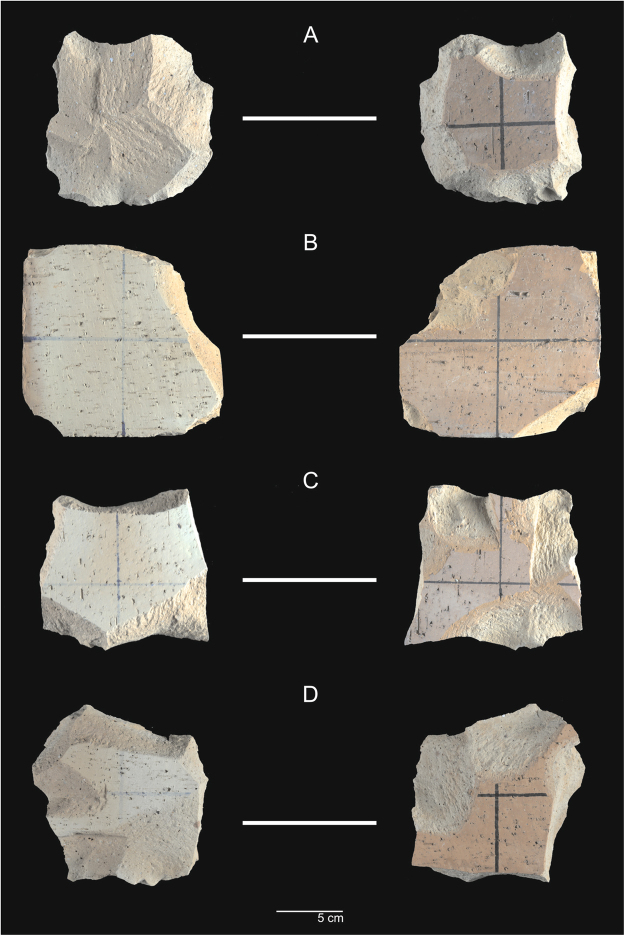
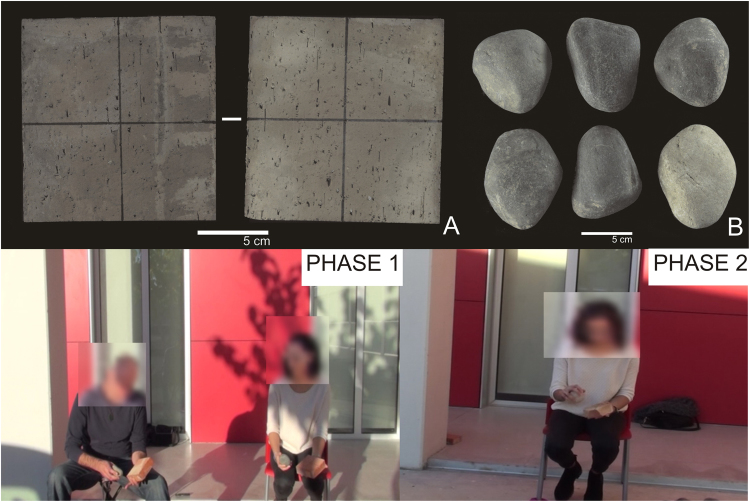
- 30 volunteers aged 20–42 with no prior knapping experience were randomly divided into three groups of 10: imitation-emulation, gestural communication, and verbal communication. Each participant had Phase 1 with the same expert knapper (5–15 min) and Phase 2 alone 30 min later (5–10 min), using identical commercial brick blanks (134 × 131 × 44 mm) and hammerstones.
- Participants were asked to reproduce the alternating method: bifacial reduction with core turning after each removal and use of the previous negative as the next percussion platform. Sessions were video-recorded; actions, products, and refitted knapping sequences were analyzed.
- Analyses included percussion types (P, D, E, F), Efficacy Index, flake dimensions and platform attributes, core perimeter, Extracted Mass Index, cortical surface/mass ratio, and sequence criteria. Non-parametric Kruskal-Wallis and Kolmogorov-Smirnov tests, ANOVA, and correspondence analysis were used with Past v.2.17c and ImageJ.
Limitations
- Stated in the paper: the experiment used a relatively short timeframe for learning; prehistoric knapping transmission would have been daily, and long-term experiments are needed to see whether initial differences persist, reduce, or increase with experience.
- Stated in the paper: in a single training session, no learner reached the expert knapper’s results on number of blows, percussion success, or Efficacy Index.
- Evident from the text: the sample was small (30 non-experts, 10 per group), used one expert knapper, artificial brick blanks rather than stone, and brief laboratory sessions, which limits generalization to prehistoric social learning.
Model-written summary. Check it against the paper before relying on it.
Integrity signals
Registry
Cites
Statistics
Figures
Verification
Claims the paper makes
46 Own result · 20 Own interpretation · 9 Own method · 7 Partly supported · 5 No basis given · 4 No full text of the sources · 3 Supported · 2 Supported so far · 1 Couldn’t confirm · 1 Sources not found · accuracy not yet measured
The cited sources support only part of this claim — read each source’s verdict below.
In the paper
“Furthermore, some ethnographic studies have reinforced the relationship between lithic technology and language, emphasising the social character of knapping in current human communities28–33.”
§ Teaching to make stone tools: new experimental evidence supporting a technological hypothesis for the origins of language > Introduction
What the sources say
- Not matchedcites [28] Bril, B., Roux, V. & Dietrich, G. Stone knapping: Khambhat (India), a unique opportunity? in Stone knapping: the necessary conditions for a uniquely hominin behaviour (eds Roux, V. & Bril, B.) 53–71 (Cambridge: McDonald Institute for Archaeological Research, 2005).
Couldn’t be matched to a paper in Crossref, so it can’t be checked.
- Not matchedcites [29] Roux, V. Peut-on interpréter les activités lithiques préhistoriques en termes de durée d’apprentissage? Apport de l’ethnologie et de la psychologie aux études technologiques in 25 ans d'études technologiques en Préhistoire. XIe Rencontres Internationales d’Archéologie et d’Histoire d’Antibes, pp. 47–56. Juan-les-Pins: Éditions APDCA. (1991).
Couldn’t be matched to a paper in Crossref, so it can’t be checked.
- Partly supportedcites [30] Roux, V. Cornaline de l’Inde. Des pratiques techniques de Cambay aux techno-systèmes de l’Indus. (Paris: Éditions de la Maison des Sciences de l’Homme, 2000). sourceExperimental — accuracy not yet measured
The book’s overview describes studying present-day carnelian bead-making in Cambay, and section II addresses the skills involved in knapping chalcedony beads. These passages support its use as a study of knapping in a current community, but the passages found do not establish a relationship between lithic technology and language or explicitly describe knapping’s social character. (LLM, conf=0.78)
- Not checked — no full text of the sourcecites [31] Roux, V., Bril, B. & Dietrich, G. Skills and learning difficulties involved in stone knapping: the case of stone-bead knapping in Khambhat, India. World Arch. 27, 63–87 (1995). source
- Not checked — no full text of the sourcecites [32] Stout, D. Skill and cognition in stone tool production. Cur. Anthr. 43, 693–720 (2002). source
- Not matchedcites [33] Stout, D. The social and cultural context of stone-knapping skill acquisition in Stone knapping: the necessary conditions for a uniquely hominin behaviour. (eds Roux, V. & Bril, B.) 331–340 (Cambridge: McDonald Institute for Archaeological Research, 2005).
Couldn’t be matched to a paper in Crossref, so it can’t be checked.
plaincorrelational- Asserted: passes — The authors put it forward as true.
- Checkable: passes — It can be checked against evidence.
- Load-bearing: unclear — It is unclear whether the paper’s conclusions depend on it.
- Based: passes — The paper gives a reason why it holds.
- Not matched
The sources with a verdict support this claim; the rest weren’t checked yet, have no full text we could read, or their verdicts aren’t rated yet.
In the paper
“Ohnuma et al.34 and Putt et al.38 found that verbal language did not represent an advantage over gestural communication.”
§ Teaching to make stone tools: new experimental evidence supporting a technological hypothesis for the origins of language > Introduction
What the sources say
- Supportedcites [34] Ohnuma, K., Aoki, K. & Akazawa, T. Transmission of tool-making through verbal and non-verbal communication: preliminary experiments in Levallois flake production. Anthropol. Sci. 105, 159–168 (1997). source
The Methods describe instruction by gesture and visual demonstration in the non-verbal group. The Concluding Remarks report no significant difference between the verbal and non-verbal groups in acquiring the Levallois technique or producing flakes. This supports the claim as applied to Ohnuma et al.’s preliminary experiment, not to tool-making generally. (LLM, conf=0.92)
- Not checked — no full text of the sourcecites [38] Putt, S. S., Woods, A. D. & Franciscus, R. G. The role of verbal interaction during experimental bifacial stone tool manufacture. Lithic Technol. 39, 96–112 (2014). source
plain- Asserted: passes — The authors put it forward as true.
- Checkable: passes — It can be checked against evidence.
- Load-bearing: passes — The paper’s conclusions depend on it.
- Based: passes — The paper gives a reason why it holds.
- Supported
The sources with a verdict support this claim; the rest weren’t checked yet, have no full text we could read, or their verdicts aren’t rated yet.
In the paper
“Language, the fastest and most efficient way to transmit information, could have lent hominins a great competitive advantage79 by favouring the social transmission of knowledge related to lithic technology39,40.”
§ Teaching to make stone tools: new experimental evidence supporting a technological hypothesis for the origins of language > Discussion > Relationship between lithic technology and language
What the sources say
- Not checked — no full text of the sourcecites [79] Corballis, M. C. From mouth to hand: Gesture, speech, and the evolution of right-handedness. Behav. Brain Sc. 26, 199–260 (2003). source
- Supportedcites [39] Morgan, T. J. H. et al. Experimental evidence for the co-evolution of hominin tool-making teaching and language. Nat. Commun. 6, 6029 (2015). source
The Discussion says language effectively transmitted abstract stone-knapping concepts and that increasingly complex communication would have enabled the more effective spread of stone-tool knowledge. The Abstract likewise reports improved transmission of Oldowan tool-making skills with language. The claim’s separate description of language as the fastest and most efficient means, and its reference to competitive advantage, are attached to citation 79 rather than this source. (LLM, conf=0.91)
- Supportedcites [40] Whiten, A. Experimental studies illuminate the cultural transmission of percussive technologies in Homo and Pan. Phi. Trans. R. Soc. B. 370, 20140359 (2015). source
The citation to this source is attached to the claim that language could favour social transmission of lithic knowledge, not to the separate claim about competitive advantage. Section 6 reports that verbal teaching was particularly effective in transmitting stone-knapping skills, while noting that the experiments do not directly establish what happened among ancient hominins. No page number is available in our copy. (LLM, conf=0.91)
hedgedconditional- Asserted: passes — The authors put it forward as true.
- Checkable: passes — It can be checked against evidence.
- Load-bearing: passes — The paper’s conclusions depend on it.
- Based: passes — The paper gives a reason why it holds.
- Rests on an assumption: Language is the fastest and most efficient way to transmit information.
Every source the paper cites for this claim was checked and supports it.
In the paper
“However, hominin dependence on lithic technology would have generated a selective process favourable to the development of a more complex social transmission mechanism, allowing more effective diffusion of technical knowledge24,39.”
§ Teaching to make stone tools: new experimental evidence supporting a technological hypothesis for the origins of language > Discussion > Relationship between lithic technology and language
What the sources say
- Supportedcites [24] Csibra, G. & Gergely, G. Natural pedagogy as evolutionary adaptation. Philos. Trans. R. Soc. Lond. B. Biol. Sci. 366, 1149–1157 (2011). source
In §4, the authors link early hominin stone-tool production to difficult skills likely to require cultural transmission and expert participation. In §5, they propose that technological knowledge made natural pedagogy—a communicative knowledge-transmission adaptation—necessary. The citing sentence fairly paraphrases that evolutionary proposal. (LLM, conf=0.90)
- Supportedcites [39] Morgan, T. J. H. et al. Experimental evidence for the co-evolution of hominin tool-making teaching and language. Nat. Commun. 6, 6029 (2015). source
The Discussion (page not supplied) states that hominin reliance on stone technology would have selected for increasingly complex communication that enabled more effective transmission of stone-tool knowledge. This directly supports the citing sentence’s paraphrase. (LLM, conf=0.94)
hedgeddirect- Asserted: passes — The authors put it forward as true.
- Checkable: passes — It can be checked against evidence.
- Load-bearing: passes — The paper’s conclusions depend on it.
- Based: passes — The paper gives a reason why it holds.
- Supported
The cited sources support only part of this claim — read each source’s verdict below.
In the paper
“our results lend weight to the pedagogical hypothesis of language6, according to which lithic knapping and language may have co-evolved5,39,76.”
§ Teaching to make stone tools: new experimental evidence supporting a technological hypothesis for the origins of language > Discussion > Relationship between lithic technology and language
What the sources say
- Supportedcites [6] Stout, D. & Chaminade, T. Stone tools, language and the brain in the human evolution. Philos. Trans. R. Soc. Lond. B. Biol. Sci. 367, 75–87 (2012). source
Section 3 says similarities between handaxe production and language processing extend the plausible context for co-evolutionary interactions between technological and linguistic capacities. The Conclusion also describes a technological pedagogy hypothesis. The citing authors’ statement about their own results is not attributed to this source. (LLM, conf=0.91)
- Not matchedcites [5] Stout, D. Possible relations between language and technology in human evolution in Stone tools and the evolution of human cognition. (eds Nowell, A. & Davidson, I.) 159–184. (Univ. Press of Colorado, 2010).
Couldn’t be matched to a paper in Crossref, so it can’t be checked.
- Supportedcites [39] Morgan, T. J. H. et al. Experimental evidence for the co-evolution of hominin tool-making teaching and language. Nat. Commun. 6, 6029 (2015). source
The citation supports the co-evolutionary hypothesis, rather than the citing authors’ statement about their own results. In the Discussion (page not supplied), the source says its findings support an account in which stone-tool manufacture generated selection favouring teaching and language. (LLM, conf=0.94)
hedgedconditional- Asserted: passes — The authors put it forward as true.
- Checkable: passes — It can be checked against evidence.
- Load-bearing: passes — The paper’s conclusions depend on it.
- Based: passes — The paper gives a reason why it holds.
- Supported
A result the paper reports from its own data — it cites no other source for it, so there is none to check. The quote shows it is in the paper.
In the paper
“In the case of the expert knapper the flakes are dominated by non-cortical platforms (83.62%), with few completely cortical platforms (9,86%).”
§ Teaching to make stone tools: new experimental evidence supporting a technological hypothesis for the origins of language > Results > Sequences
plainSingle case- Asserted: passes — The authors put it forward as true.
- Checkable: passes — It can be checked against evidence.
- Load-bearing: passes — The paper’s conclusions depend on it.
- Based: passes — The paper gives a reason why it holds.
A result the paper reports from its own data — it cites no other source for it, so there is none to check. The quote shows it is in the paper.
In the paper
“In the imitation-emulation group, completely cortical platforms predominated in both Phase 1 (Co: 52.23%) and Phase 2 (Co: 63.59%)”
§ Teaching to make stone tools: new experimental evidence supporting a technological hypothesis for the origins of language > Results > Sequences
plain- Asserted: passes — The authors put it forward as true.
- Checkable: passes — It can be checked against evidence.
- Load-bearing: passes — The paper’s conclusions depend on it.
- Based: passes — The paper gives a reason why it holds.
A result the paper reports from its own data — it cites no other source for it, so there is none to check. The quote shows it is in the paper.
In the paper
“whereas in the verbal communication group completely non-cortical platforms predominated in both phases (Phase 1 Nco: 74.59%; Phase 2 Nco: 60%)”
§ Teaching to make stone tools: new experimental evidence supporting a technological hypothesis for the origins of language > Results > Sequences
plain- Asserted: passes — The authors put it forward as true.
- Checkable: passes — It can be checked against evidence.
- Load-bearing: passes — The paper’s conclusions depend on it.
- Based: passes — The paper gives a reason why it holds.
A result the paper reports from its own data — it cites no other source for it, so there is none to check. The quote shows it is in the paper.
In the paper
“Finally, the greatest decrease occurred in the gestural communication group, falling from 58.86% of alternating flakes in Phase 1 to just 5.23% in Phase 2 (representing a relative drop of 91.1%).”
§ Teaching to make stone tools: new experimental evidence supporting a technological hypothesis for the origins of language > Results > Sequences
plain- Asserted: passes — The authors put it forward as true.
- Checkable: passes — It can be checked against evidence.
- Load-bearing: unclear — It is unclear whether the paper’s conclusions depend on it.
- Based: passes — The paper gives a reason why it holds.
A result the paper reports from its own data — it cites no other source for it, so there is none to check. The quote shows it is in the paper.
In the paper
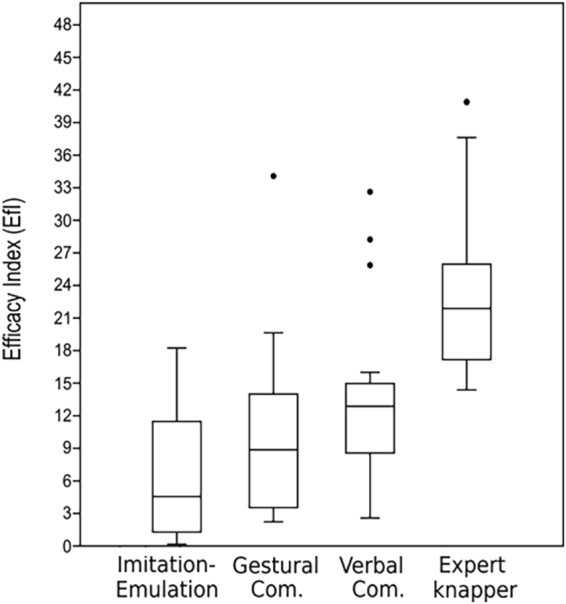
“When the number of actions performed in each knapping session was related to the mass extracted from the corresponding core (Efficacy Index - EfI), the expert knapper displayed a significantly higher mean than the apprentices (EfI EK = 23. 04), indicating his greater effectiveness in reducing the core (Fig. 2).”
§ Teaching to make stone tools: new experimental evidence supporting a technological hypothesis for the origins of language > Results > Technical capabilities
hedgedSingle case- Asserted: passes — The authors put it forward as true.
- Checkable: passes — It can be checked against evidence.
- Load-bearing: unclear — It is unclear whether the paper’s conclusions depend on it.
- Based: passes — The paper gives a reason why it holds.
A result the paper reports from its own data — it cites no other source for it, so there is none to check. The quote shows it is in the paper.
In the paper
“Similarities between the flakes produced by the gestural communication group and those made by the expert knapper were only documented in the platform thickness and elongation index (Supplementary Material Table S11).”
§ Teaching to make stone tools: new experimental evidence supporting a technological hypothesis for the origins of language > Results > Products
plain- Asserted: passes — The authors put it forward as true.
- Checkable: passes — It can be checked against evidence.
- Load-bearing: unclear — It is unclear whether the paper’s conclusions depend on it.
- Based: passes — The paper gives a reason why it holds.
A result the paper reports from its own data — it cites no other source for it, so there is none to check. The quote shows it is in the paper.
In the paper
“In the verbal communication group, the decrease is more pronounced in absolute terms, as alternating flakes dropped from 79.56% in Phase 1 to 53.13% in Phase 2 (representing a relative decrease of 33.7% in Phase 2 compared to Phase 1).”
§ Teaching to make stone tools: new experimental evidence supporting a technological hypothesis for the origins of language > Results > Sequences
plain- Asserted: passes — The authors put it forward as true.
- Checkable: passes — It can be checked against evidence.
- Load-bearing: unclear — It is unclear whether the paper’s conclusions depend on it.
- Based: passes — The paper gives a reason why it holds.
A result the paper reports from its own data — it cites no other source for it, so there is none to check. The quote shows it is in the paper.
In the paper
“In the imitation-emulation learning group, the difference in alternating flake production between Phase 1 and Phase 2 was not so pronounced, although it is important to consider that their overall percentage of alternating flakes was very low, dropping from 5.56% in Phase 1 to 2.05% in Phase 2 (a relative decrease of 63.1% in Phase 2 compared to Phase 1).”
§ Teaching to make stone tools: new experimental evidence supporting a technological hypothesis for the origins of language > Results > Sequences
plain- Asserted: passes — The authors put it forward as true.
- Checkable: passes — It can be checked against evidence.
- Load-bearing: unclear — It is unclear whether the paper’s conclusions depend on it.
- Based: passes — The paper gives a reason why it holds.
A result the paper reports from its own data — it cites no other source for it, so there is none to check. The quote shows it is in the paper.
In the paper
“The volunteers in the imitation-emulation group needed to perform more percussions than any of the other participants to reduce the core (EfI I-E = 5.98).”
§ Teaching to make stone tools: new experimental evidence supporting a technological hypothesis for the origins of language > Results > Technical capabilities
plaindirect- Asserted: passes — The authors put it forward as true.
- Checkable: passes — It can be checked against evidence.
- Load-bearing: unclear — It is unclear whether the paper’s conclusions depend on it.
- Based: passes — The paper gives a reason why it holds.
A result the paper reports from its own data — it cites no other source for it, so there is none to check. The quote shows it is in the paper.
In the paper
“During the experiment, the apprentices in the imitation-emulation group performed considerably higher number of percussion actions (n = 3,041), than those in the gestural (n = 1,744) or verbal learning groups (n = 1,369) (Table 1).”
§ Teaching to make stone tools: new experimental evidence supporting a technological hypothesis for the origins of language > Results > Technical capabilities
plain- Asserted: passes — The authors put it forward as true.
- Checkable: passes — It can be checked against evidence.
- Load-bearing: passes — The paper’s conclusions depend on it.
- Based: passes — The paper gives a reason why it holds.
A result the paper reports from its own data — it cites no other source for it, so there is none to check. The quote shows it is in the paper.
In the paper
“Anyway, all percentages are lower than that achieved by the expert knapper (92,85% of alternating flakes).”
§ Teaching to make stone tools: new experimental evidence supporting a technological hypothesis for the origins of language > Results > Sequences
plain- Asserted: passes — The authors put it forward as true.
- Checkable: passes — It can be checked against evidence.
- Load-bearing: unclear — It is unclear whether the paper’s conclusions depend on it.
- Based: passes — The paper gives a reason why it holds.
A result the paper reports from its own data — it cites no other source for it, so there is none to check. The quote shows it is in the paper.
In the paper
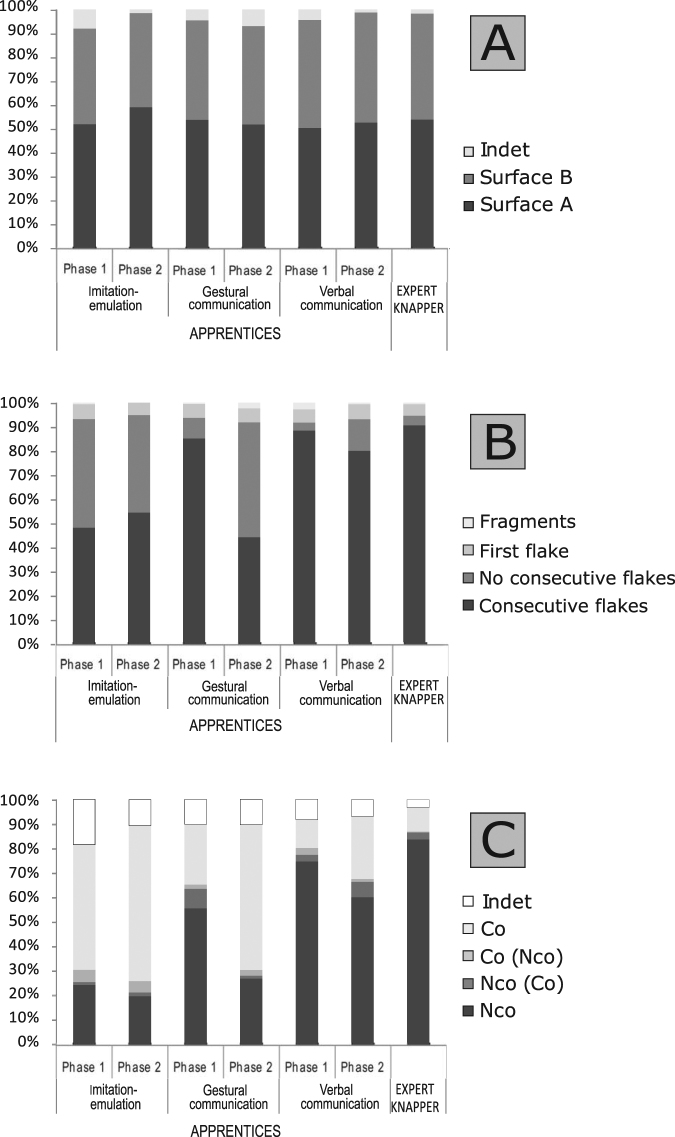
“In alternating the faces of the core, all three groups showed the same pattern of equilibrium among faces, with a slight predominance of flakes from percussions on face A, a very similar pattern to the expert knapper (Fig. 3A).”
§ Teaching to make stone tools: new experimental evidence supporting a technological hypothesis for the origins of language > Results > Sequences
plain- Asserted: passes — The authors put it forward as true.
- Checkable: passes — It can be checked against evidence.
- Load-bearing: unclear — It is unclear whether the paper’s conclusions depend on it.
- Based: passes — The paper gives a reason why it holds.
A result the paper reports from its own data — it cites no other source for it, so there is none to check. The quote shows it is in the paper.
In the paper
“In contrast, the products of the imitation-emulation group were only similar to those of the skilled knapper in platform width and elongation index (a sort of ratio that allows to differentiate between long and short pieces, since it correlates the technical length divided by the technical width).”
§ Teaching to make stone tools: new experimental evidence supporting a technological hypothesis for the origins of language > Results > Products
plain- Asserted: passes — The authors put it forward as true.
- Checkable: passes — It can be checked against evidence.
- Load-bearing: passes — The paper’s conclusions depend on it.
- Based: passes — The paper gives a reason why it holds.
A result the paper reports from its own data — it cites no other source for it, so there is none to check. The quote shows it is in the paper.
In the paper
“In core rotation, that is, the continuity of extractions around the perimeter of the core, the verbal communication group obtained a higher total number of consecutive flakes (288), while the imitation-emulation group and the gestural communication group performed a total of 184 and 249 consecutive removals, respectively.”
§ Teaching to make stone tools: new experimental evidence supporting a technological hypothesis for the origins of language > Results > Sequences
plain- Asserted: passes — The authors put it forward as true.
- Checkable: passes — It can be checked against evidence.
- Load-bearing: passes — The paper’s conclusions depend on it.
- Based: passes — The paper gives a reason why it holds.
A result the paper reports from its own data — it cites no other source for it, so there is none to check. The quote shows it is in the paper.
In the paper
“In contrast, the gestural communication group were unable to perform the alternating method.”
§ Teaching to make stone tools: new experimental evidence supporting a technological hypothesis for the origins of language > Discussion > Sequences
plain- Asserted: passes — The authors put it forward as true.
- Checkable: passes — It can be checked against evidence.
- Load-bearing: passes — The paper’s conclusions depend on it.
- Based: passes — The paper gives a reason why it holds.
A result the paper reports from its own data — it cites no other source for it, so there is none to check. The quote shows it is in the paper.
In the paper
“Finally, the method for separately analysing the learners’ technical abilities to produce flakes (savoir-faire) and their theoretical knowledge of the alternating method (connaissance) allowed us to observe that both gestural and verbal communication have greater impact on the transmission of the knapping method than on improving flake production efficiency.”
§ Teaching to make stone tools: new experimental evidence supporting a technological hypothesis for the origins of language > Discussion > Relationship between lithic technology and language
plaindirect- Asserted: passes — The authors put it forward as true.
- Checkable: passes — It can be checked against evidence.
- Load-bearing: passes — The paper’s conclusions depend on it.
- Based: passes — The paper gives a reason why it holds.
A result the paper reports from its own data — it cites no other source for it, so there is none to check. The quote shows it is in the paper.
In the paper
“Even so, the use of communication, whether gestural or verbal, in the early stages of learning makes the transmission of information more effective than direct observation.”
§ Teaching to make stone tools: new experimental evidence supporting a technological hypothesis for the origins of language > Discussion > Relationship between lithic technology and language
plaindirect- Asserted: passes — The authors put it forward as true.
- Checkable: passes — It can be checked against evidence.
- Load-bearing: passes — The paper’s conclusions depend on it.
- Based: passes — The paper gives a reason why it holds.
A result the paper reports from its own data — it cites no other source for it, so there is none to check. The quote shows it is in the paper.
In the paper
“This is reflected in the Efficacy Index, which is lower in the imitation-emulation group than in the taught groups (gestural and verbal).”
§ Teaching to make stone tools: new experimental evidence supporting a technological hypothesis for the origins of language > Conclusions
plain- Asserted: passes — The authors put it forward as true.
- Checkable: passes — It can be checked against evidence.
- Load-bearing: passes — The paper’s conclusions depend on it.
- Based: passes — The paper gives a reason why it holds.
A result the paper reports from its own data — it cites no other source for it, so there is none to check. The quote shows it is in the paper.
In the paper
“Firstly, regardless of the type of social transmission, in a single training session none of the learners achieved the results obtained by the expert knapper in terms of: (a) the number of blows struck during the core reduction; (b) the percentage of percussions without extraction compared to the total percussions; (c) the relative weight of percussions with successful extractions; and (d) the Ef”
§ Teaching to make stone tools: new experimental evidence supporting a technological hypothesis for the origins of language > Conclusions
plain- Asserted: passes — The authors put it forward as true.
- Checkable: passes — It can be checked against evidence.
- Load-bearing: passes — The paper’s conclusions depend on it.
- Based: passes — The paper gives a reason why it holds.
A result the paper reports from its own data — it cites no other source for it, so there is none to check. The quote shows it is in the paper.
In the paper
“Only the verbal communication learners were able to knap the core using the alternating method in Phase 2 of the experiment, when they were untutored.”
§ Teaching to make stone tools: new experimental evidence supporting a technological hypothesis for the origins of language > Conclusions
plaindirect- Asserted: passes — The authors put it forward as true.
- Checkable: passes — It can be checked against evidence.
- Load-bearing: passes — The paper’s conclusions depend on it.
- Based: passes — The paper gives a reason why it holds.
A result the paper reports from its own data — it cites no other source for it, so there is none to check. The quote shows it is in the paper.
In the paper
“the two groups diverged with regard to their ability to retain the information needed to replicate the method on their own.”
§ Teaching to make stone tools: new experimental evidence supporting a technological hypothesis for the origins of language > Conclusions
plaincorrelational- Asserted: passes — The authors put it forward as true.
- Checkable: passes — It can be checked against evidence.
- Load-bearing: passes — The paper’s conclusions depend on it.
- Based: passes — The paper gives a reason why it holds.
A result the paper reports from its own data — it cites no other source for it, so there is none to check. The quote shows it is in the paper.
In the paper
“although no significant differences were found between the gestural and verbal communication learners with regard to their ability to replicate the alternating method while knapping under the tuition of the skilled knapper”
§ Teaching to make stone tools: new experimental evidence supporting a technological hypothesis for the origins of language > Conclusions
plain- Asserted: passes — The authors put it forward as true.
- Checkable: passes — It can be checked against evidence.
- Load-bearing: passes — The paper’s conclusions depend on it.
- Based: passes — The paper gives a reason why it holds.
A result the paper reports from its own data — it cites no other source for it, so there is none to check. The quote shows it is in the paper.
In the paper
“Secondly, volunteers who had to replicate lithic knapping through simple observation and replication (imitation-emulation group) had difficulties making successful extractions.”
§ Teaching to make stone tools: new experimental evidence supporting a technological hypothesis for the origins of language > Conclusions
plaindirect- Asserted: passes — The authors put it forward as true.
- Checkable: passes — It can be checked against evidence.
- Load-bearing: passes — The paper’s conclusions depend on it.
- Based: passes — The paper gives a reason why it holds.
A result the paper reports from its own data — it cites no other source for it, so there is none to check. The quote shows it is in the paper.
In the paper
“Through our work we have confirmed that the combination of individual practice and social learning (whether through direct observation or teaching) is fundamental for learning how to knap.”
§ Teaching to make stone tools: new experimental evidence supporting a technological hypothesis for the origins of language > Discussion > Relationship between lithic technology and language
boosteddirect- Asserted: passes — The authors put it forward as true.
- Checkable: passes — It can be checked against evidence.
- Load-bearing: passes — The paper’s conclusions depend on it.
- Based: passes — The paper gives a reason why it holds.
The paper states this without a source or data behind it here, so there is nothing to check it against. The quote shows it is in the paper.
In the paper
“However, only three experimental studies have directly analysed the role of language in the acquisition of knapping knowledge.”
§ Teaching to make stone tools: new experimental evidence supporting a technological hypothesis for the origins of language > Introduction
plain- Asserted: passes — The authors put it forward as true.
- Checkable: passes — It can be checked against evidence.
- Load-bearing: passes — The paper’s conclusions depend on it.
- Based: passes — The paper gives a reason why it holds.
The paper states this without a source or data behind it here, so there is nothing to check it against. The quote shows it is in the paper.
In the paper
“Firstly, none of these experiments considered the need to provide all of the volunteers with nodules of identical shape, texture and size”
§ Teaching to make stone tools: new experimental evidence supporting a technological hypothesis for the origins of language > Introduction
plain- Asserted: passes — The authors put it forward as true.
- Checkable: passes — It can be checked against evidence.
- Load-bearing: passes — The paper’s conclusions depend on it.
- Based: passes — The paper gives a reason why it holds.
In the paper
“This is because the alternating method generates longer flakes than those obtained through other knapping strategies, such as the alternate method41.”
§ Teaching to make stone tools: new experimental evidence supporting a technological hypothesis for the origins of language > Discussion > Products
What the sources say
- Not checked — no full text of the sourcecites [41] Guardiola, M., Morales, J. I. & Vergès, J. M. From blunt to cutting: Distinguishing alternating method flakes in early stages on rounded blanks. Quat. Intern. 411, 378–385 (2016). source
plaindirect- Asserted: passes — The authors put it forward as true.
- Checkable: passes — It can be checked against evidence.
- Load-bearing: passes — The paper’s conclusions depend on it.
- Based: passes — The paper gives a reason why it holds.
A conclusion the paper draws from its own results — it cites no other source for it, so there is none to check. The quote shows it is in the paper.
In the paper
“The differences between the expert knapper’s results and apprentices’ results when extracting flakes mostly by means of the alternating method (such as in the verbal group) seem to be due to technical gestures and not the actual application of the method.”
§ Teaching to make stone tools: new experimental evidence supporting a technological hypothesis for the origins of language > Discussion > Products
hedgeddirect- Asserted: passes — The authors put it forward as true.
- Checkable: passes — It can be checked against evidence.
- Load-bearing: passes — The paper’s conclusions depend on it.
- Based: passes — The paper gives a reason why it holds.
In the paper
“In these groups, verbal interaction is a key component of the knapping learning process, especially for transmitting complex technological concepts31.”
§ Teaching to make stone tools: new experimental evidence supporting a technological hypothesis for the origins of language > Introduction
What the sources say
- Not checked — no full text of the sourcecites [31] Roux, V., Bril, B. & Dietrich, G. Skills and learning difficulties involved in stone knapping: the case of stone-bead knapping in Khambhat, India. World Arch. 27, 63–87 (1995). source
plaincorrelational- Asserted: passes — The authors put it forward as true.
- Checkable: passes — It can be checked against evidence.
- Load-bearing: passes — The paper’s conclusions depend on it.
- Based: passes — The paper gives a reason why it holds.
A conclusion the paper draws from its own results — it cites no other source for it, so there is none to check. The quote shows it is in the paper.
In the paper
“The differences in the reduction strategies observed among the three groups of apprentices revealed that learning through communication (both verbal and gestural) is more effective strategy for teaching the alternating method than visual observation and subsequent reproduction by an apprentice.”
§ Teaching to make stone tools: new experimental evidence supporting a technological hypothesis for the origins of language > Discussion > Sequences
plaindirect- Asserted: passes — The authors put it forward as true.
- Checkable: passes — It can be checked against evidence.
- Load-bearing: passes — The paper’s conclusions depend on it.
- Based: passes — The paper gives a reason why it holds.
A conclusion the paper draws from its own results — it cites no other source for it, so there is none to check. The quote shows it is in the paper.
In the paper
“The imitation group was only able to produce 13 alternating flakes, meaning that this mechanism of social transmission is not sufficiently effective for the early stages of knapping training.”
§ Teaching to make stone tools: new experimental evidence supporting a technological hypothesis for the origins of language > Discussion > Sequences
plain- Asserted: passes — The authors put it forward as true.
- Checkable: passes — It can be checked against evidence.
- Load-bearing: passes — The paper’s conclusions depend on it.
- Based: passes — The paper gives a reason why it holds.
A conclusion the paper draws from its own results — it cites no other source for it, so there is none to check. The quote shows it is in the paper.
In the paper
“In our case, these two mechanisms meant the apprentices focused on the more relevant aspects of the alternating method, such as the use of previous extractions as subsequent percussion platforms, and the production of consecutive sequences of extractions along the perimeter of the core.”
§ Teaching to make stone tools: new experimental evidence supporting a technological hypothesis for the origins of language > Conclusions
plaindirect- Asserted: passes — The authors put it forward as true.
- Checkable: passes — It can be checked against evidence.
- Load-bearing: passes — The paper’s conclusions depend on it.
- Based: passes — The paper gives a reason why it holds.
A conclusion the paper draws from its own results — it cites no other source for it, so there is none to check. The quote shows it is in the paper.
In the paper
“The result is that verbal language is more effective and efficient than gestural language for acquiring and retaining key information relating to the technological aspects of knapping.”
§ Teaching to make stone tools: new experimental evidence supporting a technological hypothesis for the origins of language > Conclusions
plaindirect- Asserted: passes — The authors put it forward as true.
- Checkable: passes — It can be checked against evidence.
- Load-bearing: passes — The paper’s conclusions depend on it.
- Based: passes — The paper gives a reason why it holds.
A conclusion the paper draws from its own results — it cites no other source for it, so there is none to check. The quote shows it is in the paper.
In the paper
“In the same way, the increased complexity of the lithic technology would in turn have involved the development of more complex communicative behaviour capable of transmitting yet more information in a shorter time frame.”
§ Teaching to make stone tools: new experimental evidence supporting a technological hypothesis for the origins of language > Conclusions
hedgeddirect- Asserted: passes — The authors put it forward as true.
- Checkable: passes — It can be checked against evidence.
- Load-bearing: passes — The paper’s conclusions depend on it.
- Based: passes — The paper gives a reason why it holds.
A conclusion the paper draws from its own results — it cites no other source for it, so there is none to check. The quote shows it is in the paper.
In the paper
“Fourthly, the fact that the imitation-emulation group was almost unable to replicate the alternating method leads us to believe that imitation is not sufficient to learn this method, at least in the initial stages of lithic knapping apprenticeship.”
§ Teaching to make stone tools: new experimental evidence supporting a technological hypothesis for the origins of language > Conclusions
hedgedconditional- Asserted: passes — The authors put it forward as true.
- Checkable: passes — It can be checked against evidence.
- Load-bearing: passes — The paper’s conclusions depend on it.
- Based: passes — The paper gives a reason why it holds.
A conclusion the paper draws from its own results — it cites no other source for it, so there is none to check. The quote shows it is in the paper.
In the paper
“Therefore, in a society whose subsistence was highly dependent on lithic technology, natural selection may likely have favoured increasingly complex communicative behaviour, which, in terms of lithic technology, would have improved the efficiency of knowledge transmission.”
§ Teaching to make stone tools: new experimental evidence supporting a technological hypothesis for the origins of language > Conclusions
hedgedconditional- Asserted: passes — The authors put it forward as true.
- Checkable: passes — It can be checked against evidence.
- Load-bearing: passes — The paper’s conclusions depend on it.
- Based: passes — The paper gives a reason why it holds.
A conclusion the paper draws from its own results — it cites no other source for it, so there is none to check. The quote shows it is in the paper.
In the paper
“In this way, communicative behaviour oriented at social learning and cumulative culture (in lithic knapping) could have co-evolved together with the first hominins.”
§ Teaching to make stone tools: new experimental evidence supporting a technological hypothesis for the origins of language > Discussion > Relationship between lithic technology and language
hedgedconditional- Asserted: passes — The authors put it forward as true.
- Checkable: passes — It can be checked against evidence.
- Load-bearing: passes — The paper’s conclusions depend on it.
- Based: passes — The paper gives a reason why it holds.
A claim is checked only against the cited paper’s full text, never its abstract, and none is available for its sources.
In the paper
“Initially, this communicative behaviour would not necessarily have been verbal language77,78.”
§ Teaching to make stone tools: new experimental evidence supporting a technological hypothesis for the origins of language > Discussion > Relationship between lithic technology and language
What the sources say
- Not checked — no full text of the sourcecites [77] Wynn, T., Hernandez-Aguilar, A., Marchant, L. F. & McGrew, W. C. “An ape’s view of the Oldowan” revisited. Evol. Anth. 20, 181–197 (2011). source
- Not checked — no full text of the sourcecites [78] Li, C. N. & Hombert, J.-M. On the evolutionary origin of language in Mirror neurons and the evolution of brain and language (eds Stamenov, M. I. & Gallese, V.) 175–207 (Amsterdam/Philadelphia: John Benjamins Publishing Company, 2002). source
hedged- Asserted: passes — The authors put it forward as true.
- Checkable: unclear — It is unclear whether it could be checked against evidence.
- Load-bearing: unclear — It is unclear whether the paper’s conclusions depend on it.
- Based: passes — The paper gives a reason why it holds.
What the paper did — it cites no source for this, so there is none to check. The quote shows it is in the paper.
In the paper
“Starting from this premise, the three elements of the flakes once refitted allowed us to objectively identify whether or not an alternating sequence had been achieved.”
§ Teaching to make stone tools: new experimental evidence supporting a technological hypothesis for the origins of language > Materials and Methods > Data acquisition and statistical analysis
plaindirect- Asserted: passes — The authors put it forward as true.
- Checkable: passes — It can be checked against evidence.
- Load-bearing: passes — The paper’s conclusions depend on it.
- Based: passes — The paper gives a reason why it holds.
A conclusion the paper draws from its own results — it cites no other source for it, so there is none to check. The quote shows it is in the paper.
In the paper
“All this leads us to confirm, through the quantification of actions, that gestural and verbal communication allows knappers to acquire knowledge more effectively and efficiently compared to other mechanisms of social transmission, such as simple observation.”
§ Teaching to make stone tools: new experimental evidence supporting a technological hypothesis for the origins of language > Conclusions
boosteddirect- Asserted: passes — The authors put it forward as true.
- Checkable: passes — It can be checked against evidence.
- Load-bearing: passes — The paper’s conclusions depend on it.
- Based: passes — The paper gives a reason why it holds.
The paper states this without a source or data behind it here, so there is nothing to check it against. The quote shows it is in the paper.
In the paper
“Consequently, it is difficult to quantify the efficacy of the different learning conditions for social transmission in such studies, as a particular product can be obtained in a variety of different ways.”
§ Teaching to make stone tools: new experimental evidence supporting a technological hypothesis for the origins of language > Introduction
plain- Asserted: passes — The authors put it forward as true.
- Checkable: passes — It can be checked against evidence.
- Load-bearing: passes — The paper’s conclusions depend on it.
- Based: passes — The paper gives a reason why it holds.
- Probably not a substantial claim. 17
- It may state two separate claims as one. 39
- The quote only partly states this claim. 3
The cited sources support only part of this claim — read each source’s verdict below.
In the paper
“Furthermore, some authors claim that the application of the alternating method generates more invasive flakes, that is to say, flakes that penetrate more deeply towards the inside of the blank, allowing for the extraction of more cortical surface42,49.”
§ Teaching to make stone tools: new experimental evidence supporting a technological hypothesis for the origins of language > Discussion > Products
What the sources say
- Partly supportedcites [42] White, M. J. & Ashton, N. M. Lower Paleolithic core technology and the origins of the Levallois method in North-WesternEurope. Cur. Anthr. 44, 598–609 (2003). sourceExperimental — accuracy not yet measured
In “Core Technology at Botany Pit” (page unavailable), the paper says alternate flaking tends to be invasive, removing material from the body or volume of the core. It does not say this allows more cortical surface to be removed. (LLM, conf=0.86)
- Not checked — no full text of the sourcecites [49] Moore, M. W. Australian aboriginal biface reduction techniques on the Georgia River, Camooweal, Queensland. Austral. Arch. 56, 22–34 (2003). source
hedgeddirect- Asserted: fails — The authors may not put it forward as true.
- Checkable: passes — It can be checked against evidence.
- Load-bearing: passes — The paper’s conclusions depend on it.
- Based: passes — The paper gives a reason why it holds.
Probably not a substantial claim. The authors may not put it forward as true. It may state two separate claims as one.
- Partly supported
Every source the paper cites for this claim was checked and supports it.
In the paper
“However, the results of Morgan et al. indicate that gestural communication, and especially verbal communication, are more effective than non-teaching conditions (reverse engineering or imitation-emulation)39.”
§ Teaching to make stone tools: new experimental evidence supporting a technological hypothesis for the origins of language > Introduction
What the sources say
- Supportedcites [39] Morgan, T. J. H. et al. Experimental evidence for the co-evolution of hominin tool-making teaching and language. Nat. Commun. 6, 6029 (2015). source
The Results (Performance across conditions) report that gestural and verbal teaching improved stone-knapping performance relative to reverse engineering, while imitation/emulation showed little evidence of improvement. They also report strong evidence that verbal teaching improved performance relative to gestural teaching. (LLM, conf=0.94)
hedgeddirect- Asserted: passes — The authors put it forward as true.
- Checkable: passes — It can be checked against evidence.
- Load-bearing: passes — The paper’s conclusions depend on it.
- Based: passes — The paper gives a reason why it holds.
It may state two separate claims as one.
- Supported
The cited sources that could be checked couldn’t confirm or dispute this claim.
In the paper
“The imitation-emulation volunteers produced flakes with thinner platforms, while the flake platforms of the verbal and gestural communication groups were thicker, more like to those of the skilled knapper. This may indicate that more adequate percussion platforms were selected by these groups compared with the imitation-emulation knappers73.”
§ Teaching to make stone tools: new experimental evidence supporting a technological hypothesis for the origins of language > Discussion > Products
What the sources say
- Could not verifycites [73] Lewis, H. M. & Laland, K. N. Transmission fidelity is the key to the build-up of cumulative culture. Philos. Trans. R. Soc. Lond. B. Biol. Sci. 367, 2171–2180 (2012). sourceExperimental — accuracy not yet measured
Split into 2 atoms — 0 confirmed, 0 partially supported, 0 disputed, 0 misattributed, 2 unverifiable. Expand the claim to see per-atom verdicts.
hedgedconditional- Asserted: passes — The authors put it forward as true.
- Checkable: passes — It can be checked against evidence.
- Load-bearing: passes — The paper’s conclusions depend on it.
- Based: passes — The paper gives a reason why it holds.
It may state two separate claims as one.
- Could not verify
The cited sources support only part of this claim — read each source’s verdict below.
In the paper
“although it is well known that the initial morphology of a blank strongly influences the final products41,42.”
§ Teaching to make stone tools: new experimental evidence supporting a technological hypothesis for the origins of language > Introduction
What the sources say
- Not checked — no full text of the sourcecites [41] Guardiola, M., Morales, J. I. & Vergès, J. M. From blunt to cutting: Distinguishing alternating method flakes in early stages on rounded blanks. Quat. Intern. 411, 378–385 (2016). source
- Partly supportedcites [42] White, M. J. & Ashton, N. M. Lower Paleolithic core technology and the origins of the Levallois method in North-WesternEurope. Cur. Anthr. 44, 598–609 (2003). sourceExperimental — accuracy not yet measured
The Discussion (page unavailable) says biface surface forms depend in part on the blank type used, supporting an influence of the starting blank on the resulting form. It does not establish that initial blank morphology strongly influences final products generally; the same section describes whether blank shape dictates certain core techniques as debatable. (LLM, conf=0.80)
boosteddirect- Asserted: passes — The authors put it forward as true.
- Checkable: passes — It can be checked against evidence.
- Load-bearing: passes — The paper’s conclusions depend on it.
- Based: passes — The paper gives a reason why it holds.
Probably not a substantial claim.
The cited sources support only part of this claim — read each source’s verdict below.
In the paper
“This body of study comprises evidence supporting the technological hypothesis of the origin of language, and particularly the technological pedagogy hypothesis6, which contends that intentional pedagogical demonstration may have spurred the evolution of the verbal communication24.”
§ Teaching to make stone tools: new experimental evidence supporting a technological hypothesis for the origins of language > Introduction
What the sources say
- Supportedcites [6] Stout, D. & Chaminade, T. Stone tools, language and the brain in the human evolution. Philos. Trans. R. Soc. Lond. B. Biol. Sci. 367, 75–87 (2012). source
Split into 2 atoms — 2 confirmed, 0 partially supported, 0 disputed, 0 misattributed, 0 unverifiable. Expand the claim to see per-atom verdicts.
- Partly supportedcites [24] Csibra, G. & Gergely, G. Natural pedagogy as evolutionary adaptation. Philos. Trans. R. Soc. Lond. B. Biol. Sci. 366, 1149–1157 (2011). sourceExperimental — accuracy not yet measured
Split into 2 atoms — 0 confirmed, 2 partially supported, 0 disputed, 0 misattributed, 0 unverifiable. Expand the claim to see per-atom verdicts.
hedgedconditional- Asserted: passes — The authors put it forward as true.
- Checkable: passes — It can be checked against evidence.
- Load-bearing: passes — The paper’s conclusions depend on it.
- Based: passes — The paper gives a reason why it holds.
It may state two separate claims as one.
- Supported
The cited sources support only part of this claim — read each source’s verdict below.
In the paper
“In this regard, the results of our study and other research39 indicate that teaching, especially by means of verbal communication, is the most effective social transmission mechanism for learning lithic knapping, and is especially helpful for acquiring and retaining concepts such as core rotation and turning, using negatives of previous blows as percussion platforms for subsequent extractions.”
§ Teaching to make stone tools: new experimental evidence supporting a technological hypothesis for the origins of language > Discussion > Sequences
What the sources say
- Partly supportedcites [39] Morgan, T. J. H. et al. Experimental evidence for the co-evolution of hominin tool-making teaching and language. Nat. Commun. 6, 6029 (2015). sourceExperimental — accuracy not yet measured
The Results (Performance across conditions; page unavailable) find that teaching, particularly verbal teaching, improved transmission of Oldowan flaking skills. The Discussion (page unavailable) names demonstrating core rotation as a teaching technique and says verbal instruction transmitted abstract concepts such as platform angle. The paper does not establish improved acquisition or retention of core turning or the use of negatives from earlier blows as percussion platforms. (LLM, conf=0.87)
hedgeddirect- Asserted: passes — The authors put it forward as true.
- Checkable: passes — It can be checked against evidence.
- Load-bearing: passes — The paper’s conclusions depend on it.
- Based: passes — The paper gives a reason why it holds.
It may state two separate claims as one.
- Partly supported
The cited sources support only part of this claim — read each source’s verdict below.
In the paper
“This would have allowed limited transmission among individuals maintaining long-term duration contacts, but would restrict the emergence of innovations and the dissemination speed39 of more organised methods of core reduction.”
§ Teaching to make stone tools: new experimental evidence supporting a technological hypothesis for the origins of language > Discussion > Relationship between lithic technology and language
What the sources say
- Partly supportedcites [39] Morgan, T. J. H. et al. Experimental evidence for the co-evolution of hominin tool-making teaching and language. Nat. Commun. 6, 6029 (2015). sourceExperimental — accuracy not yet measured
The Discussion (page not provided) suggests that low-fidelity transmission could have slowed the spread of Oldowan technology and prevented innovations from spreading; it also says observation alone is an inefficient way to acquire stone-tool-making skills. It does not address transmission specifically among people with long-term contacts or the spread of more organised core-reduction methods, and it presents the restriction on innovation as a possibility rather than a certainty. (LLM, conf=0.83)
hedgeddirect- Asserted: passes — The authors put it forward as true.
- Checkable: passes — It can be checked against evidence.
- Load-bearing: passes — The paper’s conclusions depend on it.
- Based: passes — The paper gives a reason why it holds.
It may state two separate claims as one.
- Partly supported
Every source the paper cites for this claim was checked and supports it.
In the paper
“It would also have been beneficial for developing skills requiring coordinated actions by multiple individuals, such as collective defence80.”
§ Teaching to make stone tools: new experimental evidence supporting a technological hypothesis for the origins of language > Discussion > Relationship between lithic technology and language
What the sources say
- Supportedcites [80] Laland, K. N. The origins of language in teaching. Psychon Bull Rev. 24, 225–231 (2017). source
The passage labeled Abstract explicitly includes collective defense among skills whose teaching would benefit from verbal instruction, and says some of those skills required coordinated actions by multiple individuals. This supports the citing sentence’s qualified claim. (LLM, conf=0.94)
hedgedconditional- Asserted: passes — The authors put it forward as true.
- Checkable: passes — It can be checked against evidence.
- Load-bearing: fails — The paper’s conclusions may not depend on it.
- Based: passes — The paper gives a reason why it holds.
Probably not a substantial claim. The paper’s conclusions may not depend on it.
- Supported
A result the paper reports from its own data — it cites no other source for it, so there is none to check. The quote shows it is in the paper.
In the paper
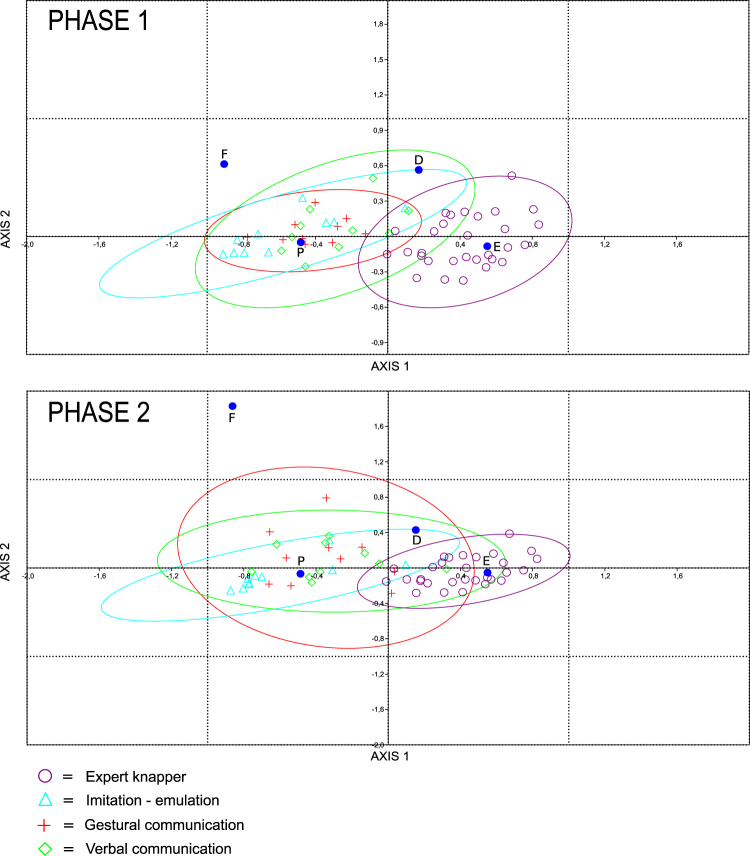
“The pattern in both phases is the same: the expert knapper is closely related to successful extractions, while the imitation-emulation group is characterized by percussions without extraction. Both the gestural and verbal communication groups are in an intermediate range, with no clear differences between them (see Fig. 1).”
§ Teaching to make stone tools: new experimental evidence supporting a technological hypothesis for the origins of language > Results > Technical capabilities
plaincorrelational- Asserted: passes — The authors put it forward as true.
- Checkable: passes — It can be checked against evidence.
- Load-bearing: passes — The paper’s conclusions depend on it.
- Based: passes — The paper gives a reason why it holds.
It may state two separate claims as one.
A result the paper reports from its own data — it cites no other source for it, so there is none to check. The quote shows it is in the paper.
In the paper
“Besides the gestural and verbal communication groups show similar striking platforms, there are statistical significant differences between the verbal communication group and the imitation-emulation and gestural communication groups, either in the thickness of the flakes (K-W IE-V (p) = 0.003855; K-W G-V (p) = 0.005541), and the carenate index (K-W IE-V (p) = 0.000000433; K-W G-V (p) = 0.001969).”
§ Teaching to make stone tools: new experimental evidence supporting a technological hypothesis for the origins of language > Results > Products
plain- Asserted: passes — The authors put it forward as true.
- Checkable: passes — It can be checked against evidence.
- Load-bearing: passes — The paper’s conclusions depend on it.
- Based: passes — The paper gives a reason why it holds.
It may state two separate claims as one. The quote only partly states this claim.
A result the paper reports from its own data — it cites no other source for it, so there is none to check. The quote shows it is in the paper.
In the paper
“Although we found no clear differences in core perimeter, the expert knapper exploited the cores more fully, that is, he extracted more mass per core, as shown by the mean of the Extracted Mass Indexes obtained for his cores (EMI EK) = 0.76). The verbal communication group produced the EMI most similar to that of the expert knapper (EMI V = 0.71), followed by the gestural communication group (EMI”
§ Teaching to make stone tools: new experimental evidence supporting a technological hypothesis for the origins of language > Results > Products
plaincorrelational- Asserted: passes — The authors put it forward as true.
- Checkable: passes — It can be checked against evidence.
- Load-bearing: passes — The paper’s conclusions depend on it.
- Based: passes — The paper gives a reason why it holds.
It may state two separate claims as one. The quote only partly states this claim.
A result the paper reports from its own data — it cites no other source for it, so there is none to check. The quote shows it is in the paper.
In the paper
“Striking differences arise when differentiating the results according to the phase of the experiment in which they were produced: although the general tendency in all groups was to produce fewer alternating flakes in Phase 2 than in Phase 1, there were differences in the intensity of these decreases.”
§ Teaching to make stone tools: new experimental evidence supporting a technological hypothesis for the origins of language > Results > Sequences
plaincorrelational- Asserted: passes — The authors put it forward as true.
- Checkable: passes — It can be checked against evidence.
- Load-bearing: unclear — It is unclear whether the paper’s conclusions depend on it.
- Based: passes — The paper gives a reason why it holds.
It may state two separate claims as one.
A result the paper reports from its own data — it cites no other source for it, so there is none to check. The quote shows it is in the paper.
In the paper
“The verbal group showed a slight decrease from 88.40% in Phase 1 to 80% in Phase 2, getting in both phases a percentage very similar to the expert (90% of consecutive flakes) (Fig. 3B).”
§ Teaching to make stone tools: new experimental evidence supporting a technological hypothesis for the origins of language > Results > Sequences
plaincorrelational- Asserted: passes — The authors put it forward as true.
- Checkable: passes — It can be checked against evidence.
- Load-bearing: passes — The paper’s conclusions depend on it.
- Based: passes — The paper gives a reason why it holds.
It may state two separate claims as one.
A result the paper reports from its own data — it cites no other source for it, so there is none to check. The quote shows it is in the paper.
In the paper
“The correlation between the cortical surface remaining in the cores and the extracted mass –that is, working out the area of the removals regarding the total surface of the core-, inform about how invasive (marginal or deep) are the flakes relative to the extracted mass. This correlation shows further differences between the skilled knapper and the apprentices, as well as between the different”
§ Teaching to make stone tools: new experimental evidence supporting a technological hypothesis for the origins of language > Results > Products
plaincorrelational- Asserted: passes — The authors put it forward as true.
- Checkable: passes — It can be checked against evidence.
- Load-bearing: passes — The paper’s conclusions depend on it.
- Based: passes — The paper gives a reason why it holds.
It may state two separate claims as one. The quote only partly states this claim.
A result the paper reports from its own data — it cites no other source for it, so there is none to check. The quote shows it is in the paper.
In the paper
“In the gestural group, there was a decrease from 85.14% of consecutive flakes in Phase 1 to 52.91% in Phase 2, the latter being very similar to the imitation-emulation group (48.15% in Phase 1 and 54.36% in Phase 2).”
§ Teaching to make stone tools: new experimental evidence supporting a technological hypothesis for the origins of language > Results > Sequences
plain- Asserted: passes — The authors put it forward as true.
- Checkable: passes — It can be checked against evidence.
- Load-bearing: passes — The paper’s conclusions depend on it.
- Based: passes — The paper gives a reason why it holds.
It may state two separate claims as one.
A result the paper reports from its own data — it cites no other source for it, so there is none to check. The quote shows it is in the paper.
In the paper
“Our results show that the apprentices improved their knapping skills in teaching conditions -both gestural and verbal communication-, and specially through the latter.”
§ Teaching to make stone tools: new experimental evidence supporting a technological hypothesis for the origins of language > Abstract
plaindirect- Asserted: passes — The authors put it forward as true.
- Checkable: passes — It can be checked against evidence.
- Load-bearing: passes — The paper’s conclusions depend on it.
- Based: passes — The paper gives a reason why it holds.
It may state two separate claims as one.
A result the paper reports from its own data — it cites no other source for it, so there is none to check. The quote shows it is in the paper.
In the paper
“All three groups started with identical blanks, and we found no clear differences in the general morphology of the final products (flakes). On the other hand, the most evident differences were seen during the knapping process: in technical abilities (reflected in the number of percussions and extractions made), and in the knapping sequences.”
§ Teaching to make stone tools: new experimental evidence supporting a technological hypothesis for the origins of language > Discussion > Products
plain- Asserted: passes — The authors put it forward as true.
- Checkable: passes — It can be checked against evidence.
- Load-bearing: passes — The paper’s conclusions depend on it.
- Based: passes — The paper gives a reason why it holds.
It may state two separate claims as one.
A result the paper reports from its own data — it cites no other source for it, so there is none to check. The quote shows it is in the paper.
In the paper
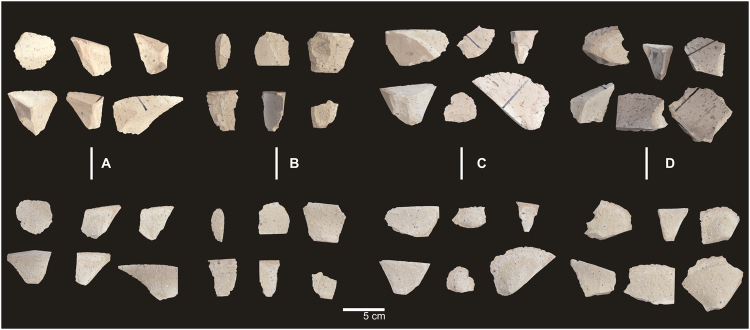
“A total of 1674 flakes and 90 cores were produced during the experiment. The skilled knapper generated 629 flakes and 30 cores; the imitation-emulation apprentices produced 357 flakes; the gestural communication apprentices generated 347 flakes; and the verbal communication apprentices obtained 341flakes (Fig. 4). Each learning group produced 20 cores (Fig. 5).”
§ Teaching to make stone tools: new experimental evidence supporting a technological hypothesis for the origins of language > Results > Products
plain- Asserted: passes — The authors put it forward as true.
- Checkable: passes — It can be checked against evidence.
- Load-bearing: unclear — It is unclear whether the paper’s conclusions depend on it.
- Based: passes — The paper gives a reason why it holds.
It may state two separate claims as one.
A result the paper reports from its own data — it cites no other source for it, so there is none to check. The quote shows it is in the paper.
In the paper
“In the three learning groups, on average, the participants in the verbal communication group achieved a higher EfI (EfI V = 13.99) than the members of the gestural communication group (EfI G = 10.43), although these differences are not statistically significant (K-W G-V (p) = 0.07205).”
§ Teaching to make stone tools: new experimental evidence supporting a technological hypothesis for the origins of language > Results > Technical capabilities
plain- Asserted: passes — The authors put it forward as true.
- Checkable: passes — It can be checked against evidence.
- Load-bearing: unclear — It is unclear whether the paper’s conclusions depend on it.
- Based: passes — The paper gives a reason why it holds.
It may state two separate claims as one.
A result the paper reports from its own data — it cites no other source for it, so there is none to check. The quote shows it is in the paper.
In the paper
“The results of the K-W test indicate that the differences between the verbal and gestural communication groups and the imitation-emulation group are statistically significant (K-W I-E-G (p) = 0.0239; K-W I-E-V (p) = 0.0003382).”
§ Teaching to make stone tools: new experimental evidence supporting a technological hypothesis for the origins of language > Results > Technical capabilities
plain- Asserted: passes — The authors put it forward as true.
- Checkable: passes — It can be checked against evidence.
- Load-bearing: passes — The paper’s conclusions depend on it.
- Based: passes — The paper gives a reason why it holds.
It may state two separate claims as one.
A result the paper reports from its own data — it cites no other source for it, so there is none to check. The quote shows it is in the paper.
In the paper
“Furthermore, non-cortical platforms predominated in Phase 1 in the gestural group (Nco: 55.43%), while in Phase 2 completely cortical platforms predominated (Co: 59.3%) (Fig. 3c).”
§ Teaching to make stone tools: new experimental evidence supporting a technological hypothesis for the origins of language > Results > Sequences
plain- Asserted: passes — The authors put it forward as true.
- Checkable: passes — It can be checked against evidence.
- Load-bearing: passes — The paper’s conclusions depend on it.
- Based: passes — The paper gives a reason why it holds.
It may state two separate claims as one.
A result the paper reports from its own data — it cites no other source for it, so there is none to check. The quote shows it is in the paper.
In the paper
“Regardless of the type of social transmission, in this work we show that trainees never reached the level of results obtained by the expert knapper in terms of: 1) the number of hits performed to reduce the core; 2) the low percentage of percussions without extraction compared to the total number of percussions; 3) the relative weight of percussions with successful extractions; and finally, 4) the”
§ Teaching to make stone tools: new experimental evidence supporting a technological hypothesis for the origins of language > Discussion > Technical capabilities
boosted- Asserted: passes — The authors put it forward as true.
- Checkable: passes — It can be checked against evidence.
- Load-bearing: passes — The paper’s conclusions depend on it.
- Based: passes — The paper gives a reason why it holds.
It may state two separate claims as one.
A result the paper reports from its own data — it cites no other source for it, so there is none to check. The quote shows it is in the paper.
In the paper
“However, the differences between these groups and the imitation-emulation group are statistically significant in the number of percussions without extraction, both in the mean (Kruskal-Wallis test (p) <0.05) and distribution of values (Kolmogorov-Smirnov (p) <0.05) (Supplementary Material Table S4).”
§ Teaching to make stone tools: new experimental evidence supporting a technological hypothesis for the origins of language > Results > Technical capabilities
plaincorrelational- Asserted: passes — The authors put it forward as true.
- Checkable: passes — It can be checked against evidence.
- Load-bearing: passes — The paper’s conclusions depend on it.
- Based: passes — The paper gives a reason why it holds.
It may state two separate claims as one.
A result the paper reports from its own data — it cites no other source for it, so there is none to check. The quote shows it is in the paper.
In the paper
“The study of flake-core refitting and the subsequent reconstruction of the knapping sequences verified that the verbal communication group produced the highest number of alternating flakes (229), followed by the gestural group (112). In contrast, the imitation-emulation group produced only 13 alternating flakes (Table 2).”
§ Teaching to make stone tools: new experimental evidence supporting a technological hypothesis for the origins of language > Results > Sequences
plaincorrelational- Asserted: passes — The authors put it forward as true.
- Checkable: passes — It can be checked against evidence.
- Load-bearing: passes — The paper’s conclusions depend on it.
- Based: passes — The paper gives a reason why it holds.
It may state two separate claims as one.
A result the paper reports from its own data — it cites no other source for it, so there is none to check. The quote shows it is in the paper.
In the paper
“When comparing the results from both faces of the cores, the skilled knapper tended to make more invasive removals in the first percussion face (face A, or second face of exploitation). This is established by the mean of the ratio between the cortical surface and the remaining mass on this face, which is much lower than that of the second face of percussion. In the gestural and verbal”
§ Teaching to make stone tools: new experimental evidence supporting a technological hypothesis for the origins of language > Results > Products
boostedcorrelational- Asserted: passes — The authors put it forward as true.
- Checkable: passes — It can be checked against evidence.
- Load-bearing: passes — The paper’s conclusions depend on it.
- Based: passes — The paper gives a reason why it holds.
It may state two separate claims as one.
A result the paper reports from its own data — it cites no other source for it, so there is none to check. The quote shows it is in the paper.
In the paper
“The most interesting difference among the learning groups is that while the verbal and gestural communication participants show thicker striking platforms, similar to those of the skilled knapper (K-W G-EK (p) = 0.9257; K-W V-EK (p) = 0.3566), the imitation-emulation group produced thinner percussion platforms, striking closer to the edge of the core.”
§ Teaching to make stone tools: new experimental evidence supporting a technological hypothesis for the origins of language > Results > Products
plaincorrelational- Asserted: passes — The authors put it forward as true.
- Checkable: passes — It can be checked against evidence.
- Load-bearing: passes — The paper’s conclusions depend on it.
- Based: passes — The paper gives a reason why it holds.
It may state two separate claims as one.
A result the paper reports from its own data — it cites no other source for it, so there is none to check. The quote shows it is in the paper.
In the paper
“Finally, verbal communication plays a major role in the retention of knowledge on lithic knapping and the successful achievement of the alternating method, since the apprentice knappers enjoyed more than a 66% success rate in Phase 2 compared to Phase 1.”
§ Teaching to make stone tools: new experimental evidence supporting a technological hypothesis for the origins of language > Conclusions
plaindirect- Asserted: passes — The authors put it forward as true.
- Checkable: passes — It can be checked against evidence.
- Load-bearing: passes — The paper’s conclusions depend on it.
- Based: passes — The paper gives a reason why it holds.
It may state two separate claims as one.
A result the paper reports from its own data — it cites no other source for it, so there is none to check. The quote shows it is in the paper.
In the paper
“In summary, in the early stages of apprenticeship, learning by imitation-emulation results in a limited success in flake production through a simple but systematic method, such as alternating knapping, and a little of the scarce knowledge acquired is retained, as the pronounced drop in learned information between Phase 1 and Phase 2 (about 63%) shows.”
§ Teaching to make stone tools: new experimental evidence supporting a technological hypothesis for the origins of language > Conclusions
plaindirect- Asserted: passes — The authors put it forward as true.
- Checkable: passes — It can be checked against evidence.
- Load-bearing: passes — The paper’s conclusions depend on it.
- Based: passes — The paper gives a reason why it holds.
It may state two separate claims as one.
A result the paper reports from its own data — it cites no other source for it, so there is none to check. The quote shows it is in the paper.
In the paper
“Learning by gestures is a successful method for replicating the alternating method under the tuition of a master knapper, but it proves to be a somewhat inefficient mechanism of social transmission when it comes to retaining the information received (c. 9% of success in Phase 2 compared with Phase 1).”
§ Teaching to make stone tools: new experimental evidence supporting a technological hypothesis for the origins of language > Conclusions
plaindirect- Asserted: passes — The authors put it forward as true.
- Checkable: passes — It can be checked against evidence.
- Load-bearing: passes — The paper’s conclusions depend on it.
- Based: passes — The paper gives a reason why it holds.
It may state two separate claims as one.
A result the paper reports from its own data — it cites no other source for it, so there is none to check. The quote shows it is in the paper.
In the paper
“Thirdly, the gestural and verbal communication groups selected their percussion platforms in much the same way that the skilled knapper did, whereas the imitation-emulation group did not.”
§ Teaching to make stone tools: new experimental evidence supporting a technological hypothesis for the origins of language > Conclusions
plaincorrelational- Asserted: passes — The authors put it forward as true.
- Checkable: passes — It can be checked against evidence.
- Load-bearing: passes — The paper’s conclusions depend on it.
- Based: passes — The paper gives a reason why it holds.
It may state two separate claims as one.
A conclusion the paper draws from its own results — it cites no other source for it, so there is none to check. The quote shows it is in the paper.
In the paper
“In conclusion, our study supports the hypothesis of co-evolution between lithic technology and social learning, which could have favoured the emergence of verbal language.”
§ Teaching to make stone tools: new experimental evidence supporting a technological hypothesis for the origins of language > Abstract
hedgedconditional- Asserted: passes — The authors put it forward as true.
- Checkable: passes — It can be checked against evidence.
- Load-bearing: passes — The paper’s conclusions depend on it.
- Based: passes — The paper gives a reason why it holds.
It may state two separate claims as one.
- Rests on an assumption: Experimental results from modern non-expert participants learning a specific knapping method in a short laboratory setting can be generalized to prehistoric hominin social transmission and language evolution.
- Rests on an assumption: The three experimental learning conditions (imitation-emulation, gestural communication, verbal communication) adequately represent the social transmission mechanisms available to early hominins.
- Rests on an assumption: A short experimental learning period is sufficient to reveal processes relevant to the evolution of language.
A conclusion the paper draws from its own results — it cites no other source for it, so there is none to check. The quote shows it is in the paper.
In the paper
“Therefore, the “core rotation” and, particularly, “cortical area of the flake percussion platforms” variables best reflect the decreasing number of alternating flakes during the reduction process.”
§ Teaching to make stone tools: new experimental evidence supporting a technological hypothesis for the origins of language > Results > Sequences
plaincorrelational- Asserted: passes — The authors put it forward as true.
- Checkable: passes — It can be checked against evidence.
- Load-bearing: passes — The paper’s conclusions depend on it.
- Based: passes — The paper gives a reason why it holds.
It may state two separate claims as one.
The paper states this without a source or data behind it here, so there is nothing to check it against. The quote shows it is in the paper.
In the paper
“Secondly, a complete reduction process, such as Levallois or bifacial knapping, actually includes various knapping methods and different ways of managing faces and sides. All of this leads to a huge diversity of options, making the chaînes opératoires very difficult to compare.”
§ Teaching to make stone tools: new experimental evidence supporting a technological hypothesis for the origins of language > Introduction
plaindirect- Asserted: passes — The authors put it forward as true.
- Checkable: passes — It can be checked against evidence.
- Load-bearing: passes — The paper’s conclusions depend on it.
- Based: passes — The paper gives a reason why it holds.
It may state two separate claims as one.
A conclusion the paper draws from its own results — it cites no other source for it, so there is none to check. The quote shows it is in the paper.
In the paper
“Interestingly, we found no clear differences between the verbal and gestural communication groups at the technical capability level. Both communication types allowed the apprentice to focus on key gestural aspects of lithic knapping (such as percussion angle, percussion force, and so on). In contrast, the imitation-emulation group struggled to generate successful blows. This difficulty had an”
§ Teaching to make stone tools: new experimental evidence supporting a technological hypothesis for the origins of language > Discussion > Technical capabilities
plain- Asserted: passes — The authors put it forward as true.
- Checkable: passes — It can be checked against evidence.
- Load-bearing: passes — The paper’s conclusions depend on it.
- Based: passes — The paper gives a reason why it holds.
It may state two separate claims as one.
What the paper did — it cites no source for this, so there is none to check. The quote shows it is in the paper.
In the paper
“All the apprentice knappers carried out the experimental task with blanks that were equal in shape and size, and were requested to replicate what the expert knapper was doing: the alternating method, a sufficiently simple, but systematic technique for detaching flakes from a core.”
§ Teaching to make stone tools: new experimental evidence supporting a technological hypothesis for the origins of language > Abstract
plain- Asserted: passes — The authors put it forward as true.
- Checkable: passes — It can be checked against evidence.
- Load-bearing: fails — The paper’s conclusions may not depend on it.
- Based: passes — The paper gives a reason why it holds.
Probably not a substantial claim. The paper’s conclusions may not depend on it.
A conclusion the paper draws from its own results — it cites no other source for it, so there is none to check. The quote shows it is in the paper.
In the paper
“This could be why the gestural and verbal communication groups exploited the blanks to a greater degree and more effectively, than the apprentices in the imitation-emulation group. In addition, the communication groups presented lower ratios of cortical area/mass surface, because they produced more invasive flakes. Therefore, the gestural and verbal communication apprentices managed the blanks”
§ Teaching to make stone tools: new experimental evidence supporting a technological hypothesis for the origins of language > Discussion > Products
hedgeddirect- Asserted: passes — The authors put it forward as true.
- Checkable: passes — It can be checked against evidence.
- Load-bearing: passes — The paper’s conclusions depend on it.
- Based: passes — The paper gives a reason why it holds.
It may state two separate claims as one.
A conclusion the paper draws from its own results — it cites no other source for it, so there is none to check. The quote shows it is in the paper.
In the paper
“This underscores the need for more information about reduction processes, in order to determine the core reduction strategies used, and hence identify a knapper’s degree of experience from the archaeological record.”
§ Teaching to make stone tools: new experimental evidence supporting a technological hypothesis for the origins of language > Discussion > Products
plain- Asserted: passes — The authors put it forward as true.
- Checkable: fails — It may be too vague to check against evidence.
- Load-bearing: passes — The paper’s conclusions depend on it.
- Based: passes — The paper gives a reason why it holds.
Probably not a substantial claim. It may be too vague to check against evidence.
What the paper did — it cites no source for this, so there is none to check. The quote shows it is in the paper.
In the paper
“None of the participants had prior experience of lithic knapping, and all had the same objective: to reproduce what the expert knapper was doing, i.e., the alternating method (Supplementary Material Table S1).”
- Also stated in: § Experimental design · plain
“None of them had prior experience of lithic knapping.”
§ Teaching to make stone tools: new experimental evidence supporting a technological hypothesis for the origins of language > Introduction
plainn = 30- Asserted: passes — The authors put it forward as true.
- Checkable: passes — It can be checked against evidence.
- Load-bearing: passes — The paper’s conclusions depend on it.
- Based: passes — The paper gives a reason why it holds.
Probably not a substantial claim.
- Also stated in: § Experimental design · plain
What the paper did — it cites no source for this, so there is none to check. The quote shows it is in the paper.
In the paper
“Our experimental programme involved 30 participants, ranging in age between 20 and 42, randomly divided into three groups of ten individuals each, according to the learning conditions to be imposed during the experiment: 10 volunteers for the imitation-emulation condition, 10 volunteers for the gestural-communication condition and 10 volunteers for the verbal communication condition.”
§ Teaching to make stone tools: new experimental evidence supporting a technological hypothesis for the origins of language > Introduction
plainn = 30- Asserted: passes — The authors put it forward as true.
- Checkable: passes — It can be checked against evidence.
- Load-bearing: passes — The paper’s conclusions depend on it.
- Based: passes — The paper gives a reason why it holds.
Probably not a substantial claim.
A conclusion the paper draws from its own results — it cites no other source for it, so there is none to check. The quote shows it is in the paper.
In the paper
“It is more effective because much more information is transmitted; and more efficient because it achieves results in less time.”
§ Teaching to make stone tools: new experimental evidence supporting a technological hypothesis for the origins of language > Conclusions
plaindirect- Asserted: passes — The authors put it forward as true.
- Checkable: passes — It can be checked against evidence.
- Load-bearing: passes — The paper’s conclusions depend on it.
- Based: passes — The paper gives a reason why it holds.
It may state two separate claims as one.
In the paper
“In addition, very few studies have focused on identifying significant attributes of this method in flakes41.”
§ Teaching to make stone tools: new experimental evidence supporting a technological hypothesis for the origins of language > Discussion > Relationship between lithic technology and language
What the sources say
- Not checked — no full text of the sourcecites [41] Guardiola, M., Morales, J. I. & Vergès, J. M. From blunt to cutting: Distinguishing alternating method flakes in early stages on rounded blanks. Quat. Intern. 411, 378–385 (2016). source
plain- Asserted: passes — The authors put it forward as true.
- Checkable: passes — It can be checked against evidence.
- Load-bearing: fails — The paper’s conclusions may not depend on it.
- Based: passes — The paper gives a reason why it holds.
Probably not a substantial claim. The paper’s conclusions may not depend on it.
A conclusion the paper draws from its own results — it cites no other source for it, so there is none to check. The quote shows it is in the paper.
In the paper
“Beyond this, verbal communication, unlike gestural communication, allows for the use of concepts such as “percussion platform”, which facilitates the understanding and retention of this knowledge, thereby favouring its subsequent use by the apprentices.”
§ Teaching to make stone tools: new experimental evidence supporting a technological hypothesis for the origins of language > Conclusions
plaindirect- Asserted: passes — The authors put it forward as true.
- Checkable: passes — It can be checked against evidence.
- Load-bearing: passes — The paper’s conclusions depend on it.
- Based: passes — The paper gives a reason why it holds.
It may state two separate claims as one.
A conclusion the paper draws from its own results — it cites no other source for it, so there is none to check. The quote shows it is in the paper.
In the paper
“This effectiveness lies in the fact that both mechanisms (gestural and verbal) facilitate learning by centring the learner’s attention both on the gestural aspects of lithic knapping (i.e., flaking paths, percussion angles, and so on), and theoretical aspects (i.e., understanding and applying the alternating method).”
§ Teaching to make stone tools: new experimental evidence supporting a technological hypothesis for the origins of language > Conclusions
plaindirect- Asserted: passes — The authors put it forward as true.
- Checkable: passes — It can be checked against evidence.
- Load-bearing: passes — The paper’s conclusions depend on it.
- Based: passes — The paper gives a reason why it holds.
It may state two separate claims as one.
What the paper did — it cites no source for this, so there is none to check. The quote shows it is in the paper.
In the paper
“These were randomly divided into three groups of 10 individuals each, to study the knapping techniques through imitation-emulation, gestural-communication, and verbal-communication.”
§ Teaching to make stone tools: new experimental evidence supporting a technological hypothesis for the origins of language > Materials and Methods > Experimental design
plainn = 30- Asserted: passes — The authors put it forward as true.
- Checkable: passes — It can be checked against evidence.
- Load-bearing: passes — The paper’s conclusions depend on it.
- Based: passes — The paper gives a reason why it holds.
Probably not a substantial claim.
What the paper did — it cites no source for this, so there is none to check. The quote shows it is in the paper.
In the paper
“Therefore, the raw material was identical for each volunteer and all volunteers had the same opportunities.”
§ Teaching to make stone tools: new experimental evidence supporting a technological hypothesis for the origins of language > Materials and Methods > Experimental design
plain- Asserted: passes — The authors put it forward as true.
- Checkable: passes — It can be checked against evidence.
- Load-bearing: passes — The paper’s conclusions depend on it.
- Based: passes — The paper gives a reason why it holds.
Probably not a substantial claim. It may state two separate claims as one.
In the paper
“As Morgan et al., suggest the relative simplicity and duration of the knapping processes from the early technocomplexes, such as the Oldowan, may indicate learning by direct observation.”
§ Teaching to make stone tools: new experimental evidence supporting a technological hypothesis for the origins of language > Discussion > Relationship between lithic technology and language
What the sources say
- Not matchedcites Morgan et al.
Couldn’t be matched to a paper in Crossref, so it can’t be checked.
hedgedconditional- Asserted: passes — The authors put it forward as true.
- Checkable: passes — It can be checked against evidence.
- Load-bearing: fails — The paper’s conclusions may not depend on it.
- Based: passes — The paper gives a reason why it holds.
Probably not a substantial claim. The paper’s conclusions may not depend on it.
- Not matched
What the paper did — it cites no source for this, so there is none to check. The quote shows it is in the paper.
In the paper
“We decided to use commercial bricks as raw material because they display conchoidal fracture, allow the variables of the initial blank morphology to be controlled, and are safe for inexperienced knappers.”
§ Teaching to make stone tools: new experimental evidence supporting a technological hypothesis for the origins of language > Materials and Methods > Experimental design
plaindirect- Asserted: passes — The authors put it forward as true.
- Checkable: passes — It can be checked against evidence.
- Load-bearing: passes — The paper’s conclusions depend on it.
- Based: passes — The paper gives a reason why it holds.
Probably not a substantial claim. It may state two separate claims as one.
The paper states this without a source or data behind it here, so there is nothing to check it against. The quote shows it is in the paper.
In the paper
“However, identifying the alternating method in the archaeological record is difficult without the presence of refits.”
§ Teaching to make stone tools: new experimental evidence supporting a technological hypothesis for the origins of language > Discussion > Relationship between lithic technology and language
plaindirect- Asserted: passes — The authors put it forward as true.
- Checkable: passes — It can be checked against evidence.
- Load-bearing: fails — The paper’s conclusions may not depend on it.
- Based: fails — The paper may give no reason why it holds.
Probably not a substantial claim. The paper’s conclusions may not depend on it. The paper may give no reason why it holds.
A conclusion the paper draws from its own results — it cites no other source for it, so there is none to check. The quote shows it is in the paper.
In the paper
“Nevertheless, lithic technology is not the only area in which more effective social transmission would have been advantageous.”
§ Teaching to make stone tools: new experimental evidence supporting a technological hypothesis for the origins of language > Discussion > Relationship between lithic technology and language
plain- Asserted: passes — The authors put it forward as true.
- Checkable: passes — It can be checked against evidence.
- Load-bearing: fails — The paper’s conclusions may not depend on it.
- Based: passes — The paper gives a reason why it holds.
Probably not a substantial claim. The paper’s conclusions may not depend on it.
A conclusion the paper draws from its own results — it cites no other source for it, so there is none to check. The quote shows it is in the paper.
In the paper
“For example, language would have been beneficial for the acquisition of other key knowledge in terms of subsistence, including hunting, scavenging, food processing, control of raw materials and water supplies.”
§ Teaching to make stone tools: new experimental evidence supporting a technological hypothesis for the origins of language > Discussion > Relationship between lithic technology and language
hedgedconditional- Asserted: passes — The authors put it forward as true.
- Checkable: fails — It may be too vague to check against evidence.
- Load-bearing: fails — The paper’s conclusions may not depend on it.
- Based: fails — The paper may give no reason why it holds.
Probably not a substantial claim. It may be too vague to check against evidence. The paper’s conclusions may not depend on it. The paper may give no reason why it holds.
What the paper did — it cites no source for this, so there is none to check. The quote shows it is in the paper.
In the paper
“Each participant was briefed on the experimental procedure and their consent for the participation in the study and the publication of images of the procedure was required to proceed.”
§ Teaching to make stone tools: new experimental evidence supporting a technological hypothesis for the origins of language > Materials and Methods > Experimental design
plain- Asserted: passes — The authors put it forward as true.
- Checkable: passes — It can be checked against evidence.
- Load-bearing: fails — The paper’s conclusions may not depend on it.
- Based: passes — The paper gives a reason why it holds.
Probably not a substantial claim. The paper’s conclusions may not depend on it. It may state two separate claims as one.
What the paper did — it cites no source for this, so there is none to check. The quote shows it is in the paper.
In the paper
“All the experiments were performed following the institutional guidelines and regulations for ethical approval (IPHES-URV sim. PGPRL-04-01).”
§ Teaching to make stone tools: new experimental evidence supporting a technological hypothesis for the origins of language > Materials and Methods > Experimental design
plain- Asserted: passes — The authors put it forward as true.
- Checkable: passes — It can be checked against evidence.
- Load-bearing: fails — The paper’s conclusions may not depend on it.
- Based: passes — The paper gives a reason why it holds.
Probably not a substantial claim. The paper’s conclusions may not depend on it.
The paper relies on this without support.
Experimental results from modern non-expert participants learning a specific knapping method in a short laboratory setting can be generalized to prehistoric hominin social transmission and language evolution.
“In conclusion, our study supports the hypothesis of co-evolution between lithic technology and social learning, which could have favoured the emergence of verbal language.”
The paper relies on this without support.
The three experimental learning conditions (imitation-emulation, gestural communication, verbal communication) adequately represent the social transmission mechanisms available to early hominins.
“we compared the acquisition of knapping skills in thirty non-experts in the early stages of learning, by means of three mechanisms of social transmission: imitation-emulation, gestural communication, and verbal communication.”
The paper relies on this without support.
A short experimental learning period is sufficient to reveal processes relevant to the evolution of language.
“Beside the fact that the timeframe for processing the new knowledge of knapping techniques used in our experiment was relatively short, and considering that transmission of knapping techniques during prehistory would have been daily53–56, our results provided relevant insight into the role of language during the early stages of lithic knapping knowledge acquisition.”
The paper relies on this without support.
Language is the fastest and most efficient way to transmit information.
“Language, the fastest and most efficient way to transmit information, could have lent hominins a great competitive advantage79 by favouring the social transmission of knowledge related to lithic technology39,40.”
Self-check
Percentages, sums and reported differences re-computed from the paper’s own numbers.
Each contradiction between two passages listed here was confirmed by an independent check.
Rated minor: it would not touch a result — a value no result rests on, a p-value that stays on the same side of the significance level, or a conflict that is clerical, resolved elsewhere in the paper, or outside its own findings.
In the paper
§ Teaching to make stone tools: new experimental evidence supporting a technological hypothesis for the origins of language > Results > Sequences
“the gestural communication group performed a total of 184 and 249 consecutive removals, respectively. In the gestural group, there was a decrease from 85.14% of consecutive flakes in Phase 1 to 52.91% in Phase 2”
§ Teaching to make stone tools: new experimental evidence supporting a technological hypothesis for the origins of language > Results > Sequences
“| App. | G | 1 | 103 | 10.3 | 4.66 | 72 | 7.2 | 5.37 | 175 | 17.5 | 2.36 | | App. | G | 2 | 9 | 0.9 | 1.91 | 163 | 16.3 | 6.68 | 172 | 17.2 | 5.97 |”
Citations
Cites
Rizzolatti, G., & Craighero, L. (2004) · Annual Review of Neuroscience · doi:10.1146/annurev.neuro.27.070203.144230 · Cited by 7,433
The Cultural Origins of Human Cognition
Tomasello, M. (2009) · doi:10.2307/j.ctvjsf4jc · Cited by 6,368
Cattaneo, L., & Rizzolatti, G. (2009) · Archives of Neurology · doi:10.1001/archneurol.2009.41 · Cited by 3,137
Natural pedagogy as evolutionary adaptation
Csibra, G., & Gergely, G. (2011) · Philosophical Transactions of the Royal Society B: Biological Sciences · doi:10.1098/rstb.2010.0319 · Cited by 970
Greenfield, P. M. (1991) · Behavioral and Brain Sciences · doi:10.1017/s0140525x00071235 · Cited by 893
Why did modern human populations disperse from Africa ca. 60,000 years ago? A new model
Mellars, P. (2006) · Proceedings of the National Academy of Sciences · doi:10.1073/pnas.0510792103 · Cited by 560
d’Errico, F., Henshilwood, C. S., Lawson, G., Vanhaeren, M., Tillier, A.-M., Soressi, M., Bresson, F., Maureille, B., Nowell, A., Andrinua, J. A. L., et al. (2003) · Journal of World Prehistory · doi:10.1023/a:1023980201043 · Cited by 536
Broca's area and the language instinct
Musso, M., Moro, A., Glauche, V., Rijntjes, M., Reichenbach, J. R., Büchel, C., & Weiller, C. (2003) · Nature Neuroscience · doi:10.1038/nn1077 · Cited by 485
Stout, D., Toth, N. P., Schick, K., & Chaminade, T. (2008) · Philosophical Transactions of the Royal Society B Biological Sciences · doi:10.1098/rstb.2008.0001 · Cited by 477
Typologie du paléolithique : ancien et moyen
Bordes, F. (1988) · Presses du CNRS eBooks · Cited by 470
Research works printed but not linked: 14
- Holloway, R. Evolution of the human brain in Handbook of human symbolic evolution (eds Lock, A. & Peters, C. R.) 74–116 (New York: Oxford Univ. Press, 1996).
- Heilman, K. M. & Valenstein, E. Clin. Neuropsych. Oxford University Press, New York. (2002).
- Bril, B., Roux, V. & Dietrich, G. Stone knapping: Khambhat (India), a unique opportunity? in Stone knapping: the necessary conditions for a uniquely hominin behaviour (eds Roux, V. & Bril, B.) 53–71 (Cambridge: McDonald Institute for Archaeological Research, 2005).
- Roux, V. Peut-on interpréter les activités lithiques préhistoriques en termes de durée d’apprentissage? Apport de l’ethnologie et de la psychologie aux études technologiques in 25 ans d'études technologiques en Préhistoire. XIe Rencontres Internationales d’Archéologie et d’Histoire d’Antibes, pp. 47–56. Juan-les-Pins: Éditions APDCA. (1991).
- Stout, D. The social and cultural context of stone-knapping skill acquisition in Stone knapping: the necessary conditions for a uniquely hominin behaviour. (eds Roux, V. & Bril, B.) 331–340 (Cambridge: McDonald Institute for Archaeological Research, 2005).
- Boëda, E. Le concept laminaire: rupture et filiation avec le concept Levallois in L’Homme de Neandertal. Vol. 8: La Mutation (ed. Otte, M.) 41–59. (Liège: Études et recherches archéologiques de l’université de Liège 31, 1988).
- Boëda, E. Le concept Levallois et evaluation de son champ d’application in L’Homme de Neandertal. Vol. 4: La technique (ed. Otte, M.) 13–26. (Liège: Études et recherches archéologiques de l’université de Liège 31, 1988).
- Ashton, N. The role of refitting in the Bristish Lower palaeolithic: a time for reflection. Lith. S. Soc. Occasional Paper. 8, 57–64 (2004).
- Pelegrin, J. Réflexions sur le comportement technique in La signification culturelle des industries lithiques (ed. Otte, M.) 72–91 (Oxford: BAR International, 1985).
- Gibson, K. R. Social Transmission of Facts and Skills in the Human Species: Neural Mechanism in Mammalian Social Learning: Comparative and Ecological Perspectives (eds Box, H. O. & Gibson, K. R.) 351–366 (Cambridge Univ., 1999).
- Wynn, T. Layers of thinking in tool behaviour in Tools, language and cognition in human evolution (eds Gibson, K. R. & Ingold, T.) 389–406 (Cambridge Univ., 1993).
- Stout, D. Oldowan tool-making and hominin brain evolution: theory and research using positron emission tomography (PET). In The Oldowan: case studies into the Earliest Stone Age. (ed. Toth, N. & Schick, K. D.) 267–306 (Bloomington, Indiana: Stone Age Institute Press, 2006).
- Stout, D. & Semaw, S. Knapping skill of the earliest stone toolmakers: insights from the study of modern human novices in The Oldowan: case studies into the Earliest Stone Age. (eds Toth, N. & Schick, K. D.) 307–320 (Bloomington, Indiana: Stone Age Institute Press, 2006).
- Toth, N. & Schick, K. D. Early stone industries and inferences regarding language and cognition in Tools, language and cognition in human evolution (eds Gibson, K. R. & Ingold, T.) 346–362 (Cambridge: Univ., 1993).
Cited by
Sorted by citations
Pargeter, J., Khreisheh, N., & Stout, D. (2019) · Journal of Human Evolution · doi:10.1016/j.jhevol.2019.05.010 · Cited by 138
Early knapping techniques do not necessitate cultural transmission
Snyder, W. D., Reeves, J. S., & Tennie, C. (2022) · Science Advances · doi:10.1126/sciadv.abo2894 · Cited by 97
The origins of gestures and language: history, current advances and proposed theories
Prieur, J., Barbu, S., Blois‐Heulin, C., & Lemasson, A. (2019) · Biological reviews/Biological reviews of the Cambridge Philosophical Society · doi:10.1111/brv.12576 · Cited by 62
Semiotics and the Origin of Language in the Lower Palaeolithic
Barham, L. S., & Everett, D. L. (2020) · Journal of Archaeological Method and Theory · doi:10.1007/s10816-020-09480-9 · Cited by 48
Courtenay, L. A., Herranz‐Rodrigo, D., Huguet, R., Maté‐González, M. Á., González‐Aguilera, D., & Yravedra, J. (2020) · PLoS ONE · doi:10.1371/journal.pone.0240328 · Cited by 45
Metadata
- Authors
- Lombao, D., Guardiola, M., & Mosquera, M.
- Affiliations
- Institut Català de Paleoecologia Humana i Evolució Social (ES)
- University of Geneva (CH)
- Corresponding author
- Lombao, D.
- ORCID
- Lombao, D.
- Venue
- Scientific Reports
- Published
- 2017-10-31
- Volume
- 7
- Issue
- 1
- Pages
- 14394-14394
- ISSN
- 2045-2322 (ISSN-L)
- PMC
- PMC5663762
- OpenAlex
- W2767137183
- Cited by
- 86
- References
- 67
- Citations by year
- 2026: 2 · 2025: 7 · 2024: 9 · 2023: 10 · 2022: 12 · 2021: 11 · 2020: 25 · 2019: 8 · 2018: 2
- FWCI
- 63.51
- Type
- journal article
- Language
- en
- Open access
- gold
- doi.org
- Locations
- Scientific Reports (publishedVersion, cc-by)
- PubMed Central (publishedVersion, cc-by)
- PubMed (publishedVersion)
- Rovira & Virgili repository (submittedVersion, cc-by)
- Funders
- Centres de Recerca de Catalunya
- Agència de Gestió d'Ajuts Universitaris i de Recerca (2014SGR-899)
- Topics
- Social Sciences › Cultural Studies › Language and cultural evolution
- Social Sciences › Anthropology › Pleistocene-Era Hominins and Archaeology
- Life Sciences › Agricultural and Biological Sciences › Ecology, Evolution, Behavior and Systematics › Primate Behavior and Ecology
- Keywords
- origin of language, lithic technology, social learning, gestural communication, verbal communication, experimental archaeology, alternating method
- MeSH terms
- Adult, Biological Evolution, Gestures, Humans, Imitative Behavior, Language, Learning, Models, Theoretical, Random Allocation, Social Behavior, Technology, Young Adult
About these checks
Registry, retraction, Cites and statistics results are computed, not judged, with one exception: a printed reference that no index lists is read once by a model before it counts as a citation error. Claims are extracted by a model and kept only when their quote appears verbatim in the text; each cited source is then checked, with a model’s help, for whether it says what the claim relies on. Those verdicts can be wrong — read the claim’s quote and the cited source before relying on one.
A language model drew the claims from the paper on 2026-11-08, under version 3 of the claim definition (model deepseek-v4.1-flash, prompt extract-v3).
A second model labelled each claim on 2026-11-08 (model jev-1.13-20260917, definition revision gold-guideline-v0.2).
Cited sources are checked with a language model’s help (gpt-6-sol).
Statistics and arithmetic are recomputed, not judged.
Confidence bands are shown only for fields calibrated on our annotated test set. None is calibrated yet, so no band is shown.
What counts as a claim ›How we measure confidence ›How we check this ›
Are you an author, or do you see a problem with this page? Request a review
