

The DOI matches its Crossref record; 75 of the 75 references it cites were found in a registry or an index.
Reduced orbitofrontal-thalamic functional connectivity related to suicidal ideation in patients with major depressive disorder
Open accessAbstract
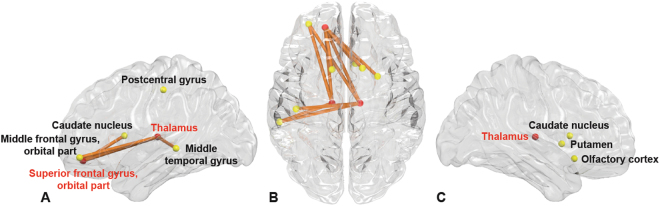
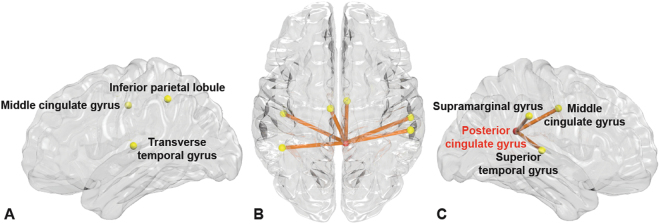
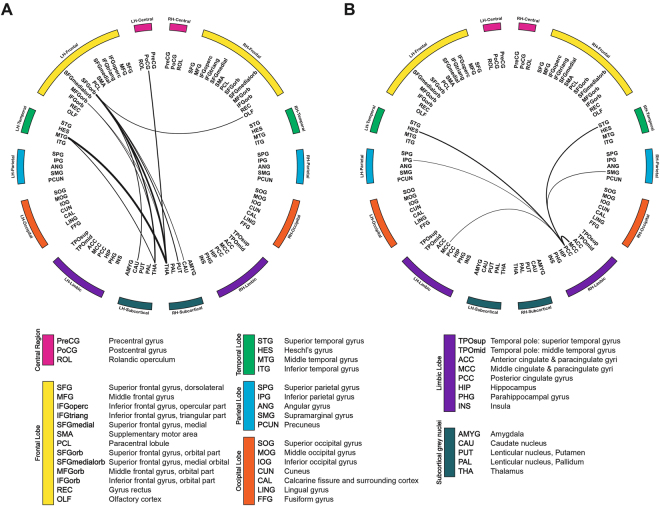
Despite recent developments in neuroimaging, alterations of brain functional connectivity in major depressive disorder (MDD) patients with suicidal ideation are poorly understood. This study investigated specific changes of suicidal ideation in functional connectivity of MDD patients. Whole brain functional connectivity in 46 patients with MDD (23 with suicidal ideation and 23 without) and 36 age- and gender- matched healthy controls were compared using resting-state functional Magnetic Resonance Imaging (fMRI) analyzed with network-based statistics (NBS) and graph-theoretical methods. Decreased functional connectivity in a characterized sub-network was observed in patients with MDD and suicidal ideation (FDR-adjusted p < 0.05). The sub-network included the regions of the fronto-thalamic circuits in the left hemisphere. The network measures of the left superior frontal gyrus, pars orbitalis (r = −0.40, p = 0.009), left thalamus (r = −0.41, p = 0.009), and right thalamus (r = −0.51, p = −0.002) were shown, through graph theoretical analysis, to be significantly negatively correlated with severity of suicidal ideation. The reduced functional connectivity in left orbitofrontal-both thalamic regions with suicidal ideation in MDD were inversely proportional to the severity of suicidality independent from depression severity. These findings suggest problems with decision-making and information integration in MDD patients with suicidal ideation.
Overview
The claims and statistics of this paper haven’t been checked yet.
Run the check — free, no account needed. It reads the open-access text and checks the sources it cites.
Integrity signals
Registry
Cites
Statistics
Figures
Verification
Claims the paper makes
The claims and statistics of this paper haven’t been checked yet.
Run the check — free, no account needed. It reads the open-access text and checks the sources it cites.
Claims other papers make about this one
Each is checked against this paper’s own text: does it say what the citing paper says it does?
In the citing paper
“However, other studies have reported lower rs-fMRI activity and functional connectivity (85, 86, 92, 93), probably due to use of different outcome measures of rs-fMRI activity, for example, regional homogeneity, fractional amplitude of low-frequency fluctuations among studies, and heterogeneity of suicidal ideation.”
From A brain-centric model of suicidal behavior (2020) · cites this paper as [92]
Self-check
Percentages, sums and reported differences re-computed from the paper’s own numbers.
The self-check needs the paper’s full text.
Citations
Cites
Tzourio-Mazoyer, N., Landeau, B., Papathanassiou, D., Crivello, F., Etard, O., Delcroix, N., Mazoyer, B., & Joliot, M. (2002) · NeuroImage · doi:10.1006/nimg.2001.0978 · Cited by 16,319
Jenkinson, M., Bannister, P., Brady, M., & Smith, S. (2002) · NeuroImage · doi:10.1006/nimg.2002.1132 · Cited by 11,888
Complex network measures of brain connectivity: Uses and interpretations
Rubinov, M., & Sporns, O. (2010) · NeuroImage · doi:10.1016/j.neuroimage.2009.10.003 · Cited by 11,522
Development of a Rating Scale for Primary Depressive Illness
Hamilton, M. (1967) · British Journal of Social and Clinical Psychology · doi:10.1111/j.2044-8260.1967.tb00530.x · Cited by 8,410
Assessment of suicidal intention: The Scale for Suicide Ideation.
Beck, A. T., Kovacs, M., & Weissman, A. (1979) · Journal of Consulting and Clinical Psychology · doi:10.1037//0022-006x.47.2.343 · Cited by 3,419
Predicting human resting-state functional connectivity from structural connectivity
Honey, C. J., Sporns, O., Cammoun, L., Gigandet, X., Thiran, J. P., Meuli, R., & Hagmann, P. (2009) · Proceedings of the National Academy of Sciences · doi:10.1073/pnas.0811168106 · Cited by 3,307
Network-based statistic: identifying differences in brain networks
Zalesky, A., Fornito, A., & Bullmore, E. T. (2010) · NeuroImage · doi:10.1016/j.neuroimage.2010.06.041 · Cited by 2,750
Achard, S., Salvador, R., Whitcher, B., Suckling, J., & Bullmore, E. (2006) · The Journal of Neuroscience · doi:10.1523/jneurosci.3874-05.2006 · Cited by 2,393
Resting-state connectivity biomarkers define neurophysiological subtypes of depression
Drysdale, A. T., Grosenick, L., Downar, J., Dunlop, K., Mansouri, F., Meng, Y., Fetcho, R. N., Zebley, B., Oathes, D. J., Etkin, A., et al. (2017) · Nature Medicine · doi:10.1038/nm.4246 · Cited by 2,170
Functional brain networks develop from a local to distributed organization
Fair, D. A., Cohen, A. L., Power, J. D., Dosenbach, N. U. F., Church, J. A., Miezin, F. M., Schlaggar, B. L., & Petersen, S. E. (2009) · PLoS Computational Biology · doi:10.1371/journal.pcbi.1000381 · Cited by 1,530
Cited by
Sorted by citations
Imaging suicidal thoughts and behaviors: a comprehensive review of 2 decades of neuroimaging studies
Schmaal, L., van Harmelen, A.-L., Chatzi, V., Lippard, E. T. C., Toenders, Y. J., Averill, L. A., Mazure, C. M., & Blumberg, H. P. (2020) · Molecular Psychiatry · doi:10.1038/s41380-019-0587-x · Cited by 373
Adolescent Suicide as a Failure of Acute Stress-Response Systems.
Miller, A. B., & Prinstein, M. J. (2019) · Annual Review of Clinical Psychology · doi:10.1146/annurev-clinpsy-050718-095625 · Cited by 235
“In adult samples, similar findings have emerged, suggesting decreased frontolimbic functional connectivity in individuals with suicidal ideation (Du et al. 2017, Kim et al. 2017, Minzenberg et al. 2015).”
BackgroundA brain-centric model of suicidal behavior
Mann, J. J., & Rizk, M. M. (2020) · American Journal of Psychiatry · doi:10.1176/appi.ajp.2020.20081224 · Cited by 214
Li, J., Duan, X., Cui, Q., Chen, H., & Liao, W. (2019) · Psychological Medicine · doi:10.1017/s0033291718001502 · Cited by 208
Liao, W., Li, J., Duan, X., Cui, Q., Chen, H., & Chen, H. (2018) · Human Brain Mapping · doi:10.1002/hbm.24235 · Cited by 132
Metadata
- Authors
- Kim, K., Kim, S.-W., Myung, W., Han, C. E., Fava, M., Mischoulon, D., Papakostas, G. I., Seo, S. W., Cho, H., Seong, J.-K., & Jeon, H. J.
- Affiliations
- Seoul National University (KR)
- Korea University (KR)
- CHA University Bundang Medical Center (KR)
- Harvard University (US)
- Samsung Medical Center (KR)
- Samsung Biomedical Research Institute (KR)
- Corresponding author
- Seong, Joon-Kyung
- Jeon, Hong Jin
- ORCID
- Venue
- Scientific Reports
- Published
- 2017-11-17
- Volume
- 7
- Issue
- 1
- Pages
- 15772-15772
- ISSN
- 2045-2322 (ISSN-L)
- PMC
- PMC5693996
- OpenAlex
- W2768253102
- Cited by
- 107
- References
- 75
- Citations by year
- 2026: 3 · 2025: 10 · 2024: 12 · 2023: 10 · 2022: 11 · 2021: 36 · 2020: 7 · 2019: 12 · 2018: 6
- FWCI
- 3.93
- Type
- journal article
- Language
- en
- Open access
- gold
- doi.org
- Locations
- Scientific Reports (publishedVersion, cc-by)
- PubMed Central (publishedVersion, cc-by)
- PubMed (publishedVersion)
- Digital Access to Scholarship at Harvard (DASH) (Harvard University) (submittedVersion, cc-by)
- DOAJ (DOAJ: Directory of Open Access Journals) (submittedVersion)
- Funders
- National Research Foundation
- Ministry of Science, ICT and Future Planning (2017M3C7A1048092, 2016M3C7A1947307, NRF-2017M3A9F1027323)
- National Research Foundation of Korea (NRF-2017M3A9F1027323, 2017M3A9F1027323, 2016M3C7A1947307, NRF-2016M3C7A1947307, No. NRF-2017M3A9F1027323; PI HJJ)
- Ministry of Science ICT and Future Planning
- Ministry of Education, Science and Technology (NRF-2017M3A9F1027323, 2011-0013064, 2016M3C7A1947307, NRF-2016M3C7A1947307)
- Ministry of Science and ICT, South Korea
- Samsung (SMO1161491)
- Topics
- Life Sciences › Neuroscience › Cognitive Neuroscience › Functional Brain Connectivity Studies
- Health Sciences › Medicine › Pharmacology (medical) › Treatment of Major Depression
- Social Sciences › Psychology › Experimental and Cognitive Psychology › Mental Health Research Topics
- Keywords
- major depressive disorder, suicidal ideation, orbitofrontal cortex, thalamus, functional connectivity, resting-state fMRI, network-based statistics, graph theory, decision-making, information integration, suicide risk
- MeSH terms
- Adult, Major Depressive Disorder, Female, Humans, Male, Middle Aged, Nerve Net, Thalamus, Prefrontal Cortex, Suicidal Ideation
About these checks
Registry, retraction, Cites and statistics results are computed, not judged, with one exception: a printed reference that no index lists is read once by a model before it counts as a citation error. Claims are extracted by a model and kept only when their quote appears verbatim in the text; each cited source is then checked, with a model’s help, for whether it says what the claim relies on. Those verdicts can be wrong — read the claim’s quote and the cited source before relying on one.
Statistics and arithmetic are recomputed, not judged.
Confidence bands are shown only for fields calibrated on our annotated test set. None is calibrated yet, so no band is shown.
What counts as a claim ›How we measure confidence ›How we check this ›
Are you an author, or do you see a problem with this page? Request a review
