

The DOI matches its Crossref record; 80 of the 80 references it cites were found in a registry or an index.
Species composition and environmental adaptation of indigenous Chinese cattle
Open accessPublished version of a preprint
Abstract
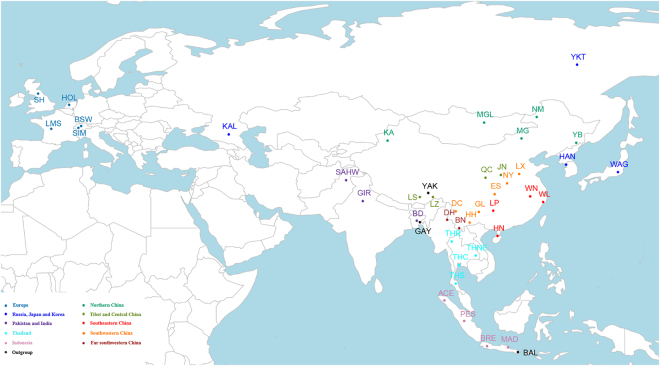
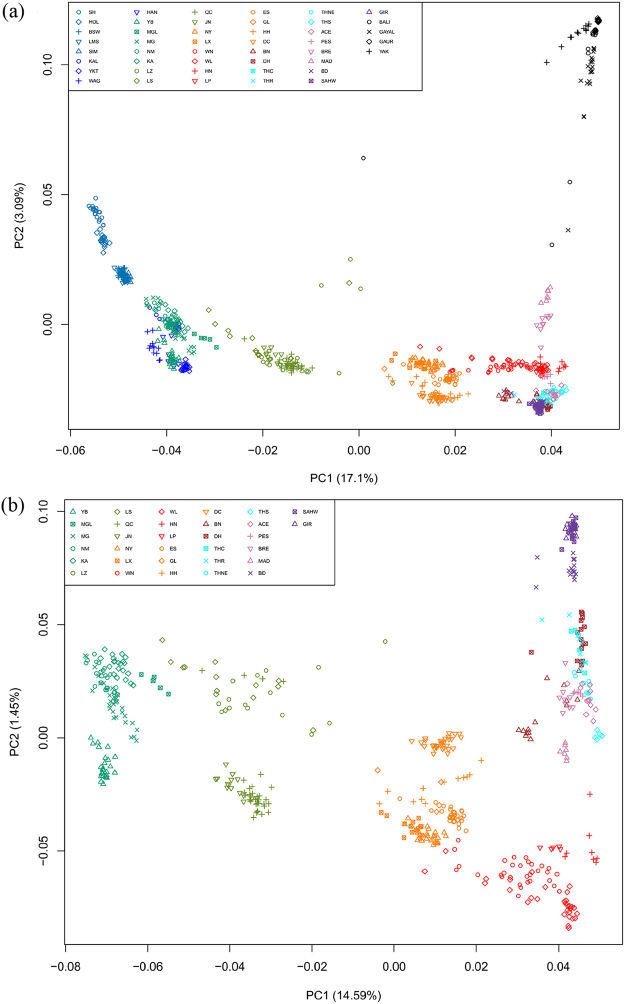
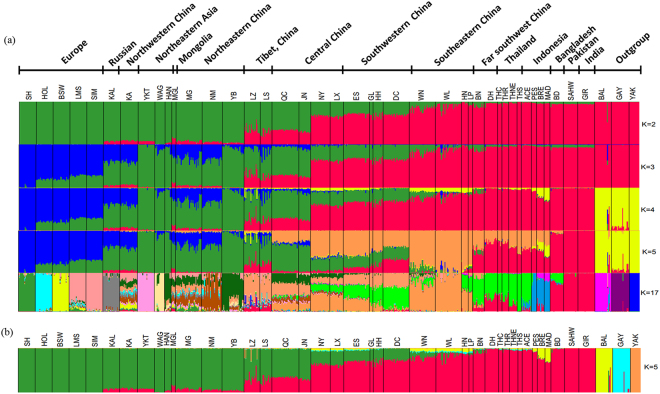
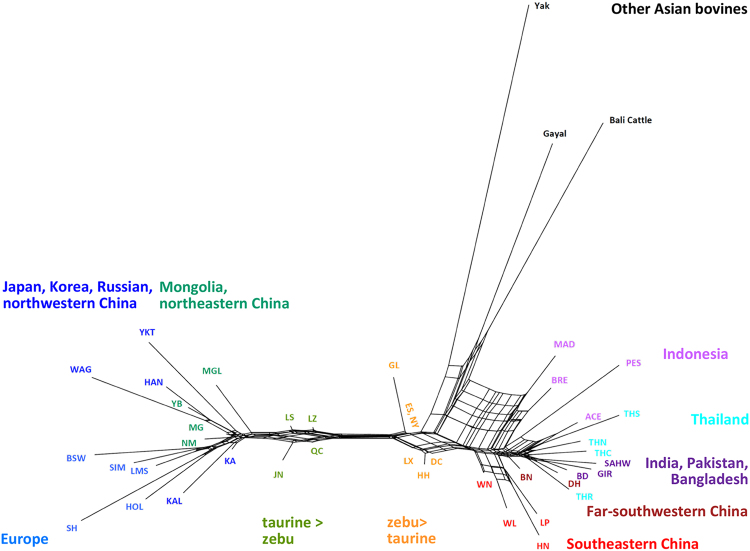
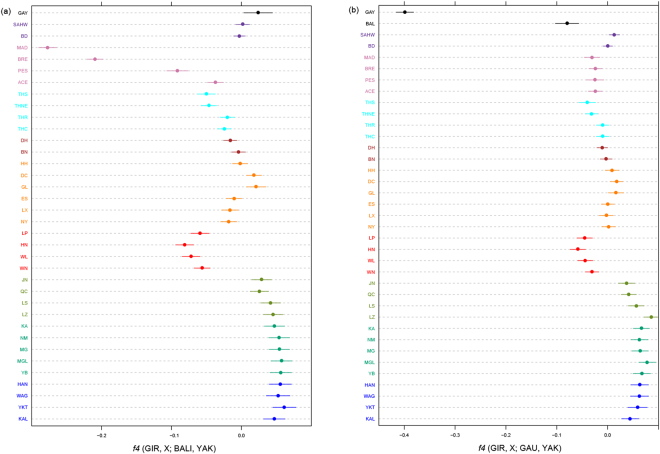
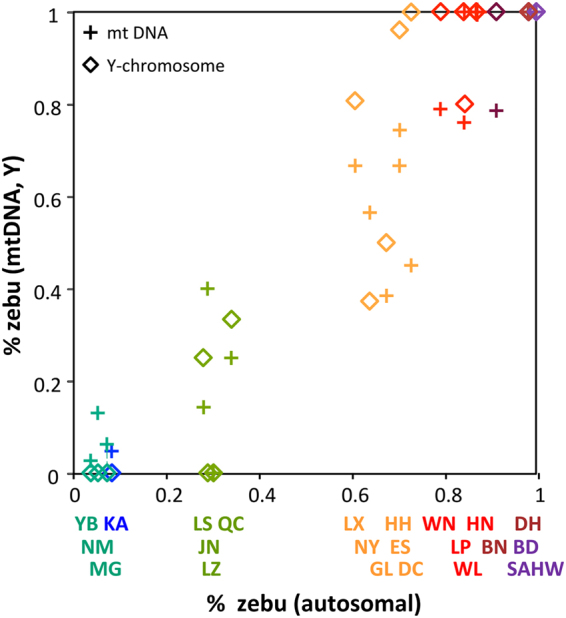
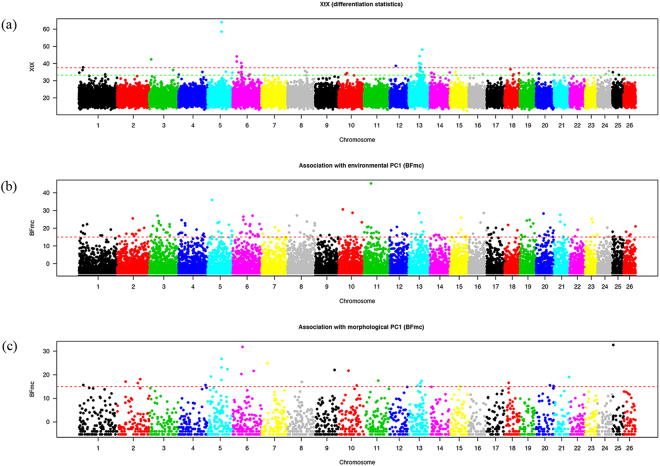
Indigenous Chinese cattle combine taurine and indicine origins and occupy a broad range of different environments. By 50 K SNP genotyping we found a discontinuous distribution of taurine and indicine cattle ancestries with extremes of less than 10% indicine cattle in the north and more than 90% in the far south and southwest China. Model-based clustering and f4-statistics indicate introgression of both banteng and gayal into southern Chinese cattle while the sporadic yak influence in cattle in or near Tibetan area validate earlier findings of mitochondrial DNA analysis. Geographic patterns of taurine and indicine mitochondrial and Y-chromosomal DNA diversity largely agree with the autosomal cline. The geographic distribution of the genomic admixture of different bovine species is proposed to be the combined effect of prehistoric immigrations, gene flow, major rivers acting as genetic barriers, local breeding objectives and environmental adaptation. Whole-genome scan for genetic differentiation and association analyses with both environmental and morphological covariables are remarkably consistent with previous studies and identify a number of genes implicated in adaptation, which include TNFRSF19, RFX4, SP4 and several coat color genes. We propose indigenous Chinese cattle as a unique and informative resource for gene-level studies of climate adaptation in mammals.
Overview
The claims and statistics of this paper haven’t been checked yet.
Run the check — free, no account needed. It reads the open-access text and checks the sources it cites.
Integrity signals
Registry
Cites
Statistics
Figures
Verification
Claims the paper makes
The claims and statistics of this paper haven’t been checked yet.
Run the check — free, no account needed. It reads the open-access text and checks the sources it cites.
Claims other papers make about this one
Each is checked against this paper’s own text: does it say what the citing paper says it does?
The source backs part of the claim, not all of it — or backs it for a different population, condition or comparison.
In the citing paper
“The rapid adaptation of East Asian cattle to hot and humid environments and high-altitude environments was promoted by localized introgression from other bovine species [65,66].”
From The Genomic Landscape of Cattle: Domestication, Dispersal, and Adaptive Evolution (2026) · cites this paper as [65]
Experimental — accuracy not yet measured
Self-check
Percentages, sums and reported differences re-computed from the paper’s own numbers.
The self-check needs the paper’s full text.
Citations
Cites
PLINK: a tool set for whole-genome association and population-based linkage analyses.
Purcell, S., Neale, B., Todd-Brown, K., Thomas, L., Ferreira, M. A. R., Bender, D., Maller, J., Sklar, P., de Bakker, P. I. W., Daly, M. J., et al. (2007) · The American Journal of Human Genetics · doi:10.1086/519795 · Cited by 34,089
DnaSP v5: a software for comprehensive analysis of DNA polymorphism data
Librado, P., & Rozas, J. (2009) · Bioinformatics · doi:10.1093/bioinformatics/btp187 · Cited by 16,147
Fast model-based estimation of ancestry in unrelated individuals
Alexander, D. H., Novembre, J., & Lange, K. (2009) · Genome Research · doi:10.1101/gr.094052.109 · Cited by 9,898
Application of Phylogenetic Networks in Evolutionary Studies
Huson, D. H., & Bryant, D. (2005) · Molecular Biology and Evolution · doi:10.1093/molbev/msj030 · Cited by 8,895
distruct : a program for the graphical display of population structure
Rosenberg, N. A. (2003) · Molecular Ecology Notes · doi:10.1046/j.1471-8286.2003.00566.x · Cited by 4,959
Ancient Admixture in Human History
Patterson, N., Moorjani, P., Luo, Y., Mallick, S., Rohland, N., Zhan, Y., Genschoreck, T., Webster, T., & Reich, D. (2012) · Genetics · doi:10.1534/genetics.112.145037 · Cited by 2,848
A high-performance computing toolset for relatedness and principal component analysis of SNP data
Zheng, X., Levine, D., Shen, J., Gogarten, S. M., Laurie, C. C., & Weir, B. S. (2012) · Bioinformatics · doi:10.1093/bioinformatics/bts606 · Cited by 2,510
Todesco, M., Pascual, M. A., Owens, G. L., Ostevik, K. L., Moyers, B. T., Hübner, S., Heredia, S. M., Hahn, M. A., Caseys, C., Bock, D. G., et al. (2016) · Evolutionary Applications · doi:10.1111/eva.12367 · Cited by 867
Robust Identification of Local Adaptation from Allele Frequencies
Günther, T., & Coop, G. (2013) · Genetics · doi:10.1534/genetics.113.152462 · Cited by 615
Hagen, G., Müller, S., Beato, M., & Suske, G. (1992) · Nucleic Acids Research · doi:10.1093/nar/20.21.5519 · Cited by 560
Research works printed but not linked: 1
- China National Commission of Animal Genetics Resources. Animal genetic resources in China – Bovine. (China Agriculture Press, 2011).
Cited by
Sorted by citations
Chen, N., Cai, Y., Chen, Q., Li, R., Wang, K., Huang, Y., Hu, S., Huang, S., Zhang, H., Zheng, Z., et al. (2018) · Nature Communications · doi:10.1038/s41467-018-04737-0 · Cited by 403
Self-citationGenomic clues of the evolutionary history of Bos indicus cattle
Utsunomiya, Y. T., Milanesi, M., Fortes, M. R. S., Porto‐Neto, L. R., Utsunomiya, A. T. H., Silva, M. V. G. B., Garcia, J. F., & Ajmone‐Marsan, P. (2019) · Animal Genetics · doi:10.1111/age.12836 · Cited by 128
Gorssen, W., Meyermans, R., Janssens, S., & Buys, N. (2021) · Genetics Selection Evolution · doi:10.1186/s12711-020-00599-7 · Cited by 142
Yurchenko, A. A., Daetwyler, H. D., Yudin, N., Schnabel, R. D., Vander Jagt, C. J., Soloshenko, V., Lhasaranov, B., Popov, R., Taylor, J. F., & Larkin, D. M. (2018) · Scientific Reports · doi:10.1038/s41598-018-31304-w · Cited by 117
Weldenegodguad, M., Popov, R. G., Pokharel, K., Ammosov, I., Ming, Y., Ivanova, Z., & Kantanen, J. (2019) · Frontiers in Genetics · doi:10.3389/fgene.2018.00728 · Cited by 100
Metadata
- Authors
- Gao, Y., Gautier, M., Ding, X., Zhang, H., Wang, Y., Wang, X., Faruque, M. O., Li, J., Ye, S., Gou, X., Han, J., Lenstra, J. A., & Zhang, Y.
- Affiliations
- China Agricultural University (CN)
- Centre de Coopération Internationale en Recherche Agronomique pour le Développement (FR)
- Shanxi Academy of Agricultural Sciences (CN)
- Bangladesh Agricultural University (BD)
- Chinese Academy of Agricultural Sciences (CN)
- Yunnan Agricultural University (CN)
- Utrecht University (NL)
- Corresponding author
- Zhang, Yi
- ORCID
- Venue
- Scientific Reports
- Published
- 2017-11-23
- Volume
- 7
- Issue
- 1
- Pages
- 16196-16196
- ISSN
- 2045-2322 (ISSN-L)
- PMC
- PMC5700937
- OpenAlex
- W2952597679
- Cited by
- 112
- References
- 80
- Citations by year
- 2026: 8 · 2025: 16 · 2024: 9 · 2023: 6 · 2022: 16 · 2021: 25 · 2020: 11 · 2019: 10 · 2018: 11
- FWCI
- 5.79
- Type
- journal article
- Language
- en
- Open access
- gold
- doi.org
- Locations
- Scientific Reports (publishedVersion, cc-by)
- Europe PMC (PubMed Central) (publishedVersion, other-oa)
- PubMed Central (publishedVersion, cc-by)
- PubMed (publishedVersion)
- HAL (submittedVersion, other-oa)
- Utrecht University Repository (Utrecht University) (submittedVersion, other-oa)
- Funders
- Universidade do Porto
- China Agricultural Research System (CARS‐37)
- Badan Penelitian dan Pengembangan Pertanian
- Topics
- Life Sciences › Biochemistry, Genetics and Molecular Biology › Genetics › Genetic and phenotypic traits in livestock
- Life Sciences › Biochemistry, Genetics and Molecular Biology › Genetics › Genetic diversity and population structure
- Life Sciences › Biochemistry, Genetics and Molecular Biology › Genetics › Forensic and Genetic Research
- Keywords
- mitochondrial DNA diversity, genetic admixture, climate change adaptation, whole genome scan, genetic differentiation, environmental adaptation, coat color genes, TNFRSF19, Sp4
- MeSH terms
- Alleles, Animals, Cattle, China, DNA, Mitochondrial, Gene Frequency, Haplotypes, Genetic Variation, Y Chromosome, Microsatellite Repeats, Polymorphism, Single Nucleotide
About these checks
Registry, retraction, Cites and statistics results are computed, not judged, with one exception: a printed reference that no index lists is read once by a model before it counts as a citation error. Claims are extracted by a model and kept only when their quote appears verbatim in the text; each cited source is then checked, with a model’s help, for whether it says what the claim relies on. Those verdicts can be wrong — read the claim’s quote and the cited source before relying on one.
Statistics and arithmetic are recomputed, not judged.
Confidence bands are shown only for fields calibrated on our annotated test set. None is calibrated yet, so no band is shown.
What counts as a claim ›How we measure confidence ›How we check this ›
Are you an author, or do you see a problem with this page? Request a review
