

Stress-associated changes in salivary microRNAs can be detected in response to the Trier Social Stress Test: An exploratory study
Open accessThe DOI matches its Crossref record; 64 of the 64 references it cites were found in a registry or an index.
Abstract
Stress is an important co-factor for the genesis and maintenance of many diseases and is known to have an effect on gene expression via epigenetic regulation. MicroRNAs (miRNAs) appear to function as one of the key factors of this regulation. This is the first study to investigate the response of 11 stress-associated miRNAs in human saliva - as a non-invasive source - in an experimental condition of acute psychological stress, and also their correlation with established psychological (subjective stress perception), physiological (heart rate and heart rate variability) and biochemical stress parameters (salivary cortisol and alpha-amylase). 24 healthy participants between 20 and 35 years of age were investigated, using the Trier Social Stress Test (TSST) to induce acute psychological stress. Stress-associated changes were significant for miR-20b, -21 and 26b, and changes in miR-16 and -134 were close to significance, recommending further research on these miRNAs in the context of stress reactions. Significant correlations with alpha-amylase suggest their integration in sympathetic stress regulation processes. Additionally, our results demonstrate the TSST as a reliable tool for studying salivary miRNAs as non-invasive indicators of epigenetic processes in acute psychological stress reactions.
Overview
The claims and statistics of this paper haven’t been checked yet.
Free: it reads the open-access text and checks the first 5 claims that cite a source we can check. Create a free account to check every claim.
Integrity signals
Registry
Cites
Statistics
Figures
Verification
Claims the paper makes
The claims and statistics of this paper haven’t been checked yet.
Free: it reads the open-access text and checks the first 5 claims that cite a source we can check. Create a free account to check every claim.
Claims other papers make about this one
Each is checked against this paper’s own text: does it say what the citing paper says it does?
The cited source says what the claim attributes to it.
In the citing paper
“Concentrations of miR 21 correlated positively with experienced stress over the course of the challenge”
From The applied implications of epigenetics in anxiety, affective and stress-related disorders - A review and synthesis on psychosocial stress, psychotherapy and prevention (2020) · cites this paper as Wiegand et al., 2018
The cited source says what the claim attributes to it.
In the citing paper
“a recent investigation of stress-associated miRNAs in saliva found significant changes in miR 20b, miR 21 and miR 26b before, during and after a psychosocial stress challenge (Trier Social Stress Test) in 24 healthy participants (Wiegand et al., 2018).”
From The applied implications of epigenetics in anxiety, affective and stress-related disorders - A review and synthesis on psychosocial stress, psychotherapy and prevention (2020) · cites this paper as Wiegand et al., 2018
The cited source says what the claim attributes to it.
In the citing paper
“while miR 21 and miR 26b concentrations correlated positively with the secreted amount of the salivary stress marker alpha-amylase”
From The applied implications of epigenetics in anxiety, affective and stress-related disorders - A review and synthesis on psychosocial stress, psychotherapy and prevention (2020) · cites this paper as Wiegand et al., 2018
The cited source says what the claim attributes to it.
In the citing paper
“suggesting an integration of miRNA-related processes into sympathetic stress regulation and offering a non-invasive way to determine a dynamic acute stress indicator (Wiegand et al., 2018).”
From The applied implications of epigenetics in anxiety, affective and stress-related disorders - A review and synthesis on psychosocial stress, psychotherapy and prevention (2020) · cites this paper as Wiegand et al., 2018
The cited source says what the claim attributes to it.
In the citing paper
“miR 21 correlated with experienced stress”
From The applied implications of epigenetics in anxiety, affective and stress-related disorders - A review and synthesis on psychosocial stress, psychotherapy and prevention (2020) · cites this paper as Wiegand et al., 2018
Self-check
Percentages, sums and reported differences re-computed from the paper’s own numbers.
The self-check needs the paper’s full text.
Citations
Cites
Statistical power analysis for the behavioral sciences
(1990) · Computers, Environment and Urban Systems · doi:10.1016/0198-9715(90)90050-4 · Cited by 65,269
Bartel (2004) · doi:10.1016/s0092-8674(04)00045-5 · Cited by 34,714
MicroRNAs: Target Recognition and Regulatory Functions
Bartel, D. P. (2009) · Cell · doi:10.1016/j.cell.2009.01.002 · Cited by 20,068
Heart Rate Variability: Standards of Measurement, Physiological Interpretation, and Clinical Use
Electrophysiology, T. F. O. T. E. S. O. C. T. N. A. (1996) · Circulation · doi:10.1161/01.cir.93.5.1043 · Cited by 17,159
Heart rate variability: Standards of measurement, physiological interpretation, and clinical use
Malik, M., Bigger, J. T., Camm, A. J., Kleiger, R. E., Malliani, A., Moss, A. J., & Schwartz, P. J. (1996) · European Heart Journal · doi:10.1093/oxfordjournals.eurheartj.a014868 · Cited by 15,289
Practical Nonparametric Statistics
Groggel, D. J. (2000) · Technometrics · doi:10.1080/00401706.2000.10486067 · Cited by 11,041
Kirschbaum, C., Pirke, K.-M., & Hellhammer, D. H. (2008) · Neuropsychobiology · doi:10.1159/000119004 · Cited by 6,093
Psychological Stress and Disease
Cohen, S., Janicki-Deverts, D., & Miller, G. E. (2007) · JAMA · doi:10.1001/jama.298.14.1685 · Cited by 3,168 · cited 3×
“(2) Our explicit selection of 11miRNAs was based on current findings about stress-associated miRNAs in general, without available knowledge about their presence in human saliva.”
BackgroundResultSalivary cortisol as a biomarker in stress research
Hellhammer, D. H., Wüst, S., & Kudielka, B. M. (2009) · Psychoneuroendocrinology · doi:10.1016/j.psyneuen.2008.10.026 · Cited by 1,925
Kirschbaum, C., Kudielka, B. M., Gaab, J., Schommer, N. C., & Hellhammer, D. H. (1999) · Psychosomatic Medicine · doi:10.1097/00006842-199903000-00006 · Cited by 1,890
A brain-specific microRNA regulates dendritic spine development
Schratt, G. M., Tuebing, F., Nigh, E. A., Kane, C. G., Sabatini, M. E., Kiebler, M., & Greenberg, M. E. (2006) · Nature · doi:10.1038/nature04367 · Cited by 1,786
MicroRNAs in Stress Signaling and Human Disease
Mendell, J. T., & Olson, E. N. (2012) · Cell · doi:10.1016/j.cell.2012.02.005 · Cited by 1,673
Cellular Stress Responses: Cell Survival and Cell Death
Fulda, S., Gorman, A. M., Hori, O., & Samali, A. (2010) · International Journal of Cell Biology · doi:10.1155/2010/214074 · Cited by 1,519
(1995) · Cited by 1,270
Salivary microRNA: Discovery, Characterization, and Clinical Utility for Oral Cancer Detection
Park, N. J., Zhou, H., Elashoff, D., Henson, B. S., Kastratovic, D. A., Abemayor, E., & Wong, D. T. (2009) · Clinical Cancer Research · doi:10.1158/1078-0432.ccr-09-0736 · Cited by 843
Biological and psychological markers of stress in humans: Focus on the Trier Social Stress Test
Allen, A. P., Kennedy, P. J., Cryan, J. F., Dinan, T. G., & Clarke, G. (2014) · Neuroscience & Biobehavioral Reviews · doi:10.1016/j.neubiorev.2013.11.005 · Cited by 734
Michael, A., Bajracharya, S., Yuen, P., Zhou, H., Star, R., Illei, G., & Alevizos, I. (2010) · Oral Diseases · doi:10.1111/j.1601-0825.2009.01604.x · Cited by 724
Nater, U. M., La Marca, R., Florin, L., Moses, A., Langhans, W., Koller, M. M., & Ehlert, U. (2006) · Psychoneuroendocrinology · doi:10.1016/j.psyneuen.2005.05.010 · Cited by 630
MiR-16 Targets the Serotonin Transporter: A New Facet for Adaptive Responses to Antidepressants
Baudry, A., Mouillet-Richard, S., Schneider, B., Launay, J.-M., & Kellermann, O. (2010) · Science · doi:10.1126/science.1193692 · Cited by 480
Alterations of the microRNA network cause neurodegenerative disease
Hébert, S. S., & De Strooper, B. (2009) · Trends in Neurosciences · doi:10.1016/j.tins.2008.12.003 · Cited by 452
Lucassen, P. J., Pruessner, J., Sousa, N., Almeida, O. F. X., Van Dam, A. M., Rajkowska, G., Swaab, D. F., & Czéh, B. (2014) · Acta Neuropathologica · doi:10.1007/s00401-013-1223-5 · Cited by 441
Gordis, E. B., Granger, D. A., Susman, E. J., & Trickett, P. K. (2006) · Psychoneuroendocrinology · doi:10.1016/j.psyneuen.2006.05.010 · Cited by 397
Plasma microRNAs as potential biomarkers for non-small-cell lung cancer
Shen, J., Todd, N. W., Zhang, H., Yu, L., Lingxiao, X., Mei, Y., Guarnera, M., Liao, J., Chou, A., Lu, C. L., et al. (2011) · Laboratory Investigation · doi:10.1038/labinvest.2010.194 · Cited by 383
Apoptosis and the target genes of microRNA-21
Buscaglia, L. E. B., & Li, Y. (2011) · Chinese Journal of Cancer · doi:10.5732/cjc.011.10132 · Cited by 378
Sex Differences in Stress Response Circuitry Activation Dependent on Female Hormonal Cycle
Goldstein, J. M., Jerram, M., Abbs, B., Whitfield-Gabrieli, S., & Makris, N. (2010) · The Journal of Neuroscience · doi:10.1523/jneurosci.3021-09.2010 · Cited by 363
Circulating microRNAs: New biomarkers in diagnosis, prognosis and treatment of cancer (Review)
ALLEGRA, A., ALONCI, A., CAMPO, S., PENNA, G., PETRUNGARO, A., GERACE, D., & MUSOLINO, C. (2012) · International Journal of Oncology · doi:10.3892/ijo.2012.1647 · Cited by 359
Measuring Stress: A Guide for Health and Social Scientists
(1995) · doi:10.1093/oso/9780195086416.001.0001 · Cited by 346
Smalheiser, N. R., Lugli, G., Rizavi, H. S., Torvik, V. I., Turecki, G., & Dwivedi, Y. (2012) · PLoS ONE · doi:10.1371/journal.pone.0033201 · Cited by 324
Altered miRNA expression in sputum for diagnosis of non-small cell lung cancer
Xie, Y., Todd, N. W., Liu, Z., Zhan, M., Fang, H., Peng, H., Alattar, M., Deepak, J., Stass, S. A., & Jiang, F. (2010) · Lung Cancer · doi:10.1016/j.lungcan.2009.04.004 · Cited by 316
Hellhammer, J., & Schubert, M. (2012) · Psychoneuroendocrinology · doi:10.1016/j.psyneuen.2011.05.012 · Cited by 304
Apoptosis and the target genes of microRNA-21
Buscaglia, L. E. B., & Li, Y. (2011) · 癌症:英文版 · doi:10.5732/cjc.30.0371 · Cited by 291
Banigan, M. G., Kao, P. F., Kozubek, J. A., Winslow, A. R., Medina, J., Costa, J., Schmitt, A., Schneider, A., Cabral, H., Cagsal-Getkin, O., et al. (2013) · PLoS ONE · doi:10.1371/journal.pone.0048814 · Cited by 266
The Trier Social Stress Test Protocol for Inducing Psychological Stress
Birkett, M. A. (2011) · Journal of Visualized Experiments · doi:10.3791/3238 · Cited by 248
MicroRNAs as biomarkers in rheumatic diseases
Alevizos, I., & Illei, G. G. (2010) · Nature Reviews Rheumatology · doi:10.1038/nrrheum.2010.81 · Cited by 231
Changes in Brain MicroRNAs Contribute to Cholinergic Stress Reactions
Meerson, A., Cacheaux, L., Goosens, K. A., Sapolsky, R. M., Soreq, H., & Kaufer, D. (2010) · Journal of Molecular Neuroscience · doi:10.1007/s12031-009-9252-1 · Cited by 201
On the Use of a Friedman-Type Statistic in Balanced and Unbalanced Block Designs
Skillings, J. H., & Mack, G. A. (1981) · Technometrics · doi:10.1080/00401706.1981.10486261 · Cited by 200
Salivary α-amylase stress reactivity across different age groups
Strahler, J., Mueller, A., Rosenloecher, F., Kirschbaum, C., & Rohleder, N. (2010) · Psychophysiology · doi:10.1111/j.1469-8986.2009.00957.x · Cited by 185
Psychological stress, immune response, and atherosclerosis
Gu, H., Tang, C., & Yang, Y.-Z. (2012) · Atherosclerosis · doi:10.1016/j.atherosclerosis.2012.01.021 · Cited by 184
MicroRNA-21 Modulates the Levels of Reactive Oxygen Species by Targeting SOD3 and TNF α
Zhang, X., Ng, W.-L., Wang, P., Tian, L., Werner, E., Wang, H., Doetsch, P., & Wang, Y. (2012) · Cancer Research · doi:10.1158/0008-5472.can-12-0639 · Cited by 181
Salivary MicroRNAs as Promising Biomarkers for Detection of Esophageal Cancer
Xie, Z., Chen, G., Zhang, X., Li, D., Huang, J. J., CuiQin, Y., Zhang, P., Qin, Y., Duan, Y., Gong, B., et al. (2013) · PLoS ONE · doi:10.1371/journal.pone.0057502 · Cited by 156
Xie, Z., Yin, X., Gong, B., Nie, W., Wu, B., Zhang, X., Huang, J., Zhang, P., Zhou, Z., & Li, Z. (2014) · Cancer Prevention Research · doi:10.1158/1940-6207.capr-14-0192 · Cited by 148
Bisognin, A., Sales, G., Coppe, A., Bortoluzzi, S., & Romualdi, C. (2012) · Nucleic Acids Research · doi:10.1093/nar/gks460 · Cited by 145
Economic crises and mortality: a review of the literature
Falagas, M. E., Vouloumanou, E. K., Mavros, M. N., & Karageorgopoulos, D. E. (2009) · International Journal of Clinical Practice · doi:10.1111/j.1742-1241.2009.02124.x · Cited by 130
Intronic miR-26b controls neuronal differentiation by repressing its host transcript,ctdsp2
Dill, H., Linder, B., Fehr, A., & Fischer, U. (2012) · Genes & Development · doi:10.1101/gad.177774.111 · Cited by 125
Morse, D. T. (1999) · Educational and Psychological Measurement · doi:10.1177/00131649921969901 · Cited by 121
miRNA and mRNA expression analysis reveals potential sex-biased miRNA expression
Guo, L., Zhang, Q., Ma, X., Wang, J., & Liang, T. (2017) · Scientific Reports · doi:10.1038/srep39812 · Cited by 116
Boesch, M., Sefidan, S., Ehlert, U., Annen, H., Wyss, T., Steptoe, A., & Marca, R. L. (2014) · Psychoneuroendocrinology · doi:10.1016/j.psyneuen.2014.02.003 · Cited by 114
High resolution of microRNA signatures in human whole saliva
Patel, R. S., Jakymiw, A., Yao, B., Pauley, B. A., Carcamo, W. C., Katz, J., Cheng, J. Q., & Chan, E. K. L. (2011) · Archives of Oral Biology · doi:10.1016/j.archoralbio.2011.05.015 · Cited by 108
Balakathiresan, N. S., Chandran, R., Bhomia, M., Jia, M., Li, H., & Maheshwari, R. K. (2014) · Journal of Psychiatric Research · doi:10.1016/j.jpsychires.2014.05.020 · Cited by 102
Katsuura, S., Kuwano, Y., Yamagishi, N., Kurokawa, K., Kajita, K., Akaike, Y., Nishida, K., Masuda, K., Tanahashi, T., & Rokutan, K. (2012) · Neuroscience Letters · doi:10.1016/j.neulet.2012.03.062 · Cited by 100
MicroRNAs in Mental Health: From Biological Underpinnings to Potential Therapies
Hunsberger, J. G., Austin, D. R., Chen, G., & Manji, H. K. (2009) · NeuroMolecular Medicine · doi:10.1007/s12017-009-8070-5 · Cited by 98
Hayashi, T. (2015) · Psychiatry and Clinical Neurosciences · doi:10.1111/pcn.12262 · Cited by 87
Quantification of microRNA Expression with Next‐Generation Sequencing
Eminaga, S., Christodoulou, D. C., Vigneault, F., Church, G. M., & Seidman, J. G. (2013) · Current Protocols in Molecular Biology · doi:10.1002/0471142727.mb0417s103 · Cited by 70
Martinez, N., Drescher, B., Riehle, H., Claire, C., Vornlocher, H., Ganser, A., Heil, G., Nordheim, A., Krauter, J., & Heidenreich, O. T. (2004) · BMC Cancer · doi:10.1186/1471-2407-4-44 · Cited by 65
Chronic Academic Stress Increases a Group of microRNAs in Peripheral Blood
Honda, M., Kuwano, Y., Katsuura-Kamano, S., Kamezaki, Y., Fujita, K., Akaike, Y., Kano, S., Nishida, K., Masuda, K., & Rokutan, K. (2013) · PLoS ONE · doi:10.1371/journal.pone.0075960 · Cited by 59
Neuro-Epigenetic Indications of Acute Stress Response in Humans: The Case of MicroRNA-29c
Vaisvaser, S., Modai, S., Farberov, L., Lin, T., Sharon, H., Gilam, A., Volk, N., Admon, R., Edry, L., Fruchter, E., et al. (2016) · PLOS ONE · doi:10.1371/journal.pone.0146236 · Cited by 47
Beech, R. D., Leffert, J. J., Lin, A., Hong, K., Hansen, J., Umlauf, S., Mane, S., Zhao, H., & Sinha, R. (2014) · Alcoholism Clinical and Experimental Research · doi:10.1111/acer.12549 · Cited by 40
Wiegand, C., Savelsbergh, A., & Heusser, P. (2017) · Biomedicine Hub · doi:10.1159/000481126 · Cited by 39 · cited 1×
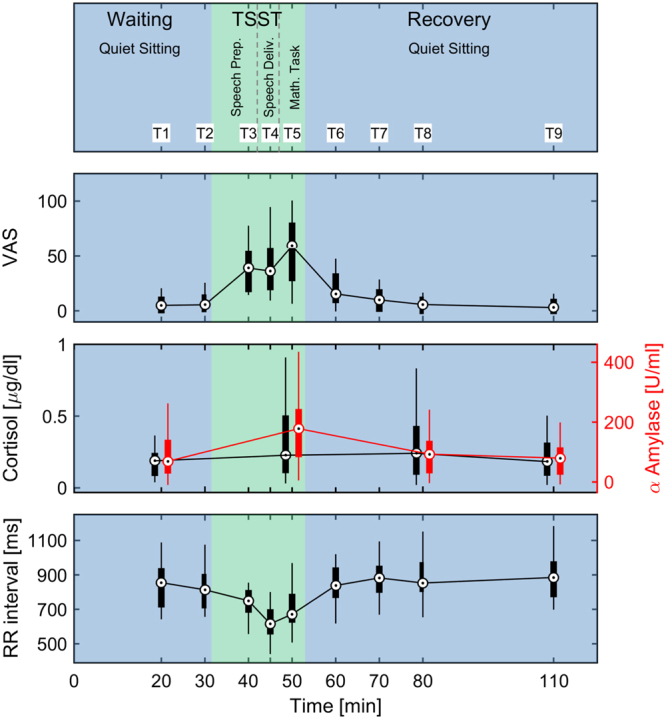
“The median VAS increased from the waiting period T1 (5) to the TSST test-period, peaking at the end of the TSST at T5 (59) directly after the arithmetic task, and then decreased continuously from T5 to T9 (end of recovery period) back to the level baseline (Table 2/ Figure 1.”
BackgroundSelf-citationAcute responses of circulating microRNAs to low-volume sprint interval cycling
Cui, S. F., Li, W., Niu, J., Zhang, C. Y., Chen, X., & Zheng, J. (2015) · Frontiers in Physiology · doi:10.3389/fphys.2015.00311 · Cited by 38
Adrenaline inhibits osteogenesis via repressing miR‐21 expression
Chen, D., & Wang, Z. (2016) · Cell Biology International · doi:10.1002/cbin.10685 · Cited by 29
Influence of stress and health-behaviour on miRNA expression
Gidron (2010) · Molecular Medicine Reports · doi:10.3892/mmr_00000279 · Cited by 27
Obesity and Density of the Crystalline Lens: Revisiting a Growing Dilemma
Mohammadi, S.-F., Afarideh, M., Mehrjardi, H. Z., & Mirhadi, S. (2017) · Biomedicine Hub · doi:10.1159/000454979 · Cited by 6
Barbero (2014) · doi:10.1016/j · Cited by 1
(1996) · PubMed
Research works printed but not linked: 1
- 52. Birkett, M. A. The Trier Social Stress Test protocol for inducing psychological stress. J Vis Exp, https://doi.org/10.3791/3238 (2011). · DOI · Paper page
Cited by
Narvaez Linares, N. F., Charron, V., Ouimet, A. J., Labelle, P. R., & Plamondon, H. (2020) · Neurobiology of Stress · doi:10.1016/j.ynstr.2020.100235 · Cited by 147
Pan, T., Jia, P., Chen, N., Fang, Y., Liang, Y., Guo, M., & Ding, X. (2019) · Theranostics · doi:10.7150/thno.29832 · Cited by 190
“These increases in miR-21 expression may be achieved by accurate blocking of the lower extremity arteries in mice [41-43].”
Daiber, A., Kröller‐Schön, S., Frenis, K., Oelze, M., Kalinovic, S., Vujacic‐Mirski, K., Kuntic, M., Bayo Jimenez, M. T., Helmstädter, J., Steven, S., et al. (2019) · BioFactors · doi:10.1002/biof.1506 · Cited by 162
“, miR-20b, −21 and -26b) with established psychological (subjective stress perception), physiological (heart rate and heart rate variability), and biochemical stress parameters (salivary cortisol and alpha-amylase) in response to acute psychological stress [76].”
BackgroundSchiele, M. A., Gottschalk, M. G., & Domschke, K. (2020) · Clinical Psychology Review · doi:10.1016/j.cpr.2020.101830 · Cited by 156
Frontal lobe real-time EEG analysis using machine learning techniques for mental stress detection
AlShorman, O., Masadeh, M., Heyat, M. B. B., Akhtar, F., Almahasneh, H. S., Ashraf, G. M., & Alexiou, A. T. (2022) · Journal of Integrative Neuroscience · doi:10.31083/j.jin2101020 · Cited by 153
“Various techniques have been proposed to evaluate stress based on biological and biochemical effects [22].”
Background
Metadata
- Authors
- Wiegand, C., Heusser, P., Klinger, C., Cysarz, D., Büssing, A., Ostermann, T., & Savelsbergh, A.
- Affiliations
- Witten/Herdecke University (DE)
- Corresponding author
- Wiegand, Conrad
- Venue
- Scientific Reports
- Published
- 2018-05-08
- Volume
- 8
- Issue
- 1
- Pages
- 7112-7112
- ISSN
- 2045-2322 (ISSN-L)
- PMC
- PMC5940676
- OpenAlex
- W2806081118
- Semantic Scholar
- 8ee37961ca0ace2f79dd0cf52696073c21e5666a
- Cited by
- 46
- References
- 62
- Citations by year
- 2026: 6 · 2025: 8 · 2024: 4 · 2023: 5 · 2022: 5 · 2021: 5 · 2020: 10 · 2019: 2 · 2018: 1
- FWCI
- 2.58
- Type
- journal article
- Language
- en
- Open access
- gold
- doi.org
- Licence
- cc-by
- creativecommons.org/licenses/by/4.0 (tdm)
- creativecommons.org/licenses/by/4.0 (vor)
- Locations
- Scientific Reports (publishedVersion, cc-by)
- Europe PMC (PubMed Central) (publishedVersion, other-oa)
- PubMed Central (publishedVersion, cc-by)
- PubMed (publishedVersion)
- DOAJ (DOAJ: Directory of Open Access Journals) (submittedVersion, cc-by-sa)
- Funders
- NIH Clinical Center
- Topics
- Life Sciences › Neuroscience › Behavioral Neuroscience › Stress Responses and Cortisol
- Life Sciences › Biochemistry, Genetics and Molecular Biology › Cancer Research › MicroRNA in disease regulation
- Health Sciences › Medicine › Cardiology and Cardiovascular Medicine › Heart Rate Variability and Autonomic Control
- Keywords
- salivary microRNAs, acute psychological stress, Trier Social Stress Test, epigenetic regulation, miR-20b, miR-21, miR-26b, miR-16, miR-134, salivary cortisol, salivary amylase, heart rate variability, stress biomarkers, non-invasive biomarkers
- MeSH terms
- Adult, Anxiety, Exercise Test, Female, Heart Rate, Humans, Male, Saliva, Stress, Psychological, MicroRNAs, Young Adult
About these checks
Registry, retraction, Cites and statistics results are computed, not judged, with one exception: a printed reference that no index lists is read once by a model before it counts as a citation error. Claims are extracted by a model and kept only when their quote appears verbatim in the text; each cited source is then checked, with a model’s help, for whether it says what the claim relies on. Those verdicts can be wrong — read the claim’s quote and the cited source before relying on one.
Statistics and arithmetic are recomputed, not judged.
Confidence bands are shown only for fields calibrated on our annotated test set. None is calibrated yet, so no band is shown.
What counts as a claim ›How we measure confidence ›How we check this ›
Are you an author, or do you see a problem with this page? Request a review
Data sources
Bibliographic data: Semantic Scholar, OpenAlex, Crossref.
Contains information from the Semantic Scholar Academic Graph Datasets, made available under the ODC Attribution License (ODC-BY 1.0).
Semantic Scholar’s data is described in: Kinney, R., et al. (2023). The Semantic Scholar Open Data Platform. arXiv:2301.10140.
