

Affiliative zygomatic synchrony in co-present strangers
Open accessThe DOI matches its Crossref record; 76 of the 78 references it cites were found in a registry or an index.
Abstract
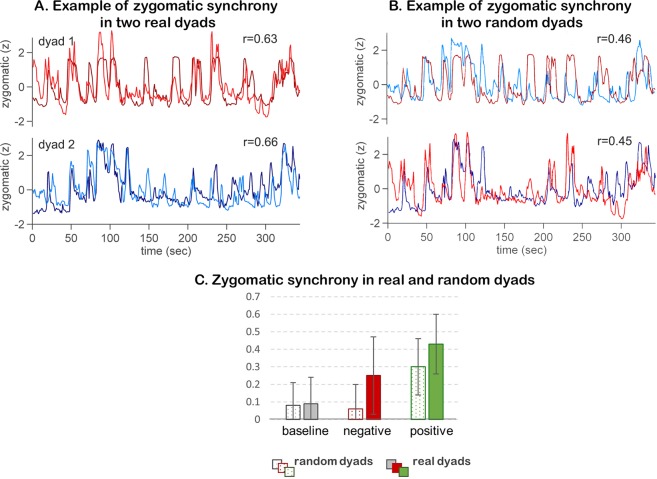
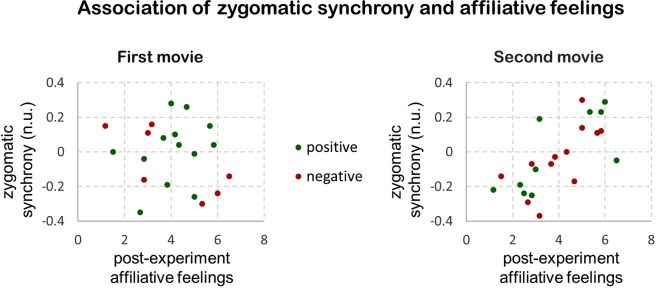
In social contexts individuals frequently act as social chameleons, synchronizing their responses with those of others. Such synchrony is believed to play an important role, promoting mutual emotional and social states. However, synchrony in facial signals, which serve as the main communicative channel between people, has not been systematically studied. To address this gap, we investigated the social spread of smiling dynamics in a naturalistic social setting and assessed its affiliative function. We also studied whether smiling synchrony between people is linked with convergence in their autonomic and emotional responses. To that aim we measured moment-by-moment changes in zygomatic electromyography and cardiovascular activity in dyads of previously unacquainted participants, who co-viewed and subsequently rated emotional movies. We found a robust, dyad-specific zygomatic synchrony in co-viewing participants. During the positive movie, such zygomatic synchrony co-varied with cardiovascular synchrony and with convergence in positive feelings. No such links were found for the negative movie. Centrally, zygomatic synchrony in both emotional contexts predicted the subsequently reported affiliative feelings of dyad members. These results demonstrate that a naturally unfolding smiling behavior is highly contagious. They further suggest that zygomatic synchrony functions as a social facilitator, eliciting affiliation towards previously unknown others.
Overview
The claims and statistics of this paper haven’t been checked yet.
Free: it reads the open-access text and checks the first 5 claims that cite a source we can check. Create a free account to check every claim.
Integrity signals
Registry
Cites
Statistics
Figures
Verification
Claims the paper makes
The claims and statistics of this paper haven’t been checked yet.
Free: it reads the open-access text and checks the first 5 claims that cite a source we can check. Create a free account to check every claim.
Claims other papers make about this one
Each is checked against this paper’s own text: does it say what the citing paper says it does?
The cited source says what the claim attributes to it.
In the citing paper
“While previous studies have reported IPS in both familiar [4, 24, 43, 44] and unfamiliar [45, 46, 47] pairs of participants”
From Interpersonal Synchronization of Autonomic Physiology via Mere Visual Contact (2026) · cites this paper as [47]
The cited source says what the claim attributes to it.
In the citing paper
“In dyads, it has been shown that increased heart rate synchronization and facial muscle synchronization occur automatically without direct interaction when individuals merely sit side by side and watch movies together58,59.”
From Physiological and Behavioral Synchrony Predict Group Cohesion and Performance (2020) · cites this paper as [59]
Self-check
Percentages, sums and reported differences re-computed from the paper’s own numbers.
The self-check needs the paper’s full text.
Citations
Cites
The need to belong: Desire for interpersonal attachments as a fundamental human motivation.
Baumeister, R. F., & Leary, M. R. (1995) · Psychological Bulletin · doi:10.1037//0033-2909.117.3.497 · Cited by 23,245
Maslow, A. H. (1943) · Psychological Review · doi:10.1037/h0054346 · Cited by 21,563
(2017) · Defining and Classifying Children in Need · doi:10.4324/9781315258324-16 · Cited by 11,320
Looking at pictures: Affective, facial, visceral, and behavioral reactions
LANG, P. J., GREENWALD, M. K., BRADLEY, M. M., & HAMM, A. O. (1993) · Psychophysiology · doi:10.1111/j.1469-8986.1993.tb03352.x · Cited by 3,190
Autonomic nervous system activity in emotion: a review
Kreibig, S. D. (2010) · Biological Psychology · doi:10.1016/j.biopsycho.2010.03.010 · Cited by 3,188
Unconscious facial reactions to emotional facial expressions
Dimberg, U., Thunberg, M., & Elmehed, K. (2000) · Psychological Science · doi:10.1111/1467-9280.00221 · Cited by 1,788
Guidelines for Human Electromyographic Research
Fridlund, A. J., & Cacioppo, J. T. (1986) · Psychophysiology · doi:10.1111/j.1469-8986.1986.tb00676.x · Cited by 1,737
Brain-to-brain coupling: a mechanism for creating and sharing a social world
Hasson, U., Ghazanfar, A. A., Galantucci, B., Garrod, S., & Keysers, C. (2012) · Trends in Cognitive Sciences · doi:10.1016/j.tics.2011.12.007 · Cited by 1,140
Inter-Brain Synchronization during Social Interaction
Dumas, G., Nadel, J., Soussignan, R., Martinerie, J., & Garnero, L. (2010) · PLoS ONE · doi:10.1371/journal.pone.0012166 · Cited by 966
Marital interaction: Physiological linkage and affective exchange.
Levenson, R. W., & Gottman, J. M. (1983) · Journal of Personality and Social Psychology · doi:10.1037/0022-3514.45.3.587 · Cited by 855
Research works printed but not linked: 2
- Palumbo, R. V. et al. Interpersonal AutonomicPhysiology A Systematic Review of the Literature. Personal. Soc. Psychol. Rev. 1088868316628405 (2016).
- Kenny, D. A., Kashy, D. A. & Bolger, N. Data analysis in social psychology. In The handbook of social psychology (eds Gilbert, Daniel T., Fiske, Susan T. & Lindzey, Gardner) 1, 233–265 (NY: McGraw-Hill, 1998).
Cited by
Mirror neurons 30 years later: implications and applications
Bonini, L., Rotunno, C., Arcuri, E., & Gallese, V. (2022) · Trends in Cognitive Sciences · doi:10.1016/j.tics.2022.06.003 · Cited by 316
Py-Feat: Python Facial Expression Analysis Toolbox
Cheong, J. H., Jolly, E., Xie, T., Byrne, S., Kenney, M., & Chang, L. J. (2023) · Affective Science · doi:10.1007/s42761-023-00191-4 · Cited by 178
“Participants can be untethered from cumbersome wires and can naturally engage in tasks such as watching a movie or having a conversation (Cheong et al., 2019, 2020; Golland et al., 2019; Navarathna et al., 2014; Sayette et al., 2012).”
BackgroundThe neuroethology of spontaneous mimicry and emotional contagion in human and non-human animals
Palagi, E., Celeghin, A., Tamietto, M., Winkielman, P., & Norscia, I. (2020) · Neuroscience & Biobehavioral Reviews · doi:10.1016/j.neubiorev.2020.01.020 · Cited by 178
“Also, enhanced synchrony in real dyads was paired with cardiovascular synchrony, subjective emotions, and emotional convergence towards previously unknown others (Golland et al., 2019).”
BackgroundPhysiological and Behavioral Synchrony Predict Group Cohesion and Performance
Gordon, I., Gilboa, A., Cohen, S., Milstein, N., Haimovich, N., Pinhasi, S., & Siegman, S. (2020) · Scientific Reports · doi:10.1038/s41598-020-65670-1 · Cited by 146
How and why people synchronize: An integrated perspective
daSilva, E. B., & Wood, A. (2025) · Personality and Social Psychology Review · doi:10.1177/10888683241252036 · Cited by 56
“Or, they might use electromyography manual coding, or computer vision software to continuously quantify the degree of smiling (Golland et al., 2019; Hess & Bourgeois, 2010; Zhao et al., 2022).”
Exposure to social suffering in virtual reality boosts compassion and facial synchrony
Cohen, D., Landau, D. H., Friedman, D. A., Hasler, B. S., Levit‐Binnun, N., & Golland, Y. (2021) · Computers in Human Behavior · doi:10.1016/j.chb.2021.106781 · Cited by 54
Self-citationAn Android for Emotional Interaction: Spatiotemporal Validation of Its Facial Expressions
Sato, W., Namba, S., Yang, D., Nishida, S., Ishi, C. T., & Minato, T. (2022) · Frontiers in Psychology · doi:10.3389/fpsyg.2021.800657 · Cited by 52
Gordon, I., Wallot, S., & Berson, Y. (2021) · Psychophysiology · doi:10.1111/psyp.13857 · Cited by 45
Interpersonal Physiological Synchrony Predicts Group Cohesion
Tomashin, A., Gordon, I., & Wallot, S. (2022) · Frontiers in Human Neuroscience · doi:10.3389/fnhum.2022.903407 · Cited by 45
Forms and Functions of Affective Synchrony
Wood, A., Lipson, J., Zhao, O., & Niedenthal, P. M. (2021) · Springer eBooks · doi:10.1007/978-3-030-78471-3_17 · Cited by 39
Gordon, I., Gilboa, A., Cohen, S., & Kleinfeld, T. (2020) · Physiology & Behavior · doi:10.1016/j.physbeh.2020.113074 · Cited by 28
McNaughton, K. A., Moss, A., Yarger, H. A., & Redcay, E. (2024) · Autism · doi:10.1177/13623613241238269 · Cited by 28
Multimodal interpersonal synchrony: Systematic review and meta-analysis
Ohayon, S., & Gordon, I. (2024) · Behavioural Brain Research · doi:10.1016/j.bbr.2024.115369 · Cited by 29
Empathy Modulates the Activity of the Sensorimotor Mirror Neuron System during Pain Observation
Bello, J. P., Privato, N., Modroño, C., Pérez-Martín, Y., Borges, Á., & González–Mora, J. L. (2023) · Behavioral Sciences · doi:10.3390/bs13110947 · Cited by 27
Collective Emotion: A Framework for Experimental Research
Chung, V., Grèzes, J., & Pacherie, É. (2023) · Emotion Review · doi:10.1177/17540739231214533 · Cited by 23
Synchrony with distress in affective empathy and compassion
Dor‐Ziderman, Y., Cohen, D., Levit‐Binnun, N., & Golland, Y. (2021) · Psychophysiology · doi:10.1111/psyp.13889 · Cited by 20
Self-citationOakes, R. A., Peschel, L., & Barraclough, N. E. (2024) · iScience · doi:10.1016/j.isci.2024.109843 · Cited by 20
Social bonding through shared experiences: the role of emotional intensity
Chung, V., Mennella, R., Pacherie, É., & Grèzes, J. (2024) · Royal Society Open Science · doi:10.1098/rsos.240048 · Cited by 18
Effects of social and emotional context on neural activation and synchrony during movie viewing
Dziura, S. L., Merchant, J. S., Alkire, D. R., Rashid, A., Shariq, D. A., Moraczewski, D., & Redcay, E. (2021) · Human Brain Mapping · doi:10.1002/hbm.25669 · Cited by 19
Horowitz‐Kraus, T., & Gashri, C. (2023) · Biology · doi:10.3390/biology12020241 · Cited by 18
Bizzego, A., Azhari, A., & Esposito, G. (2021) · Neuroinformatics · doi:10.1007/s12021-021-09551-6 · Cited by 14
Aligning the smiles of dating dyads causally increases attraction
Arias, P., Bedoya, D., Daube, C., Aucouturier, J., Hall, L., & Johansson, P. (2024) · Proceedings of the National Academy of Sciences · doi:10.1073/pnas.2400369121 · Cited by 13
Mota, B. E. F., Rodrigues, P. O., Lacerda, K. C. D., David, I. A., Volchan, E., Campagnoli, R. R., & Souza, G. G. L. (2021) · Scientific Reports · doi:10.1038/s41598-021-84880-9 · Cited by 12
Fogel‐Yaakobi, S., Golland, Y., Levit‐Binnun, N., Borelli, J. L., Mikulincer, M., & Shai, D. (2023) · Psychophysiology · doi:10.1111/psyp.14263 · Cited by 10
Self-citationHigh depressive symptomatology reduces emotional reactions to pictures of social interaction
Lacerda, K. C. D., Souza, F. C. D. O., Araújo, C. R. V., Mota, B. E. F., Muñoz, P. M. G., Berger, W., Vilete, L. M. P., Bearzoti, E., & Souza, G. G. L. (2024) · Scientific Reports · doi:10.1038/s41598-024-51813-1 · Cited by 10
An Exploratory Study of Physiological Linkage Among Strangers
Boyd, S. M., Kuelz, A., Page‐Gould, E., Butler, E. A., & Danyluck, C. M. (2022) · Frontiers in Neuroergonomics · doi:10.3389/fnrgo.2021.751354 · Cited by 8
Wang, H., Gao, X., Xu, C., & Chen, W. (2025) · Social Neuroscience · doi:10.1080/17470919.2025.2535011 · Cited by 5
Matyjek, M., Dziobek, I., Hamilton, A. F. D. C., & Wheatley, T. P. (2026) · Autism in Adulthood · doi:10.1177/25739581251375249 · Cited by 5
Matyjek, M., Dziobek, I., Hamilton, A. F. D. C., & Wheatley, T. P. (2025) · PsyArXiv (OSF Preprints) · doi:10.31234/osf.io/tkmyw · Cited by 5
Facial mimicry predicts preference
Amihai, L., Sharvit, E., Man, H., Hanein, Y., & Yeshurun, Y. (2025) · Communications Psychology · doi:10.1038/s44271-025-00351-1 · Cited by 4
Social exclusion enhances affiliative signaling
Philipp, M. C., Bernstein, M. J., Vanman, E. J., & Johnston, L. C. (2020) · The Journal of Social Psychology · doi:10.1080/00224545.2020.1854648 · Cited by 4
Kim, I., Kim, H., & Kim, J. (2023) · International Journal of Psychophysiology · doi:10.1016/j.ijpsycho.2023.112242 · Cited by 3
Empathy deficits in women with complex trauma following childhood sexual abuse
Damari-Tabachnik, O., Heymann, A., Perry, A., Tiberg, K., Shlomi, I., & Golland, Y. (2025) · Journal of Affective Disorders · doi:10.1016/j.jad.2025.119629 · Cited by 2
Self-citationDenk, B., Pruessner, J. C., Farah, S., Barth, C., Putra, P. U., Lenggenhager, B., & Grütter, J. (2026) · Scientific Reports · doi:10.1038/s41598-026-41275-y · Cited by 2
Interpersonal Synchronization of Autonomic Physiology via Mere Visual Contact
Koul, A., & Novembre, G. (2026) · Annals of the New York Academy of Sciences · doi:10.1111/nyas.70322 · Cited by 1
James, K. M., Kaurin, A., Lint, A. H., Wert, S., McKone, K. M. P., Hutchinson, E., Price, R. B., Ladouceur, C. D., & Silk, J. S. (2025) · Development and Psychopathology · doi:10.1017/s0954579425000070 · Cited by 1
Benjamini, H., Keisari, S., Golland, Y., & Ben‐David, B. M. (2025) · Humanities and Social Sciences Communications · doi:10.1057/s41599-025-05935-0 · Cited by 1
Self-citationNew social contracts and digital intimacy in mammalian diving reflex’s the lockdown resolution
Abdelaziz, N., & O’Donnell, D. (2022) · International Journal of Performance Arts and Digital Media · doi:10.1080/14794713.2022.2152963 · Cited by 1
Social Exclusion Enhances Affiliative SignallingPreprint
Philipp, M. C., Bernstein, M. A., Vanman, E. J., & Johnston, L. C. (2018) · PsyArXiv (OSF Preprints) · doi:10.31234/osf.io/2dpme · Cited by 1
Exploring the Impact of Criminal Harm on Personal and Relationship Wellbeing in Romantic Couples
Ranger, A. R. (2024) · Carleton University's Institutional Repository (MacOdrum Library, Carleton University) · doi:10.22215/etd/2024-16035
Beyond self-report: Perceived similar experience is linked to multimodal synchrony
Einstein, G. O. G., Levit‐Binnun, N., & Golland, Y. (2026) · Acta Psychologica · doi:10.1016/j.actpsy.2026.107852
Self-citationCarter, F., Richardson, M., Fraser, D. S., & Gilchrist, I. D. (2026) · Entropy · doi:10.3390/e28050503
Zadok, E., Ben-Moshe, Z., Gordon, I., & Golan, O. (2025) · Journal of Autism and Developmental Disorders · doi:10.1007/s10803-025-06903-y
Kauttonen, J., Paekivi, S., Kauramäki, J., & Tikka, P. (2023) · Frontiers in Psychology · doi:10.3389/fpsyg.2023.1153968
Better Together? Facial Expressions as a Mechanism Shaping Enjoyment During Shared Experience
Meir, . B., Amihai, L., Toledano, D., Ravreby, I., & Yeshurun, Y. (2026) · Psychological Science · doi:10.1177/09567976261470401
Lintujärvi, H., & Sankala, P. (2025) · Tampere University Institutional Repository (Tampere University)
Sato, W., Namba, S., Yang, D., Nishida, S., Ishi, C., & Minato, T. (2022) · doi:10.3389/fpsyg.2021.800657.s002
Kauttonen, J., Paekivi, S., Kauramäki, J., & Tikka, P. (2023) · doi:10.3389/fpsyg.2023.1153968.s001
Metadata
- Authors
- Golland, Y., Mevorach, D., & Levit-Binnun, N.
- Affiliations
- Reichman University (IL)
- Corresponding author
- Golland, Yulia
- ORCID
- Golland, Yulia
- Venue
- Scientific Reports
- Published
- 2019-02-28
- Volume
- 9
- Issue
- 1
- Pages
- 3120-3120
- ISSN
- 2045-2322 (ISSN-L)
- PMC
- PMC6395718
- OpenAlex
- W2917092679
- Cited by
- 42
- References
- 78
- Citations by year
- 2026: 5 · 2025: 6 · 2024: 8 · 2023: 7 · 2022: 5 · 2021: 7 · 2020: 4
- FWCI
- 5.02
- Type
- journal article
- Language
- en
- Open access
- gold
- doi.org
- Licence
- cc-by
- creativecommons.org/licenses/by/4.0 (tdm)
- creativecommons.org/licenses/by/4.0 (vor)
- Locations
- Scientific Reports (publishedVersion, cc-by)
- Europe PMC (PubMed Central) (publishedVersion, other-oa)
- PubMed Central (publishedVersion, cc-by)
- PubMed (publishedVersion)
- DOAJ (DOAJ: Directory of Open Access Journals) (submittedVersion)
- Funders
- Israel Science Foundation (698/15)
- Topics
- Social Sciences › Psychology › Social Psychology › Action Observation and Synchronization
- Social Sciences › Psychology › Experimental and Cognitive Psychology › Evolutionary Psychology and Human Behavior
- Life Sciences › Neuroscience › Cognitive Neuroscience › Face Recognition and Perception
- Keywords
- smiling, emotional contagion, affiliation, strangers, co-viewing
- MeSH terms
- Adult, Cardiovascular Physiological Phenomena, Electromyography, Emotions, Female, Humans, Interpersonal Relations, Movement, Smiling, Friends, Young Adult
About these checks
Registry, retraction, Cites and statistics results are computed, not judged, with one exception: a printed reference that no index lists is read once by a model before it counts as a citation error. Claims are extracted by a model and kept only when their quote appears verbatim in the text; each cited source is then checked, with a model’s help, for whether it says what the claim relies on. Those verdicts can be wrong — read the claim’s quote and the cited source before relying on one.
Statistics and arithmetic are recomputed, not judged.
Confidence bands are shown only for fields calibrated on our annotated test set. None is calibrated yet, so no band is shown.
What counts as a claim ›How we measure confidence ›How we check this ›
Are you an author, or do you see a problem with this page? Request a review
Data sources
Bibliographic data: Semantic Scholar, OpenAlex, Crossref.
Contains information from the Semantic Scholar Academic Graph Datasets, made available under the ODC Attribution License (ODC-BY 1.0).
Semantic Scholar’s data is described in: Kinney, R., et al. (2023). The Semantic Scholar Open Data Platform. arXiv:2301.10140.
