

Affiliative zygomatic synchrony in co-present strangers
Open accessThe DOI matches its Crossref record; 76 of the 78 references it cites were found in a registry or an index.
Abstract
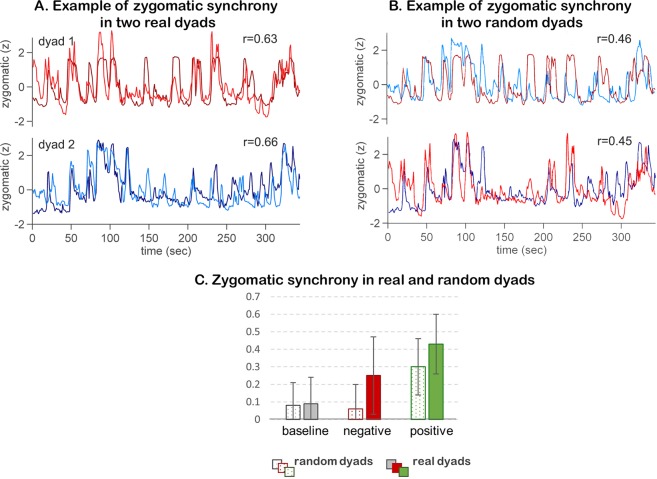
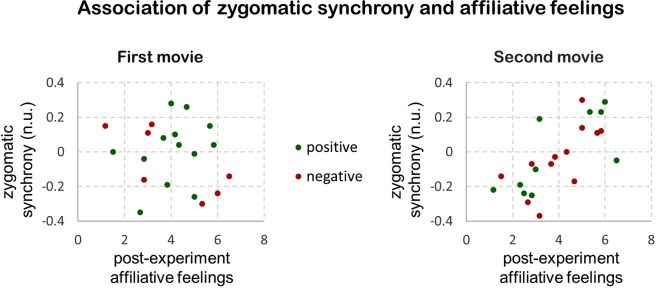
In social contexts individuals frequently act as social chameleons, synchronizing their responses with those of others. Such synchrony is believed to play an important role, promoting mutual emotional and social states. However, synchrony in facial signals, which serve as the main communicative channel between people, has not been systematically studied. To address this gap, we investigated the social spread of smiling dynamics in a naturalistic social setting and assessed its affiliative function. We also studied whether smiling synchrony between people is linked with convergence in their autonomic and emotional responses. To that aim we measured moment-by-moment changes in zygomatic electromyography and cardiovascular activity in dyads of previously unacquainted participants, who co-viewed and subsequently rated emotional movies. We found a robust, dyad-specific zygomatic synchrony in co-viewing participants. During the positive movie, such zygomatic synchrony co-varied with cardiovascular synchrony and with convergence in positive feelings. No such links were found for the negative movie. Centrally, zygomatic synchrony in both emotional contexts predicted the subsequently reported affiliative feelings of dyad members. These results demonstrate that a naturally unfolding smiling behavior is highly contagious. They further suggest that zygomatic synchrony functions as a social facilitator, eliciting affiliation towards previously unknown others.
Overview
The claims and statistics of this paper haven’t been checked yet.
Free: it reads the open-access text and checks the first 5 claims that cite a source we can check. Create a free account to check every claim.
Integrity signals
Registry
Cites
Statistics
Figures
Verification
Claims the paper makes
The claims and statistics of this paper haven’t been checked yet.
Free: it reads the open-access text and checks the first 5 claims that cite a source we can check. Create a free account to check every claim.
Claims other papers make about this one
Each is checked against this paper’s own text: does it say what the citing paper says it does?
The cited source says what the claim attributes to it.
In the citing paper
“While previous studies have reported IPS in both familiar [4, 24, 43, 44] and unfamiliar [45, 46, 47] pairs of participants”
From Interpersonal Synchronization of Autonomic Physiology via Mere Visual Contact (2026) · cites this paper as [47]
The cited source says what the claim attributes to it.
In the citing paper
“In dyads, it has been shown that increased heart rate synchronization and facial muscle synchronization occur automatically without direct interaction when individuals merely sit side by side and watch movies together58,59.”
From Physiological and Behavioral Synchrony Predict Group Cohesion and Performance (2020) · cites this paper as [59]
Self-check
Percentages, sums and reported differences re-computed from the paper’s own numbers.
The self-check needs the paper’s full text.
Citations
Cites
The need to belong: Desire for interpersonal attachments as a fundamental human motivation.
Baumeister, R. F., & Leary, M. R. (1995) · Psychological Bulletin · doi:10.1037//0033-2909.117.3.497 · Cited by 23,245
Maslow, A. H. (1943) · Psychological Review · doi:10.1037/h0054346 · Cited by 21,563
(2017) · Defining and Classifying Children in Need · doi:10.4324/9781315258324-16 · Cited by 11,320
Looking at pictures: Affective, facial, visceral, and behavioral reactions
LANG, P. J., GREENWALD, M. K., BRADLEY, M. M., & HAMM, A. O. (1993) · Psychophysiology · doi:10.1111/j.1469-8986.1993.tb03352.x · Cited by 3,190
Autonomic nervous system activity in emotion: a review
Kreibig, S. D. (2010) · Biological Psychology · doi:10.1016/j.biopsycho.2010.03.010 · Cited by 3,188
Unconscious facial reactions to emotional facial expressions
Dimberg, U., Thunberg, M., & Elmehed, K. (2000) · Psychological Science · doi:10.1111/1467-9280.00221 · Cited by 1,788
Guidelines for Human Electromyographic Research
Fridlund, A. J., & Cacioppo, J. T. (1986) · Psychophysiology · doi:10.1111/j.1469-8986.1986.tb00676.x · Cited by 1,737
Brain-to-brain coupling: a mechanism for creating and sharing a social world
Hasson, U., Ghazanfar, A. A., Galantucci, B., Garrod, S., & Keysers, C. (2012) · Trends in Cognitive Sciences · doi:10.1016/j.tics.2011.12.007 · Cited by 1,140
Inter-Brain Synchronization during Social Interaction
Dumas, G., Nadel, J., Soussignan, R., Martinerie, J., & Garnero, L. (2010) · PLoS ONE · doi:10.1371/journal.pone.0012166 · Cited by 966
Marital interaction: Physiological linkage and affective exchange.
Levenson, R. W., & Gottman, J. M. (1983) · Journal of Personality and Social Psychology · doi:10.1037/0022-3514.45.3.587 · Cited by 855
Research works printed but not linked: 2
- Palumbo, R. V. et al. Interpersonal AutonomicPhysiology A Systematic Review of the Literature. Personal. Soc. Psychol. Rev. 1088868316628405 (2016).
- Kenny, D. A., Kashy, D. A. & Bolger, N. Data analysis in social psychology. In The handbook of social psychology (eds Gilbert, Daniel T., Fiske, Susan T. & Lindzey, Gardner) 1, 233–265 (NY: McGraw-Hill, 1998).
Cited by
Mirror neurons 30 years later: implications and applications
Bonini, L., Rotunno, C., Arcuri, E., & Gallese, V. (2022) · Trends in Cognitive Sciences · doi:10.1016/j.tics.2022.06.003 · Cited by 316
Py-Feat: Python Facial Expression Analysis Toolbox
Cheong, J. H., Jolly, E., Xie, T., Byrne, S., Kenney, M., & Chang, L. J. (2023) · Affective Science · doi:10.1007/s42761-023-00191-4 · Cited by 178
“Participants can be untethered from cumbersome wires and can naturally engage in tasks such as watching a movie or having a conversation (Cheong et al., 2019, 2020; Golland et al., 2019; Navarathna et al., 2014; Sayette et al., 2012).”
BackgroundThe neuroethology of spontaneous mimicry and emotional contagion in human and non-human animals
Palagi, E., Celeghin, A., Tamietto, M., Winkielman, P., & Norscia, I. (2020) · Neuroscience & Biobehavioral Reviews · doi:10.1016/j.neubiorev.2020.01.020 · Cited by 178
“Also, enhanced synchrony in real dyads was paired with cardiovascular synchrony, subjective emotions, and emotional convergence towards previously unknown others (Golland et al., 2019).”
BackgroundPhysiological and Behavioral Synchrony Predict Group Cohesion and Performance
Gordon, I., Gilboa, A., Cohen, S., Milstein, N., Haimovich, N., Pinhasi, S., & Siegman, S. (2020) · Scientific Reports · doi:10.1038/s41598-020-65670-1 · Cited by 146
How and why people synchronize: An integrated perspective
daSilva, E. B., & Wood, A. (2025) · Personality and Social Psychology Review · doi:10.1177/10888683241252036 · Cited by 56
“Or, they might use electromyography manual coding, or computer vision software to continuously quantify the degree of smiling (Golland et al., 2019; Hess & Bourgeois, 2010; Zhao et al., 2022).”
Metadata
- Authors
- Golland, Y., Mevorach, D., & Levit-Binnun, N.
- Affiliations
- Reichman University (IL)
- Corresponding author
- Golland, Yulia
- ORCID
- Golland, Yulia
- Venue
- Scientific Reports
- Published
- 2019-02-28
- Volume
- 9
- Issue
- 1
- Pages
- 3120-3120
- ISSN
- 2045-2322 (ISSN-L)
- PMC
- PMC6395718
- OpenAlex
- W2917092679
- Cited by
- 42
- References
- 78
- Citations by year
- 2026: 5 · 2025: 6 · 2024: 8 · 2023: 7 · 2022: 5 · 2021: 7 · 2020: 4
- FWCI
- 5.02
- Type
- journal article
- Language
- en
- Open access
- gold
- doi.org
- Licence
- cc-by
- creativecommons.org/licenses/by/4.0 (tdm)
- creativecommons.org/licenses/by/4.0 (vor)
- Locations
- Scientific Reports (publishedVersion, cc-by)
- Europe PMC (PubMed Central) (publishedVersion, other-oa)
- PubMed Central (publishedVersion, cc-by)
- PubMed (publishedVersion)
- DOAJ (DOAJ: Directory of Open Access Journals) (submittedVersion)
- Funders
- Israel Science Foundation (698/15)
- Topics
- Social Sciences › Psychology › Social Psychology › Action Observation and Synchronization
- Social Sciences › Psychology › Experimental and Cognitive Psychology › Evolutionary Psychology and Human Behavior
- Life Sciences › Neuroscience › Cognitive Neuroscience › Face Recognition and Perception
- Keywords
- smiling, emotional contagion, affiliation, strangers, co-viewing
- MeSH terms
- Adult, Cardiovascular Physiological Phenomena, Electromyography, Emotions, Female, Humans, Interpersonal Relations, Movement, Smiling, Friends, Young Adult
About these checks
Registry, retraction, Cites and statistics results are computed, not judged, with one exception: a printed reference that no index lists is read once by a model before it counts as a citation error. Claims are extracted by a model and kept only when their quote appears verbatim in the text; each cited source is then checked, with a model’s help, for whether it says what the claim relies on. Those verdicts can be wrong — read the claim’s quote and the cited source before relying on one.
Statistics and arithmetic are recomputed, not judged.
Confidence bands are shown only for fields calibrated on our annotated test set. None is calibrated yet, so no band is shown.
What counts as a claim ›How we measure confidence ›How we check this ›
Are you an author, or do you see a problem with this page? Request a review
Data sources
Bibliographic data: Semantic Scholar, OpenAlex, Crossref.
Contains information from the Semantic Scholar Academic Graph Datasets, made available under the ODC Attribution License (ODC-BY 1.0).
Semantic Scholar’s data is described in: Kinney, R., et al. (2023). The Semantic Scholar Open Data Platform. arXiv:2301.10140.
