

Affiliative zygomatic synchrony in co-present strangers
Open accessThe DOI matches its Crossref record; 76 of the 78 references it cites were found in a registry or an index.
Abstract
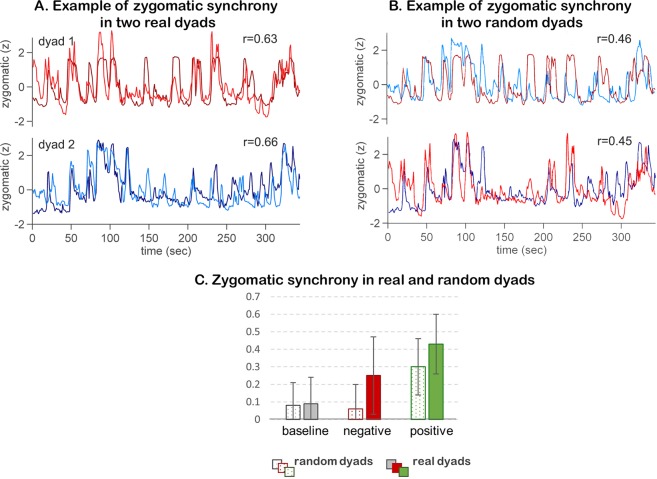
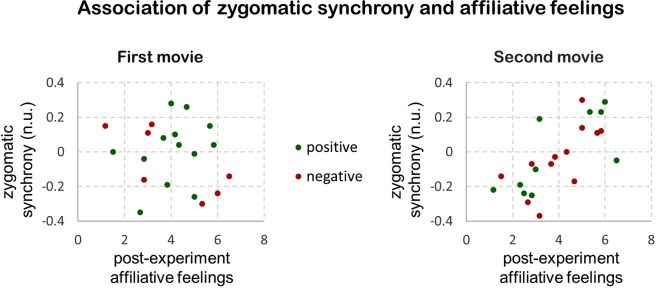
In social contexts individuals frequently act as social chameleons, synchronizing their responses with those of others. Such synchrony is believed to play an important role, promoting mutual emotional and social states. However, synchrony in facial signals, which serve as the main communicative channel between people, has not been systematically studied. To address this gap, we investigated the social spread of smiling dynamics in a naturalistic social setting and assessed its affiliative function. We also studied whether smiling synchrony between people is linked with convergence in their autonomic and emotional responses. To that aim we measured moment-by-moment changes in zygomatic electromyography and cardiovascular activity in dyads of previously unacquainted participants, who co-viewed and subsequently rated emotional movies. We found a robust, dyad-specific zygomatic synchrony in co-viewing participants. During the positive movie, such zygomatic synchrony co-varied with cardiovascular synchrony and with convergence in positive feelings. No such links were found for the negative movie. Centrally, zygomatic synchrony in both emotional contexts predicted the subsequently reported affiliative feelings of dyad members. These results demonstrate that a naturally unfolding smiling behavior is highly contagious. They further suggest that zygomatic synchrony functions as a social facilitator, eliciting affiliation towards previously unknown others.
Overview
The claims and statistics of this paper haven’t been checked yet.
Free: it reads the open-access text and checks the first 5 claims that cite a source we can check. Create a free account to check every claim.
Integrity signals
Registry
Cites
Statistics
Figures
Verification
Claims the paper makes
The claims and statistics of this paper haven’t been checked yet.
Free: it reads the open-access text and checks the first 5 claims that cite a source we can check. Create a free account to check every claim.
Claims other papers make about this one
Each is checked against this paper’s own text: does it say what the citing paper says it does?
The cited source says what the claim attributes to it.
In the citing paper
“While previous studies have reported IPS in both familiar [4, 24, 43, 44] and unfamiliar [45, 46, 47] pairs of participants”
From Interpersonal Synchronization of Autonomic Physiology via Mere Visual Contact (2026) · cites this paper as [47]
The cited source says what the claim attributes to it.
In the citing paper
“In dyads, it has been shown that increased heart rate synchronization and facial muscle synchronization occur automatically without direct interaction when individuals merely sit side by side and watch movies together58,59.”
From Physiological and Behavioral Synchrony Predict Group Cohesion and Performance (2020) · cites this paper as [59]
Self-check
Percentages, sums and reported differences re-computed from the paper’s own numbers.
The self-check needs the paper’s full text.
Citations
Cites
The need to belong: Desire for interpersonal attachments as a fundamental human motivation.
Baumeister, R. F., & Leary, M. R. (1995) · Psychological Bulletin · doi:10.1037//0033-2909.117.3.497 · Cited by 23,245
Maslow, A. H. (1943) · Psychological Review · doi:10.1037/h0054346 · Cited by 21,563
(2017) · Defining and Classifying Children in Need · doi:10.4324/9781315258324-16 · Cited by 11,320
Looking at pictures: Affective, facial, visceral, and behavioral reactions
LANG, P. J., GREENWALD, M. K., BRADLEY, M. M., & HAMM, A. O. (1993) · Psychophysiology · doi:10.1111/j.1469-8986.1993.tb03352.x · Cited by 3,190
Autonomic nervous system activity in emotion: a review
Kreibig, S. D. (2010) · Biological Psychology · doi:10.1016/j.biopsycho.2010.03.010 · Cited by 3,188
Unconscious facial reactions to emotional facial expressions
Dimberg, U., Thunberg, M., & Elmehed, K. (2000) · Psychological Science · doi:10.1111/1467-9280.00221 · Cited by 1,788
Guidelines for Human Electromyographic Research
Fridlund, A. J., & Cacioppo, J. T. (1986) · Psychophysiology · doi:10.1111/j.1469-8986.1986.tb00676.x · Cited by 1,737
Brain-to-brain coupling: a mechanism for creating and sharing a social world
Hasson, U., Ghazanfar, A. A., Galantucci, B., Garrod, S., & Keysers, C. (2012) · Trends in Cognitive Sciences · doi:10.1016/j.tics.2011.12.007 · Cited by 1,140
Inter-Brain Synchronization during Social Interaction
Dumas, G., Nadel, J., Soussignan, R., Martinerie, J., & Garnero, L. (2010) · PLoS ONE · doi:10.1371/journal.pone.0012166 · Cited by 966
Marital interaction: Physiological linkage and affective exchange.
Levenson, R. W., & Gottman, J. M. (1983) · Journal of Personality and Social Psychology · doi:10.1037/0022-3514.45.3.587 · Cited by 855
Larsen, J. T., Norris, C. J., & Cacioppo, J. T. (2003) · Psychophysiology · doi:10.1111/1469-8986.00078 · Cited by 765
Ramseyer, F., & Tschacher, W. (2011) · Journal of Consulting and Clinical Psychology · doi:10.1037/a0023419 · Cited by 754
Empathy: A physiological substrate.
Levenson, R. W., & Ruef, A. M. (1992) · Journal of Personality and Social Psychology · doi:10.1037/0022-3514.63.2.234 · Cited by 709
Hess, U., & Blairy, S. (2001) · International Journal of Psychophysiology · doi:10.1016/s0167-8760(00)00161-6 · Cited by 697
The Antecedents and Consequences of Human Behavioral Mimicry
Chartrand, T. L., & Lakin, J. L. (2013) · Annual Review of Psychology · doi:10.1146/annurev-psych-113011-143754 · Cited by 662
The social roles and functions of emotions.
Frijda, N. H., & Mesquita, B. (2004) · Emotion and culture: Empirical studies of mutual influence. · doi:10.1037/10152-002 · Cited by 632
Emotional Mimicry as Social Regulation
Hess, U., & Fischer, A. (2013) · Personality and Social Psychology Review · doi:10.1177/1088868312472607 · Cited by 596
Sociality of solitary smiling: Potentiation by an implicit audience.
Fridlund, A. J. (1991) · Journal of Personality and Social Psychology · doi:10.1037//0022-3514.60.2.229 · Cited by 567
Interpersonal autonomic physiology: a systematic review of the literature
Palumbo, R. V., Marraccini, M. E., Weyandt, L. L., Wilder-Smith, O., McGee, H. A., Liu, S., & Goodwin, M. S. (2017) · Personality and Social Psychology Review · doi:10.1177/1088868316628405 · Cited by 566
Emotions promote social interaction by synchronizing brain activity across individuals
Nummenmaa, L., Glerean, E., Viinikainen, M., Jääskeläinen, I. P., Hari, R., & Sams, M. (2012) · Proceedings of the National Academy of Sciences · doi:10.1073/pnas.1206095109 · Cited by 538
The impact of social context on mimicry
Bourgeois, P., & Hess, U. (2008) · Biological Psychology · doi:10.1016/j.biopsycho.2007.11.008 · Cited by 458
Brain-to-Brain Synchrony during Naturalistic Social Interactions
Kinreich, S., Djalovski, A., Kraus, L., Louzoun, Y., & Feldman, R. (2017) · Scientific Reports · doi:10.1038/s41598-017-17339-5 · Cited by 402
An Approach to Artifact Identification: Application to Heart Period Data
Berntson, G. G., Quigley, K. S., Jang, J. F., & Boysen, S. T. (1990) · Psychophysiology · doi:10.1111/j.1469-8986.1990.tb01982.x · Cited by 392
Facial reactions to emotional stimuli: Automatically controlled emotional responses
Dimberg, U., Thunberg, M., & Grunedal, S. (2002) · Cognition & Emotion · doi:10.1080/02699930143000356 · Cited by 392
Unseen facial and bodily expressions trigger fast emotional reactions
Tamietto, M., Castelli, L., Vighetti, S., Perozzo, P., Geminiani, G., Weiskrantz, L., & de Gelder, B. (2009) · Proceedings of the National Academy of Sciences · doi:10.1073/pnas.0908994106 · Cited by 385
Interpersonal body and neural synchronization as a marker of implicit social interaction
Yun, K., Watanabe, K., & Shimojo, S. (2012) · Scientific Reports · doi:10.1038/srep00959 · Cited by 379
Hatfield, E., Bensman, L., Thornton, P. D., & Rapson, R. L. (2014) · Interpersona: An International Journal on Personal Relationships · doi:10.5964/ijpr.v8i2.162 · Cited by 375
Mirroring and beyond: coupled dynamics as a generalized framework for modelling social interactions
Hasson, U., & Frith, C. D. (2016) · Philosophical Transactions of the Royal Society B: Biological Sciences · doi:10.1098/rstb.2015.0366 · Cited by 371
Gender differences in facial reactions to facial expressions
Dimberg, U., & Lundquist, L.-O. (1990) · Biological Psychology · doi:10.1016/0301-0511(90)90024-q · Cited by 342
Hess, U., Blairy, S., & Kleck, R. E. (2000) · Journal of Nonverbal Behavior · doi:10.1023/a:1006623213355 · Cited by 340
The intensity of facial expression is determined by underlying affective state and social situation.
Hess, U., Banse, R., & Kappas, A. (1995) · Journal of Personality and Social Psychology · doi:10.1037//0022-3514.69.2.280 · Cited by 339
Emotional Mimicry: Why and When We Mimic Emotions
Hess, U., & Fischer, A. (2014) · Social and Personality Psychology Compass · doi:10.1111/spc3.12083 · Cited by 334
Fischer, A. H., & Manstead, A. S. R. (2008) · UvA-DARE (University of Amsterdam) · Cited by 328
Konvalinka, I., & Roepstorff, A. (2012) · Frontiers in Human Neuroscience · doi:10.3389/fnhum.2012.00215 · Cited by 324
Brain-to-brain coupling during handholding is associated with pain reduction
Goldstein, P., Weissman-Fogel, I., Dumas, G., & Shamay-Tsoory, S. G. (2018) · Proceedings of the National Academy of Sciences · doi:10.1073/pnas.1703643115 · Cited by 311
Do Facial Movements Express Emotions or Communicate Motives?
Parkinson, B. (2005) · Personality and Social Psychology Review · doi:10.1207/s15327957pspr0904_1 · Cited by 299
Perceptual and affective mechanisms in facial expression recognition: An integrative review
Calvo, M. G., & Nummenmaa, L. (2016) · Cognition and Emotion · doi:10.1080/02699931.2015.1049124 · Cited by 292
Evolution and facial action in reflex, social motive, and paralanguage
Fridlund, A. J. (1991) · Biological Psychology · doi:10.1016/0301-0511(91)90003-y · Cited by 287
Convergent and divergent responses to emotional displays of ingroup and outgroup.
van der Schalk, J., Fischer, A., Doosje, B., Wigboldus, D., Hawk, S., Rotteveel, M., & Hess, U. (2011) · Emotion · doi:10.1037/a0022582 · Cited by 275
Mimicry in social interaction: Benefits for mimickers, mimickees, and their interaction
Stel, M., & Vonk, R. (2010) · British Journal of Psychology · doi:10.1348/000712609x465424 · Cited by 265
Gender differences in nonverbal communication of emotion
Hall, J. A., Carter, J. D., & Horgan, T. G. (2000) · Gender and Emotion · doi:10.1017/cbo9780511628191.006 · Cited by 258
Interpersonal consequences of social anxiety
Heerey, E. A., & Kring, A. M. (2007) · Journal of Abnormal Psychology · doi:10.1037/0021-843x.116.1.125 · Cited by 252
You smile–I smile: Emotion expression in social interaction
Hess, U., & Bourgeois, P. (2010) · Biological Psychology · doi:10.1016/j.biopsycho.2009.11.001 · Cited by 246
Who may frown and who should smile? Dominance, affiliation, and the display of happiness and anger
Hess, U., Adams, R., & Kleck, R. (2005) · Cognition & Emotion · doi:10.1080/02699930441000364 · Cited by 228
Spontaneous facial mimicry in response to dynamic facial expressions
Sato, W., & Yoshikawa, S. (2007) · Cognition · doi:10.1016/j.cognition.2006.05.001 · Cited by 228
Simultaneous recording of EEG and facial muscle reactions during spontaneous emotional mimicry
Achaibou, A., Pourtois, G., Schwartz, S., & Vuilleumier, P. (2008) · Neuropsychologia · doi:10.1016/j.neuropsychologia.2007.10.019 · Cited by 194
Interpersonal Emotion Transfer: Contagion and Social Appraisal
Parkinson, B. (2011) · Social and Personality Psychology Compass · doi:10.1111/j.1751-9004.2011.00365.x · Cited by 178
Facial expression recognition in peripheral versus central vision: role of the eyes and the mouth
Calvo, M. G., Fernández-Martín, A., & Nummenmaa, L. (2013) · Psychological Research · doi:10.1007/s00426-013-0492-x · Cited by 160
Facial mimicry in its social setting
Seibt, B., Mühlberger, A., Likowski, K. U., & Weyers, P. (2015) · Frontiers in Psychology · doi:10.3389/fpsyg.2015.01122 · Cited by 155
Golland, Y., Arzouan, Y., & Levit-Binnun, N. (2015) · PLOS ONE · doi:10.1371/journal.pone.0125804 · Cited by 152
Self-citationSocial context effects on facial activity in a negative emotional setting.
Jakobs, E., Manstead, A. S. R., & Fischer, A. H. (2001) · Emotion · doi:10.1037//1528-3542.1.1.51 · Cited by 143
Facial expressions allow inference of both emotions and their components
Scherer, K. R., & Grandjean, D. (2008) · Cognition & Emotion · doi:10.1080/02699930701516791 · Cited by 137
Similar facial electromyographic responses to faces, voices, and body expressions
Magn??e, M. J. C. M., Stekelenburg, J. J., Kemner, C., & de Gelder, B. (2007) · NeuroReport · doi:10.1097/wnr.0b013e32801776e6 · Cited by 131
Fischer, A. H., & Heß, U. (2017) · Current Opinion in Psychology · doi:10.1016/j.copsyc.2017.07.008 · Cited by 126
Standardized Computer‐based Organized Reporting of EEG: SCORE
Beniczky, S., Aurlien, H., Brøgger, J. C., Fuglsang‐Frederiksen, A., Martins‐da‐Silva, A., Trinka, E., Visser, G., Rubboli, G., Hjalgrim, H., Stefan, H., et al. (2013) · Epilepsia · doi:10.1111/epi.12135 · Cited by 123
Relationships among Facial Mimicry, Emotional Experience, and Emotion Recognition
Sato, W., Fujimura, T., Kochiyama, T., & Suzuki, N. (2013) · PLoS ONE · doi:10.1371/journal.pone.0057889 · Cited by 120
Synchrony of brains and bodies during implicit interpersonal interaction
Hari, R., Himberg, T., Nummenmaa, L., Hämäläinen, M., & Parkkonen, L. T. (2013) · Trends in Cognitive Sciences · doi:10.1016/j.tics.2013.01.003 · Cited by 118
The role of touch in regulating inter-partner physiological coupling during empathy for pain
Goldstein, P., Weissman-Fogel, I., & Shamay-Tsoory, S. G. (2017) · Scientific Reports · doi:10.1038/s41598-017-03627-7 · Cited by 118
Social Motives and Emotional Feelings as Determinants of Facial Displays: The Case of Smiling
Jakobs, E., Manstead, A. S. R., & Fischer, A. H. (1999) · Personality and Social Psychology Bulletin · doi:10.1177/0146167299025004003 · Cited by 102
Studying the dynamics of autonomic activity during emotional experience
Golland, Y., Keissar, K., & Levit‐Binnun, N. (2014) · Psychophysiology · doi:10.1111/psyp.12261 · Cited by 92
Self-citationRecognition advantage of happy faces in extrafoveal vision: Featural and affective processing
Calvo, M. G., Nummenmaa, L., & Avero, P. (2010) · Visual Cognition · doi:10.1080/13506285.2010.481867 · Cited by 90
Elul, B., Basinga, P., Nuwagaba-Biribonwoha, H., Saito, S., Horowitz, D., Nash, D., Mugabo, J., Mugisha, V., Rugigana, E., Nkunda, R., et al. (2013) · PLoS ONE · doi:10.1371/journal.pone.0053586 · Cited by 87
Mojzisch, A., Schilbach, L., Helmert, J. R., Pannasch, S., Velichkovsky, B. M., & Vogeley, K. (2006) · Social Neuroscience · doi:10.1080/17470910600985621 · Cited by 86
Heller, A. S., Lapate, R. C., Mayer, K. E., & Davidson, R. J. (2014) · Journal of Cognitive Neuroscience · doi:10.1162/jocn_a_00622 · Cited by 85
Timing and voluntary suppression of facial mimicry to smiling faces in a Go/NoGo task—An EMG study
Korb, S., Grandjean, D., & Scherer, K. R. (2010) · Biological Psychology · doi:10.1016/j.biopsycho.2010.07.012 · Cited by 84
Predictive and Reactive Mechanisms in Smile Reciprocity
Heerey, E. A., & Crossley, H. M. (2013) · Psychological Science · doi:10.1177/0956797612472203 · Cited by 84
How reward modulates mimicry: EMG evidence of greater facial mimicry of more rewarding happy faces
Sims, T. B., Van Reekum, C. M., Johnstone, T., & Chakrabarti, B. (2012) · Psychophysiology · doi:10.1111/j.1469-8986.2012.01377.x · Cited by 84
Bruder, M., Dosmukhambetova, D., Nerb, J., & Manstead, A. S. R. (2012) · Cognition and Emotion · doi:10.1080/02699931.2011.645280 · Cited by 80
Salazar Kämpf, M., Liebermann, H., Kerschreiter, R., Krause, S., Nestler, S., & Schmukle, S. C. (2018) · Psychological Science · doi:10.1177/0956797617727121 · Cited by 71
Posed versus spontaneous facial expressions are modulated by opposite cerebral hemispheres
Ross, E. D., & Pulusu, V. K. (2012) · Cortex · doi:10.1016/j.cortex.2012.05.002 · Cited by 68
Affect dynamics of facial EMG during continuous emotional experiences
Golland, Y., Hakim, A., Alony, T., Schaefer, S. M., & Levit‐Binnun, N. (2018) · Biological Psychology · doi:10.1016/j.biopsycho.2018.10.003 · Cited by 62
Self-citationvan Reekum, C. M., Schaefer, S. M., Lapate, R. C., Norris, C. J., Greischar, L. L., & Davidson, R. J. (2011) · Social Cognitive and Affective Neuroscience · doi:10.1093/scan/nsq031 · Cited by 55
Prolonged marital stress is associated with short‐lived responses to positive stimuli
Lapate, R. C., van Reekum, C. M., Schaefer, S. M., Greischar, L. L., Norris, C. J., Bachhuber, D. R. W., Ryff, C. D., & Davidson, R. J. (2014) · Psychophysiology · doi:10.1111/psyp.12203 · Cited by 38
Decoding the Dyad: Challenges in the Study of Individual Differences in Social Behavior
Heerey, E. A. (2015) · Current Directions in Psychological Science · doi:10.1177/0963721415570731 · Cited by 35
Neural dynamics underlying emotional transmissions between individuals
Golland, Y., Levit‐Binnun, N., Hendler, T., & Lerner, Y. (2017) · Social Cognitive and Affective Neuroscience · doi:10.1093/scan/nsx049 · Cited by 30
Self-citationNeurofunctional Signature of Hyperfamiliarity for Unknown Faces
Negro, E., D’Agata, F., Caroppo, P., Coriasco, M., Ferrio, M. F., Celeghin, A., Diano, M., Rubino, E., de Gelder, B., Rainero, I., et al. (2015) · PLoS ONE · doi:10.1371/journal.pone.0129970 · Cited by 25
Blocker, H. S., & McIntosh, D. N. (2016) · Motivation and Emotion · doi:10.1007/s11031-016-9581-7 · Cited by 21
Sato, S., Sesay, A. K., & Holder, A. A. (2013) · PLoS ONE · doi:10.1371/annotation/f9f809fc-34b8-42c8-acf3-f8b2616a5f44 · Cited by 12
Research works printed but not linked: 2
- Palumbo, R. V. et al. Interpersonal AutonomicPhysiology A Systematic Review of the Literature. Personal. Soc. Psychol. Rev. 1088868316628405 (2016).
- Kenny, D. A., Kashy, D. A. & Bolger, N. Data analysis in social psychology. In The handbook of social psychology (eds Gilbert, Daniel T., Fiske, Susan T. & Lindzey, Gardner) 1, 233–265 (NY: McGraw-Hill, 1998).
Cited by
Mirror neurons 30 years later: implications and applications
Bonini, L., Rotunno, C., Arcuri, E., & Gallese, V. (2022) · Trends in Cognitive Sciences · doi:10.1016/j.tics.2022.06.003 · Cited by 316
Py-Feat: Python Facial Expression Analysis Toolbox
Cheong, J. H., Jolly, E., Xie, T., Byrne, S., Kenney, M., & Chang, L. J. (2023) · Affective Science · doi:10.1007/s42761-023-00191-4 · Cited by 178
“Participants can be untethered from cumbersome wires and can naturally engage in tasks such as watching a movie or having a conversation (Cheong et al., 2019, 2020; Golland et al., 2019; Navarathna et al., 2014; Sayette et al., 2012).”
BackgroundThe neuroethology of spontaneous mimicry and emotional contagion in human and non-human animals
Palagi, E., Celeghin, A., Tamietto, M., Winkielman, P., & Norscia, I. (2020) · Neuroscience & Biobehavioral Reviews · doi:10.1016/j.neubiorev.2020.01.020 · Cited by 178
“Also, enhanced synchrony in real dyads was paired with cardiovascular synchrony, subjective emotions, and emotional convergence towards previously unknown others (Golland et al., 2019).”
BackgroundPhysiological and Behavioral Synchrony Predict Group Cohesion and Performance
Gordon, I., Gilboa, A., Cohen, S., Milstein, N., Haimovich, N., Pinhasi, S., & Siegman, S. (2020) · Scientific Reports · doi:10.1038/s41598-020-65670-1 · Cited by 146
How and why people synchronize: An integrated perspective
daSilva, E. B., & Wood, A. (2025) · Personality and Social Psychology Review · doi:10.1177/10888683241252036 · Cited by 56
“Or, they might use electromyography manual coding, or computer vision software to continuously quantify the degree of smiling (Golland et al., 2019; Hess & Bourgeois, 2010; Zhao et al., 2022).”
Metadata
- Authors
- Golland, Y., Mevorach, D., & Levit-Binnun, N.
- Affiliations
- Reichman University (IL)
- Corresponding author
- Golland, Yulia
- ORCID
- Golland, Yulia
- Venue
- Scientific Reports
- Published
- 2019-02-28
- Volume
- 9
- Issue
- 1
- Pages
- 3120-3120
- ISSN
- 2045-2322 (ISSN-L)
- PMC
- PMC6395718
- OpenAlex
- W2917092679
- Cited by
- 42
- References
- 78
- Citations by year
- 2026: 5 · 2025: 6 · 2024: 8 · 2023: 7 · 2022: 5 · 2021: 7 · 2020: 4
- FWCI
- 5.02
- Type
- journal article
- Language
- en
- Open access
- gold
- doi.org
- Licence
- cc-by
- creativecommons.org/licenses/by/4.0 (tdm)
- creativecommons.org/licenses/by/4.0 (vor)
- Locations
- Scientific Reports (publishedVersion, cc-by)
- Europe PMC (PubMed Central) (publishedVersion, other-oa)
- PubMed Central (publishedVersion, cc-by)
- PubMed (publishedVersion)
- DOAJ (DOAJ: Directory of Open Access Journals) (submittedVersion)
- Funders
- Israel Science Foundation (698/15)
- Topics
- Social Sciences › Psychology › Social Psychology › Action Observation and Synchronization
- Social Sciences › Psychology › Experimental and Cognitive Psychology › Evolutionary Psychology and Human Behavior
- Life Sciences › Neuroscience › Cognitive Neuroscience › Face Recognition and Perception
- Keywords
- smiling, emotional contagion, affiliation, strangers, co-viewing
- MeSH terms
- Adult, Cardiovascular Physiological Phenomena, Electromyography, Emotions, Female, Humans, Interpersonal Relations, Movement, Smiling, Friends, Young Adult
About these checks
Registry, retraction, Cites and statistics results are computed, not judged, with one exception: a printed reference that no index lists is read once by a model before it counts as a citation error. Claims are extracted by a model and kept only when their quote appears verbatim in the text; each cited source is then checked, with a model’s help, for whether it says what the claim relies on. Those verdicts can be wrong — read the claim’s quote and the cited source before relying on one.
Statistics and arithmetic are recomputed, not judged.
Confidence bands are shown only for fields calibrated on our annotated test set. None is calibrated yet, so no band is shown.
What counts as a claim ›How we measure confidence ›How we check this ›
Are you an author, or do you see a problem with this page? Request a review
Data sources
Bibliographic data: Semantic Scholar, OpenAlex, Crossref.
Contains information from the Semantic Scholar Academic Graph Datasets, made available under the ODC Attribution License (ODC-BY 1.0).
Semantic Scholar’s data is described in: Kinney, R., et al. (2023). The Semantic Scholar Open Data Platform. arXiv:2301.10140.
