

From Louvain to Leiden: guaranteeing well-connected communities
Open accessThe DOI matches its Crossref record; 30 of the 30 references it cites were found in a registry or an index; 1 of the 26 sources its claims cite were checked for support.
Abstract
Community detection is often used to understand the structure of large and complex networks. One of the most popular algorithms for uncovering community structure is the so-called Louvain algorithm. We show that this algorithm has a major defect that largely went unnoticed until now: the Louvain algorithm may yield arbitrarily badly connected communities. In the worst case, communities may even be disconnected, especially when running the algorithm iteratively. In our experimental analysis, we observe that up to 25% of the communities are badly connected and up to 16% are disconnected. To address this problem, we introduce the Leiden algorithm. We prove that the Leiden algorithm yields communities that are guaranteed to be connected. In addition, we prove that, when the Leiden algorithm is applied iteratively, it converges to a partition in which all subsets of all communities are locally optimally assigned. Furthermore, by relying on a fast local move approach, the Leiden algorithm runs faster than the Louvain algorithm. We demonstrate the performance of the Leiden algorithm for several benchmark and real-world networks. We find that the Leiden algorithm is faster than the Louvain algorithm and uncovers better partitions, in addition to providing explicit guarantees.
Overview
CoChat Summary
TL;DR
The Louvain algorithm can yield arbitrarily badly connected communities, including disconnected ones, especially when iterated. The Leiden algorithm guarantees connected communities and, under iteration, converges to subset-optimal partitions while running faster and finding higher-quality partitions.
Key findings
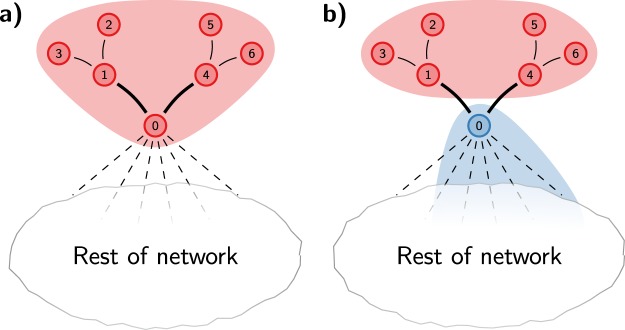
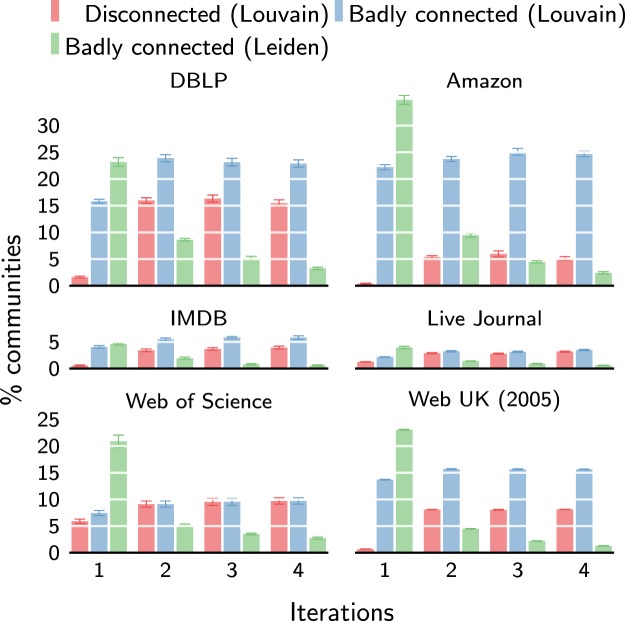
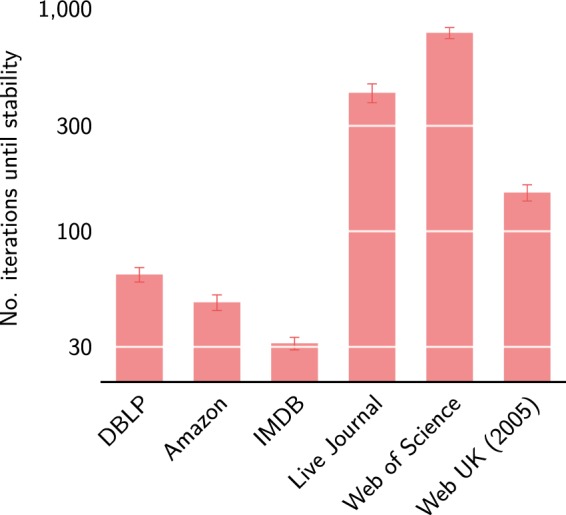
- Louvain may produce arbitrarily badly connected communities; in experiments up to 25% of communities were badly connected and up to 16% were disconnected. First-iteration badly connected percentages included Amazon 23%, DBLP 16%, and Web UK 14%; disconnected communities were usually around 1%, but exceeded 5% for Web of Science in the first iteration and jumped to 16% for DBLP in later iterations. After four iterations, Amazon had 5% disconnected but 25% badly connected communities.
- Leiden guarantees all communities are connected after each iteration, and also γ-separated and γ-connected. After a stable iteration, all nodes are locally optimally assigned and all communities are subpartition γ-dense; asymptotically, all communities are uniformly γ-dense and subset optimal.
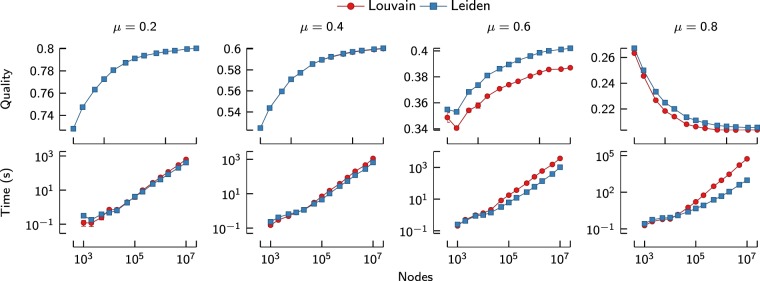
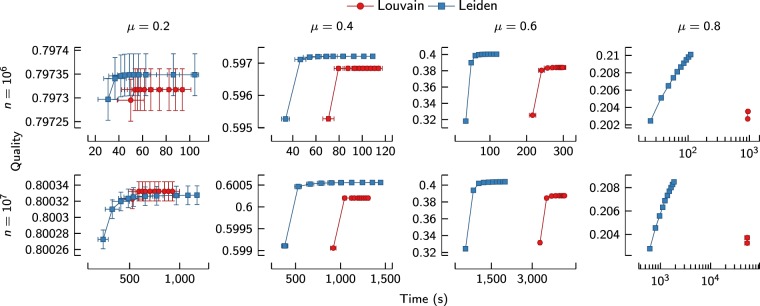
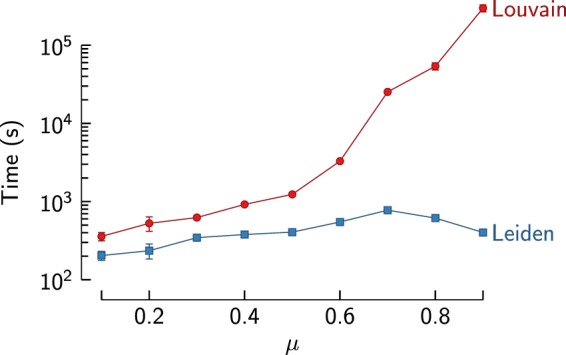
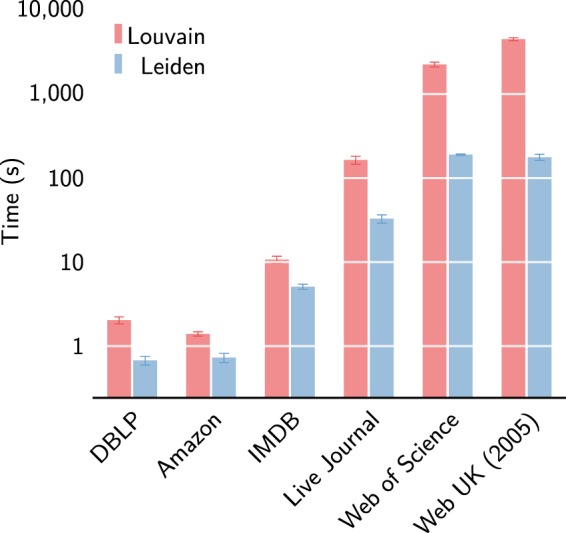
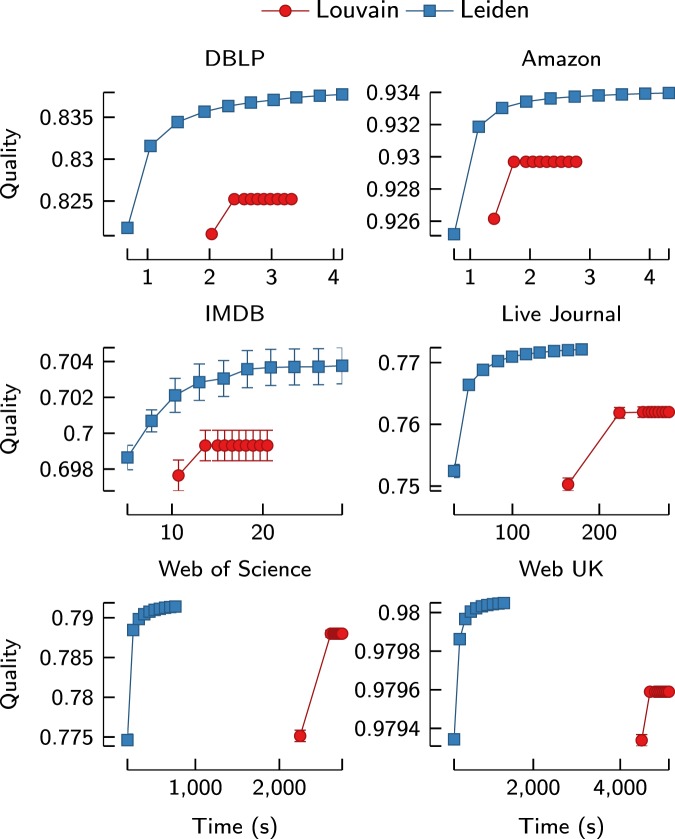
- Leiden was faster than Louvain: first iteration roughly 2–20 times faster on empirical networks, including more than 7× faster for Live Journal, more than 11× for Web of Science, and more than 20× for Web UK. On benchmark networks with difficult partitions (μ = 0.9), Louvain required almost 2.5 days while Leiden needed fewer than 10 minutes; for largest networks Leiden reached 10–100 times faster runtimes.
- Leiden found higher modularity on all six empirical networks: DBLP 0.8387 vs 0.8262, Amazon 0.9341 vs 0.9301, IMDB 0.7069 vs 0.7062, Live Journal 0.7739 vs 0.7653, Web of Science 0.7951 vs 0.7911, and Web UK 0.9801 vs 0.9796.
Methods
- The paper introduces the Leiden algorithm, which combines local moving, refinement of the partition, and aggregation; proofs of guarantees are relegated to Supplementary Information. It compares Leiden with Louvain on six empirical networks and on benchmark networks.
- Empirical networks: DBLP (317,080 nodes, degree 6.6), Amazon (334,863, 5.6), IMDB (374,511, 80.2), Live Journal (3,997,962, 17.4), Web of Science (9,811,130, 21.2), and Web UK (39,252,879, 39.8). Modularity was used with γ = 1; Table 2 reports maximal modularity after 10 replications of 10 iterations each. Badly connected community analysis was repeated 10 times, with Leiden run on each community’s subnetwork until a stable iteration.
- Benchmark networks ranged from n = 10^3 to n = 10^7 nodes, with community size 50 and CPM as the quality function; the mixing parameter μ varied, 10 iterations were performed, and each parameter set was repeated 10 times. The refinement randomness parameter was θ = 0.01.
Limitations
- The paper states that benchmark networks have only limited value because they are not representative of empirical real-world networks and have a rather simple structure.
- The paper states that counting communities split by Leiden gives only a lower bound on the number of badly connected communities; if Leiden does not find subcommunities, there is no guarantee that modularity cannot be increased by splitting the community.
- Evident from the text: there is no dedicated limitations section; technical details and proofs are relegated to Supplementary Information, and the experimental analysis fixes θ = 0.01 although values roughly in [0.0005, 0.1] are said to provide reasonable results.
Model-written summary. Check it against the paper before relying on it.
Integrity signals
Registry
Cites
Statistics
Figures
Verification
Claims the paper makes
1 Valid · 2 Not valid · 17 Not checked · 142 Own results and interpretations
The cited sources support only part of this claim — read each source’s verdict below.
In the paper
“Hence, the problem of Louvain outlined above is independent from the issue of the resolution limit.”
§ From Louvain to Leiden: guaranteeing well-connected communities > Louvain Algorithm > Badly connected communities
What the sources say
- Partly supportedcites [14] Fortunato S Barthélemy M Resolution Limit in Community Detection Proc. Natl. Acad. Sci. USA 2007 104 36 10.1073/pnas.0605965104 17190818 PMC1765466 sourceExperimental — accuracy not yet measured
Our copy supports the resolution-limit side of the sentence: the Conclusions (VI, p. 7) state that 'the resolution limit of modularity does not rely on particular network structures, but only on the comparison between the sizes of interconnected communities and that of the whole network', the Introduction (p. 1) calls it an 'intrinsic scale' of modularity, and Section V (pp. 5-6) shows the failure persists with simulated annealing, i.e. it is a property of the quality function rather than of one particular optimizer. What the source does not contain is the other term of the comparison: Louvain is never mentioned anywhere in the paper (the Introduction, p. 1, lists only generic greedy procedures [19,20], extremal optimization [21] and simulated annealing [22,23]), and no passage contrasts the resolution limit with an algorithm-specific defect. The independence claim is therefore the citing authors' own inference built on this paper's characterization of the resolution limit. (LLM, conf=0.70)
plain- Asserted: passes — The authors put it forward as true.
- Checkable: passes — It can be checked against evidence.
- Load-bearing: passes — The paper’s conclusions depend on it.
- Based: passes — The paper gives a reason why it holds.
- Partly supported
A result the paper states — it cites no source for it, so there is none to check. The quote shows it is in the paper.
In the paper
“The percentage of badly connected communities is less affected by the number of iterations of the Louvain algorithm.”
§ From Louvain to Leiden: guaranteeing well-connected communities > Experimental Analysis > Badly connected communities
plain- Asserted: passes — The authors put it forward as true.
- Checkable: passes — It can be checked against evidence.
- Load-bearing: unclear — It is unclear whether the paper’s conclusions depend on it.
- Based: passes — The paper gives a reason why it holds.
A result the paper states — it cites no source for it, so there is none to check. The quote shows it is in the paper.
In the paper
“In addition, we prove that, when the Leiden algorithm is applied iteratively, it converges to a partition in which all subsets of all communities are locally optimally assigned.”
- Also stated in: § Introduction · boosted
“In addition, we prove that the algorithm converges to an asymptotically stable partition in which all subsets of all communities are locally optimally assigned.”
§ From Louvain to Leiden: guaranteeing well-connected communities > Abstract
boostedstates a cause- Asserted: passes — The authors put it forward as true.
- Checkable: passes — It can be checked against evidence.
- Load-bearing: passes — The paper’s conclusions depend on it.
- Based: passes — The paper gives a reason why it holds.
- Also stated in: § Introduction · boosted
A result the paper reports from its own data — it cites no other source for it, so there is none to check. The quote shows it is in the paper.
In the paper
“The second iteration of Louvain shows a large increase in the percentage of disconnected communities.”
§ From Louvain to Leiden: guaranteeing well-connected communities > Experimental Analysis > Badly connected communities
plainstates a cause- Asserted: passes — The authors put it forward as true.
- Checkable: passes — It can be checked against evidence.
- Load-bearing: passes — The paper’s conclusions depend on it.
- Based: passes — The paper gives a reason why it holds.
A result the paper reports from its own data — it cites no other source for it, so there is none to check. The quote shows it is in the paper.
In the paper
“In terms of the percentage of badly connected communities in the first iteration, Leiden performs even worse than Louvain, as can be seen in Fig. 4.”
§ From Louvain to Leiden: guaranteeing well-connected communities > Experimental Analysis > Badly connected communities
plain- Asserted: passes — The authors put it forward as true.
- Checkable: passes — It can be checked against evidence.
- Load-bearing: unclear — It is unclear whether the paper’s conclusions depend on it.
- Based: passes — The paper gives a reason why it holds.
115 more claims
Create a free account to see all 162 claims and to verify the 24 references still open.
- Probably not a substantial claim. 23
- It may state two separate claims as one. 23
- The quote only partly states this claim. 1
Claims other papers make about this one
Each is checked against this paper’s own text: does it say what the citing paper says it does?
The cited source says what the claim attributes to it.
In the citing paper
“When compared to six common clustering algorithms, including Leiden25 and CellHarmony26, VFC was the top performing algorithm on every simulation on the T cell data and best performing, on average, on the zebrafish dataset, with a 57% increase in average performance over Louvain, which was the next best algorithm”
From Quantifying the effect of experimental perturbations at single-cell resolution (2021) · cites this paper as [25]
The cited source says what the claim attributes to it.
In the citing paper
“Louvain’s successor Leiden circumvents this issue by yielding guaranteed connected communities and is computationally more efficient52.”
From Best practices for single-cell analysis across modalities (2023) · cites this paper as [52]
The cited source says what the claim attributes to it.
In the citing paper
“However, the Louvain algorithm can lead to arbitrarily poorly connected communities52.”
From Best practices for single-cell analysis across modalities (2023) · cites this paper as [52]
The cited source says what the claim attributes to it.
In the citing paper
“We found that many t-types had total variance substantially above the variances of the k-means clusters (Fig. 5b) and an alternative analysis using entropies of Leiden clustering35 often highlighted the same t-types as variable (Extended Data Fig. 8).”
From Phenotypic variation of transcriptomic cell types in mouse motor cortex (2021) · cites this paper as [35]
The cited source says what the claim attributes to it.
In the citing paper
“Community detection uses the Leiden algorithm [28] with ModularityVertexPartition, producing hierarchical subclustering to depth 3.”
From SuperLocalMemory: Privacy-Preserving Multi-Agent Memory with Bayesian Trust Defense Against Memory Poisoning (2026) · cites this paper as [28]
6 more claims about this paper
Create a free account to see every claim other papers make about this one.
Citations
Cites
Fast unfolding of communities in large networks
Blondel, V. D., Guillaume, J.-L., Lambiotte, R., & Lefebvre, E. (2008) · Journal of Statistical Mechanics: Theory and Experiment · doi:10.1088/1742-5468/2008/10/p10008 · Cited by 21,424 · cited 3×
“The Louvain algorithm 10 is very simple and elegant.”
MethodFinding and evaluating community structure in networks
Newman, M. E. J., & Girvan, M. (2004) · Physical Review E · doi:10.1103/physreve.69.026113 · Cited by 13,931 · cited 2×
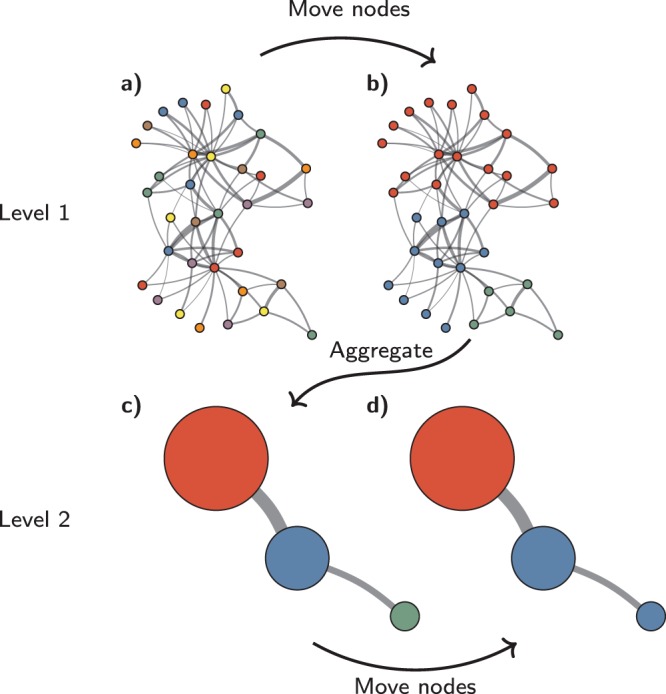
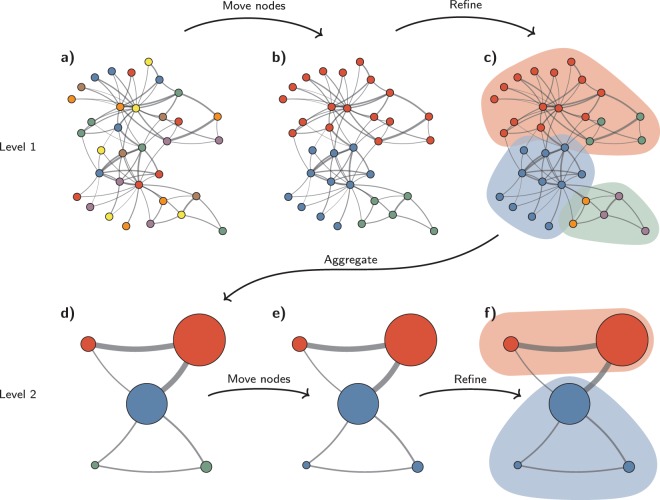
“The Leiden algorithm consists of three phases: (1) local moving of nodes, (2) refinement of the partition and (3) aggregation of the network based on the refined partition, using the non-refined partition to create an initial partition for the aggregate network.”
BackgroundMethodComplex brain networks: graph theoretical analysis of structural and functional systems
Bullmore, E., & Sporns, O. (2009) · Nature Reviews Neuroscience · doi:10.1038/nrn2575 · Cited by 11,820
Fortunato, S. (2010) · Physics Reports · doi:10.1016/j.physrep.2009.11.002 · Cited by 11,293 · cited 4×
“The Leiden algorithm consists of three phases: (1) local moving of nodes, (2) refinement of the partition and (3) aggregation of the network based on the refined partition, using the non-refined partition to create an initial partition for the aggregate network.”
BackgroundMethodInfluentialFinding community structure in very large networks
Clauset, A., Newman, M. E. J., & Moore, C. (2004) · Physical Review E · doi:10.1103/physreve.70.066111 · Cited by 7,390 · cited 1×
“Optimising modularity is NP-hard 5 , and consequentially many heuristic algorithms have been proposed, such as hierarchical agglomeration 6 , extremal optimisation 7 , simulated annealing 4,8 and spectral 9 algorithms.”
MethodFinding community structure in networks using the eigenvectors of matrices
Newman, M. E. J. (2006) · Physical Review E · doi:10.1103/physreve.74.036104 · Cited by 4,761
Functional cartography of complex metabolic networks
Guimerà, R., & Nunes Amaral, L. A. (2005) · Nature · doi:10.1038/nature03288 · Cited by 3,983 · cited 2×
“Optimising modularity is NP-hard 5 , and consequentially many heuristic algorithms have been proposed, such as hierarchical agglomeration 6 , extremal optimisation 7 , simulated annealing 4,8 and spectral 9 algorithms.”
MethodNear linear time algorithm to detect community structures in large-scale networks
Raghavan, U. N., Albert, R., & Kumara, S. (2007) · Physical Review E · doi:10.1103/physreve.76.036106 · Cited by 3,502 · cited 2×
“Trying to fix the problem by simply considering the connected components of communities 19–21 is unsatisfactory because it addresses only the most extreme case and does not resolve the more fundamental problem.”
BackgroundBenchmark graphs for testing community detection algorithms
Lancichinetti, A., Fortunato, S., & Radicchi, F. (2008) · Physical Review E · doi:10.1103/physreve.78.046110 · Cited by 3,051 · cited 1×
“To study the scaling of the Louvain and the Leiden algorithm, we rely on a variant of a well-known approach for constructing benchmark networks 28 .”
MethodResolution limit in community detection
Fortunato, S., & Barthélemy, M. (2007) · Proceedings of the National Academy of Sciences · doi:10.1073/pnas.0605965104 · Cited by 3,024 · cited 2×
“The algorithm may yield arbitrarily badly connected communities, over and above the well-known issue of the resolution limit 14 .”
Background
Research works printed but not linked: 2
- Porter MA Onnela J-P Mucha PJ Communities in Networks Not. AMS 2009 56 1082 1097
- Luecken, M. D. Application of multi-resolution partitioning of interaction networks to the study of complex disease. Ph.D. thesis, (University of Oxford, 2016).
Cited by
Items 7,001–7,100 of 7,288
Grønberg, M., Pavel, A., & Clemmensen, L. (2026) · Research Square · doi:10.21203/rs.3.rs-10587521/v1
A single-cell view of human tissue aging reveals architectural decline beyond cellular compositionPreprint
Abila, E., Zheng, Y., Bagó-Horváth, Z., & Rendeiro, A. F. (2026) · bioRxiv (Cold Spring Harbor Laboratory) · doi:10.64898/2026.09.06.749715
Holdener, C., Jiang, S., Griswold, K. A., Kimble, K. A., Schweitzer, P. A., Mantri, M., Hinchman, M. M., Sutherland, D. M., Parker, J. S. L., Dermody, T. S., et al. (2026) · bioRxiv (Cold Spring Harbor Laboratory) · doi:10.64898/2026.08.17.745247
AI-Based Gene Expression Clustering
Nowak, M., Rossi, M., & Klein, D. (2023) · The Biosis Bulletin: Bioscience and Information science Journal · doi:10.5281/zenodo.19549095
HoloGene: Learning to Lift Sliced Spatial Transcriptomics to Holistic 3D Gene FieldsPreprint
Zheng, Y., Zhu, Q., Zhu, Z., Song, K., Zheng, Y., & Ding, J. (2026) · arXiv (Cornell University) · doi:10.48550/arxiv.2611.20368
Dynamic Coupling Index-Based Network Reconstruction for Heterogeneous Time Series SystemsPreprint
Mohan, J., Ramsundar, B., & Subramanian, S. (2026) · Engineering Archive (engrXiv) · doi:10.31224/8189
Janjic, B. M., Kulkarni, A., Ferris, R. L., Vujanovic, L., & Vujanovic, N. L. (2022) · doi:10.3389/fimmu.2022.837842.s001
Zhang, B., Fong, Y., Yu, C., Chen, S., Voillet, V., Borate, B. R., Schwedhelm, K. V., Chen, Z., Wang, J., Rouphael, N., et al. (2026) · Nature Communications · doi:10.1038/s41467-026-78444-6
Sarkar, S., Ghosh, M., Coka, L. D., Powers, S., Sathian, R., Davuluri, R. V., Gong, X., Mak, M. V., Villar, J., Qi, X., et al. (2026) · bioRxiv (Cold Spring Harbor Laboratory) · doi:10.64898/2026.10.27.762113
A new cell type facilitated live-bearing and multiple independent origins of placentation in fishPreprint
Safian, D., Kraunsoe, S., Falis, M., Labra, L., Reznick, D. N., & Cardoso-Moreira, M. (2026) · bioRxiv (Cold Spring Harbor Laboratory) · doi:10.64898/2026.11.11.765921
Espinoza, J. L., Phillips, A. J., & Dupont, C. L. (2026) · mSystems · doi:10.1128/msystems.00970-26
Modeling systemic road network vulnerability and cascading healthcare disruption during urban Floods
Nobin, P. R. (2026) · Transportation Research Part D Transport and Environment · doi:10.1016/j.trd.2026.105716
On the illusion of a pre-treatment chemoresistance signal in HR+ breast cancerPreprint
Uthayasegar, K. (2026) · doi:10.58445/rars.4198
Metzler, T. T. (2025) · Elektronische Hochschulschriften der LMU München (Ludwig-Maximilians-Universität München) · doi:10.5282/edoc.36054
Rostovtseva, V. V., Семеновна, К. С., Mezentseva, A. A., & Butovskaya, M. (2026) · Early Human Development · doi:10.1016/j.earlhumdev.2026.106708
Lituma-González, W. D., Arunprasad, A. V., ORTEGA, H. K. C., Jayavelan, V., Chakravadhanula, M., Ballaz, S., & Lakshmanan, S. (2026) · Cancers · doi:10.3390/cancers18213476
Efficient Neural Community Detection on Time-Varying Attributed Graphs
PASSOS, N. A. R. D. A. (2026) · Electronic Theses and Dissertations Repository (University of Pisa)
Beyond Symmetry: Asymmetric Matching with Transformers for Collective Entity ResolutionPreprint
Olar, A. (2026) · arXiv (Cornell University) · doi:10.48550/arxiv.2611.15185
Ruberto, A. A., Maher, S. P., Vantaux, A., Joyner, C. J., Bourke, C., Balan, B., Jex, A., Mueller, I., Witkowski, B., & Kyle, D. E. (2022) · doi:10.3389/fcimb.2022.986314.s001
A Stability-Weighted Combined Map for Cell Painting Across Regular and Prolonged Incubation
Lavrinenko, V., Donskaya, I., Popov, V., Litau, E., Petrova, V., Valetdinova, K., Trofimov, M. A., Shurova, A., Danilenko, D., Lioznov, D. A., et al. (2026) · International Journal of Molecular Sciences · doi:10.3390/ijms272210328
Refining Heuristic-Based Bitcoin Address Clustering with Graph Neural NetworksPreprint
Schnoering, H., Bresson, R., & Vazirgiannis, M. (2026) · SSRN Electronic Journal · doi:10.2139/ssrn.7583173
Learning latent progression states from spatial heterogeneity in uterine histopathologyPreprint
He, Q., Liu, Y., Ge, S., Yang, F., Wang, Y., Zhang, I. M., Yang, J., Jia, Z., Hu, A., Zhang, Y., et al. (2026) · arXiv (Cornell University) · doi:10.48550/arxiv.2608.17337
MELDBench: A large-scale benchmark for unified heterogeneous data discovery
Tang, P., Hou, W., Zeng, W., Wu, J., Huang, H., Xu, H., & Zhao, X. H. (2026) · Expert Systems with Applications · doi:10.1016/j.eswa.2026.134353
Huang, C., Zhang, Y.-J., Zhang, F., Gai, C., Li, Z., Lv, H.-L., Wen, S., & Tian, Z.-Q. (2026) · Journal of Gastrointestinal Oncology · doi:10.21037/jgo-2026-0588
Coronel-Córdoba, P., Gaya-Ocón, J., García-Castro, H., Emili, E., Kenny, N. J., Chitgaran, S., Tapia-Saló, G., Abril, J. F., Saló, E., Solana, J., et al. (2026) · bioRxiv (Cold Spring Harbor Laboratory) · doi:10.64898/2026.11.12.766096
González, A. B. I., Jakobsson, J. E. T., Vieillard, J., Lagerström, M. C., Kullander, K., & Boije, H. (2021) · doi:10.3389/fncel.2021.781197.s005
Vashunina, D., LEONOVA, M., Reshetova, I., Nikitina, A., Dobrovolskaya, M., Zhur, K., Makarov, N., & Prokhortchouk, E. (2026) · bioRxiv (Cold Spring Harbor Laboratory) · doi:10.64898/2026.11.13.766448
A Knowledge Graph Approach for Mapping Relationships Across Industrial Cybersecurity Standards
Ramezani, P., Specht, F., & Trsek, H. (2026) · 2026 IEEE 31st International Conference on Emerging Technologies and Factory Automation (ETFA) · doi:10.1109/etfa68377.2026.11725168
Jin, Z., Ge, Y., & Tian, Z. (2026) · Conference on Empirical Methods in Natural Language Processing (EMNLP) · doi:10.18653/2026.emnlp-main.1360
Arppo, A., Barker, H., & Parkkila, S. (2024) · doi:10.1371/journal.pone.0307731.r003
Functional genetics reveals a role for the proteasome in regulating centromere assemblyPreprint
Marescal, O., Su, K.-C., Bernardo, M. D., Manzer, K. M., He, J., Kern, R., & Cheeseman, I. M. (2026) · bioRxiv (Cold Spring Harbor Laboratory) · doi:10.64898/2026.10.14.759079
Liashenko, A., Sulima, S., & Сергіївна, Г. Л. (2026) · Електронний архів наукових та освітніх матеріалів КПІ ім. Ігоря Сікорського (КПІ ім. Ігоря Сікорського)
Lateh, A., Razalli, M. R., & Osman, N. H. (2026) · PaperAsia · doi:10.59953/paperasia.v42i5b.1855
DairySocialTwin: Auditable Video Analytics for Dairy Digital TwinsPreprint
Huang, Y., & Neethirajan, S. R. (2026) · SSRN Electronic Journal · doi:10.2139/ssrn.7535078
DairySocialTwin: Auditing the video-to-graph evidence chain in cattle social networksPreprint
Huang, Y., & Neethirajan, S. R. (2026) · arXiv (Cornell University) · doi:10.48550/arxiv.2610.32989
Reproducible quantum clustering for single-cell transcriptome atlasesPreprint
Han, H. (2026) · arXiv · doi:10.48550/arxiv.2611.11745
Marrale, E. (2026) · Electronic Theses and Dissertations Repository (University of Pisa)
Arjomandi, H. M. (2026) · arXiv (Cornell University) · doi:10.48550/arxiv.2611.10474
Rao, T. R., Pandey, P. K., & Saxena, A. (2026) · International Journal of Data Science and Analytics · doi:10.1007/s41060-026-01299-z
Lu, X., Liang, H., Zhang, X., Xie, C., Yuan, Y., Peng, H., Wu, X., Liang, W., & Liu, S. (2026) · Biomedical Signal Processing and Control · doi:10.1016/j.bspc.2026.111734
Classification of Tumor Spatial Transcriptomics Data and Methods
Qiu, G. (2026) · Theoretical and Natural Science · doi:10.54254/2753-8818/2026.es36957
Bakoev, S., Ermilov, A., Sidorenko, D., Bakoev, F., Kostyunina, O., Сергеевна, А. Н., Nemkovskiy, G. B., & Владимир, В. Б. (2026) · International Journal of Molecular Sciences · doi:10.3390/ijms27219867
Yoon, L., Chung, S. S., Thébault, S., Bréville, G., Muñoz, L., MacMullen, L. N., Gu, A., Yang, T. H. N., He, S., Claiborne, D. T., et al. (2026) · bioRxiv (Cold Spring Harbor Laboratory) · doi:10.64898/2026.11.16.767068
OpenStripe supports open-set identification and spatial stripe profiling in wild Amur tigersPreprint
Peng, Y., Li, Y., Hou, J., Song, Q., Guo, X., Zhang, N., 韦德刚, Huang, Y., Guan, Y., Ge, J., et al. (2026) · arXiv (Cornell University) · doi:10.48550/arxiv.2610.32848
Davies, J., Sirvent, S., Vallejo, A. F., Clayton, K., Douilhet, G., Keeler, P. S., West, J., Ardern-Jones, M., MacArthur, B. D., Singh, H., et al. (2022) · doi:10.3389/fimmu.2022.892254.s003
Cell2Text: Multimodal LLM for generating textual descriptions from single-cell RNA-Seq profiles
Markogiannakis, A. (2026) · DSpace - NTUA (National Technical University of Athens) · doi:10.26240/heal.ntua.32042
LingoCell interprets gene perturbations through natural language and tissue nichesPreprint
Yang, Y., Xu, W., Zhang, Z., Cui, Y., Yu, X., Gu, W., Wang, J., & Nakai, K. (2026) · bioRxiv (Cold Spring Harbor Laboratory) · doi:10.64898/2026.11.08.765157
Su, D., Peng, H., Pan, Y., & Li, A. (2026) · ACM International Conference on Information and Knowledge Management (CIKM) · doi:10.1145/3799682.3840913
A pan-cancer spatial atlas from Asia Pacific reveals recurrent spatial theratopesPreprint
Sharma, A., Chhuo, L., Otsuka, Y., Kawai, H., Eapen, M., Sekimoto, R., Asayama, K., Matsuoka, R., Singh, A., 利朗, 仁., et al. (2026) · Research Square · doi:10.21203/rs.3.rs-11641830/v1
xVGAE: A Hierarchical Variational Graph Autoencoder for Exchangeable GraphsPreprint
Micheletti, D., Ricci, F. Z., & Sudderth, E. B. (2026) · arXiv (Cornell University) · doi:10.48550/arxiv.2610.30815
"The self" as shifting coalitions of brain systems in a continuous configuration spacePreprint
Skipper, J. I., Blackburne, G., Cooper, G., Jaglinska, M., Jedlovszky, K., Kuc, J., McAlpine, R., & Timmermann, C. (2026) · bioRxiv (Cold Spring Harbor Laboratory) · doi:10.64898/2026.11.12.766263
Schwedhelm, K. V., & Rosa, S. C. D. (2026) · Wiley eBooks · doi:10.1002/9781394240296.ch11
Spatial and epigenetic programs underlie heterogeneous cellular senescence in the aging liverPreprint
Mamde, S., Li, K. Y., Teneche, M. G., Olness, J., Smoot, E. W., Kern, C., Miller, K. N., Flores, J., Zhao, Z., Lau, P. K., et al. (2026) · bioRxiv (Cold Spring Harbor Laboratory) · doi:10.64898/2026.11.18.767706
Kwart, D., Wei, Q., Cheng, W., Ryan, K., Leary, A. Y., Golubov, J., Torres, C., Poon, P., Warsaw, J. J., Lowy, J., et al. (2026) · Nature Communications · doi:10.1038/s41467-026-79192-3
Diverse genome organization strategies for polysaccharide utilization in the oceansPreprint
Oliver, A., Podell, S. B., & Allen, E. E. (2026) · bioRxiv (Cold Spring Harbor Laboratory) · doi:10.64898/2026.09.21.753266
Pan, W., Barrett, T. M., Coombes, C., Navas, A. A., Benítez, F. L., Cárdenas-Campoverde, H., Chacón-Uscamaita, P. R., Lescano, A. G., Barbieri, A. F., Santos, R., et al. (2026) · SSRN Electronic Journal · doi:10.2139/ssrn.7300077
Angeli, M. R., Schütz, C., Schmidt, H., Demmler, R., Chang, J., Labinsky, H., Raimondo, M. G., Lalazi, B., Stergioula, K., Huang, K., et al. (2026) · Nature Communications · doi:10.1038/s41467-026-78351-w
liang, P., Ma, H., & Zongyi, Y. (2026) · Research Square · doi:10.21203/rs.3.rs-10699027/v1
He, Z., Li, S., Gu, J., Liu, J., Huang, X., Jing, J., Sun, Q., Wei, M., Wang, J., Fan, D., et al. (2026) · Research Square · doi:10.21203/rs.3.rs-10992120/v1
scICER: clustering stability assessment for integrated single-cell analyses
Yu, B., Xu, D., Shi, Z., Li, M., Zheng, Y., & Cao, X. (2026) · Bioinformatics Advances · doi:10.1093/bioadv/vbag334
Learning gene co-regulation across cells with Multicellular TransformerPreprint
Wiatrak, M., Andersson, A., Hoi, K. H., Biancalani, T., & BenTaieb, A. (2026) · bioRxiv (Cold Spring Harbor Laboratory) · doi:10.64898/2026.11.14.766251
Jin, S., Song, Z., Fang, L., Zhang, J., Ling, Z., Lu, C., Guo, S., 宋晓萌, Shen, X., & Jiang, H. (2026) · Redox Biology · doi:10.1016/j.redox.2026.104490
Rodriguez, L. R., Tang, S. Y., Barboza, W. R., Murthy, A., Tomer, Y., Cai, T.-Q., Iyer, S., Chavez, K., Das, U. S., Ghosh, S., et al. (2023) · doi:10.1172/jci.insight.172977ds2
Santirattanaphakdi, C., & Eurvongkul, R. (2026) · Journal of Business Administration and Languages (JBAL)
Router Prior Bias: Preserving Base Routing Structure in MoE Post-Training
Lee, J., Kim, K., Han, D., Yun, S., Choi, Y., & Yoo, H. (2026) · Findings of the Association for Computational Linguistics: EMNLP (Findings of EMNLP) · doi:10.18653/2026.findings-emnlp.2339
Fedron, J. H. (2026) · Journal of Language and Literature Inquiry · doi:10.55942/jlli.v1i2.2369
Angioni, S., Baglioni, M., Mannocci, A., & Manghi, P. (2026) · arXiv (Cornell University) · doi:10.5281/zenodo.23643293
Conserved synteny reveals a saccharolytic lifestyle across KiritimatielliaPreprint
Oliver, A., Podell, S. B., & Allen, E. E. (2026) · bioRxiv (Cold Spring Harbor Laboratory) · doi:10.64898/2026.10.06.756941
Chung, N., Dai, G., Vance, A., Branchini, J., Zhang, M. H., Byanova, K. L., Smith, D. L., Shimoda, M., Maliskova, L., Eckalbar, W., et al. (2026) · AIDS · doi:10.1097/qad.0000000000004649
Carvalho, P. C., Millsteed, T., & Henry, R. J. (2026) · Food Chemistry · doi:10.1016/j.foodchem.2026.152123
GraCo: A Unified Toolkit of Graph Coarsening Algorithms and MetricsPreprint
Joly, A. (2026) · arXiv (Cornell University) · doi:10.48550/arxiv.2611.01200
TOPRAK, H. B., Taşkın, G., & Yamanel, L. (2026) · Intensive and Critical Care Nursing · doi:10.1016/j.iccn.2026.104612
Structural balance in complex networks: from measurement to dynamics, emergence and implicationsPreprint
Vaccario, G., Górski, P. J., Andres, G., Mariani, M. S., & Hołyst, J. A. (2026) · arXiv (Cornell University) · doi:10.48550/arxiv.2611.21963
Ebrahimi, A. (2024) · K-State Research Exchange (Kansas State University)
Marriage boundaries: A network approach to occupational assortative mating in the United States
Xiaoqian, Y. U. E., & Lee, J. (2026) · Social Science Research · doi:10.1016/j.ssresearch.2026.103443
Tena, E. M., Gómez, D., Castro, J., & Álvarez-Liébana, J. (2026) · SSRN Electronic Journal · doi:10.2139/ssrn.7309912
Balzer, M. (2026) · Publikationen an der Universität Bielefeld (Universität Bielefeld)
Declining Modularity of Intellectual Bases During the Emergence of Research AreasPreprint
Nakajima, K., Sasaki, Y., & Aida, M. (2026) · arXiv · doi:10.48550/arxiv.2608.16602
Bibliometric uncertainty: data quality, reliability, and validity
Donner, P. (2026) · Leiden Repository (Leiden University)
Thakur, R., Bedi, K. P., Perveen, R., Anumula, S. K., Singh, N., Shubneet, & Yadav, A. R. (2026) · Lecture notes in networks and systems · doi:10.1007/978-3-032-27691-9_3
LIFE-seq: longitudinal spatial transcriptomics of living tissuePreprint
Wang, W., Wang, H., Ye, K., Ding, F., Chu, L., Ma, X., Dang, K., He, L., Huang, Y., Li, H., et al. (2026) · bioRxiv (Cold Spring Harbor Laboratory) · doi:10.64898/2026.11.13.766339
T2T-CHM13 v2.0 Y-Chromosome Alignment Dataset for Sample ALT3S129W
Bakaryukin, V. (2026) · Zenodo (CERN European Organization for Nuclear Research) · doi:10.5281/zenodo.23311585
LANCE-seq: Live-tissue Analysis via Needle-encoded Capture Extraction for Spatial TranscriptomicsPreprint
Wenjia, W., Wang, H., He, L., Dang, K., Chu, L., Gao, C., Ye, K., & Zhao, X. (2026) · bioRxiv (Cold Spring Harbor Laboratory) · doi:10.64898/2026.11.14.766625
Ruberto, A. A., Bourke, C., Vantaux, A., Maher, S. P., Jex, A., Witkowski, B., Snounou, G., & Mueller, I. (2022) · doi:10.1371/journal.pntd.0010633.r001
Dedden, M., Wiendl, M., Müller, T. M., Neurath, M. F., & Zundler, S. (2023) · doi:10.3389/fimmu.2023.1027346.s002
TFE3 fusions drive expression of CD44 and SPP1 in Translocation Renal Cell CarcinomaPreprint
Asrani, K. V., Woo, J., Vidotto, T., Feng, K., Lorenzetti, A., Imada, E. L., Li, H., Singh, R., Thotakura, A. K., Ray, S., et al. (2026) · bioRxiv (Cold Spring Harbor Laboratory) · doi:10.64898/2026.09.18.752493
Gravlax: an annotation-independent molecular evidence archive for single-cell RNA-seqPreprint
Patro, R. (2026) · bioRxiv (Cold Spring Harbor Laboratory) · doi:10.64898/2026.09.18.752708
Topology-induced Operators Reveal Complementary Graph Representations without TrainingPreprint
Qin, M., Cui, J., Zheng, H., Li, W., & Pei, S. (2026) · arXiv (Cornell University) · doi:10.48550/arxiv.2609.08152
Métriques de communautés de graphes pour la détection de cyberattaques robuste dans le temps
Michel, J. (2026) · theses.fr (ABES) · doi:10.70675/0d62c768z3d79z4040za1d9z48a01faa0d8c
DISC: Dimension-Informed Clustering with Entropy Metric Warping and Attractor BasinsPreprint
徐沁, Xu, C., Zhang, H. H., & Xu, T. (2026) · Research Square · doi:10.21203/rs.3.rs-11435776/v1
GraphML Studio: An Application for Interactive Network Structure Analysis with Graph Neural NetworksPreprint
Majumder, B. (2026) · SSRN Electronic Journal · doi:10.2139/ssrn.7268575
Parameter-light algorithms for improving hypermodularity-based community detection
Brandt-Tumescheit, F., & Meyerhenke, H. (2026) · Social Network Analysis and Mining · doi:10.1007/s13278-026-01638-9
Ryba, S. (2026) · bioRxiv (Cold Spring Harbor Laboratory) · doi:10.64898/2026.08.20.745999
A Comparative Analysis of Community Detection in Bitcoin Transaction Graphs for De-Anonymization
Kulkarni, P., Dalvi, A., & Siddavatam, I. N. A. (2026) · Information systems engineering and management · doi:10.1007/978-3-032-32709-3_22
Srinivasulu, C., Chittibabu, K., & Murthy, D. (2026) · International Journal of Physics and Mathematics · doi:10.33545/26648636.2026.v8.i2a.244
Utsumi, S., Kondo, R., Tatsukawa, Y., & Tanimoto, J. (2026) · Chaos Solitons & Fractals · doi:10.1016/j.chaos.2026.118844
Sparsity-Driven Search for Multi-Hit Genetic Mutation Combinations in Cancer
Prabhu, R. (2026) · VTechWorks (Virginia Tech)
Metadata
- Authors
- Traag, V. A., Waltman, L., & van Eck, N. J.
- Affiliations
- Leiden University (NL)
- Corresponding author
- Traag, V. A.
- Venue
- Scientific Reports
- Published
- 2019-03-26
- Volume
- 9
- Issue
- 1
- Pages
- 5233-5233
- ISSN
- 2045-2322 (ISSN-L)
- PMC
- PMC6435756
- OpenAlex
- W2897249806
- Semantic Scholar
- 79cdbabb22ef80074f5659430fe6fc97932798f5
- Cited by
- 5,635
- References
- 27
- Citations by year
- 2026: 1250 · 2025: 1281 · 2024: 980 · 2023: 757 · 2022: 639 · 2021: 466 · 2020: 213 · 2019: 46
- FWCI
- 158.78
- Type
- journal article
- Language
- en
- Open access
- gold
- doi.org
- Licence
- cc-by
- creativecommons.org/licenses/by/4.0 (tdm)
- creativecommons.org/licenses/by/4.0 (vor)
- Locations
- Scientific Reports (publishedVersion, cc-by)
- Europe PMC (PubMed Central) (publishedVersion, other-oa)
- PubMed Central (publishedVersion, cc-by)
- PubMed (publishedVersion)
- arXiv (Cornell University) (submittedVersion)
- Leiden Repository (Leiden University) (submittedVersion, cc-by)
- Data Archiving and Networked Services (DANS) (submittedVersion, cc-by)
- DOAJ (DOAJ: Directory of Open Access Journals) (submittedVersion)
- Leiden Repository (Leiden University) (submittedVersion)
- arXiv (Cornell University)
- Topics
- Physical Sciences › Physics and Astronomy › Statistical and Nonlinear Physics › Complex Network Analysis Techniques
- Physical Sciences › Computer Science › Artificial Intelligence › Advanced Clustering Algorithms Research
- Life Sciences › Biochemistry, Genetics and Molecular Biology › Molecular Biology › Bioinformatics and Genomic Networks
- Keywords
- community detection, Louvain algorithm, Leiden algorithm, network partitioning, community connectivity, complex networks
About these checks
Registry, retraction, Cites and statistics results are computed, not judged, with one exception: a printed reference that no index lists is read once by a model before it counts as a citation error. Claims are extracted by a model and kept only when their quote appears verbatim in the text; each cited source is then checked, with a model’s help, for whether it says what the claim relies on. Those verdicts can be wrong — read the claim’s quote and the cited source before relying on one.
The claim verdicts this report counts are experimental: their accuracy is not yet measured.
A language model drew the claims from the paper on 2026-11-23, under version 3 of the claim definition (model deepseek-v4.1-flash, prompt extract-v3).
A second model labelled each claim on 2026-11-23 (model jev-1.13-20260917, definition revision gold-guideline-v0.2).
Cited sources are checked with a language model’s help (qwen3.8-omni-flash).
Statistics and arithmetic are recomputed, not judged.
Confidence bands are shown only for fields calibrated on our annotated test set. None is calibrated yet, so no band is shown.
What counts as a claim ›How we measure confidence ›How we check this ›
Are you an author, or do you see a problem with this page? Request a review
Data sources
Bibliographic data: Semantic Scholar, OpenAlex, Crossref.
Contains information from the Semantic Scholar Academic Graph Datasets, made available under the ODC Attribution License (ODC-BY 1.0).
Semantic Scholar’s data is described in: Kinney, R., et al. (2023). The Semantic Scholar Open Data Platform. arXiv:2301.10140.
