

Effect of grinding, extraction time and type of coffee on the physicochemical and flavour characteristics of cold brew coffee
Open accessThe DOI matches its Crossref record; 55 of the 59 references it cites were found in a registry or an index; 4 of the 16 sources its claims cite were checked for support.
Abstract
The effects of grinding (medium-coarse) and extraction time (14-22 h) on the physicochemical and sensorial properties of cold brew coffee produced using two types of Colombian specialty coffees (Huila and Nariño) were evaluated. Cold coffee brewed under coarse grinding and 22 h of extraction exhibited the highest values of total dissolved solids, extraction yield, pH, titratable acidity (TA), and total phenolic content. The type of coffee used mainly affected the TA and pH. All cold brew coffee samples had lower TA values than their hot counterparts. Nariño cold brew samples had higher TA values than those of Huila in all treatments evaluated. Higher scores were reported in the sensorial evaluation of cold brew coffee when prepared using the shortest time (14 h) and coarse grinding for both coffee types. These coffees were characterized by strong sweetness, fruity and floral flavours, medium bitterness and acidity, and a creamy body. Furans, pyrazines, ketones, aldehydes, pyrroles, esters, lactones, furanones, and phenols were detected as odour-active compounds. The findings of this study demonstrate that the particle size, contact time, and coffee type affect the physicochemical and sensorial characteristics of cold brew coffee, leading to cold brew coffees with different flavour profiles.
Overview
CoChat Summary
## TL;DR
This study tested how grind size, extraction time, and Colombian coffee origin affect cold brew chemistry and flavor. Coarser grinding and longer extraction generally increased extraction yield, total dissolved solids, phenolics, pH/TA, while the best sensory scores came from coarse grinding with the shorter 14 h extraction.
## Key findings
- Cold brew coffees made with coarse grinding and 22 h extraction had the highest extraction yield (EY), total dissolved solids (TDS), pH, titratable acidity (TA), and total phenolic content (TPC).
- The coffee type mainly affected pH and TA; Nariño cold brew had higher TA than Huila in all treatments, and all cold brews had lower TA than hot brews.
- The best sensory scores for cold brew were reported for coarse grinding and 14 h extraction for both coffees; these samples were described as having strong sweetness, fruity and floral flavours, medium bitterness and acidity, and a creamy body.
- Volatile analysis of the best-rated cold brews identified 30 volatile compounds in Nariño and 34 in Huila; the main classes were furans, pyrazines, ketones, aldehydes, pyrroles, esters, lactones, furanones, and phenols.
## Methods
- Design: Randomized factorial design (2 × 2 × 2) in duplicate, with measurements in triplicate; factors were grinding level (coarse, medium), extraction time (14, 22 h), and coffee origin (Huila, Nariño).
- Sample and brewing: Medium-roasted Arabica coffee (Coffea arabica var. caturra) from two Colombian origins; cold brew used 60 g coffee per 700 g water by indirect immersion at 20 °C, and hot brew was prepared for comparison.
- Analysis: Measured TDS, EY, pH, TA, TPC, sensory attributes by a trained panel of 3 tasters, and volatile compounds by HS-SPME GC–MS; treatment differences were tested using one-way ANOVA with LSD at 95%.
## Limitations
- The paper states that few scientific studies on cold brew physicochemical and sensory attributes were available for comparison, limiting benchmarking against prior work.
- The volatile analysis was performed only on the cold brew samples with the best global sensory scores, not on all treatments, so the chemical-flavor comparison is incomplete. *(inferred from the text)*
- Sensory testing used a small panel of 3 trained tasters, which limits generalizability of the sensory results. *(evident from the text)*
Model-written summary. Check it against the paper before relying on it.
Integrity signals
Registry
Cites
Statistics
Figures
Verification
Claims the paper makes
2 Valid · 1 Not valid · 9 Not checked · 88 Own results and interpretations
Every source the paper cites for this claim was checked and supports it.
In the paper
“Furthermore, the particle size distribution also affects the permeability and, therefore, the diffusion and mass transfer phenomena51.”
§ Effect of grinding, extraction time and type of coffee on the physicochemical and flavour characteristics of cold brew coffee > Discussion In cold extraction, the grinding level had a significant effect on the physicochemical properties of the resulting coffee brews. The results showed that coarse grinding increased the TDS, EY and TPC values. However, it is well known that in a solid-liquid extraction, finer grinds enhance the extraction of compounds, while coarser grinds reduce the extraction due to the reduced contact area. These counter-intuitive results can be explained because the indirect immersion method was used in the cold extraction trials. In this method, the coffee grounds were placed inside a filter bag that was then placed in a vessel with water for the established extraction time. At the end of the trials, a greater caking effect was evidenced in the filter bags with medium ground coffee in comparison with those where coarsely ground coffee was used. During the extraction, this caking effect could have affected the diffusivity, lowering the detected values of TDS, EY and TPC in the brewed coffee. Recent studies have established that particle size, size distribution, and the coffee packing bed are parameters that affect and determine the diffusion of solids during the coffee extraction process48–50. Furthermore, the particle size distribution also affects the permeability and, therefore, the diffusion and mass transfer phenomena51. Given that the particle size distribution is a factor that affects the permeability and diffusion of chemical compounds during the extraction process, this phenomenon will be studied in futures investigations of the cold brew methods. The long extraction times (22 h) that are applied in cold extraction tended to increase the values of TDS, EY and TPC, which were even higher when coarse grinding was used. In the extraction process, temperature can be considered as the driving force that favours the extraction of the chemical compounds present in the coffee grounds. At higher temperatures, the kinetic energy of the water molecules is higher, leading to a faster removal of the numerous compounds present in the roasted coffee. Conversely, during cold coffee brewing, the temperature is low (less than room temperature); therefore, the extraction and diffusion of several compounds requires more time to compensate for the low temperature. This could explain the fact that the cold brewed coffee with longer extraction times exhibited EY, TDS, and TPC values close to or even higher than their hot counterparts. In addition to the effect of grinding and extraction time, the type of coffee also had a significant effect on the pH and titratable acidity (TA). Measurements of pH quantify the concentration of aqueous hydrogen ions at the time of analysis, providing a metric for the quantity of deprotonated acid molecules in a sample. Total titratable acidity is a measure of all acidic protons in a sample, including non-dissociated protons27. All cold brew samples evaluated in this study showed lower TA values than their hot counterparts. Recently, similar results have been reported by Rao & Fuller27 in cold brewing with coffees from different countries. These differences suggest that the cold and hot brew coffees are similar in their total concentrations of deprotonated acid compounds, but differ in the concentration, and possibly in the complexity, of protonated acids at the pH of extraction27. Several acids such as acetic, formic, malic, lactic and phosphoric, along with quinic and chlorogenic acids, have been detected in coffee brews52. Some of these can be extracted very efficiently in the initial seconds because their solubility increases with temperature, which could be why the hot brews exhibited higher TA values than the cold brews. Although the coarse grinding and longest extraction time were identified as the optimal conditions for the physicochemical properties, higher scores in the global sensorial evaluation were reported for samples processed using coarse grinding and the lowest extraction time (14 h). This may be because lengthy extraction times can lead to over-extraction of the compounds associated with undesirable sensory notes. Likewise, lengthy extraction times may lead to the degradation of compounds in the beverage, and off-flavour compounds may be formed in the cold brew coffees. Illy and Viani52 found that in hot coffee brewing, over-extraction incorporated undesirable and less soluble aromatic compounds into the drink. Several coffee vendors have marketed cold brew coffee with claims related to tasting smoother and less bitter and having a sweet taste and low acidity27. However, there are few published scientific studies that have carried out a cold brew flavour analysis. The results of this work revealed that cold brew coffees present global flavour profiles with less intensity in the aroma, taste, aftertaste, acidity, and body than their hot counterparts. The global perception or overall impact indicated that the assessors found that cold brew coffees had an acceptable flavour. The complexity of the cold brew coffee flavour also showed that there are specific attributes that are different from a hot brew. Cold brews presented the highest or similar values when compared to their hot counterparts for the flavour attribute scores of malt, pepper, almond, cocoa, chocolate, floral, bitterness, sweetness, and smooth and creamy body. Many of these had higher scores when a 14 h cold extraction was employed. According to volatile profile results, both coffees presented differences in the number of compounds identified. As yet, there are no studies regarding the volatile compounds of cold brew coffees that allow making a rigorous comparison. In general, the high relative concentration of furans, pyrazines, and ketones in both samples (Nariño and Huila) could be associated with sweetness, malty and fruity, which was also described by the assessors in the sensorial analysis. Previous studies have indicated that the aroma of the filtered beverage is associated with the aromas of the alkylpyrazines, phenols, furanones and some thiols. These volatile compounds have been generally associated with sweet, caramel, herbal, fruity, malty, and nutty flavors38.
What the sources say
- Supportedcites [51] Corrochano BR Melrose JR Bentley AC Fryer PJ Bakalis S A new methodology to estimate the steady-state permeability of roast and ground coffee in packed beds J. Food Eng. 2015 150 106 116 10.1016/j.jfoodeng.2014.11.006 source
The Introduction states that 'Permeability is an exclusive function of particle size distribution of the solids forming the bed and packing structure', and §4.4 (Steady-state permeability) quantifies this (coarse distribution D 4.4x the permeability of fine A at 360 kg m-3, largest-to-smallest ratio 17 across the data). The same §4.4 passage and the Conclusions draw the attributed consequence: permeability alters flow rate and hence brewing/residence time 'and thus mass transfer', with implications for under/over-extraction. The source frames the link as permeability affecting mass transfer in extraction generally rather than naming diffusion as a separate mechanism, but it clearly treats the claim's substance. (LLM, conf=0.82)
plainstates a cause- Asserted: passes — The authors put it forward as true.
- Checkable: passes — It can be checked against evidence.
- Load-bearing: passes — The paper’s conclusions depend on it.
- Based: passes — The paper gives a reason why it holds.
- Supported
A result the paper reports from its own data — it cites no other source for it, so there is none to check. The quote shows it is in the paper.
In the paper
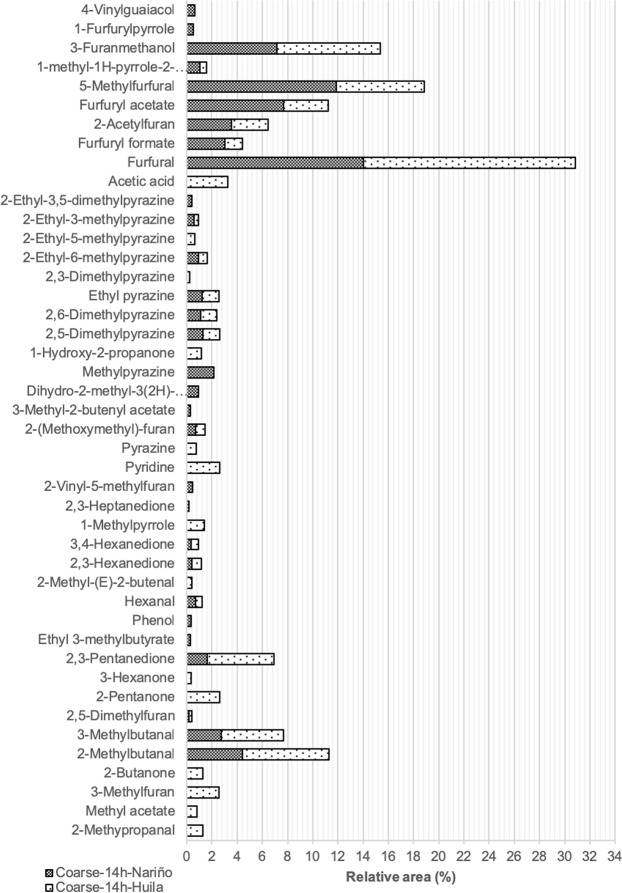
“The current results showed that most of the volatile compounds detected in both of the cold coffee samples belonged to these chemical classes.”
§ Effect of grinding, extraction time and type of coffee on the physicochemical and flavour characteristics of cold brew coffee > Results > Organic volatile compounds in cold brew coffee
plain- Asserted: passes — The authors put it forward as true.
- Checkable: passes — It can be checked against evidence.
- Load-bearing: unclear — It is unclear whether the paper’s conclusions depend on it.
- Based: passes — The paper gives a reason why it holds.
A result the paper reports from its own data — it cites no other source for it, so there is none to check. The quote shows it is in the paper.
In the paper
“Cold coffee brewed under coarse grinding and 22 h of extraction exhibited the highest values of total dissolved solids, extraction yield, pH, titratable acidity (TA), and total phenolic content.”
§ Effect of grinding, extraction time and type of coffee on the physicochemical and flavour characteristics of cold brew coffee > Abstract
plainstates a cause- Asserted: passes — The authors put it forward as true.
- Checkable: passes — It can be checked against evidence.
- Load-bearing: passes — The paper’s conclusions depend on it.
- Based: passes — The paper gives a reason why it holds.
A result the paper reports from its own data — it cites no other source for it, so there is none to check. The quote shows it is in the paper.
In the paper
“Acids and pyridines were only found in the cold brew from Huila coffee.”
§ Effect of grinding, extraction time and type of coffee on the physicochemical and flavour characteristics of cold brew coffee > Results > Organic volatile compounds in cold brew coffee
plain- Asserted: passes — The authors put it forward as true.
- Checkable: passes — It can be checked against evidence.
- Load-bearing: unclear — It is unclear whether the paper’s conclusions depend on it.
- Based: passes — The paper gives a reason why it holds.
A result the paper reports from its own data — it cites no other source for it, so there is none to check. The quote shows it is in the paper.
In the paper
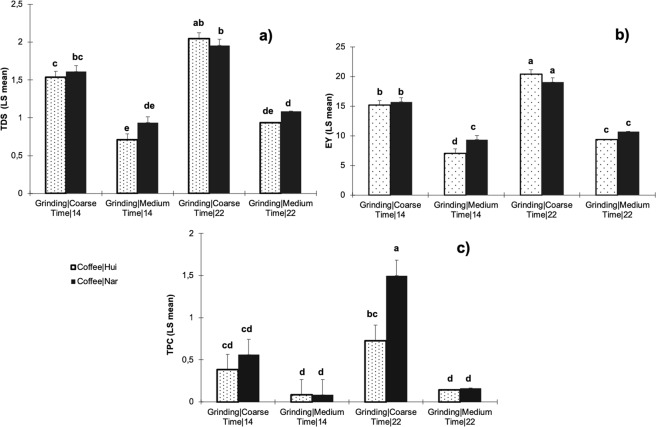
“A higher TPC was found when using coarse grinding and 22 h of extraction with Nariño coffee (1.50 ± 0.37 g/L gallic acid).”
- Also stated in: § Comparison of physicochemical characteristics between cold and hot coffee brews · plain
“In cold brew coffee, the highest TPC values were found in treatments that used Nariño coffee, coarse grinding and 22 h of extraction (1.50 ± 0.37 g/L gallic acid).”
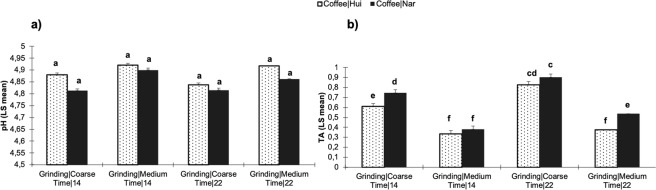
§ Effect of grinding, extraction time and type of coffee on the physicochemical and flavour characteristics of cold brew coffee > Results > Physicochemical characteristics of cold brew coffee under different extraction conditions The physicochemical characteristic results of cold brewed coffee under different extraction condition (grinding, time and type of coffee) are shown in Figs 1 and 2. The process variables of grinding and contact time were statistically significant (p < 0.05) for extraction yield (EY), total dissolved solids (TDS), total phenolic content (TPC), pH and total titratable acidity (TA), while the type of specialty coffee used was only statistically significant (p < 0.05) for pH and TA. According to the coefficients of the statistical analysis, grinding was the factor with the greatest impact on the physicochemical parameters of the cold brew coffee, followed by the extraction time. A coarse grinding and a long extraction time (22 h) increased of the EY percentage and TDS for both coffees evaluated (Fig. 1a,b). Grinding and time were statistically significant (p < 0.05) for the phenolic content (TPC) of the cold brew coffee. A higher TPC was found when using coarse grinding and 22 h of extraction with Nariño coffee (1.50 ± 0.37 g/L gallic acid). Although the type of coffee was not statistically significant for the TPC (p > 0.05), Nariño cold brew samples showed higher values than Huila samples, mainly under coarse grinding (Fig. 1c). Polyphenols are present in coffee and have been related to human health. They have been recognized for their strong antioxidant properties28. Publications regarding cold brew coffee and their phenolic content are scarce. Although chlorogenic acids and their related molecules have been associated primarily with the functional properties of coffee, recent studies in cold brewing using different origins of coffee have reported low total caffeoylquinic acid (CQA) concentrations and total antioxidant activities compared with their hot brew counterparts27. Although the grinding level and time had a significant effect (p < 0.05) on the pH and TA, these parameters were also influenced by the type of coffee used for cold brewing. The lowest pH values (more acidic) for Nariño and Huila coffees were 4.81 ± 0.01 and 4.88 ± 0.0, respectively, which were obtained under coarse grinding and 14 h of extraction for both coffees. Overall, higher pH values (less acidic) were reported for Huila coffee (4.92 ± 0.02), while the higher pH value from Nariño cold brew was 4.90 ± 0.0. Recently, Fuller and Rao17 reported pH values between 5.40 and 5.63 for cold brew Coffea arabica (Kona Typica)17. In addition, Rao and Fuller27 found that the pH values of cold brew coffees of different coffee types (origin countries) ranged between 4.96 and 5.1327. Regarding total titratable acidity, the highest values (0.90 ± 0.04 mg/g chlorogenic acid) were found in the coarse ground and 22 h cold brew samples using Nariño coffee. Lower TA values (0.33 ± 0.03 mg/g chlorogenic acid) were identified in cold brew coffee with medium grinding and 14 h of extraction; these values were lower when Huila coffee was used.
plainstates an association- Asserted: passes — The authors put it forward as true.
- Checkable: passes — It can be checked against evidence.
- Load-bearing: passes — The paper’s conclusions depend on it.
- Based: passes — The paper gives a reason why it holds.
- Also stated in: § Comparison of physicochemical characteristics between cold and hot coffee brews · plain
50 more claims
Create a free account to see all 100 claims and every source verdict.
- Probably not a substantial claim. 22
- It may state two separate claims as one. 27
Claims other papers make about this one
Each is checked against this paper’s own text: does it say what the citing paper says it does?
The source backs part of the claim, not all of it — or backs it for a different population, condition or comparison.
In the citing paper
“The current general practice of cold brew falls between 12 to 24 h12,28,32,33.”
From Sensory analysis of the flavor profile of full immersion hot, room temperature, and cold brewed coffee over time (2024) · cites this paper as [12]
Experimental — accuracy not yet measuredThe source backs part of the claim, not all of it — or backs it for a different population, condition or comparison.
In the citing paper
“the definition by Fuller and Rao (2017) is well accepted and used by various researchers [7,8,9,10].”
From Optimization of Cold Brew Coffee Using Central Composite Design and Its Properties Compared with Hot Brew Coffee (2023) · cites this paper as [7]
Experimental — accuracy not yet measuredThe cited source says what the claim attributes to it.
In the citing paper
“While most coffee sensory studies of brewed coffee focused on pressurized espresso brew or flow-based drip brew2,4,6–10, there are comparatively less sensory studies on full immersion brewing methods other than a few recent ones focused on cold brew10–14.”
From Sensory analysis of the flavor profile of full immersion hot, room temperature, and cold brewed coffee over time (2024) · cites this paper as [12]
Citations
Cites
Colorimetry of Total Phenolics with Phosphomolybdic-Phosphotungstic Acid Reagents
Singleton, V. L., & Rossi, J. A. (1965) · American Journal of Enology and Viticulture · doi:10.5344/ajev.1965.16.3.144 · Cited by 24,852
Azevedo, R. S. S., de Sousa, J. R., Araujo, M. T. F., Martins Filho, A. J., de Alcantara, B. N., Araujo, F. M. C., Queiroz, M. G. L., Cruz, A. C. R., Vasconcelos, B. H. B., Chiang, J. O., et al. (2018) · Scientific Reports · doi:10.1038/s41598-017-17765-5 · Cited by 3,478
The `Latte Revolution'? Regulation, Markets and Consumption in the Global Coffee Chain
Ponte, S. (2002) · World Development · doi:10.1016/s0305-750x(02)00032-3 · Cited by 691
Complexity of coffee flavor: A compositional and sensory perspective
Sunarharum, W. B., Williams, D. J., & Smyth, H. E. (2014) · Food Research International · doi:10.1016/j.foodres.2014.02.030 · Cited by 620
Coffee: Biochemistry and Potential Impact on Health
Ludwig, I. A., Clifford, M. N., Lean, M. E. J., Ashihara, H., & Crozier, A. (2014) · Food Funct. · doi:10.1039/c4fo00042k · Cited by 537
Gao, J., Nutter, J., Liu, X., Guan, D., Huang, Y., Dye, D., & Rainforth, W. M. (2018) · Scientific Reports · doi:10.1038/s41598-018-25899-3 · Cited by 426
Flament, I., & BESSIERE‐CHRETIEN, Y. (2001) · Cited by 348
Farah, A. (2012) · Coffee · doi:10.1002/9781119949893.ch2 · Cited by 330
Coffee fermentation and flavor – An intricate and delicate relationship
Lee, L. W., Cheong, M. W., Curran, P., Yu, B., & Liu, S. Q. (2015) · Food Chemistry · doi:10.1016/j.foodchem.2015.03.124 · Cited by 323
Comparison of nine common coffee extraction methods: Instrumental and sensory analysis
Gloess, A. N., Schönbächler, B., Klopprogge, B., D`Ambrosio, L., Chatelain, K., Bongartz, A., Strittmatter, A., Rast, M., & Yeretzian, C. (2013) · European Food Research and Technology · doi:10.1007/s00217-013-1917-x · Cited by 311
Research works printed but not linked: 1
- Kim AR Kim JS Flavor Contributing Nonvolatile Chemical and Sensory Characterization of Cold Water Extraction-based Coffee by Different ExtractionMethods (Dripping vs Steeping) and Time J. Korea Soc. Coffee Ind. 2014 3 1 9
Cited by
Items 101–166 of 166
Morresi, A. M., Truglio, K., Specchio, J., & Kerrihard, A. L. (2020) · International Journal of Food Science & Technology · doi:10.1111/ijfs.14824 · Cited by 7
Walston, J. D., Short, D. L., & Badar, M. A. (2022) · Asia-Pacific Journal of Management Research and Innovation · doi:10.1177/2319510x221136690 · Cited by 18
“Further, many have attempted to quantify the quality of the coffee by changing the level of grind on the beans (Cordoba et al., 2019), the temperature (Espitia-López et al.”
BackgroundCoffee phytochemicals and their protective roles in hepatic and renal disorders: a review
Asmaey, M. A., & Kita, M. (2025) · Food & Function · doi:10.1039/d5fo03944d · Cited by 5
Processing and Shelf Life of Cold Brew Organic Coffee
Soares, E. A., Bento, G. P., Nogueira, L., Arismendes, T. L. C., Machado, C. L. D. O., Guerra, E. L., Verruma-Bernardi, M. R., & Petrus, R. R. (2025) · Processes · doi:10.3390/pr13010243 · Cited by 4
Effects of Roasting Degree and Grinding Size on Caffeine Content and Sensorial Quality of Coffee
Duke, B. W., Mokonon, M. A., Mekonin, N. D., & Kuffi, K. D. (2025) · Journal of Food Quality · doi:10.1155/jfq/2405668 · Cited by 6
Abdullah, A., Satria, A., Mulyati, H., Arkeman, Y., & Indrawan, D. (2025) · Sustainable Futures · doi:10.1016/j.sftr.2025.101346 · Cited by 6
Gök, İ. (2021) · Food and Health · doi:10.3153/fh21032 · Cited by 7
Hong, S. J., Boo, C. G., Jo, S. M., et al. (2021) · Journal of the Korean Society of Food Science and Nutrition · doi:10.3746/jkfn.2021.50.10.1091 · Cited by 3
Functional properties and sensory profile of coffee prepared by different brewing methods
Barrera-López, J., & Hernández‐Carrión, M. (2023) · Food Science and Technology International · doi:10.1177/10820132231205625 · Cited by 4
“A longer brewing time allowed for more compound extractions (Cordoba et al., 2019; Morresi, 2019), as well as more contact between the water and the ground coffee (Ludwig et al., 2012).”
Zwicker, M., & Lim, L. (2023) · Journal of Food Process Engineering · doi:10.1111/jfpe.14509 · Cited by 5
Speciality Coffees: Searching for the Edge of Beverage Quality
Belchior, V., & Casal, S. I. P. (2024) · Reference series in phytochemistry · doi:10.1007/978-3-031-38663-3_22 · Cited by 4
Physicochemical, Antioxidant and Mineral Composition of Cascara Beverage Prepared by Cold Brewing
Muriqi, S., Červenka, L., Česlová, L., Kašpar, M., Řezková, S., Husáková, L., Patočka, J., Česla, P., & Velichová, H. (2025) · Food Technology and Biotechnology · doi:10.17113/ftb.63.01.25.8605 · Cited by 3
“It also contains less caffeine and brown compounds than its hot-brewed counter-part ( 14,16,17 ).”
Yang, S., Park, S., & Kim, I. (2025) · Journal of the Korean Society of Food Science and Nutrition · doi:10.3746/jkfn.2025.54.8.688 · Cited by 2
Wang, Z., Zhang, X., Wu, Y., et al. (2025) · BMC Genomics · doi:10.1186/s12864-025-12385-0 · Cited by 2
“Coffea Arabica L. is a small tree or large shrub belonging to the Rubiaceae family, native to Ethiopia, East Africa [1, 2].”
Effects of grind size and brewing time on properties of cold brewed Robusta Ijen coffee
JAYUS, J., Darmajana, D. A., Fitria, A. N., & Afriliana, A. (2026) · Journal of Food Science and Technology · doi:10.1007/s13197-026-06628-5 · Cited by 3
Naliyadhara, N., Zhu, Y., Yue, K., Jones, A., Bucknall, M. P., Arcot, J., & Trujillo, F. J. (2026) · Journal of Food Engineering · doi:10.1016/j.jfoodeng.2026.113193 · Cited by 3
Darmajana, D. A., WULANDARI, R., & Sagita, D. (2022) · INMATEH Agricultural Engineering · doi:10.35633/inmateh-68-83 · Cited by 4
Caffeine extraction from Arabic coffee: The role of brewing and roasting
AlShareef, S. M. (2021) · Imam Journal of Applied Sciences · doi:10.4103/ijas.ijas_6_21 · Cited by 3
Determining the Efficiency and Yield of Caffeine Extraction for Robusta and Arabica Coffee Beans
Yu, Z., Reddy, A. J., & Wagh, H. (2021) · Applied Cell Biology · doi:10.53043/2320-1991.acb90013 · Cited by 2
Quantitative Analysis of Caffeine in different commercial kinds of coffee in Iraq
Eldalawy, R., Kutaif, R. H., Tawfeeq, T. A., et al. (2023) · Research Journal of Pharmacy and Technology · doi:10.52711/0974-360x.2023.00555 · Cited by 2
Food Processing and Its Impact on Phenolic and other Bioactive Constituents in Food
Oszmiański, J., & Lachowicz, S. (2022) · MDPI eBooks · doi:10.3390/books978-3-0365-4459-5 · Cited by 1
Rahmawati, I., & Asrori, S. H. (2024) · JKPK (Jurnal Kimia dan Pendidikan Kimia) · doi:10.20961/jkpk.v9i1.84991 · Cited by 2
“The processing techniques, such as grinding, extraction time, and temperature, influence coffee's physicochemical characteristics and flavor, including its caffeine content [18].”
MethodEspresso coffee preparation and the importance of volatiles
Caprioli, G., Sagratini, G., Vittori, S., & Santanatoglia, A. (2024) · Elsevier eBooks · doi:10.1016/b978-0-443-13868-3.00032-6 · Cited by 1
Cold Brew Coffee: Profile and Preservation
Soares, E. A., & Petrus, R. R. (2024) · Food Reviews International · doi:10.1080/87559129.2024.2438301 · Cited by 2
“[6,34] A study carried out by Rao, Fuller and Grim [26] pointed out that cold coffees showed differential extraction marked by a decrease in acidity, a lower concentration of dark compounds and less total dissolved solids (TSS), which indicates that preparation with cold water extracts some…”
InfluentialGulshan, A., Yiasmin, M. N., Zeb, M., Mushtaq, A., Cao, W., Lu, R., Li, X., & Hua, X. (2025) · Food Chemistry · doi:10.1016/j.foodchem.2025.147716 · Cited by 5
Santanatoglia, A., Alessandroni, L., Sagratini, G., & Caprioli, G. (2026) · Food Research International · doi:10.1016/j.foodres.2026.119964 · Cited by 1
AGARWOOD BRANCH ETHANOLIC EXTRACT: OPTIMAL EXTRACTION PROCESS CONDITIONS AND CYTOTOXIC EFFECTS
Abbas, P., Hashim, Y. Z. H.-Y., Salleh, H. M., & Azziz, S. S. S. A. (2020) · Chemical and Natural Resources Engineering Journal (Formally known as Biological and Natural Resources Engineering Journal) · doi:10.31436/cnrej.v3i2.50 · Cited by 1
“Longer extraction time indicated a less efficient extraction process since longer exposure to high temperature increases the risk of degradation of heat-sensitive compounds resulting in extracts void of or with suboptimal bioactive properties [21, 35].”
Fadri, R. A., Sayuti, K., Nazir, N., & Suliansyah, I. (2021) · IOP Conference Series Earth and Environmental Science · doi:10.1088/1755-1315/819/1/012004 · Cited by 2
“Another defected value that results in a brew coffee flavor is the spread of dust or soil(1, 3, 5, 8, 11, 13, 16, 18-19).”
BackgroundElmacı, İ., Gök, İ., & Tokuşoğlu, Ö. (2022) · Journal of Food Processing and Preservation · doi:10.1111/jfpp.17201 · Cited by 2
Extraction technology and influencing factors of cold brew coffee
Li, Z. (2023) · Theoretical and Natural Science · doi:10.54254/2753-8818/6/20230253 · Cited by 1
von Heynitz, C., Ohlmann, K., Schmieder, B. K. L., Hofmann, T., & Glas, K. (2023) · Journal of Food Process Engineering · doi:10.1111/jfpe.14473 · Cited by 2
Savitri, D. A., Amini, H. W., & Darmayanti, R. F. (2020) · Warta Pengabdian · doi:10.19184/wrtp.v14i4.14863 · Cited by 1
Violin, J. L., Acre, L. B., Francisco, J. S., Mori, A. L. B., & Benassi, M. D. T. (2021) · Coffee Science · doi:10.25186/.v16i.1911 · Cited by 2
Kārkliņa, K., & Kampuse, S. (2021) · Proceedings of the Latvian Academy of Sciences Section B Natural Exact and Applied Sciences · doi:10.2478/prolas-2021-0070 · Cited by 2
“Titratable acid concentration according to studies on French pressed coffee is higher than in cold brewed coffee (Cordoba et al., 2019).”
BackgroundEfeito do tempo de extração de café a frio nas características físico-químicas da bebida cold brew
Santos, W. W. V., Couto, É. L. E., da Silva, F. M., Rocha, M. E. M., Silva, M. S. L., Alves, R. O., & da Silva, S. P. (2022) · Research Society and Development · doi:10.33448/rsd-v11i15.36948
The role of fines in espresso extraction dynamicsPreprint
Smrke, S., Eiermann, A., & Yeretzian, C. (2023) · Research Square · doi:10.21203/rs.3.rs-3610417/v1 · Cited by 1
Effects of newly developed coffee filter on contents of functional components in coffee
Shimomura, K., Ichinosawa, Y., & Kinuta, S. (2021) · Journal of Advanced Science · doi:10.2978/jsas.33102
Sitohang, A., Sihombing, D. R., Daniela, C., et al. (2021) · Jurnal Riset Teknologi Pangan Dan Hasil Pertanian (RETIPA) · doi:10.54367/retipa.v1i2.1204
Ramadhan, I., & Murtini, E. S. (2022) · Jurnal Teknologi Pertanian · doi:10.21776/ub.jtp.2022.023.03.1 · Cited by 6
Sanchez, K., Mroz, A. M., & Hendon, C. H. (2023) · Oxford University Press eBooks · doi:10.1093/oso/9780190936587.003.0005
Monitoring and Controlling System of Water Quality and Temperature in a Coffee Pot
Lan, T.-S., Chiu, M., & Lin, W.-L. (2023) · Sensors and Materials · doi:10.18494/sam4444
Tendencias de investigación emergentes en cafés especiales: un análisis bibliométrico
Largo-Ávila, E., Suarez-Rodríguez, C. H., & Granada, J. D. R. (2023) · Revista de Investigación Agraria y Ambiental · doi:10.22490/21456453.6558
“Por otro lado, se examina cómo el tamaño de las partículas, el tiempo de contacto y el tipo de café, influyen en las caracterís - ticas fisicoquímicas y sensoriales del café Área Agrícola preparado en frío (Cordoba et al ., 2019).”
BackgroundOpryshkin, O. (2023) · Bulletin of the National Technical University KhPI Series Innovation researches in students’ scientific work · doi:10.20998/2220-4784.2023.02.06
Janiszewska‐Turak, E., & Szulc, K. (2024) · Elsevier eBooks · doi:10.1016/b978-0-12-819799-8.00014-4
Speciality Coffees: Searching for the Edge of Beverage Quality
Belchior, V., & Casal, S. I. P. (2024) · Reference series in phytochemistry · doi:10.1007/978-3-031-04195-2_22-1
Insight into coffee consumption behavior: a Bibliometrix analysis
Wang, X. (2024) · Advances in economics, business and management research/Advances in Economics, Business and Management Research · doi:10.2991/978-94-6463-408-2_13
Quality characteristics and acrylamide content of commonly sold coffee brands in Kenyan markets
Abdirahman, M., Abong, G., & Okoth, M. (2024) · African Journal of Food Agriculture Nutrition and Development · doi:10.18697/ajfand.130.24730 · Cited by 1
Palacios-Ruíz, V., Suárez-Quiroz, M. L., Figueroa-Hernández, C. Y., Hernández‐Estrada, Z. J., & González-Ríos, Ó. (2025) · BIOtecnia · doi:10.18633/biotecnia.v27.2244
Coffee Preparations and Roasting
Honda, M. (2025) · Royal Society of Chemistry eBooks · doi:10.1039/9781839166853-00021
Puntuwanit, K., Maneechot, P., Suriwong, T., & Nimpanich, K. (2025) · Journal of Food Measurement & Characterization · doi:10.1007/s11694-025-03321-7
“The Combined Heat Transfer to the Coffee Beans (Q-conv + rad.b) reflects all heat transfer carried by convection and radiation into the beans [33, 34].”
Friedenauer, T., Kordhishte, S., Narz, W. L. M., Bessel, T., Tintrop, L. K., Vosough, M., Salemi, A., Thom, C., Meckelmann, S. W., Spellauge, M., et al. (2025) · Advanced Photonics Research · doi:10.1002/adpr.202500115
Zambelli, R. A., de França, Í. W. L., & de Albuquerque, T. L. (2025) · Elsevier eBooks · doi:10.1016/b978-0-12-819518-5.00004-8 · Cited by 1
Uslu, N., & Özcan, M. M. (2025) · International Journal of Gastronomy and Food Science · doi:10.1016/j.ijgfs.2025.101362
Suhita, C. P., Setyaningrum, D., & Wikanditha, K. (2025) · E3S Web of Conferences · doi:10.1051/e3sconf/202566501006
Coffee: One of the Most Consumed Beverages in the World
Lim, L., Zwicker, M., & Wang, X. (2025) · Elsevier eBooks · doi:10.1016/b978-0-443-24738-5.00004-5
GC-MS-Based Metabolite Profiling Method for Coffee
Amalia, F., & Yulianti (2026) · Methods and protocols in food science · doi:10.1007/978-1-0716-5108-7_5
Liu, C., Chen, W., Cao, M., Deng, H., Li, D., Liu, Y., Zhu, C., Jing, J., & Wang, X. (2026) · Innovative Food Science & Emerging Technologies · doi:10.1016/j.ifset.2026.104597 · Cited by 1
Ranking descriptive analysis and preference of cold brew coffee: Impact of roasting degree
Soares, E. C., Bento, G. P., Verruma-Bernardi, M. R., & Petrus, R. R. (2026) · Journal of Food Measurement & Characterization · doi:10.1007/s11694-026-04500-w · Cited by 1
Wang, Z., Li, C., Zhou, Y., et al. (2026) · Ultrasonics Sonochemistry · doi:10.1016/j.ultsonch.2026.107940
“This transmission perturbs the surface tissue of the coffee beans and the residual mucilage/pectin network, thereby enhancing the release and apparent extractability of certain soluble components [32,33].”
Blanco, D. A. O., Parra, S. G., Quevedo-Villamil, M. P., Ramos, A. C., Orjuela, M. E. M., & Gutiérrez-Guzmán, N. (2026) · Journal of Food Processing and Preservation · doi:10.1155/jfpp/8241564
Mohamed, A., Ismail, H., Erukainure, O. L., & Islam, M. S. (2026) · Research Square · doi:10.21203/rs.3.rs-10233429/v1
Germination alters the chemical and sensory quality of Robusta coffee
Muzakkir, B. N., Bastian, F., & Syarifuddin, A. (2026) · Food Chemistry Advances · doi:10.1016/j.focha.2026.101384
Kim, S. Y. (2026) · Journal of the East Asian Society of Dietary Life · doi:10.17495/easdl.2026.8.36.4.205
Üçok, G. (2026) · Ömer Halisdemir Üniversitesi Mühendislik Bilimleri Dergisi · doi:10.28948/ngumuh.2003569
Metadata
- Authors
- Cordoba, N., Pataquiva, L., Osorio, C., Moreno, F. L. M., & Ruiz, R. Y.
- Affiliations
- Universidad de La Sabana (CO)
- Universidad Nacional de Colombia (CO)
- Venue
- Scientific Reports
- Published
- 2019-06-11
- Volume
- 9
- Issue
- 1
- Pages
- 8440-8440
- ISSN
- 2045-2322 (ISSN-L)
- PMC
- PMC6560105
- OpenAlex
- W2951335397
- Semantic Scholar
- c6d2a1eef68c2cb32ff7c7c9f481c16f8b7260bd
- Cited by
- 166
- References
- 59
- Citations by year
- 2026: 13 · 2025: 25 · 2024: 21 · 2023: 30 · 2022: 30 · 2021: 29 · 2020: 16 · 2019: 2
- FWCI
- 11.93
- Type
- journal article
- Language
- en
- Open access
- gold
- doi.org
- Licence
- cc-by
- creativecommons.org/licenses/by/4.0 (tdm)
- creativecommons.org/licenses/by/4.0 (vor)
- Locations
- Scientific Reports (publishedVersion, cc-by)
- PubMed Central (publishedVersion, cc-by)
- PubMed (publishedVersion)
- DOAJ (DOAJ: Directory of Open Access Journals) (submittedVersion)
- Intellectum (Universidad de La Sabana) (submittedVersion, cc-by)
- Greater South Information System
- Funders
- Departamento Administrativo de Ciencia, Tecnología e Innovación (COLCIENCIAS) (727, 2015.)
- Catholic Relief Services
- Universidad de La Sabana (727-2015)
- Topics
- Health Sciences › Medicine › Pharmacology (medical) › Coffee research and impacts
- Life Sciences › Agricultural and Biological Sciences › Food Science › Fermentation and Sensory Analysis
- Life Sciences › Agricultural and Biological Sciences › Food Science › Food Chemistry and Fat Analysis
- Keywords
- cold brew coffee, coffee grinding, extraction time, coffee types, physicochemical properties, sensory evaluation, flavor profile, aroma-active compounds, total phenolic content, titratable acidity, particle size
- MeSH terms
- Coffee, Cooking, Flavoring Agents, Food Handling, Humans, Odorants, Taste, Coffea
About these checks
Registry, retraction, Cites and statistics results are computed, not judged, with one exception: a printed reference that no index lists is read once by a model before it counts as a citation error. Claims are extracted by a model and kept only when their quote appears verbatim in the text; each cited source is then checked, with a model’s help, for whether it says what the claim relies on. Those verdicts can be wrong — read the claim’s quote and the cited source before relying on one.
The claim verdicts this report counts are experimental: their accuracy is not yet measured.
A language model drew the claims from the paper on 2026-10-10, under version 3 of the claim definition (model deepseek-v4.1-flash, prompt extract-v3).
A second model labelled each claim on 2026-10-10 (model jev-1.13-20260917, definition revision gold-guideline-v0.2).
Cited sources are checked with a language model’s help (qwen3.8-omni-flash).
Statistics and arithmetic are recomputed, not judged.
Confidence bands are shown only for fields calibrated on our annotated test set. None is calibrated yet, so no band is shown.
What counts as a claim ›How we measure confidence ›How we check this ›
Are you an author, or do you see a problem with this page? Request a review
Data sources
Bibliographic data: Semantic Scholar, OpenAlex, Crossref.
Contains information from the Semantic Scholar Academic Graph Datasets, made available under the ODC Attribution License (ODC-BY 1.0).
Semantic Scholar’s data is described in: Kinney, R., et al. (2023). The Semantic Scholar Open Data Platform. arXiv:2301.10140.
