

Genome-wide Phenotypic Profiling Identifies and Categorizes Genes Required for Mycobacterial Low Iron Fitness
Open accessThe DOI matches its Crossref record; 61 of the 63 references it cites were found in a registry or an index.
Abstract
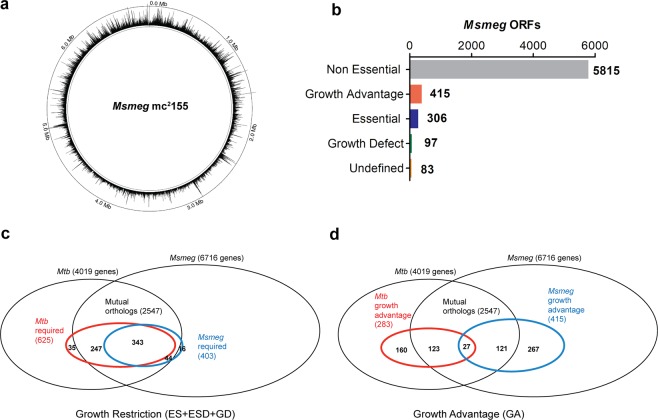
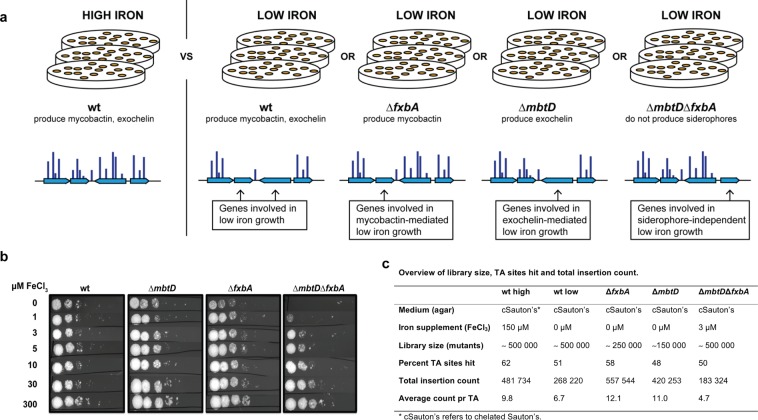
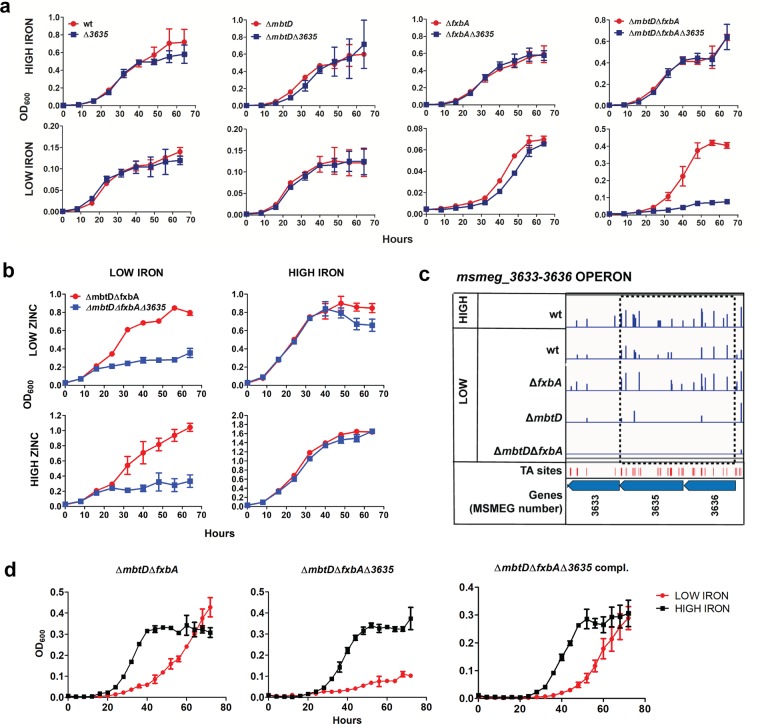
Iron is vital for nearly all living organisms, but during infection, not readily available to pathogens. Infectious bacteria therefore depend on specialized mechanisms to survive when iron is limited. These mechanisms make attractive targets for new drugs. Here, by genome-wide phenotypic profiling, we identify and categorize mycobacterial genes required for low iron fitness. Mycobacterium tuberculosis (Mtb), the causative agent of tuberculosis (TB), can scavenge host-sequestered iron by high-affinity iron chelators called siderophores. We take advantage of siderophore redundancy within the non-pathogenic mycobacterial model organism M. smegmatis (Msmeg), to identify genes required for siderophore dependent and independent fitness when iron is low. In addition to genes with a potential function in recognition, transport or utilization of mycobacterial siderophores, we identify novel putative low iron survival strategies that are separate from siderophore systems. We also identify the Msmeg in vitro essential gene set, and find that 96% of all growth-required Msmeg genes have a mutual ortholog in Mtb. Of these again, nearly 90% are defined as required for growth in Mtb as well. Finally, we show that a novel, putative ferric iron ABC transporter contributes to low iron fitness in Msmeg, in a siderophore independent manner.
Overview
The claims and statistics of this paper haven’t been checked yet.
Free: it reads the open-access text and checks the first 5 claims that cite a source we can check. Create a free account to check every claim.
Integrity signals
Registry
Cites
Statistics
Figures
Verification
Claims the paper makes
The claims and statistics of this paper haven’t been checked yet.
Free: it reads the open-access text and checks the first 5 claims that cite a source we can check. Create a free account to check every claim.
Claims other papers make about this one
Each is checked against this paper’s own text: does it say what the citing paper says it does?
The source backs part of the claim, not all of it — or backs it for a different population, condition or comparison.
In the citing paper
“96% of the genes identified as essential in M. smegmatis have orthologs in M. tuberculosis, and 90% of which are essential in M. tuberculosis (34).”
From Mycobacterium smegmatis: The Vanguard of Mycobacterial Research (2023) · cites this paper as [34]
Experimental — accuracy not yet measured
Self-check
Percentages, sums and reported differences re-computed from the paper’s own numbers.
The self-check needs the paper’s full text.
Citations
Cites
Snapper, S. B., Melton, R. E., Mustafa, S., Kieser, T., & Jr, W. R. J. (1990) · Molecular Microbiology · doi:10.1111/j.1365-2958.1990.tb02040.x · Cited by 1,237
Griffin, J. E., Gawronski, J. D., DeJesus, M. A., Ioerger, T. R., Akerley, B. J., & Sassetti, C. M. (2011) · PLoS Pathogens · doi:10.1371/journal.ppat.1002251 · Cited by 1,048
Self-citationDeJesus, M. A., Gerrick, E. R., Xu, W., Park, S. W., Long, J. E., Boutte, C. C., Rubin, E. J., Schnappinger, D., Ehrt, S., Fortune, S. M., et al. (2017) · mBio · doi:10.1128/mbio.02133-16 · Cited by 668
Self-citationComprehensive identification of conditionally essential genes in mycobacteria
Sassetti, C. M., Boyd, D. H., & Rubin, E. J. (2001) · Proceedings of the National Academy of Sciences · doi:10.1073/pnas.231275498 · Cited by 616
Self-citationExploiting rRNA operon copy number to investigate bacterial reproductive strategies
Roller, B. R. K., Stoddard, S. F., & Schmidt, T. M. (2016) · Nature Microbiology · doi:10.1038/nmicrobiol.2016.160 · Cited by 591
Recombineering in Mycobacterium tuberculosis
van Kessel, J. C., & Hatfull, G. F. (2007) · Nature Methods · doi:10.1038/nmeth996 · Cited by 581
Transposon insertion sequencing: a new tool for systems-level analysis of microorganisms
van Opijnen, T., & Camilli, A. (2013) · Nature Reviews Microbiology · doi:10.1038/nrmicro3033 · Cited by 494
Rodriguez, G. M., Voskuil, M. I., Gold, B., Schoolnik, G. K., & Smith, I. (2002) · Infection and Immunity · doi:10.1128/iai.70.7.3371-3381.2002 · Cited by 490
Asymmetry and Aging of Mycobacterial Cells Lead to Variable Growth and Antibiotic Susceptibility
Aldridge, B. B., Fernandez-Suarez, M., Heller, D., Ambravaneswaran, V., Irimia, D., Toner, M., & Fortune, S. M. (2012) · Science · doi:10.1126/science.1216166 · Cited by 454
Quadri, L. E. N., Sello, J., Keating, T. A., Weinreb, P. H., & Walsh, C. T. (1998) · Chemistry & Biology · doi:10.1016/s1074-5521(98)90291-5 · Cited by 416
Cited by
Genome-wide gene expression tuning reveals diverse vulnerabilities of M. tuberculosis
Bosch, B., DeJesus, M. A., Poulton, N. C., Zhang, W., Engelhart, C. A., Zaveri, A., Lavalette, S., Ruecker, N., Trujillo, C., Wallach, J. B., et al. (2021) · Cell · doi:10.1016/j.cell.2021.06.033 · Cited by 316
“(G) Bar chart showing the overlap between gene calls by TnSeq (Dragset et al., 2019) and CRISPRi.”
BackgroundMethodInfluentialMycobacterium smegmatis: The Vanguard of Mycobacterial Research
Sparks, I. L., Derbyshire, K. M., Jacobs, W. R., & Morita, Y. S. (2023) · Journal of Bacteriology · doi:10.1128/jb.00337-22 · Cited by 149
The ABC exporter IrtAB imports and reduces mycobacterial siderophores
Arnold, F. M., Weber, M. S., Gonda, I., Gallenito, M. J., Adenau, S., Egloff, P., Zimmermann, I., Hutter, C. A. J., Hürlimann, L. M., Peters, E. E., et al. (2020) · Nature · doi:10.1038/s41586-020-2136-9 · Cited by 91
de Wet, T. J., Winkler, K. R., Mhlanga, M., Mizrahi, V., & Warner, D. F. (2020) · eLife · doi:10.7554/elife.60083 · Cited by 79
A Mycobacterial Systems Resource for the Research Community
Judd, J. A., Canestrari, J., Clark, R., Joseph, A., Lapierre, P., Lasek-Nesselquist, E., Mir, M., Palumbo, M., Smith, C., Stone, M., et al. (2021) · mBio · doi:10.1128/mbio.02401-20 · Cited by 45
“This is in agreement with Tn-seq predicted growth-defect/essentiality calls (28).”
BackgroundResultInfluentialSelf-citationGuo, R., Luo, X., Liu, J., & Lu, H. (2020) · Analytica Chimica Acta · doi:10.1016/j.aca.2020.12.021 · Cited by 47
Nonredundant functions of Mycobacterium tuberculosis chaperones promote survival under stress
Harnagel, A. P., Quezada, L. A. L., Park, S. W., Baranowski, C., Kieser, K. J., Jiang, X., Roberts, J., Vaubourgeix, J., Yang, A., Nelson, B., et al. (2020) · Molecular Microbiology · doi:10.1111/mmi.14615 · Cited by 43
“…to a purported buffering capacity of thiols whose production is dependent on cys genes, both cys and mbt genes are upregulated when cells are exposed to intermediate levels of peroxide and thereby contribute to repair of iron-sulfur cluster proteins (Dragset et al., 2019; Voskuil et al., 2011).”
BackgroundSelf-citationDelbeau, M., Omollo, E. O., Froom, R., Koh, S., Mooney, R. A., Lilić, M., Brewer, J. J., Rock, J. M., Darst, S. A., Campbell, E. A., et al. (2023) · Molecular Cell · doi:10.1016/j.molcel.2023.04.007 · Cited by 37
Peterson, E. J. R., Brooks, A. N., Reiss, D. J., Kaur, A., Do, J., Pan, M., Wu, W., Morrison, R., Srinivas, V., Carter, W., et al. (2023) · Cell Reports · doi:10.1016/j.celrep.2023.112875 · Cited by 32
Guerrero-Bustamante, C. A., & Hatfull, G. F. (2024) · mBio · doi:10.1128/mbio.03260-23 · Cited by 32
“Curiously, the Fionnbharth tRNA-Lys-TTT overlaps protein-coding gene 37 but is transcribed from the opposite DNA strand (Fig.”
BackgroundInfluentialWang, X., Jowsey, W. J., Cheung, C., Smart, C. J., Klaus, H. R., Seeto, N. E. J., Waller, N. J. E., Chrisp, M. T., Peterson, A. L., Ofori-Anyinam, B., et al. (2024) · Nature Communications · doi:10.1038/s41467-024-54072-w · Cited by 33
Gupta, K. R., Gwin, C. M., Rahlwes, K. C., Biegas, K. J., Wang, C., Park, J., Liu, J., Swarts, B. M., Morita, Y. S., & Rego, E. H. (2022) · eLife · doi:10.7554/elife.80395 · Cited by 30
Ko, C., & Hatfull, G. F. (2020) · Scientific Reports · doi:10.1038/s41598-020-71588-5 · Cited by 30
Melzer, E. S., Kado, T., García‐Heredia, A., Gupta, K. R., Méniche, X., Morita, Y. S., Sassetti, C. M., Rego, E. H., & Siegrist, M. S. (2022) · Journal of Bacteriology · doi:10.1128/jb.00540-21 · Cited by 23
“For example, mycobacteria and related organisms lack MreB and do not rely 91 on RodA for in vitro growth (29-33).”
BackgroundShaku, M. T., Ocius, K. L., Apostolos, A. J., Pires, M. M., VanNieuwenhze, M. S., Dhar, N., & Kana, B. D. (2023) · Frontiers in Cellular and Infection Microbiology · doi:10.3389/fcimb.2023.1205829 · Cited by 19
SufT is required for growth of Mycobacterium smegmatis under iron limiting conditions
Tamuhla, T., Joubert, L., Willemse, D., & Williams, M. J. (2019) · Microbiology · doi:10.1099/mic.0.000881 · Cited by 20
Xie, W., Wang, L., Luo, D., Soni, V., Rosenn, E. H., & Wang, Z. (2023) · Vaccines · doi:10.3390/vaccines11081302 · Cited by 20
Kipkorir, T., Mashabela, G. T., de Wet, T. J., Koch, A. S., Dawes, S. S., Wiesner, L., Mizrahi, V., & Warner, D. F. (2021) · Journal of Bacteriology · doi:10.1128/jb.00620-20 · Cited by 21
Freeman, A. H., Tembiwa, K. E., Brenner, J. R., Chase, M. R., Fortune, S. M., Morita, Y. S., & Boutte, C. C. (2022) · Molecular Microbiology · doi:10.1111/mmi.15006 · Cited by 18
“According to TnSeq experiments and our previous work, sepIVA is an essential gene (DeJesus et al., 2017; Dragset et al., 2019; Wu et al., 2018).”
MethodIntercellular communication and social behaviors in mycobacteria
Boopathi, S., Ramasamy, S., Haridevamuthu, B., Murugan, R., Veerabadhran, M., Jia, A., & Arockiaraj, J. (2022) · Frontiers in Microbiology · doi:10.3389/fmicb.2022.943278 · Cited by 17
Multi-omics Investigation into the Mechanism of Action of an Anti-tubercular Fatty Acid Analogue
Sakallioglu, I. T., Maroli, A. S., Leite, A. D. L., Marshall, D. D., Evans, B. W., Zinniel, D. K., Dussault, P. H., Barletta, R. G., & Powers, R. (2022) · Journal of the American Chemical Society · doi:10.1021/jacs.2c08238 · Cited by 14
A mycobacterial DivIVA domain-containing protein involved in cell length and septation
Pickford, H., Alcock, E., Singh, A., Kelemen, G. H., & Bhatt, A. (2020) · Microbiology · doi:10.1099/mic.0.000952 · Cited by 12
ATP-independent substrate recruitment to proteasomal degradation in mycobacteria
von Rosen, T., Pepelnjak, M., Quast, J.-P., Picotti, P., & Weber-Ban, E. U. (2023) · Life Science Alliance · doi:10.26508/lsa.202301923 · Cited by 9
“…M. smegmatis is located upstream of the orthologous genes (MSMEG_6366, MSMEG_6367, MSMEG_6369) and they were shown to be essential in M. smegmatis (Dragset et al, 2019), we followed an analogous strategy for knockout construction, fi rst relocating the downstream genes before generation of the…”
PlrA (MSMEG_5223) is an essential polar growth regulator in Mycobacterium smegmatis
Quintanilla, S. Y., Arejan, N. H., Patel, P. B., & Boutte, C. C. (2023) · PLoS ONE · doi:10.1371/journal.pone.0280336 · Cited by 7
“These data show that Msmeg is unable to elongate properly and is unable to control cell wall structure at the poles without PlrA.”
BackgroundInfluentialHigh‐throughput functional genomics: A (myco)bacterial perspective
Winkler, K., Mizrahi, V., Warner, D. F., & de Wet, T. J. (2023) · Molecular Microbiology · doi:10.1111/mmi.15103 · Cited by 5
Contribution of Bacterial Volatiles to Chemical Ecology
Sharifi, R., & Ryu, C. (2020) · Springer eBooks · doi:10.1007/978-981-15-7293-7_6 · Cited by 6
Melzer, E. S., Kado, T., García‐Heredia, A., Gupta, K. R., Méniche, X., Morita, Y. S., Sassetti, C. M., Rego, E. H., & Siegrist, M. S. (2021) · bioRxiv (Cold Spring Harbor Laboratory) · doi:10.1101/2021.10.26.465981 · Cited by 6
Gao, S., He, Y., Deng, X., Lu, N., Bao, J., Li, A., He, X., He, S., Fu, N., Hosyanto, F. F., et al. (2025) · ACS Infectious Diseases · doi:10.1021/acsinfecdis.4c00856 · Cited by 6
The role of colony morphotype in shaping gene essentiality in Mycobacteroides abscessus
Ross, B. N., Evans, E., Diggle, F. L., Briaud, P., & Whiteley, M. (2025) · Proceedings of the National Academy of Sciences · doi:10.1073/pnas.2500719122 · Cited by 7
“In contrast pknA , which is required in vitro in MAB R but not MAB S , is essential in both Mtb and M. smegmatis ( 85 ).”
Prithviraj, M., Shivangi, Freundlich, J. S., & Morita, Y. S. (2025) · Journal of Biological Chemistry · doi:10.1016/j.jbc.2025.110361 · Cited by 7
“The deletion of the qcrCAB operon causes severe growth defects in M. smegmatis (16) and the growth defect phenotype was corroborated by a genome-wide Tn-seq study (14).”
InfluentialGenome-wide phenotypic insights into mycobacterial virulence using Drosophila melanogaster
Sivakumar, N., Fuentes, E., Selvik, L.-K. M., Arch, M., Gabrielsen, C., Cardona, P.-J., Ioerger, T. R., & Dragset, M. S. (2025) · PLoS Pathogens · doi:10.1371/journal.ppat.1013474 · Cited by 6
“Due to our previous experience and interest in mycobacterial low iron growth [51–53], we chose mmar_1660 which encodes a putative conserved ATP-binding protein ABC transporter whose Mtb ortholog is suggested by homology to be involved gene.”
Self-citationKhan, S. S., Sudasinghe, T. D., Landgraf, A. D., Ronning, D. R., & Sucheck, S. J. (2021) · ACS Infectious Diseases · doi:10.1021/acsinfecdis.1c00283 · Cited by 4
Levendosky, K., Janisch, N., & Quadri, L. E. N. (2023) · mBio · doi:10.1128/mbio.00573-23 · Cited by 5
Miller, A. H., Marks, F., Chan, L., Botella, H., Schnappinger, D., & Ehrt, S. (2024) · Microbiology Spectrum · doi:10.1128/spectrum.00487-24 · Cited by 4
CARF-dependent preferential RNA cleavage by Csm6 increases drug susceptibility of mycobacteria
Wei, W., Gao, C., Jiang, X., Qiao, J., Zhang, L., Yan, Y., Zhao, G., Yang, K., Yan, J., & Yang, M. (2025) · Nucleic Acids Research · doi:10.1093/nar/gkaf622 · Cited by 3
Experimental Evolution Reveals Redox State Modulates Mycobacterial Pathogenicity
Jiang, Z., Zhuang, Z., & Mi, K. (2022) · Frontiers in Genetics · doi:10.3389/fgene.2022.758304 · Cited by 3
Lynch, E. M., Lu, Y., Park, J., Shao, L., Kollman, J. M., & Rego, E. H. (2025) · Nature Communications · doi:10.1038/s41467-025-60847-6 · Cited by 3
Guo, R., Luo, X., Liu, J., & Lu, H. (2020) · SSRN Electronic Journal · doi:10.2139/ssrn.3562437 · Cited by 4
Xu, Y., Wang, L., Jiang, J., Zhao, G., & Wang, Z. (2025) · Tuberculosis · doi:10.1016/j.tube.2025.102693 · Cited by 1
Gupta, K. R., Gwin, C. M., Rahlwes, K. C., Biegas, K. J., Wang, C., Park, J. H., Liu, J., Swarts, B. M., Morita, Y. S., & Rego, E. H. (2019) · doi:10.1101/633768 · Cited by 1
Delbeau, M., Omollo, E. O., Froom, R., Koh, S., Mooney, R. A., Lilić, M., Brewer, J. J., Rock, J. M., Darst, S. A., Campbell, E. A., et al. (2022) · bioRxiv (Cold Spring Harbor Laboratory) · doi:10.1101/2022.10.21.513233 · Cited by 1
“All five genes in the nusG transcriptional unit are predicted to be required for mycobacterial viability (Dragset et al., 2019); it is thus likely that nusG knockdown induces both upstream and downstream polar effects (Bosch et al.”
BackgroundFreeman, A. H., Tembiwa, K. E., Brenner, J., Chase, M., Fortune, S., Morita, Y., & Boutte, C. C. (2021) · bioRxiv · doi:10.1101/2021.10.06.463415
Ambudkar, S. V. (2020) · Faculty Opinions – Post-Publication Peer Review of the Biomedical Literature · doi:10.3410/f.737622951.793578545
PlrA (MSMEG_5223) is an essential polar growth regulator in Mycobacterium smegmatisPreprint
Quintanilla, S. Y., Arejan, N. H., Patel, P. B., & Boutte, C. C. (2022) · bioRxiv (Cold Spring Harbor Laboratory) · doi:10.1101/2022.09.08.507195
Williams, J. T., Baker, J. J., Zheng, H., Dechow, S. J., Fallon, J., Murto, M., Albrecht, V. J., Gilliland, H. N., Olive, A. J., & Abramovitch, R. B. (2023) · mSphere · doi:10.1128/msphere.00358-23
“Genes for these transporters as well as other iron-interacting proteins (33, 34, 45, 46) were also upregu lated in our RNAseq profile ( MSMEG_3635, MSMEG_3636, MSMEG_5039, MSMEG_5418, MSMEG_6553, and MSMEG_6554 ) (Fig.”
BackgroundWang, X., Jowsey, W. J., Cheung, C., Seeto, N. E. J., Waller, N. J. E., Chrisp, M. T., Peterson, A. L., Nijagal, B., Fineran, P. C., Cook, G. M., et al. (2023) · bioRxiv (Cold Spring Harbor Laboratory) · doi:10.1101/2023.12.07.570702
Point, V., Achache, W., Laudouze, J., Ramos, E. S., Maziero, M., Crauste, C., Canaan, S., & Santucci, P. (2025) · FEBS Open Bio · doi:10.1002/2211-5463.70172 · Cited by 1
Wang, S., Zhang, L., Wu, R., Wang, H., Sun, M., Zhang, Y., Xing, J., Fang, R., Li, X., Wang, Y. F., et al. (2026) · ACS Omega · doi:10.1021/acsomega.5c10658
Self-citationMetabolic flexibility and an unusual route for peptidoglycan muramic acid recycling in mycobacteria
Stravoravdis, S., Carnahan, B. R., Gordon, R. A., Wodzanowski, K. A., Havaleshko, K., Fils-Aime, E., Putnik, R., Hyland, S. N., Grimes, C. L., & Siegrist, M. S. (2026) · Journal of Biological Chemistry · doi:10.1016/j.jbc.2026.113575
“Of note, M . smegmatis mc 2 155 has two copies of murA ( msmeg _4932), as this gene is found in a duplicated region of the chromosome (104, 105).”
Metadata
- Authors
- Dragset, M. S., Ioerger, T. R., Zhang, Y. J., Mærk, M., Ginbot, Z., Sacchettini, J. C., Flo, T. H., Rubin, E. J., & Steigedal, M.
- Affiliations
- Harvard University (US)
- Texas A&M University (US)
- Norwegian University of Science and Technology (NO)
- Corresponding author
- Dragset, Marte S.
- ORCID
- Venue
- Scientific Reports
- Published
- 2019-08-06
- Volume
- 9
- Issue
- 1
- Pages
- 11394-11394
- ISSN
- 2045-2322 (ISSN-L)
- PMC
- PMC6684656
- OpenAlex
- W2965016808
- Semantic Scholar
- 8d598b738bf17ed79c7a585c29126b1e74152e7a
- Cited by
- 49
- References
- 63
- Citations by year
- 2026: 2 · 2025: 8 · 2024: 3 · 2023: 11 · 2022: 8 · 2021: 6 · 2020: 9 · 2019: 2
- FWCI
- 4.79
- Type
- journal article
- Language
- en
- Open access
- gold
- doi.org
- Licence
- cc-by
- creativecommons.org/licenses/by/4.0 (tdm)
- creativecommons.org/licenses/by/4.0 (vor)
- Locations
- Scientific Reports (publishedVersion, cc-by)
- Europe PMC (PubMed Central) (publishedVersion, cc-by)
- PubMed Central (publishedVersion, cc-by)
- PubMed (publishedVersion)
- DOAJ (DOAJ: Directory of Open Access Journals) (submittedVersion)
- NORA - Norwegian Open Research Archives (submittedVersion, cc-by)
- Funders
- Norges Forskningsråd (223255, 249901, 246944, 220836)
- Helse Midt-Norge
- Topics
- Health Sciences › Medicine › Infectious Diseases › Tuberculosis Research and Epidemiology
- Life Sciences › Biochemistry, Genetics and Molecular Biology › Genetics › Bacterial Genetics and Biotechnology
- Health Sciences › Medicine › Hematology › Iron Metabolism and Disorders
- Keywords
- Mycobacterium tuberculosis, Mycobacterium smegmatis, siderophores, iron acquisition, essential genes, orthologs, tuberculosis
- MeSH terms
- Genetic Profile, Drug Development, Antitubercular Agents, Bacterial Proteins, Genes, Bacterial, Humans, Iron, Mycobacterium tuberculosis, Tuberculosis, Siderophores, ATP-Binding Cassette Transporters, Genes, Essential, Mycobacterium smegmatis, Gene Knockdown Techniques
About these checks
Registry, retraction, Cites and statistics results are computed, not judged, with one exception: a printed reference that no index lists is read once by a model before it counts as a citation error. Claims are extracted by a model and kept only when their quote appears verbatim in the text; each cited source is then checked, with a model’s help, for whether it says what the claim relies on. Those verdicts can be wrong — read the claim’s quote and the cited source before relying on one.
Statistics and arithmetic are recomputed, not judged.
Confidence bands are shown only for fields calibrated on our annotated test set. None is calibrated yet, so no band is shown.
What counts as a claim ›How we measure confidence ›How we check this ›
Are you an author, or do you see a problem with this page? Request a review
Data sources
Bibliographic data: Semantic Scholar, OpenAlex, Crossref.
Contains information from the Semantic Scholar Academic Graph Datasets, made available under the ODC Attribution License (ODC-BY 1.0).
Semantic Scholar’s data is described in: Kinney, R., et al. (2023). The Semantic Scholar Open Data Platform. arXiv:2301.10140.
