

The DOI matches its Crossref record; 107 of the 107 references it cites were found in a registry or an index.
Increasing altruistic and cooperative behaviour with simple moral nudges
Open accessAbstract
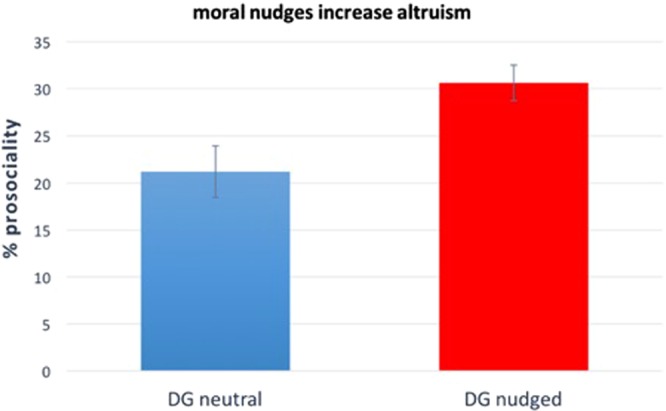
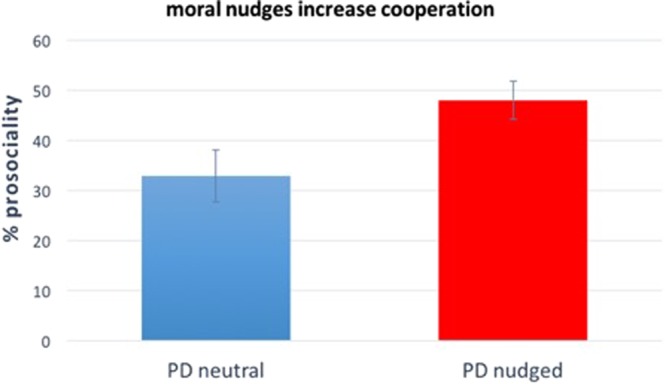
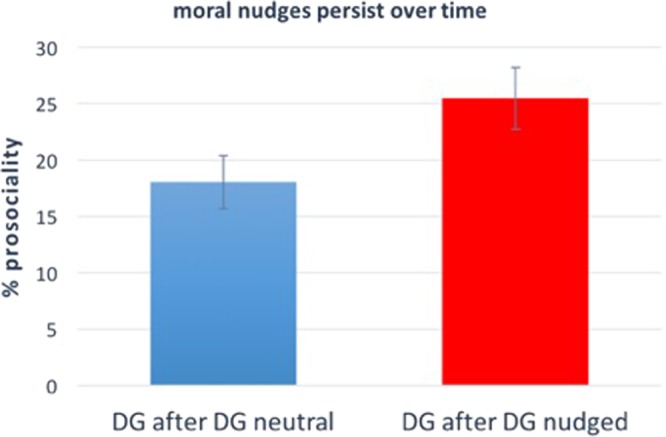
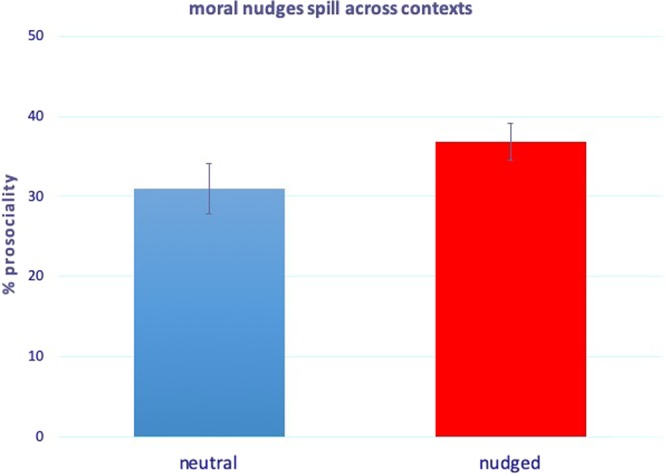
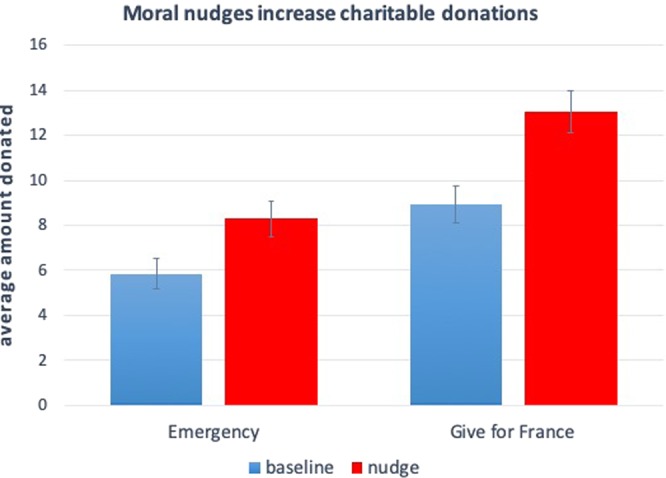
The conflict between pro-self and pro-social behaviour is at the core of many key problems of our time, as, for example, the reduction of air pollution and the redistribution of scarce resources. For the well-being of our societies, it is thus crucial to find mechanisms to promote pro-social choices over egoistic ones. Particularly important, because cheap and easy to implement, are those mechanisms that can change people’s behaviour without forbidding any options or significantly changing their economic incentives, the so-called “nudges”. Previous research has found that moral nudges (e.g., making norms salient) can promote pro-social behaviour. However, little is known about whether their effect persists over time and spills across context. This question is key in light of research showing that pro-social actions are often followed by selfish actions, thus suggesting that some moral manipulations may backfire. Here we present a class of simple moral nudges that have a great positive impact on pro-sociality. In Studies 1–4 (total N = 1,400), we use economic games to demonstrate that asking subjects to self-report “what they think is the morally right thing to do” does not only increase pro-sociality in the choice immediately after, but also in subsequent choices, and even when the social context changes. In Study 5, we explore whether moral nudges promote charity donations to humanitarian organisations in a large (N = 1,800) crowdfunding campaign. We find that, in this context, moral nudges increase donations by about 44 percent.
Overview
The claims and statistics of this paper haven’t been checked yet.
Run the check — free, no account needed. It reads the open-access text and checks the sources it cites.
Integrity signals
Registry
Cites
Statistics
Figures
Verification
Claims the paper makes
The claims and statistics of this paper haven’t been checked yet.
Run the check — free, no account needed. It reads the open-access text and checks the sources it cites.
Claims other papers make about this one
Each is checked against this paper’s own text: does it say what the citing paper says it does?
The cited source says what the claim attributes to it.
In the citing paper
“Providing cues that make the morality of an action salient (such as having people read the Golden Rule before making a decision or asking them to report what they think is the morally right thing to do) have also been shown to increase cooperation 189,190 .”
From Using social and behavioural science to support COVID-19 pandemic response (2020) · cites this paper as [190]
Self-check
Percentages, sums and reported differences re-computed from the paper’s own numbers.
The self-check needs the paper’s full text.
Citations
Cites
Tversky, A., & Kahneman, D. (1974) · Science · doi:10.1126/science.185.4157.1124 · Cited by 28,810
Judgment under Uncertainty: Heuristics and Biases
Tversky, A., & Kahneman, D. (1975) · Utility, Probability, and Human Decision Making · doi:10.1007/978-94-010-1834-0_8 · Cited by 22,650
Nudge: improving decisions about health, wealth, and happiness
(2008) · Choice Reviews Online · doi:10.5860/choice.46-0977 · Cited by 11,624
A Theory of Fairness, Competition, and Cooperation
Fehr, E., & Schmidt, K. M. (1999) · The Quarterly Journal of Economics · doi:10.1162/003355399556151 · Cited by 11,264
The Evolution of Reciprocal Altruism
Trivers, R. L. (1971) · The Quarterly Review of Biology · doi:10.1086/406755 · Cited by 11,010
Five Rules for the Evolution of Cooperation
Nowak, M. A. (2006) · Science · doi:10.1126/science.1133755 · Cited by 5,894
Altruistic punishment in humans
Fehr, E., & Gächter, S. (2002) · Nature · doi:10.1038/415137a · Cited by 5,616
ERC: A Theory of Equity, Reciprocity, and Competition
Bolton, G. E., & Ockenfels, A. (2000) · American Economic Review · doi:10.1257/aer.90.1.166 · Cited by 5,399
Normative Influences on Altruism
Schwartz, S. H. (1977) · Advances in Experimental Social Psychology · doi:10.1016/s0065-2601(08)60358-5 · Cited by 5,364
Cooperation and Punishment in Public Goods Experiments
Fehr, E., & Gächter, S. (2000) · American Economic Review · doi:10.1257/aer.90.4.980 · Cited by 4,547
Research works printed but not linked: 1
- Dennis, S. A., Goodson, B. M., & Pearson, C. Virtual private servers and the limitations of IP-based screening procedures: Lessons from the MTurk Quality Crisis of 2018. Available at SSRN, https://ssrn.com/abstract=3233954 (2019) (Date of last access: 28/05/2019).
Cited by
Sorted by citations
Items 101–136 of 136
Zhu, L., Jia, W., & Li, Y. (2026) · Applied Mathematics and Computation · doi:10.1016/j.amc.2026.130222 · Cited by 1
What's Behind Image? Toward a Better Understanding of Image-Driven Behavior
Regner, T. (2021) · Frontiers in Psychology · doi:10.3389/fpsyg.2021.614575 · Cited by 3
Development and validation of the prosocial conformity tendency scale in adolescents
Xu, Y., Zhao, X., Yu, D., & Xu, H. (2024) · Personality and Individual Differences · doi:10.1016/j.paid.2024.112932 · Cited by 1
The inevitability argument for choice architecture and the evidence-based view
Ivanković, V., & Moles, A. (2025) · Behavioural Public Policy · doi:10.1017/bpp.2025.1 · Cited by 1
Sabato, H. (2025) · PLoS ONE · doi:10.1371/journal.pone.0321547 · Cited by 1
It Takes Two to Tango: Nudging Cooperative Behavior with a Proverb
Hassan, N. A. (2025) · Review of Law & Economics · doi:10.1515/rle-2024-0054 · Cited by 1
Luccasen, R. A., & Thomas, M. K. (2025) · Oxford Bulletin of Economics and Statistics · doi:10.1111/obes.70017 · Cited by 1
The evolution of strongly-held group identities through agent-based cooperation
Whitaker, R. M., Colombo, G. B., & Dunham, Y. C. (2021) · Scientific Reports · doi:10.1038/s41598-021-91333-w · Cited by 2
The More the Better? – Synergies of Prosocial Interventions and Effects on Behavioural SpilloversPreprint
Alt, M., Bruns, H., & Valle, N. D. (2023) · SSRN Electronic Journal · doi:10.2139/ssrn.4492487 · Cited by 1
Igersheim, H., & Lefèbvre, M. (2024) · Archimedes · doi:10.1007/978-3-031-58505-0_7 · Cited by 1
Moral Suasion in 2 Clement and the early Christian ChurchPreprint
Crego, D., & Salter, A. W. (2024) · SSRN Electronic Journal · doi:10.2139/ssrn.5022563 · Cited by 1
Engelen, B. (2022) · Wiley eBooks · doi:10.1002/9781444367072.wbiee972
Sijtsma, H. (2023) · doi:10.5463/thesis.49
Zhang, W., Zhu, X., Guan, H., & Li, T. (2023) · Behavioral Sciences · doi:10.3390/bs13050366
What’s the Net Benefit of a Nudge? Prosocial Defaults Affect Both Targeted and Subsequent BehaviourPreprint
Hedesström, M., Luke, T. J., Michaelsen, P., Nyström, L., & Johansson, L. (2023) · PsyArXiv (OSF Preprints) · doi:10.31234/osf.io/dq9em
#WouldYouBetOnIt - A cognitive approach to combat "fake news"Preprint
Hamburger, K., Schwarz, M., Arnold, K. U., Feldmann, F., Castañeda, L. E. G., Jakob, S., Kania, W., Makhlouf, K., & Contributors, A. (2024) · doi:10.31234/osf.io/ghvkj
Capraro, V. (2024) · doi:10.31234/osf.io/zbx4s
Self-citationPromoting civil discourse on social media using nudges: A tournament of seven interventionsPreprint
Celadin, T., Panizza, F., & Capraro, V. (2024) · doi:10.31234/osf.io/qsbrd
Self-citationPromoting Civil Discourse on Social Media Using Nudges: A Tournament of Seven InterventionsPreprint
Celadin, T., Panizza, F., & Capraro, V. (2024) · SSRN Electronic Journal · doi:10.2139/ssrn.4776172
Self-citationCapraro, V. (2024) · SSRN Electronic Journal · doi:10.2139/ssrn.4769363
Self-citationIrrationality and Immorality: Exploring the Ethical Dimensions of Behavioral Public PolicyPreprint
Hortal, A. (2024) · SSRN Electronic Journal · doi:10.2139/ssrn.4779807
Efficacious methods of restraining COVID-19 through behavioral public policy
Управителев, А. А. (2023) · Journal of the New Economic Association · doi:10.31737/22212264_2023_4_203-222
Lira, C. D., Broschat, S. L., Adesope, O., & Hundhausen, C. D. (2025) · ACM Transactions on Computing Education · doi:10.1145/3746460
Partial ignorance: Strategies for coping with inconvenient information
Amasino, D. R., & Leib, M. (2025) · Current Opinion in Psychology · doi:10.1016/j.copsyc.2025.102106
Conflito Judicial em Organizações: uma Revisão Bibliométrica
Arruda, G. P., Simoes, M. D. P., de Medeiros, J. F., & Camilo, S. P. O. (2025) · Revista de Gestão e Secretariado (Management and Administrative Professional Review) · doi:10.7769/gesec.v16i10.5276
Divided We Act: The Role of Social Sanctions in a Polarized World
Dimant, E., Gelfand, M. J., Hochleitner, A., & Sonderegger, S. (2026) · CESifo · doi:10.65864/qm9asidtr3
For God, Family, and Country: The Moral Power of Authorities
Falco, P., Lesseri, G., Ngasamiaku, W. M., Ruhinduka, R., & Zaccagni, S. (2025) · The World Bank Economic Review · doi:10.1093/wber/lhaf027
The Hedonic Penalty in Supporting Low‐Income Consumers' Needs
Rafieian, H., Aggarwal, A., Hamerman, E. J., & Zheng, Q. D. (2025) · Journal of Consumer Affairs · doi:10.1111/joca.70028
Candelo, N., Gu, J., & Li, S. X. (2026) · Journal of Development Economics · doi:10.1016/j.jdeveco.2026.103750
From Brain Maps to Behavioral Governance
Quintana, S. C. (2026) · Advances in computational intelligence and robotics book series · doi:10.4018/979-8-3373-4480-5.ch009
Social Norms and Trust Levels among Refugees and Swiss Natives : A Behavioral Economics Approach
Baumgartner, S. (2024) · theses.fr (ABES) · doi:10.51363/unifr.eth.2024.018
Opportunity cost in monetary donation decisions to non-identified and identified victimsPreprint
Erlandsson, A., Västfjäll, D., & Moche, H. (2022) · OSF Preprints (OSF Preprints)
Agentic Artificial Intelligence and Social-Emotional Development in Education
Romeo, G., Conti, D., & Nuovo, S. D. (2026) · Advances in computational intelligence and robotics book series · doi:10.4018/979-8-3373-6471-1.ch004
Emphasizing society's expectations enhances charitable giving in NGO advertisements
Tanaka, T., Nihonsugi, T., & Haruno, M. (2026) · PNAS Nexus · doi:10.1093/pnasnexus/pgag206
Long-term morality effects of behavioral interventions in networks
Gråd, E., Rapanos, T., Swain, R. B., & Ranganathan, S. (2026) · International Journal of Game Theory · doi:10.1007/s00182-026-01005-0
Informational Nudging and Collective Cooperation under Flood Risk: An Agent-Based Study
Sapienza, A., Fabio Paglieri, A., Marini, M., Munini, S., Gerna, A., & Falcone, R. (2026) · International Conference on Distributed Computing in Smart Systems and the Internet of Things (DCOSS-IoT) · doi:10.1109/dcoss-iot69657.2026.00133
Metadata
- Authors
- Capraro, V., Jagfeld, G., Klein, R., Mul, M., & de Pol, I. V.
- Affiliations
- Middlesex University London (GB)
- University of Stuttgart (DE)
- University of Amsterdam (NL)
- Corresponding author
- Capraro, Valerio
- Venue
- Scientific Reports
- Published
- 2019-08-15
- Volume
- 9
- Issue
- 1
- Pages
- 11880-11880
- ISSN
- 2045-2322 (ISSN-L)
- PMC
- PMC6695418
- OpenAlex
- W2968470688
- Cited by
- 135
- References
- 106
- Citations by year
- 2026: 9 · 2025: 18 · 2024: 27 · 2023: 19 · 2022: 20 · 2021: 19 · 2020: 21 · 2019: 2
- FWCI
- 27.12
- Type
- journal article
- Language
- en
- Open access
- gold
- doi.org
- Locations
- Scientific Reports (publishedVersion, cc-by)
- Europe PMC (PubMed Central) (publishedVersion, cc-by)
- PubMed Central (publishedVersion, cc-by)
- PubMed (publishedVersion)
- Middlesex University Research Repository (Middlesex University Of London) (acceptedVersion)
- BOA (University of Milano-Bicocca) (submittedVersion)
- DOAJ (DOAJ: Directory of Open Access Journals) (submittedVersion)
- Topics
- Social Sciences › Economics, Econometrics and Finance › Economics and Econometrics › Experimental Behavioral Economics Studies
- Social Sciences › Decision Sciences › General Decision Sciences › Decision-Making and Behavioral Economics
- Social Sciences › Psychology › Social Psychology › Psychology of Social Influence
- Keywords
- prosocial behavior, altruism, cooperation, spillover effects, backfire effect, charitable giving, crowdfunding, humanitarian organizations, economic games
- MeSH terms
- Altruism, Choice Behavior, Cooperative Behavior, Decision Making, Games, Experimental, Humans, Morals, Social Behavior, Social Environment
About these checks
Registry, retraction, Cites and statistics results are computed, not judged, with one exception: a printed reference that no index lists is read once by a model before it counts as a citation error. Claims are extracted by a model and kept only when their quote appears verbatim in the text; each cited source is then checked, with a model’s help, for whether it says what the claim relies on. Those verdicts can be wrong — read the claim’s quote and the cited source before relying on one.
Statistics and arithmetic are recomputed, not judged.
Confidence bands are shown only for fields calibrated on our annotated test set. None is calibrated yet, so no band is shown.
What counts as a claim ›How we measure confidence ›How we check this ›
Are you an author, or do you see a problem with this page? Request a review
