

The DOI matches its Crossref record; 107 of the 107 references it cites were found in a registry or an index.
Increasing altruistic and cooperative behaviour with simple moral nudges
Open accessAbstract
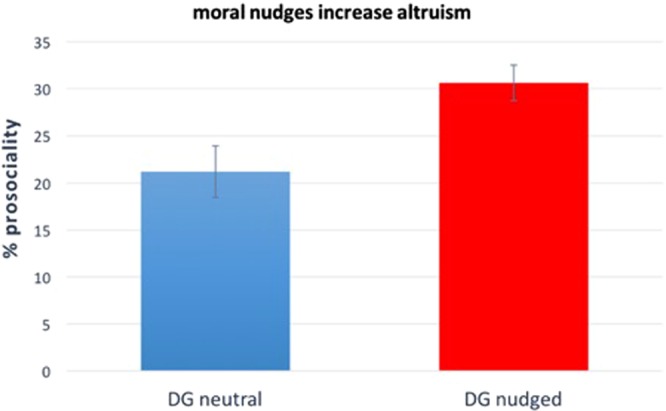
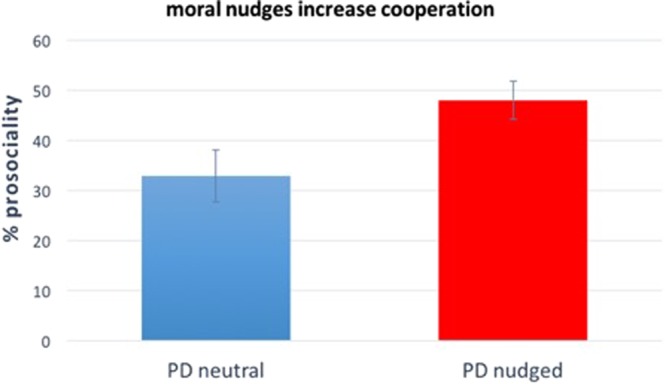
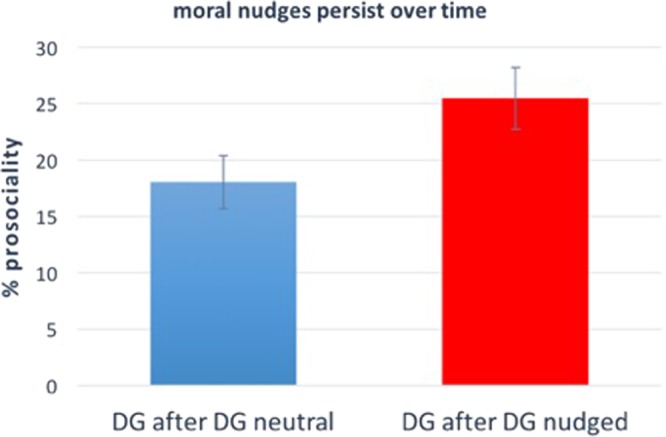
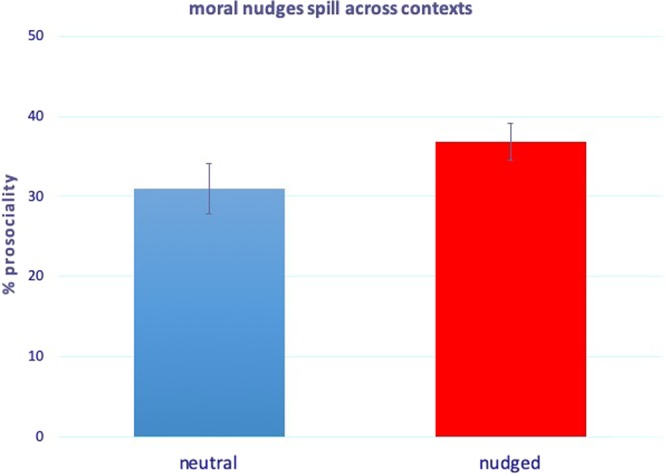
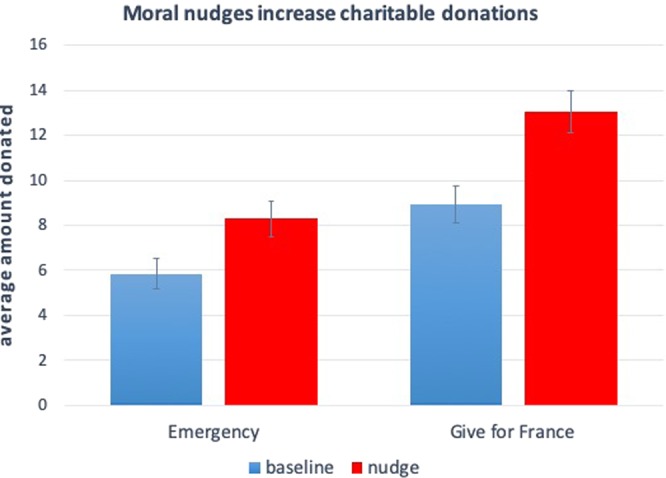
The conflict between pro-self and pro-social behaviour is at the core of many key problems of our time, as, for example, the reduction of air pollution and the redistribution of scarce resources. For the well-being of our societies, it is thus crucial to find mechanisms to promote pro-social choices over egoistic ones. Particularly important, because cheap and easy to implement, are those mechanisms that can change people’s behaviour without forbidding any options or significantly changing their economic incentives, the so-called “nudges”. Previous research has found that moral nudges (e.g., making norms salient) can promote pro-social behaviour. However, little is known about whether their effect persists over time and spills across context. This question is key in light of research showing that pro-social actions are often followed by selfish actions, thus suggesting that some moral manipulations may backfire. Here we present a class of simple moral nudges that have a great positive impact on pro-sociality. In Studies 1–4 (total N = 1,400), we use economic games to demonstrate that asking subjects to self-report “what they think is the morally right thing to do” does not only increase pro-sociality in the choice immediately after, but also in subsequent choices, and even when the social context changes. In Study 5, we explore whether moral nudges promote charity donations to humanitarian organisations in a large (N = 1,800) crowdfunding campaign. We find that, in this context, moral nudges increase donations by about 44 percent.
Overview
The claims and statistics of this paper haven’t been checked yet.
Run the check — free, no account needed. It reads the open-access text and checks the sources it cites.
Integrity signals
Registry
Cites
Statistics
Figures
Verification
Claims the paper makes
The claims and statistics of this paper haven’t been checked yet.
Run the check — free, no account needed. It reads the open-access text and checks the sources it cites.
Claims other papers make about this one
Each is checked against this paper’s own text: does it say what the citing paper says it does?
The cited source says what the claim attributes to it.
In the citing paper
“Providing cues that make the morality of an action salient (such as having people read the Golden Rule before making a decision or asking them to report what they think is the morally right thing to do) have also been shown to increase cooperation 189,190 .”
From Using social and behavioural science to support COVID-19 pandemic response (2020) · cites this paper as [190]
Self-check
Percentages, sums and reported differences re-computed from the paper’s own numbers.
The self-check needs the paper’s full text.
Citations
Cites
Tversky, A., & Kahneman, D. (1974) · Science · doi:10.1126/science.185.4157.1124 · Cited by 28,810
Judgment under Uncertainty: Heuristics and Biases
Tversky, A., & Kahneman, D. (1975) · Utility, Probability, and Human Decision Making · doi:10.1007/978-94-010-1834-0_8 · Cited by 22,650
Nudge: improving decisions about health, wealth, and happiness
(2008) · Choice Reviews Online · doi:10.5860/choice.46-0977 · Cited by 11,624
A Theory of Fairness, Competition, and Cooperation
Fehr, E., & Schmidt, K. M. (1999) · The Quarterly Journal of Economics · doi:10.1162/003355399556151 · Cited by 11,264
The Evolution of Reciprocal Altruism
Trivers, R. L. (1971) · The Quarterly Review of Biology · doi:10.1086/406755 · Cited by 11,010
Five Rules for the Evolution of Cooperation
Nowak, M. A. (2006) · Science · doi:10.1126/science.1133755 · Cited by 5,894
Altruistic punishment in humans
Fehr, E., & Gächter, S. (2002) · Nature · doi:10.1038/415137a · Cited by 5,616
ERC: A Theory of Equity, Reciprocity, and Competition
Bolton, G. E., & Ockenfels, A. (2000) · American Economic Review · doi:10.1257/aer.90.1.166 · Cited by 5,399
Normative Influences on Altruism
Schwartz, S. H. (1977) · Advances in Experimental Social Psychology · doi:10.1016/s0065-2601(08)60358-5 · Cited by 5,364
Cooperation and Punishment in Public Goods Experiments
Fehr, E., & Gächter, S. (2000) · American Economic Review · doi:10.1257/aer.90.4.980 · Cited by 4,547
Evaluating Online Labor Markets for Experimental Research: Amazon.com's Mechanical Turk
Berinsky, A. J., Huber, G. A., & Lenz, G. S. (2012) · Political Analysis · doi:10.1093/pan/mpr057 · Cited by 4,008
Understanding Social Preferences with Simple Tests
Charness, G., & Rabin, M. (2002) · The Quarterly Journal of Economics · doi:10.1162/003355302760193904 · Cited by 3,970
Running experiments on Amazon Mechanical Turk
Paolacci, G., Chandler, J., & Ipeirotis, P. G. (2010) · Judgment and Decision Making · doi:10.1017/s1930297500002205 · Cited by 3,767
Conducting behavioral research on Amazon’s Mechanical Turk
Mason, W., & Suri, S. (2012) · Behavior Research Methods · doi:10.3758/s13428-011-0124-6 · Cited by 3,172
Cialdini, R. B., Kallgren, C. A., & Reno, R. R. (1991) · Advances in Experimental Social Psychology · doi:10.1016/s0065-2601(08)60330-5 · Cited by 3,143
The Dishonesty of Honest People: A Theory of Self-Concept Maintenance
Mazar, N., Amir, O., & Ariely, D. (2008) · Journal of Marketing Research · doi:10.1509/jmkr.45.6.633 · Cited by 2,875
Data collection in a flat world: the strengths and weaknesses of Mechanical Turk samples
Goodman, J. K., Cryder, C. E., & Cheema, A. (2013) · Journal of Behavioral Decision Making · doi:10.1002/bdm.1753 · Cited by 2,242
Inside the Turk: Understanding Mechanical Turk as a Participant Pool
Paolacci, G., & Chandler, J. (2014) · Current Directions in Psychological Science · doi:10.1177/0963721414531598 · Cited by 2,136
Thaler, R. H., & Sunstein, C. R. (2003) · American Economic Review · doi:10.1257/000282803321947001 · Cited by 1,874
Doing Good or Doing Well? Image Motivation and Monetary Incentives in Behaving Prosocially
Ariely, D., Bracha, A., & Meier, S. (2009) · American Economic Review · doi:10.1257/aer.99.1.544 · Cited by 1,753
Statistical physics of human cooperation
Perc, M., Jordan, J., Rand, D. G., Wang, Z., Boccaletti, S., & Szolnoki, A. (2017) · Physics Reports · doi:10.1016/j.physrep.2017.05.004 · Cited by 1,599
Punishment allows the evolution of cooperation (or anything else) in sizable groups
Boyd, R., & Richerson, P. J. (1992) · Ethology and Sociobiology · doi:10.1016/0162-3095(92)90032-y · Cited by 1,482
The Online Laboratory: Conducting Experiments in a Real Labor Market∗Preprint
Zeckhauser, R. J. (2016) · Cited by 1,454
Reputation helps solve the ‘tragedy of the commons’
Milinski, M., Semmann, D., & Krambeck, H.-J. (2002) · Nature · doi:10.1038/415424a · Cited by 1,371
Allcott, H., & Rogers, T. (2014) · American Economic Review · doi:10.1257/aer.104.10.3003 · Cited by 1,340
Rand, D. G., & Nowak, M. A. (2013) · Trends in Cognitive Sciences · doi:10.1016/j.tics.2013.06.003 · Cited by 1,308
Experimenter demand effects in economic experiments
Zizzo, D. J. (2010) · Experimental Economics · doi:10.1007/s10683-009-9230-z · Cited by 1,194
Social Comparisons and Pro-social Behavior: Testing “Conditional Cooperation” in a Field Experiment
Frey, B. S., & Meier, S. (2004) · American Economic Review · doi:10.1257/0002828043052187 · Cited by 1,184
Moral Self‐Licensing: When Being Good Frees Us to Be Bad
Merritt, A. C., Effron, D. A., & Monin, B. (2010) · Social and Personality Psychology Compass · doi:10.1111/j.1751-9004.2010.00263.x · Cited by 1,139
Moral credentials and the expression of prejudice.
Monin, B., & Miller, D. T. (2001) · Journal of Personality and Social Psychology · doi:10.1037/0022-3514.81.1.33 · Cited by 1,086
Explaining altruistic behavior in humans
Gintis, H., Bowles, S., Boyd, R., & Fehr, E. (2003) · Evolution and Human Behavior · doi:10.1016/s1090-5138(02)00157-5 · Cited by 1,037
IDENTIFYING SOCIAL NORMS USING COORDINATION GAMES: WHY DOES DICTATOR GAME SHARING VARY?
Krupka, E. L., & Weber, R. A. (2013) · Journal of the European Economic Association · doi:10.1111/jeea.12006 · Cited by 1,020
The Competitive Advantage of Sanctioning Institutions
Gürerk, O., Irlenbusch, B., & Rockenbach, B. (2006) · Science · doi:10.1126/science.1123633 · Cited by 997
Do Green Products Make Us Better People?
Mažar, N., & Zhong, C. (2010) · Psychological Science · doi:10.1177/0956797610363538 · Cited by 942
Indirect reciprocity can stabilize cooperation without the second-order free rider problem
Panchanathan, K., & Boyd, R. (2004) · Nature · doi:10.1038/nature02978 · Cited by 865
Sinning Saints and Saintly Sinners
Sachdeva, S. S., Iliev, R. I., & Medin, D. L. (2009) · Psychological Science · doi:10.1111/j.1467-9280.2009.02326.x · Cited by 777
Uri Gneezy, B., & List, J. A. (2006) · Econometrica · doi:10.1111/j.1468-0262.2006.00707.x · Cited by 689
A Meta-Analytic Review of Moral Licensing
Blanken, I., van de Ven, N., & Zeelenberg, M. (2015) · Personality and Social Psychology Bulletin · doi:10.1177/0146167215572134 · Cited by 685
THE EFFECT OF REWARDS AND SANCTIONS IN PROVISION OF PUBLIC GOODS
Sefton, M., Shupp, R., & Walker, J. M. (2007) · Economic Inquiry · doi:10.1111/j.1465-7295.2007.00051.x · Cited by 649
Using Nonpecuniary Strategies to Influence Behavior: Evidence from a Large-Scale Field Experiment
Ferraro, P. J., & Price, M. (2013) · The Review of Economics and Statistics · doi:10.1162/rest_a_00344 · Cited by 631
An economic model of moral motivation
Brekke, K. A., Kverndokk, S., & Nyborg, K. (2003) · Journal of Public Economics · doi:10.1016/s0047-2727(01)00222-5 · Cited by 615
The Carrot or the Stick: Rewards, Punishments, and Cooperation
Andreoni, J., Harbaugh, W. T., & Vesterlund, L. (2003) · American Economic Review · doi:10.1257/000282803322157142 · Cited by 608
Does Price Matter in Charitable Giving? Evidence from a Large-Scale Natural Field Experiment
Karlan, D., & List, J. A. (2007) · American Economic Review · doi:10.1257/aer.97.5.1774 · Cited by 519
The efficient interaction of indirect reciprocity and costly punishment
Rockenbach, B., & Milinski, M. (2006) · Nature · doi:10.1038/nature05229 · Cited by 501
Avoiding the Ask: A Field Experiment on Altruism, Empathy, and Charitable Giving
James Andreoni, A., Rao, J. M., & Trachtman, H. (2017) · Journal of Political Economy · doi:10.1086/691703 · Cited by 495
Striving for the Moral Self: The Effects of Recalling Past Moral Actions on Future Moral Behavior
Jordan, J., Mullen, E., & Murnighan, J. K. (2011) · Personality and Social Psychology Bulletin · doi:10.1177/0146167211400208 · Cited by 484
Public Finance and Public Policy
Hillman, A. L. (2009) · Cambridge University Press eBooks · doi:10.1017/9781316479780 · Cited by 479
(2014) · Digital Access to Scholarship at Harvard (DASH) (Harvard University) · Cited by 464
Do people behave in experiments as in the field?—evidence from donations
Benz, M., & Meier, S. (2008) · Experimental Economics · doi:10.1007/s10683-007-9192-y · Cited by 428
Humans display a ‘cooperative phenotype’ that is domain general and temporally stable
Peysakhovich, A., Nowak, M. A., & Rand, D. G. (2014) · Nature Communications · doi:10.1038/ncomms5939 · Cited by 426
Toward an Understanding of the Economics of Charity: Evidence from a Field Experiment
Landry, C. E., Lange, A., List, J. A., Price, M., & Rupp, N. G. (2006) · The Quarterly Journal of Economics · doi:10.1162/qjec.2006.121.2.747 · Cited by 408
Kimbrough, E. O., & Vostroknutov, A. (2015) · Journal of the European Economic Association · doi:10.1111/jeea.12152 · Cited by 406
Ferraro, P. J., Miranda, J. J., & Price, M. (2011) · American Economic Review · doi:10.1257/aer.101.3.318 · Cited by 393
Milinski, M., Semmann, D., Krambeck, H.-J., & Marotzke, J. (2006) · Proceedings of the National Academy of Sciences · doi:10.1073/pnas.0504902103 · Cited by 389
Effects of eye images on everyday cooperative behavior: a field experiment
Ernest-Jones, M., Nettle, D., & Melissa Bateson, B. (2010) · Evolution and Human Behavior · doi:10.1016/j.evolhumbehav.2010.10.006 · Cited by 384
Falk, A. (2007) · Econometrica · doi:10.1111/j.1468-0262.2007.00800.x · Cited by 384
Homo Moralis--Preference Evolution Under Incomplete Information and Assortative Matching
Alger, I., & Weibull, J. W. (2013) · Econometrica · doi:10.3982/ecta10637 · Cited by 372
Economic games on the internet: the effect of $1 stakes
Amir, O., Rand, D. G., & Gal, Y. K. (2012) · PLoS ONE · doi:10.1371/journal.pone.0031461 · Cited by 364
Paying to Be Nice: Consistency and Costly Prosocial Behavior
Gneezy, A., Imas, A., Brown, A., Nelson, L. D., & Norton, M. I. (2011) · Management Science · doi:10.1287/mnsc.1110.1437 · Cited by 349
Social heuristics and social roles: Intuition favors altruism for women but not for men.
Rand, D. G., Brescoll, V. L., Everett, J. A. C., Capraro, V., & Barcelo, H. (2016) · Journal of Experimental Psychology General · doi:10.1037/xge0000154 · Cited by 345
Self-citationAvoiding overhead aversion in charity
Uri Gneezy, B., Keenan, E. A., & Gneezy, A. (2014) · Science · doi:10.1126/science.1253932 · Cited by 340
Do Subsidies Increase Charitable Giving in the Long Run? Matching Donations in a Field Experiment
Meier, S. (2007) · Journal of the European Economic Association · doi:10.1162/jeea.2007.5.6.1203 · Cited by 320
A field study on cooperativeness and impatience in the Tragedy of the Commons
Fehr, E., & Leibbrandt, A. (2011) · Journal of Public Economics · doi:10.1016/j.jpubeco.2011.05.013 · Cited by 313
Habits of Virtue: Creating Norms of Cooperation and Defection in the Laboratory
Peysakhovich, A., & Rand, D. G. (2013) · Management Science · doi:10.1287/mnsc.2015.2168 · Cited by 310
On the External Validity of Social Preference Games: A Systematic Lab-Field Study
Galizzi, M. M., & Navarro‐Martinez, D. (2018) · Management Science · doi:10.1287/mnsc.2017.2908 · Cited by 291
Powering up with indirect reciprocity in a large-scale field experiment
Yoeli, E., Hoffman, M., Rand, D. G., & Nowak, M. A. (2013) · Proceedings of the National Academy of Sciences · doi:10.1073/pnas.1301210110 · Cited by 285
Brandts, J., & Cooper, D. J. (2006) · American Economic Review · doi:10.1257/aer.96.3.669 · Cited by 282
Phase transitions in models of human cooperation
Perc, M. (2016) · Physics Letters A · doi:10.1016/j.physleta.2016.06.017 · Cited by 277
Experimental subjects are not different
Exadaktylos, F., Espín, A. M., & Brañas‐Garza, P. (2013) · Scientific Reports · doi:10.1038/srep01213 · Cited by 267
Motivating voter turnout by invoking the self
Bryan, C. J., Walton, G. M., Rogers, T., & Dweck, C. S. (2011) · Proceedings of the National Academy of Sciences · doi:10.1073/pnas.1103343108 · Cited by 246
Gender differences in altruism on Mechanical Turk: Expectations and actual behaviour
Brañas‐Garza, P., Capraro, V., & Ramirez, E. G. R. (2018) · Economics Letters · doi:10.1016/j.econlet.2018.05.022 · Cited by 233
Self-citationPublic Finance and Public Policy: Responsibilities and Limitations of Government
Hillman, A. L. (2003) · Cited by 229
How is donation behaviour affected by the donations of others?
Martin, R., & Randal, J. (2007) · Journal of Economic Behavior & Organization · doi:10.1016/j.jebo.2007.08.001 · Cited by 200
Capraro, V., & Rand, D. G. (2017) · Judgment and Decision Making · doi:10.1017/s1930297500008858 · Cited by 191
Self-citationDennis, S. A., Goodson, B. M., & Pearson, C. A. (2019) · Behavioral Research in Accounting · doi:10.2308/bria-18-044 · Cited by 188
Incentives and opportunism: from the carrot to the stick
Hilbe, C., & Sigmund, K. (2010) · Proceedings of the Royal Society B Biological Sciences · doi:10.1098/rspb.2010.0065 · Cited by 187
Using Nonnaive Participants Can Reduce Effect Sizes
Chandler, J., Paolacci, G., Peer, E., Mueller, P., & Ratliff, K. A. (2015) · Psychological Science · doi:10.1177/0956797615585115 · Cited by 185
Promoting helping behavior with framing in dictator games
Brañas‐Garza, P. (2006) · Journal of Economic Psychology · doi:10.1016/j.joep.2006.10.001 · Cited by 182
Promoting cooperation in the field
Kraft-Todd, G., Yoeli, E., Bhanot, S., & Rand, D. (2015) · Current Opinion in Behavioral Sciences · doi:10.1016/j.cobeha.2015.02.006 · Cited by 178
Do watching eyes affect charitable giving? Evidence from a field experiment
Ekström, M. (2011) · Experimental Economics · doi:10.1007/s10683-011-9312-6 · Cited by 173
The external validity of giving in the dictator game
Franzén, A., & Pointner, S. (2012) · Experimental Economics · doi:10.1007/s10683-012-9337-5 · Cited by 171
Conscience Accounting: Emotion Dynamics and Social Behavior
Uri Gneezy, B., Imas, A., & Madarász, K. (2014) · Management Science · doi:10.1287/mnsc.2014.1942 · Cited by 164
Heuristics guide the implementation of social preferences in one-shot Prisoner's Dilemma experiments
Capraro, V., Jordan, J., & Rand, D. G. (2014) · Scientific Reports · doi:10.1038/srep06790 · Cited by 159
Self-citation“Do the right thing:” The effects of moral suasion on cooperation
Dal Bó, E., & Dal Bó, P. (2014) · Journal of Public Economics · doi:10.1016/j.jpubeco.2014.05.002 · Cited by 157
Knez, M., & Camerer, C. F. (2000) · Organizational Behavior and Human Decision Processes · doi:10.1006/obhd.2000.2882 · Cited by 155
Matching and challenge gifts to charity: evidence from laboratory and natural field experiments
Rondeau, D., & List, J. A. (2008) · Experimental Economics · doi:10.1007/s10683-007-9190-0 · Cited by 153
A Model of Human Cooperation in Social Dilemmas
Capraro, V. (2013) · PLoS ONE · doi:10.1371/journal.pone.0072427 · Cited by 149
Self-citationStake size effects in ultimatum game and dictator game offers: A meta-analysis
Larney, A., Rotella, A., & Barclay, P. (2019) · Organizational Behavior and Human Decision Processes · doi:10.1016/j.obhdp.2019.01.002 · Cited by 143
Collective Action in Action: Prosocial Behavior in and out of the Laboratory
Gurven, M., & Winking, J. (2008) · American Anthropologist · doi:10.1111/j.1548-1433.2008.00024.x · Cited by 133
Natural-field dictator game shows no altruistic giving
Winking, J., & Mizer, N. J. (2013) · Evolution and Human Behavior · doi:10.1016/j.evolhumbehav.2013.04.002 · Cited by 124
Using Nonnaive Participants Can Reduce Effect SizesPreprint
Chandler, J., Paolacci, G., Péer, E., Mueller, P. A., & Ratliff, K. A. (2015) · RePEc: Research Papers in Economics · Cited by 118
Social norms and economic incentives in firms
Huck, S., Kübler, D. F., & Weibull, J. W. (2012) · Journal of Economic Behavior & Organization · doi:10.1016/j.jebo.2012.05.005 · Cited by 117
No margin, no mission? A field experiment on incentives for public service delivery
Ashraf, N., Bandiera, O., & Jack, B. K. (2014) · Journal of Public Economics · doi:10.1016/j.jpubeco.2014.06.014 · Cited by 101
MORAL CLEANSING AND MORAL LICENSES: EXPERIMENTAL EVIDENCE
Brañas‐Garza, P., Bucheli, M., Espinosa, M. P., & García‐Muñoz, T. (2013) · Economics and Philosophy · doi:10.1017/s0266267113000199 · Cited by 99
Tappin, B. M., & Capraro, V. (2018) · Journal of Experimental Social Psychology · doi:10.1016/j.jesp.2018.06.005 · Cited by 98
Self-citationThe power of moral words: Loaded language generates framing effects in the extreme dictator game
Capraro, V., & Vanzo, A. (2019) · Judgment and Decision Making · doi:10.1017/s1930297500004356 · Cited by 89
Self-citationExperimental effects of injunctive norms on simulated risky driving among teenage males.
Simons‐Morton, B. G., Bingham, C. R., Falk, E. B., Li, K., Pradhan, A. K., Ouimet, M. C., Almani, F., & Shope, J. T. (2014) · Health Psychology · doi:10.1037/a0034837 · Cited by 82
Push, don’t nudge: Behavioral spillovers and policy instruments
D’Adda, G., Capraro, V., & Tavoni, M. (2016) · Economics Letters · doi:10.1016/j.econlet.2017.02.029 · Cited by 79
Self-citationBenevolent Characteristics Promote Cooperative Behaviour among Humans
Capraro, V., Smyth, C., Mylona, K., & Niblo, G. A. (2014) · PLoS ONE · doi:10.1371/journal.pone.0102881 · Cited by 70
Self-citationSocial anxiety and alcohol problems: The roles of perceived descriptive and injunctive peer norms
Buckner, J. D., Ecker, A. H., & Proctor, S. L. (2011) · Journal of Anxiety Disorders · doi:10.1016/j.janxdis.2011.02.003 · Cited by 68
Gendered giving: the influence of social norms on the donation behavior of men and women
Croson, R. T. A., Handy, F., & Shang, J. Y. (2009) · International Journal of Nonprofit and Voluntary Sector Marketing · doi:10.1002/nvsm.385 · Cited by 68
Precedent transfer in coordination games: An experiment
Devetag, G. (2005) · Economics Letters · doi:10.1016/j.econlet.2005.05.038 · Cited by 67
Religious Motivations for Cooperation: An Experimental Investigation Using Explicit Primes
Rand, D. G., Dreber, A., Haque, O. S., Kane, R. J., Nowak, M. A., & Coakley, S. (2012) · Religion Brain & Behavior · doi:10.1080/2153599x.2013.775664 · Cited by 60
Partner selection supported by opaque reputation promotes cooperative behavior
Capraro, V., Giardini, F., Vilone, D., & Paolucci, M. (2016) · Judgment and Decision Making · doi:10.1017/s1930297500004800 · Cited by 45
Self-citationSocial dilemmas in the laboratory and in the field
Englmaier, F., & Gebhardt, G. (2016) · Journal of Economic Behavior & Organization · doi:10.1016/j.jebo.2016.03.006 · Cited by 32
Extending the Cooperative Phenotype: Assessing the Stability of Cooperation across Countries
Reigstad, A. G., Strømland, E., & Tinghög, G. (2017) · Frontiers in Psychology · doi:10.3389/fpsyg.2017.01990 · Cited by 26
The online laboratory: conducting experiments in a real labor market
Horton, J. J., Rand, D. G., & Zeckhauser, R. (2011) · Experimental Economics · doi:10.1007/s10683-011-9273-9 · Cited by 9
Research works printed but not linked: 1
- Dennis, S. A., Goodson, B. M., & Pearson, C. Virtual private servers and the limitations of IP-based screening procedures: Lessons from the MTurk Quality Crisis of 2018. Available at SSRN, https://ssrn.com/abstract=3233954 (2019) (Date of last access: 28/05/2019).
Cited by
Sorted by citations
Using social and behavioural science to support COVID-19 pandemic response
Bavel, J. J. V., Baicker, K., Boggio, P. S., Capraro, V., Cichocka, A., Cikara, M., Crockett, M. J., Crum, A. J., Douglas, K. M., Druckman, J. N., et al. (2020) · Nature Human Behaviour · doi:10.1038/s41562-020-0884-z · Cited by 4,964
Self-citationMathematical foundations of moral preferences
Capraro, V., & Perc, M. (2021) · Journal of The Royal Society Interface · doi:10.1098/rsif.2020.0880 · Cited by 337
Self-citationThe evolution of trust and trustworthiness
Kumar, A., Capraro, V., & Perc, M. (2020) · Journal of The Royal Society Interface · doi:10.1098/rsif.2020.0491 · Cited by 148
Self-citationUsing Social and Behavioural Science to Support COVID-19 Pandemic ResponsePreprint
Bavel, J. J. V., D, K. B. A., Boggio, P. S., Capraro, V., Cichocka, A. K., Cikara, M., Crockett, M. J., Crum, A. J., Douglas, K. M., Druckman, J. N., et al. (2022) · SSRN Electronic Journal · doi:10.2139/ssrn.4178356 · Cited by 89
Self-citationFrom Outcome-Based to Language-Based Preferences
Capraro, V., Halpern, J. Y., & Perc, M. (2024) · Journal of Economic Literature · doi:10.1257/jel.20221613 · Cited by 94
Self-citation
Metadata
- Authors
- Capraro, V., Jagfeld, G., Klein, R., Mul, M., & de Pol, I. V.
- Affiliations
- Middlesex University London (GB)
- University of Stuttgart (DE)
- University of Amsterdam (NL)
- Corresponding author
- Capraro, Valerio
- Venue
- Scientific Reports
- Published
- 2019-08-15
- Volume
- 9
- Issue
- 1
- Pages
- 11880-11880
- ISSN
- 2045-2322 (ISSN-L)
- PMC
- PMC6695418
- OpenAlex
- W2968470688
- Cited by
- 135
- References
- 106
- Citations by year
- 2026: 9 · 2025: 18 · 2024: 27 · 2023: 19 · 2022: 20 · 2021: 19 · 2020: 21 · 2019: 2
- FWCI
- 27.12
- Type
- journal article
- Language
- en
- Open access
- gold
- doi.org
- Locations
- Scientific Reports (publishedVersion, cc-by)
- Europe PMC (PubMed Central) (publishedVersion, cc-by)
- PubMed Central (publishedVersion, cc-by)
- PubMed (publishedVersion)
- Middlesex University Research Repository (Middlesex University Of London) (acceptedVersion)
- BOA (University of Milano-Bicocca) (submittedVersion)
- DOAJ (DOAJ: Directory of Open Access Journals) (submittedVersion)
- Topics
- Social Sciences › Economics, Econometrics and Finance › Economics and Econometrics › Experimental Behavioral Economics Studies
- Social Sciences › Decision Sciences › General Decision Sciences › Decision-Making and Behavioral Economics
- Social Sciences › Psychology › Social Psychology › Psychology of Social Influence
- Keywords
- prosocial behavior, altruism, cooperation, spillover effects, backfire effect, charitable giving, crowdfunding, humanitarian organizations, economic games
- MeSH terms
- Altruism, Choice Behavior, Cooperative Behavior, Decision Making, Games, Experimental, Humans, Morals, Social Behavior, Social Environment
About these checks
Registry, retraction, Cites and statistics results are computed, not judged, with one exception: a printed reference that no index lists is read once by a model before it counts as a citation error. Claims are extracted by a model and kept only when their quote appears verbatim in the text; each cited source is then checked, with a model’s help, for whether it says what the claim relies on. Those verdicts can be wrong — read the claim’s quote and the cited source before relying on one.
Statistics and arithmetic are recomputed, not judged.
Confidence bands are shown only for fields calibrated on our annotated test set. None is calibrated yet, so no band is shown.
What counts as a claim ›How we measure confidence ›How we check this ›
Are you an author, or do you see a problem with this page? Request a review
