

The DOI matches its Crossref record; 107 of the 107 references it cites were found in a registry or an index.
Increasing altruistic and cooperative behaviour with simple moral nudges
Open accessAbstract
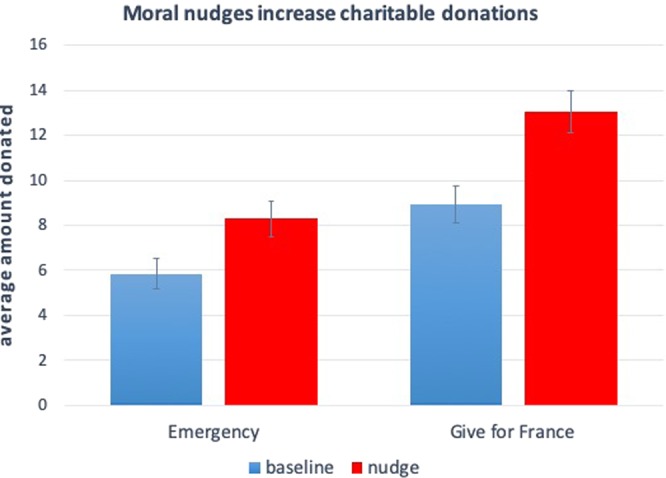
The conflict between pro-self and pro-social behaviour is at the core of many key problems of our time, as, for example, the reduction of air pollution and the redistribution of scarce resources. For the well-being of our societies, it is thus crucial to find mechanisms to promote pro-social choices over egoistic ones. Particularly important, because cheap and easy to implement, are those mechanisms that can change people’s behaviour without forbidding any options or significantly changing their economic incentives, the so-called “nudges”. Previous research has found that moral nudges (e.g., making norms salient) can promote pro-social behaviour. However, little is known about whether their effect persists over time and spills across context. This question is key in light of research showing that pro-social actions are often followed by selfish actions, thus suggesting that some moral manipulations may backfire. Here we present a class of simple moral nudges that have a great positive impact on pro-sociality. In Studies 1–4 (total N = 1,400), we use economic games to demonstrate that asking subjects to self-report “what they think is the morally right thing to do” does not only increase pro-sociality in the choice immediately after, but also in subsequent choices, and even when the social context changes. In Study 5, we explore whether moral nudges promote charity donations to humanitarian organisations in a large (N = 1,800) crowdfunding campaign. We find that, in this context, moral nudges increase donations by about 44 percent.
Overview
The claims and statistics of this paper haven’t been checked yet.
Run the check — free, no account needed. It reads the open-access text and checks the sources it cites.
Integrity signals
Registry
Cites
Statistics
Figures
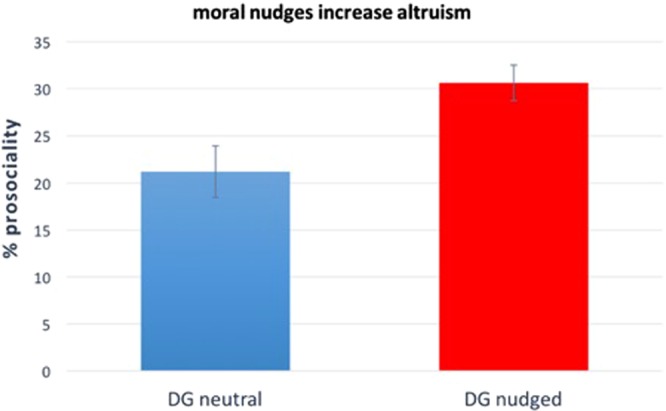
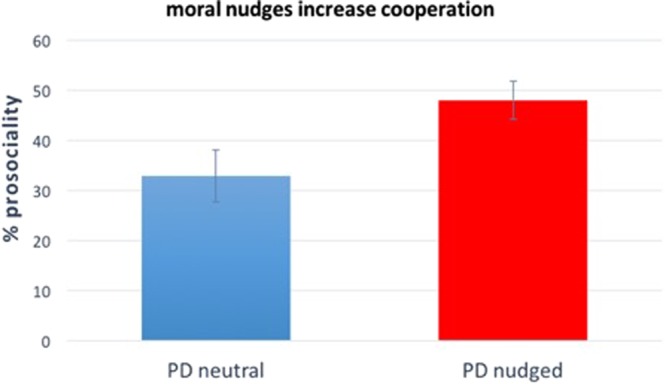
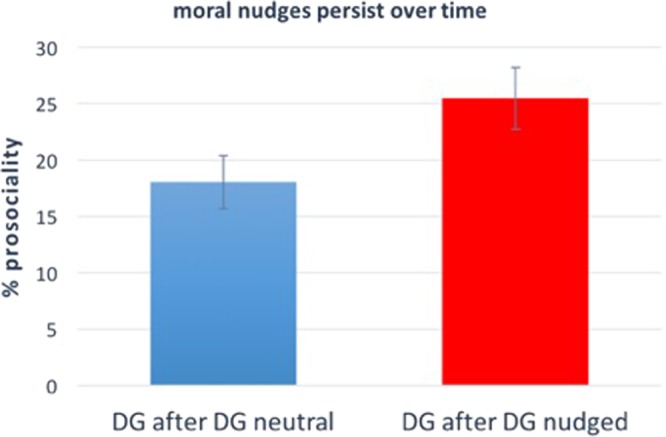
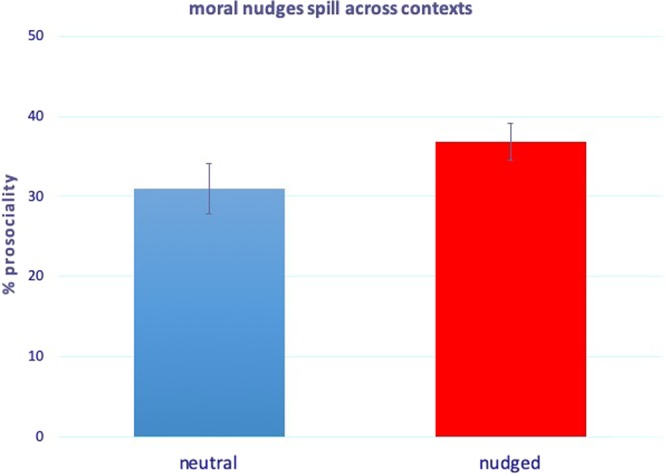
Verification
Claims the paper makes
The claims and statistics of this paper haven’t been checked yet.
Run the check — free, no account needed. It reads the open-access text and checks the sources it cites.
Claims other papers make about this one
Each is checked against this paper’s own text: does it say what the citing paper says it does?
The cited source says what the claim attributes to it.
In the citing paper
“Providing cues that make the morality of an action salient (such as having people read the Golden Rule before making a decision or asking them to report what they think is the morally right thing to do) have also been shown to increase cooperation 189,190 .”
From Using social and behavioural science to support COVID-19 pandemic response (2020) · cites this paper as [190]
Self-check
Percentages, sums and reported differences re-computed from the paper’s own numbers.
The self-check needs the paper’s full text.
Citations
Cites
Tversky, A., & Kahneman, D. (1974) · Science · doi:10.1126/science.185.4157.1124 · Cited by 28,810
Judgment under Uncertainty: Heuristics and Biases
Tversky, A., & Kahneman, D. (1975) · Utility, Probability, and Human Decision Making · doi:10.1007/978-94-010-1834-0_8 · Cited by 22,650
Nudge: improving decisions about health, wealth, and happiness
(2008) · Choice Reviews Online · doi:10.5860/choice.46-0977 · Cited by 11,624
A Theory of Fairness, Competition, and Cooperation
Fehr, E., & Schmidt, K. M. (1999) · The Quarterly Journal of Economics · doi:10.1162/003355399556151 · Cited by 11,264
The Evolution of Reciprocal Altruism
Trivers, R. L. (1971) · The Quarterly Review of Biology · doi:10.1086/406755 · Cited by 11,010
Five Rules for the Evolution of Cooperation
Nowak, M. A. (2006) · Science · doi:10.1126/science.1133755 · Cited by 5,894
Altruistic punishment in humans
Fehr, E., & Gächter, S. (2002) · Nature · doi:10.1038/415137a · Cited by 5,616
ERC: A Theory of Equity, Reciprocity, and Competition
Bolton, G. E., & Ockenfels, A. (2000) · American Economic Review · doi:10.1257/aer.90.1.166 · Cited by 5,399
Normative Influences on Altruism
Schwartz, S. H. (1977) · Advances in Experimental Social Psychology · doi:10.1016/s0065-2601(08)60358-5 · Cited by 5,364
Cooperation and Punishment in Public Goods Experiments
Fehr, E., & Gächter, S. (2000) · American Economic Review · doi:10.1257/aer.90.4.980 · Cited by 4,547
Research works printed but not linked: 1
- Dennis, S. A., Goodson, B. M., & Pearson, C. Virtual private servers and the limitations of IP-based screening procedures: Lessons from the MTurk Quality Crisis of 2018. Available at SSRN, https://ssrn.com/abstract=3233954 (2019) (Date of last access: 28/05/2019).
Cited by
Sorted by citations
Using social and behavioural science to support COVID-19 pandemic response
Bavel, J. J. V., Baicker, K., Boggio, P. S., Capraro, V., Cichocka, A., Cikara, M., Crockett, M. J., Crum, A. J., Douglas, K. M., Druckman, J. N., et al. (2020) · Nature Human Behaviour · doi:10.1038/s41562-020-0884-z · Cited by 4,964
Self-citationMathematical foundations of moral preferences
Capraro, V., & Perc, M. (2021) · Journal of The Royal Society Interface · doi:10.1098/rsif.2020.0880 · Cited by 337
Self-citationThe evolution of trust and trustworthiness
Kumar, A., Capraro, V., & Perc, M. (2020) · Journal of The Royal Society Interface · doi:10.1098/rsif.2020.0491 · Cited by 148
Self-citationUsing Social and Behavioural Science to Support COVID-19 Pandemic ResponsePreprint
Bavel, J. J. V., D, K. B. A., Boggio, P. S., Capraro, V., Cichocka, A. K., Cikara, M., Crockett, M. J., Crum, A. J., Douglas, K. M., Druckman, J. N., et al. (2022) · SSRN Electronic Journal · doi:10.2139/ssrn.4178356 · Cited by 89
Self-citationFrom Outcome-Based to Language-Based Preferences
Capraro, V., Halpern, J. Y., & Perc, M. (2024) · Journal of Economic Literature · doi:10.1257/jel.20221613 · Cited by 94
Self-citationCooperation versus social welfare
Han, T. A., Song, Z., Cimpeanu, T., Duong, M. H., Krellner, M., Capraro, V., & Perc, M. (2025) · Physics of Life Reviews · doi:10.1016/j.plrev.2025.11.006 · Cited by 67
Self-citationPersonal norms — and not only social norms — shape economic behavior
Bašić, Z., & Verrina, E. (2024) · Journal of Public Economics · doi:10.1016/j.jpubeco.2024.105255 · Cited by 63
Evolutionary Game on Government Regulation and Green Supply Chain Decision-Making
Xu, J., Cao, J. D., Wang, Y., Shi, X., & Zeng, J. (2020) · Energies · doi:10.3390/en13030620 · Cited by 48
The impact of place and legacy framing on climate action: A lifespan approach
Wickersham, R. H., Zaval, L., Pachana, N. A., & Smyer, M. A. (2020) · PLOS ONE · doi:10.1371/journal.pone.0228963 · Cited by 46
Personal Norms — and Not Only Social Norms — Shape Economic BehaviorPreprint
Bašić, Z., & Verrina, E. (2020) · SSRN Electronic Journal · doi:10.2139/ssrn.3720539 · Cited by 35
From slacktivism to activism: Improving the commitment power of e-pledges for prosocial causes
Chou, E. Y., Hsu, D. Y., & Hernon, E. (2020) · PLoS ONE · doi:10.1371/journal.pone.0231314 · Cited by 34
Capraro, V., Jordan, J., & Tappin, B. M. (2021) · Journal of Experimental Social Psychology · doi:10.1016/j.jesp.2021.104103 · Cited by 35
Self-citationBilancini, E., Boncinelli, L., Capraro, V., Celadin, T., & Paolo, R. D. (2020) · Judgment and Decision Making · doi:10.1017/s1930297500007336 · Cited by 37
Self-citationStrategic Behavior with Tight, Loose, and Polarized Norms
Dimant, E., Gelfand, M. J., Hochleitner, A., & Sonderegger, S. (2024) · Management Science · doi:10.1287/mnsc.2023.01022 · Cited by 30
Mol, J. M., Botzen, W. J. W., Blasch, J., Kranzler, E. C., & Kunreuther, H. C. (2020) · Behavioural Public Policy · doi:10.1017/bpp.2021.17 · Cited by 30
Once Good, Always Good? Testing Nudge’s Spillovers on Pro Environmental Behavior
Clot, S., Giusta, M. D., & Jewell, S. L. (2021) · Environment and Behavior · doi:10.1177/00139165211060524 · Cited by 30
Chen, H., Zeng, Z., & Ma, J. (2020) · PLoS ONE · doi:10.1371/journal.pone.0229510 · Cited by 28
Lefèbvre, M., & Stenger, A. (2020) · PLoS ONE · doi:10.1371/journal.pone.0227360 · Cited by 27
Ivanković, V., & Engelen, B. (2022) · Economics and Philosophy · doi:10.1017/s0266267122000347 · Cited by 25
Do nudges crowd out prosocial behavior?
Gråd, E., Erlandsson, A., & Tinghög, G. (2021) · Behavioural Public Policy · doi:10.1017/bpp.2021.10 · Cited by 24
Moral Decision-Making in Organizations
Kouchaki, M., & Smith, I. H. (2024) · Annual Review of Organizational Psychology and Organizational Behavior · doi:10.1146/annurev-orgpsych-110622-045715 · Cited by 30
Strategic Behavior with Tight, Loose, and Polarized NormsPreprint
Dimant, E., Gelfand, M. J., Hochleitner, A., & Sonderegger, S. (2022) · SSRN Electronic Journal · doi:10.2139/ssrn.4004123 · Cited by 22
Combining Defaults and Transparency Information to Increase Policy Compliance
Paunov, Y., Wänke, M., & Vogel, T. (2020) · Social Psychology · doi:10.1027/1864-9335/a000419 · Cited by 22
Nudging Charitable Giving: What (If Anything) Is Wrong With It?
Ruehle, R. C., Engelen, B., & Archer, A. (2020) · Nonprofit and Voluntary Sector Quarterly · doi:10.1177/0899764020954266 · Cited by 18
Motivators of and barriers to becoming a COVID‐19 convalescent plasma donor: A survey study
Masser, B., Ferguson, E., Thorpe, R. D., Lawrence, C., Davison, T. E., Hoad, V. C., & Gosbell, I. B. (2020) · Transfusion Medicine · doi:10.1111/tme.12753 · Cited by 17
When Lone Wolf Defectors Undermine the Power of the Opt-Out Default
Ferguson, E., Shichman, R., & Tan, J. H. W. (2020) · Scientific Reports · doi:10.1038/s41598-020-65163-1 · Cited by 17
Michaelsen, P., Nyström, L., Luke, T. J., & Hedesström, M. (2021) · Comprehensive Results in Social Psychology · doi:10.1080/23743603.2021.1983720 · Cited by 16
Understanding the Better Than Average Effect on Altruism
Xiao, Y., Wong, K. K. F., Cheng, Q., & Yip, P. S. F. (2021) · Frontiers in Psychology · doi:10.3389/fpsyg.2020.562846 · Cited by 16
Opportunity Cost in Monetary Donation Decisions to Non-identified and Identified Victims
Moche, H., Erlandsson, A., Andersson, D., & Västfjäll, D. (2020) · Frontiers in Psychology · doi:10.3389/fpsyg.2019.03035 · Cited by 17
Helping the ingroup versus harming the outgroup: Evidence from morality-based groups
Grigoryan, L. K., Seo, S., Šimunović, D., & Hofmann, W. (2022) · Journal of Experimental Social Psychology · doi:10.1016/j.jesp.2022.104436 · Cited by 16
Weiss, E. M., Donohue, P., Wootton, S. H., Stevens, E., Merhar, S. L., Puia‐Dumitrescu, M., Mercer, A. H., Oslin, E., Porter, K. M., & Wilfond, B. S. (2024) · The Journal of Pediatrics · doi:10.1016/j.jpeds.2024.113923 · Cited by 15
Lee, V. K., Kranton, R. E., Conzo, P., & Huettel, S. A. (2021) · Journal of Economic Psychology · doi:10.1016/j.joep.2021.102424 · Cited by 16
Factors of influence in prisoner’s dilemma task: a review of medical literature
Mantas, V., Pehlivanidis, A., Kotoula, V., Papanikolaou, Κ., Vassiliou, G., Papaiakovou, A., & Papageorgiou, C. (2022) · PeerJ · doi:10.7717/peerj.12829 · Cited by 18
Cooperation and Acting for the Greater Good During the COVID-19 Pandemic
Capraro, V., Boggio, P. S., BOHM, R. M., Perc, M., & Sjåstad, H. (2023) · Oxford University Press eBooks · doi:10.1093/oso/9780197615133.003.0013 · Cited by 16
Self-citationBeneficiary effects in prosocial decision making: Understanding unequal valuations of lives
Erlandsson, A., Dickert, S., Moche, H., Västfjäll, D., & Chapman, C. M. (2023) · European Review of Social Psychology · doi:10.1080/10463283.2023.2272238 · Cited by 17
Fostering participation in digital contact tracing
Rehse, D., & Tremöhlen, F. (2021) · Information Economics and Policy · doi:10.1016/j.infoecopol.2021.100938 · Cited by 16
Gamble for the needy! Does identifiability enhances donation?
Wyszynski, M., Diederich, A., & Ritov, I. (2020) · PLoS ONE · doi:10.1371/journal.pone.0234336 · Cited by 13
From outcome-based to language-based preferencesPreprint
Capraro, V., Halpern, J., & Perc, M. (2022) · doi:10.31234/osf.io/5w9yf · Cited by 13
Self-citationHsieh, T.-Y., & Cross, E. S. (2022) · Cognition & Emotion · doi:10.1080/02699931.2022.2054781 · Cited by 12
Preschoolers' Helping Motivations: Altruistic, Egoistic or Diverse?
Hao, J., & Du, X. (2021) · Frontiers in Psychology · doi:10.3389/fpsyg.2021.614868 · Cited by 12
Grodeck, B., & Schoenegger, P. (2023) · Journal of Behavioral and Experimental Economics · doi:10.1016/j.socec.2023.101988 · Cited by 11
Voting Sustains Intergenerational Cooperation, Even When the Tipping Point Threshold is Ambiguous
Balmford, B., Marino, M., & Hauser, O. (2023) · Environmental and Resource Economics · doi:10.1007/s10640-023-00817-y · Cited by 10
The Banker’s oath and financial advice
Weitzel, U., & Kirchler, M. (2022) · Journal of Banking & Finance · doi:10.1016/j.jbankfin.2022.106750 · Cited by 10
Boggio, P. S., Nezlek, J. B., Alfano, M., Azevedo, F., Capraro, V., Cichocka, A. K., Pärnamets, P., do Rêgo, G. G., Sampaio, W. M., Sjåstad, H., et al. (2023) · Group Processes & Intergroup Relations · doi:10.1177/13684302231153800 · Cited by 10
Self-citationThe more the better? Synergies of prosocial interventions and effects on behavioural spillovers
Alt, M., Bruns, H., & Valle, N. D. (2024) · Journal of Environmental Economics and Management · doi:10.1016/j.jeem.2024.103061 · Cited by 11
Morvinski, C., Saccardo, S., & Amir, O. (2022) · Management Science · doi:10.1287/mnsc.2022.4344 · Cited by 10
Pushed for Being Better: On the Possibility and Desirability of Moral Nudging
Engelen, B., & Nys, T. R. V. (2024) · The Journal of Value Inquiry · doi:10.1007/s10790-023-09977-y · Cited by 9
Promoting civil discourse on social media using nudges: A tournament of seven interventions
Celadin, T., Panizza, F., & Capraro, V. (2024) · PNAS Nexus · doi:10.1093/pnasnexus/pgae380 · Cited by 9
Self-citationBehavioral strategies for reducing corruption: from regulation to choice architecture
Hortal, A., & Martínez, A. P. (2024) · Behavioural Public Policy · doi:10.1017/bpp.2024.48 · Cited by 9
Promoting prosocial behavior in an unequal world
Kirkland, K., Jetten, J., Wilks, M., & Kirby, J. N. (2023) · Frontiers in Psychology · doi:10.3389/fpsyg.2022.1021093 · Cited by 12
Three roots of online toxicity: disembodiment, accountability, and disinhibition
Pandita, S., Garg, K., Zhang, J., & Mobbs, D. (2024) · Trends in Cognitive Sciences · doi:10.1016/j.tics.2024.06.001 · Cited by 16
Help Is in Your Blood—Incentive to “Double Altruism” Resolves the Plasma Donation Paradox
Gyuris, P., Gáspár, B. G., Birkás, B., Csókási, K., & Kocsor, F. (2021) · Frontiers in Psychology · doi:10.3389/fpsyg.2021.653848 · Cited by 10
Reinhard, S., Naranjo, M. A., Polman, N. B. P., & Hennen, W. H. G. J. (2021) · Land Use Policy · doi:10.1016/j.landusepol.2021.105886 · Cited by 9
Deviatko, I. F., & Bykov, A. V. (2021) · Philosophical Psychology · doi:10.1080/09515089.2021.1950666 · Cited by 8
Designing Nudge Agents that Promote Human Altruism
Hang, C., Ono, T., & Yamada, S. (2021) · Lecture notes in computer science · doi:10.1007/978-3-030-90525-5_32 · Cited by 9
Prior behavior and wording of norm nudge requests shape compliance and reciprocity
Pittarello, A., Schmidt, T., Segel, A., & Mayo, R. (2023) · Journal of Behavioral Decision Making · doi:10.1002/bdm.2327 · Cited by 8
The Law and Economics of Behavioral Regulation
Tor, A. (2022) · Review of Law & Economics · doi:10.1515/rle-2021-0081 · Cited by 7
How perceived scarcity predicted cooperation during early pandemic lockdown
Civai, C., Caserotti, M., Carrus, E., Huijsmans, I., & Rubaltelli, E. (2022) · Frontiers in Psychology · doi:10.3389/fpsyg.2022.951757 · Cited by 7
Prosocial behaviour axioms and values: Influence of gender and volunteering
Olmos-Gómez, M. D. C., Garzón, F. R., Chocrón, D. A., & López-Cordero, R. (2023) · Psicologia Reflexão e Crítica · doi:10.1186/s41155-023-00258-y · Cited by 7
Do social networks increase donation frequency? The Swiss context
Unger, A., Papastamatelou, J., & Arpagaus, J. (2021) · Current Psychology · doi:10.1007/s12144-020-01335-6 · Cited by 7
The Scarcity–Prosociality Link: Ambiguous, Yet Thought-provoking
Krishnan, L. (2022) · Psychology and Developing Societies · doi:10.1177/09713336221080648 · Cited by 6
Moral suasion and charitable giving
Balafoutas, L., & Rezaei, S. (2022) · Scientific Reports · doi:10.1038/s41598-022-24944-6 · Cited by 7
HEXACO Personality Dimensions Do Not Predict Individual Differences in Adolescent Trust Behavior
Sijtsma, H., Lee, N. C., Buczny, J., Hollarek, M., Walsh, R. J., van Buuren, M., & Krabbendam, L. (2023) · Games · doi:10.3390/g14010010 · Cited by 7
Human, S. J., & Capraro, V. (2020) · doi:10.31234/osf.io/mx27g · Cited by 7
Self-citationVaccination and Collective Action Under Social Norms
Morsky, B. (2025) · Bulletin of Mathematical Biology · doi:10.1007/s11538-025-01436-y · Cited by 6
A reinforcement learning approach to explore the role of social expectations in altruistic behavior
Castañón, R., Campos, F. A., Villar, J., & Sánchez, Á. (2023) · Scientific Reports · doi:10.1038/s41598-023-28659-0 · Cited by 7
A Decade of Donation-Based Crowdfunding: A Bibliometric Analysis using the SCOPUS Database
Vijaya, V., & Mathur, H. P. (2022) · Purushartha - A Journal of Management Ethics and Spirituality · doi:10.21844/16202115203 · Cited by 6
Neagoe, A., Neag, D. L. M., & Lucheș, D. (2019) · PLoS ONE · doi:10.1371/journal.pone.0222716 · Cited by 6
Delaying and motivating decisions in the (Bully) dictator game
Bilancini, E., Boncinelli, L., Guarnieri, P., & Spadoni, L. (2023) · Journal of Behavioral and Experimental Economics · doi:10.1016/j.socec.2023.102106 · Cited by 6
Capraro, V., Jordan, J., & Tappin, B. M. (2020) · doi:10.31234/osf.io/bqjcv · Cited by 6
Self-citationAndrés, E. F., Herrando, C., Lucia‐Palacios, L., & Pérez‐López, R. (2025) · Journal of Social Marketing · doi:10.1108/jsocm-02-2024-0039 · Cited by 5
The last will: Estate divisions as a testament of to whom altruism is directed
Elinder, M., Engström, P., & Erixson, O. (2021) · PLoS ONE · doi:10.1371/journal.pone.0254492 · Cited by 6
The Good of Rules: A pilot study on prosocial behavior
Caserta, M., Distefano, R., Ferrante, L., & Reito, F. (2023) · Journal of Behavioral and Experimental Economics · doi:10.1016/j.socec.2023.102085 · Cited by 5
Time pressure and deliberation affect moral punishment
Philippsen, A., Mieth, L., Buchner, A., & Bell, R. (2024) · Scientific Reports · doi:10.1038/s41598-024-67268-3 · Cited by 5
The status quo of online and offline moral education classroom barriers and connecting paths
Gao, H. (2021) · Educational Philosophy and Theory · doi:10.1080/00131857.2021.1945439 · Cited by 5
Capraro, V., Paolo, R. D., & Pizziol, V. (2023) · doi:10.31234/osf.io/8ackv · Cited by 9
Self-citationRizzitello, E., Nigro, G. L., Mancini, S., & Gansterer, M. (2025) · International Journal of Production Economics · doi:10.1016/j.ijpe.2025.109855 · Cited by 4
Brown, L., Hayes, E. T., & Barnes, J. (2024) · Transportation Research Part D Transport and Environment · doi:10.1016/j.trd.2024.104454 · Cited by 4
Kim, Y., & Reeck, C. (2019) · Frontiers in Psychology · doi:10.3389/fpsyg.2019.02353 · Cited by 5
Nudging Altruism by Color: Blue or Red?
Nie, X., Lin, H., Tu, J., Fan, J., & Wu, P. (2020) · Frontiers in Psychology · doi:10.3389/fpsyg.2019.03086 · Cited by 4
Self-focused or other-focused: The influence of acknowledgment type on subsequent donation desires
Feng, W., Xianyun, S., & Zuowei, Y. (2022) · Frontiers in Psychology · doi:10.3389/fpsyg.2022.959369 · Cited by 3
Cui prodest ? Nudging prosocial behavior among healthcare professionals
Belle, N., & Cantarelli, P. (2024) · International Public Management Journal · doi:10.1080/10967494.2023.2294766 · Cited by 3
Castiglioni, C., & Lozza, E. (2021) · RICERCHE DI PSICOLOGIA · doi:10.3280/rip2021oa12237 · Cited by 3
Zheng, S. Y., Rozenkrantz, L., & Sharot, T. (2024) · Communications Psychology · doi:10.1038/s44271-024-00068-7 · Cited by 3
Carron, R., Brigaud, E., Anders, R., & Blanc, N. (2024) · Frontiers in Psychology · doi:10.3389/fpsyg.2024.1477825 · Cited by 5
Long-lasting effects of incentives and social preference: A public goods experiment
Nakagawa, M., Lefèbvre, M., & Stenger, A. (2022) · PLoS ONE · doi:10.1371/journal.pone.0273014 · Cited by 5
Rationality wars: epistemological boundaries and the limits of reductionism
Hortal, A. (2025) · Behavioural Public Policy · doi:10.1017/bpp.2025.10027 · Cited by 2
Ahmed, A. M., Rasool, S., Prentice, C., & Ahmad, M. H. (2022) · Journal of Social Issues · doi:10.1111/josi.12506 · Cited by 2
Galdikiene, L., Jaraitė, J., & Kajackaite, A. (2024) · Journal of Behavioral and Experimental Economics · doi:10.1016/j.socec.2024.102246 · Cited by 2
A computational account of multiple motives guiding context-dependent prosocial behavior
Lugrin, C., Hu, J., & Ruff, C. C. (2025) · PLoS Computational Biology · doi:10.1371/journal.pcbi.1013032 · Cited by 2
Hu, H., Hu, W., Lau, J. T. F., Hu, Q., Yan, Y., & Mo, P. K. H. (2025) · Annals of Behavioral Medicine · doi:10.1093/abm/kaaf036 · Cited by 2
Senci, C. M., Breccia, F., & Freidín, E. (2020) · Journal of Psychology and Psychotherapy Research · doi:10.12974/2313-1047.2020.07.2 · Cited by 2
A NeuroIS Investigation of the Effects of a Digital Dark Nudge
Costello, F. J., Yun, J. H., & Lee, K. C. (2020) · Lecture notes in information systems and organisation · doi:10.1007/978-3-030-60073-0_8 · Cited by 2
How to Promote Cooperation for the Well-Being of Individuals and Societies
Capraro, V. (2023) · Springer series in design and innovation · doi:10.1007/978-3-031-28390-1_2 · Cited by 4
Self-citationIsolation, Group Identity and Community
Burns, R. B. (2023) · Springer eBooks · doi:10.1007/978-981-99-1710-5_6 · Cited by 2
Predictive cues elicit a liminal confirmation bias in the moral evaluation of real-world images
Ma, C., & Lauwereyns, J. (2024) · Frontiers in Psychology · doi:10.3389/fpsyg.2024.1329116 · Cited by 4
Polarization in Environmental Donations – Application to Deforestation Prevention DonationPreprint
Long, D., Liu, H., & Nayga, R. M. (2022) · SSRN Electronic Journal · doi:10.2139/ssrn.4001175 · Cited by 2
Moral preferences in ultimatum and impunity games
Capraro, V., & Rodríguez-Lara, I. (2025) · Journal of Behavioral and Experimental Economics · doi:10.1016/j.socec.2025.102371 · Cited by 1
Self-citationBiondo, A. E., Burgio, G., Mazzarino, L., & Pluchino, A. (2025) · Journal of Economic Interaction and Coordination · doi:10.1007/s11403-025-00461-3 · Cited by 1
Psychosocial factors associated with corrupt intentions among educated citizens
Urcia, M., Alva, E., Vivas, V., & Espinosa, A. (2026) · Discover Psychology · doi:10.1007/s44202-026-00651-5 · Cited by 1
Metadata
- Authors
- Capraro, V., Jagfeld, G., Klein, R., Mul, M., & de Pol, I. V.
- Affiliations
- Middlesex University London (GB)
- University of Stuttgart (DE)
- University of Amsterdam (NL)
- Corresponding author
- Capraro, Valerio
- Venue
- Scientific Reports
- Published
- 2019-08-15
- Volume
- 9
- Issue
- 1
- Pages
- 11880-11880
- ISSN
- 2045-2322 (ISSN-L)
- PMC
- PMC6695418
- OpenAlex
- W2968470688
- Cited by
- 135
- References
- 106
- Citations by year
- 2026: 9 · 2025: 18 · 2024: 27 · 2023: 19 · 2022: 20 · 2021: 19 · 2020: 21 · 2019: 2
- FWCI
- 27.12
- Type
- journal article
- Language
- en
- Open access
- gold
- doi.org
- Locations
- Scientific Reports (publishedVersion, cc-by)
- Europe PMC (PubMed Central) (publishedVersion, cc-by)
- PubMed Central (publishedVersion, cc-by)
- PubMed (publishedVersion)
- Middlesex University Research Repository (Middlesex University Of London) (acceptedVersion)
- BOA (University of Milano-Bicocca) (submittedVersion)
- DOAJ (DOAJ: Directory of Open Access Journals) (submittedVersion)
- Topics
- Social Sciences › Economics, Econometrics and Finance › Economics and Econometrics › Experimental Behavioral Economics Studies
- Social Sciences › Decision Sciences › General Decision Sciences › Decision-Making and Behavioral Economics
- Social Sciences › Psychology › Social Psychology › Psychology of Social Influence
- Keywords
- prosocial behavior, altruism, cooperation, spillover effects, backfire effect, charitable giving, crowdfunding, humanitarian organizations, economic games
- MeSH terms
- Altruism, Choice Behavior, Cooperative Behavior, Decision Making, Games, Experimental, Humans, Morals, Social Behavior, Social Environment
About these checks
Registry, retraction, Cites and statistics results are computed, not judged, with one exception: a printed reference that no index lists is read once by a model before it counts as a citation error. Claims are extracted by a model and kept only when their quote appears verbatim in the text; each cited source is then checked, with a model’s help, for whether it says what the claim relies on. Those verdicts can be wrong — read the claim’s quote and the cited source before relying on one.
Statistics and arithmetic are recomputed, not judged.
Confidence bands are shown only for fields calibrated on our annotated test set. None is calibrated yet, so no band is shown.
What counts as a claim ›How we measure confidence ›How we check this ›
Are you an author, or do you see a problem with this page? Request a review
