

Cuttlefish retrieve whether they smelt or saw a previously encountered item
Open accessThe DOI matches its Crossref record; 39 of the 40 references it cites were found in a registry or an index.
Abstract
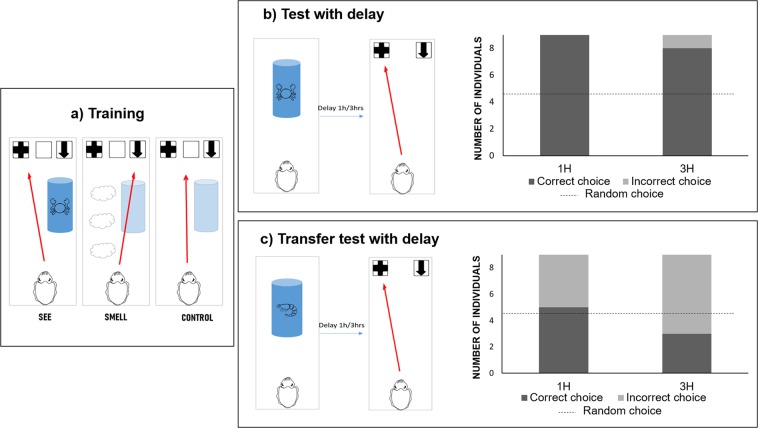
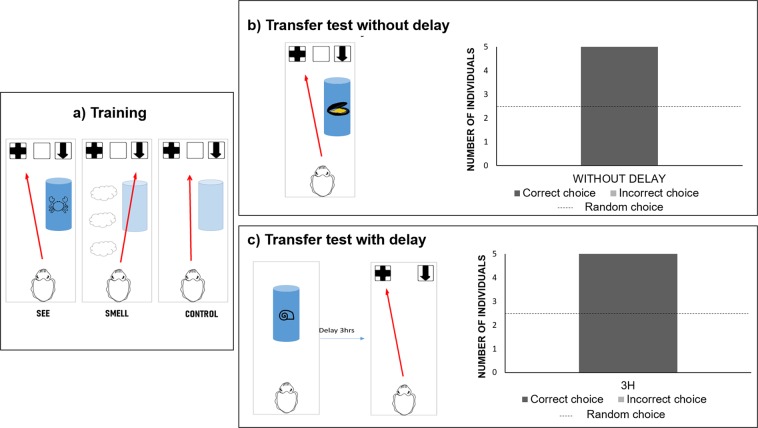
According to the Source Monitoring Framework, the origin of a memory is remembered through the retrieval of specific features (e.g. perceptive, sensitive, affective signals). In two source discrimination tasks, we studied the ability of cuttlefish to remember the modality in which an item had been presented several hours ago. In Experiment 1, cuttlefish were able to retrieve the modality of presentation of a crab (visual vs olfactory) sensed before 1 h and 3 hrs delays. In Experiment 2, cuttlefish were trained to retrieve the modality of the presentation of fish, shrimp, and crabs. After training, cuttlefish performed the task with another item never encountered before (e.g. mussel). The cuttlefish successfully passed transfer tests with and without a delay of 3 hrs. This study is the first to show the ability to discriminate between two sensory modalities (i.e. see vs smell) in an animal. Taken together, these results suggest that cuttlefish can retrieve perceptual features of a previous event, namely whether they had seen or smelled an item.
Overview
The claims and statistics of this paper haven’t been checked yet.
Free: it reads the open-access text and checks the first 5 claims that cite a source we can check. Create a free account to check every claim.
Integrity signals
Registry
Cites
Statistics
Figures
Verification
Claims the paper makes
The claims and statistics of this paper haven’t been checked yet.
Free: it reads the open-access text and checks the first 5 claims that cite a source we can check. Create a free account to check every claim.
Claims other papers make about this one
Each is checked against this paper’s own text: does it say what the citing paper says it does?
The cited source says what the claim attributes to it.
In the citing paper
“Therefore, this paradigm may provide more detail about the subjective experience of the animal during recall (i.e. ‘what did I just experience?’) [101].”
From Is episodic-like memory like episodic memory? (2024) · cites this paper as [101]
The cited source says what the claim attributes to it.
In the citing paper
“If an animal can remember the source of a memory (e.g., vision or smell) and not just the content, that is suggestive of conscious recall, though not conclusive [57].”
From Dimensions of Animal Consciousness (2020) · cites this paper as [57]
In the citing paper
“as source memories are embedded within episodic memories, they are a characteristic component of episodic memory in humans [99,101,103,104].”
From Is episodic-like memory like episodic memory? (2024) · cites this paper as [101]
In the citing paper
“In the latest source memory experiment with non-human animals, cuttlefish demonstrated their ability to differentiate the sensory modality (smell versus sight) by which they acquired foraging information [101].”
From Is episodic-like memory like episodic memory? (2024) · cites this paper as [101]
In the citing paper
“This retrieval relies on a personal assessment of the subject’s own previous internal experiences [101].”
From Is episodic-like memory like episodic memory? (2024) · cites this paper as [101]
Self-check
Percentages, sums and reported differences re-computed from the paper’s own numbers.
The self-check needs the paper’s full text.
Citations
Cites
Johnson, M. K., Hashtroudi, S., & Lindsay, D. S. (1993) · Psychological Bulletin · doi:10.1037/0033-2909.114.1.3 · Cited by 3,392
Episodic-like memory during cache recovery by scrub jays
Clayton, N. S., & Dickinson, A. (1998) · Nature · doi:10.1038/26216 · Cited by 1,464
Self-citationMultiple routes to memory: distinct medial temporal lobe processes build item and source memories
Davachi, L., Mitchell, J. P., & Wagner, A. D. (2003) · Proceedings of the National Academy of Sciences · doi:10.1073/pnas.0337195100 · Cited by 899
Distinct prefrontal cortex activity associated with item memory and source memory for visual shapes
Slotnick, S. D., Moo, L. R., Segal, J. B., & Hart, J. (2003) · Cognitive Brain Research · doi:10.1016/s0926-6410(03)00082-x · Cited by 654
Hanlon, R. T., & Messenger, J. B. (1988) · Philosophical Transactions of the Royal Society of London. B, Biological Sciences · doi:10.1098/rstb.1988.0087 · Cited by 358
Conditioning procedure and color discrimination in the honeybee Apis mellifera
Giurfa, M. (2004) · Naturwissenschaften · doi:10.1007/s00114-004-0530-z · Cited by 209
Odour perception in honeybees: coding information in glomerular patterns
Galizia, C. G., & Menzel, R. (2000) · Current Opinion in Neurobiology · doi:10.1016/s0959-4388(00)00109-4 · Cited by 168
Dissociating memory traces and scenario construction in mental time travel
Cheng, S., Werning, M., & Suddendorf, T. (2015) · Neuroscience & Biobehavioral Reviews · doi:10.1016/j.neubiorev.2015.11.011 · Cited by 159
Evidence of episodic-like memory in cuttlefish
Jozet-Alves, C., Bertin, M., & Clayton, N. S. (2013) · Current Biology · doi:10.1016/j.cub.2013.10.021 · Cited by 154
Self-citationItem and source memory: differential age effects revealed by event-related potentials
Trott, C. T., Friedman, D., Ritter, W., & Fabiani, M. (1997) · NeuroReport · doi:10.1097/00001756-199710200-00036 · Cited by 135
Swaisgood, R. R., Lindburg, D. G., Zhou, X., & Owen, M. A. (2000) · Animal Behaviour · doi:10.1006/anbe.2000.1464 · Cited by 114
Remembering the Color of Objects: An ERP Investigation of Source Memory
Cycowicz, Y. M. (2001) · Cerebral Cortex · doi:10.1093/cercor/11.4.322 · Cited by 114
CATEGORIZATION OF NATURAL MOVEMENTS BY PIGEONS: VISUAL CONCEPT DISCRIMINATION AND BIOLOGICAL MOTION
Dittrich, W. H., Lea, S. E. G., Barrett, J., & Gurr, P. R. (1998) · Journal of the Experimental Analysis of Behavior · doi:10.1901/jeab.1998.70-281 · Cited by 107
Perceptual learning in flavour aversion conditioning.
Mackintosh, N. J., Kaye, H., & Bennett, C. H. (1991) · PubMed · Cited by 104
The Discrimination of Human Odour by the Dog
Hepper, P. G. (1988) · Perception · doi:10.1068/p170549 · Cited by 103
Perceptual Learning in Flavour Aversion Conditioning
Mackintosh, N., Kaye, H., & Bennett, C. H. (1991) · The Quarterly journal of experimental psychology. B, Comparative and physiological psychology · doi:10.1080/14640749108401272 · Cited by 95
Hvorecny, L. M., Grudowski, J. L., Blakeslee, C. J., Simmons, T. L., Roy, P. R., Brooks, J. A., Hanner, R. M., Beigel, M. E., Karson, M. A., Nichols, R. H., et al. (2007) · Animal Cognition · doi:10.1007/s10071-007-0085-4 · Cited by 89
Discrimination of Multidimensional Visual Stimuli by Mice: Intra- and Extradimensional Shifts.
Brigman, J. L., Bussey, T. J., Saksida, L. M., & Rothblat, L. A. (2005) · Behavioral Neuroscience · doi:10.1037/0735-7044.119.3.839 · Cited by 85
Simple color discrimination in chimpanzees: effect of varying contiguity between cue and incentive.
Jarvik, M. E. (1956) · Journal of Comparative and Physiological Psychology · doi:10.1037/h0045644 · Cited by 82
Crystal, J. D., Alford, W. T., Zhou, W., & Hohmann, A. G. (2013) · Current Biology · doi:10.1016/j.cub.2013.01.023 · Cited by 82
Female Choice of Males in Cuttlefish (Mollusca: Cephalopoda)
Boal, J. G. (1997) · Behaviour · doi:10.1163/156853997x00340 · Cited by 78
A REVIEW OF SIMULTANEOUS VISUAL DISCRIMINATION AS A METHOD OF TRAINING OCTOPUSES
Boal, J. G. (1996) · Biological Reviews · doi:10.1111/j.1469-185x.1996.tb00746.x · Cited by 71
Distance chemoreception in the common cuttlefish, Sepia officinalis (Mollusca, Cephalopoda)
Boal, J. G., & Golden, D. (1999) · Journal of Experimental Marine Biology and Ecology · doi:10.1016/s0022-0981(98)00187-7 · Cited by 70
The role of odour in the discrimination of conspecifics by pipistrelle bats
Fanis, E. D., & Jones, G. (1995) · Animal Behaviour · doi:10.1016/0003-3472(95)80215-0 · Cited by 65
Young female pigs can discriminate individual differences in odours from conspecific urine
Mendl, M., Randle, K., & Pope, S. J. (2002) · Animal Behaviour · doi:10.1006/anbe.2002.3040 · Cited by 64
Sex differences in spatial cognition in an invertebrate: the cuttlefish
Jozet‐Alves, C., Modéran, J., & Dickel, L. (2008) · Proceedings of the Royal Society B Biological Sciences · doi:10.1098/rspb.2008.0501 · Cited by 63
Self-citationColor discrimination in horses
Smith, S., & Goldman, L. (1999) · Applied Animal Behaviour Science · doi:10.1016/s0168-1591(98)00206-8 · Cited by 61
Animal models of episodic memory
Crystal, J. D. (2018) · Comparative Cognition & Behavior Reviews · doi:10.3819/ccbr.2018.130012 · Cited by 59
Color Discrimination in Weanling Pigs
Tanida, H., SENDA, K., Suzuki, S., Tanaka, T., & YOSHIMOTO, T. (1991) · Nihon Chikusan Gakkaiho · doi:10.2508/chikusan.62.1029 · Cited by 50
Mezraï, N., Arduini, L., Dickel, L., Chiao, C., & Darmaillacq, A. (2020) · Learning & Behavior · doi:10.3758/s13420-020-00424-7 · Cited by 49
Exposure to extreme stress impairs contextual odour discrimination in an animal model of PTSD
Cohen, H., Liberzon, I., & Richter-Levin, G. (2009) · The International Journal of Neuropsychopharmacology · doi:10.1017/s146114570800919x · Cited by 44
Color discrimination by a bering sea spotted seal, Phoca largha
Wartzok, D., & McCormick, M. G. (1978) · Vision Research · doi:10.1016/0042-6989(78)90117-7 · Cited by 43
Social recognition using chemical cues in cuttlefish (Sepia officinalis Linnaeus, 1758)
Boal, J. G., & Marsh, S. (1998) · Journal of Experimental Marine Biology and Ecology · doi:10.1016/s0022-0981(98)00068-9 · Cited by 36
Visual Discrimination of Shape by Octopus. Squares and Triangles
Sutherland, N. (1958) · Quarterly Journal of Experimental Psychology · doi:10.1080/17470215808416252 · Cited by 27
The performance of ravens on simple discrimination tasks: a preliminary study
Range, F., Bugnyar, T., & Kotrschal, K. M. (2008) · acta ethologica · doi:10.1007/s10211-008-0039-0 · Cited by 21
Dissociation of item and source memory in rhesus monkeys
Basile, B. M., & Hampton, R. R. (2017) · Cognition · doi:10.1016/j.cognition.2017.06.009 · Cited by 20
Multimodal integration in behaving chickens
Verhaal, J., & Luksch, H. (2015) · Journal of Experimental Biology · doi:10.1242/jeb.129387 · Cited by 16
Meyer, D. R., & Anderson, R. A. (2008) · Novartis Foundation symposium · doi:10.1002/9780470719404.ch17 · Cited by 6
Mezraï, N., Arduini, L., Dickel, L., et al. (2018) · bioRxiv (Cold Spring Harbor Laboratory) · doi:10.1101/508853 · Cited by 4
Wells, M. J. (1997) · Trends in Ecology & Evolution · doi:10.1016/s0169-5347(97)82690-0 · Cited by 2
Cited by
Dimensions of Animal Consciousness
Birch, J., Schnell, A. K., & Clayton, N. S. (2020) · Trends in Cognitive Sciences · doi:10.1016/j.tics.2020.07.007 · Cited by 406
“, vision or smell) and not just the content, that is suggestive of conscious recall, though not conclusive [57].”
BackgroundSelf-citationHow intelligent is a cephalopod? Lessons from comparative cognition
Schnell, A. K., Amodio, P., Boeckle, M., & Clayton, N. S. (2021) · Biological Reviews · doi:10.1111/brv.12651 · Cited by 120
Self-citationCuttlefish exert self-control in a delay of gratification task
Schnell, A. K., Boeckle, M., Rivera, M., Clayton, N. S., & Hanlon, R. T. (2021) · Proceedings of the Royal Society B Biological Sciences · doi:10.1098/rspb.2020.3161 · Cited by 110
Self-citationCephalopod Behavior: From Neural Plasticity to Consciousness
Ponte, G., Chiandetti, C., Edelman, D. B., Imperadore, P., Pieroni, E. M., & Fiorito, G. (2022) · Frontiers in Systems Neuroscience · doi:10.3389/fnsys.2021.787139 · Cited by 75
“officinalis proved these animals’ ability to discriminate between visual and olfactory modalities and then recall which one was previously encountered before an extended delay (Billard et al., 2020a).”
BackgroundThe Case for Octopus Consciousness: Temporality
Mather, J. A. (2022) · NeuroSci · doi:10.3390/neurosci3020018 · Cited by 46
Metadata
- Authors
- Billard, P., Clayton, N. S., & Jozet-Alves, C.
- Affiliations
- Centre National de la Recherche Scientifique (FR)
- University of Cambridge (GB)
- Corresponding author
- Billard, P.
- Venue
- Scientific Reports
- Published
- 2020-03-25
- Volume
- 10
- Issue
- 1
- Pages
- 5413-5413
- ISSN
- 2045-2322 (ISSN-L)
- PMC
- PMC7096502
- OpenAlex
- W3013060695
- Cited by
- 30
- References
- 38
- Citations by year
- 2026: 1 · 2025: 5 · 2024: 6 · 2023: 4 · 2022: 7 · 2021: 2 · 2020: 5
- FWCI
- 3.36
- Type
- journal article
- Language
- en
- Open access
- gold
- doi.org
- Licence
- cc-by
- creativecommons.org/licenses/by/4.0 (tdm)
- creativecommons.org/licenses/by/4.0 (vor)
- Locations
- Scientific Reports (publishedVersion, cc-by)
- PubMed Central (publishedVersion, cc-by)
- PubMed (publishedVersion)
- HAL (submittedVersion, other-oa)
- Apollo (University of Cambridge) (submittedVersion, cc-by)
- Apollo (cc-by)
- Funders
- Royal Society (NIF∖R1∖180962)
- Agence Nationale de la Recherche (ANR18, ANR-18-CE02-0002)
- CHIST-ERA
- Topics
- Life Sciences › Agricultural and Biological Sciences › Ecology, Evolution, Behavior and Systematics › Cephalopods and Marine Biology
- Life Sciences › Neuroscience › Cognitive Neuroscience › Memory Processes and Influences
- Life Sciences › Neuroscience › Cognitive Neuroscience › Memory and Neural Mechanisms
- Keywords
- cuttlefish, memory retrieval, source monitoring, visual memory, olfactory memory, memory transfer, cephalopod cognition
- MeSH terms
- Animals, Cognition, Brachyura, Learning, Memory, Predatory Behavior, Sensory Receptor Cells, Osmeriformes, Decapodiformes
About these checks
Registry, retraction, Cites and statistics results are computed, not judged, with one exception: a printed reference that no index lists is read once by a model before it counts as a citation error. Claims are extracted by a model and kept only when their quote appears verbatim in the text; each cited source is then checked, with a model’s help, for whether it says what the claim relies on. Those verdicts can be wrong — read the claim’s quote and the cited source before relying on one.
Statistics and arithmetic are recomputed, not judged.
Confidence bands are shown only for fields calibrated on our annotated test set. None is calibrated yet, so no band is shown.
What counts as a claim ›How we measure confidence ›How we check this ›
Are you an author, or do you see a problem with this page? Request a review
Data sources
Bibliographic data: Semantic Scholar, OpenAlex, Crossref.
Contains information from the Semantic Scholar Academic Graph Datasets, made available under the ODC Attribution License (ODC-BY 1.0).
Semantic Scholar’s data is described in: Kinney, R., et al. (2023). The Semantic Scholar Open Data Platform. arXiv:2301.10140.
