

Group structure and kinship in beluga whale societies
Open accessThe DOI matches its Crossref record; 89 of the 89 references it cites were found in a registry or an index.
Abstract
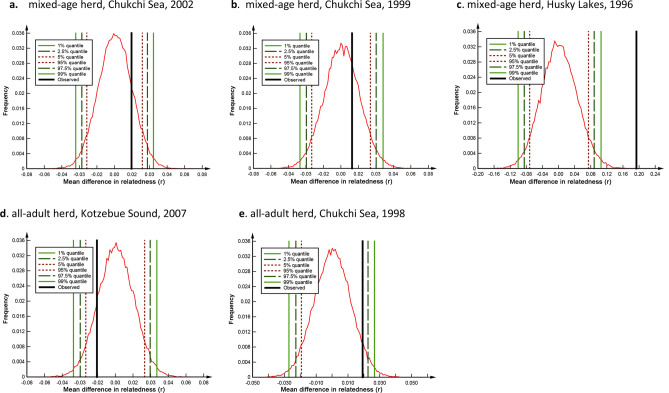
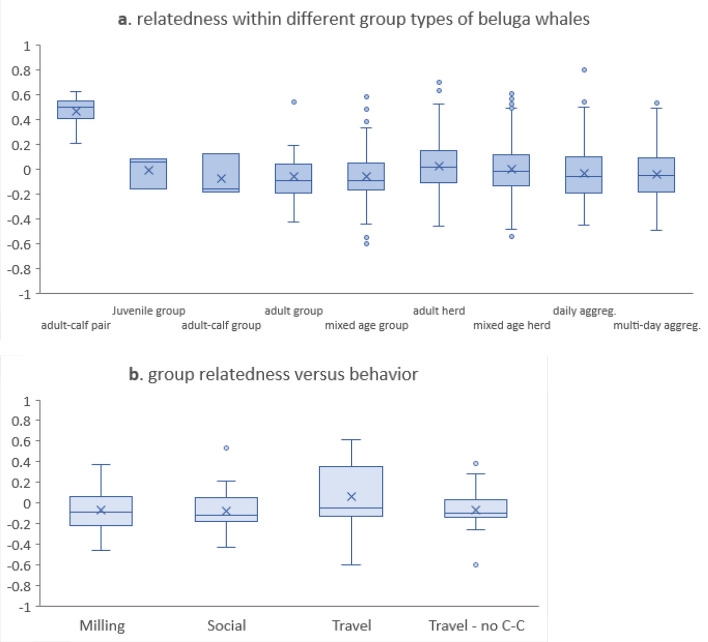
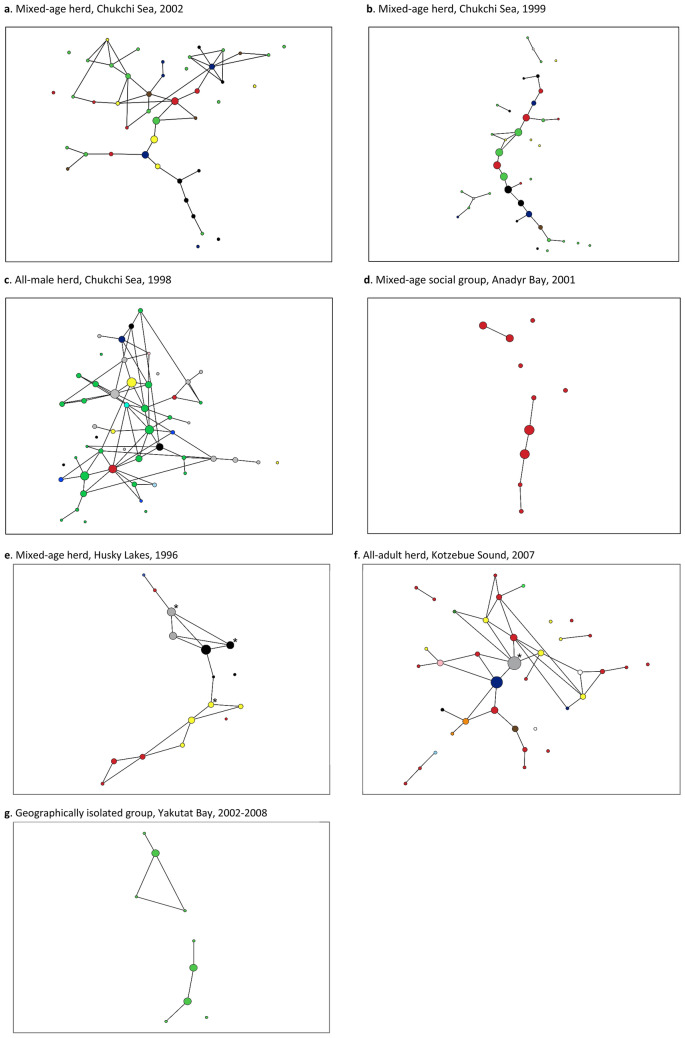
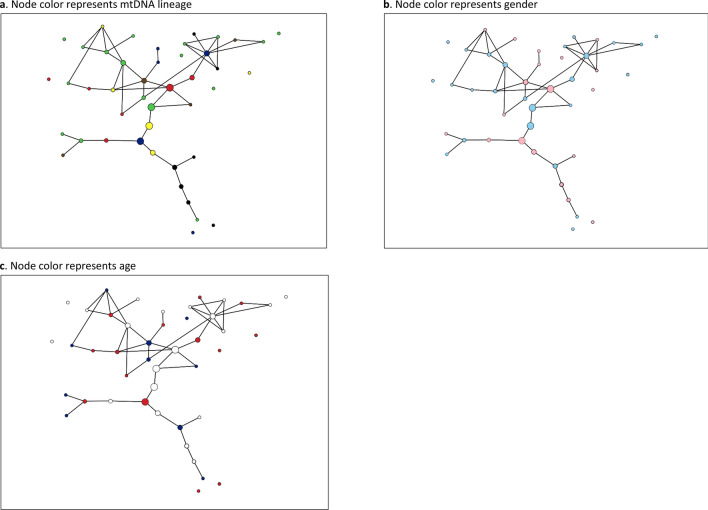
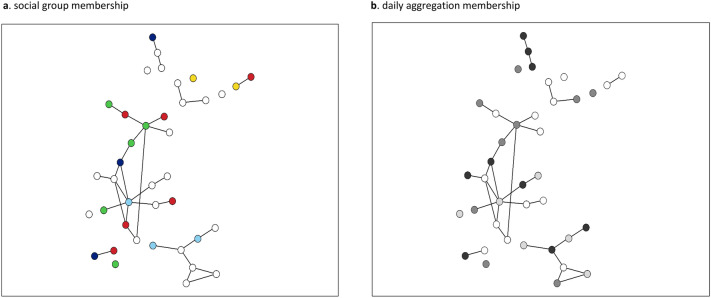
Evolutionary explanations for mammalian sociality typically center on inclusive-fitness benefits of associating and cooperating with close kin, or close maternal kin as in some whale societies, including killer and sperm whales. Their matrilineal structure has strongly influenced the thinking about social structure in less well-studied cetaceans, including beluga whales. In a cross-sectional study of group structure and kinship we found that belugas formed a limited number of distinct group types, consistently observed across populations and habitats. Certain behaviours were associated with group type, but group membership was often dynamic. MtDNA-microsatellite profiling combined with relatedness and network analysis revealed, contrary to predictions, that most social groupings were not predominantly organized around close maternal relatives. They comprised both kin and non-kin, many group members were paternal rather than maternal relatives, and unrelated adult males often traveled together. The evolutionary mechanisms that shape beluga societies are likely complex; fitness benefits may be achieved through reciprocity, mutualism and kin selection. At the largest scales these societies are communities comprising all ages and both sexes where multiple social learning pathways involving kin and non-kin can foster the emergence of cultures. We explore the implications of these findings for species management and the evolution of menopause.
Overview
The claims and statistics of this paper haven’t been checked yet.
Free: it reads the open-access text and checks the first 5 claims that cite a source we can check. Create a free account to check every claim.
Integrity signals
Registry
Cites
Statistics
Figures
Verification
Claims the paper makes
The claims and statistics of this paper haven’t been checked yet.
Free: it reads the open-access text and checks the first 5 claims that cite a source we can check. Create a free account to check every claim.
Claims other papers make about this one
Each is checked against this paper’s own text: does it say what the citing paper says it does?
The source backs part of the claim, not all of it — or backs it for a different population, condition or comparison.
In the citing paper
“Beluga whales are members of the family Monodontidae and like the other mammalian species that demonstrate the capacity for MSR, have large complex brains [19,20] and live in complex societies with a fission-fusion social structure [21–23].”
From Evidence for mirror self-recognition in beluga whales (Delphinapterus leucas) (2026) · cites this paper as [23]
Experimental — accuracy not yet measured
Self-check
Percentages, sums and reported differences re-computed from the paper’s own numbers.
The self-check needs the paper’s full text.
Citations
Cites
Axelrod, R., & Hamilton, W. D. (1981) · Science · doi:10.1126/science.7466396 · Cited by 20,065
The genetical evolution of social behaviour. I
Hamilton, W. D. (1964) · Journal of Theoretical Biology · doi:10.1016/0022-5193(64)90038-4 · Cited by 15,725
The Evolution of Reciprocal Altruism
Trivers, R. L. (1971) · The Quarterly Review of Biology · doi:10.1086/406755 · Cited by 11,010
Hamilton, W. D. (1971) · Journal of Theoretical Biology · doi:10.1016/0022-5193(71)90189-5 · Cited by 3,506
ESTIMATING RELATEDNESS USING GENETIC MARKERS
Queller, D. C., & Goodnight, K. F. (1989) · Evolution · doi:10.1111/j.1558-5646.1989.tb04226.x · Cited by 3,032
Nowak, M. A., Tarnita, C. E., & Wilson, E. O. (2010) · Nature · doi:10.1038/nature09205 · Cited by 1,491
Estimating Relatedness Using Genetic Markers
Queller, D. C., & Goodnight, K. F. (1989) · Evolution · doi:10.2307/2409206 · Cited by 1,191
Evolution from Molecules to Men.
Fryer, G., & Bendal, D. S. (1984) · The Journal of Ecology · doi:10.2307/2260026 · Cited by 1,139
Cooperation between non-kin in animal societies
Clutton-Brock, T. (2009) · Nature · doi:10.1038/nature08366 · Cited by 951
ml‐relate: a computer program for maximum likelihood estimation of relatedness and relationship
KALINOWSKI, S. T., WAGNER, A. P., & TAPER, M. L. (2006) · Molecular Ecology Notes · doi:10.1111/j.1471-8286.2006.01256.x · Cited by 933
Research works printed but not linked: 7
- Bigg MA Olesiuk PF Ellis GM Ford JKB Balcomb KC III Social organization and genealogy of resident killer whales (Orcinus orca) in the coastal waters of British Columbia and Washington State Rep. Int. Whal. Commun. 1990 SI 12 383 405
- Michaud R Distribution estivale du béluga du St.-Laurent: synthèse 1986 à 1992 Can. Tech. Rep. Fish. Aquat. Sci. 1993 1906 28
- Suydam, R. S. Age, Growth, Reproduction, and Movements of Beluga Whales (Delphinapterus leucas) from the Eastern Chukchi Sea. PhD thesis (2009).
- Ford JKB Ellis GM Balcomb KC III Killer Whales 2000 Vancouver University of British Columbia Press
- Litovka DI Research of belugas Delphinapterus leucas in Anadyr Gulf (Chukotka) using satellite telemetry Mar. Mamm. Holarctic 2002 10 70 80
- Fain SR LeMay JP Gender identification of humans and mammalian wildlife species from PCR amplified sex linked genes Proc. Am. Acad. Forensic Sci. 1995 1 34
- Kivelä M Arnaud-Haond S Saramäki J EDENetworks Version 218: Ecological and Evolutionary Networks 2014 Oxford Oxford University Press
Cited by
Items 101–108 of 108
Beluga Delphinapterus leucas (Pallas, 1776)
Shelden, K. E. W., & O'Corry-Crowe, G. (2026) · Elsevier eBooks · doi:10.1016/b978-0-443-13669-6.00003-0
Self-citationMüller, C. (2026) · Mspace (University of Manitoba)
A psychological perspective on international environmental law
Li, J.-S. (. (2024) · Illinois Digital Environment for Access to Learning and Scholarship (University of Illinois at Urbana-Champaign)
Clarke, J. T., Ferguson, M. C., Brower, A. A., Fujioka, E., & Deland, S. (2023) · doi:10.3389/fmars.2023.1040123.s001
Storrie, L., Hussey, N. E., MacPhee, S. A., O’Corry-Crowe, G., Iacozza, J., Barber, D. G., Nunes, A., & Loseto, L. L. (2022) · doi:10.3389/fmars.2021.715412.s002
Self-citationEstablishing an acoustic benchmark of beluga habitat use in the Churchill River estuary, Manitoba
Coppolaro, V. L. M., Kirillov, S. A., Isleifson, D., Loseto, L. L., & Marcoux, M. (2026) · Frontiers in Mammal Science · doi:10.3389/fmamm.2026.1903254
Population density, cooperation, and the evolution of toothed whale societiesPreprint
Walmsley, S., & Connor, R. (2026) · EcoEvoRxiv · doi:10.32942/x2b11f
Characterizing the Prey Landscape of Endangered Cook Inlet Beluga Whales Using an eDNA Time SeriesPreprint
Gold, Z. J., Shelton, A. O., Tobin, D. D. B., Ramón‐Laca, A., Kumar, S. V., Kosma, M. M., Becher, T., Gill, V. A., Wade, P. R., & Parsons, K. M. (2026) · bioRxiv (Cold Spring Harbor Laboratory) · doi:10.64898/2026.11.12.766312
Metadata
- Authors
- O’Corry-Crowe, G., Suydam, R., Quakenbush, L., Smith, T. G., Lydersen, C., Kovacs, K. M., Orr, J., Harwood, L., Litovka, D., & Ferrer, T.
- Affiliations
- North Slope Borough (US)
- Alaska Department of Fish and Game (US)
- The FRAM Centre (NO)
- Fisheries and Oceans Canada (CA)
- Florida Atlantic University (US)
- Venue
- Scientific Reports
- Published
- 2020-07-10
- Volume
- 10
- Issue
- 1
- Pages
- 11462-11462
- ISSN
- 2045-2322 (ISSN-L)
- PMC
- PMC7351962
- OpenAlex
- W3041411185
- Cited by
- 81
- References
- 88
- Citations by year
- 2026: 8 · 2025: 13 · 2024: 7 · 2023: 11 · 2022: 17 · 2021: 22 · 2020: 3
- FWCI
- 7.04
- Type
- journal article
- Language
- en
- Open access
- gold
- doi.org
- Licence
- cc-by
- creativecommons.org/licenses/by/4.0 (tdm)
- creativecommons.org/licenses/by/4.0 (vor)
- Locations
- Scientific Reports (publishedVersion, cc-by)
- PubMed Central (publishedVersion, cc-by)
- PubMed (publishedVersion)
- Funders
- National Fish and Wildlife Foundation (2008-0105-000)
- Alaska Beluga Whale Committee
- Topics
- Physical Sciences › Environmental Science › Ecology › Marine animal studies overview
- Life Sciences › Agricultural and Biological Sciences › Ecology, Evolution, Behavior and Systematics › Animal Behavior and Reproduction
- Social Sciences › Cultural Studies › Language and cultural evolution
- Keywords
- beluga whale, Delphinaptera musculus, social structure, kinship, matrilineal kinship, group types, kin selection, reciprocal altruism, social learning, cultural evolution, species management
About these checks
Registry, retraction, Cites and statistics results are computed, not judged, with one exception: a printed reference that no index lists is read once by a model before it counts as a citation error. Claims are extracted by a model and kept only when their quote appears verbatim in the text; each cited source is then checked, with a model’s help, for whether it says what the claim relies on. Those verdicts can be wrong — read the claim’s quote and the cited source before relying on one.
Statistics and arithmetic are recomputed, not judged.
Confidence bands are shown only for fields calibrated on our annotated test set. None is calibrated yet, so no band is shown.
What counts as a claim ›How we measure confidence ›How we check this ›
Are you an author, or do you see a problem with this page? Request a review
Data sources
Bibliographic data: Semantic Scholar, OpenAlex, Crossref.
Contains information from the Semantic Scholar Academic Graph Datasets, made available under the ODC Attribution License (ODC-BY 1.0).
Semantic Scholar’s data is described in: Kinney, R., et al. (2023). The Semantic Scholar Open Data Platform. arXiv:2301.10140.
