

The COVID-19 social media infodemic
Open accessThe DOI matches its Crossref record; 57 of the 57 references it cites were found in a registry or an index.
Abstract
We address the diffusion of information about the COVID-19 with a massive data analysis on Twitter, Instagram, YouTube, Reddit and Gab. We analyze engagement and interest in the COVID-19 topic and provide a differential assessment on the evolution of the discourse on a global scale for each platform and their users. We fit information spreading with epidemic models characterizing the basic reproduction number $$R_0$$ R 0 for each social media platform. Moreover, we identify information spreading from questionable sources, finding different volumes of misinformation in each platform. However, information from both reliable and questionable sources do not present different spreading patterns. Finally, we provide platform-dependent numerical estimates of rumors’ amplification.
Overview
The claims and statistics of this paper haven’t been checked yet.
Free: it reads the open-access text and checks the first 5 claims that cite a source we can check. Create a free account to check every claim.
Integrity signals
Registry
Cites
Statistics
Figures
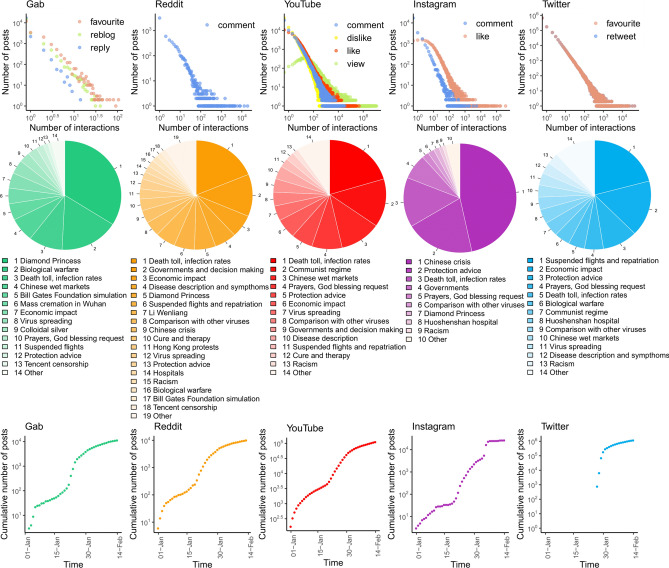
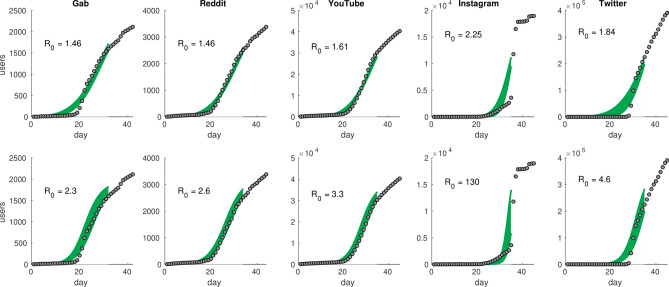
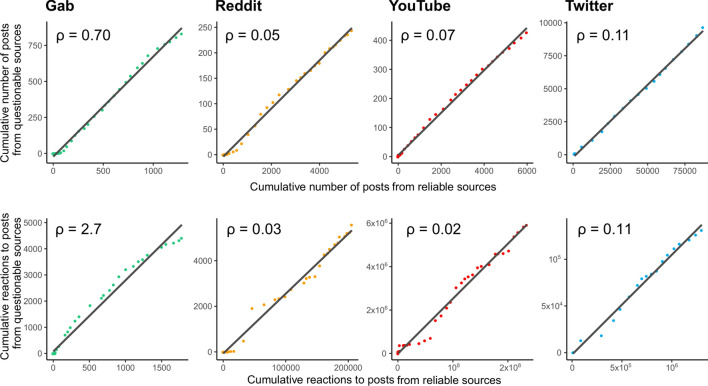
Verification
Claims the paper makes
The claims and statistics of this paper haven’t been checked yet.
Free: it reads the open-access text and checks the first 5 claims that cite a source we can check. Create a free account to check every claim.
Claims other papers make about this one
Each is checked against this paper’s own text: does it say what the citing paper says it does?
The source backs part of the claim, not all of it — or backs it for a different population, condition or comparison.
In the citing paper
“Our attention span remains limited (9, 10), and feed algorithms might limit our selection process by suggesting contents similar to the ones we are usually exposed to (11–13).”
From The echo chamber effect on social media (2021) · cites this paper as [12]
Experimental — accuracy not yet measuredThe cited source says what the claim attributes to it.
In the citing paper
“The uncontrolled dissemination of false or misleading health information via digital channels represents one of the most complex and urgent challenges currently facing Public Health (1, 2).”
From Health misinformation, digital health literacy, and attitudes toward science among university students: an exploratory cross-sectional survey (2026) · cites this paper as [2]
The cited source says what the claim attributes to it.
In the citing paper
“the amplification of questionable sources of COVID-19 misinformation is highly platform dependent, with some platforms amplifying questionable content less than reliable content 58 .”
From Measuring the impact of COVID-19 vaccine misinformation on vaccination intent in the UK and USA (2021) · cites this paper as [58]
The cited source says what the claim attributes to it.
In the citing paper
“The broad public reach of the Internet and social media favours the spread of rumours and dissemination of unreliable information [7].”
Self-check
Percentages, sums and reported differences re-computed from the paper’s own numbers.
The self-check needs the paper’s full text.
Citations
Cites
An Introduction to the Bootstrap
Efron, B., & Tibshirani, R. J. (1994) · doi:10.1201/9780429246593 · Cited by 40,500
Learning representations by back-propagating errors
Rumelhart, D. E., Hinton, G. E., & Williams, R. J. (1986) · Nature · doi:10.1038/323533a0 · Cited by 31,892 · cited 1×
“More formally, given a content represented by the sequence of words w 1 , w 2 , . . . , w T , we use stochastic gradient descent with gradient computed through backpropagation rule [39] for maximizing the average log probability where k is the size of the training window.”
MethodDistributed Representations of Words and Phrases and their Compositionality
Mikolov, T., Sutskever, I., Chen, K., Corrado, G., & Dean, J. (2013) · arXiv · doi:10.48550/arxiv.1310.4546 · Cited by 24,533
The spread of true and false news online
Vosoughi, S., Roy, D., & Aral, S. (2018) · Science · doi:10.1126/science.aap9559 · Cited by 8,847 · cited 2×
“Some studies pointed out that fake news and inaccurate information may spread faster and wider than fact-based news [22].”
BackgroundAn Introduction to the Bootstrap.
Buckland, S. T., Efron, B., & Tibshirani, R. J. (1994) · Biometrics · doi:10.2307/2532810 · Cited by 3,103
Linguistic Regularities in Continuous Space Word Representations
Mikolov, T., Yih, W.-T., & Zweig, G. (2013) · North American Chapter of the Association for Computational Linguistics · Cited by 2,912
The spread of behavior in an online social network experiment
Centola, D. (2010) · Science · doi:10.1126/science.1185231 · Cited by 2,692 · cited 1×
“While R0 is a good proxy for the engagement rate and a good predictor for epidemic-like information spreading, social contagion phenomena might be in general more complex [34, 35, 36].”
BackgroundThe spreading of misinformation online
Del Vicario, M., Bessi, A., Zollo, F., Petroni, F., Scala, A., Caldarelli, G., Stanley, H. E., & Quattrociocchi, W. (2016) · Proceedings of the National Academy of Sciences · doi:10.1073/pnas.1517441113 · Cited by 2,407 · cited 2×
“social perceptions [11] and the framing of narratives; it in uences policy-making, political communication, as well as the evolution of public debate [12, 13] especially when issues are controversial [14]. Indeed, users online tend to acquire information adhering to their worldviews [15], to ignore dissenting informat…”
BackgroundMethodSelf-citationZarocostas, J. (2020) · The Lancet · doi:10.1016/s0140-6736(20)30461-x · Cited by 2,344 · cited 1×
“The term infodemic [2, 3] has been coined to outline the perils of misinformation phenomena during the management of virus outbreaks [4, 5], since it could even speed up the epidemic process by influencing and fragmenting social response [6].”
BackgroundThe Mathematical Theory of Infectious Diseases and its applications
Ling, N. R. (1978) · Immunology · Cited by 1,934
Exposure to opposing views on social media can increase political polarization
Bail, C. A., Argyle, L. P., Brown, T. W., Bumpus, J. P., Chen, H., Hunzaker, M. B. F., Lee, J., Mann, M., Merhout, F., & Volfovsky, A. (2018) · Proceedings of the National Academy of Sciences · doi:10.1073/pnas.1804840115 · Cited by 1,863 · cited 1×
“Indeed, users online tend to acquire information adhering to their worldviews [15], to ignore dissenting information [16, 17] and to form polarized groups around shared narratives [18, 19].”
BackgroundFake news on Twitter during the 2016 U.S. presidential election
Grinberg, N., Joseph, K., Friedland, L., Swire-Thompson, B., & Lazer, D. (2019) · Science · doi:10.1126/science.aau2706 · Cited by 1,803
Romero, D. M., Meeder, B., & Kleinberg, J. (2011) · Proceedings of the 20th international conference on World wide web · doi:10.1145/1963405.1963503 · Cited by 1,082
Twitter under crisis: can we trust what we RT?
Mendoza, M., Poblete, B., & Castillo, C. (2010) · Proceedings of the First Workshop on Social Media Analytics · doi:10.1145/1964858.1964869 · Cited by 955 · cited 1×
“he virus that causes it. 1 arXiv:2003.05004v1 [cs.SI] 10 Mar 2020 The term infodemic [2, 3] has been coined to outline the perils of misinformation phenomena during the management of virus outbreaks2 [4, 5], since it could even speed up the epidemic process by in uencing and fragmenting social response [6]. As an exam…”
BackgroundLanaspa, M. A., Ishimoto, T., Li, N., Cicerchi, C., Orlicky, D. J., Ruzycki, P., Rivard, C., Inaba, S., Roncal-Jimenez, C. A., Bales, E. S., et al. (2013) · Nature Communications · doi:10.1038/ncomms3929 · Cited by 796
Learning Representations by Back-Propagating Errors
Rumelhart, D. E., Hinton, G. E., & Williams, R. J. (2002) · Cognitive Modeling · doi:10.7551/mitpress/1888.003.0013 · Cited by 759
Influence of fake news in Twitter during the 2016 US presidential election
Bovet, A., & Makse, H. A. (2019) · Nature Communications · doi:10.1038/s41467-018-07761-2 · Cited by 701 · cited 1×
“While most of the studies on misinformation diffusion focus on a single platform [22, 24, 14], the dynamics behind information consumption might be particular to the environment in which they spread on.”
BackgroundScience vs Conspiracy: Collective Narratives in the Age of Misinformation
Bessi, A., Coletto, M., Davidescu, G. A., Scala, A., Caldarelli, G., & Quattrociocchi, W. (2015) · PLOS ONE · doi:10.1371/journal.pone.0118093 · Cited by 645 · cited 1×
“Indeed, users online tend to acquire information adhering to their worldviews [15], to ignore dissenting information [16, 17] and to form polarized groups around shared narratives [18, 19].”
BackgroundSelf-citationEcho Chambers: Emotional Contagion and Group Polarization on Facebook
Del Vicario, M., Vivaldo, G., Bessi, A., Zollo, F., Scala, A., Caldarelli, G., & Quattrociocchi, W. (2016) · Scientific Reports · doi:10.1038/srep37825 · Cited by 576
Self-citationModeling echo chambers and polarization dynamics in social networks
Baumann, F., Lorenz-Spreen, P., Sokolov, I. M., & Starnini, M. (2020) · Physical Review Letters · doi:10.1103/physrevlett.124.048301 · Cited by 427 · cited 1×
“ing during critical events. While R 0 is a good proxy for the engagement rate and a good predictor for epidemic-like information spreading, social contagion phenomena might be in general more complex [34, 35, 36]. For instance, in the case of Instagram, we observe an abrupt jump in the number of new users that cannot…”
Background(2014) · iConference 2014 Proceedings · doi:10.9776/14308 · Cited by 423
The Mathematical Theory of Infectious Diseases and Its Applications
Giles, P. (1977) · Journal of the Operational Research Society · doi:10.1057/jors.1977.92 · Cited by 421
Polarization of the vaccination debate on Facebook
Schmidt, A. L., Zollo, F., Scala, A., Betsch, C., & Quattrociocchi, W. (2018) · Vaccine · doi:10.1016/j.vaccine.2018.05.040 · Cited by 403
Self-citationHow people decide what they want to know
Sharot, T., & Sunstein, C. R. (2020) · Nature Human Behaviour · doi:10.1038/s41562-019-0793-1 · Cited by 383 · cited 1×
“Thus, an important research challenge is to determine how people seek or avoid information and how those decisions affect their behavior [7], particularly when the news cycle – dominated by the disintermediated diffusion of information – alters the way information is consumed and reported on.”
BackgroundAn exploratory study of COVID-19 misinformation on Twitter
Shahi, G. K., Dirkson, A., & Majchrzak, T. A. (2021) · Online Social Networks and Media · doi:10.1016/j.osnem.2020.100104 · Cited by 352
Chowell, G. (2017) · Infectious Disease Modelling · doi:10.1016/j.idm.2017.08.001 · Cited by 349
Debunking in a world of tribes
Zollo, F., Bessi, A., Del Vicario, M., Scala, A., Caldarelli, G., Shekhtman, L., Havlin, S., & Quattrociocchi, W. (2017) · PLOS ONE · doi:10.1371/journal.pone.0181821 · Cited by 345 · cited 1×
“evolution of public debate [12, 13] especially when issues are controversial [14]. Indeed, users online tend to acquire information adhering to their worldviews [15], to ignore dissenting information [16, 17] and to form polarized groups around shared narratives [18, 19]. Furthermore, when polarization is high, misinf…”
BackgroundSelf-citationAnatomy of news consumption on Facebook
Schmidt, A. L., Zollo, F., Del Vicario, M., Bessi, A., Scala, A., Caldarelli, G., Stanley, H. E., & Quattrociocchi, W. (2017) · Proceedings of the National Academy of Sciences · doi:10.1073/pnas.1617052114 · Cited by 305 · cited 1×
“s’ preferences and attitudes, algorithms mediate and facilitate content promotion and thus information spreading [10]. This shift of paradigm profoundly impacts the construction of social perceptions [11] and the framing of narratives; it in uences policy-making, political communication, as well as the evolution of pu…”
BackgroundSelf-citationReal-time influenza forecasts during the 2012–2013 season
Shaman, J., Karspeck, A., Yang, W., Tamerius, J., & Lipsitch, M. (2013) · Nature Communications · doi:10.1038/ncomms3837 · Cited by 296 · cited 1×
“To this respect, models to forecast virus spreading are starting to account for the behavioral response of the population with respect to public health interventions and the communication dynamics behind content consumption [8, 6, 9].”
Estimating epidemic exponential growth rate and basic reproduction number
Ma, J. (2020) · Infectious Disease Modelling · doi:10.1016/j.idm.2019.12.009 · Cited by 284
Polarization and Fake News: Early Warning of Potential Misinformation Targets
Vicario, M. D., Quattrociocchi, W., Scala, A., & Zollo, F. (2019) · ACM Transactions on the Web · doi:10.1145/3316809 · Cited by 280 · cited 1×
“ldviews [15], to ignore dissenting information [16, 17] and to form polarized groups around shared narratives [18, 19]. Furthermore, when polarization is high, misinformation might easily proliferate [20, 21]. Some studies pointed out that fake news and inaccurate information may spread faster and wider than fact-base…”
BackgroundSelf-citationWhat types of COVID-19 conspiracies are populated by Twitter bots?
Ferrara, E. (2020) · First Monday · doi:10.5210/fm.v25i6.10633 · Cited by 223
Modeling confirmation bias and polarization
Del Vicario, M., Scala, A., Caldarelli, G., Stanley, H. E., & Quattrociocchi, W. (2017) · Scientific Reports · doi:10.1038/srep40391 · Cited by 222
Self-citationAlam, F., Shaar, S., Dalvi, F., Sajjad, H., Nikolov, A., Mubarak, H., Martino, G. D. S., Abdelali, A., Durrani, N., Darwish, K., et al. (2020) · Conference on Empirical Methods in Natural Language Processing · doi:10.48550/arxiv.2005.00033 · Cited by 192
Eight challenges for network epidemic models
Pellis, L., Ball, F., Bansal, S., Eames, K., House, T., Isham, V., & Trapman, P. (2015) · Epidemics · doi:10.1016/j.epidem.2014.07.003 · Cited by 185 · cited 1×
“tter is dated January 27th. 1.2 Information Spreading Eorts to simulate the spreading of information on social media by reproducing real data have mostly applied variants of standard epidemic models [26, 27, 28, 29]. Coherently, we analyze the observed monotonic increasing trend in the way new users interact with info…”
MethodInfluentialSchild, L., Ling, C., Blackburn, J., et al. (2020) · arXiv.org · doi:10.48550/arxiv.2004.04046 · Cited by 165
The emergence of consensus: a primer
Baronchelli, A. (2018) · Royal Society Open Science · doi:10.1098/rsos.172189 · Cited by 161
Quantifying Search Bias: Investigating Sources of Bias for Political Searches in Social Media
Kulshrestha, J., Eslami, M., Messias, J., Zafar, M. B., Ghosh, S., Gummadi, K. P., & Karahalios, K. (2017) · Proceedings of the 2017 ACM Conference on Computer Supported Cooperative Work and Social Computing · doi:10.1145/2998181.2998321 · Cited by 148 · cited 1×
“f content and may amplify rumors and questionable information. Taking into account users’ preferences and attitudes, algorithms mediate and facilitate content promotion and thus information spreading [10]. This shift of paradigm profoundly impacts the construction of social perceptions [11] and the framing of narrativ…”
BackgroundRalph, A. P., Waramori, G., Pontororing, G. J., Kenangalem, E., Wiguna, A., Tjitra, E., Sandjaja, Lolong, D. B., Yeo, T. W., Chatfield, M. D., et al. (2013) · PLoS ONE · doi:10.1371/journal.pone.0070032 · Cited by 141
Alam, F., Shaar, S., Dalvi, F., Sajjad, H., Nikolov, A., Mubarak, H., Da San Martino, G., Abdelali, A., Durrani, N., Darwish, K., et al. (2021) · Findings of the Association for Computational Linguistics: EMNLP 2021 · doi:10.18653/v1/2021.findings-emnlp.56 · Cited by 132
Selective exposure shapes the Facebook news diet
Cinelli, M., Brugnoli, E., Schmidt, A. L., Zollo, F., Quattrociocchi, W., & Scala, A. (2020) · PLOS ONE · doi:10.1371/journal.pone.0229129 · Cited by 130
Self-citationQuantifying Search Bias: Investigating Sources of Bias for Political Searches in Social Media
Kulshrestha, J., Eslami, M., Messias, J., Zafar, M. B., Ghosh, S., Gummadi, K. P., & Karahalios, K. G. (2017) · arXiv (Cornell University) · doi:10.48550/arxiv.1704.01347 · Cited by 129 · cited 1×
“f content and may amplify rumors and questionable information. Taking into account users’ preferences and attitudes, algorithms mediate and facilitate content promotion and thus information spreading [10]. This shift of paradigm profoundly impacts the construction of social perceptions [11] and the framing of narrativ…”
BackgroundReconstructing meaning from bits of information
Kivisaari, S. L., van Vliet, M., Hultén, A., Lindh‐Knuutila, T., Faisal, A., & Salmelin, R. H. (2019) · Nature Communications · doi:10.1038/s41467-019-08848-0 · Cited by 128
An Introduction to the Bootstrap
Grimshaw, S. D. (1995) · Technometrics · doi:10.1080/00401706.1995.10484340 · Cited by 120
Incorporating media data into a model of infectious disease transmission
Kim, L., Fast, S. M., & Markuzon, N. (2019) · PLOS ONE · doi:10.1371/journal.pone.0197646 · Cited by 117 · cited 2×
“to forecast virus spreading are starting to account for the behavioral response of the population with respect to public health interventions and the communication dynamics behind content consumption [8, 6, 9]. Social media platforms such as Youtube and Twitter provide direct access to an unprecedented amount of conte…”
BackgroundPhase transitions in information spreading on structured populations
Davis, J. T., Perra, N., Zhang, Q., Moreno, Y., & Vespignani, A. (2020) · Nature Physics · doi:10.1038/s41567-020-0810-3 · Cited by 102 · cited 1×
“Efforts to simulate the spreading of information on social media by reproducing real data have mostly applied variants of standard epidemic models [26, 27, 28, 29].”
The future of influenza forecasts
Viboud, C., & Vespignani, A. (2019) · Proceedings of the National Academy of Sciences · doi:10.1073/pnas.1822167116 · Cited by 100 · cited 1×
“To this respect, models to forecast virus spreading are starting to account for the behavioral response of the population with respect to public health interventions and the communication dynamics behind content consumption [8, 6, 9].”
MethodSchild, L., Ling, C., Blackburn, J., Stringhini, G., Zhang, Y., & Zannettou, S. (2020) · MPG.PuRe (Max Planck Society) · Cited by 89
An IDEA for Short Term Outbreak Projection: Nearcasting Using the Basic Reproduction Number
Fisman, D., Hauck, T. S., Tuite, A., & Greer, A. (2013) · PLoS ONE · doi:10.1371/journal.pone.0083622 · Cited by 80 · cited 3×
“To fit our cumulative curves, we first use the adjusted exponential model of [32] since it naturally provides an estimate of the basic reproduction number R0.”
BackgroundMethodCharacterizing super-spreading in microblog: An epidemic-based information propagation model
Liu, Y., Wang, B., Wu, B., Shang, S., Zhang, Y., & Shi, C. (2016) · Physica A Statistical Mechanics and its Applications · doi:10.1016/j.physa.2016.07.022 · Cited by 72 · cited 1×
“Efforts to simulate the spreading of information on social media by reproducing real data have mostly applied variants of standard epidemic models [26, 27, 28, 29].”
de Beaufort, H. W. L., Coda, M., Conti, M., van Bakel, T. M. J., Nauta, F. J. H., Lanzarone, E., Moll, F. L., van Herwaarden, J. A., Auricchio, F., & Trimarchi, S. (2017) · PLOS ONE · doi:10.1371/journal.pone.0186080 · Cited by 62
Polarization and Fake News: Early Warning of Potential Misinformation Targets
Vicario, M. D., Quattrociocchi, W., Scala, A., & Zollo, F. (2018) · arXiv (Cornell University) · doi:10.48550/arxiv.1802.01400 · Cited by 60 · cited 1×
“ldviews [15], to ignore dissenting information [16, 17] and to form polarized groups around shared narratives [18, 19]. Furthermore, when polarization is high, misinformation might easily proliferate [20, 21]. Some studies pointed out that fake news and inaccurate information may spread faster and wider than fact-base…”
BackgroundSelf-citationEmergence of metapopulations and echo chambers in mobile agents
Starnini, M., Frasca, M., & Baronchelli, A. (2016) · Scientific Reports · doi:10.1038/srep31834 · Cited by 56 · cited 1×
“f paradigm profoundly impacts the construction of social perceptions [11] and the framing of narratives; it in uences policy-making, political communication, as well as the evolution of public debate [12, 13] especially when issues are controversial [14]. Indeed, users online tend to acquire information adhering to th…”
BackgroundRuths, D. (2019) · Science · doi:10.1126/science.aaw1315 · Cited by 51 · cited 1×
“news [22]. However, this eect might be platform-specic. The denition of \Fake News" may indeed be inadequate since political debate often resorts to label opposite news as unreliable or fake [23]. In this work we provide an in-depth analysis of social dynamics in a time window where narratives and moods in social…”
BackgroundSong, T., & Kim, J. (2019) · PLoS ONE · doi:10.1371/journal.pone.0216750 · Cited by 49
Modeling the infectiousness of Twitter hashtags
Skaza, J., & Blais, B. (2017) · Physica A: Statistical Mechanics and its Applications · doi:10.1016/j.physa.2016.08.038 · Cited by 35 · cited 1×
“tter is dated January 27th. 1.2 Information Spreading Eorts to simulate the spreading of information on social media by reproducing real data have mostly applied variants of standard epidemic models [26, 27, 28, 29]. Coherently, we analyze the observed monotonic increasing trend in the way new users interact with info…”
MethodInfluentialHate multiverse spreads malicious COVID-19 content online beyond individual platform controlPreprint
Velásquez, N., Leahy, R., Restrepo, N. J., Lupu, Y., Sear, R. F., Gabriel, N., Jha, O., Goldberg, B., & Johnson, N. F. (2020) · arXiv (Cornell University) · doi:10.48550/arxiv.2004.00673 · Cited by 33
Cited by
The echo chamber effect on social media
Cinelli, M., De Francisci Morales, G., Galeazzi, A., Quattrociocchi, W., & Starnini, M. (2021) · Proceedings of the National Academy of Sciences · doi:10.1073/pnas.2023301118 · Cited by 2,092
Self-citationMeasuring the impact of COVID-19 vaccine misinformation on vaccination intent in the UK and USA
Loomba, S., de Figueiredo, A., Piatek, S. J., de Graaf, K., & Larson, H. J. (2021) · Nature Human Behaviour · doi:10.1038/s41562-021-01056-1 · Cited by 1,800
Puri, N., Coomes, E. A., Haghbayan, H., & Gunaratne, K. (2020) · Human Vaccines & Immunotherapeutics · doi:10.1080/21645515.2020.1780846 · Cited by 1,157
“discourse, with Twitter reporting a COVID-19 related tweet every 45 milliseconds and the hashtag #coronavirus rapidly becoming the 2 most used in 2020.(41,42) Unfortunately, false and misleading information about COVID-19, potentially dangerous treatments, and eventual vaccination continues to grow on social media pla…”
BackgroundChatGPT and the rise of large language models: the new AI-driven infodemic threat in public health
De Angelis, L., Baglivo, F., Arzilli, G., Privitera, G. P., Ferragina, P., Tozzi, A. E., & Rizzo, C. (2023) · Frontiers in Public Health · doi:10.3389/fpubh.2023.1166120 · Cited by 708
“Even more than scientific literature, social media have been the ground of health information dissemination during the COVID-19 pandemic, with the rise of a phenomenon known as infodemic (8).”
BackgroundWhat drives unverified information sharing and cyberchondria during the COVID-19 pandemic?
Laato, S., Islam, A. K. M. N., Islam, M. N., & Whelan, E. (2020) · European Journal of Information Systems · doi:10.1080/0960085x.2020.1770632 · Cited by 515
Metadata
- Authors
- Cinelli, M., Quattrociocchi, W., Galeazzi, A., Valensise, C. M., Brugnoli, E., Schmidt, A. L., Zola, P., Zollo, F., & Scala, A.
- Affiliations
- Ca' Foscari University of Venice (IT)
- University of Brescia (IT)
- Politecnico di Milano (IT)
- Institute of Informatics and Telematics (IT)
- Corresponding author
- Quattrociocchi, Walter
- Venue
- Scientific Reports
- Published
- 2020-10-06
- Volume
- 10
- Issue
- 1
- Pages
- 16598-16598
- ISSN
- 2045-2322 (ISSN-L)
- PMC
- PMC7538912
- OpenAlex
- W3011345566
- Cited by
- 2,313
- References
- 57
- Citations by year
- 2026: 201 · 2025: 251 · 2024: 246 · 2023: 349 · 2022: 451 · 2021: 557 · 2020: 257
- FWCI
- 541.32
- Type
- journal article
- Language
- en
- Open access
- gold
- doi.org
- Licence
- cc-by
- creativecommons.org/licenses/by/4.0 (tdm)
- creativecommons.org/licenses/by/4.0 (vor)
- Locations
- Scientific Reports (publishedVersion, cc-by)
- PubMed Central (publishedVersion, cc-by)
- PubMed (publishedVersion)
- arXiv (Cornell University) (submittedVersion)
- Informationszentrum Lebenswissenschaften (ZB MED) (submittedVersion, cc-by)
- IRIS Research product catalog (Sapienza University of Rome) (submittedVersion)
- ARCA (Università Ca' Foscari Venezia) (submittedVersion, cc-by-nc)
- Padua Research Archive (University of Padova) (submittedVersion, cc-by)
- arXiv (Cornell University)
- Topics
- Social Sciences › Sociology and Political Science › Misinformation and Its Impacts
- Physical Sciences › Physics and Astronomy › Statistical and Nonlinear Physics › Complex Network Analysis Techniques
- Social Sciences › Communication › Communication and COVID-19 Impact
- Keywords
- COVID-19 pandemic, infodemic, social media, misinformation, information dissemination, basic reproduction number, epidemic modeling, engagement, Twitter, Instagram, YouTube, Reddit, Gab
- MeSH terms
- Betacoronavirus, Data Analysis, COVID-19, SARS-CoV-2, Humans, Pneumonia, Viral, Social Behavior, Linear Models, Neural Networks, Computer, Coronavirus Infections, Information Dissemination, Basic Reproduction Number, Pandemics, Social Media
About these checks
Registry, retraction, Cites and statistics results are computed, not judged, with one exception: a printed reference that no index lists is read once by a model before it counts as a citation error. Claims are extracted by a model and kept only when their quote appears verbatim in the text; each cited source is then checked, with a model’s help, for whether it says what the claim relies on. Those verdicts can be wrong — read the claim’s quote and the cited source before relying on one.
Statistics and arithmetic are recomputed, not judged.
Confidence bands are shown only for fields calibrated on our annotated test set. None is calibrated yet, so no band is shown.
What counts as a claim ›How we measure confidence ›How we check this ›
Are you an author, or do you see a problem with this page? Request a review
Data sources
Bibliographic data: Semantic Scholar, OpenAlex, Crossref.
Contains information from the Semantic Scholar Academic Graph Datasets, made available under the ODC Attribution License (ODC-BY 1.0).
Semantic Scholar’s data is described in: Kinney, R., et al. (2023). The Semantic Scholar Open Data Platform. arXiv:2301.10140.
