

An easy-to-use function to assess deep space radiation in human brains
Open accessThe DOI matches its Crossref record; 51 of the 52 references it cites were found in a registry or an index.
Abstract
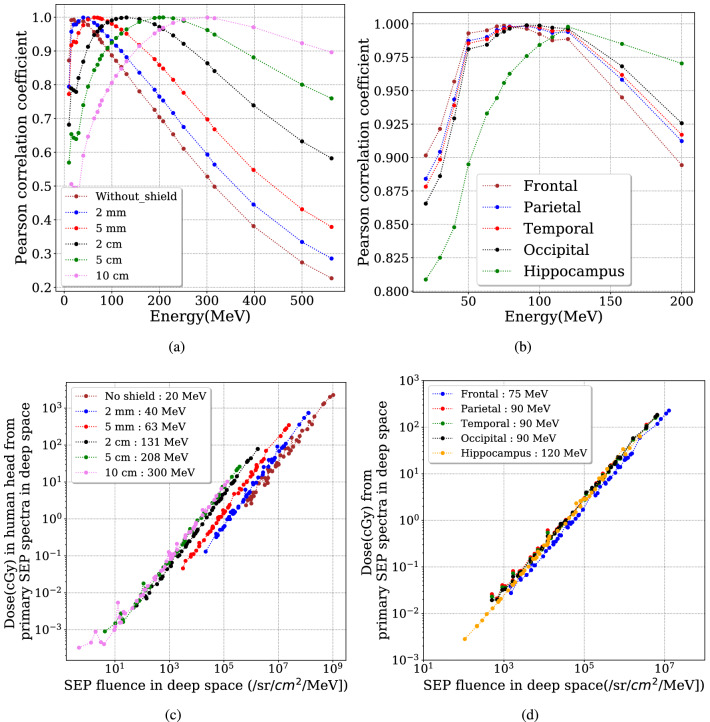
Health risks from radiation exposure in space are an important factor for astronauts’ safety as they venture on long-duration missions to the Moon or Mars. It is important to assess the radiation level inside the human brain to evaluate the possible hazardous effects on the central nervous system especially during solar energetic particle (SEP) events. We use a realistic model of the head/brain structure and calculate the radiation deposit therein by realistic SEP events, also under various shielding scenarios. We then determine the relation between the radiation dose deposited in different parts of the brain and the properties of the SEP events and obtain some simple and ready-to-use functions which can be used to quickly and reliably forecast the event dose in the brain. Such a novel tool can be used from fast nowcasting of the consequences of SEP events to optimization of shielding systems and other mitigation strategies of astronauts in space.
Overview
The claims and statistics of this paper haven’t been checked yet.
Free: it reads the open-access text and checks the first 5 claims that cite a source we can check. Create a free account to check every claim.
Integrity signals
Registry
Cites
Statistics
Figures
Verification
Claims the paper makes
The claims and statistics of this paper haven’t been checked yet.
Free: it reads the open-access text and checks the first 5 claims that cite a source we can check. Create a free account to check every claim.
Claims other papers make about this one
Each is checked against this paper’s own text: does it say what the citing paper says it does?
The source backs part of the claim, not all of it — or backs it for a different population, condition or comparison.
In the citing paper
“Khaksarighiri et al. (2021) have modeled the dose distribution inside a realistic human head structure induced by GCRs and SEP spectra of historical events, and found that the drastically enhanced dose induced by some SEP events inside the brain could actually exceed 0.5 Gy, with a potential mission-critical radiation effect.”
From Radiation environment for future human exploration on the surface of Mars: the current understanding based on MSL/RAD dose measurements (2021) · cites this paper as Khaksarighiri et al. 2021
Experimental — accuracy not yet measured
Self-check
Percentages, sums and reported differences re-computed from the paper’s own numbers.
The self-check needs the paper’s full text.
Citations
Cites
Agostinelli, S., Allison, J., Amako, K., Apostolakis, J., Araujo, H., Arce, P., Asai, M., Axen, D., Banerjee, S., Barrand, G., et al. (2003) · Nuclear Instruments and Methods in Physics Research Section A: Accelerators, Spectrometers, Detectors and Associated Equipment · doi:10.1016/s0168-9002(03)01368-8 · Cited by 25,106
Allison, J., Amako, K., Apostolakis, J., Arce, P., Asai, M., Aso, T., Bagli, E., Bagulya, A., Banerjee, S., Barrand, G., et al. (2016) · Nuclear Instruments and Methods in Physics Research Section A: Accelerators, Spectrometers, Detectors and Associated Equipment · doi:10.1016/j.nima.2016.06.125 · Cited by 4,194
The passage of energetic charged particles through interplanetary space
Parker, E. N. (1965) · Planetary and Space Science · doi:10.1016/0032-0633(65)90131-5 · Cited by 1,607
Elemental and isotopic composition of the galactic cosmic rays
Simpson, J. A. (1983) · Annual Review of Nuclear and Particle Science · doi:10.1146/annurev.ns.33.120183.001543 · Cited by 724
Cucinotta, F. A., & Durante, M. (2006) · The Lancet Oncology · doi:10.1016/s1470-2045(06)70695-7 · Cited by 697
Measurements of energetic particle radiation in transit to Mars on the Mars Science Laboratory
Zeitlin, C., Hassler, D. M., Cucinotta, F. A., Ehresmann, B., Wimmer-Schweingruber, R. F., Brinza, D. E., Kang, S., Weigle, G., Böttcher, S., Böhm, E., et al. (2013) · Science · doi:10.1126/science.1235989 · Cited by 641
Self-citationThe Radioresponse of the Central Nervous System: A Dynamic Process
Tofilon, P. J., & Fike, J. R. (2000) · Radiation Research · doi:10.1667/0033-7587(2000)153[0357:trotcn]2.0.co;2 · Cited by 526
Space Radiation: The number one risk to astronaut health beyond low earth orbit
Chancellor, J., Scott, G., & Sutton, J. (2014) · Life · doi:10.3390/life4030491 · Cited by 455
Change in Neurocognitive Functioning After Treatment With Cranial Radiation in Childhood
Spiegler, B. J., Bouffet, E., Greenberg, M. L., Rutka, J. T., & Mabbott, D. J. (2004) · Journal of Clinical Oncology · doi:10.1200/jco.2004.05.186 · Cited by 409
Segregating the functions of human hippocampus
Strange, B. A., Fletcher, P. C., Henson, R. N. A., Friston, K. J., & Dolan, R. J. (1999) · Proceedings of the National Academy of Sciences · doi:10.1073/pnas.96.7.4034 · Cited by 332
Space Radiation Cancer Risks and Uncertainties for Mars Missions
Cucinotta, F. A., Schimmerling, W., Wilson, J. W., Peterson, L. E., Badhwar, G. D., Saganti, P. B., & Dicello, J. F. (2001) · Radiation Research · doi:10.1667/0033-7587(2001)156[0682:srcrau]2.0.co;2 · Cited by 328
Frontal Lobes, Memory, and Aging
MOSCOVITCH, M., & WINOCUR, G. (1995) · Annals of the New York Academy of Sciences · doi:10.1111/j.1749-6632.1995.tb38135.x · Cited by 318
Effects of Spaceflight on Astronaut Brain Structure as Indicated on MRI
Roberts, D. R., Albrecht, M. H., Collins, H. R., Asemani, D., Chatterjee, A. R., Spampinato, M. V., Zhu, X., Chimowitz, M. I., & Antonucci, M. U. (2017) · New England Journal of Medicine · doi:10.1056/nejmoa1705129 · Cited by 318
Grill, J., Renaux, V. K., Bulteau, C., Viguier, D., Levy-Piebois, C., Sainte-Rose, C., Dellatolas, G., Raquin, M.-A., Jambaqué, I., & Kalifa, C. (1999) · International Journal of Radiation Oncology*Biology*Physics · doi:10.1016/s0360-3016(99)00177-7 · Cited by 287
Space radiation risks to the central nervous system
Cucinotta, F. A., Alp, M., Sulzman, F. M., & Wang, M. (2014) · Life Sciences in Space Research · doi:10.1016/j.lssr.2014.06.003 · Cited by 262
Cosmic radiation exposure and persistent cognitive dysfunction
Parihar, V. K., Allen, B. D., Caressi, C., Kwok, S., Chu, E., Tran, K. K., Chmielewski, N. N., Giedzinski, E., Acharya, M. M., Britten, R. A., et al. (2016) · Scientific Reports · doi:10.1038/srep34774 · Cited by 221
What happens to your brain on the way to Mars
Parihar, V. K., Allen, B., Tran, K. K., Macaraeg, T. G., Chu, E. M., Kwok, S. F., Chmielewski, N. N., Craver, B. M., Baulch, J. E., Acharya, M. M., et al. (2015) · Science Advances · doi:10.1126/sciadv.1400256 · Cited by 217
Delp, M. D., Charvat, J. M., Limoli, C. L., Globus, R. K., & Ghosh, P. (2016) · Scientific Reports · doi:10.1038/srep29901 · Cited by 216
Cherry, J. D., Liu, B., Frost, J. L., Lemere, C. A., Williams, J. P., Olschowka, J. A., & O’Banion, M. K. (2012) · PLoS ONE · doi:10.1371/journal.pone.0053275 · Cited by 198
Biological effects of space radiation and development of effective countermeasures
Kennedy, A. R. (2014) · Life Sciences in Space Research · doi:10.1016/j.lssr.2014.02.004 · Cited by 188
Getting ready for the manned mission to Mars: the astronauts’ risk from space radiation
Hellweg, C. E., & Baumstark-Khan, C. (2007) · Naturwissenschaften · doi:10.1007/s00114-006-0204-0 · Cited by 170
Badhwar–O'Neill 2010 Galactic Cosmic Ray Flux Model—Revised
O'Neill, P. M. (2010) · IEEE Transactions on Nuclear Science · doi:10.1109/tns.2010.2083688 · Cited by 166
Brain ventricular volume changes induced by long-duration spaceflight
Van Ombergen, A., Jillings, S., Jeurissen, B., Tomilovskaya, E., Rumshiskaya, A., Litvinova, L., Nosikova, I., Pechenkova, E., Rukavishnikov, I., Manko, O., et al. (2019) · Proceedings of the National Academy of Sciences · doi:10.1073/pnas.1820354116 · Cited by 148
Acharya, M. M., Baulch, J. E., Klein, P., Baddour, A. A. D., Apodaca, L. A., Kramár, E. A., Alikhani, L., García, C. P., Angulo, M. C., Batra, R. S., et al. (2019) · eNeuro · doi:10.1523/eneuro.0094-19.2019 · Cited by 140
Totally tubular: the mystery behind function and origin of the brain ventricular system
Lowery, L. A., & Sive, H. L. (2009) · BioEssays · doi:10.1002/bies.200800207 · Cited by 132
Modeling the acute health effects of astronauts from exposure to large solar particle events
Hu, S., Kim, M.-H. Y., McClellan, G. E., & Cucinotta, F. A. (2009) · Health Physics · doi:10.1097/01.hp.0000339020.92837.61 · Cited by 125
Female mice are protected from space radiation-induced maladaptive responses
Krukowski, K., Grue, K., Frias, E. S., Pietrykowski, J., Jones, T., Nelson, G., & Rosi, S. (2018) · Brain, Behavior, and Immunity · doi:10.1016/j.bbi.2018.08.008 · Cited by 124
Shielding from solar particle event exposures in deep space
Wilson, J. W., Cucinotta, F. A., Shinn, J. L., Simonsen, L. C., Dubey, R. R., Jordan, W. R., Jones, T. D., Chang, C. K., & Kim, M. Y. (1999) · Radiation Measurements · doi:10.1016/s1350-4487(99)00063-3 · Cited by 117
Tang, Y., Luo, D., Rong, X., Shi, X., & Peng, Y. (2012) · PLoS ONE · doi:10.1371/journal.pone.0036529 · Cited by 117
Macro- and microstructural changes in cosmonauts’ brains after long-duration spaceflight
Jillings, S., Ombergen, A. V., Tomilovskaya, E., Rumshiskaya, A. D., Litvinova, L., Nosikova, I., Pechenkova, E., Rukavishnikov, I. V., Kozlovskaya, I. B., Manko, O. M., et al. (2020) · Science Advances · doi:10.1126/sciadv.aaz9488 · Cited by 107
Belli, M., Sapora, O., & Tabocchini, M. A. (2002) · Journal of Radiation Research · doi:10.1269/jrr.43.s13 · Cited by 103
Concepts and challenges in cancer risk prediction for the space radiation environment
Barcellos-Hoff, M. H., Blakely, E. A., Burma, S., Fornace, A. J., Gerson, S., Hlatky, L., Kirsch, D. G., Luderer, U., Shay, J., Wang, Y., et al. (2015) · Life Sciences in Space Research · doi:10.1016/j.lssr.2015.07.006 · Cited by 96
Biological effects of space radiation on human cells: History, advances and outcomes
MAALOUF, M., DURANTE, M., & FORAY, N. (2011) · Journal of Radiation Research · doi:10.1269/jrr.10128 · Cited by 96
Space radiation and cardiovascular disease risk
Boerma, M. (2015) · World Journal of Cardiology · doi:10.4330/wjc.v7.i12.882 · Cited by 90
Psychological reactions to radiation therapy: Reconsideration of the adaptive aspects of anxiety.
Andersen, B. L., & Tewfik, H. H. (1985) · Journal of Personality and Social Psychology · doi:10.1037//0022-3514.48.4.1024 · Cited by 87
Effects of Proton and Combined Proton and 56Fe Radiation on the Hippocampus
Raber, J., Allen, A. R., Sharma, S., Allen, B., Rosi, S., Olsen, R. H. J., Davis, M. J., Eiwaz, M., Fike, J. R., & Nelson, G. A. (2015) · Radiation Research · doi:10.1667/rr14222.1 · Cited by 83
Radiation Exposure For Human Mars Exploration
Simonsen, L. C., Wilson, J. W., Kim, M. H., & Cucinotta, F. A. (2000) · Health Physics · doi:10.1097/00004032-200011000-00008 · Cited by 82 · cited 1×
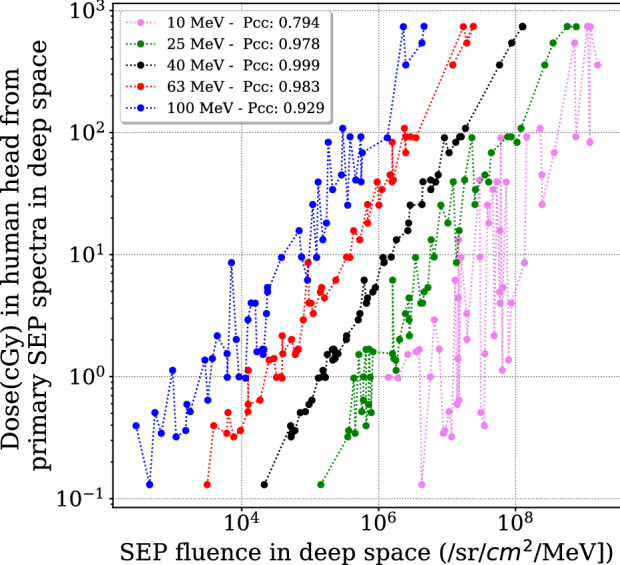
“As expected, the best Pcc for each case has the peak value around 1 at a certain energy that is (2) DBrain = a · IPivot Energy + b”
Backgroundde Boer, H. H., van der Merwe, A. E., & Soerdjbalie‐Maikoe, V. (2016) · International Journal of Legal Medicine · doi:10.1007/s00414-016-1324-5 · Cited by 75
Cosmic ray hit frequencies in critical sites in the central nervous system
Curtis, S. B., Vazquez, M. E., Wilson, J. W., Atwell, W., Kim, M. Y., & Capala, J. (1998) · Advances in Space Research · doi:10.1016/s0273-1177(98)80011-2 · Cited by 65
Sokolova, I. V., Schneider, C. J., Bezaire, M., Soltesz, I., Vlkolinsky, R., & Nelson, G. A. (2015) · Radiation Research · doi:10.1667/rr13785.1 · Cited by 62
Risks of cognitive detriments after low dose heavy ion and proton exposures
Cucinotta, F. A., & Cacao, E. (2019) · International Journal of Radiation Biology · doi:10.1080/09553002.2019.1623427 · Cited by 58
Guo, J., Zeitlin, C., Wimmer-Schweingruber, R. F., McDole, T., Kühl, P., Appel, J. C., Matthiä, D., Krauss, J., & Köhler, J. (2018) · The Astronomical Journal · doi:10.3847/1538-3881/aaa085 · Cited by 40
Self-citationImplementation and validation of the GEANT4/AtRIS code to model the radiation environment at Mars
Guo, J., Banjac, S., Röstel, L., Terasa, J. C., Herbst, K., Heber, B., & Wimmer-Schweingruber, R. F. (2019) · Journal of Space Weather and Space Climate · doi:10.1051/swsc/2018051 · Cited by 40
Self-citationLate Effects After Radiotherapy for Childhood Low-grade Glioma
Williams, N. L., Rotondo, R. L., Bradley, J. A., Pincus, D. W., Fort, J. A., Wynn, T., Morris, C. G., Mendenhall, N. P., & Indelicato, D. J. (2016) · American Journal of Clinical Oncology · doi:10.1097/coc.0000000000000267 · Cited by 37
Advances in modeling gradual solar energetic particle events
Lario, D. (2005) · Advances in Space Research · doi:10.1016/j.asr.2005.07.081 · Cited by 32
Implementation and validation of the GEANT4/AtRIS code to model the radiation environment at Mars
Guo, J., Banjac, S., Röstel, L., Terasa, J. C., Herbst, K., Heber, B., & Wimmer-Schweingruber, R. F. (2019) · Springer Link (Chiba Institute of Technology) · doi:10.1051/swsc/2018051/pdf · Cited by 32
Self-citationReady functions for calculating the Martian radiation environment
Guo, J., Wimmer-Schweingruber, R. F., Grande, M., Hannah Lee-Payne, Z., & Matthia, D. (2019) · Journal of Space Weather and Space Climate · doi:10.1051/swsc/2019004 · Cited by 23
Self-citationThe Pivot Energy of Solar Energetic Particles Affecting the Martian Surface Radiation Environment
Guo, J., Wimmer-Schweingruber, R. F., Wang, Y., Grande, M., Matthiä, D., Zeitlin, C., Ehresmann, B., & Hassler, D. M. (2019) · The Astrophysical Journal Letters · doi:10.3847/2041-8213/ab3ec2 · Cited by 14
Self-citationKhaksarighiri, S., Guo, J., Wimmer-Schweingruber, R. F., Narici, L., & Lohf, H. (2020) · Life Sciences in Space Research · doi:10.1016/j.lssr.2020.07.003 · Cited by 14
Self-citationZeitlin, C. J. (2019) · Springer eBooks · doi:10.1007/978-3-319-10152-1_28-1 · Cited by 9
Early Results from the Advanced Radiation Protection Thick GCR Shielding Project
Norman, R. B., Clowdsley, M. S., Slaba, T. C., Heilbronn, L., Zeitlin, C. J., Kenny, S., Crespo, L. G., Giesy, D. P., Warner, J. R., McGirl, N. A., et al. (2017) · NASA Technical Reports Server (NASA) · Cited by 2
Research works printed but not linked: 1
- Hu S Kim M-HY McClellan GE Cucinotta FA Modeling the acute health effects of astronauts from exposure to large solar particle events Health Phys. 2009 96 4 465 476 10.1097/01.HP.0000339020.92837.61 19276707 · DOI · Paper page
Cited by
Guo, J., Zeitlin, C., Wimmer-Schweingruber, R. F., Hassler, D. M., Ehresmann, B., Rafkin, S., Freiherr von Forstner, J. L., Khaksarighiri, S., Liu, W., & Wang, Y. (2021) · The Astronomy and Astrophysics Review · doi:10.1007/s00159-021-00136-5 · Cited by 73
Self-citationVerma, S. D., de la Chapelle, E. P., Malkani, S., Juran, C. M., Boyko, V., Costes, S. V., & Cekanaviciute, E. (2022) · Frontiers in Immunology · doi:10.3389/fimmu.2022.864923 · Cited by 41
Human Physiological Limitations to Long-Term Spaceflight and Living in Space
Winkler, L. H. (2023) · Aerospace Medicine and Human Performance · doi:10.3357/amhp.6190.2023 · Cited by 22
Nowcasting Solar Energetic Particle Events for Mars Missions
Löwe, J. L., Khaksarighiri, S., Wimmer-Schweingruber, R. F., Hassler, D. M., Ehresmann, B., Guo, J., Reitz, G., Berger, T., Matthiä, D., Zeitlin, C. J., et al. (2025) · Space Weather · doi:10.1029/2025sw004372 · Cited by 12
“A distinction is made between acute radiation syn-droms (ARS), primarily triggered by SEP events, and long‐term effects, caused by the combination of GCRs and SEPs (Barcellos‐Hoff et al., 2015).”
Self-citationKhaksarighiri, S., Guo, J., Wimmer-Schweingruber, R. F., Löffler, S., Ehresmann, B., Matthiä, D., Hassler, D. M., Zeitlin, C. J., & Berger, T. (2023) · Journal of Geophysical Research Planets · doi:10.1029/2022je007644 · Cited by 7
“Long-term exposure to GCRs does not cause immediate health effects but can increase the risk of cancer over a lifetime and also cataracts and central nervous system decrements (Cucinotta et al., 2014; Kennedy, 2014; Khaksarighiri et al., 2021).”
BackgroundSelf-citation
Metadata
- Authors
- Khaksarighiri, S., Guo, J., Wimmer-Schweingruber, R., & Narici, L.
- Affiliations
- Christian-Albrechts-Universität zu Kiel (DE)
- University of Science and Technology of China (CN)
- University of Rome Tor Vergata (IT)
- Corresponding author
- Guo, Jingnan
- Venue
- Scientific Reports
- Published
- 2021-06-03
- Volume
- 11
- Issue
- 1
- Pages
- 11687-11687
- ISSN
- 2045-2322 (ISSN-L)
- PMC
- PMC8175378
- OpenAlex
- W3165830143
- Cited by
- 8
- References
- 52
- Citations by year
- 2025: 3 · 2023: 3 · 2022: 1 · 2021: 1
- FWCI
- 0.81
- Type
- journal article
- Language
- en
- Open access
- gold
- doi.org
- Licence
- cc-by
- creativecommons.org/licenses/by/4.0 (tdm)
- creativecommons.org/licenses/by/4.0 (vor)
- Locations
- Scientific Reports (publishedVersion, cc-by)
- PubMed Central (publishedVersion, cc-by)
- PubMed (publishedVersion)
- DOAJ (DOAJ: Directory of Open Access Journals) (submittedVersion, cc-by-sa)
- Multimedialen Archiv und Publikationsserver der Christian-Albrechts-Universität zu Kiel (Christian-Albrechts-Universität zu Kiel) (submittedVersion, cc-by)
- Funders
- DLR’s Space Administration grant (50QM0501)
- DLR’s Space Administration (50QM1201)
- Strategic Priority Program of the Chinese Academy of Sciences (XDB41000000)
- National Natural Science Foundation of China (42074222)
- CNSA pre-research Project on Civil Aerospace Technologies (D020104)
- ASI ALTEA-BrainRad (2016-28-H.O.)
- Christian-Albrechts-Universität zu Kiel
- Topics
- Physical Sciences › Physics and Astronomy › Radiation › Radiation Therapy and Dosimetry
- Physical Sciences › Physics and Astronomy › Astronomy and Astrophysics › Solar and Space Plasma Dynamics
- Health Sciences › Medicine › Physiology (medical) › Spaceflight effects on biology
- Keywords
- deep space radiation, solar energetic particles, central nervous system, radiation shielding, astronaut health risk
- MeSH terms
- Brain, Central Nervous System, Humans, Radiation Protection, Risk Factors, Solar Energy, Space Flight, Exobiology
About these checks
Registry, retraction, Cites and statistics results are computed, not judged, with one exception: a printed reference that no index lists is read once by a model before it counts as a citation error. Claims are extracted by a model and kept only when their quote appears verbatim in the text; each cited source is then checked, with a model’s help, for whether it says what the claim relies on. Those verdicts can be wrong — read the claim’s quote and the cited source before relying on one.
Statistics and arithmetic are recomputed, not judged.
Confidence bands are shown only for fields calibrated on our annotated test set. None is calibrated yet, so no band is shown.
What counts as a claim ›How we measure confidence ›How we check this ›
Are you an author, or do you see a problem with this page? Request a review
Data sources
Bibliographic data: Semantic Scholar, OpenAlex, Crossref.
Contains information from the Semantic Scholar Academic Graph Datasets, made available under the ODC Attribution License (ODC-BY 1.0).
Semantic Scholar’s data is described in: Kinney, R., et al. (2023). The Semantic Scholar Open Data Platform. arXiv:2301.10140.
