

Low predictive power of clinical features for relapse prediction after antidepressant discontinuation in a naturalistic setting.
Open accessThe DOI matches its Crossref record; 51 of the 52 references it cites were found in a registry or an index.
Abstract
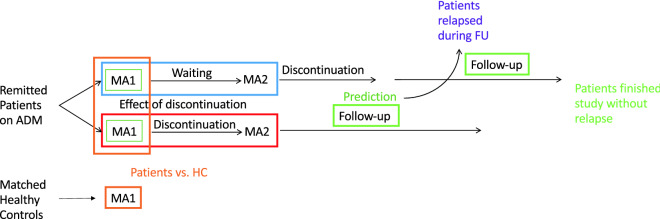
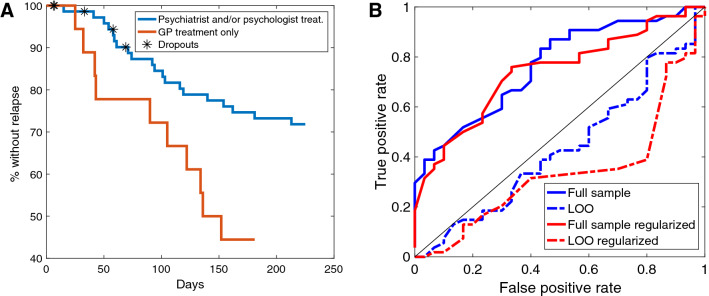
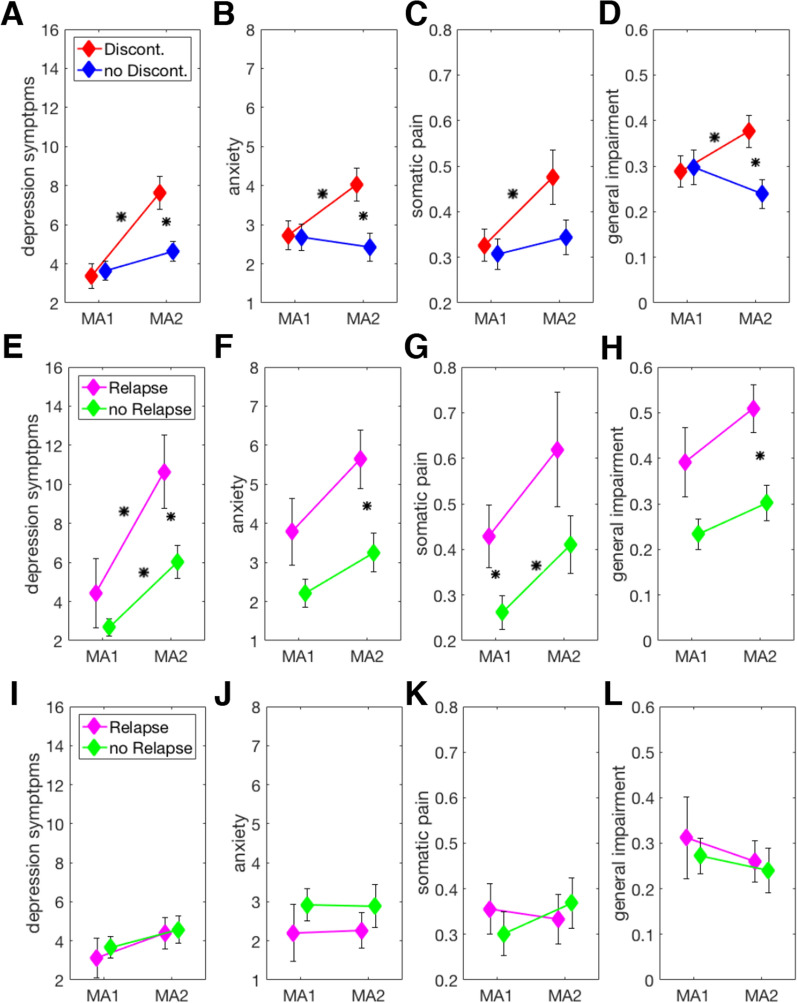
The risk of relapse after antidepressant medication (ADM) discontinuation is high. Predictors of relapse could guide clinical decision-making, but are yet to be established. We assessed demographic and clinical variables in a longitudinal observational study before antidepressant discontinuation. State-dependent variables were re-assessed either after discontinuation or before discontinuation after a waiting period. Relapse was assessed during 6 months after discontinuation. We applied logistic general linear models in combination with least absolute shrinkage and selection operator and elastic nets to avoid overfitting in order to identify predictors of relapse and estimated their generalisability using cross-validation. The final sample included 104 patients (age: 34.86 (11.1), 77% female) and 57 healthy controls (age: 34.12 (10.6), 70% female). 36% of the patients experienced a relapse. Treatment by a general practitioner increased the risk of relapse. Although within-sample statistical analyses suggested reasonable sensitivity and specificity, out-of-sample prediction of relapse was at chance level. Residual symptoms increased with discontinuation, but did not relate to relapse. Demographic and standard clinical variables appear to carry little predictive power and therefore are of limited use for patients and clinicians in guiding clinical decision-making.
Overview
The claims and statistics of this paper haven’t been checked yet.
Free: it reads the open-access text and checks the first 5 claims that cite a source we can check. Create a free account to check every claim.
Integrity signals
Registry
Cites
Statistics
Figures
Verification
Claims the paper makes
The claims and statistics of this paper haven’t been checked yet.
Free: it reads the open-access text and checks the first 5 claims that cite a source we can check. Create a free account to check every claim.
Claims other papers make about this one
Each is checked against this paper’s own text: does it say what the citing paper says it does?
In the citing paper
“While clinical features and even discon nua on symptoms are not predic ve of relapse [13, 48] in this sample, several neurocogni ve measures have shown promise.”
From Amygdala Reactivity, Antidepressant Discontinuation, and Relapse (2024) · cites this paper as [13]
Self-check
Percentages, sums and reported differences re-computed from the paper’s own numbers.
The self-check needs the paper’s full text.
Citations
Cites
1 retracted
Hollon, S. D., DeRubeis, R. J., Fawcett, J., Amsterdam, J. D., Shelton, R. C., Zajecka, J., Young, P. R., & Gallop, R. (2014) · JAMA Psychiatry · doi:10.1001/jamapsychiatry.2014.1054 · Cited by 179 · cited 1×
“Indeed, psychotherapeutic techniques explicitly aimed at relapse have been developed (Hollon et al., 2005, 2014).”
BackgroundRetractedA Brief Measure for Assessing Generalized Anxiety Disorder: The GAD-7
Spitzer, R. L., Kroenke, K., Williams, J. B. W., & Löwe, B. (2006) · Archives of Internal Medicine · doi:10.1001/archinte.166.10.1092 · Cited by 31,765
Regularization and Variable Selection Via the Elastic Net
Zou, H., & Hastie, T. (2005) · Journal of the Royal Statistical Society Series B: Statistical Methodology · doi:10.1111/j.1467-9868.2005.00503.x · Cited by 20,957
Kessler, R. C., Berglund, P., Demler, O., Jin, R., Koretz, D., Merikangas, K. R., Rush, A. J., Walters, E. E., & Wang, P. S. (2003) · JAMA · doi:10.1001/jama.289.23.3095 · Cited by 7,988
Rush, A. J., Trivedi, M. H., Wisniewski, S. R., Nierenberg, A. A., Stewart, J. W., Warden, D., Niederehe, G., Thase, M. E., Lavori, P. W., Lebowitz, B. D., et al. (2006) · American Journal of Psychiatry · doi:10.1176/ajp.2006.163.11.1905 · Cited by 5,643
The Inventory of Depressive Symptomatology (IDS): Psychometric properties
Rush, A. J., Gullion, C. M., Basco, M. R., Jarrett, R. B., & Trivedi, M. H. (1996) · Psychological Medicine · doi:10.1017/s0033291700035558 · Cited by 2,177 · cited 2×
“77 a) Unless stated otherwise, mean (SD) are shown; b) Determined as follows: intelligence: Mehrfachwahl Wortschatz Test (Lehr, 2005); residual depression: Inventory of Depressive Symptomatology-Clinician Rated (Rush et al., 1996); residual anxiety: screening generalised anxiety disorder (GAD-7; Spitzer et al.”
MethodWilamowska (2010) · doi:10.1001/archpsyc.1988.01800320058007 · Cited by 2,115
Frank, E. (1991) · Archives of General Psychiatry · doi:10.1001/archpsyc.1991.01810330075011 · Cited by 1,959
Confirmation of the dimensional structure of the scl-90: A study in construct validation
Derogatis, L. R., & Cleary, P. A. (1977) · Journal of Clinical Psychology · doi:10.1002/1097-4679(197710)33:4<981::aid-jclp2270330412>3.0.co;2-0 · Cited by 1,563
The increasing burden of depression
Briley, M., & Lépine (2011) · Neuropsychiatric Disease and Treatment · doi:10.2147/ndt.s19617 · Cited by 1,211
Risk for recurrence in depression
Burcusa, S. L., & Iacono, W. G. (2007) · Clinical Psychology Review · doi:10.1016/j.cpr.2007.02.005 · Cited by 1,023
Computational psychiatry as a bridge from neuroscience to clinical applications
Huys, Q. J. M., Maia, T. V., & Frank, M. J. (2016) · Nature Neuroscience · doi:10.1038/nn.4238 · Cited by 1,002
Self-citationRelapse prevention with antidepressant drug treatment in depressive disorders: a systematic review
Geddes, J. R., Carney, S. M., Davies, C., Furukawa, T. A., Kupfer, D. J., Frank, E., & Goodwin, G. M. (2003) · The Lancet · doi:10.1016/s0140-6736(03)12599-8 · Cited by 945
Rush, A. J. (2006) · American Journal of Psychiatry · doi:10.1176/appi.ajp.163.11.1905 · Cited by 870
Prevention of Relapse following cognitive therapy vs medications in moderate to severe depression.
Hollon, S. D., DeRubeis, R. J., Shelton, R. C., Amsterdam, J. D., Salomon, R. M., O’Reardon, J. P., Lovett, M. L., Young, P. R., Haman, K. L., Freeman, B. B., et al. (2005) · Archives of General Psychiatry · doi:10.1001/archpsyc.62.4.417 · Cited by 735
Monroe, S. M., & Harkness, K. L. (2005) · Psychological Review · doi:10.1037/0033-295x.112.2.417 · Cited by 693
Cross-trial prediction of treatment outcome in depression: a machine learning approach
Chekroud, A. M., Zotti, R. J., Shehzad, Z., Gueorguieva, R., Johnson, M. K., Trivedi, M. H., Cannon, T. D., Krystal, J. H., & Corlett, P. R. (2016) · The Lancet Psychiatry · doi:10.1016/s2215-0366(15)00471-x · Cited by 676
Bauer, M., Pfennig, A., Severus, E., Whybrow, P. C., Angst, J., Möller, H.-J., & Šon behalf of the Task Force on Unipolar Depressive Disorders (2013) · The World Journal of Biological Psychiatry · doi:10.3109/15622975.2013.804195 · Cited by 632
Prevalence and predictors of recurrence of major depressive disorder in the adult population
Hardeveld, F., Spijker, J., De Graaf, R., Nolen, W. A., & Beekman, A. T. F. (2010) · Acta Psychiatrica Scandinavica · doi:10.1111/j.1600-0447.2009.01519.x · Cited by 486
Nierenberg, A. A., Husain, M. M., Trivedi, M. H., Fava, M., Warden, D., Wisniewski, S. R., Miyahara, S., & Rush, A. J. (2010) · Psychological Medicine · doi:10.1017/s0033291709006011 · Cited by 458
Continuity of antidepressant treatment for adults with depression in the United States
Olfson, M., Marcus, S. C., Tedeschi, M., & Wan, G. J. (2006) · American Journal of Psychiatry · doi:10.1176/appi.ajp.163.1.101 · Cited by 392
Predictors of Relapse in Major Depressive Disorder
Keller, M. B. (1983) · JAMA: The Journal of the American Medical Association · doi:10.1001/jama.1983.03340240025024 · Cited by 306
Why significant variables aren’t automatically good predictors
Lo, A., Chernoff, H., Zheng, T., & Lo, S.-H. (2015) · Proceedings of the National Academy of Sciences · doi:10.1073/pnas.1518285112 · Cited by 301
Long-term Outcome of Episodes of Major Depression: Clinical and Public Health Significance
Keller, M. B. (1984) · JAMA · doi:10.1001/jama.252.6.788 · Cited by 295
Wolfers, T., Buitelaar, J. K., Beckmann, C. F., Franke, B., & Marquand, A. F. (2015) · Neuroscience & Biobehavioral Reviews · doi:10.1016/j.neubiorev.2015.08.001 · Cited by 290 · cited 1×
“Such approaches are standard in the field of machine-learning, and are becoming more prominent in neuroscience and psychiatry (e.g. Chekroud et al. , 2016; Wolfers et al. , 2015; Dinga et al. , 2018).”
Recurrence in major depression: A conceptual analysis
Monroe, S. M., & Harkness, K. L. (2011) · Psychological Review · doi:10.1037/a0025190 · Cited by 225
Sim, K., Lau, W. K., Sim, J., Sum, M. Y., & Baldessarini, R. J. (2016) · International Journal of Neuropsychopharmacology · doi:10.1093/ijnp/pyv076 · Cited by 218
Growth modeling with nonignorable dropout: Alternative analyses of the STAR*D antidepressant trial.
Muthén, B., Asparouhov, T., Hunter, A. M., & Leuchter, A. F. (2011) · Psychological Methods · doi:10.1037/a0022634 · Cited by 204
Use of Pattern Analysis to Identify True Drug Response: A Replication
Quitkin, F. M. (1987) · Archives of General Psychiatry · doi:10.1001/archpsyc.1987.01800150071009 · Cited by 191
Hunot, V. M., Horne, R., Leese, M. N., & Churchill, R. C. (2007) · The Primary Care Companion to The Journal of Clinical Psychiatry · doi:10.4088/pcc.v09n0202 · Cited by 180
Discontinuing antidepressant treatment in major depression.
Viguera, A. C., Baldessarini, R. J., & Friedberg, J. (1998) · Harvard Review of Psychiatry · doi:10.3109/10673229809003578 · Cited by 145
Kaymaz, N., van Os, J., Loonen, A. J. M., & Nolan, W. A. (2008) · The Journal of Clinical Psychiatry · doi:10.4088/jcp.v69n0910 · Cited by 135
Wakefield, J. C., & Schmitz, M. F. (2013) · World Psychiatry · doi:10.1002/wps.20015 · Cited by 133
Trajectories of change in depression severity during treatment with antidepressants
Uher, R., Muthén, B., Souery, D., Mors, O., Jaracz, J., Placentino, A., Petrovic, A., Zobel, A., Henigsberg, N., Rietschel, M., et al. (2010) · Psychological Medicine · doi:10.1017/s0033291709991528 · Cited by 128
Dinga, R., Marquand, A. F., Veltman, D. J., Beekman, A. T. F., Schoevers, R. A., van Hemert, A. M., Penninx, B. W. J. H., & Schmaal, L. (2018) · Translational Psychiatry · doi:10.1038/s41398-018-0289-1 · Cited by 125
Hollon, S. D., Shelton, R. C., Wisniewski, S., Warden, D., Biggs, M. M., Friedman, E. S., Husain, M., Kupfer, D. J., Nierenberg, A. A., Petersen, T. J., et al. (2006) · Journal of Psychiatric Research · doi:10.1016/j.jpsychires.2005.07.008 · Cited by 120
Gueorguieva, R. (2011) · Archives of General Psychiatry · doi:10.1001/archgenpsychiatry.2011.132 · Cited by 115
Stewart, J. W., Quitkin, F. M., McGrath, P. J., Amsterdam, J., Fava, M., Fawcett, J., Reimherr, F., Rosenbaum, J., Beasley, C., & Roback, P. (1998) · Archives of General Psychiatry · doi:10.1001/archpsyc.55.4.334 · Cited by 113
Berwian, I. M., Wenzel, J. G., Collins, A. G. E., Seifritz, E., Stephan, K. E., Walter, H., & Huys, Q. J. M. (2020) · JAMA Psychiatry · doi:10.1001/jamapsychiatry.2019.4971 · Cited by 113
Self-citationAndrews, P. W., Kornstein, S. G., Halberstadt, L. J., Gardner, C. O., & Neale, M. C. (2011) · Frontiers in Psychology · doi:10.3389/fpsyg.2011.00159 · Cited by 107
Meta-analysis of relapse prevention antidepressant trials in depressive disorders
Glue, P., Donovan, M. R., Kolluri, S., & Emir, B. (2010) · Australian & New Zealand Journal of Psychiatry · doi:10.3109/00048671003705441 · Cited by 100
Predicting relapse after antidepressant withdrawal – a systematic review
Berwian, I. M., Walter, H., Seifritz, E., & Huys, Q. J. M. (2017) · Psychological Medicine · doi:10.1017/s0033291716002580 · Cited by 93
Self-citationGueorguieva, R., Chekroud, A. M., & Krystal, J. H. (2017) · The Lancet Psychiatry · doi:10.1016/s2215-0366(17)30038-x · Cited by 67
Predictors of Relapse During Fluoxetine Continuation or Maintenance Treatment of Major Depression
McGrath, P. J., Stewart, J. W., Petkova, E., Quitkin, F. M., Amsterdam, J. D., Fawcett, J., Reimherr, F. W., Rosenbaum, J. F., & Beasley, C. M. (2000) · The Journal of Clinical Psychiatry · doi:10.4088/jcp.v61n0710 · Cited by 65
Musliner, K. L., Munk-Olsen, T., Laursen, T. M., Eaton, W. W., Zandi, P. P., & Mortensen, P. B. (2016) · JAMA Psychiatry · doi:10.1001/jamapsychiatry.2015.3365 · Cited by 63 · cited 1×
“Thus, not all patients benefit equally from continuation treatment and there appears to be variation in individual trajectories after the initial response to ADMs (Uher et al., 2010; Gueorguieva et al., 2011; Muthén et al., 2011; Musliner et al., 2016).”
BackgroundNierenberg, A. A., Quitkin, F. M., Kremer, C., Keller, M. B., & Thase, M. E. (2004) · Neuropsychopharmacology · doi:10.1038/sj.npp.1300405 · Cited by 51 · cited 1×
“Duration of ADM intake – – – 24 (29) 22.”
Berwian, I. M., Wenzel, J. G., Kuehn, L., Schnuerer, I., Kasper, L., Veer, I. M., Seifritz, E., Stephan, K. E., Walter, H., & Huys, Q. J. M. (2020) · Scientific Reports · doi:10.1038/s41598-020-79170-9 · Cited by 29
Self-citationPredictors of relapse in a study of duloxetine treatment in patients with major depressive disorder
Fava, M., Wiltse, C. G., Walker, D. J., Brecht, S., Chen, A., & David, P. (2008) · Journal of Affective Disorders · doi:10.1016/j.jad.2008.05.023 · Cited by 27
Long-Term Treatment Outcomes of Depression With Associated Anxiety
Joliat, M. J., Schmidt, M. E., D, M. F. M., Zhang, S., Michelson, D., Trapp, N. J., & Miner, C. M. (2004) · The Journal of Clinical Psychiatry · doi:10.4088/jcp.v65n0313 · Cited by 16
Quality of life after response to acute-phase cognitive therapy for recurrent depression
Vittengl, J. R., Jha, M. K., Minhajuddin, A., Thase, M. E., & Jarrett, R. B. (2021) · Journal of Affective Disorders · doi:10.1016/j.jad.2020.09.059 · Cited by 12
Examining the role of race and ethnicity in relapse rates of major depressive disorder
Trinh, N., Shyu, I., McGrath, P. J., Clain, A. J., Baer, L., D, M. F. M., & Yeung, A. (2010) · Comprehensive Psychiatry · doi:10.1016/j.comppsych.2010.05.004 · Cited by 7
Research works printed but not linked: 3
- 16. NICE. Depression: The Treatment and Management of Depression in Adults (Updated Edition). (British Psychological Society, 2010).
- 36. Wittchen, H.-U. & Fydrich, T. Strukturiertes klinisches Interview für DSM-IV. Manual zum SKID-I und SKID-II (Hofgrefe, 1997).
- 39. Lehr, S. Mehrfachwahl-Wortschatz-Intelligenztest MWT-B (Spitta, 2005).
Cited by
Amygdala Reactivity, Antidepressant Discontinuation, and Relapse
Erdmann, T., Berwian, I. M., Stephan, K. E., Seifritz, E., Walter, H., & Huys, Q. J. M. (2024) · JAMA Psychiatry · doi:10.1001/jamapsychiatry.2024.2136 · Cited by 18
Self-citation(2024) · doi:10.1016/j.psychres.2024.115926 · Cited by 15
Towards a consensus roadmap for a new diagnostic framework for mental disorders
Kas, M. J., Hyman, S. E., Williams, L. M., Hidalgo‐Mazzei, D., Huys, Q. J. M., Hotopf, M. H., Cuthbert, B. N., Lewis, C. M., Picker, L. D., Lalousis, P. A., et al. (2024) · European Neuropsychopharmacology · doi:10.1016/j.euroneuro.2024.08.515 · Cited by 17
Self-citationAntidepressant Discontinuation Syndrome
Kim, S. H., Kim, Y. S., & Kang, U. G. (2024) · 신경정신의학 · doi:10.4306/jknpa.2024.63.2.104 · Cited by 12
Meißner, C., Warren, C. V., Fadai, T., Müller, A., Zapf, A., Lezius, S., Ozga, A., Falkenberg, I., Kircher, T. T. J., & Nestoriuc, Y. (2023) · BMC Psychiatry · doi:10.1186/s12888-023-04941-3 · Cited by 11
“Clinical and demographic variables were found to be of limited use as indicators of recurrence risk [41, 42].”
Background
Metadata
- Authors
- Berwian, I. M., Wenzel, J. G., Kuehn, L., Schnuerer, I., Seifritz, E., Stephan, K. E., Walter, H., & Huys, Q. J. M.
- Affiliations
- Princeton University (US)
- Charité – Universitätsmedizin Berlin (DE)
- University of Zurich (CH)
- Wellcome Centre for Human Neuroimaging (GB)
- Corresponding author
- Berwian, Isabel M.
- ORCID
- Venue
- Scientific Reports
- Published
- 2022-07-01
- Volume
- 12
- Issue
- 1
- Pages
- 11171-11171
- ISSN
- 2045-2322 (ISSN-L)
- PMC
- PMC9249776
- OpenAlex
- W4283753310
- Semantic Scholar
- 94ca566fbfbad3287f1393d7548e96b80f21deb9
- Cited by
- 13
- References
- 52
- Citations by year
- 2026: 2 · 2025: 1 · 2024: 7 · 2023: 3
- FWCI
- 1.65
- Type
- journal article
- Language
- en
- Open access
- gold
- doi.org
- Licence
- cc-by
- creativecommons.org/licenses/by/4.0 (tdm)
- creativecommons.org/licenses/by/4.0 (vor)
- Locations
- Scientific Reports (publishedVersion, cc-by)
- PubMed Central (publishedVersion, cc-by)
- PubMed (publishedVersion)
- DOAJ (DOAJ: Directory of Open Access Journals) (submittedVersion)
- Zurich Open Repository and Archive (University of Zurich) (submittedVersion, cc-by)
- Funders
- Clinical Research Priority Program “Molecular Imaging” at the University of Zurich
- Rene and Susanne Braginsky Foundation
- Deutsche Forschungsgemeinschaft (WA 1539/5-1)
- Schweizerischer Nationalfonds zur Förderung der Wissenschaftlichen Forschung (320030L_153449/1)
- Topics
- Health Sciences › Medicine › Pharmacology (medical) › Treatment of Major Depression
- Health Sciences › Medicine › Psychiatry and Mental health › Mental Health Treatment and Access
- Social Sciences › Psychology › Experimental and Cognitive Psychology › Anxiety, Depression, Psychometrics, Treatment, Cognitive Processes
- Keywords
- antidepressant discontinuation, recurrence prediction, depression, clinical predictors, residual symptoms, naturalistic settings
- MeSH terms
- Adult, Antidepressive Agents, Chronic Disease, Female, Humans, Longitudinal Studies, Male, Recurrence, Disease Progression
About these checks
Registry, retraction, Cites and statistics results are computed, not judged, with one exception: a printed reference that no index lists is read once by a model before it counts as a citation error. Claims are extracted by a model and kept only when their quote appears verbatim in the text; each cited source is then checked, with a model’s help, for whether it says what the claim relies on. Those verdicts can be wrong — read the claim’s quote and the cited source before relying on one.
Statistics and arithmetic are recomputed, not judged.
Confidence bands are shown only for fields calibrated on our annotated test set. None is calibrated yet, so no band is shown.
What counts as a claim ›How we measure confidence ›How we check this ›
Are you an author, or do you see a problem with this page? Request a review
Data sources
Bibliographic data: Semantic Scholar, OpenAlex, Crossref.
Contains information from the Semantic Scholar Academic Graph Datasets, made available under the ODC Attribution License (ODC-BY 1.0).
Semantic Scholar’s data is described in: Kinney, R., et al. (2023). The Semantic Scholar Open Data Platform. arXiv:2301.10140.
