

Social determinants and lifestyle factors for brain health: implications for risk reduction of cognitive decline and dementia
Open accessThe DOI matches its Crossref record; 48 of the 48 references it cites were found in a registry or an index.
Abstract
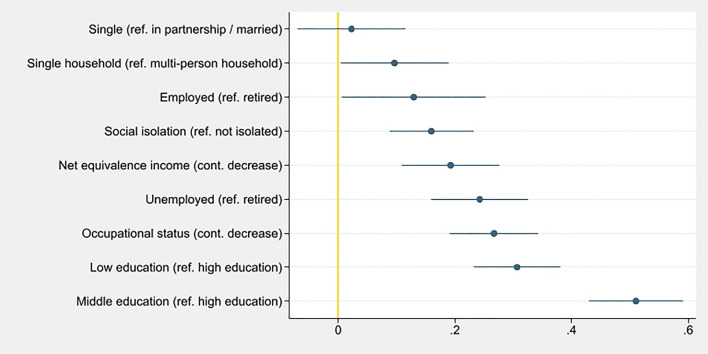
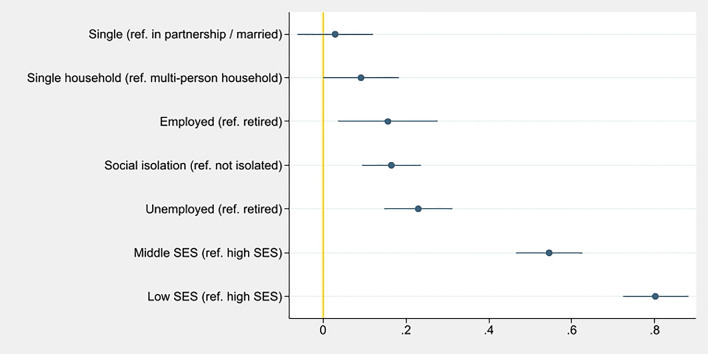
Substantial evidence indicates a huge potential for risk reduction of cognitive decline and dementia based on modifiable health and lifestyle factors. To maximize the chances for risk reduction, it is useful to investigate associations of social determinants and lifestyle for brain health. We computed the “LIfestyle for BRAin health” (LIBRA) score for baseline participants of the Leipzig Research Centre for Civilization Diseases (LIFE) Adult Study, a population-based urban cohort in Germany. LIBRA predicts dementia in midlife and early late life populations, comprising 12 modifiable risk factors (heart disease, kidney disease, diabetes, obesity, hypertension, hypercholesterolemia, alcohol consumption, smoking, physical inactivity, diet, depression, cognitive inactivity). Associations of social determinants (living situation, marital status, social isolation, education, net equivalence income, occupational status, socioeconomic status/SES, employment) with LIBRA were inspected using age- and sex-adjusted multivariable linear regression analysis. Z-standardization and sampling weights were applied. Participants (n = 6203) were M = 57.4 (SD = 10.6, range 40–79) years old and without dementia, 53.0% were women. Except for marital status, all considered social determinants were significantly associated with LIBRA. Beta coefficients for the association with higher LIBRA scores were most pronounced for low SES (β = 0.80, 95% CI [0.72–0.88]; p < 0.001) and middle SES (β = 0.55, 95% CI [0.47–0.62]; p < 0.001). Social determinants, particularly socioeconomic factors, are associated with lifestyle for brain health, and should thus be addressed in risk reduction strategies for cognitive decline and dementia. A social-ecological public health perspective on risk reduction might be more effective and equitable than focusing on individual lifestyle behaviors alone.
Overview
The claims and statistics of this paper haven’t been checked yet.
Free: it reads the open-access text and checks the first 5 claims that cite a source we can check. Create a free account to check every claim.
Integrity signals
Registry
Cites
Statistics
Figures
Verification
Claims the paper makes
The claims and statistics of this paper haven’t been checked yet.
Free: it reads the open-access text and checks the first 5 claims that cite a source we can check. Create a free account to check every claim.
Claims other papers make about this one
Each is checked against this paper’s own text: does it say what the citing paper says it does?
The cited source says what the claim attributes to it.
In the citing paper
“Important social disadvantage such as less education, more social isolation and lower socioeconomic status tend to cluster with health factors that predict cognitive decline and dementia. (30)”
From Dementia prevention, intervention, and care: 2024 report of the Lancet standing Commission (2024) · cites this paper as [30]
Self-check
Percentages, sums and reported differences re-computed from the paper’s own numbers.
The self-check needs the paper’s full text.
Citations
Cites
1 retracted
Dementia prevention, intervention, and care: 2020 report of the Lancet Commission
Livingston, G., Huntley, J., Sommerlad, A., Ames, D., Ballard, C., Banerjee, S., Brayne, C., Burns, A., Cohen-Mansfield, J., Cooper, C., et al. (2020) · The Lancet · doi:10.1016/s0140-6736(20)30367-6 · Cited by 10,430 · cited 1×
“Assigned values ranged from 1 to 7, representing professional categories from (1) farmer/ unskilled worker/semi-skilled worker to (7) freelance academics/civil servants in highest services/supervisors with ≥ 5 employees, based on the International Socio-Economic-Index of Occupational Status (ISEI) which uses the profe…”
BackgroundRetractedBundesgesundheitsblatt - Gesundheitsforschung - Gesundheitsschutz
(2013) · Bundesgesundheitsblatt - Gesundheitsforschung - Gesundheitsschutz · doi:10.1007/103.1437-1588 · Cited by 11,796
Social determinants of health inequalities
Marmot, M. (2005) · The Lancet · doi:10.1016/s0140-6736(05)71146-6 · Cited by 5,086
Ngandu, T., Lehtisalo, J., Solomon, A., Levälahti, E., Ahtiluoto, S., Antikainen, R., Bäckman, L., Hänninen, T., Jula, A., Laatikainen, T., et al. (2015) · The Lancet · doi:10.1016/s0140-6736(15)60461-5 · Cited by 3,689
Cognitive reserve in ageing and Alzheimer's disease
Stern, Y. (2012) · The Lancet Neurology · doi:10.1016/s1474-4422(12)70191-6 · Cited by 3,557
A standard international socio-economic index of occupational status
Ganzeboom, H. B. G., De Graaf, P. M., & Treiman, D. J. (1992) · Social Science Research · doi:10.1016/0049-089x(92)90017-b · Cited by 3,129
Lubben, J., Blozik, E., Gillmann, G., Iliffe, S., von Renteln Kruse, W., Beck, J. C., & Stuck, A. E. (2006) · The Gerontologist · doi:10.1093/geront/46.4.503 · Cited by 2,123
Participation Rates in Epidemiologic Studies
Galea, S., & Tracy, M. (2007) · Annals of Epidemiology · doi:10.1016/j.annepidem.2007.03.013 · Cited by 1,877
Golden, S. D., & Earp, J. A. L. (2012) · Health Education & Behavior · doi:10.1177/1090198111418634 · Cited by 1,394
Health lifestyle theory and the convergence of agency and structure
Cockerham, W. C. (2005) · Journal of Health and Social Behavior · doi:10.1177/002214650504600105 · Cited by 979
Andrieu, S., Guyonnet, S., Coley, N., Cantet, C., Bonnefoy, M., Bordes, S., Bories, L., Cufi, M.-N., Dantoine, T., Dartigues, J.-F., et al. (2017) · The Lancet Neurology · doi:10.1016/s1474-4422(17)30040-6 · Cited by 838 · cited 1×
“Assigned values ranged from 1 to 7, representing professional categories from (1) farmer/ unskilled worker/semi-skilled worker to (7) freelance academics/civil servants in highest services/supervisors with ≥ 5 employees, based on the International Socio-Economic-Index of Occupational Status (ISEI) which uses the profe…”
BackgroundSocial determinants of health equity
Marmot, M., & Allen, J. J. (2014) · American Journal of Public Health · doi:10.2105/ajph.2014.302200 · Cited by 711
van Charante, E. P. M., Richard, E., Eurelings, L. S., van Dalen, J.-W., Ligthart, S. A., van Bussel, E. F., Hoevenaar-Blom, M. P., Vermeulen, M., & van Gool, W. A. (2016) · The Lancet · doi:10.1016/s0140-6736(16)30950-3 · Cited by 611
Relationship Between Education and Dementia: An Updated Systematic Review
Sharp, E. S., & Gatz, M. (2011) · Alzheimer Disease & Associated Disorders · doi:10.1097/wad.0b013e318211c83c · Cited by 591
Kivipelto, M., Solomon, A., Ahtiluoto, S., Ngandu, T., Lehtisalo, J., Antikainen, R., Bäckman, L., Hänninen, T., Jula, A., Laatikainen, T., et al. (2013) · Alzheimer's & Dementia · doi:10.1016/j.jalz.2012.09.012 · Cited by 589
Deckers, K., van Boxtel, M. P. J., Schiepers, O. J. G., de Vugt, M., Muñoz Sánchez, J. L., Anstey, K. J., Brayne, C., Dartigues, J.-F., Engedal, K., Kivipelto, M., et al. (2015) · International Journal of Geriatric Psychiatry · doi:10.1002/gps.4245 · Cited by 534
Wolters, F. J., Chibnik, L. B., Waziry, R., Anderson, R., Berr, C., Beiser, A., Bis, J. C., Blacker, D., Bos, D., Brayne, C., et al. (2020) · Neurology · doi:10.1212/wnl.0000000000010022 · Cited by 489
Recruiting Vulnerable Populations into Research: A Systematic Review of Recruitment Interventions
UyBico, S. J., Pavel, S., & Gross, C. P. (2007) · Journal of General Internal Medicine · doi:10.1007/s11606-007-0126-3 · Cited by 384
The CASMIN Educational Classification in International Comparative Research
Brauns, H., Scherer, S., & Steinmann, S. (2003) · Advances in Cross-National Comparison · doi:10.1007/978-1-4419-9186-7_11 · Cited by 379
Loeffler, M., Engel, C., Ahnert, P., Alfermann, D., Arelin, K., Baber, R., Beutner, F., Binder, H., Brähler, E., Burkhardt, R., et al. (2015) · BMC Public Health · doi:10.1186/s12889-015-1983-z · Cited by 357
Self-citationRosenberg, A., Mangialasche, F., Ngandu, T., Solomon, A., & Kivipelto, M. (2020) · The Journal of Prevention of Alzheimer's Disease · doi:10.14283/jpad.2019.41 · Cited by 316
Social causes of health and disease
(2013) · Choice Reviews Online · doi:10.5860/choice.50-6472 · Cited by 305
Education and dementia: What lies behind the association?
Ngandu, T., von Strauss, E., Helkala, E. L., Winblad, B., Nissinen, A., Tuomilehto, J., Soininen, H., & Kivipelto, M. (2007) · Neurology · doi:10.1212/01.wnl.0000277456.29440.16 · Cited by 289
Education and dementia: a meta-analytic study
Caamaño-Isorna, F., Corral, M., Montes-Martínez, A., & Takkouche, B. (2006) · Neuroepidemiology · doi:10.1159/000093378 · Cited by 288
Messung des sozioökonomischen Status in der Studie „Gesundheit in Deutschland aktuell“ (GEDA)
Lampert, T., Kroll, L. E., Müters, S., & Stolzenberg, H. (2013) · Bundesgesundheitsblatt - Gesundheitsforschung - Gesundheitsschutz · doi:10.1007/s00103-012-1583-3 · Cited by 258
Lifestyle for Brain Health (LIBRA): a new model for dementia prevention
Schiepers, O. J. G., Köhler, S., Deckers, K., Irving, K., O'Donnell, C. A., van den Akker, M., Verhey, F. R. J., Vos, S. J. B., de Vugt, M. E., & van Boxtel, M. P. J. (2018) · International Journal of Geriatric Psychiatry · doi:10.1002/gps.4700 · Cited by 208
Marital status and risk of dementia: a nationwide population-based prospective study from Sweden
Sundström, A., Westerlund, O., & Kotyrlo, E. (2016) · BMJ Open · doi:10.1136/bmjopen-2015-008565 · Cited by 201
Majoka, M. A., & Schimming, C. (2021) · Clinical Therapeutics · doi:10.1016/j.clinthera.2021.05.005 · Cited by 191
Deckers, K., Cadar, D., van Boxtel, M. P. J., Verhey, F. R. J., Steptoe, A., & Köhler, S. (2019) · Journal of Alzheimer's Disease · doi:10.3233/jad-190541 · Cited by 182
Marital Status and Dementia: Evidence from the Health and Retirement Study
Liu, H., Zhang, Z., Choi, S.-W., & Langa, K. M. (2020) · The Journals of Gerontology: Series B · doi:10.1093/geronb/gbz087 · Cited by 155
Algren, M. H., Ekholm, O., Nielsen, L., Ersbøll, A. K., Bak, C. K., & Andersen, P. T. (2020) · SSM - Population Health · doi:10.1016/j.ssmph.2020.100546 · Cited by 154
Penn, L., Moffatt, S. M., & White, M. (2008) · BMC Public Health · doi:10.1186/1471-2458-8-235 · Cited by 117
Is dementia incidence declining in high-income countries? A systematic review and meta-analysis
Roehr, S., Pabst, A., Luck, T., & Riedel-Heller, S. (2018) · Clinical Epidemiology · doi:10.2147/clep.s163649 · Cited by 115
Self-citationLong-term dementia risk prediction by the LIBRA score: a 30-year follow-up of the CAIDE study
Deckers, K., Barbera, M., Köhler, S., Ngandu, T., van Boxtel, M., Rusanen, M., Laatikainen, T., Verhey, F., Soininen, H., Kivipelto, M., et al. (2020) · International Journal of Geriatric Psychiatry · doi:10.1002/gps.5235 · Cited by 99
Retirement—A Transition to a Healthier Lifestyle?
Ding, D., Grunseit, A. C., Chau, J. Y., Vo, K., Byles, J., & Bauman, A. E. (2016) · American Journal of Preventive Medicine · doi:10.1016/j.amepre.2016.01.019 · Cited by 87
Chhetri, J. K., de Souto Barreto, P., Cantet, C., Pothier, K., Cesari, M., Andrieu, S., Coley, N., & Vellas, B. (2018) · Journal of Alzheimer’s Disease · doi:10.3233/jad-180209 · Cited by 75
Vigezzi, G. P., Gaetti, G., Gianfredi, V., Frascella, B., Gentile, L., d’Errico, A., Stückler, D., Ricceri, F., Costa, G., Odone, A., et al. (2021) · BMC Public Health · doi:10.1186/s12889-021-11670-3 · Cited by 70
Deckers, K., Nooyens, A., van Boxtel, M., Verhey, F., Verschuren, M., & Köhler, S. (2019) · Journal of Alzheimer’s Disease · doi:10.3233/jad-180492 · Cited by 62
The role of education and income for cognitive functioning in old age: A cross‐country comparison
Rodriguez, F. S., Hofbauer, L. M., & Röhr, S. (2021) · International Journal of Geriatric Psychiatry · doi:10.1002/gps.5613 · Cited by 61
Self-citationYang, Q., Lyu, X., Lin, Q., Wang, Z., Tang, L., Zhao, Y., & Lyu, Q.-Y. (2021) · International Journal of Nursing Studies · doi:10.1016/j.ijnurstu.2021.104110 · Cited by 59
How can urban environments support dementia risk reduction? A qualitative study
Röhr, S., Rodriguez, F. S., Siemensmeyer, R., Müller, F., Romero‐Ortuño, R., & Riedel-Heller, S. G. (2021) · International Journal of Geriatric Psychiatry · doi:10.1002/gps.5626 · Cited by 49
Self-citationKris-Etherton, P. M., Petersen, K. S., Després, J.-P., Braun, L., de Ferranti, S. D., Furie, K. L., Lear, S. A., Lobelo, F., Morris, P. B., Sacks, F. M., et al. (2021) · Circulation · doi:10.1161/cir.0000000000001014 · Cited by 43
Role of Improved Vascular Health in the Declining Incidence of Dementia
Pase, M. P., Satizabal, C. L., & Seshadri, S. (2017) · Stroke · doi:10.1161/strokeaha.117.013369 · Cited by 42
Kabisch, S., Wenschuh, S., Buccellato, P., Spranger, J., & Pfeiffer, A. F. H. (2021) · Nutrients · doi:10.3390/nu13093037 · Cited by 37
Jones, I. R., Papacosta, O., Whincup, P. H., Wannamethee, S. G., & Morris, R. W. (2011) · Sociology of Health & Illness · doi:10.1111/j.1467-9566.2010.01280.x · Cited by 32
Dementia and marital status at midlife and late life
Helmer, C. (2009) · BMJ · doi:10.1136/bmj.b1690 · Cited by 18
Ageing and Climate Change: A Society-Technology-Design Discourse
Evans, G. L. (2013) · The Design Journal · doi:10.2752/175630613x13584367985027 · Cited by 11
González-Marín, P., Puig‐Barrachina, V., Cortès, I., Bartoll, X., Artazcoz, L., Malmusi, D., Clotet, E., Daban, F., Díez, È., Cardona, À., et al. (2018) · Archives of Public Health · doi:10.1186/s13690-018-0310-4 · Cited by 9
Research works printed but not linked: 2
- Risk Reduction of Cognitive Decline and Dementia. WHO Guidelines. (World Health Organization, 2019). 31219687
- Fitzgerald N Spaccarotella K Barriers to a healthy lifestyle: From individuals to public policy—An ecological perspective J. Ext. 2009 47 1 1 8
Cited by
Dementia prevention, intervention, and care: 2024 report of the Lancet standing Commission
Livingston, G., Huntley, J., Liu, K. Y., Costafreda, S. G., Selbæk, G., Alladi, S., Ames, D., Banerjee, S., Burns, A., Brayne, C., et al. (2024) · The Lancet · doi:10.1016/s0140-6736(24)01296-0 · Cited by 3,860
Wang, K., Fang, Y., Zheng, R., Zhao, X., Wang, S., Lu, J., Wang, W., Ning, G., Xu, Y., & Bi, Y. (2024) · EClinicalMedicine · doi:10.1016/j.eclinm.2024.102831 · Cited by 63
“24 Results from joint analysis also revealed that keeping a favorable lifestyle was associated with a lower risk of incident dementia and a slower rate of cognitive decline in different SES subgroups, which can be further con fi rmed by the Finnish Geriatric Intervention Study to Prevent Cognitive…”
BackgroundHao, W., Fu, C., Dong, C., Zhou, C., Sun, H., Xie, Z., & Zhu, D. (2023) · Human Reproduction · doi:10.1093/humrep/dead130 · Cited by 59
Ou, Y., Zhang, Y., Li, Y., Huang, S., Zhang, W., Deng, Y., Wu, B., Tan, L., Dong, Q., Pan, A., et al. (2023) · GeroScience · doi:10.1007/s11357-023-00994-0 · Cited by 45
“SES inequalities are one of the major contributors to the widening health gap [31], and also the major drivers of health and social policy [32].”
Sex/gender and socioeconomic differences in modifiable risk factors for dementia
Geraets, A. F. J., & Leist, A. K. (2023) · Scientific Reports · doi:10.1038/s41598-022-27368-4 · Cited by 43
Metadata
- Authors
- Röhr, S., Pabst, A., Baber, R., Engel, C., Glaesmer, H., Hinz, A., Schroeter, M. L., Witte, A. V., Zeynalova, S., Villringer, A., Löffler, M., & Riedel-Heller, S. G.
- Affiliations
- Trinity College Dublin (IE)
- Leipzig University (DE)
- University Hospital Leipzig (DE)
- Max Planck Institute for Human Cognitive and Brain Sciences (DE)
- Corresponding author
- Röhr, Susanne
- ORCID
- Venue
- Scientific Reports
- Published
- 2022-07-28
- Volume
- 12
- Issue
- 1
- Pages
- 12965-12965
- ISSN
- 2045-2322 (ISSN-L)
- PMC
- PMC9334303
- OpenAlex
- W4288428515
- Cited by
- 92
- References
- 48
- Citations by year
- 2026: 27 · 2025: 21 · 2024: 29 · 2023: 15
- FWCI
- 10.58
- Type
- journal article
- Language
- en
- Open access
- gold
- doi.org
- Licence
- cc-by
- creativecommons.org/licenses/by/4.0 (tdm)
- creativecommons.org/licenses/by/4.0 (vor)
- Locations
- Scientific Reports (publishedVersion, cc-by)
- PubMed Central (publishedVersion, cc-by)
- PubMed (publishedVersion)
- DOAJ (DOAJ: Directory of Open Access Journals) (submittedVersion, cc-by-sa)
- Funders
- Free State of Saxony
- Universität Leipzig
- Topics
- Health Sciences › Medicine › Psychiatry and Mental health › Dementia and Cognitive Impairment Research
- Social Sciences › Health › Health disparities and outcomes
- Health Sciences › Medicine › Cardiology and Cardiovascular Medicine › Cardiovascular Health and Risk Factors
- Keywords
- social determinants of health, lifestyle factors, brain health, cognitive decline, dementia risk, modifiable risk factors, socioeconomic status, social isolation, marital status, occupational status, employment, LIFE-Adult-Study, risk mitigation
- MeSH terms
- Adult, Aged, Brain, Dementia, Female, Humans, Life Style, Male, Middle Aged, Risk Factors, Risk Reduction Behavior, Cognitive Dysfunction, Social Determinants of Health
About these checks
Registry, retraction, Cites and statistics results are computed, not judged, with one exception: a printed reference that no index lists is read once by a model before it counts as a citation error. Claims are extracted by a model and kept only when their quote appears verbatim in the text; each cited source is then checked, with a model’s help, for whether it says what the claim relies on. Those verdicts can be wrong — read the claim’s quote and the cited source before relying on one.
Statistics and arithmetic are recomputed, not judged.
Confidence bands are shown only for fields calibrated on our annotated test set. None is calibrated yet, so no band is shown.
What counts as a claim ›How we measure confidence ›How we check this ›
Are you an author, or do you see a problem with this page? Request a review
Data sources
Bibliographic data: Semantic Scholar, OpenAlex, Crossref.
Contains information from the Semantic Scholar Academic Graph Datasets, made available under the ODC Attribution License (ODC-BY 1.0).
Semantic Scholar’s data is described in: Kinney, R., et al. (2023). The Semantic Scholar Open Data Platform. arXiv:2301.10140.
