

The DOI matches its Crossref record; 10 of the 10 references it cites were found in a registry or an index.
Kinship practices in the early state El Argar society from Bronze Age Iberia
Abstract
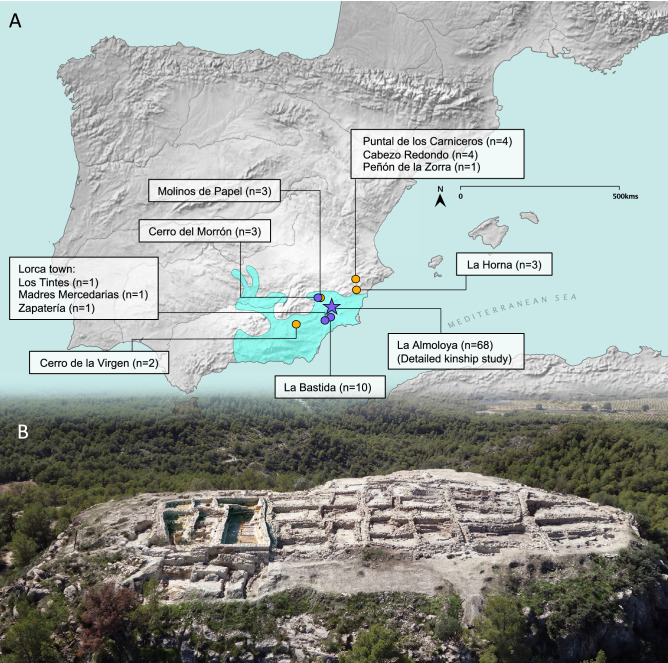
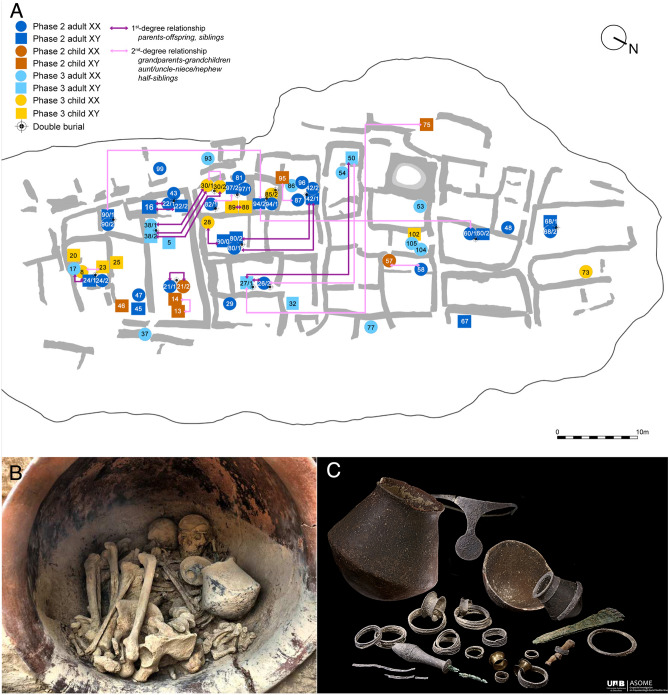
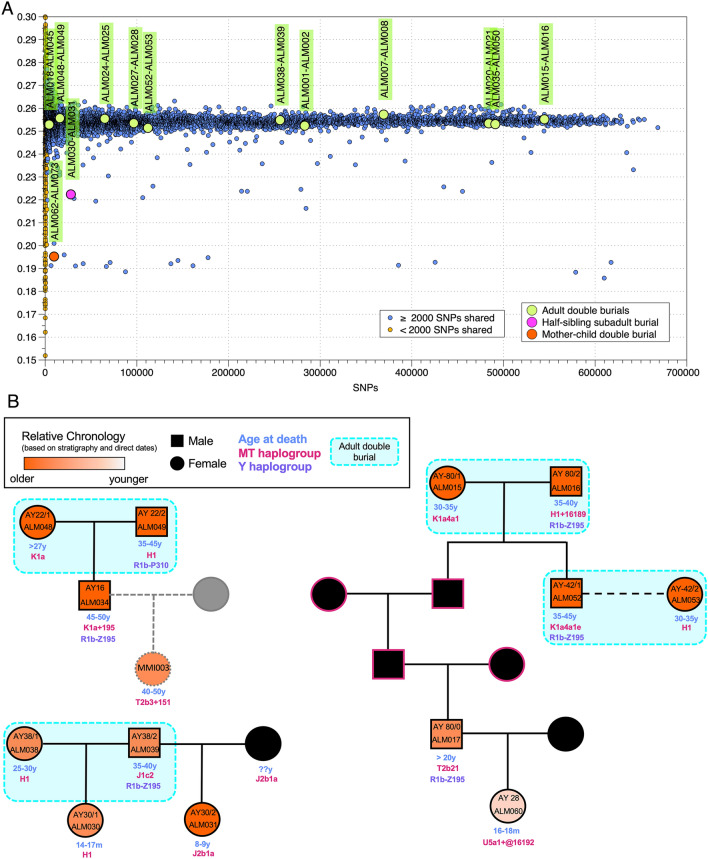
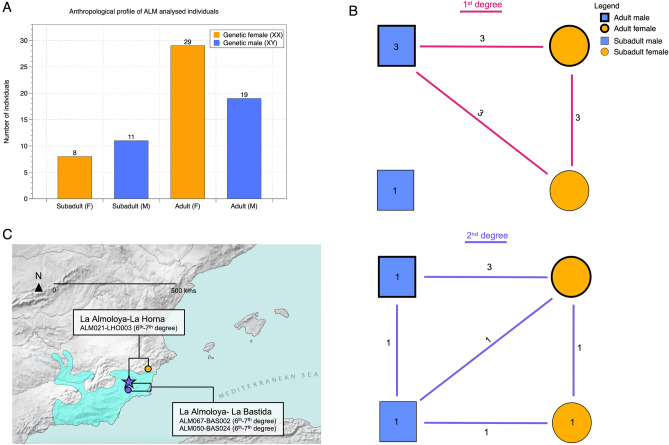
The Early Bronze Age in Europe is characterized by social and genetic transformations, starting in the early 3rd millennium BCE. New settlement and funerary structures, artifacts and techniques indicate times of change with increasing economic asymmetries and political hierarchization. Technological advances in metallurgy also played an important role, facilitating trade and exchange networks, which became tangible in higher levels of mobility and connectedness. Archeogenetic studies have revealed a substantial transformation of the genetic ancestry around this time, ultimately linked to the expansion of steppe- and forest steppe pastoralists from Eastern Europe. Evidence for emerging infectious diseases such as Yersinia pestis adds further complexity to these tumultuous and transformative times. The El Argar complex in southern Iberia marks the genetic turnover in southwestern Europe ~ 2200 BCE that accompanies profound changes in the socio-economic structure of the region. To answer the question of who was buried in the emblematic double burials of the El Argar site La Almoloya, we integrated results from biological relatedness analyses and archaeological funerary contexts and refined radiocarbon-based chronologies from 68 individuals. We find that the El Argar society was virilocally and patrilineally organized and practiced reciprocal female exogamy, supported by pedigrees that extend up to five generations along the paternal line. Synchronously dated adult males and females from double tombs were found to be unrelated mating partners, whereby the incoming females reflect socio-political alliances among El Argar groups. In three cases these unions had common offspring, while paternal half-siblings also indicate serial monogamy or polygyny.
Overview
The claims and statistics of this paper haven’t been checked yet.
Run the check — free, no account needed. It reads the open-access text and checks the sources it cites.
Integrity signals
Registry
Cites
Statistics
Figures
Verification
Claims the paper makes
The claims and statistics of this paper haven’t been checked yet.
Run the check — free, no account needed. It reads the open-access text and checks the sources it cites.
Claims other papers make about this one
Each is checked against this paper’s own text: does it say what the citing paper says it does?
In the citing paper
“Consistent with the hypothesis of a rapid spread of patrilocality after the Neolithic transition, ancient DNA studies show that male relatedness is often higher than female relatedness within archaeological sites from the Neolithic and the Bronze Age (mostly from Europe).”
From Patrilineal segmentary systems provide a peaceful explanation for the post-Neolithic Y-chromosome bottleneck (2024) · cites this paper as [74]
In the citing paper
“In addition, kinship analyses based on ancient DNA data from the Neolithic and Bronze Age (mostly Europe) showed low frequency of half-brothers and half-sisters67–71,73–77, with the exception of Hazleton North long cairn72.”
From Patrilineal segmentary systems provide a peaceful explanation for the post-Neolithic Y-chromosome bottleneck (2024) · cites this paper as [74]
In the citing paper
“In particular, males tend to share more often the same haplogroup of the Y chromosome, whereas there is a greater diversity of haplogroups for mtDNA67–77.”
From Patrilineal segmentary systems provide a peaceful explanation for the post-Neolithic Y-chromosome bottleneck (2024) · cites this paper as [74]
Self-check
Percentages, sums and reported differences re-computed from the paper’s own numbers.
The self-check needs the paper’s full text.
Citations
Cites
ANGSD: Analysis of Next Generation Sequencing Data
Korneliussen, T. S., Albrechtsen, A., & Nielsen, R. (2014) · BMC Bioinformatics · doi:10.1186/s12859-014-0356-4 · Cited by 2,982
Massive migration from the steppe was a source for Indo-European languages in Europe
Haak, W., Lazaridis, I., Patterson, N., Rohland, N., Mallick, S., Llamas, B., Brandt, G., Nordenfelt, S., Harney, E., Stewardson, K., et al. (2015) · Nature · doi:10.1038/nature14317 · Cited by 1,940
Self-citationPopulation genomics of Bronze Age Eurasia
Allentoft, M. E., Sikora, M., Sjögren, K.-G., Rasmussen, S., Rasmussen, M., Stenderup, J., Damgaard, P. B., Schroeder, H., Ahlström, T., Vinner, L., et al. (2015) · Nature · doi:10.1038/nature14507 · Cited by 1,550
Genome-wide patterns of selection in 230 ancient Eurasians
Mathieson, I., Lazaridis, I., Rohland, N., Mallick, S., Patterson, N., Roodenberg, S. A., Harney, E., Stewardson, K., Fernandes, D., Novak, M., et al. (2015) · Nature · doi:10.1038/nature16152 · Cited by 1,515
Self-citationA Revised Timescale for Human Evolution Based on Ancient Mitochondrial Genomes
Fu, Q., Mittnik, A., Johnson, P. L. F., Bos, K., Lari, M., Bollongino, R., Sun, C., Giemsch, L., Schmitz, R., Burger, J., et al. (2013) · Current Biology · doi:10.1016/j.cub.2013.02.044 · Cited by 709
Self-citationPartial uracil–DNA–glycosylase treatment for screening of ancient DNA
Rohland, N., Harney, E., Mallick, S., Nordenfelt, S., & Reich, D. (2015) · Philosophical Transactions of the Royal Society B: Biological Sciences · doi:10.1098/rstb.2013.0624 · Cited by 572
The genomic history of the Iberian Peninsula over the past 8000 years
Olalde, I., Mallick, S., Patterson, N., Rohland, N., Villalba-Mouco, V., Silva, M., Dulias, K., Edwards, C. J., Gandini, F., Pala, M., et al. (2019) · Science · doi:10.1126/science.aav4040 · Cited by 552
Self-citationEstimating genetic kin relationships in prehistoric populations
Monroy Kuhn, J. M., Jakobsson, M., & Günther, T. (2018) · PLOS ONE · doi:10.1371/journal.pone.0195491 · Cited by 330
Archaeogenomic evidence reveals prehistoric matrilineal dynasty
Kennett, D. J., Plog, S., George, R. J., Culleton, B. J., Watson, A. S., Skoglund, P., Rohland, N., Mallick, S., Stewardson, K., Kistler, L., et al. (2017) · Nature Communications · doi:10.1038/ncomms14115 · Cited by 301
Zeng, T. C., Aw, A. J., & Feldman, M. W. (2018) · Nature Communications · doi:10.1038/s41467-018-04375-6 · Cited by 121
Research works printed but not linked: 47
- Balquet, A. Les Tumulus Armoricains du Bronze Ancien (Institut Culturel de Bretagne, 2001).
- Meller, H. Princes, Armies, Sanctuaries: The emergence of complex authority in the Central German Únětice Culture. Acta Archaeol. 90, 39–79 (2019).
- Martiniano, R. et al. The population genomics of archaeological transition in west Iberia: Investigation of ancient substructure using imputation and haplotype-based methods. PLoS Genet. 13, e1006852 (2017). · DOI
- Olalde, I. et al. The Beaker phenomenon and the genomic transformation of northwest Europe. Nature 555, 190 (2018). · DOI · Paper page
- Villalba-Mouco, V. et al. Genomic transformation and social organization during the Copper Age-Bronze Age transition in southern Iberia. Sci. Adv. 7, eabi7038 (2021). · DOI
- Kristiansen, K. et al. Re-theorising mobility and the formation of culture and language among the Corded Ware Culture in Europe. Antiquity 91, 334–347. https://doi.org/10.15184/aqy.2017.17 (2017). · DOI
- Rasmussen, S. et al. Early divergent strains of Yersinia pestis in Eurasia 5,000 years ago. Cell 163, 571–582 (2015). · DOI
- Rascovan, N. et al. Emergence and spread of Basal Lineages of Yersinia pestis during the Neolithic Decline. Cell 176, 295-305.e10 (2019). · DOI
- AndradesValtueña, A. et al. The stone age plague and its persistence in Eurasia. Curr. Biol. 27, 3683-3691.e8 (2017). · DOI
- Andrades Valtueña, A. et al. Stone Age Yersinia pestis genomes shed light on the early evolution, diversity, and ecology of plague. Proc. Natl. Acad. Sci. USA 119, e2116722119 (2022). · DOI
- Lull, V., Micó, R., Rihuete Herrada, C. & Risch, R. El Argar and the beginning of Class Society in the Western Mediterranean. In Sozialarchäologische Perspektiven: Gesellschaftlicher Wandel 5000–1500 v. Chr. Zwischen Atlantik und Kaukasus 24 (eds Hansen, S. & Müller, J.) 381–414 (Archäologie in Eurasien, 2011).
- Lull & Risch. El estado argárico. Verdolay 7, 97–109 (1995).
- Arteaga Matute, O. Tribalización, jerarquización y estado en el territorio de El Argar. SPAL Rev. Prehist. Arqueol. Univ. Sevilla 20, 179–208 (1992).
- Lull, V. et al. Emblems of power and spaces of power during the Argaric Bronze Age in La Almoloya (Murcia, Spain), antiquity. Antiquity 95, 329–348 (2021). · DOI
- Risch, R. Análisis funcional y producción social: Relación entre método arqueológico y teoría económica. BAR Int. Ser. 1073, 19–30 (2002).
- Knipper, C. et al. Reconstructing Bronze Age diets and farming strategies at the early Bronze Age sites of La Bastida and Gatas (southeast Iberia) using stable isotope analysis. PLoS One 15, e0229398 (2020). · DOI
- Lull, V., Micó, R., Herrada, C. R. & Risch, R. Argaric sociology: Sex and death. Complutum 27, 31–62 (2016). · DOI
- Inchaurrandieta, R. Estudios Pre-Históricos. La Edad del Bronce en la prov. de Murcia. Bol. Rev. Univ. Madrid II, 806–815 (1870).
- Childe, V. G. The Prehistory of European Society (Penguin, 1958).
- Schubart, H. Die Gräber von Fuente Álamo (Reichert, 2012).
- Lull, V., Micó, R., Rihuete-Herrada, C. & Risch, R. Funerary practices and kinship in an Early Bronze Age society: A Bayesian approach applied to the radiocarbon dating of Argaric double tombs. J. Archaeol. Sci. 40, 4626–4634 (2013). · DOI
- Lull, V. Argaric society: Death at home. Antiquity 74, 581–590 (2000). · DOI
- Lull, V., Pérez, R. M., Herrada, C. R. & Risch, R. Property Relations in the Bronze Age of South-western Europe: An Archaeological Analysis of Infant Burials from El Argar (Almeria, Spain). Proc. Prehist. Soc 71, 247–268 (2005). · DOI
- Valdiosera, C. et al. Four millennia of Iberian biomolecular prehistory illustrate the impact of prehistoric migrations at the far end of Eurasia. Proc. Natl. Acad. Sci. 115, 3428–3433 (2018). · DOI
- Mittnik, A. et al. Kinship-based social inequality in Bronze Age Europe. Science 366, 731–734 (2019). · DOI · Paper page
- Sjögren, K.-G. et al. Kinship and social organization in Copper Age Europe. A cross-disciplinary analysis of archaeology, DNA, isotopes, and anthropology from two Bell Beaker cemeteries. PLoS One 15, 1278 (2020).
- Furtwängler, A. et al. Ancient genomes reveal social and genetic structure of Late Neolithic Switzerland. Nat. Commun. 11, 1915 (2020). · DOI · Paper page
- Žegarac, A. et al. Ancient genomes provide insights into family structure and the heredity of social status in the early Bronze Age of southeastern Europe. Sci. Rep. 11, 10072 (2021). · DOI
- Otter, M., Schrander-Stumpel, C. T. & Curfs, L. M. G. Triple X syndrome: A review of the literature. Eur. J. Hum. Genet. 18, 265–271 (2010). · DOI
- Szécsényi-Nagy, A. et al. The maternal genetic make-up of the Iberian Peninsula between the Neolithic and the Early Bronze Age. Sci. Rep. 7, 15644 (2017). · DOI
- Hernández Pérez, M. S. La Edad del Bronce en el País Valenciano: Panorama y perspectivas. Lvcentvm 20, 101–120 (1985).
- Peres, M. & Risch, R. Espacios y fuerzas sociales en el centro y el este de la península ibérica entre 2200 y 1550 ANE: Una aproximación macroespacial. Trabprehist 79, 47–66 (2022). · DOI
- Owens, I. P. F. Sex differences in mortality rate. Science 297, 2008–2009 (2002). · DOI
- Lemaître, J.-F. et al. Sex differences in adult lifespan and aging rates of mortality across wild mammals. Proc. Natl. Acad. Sci. USA 117, 8546–8553 (2020). · DOI
- Jiménez-Brobeil, S. A., du Souich, P. & Al Oumaoui, I. Possible relationship of cranial traumatic injuries with violence in the south-east Iberian Peninsula from the Neolithic to the Bronze Age. Am. J. Phys. Anthropol. 140, 465–475 (2009). · DOI
- Rivollat, M. et al. Ancient DNA gives new insights into a Norman Neolithic monumental cemetery dedicated to male elites. Proc. Natl. Acad. Sci. USA 119, e2120786119 (2022). · DOI · Paper page
- Fowler, C. et al. A high-resolution picture of kinship practices in an Early Neolithic tomb. Nature 601, 584–587 (2022). · DOI · Paper page
- Cassidy, L. M. et al. A dynastic elite in monumental Neolithic society. Nature 582, 384–388 (2020). · DOI · Paper page
- Schroeder, H. et al. Unraveling ancestry, kinship, and violence in a Late Neolithic mass grave. Proc. Natl. Acad. Sci. USA 116, 10705–10710 (2019). · DOI · Paper page
- Cardoso, H. F. V. Environmental effects on skeletal versus dental development: Using a documented subadult skeletal sample to test a basic assumption in human osteological research. Am. J. Phys. Anthropol. 132, 223–233 (2007). · DOI
- Brooks, S. & Suchey, J. M. Skeletal age determination based on the os pubis: A comparison of the Acsádi-Nemeskéri and Suchey-Brooks methods. Hum. Evol. 5, 227–238 (1990). · DOI · Paper page
- Lovejoy, C. O., Meindl, R. S., Pryzbeck, T. R. & Mensforth, R. P. Chronological metamorphosis of the auricular surface of the ilium: A new method for the determination of adult skeletal age at death. Am. J. Phys. Anthropol. 68, 15–28 (1985). · DOI · Paper page
- Scheuer, L. & Black, S. Development and Ageing of the Juvenile Skeleton (Greenwich Medical Media London, 2000).
- Duday, H. & Guillon, M. Understanding the circumstances of decomposition when the body is skeletonized. In Forensic Anthropology and Medicine: Complementary Sciences From Recovery to Cause of Death (eds Schmitt, A. et al.) 117–157 (Humana Press, 2006). · DOI
- Duday, H., Cipriani, A. M. & Pearce, J. The Archaeology of the Dead: Lectures in Archaeothanatology (Oxbow Books, 2009). · DOI
- Peltzer, A. et al. EAGER: Efficient ancient genome reconstruction. Genome Biol. 17, 60 (2016). · DOI · Paper page
- Lipatov, M., Sanjeev, K., Patro, R. & Veeramah, K. R. Maximum likelihood estimation of biological relatedness from low coverage sequencing data. bioRxiv 20, 23374 (2015).
Cited by
Guyon, L., Guez, J., Toupance, B., Heyer, E., & Chaix, R. (2024) · Nature Communications · doi:10.1038/s41467-024-47618-5 · Cited by 28
Metadata
- Authors
- Villalba-Mouco, V., Oliart, C., Rihuete-Herrada, C., Rohrlach, A. B., Fregeiro, M. I., Childebayeva, A., Ringbauer, H., Olalde, I., Celdrán Beltrán, E., Puello-Mora, C., Valério, M., Krause, J., Lull, V., Micó, R., Risch, R., & Haak, W.
- Venue
- Scientific Reports
- Published
- 2022-12-27
- Volume
- 12
- Issue
- 1
- ISSN
- 2045-2322
- PMC
- PMC9794729
- Cited by
- 53
- References
- 10
- Language
- en
- Funders
- HORIZON EUROPE European Research Council (771234-PALEoRIDER)
- Max Planck Society
- European Union-NextGenerationEU, Ministry of Universities and Recovery, Transformation and Resilience Plan, Margarita Salas
- Spanish Ministry of Economy, Industry and Competitiveness (HAR2017-85962-P)
- AGAUR-Ajuts per a Grups de Recerca de Qualitat (2017SGR1044)
- Ministerio de Ciencia e Innovación (RYC2019-027909-I/AEI/10.13039/501100011033)
- European Union-NextGenerationEU, Ministry of Universities and Recovery, Transformation and Resilience Plan, María Zambrano
- Max Planck Institute for Evolutionary Anthropology
About these checks
Registry, retraction, Cites and statistics results are computed, not judged, with one exception: a printed reference that no index lists is read once by a model before it counts as a citation error. Claims are extracted by a model and kept only when their quote appears verbatim in the text; each cited source is then checked, with a model’s help, for whether it says what the claim relies on. Those verdicts can be wrong — read the claim’s quote and the cited source before relying on one.
Statistics and arithmetic are recomputed, not judged.
Confidence bands are shown only for fields calibrated on our annotated test set. None is calibrated yet, so no band is shown.
What counts as a claim ›How we measure confidence ›How we check this ›
Are you an author, or do you see a problem with this page? Request a review
