

Best humans still outperform artificial intelligence in a creative divergent thinking task
Open accessThe DOI matches its Crossref record; 28 of the 28 references it cites were found in a registry or an index; 4 of the 6 sources its claims cite were checked for support.
Abstract
Creativity has traditionally been considered an ability exclusive to human beings. However, the rapid development of artificial intelligence (AI) has resulted in generative AI chatbots that can produce high-quality artworks, raising questions about the differences between human and machine creativity. In this study, we compared the creativity of humans (n = 256) with that of three current AI chatbots using the alternate uses task (AUT), which is the most used divergent thinking task. Participants were asked to generate uncommon and creative uses for everyday objects. On average, the AI chatbots outperformed human participants. While human responses included poor-quality ideas, the chatbots generally produced more creative responses. However, the best human ideas still matched or exceed those of the chatbots. While this study highlights the potential of AI as a tool to enhance creativity, it also underscores the unique and complex nature of human creativity that may be difficult to fully replicate or surpass with AI technology. The study provides insights into the relationship between human and machine creativity, which is related to important questions about the future of creative work in the age of AI.
Overview
CoChat Summary
TL;DR
In an Alternate Uses Task with 256 humans and three AI chatbots, the chatbots scored higher on average than humans on both semantic-distance and human-rated creativity measures. However, the best human responses still matched or exceeded the best chatbot responses in most cases.
Key findings
- Humans (n = 256) were compared with three AI chatbots on four AUT objects: rope, box, pencil, and candle; each AI was tested in 11 sessions, yielding 132 AI observations.
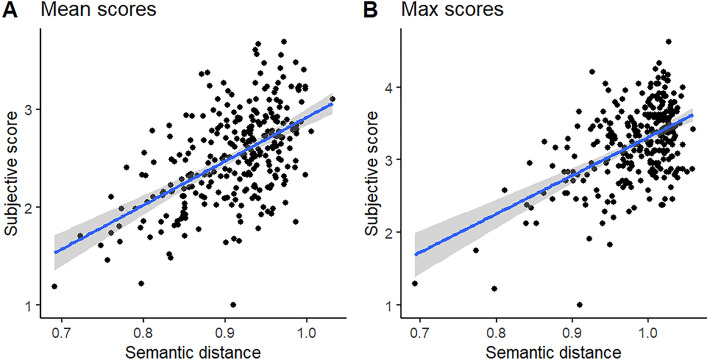
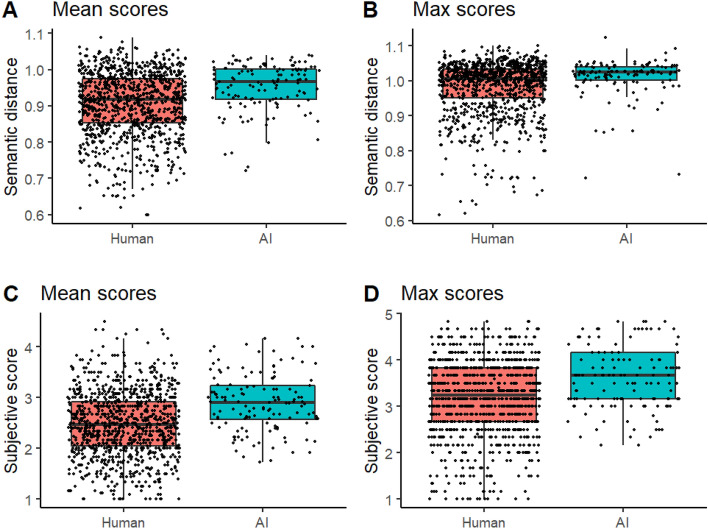
- On average, AI outperformed humans: semantic-distance mean scores were higher for AI than humans, B = 0.049, SE = 0.010, CI [0.030, 0.069], p < 0.001; subjective mean scores were also higher for AI, B = 0.453, SE = 0.082, CI [0.292, 0.614], p < 0.001.
- AI also led on max scores overall: semantic-distance max scores, B = 0.027, SE = 0.009, CI [0.010, 0.044], p = 0.003; subjective max scores, B = 0.403, SE = 0.091, CI [0.226, 0.581], p < 0.001.
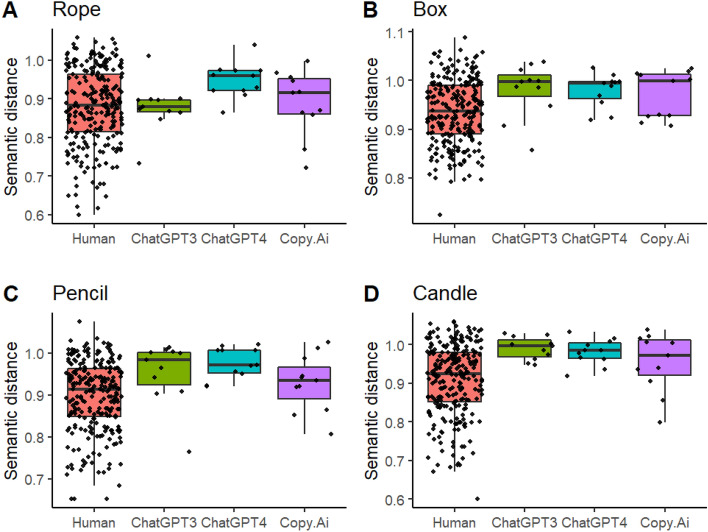
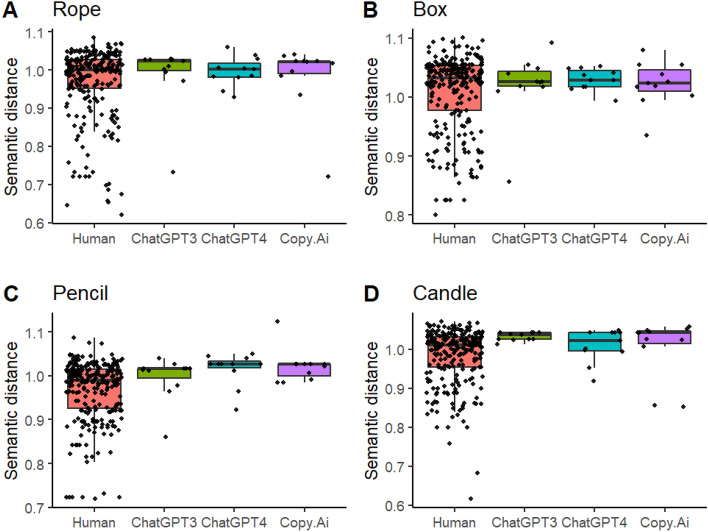
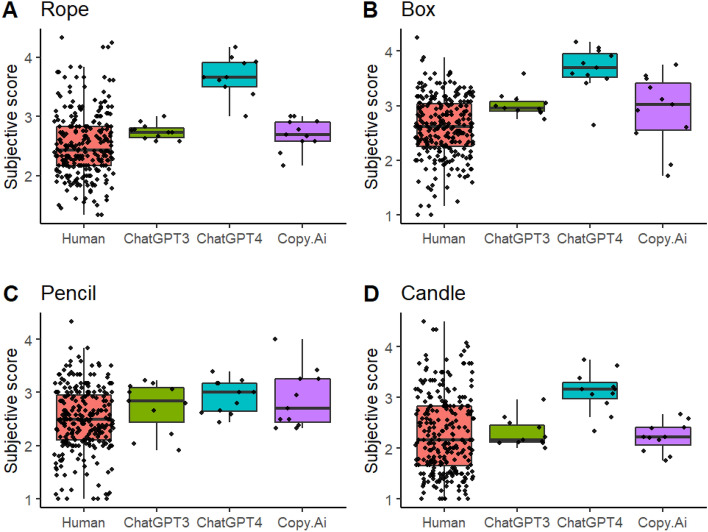
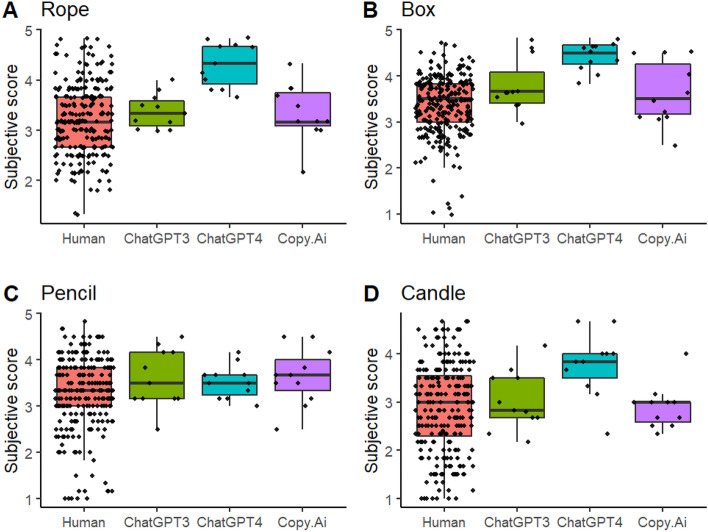
- Best-human performance remained competitive: the paper states there was only one instance where an AI had the highest semantic-distance score and two instances where AI had the highest subjective score; in all other cases, humans had the highest scores.
Methods
- Design: comparative study using the Alternate Uses Task (AUT), with humans and three current AI chatbots (ChatGPT3.5/ChatGPT3, ChatGPT4, Copy.AI) generating uncommon uses for everyday objects.
- Sample/data: 256 native English-speaking humans recruited via Prolific; the AI chatbots were each tested 11 times with the four object prompts in separate sessions.
- Analysis: originality was measured two ways—semantic distance (computed with SemDis and averaged across five semantic models) and subjective creativity ratings from six blinded human raters; separate linear mixed-effects models tested group, object, fluency, and their interactions.
Limitations
- The paper states that the number of observations per chatbot was restricted, limiting statistical power, especially for comparisons between individual chatbots.
- The authors say they restricted chatbot output length and number of ideas to control fluency and elaboration, which they note may have purposely impaired AI performance.
- The paper states that chatbot processes are “black boxes,” so process-level comparison with humans is impossible.
- Evident from the text: the human sample was limited to young and middle-aged adults from Western countries, which the authors say limits generalization.
Model-written summary. Check it against the paper before relying on it.
Integrity signals
Registry
Cites
Statistics
Figures
Verification
Claims the paper makes
3 Valid · 0 Not valid · 1 Not checked · 37 Own results and interpretations
Every source the paper cites for this claim was checked and supports it.
In the paper
“Based on the controlled-attention theories of creativity21,22, it seems that the weakness in human creative thinking, compared to AI chatbots, lies in executive functions.”
§ Best humans still outperform artificial intelligence in a creative divergent thinking task > Discussion
What the sources say
- Supportedcites [21] Beaty RE Silvia PJ Nusbaum EC Jauk E Benedek M The roles of associative and executive processes in creative cognition Mem. Cognit. 2014 42 1186 1197 10.3758/s13421-014-0428-8 24898118 source
The citation supports the controlled-attention premise: the Discussion (p. 9) says executive abilities predicted creativity and that the findings support controlled-attention theory. The comparison with AI chatbots is framed as the citing authors’ own inference, not a finding attributed to this paper. (LLM, conf=0.90)
- Supportedcites [22] Beaty RE Zeitlen D Baker BS Kenett YN Forward flow and creative thought: Assessing associative cognition and its role in divergent thinking Think. Skills Creat. 2021 41 100859 10.1016/j.tsc.2021.100859 source
The citation is attached to the controlled-attention theories of creativity, not to the citing authors’ subsequent inference about AI chatbots. In the paper’s opening discussion (page not supplied), controlled-attention theory is described as holding that executive control helps people direct attention and search for creative ideas. (LLM, conf=0.90)
hedgedstates a cause- Asserted: passes — The authors put it forward as true.
- Checkable: passes — It can be checked against evidence.
- Load-bearing: passes — The paper’s conclusions depend on it.
- Based: passes — The paper gives a reason why it holds.
- Supported
Every source the paper cites for this claim was checked and supports it.
In the paper
“Just as in the case of the arts8, these results suggest that the production of creative ideas may not be a feature only displayed in conscious human beings.”
§ Best humans still outperform artificial intelligence in a creative divergent thinking task > Discussion
What the sources say
- Supportedcites [8] Arriagada L CG-Art: Demystifying the anthropocentric bias of artistic creativity Connect. Sci. 2020 32 4 398 405 10.1080/09540091.2020.1741514 source
In section 4.2 (page unavailable), the paper argues that CAN-based systems have creative autonomy. Its Introduction (page unavailable) also says algorithms can produce novel and surprising Go plays. These passages support the citing sentence’s hedged comparison to creativity in the arts beyond conscious humans. (LLM, conf=0.88)
hedged- Asserted: passes — The authors put it forward as true.
- Checkable: passes — It can be checked against evidence.
- Load-bearing: passes — The paper’s conclusions depend on it.
- Based: passes — The paper gives a reason why it holds.
- Supported
A result the paper reports from its own data — it cites no other source for it, so there is none to check. The quote shows it is in the paper.
In the paper
“Figure 4C reveals, however, that only one max score of the AI chatbots, Copy.Ai’s max score to pencil (1.124), was higher than the corresponding highest human max score (1.101).”
§ Best humans still outperform artificial intelligence in a creative divergent thinking task > Results > Differentiating performance between AI chatbots and objects: semantic distance
plain- Asserted: passes — The authors put it forward as true.
- Checkable: passes — It can be checked against evidence.
- Load-bearing: unclear — It is unclear whether the paper’s conclusions depend on it.
- Based: passes — The paper gives a reason why it holds.
A result the paper reports from its own data — it cites no other source for it, so there is none to check. The quote shows it is in the paper.
In the paper
“The semantic distance mean scores (Fig. 2A) and max scores (Fig. 1B) were higher for AI than humans”
§ Best humans still outperform artificial intelligence in a creative divergent thinking task > Results > Overall human and AI performance
plain- Asserted: passes — The authors put it forward as true.
- Checkable: passes — It can be checked against evidence.
- Load-bearing: unclear — It is unclear whether the paper’s conclusions depend on it.
- Based: passes — The paper gives a reason why it holds.
A result the paper reports from its own data — it cites no other source for it, so there is none to check. The quote shows it is in the paper.
In the paper
“There were two AI sessions where the max score in response to box was higher than the corresponding highest human max score 4.67 (Fig. 6B). They were ChatGPT3’s and ChatGPT4’s max responses to box (4.83, for both chatbots).”
§ Best humans still outperform artificial intelligence in a creative divergent thinking task > Results > Differentiating performance between AI chatbots and objects: human subjective ratings
plain- Asserted: passes — The authors put it forward as true.
- Checkable: passes — It can be checked against evidence.
- Load-bearing: unclear — It is unclear whether the paper’s conclusions depend on it.
- Based: passes — The paper gives a reason why it holds.
19 more claims
Create a free account to see all 41 claims and every source verdict.
- Probably not a substantial claim. 8
- It may state two separate claims as one. 10
Claims other papers make about this one
Each is checked against this paper’s own text: does it say what the citing paper says it does?
The source backs part of the claim, not all of it — or backs it for a different population, condition or comparison.
In the citing paper
“This result is also in line with studies explicitly comparing the creative performance of different models, such as GPT-3 and GPT-4 [37].”
From Generative AI and Creativity: A Systematic Literature Review and Meta-Analysis (2025) · cites this paper as [37]
Experimental — accuracy not yet measuredThe source backs part of the claim, not all of it — or backs it for a different population, condition or comparison.
In the citing paper
“Koivisto and Grassini (2023) note that AI can tirelessly and with great quickness output large volumes of preliminary ideas, substantially enhancing the efficiency and scalability of creative production—a performance advantage that makes AI an ideal partner in the creative process.”
From From humans to AI: understanding why AI is perceived as the preferred co-creation partner (2025) · cites this paper as Koivisto and Grassini, 2023
Experimental — accuracy not yet measuredThe source backs part of the claim, not all of it — or backs it for a different population, condition or comparison.
In the citing paper
“Koivisto and Grassini (2023) likewise noted that AI can circumvent affective interference that may arise in human collaboration, making the cooperative process smoother.”
From From humans to AI: understanding why AI is perceived as the preferred co-creation partner (2025) · cites this paper as Koivisto and Grassini, 2023
Experimental — accuracy not yet measuredThe cited source says what the claim attributes to it.
In the citing paper
“The majority of studies identified in our literature review rely on relatively naive GenAI setups-often based on simple one-shot prompts (e.g., as in [37]) or by providing participants with unmodified, offthe-shelf LLMs (e.g., as in [39]).”
From Generative AI and Creativity: A Systematic Literature Review and Meta-Analysis (2025) · cites this paper as [37]
The cited source says what the claim attributes to it.
In the citing paper
“State-ofthe-art generative AI systems have reached proficiency levels that not only match human creativity in certain evaluations [20,33], but can also enhance the creative output of knowledge workers [1,2,30].”
From Human Creativity in the Age of LLMs: Randomized Experiments on Divergent and Convergent Thinking (2025) · cites this paper as [33]
Statistics recomputed
Every reported test result, recomputed from its test statistic and degrees of freedom. A result shows as not adding up only once an independent check has confirmed it.
- Not confirmedt(852) = 3.283reported p = .006 · recomputed p = .001
“t(852) = 3.283, p = .006”
- Consistentt(274) = 4.949reported p < .001 · recomputed p < .001
“t(274) = 4.949, p < .001”
- Consistentt(268) = 3.037reported p = .003 · recomputed p = .003
“t(268) = 3.037, p = .003”
- Consistentt(279) = -4.17reported p < .001 · recomputed p < .001
“t(279) = −4.170, p < .001”
- Consistentt(274) = 4.486reported p < .001 · recomputed p < .001
“t(274) = 4.486, p < .001”
15 more recomputed tests
Create a free account to see every test the Stats check recomputed.
Self-check
Percentages, sums and reported differences re-computed from the paper’s own numbers.
Rated major: it would touch a result — a value a result rests on, reported and recomputed p-values on opposite sides of the significance level, two passages that conflict with no sign which is right, or a cited work retracted before this paper was published.
In the paper
“The ICCs were 0.88, 95% CI [0.86, 0.90] for rope, 0.93, 95% CI [91, 94] for box, 0.90, 95% CI [0.88, 0.82] for pencil, and 0.93,”
§ Best humans still outperform artificial intelligence in a creative divergent thinking task > Method > Scoring
Reported 0.82 · recomputed 0.06
Citations
Cites
Fitting Linear Mixed-Effects Models Using lme4
Bates, D., Mächler, M., Bolker, B., & Walker, S. (2015) · Journal of Statistical Software · doi:10.18637/jss.v067.i01 · Cited by 86,835
lmerTest Package: Tests in Linear Mixed Effects Models
Kuznetsova, A., Brockhoff, P. B., & Christensen, R. H. B. (2017) · Journal of Statistical Software · doi:10.18637/jss.v082.i13 · Cited by 24,346
The associative basis of the creative process.
Mednick, S. (1962) · Psychological Review · doi:10.1037/h0048850 · Cited by 4,140 · cited 2×
“In associative theories of creativity, individuals differ in their structure of semantic memory and creativity is linked to flexible and highly connected semantic networks 18,19 .”
BackgroundThe standard definition of creativity
Runco, M. A., & Jaeger, G. J. (2012) · Creativity Research Journal · doi:10.1080/10400419.2012.650092 · Cited by 3,895 · cited 1×
“The standard definition describes creativity as the ability to produce ideas that are, to some extent, original and useful 12 .”
BackgroundGuilford, J. P. (1950) · American Psychologist · doi:10.1037/h0063487 · Cited by 3,588
The Ethics of AI Ethics: An Evaluation of Guidelines
Hagendorff, T. (2020) · Minds and Machines · doi:10.1007/s11023-020-09517-8 · Cited by 1,911
The Ethics of AI Ethics -- An Evaluation of Guidelines
Hagendorff, T. (2019) · arXiv · doi:10.48550/arxiv.1903.03425 · Cited by 1,907
Creativity: Yesterday, today and tomorrow
GUILFORD, J. P. (1967) · The Journal of Creative Behavior · doi:10.1002/j.2162-6057.1967.tb00002.x · Cited by 1,008 · cited 2×
“Guilford’s 16 model proposed that the creative process involves an interplay between spontaneous (divergent) and controlled (convergent) modes of thinking.”
BackgroundMethodSilvia, P. J., Winterstein, B. P., Willse, J. T., Barona, C. M., Cram, J. T., Hess, K. I., Martinez, J. L., & Richard, C. A. (2008) · Psychology of Aesthetics, Creativity, and the Arts · doi:10.1037/1931-3896.2.2.68 · Cited by 912
The roles of associative and executive processes in creative cognition
Beaty, R. E., Silvia, P. J., Nusbaum, E. C., Jauk, E., & Benedek, M. (2014) · Memory & Cognition · doi:10.3758/s13421-014-0428-8 · Cited by 448 · cited 4×
“The controlled-attention theory emphasizes that executive functions are necessary for creative idea generation 21,22 .”
BackgroundInfluential
Research works printed but not linked: 1
- Nadikattu RR The emerging role of artificial intelligence in modern society Int. J. Create. Res. Thoughts 2016 4 4 906 911
Cited by
Mariani, M., & Dwivedi, Y. K. (2024) · Journal of Business Research · doi:10.1016/j.jbusres.2024.114542 · Cited by 409
The Crowdless Future? Generative AI and Creative Problem Solving
Boussioux, L., N. Lane, J., Zhang, M., Jacimovic, V., & Lakhani, K. R. (2023) · doi:10.2139/ssrn.4533642 · Cited by 343
The Crowdless Future? Generative AI and Creative Problem-Solving
Boussioux, L., Lane, J. N., Zhang, M., Jacimovic, V., & Lakhani, K. R. (2024) · Organization Science · doi:10.1287/orsc.2023.18430 · Cited by 329
Artificial intelligence and consumer behavior: From predictive to generative AI
Hermann, E., & Puntoni, S. (2024) · Journal of Business Research · doi:10.1016/j.jbusres.2024.114720 · Cited by 230
Hubert, K. F., Awa, K. N., & Zabelina, D. L. (2024) · Scientific Reports · doi:10.1038/s41598-024-53303-w · Cited by 221
“In fact, recent studies have found that AI divergent creativity matched that of humans using a later version of GPT-4 32,33 .”
BackgroundA Primer on Generative Artificial Intelligence
Kalota, F. (2024) · Education Sciences · doi:10.3390/educsci14020172 · Cited by 177
“They found that while the AI chatbots generally produced more creative ideas, the best human ideas still matched or exceeded those ideas [33].”
BackgroundResultGenerative AI in innovation and marketing processes: A roadmap of research opportunities
Cillo, P., & Rubera, G. (2025) · Journal of the Academy of Marketing Science · doi:10.1007/s11747-024-01044-7 · Cited by 176
“On the other hand, creating novel content is a subjective task and creativity is widely regarded as a quintessential human capability (Koivisto & Grassini, 2023).”
AI and Its Impact on Creativity and Diversity: An Empirical Study of LLM-Generated Product Ideas
Terwiesch, C., Meincke, L., Girotra, K., Mollick, E. R., Nave, G., & Ulrich, K. T. (2023) · doi:10.2139/ssrn.4526071 · Cited by 174
Artificial intelligence as a tool for creativity
Ivcevic, Z., & Grandinetti, M. (2024) · Journal of Creativity · doi:10.1016/j.yjoc.2024.100079 · Cited by 134
Understanding University Students’ Acceptance of ChatGPT: Insights from the UTAUT2 Model
Grassini, S., Aasen, M. L., & Møgelvang, A. (2024) · Applied Artificial Intelligence · doi:10.1080/08839514.2024.2371168 · Cited by 116
Self-citationHarnessing the power of AI in qualitative research: Exploring, using and redesigning ChatGPT
Zhang, H., Wu, C., Xie, J., Lyu, Y., Cai, J., & Carroll, J. M. (2025) · Computers in Human Behavior Artificial Humans · doi:10.1016/j.chbah.2025.100144 · Cited by 410
Generative AI in Marketing and Principles for Ethical Design and Deployment
Hermann, E., & Puntoni, S. (2025) · Journal of Public Policy & Marketing · doi:10.1177/07439156241309874 · Cited by 136
How Artificial Intelligence Constrains the Human Experience
Valenzuela, A., Puntoni, S., Hoffman, D., Castelo, N., De Freitas, J., Dietvorst, B., Hildebrand, C., Huh, Y. E., Meyer, R., Sweeney, M. E., et al. (2024) · Journal of the Association for Consumer Research · doi:10.1086/730709 · Cited by 81
“For example, generative AI models can now outperform most humans at creative idea generation (Guzik, Byrge, and Gilde 2023; Koivisto and Grassini 2023).”
BackgroundBeyond Code Generation: An Observational Study of ChatGPT Usage in Software Engineering Practice
Khojah, R., Mohamad, M., Leitner, P., & de Oliveira Neto, F. G. (2024) · Proceedings of the ACM on Software Engineering · doi:10.1145/3660788 · Cited by 86
Grassini, S., & Koivisto, M. (2024) · Scientific Reports · doi:10.1038/s41598-024-54294-4 · Cited by 75
Self-citationChatGPT for Academic Purposes: Survey Among Undergraduate Healthcare Students in Malaysia
George Pallivathukal, R., Kyaw Soe, H. H., Donald, P. M., Samson, R. S., & Hj Ismail, A. R. (2024) · Cureus · doi:10.7759/cureus.53032 · Cited by 68
“Recent research [12-15] highlighted the potential of AI as a tool to enhance creativity but also underscored the unique and complex nature of human creativity that may be difficult to replicate AI technology fully.”
BackgroundConceptualizing generative AI as style engines: Application archetypes and implications
Riemer, K., & Peter, S. (2024) · International Journal of Information Management · doi:10.1016/j.ijinfomgt.2024.102824 · Cited by 63
Experimental narratives: A comparison of human crowdsourced storytelling and AI storytelling
Beguš, N. (2024) · Humanities and Social Sciences Communications · doi:10.1057/s41599-024-03868-8 · Cited by 60
“With culture as an archive of humanity ’ s monumental junctures (Puchner, 2017) and with humans considered as the only creative species (Koivisto and Grassini, 2023), literary studies and fi lm and media studies have a long history of studying this collective imaginary across cultural artifacts.”
Heigl, R. M. (2025) · Management Review Quarterly · doi:10.1007/s11301-025-00494-9 · Cited by 126
The Art of Creative Inquiry—From Question Asking to Prompt Engineering
Sasson-Lazovsky, G., Raz, T., & Kenett, Y. N. (2024) · The Journal of Creative Behavior · doi:10.1002/jocb.671 · Cited by 86
Ideation with Generative AI—in Consumer Research and Beyond
Freitas, J. D., Nave, G., & Puntoni, S. (2025) · Journal of Consumer Research · doi:10.1093/jcr/ucaf012 · Cited by 90
Pergantis, P., Bamicha, V., Skianis, C., & Drigas, A. S. (2025) · Brain Sciences · doi:10.3390/brainsci15010047 · Cited by 149
Human Creativity in the Age of LLMs: Randomized Experiments on Divergent and Convergent Thinking
Kumar, H., Vincentius, J., Jordan, E., & Anderson, A. (2025) · Proceedings of the 2025 CHI Conference on Human Factors in Computing Systems · doi:10.1145/3706598.3714198 · Cited by 129
“Koivisto et al. [33] compared LLM vs. human performance in a divergent thinking task, but without examining how LLM use affects human creativity.”
InfluentialBaltà‐Salvador, R., Madafri, I. E., Brasó‐Vives, E., & Peña, M. (2025) · Computer Applications in Engineering Education · doi:10.1002/cae.22817 · Cited by 91
Language models and psychological sciences
Sartori, G., & Orrù, G. (2023) · Frontiers in Psychology · doi:10.3389/fpsyg.2023.1279317 · Cited by 92
Moon, K., Green, A. E., & Kushlev, K. (2025) · Computers in Human Behavior: Artificial Humans · doi:10.1016/j.chbah.2025.100207 · Cited by 38
Grassini, S., & Koivisto, M. (2024) · International Journal of Human-Computer Interaction · doi:10.1080/10447318.2024.2345430 · Cited by 70
Self-citationLarge models in medical imaging: Advances and prospects
Fang, M., Wang, Z., Pan, S., Feng, X., Zhao, Y., Hou, D., Wu, L., Xie, X., Zhang, X.-Y., Tian, J., et al. (2025) · Chinese Medical Journal · doi:10.1097/cm9.0000000000003699 · Cited by 59
Gholamizadeh, K., Zarei, E., Gualtieri, L., & Marchi, M. D. (2025) · Safety Science · doi:10.1016/j.ssci.2024.106770 · Cited by 40
Artificial intelligence – Human intelligence conflict and its impact on process system safety
Arunthavanathan, R., Sajid, Z., Khan, F. I., et al. (2024) · Digital Chemical Engineering · doi:10.1016/j.dche.2024.100151 · Cited by 33
Who Says Artificial Intelligence Is Stealing Our Jobs?
Dahlin, E. C. (2024) · Socius Sociological Research for a Dynamic World · doi:10.1177/23780231241259672 · Cited by 55
Kozak, J., & Fel, S. (2024) · Religions · doi:10.3390/rel15030331 · Cited by 41
Human‐AI Co‐Creativity: Does ChatGPT Make Us More Creative?
Medeiros, K., Cropley, D. H., Marrone, R. L., & Reiter‐Palmon, R. (2025) · The Journal of Creative Behavior · doi:10.1002/jocb.70022 · Cited by 30
Student-AI collaborative creative Problem-Solving: The role of human agency
Guoa, W., Liang, Z., Wang, C., Li, X., Hu, H., Chen, S., Yu, Q., & Zhao, Q. (2025) · Computers & Education · doi:10.1016/j.compedu.2025.105433 · Cited by 55
Pence, H. E., Hightower, G. L., Forlenza, J. T., Leonard, K., McLellan, A., Suero, A., Amoah, B., Mbow, M., Borner, S., Castillo, A., et al. (2024) · Journal of Chemical Education · doi:10.1021/acs.jchemed.4c00242 · Cited by 30
Generative artificial intelligence: implications for biomedical and health professions education
Hersh, W. (2025) · Annual Review of Biomedical Data Science · doi:10.1146/annurev-biodatasci-103123-094756 · Cited by 28
Designing Co-Creative Systems: Five Paradoxes in Human–AI Collaboration
Salma, Z., Hijón‐Neira, R., & Pizarro, C. (2025) · Information · doi:10.3390/info16100909 · Cited by 48
A Systematic Review of User Attitudes Toward GenAI: Influencing Factors and Industry Perspectives
Chen, J., Wei, X., Xie, Q., Hu, A., Qiao, Y., Wan, R., & Liu, Y. (2025) · Journal of Intelligence · doi:10.3390/jintelligence13070078 · Cited by 54
Jang, H., & Choi, H. (2024) · Journal of Science Education and Technology · doi:10.1007/s10956-024-10173-1 · Cited by 45
Creativity and artificial intelligence: A study with prospective teachers
Pont, I., Sanz, Y. E., Gómez, P. O., & Ezpeleta, A. M. (2024) · Digital Education Review · doi:10.1344/der.2024.45.91-97 · Cited by 66
Evaluating AI-assisted creative ideation: A crossover study in higher education
Baltà‐Salvador, R., Brasó‐Vives, E., & Peña, M. (2025) · Thinking Skills and Creativity · doi:10.1016/j.tsc.2025.101958 · Cited by 53
Exploring cognitive strategies in human-AI interaction: ChatGPT's role in creative tasks
Boers, J., Etty, T., Baars, M., & van Broekhoven, K. (2025) · Journal of Creativity · doi:10.1016/j.yjoc.2025.100095 · Cited by 26
Zhou, Y., Liu, Q., Huang, J., & Li, G. (2026) · Technology in Society · doi:10.1016/j.techsoc.2025.103087 · Cited by 24
The Impact of Generative AI on Creativity in Software Development: A Research Agenda
Jackson, V., Vasilescu, B., Russo, D., Ralph, P., Prikladnicki, R., Izadi, M., D’Angelo, S., Inman, S., Andrade, A., & van der Hoek, A. (2025) · ACM Transactions on Software Engineering and Methodology · doi:10.1145/3708523 · Cited by 23
Generative AI and Social Media May Exacerbate the Climate Crisis
van der Ven, H., Corry, D., Elnur, R. I., Provost, V. J., & Syukron, M. (2024) · Global Environmental Politics · doi:10.1162/glep_a_00747 · Cited by 33
Divergent creativity in humans and large language models
Bellemare-Pepin, A., Lespinasse, F., Thölke, P., Harel, Y., Mathewson, K. W., Olson, J. A., Bengio, Y., & Jerbi, K. (2026) · Scientific Reports · doi:10.1038/s41598-025-25157-3 · Cited by 145
Human agents, generative AI, and innovation: A formal model of hybrid creative process
Pedota, M., Cicala, F., & Basti, A. (2025) · Technovation · doi:10.1016/j.technovation.2025.103323 · Cited by 41
Nie, X., Tian, Y., Liu, M., Wu, D., & Guo, Y. (2025) · Education and Information Technologies · doi:10.1007/s10639-025-13735-x · Cited by 20
“Gen-AI has shown its potential in fields like art design (Koivisto & Grassini, 2023), writing (Gupta et al., 2023), and scientific research (Dahmen et al., 2023), providing diverse, clear creative ideas or solutions, and accelerating data analysis.”
The Role of Artificial Intelligence in the Ideation Process
Pescher, C., & Tellis, G. J. (2025) · Journal of Product Innovation Management · doi:10.1111/jpim.12791 · Cited by 40
Cicco, R. D., Francioni, B., Curina, I., & Cioppi, M. (2025) · Journal of Services Marketing · doi:10.1108/jsm-10-2024-0539 · Cited by 34
Am I Still Creative? The Effect of Artificial Intelligence on Creative Self‐Beliefs
Faiella, A., Zielińska, A., Karwowski, M., & Corazza, G. E. (2025) · The Journal of Creative Behavior · doi:10.1002/jocb.70011 · Cited by 32
Generative AI and Creativity: A Systematic Literature Review and Meta-Analysis
Holzner, N., Maier, S., & Feuerriegel, S. (2025) · arXiv · doi:10.48550/arxiv.2505.17241 · Cited by 143
“This result is also in line with studies explicitly comparing the creative performance of different models, such as GPT-3 and GPT-4 [37].”
Bianchi, I., Branchini, E., Uricchio, T., & Bongelli, R. (2025) · Frontiers in Psychology · doi:10.3389/fpsyg.2025.1648480 · Cited by 45
Human-Centered Cybersecurity Revisited: From Enemies to Partners
Zimmermann, V., Schöni, L., Schaltegger, T., Ambuehl, B., Knieps, M., & Ebert, N. (2024) · Communications of the ACM · doi:10.1145/3665665 · Cited by 30
Qiao, Y., Gao, Y., Wang, Y., Dai, D., & Luan, Z. (2025) · International Journal of Human-Computer Interaction · doi:10.1080/10447318.2025.2518333 · Cited by 22
How Generative AI Fits into Knowledge Work
Sako, M. (2024) · Communications of the ACM · doi:10.1145/3638567 · Cited by 21
Marconi, L., Longo, L., & Cabitza, F. (2026) · Machine Learning and Knowledge Extraction · doi:10.3390/make8020028 · Cited by 29
Can ChatGPT enhance business student creativity? Evidence from a randomised controlled trial
Fisher, R., Gogan, T. D., Williams, J. S., Laferriere, R., Campbell, G., Gunasekara, A. N., & Nguyen, J. (2025) · Studies in Higher Education · doi:10.1080/03075079.2025.2515512 · Cited by 23
Moon, K., Green, A. E., & Kushlev, K. (2024) · PsyArXiv (OSF Preprints) · doi:10.31234/osf.io/8p9wu · Cited by 20
From humans to machines: Researching entrepreneurial AI agents built on large language models
Obschonka, M., & Fisch, C. O. (2025) · Journal of Business Venturing Insights · doi:10.1016/j.jbvi.2025.e00581 · Cited by 16
Exploring the use of generative text AI in design creativity inquiries
Georgieva, I., & Georgiev, G. V. (2025) · Computers in Human Behavior Artificial Humans · doi:10.1016/j.chbah.2025.100219 · Cited by 24
CreAItive Collaboration? Users' Misjudgment of AI-Creativity Affects Their Collaborative Performance
Bangerl, M. M., Disch, L., David, T., & Pammer-Schindler, V. (2025) · Proceedings of the 2025 CHI Conference on Human Factors in Computing Systems · doi:10.1145/3706598.3713886 · Cited by 13
“In line with prior work that shows good performance of generative AI in the AUT [54, 61], we identifed a positive correlation between the percentage of accepted AI-generated content and fuency.”
InfluentialIntegration of AI GPTs in music education and their impact on students’ perception and creativity
Xia, W. (2025) · Education and Information Technologies · doi:10.1007/s10639-025-13531-7 · Cited by 21
Grassini, S. (2024) · International Journal of Human-Computer Interaction · doi:10.1080/10447318.2024.2422755 · Cited by 26
Self-citationQuan, C., & Zheng, X. (2024) · World Customs Journal · doi:10.55596/001c.122754 · Cited by 25
Gonzalez, K., Kanitz, R., & Briker, R. (2024) · The Journal of Applied Behavioral Science · doi:10.1177/00218863241279916 · Cited by 18
The Role of the Expressive Therapies Continuum in Human Creativity in the Age of AI
Choe, N. S., & Hinz, L. D. (2024) · Art Therapy · doi:10.1080/07421656.2024.2346689 · Cited by 17
Yager, K. G. (2024) · Digital Discovery · doi:10.1039/d4dd00178h · Cited by 12
CAP: The creativity assessment platform for online testing and automated scoring
Patterson, J. D., Pronchick, J., Panchanadikar, R., Fuge, M., van Hell, J. G., Miller, S. R., Johnson, D. R., & Beaty, R. E. (2025) · Behavior Research Methods · doi:10.3758/s13428-025-02761-9 · Cited by 33
From tools to partners: How large language models are transforming urban planning
Pan, F., Huang, X., Bi, Y., Gao, Y., Yu, Y., & Wang, H. (2025) · AI Open · doi:10.1016/j.aiopen.2025.11.001 · Cited by 18
Attitudes of Catholic Clergies to the Application of ChatGPT in Unite Religious Communities
Ignatowski, G., Sułkowski, Ł., Przybyszewski, K., & Seliga, R. (2024) · Religions · doi:10.3390/rel15080980 · Cited by 16
How AI Outperforms Humans at Creative Idea GenerationPreprint
Castelo, N., Katona, Z., Li, P., & Sárváry, M. (2024) · SSRN Electronic Journal · doi:10.2139/ssrn.4751779 · Cited by 21
AI-assisted design synthesis and human creativity in engineering education
Tsakalerou, M., Akhmadi, S., Balgynbayeva, A., & Kumisbek, Y. (2026) · Frontiers in Artificial Intelligence · doi:10.3389/frai.2026.1714523 · Cited by 11
From humans to AI: understanding why AI is perceived as the preferred co-creation partner
Liu, Y., Yang, Y., & Xu, H. (2025) · Frontiers in Psychology · doi:10.3389/fpsyg.2025.1695532 · Cited by 10
Who expands the human creative frontier with generative AI: Hive minds or masterminds?
Zhou, E., Lee, D., & Gu, B. (2025) · Science Advances · doi:10.1126/sciadv.adu5800 · Cited by 28
Large language models show both individual and collective creativity comparable to humans
Sun, L., Yuan, Y., Yao, Y., Li, Y., Zhang, H., Xie, X., Wang, X., Luo, F., & Stillwell, D. J. (2025) · Thinking Skills and Creativity · doi:10.1016/j.tsc.2025.101870 · Cited by 34
Large language models are homogeneously creative
Wenger, E., & Kenett, Y. N. (2026) · PNAS Nexus · doi:10.1093/pnasnexus/pgag042 · Cited by 29
The Misleading Definition of Creativity Suggested by AI Must Be Kept out of the Classroom
Runco, M. A. (2025) · Education Sciences · doi:10.3390/educsci15091141 · Cited by 15
Bordas, A., Masson, P. L., & Weil, B. (2025) · Creativity and Innovation Management · doi:10.1111/caim.70013 · Cited by 12
de Souza, B. C., Neto, A. S. D. A., & Roazzi, A. (2024) · Computers in Human Behavior Artificial Humans · doi:10.1016/j.chbah.2024.100042 · Cited by 21
Automated vs. manual linguistic annotation for assessing pragmatic competence in English classes
Mahmoudi-Dehaki, M., & Nasr-Esfahani, N. (2025) · Research Methods in Applied Linguistics · doi:10.1016/j.rmal.2025.100253 · Cited by 16
Chen, J., Xue, J., Li, Y., & Luo, W. (2025) · International Journal of Human-Computer Interaction · doi:10.1080/10447318.2025.2474460 · Cited by 20
Creativity and Generative AI for Preservice Teachers
Butler-Ulrich, T., Hughes, J., & Morrison, L. (2024) · IntechOpen eBooks · doi:10.5772/intechopen.1007517 · Cited by 13
Building the Plane as We Fly It: Experimenting with GenAI for Scholarly Writing
Avgerinou, M. D., Karampelas, A., & Stefanou, V. (2023) · Irish Journal of Technology Enhanced Learning · doi:10.22554/ijtel.v7i2.128 · Cited by 10
Memmert, L., Cvetković, I., Tavanapour, N., & Bittner, E. A. C. (2025) · Business & Information Systems Engineering · doi:10.1007/s12599-025-00974-y · Cited by 17
No Evidence for LLMs Being Useful in Problem Reframing
Shin, J., Polyanskaya, A., Lucero, A., & Oulasvirta, A. (2025) · CHI Conference on Human Factors in Computing Systems · doi:10.1145/3706598.3713273 · Cited by 19
Stańko-Kaczmarek, M., Dera, L., & Koscielska, H. (2024) · The Journal of Creative Behavior · doi:10.1002/jocb.1513 · Cited by 15
All Just in Your Head? Unraveling the Side Effects of Generative AI Disclosure in Creative TaskPreprint
Bauer, K., Jussupow, E., Heigl, R., Vogt, B., & Hinz, O. (2024) · Social Science Research Network · doi:10.2139/ssrn.4782554 · Cited by 10
Maier, S., Schneider, M., & Feuerriegel, S. (2026) · CHI Conference on Human Factors in Computing Systems · doi:10.1145/3772318.3791185 · Cited by 33
Augmented Learning for Joint Creativity in Human-GenAI Co-Creation
Luan, Y. L., Kim, Y. J., & Zhou, J. (2025) · Information Systems Research · doi:10.1287/isre.2024.0984 · Cited by 23
Byrge, C., Guzik, E. E., & Gilde, C. (2025) · Journal of Creativity · doi:10.1016/j.yjoc.2025.100105 · Cited by 17
Infinity Book: Speculating Literary Expressions in the Age of Generative AI
Holopainen, J. P., Huang, Y., Shin, J., Nissinen, E., & Lucero, A. (2025) · Designing Interactive Systems Conference · doi:10.1145/3715336.3735735 · Cited by 11
Exploring the dual effect of trust in GAI on employees’ exploitative and exploratory innovation
Lin, X., Wang, T., & Sheng, F. (2025) · Humanities and Social Sciences Communications · doi:10.1057/s41599-025-04956-z · Cited by 10
Human-Centered AI in Design: Examining Educational Paradigms for Creativity and Responsibility
Shen, Y., Kang, B., & Münch, F. (2025) · Lecture notes in computer science · doi:10.1007/978-3-031-93236-6_5 · Cited by 8
Dimensions of AI de-anthropomorphization based on impression integration theory
Li, J., Huang, J., & Ni, B. (2026) · Technology in Society · doi:10.1016/j.techsoc.2026.103352 · Cited by 7
Arora, V., Thabane, A., Parpia, S., Calic, G., & Bhandari, M. (2025) · Scientific Reports · doi:10.1038/s41598-025-21398-4 · Cited by 21
Friend or foe? Enhancing creativity in K-12 education through AI
Weatherly, K. I. C. H., & Weatherly, C. A. (2025) · Thinking Skills and Creativity · doi:10.1016/j.tsc.2025.102030 · Cited by 8
From friction to synergy: The complex interplay of human creativity and AI
Deschryver, M., Henriksen, D., & Leahy, S. (2025) · Possibility Studies & Society · doi:10.1177/27538699251350483 · Cited by 14
Verdenhofa, O., Kinderis, R., & Berjozkina, G. (2024) · Baltic Journal of Economic Studies · doi:10.30525/2256-0742/2024-10-5-111-119 · Cited by 13
Galli, C., Moretti, C., & Calciolari, E. (2024) · Learned Publishing · doi:10.1002/leap.1648 · Cited by 10
Metadata
- Authors
- Koivisto, M., & Grassini, S.
- Affiliations
- University of Turku (FI)
- University of Bergen (NO)
- Corresponding author
- Grassini, Simone
- Venue
- Scientific Reports
- Published
- 2023-09-14
- Volume
- 13
- Issue
- 1
- Pages
- 13601-13601
- ISSN
- 2045-2322 (ISSN-L)
- PMC
- PMC10502005
- OpenAlex
- W4386740961
- Semantic Scholar
- 86312ea272f7a6f5e3b067c9aaa355a4f559f95e
- Cited by
- 247
- References
- 28
- Citations by year
- 2026: 83 · 2025: 101 · 2024: 59 · 2023: 3
- FWCI
- 63.40
- Type
- journal article
- Language
- en
- Update notices
- correction (2024-02-20)
- Open access
- gold
- doi.org
- Licence
- cc-by
- creativecommons.org/licenses/by/4.0 (tdm)
- creativecommons.org/licenses/by/4.0 (vor)
- Locations
- Scientific Reports (publishedVersion, cc-by)
- PubMed Central (publishedVersion, cc-by)
- PubMed (publishedVersion)
- NORA - Norwegian Open Research Archives (submittedVersion, cc-by)
- UTUPub (University of Turku) (submittedVersion, other-oa)
- DOAJ (DOAJ: Directory of Open Access Journals) (submittedVersion, cc-by-sa)
- Funders
- University of Bergen
- Topics
- Social Sciences › Psychology › Experimental and Cognitive Psychology › Creativity in Education and Neuroscience
- Physical Sciences › Engineering › Mechanical Engineering › Design Education and Practice
- Life Sciences › Neuroscience › Cognitive Neuroscience › Aesthetic Perception and Analysis
- Keywords
- human creativity, artificial intelligence, generative AI chatbots, divergent thinking, alternative uses task, human-AI comparison
- MeSH terms
- Artificial Intelligence, Humans, Technology
About these checks
Registry, retraction, Cites and statistics results are computed, not judged, with one exception: a printed reference that no index lists is read once by a model before it counts as a citation error. Claims are extracted by a model and kept only when their quote appears verbatim in the text; each cited source is then checked, with a model’s help, for whether it says what the claim relies on. Those verdicts can be wrong — read the claim’s quote and the cited source before relying on one.
A language model drew the claims from the paper on 2026-10-09, under version 3 of the claim definition (model deepseek-v4.1-flash, prompt extract-v3).
A second model labelled each claim on 2026-10-09 (model jev-1.13-20260917, definition revision gold-guideline-v0.2).
Cited sources are checked with a language model’s help (gpt-6-sol).
Statistics and arithmetic are recomputed, not judged.
Confidence bands are shown only for fields calibrated on our annotated test set. None is calibrated yet, so no band is shown.
What counts as a claim ›How we measure confidence ›How we check this ›
Are you an author, or do you see a problem with this page? Request a review
Data sources
Bibliographic data: Semantic Scholar, OpenAlex, Crossref.
Contains information from the Semantic Scholar Academic Graph Datasets, made available under the ODC Attribution License (ODC-BY 1.0).
Semantic Scholar’s data is described in: Kinney, R., et al. (2023). The Semantic Scholar Open Data Platform. arXiv:2301.10140.
