

Standalone smartphone apps for mental health—a systematic review and meta-analysis
Open accessThe DOI matches its Crossref record; 64 of the 64 references it cites were found in a registry or an index.
Abstract
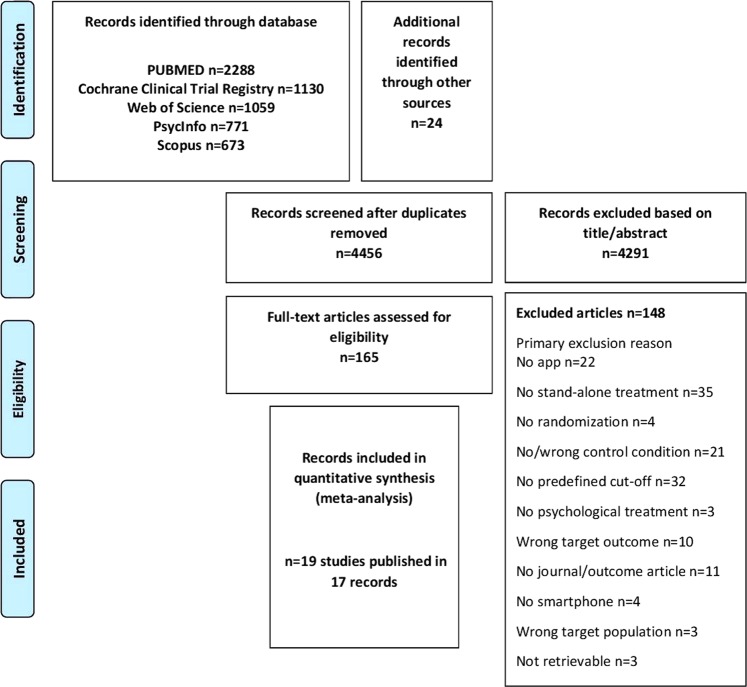
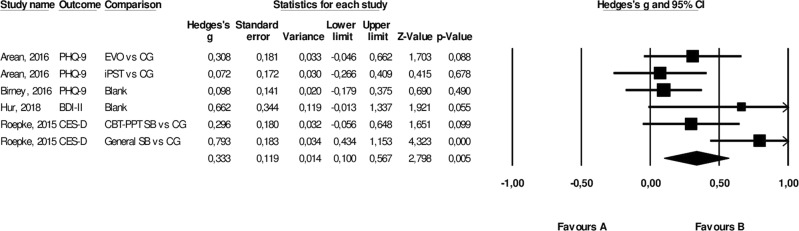
While smartphone usage is ubiquitous, and the app market for smartphone apps targeted at mental health is growing rapidly, the evidence of standalone apps for treating mental health symptoms is still unclear. This meta-analysis investigated the efficacy of standalone smartphone apps for mental health. A comprehensive literature search was conducted in February 2018 on randomized controlled trials investigating the effects of standalone apps for mental health in adults with heightened symptom severity, compared to a control group. A random-effects model was employed. When insufficient comparisons were available, data was presented in a narrative synthesis. Outcomes included assessments of mental health disorder symptom severity specifically targeted at by the app. In total, 5945 records were identified and 165 full-text articles were screened for inclusion by two independent researchers. Nineteen trials with 3681 participants were included in the analysis: depression ( k = 6), anxiety ( k = 4), substance use ( k = 5), self-injurious thoughts and behaviors ( k = 4), PTSD ( k = 2), and sleep problems ( k = 2). Effects on depression (Hedges’ g = 0.33, 95%CI 0.10–0.57, P = 0.005, NNT = 5.43, I 2 = 59%) and on smoking behavior ( g = 0.39, 95%CI 0.21–0.57, NNT = 4.59, P ≤ 0.001, I 2 = 0%) were significant. No significant pooled effects were found for anxiety, suicidal ideation, self-injury, or alcohol use ( g = −0.14 to 0.18). Effect sizes for single trials ranged from g = −0.05 to 0.14 for PTSD and g = 0.72 to 0.84 for insomnia. Although some trials showed potential of apps targeting mental health symptoms, using smartphone apps as standalone psychological interventions cannot be recommended based on the current level of evidence.
Overview
The claims and statistics of this paper haven’t been checked yet.
Free: it reads the open-access text and checks the first 5 claims that cite a source we can check. Create a free account to check every claim.
Integrity signals
Registry
Cites
Statistics
Figures
Verification
Claims the paper makes
The claims and statistics of this paper haven’t been checked yet.
Free: it reads the open-access text and checks the first 5 claims that cite a source we can check. Create a free account to check every claim.
Claims other papers make about this one
Each is checked against this paper’s own text: does it say what the citing paper says it does?
The cited source doesn’t support the claim as written.
In the citing paper
“The finding is inconsistent with other systematic reviews reporting that smartphone apps have small-to-moderate effect sizes on depression symptom reduction [4,10,12].”
From Effectiveness and Minimum Effective Dose of App-Based Mobile Health Interventions for Anxiety and Depression Symptom Reduction: Systematic Review and Meta-Analysis (2022) · cites this paper as [12]
Checked by a reasoning model — may be wrong.
Experimental — accuracy not yet measuredThe source backs part of the claim, not all of it — or backs it for a different population, condition or comparison.
In the citing paper
“Apps did not differ from non-specific controls on a combination of smoking and drinking outcomes (d = 0.18 [20]).”
From Mobile phone-based interventions for mental health: A systematic meta-review of 14 meta-analyses of randomized controlled trials (2022) · cites this paper as [20]
Experimental — accuracy not yet measuredThe source backs part of the claim, not all of it — or backs it for a different population, condition or comparison.
In the citing paper
“Apps did not differ from non-specific controls (d = 0.14 [20]).”
From Mobile phone-based interventions for mental health: A systematic meta-review of 14 meta-analyses of randomized controlled trials (2022) · cites this paper as [20]
Experimental — accuracy not yet measuredThe source backs part of the claim, not all of it — or backs it for a different population, condition or comparison.
In the citing paper
“People can benefit from fully automated, unguided DMHTs (36); however, at a population level, they show small benefits, likely because dropout rates are higher in unguided than guided interventions (37, 38).”
From Banbury forum consensus statement on the path forward for digital mental health treatment (2021) · cites this paper as [38]
Experimental — accuracy not yet measuredThe source backs part of the claim, not all of it — or backs it for a different population, condition or comparison.
In the citing paper
“In an unguided format, the effectiveness of iCBT, including digital health apps, seems to be limited [19,20]”
From Barriers to and Facilitators of a Blended Cognitive Behavioral Therapy Program for Depression and Anxiety Based on Experiences of University Students: Qualitative Interview Study (2023) · cites this paper as [20]
Experimental — accuracy not yet measured
19 more claims about this paper
Create a free account to see every claim other papers make about this one.
Self-check
Percentages, sums and reported differences re-computed from the paper’s own numbers.
The self-check needs the paper’s full text.
Citations
Cites
Diagnostic and Statistical Manual of Mental Disorders
American Psychiatric Association (2013) · doi:10.1176/appi.books.9780890425596 · Cited by 116,369
Measuring inconsistency in meta-analyses
Higgins, J. P. T., Thompson, S. G., Deeks, J. J., & Altman, D. G. (2003) · BMJ · doi:10.1136/bmj.327.7414.557 · Cited by 63,139
Liberati, A., Altman, D. G., Tetzlaff, J., Mulrow, C., Gøtzsche, P. C., Ioannidis, J. P. A., Clarke, M., Devereaux, P. J., Kleijnen, J., & Moher, D. (2009) · PLoS Medicine · doi:10.1371/journal.pmed.1000100 · Cited by 28,164
Duval, S., & Tweedie, R. (2000) · Biometrics · doi:10.1111/j.0006-341x.2000.00455.x · Cited by 14,099
Borenstein, M., Hedges, L. V., Higgins, J. P. T., & Rothstein, H. R. (2021) · doi:10.1002/9781119558378 · Cited by 9,799
Gulliver, A., Griffiths, K. M., & Christensen, H. (2010) · BMC Psychiatry · doi:10.1186/1471-244x-10-113 · Cited by 3,292
Scaling-up treatment of depression and anxiety: a global return on investment analysis
Chisholm, D., Sweeny, K., Sheehan, P., Rasmussen, B., Smit, F., Cuijpers, P., & Saxena, S. (2016) · The Lancet Psychiatry · doi:10.1016/s2215-0366(16)30024-4 · Cited by 1,451
Self-citationAndrews, G., Cuijpers, P., Craske, M. G., McEvoy, P., & Titov, N. (2010) · PLoS ONE · doi:10.1371/journal.pone.0013196 · Cited by 1,311 · cited 1×
“31 The same goes for PTSD, for which the most recent review found an average pooled effect of 0.95, 32 while the two only randomized trials that we were able to include in this study evaluating standalone apps for PTSD did not fi nd signi fi cant effects.”
InfluentialSelf-citationSmartphones for smarter delivery of mental health programs: A systematic review
Donker, T., Petrie, K., Proudfoot, J., Clarke, J., Birch, M.-R., & Christensen, H. (2013) · Journal of Medical Internet Research · doi:10.2196/jmir.2791 · Cited by 1,136
Firth, J., Torous, J., Nicholas, J., Carney, R., Pratap, A., Rosenbaum, S., & Sarris, J. (2017) · World Psychiatry · doi:10.1002/wps.20472 · Cited by 1,097
Cited by
Items 301–400 of 444
Rings, S., Kruse, L., Rudschies, C., Rolvien, L., Schauenburg, G., Gallinat, J., Schneider, I., & Steinicke, F. (2025) · Mensch und Computer (MuC) · doi:10.1145/3743049.3743063 · Cited by 4
Identifying what works in mental health apps through meta-regression analyses of 169 trials
Kraiss, J. T., Fiß, F., Chakhssi, F., Aktas, F. B., Koelen, J. A., & Simões, J. P. (2026) · npj Digital Medicine · doi:10.1038/s41746-026-02466-z · Cited by 1
Chow, C.-Y., Wong, V. W.-H., & Ho, F. Y. (2026) · Journal of Affective Disorders · doi:10.1016/j.jad.2026.122319 · Cited by 1
Introduction to Applied Affective Computing
Tian, L., Oviatt, S. L., Muszyński, M., Chamberlain, B. C., Healey, J., & Sano, A. (2022) · ACM eBooks · doi:10.1145/3502398.3502400 · Cited by 1
Biomedical Advances: Neuroinnovation and Technology
Martinez‐Martin, N. (2023) · Springer eBooks · doi:10.1007/978-3-031-14339-7_5 · Cited by 1
Depression and Mood Monitoring for Pregnant Women Using IoT-Based Wearables
Devi, D. H., Naresh, R., Kumar, C. N. S. V., Senthilkumar, S., & Jovin, A. A. (2023) · Advances in computational intelligence and robotics book series · doi:10.4018/979-8-3693-1718-1.ch009 · Cited by 1
Zych, M. M., Bond, R., Mulvenna, M. D., Bai, L., Carracedo, J. M., & Leigh, S. (2025) · JMIR mhealth and uhealth · doi:10.2196/57279 · Cited by 1
Zohar, S., Yuval, K., Gebremariam, S. G., Goldberg, S. B., Aviad, N., Baldwin, S. A., & Bernstein, A. (2025) · Mindfulness · doi:10.1007/s12671-025-02675-9 · Cited by 1
“Indeed, evidence suggests that guidance generally improves the utilization of BITs (Baumeister et al., 2014; Weisel et al., 2019; Werntz et al., 2023), and specifically mindfulness-based and mindfulness-informed BITs (Osborne et al., 2023; Sommers-Spijkerman et al., 2021; Spijkerman et al., 2016;…”
Butt, F., Klein, J. P., Schefft, C., & Köhler, S. (2025) · Quality of Life Research · doi:10.1007/s11136-025-04057-z · Cited by 1
“Unguided IBIs show small to moderate effects on depressive symptoms [ 22–24 ].”
Meta-Analysis on the Effectiveness of mHealth Interventions for Mental Health: A 10-Year Update
Tomlinson, C. S., Toevs, E. K., Gallagher, H. T., Angus, A., & Lindhiem, O. J. (2025) · Behavior Modification · doi:10.1177/01454455251380218 · Cited by 2
“While it is a strength that these applications are available and easy to access, some have noted concerns related to easy access to potentially ineffective or harmful interventions (Hrynyschyn & Dockweiler, 2021; Weisel et al., 2019).”
Huth, D., Brand, S., & Lindenberg, K. (2026) · Journal of Behavioral Addictions · doi:10.1556/2006.2025.00551 · Cited by 1
Development of a stand-alone eHealth treatment: iCamperdown
Alateras, C., O’Brian, S., Onslow, M., Hearne, A., Carey, B., Menzies, R. G., Packman, A., & Lowe, R. (2025) · Journal of Fluency Disorders · doi:10.1016/j.jfludis.2025.106189 · Cited by 1
Al-Wahedi, M., Ismail, S., Alkhofani, W., & Azman, A. (2024) · Psychology · doi:10.4236/psych.2024.159087 · Cited by 4
Rilveria, J. R. C., Grepo, L. C., Lim, P. M. Q., Malapit, J. A. N., Tan, B. U., Custodio, B. P., Landicho, S. C. D., & Isip-Tan, I. T. (2026) · npj Mental Health Research · doi:10.1038/s44184-026-00219-0 · Cited by 1
Yu, S., Qian, L., & Wang, H. (2026) · JMIR Nursing · doi:10.2196/91498 · Cited by 1
“However, despite growing evidence of DMHI efficacy from over a decade of randomized controlled trials [6,7], their real-world implementation in nursing practice remains limited, creating what has been termed the “implementation-to-practice gap” in digital mental health [8,9].”
Vasiloglou, M. F., Kotzakioulafi, E., Mainardi, F., Ahmed, M., Staiano, A. E., Dimidi, E., Salathé, M., Maher, C., Vandelanotte, C., & Mantzoros, C. S. (2026) · The Lancet Digital Health · doi:10.1016/j.landig.2026.101009 · Cited by 1
Future of Affective Computing and Applied Affective Computing
Tian, L., Oviatt, S. L., Muszyński, M., Chamberlain, B. C., Healey, J., & Sano, A. (2022) · ACM eBooks · doi:10.1145/3502398.3502411 · Cited by 1
Strudwick, G., Lo, B., Kemp, J., Jessa, K., Tajirian, T., White, P., & Nagle, L. (2022) · PubMed Central · Cited by 5
Devices, Mobile Health and Digital Phenotyping
Volpe, U., Elkholy, H. A., Gargot, T., da Costa, M. P., & Orsolini, L. (2023) · Springer eBooks · doi:10.1007/978-3-030-42825-9_151-1 · Cited by 2
Mandelbaum, M. M., Rumelt, A. M. A., Wein, S. N., & Vidair, H. B. (2024) · Journal of Child and Family Studies · doi:10.1007/s10826-024-02789-z · Cited by 1
“For example, apps can aid in the assessment, treatment, and monitoring of various disorders by providing virtual coaching and teaching users therapeutic skills (Luxton et al., 2011; Weisel et al., 2019).”
Andino, A. A., Koehler, J. L., & Rahman, M. (2024) · Journal of Technology in Behavioral Science · doi:10.1007/s41347-024-00396-9 · Cited by 5
Lanza, S. T., Linden‐Carmichael, A. N., Wang, D., Bhandari, S., & Stull, S. W. (2024) · JMIR Research Protocols · doi:10.2196/57664 · Cited by 3
“Many of these apps have shown no efficacy and/or modest clinical effects [10].”
mHealth-Apps für Menschen mit Diabetes und ihr Einfluss auf die Lebensqualität
Priesterroth, L. (2020) · Diabetes aktuell · doi:10.1055/a-1284-4604 · Cited by 1
“Dabei ist es offenkundig, dass mHealthApps eine psychotherapeutische Behandlung – sofern indiziert – maximal ergänzen, aber keinesfalls ersetzen können [18].”
BackgroundThe Use of Gamification in Social Phobia
Simões-Silva, V., Maravalhas, V., Cunha, A. R., Soares, M. I., & Marques, A. J. (2020) · Advances in medical technologies and clinical practice book series · doi:10.4018/978-1-7998-7472-0.ch009 · Cited by 1
Gilani, S. M., Tanvy, A., Pasha, M. F., & Thanzami, V. (2022) · Hawaii International Conference on System Sciences (HICSS) · doi:10.24251/hicss.2022.472 · Cited by 1
Reinforcement Learning and Affective Computing
Tian, L., Oviatt, S. L., Muszyński, M., Chamberlain, B. C., Healey, J., & Sano, A. (2022) · ACM eBooks · doi:10.1145/3502398.3502405 · Cited by 1
Asbach, M. (2021) · Physician Assistant Clinics · doi:10.1016/j.cpha.2021.03.003 · Cited by 1
Digital interventions for mental health
Hariman, K. W. (2022) · Oxford University Press eBooks · doi:10.1093/med/9780198861478.003.0055 · Cited by 1
Grant, L., Mitchell, P. B., & Hulvershorn, L. A. (2023) · Springer eBooks · doi:10.1007/978-3-030-42825-9_21-1 · Cited by 1
Social Interaction and Interpersonal Relationships
Ellis, D. A. (2020) · Cambridge University Press eBooks · doi:10.1017/9781108671408.005 · Cited by 1
WITHDRAWNPreprint
Doe, J. (2020) · Qeios · doi:10.32388/734ocf · Cited by 1
“due to stigma) by improving access to behaviour change interventions [17].”
BackgroundPine, R. (2022) · Open Access Victoria University of Wellington | Te Herenga Waka (Figshare) · doi:10.26686/wgtn.20104103 · Cited by 1
Sampling the self: investigating and improving self-esteem in pathways to psychopathology
Daemen, M. (2022) · Research Publications (Maastricht University) · doi:10.26481/dis.20220715md · Cited by 1
Carvalho, L. R. B. D. A. (2023) · Digital Library of Theses and Dissertations (Universidade de São Paulo) · doi:10.11606/d.5.2023.tde-04082023-161602 · Cited by 1
Ormerod, F. B. (2023) · Open Access Victoria University of Wellington | Te Herenga Waka (Figshare) · doi:10.26686/wgtn.24040836 · Cited by 2
He, L., Geng, Y., Pan, Y., Tian, J., He, X., Deng, X., Duan, W., & Peng, H. (2020) · BMJ Open · doi:10.1136/bmjopen-2020-038951
Should we use more Digital Therapy in Clinical Practice?
Kothgassner, O. D., & Felnhofer, A. (2021) · Digital Psychology · doi:10.24989/dp.v2i1.1980
“…suggest moderate effects in the treatment of depressive symptoms, nicotine addiction and social anxiety symptoms; but smartphone treatments seem to have only limited efficacy in treating general anxiety, PTSD, or suicidality (Goreis et al., 2020; Linardon et al., 2019; Weisel et al., 2019).”
BackgroundTechnological Interventions for Depression
Cuijpers, P. J., Karyotaki, E., & Riper, H. M. (2020) · Elsevier eBooks · doi:10.1016/b978-0-12-818697-8.00027-3
Self-citationBogucki, O. E., Tomer, A., & Sawchuk, C. N. (2021) · Elsevier eBooks · doi:10.1016/b978-0-12-818697-8.00160-6
Multimodal Data Collection and Processing for Applied Affective Computing
Tian, L., Oviatt, S. L., Muszyński, M., Chamberlain, B. C., Healey, J., & Sano, A. (2022) · ACM eBooks · doi:10.1145/3502398.3502403
Tian, L., Oviatt, S. L., Muszyński, M., Chamberlain, B. C., Healey, J., & Sano, A. (2022) · ACM eBooks · doi:10.1145/3502398.3502399
Tian, L., Oviatt, S. L., Muszyński, M., Chamberlain, B. C., Healey, J., & Sano, A. (2022) · ACM eBooks · doi:10.1145/3502398.3502412
Tian, L., Oviatt, S. L., Muszyński, M., Chamberlain, B. C., Healey, J., & Sano, A. (2022) · ACM eBooks · doi:10.1145/3502398.3502413
Applied Affective Computing in Built Environments
Tian, L., Oviatt, S. L., Muszyński, M., Chamberlain, B. C., Healey, J., & Sano, A. (2022) · ACM eBooks · doi:10.1145/3502398.3502409 · Cited by 1
Machine Learning Approaches for Applied Affective Computing
Tian, L., Oviatt, S. L., Muszyński, M., Chamberlain, B. C., Healey, J., & Sano, A. (2022) · ACM eBooks · doi:10.1145/3502398.3502402
Affective Computing for Enhancing Well-Being
Tian, L., Oviatt, S. L., Muszyński, M., Chamberlain, B. C., Healey, J., & Sano, A. (2022) · ACM eBooks · doi:10.1145/3502398.3502408 · Cited by 1
“Additionally, envisioning the phone as therapist and intervention device had been extensively studied by Morris et al. [Morris et al. 2010, Morris and Aguilera 2012], and hundreds of standalone smartphone apps have already been developed to support mental health [Weisel et al. 2019] (Figure 9.2).”
InfluentialSynthesizing Natural and Believable Emotional Expressions
Tian, L., Oviatt, S. L., Muszyński, M., Chamberlain, B. C., Healey, J., & Sano, A. (2022) · ACM eBooks · doi:10.1145/3502398.3502406
Addressing Ethical Issues of Affective Computing
Tian, L., Oviatt, S. L., Muszyński, M., Chamberlain, B. C., Healey, J., & Sano, A. (2022) · ACM eBooks · doi:10.1145/3502398.3502410
Emotions as Studied in Psychology and Cognitive Science
Tian, L., Oviatt, S. L., Muszyński, M., Chamberlain, B. C., Healey, J., & Sano, A. (2022) · ACM eBooks · doi:10.1145/3502398.3502401
Ellis, D. A. (2020) · Cambridge University Press eBooks · doi:10.1017/9781108671408.008
Ellis, D. A. (2020) · Cambridge University Press eBooks · doi:10.1017/9781108671408.001
Ellis, D. A. (2020) · Cambridge University Press eBooks · doi:10.1017/9781108671408.004
Ellis, D. A. (2020) · Cambridge University Press eBooks · doi:10.1017/9781108671408.002
Ellis, D. A. (2020) · Cambridge University Press eBooks · doi:10.1017/9781108671408.009
Ellis, D. A. (2020) · Cambridge University Press eBooks · doi:10.1017/9781108671408.007
Ellis, D. A. (2020) · Cambridge University Press eBooks · doi:10.1017/9781108671408.010
Mental Wellness Portal: PsychCafe
Sarode, V. (2022) · International Journal for Research in Applied Science and Engineering Technology · doi:10.22214/ijraset.2022.44038
Digitale Interventionen bei Angststörungen
Steubl, L., & Baumeister, H. (2022) · PiD - Psychotherapie im Dialog · doi:10.1055/a-1686-2068
Self-citationKunzler, A. M., Schäfer, S. K., & Lieb, K. (2022) · International Journal of Nursing Studies · doi:10.1016/j.ijnurstu.2022.104394
The Use of Gamification in Social Phobia
Simões-Silva, V., Maravalhas, V., Cunha, A. R., Soares, M. I., & Marques, A. J. (2022) · IGI Global eBooks · doi:10.4018/978-1-6684-7589-8.ch060
El-Haj-Mohamad, R., Nohr, L., Niemeyer, H., et al. (2022) · Cambridge Prisms Global Mental Health · doi:10.1017/gmh.2022.61.pr8
El-Haj-Mohamad, R., Nohr, L., Niemeyer, H., et al. (2022) · Cambridge Prisms Global Mental Health · doi:10.1017/gmh.2022.61.pr4
El-Haj-Mohamad, R., Nohr, L., Niemeyer, H., et al. (2022) · Cambridge Prisms Global Mental Health · doi:10.1017/gmh.2022.61.pr5
El-Haj-Mohamad, R., Nohr, L., Niemeyer, H., et al. (2022) · Cambridge Prisms Global Mental Health · doi:10.1017/gmh.2022.61.pr9
El-Haj-Mohamad, R., Nohr, L., Niemeyer, H., et al. (2022) · Cambridge Prisms Global Mental Health · doi:10.1017/gmh.2022.61.pr10
El-Haj-Mohamad, R., Nohr, L., Niemeyer, H., et al. (2022) · Cambridge Prisms Global Mental Health · doi:10.1017/gmh.2022.61.pr6
El-Haj-Mohamad, R., Nohr, L., Niemeyer, H., et al. (2022) · Cambridge Prisms Global Mental Health · doi:10.1017/gmh.2022.61.pr2
Nohr, L. (2022) · Cambridge Prisms Global Mental Health · doi:10.1017/gmh.2022.61.pr1
Nohr, L. (2022) · Cambridge Prisms Global Mental Health · doi:10.1017/gmh.2022.61.pr7
El-Haj-Mohamad, R., Nohr, L., Niemeyer, H., et al. (2022) · Cambridge Prisms Global Mental Health · doi:10.1017/gmh.2022.61.pr3
Sachdeva, D., Kaur, H., Avasthi, A., & Grover, S. (2022) · Journal of Mental Health and Human Behaviour · doi:10.4103/jmhhb.jmhhb_28_22
Anxiety disorders: Mindfulness-based cognitive behavioral therapy
Apolinário-Hagen, J., Drüge, M., Danino, R., & Tasseit, S. (2023) · Elsevier eBooks · doi:10.1016/b978-0-323-85726-0.00014-4 · Cited by 1
Opozda, M. J., Oxlad, M., Turnbull, D. A., Gupta, H., Vincent, A. D., Ziesing, S., Nankivell, M. E., & Wittert, G. (2022) · Journal of Medical Internet Research · doi:10.2196/40854
Schaub, M. P. (2023) · Springer eBooks · doi:10.1007/978-3-662-65816-1_5
Buntrock, C., Baumeister, H., & Ebert, D. D. (2023) · Springer eBooks · doi:10.1007/978-3-662-65816-1_20
Self-citationWeisel, K. K., Baumeister, H., & Ebert, D. D. (2023) · Springer eBooks · doi:10.1007/978-3-662-65816-1_24
Self-citationLin, J., Hohberg, V., & Baumeister, H. (2023) · Springer eBooks · doi:10.1007/978-3-662-65816-1_17
Self-citationDietvorst, E., Hillegers, M. H. J., Legerstee, J. S., Vreeker, A., & Keijsers, L. (2023) · doi:10.2196/preprints.47511
Das, S., Lomax, S., & Gerk, A. (2023) · Elsevier eBooks · doi:10.1016/b978-0-323-90531-2.00004-7 · Cited by 1
Mobile Health System using Facial Image for Assessment of Work Engagement, Recovery and Reattachment
Yoshimura, S., Suwa, H., & Mizumoto, T. (2023) · IEEE International Conference on Pervasive Computing and Communications Workshops (PerCom Workshops) · doi:10.1109/percomworkshops56833.2023.10150320
Ruhlmann, R. E., Fairbairn, C. E., & Flanagan, J. C. (2023) · The Psychology of learning and motivation/The psychology of learning and motivation · doi:10.1016/bs.plm.2023.06.001 · Cited by 1
Understanding Text Messages for Anxiety Therapy Through Topic Modeling
Rahman, T. F. A., & Nayan, N. M. (2023) · Lecture notes in computer science · doi:10.1007/978-981-99-7339-2_8
Etične smernice in psihološka praksa na področju telepsihologije
Gosar, D. (2023) · doi:10.26493/978-961-293-275-6.459-480 · Cited by 2
Is internet-based psychological therapy effective for treating major depressive disorder?
Fatori, D., Passos, I. C., & Brunoni, A. R. (2023) · Expert Review of Neurotherapeutics · doi:10.1080/14737175.2023.2295417
“In 2019, Weasel et al. investigated the efficacy of smartphone apps for various mental disorders, including depression [9].”
BackgroundWorking your way through self-esteem
Postma, M. R. (2024) · Research Publications (Maastricht University) · doi:10.26481/dis.20240111mp
Réalité virtuelle, applications et nouvelles technologies
Taquet, P., Gomet, R., Lemercier-Dugarin, M., & Nègre, F. (2023) · Elsevier eBooks · doi:10.1016/b978-2-294-77934-3.00067-6 · Cited by 1
The impact of smartphone use on childhood depression: A pediatric perspective
Portal, P. V. R., & González‐Argote, J. (2023) · Salud Ciencia y Tecnología - Serie de Conferencias · doi:10.56294/sctconf2023335
Artificial intelligence-based detection of cancer survivors’ depression cues: A narrative review
Smrke, U., Mlakar, I., Ariöz, U., & Plohl, N. (2024) · AIP conference proceedings · doi:10.1063/5.0193108
Whispers of progress: innovative apps to cope with distressing voice experiences
Jongeneel, M. J. (2024) · doi:10.5463/thesis.667
Hybrid Algorithm Generation for the Development of Medical System using FC, AI & ML
Raman, R., Kumar, V., Pillai, B. G., Verma, A., Rastogi, S., & Meenakshi, R. (2024) · International Conference on Advance Computing and Innovative Technologies in Engineering (ICACITE) · doi:10.1109/icacite60783.2024.10616754
Baharum, A., Ismail, R., Rahim, E. A., Halamy, S., Noor, N. A. M., & Ramli, N. A. (2024) · Lecture notes in electrical engineering · doi:10.1007/978-981-97-2977-7_22
Grant, L., Mitchell, P. B., & Hulvershorn, L. A. (2024) · Springer eBooks · doi:10.1007/978-3-030-51366-5_21
Devices, Mobile Health, and Digital Phenotyping
Volpe, U., Elkholy, H. A., Gargot, T., da Costa, M. P., & Orsolini, L. (2024) · Springer eBooks · doi:10.1007/978-3-030-51366-5_151
Evaluating the Potential of Mobile Applications for Mental Health Prediction: A Review
Gupta, S., Vashist, N., Pal, P. K., & Sharma, S. (2024) · Smart innovation, systems and technologies · doi:10.1007/978-981-97-6810-3_4
The Role of Technology in Facilitating Entrepreneurial Mental Health Support
Yadav, M., Kanwal, P., & Rohit, R. (2024) · Advances in psychology, mental health, and behavioral studies (APMHBS) book series · doi:10.4018/979-8-3693-3673-1.ch023
Advancing Mental Health Care: Global Perspectives on Digital and Telepsychiatry Solutions
Mucić, D., Hilty, D. M., & Yellowlees, P. (2024) · Springer eBooks · doi:10.1007/978-3-031-59936-1_17 · Cited by 1
Behavioural health technologies and telehealth
Torous, J. B., & Carpenter-Song, E. A. (2025) · Oxford University Press eBooks · doi:10.1093/med/9780198898818.003.0025
Jacoba, G. L. B., & Ferrer, B. P. (2025) · AIP conference proceedings · doi:10.1063/5.0262217
Metadata
- Authors
- Weisel, K. K., Fuhrmann, L. M., Berking, M., Baumeister, H., Cuijpers, P., & Ebert, D. D.
- Affiliations
- Friedrich-Alexander-Universität Erlangen-Nürnberg (DE)
- Universität Ulm (DE)
- Amsterdam Public Health (NL)
- Corresponding author
- Weisel, Kiona K.
- ORCID
- Venue
- npj Digital Medicine
- Published
- 2019-12-02
- Volume
- 2
- Issue
- 1
- Pages
- 118-118
- ISSN
- 2398-6352 (ISSN-L)
- PMC
- PMC6889400
- OpenAlex
- W2990241465
- Cited by
- 447
- References
- 64
- Citations by year
- 2026: 32 · 2025: 63 · 2024: 67 · 2023: 61 · 2022: 91 · 2021: 79 · 2020: 54
- FWCI
- 7.93
- Type
- journal article
- Language
- en
- Open access
- gold
- doi.org
- Licence
- cc-by
- creativecommons.org/licenses/by/4.0 (tdm)
- creativecommons.org/licenses/by/4.0 (vor)
- Locations
- npj Digital Medicine (publishedVersion, cc-by)
- PubMed Central (publishedVersion, cc-by)
- PubMed (publishedVersion)
- VU Research Portal (publishedVersion, cc-by)
- DOAJ (DOAJ: Directory of Open Access Journals) (submittedVersion)
- OPUS FAU (Kooperativer Bibliotheksverbund Berlin-Brandenburg (KOBV), on behalf of the Universitätsbibliothek Erlangen-Nürnberg) (submittedVersion, cc-by)
- Data Archiving and Networked Services (DANS) (submittedVersion, other-oa)
- Funders
- National Institute for Health and Care Research
- Topics
- Social Sciences › Psychology › Applied Psychology › Digital Mental Health Interventions
- Health Sciences › Health Professions › General Health Professions › Mobile Health and mHealth Applications
- Social Sciences › Psychology › Experimental and Cognitive Psychology › Mental Health Research Topics
- Keywords
- mobile application, mental health apps, digital mental health interventions, depression, anxiety, substance use, self-harm, suicidal ideation, post-traumatic stress disorder, insomnia, smoking cessation, app efficacy
About these checks
Registry, retraction, Cites and statistics results are computed, not judged, with one exception: a printed reference that no index lists is read once by a model before it counts as a citation error. Claims are extracted by a model and kept only when their quote appears verbatim in the text; each cited source is then checked, with a model’s help, for whether it says what the claim relies on. Those verdicts can be wrong — read the claim’s quote and the cited source before relying on one.
Statistics and arithmetic are recomputed, not judged.
Confidence bands are shown only for fields calibrated on our annotated test set. None is calibrated yet, so no band is shown.
What counts as a claim ›How we measure confidence ›How we check this ›
Are you an author, or do you see a problem with this page? Request a review
Data sources
Bibliographic data: Semantic Scholar, OpenAlex, Crossref.
Contains information from the Semantic Scholar Academic Graph Datasets, made available under the ODC Attribution License (ODC-BY 1.0).
Semantic Scholar’s data is described in: Kinney, R., et al. (2023). The Semantic Scholar Open Data Platform. arXiv:2301.10140.
