

Standalone smartphone apps for mental health—a systematic review and meta-analysis
Open accessThe DOI matches its Crossref record; 64 of the 64 references it cites were found in a registry or an index.
Abstract
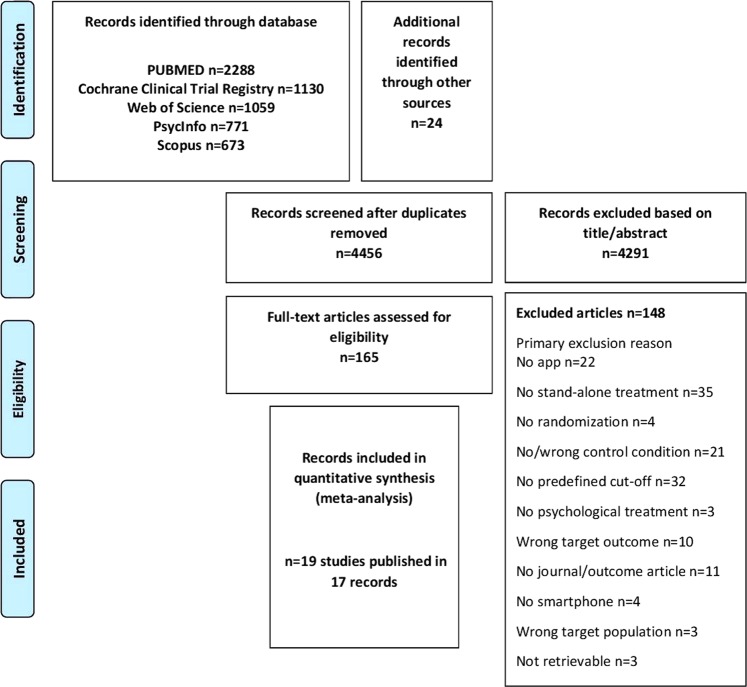
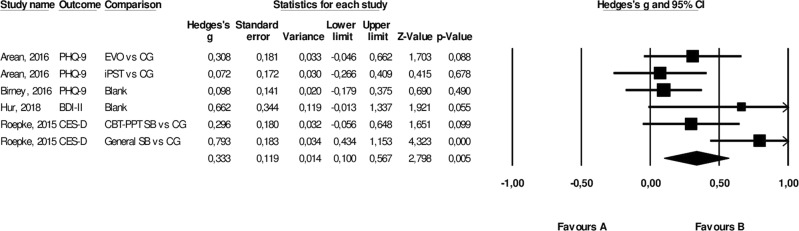
While smartphone usage is ubiquitous, and the app market for smartphone apps targeted at mental health is growing rapidly, the evidence of standalone apps for treating mental health symptoms is still unclear. This meta-analysis investigated the efficacy of standalone smartphone apps for mental health. A comprehensive literature search was conducted in February 2018 on randomized controlled trials investigating the effects of standalone apps for mental health in adults with heightened symptom severity, compared to a control group. A random-effects model was employed. When insufficient comparisons were available, data was presented in a narrative synthesis. Outcomes included assessments of mental health disorder symptom severity specifically targeted at by the app. In total, 5945 records were identified and 165 full-text articles were screened for inclusion by two independent researchers. Nineteen trials with 3681 participants were included in the analysis: depression ( k = 6), anxiety ( k = 4), substance use ( k = 5), self-injurious thoughts and behaviors ( k = 4), PTSD ( k = 2), and sleep problems ( k = 2). Effects on depression (Hedges’ g = 0.33, 95%CI 0.10–0.57, P = 0.005, NNT = 5.43, I 2 = 59%) and on smoking behavior ( g = 0.39, 95%CI 0.21–0.57, NNT = 4.59, P ≤ 0.001, I 2 = 0%) were significant. No significant pooled effects were found for anxiety, suicidal ideation, self-injury, or alcohol use ( g = −0.14 to 0.18). Effect sizes for single trials ranged from g = −0.05 to 0.14 for PTSD and g = 0.72 to 0.84 for insomnia. Although some trials showed potential of apps targeting mental health symptoms, using smartphone apps as standalone psychological interventions cannot be recommended based on the current level of evidence.
Overview
The claims and statistics of this paper haven’t been checked yet.
Free: it reads the open-access text and checks the first 5 claims that cite a source we can check. Create a free account to check every claim.
Integrity signals
Registry
Cites
Statistics
Figures
Verification
Claims the paper makes
The claims and statistics of this paper haven’t been checked yet.
Free: it reads the open-access text and checks the first 5 claims that cite a source we can check. Create a free account to check every claim.
Claims other papers make about this one
Each is checked against this paper’s own text: does it say what the citing paper says it does?
The cited source doesn’t support the claim as written.
In the citing paper
“The finding is inconsistent with other systematic reviews reporting that smartphone apps have small-to-moderate effect sizes on depression symptom reduction [4,10,12].”
From Effectiveness and Minimum Effective Dose of App-Based Mobile Health Interventions for Anxiety and Depression Symptom Reduction: Systematic Review and Meta-Analysis (2022) · cites this paper as [12]
Checked by a reasoning model — may be wrong.
Experimental — accuracy not yet measuredThe source backs part of the claim, not all of it — or backs it for a different population, condition or comparison.
In the citing paper
“Apps did not differ from non-specific controls on a combination of smoking and drinking outcomes (d = 0.18 [20]).”
From Mobile phone-based interventions for mental health: A systematic meta-review of 14 meta-analyses of randomized controlled trials (2022) · cites this paper as [20]
Experimental — accuracy not yet measuredThe source backs part of the claim, not all of it — or backs it for a different population, condition or comparison.
In the citing paper
“Apps did not differ from non-specific controls (d = 0.14 [20]).”
From Mobile phone-based interventions for mental health: A systematic meta-review of 14 meta-analyses of randomized controlled trials (2022) · cites this paper as [20]
Experimental — accuracy not yet measuredThe source backs part of the claim, not all of it — or backs it for a different population, condition or comparison.
In the citing paper
“People can benefit from fully automated, unguided DMHTs (36); however, at a population level, they show small benefits, likely because dropout rates are higher in unguided than guided interventions (37, 38).”
From Banbury forum consensus statement on the path forward for digital mental health treatment (2021) · cites this paper as [38]
Experimental — accuracy not yet measuredThe source backs part of the claim, not all of it — or backs it for a different population, condition or comparison.
In the citing paper
“In an unguided format, the effectiveness of iCBT, including digital health apps, seems to be limited [19,20]”
From Barriers to and Facilitators of a Blended Cognitive Behavioral Therapy Program for Depression and Anxiety Based on Experiences of University Students: Qualitative Interview Study (2023) · cites this paper as [20]
Experimental — accuracy not yet measured
19 more claims about this paper
Create a free account to see every claim other papers make about this one.
Self-check
Percentages, sums and reported differences re-computed from the paper’s own numbers.
The self-check needs the paper’s full text.
Citations
Cites
Diagnostic and Statistical Manual of Mental Disorders
American Psychiatric Association (2013) · doi:10.1176/appi.books.9780890425596 · Cited by 116,369
Measuring inconsistency in meta-analyses
Higgins, J. P. T., Thompson, S. G., Deeks, J. J., & Altman, D. G. (2003) · BMJ · doi:10.1136/bmj.327.7414.557 · Cited by 63,139
Liberati, A., Altman, D. G., Tetzlaff, J., Mulrow, C., Gøtzsche, P. C., Ioannidis, J. P. A., Clarke, M., Devereaux, P. J., Kleijnen, J., & Moher, D. (2009) · PLoS Medicine · doi:10.1371/journal.pmed.1000100 · Cited by 28,164
Duval, S., & Tweedie, R. (2000) · Biometrics · doi:10.1111/j.0006-341x.2000.00455.x · Cited by 14,099
Borenstein, M., Hedges, L. V., Higgins, J. P. T., & Rothstein, H. R. (2021) · doi:10.1002/9781119558378 · Cited by 9,799
Gulliver, A., Griffiths, K. M., & Christensen, H. (2010) · BMC Psychiatry · doi:10.1186/1471-244x-10-113 · Cited by 3,292
Scaling-up treatment of depression and anxiety: a global return on investment analysis
Chisholm, D., Sweeny, K., Sheehan, P., Rasmussen, B., Smit, F., Cuijpers, P., & Saxena, S. (2016) · The Lancet Psychiatry · doi:10.1016/s2215-0366(16)30024-4 · Cited by 1,451
Self-citationAndrews, G., Cuijpers, P., Craske, M. G., McEvoy, P., & Titov, N. (2010) · PLoS ONE · doi:10.1371/journal.pone.0013196 · Cited by 1,311 · cited 1×
“31 The same goes for PTSD, for which the most recent review found an average pooled effect of 0.95, 32 while the two only randomized trials that we were able to include in this study evaluating standalone apps for PTSD did not fi nd signi fi cant effects.”
InfluentialSelf-citationSmartphones for smarter delivery of mental health programs: A systematic review
Donker, T., Petrie, K., Proudfoot, J., Clarke, J., Birch, M.-R., & Christensen, H. (2013) · Journal of Medical Internet Research · doi:10.2196/jmir.2791 · Cited by 1,136
Firth, J., Torous, J., Nicholas, J., Carney, R., Pratap, A., Rosenbaum, S., & Sarris, J. (2017) · World Psychiatry · doi:10.1002/wps.20472 · Cited by 1,097
The impact of guidance on Internet-based mental health interventions — A systematic review
Baumeister, H., Reichler, L., Munzinger, M., & Lin, J. (2014) · Internet Interventions · doi:10.1016/j.invent.2014.08.003 · Cited by 1,037
Self-citationBarriers to mental health treatment: results from the National Comorbidity Survey Replication
Mojtabai, R., Olfson, M., Sampson, N. A., Jin, R., Druss, B., Wang, P. S., Wells, K. B., Pincus, H. A., & Kessler, R. C. (2011) · Psychological Medicine · doi:10.1017/s0033291710002291 · Cited by 951
Size of Treatment Effects and Their Importance to Clinical Research and Practice
Kraemer, H. C., & Kupfer, D. J. (2006) · Biological Psychiatry · doi:10.1016/j.biopsych.2005.09.014 · Cited by 850
Hollis, C., Falconer, C. J., Martin, J. L., Whittington, C., Stockton, S., Glazebrook, C., & Davies, E. B. (2017) · Journal of Child Psychology and Psychiatry · doi:10.1111/jcpp.12663 · Cited by 846
Torous, J., Nicholas, J., Larsen, M. E., Firth, J., & Christensen, H. (2018) · Evidence Based Mental Health · doi:10.1136/eb-2018-102891 · Cited by 790
Zachariae, R., Lyby, M. S., Ritterband, L. M., & O'Toole, M. S. (2016) · Sleep Medicine Reviews · doi:10.1016/j.smrv.2015.10.004 · Cited by 704
Firth, J., Torous, J., Nicholas, J., Carney, R., Rosenbaum, S., & Sarris, J. (2017) · Journal of Affective Disorders · doi:10.1016/j.jad.2017.04.046 · Cited by 675
Barth, J., Munder, T., Gerger, H., Nüesch, E., Trelle, S., Znoj, H., Jüni, P., & Cuijpers, P. (2013) · PLoS Medicine · doi:10.1371/journal.pmed.1001454 · Cited by 569
Self-citationErbe, D., Eichert, H.-C., Riper, H., & Ebert, D. D. (2017) · Journal of Medical Internet Research · doi:10.2196/jmir.6588 · Cited by 532
Self-citationEbert, D. D., Van Daele, T., Nordgreen, T., Karekla, M., Compare, A., Zarbo, C., Brugnera, A., Øverland, S., Trebbi, G., Jensen, K. L., et al. (2018) · European Psychologist · doi:10.1027/1016-9040/a000318 · Cited by 437
Self-citationVEVEA, J. L., ZELINSKY, N. A. M., & ORWIN, R. G. (2019) · The Handbook of Research Synthesis and Meta-Analysis · doi:10.7758/9781610448864.13 · Cited by 409 · cited 1×
“75).(47) Disagreement was resolved through discussion.”
The Use and Effectiveness of Mobile Apps for Depression: Results From a Fully Remote Clinical Trial
Arean, P. A., Hallgren, K. A., Jordan, J. T., Gazzaley, A., Atkins, D. C., Heagerty, P. J., & Anguera, J. A. (2016) · Journal of Medical Internet Research · doi:10.2196/jmir.6482 · Cited by 376
Torous, J., & Roberts, L. W. (2017) · JAMA Psychiatry · doi:10.1001/jamapsychiatry.2017.0262 · Cited by 362
Josephine, K., Josefine, L., Philipp, D., David, E., & Harald, B. (2017) · Journal of Affective Disorders · doi:10.1016/j.jad.2017.07.021 · Cited by 341
Self-citationPreliminary Evaluation of PTSD Coach, a Smartphone App for Post-Traumatic Stress Symptoms
Kuhn, E., Greene, C., Hoffman, J., Nguyen, T., Wald, L., Schmidt, J., Ramsey, K. M., & Ruzek, J. (2014) · Military Medicine · doi:10.7205/milmed-d-13-00271 · Cited by 289
Roepke, A. M., Jaffee, S. R., Riffle, O. M., McGonigal, J., Broome, R., & Maxwell, B. (2015) · Games for Health Journal · doi:10.1089/g4h.2014.0046 · Cited by 265
Kuester, A., Niemeyer, H., & Knaevelsrud, C. (2016) · Clinical Psychology Review · doi:10.1016/j.cpr.2015.11.004 · Cited by 261
Buntrock, C., Ebert, D. D., Lehr, D., Smit, F., Riper, H., Berking, M., & Cuijpers, P. (2016) · JAMA · doi:10.1001/jama.2016.4326 · Cited by 232
Self-citationTighe, J., Shand, F., Ridani, R., Mackinnon, A., De La Mata, N., & Christensen, H. (2017) · BMJ Open · doi:10.1136/bmjopen-2016-013518 · Cited by 227
A randomized controlled trial of a smartphone app for posttraumatic stress disorder symptoms.
Kuhn, E., Kanuri, N., Hoffman, J. E., Garvert, D. W., Ruzek, J. I., & Taylor, C. B. (2017) · Journal of Consulting and Clinical Psychology · doi:10.1037/ccp0000163 · Cited by 225
Adar, S. D., Sheppard, L., Vedal, S., Polak, J. F., Sampson, P. D., Diez Roux, A. V., Budoff, M., Jacobs, D. R., Barr, R. G., Watson, K., et al. (2013) · PLoS Medicine · doi:10.1371/journal.pmed.1001430 · Cited by 223
Franklin, J. C., Fox, K. R., Franklin, C. R., Kleiman, E. M., Ribeiro, J. D., Jaroszewski, A. C., Hooley, J. M., & Nock, M. K. (2016) · Journal of Consulting and Clinical Psychology · doi:10.1037/ccp0000093 · Cited by 217
Lim, S. L., Bentley, P. J., Kanakam, N., Ishikawa, F., & Honiden, S. (2015) · IEEE Transactions on Software Engineering · doi:10.1109/tse.2014.2360674 · Cited by 189
Enock, P. M., Hofmann, S. G., & McNally, R. J. (2014) · Cognitive Therapy and Research · doi:10.1007/s10608-014-9606-z · Cited by 186
Miner, A., Kuhn, E., Hoffman, J. E., Owen, J. E., Ruzek, J. I., & Taylor, C. B. (2016) · Psychological Trauma: Theory, Research, Practice, and Policy · doi:10.1037/tra0000092 · Cited by 185
Meta-analysis of technology-assisted interventions for social anxiety disorder
Kampmann, I. L., Emmelkamp, P. M. G., & Morina, N. (2016) · Journal of Anxiety Disorders · doi:10.1016/j.janxdis.2016.06.007 · Cited by 180
Gajecki, M., Berman, A. H., Sinadinovic, K., Rosendahl, I., & Andersson, C. (2014) · Addiction Science & Clinical Practice · doi:10.1186/1940-0640-9-11 · Cited by 179
Horsch, C. H., Lancee, J., Griffioen-Both, F., Spruit, S., Fitrianie, S., Neerincx, M. A., Beun, R. J., & Brinkman, W.-P. (2017) · Journal of Medical Internet Research · doi:10.2196/jmir.6524 · Cited by 164
Towards a Framework for Evaluating Mobile Mental Health Apps
Chan, S., Torous, J., Hinton, L., & Yellowlees, P. (2015) · Telemedicine and e-Health · doi:10.1089/tmj.2015.0002 · Cited by 163
Ebert, D. D., Berking, M., Thiart, H., Riper, H., Laferton, J. A. C., Cuijpers, P., Sieland, B., & Lehr, D. (2015) · Health Psychology · doi:10.1037/hea0000277 · Cited by 161
Self-citationBirney, A. J., Gunn, R., Russell, J. K., & Ary, D. V. (2016) · JMIR mHealth and uHealth · doi:10.2196/mhealth.4231 · Cited by 159
App-based psychological interventions: friend or foe?
Leigh, S., & Flatt, S. (2015) · Evidence Based Mental Health · doi:10.1136/eb-2015-102203 · Cited by 140
Witkiewitz, K., Desai, S. A., Bowen, S., Leigh, B. C., Kirouac, M., & Larimer, M. E. (2014) · Psychology of Addictive Behaviors · doi:10.1037/a0034747 · Cited by 134
Richards, D., Richardson, T., Timulak, L., & McElvaney, J. (2015) · Internet Interventions · doi:10.1016/j.invent.2015.07.003 · Cited by 111
BinDhim, N. F., McGeechan, K., & Trevena, L. (2018) · BMJ Open · doi:10.1136/bmjopen-2017-017105 · Cited by 110
Pham, Q., Khatib, Y., Stansfeld, S., Fox, S., & Green, T. (2016) · Games for Health Journal · doi:10.1089/g4h.2015.0033 · Cited by 104
Stolz, T., Schulz, A., Krieger, T., Vincent, A., Urech, A., Moser, C., Westermann, S., & Berger, T. (2018) · Journal of Consulting and Clinical Psychology · doi:10.1037/ccp0000301 · Cited by 102
Berger, T., Urech, A., Krieger, T., Stolz, T., Schulz, A., Vincent, A., Moser, C. T., Moritz, S., & Meyer, B. (2017) · Psychological Medicine · doi:10.1017/s0033291716002270 · Cited by 98
Lee, L. M., & Gostin, L. O. (2009) · JAMA · doi:10.1001/jama.2009.958 · Cited by 88
Terhorst, Y., Rathner, E.-M., Baumeister, H., & Sander, L. (2018) · Verhaltenstherapie · doi:10.1159/000481692 · Cited by 84
Self-citationHur, J.-W., Kim, B., Park, D., & Choi, S.-W. (2018) · Telemedicine and e-Health · doi:10.1089/tmj.2017.0214 · Cited by 82
Smartphone Applications for Mental Health
Radovic, A., Vona, P. L., Santostefano, A. M., Ciaravino, S., Miller, E., & Stein, B. D. (2016) · Cyberpsychology, Behavior, and Social Networking · doi:10.1089/cyber.2015.0619 · Cited by 78
Menon, V., Rajan, T. M., & Sarkar, S. (2017) · Indian Journal of Psychological Medicine · doi:10.4103/0253-7176.198956 · Cited by 62
Growing up in a digital world: benefits and risks
Health, T. L. C. &. A. (2018) · The Lancet Child & Adolescent Health · doi:10.1016/s2352-4642(18)30002-6 · Cited by 46
Can healthy people benefit from health apps?
Husain, I., & Spence, D. (2015) · BMJ · doi:10.1136/bmj.h1887 · Cited by 44
Clarke, P., Bedford, K., Notebaert, L., Bucks, R. S., Rudaizky, D., Milkins, B., & MacLeod, C. (2016) · Psychotherapy and Psychosomatics · doi:10.1159/000442025 · Cited by 41
Dar, R. (2018) · Nicotine & Tobacco Research · doi:10.1093/ntr/ntx223 · Cited by 39
An Adjuvant Role for Mobile Health in Psychiatry
Hsin, H., Torous, J. B., & Roberts, L. W. (2016) · JAMA Psychiatry · doi:10.1001/jamapsychiatry.2015.2839 · Cited by 39
Use of Facebook by Local Health Departments
Trivedi, R., Shah, G. H., & Bangar, A. (2015) · Frontiers in Public Health · doi:10.13023/fphssr.0405.01 · Cited by 34
Experts warn on data security in health and fitness apps
McCarthy, M. (2013) · BMJ · doi:10.1136/bmj.f5600 · Cited by 26
Practitioners should embrace, not ignore, health apps
Hickey, E., McMillan, B., & Mitchell, C. A. (2015) · BMJ · doi:10.1136/bmj.h2336 · Cited by 20
Schmädeke, S., & Bischoff, C. (2015) · Verhaltenstherapie · doi:10.1159/000441856 · Cited by 15
Growing Up in a Digital World: Benefits and Risks
Nandhakumar, M. (2018) · International Journal on Future Revolution in Computer Science & Communication Engineering · Cited by 10
Egger, S. T., Vetter, S., Weniger, G., Vandeleur, C., Seifritz, E., & Müller, M. (2016) · Frontiers in Public Health · doi:10.3389/fpubh.2016.00220 · Cited by 6
Cited by
Torous, J., Bucci, S., Bell, I. H., Kessing, L. V., Faurholt‐Jepsen, M., Whelan, P., Carvalho, A. F., Keshavan, M., Linardon, J., & Firth, J. (2021) · World Psychiatry · doi:10.1002/wps.20883 · Cited by 1,199
Torous, J., Jän Myrick, K., Rauseo-Ricupero, N., & Firth, J. (2020) · JMIR Mental Health · doi:10.2196/18848 · Cited by 946
“Current evidence for apps for behavior change remains limited [17], and self-help for mental health remains equally limited [18].”
BackgroundMethodInfluentialArtificially intelligent chatbots in digital mental health interventions: a review
Boucher, E. M., Harake, N. R., Ward, H. E., Stoeckl, S. E., Vargas, J., Minkel, J., Parks, A. C., & Zilca, R. (2021) · Expert Review of Medical Devices · doi:10.1080/17434440.2021.2013200 · Cited by 440
“engagement features [31], though other meta-analyses found significant pooled effects for depression but not for other psychological outcomes, including anxiety [32].”
BackgroundDigital interventions for the treatment of depression: a meta-analytic review
Moshe, I., Terhorst, Y., Philippi, P., Domhardt, M., Cuijpers, P., Cristea, I., Pulkki-Råback, L., Baumeister, H., & Sander, L. B. (2021) · Psychological Bulletin · doi:10.1037/bul0000334 · Cited by 390
Self-citationMobile Apps for Mental Health Issues: Meta-Review of Meta-Analyses
Lecomte, T., Potvin, S., Corbière, M., Guay, S., Samson, C., Cloutier, B., Francoeur, A., Pennou, A., & Khazaal, Y. (2020) · JMIR mHealth and uHealth · doi:10.2196/17458 · Cited by 336
“Although Weisel et al [41] do not recommend stand-alone apps for mental health problems, our results are more nuanced.”
BackgroundResult
Metadata
- Authors
- Weisel, K. K., Fuhrmann, L. M., Berking, M., Baumeister, H., Cuijpers, P., & Ebert, D. D.
- Affiliations
- Friedrich-Alexander-Universität Erlangen-Nürnberg (DE)
- Universität Ulm (DE)
- Amsterdam Public Health (NL)
- Corresponding author
- Weisel, Kiona K.
- ORCID
- Venue
- npj Digital Medicine
- Published
- 2019-12-02
- Volume
- 2
- Issue
- 1
- Pages
- 118-118
- ISSN
- 2398-6352 (ISSN-L)
- PMC
- PMC6889400
- OpenAlex
- W2990241465
- Cited by
- 447
- References
- 64
- Citations by year
- 2026: 32 · 2025: 63 · 2024: 67 · 2023: 61 · 2022: 91 · 2021: 79 · 2020: 54
- FWCI
- 7.93
- Type
- journal article
- Language
- en
- Open access
- gold
- doi.org
- Licence
- cc-by
- creativecommons.org/licenses/by/4.0 (tdm)
- creativecommons.org/licenses/by/4.0 (vor)
- Locations
- npj Digital Medicine (publishedVersion, cc-by)
- PubMed Central (publishedVersion, cc-by)
- PubMed (publishedVersion)
- VU Research Portal (publishedVersion, cc-by)
- DOAJ (DOAJ: Directory of Open Access Journals) (submittedVersion)
- OPUS FAU (Kooperativer Bibliotheksverbund Berlin-Brandenburg (KOBV), on behalf of the Universitätsbibliothek Erlangen-Nürnberg) (submittedVersion, cc-by)
- Data Archiving and Networked Services (DANS) (submittedVersion, other-oa)
- Funders
- National Institute for Health and Care Research
- Topics
- Social Sciences › Psychology › Applied Psychology › Digital Mental Health Interventions
- Health Sciences › Health Professions › General Health Professions › Mobile Health and mHealth Applications
- Social Sciences › Psychology › Experimental and Cognitive Psychology › Mental Health Research Topics
- Keywords
- mobile application, mental health apps, digital mental health interventions, depression, anxiety, substance use, self-harm, suicidal ideation, post-traumatic stress disorder, insomnia, smoking cessation, app efficacy
About these checks
Registry, retraction, Cites and statistics results are computed, not judged, with one exception: a printed reference that no index lists is read once by a model before it counts as a citation error. Claims are extracted by a model and kept only when their quote appears verbatim in the text; each cited source is then checked, with a model’s help, for whether it says what the claim relies on. Those verdicts can be wrong — read the claim’s quote and the cited source before relying on one.
Statistics and arithmetic are recomputed, not judged.
Confidence bands are shown only for fields calibrated on our annotated test set. None is calibrated yet, so no band is shown.
What counts as a claim ›How we measure confidence ›How we check this ›
Are you an author, or do you see a problem with this page? Request a review
Data sources
Bibliographic data: Semantic Scholar, OpenAlex, Crossref.
Contains information from the Semantic Scholar Academic Graph Datasets, made available under the ODC Attribution License (ODC-BY 1.0).
Semantic Scholar’s data is described in: Kinney, R., et al. (2023). The Semantic Scholar Open Data Platform. arXiv:2301.10140.
