

Standalone smartphone apps for mental health—a systematic review and meta-analysis
Open accessThe DOI matches its Crossref record; 64 of the 64 references it cites were found in a registry or an index.
Abstract
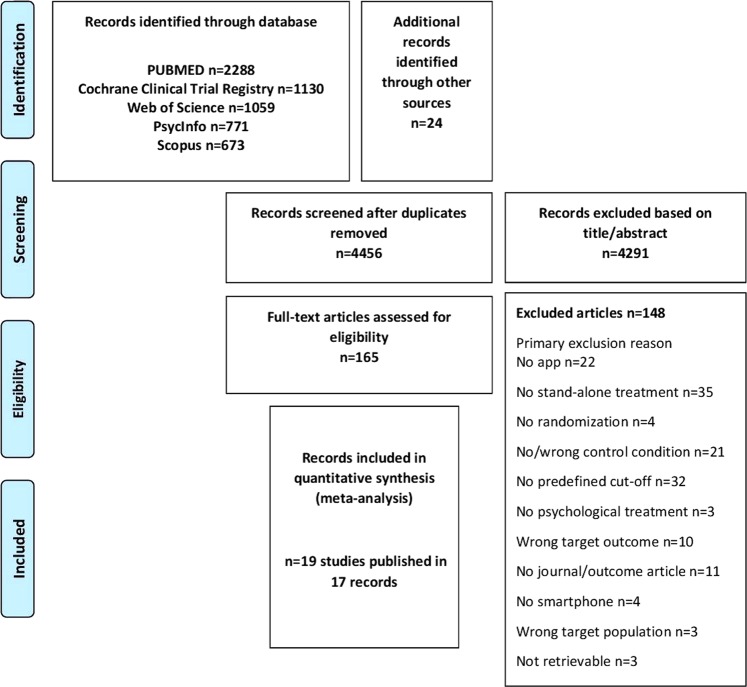
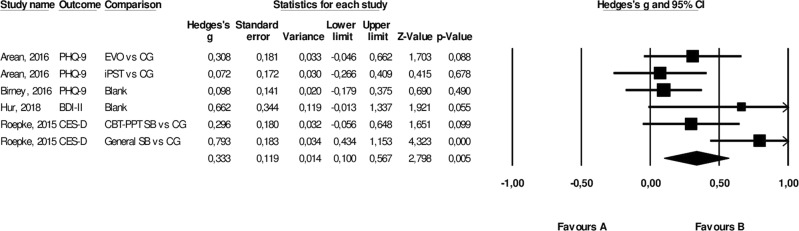
While smartphone usage is ubiquitous, and the app market for smartphone apps targeted at mental health is growing rapidly, the evidence of standalone apps for treating mental health symptoms is still unclear. This meta-analysis investigated the efficacy of standalone smartphone apps for mental health. A comprehensive literature search was conducted in February 2018 on randomized controlled trials investigating the effects of standalone apps for mental health in adults with heightened symptom severity, compared to a control group. A random-effects model was employed. When insufficient comparisons were available, data was presented in a narrative synthesis. Outcomes included assessments of mental health disorder symptom severity specifically targeted at by the app. In total, 5945 records were identified and 165 full-text articles were screened for inclusion by two independent researchers. Nineteen trials with 3681 participants were included in the analysis: depression ( k = 6), anxiety ( k = 4), substance use ( k = 5), self-injurious thoughts and behaviors ( k = 4), PTSD ( k = 2), and sleep problems ( k = 2). Effects on depression (Hedges’ g = 0.33, 95%CI 0.10–0.57, P = 0.005, NNT = 5.43, I 2 = 59%) and on smoking behavior ( g = 0.39, 95%CI 0.21–0.57, NNT = 4.59, P ≤ 0.001, I 2 = 0%) were significant. No significant pooled effects were found for anxiety, suicidal ideation, self-injury, or alcohol use ( g = −0.14 to 0.18). Effect sizes for single trials ranged from g = −0.05 to 0.14 for PTSD and g = 0.72 to 0.84 for insomnia. Although some trials showed potential of apps targeting mental health symptoms, using smartphone apps as standalone psychological interventions cannot be recommended based on the current level of evidence.
Overview
The claims and statistics of this paper haven’t been checked yet.
Free: it reads the open-access text and checks the first 5 claims that cite a source we can check. Create a free account to check every claim.
Integrity signals
Registry
Cites
Statistics
Figures
Verification
Claims the paper makes
The claims and statistics of this paper haven’t been checked yet.
Free: it reads the open-access text and checks the first 5 claims that cite a source we can check. Create a free account to check every claim.
Claims other papers make about this one
Each is checked against this paper’s own text: does it say what the citing paper says it does?
The cited source doesn’t support the claim as written.
In the citing paper
“The finding is inconsistent with other systematic reviews reporting that smartphone apps have small-to-moderate effect sizes on depression symptom reduction [4,10,12].”
From Effectiveness and Minimum Effective Dose of App-Based Mobile Health Interventions for Anxiety and Depression Symptom Reduction: Systematic Review and Meta-Analysis (2022) · cites this paper as [12]
Checked by a reasoning model — may be wrong.
Experimental — accuracy not yet measuredThe source backs part of the claim, not all of it — or backs it for a different population, condition or comparison.
In the citing paper
“Apps did not differ from non-specific controls on a combination of smoking and drinking outcomes (d = 0.18 [20]).”
From Mobile phone-based interventions for mental health: A systematic meta-review of 14 meta-analyses of randomized controlled trials (2022) · cites this paper as [20]
Experimental — accuracy not yet measuredThe source backs part of the claim, not all of it — or backs it for a different population, condition or comparison.
In the citing paper
“Apps did not differ from non-specific controls (d = 0.14 [20]).”
From Mobile phone-based interventions for mental health: A systematic meta-review of 14 meta-analyses of randomized controlled trials (2022) · cites this paper as [20]
Experimental — accuracy not yet measuredThe source backs part of the claim, not all of it — or backs it for a different population, condition or comparison.
In the citing paper
“People can benefit from fully automated, unguided DMHTs (36); however, at a population level, they show small benefits, likely because dropout rates are higher in unguided than guided interventions (37, 38).”
From Banbury forum consensus statement on the path forward for digital mental health treatment (2021) · cites this paper as [38]
Experimental — accuracy not yet measuredThe source backs part of the claim, not all of it — or backs it for a different population, condition or comparison.
In the citing paper
“In an unguided format, the effectiveness of iCBT, including digital health apps, seems to be limited [19,20]”
From Barriers to and Facilitators of a Blended Cognitive Behavioral Therapy Program for Depression and Anxiety Based on Experiences of University Students: Qualitative Interview Study (2023) · cites this paper as [20]
Experimental — accuracy not yet measured
19 more claims about this paper
Create a free account to see every claim other papers make about this one.
Self-check
Percentages, sums and reported differences re-computed from the paper’s own numbers.
The self-check needs the paper’s full text.
Citations
Cites
Diagnostic and Statistical Manual of Mental Disorders
American Psychiatric Association (2013) · doi:10.1176/appi.books.9780890425596 · Cited by 116,369
Measuring inconsistency in meta-analyses
Higgins, J. P. T., Thompson, S. G., Deeks, J. J., & Altman, D. G. (2003) · BMJ · doi:10.1136/bmj.327.7414.557 · Cited by 63,139
Liberati, A., Altman, D. G., Tetzlaff, J., Mulrow, C., Gøtzsche, P. C., Ioannidis, J. P. A., Clarke, M., Devereaux, P. J., Kleijnen, J., & Moher, D. (2009) · PLoS Medicine · doi:10.1371/journal.pmed.1000100 · Cited by 28,164
Duval, S., & Tweedie, R. (2000) · Biometrics · doi:10.1111/j.0006-341x.2000.00455.x · Cited by 14,099
Borenstein, M., Hedges, L. V., Higgins, J. P. T., & Rothstein, H. R. (2021) · doi:10.1002/9781119558378 · Cited by 9,799
Gulliver, A., Griffiths, K. M., & Christensen, H. (2010) · BMC Psychiatry · doi:10.1186/1471-244x-10-113 · Cited by 3,292
Scaling-up treatment of depression and anxiety: a global return on investment analysis
Chisholm, D., Sweeny, K., Sheehan, P., Rasmussen, B., Smit, F., Cuijpers, P., & Saxena, S. (2016) · The Lancet Psychiatry · doi:10.1016/s2215-0366(16)30024-4 · Cited by 1,451
Self-citationAndrews, G., Cuijpers, P., Craske, M. G., McEvoy, P., & Titov, N. (2010) · PLoS ONE · doi:10.1371/journal.pone.0013196 · Cited by 1,311 · cited 1×
“31 The same goes for PTSD, for which the most recent review found an average pooled effect of 0.95, 32 while the two only randomized trials that we were able to include in this study evaluating standalone apps for PTSD did not fi nd signi fi cant effects.”
InfluentialSelf-citationSmartphones for smarter delivery of mental health programs: A systematic review
Donker, T., Petrie, K., Proudfoot, J., Clarke, J., Birch, M.-R., & Christensen, H. (2013) · Journal of Medical Internet Research · doi:10.2196/jmir.2791 · Cited by 1,136
Firth, J., Torous, J., Nicholas, J., Carney, R., Pratap, A., Rosenbaum, S., & Sarris, J. (2017) · World Psychiatry · doi:10.1002/wps.20472 · Cited by 1,097
Cited by
Items 401–444 of 444
Steubl, L., Klein, J. P., & Baumeister, H. (2025) · Der Nervenarzt · doi:10.1007/s00115-025-01866-y
Self-citationChoudhary, S., Nelson, B., Jones, N., Mehta, U. M., & Torous, J. B. (2025) · Pharmaceutical Medicine · doi:10.1007/s40290-025-00579-6 · Cited by 1
eHealth for the Treatment of Depression and Insomnia
Taple, B. J., Lattie, E. G., & Stamatis, C. A. (2025) · CBT: science into practice · doi:10.1007/978-3-031-92265-7_8
Foley, G., Cassiano, M. S., & Ricciardelli, R. (2025) · Digital Health · doi:10.1177/20552076251384142
“37 In other words, most health apps are not reliable as a sole source of mental health treatment; however, they are often used as such.”
Ho, Y., Ching, Y., & Molloy, L. (2025) · doi:10.2196/preprints.86434
Umělá inteligence jako nástroj podporující duševní zdraví mladých dospělých
Cejp, D., & Frombergerová, A. (2025) · DIAGNOSTIKA A PORADENSTVÍ v pomáhajících profesích · doi:10.58743/dap2025no15.375
Jacobson, N. C., Chen, W. C., & Huang, R. (2025) · Meta-Psychology · doi:10.15626/mp.2020.2458
Digital Innovation in Mental Health
Gillett, G., Rigby, D., & Gadelrab, R. (2025) · Cambridge University Press eBooks · doi:10.1017/9781009028967.011
Expanding access to mental healthcare through technology
Reddy, K. J. (2025) · Elsevier eBooks · doi:10.1016/b978-0-443-43908-7.00018-5
Digital innovations in mental health
Reddy, K. J. (2025) · Elsevier eBooks · doi:10.1016/b978-0-443-43908-7.00021-5
Anderson, C., & Linardon, J. (2025) · Cognitive Behaviour Therapy · doi:10.1080/16506073.2025.2599349
“…conducted over the past decade, with multiple meta-analyses finding that they can effectively reduce symptoms of depression, generalized anxiety, specific phobias, panic, and social anxiety (Linardon et al., 2025; Linardon, Torous, et al., 2024; Serrano-Ripoll et al., 2022; Weisel et al., 2019).”
Clare, A., Mukumba, R., Mclaren, M., Dalal, N., Murray, J., Wayal, S., & Hollowell, J. (2025) · Mental Health Science · doi:10.1002/mhs2.70035
Esen, E. C., & Baykan, H. (2025) · BMC Psychiatry · doi:10.1186/s12888-025-07696-1
“…solutions that include psychoeducation and cognitive restructuring developed in conjunction with mental health professionals, administered under the supervision of a psychiatrist or psychologist, and functioning as a complementary and supportive adjunct to face-to-face therapy processes [15, 25].”
Domhardt, M., Messner, E.-M., Eder, A.-S., Engler, S., Sander, L., Baumeister, H., & Terhorst, Y. (2021) · Figshare · doi:10.6084/m9.figshare.16614635
Self-citationCao, W., Kadir, A. A., Tang, W., Wang, J., Yuan, J., & Hassan, I. I. (2024) · Figshare · doi:10.6084/m9.figshare.24934617
Cao, W., Kadir, A. A., Tang, W., Wang, J., Yuan, J., & Hassan, I. I. (2024) · Figshare · doi:10.6084/m9.figshare.24934343
Digital mental health programs are inexpensive and innovative. But do they work?
Clough, B. A., Farrer, L., & Ganapathy, A. (2025) · The Conversation · doi:10.64628/aa.64jp5jjvs
Sun, F., Du, Y., Teng, H., & Guo, Y. (2026) · Psychogeriatrics · doi:10.1111/psyg.70132
“Using mHealth apps has been shown to be effective in improving mental health and alleviating negative emotions such as anxiety and depression [25].”
Linking mHealth Engagement to Depression, Anxiety, and Stress Through Perceived Health Competence
Busneag, I.-C., Chiracu, A., Cojocaru, M., Adin-Marian, C., Cosma, G., & Cosma, M. (2026) · Healthcare · doi:10.3390/healthcare14030338
“Meta-analytic and systematic reviews have documented small and heterogeneous beneficial effects of mHealth interventions for depression and anxiety [3,20].”
Evidence of Internet- and Mobile-Based Interventions for Mental Disorders
Löchner, J., Schoenenberg, K., & Zarski, A. (2026) · Springer eBooks · doi:10.1007/978-3-032-08980-9_3
Pasch, L., Verma, R., Sandhu, A., Shen, J., Masiello, A. M., Ajeya, D., Ailani, S., & KASHYAP, R. (2026) · Journal of Affective Disorders · doi:10.1016/j.jad.2026.121513
A Structured Decision-Making Framework for Clinicians Evaluating Mental Health Apps
Yu, R., & Haddock, A. D. (2026) · Journal of Technology in Behavioral Science · doi:10.1007/s41347-026-00610-w
The Relevance of Heart Rate Variability for Hypnotherapy and Psychotherapy
Moss, D. (2026) · Brain Sciences · doi:10.3390/brainsci16040352
“There are also an abundance of training apps available online, as summarized in recent reviews [87–89].”
Mei, X., Liu, J., Qiu, Y., Tong, M., Gu, J., Yue, Y., Yang, F., & Zhang, L. (2026) · BMC Public Health · doi:10.1186/s12889-026-27309-0
“These incorporation of social elements can help to reduce the psychological barriers of older users to the application of new technologies, thus enhancing their acceptance of DMHIs [53].”
van Noort, B. M., Emmerich, O. L. M., Wolfermann, L., Reuter, L., & Wagner, B. (2026) · Journal of Child & Adolescent Trauma · doi:10.1007/s40653-026-00886-3 · Cited by 1
“However, meta-analyses indicate limited efficacy of stand - alone mobile applications for mental health interventions (Buttazzoni et al., 2021; Khan et al., 2019; Weisel et al., 2019).”
Hudgens, S. A., Purnajo, I., Floden, L., Hwang, S., Ash, J. A., Rothman, B. S., Speier, A., & Forbes, A. (2026) · JMIR Formative Research · doi:10.2196/85037
Erqsous, M., Lovell, F., Abraham, B., Ngo, A. A., Chandrasekaran, A., & Mauriello, M. L. (2026) · doi:10.2196/preprints.94528
Mu, J., & Sun, P. (2026) · Well-Being Sciences Review · doi:10.54844/wsr.2026.1139
“The meta-analysis by Weisel et al. (2019) that app-based mMHIs had significant reducing effects on anxiety symptoms.”
Rinn, A., Goetsch, S., Hannibal, S., Lehr, D., & Weise, C. (2026) · JMIR mhealth and uhealth · doi:10.2196/66151
“Nevertheless, questions and potential risks arise when implementing IMIs, for example, concerning data security or the efficacy of stand-alone smartphone apps [10-12].”
Online Psychological Counseling Based on Cognitive Behavioral Theraphy in Depression A Case Study
Korkmaz, K., & Çekiç, A. (2026) · Sinop Üniversitesi Sosyal Bilimler Dergisi · doi:10.30561/sinopusd.1835154
Impact of Cognitive-Behavioural Therapy on Anxiety, Depression, and Resilience among Young Adults
Pathak, P. (2026) · International Journal of Psychology Research · doi:10.33545/26648903.2026.v8.i6a.199
Oh, D., Choi, H. S., Mohr, D. C., & Na, H. (2026) · Frontiers in Public Health · doi:10.3389/fpubh.2026.1830292
“This pattern reflects the mechanisms highlighted by Weisel et al. (34), emphasizing the importance of real-time self-monitoring and repeated use of app-based interventions for reducing stress.”
Responsible Leapfrogging: Countering the Automation of Inequality in Global Mental Health
DeFranza, D., & Bae, S. Y. (2026) · ACM Conference on Fairness, Accountability, and Transparency (FAccT) · doi:10.1145/3805689.3812349
“Several reviews reveal that while user satisfaction tends to be high, measurable outcomes are inconsistent and often modest [44, 71].”
Leightley, D., Gillings, E., Boering, P., Dalrymple, K. V., Ćurčin, V., Greenberg, N. L., & Williamson, C. (2026) · medRxiv · doi:10.64898/2026.06.22.26356243
Oewel, B., Nambiar, K., Agapie, E., & Reddy, M. C. (2026) · JMIR Formative Research · doi:10.2196/89009
Cakirpaloglu, S. D., Cakirpaloglu, P., Kvapilová, B., Schovankova, T., Skopal, O., & Vévodová, Š. (2026) · Frontiers in Psychology · doi:10.3389/fpsyg.2026.1867560
“Mobile health (mHealth) interventions have emerged as promising tools for delivering psychological support in an accessible and scalable manner (Firth et al., 2017; Weisel et al., 2019; Bakker et al., 2016).”
Ong, Q. C., Pienkowska, A., Obarcanin, E., Stona, A., Khong, A. W. H., Car, J., & Ho, A. H. Y. (2026) · JMIR mhealth and uhealth · doi:10.2196/83442
“Despite their ubiquity and growing adoption, the effect of these apps across various health outcomes remains inconsistent [2,5,6].”
Developer evidence and user satisfaction in mental health apps across China and the United States
Liang, J., Ma, J., Li, X., Peng, X., Fang, Q., Zhang, Z., Pan, H., Zhao, L., Liu, Y., He, Y. Q., et al. (2026) · npj Digital Medicine · doi:10.1038/s41746-026-03026-1
Wang, B., Mundal, I. P., Fortuna, K. L., Grønvik, C. K. U., Eines, T. F., & Storm, M. (2026) · Digital Health · doi:10.1177/20552076261469387
“46 However, we observed digital exclusion may occur among people receiving mental healthcare, particularly those with SMI, due to factors such as concentration problems, paranoia, or advanced age.”
Jackman, M., & Sunkel, C. (2026) · Health informatics · doi:10.1007/978-3-032-24537-3_3
Talekar, R., Arevalo, I., Macareno, B., & Garney, W. R. (2026) · JMIR Formative Research · doi:10.2196/97517
“However, findings on MHapps’ impact have been mixed, with inconsistencies on the impact of such apps, ranging from some recommended tools to “cannot recommend” as a stand-alone psychological intervention for the treatment of depression and anxiety [24-26].”
Bresin, K., Ahrenholtz, M. S., Nicholas, J. K., & Bewley, M. (2026) · Suicide and Life-Threatening Behavior · doi:10.1111/sltb.70138
Butorac, I., McNaney, R., Seguin, J. P., Northam, J. C., Yap, M. B. H., & Carter, A. (2026) · Frontiers in Digital Health · doi:10.3389/fdgth.2026.1941307
“DMH tools could deliver support and increase service capacity (152); however, the young people in this study had contrasting attitudes toward classroom surveillance and the level of teacher involvement when it came to supporting their mental health.”
Meng, K., Hou, M., & Chae, H. (2026) · World Journal of Psychiatry · doi:10.5498/wjp.125040
Metadata
- Authors
- Weisel, K. K., Fuhrmann, L. M., Berking, M., Baumeister, H., Cuijpers, P., & Ebert, D. D.
- Affiliations
- Friedrich-Alexander-Universität Erlangen-Nürnberg (DE)
- Universität Ulm (DE)
- Amsterdam Public Health (NL)
- Corresponding author
- Weisel, Kiona K.
- ORCID
- Venue
- npj Digital Medicine
- Published
- 2019-12-02
- Volume
- 2
- Issue
- 1
- Pages
- 118-118
- ISSN
- 2398-6352 (ISSN-L)
- PMC
- PMC6889400
- OpenAlex
- W2990241465
- Cited by
- 447
- References
- 64
- Citations by year
- 2026: 32 · 2025: 63 · 2024: 67 · 2023: 61 · 2022: 91 · 2021: 79 · 2020: 54
- FWCI
- 7.93
- Type
- journal article
- Language
- en
- Open access
- gold
- doi.org
- Licence
- cc-by
- creativecommons.org/licenses/by/4.0 (tdm)
- creativecommons.org/licenses/by/4.0 (vor)
- Locations
- npj Digital Medicine (publishedVersion, cc-by)
- PubMed Central (publishedVersion, cc-by)
- PubMed (publishedVersion)
- VU Research Portal (publishedVersion, cc-by)
- DOAJ (DOAJ: Directory of Open Access Journals) (submittedVersion)
- OPUS FAU (Kooperativer Bibliotheksverbund Berlin-Brandenburg (KOBV), on behalf of the Universitätsbibliothek Erlangen-Nürnberg) (submittedVersion, cc-by)
- Data Archiving and Networked Services (DANS) (submittedVersion, other-oa)
- Funders
- National Institute for Health and Care Research
- Topics
- Social Sciences › Psychology › Applied Psychology › Digital Mental Health Interventions
- Health Sciences › Health Professions › General Health Professions › Mobile Health and mHealth Applications
- Social Sciences › Psychology › Experimental and Cognitive Psychology › Mental Health Research Topics
- Keywords
- mobile application, mental health apps, digital mental health interventions, depression, anxiety, substance use, self-harm, suicidal ideation, post-traumatic stress disorder, insomnia, smoking cessation, app efficacy
About these checks
Registry, retraction, Cites and statistics results are computed, not judged, with one exception: a printed reference that no index lists is read once by a model before it counts as a citation error. Claims are extracted by a model and kept only when their quote appears verbatim in the text; each cited source is then checked, with a model’s help, for whether it says what the claim relies on. Those verdicts can be wrong — read the claim’s quote and the cited source before relying on one.
Statistics and arithmetic are recomputed, not judged.
Confidence bands are shown only for fields calibrated on our annotated test set. None is calibrated yet, so no band is shown.
What counts as a claim ›How we measure confidence ›How we check this ›
Are you an author, or do you see a problem with this page? Request a review
Data sources
Bibliographic data: Semantic Scholar, OpenAlex, Crossref.
Contains information from the Semantic Scholar Academic Graph Datasets, made available under the ODC Attribution License (ODC-BY 1.0).
Semantic Scholar’s data is described in: Kinney, R., et al. (2023). The Semantic Scholar Open Data Platform. arXiv:2301.10140.
