

The future of digital health with federated learning
Open accessThe DOI matches its Crossref record; 75 of the 76 references it cites were found in a registry or an index, and 1 are not checked yet; 31 of the 51 sources its claims cite were checked for support.
Abstract
Data-driven machine learning (ML) has emerged as a promising approach for building accurate and robust statistical models from medical data, which is collected in huge volumes by modern healthcare systems. Existing medical data is not fully exploited by ML primarily because it sits in data silos and privacy concerns restrict access to this data. However, without access to sufficient data, ML will be prevented from reaching its full potential and, ultimately, from making the transition from research to clinical practice. This paper considers key factors contributing to this issue, explores how federated learning (FL) may provide a solution for the future of digital health and highlights the challenges and considerations that need to be addressed.
Verified 2026-11-25 · 1 reference not checked yet
Overview
CoChat Summary
TL;DR
This perspective paper argues that federated learning (FL) is a promising way to train medical AI across institutions without centralizing sensitive data, potentially improving accuracy, robustness, and privacy in digital health. It also emphasizes that FL does not remove core challenges such as data heterogeneity, privacy leakage, and the need for standardization and governance.
Key findings
- FL is presented as a learning paradigm that lets multiple parties train collaboratively without exchanging or centralizing datasets, by moving the model to the data rather than the data to the model.
- The paper states that recent research has shown FL models can achieve performance comparable to centrally hosted data sets and superior to models trained on isolated single-institution data.
- Reported application areas already include EHR tasks such as finding clinically similar patients and predicting hospitalizations due to cardiac events, mortality, and ICU stay time, as well as medical imaging tasks such as whole-brain segmentation, brain tumor segmentation, and fMRI classification.
- Concrete initiatives mentioned include a collaboration across 4 hospitals in France (HealthChain), an international federation of 30 healthcare institutions (FeTS), and a project across 10 pharmaceutical companies (Melloddy).
Methods
- Not stated in the paper.
- The article is a perspective/consensus paper rather than an empirical study; it synthesizes prior work and examples to discuss FL’s promise, current uses, and technical considerations.
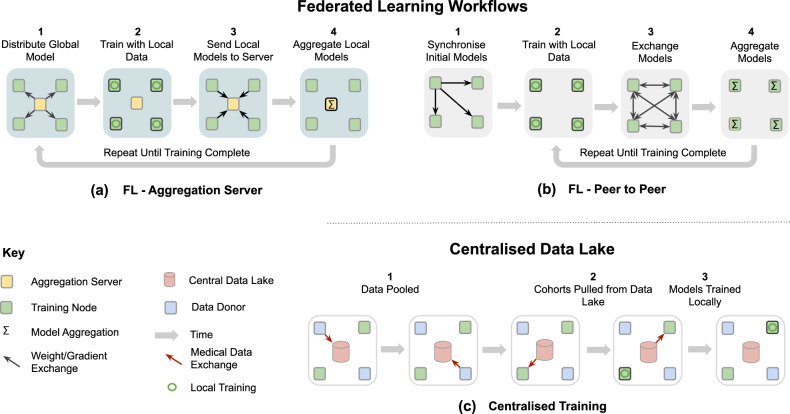
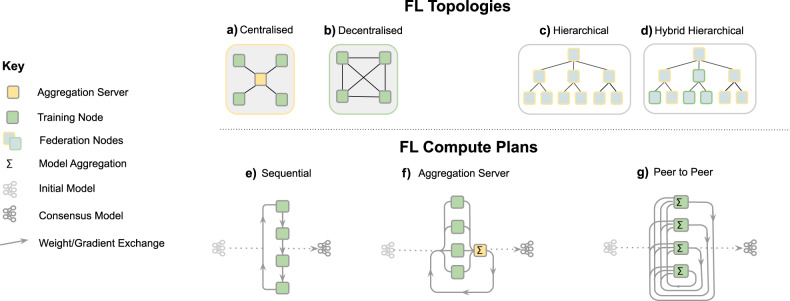
- The text describes FL workflows, including aggregation-server and peer-to-peer topologies, and discusses mechanisms such as FedAvg, FedProx, domain adaptation, and differential privacy at a conceptual level.
Limitations
- The paper explicitly states that FL does not solve all issues inherent to learning on medical data; success still depends on data quality, bias, and standardization.
- It states that FL does not eliminate privacy risks: models can still memorize information, and gradients/model updates may leak private data through inversion or adversarial attacks.
- Evident from the text: this is a perspective article, so it does not report original experimental results, sample sizes, or statistical testing.
Model-written summary. Check it against the paper before relying on it.
Integrity signals
Registry
Cites
Statistics
Figures
Verification
Claims the paper makes
16 Valid · 0 Not valid · 4 Not checked · 19 Own results and interpretations
The cited sources support only part of this claim — read each source’s verdict below.
In the paper
“Modern DL models feature millions of parameters that need to be learned from sufficiently large curated data sets in order to achieve clinical-grade accuracy, while being safe, fair, equitable and generalising well to unseen data2–5.”
§ The future of digital health with federated learning > Introduction
What the sources say
- Not checked — no full text of the sourcecites [2] Wang F Casalino LP Khullar D Deep learning in medicine—promise, progress, and challenges JAMA Intern. Med. 2019 179 293 294 10.1001/jamainternmed.2018.7117 30556825 source
- Not checked — no full text of the sourcecites [3] Chartrand G Deep learning: a primer for radiologists Radiographics 2017 37 2113 2131 10.1148/rg.2017170077 29131760 source
- Partly supportedcites [4] De Fauw J Clinically applicable deep learning for diagnosis and referral in retinal disease Nat. Med. 2018 24 1342 10.1038/s41591-018-0107-6 30104768 sourceExperimental — accuracy not yet measured
Split into 2 atoms — 0 confirmed, 2 partially supported, 0 disputed, 0 misattributed, 0 unverifiable. Expand the claim to see per-atom verdicts.
- Partly supportedcites [5] Sun, C., Shrivastava, A., Singh, S. & Gupta, A. Revisiting unreasonable effectiveness of data in deep learning era. In Proceedings of the IEEE international conference on computer vision, 843–852 (IEEE, 2017). sourceExperimental — accuracy not yet measured
Split into 2 atoms — 0 confirmed, 2 partially supported, 0 disputed, 0 misattributed, 0 unverifiable. Expand the claim to see per-atom verdicts.
plainstates a cause- Asserted: passes — The authors put it forward as true.
- Checkable: passes — It can be checked against evidence.
- Load-bearing: passes — The paper’s conclusions depend on it.
- Based: passes — The paper gives a reason why it holds.
The cited sources support only part of this claim — read each source’s verdict below.
In the paper
“Existing medical data is not fully exploited by ML primarily because it sits in data silos and privacy concerns restrict access to this data.”
§ The future of digital health with federated learning > Abstract
What the sources say
- Partly supportedcites [6] Van Panhuis WG A systematic review of barriers to data sharing in public health BMC Public Health 2014 14 1144 10.1186/1471-2458-14-1144 25377061 PMC4239377 sourceExperimental — accuracy not yet measured
The Background describes routinely collected public-health data as underused, and Results > Legal barriers says privacy concerns can lead to restrictive data-access policies. Results > Technical barriers describes difficulties integrating datasets. The paper does not establish that machine learning is the affected use or that data silos and privacy are the primary reasons medical data is underexploited. (LLM, conf=0.87)
- Partly supportedcites [7] Rocher L Hendrickx JM De Montjoye Y-A Estimating the success of re-identifications in incomplete datasets using generative models Nat. Commun. 2019 10 1 9 10.1038/s41467-019-10933-3 31337762 PMC6650473 sourceExperimental — accuracy not yet measured
The Introduction (page not provided) says medical and other personal data can advance AI, while privacy concerns affect its collection, use, and sharing. It does not say that medical data sits in silos or that silos and privacy restrictions are the primary reasons ML underuses it. (LLM, conf=0.85)
plainstates a cause- Asserted: passes — The authors put it forward as true.
- Checkable: passes — It can be checked against evidence.
- Load-bearing: passes — The paper’s conclusions depend on it.
- Based: passes — The paper gives a reason why it holds.
- Partly supported
The cited sources support only part of this claim — read each source’s verdict below.
In the paper
“The more rounds of local training are performed, the less it is guaranteed that the overall procedure is minimising (Eq. 1)9,12.”
§ The future of digital health with federated learning > Technical considerations > Federated learning definition
What the sources say
- Partly supportedcites [9] McMahan, B., Moore, E., Ramage, D., Hampson, S. & y Arcas, B. A. Communication-efficient learning of deep networks from decentralized data. In Artificial Intelligence and Statistics, 1273–1282. https://scholar.google.de/scholar?hl=de&as_sdt=0%2C5&q=Communicationefficient+learning+of+deep+networks+from+decentralized+data&btnG= (2017). sourceExperimental — accuracy not yet measured
The Experimental Results (p. 7) report that with very many local epochs, FedAvg can plateau or diverge on the Shakespeare LSTM task. But they also report no significant convergence degradation for large numbers of local epochs on the MNIST CNN, so the paper does not establish a general rule that more local training makes minimisation of the global loss less assured. (LLM, conf=0.86)
- Supportedcites [12] Kairouz, P. et al. Advances and open problems in federated learning. arXiv preprint arXiv:1912.04977 (2019). source
Section 3.2.1 states that more local updates increase divergence between client models and slow convergence of the training loss. Section 3.2.2 also reports more restrictive convergence bounds for local updates with non-IID data. Together, these support the claim that increasing local training weakens convergence assurances for the global loss. (LLM, conf=0.86)
plainstates a cause- Asserted: passes — The authors put it forward as true.
- Checkable: passes — It can be checked against evidence.
- Load-bearing: unclear — It is unclear whether the paper’s conclusions depend on it.
- Based: passes — The paper gives a reason why it holds.
- Partly supported
A conclusion the paper draws from its own results — it cites no other source for it, so there is none to check. The quote shows it is in the paper.
In the paper
“By linking healthcare institutions, not restricted to research centres, FL can have direct clinical impact.”
§ The future of digital health with federated learning > Data-driven medicine requires federated efforts > Current FL efforts for digital health
plainstates a possible cause- Asserted: passes — The authors put it forward as true.
- Checkable: passes — It can be checked against evidence.
- Load-bearing: passes — The paper’s conclusions depend on it.
- Based: passes — The paper gives a reason why it holds.
A conclusion the paper draws from its own results — it cites no other source for it, so there is none to check. The quote shows it is in the paper.
In the paper
“FL enables collaborative research for, even competing, companies.”
§ The future of digital health with federated learning > Data-driven medicine requires federated efforts > Current FL efforts for digital health
plainstates a cause- Asserted: passes — The authors put it forward as true.
- Checkable: passes — It can be checked against evidence.
- Load-bearing: unclear — It is unclear whether the paper’s conclusions depend on it.
- Based: passes — The paper gives a reason why it holds.
14 references still to check
A free account verifies the references that are still open.
- Probably not a substantial claim. 19
- It may state two separate claims as one. 32
- The quote only partly states this claim. 1
Claims other papers make about this one
Each is checked against this paper’s own text: does it say what the citing paper says it does?
The source backs part of the claim, not all of it — or backs it for a different population, condition or comparison.
In the citing paper
“This is currently addressed by sharing multi-site data, but such centralization is challenging/infeasible to scale due to various limitations.”
From Federated learning enables big data for rare cancer boundary detection (2022) · cites this paper as [10]
Experimental — accuracy not yet measuredThe source backs part of the claim, not all of it — or backs it for a different population, condition or comparison.
In the citing paper
“However, these methods often come with trade-offs in accuracy and computational efficiency.”
From The role of multimodality in clinical disease diagnosis: advances, challenges, and opportunities (2026) · cites this paper as [34]
Experimental — accuracy not yet measuredThe source backs part of the claim, not all of it — or backs it for a different population, condition or comparison.
In the citing paper
“The experts in healthcare and life sciences can use FL to solve the unique problem of data governance by training algorithms behind the hospital's firewall and only sharing models so that data remain secure [31].”
From A comprehensive survey on federated learning techniques for healthcare informatics (2023) · cites this paper as [31]
Experimental — accuracy not yet measuredThe source backs part of the claim, not all of it — or backs it for a different population, condition or comparison.
In the citing paper
“It also improves patient privacy and reduces low latency during the collaboration of multiple hospitals/entities [7].”
From Handling privacy-sensitive medical data with federated learning: Challenges and future directions (2023) · cites this paper as [7]
Experimental — accuracy not yet measuredThe source backs part of the claim, not all of it — or backs it for a different population, condition or comparison.
In the citing paper
“Enabling privacy protected data sharing across clinical centers is advocated as an essential pathway to promote collaborations internationally yet underexplored so far6,7.”
From Federated deep learning for detecting COVID-19 lung abnormalities in CT: a privacy-preserving multinational validation study (2021) · cites this paper as [7]
Experimental — accuracy not yet measured
27 more claims about this paper
Create a free account to see every claim other papers make about this one.
Citations
Cites
LeCun, Y., Bengio, Y., & Hinton, G. (2015) · Nature · doi:10.1038/nature14539 · Cited by 84,126
Communication-Efficient Learning of Deep Networks from Decentralized Data
McMahan, H. B., Moore, E., Ramage, D., Hampson, S., & Arcas, B. A. Y. (2016) · arXiv · doi:10.48550/arxiv.1602.05629 · Cited by 14,215
Sudlow, C., Gallacher, J., Allen, N., Beral, V., Burton, P., Danesh, J., Downey, P., Elliott, P., Green, J., Landray, M., et al. (2015) · PLOS Medicine · doi:10.1371/journal.pmed.1001779 · Cited by 12,728 · cited 2×
“Substantial, albeit smaller, initiatives include the Human Connectome25, the UK Biobank26, the Cancer Imaging Archive (TCIA)27, NIH CXR828, NIH DeepLesion29, the Cancer Genome Atlas (TCGA)30, the Alzheimer’s Disease Neuroimaging Initiative (ADNI)31, as well as medical grand challenges32 such as the CAMELYON challenge3…”
BackgroundAdvances and Open Problems in Federated Learning
Kairouz, P., McMahan, H. B., Avent, B., Bellet, A., Bennis, M., Bhagoji, A. N., Bonawitz, K., Charles, Z., Cormode, G., Cummings, R., et al. (2019) · arXiv · doi:10.48550/arxiv.1912.04977 · Cited by 7,857
Advances and Open Problems in Federated Learning
Kairouz, P., & McMahan, H. B. (2021) · Foundations and Trends in Machine Learning · doi:10.1561/2200000083 · Cited by 7,772
The multimodal brain tumor image segmentation benchmark (BRATS)
Menze, B. H., Jakab, A., Bauer, S., Kalpathy-Cramer, J., Farahani, K., Kirby, J., Burren, Y., Porz, N., Slotboom, J., Wiest, R., et al. (2015) · IEEE Transactions on Medical Imaging · doi:10.1109/tmi.2014.2377694 · Cited by 6,781
Deep Learning with Differential Privacy
Abadi, M., Chu, A., Goodfellow, I., McMahan, H. B., Mironov, I., Talwar, K., & Zhang, L. (2016) · Proceedings of the 2016 ACM SIGSAC Conference on Computer and Communications Security · doi:10.1145/2976749.2978318 · Cited by 6,578 · cited 2×
“Countermeasures, such as limiting the granularity of the shared model updates and to add specific noise to ensure differential privacy [34, 12, 57] may be needed and is still an active area of research [14].”
BackgroundMethodFederated Machine Learning: Concept and Applications
Yang, Q., Liu, Y., Chen, T., & Tong, Y. (2019) · ACM Transactions on Intelligent Systems and Technology · doi:10.1145/3298981 · Cited by 6,322 · cited 4×
“d FL approaches are still under development. 3 Technical Considerations FL is perhaps best-known from the work of Konecnˇ y` et al. [36], but various other definitions have been proposed in literature [14, 11, 15, 9]. These approaches can be realised via different communication architectures (see Figure 1) and respecti…”
BackgroundInfluentialFederated learning: Challenges, methods, and future directions
Li, T., Sahu, A. K., Talwalkar, A., & Smith, V. (2020) · IEEE Signal Processing Magazine · doi:10.1109/msp.2020.2975749 · Cited by 6,210 · cited 3×
“However, there is a trade-off in terms of performance and these techniques may affect for example the accuracy of the final model [10].”
BackgroundMethodShin, H.-C., Roth, H. R., Gao, M., Lu, L., Xu, Z., Nogues, I., Yao, J., Mollura, D., & Summers, R. M. (2016) · IEEE Transactions on Medical Imaging · doi:10.1109/tmi.2016.2528162 · Cited by 5,759
Self-citation
Cited by
Items 1,601–1,700 of 3,132
Dynamic Ensemble Selection for EEG Signal Classification in Distributed Data Environments
Przybyła‐Kasperek, M., & Sacewicz, J. (2025) · Applied Sciences · doi:10.3390/app15116043 · Cited by 4
Bayesian federated inference for survival models
Pazira, H., Massa, E., Weijers, J. A. M., et al. (2025) · Journal of Applied Statistics · doi:10.1080/02664763.2025.2511932 · Cited by 2
Leveraging Large Language Models for Departmental Classification of Medical Records
Ihnaini, B., Zeng, X., Yan, H., Fang, F., & Sangi, A. R. (2025) · Applied Sciences · doi:10.3390/app15126525 · Cited by 3
Harnessing Deep Learning for Lung Cancer Detection and Prevention: A Comprehensive Survey
Tidke, D., & Banait, S. S. (2025) · EPJ Web of Conferences · doi:10.1051/epjconf/202532801007 · Cited by 3
AI for Predictive Healthcare: Real-Time Insight Generation from Diverse Patient Data
Singh, D. K., Bharti, K. K., Shahi, B., & Larhgotra, A. (2025) · International Conference on Data Science and Business Systems (ICDSBS) · doi:10.1109/icdsbs63635.2025.11031750 · Cited by 2
Koli, H. V., Thaker, D. J., & Khengar, J. (2025) · 2025 2nd International Conference on Trends in Engineering Systems and Technologies (ICTEST) · doi:10.1109/ictest64710.2025.11042869 · Cited by 3
Mainstream Artificial Intelligence Technologies in Contemporary Ophthalmology
Yin, S., Wang, L., Wu, S., Jiang, J., Qiang, W., Wang, Y., Wang, S., Shao, Y., Chen, W., & Li, Z. (2025) · Advanced Intelligent Systems · doi:10.1002/aisy.202500055 · Cited by 5
Challenges and future directions of AIRR-seq-based diagnostics
Stervbo, U., Filippidis, P., Breden, F. J., Cowell, L. G., Davi, F., Greiff, V., Langerak, A. W., Prak, E. T. L., Sharland, A. F., Miho, E., et al. (2025) · ImmunoInformatics · doi:10.1016/j.immuno.2025.100056 · Cited by 5
Federated learning: Removing barriers to collaboration in AI-driven plastic surgery research
Özmen, B. B., Vishwanath, N., Kim, E., & Schwarz, G. S. (2025) · Journal of Plastic Reconstructive & Aesthetic Surgery · doi:10.1016/j.bjps.2025.07.036 · Cited by 3
PathoPainter: Augmenting Histopathology Segmentation via Tumor-Aware Inpainting
Liu, H., Yang, H., Huijben, E. M. C., Schuiveling, M., Su, R., Pluim, J. P. W., & Veta, M. (2025) · Lecture notes in computer science · doi:10.1007/978-3-032-05325-1_39 · Cited by 5
Developing federated time-to-event scores using heterogeneous real-world survival data
Li, S., Wang, Z., Shang, Y., Wu, Q., Hong, C., Ning, Y., Miao, D., Ong, M. E. H., Chakraborty, B., & Liu, N. (2025) · Computers in Biology and Medicine · doi:10.1016/j.compbiomed.2025.111084 · Cited by 6
From Mammogram Analysis to Clinical Integration with Deep Learning in Breast Cancer Diagnosis
Abdikenov, B., Zhaksylyk, T., Imasheva, A., & Rakishev, D. (2025) · Informatics · doi:10.3390/informatics12040106 · Cited by 7
Frimpong, G., Anyebe, A. C. P., & Omachi, A. (2024) · International Journal of Scientific Research and Modern Technology. · doi:10.38124/ijsrmt.v3i12.962 · Cited by 3
Artificial intelligence for mechanistic understanding of hepatitis B virus
Hu, Y., & Jiang, W. (2025) · Frontiers in Virology · doi:10.3389/fviro.2025.1729171 · Cited by 2
Deep Learning Algorithms to Analyze Medical Images for Early Detection of Cancer
Saini, C., Sakshi, Singh, O., Pandey, C., & Singh, S. (2025) · Springer eBooks · doi:10.1007/978-981-96-9346-7_16 · Cited by 2
Debunking Optimization Myths in Federated Learning for Medical Image Classification
Lee, Y., Lee, H., Gong, J., Cao, Y., & Kang, J. (2026) · Lecture notes in computer science · doi:10.1007/978-3-032-13961-0_33 · Cited by 4
Model Reports, a Supervision Tool for Machine Learning Engineers and Users
Saboni, A., Ouamane, M. R., Bennis, O., & Kratz, F. (2022) · International Journal of Education and Information Technologies · doi:10.46300/9109.2022.16.5 · Cited by 2
Künstliche Intelligenz: Infrastrukturen und Voraussetzungen auf europäischer Ebene
Fritsch, S. J., Maaßen, O., & Riedel, M. (2022) · AINS - Anästhesiologie · Intensivmedizin · Notfallmedizin · Schmerztherapie · doi:10.1055/a-1423-8052 · Cited by 2
Opportunities and Challenges for Deep Learning in Brain Lesions
Patel, J., Chang, K., Ahmed, S. R., Jang, I., & Kalpathy–Cramer, J. (2022) · Lecture notes in computer science · doi:10.1007/978-3-031-08999-2_2 · Cited by 3
Calibration and Classifier Design for IoT Healthcare Applications using Federated Learning
Anavangot, V., & Lukose, J. (2022) · International Conference on Computing, Communication, Security and Intelligent Systems (IC3SIS) · doi:10.1109/ic3sis54991.2022.9885641 · Cited by 2
Milne, R., Sheehan, M., Barnes, B., Kapper, J., Lea, N., N'Dow, J. M., Singh, G., Martín-Uranga, A., & Hughes, N. (2022) · Frontiers in Big Data · doi:10.3389/fdata.2022.945739 · Cited by 2
Radiomics in clinical trials: perspectives on standardization
Nie, K., & Xiao, Y. (2022) · Physics in Medicine and Biology · doi:10.1088/1361-6560/aca388 · Cited by 2
Secure Sparse Gradient Aggregation in Distributed Architectures
van Rooij, M., van Rooij, S. B., Bouma, H., & Pimentel, A. D. (2022) · International Conference on Internet of Things: Systems, Management and Security (IOTSMS) · doi:10.1109/iotsms58070.2022.10062180 · Cited by 3
Drug Discovery and Big Data: From Research to the Community
Barbanotti, L., Cicchetti, M., & Varriale, G. (2023) · SpringerBriefs in applied sciences and technology · doi:10.1007/978-3-031-30691-4_8 · Cited by 2
Weighting Schemes for Federated Learning in Heterogeneous and Imbalanced Segmentation Datasets
Otálora, S., Rafael‐Patiño, J., Madrona, A., Fischi-Gómez, E., Ravano, V., Kober, T., Christensen, S., Hakim, A., Wiest, R., Richiardi, J., et al. (2023) · Lecture notes in computer science · doi:10.1007/978-3-031-33842-7_4 · Cited by 8
FedAcc and FedAccSize: Aggregation Methods for Federated Learning Applications
Bejenar, I., Ferariu, L. E., Pascal, C. M., & Caruntu, C. F. (2023) · Mediterranean Conference on Control and Automation (MED) · doi:10.1109/med59994.2023.10185810 · Cited by 2
Secure Feedback to Edge Servers in Distributed Machine Learning Using Rich Clients
Takano, S., Nakao, A., Yamagchi, S., & Oguchi, M. (2023) · IEEE Annual International Computer Software and Applications Conference (COMPSAC) · doi:10.1109/compsac57700.2023.00124 · Cited by 2
Li, W., Shi, Y., Lam, S., Cheung, A. L.-Y., Xiao, H., Liu, C., Tian, L., Zhi, S., Liu, B., Lee, F. K.-H., et al. (2023) · Lecture notes in computer science · doi:10.1007/978-3-031-45087-7_1 · Cited by 2
Self-citationDu, C., He, H., & Jin, Y. (2023) · Applied Intelligence · doi:10.1007/s10489-023-05040-2 · Cited by 2
FedRNN: Federated Learning with RNN-Based Aggregation on Pancreas Segmentation
Deng, Z., Qureshi, T. A., Javed, S., Wang, L., Christodoulou, A., Xie, Y., Gaddam, S., Pandol, S. J., & Li, D. (2023) · Lecture notes in electrical engineering · doi:10.1007/978-981-16-6775-6_37 · Cited by 3
Secure Future Healthcare Applications Through Federated Learning Approaches
Tabassum, M., Kuzlu, M., Çatak, F. Ö., Sarp, S., & Şahinbaş, K. (2023) · Communications in computer and information science · doi:10.1007/978-3-031-50920-9_17 · Cited by 2
Improving data participation for the development of artificial intelligence in dermatology
de Luzuriaga, A. M. R. (2024) · Clinics in Dermatology · doi:10.1016/j.clindermatol.2024.06.013 · Cited by 3
Federated Machine Learning with Data Mining in Healthcare
Bhati, N. S., Chugh, G., & Bhati, B. S. (2022) · EAI/Springer Innovations in Communication and Computing · doi:10.1007/978-3-030-85559-8_15 · Cited by 2
Potential and role of artificial intelligence in current medical healthcare
Hung, C.-M., Shi, H., Lee, P., Chang, C., Rau, K., Lee, H.-M., Tseng, C.-H., Pei, S., Tsai, K.-J., & Chiu, C. (2022) · WArtificial Intelligence in Cancer · doi:10.35713/aic.v3.i1.1 · Cited by 3
Editorial: The use of deep learning in mapping and diagnosis of cancers
Mahajan, A., & Chakrabarty, N. (2022) · Frontiers in Oncology · doi:10.3389/fonc.2022.1077341 · Cited by 2
Bayesian data fusion for distributed learning
Wu, P. (2024) · Digital Repository Service (Northeastern University) · doi:10.17760/d20659818 · Cited by 2
Easy to integrate API for accessing true random numbers generated with IDQ’s Quantis Appliance
Ardelean, S. M., Udrescu, M., & Stângaciu, V. (2024) · SoftwareX · doi:10.1016/j.softx.2024.101841 · Cited by 2
Yu, L., Lam, K. K. W., Ng, E. H. Y., Yeung, W. S. B., Yu, L., Lee, Y. L., & Huang, Y. (2024) · medRxiv · doi:10.1101/2024.10.28.24316259 · Cited by 2
Secure Decentralized ECG Prediction: Balancing Privacy, Performance, and Heterogeneity
Kumar, B., Kumar, S., Rathore, Y. V. S., Raj, A., Andotra, V. S., Gupta, R., & Shukla, P. (2025) · Wiley eBooks · doi:10.1002/9781394280735.ch29 · Cited by 2
Fiszer, J., Ciupek, D., Malawski, M., & Pieciak, T. (2025) · bioRxiv (Cold Spring Harbor Laboratory) · doi:10.1101/2025.02.09.637305 · Cited by 2
FMed-Diffusion Federated Learning on Medical Image DiffusionPreprint
Perumal, M., & Srinivas, M. (2025) · bioRxiv (Cold Spring Harbor Laboratory) · doi:10.1101/2025.04.22.649958 · Cited by 2
Asti, G., Apellániz, P. A., Carota, L., Casadei, F., Piscia, D., Delleani, M., Isasa, I., Duarte, D. M., Rollo, C., Martin, C. G., et al. (2025) · medRxiv · doi:10.1101/2025.08.07.25333044 · Cited by 4
Artificial intelligence applications for dementia: A systematic review for clinical researchPreprint
Altares-López, S., & Rauchmann, B. (2025) · medRxiv · doi:10.1101/2025.08.22.25333992 · Cited by 3
Decentralized, privacy-preserving surgical video analysis with Swarm LearningPreprint
Saldanha, O. L., Pfeiffer, K., Bodenstedt, S., Kirchner, M., Jenke, A. C., Barata, C., Barbosa, S., Barthel, J., Carstens, M., Castro, L. T., et al. (2025) · medRxiv · doi:10.1101/2025.10.02.25337106 · Cited by 2
Abdalnabi, N., Addepalli, V. R., Sarker, S., Kiselica, A. M., Kummerfeld, E., Rao, P., & Lee, K. (2026) · medRxiv · doi:10.64898/2026.01.06.25342431 · Cited by 5
Quantifying and Localizing Usable Information Leakage from Neural Network Gradients
Mo, F., Borovykh, A., Malekzadeh, M., Demetriou, S., Gündüz, D., & Haddadi, H. (2021) · arXiv · doi:10.48550/arxiv.2105.13929 · Cited by 1
“Collaborative learning [1], [2] allows private data owners (holding personal, medical, financial, or governmental datasets [3], [4], [5]) to participate in training a deep neural network (DNN) model for some target task.”
BackgroundArtificial intelligence in mass spectrometry-based proteomics
Zeng, W., Mann, M., & Strauss, M. T. (2023) · Elsevier eBooks · doi:10.1016/b978-0-443-15688-5.00010-3 · Cited by 1
He, W., Liu, Z., & Chang, C.-H. (2023) · Proceedings - Asian Test Symposium/Proceedings · doi:10.1109/ats59501.2023.10317993 · Cited by 1
Samal, S., Srivastava, G., Gadekallu, T. R., et al. (2023) · Communications in computer and information science · doi:10.1007/978-981-99-8181-6_4 · Cited by 1
Targeted Defense Against Neuron-Exclusivity-Based Gradient Inversion Attack in Federated Learning
Yan, Y., Sun, Y., Cui, J., & Liu, J. (2023) · IEEE International Conference on Smart Cloud (SmartCloud) · doi:10.1109/smartcloud58862.2023.00015 · Cited by 1
Private Continuous Survival Analysis with Distributed Multi-Site Data
Bonomi, L., Lionts, M., & Fan, L. (2023) · IEEE International Conference on Big Data (BigData) · doi:10.1109/bigdata59044.2023.10386571 · Cited by 3
Blockchain Empowered IVF: Revolutionizing Efficiency and Trust Through Smart Contracts
Upreti, K., Haque, M., Patil, S., Shukla, S., Kumar, A., & Vats, P. (2024) · Lecture notes in electrical engineering · doi:10.1007/978-981-99-8661-3_26 · Cited by 1
Haddouti, S. E., & Kettani, M. D. E.-C. E. (2024) · Lecture notes in networks and systems · doi:10.1007/978-3-031-53824-7_41 · Cited by 3
Federated Approach to Online Pairwise Comparison Ranking Problem
Lin, T.-Y., & Tsai, Y.-L. (2024) · International Conference on Consumer Electronics · doi:10.1109/icce59016.2024.10444309 · Cited by 2
Privacy Focused Classification of Prostate Cancer Using Federated Learning
Salma, S. U., Sakib, M. S., Yasaar, N., Alvee, M. M. M., Reza, M. T., & Parvez, M. Z. (2024) · Lecture notes in networks and systems · doi:10.1007/978-981-99-8324-7_24 · Cited by 2
Towards a Patterns Driven Cloud Edge Continuum Architecture for eHealth
Sabia, A., & Martino, B. D. (2024) · Lecture notes on data engineering and communications technologies · doi:10.1007/978-3-031-57931-8_33 · Cited by 1
Government and economic regulations on federated learning in emerging digital healthcare systems
Musa, A., Abdulfatai, A. O., Jacob, S. E., & Oluyemi, D. F. (2024) · Elsevier eBooks · doi:10.1016/b978-0-443-13897-3.00012-6 · Cited by 3
Wu, C., Gupta, P., & Mohapatra, S. (2024) · Elsevier eBooks · doi:10.1016/b978-0-443-13897-3.00007-2 · Cited by 2
Towards Federated-Deep Learning-Based Glaucoma Detection from Color Fundus Images
Easha, U. H., Obaydullah, M., Arif, J., et al. (2024) · Lecture notes in networks and systems · doi:10.1007/978-981-97-1923-5_19 · Cited by 1
Multi-Tier Arrhythmia Detection: Achieving AI Hardware Compatibility Across Diverse Nodes
Bhattarai, A., Liu, Y., & Peng, D. (2024) · IEEE World AI IoT Congress (AIIoT) · doi:10.1109/aiiot61789.2024.10578998 · Cited by 1
Desiraju, B. K., Thiruvengadam, R., Wadhwa, N., Khurana, A., Papageorghiou, A. T., Noble, J. A., & Bhatnagar, S. (2024) · F1000Research · doi:10.12688/f1000research.152426.1 · Cited by 1
Federated Learning for Enhanced Medical Image Analysis
Lakrouni, S., Bah, S., & Sebgui, M. (2024) · Lecture notes in computer science · doi:10.1007/978-3-031-67321-4_10 · Cited by 1
Deep Learning‐Based Blood Abnormalities Detection as a Tool for VEXAS Syndrome Screening
Braga, C. D. A., Bauvais, M., Sujobert, P., Heiblig, M., Jullien, M., Calvez, B. L., Richard, C., Roc'h, V. L., Rault, E., Hérault, O., et al. (2024) · International Journal of Laboratory Hematology · doi:10.1111/ijlh.14368 · Cited by 1
Fault Tolerant and Malicious Secure Federated Learning
Karakoç, F., Küpçü, A., & Önen, M. (2024) · Lecture notes in computer science · doi:10.1007/978-981-97-8016-7_4 · Cited by 1
Apodotiko: Enabling Efficient Serverless Federated Learning in Heterogeneous Environments
Chadha, M., Jensen, A., Gu, J., Abboud, O., & Gerndt, M. (2024) · IEEE/ACM International Symposium on Cluster, Cloud and Grid Computing (CCGrid) · doi:10.1109/ccgrid59990.2024.00032 · Cited by 3
Artificial Intelligence in Healthcare: India Case Study
Mathew, R. S., Paluru, N., & Yalavarthy, P. K. (2024) · Springer eBooks · doi:10.1007/978-981-97-0896-3_8 · Cited by 2
Artificial Intelligence-Driven Advances in Coronary Calcium Scoring: Expanding Preventive Cardiology
Vivekanandan, D. D., Singh, N., Robaczewski, M. L., Wyer, A., Canaan, L. N., Whitson, D., Grabill, N., & Louis, M. (2024) · Cureus · doi:10.7759/cureus.74681 · Cited by 10
Li, J., Su, H., Li, G., Wang, W., Yang, Y., Wen, Y., Li, K., & Mo, P. (2024) · International Journal of Network Management · doi:10.1002/nem.2316 · Cited by 2
Adaptive Differential Privacy via Gradient Components in Medical Federated Learning
Yu, Z., Lu, Z. G., Lu, S., Cui, Y., Tang, X., & Wu, J. (2024) · IEEE International Conference on Bioinformatics and Biomedicine (BIBM) · doi:10.1109/bibm62325.2024.10822141 · Cited by 8
Federated Privacy-Preserving Visualization: A Vision Paper
Tao, Y., Sarwate, A. D., Panta, S. R., Plis, S., & Calhoun, V. D. (2024) · IEEE International Conference on Big Data (BigData) · doi:10.1109/bigdata62323.2024.10825849 · Cited by 1
A systematic review of the foundations, applications, and challenges of federated learning
Fateh, H., Rezvani, M., & Tahanian, E. (2024) · Archives de l'Institut d'Hessarek. · doi:10.61186/jsdp.21.3.23 · Cited by 1
Ismaila, L., Turki, H., Frikha, M., Weinstein, T., Hunja, F., Fourie, C., & Adeshina, S. A. (2025) · Communications in computer and information science · doi:10.1007/978-3-031-79103-1_20 · Cited by 1
Applications of Artificial Intelligence in Orthodontics
杨, 丹. (2025) · Advances in Clinical Medicine · doi:10.12677/acm.2025.152345 · Cited by 1
Advancing Healthcare with Federated Learning: Strengths, Challenges, and Methodological Concerns
Marada, A., Farooqui, Y. A., & Chauhan, A. (2025) · International Conference on Mobile Computing and Sustainable Informatics (ICMCSI) · doi:10.1109/icmcsi64620.2025.10883585 · Cited by 1
I. Federated Learning: Pushing Forward Machine Learning Without Scarifising Privacy
Ghade, O., & Narad, S. (2024) · International Conference on Artificial Intelligence and Quantum Computation-Based Sensor Application (ICAIQSA) · doi:10.1109/icaiqsa64000.2024.10882458 · Cited by 1
Ho, D. J., Agaram, N. P., Healey, J. H., & Hameed, M. (2025) · American Journal Of Pathology · doi:10.1016/j.ajpath.2025.02.002 · Cited by 1
Chawla, M., Panda, S. N., & Khullar, V. (2025) · Proceedings of the Institution of Mechanical Engineers Part H Journal of Engineering in Medicine · doi:10.1177/09544119251325331 · Cited by 1
Privacy-Preserving Data Mining Methods Metrics and Applications in Healthcare Informatics
Shukla, A., Chaurasia, S., Pandey, G., Shukla, S. K., Parihar, S. S., & B, E. P. P. (2025) · ITM Web of Conferences · doi:10.1051/itmconf/20257604002 · Cited by 1
Adaptive Differential Privacy Cox-MLP Model Based on Federated Learning
Niu, J., He, R., Zhou, Q., Li, W., Jiang, R., Li, H., & Chen, D. (2025) · Mathematics · doi:10.3390/math13071096 · Cited by 2
Self-citationAhmad, S., Alharbi, M., Jha, S., & Ali, A. (2025) · Artificial intelligence · doi:10.5772/intechopen.1009629 · Cited by 2
Deep Learning for Lymph Node Metastasis Detection in Pancreatic Ductal Adenocarcinoma
Gaviria, D. D., Kupczyk, P. A., Lee, B., Gibbs, P., Ko, H. S., Semaan, A., & Albarqouni, S. (2025) · Lecture notes in electrical engineering · doi:10.1007/978-981-96-3863-5_7 · Cited by 2
Self-citationHeesen, P., Christ, S. M., Ciobanu-Caraus, O., Kahraman, A., Schelling, G., Studer, G., Bode‐Lesniewska, B., & Fuchs, B. (2025) · Diagnostic and Prognostic Research · doi:10.1186/s41512-025-00186-8 · Cited by 1
Poster Abstract: Compromising Federated Medical AI-Backdoor Risks in Prompt Learning
Khan, M. A., Chandio, Y., Bagdasarian, E., et al. (2025) · ACM Conference on Embedded Networked Sensor Systems (SenSys) · doi:10.1145/3715014.3724042 · Cited by 1
Future Trends in Artificial Intelligence for Medical Applications
Chaudhuri, T., & Ghosh, J. (2025) · Advances in medical diagnosis, treatment, and care (AMDTC) book series · doi:10.4018/979-8-3693-9816-6.ch020 · Cited by 1
MEFL: Meta-Equilibrize Federated Learning for Imbalanced Data in IoT
Tang, J., Gao, Y., Li, X., & Jia, J. (2025) · Entropy · doi:10.3390/e27060553 · Cited by 1
FedRE: Robust and Effective Federated Learning with Privacy Preference
Xiao, T., Li, Y., Zhou, Y., Qi, Y., Liu, Y., Wang, W., Wang, H., Wang, Y., & Li, R. (2025) · International Conference on Multimedia Retrieval · doi:10.1145/3731715.3733336 · Cited by 1
Secflh- Defending Federated Learning-Based IoT Health Prediction Systems Against Poisoning Attacks
Liyanage, S., Weerawardhane, V., Kheminda, J., Siriwardhana, Y., Weerasinghe, T. N., & Liyanage, M. (2025) · Joint European Conference on Networks and Communications & 6G Summit (EuCNC/6G Summit) · doi:10.1109/eucnc/6gsummit63408.2025.11037014 · Cited by 4
Fully Decentralized Collaborative Learning for Visual Question Answering in Distributed Scenarios
Ueda, Y., & Ochiai, H. (2025) · IEEE Conference on Artificial Intelligence (CAI) · doi:10.1109/cai64502.2025.00220 · Cited by 1
A Byzantine-robust federated learning against adversarial–majority attacks
Shi, Y., Hu, X., Bai, S., Liu, Y., & Lin, H. W. (2025) · The Journal of Supercomputing · doi:10.1007/s11227-025-07619-7 · Cited by 3
Federated Learning-Based Approach for Landslide Prediction – the Case Study in Taiwan
Cheng, P.-W., & Tsai, W. (2025) · International Conference on Dependable Systems and Networks workshops · doi:10.1109/dsn-w65791.2025.00067 · Cited by 1
Ramesh, D., Kumara, D. V., & Leb, C. H. (2025) · Lecture notes in networks and systems · doi:10.1007/978-981-96-4148-2_24 · Cited by 1
Ten simple rules for research with humans
Coates, M. K., Sava, T. V., & Tashjian, S. M. (2025) · PLoS Computational Biology · doi:10.1371/journal.pcbi.1013362 · Cited by 3
Digital adaptive intervention in the medical field: a bibliometric analysis
Ma, C., Wang, X., He, X., Li, Y., Yang, M., Qian, Q., & Ma, Y. (2025) · Translational Behavioral Medicine · doi:10.1093/tbm/ibaf037 · Cited by 1
The Role of PET Image Quantification in Modern Radiation Therapy
Abdelrahman, A., & Naqa, I. E. (2025) · PET Clinics · doi:10.1016/j.cpet.2025.07.008 · Cited by 1
Mali, S., Mali, N., Zeng, F., & Zhang, L. (2025) · BMC Medical Informatics and Decision Making · doi:10.1186/s12911-025-03130-4 · Cited by 3
Enhanced Federated Learning for Drug Interaction Prediction Using Synthetic Data and Deep Learning
Subashree, R. R., & Goldena, N. J. (2025) · Lecture notes in networks and systems · doi:10.1007/978-981-96-6718-5_12 · Cited by 1
FedRPW: Robust and privacy-compliant watermarking framework for federated model ownership protection
Shi, L., Tian, Y., Jin, K., Wang, S., Peng, C., & Zhou, Z. (2025) · Information Sciences · doi:10.1016/j.ins.2025.122636 · Cited by 1
Federated Incomplete Tabular Data Prediction with Missing Complementarity
Zhang, Y., Liang, S., Miao, X., et al. (2025) · Proceedings of the VLDB Endowment · doi:10.14778/3748191.3748213 · Cited by 1
Unsupervised Domain Adaptation for Automatic Polyp Segmentation Using Synthetic Data
Malli, I., Vezakis, I., Kakkos, I., Κalamatianos, T., & Matsopoulos, G. K. (2025) · Applied Sciences · doi:10.3390/app15179829 · Cited by 3
Kumar, S., Malviya, R., Sridhar, S. B., Shareef, J., & Wadhwa, T. (2025) · Anti-Inflammatory & Anti-Allergy Agents in Medicinal Chemistry · doi:10.2174/0118715230389406250906142050 · Cited by 1
Metadata
- Authors
- Rieke, N., Hancox, J., Li, W., Milletarì, F., Roth, H. R., Albarqouni, S., Bakas, S., Galtier, M. N., Landman, B. A., Maier-Hein, K., Ourselin, S., Sheller, M., Summers, R. M., Trask, A., Xu, D., Baust, M., & Cardoso, M. J.
- Affiliations
- Technical University of Munich (DE)
- Nvidia (United Kingdom) (GB)
- Nvidia (United States) (US)
- Imperial College London (GB)
- University of Pennsylvania (US)
- Vanderbilt University (US)
- German Cancer Research Center (DE)
- Intel (United States) (US)
- National Institutes of Health (US)
- University of Oxford (GB)
- King's College London (GB)
- Corresponding author
- Rieke, Nicola
- ORCID
- Venue
- npj Digital Medicine
- Published
- 2020-09-14
- Volume
- 3
- Issue
- 1
- Pages
- 119-119
- ISSN
- 2398-6352 (ISSN-L)
- PMC
- PMC7490367
- OpenAlex
- W3012501605
- Semantic Scholar
- b245c5d36702eaae0ff374fad92848024bc99534
- Cited by
- 4,015
- References
- 38
- Citations by year
- 2026: 1453 · 2025: 921 · 2024: 618 · 2023: 473 · 2022: 353 · 2021: 175 · 2020: 18
- FWCI
- 13.36
- Type
- journal article
- Language
- en
- Open access
- gold
- doi.org
- Licence
- cc-by
- creativecommons.org/licenses/by/4.0 (tdm)
- creativecommons.org/licenses/by/4.0 (vor)
- Locations
- npj Digital Medicine (publishedVersion, cc-by)
- PubMed (publishedVersion)
- arXiv (Cornell University) (submittedVersion, other-oa)
- Informationszentrum Lebenswissenschaften (ZB MED) (submittedVersion, cc-by)
- DOAJ (DOAJ: Directory of Open Access Journals) (submittedVersion, cc-by-sa)
- Research Portal (King's College London) (submittedVersion, other-oa)
- mediaTUM – the media and publications repository of the Technical University Munich (Technical University Munich) (submittedVersion, other-oa)
- arXiv (Cornell University)
- Funders
- U.S. Department of Health and Human Services (R01NS042645, U01CA242871)
- Nvidia
- Wellcome Trust
- UK Research and Innovation
- Bpifrance
- Deutscher Akademischer Austauschdienst
- Bundesministerium für Bildung und Forschung
- National Institutes of Health (1s10od023495-01)
- Engineering and Physical Sciences Research Council ([WT203148/Z/16/Z], WT213038/Z/18/Z)
- Centre For Medical Engineering, King’s College London (WT 203148/Z/16/Z)
- National Cancer Institute (U24CA189523, U01CA242871)
- National Institute of Neurological Disorders and Stroke (R01NS042645)
- NIH Clinical Center
- Topics
- Physical Sciences › Computer Science › Artificial Intelligence › Privacy-Preserving Technologies in Data
- Health Sciences › Medicine › Health Informatics › Artificial Intelligence in Healthcare and Education
- Physical Sciences › Computer Science › Artificial Intelligence › Machine Learning in Healthcare
- Keywords
- federated learning, digital health, medical data privacy, data silos, data-driven machine learning, health information access
About these checks
Registry, retraction, Cites and statistics results are computed, not judged, with one exception: a printed reference that no index lists is read once by a model before it counts as a citation error. Claims are extracted by a model and kept only when their quote appears verbatim in the text; each cited source is then checked, with a model’s help, for whether it says what the claim relies on. Those verdicts can be wrong — read the claim’s quote and the cited source before relying on one.
The claim verdicts this report counts are experimental: their accuracy is not yet measured.
A language model drew the claims from the paper on 2026-10-10, under version 3 of the claim definition (model deepseek-v4.1-flash, prompt extract-v3).
A second model labelled each claim on 2026-10-10 (model jev-1.13-20260917, definition revision gold-guideline-v0.2).
Cited sources are checked with a language model’s help (gpt-6-sol and qwen3.8-omni-flash).
Statistics and arithmetic are recomputed, not judged.
Confidence bands are shown only for fields calibrated on our annotated test set. None is calibrated yet, so no band is shown.
What counts as a claim ›How we measure confidence ›How we check this ›
Are you an author, or do you see a problem with this page? Request a review
Data sources
Bibliographic data: Semantic Scholar, OpenAlex, Crossref.
Contains information from the Semantic Scholar Academic Graph Datasets, made available under the ODC Attribution License (ODC-BY 1.0).
Semantic Scholar’s data is described in: Kinney, R., et al. (2023). The Semantic Scholar Open Data Platform. arXiv:2301.10140.
