

The future of digital health with federated learning
Open accessThe DOI matches its Crossref record; 75 of the 76 references it cites were found in a registry or an index, and 1 are not checked yet; 31 of the 51 sources its claims cite were checked for support.
Abstract
Data-driven machine learning (ML) has emerged as a promising approach for building accurate and robust statistical models from medical data, which is collected in huge volumes by modern healthcare systems. Existing medical data is not fully exploited by ML primarily because it sits in data silos and privacy concerns restrict access to this data. However, without access to sufficient data, ML will be prevented from reaching its full potential and, ultimately, from making the transition from research to clinical practice. This paper considers key factors contributing to this issue, explores how federated learning (FL) may provide a solution for the future of digital health and highlights the challenges and considerations that need to be addressed.
Verified 2026-11-22 · 1 reference not checked yet
Overview
CoChat Summary
TL;DR
This perspective paper argues that federated learning (FL) is a promising way to train medical AI across institutions without centralizing sensitive data, potentially improving accuracy, robustness, and privacy in digital health. It also emphasizes that FL does not remove core challenges such as data heterogeneity, privacy leakage, and the need for standardization and governance.
Key findings
- FL is presented as a learning paradigm that lets multiple parties train collaboratively without exchanging or centralizing datasets, by moving the model to the data rather than the data to the model.
- The paper states that recent research has shown FL models can achieve performance comparable to centrally hosted data sets and superior to models trained on isolated single-institution data.
- Reported application areas already include EHR tasks such as finding clinically similar patients and predicting hospitalizations due to cardiac events, mortality, and ICU stay time, as well as medical imaging tasks such as whole-brain segmentation, brain tumor segmentation, and fMRI classification.
- Concrete initiatives mentioned include a collaboration across 4 hospitals in France (HealthChain), an international federation of 30 healthcare institutions (FeTS), and a project across 10 pharmaceutical companies (Melloddy).
Methods
- Not stated in the paper.
- The article is a perspective/consensus paper rather than an empirical study; it synthesizes prior work and examples to discuss FL’s promise, current uses, and technical considerations.
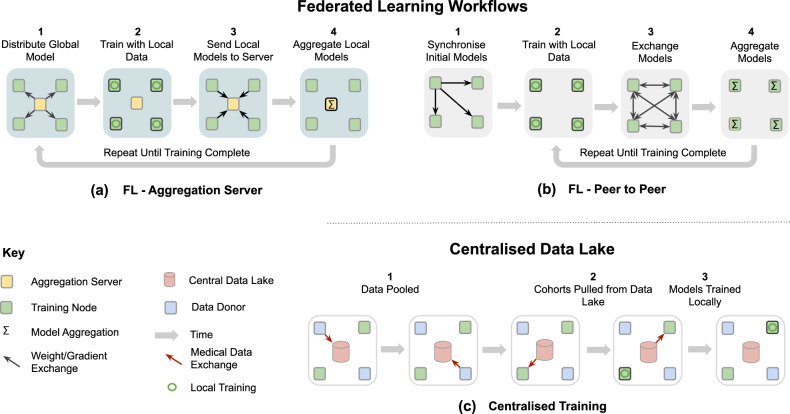
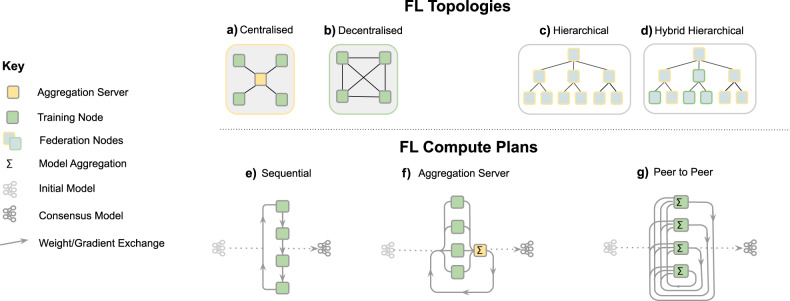
- The text describes FL workflows, including aggregation-server and peer-to-peer topologies, and discusses mechanisms such as FedAvg, FedProx, domain adaptation, and differential privacy at a conceptual level.
Limitations
- The paper explicitly states that FL does not solve all issues inherent to learning on medical data; success still depends on data quality, bias, and standardization.
- It states that FL does not eliminate privacy risks: models can still memorize information, and gradients/model updates may leak private data through inversion or adversarial attacks.
- Evident from the text: this is a perspective article, so it does not report original experimental results, sample sizes, or statistical testing.
Model-written summary. Check it against the paper before relying on it.
Integrity signals
Registry
Cites
Statistics
Figures
Verification
Claims the paper makes
16 Valid · 0 Not valid · 4 Not checked · 19 Own results and interpretations
The cited sources support only part of this claim — read each source’s verdict below.
In the paper
“Modern DL models feature millions of parameters that need to be learned from sufficiently large curated data sets in order to achieve clinical-grade accuracy, while being safe, fair, equitable and generalising well to unseen data2–5.”
§ The future of digital health with federated learning > Introduction
What the sources say
- Not checked — no full text of the sourcecites [2] Wang F Casalino LP Khullar D Deep learning in medicine—promise, progress, and challenges JAMA Intern. Med. 2019 179 293 294 10.1001/jamainternmed.2018.7117 30556825 source
- Not checked — no full text of the sourcecites [3] Chartrand G Deep learning: a primer for radiologists Radiographics 2017 37 2113 2131 10.1148/rg.2017170077 29131760 source
- Partly supportedcites [4] De Fauw J Clinically applicable deep learning for diagnosis and referral in retinal disease Nat. Med. 2018 24 1342 10.1038/s41591-018-0107-6 30104768 sourceExperimental — accuracy not yet measured
Split into 2 atoms — 0 confirmed, 2 partially supported, 0 disputed, 0 misattributed, 0 unverifiable. Expand the claim to see per-atom verdicts.
- Partly supportedcites [5] Sun, C., Shrivastava, A., Singh, S. & Gupta, A. Revisiting unreasonable effectiveness of data in deep learning era. In Proceedings of the IEEE international conference on computer vision, 843–852 (IEEE, 2017). sourceExperimental — accuracy not yet measured
Split into 2 atoms — 0 confirmed, 2 partially supported, 0 disputed, 0 misattributed, 0 unverifiable. Expand the claim to see per-atom verdicts.
plainstates a cause- Asserted: passes — The authors put it forward as true.
- Checkable: passes — It can be checked against evidence.
- Load-bearing: passes — The paper’s conclusions depend on it.
- Based: passes — The paper gives a reason why it holds.
The cited sources support only part of this claim — read each source’s verdict below.
In the paper
“Existing medical data is not fully exploited by ML primarily because it sits in data silos and privacy concerns restrict access to this data.”
§ The future of digital health with federated learning > Abstract
What the sources say
- Partly supportedcites [6] Van Panhuis WG A systematic review of barriers to data sharing in public health BMC Public Health 2014 14 1144 10.1186/1471-2458-14-1144 25377061 PMC4239377 sourceExperimental — accuracy not yet measured
The Background describes routinely collected public-health data as underused, and Results > Legal barriers says privacy concerns can lead to restrictive data-access policies. Results > Technical barriers describes difficulties integrating datasets. The paper does not establish that machine learning is the affected use or that data silos and privacy are the primary reasons medical data is underexploited. (LLM, conf=0.87)
- Partly supportedcites [7] Rocher L Hendrickx JM De Montjoye Y-A Estimating the success of re-identifications in incomplete datasets using generative models Nat. Commun. 2019 10 1 9 10.1038/s41467-019-10933-3 31337762 PMC6650473 sourceExperimental — accuracy not yet measured
The Introduction (page not provided) says medical and other personal data can advance AI, while privacy concerns affect its collection, use, and sharing. It does not say that medical data sits in silos or that silos and privacy restrictions are the primary reasons ML underuses it. (LLM, conf=0.85)
plainstates a cause- Asserted: passes — The authors put it forward as true.
- Checkable: passes — It can be checked against evidence.
- Load-bearing: passes — The paper’s conclusions depend on it.
- Based: passes — The paper gives a reason why it holds.
- Partly supported
The cited sources support only part of this claim — read each source’s verdict below.
In the paper
“The more rounds of local training are performed, the less it is guaranteed that the overall procedure is minimising (Eq. 1)9,12.”
§ The future of digital health with federated learning > Technical considerations > Federated learning definition
What the sources say
- Partly supportedcites [9] McMahan, B., Moore, E., Ramage, D., Hampson, S. & y Arcas, B. A. Communication-efficient learning of deep networks from decentralized data. In Artificial Intelligence and Statistics, 1273–1282. https://scholar.google.de/scholar?hl=de&as_sdt=0%2C5&q=Communicationefficient+learning+of+deep+networks+from+decentralized+data&btnG= (2017). sourceExperimental — accuracy not yet measured
The Experimental Results (p. 7) report that with very many local epochs, FedAvg can plateau or diverge on the Shakespeare LSTM task. But they also report no significant convergence degradation for large numbers of local epochs on the MNIST CNN, so the paper does not establish a general rule that more local training makes minimisation of the global loss less assured. (LLM, conf=0.86)
- Supportedcites [12] Kairouz, P. et al. Advances and open problems in federated learning. arXiv preprint arXiv:1912.04977 (2019). source
Section 3.2.1 states that more local updates increase divergence between client models and slow convergence of the training loss. Section 3.2.2 also reports more restrictive convergence bounds for local updates with non-IID data. Together, these support the claim that increasing local training weakens convergence assurances for the global loss. (LLM, conf=0.86)
plainstates a cause- Asserted: passes — The authors put it forward as true.
- Checkable: passes — It can be checked against evidence.
- Load-bearing: unclear — It is unclear whether the paper’s conclusions depend on it.
- Based: passes — The paper gives a reason why it holds.
- Partly supported
A conclusion the paper draws from its own results — it cites no other source for it, so there is none to check. The quote shows it is in the paper.
In the paper
“By linking healthcare institutions, not restricted to research centres, FL can have direct clinical impact.”
§ The future of digital health with federated learning > Data-driven medicine requires federated efforts > Current FL efforts for digital health
plainstates a possible cause- Asserted: passes — The authors put it forward as true.
- Checkable: passes — It can be checked against evidence.
- Load-bearing: passes — The paper’s conclusions depend on it.
- Based: passes — The paper gives a reason why it holds.
A conclusion the paper draws from its own results — it cites no other source for it, so there is none to check. The quote shows it is in the paper.
In the paper
“FL enables collaborative research for, even competing, companies.”
§ The future of digital health with federated learning > Data-driven medicine requires federated efforts > Current FL efforts for digital health
plainstates a cause- Asserted: passes — The authors put it forward as true.
- Checkable: passes — It can be checked against evidence.
- Load-bearing: unclear — It is unclear whether the paper’s conclusions depend on it.
- Based: passes — The paper gives a reason why it holds.
14 references still to check
A free account verifies the references that are still open.
- Probably not a substantial claim. 19
- It may state two separate claims as one. 32
- The quote only partly states this claim. 1
Claims other papers make about this one
Each is checked against this paper’s own text: does it say what the citing paper says it does?
The source backs part of the claim, not all of it — or backs it for a different population, condition or comparison.
In the citing paper
“This is currently addressed by sharing multi-site data, but such centralization is challenging/infeasible to scale due to various limitations.”
From Federated learning enables big data for rare cancer boundary detection (2022) · cites this paper as [10]
Experimental — accuracy not yet measuredThe source backs part of the claim, not all of it — or backs it for a different population, condition or comparison.
In the citing paper
“However, these methods often come with trade-offs in accuracy and computational efficiency.”
From The role of multimodality in clinical disease diagnosis: advances, challenges, and opportunities (2026) · cites this paper as [34]
Experimental — accuracy not yet measuredThe source backs part of the claim, not all of it — or backs it for a different population, condition or comparison.
In the citing paper
“The experts in healthcare and life sciences can use FL to solve the unique problem of data governance by training algorithms behind the hospital's firewall and only sharing models so that data remain secure [31].”
From A comprehensive survey on federated learning techniques for healthcare informatics (2023) · cites this paper as [31]
Experimental — accuracy not yet measuredThe source backs part of the claim, not all of it — or backs it for a different population, condition or comparison.
In the citing paper
“It also improves patient privacy and reduces low latency during the collaboration of multiple hospitals/entities [7].”
From Handling privacy-sensitive medical data with federated learning: Challenges and future directions (2023) · cites this paper as [7]
Experimental — accuracy not yet measuredThe source backs part of the claim, not all of it — or backs it for a different population, condition or comparison.
In the citing paper
“Enabling privacy protected data sharing across clinical centers is advocated as an essential pathway to promote collaborations internationally yet underexplored so far6,7.”
From Federated deep learning for detecting COVID-19 lung abnormalities in CT: a privacy-preserving multinational validation study (2021) · cites this paper as [7]
Experimental — accuracy not yet measured
27 more claims about this paper
Create a free account to see every claim other papers make about this one.
Citations
Cites
LeCun, Y., Bengio, Y., & Hinton, G. (2015) · Nature · doi:10.1038/nature14539 · Cited by 84,126
Communication-Efficient Learning of Deep Networks from Decentralized Data
McMahan, H. B., Moore, E., Ramage, D., Hampson, S., & Arcas, B. A. Y. (2016) · arXiv · doi:10.48550/arxiv.1602.05629 · Cited by 14,215
Sudlow, C., Gallacher, J., Allen, N., Beral, V., Burton, P., Danesh, J., Downey, P., Elliott, P., Green, J., Landray, M., et al. (2015) · PLOS Medicine · doi:10.1371/journal.pmed.1001779 · Cited by 12,728 · cited 2×
“Substantial, albeit smaller, initiatives include the Human Connectome25, the UK Biobank26, the Cancer Imaging Archive (TCIA)27, NIH CXR828, NIH DeepLesion29, the Cancer Genome Atlas (TCGA)30, the Alzheimer’s Disease Neuroimaging Initiative (ADNI)31, as well as medical grand challenges32 such as the CAMELYON challenge3…”
BackgroundAdvances and Open Problems in Federated Learning
Kairouz, P., McMahan, H. B., Avent, B., Bellet, A., Bennis, M., Bhagoji, A. N., Bonawitz, K., Charles, Z., Cormode, G., Cummings, R., et al. (2019) · arXiv · doi:10.48550/arxiv.1912.04977 · Cited by 7,857
Advances and Open Problems in Federated Learning
Kairouz, P., & McMahan, H. B. (2021) · Foundations and Trends in Machine Learning · doi:10.1561/2200000083 · Cited by 7,772
The multimodal brain tumor image segmentation benchmark (BRATS)
Menze, B. H., Jakab, A., Bauer, S., Kalpathy-Cramer, J., Farahani, K., Kirby, J., Burren, Y., Porz, N., Slotboom, J., Wiest, R., et al. (2015) · IEEE Transactions on Medical Imaging · doi:10.1109/tmi.2014.2377694 · Cited by 6,781
Deep Learning with Differential Privacy
Abadi, M., Chu, A., Goodfellow, I., McMahan, H. B., Mironov, I., Talwar, K., & Zhang, L. (2016) · Proceedings of the 2016 ACM SIGSAC Conference on Computer and Communications Security · doi:10.1145/2976749.2978318 · Cited by 6,578 · cited 2×
“Countermeasures, such as limiting the granularity of the shared model updates and to add specific noise to ensure differential privacy [34, 12, 57] may be needed and is still an active area of research [14].”
BackgroundMethodFederated Machine Learning: Concept and Applications
Yang, Q., Liu, Y., Chen, T., & Tong, Y. (2019) · ACM Transactions on Intelligent Systems and Technology · doi:10.1145/3298981 · Cited by 6,322 · cited 4×
“d FL approaches are still under development. 3 Technical Considerations FL is perhaps best-known from the work of Konecnˇ y` et al. [36], but various other definitions have been proposed in literature [14, 11, 15, 9]. These approaches can be realised via different communication architectures (see Figure 1) and respecti…”
BackgroundInfluentialFederated learning: Challenges, methods, and future directions
Li, T., Sahu, A. K., Talwalkar, A., & Smith, V. (2020) · IEEE Signal Processing Magazine · doi:10.1109/msp.2020.2975749 · Cited by 6,210 · cited 3×
“However, there is a trade-off in terms of performance and these techniques may affect for example the accuracy of the final model [10].”
BackgroundMethodShin, H.-C., Roth, H. R., Gao, M., Lu, L., Xu, Z., Nogues, I., Yao, J., Mollura, D., & Summers, R. M. (2016) · IEEE Transactions on Medical Imaging · doi:10.1109/tmi.2016.2528162 · Cited by 5,759
Self-citationMembership Inference Attacks Against Machine Learning Models
Shokri, R., Stronati, M., Song, C., & Shmatikov, V. (2017) · 2017 IEEE Symposium on Security and Privacy (SP) · doi:10.1109/sp.2017.41 · Cited by 4,754 · cited 1×
“ation and distribution, the participating institutions can even remain unknown to each other. However, it has been shown that the models themselves can, under certain conditions, memorise information [30, 31, 32, 33]. Therefore the FL setup can be further enhanced by privacy protections using mechanisms such as differ…”
MethodWang, X., Peng, Y., Lu, L., Lu, Z., Bagheri, M., & Summers, R. M. (2017) · 2017 IEEE Conference on Computer Vision and Pattern Recognition (CVPR) · doi:10.1109/cvpr.2017.369 · Cited by 4,616 · cited 1×
“…made data available to the general community such as The Human Connectome [20], UK Biobank [21], The Cancer Imaging Archive (TCIA) [22], NIH CXR8 [23], NIH DeepLesion [24], The Cancer Genome Atlas (TCGA) [25], the Alzheimer’s disease neu-3 roimaging initiative (ADNI) [26], or as part of medical…”
BackgroundSelf-citationThe Cancer Imaging Archive (TCIA): Maintaining and Operating a Public Information Repository
Clark, K., Vendt, B., Smith, K., Freymann, J., Kirby, J., Koppel, P., Moore, S., Phillips, S., Maffitt, D., Pringle, M., et al. (2013) · Journal of Digital Imaging · doi:10.1007/s10278-013-9622-7 · Cited by 4,599
The Alzheimer’s disease neuroimaging initiative (ADNI): MRI methods
Jack, C. R., Bernstein, M. A., Fox, N. C., Thompson, P., Alexander, G., Harvey, D., Borowski, B., Britson, P. J., L. Whitwell, J., Ward, C., et al. (2008) · Journal of Magnetic Resonance Imaging · doi:10.1002/jmri.21049 · Cited by 4,347
Li, Z., & Hoiem, D. (2018) · IEEE Transactions on Pattern Analysis and Machine Intelligence · doi:10.1109/tpami.2017.2773081 · Cited by 4,202
Federated Optimization in Heterogeneous Networks
Li, T., Sahu, A. K., Zaheer, M., Sanjabi, M., Talwalkar, A., & Smith, V. (2018) · arXiv · doi:10.48550/arxiv.1812.06127 · Cited by 4,023
Catastrophic Interference in Connectionist Networks: The Sequential Learning Problem
McCloskey, M., & Cohen, N. J. (1989) · Psychology of Learning and Motivation · doi:10.1016/s0079-7421(08)60536-8 · Cited by 3,770
Review The Cancer Genome Atlas (TCGA): an immeasurable source of knowledge
Tomczak, K., Czerwińska, P., & Wiznerowicz, M. (2015) · Współczesna Onkologia · doi:10.5114/wo.2014.47136 · Cited by 3,492
Convolutional Neural Networks for Medical Image Analysis: Full Training or Fine Tuning?
Tajbakhsh, N., Shin, J. Y., Gurudu, S. R., Hurst, R. T., Kendall, C. B., Gotway, M. B., & Liang, J. (2016) · IEEE Transactions on Medical Imaging · doi:10.1109/tmi.2016.2535302 · Cited by 3,277 · cited 1×
“performance [41, 42] when compared to strategies where the model had been trained from scratch on the target data only, especially when the target dataset is comparably small.”
MethodThe Human Connectome: A Structural Description of the Human Brain
Sporns, O., Tononi, G., & Kötter, R. (2005) · PLoS Computational Biology · doi:10.1371/journal.pcbi.0010042 · Cited by 3,260 · cited 1×
“Substantial, albeit smaller, initiatives have also made data available to the general community such as The Human Connectome [20], UK Biobank [21], The Cancer Imaging Archive (TCIA) [22], NIH CXR8 [23], NIH DeepLesion [24], The Cancer Genome Atlas (TCGA) [25], the Alzheimer’s disease neu-”
BackgroundBakas, S., Akbari, H., Sotiras, A., Bilello, M., Rozycki, M., Kirby, J. S., Freymann, J. B., Farahani, K., & Davatzikos, C. (2017) · Scientific Data · doi:10.1038/sdata.2017.117 · Cited by 3,049
Self-citationUnderstanding deep learning requires rethinking generalization
Zhang, C., Bengio, S., Hardt, M., Recht, B., & Vinyals, O. (2016) · arXiv · doi:10.48550/arxiv.1611.03530 · Cited by 2,838 · cited 1×
“However, it has been shown that the models themselves can, under certain conditions, memorise information [30, 31, 32, 33].”
BackgroundClinically applicable deep learning for diagnosis and referral in retinal disease
De Fauw, J., Ledsam, J. R., Romera-Paredes, B., Nikolov, S., Tomasev, N., Blackwell, S., Askham, H., Glorot, X., O’Donoghue, B., Visentin, D., et al. (2018) · Nature Medicine · doi:10.1038/s41591-018-0107-6 · Cited by 2,639
Revisiting Unreasonable Effectiveness of Data in Deep Learning Era
Sun, C., Shrivastava, A., Singh, S., & Gupta, A. (2017) · 2017 IEEE International Conference on Computer Vision (ICCV) · doi:10.1109/iccv.2017.97 · Cited by 2,484 · cited 1×
“data [2, 3, 4].”
Privacy-preserving deep learning
Shokri, R., & Shmatikov, V. (2015) · Proceedings of the 22nd ACM SIGSAC Conference on Computer and Communications Security · doi:10.1145/2810103.2813687 · Cited by 2,356 · cited 1×
“Therefore the FL setup can be further enhanced by privacy protections using mechanisms such as differential privacy [34, 35] or learning from encrypted data (c.”
MethodAccurate, Large Minibatch SGD: Training ImageNet in 1 Hour
Goyal, P., Dollár, P., Girshick, R., Noordhuis, P., Wesolowski, L., Kyrola, A., Tulloch, A., Jia, Y., & He, K. (2017) · arXiv · doi:10.48550/arxiv.1706.02677 · Cited by 2,294 · cited 2×
“The second characteristic of FL - to distribute the compute - has been well studied in recent years [49, 50, 51].”
BackgroundMethodAn Overview of Multi-Task Learning in Deep Neural Networks
Ruder, S. (2017) · arXiv (Cornell University) · doi:10.48550/arxiv.1706.05098 · Cited by 2,265
Federated Learning with Non-IID Data
Zhao, Y., Li, M., Lai, L., Suda, N., Civin, D., & Chandra, V. (2018) · arXiv · doi:10.48550/arxiv.1806.00582 · Cited by 2,077 · cited 1×
“cal nonIID data is possible, even if the data is not uniformly distributed across the institutions [12, 13]. In general however, strategies such as FedAvg [9] are prone to fail under these conditions [58, 59, 60], in part defeating the very purpose of collaborative learning strategies. Research addressing this problem…”
MethodZhu, L., & Han, S. (2020) · Lecture Notes in Computer Science · doi:10.1007/978-3-030-63076-8_2 · Cited by 1,906
Federated Optimization: Distributed Machine Learning for On-Device Intelligence
Konečný, J., McMahan, H. B., Ramage, D., & Richtárik, P. (2016) · arXiv · doi:10.48550/arxiv.1610.02527 · Cited by 1,563
Federated Learning for Healthcare Informatics
Xu, J., Glicksberg, B. S., Su, C., Walker, P., Bian, J., & Wang, F. (2021) · Journal of Healthcare Informatics Research · doi:10.1007/s41666-020-00082-4 · Cited by 1,542
Federated Learning for Healthcare Informatics
Xu, J., Glicksberg, B. S., Su, C., Walker, P., Bian, J., & Wang, F. (2019) · arXiv · doi:10.48550/arxiv.1911.06270 · Cited by 1,538
Bakas, S., Reyes, M., Jakab, A., Bauer, S., Rempfler, M., Crimi, A., Shinohara, R. T., Berger, C., Ha, S. M., Rozycki, M., et al. (2018) · arXiv · doi:10.48550/arxiv.1811.02629 · Cited by 1,441
Self-citationBakas, S., Reyes, M., Jakab, A., Bauer, S., Rempfler, M., Crimi, A., Shinohara, R. T., Berger, C., Ha, S. M., Rozycki, M., et al. (2018) · Apollo - University of Cambridge Repository · doi:10.17863/cam.38755 · Cited by 1,441
Self-citationDeep Models Under the GAN: Information Leakage from Collaborative Deep Learning
Hitaj, B., Ateniese, G., & Perez-Cruz, F. (2017) · Proceedings of the 2017 ACM SIGSAC Conference on Computer and Communications Security · doi:10.1145/3133956.3134012 · Cited by 1,377
Federated Learning of Deep Networks using Model AveragingPreprint
McMahan, H. B., Moore, E., Ramage, D., & y Arcas, B. A. (2016) · arXiv (Cornell University) · Cited by 1,288
Deep Learning: A Primer for Radiologists
Chartrand, G., Cheng, P. M., Vorontsov, E., Drozdzal, M., Turcotte, S., Pal, C. J., Kadoury, S., & Tang, A. (2017) · RadioGraphics · doi:10.1148/rg.2017170077 · Cited by 1,115
An Empirical Investigation of Catastrophic Forgetting in Gradient-Based Neural Networks
Goodfellow, I. J., Mirza, M., Xiao, D., Courville, A., & Bengio, Y. (2013) · arXiv · doi:10.48550/arxiv.1312.6211 · Cited by 1,089 · cited 1×
“And, unfortunately, deep learning models tend to ”forget” [43, 44].”
BackgroundFederated learning of predictive models from federated Electronic Health Records
Brisimi, T. S., Chen, R., Mela, T., Olshevsky, A., Paschalidis, I. C., & Shi, W. (2018) · International Journal of Medical Informatics · doi:10.1016/j.ijmedinf.2018.01.007 · Cited by 997
Beyond Inferring Class Representatives: User-Level Privacy Leakage From Federated Learning
Wang, Z., Song, M., Zhang, Z., Song, Y., Wang, Q., & Qi, H. (2019) · IEEE INFOCOM 2019 - IEEE Conference on Computer Communications · doi:10.1109/infocom.2019.8737416 · Cited by 881 · cited 1×
“the shared information may still indirectly expose private data used for local training, for example by model inversion [53] of the model updates, the gradients themselves [54] or adversarial attacks [55, 56]. FL is different from traditional training insofar as the training process is exposed to multiple parties. As…”
BackgroundLearning Differentially Private Recurrent Language Models
McMahan, H. B., Ramage, D., Talwar, K., & Zhang, L. (2017) · arXiv · doi:10.48550/arxiv.1710.06963 · Cited by 849
Estimating the success of re-identifications in incomplete datasets using generative models
Rocher, L., Hendrickx, J. M., & de Montjoye, Y.-A. (2019) · Nature Communications · doi:10.1038/s41467-019-10933-3 · Cited by 816
Li, Z., & Hoiem, D. (2016) · Lecture Notes in Computer Science · doi:10.1007/978-3-319-46493-0_37 · Cited by 659
Simpson, A. L., Antonelli, M., Bakas, S., Bilello, M., Farahani, K., van Ginneken, B., Kopp‐Schneider, A., Landman, B. A., Litjens, G. J. S., Menze, B. H., et al. (2019) · arXiv (Cornell University) · doi:10.48550/arxiv.1902.09063 · Cited by 643
Self-citationThe Secret Sharer: Evaluating and Testing Unintended Memorization in Neural Networks
Carlini, N., Liu, C., Erlingsson, Ú., Kos, J., & Song, D. (2018) · arXiv · doi:10.48550/arxiv.1802.08232 · Cited by 629
Sheller, M. J., Reina, G. A., Edwards, B., Martin, J., & Bakas, S. (2019) · Lecture Notes in Computer Science · doi:10.1007/978-3-030-11723-8_9 · Cited by 609 · cited 4×
“Recent research has shown that this approach can achieve a performance that is comparable to a scenario where the data was co-located in a data lake and superior to the models that only see isolated singleinstitutional data [12, 13].”
BackgroundResultInfluentialSelf-citationFederated Machine Learning: Concept and Applications
Yang, Q., Liu, Y., Chen, T., & Tong, Y. (2019) · arXiv · doi:10.48550/arxiv.1902.04885 · Cited by 600
A systematic review of barriers to data sharing in public health
van Panhuis, W. G., Paul, P., Emerson, C., Grefenstette, J., Wilder, R., Herbst, A. J., Heymann, D., & Burke, D. S. (2014) · BMC Public Health · doi:10.1186/1471-2458-14-1144 · Cited by 579
Privacy-Preserving Federated Brain Tumour Segmentation
Li, W., Milletarì, F., Xu, D., Rieke, N., Hancox, J., Zhu, W., Baust, M., Cheng, Y., Ourselin, S., Cardoso, M. J., et al. (2019) · Lecture Notes in Computer Science · doi:10.1007/978-3-030-32692-0_16 · Cited by 578 · cited 4×
“Recent research has shown that this approach can achieve a performance that is comparable to a scenario where the data was co-located in a data lake and superior to the models that only see isolated singleinstitutional data [12, 13].”
BackgroundMethodResultInfluentialSelf-citationDemystifying Parallel and Distributed Deep Learning: An In-depth Concurrency Analysis
Ben-Nun, T., & Hoefler, T. (2020) · ACM Computing Surveys · doi:10.1145/3320060 · Cited by 577
Yan, K., Wang, X., Lu, L., & Summers, R. M. (2018) · Journal of medical imaging · doi:10.1117/1.jmi.5.3.036501 · Cited by 573
Self-citationDeep Learning in Medicine—Promise, Progress, and Challenges
Wang, F., Casalino, L. P., & Khullar, D. (2019) · JAMA Internal Medicine · doi:10.1001/jamainternmed.2018.7117 · Cited by 483
Li, X., Gu, Y., Dvornek, N., Staib, L. H., Ventola, P., & Duncan, J. S. (2020) · Medical Image Analysis · doi:10.1016/j.media.2020.101765 · Cited by 480 · cited 1×
“Countermeasures, such as limiting the granularity of the shared model updates and to add specific noise to ensure differential privacy [34, 12, 57] may be needed and is still an active area of research [14].”
BackgroundHuang, L., Shea, A. L., Qian, H., Masurkar, A., Deng, H., & Liu, D. (2019) · Journal of Biomedical Informatics · doi:10.1016/j.jbi.2019.103291 · Cited by 437
1399 H&E-stained sentinel lymph node sections of breast cancer patients: the CAMELYON dataset
Litjens, G., Bandi, P., Ehteshami Bejnordi, B., Geessink, O., Balkenhol, M., Bult, P., Halilovic, A., Hermsen, M., van de Loo, R., Vogels, R., et al. (2018) · GigaScience · doi:10.1093/gigascience/giy065 · Cited by 418
Langlotz, C. P., Allen, B., Erickson, B. J., Kalpathy-Cramer, J., Bigelow, K., Cook, T. S., Flanders, A. E., Lungren, M. P., Mendelson, D. S., Rudie, J. D., et al. (2019) · Radiology · doi:10.1148/radiol.2019190613 · Cited by 368
Distributed deep learning networks among institutions for medical imaging
Chang, K., Balachandar, N., Lam, C., Yi, D., Brown, J., Beers, A., Rosen, B., Rubin, D. L., & Kalpathy-Cramer, J. (2018) · Journal of the American Medical Informatics Association · doi:10.1093/jamia/ocy017 · Cited by 340
Hadzhiev, Y., Qureshi, H. K., Wheatley, L., Cooper, L., Jasiulewicz, A., Van Nguyen, H., Wragg, J. W., Poovathumkadavil, D., Conic, S., Bajan, S., et al. (2019) · Nature Communications · doi:10.1038/s41467-019-08487-5 · Cited by 256
Privacy-preserving deep learning
Shokri, R., & Shmatikov, V. (2015) · 2015 53rd Annual Allerton Conference on Communication, Control, and Computing (Allerton) · doi:10.1109/allerton.2015.7447103 · Cited by 223
Collaborative Learning for Deep Neural Networks
Song, G., & Chai, W. (2018) · neural information processing systems · doi:10.48550/arxiv.1805.11761 · Cited by 219
Identification of Anonymous MRI Research Participants with Face-Recognition Software
Schwarz, C. G., Kremers, W. K., Therneau, T. M., Sharp, R. R., Gunter, J. L., Vemuri, P., Arani, A., Spychalla, A. J., Kantarci, K., Knopman, D. S., et al. (2019) · New England Journal of Medicine · doi:10.1056/nejmc1908881 · Cited by 215
BrainTorrent: A Peer-to-Peer Environment for Decentralized Federated Learning
Roy, A. G., Siddiqui, S., Pölsterl, S., Navab, N., & Wachinger, C. (2019) · arXiv · doi:10.48550/arxiv.1905.06731 · Cited by 212
Privacy-Preserving Patient Similarity Learning in a Federated Environment: Development and Analysis
Lee, J., Sun, J., Wang, F., Wang, S., Jun, C.-H., & Jiang, X. (2018) · JMIR Medical Informatics · doi:10.2196/medinform.7744 · Cited by 196
BrainPrint: A discriminative characterization of brain morphology
Wachinger, C., Golland, P., Kremen, W., Fischl, B., & Reuter, M. (2015) · NeuroImage · doi:10.1016/j.neuroimage.2015.01.032 · Cited by 164
Yeh, F.-C., Vettel, J. M., Singh, A., Poczos, B., Grafton, S. T., Erickson, K. I., Tseng, W.-Y. I., & Verstynen, T. D. (2016) · PLOS Computational Biology · doi:10.1371/journal.pcbi.1005203 · Cited by 151
Peer-to-peer Federated Learning on Graphs
Lalitha, A., Kilinc, O. C., Javidi, T., & Koushanfar, F. (2019) · arXiv · doi:10.48550/arxiv.1901.11173 · Cited by 146
Overcoming Forgetting in Federated Learning on Non-IID Data
Shoham, N., Avidor, T., Keren, A., Israel, N., Benditkis, D., Mor-Yosef, L., & Zeitak, I. (2019) · arXiv (Cornell University) · doi:10.48550/arxiv.1910.07796 · Cited by 135
Federated Tensor Factorization for Computational Phenotyping
Kim, Y., Sun, J., Yu, H., & Jiang, X. (2017) · Proceedings of the 23rd ACM SIGKDD International Conference on Knowledge Discovery and Data Mining · doi:10.1145/3097983.3098118 · Cited by 128
Yet Another Accelerated SGD: ResNet-50 Training on ImageNet in 74.7 secondsPreprint
Yamazaki, M., Kasagi, A., Tabuchi, A., Honda, T., Miwa, M., Fukumoto, N., Tabaru, T., Ike, A., & Nakashima, K. (2019) · arXiv (Cornell University) · doi:10.48550/arxiv.1903.12650 · Cited by 115
How to scale distributed deep learning?
Jin, P. H., Yuan, Q., Iandola, F., & Keutzer, K. (2016) · arXiv · doi:10.48550/arxiv.1611.04581 · Cited by 85 · cited 1×
“The second characteristic of FL - to distribute the compute - has been well studied in recent years [49, 50, 51].”
BackgroundCuggia, M., & Combes, S. (2019) · Yearbook of Medical Informatics · doi:10.1055/s-0039-1677917 · Cited by 69
(2020) · arXiv (Cornell University) · Cited by 64
Wu, B., Zhao, S., Sun, G., Zhang, X., Su, Z., Zeng, C., & Liu, Z. (2019) · 2019 IEEE/CVF Conference on Computer Vision and Pattern Recognition (CVPR) · doi:10.1109/cvpr.2019.00220 · Cited by 44 · cited 1×
“However, the shared information may still indirectly expose private data used for local training, for example by model inversion [53] of the model updates, the gradients themselves [54] or adversarial attacks [55, 56].”
BackgroundData Shapley: Equitable Valuation of Data for Machine Learning
Ghorbani, A., & Zou, J. (2019) · arXiv · doi:10.48550/arxiv.1904.02868
White-box vs Black-box: Bayes Optimal Strategies for Membership Inference
Sablayrolles, A., Douze, M., Ollivier, Y., Schmid, C., & Jégou, H. (2019) · arXiv · doi:10.48550/arxiv.1908.11229
(2020) · International Conference on Learning Representations
Cited by
A survey on federated learning
Zhang, C., Xie, Y., Bai, H., Yu, B., Li, W., & Gao, Y. (2021) · Knowledge-Based Systems · doi:10.1016/j.knosys.2021.106775 · Cited by 1,899
Self-citationSecure, privacy-preserving and federated machine learning in medical imaging
Kaissis, G. A., Makowski, M. R., Rückert, D., & Braren, R. F. (2020) · Nature Machine Intelligence · doi:10.1038/s42256-020-0186-1 · Cited by 1,676
Traumatic brain injury: progress and challenges in prevention, clinical care, and research
Maas, A. I. R., Menon, D. K., Manley, G. T., Abrams, M., Åkerlund, C., Andelic, N., Aries, M., Bashford, T., Bell, M. J., Bodien, Y. G., et al. (2022) · The Lancet Neurology · doi:10.1016/s1474-4422(22)00309-x · Cited by 1,520
Federated Learning for Internet of Things: A Comprehensive Survey
Nguyen, D. C., Ding, M., Pathirana, P. N., Seneviratne, A., Li, J., & Vincent Poor, H. (2021) · IEEE Communications Surveys & Tutorials · doi:10.1109/comst.2021.3075439 · Cited by 1,503
“1) FL for Smart Healthcare: FL can provide a number of efficient solutions for smart healthcare and potentially reshapes the current intelligent healthcare systems by proving AI functions for supporting healthcare services while improving user privacy and reducing low latency with the cooperation of multiple entities…”
BackgroundInfluentialThe Liver Tumor Segmentation Benchmark (LiTS)
Bilic, P., Christ, P., Li, H. B., Vorontsov, E., Ben-Cohen, A., Kaissis, G., Szeskin, A., Jacobs, C., Mamani, G. E. H., Chartrand, G., et al. (2023) · Medical Image Analysis · doi:10.1016/j.media.2022.102680 · Cited by 1,412
“Another recent and intriguing use case is the research direction of federated learning, where the multi-institutional nature of the LiTS benchmark dataset could further contribute to federated learning simulations studies and benchmarks (Sheller et al., 2018, 2020; Rieke et al., 2020; Pati et al., 2021).”
BackgroundSelf-citation
Metadata
- Authors
- Rieke, N., Hancox, J., Li, W., Milletarì, F., Roth, H. R., Albarqouni, S., Bakas, S., Galtier, M. N., Landman, B. A., Maier-Hein, K., Ourselin, S., Sheller, M., Summers, R. M., Trask, A., Xu, D., Baust, M., & Cardoso, M. J.
- Affiliations
- Technical University of Munich (DE)
- Nvidia (United Kingdom) (GB)
- Nvidia (United States) (US)
- Imperial College London (GB)
- University of Pennsylvania (US)
- Vanderbilt University (US)
- German Cancer Research Center (DE)
- Intel (United States) (US)
- National Institutes of Health (US)
- University of Oxford (GB)
- King's College London (GB)
- Corresponding author
- Rieke, Nicola
- ORCID
- Venue
- npj Digital Medicine
- Published
- 2020-09-14
- Volume
- 3
- Issue
- 1
- Pages
- 119-119
- ISSN
- 2398-6352 (ISSN-L)
- PMC
- PMC7490367
- OpenAlex
- W3012501605
- Cited by
- 4,015
- References
- 38
- Citations by year
- 2026: 1453 · 2025: 921 · 2024: 618 · 2023: 473 · 2022: 353 · 2021: 175 · 2020: 18
- FWCI
- 13.36
- Type
- journal article
- Language
- en
- Open access
- gold
- doi.org
- Licence
- cc-by
- creativecommons.org/licenses/by/4.0 (tdm)
- creativecommons.org/licenses/by/4.0 (vor)
- Locations
- npj Digital Medicine (publishedVersion, cc-by)
- PubMed (publishedVersion)
- arXiv (Cornell University) (submittedVersion, other-oa)
- Informationszentrum Lebenswissenschaften (ZB MED) (submittedVersion, cc-by)
- DOAJ (DOAJ: Directory of Open Access Journals) (submittedVersion, cc-by-sa)
- Research Portal (King's College London) (submittedVersion, other-oa)
- mediaTUM – the media and publications repository of the Technical University Munich (Technical University Munich) (submittedVersion, other-oa)
- arXiv (Cornell University)
- Funders
- U.S. Department of Health and Human Services (R01NS042645, U01CA242871)
- Nvidia
- Wellcome Trust
- UK Research and Innovation
- Bpifrance
- Deutscher Akademischer Austauschdienst
- Bundesministerium für Bildung und Forschung
- National Institutes of Health (1s10od023495-01)
- Engineering and Physical Sciences Research Council ([WT203148/Z/16/Z], WT213038/Z/18/Z)
- Centre For Medical Engineering, King’s College London (WT 203148/Z/16/Z)
- National Cancer Institute (U24CA189523, U01CA242871)
- National Institute of Neurological Disorders and Stroke (R01NS042645)
- NIH Clinical Center
- Topics
- Physical Sciences › Computer Science › Artificial Intelligence › Privacy-Preserving Technologies in Data
- Health Sciences › Medicine › Health Informatics › Artificial Intelligence in Healthcare and Education
- Physical Sciences › Computer Science › Artificial Intelligence › Machine Learning in Healthcare
- Keywords
- federated learning, digital health, medical data privacy, data silos, data-driven machine learning, health information access
About these checks
Registry, retraction, Cites and statistics results are computed, not judged, with one exception: a printed reference that no index lists is read once by a model before it counts as a citation error. Claims are extracted by a model and kept only when their quote appears verbatim in the text; each cited source is then checked, with a model’s help, for whether it says what the claim relies on. Those verdicts can be wrong — read the claim’s quote and the cited source before relying on one.
The claim verdicts this report counts are experimental: their accuracy is not yet measured.
A language model drew the claims from the paper on 2026-10-10, under version 3 of the claim definition (model deepseek-v4.1-flash, prompt extract-v3).
A second model labelled each claim on 2026-10-10 (model jev-1.13-20260917, definition revision gold-guideline-v0.2).
Cited sources are checked with a language model’s help (gpt-6-sol and qwen3.8-omni-flash).
Statistics and arithmetic are recomputed, not judged.
Confidence bands are shown only for fields calibrated on our annotated test set. None is calibrated yet, so no band is shown.
What counts as a claim ›How we measure confidence ›How we check this ›
Are you an author, or do you see a problem with this page? Request a review
Data sources
Bibliographic data: Semantic Scholar, OpenAlex, Crossref.
Contains information from the Semantic Scholar Academic Graph Datasets, made available under the ODC Attribution License (ODC-BY 1.0).
Semantic Scholar’s data is described in: Kinney, R., et al. (2023). The Semantic Scholar Open Data Platform. arXiv:2301.10140.
