

The future of digital health with federated learning
Open accessThe DOI matches its Crossref record; 75 of the 76 references it cites were found in a registry or an index, and 1 are not checked yet; 31 of the 51 sources its claims cite were checked for support.
Abstract
Data-driven machine learning (ML) has emerged as a promising approach for building accurate and robust statistical models from medical data, which is collected in huge volumes by modern healthcare systems. Existing medical data is not fully exploited by ML primarily because it sits in data silos and privacy concerns restrict access to this data. However, without access to sufficient data, ML will be prevented from reaching its full potential and, ultimately, from making the transition from research to clinical practice. This paper considers key factors contributing to this issue, explores how federated learning (FL) may provide a solution for the future of digital health and highlights the challenges and considerations that need to be addressed.
Verified 2026-11-25 · 1 reference not checked yet
Overview
CoChat Summary
TL;DR
This perspective paper argues that federated learning (FL) is a promising way to train medical AI across institutions without centralizing sensitive data, potentially improving accuracy, robustness, and privacy in digital health. It also emphasizes that FL does not remove core challenges such as data heterogeneity, privacy leakage, and the need for standardization and governance.
Key findings
- FL is presented as a learning paradigm that lets multiple parties train collaboratively without exchanging or centralizing datasets, by moving the model to the data rather than the data to the model.
- The paper states that recent research has shown FL models can achieve performance comparable to centrally hosted data sets and superior to models trained on isolated single-institution data.
- Reported application areas already include EHR tasks such as finding clinically similar patients and predicting hospitalizations due to cardiac events, mortality, and ICU stay time, as well as medical imaging tasks such as whole-brain segmentation, brain tumor segmentation, and fMRI classification.
- Concrete initiatives mentioned include a collaboration across 4 hospitals in France (HealthChain), an international federation of 30 healthcare institutions (FeTS), and a project across 10 pharmaceutical companies (Melloddy).
Methods
- Not stated in the paper.
- The article is a perspective/consensus paper rather than an empirical study; it synthesizes prior work and examples to discuss FL’s promise, current uses, and technical considerations.
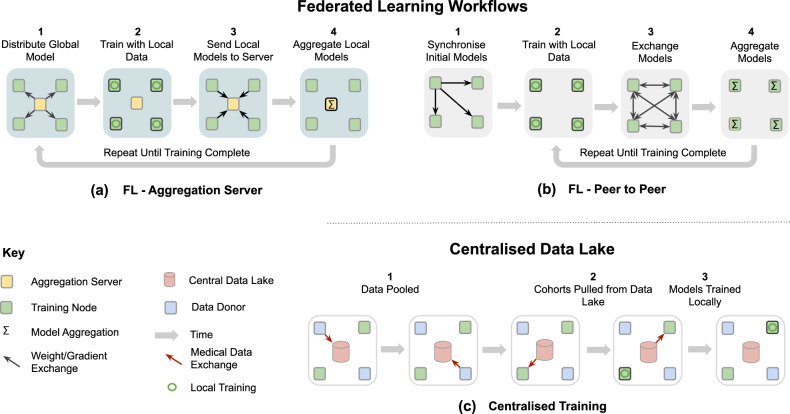
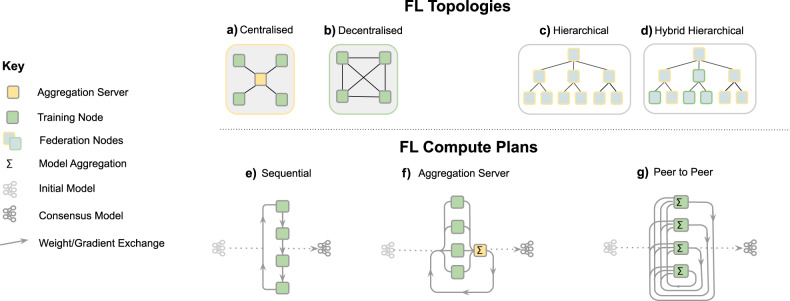
- The text describes FL workflows, including aggregation-server and peer-to-peer topologies, and discusses mechanisms such as FedAvg, FedProx, domain adaptation, and differential privacy at a conceptual level.
Limitations
- The paper explicitly states that FL does not solve all issues inherent to learning on medical data; success still depends on data quality, bias, and standardization.
- It states that FL does not eliminate privacy risks: models can still memorize information, and gradients/model updates may leak private data through inversion or adversarial attacks.
- Evident from the text: this is a perspective article, so it does not report original experimental results, sample sizes, or statistical testing.
Model-written summary. Check it against the paper before relying on it.
Integrity signals
Registry
Cites
Statistics
Figures
Verification
Claims the paper makes
16 Valid · 0 Not valid · 4 Not checked · 19 Own results and interpretations
The cited sources support only part of this claim — read each source’s verdict below.
In the paper
“Modern DL models feature millions of parameters that need to be learned from sufficiently large curated data sets in order to achieve clinical-grade accuracy, while being safe, fair, equitable and generalising well to unseen data2–5.”
§ The future of digital health with federated learning > Introduction
What the sources say
- Not checked — no full text of the sourcecites [2] Wang F Casalino LP Khullar D Deep learning in medicine—promise, progress, and challenges JAMA Intern. Med. 2019 179 293 294 10.1001/jamainternmed.2018.7117 30556825 source
- Not checked — no full text of the sourcecites [3] Chartrand G Deep learning: a primer for radiologists Radiographics 2017 37 2113 2131 10.1148/rg.2017170077 29131760 source
- Partly supportedcites [4] De Fauw J Clinically applicable deep learning for diagnosis and referral in retinal disease Nat. Med. 2018 24 1342 10.1038/s41591-018-0107-6 30104768 sourceExperimental — accuracy not yet measured
Split into 2 atoms — 0 confirmed, 2 partially supported, 0 disputed, 0 misattributed, 0 unverifiable. Expand the claim to see per-atom verdicts.
- Partly supportedcites [5] Sun, C., Shrivastava, A., Singh, S. & Gupta, A. Revisiting unreasonable effectiveness of data in deep learning era. In Proceedings of the IEEE international conference on computer vision, 843–852 (IEEE, 2017). sourceExperimental — accuracy not yet measured
Split into 2 atoms — 0 confirmed, 2 partially supported, 0 disputed, 0 misattributed, 0 unverifiable. Expand the claim to see per-atom verdicts.
plainstates a cause- Asserted: passes — The authors put it forward as true.
- Checkable: passes — It can be checked against evidence.
- Load-bearing: passes — The paper’s conclusions depend on it.
- Based: passes — The paper gives a reason why it holds.
The cited sources support only part of this claim — read each source’s verdict below.
In the paper
“Existing medical data is not fully exploited by ML primarily because it sits in data silos and privacy concerns restrict access to this data.”
§ The future of digital health with federated learning > Abstract
What the sources say
- Partly supportedcites [6] Van Panhuis WG A systematic review of barriers to data sharing in public health BMC Public Health 2014 14 1144 10.1186/1471-2458-14-1144 25377061 PMC4239377 sourceExperimental — accuracy not yet measured
The Background describes routinely collected public-health data as underused, and Results > Legal barriers says privacy concerns can lead to restrictive data-access policies. Results > Technical barriers describes difficulties integrating datasets. The paper does not establish that machine learning is the affected use or that data silos and privacy are the primary reasons medical data is underexploited. (LLM, conf=0.87)
- Partly supportedcites [7] Rocher L Hendrickx JM De Montjoye Y-A Estimating the success of re-identifications in incomplete datasets using generative models Nat. Commun. 2019 10 1 9 10.1038/s41467-019-10933-3 31337762 PMC6650473 sourceExperimental — accuracy not yet measured
The Introduction (page not provided) says medical and other personal data can advance AI, while privacy concerns affect its collection, use, and sharing. It does not say that medical data sits in silos or that silos and privacy restrictions are the primary reasons ML underuses it. (LLM, conf=0.85)
plainstates a cause- Asserted: passes — The authors put it forward as true.
- Checkable: passes — It can be checked against evidence.
- Load-bearing: passes — The paper’s conclusions depend on it.
- Based: passes — The paper gives a reason why it holds.
- Partly supported
The cited sources support only part of this claim — read each source’s verdict below.
In the paper
“The more rounds of local training are performed, the less it is guaranteed that the overall procedure is minimising (Eq. 1)9,12.”
§ The future of digital health with federated learning > Technical considerations > Federated learning definition
What the sources say
- Partly supportedcites [9] McMahan, B., Moore, E., Ramage, D., Hampson, S. & y Arcas, B. A. Communication-efficient learning of deep networks from decentralized data. In Artificial Intelligence and Statistics, 1273–1282. https://scholar.google.de/scholar?hl=de&as_sdt=0%2C5&q=Communicationefficient+learning+of+deep+networks+from+decentralized+data&btnG= (2017). sourceExperimental — accuracy not yet measured
The Experimental Results (p. 7) report that with very many local epochs, FedAvg can plateau or diverge on the Shakespeare LSTM task. But they also report no significant convergence degradation for large numbers of local epochs on the MNIST CNN, so the paper does not establish a general rule that more local training makes minimisation of the global loss less assured. (LLM, conf=0.86)
- Supportedcites [12] Kairouz, P. et al. Advances and open problems in federated learning. arXiv preprint arXiv:1912.04977 (2019). source
Section 3.2.1 states that more local updates increase divergence between client models and slow convergence of the training loss. Section 3.2.2 also reports more restrictive convergence bounds for local updates with non-IID data. Together, these support the claim that increasing local training weakens convergence assurances for the global loss. (LLM, conf=0.86)
plainstates a cause- Asserted: passes — The authors put it forward as true.
- Checkable: passes — It can be checked against evidence.
- Load-bearing: unclear — It is unclear whether the paper’s conclusions depend on it.
- Based: passes — The paper gives a reason why it holds.
- Partly supported
A conclusion the paper draws from its own results — it cites no other source for it, so there is none to check. The quote shows it is in the paper.
In the paper
“By linking healthcare institutions, not restricted to research centres, FL can have direct clinical impact.”
§ The future of digital health with federated learning > Data-driven medicine requires federated efforts > Current FL efforts for digital health
plainstates a possible cause- Asserted: passes — The authors put it forward as true.
- Checkable: passes — It can be checked against evidence.
- Load-bearing: passes — The paper’s conclusions depend on it.
- Based: passes — The paper gives a reason why it holds.
A conclusion the paper draws from its own results — it cites no other source for it, so there is none to check. The quote shows it is in the paper.
In the paper
“FL enables collaborative research for, even competing, companies.”
§ The future of digital health with federated learning > Data-driven medicine requires federated efforts > Current FL efforts for digital health
plainstates a cause- Asserted: passes — The authors put it forward as true.
- Checkable: passes — It can be checked against evidence.
- Load-bearing: unclear — It is unclear whether the paper’s conclusions depend on it.
- Based: passes — The paper gives a reason why it holds.
14 references still to check
A free account verifies the references that are still open.
- Probably not a substantial claim. 19
- It may state two separate claims as one. 32
- The quote only partly states this claim. 1
Claims other papers make about this one
Each is checked against this paper’s own text: does it say what the citing paper says it does?
The source backs part of the claim, not all of it — or backs it for a different population, condition or comparison.
In the citing paper
“This is currently addressed by sharing multi-site data, but such centralization is challenging/infeasible to scale due to various limitations.”
From Federated learning enables big data for rare cancer boundary detection (2022) · cites this paper as [10]
Experimental — accuracy not yet measuredThe source backs part of the claim, not all of it — or backs it for a different population, condition or comparison.
In the citing paper
“However, these methods often come with trade-offs in accuracy and computational efficiency.”
From The role of multimodality in clinical disease diagnosis: advances, challenges, and opportunities (2026) · cites this paper as [34]
Experimental — accuracy not yet measuredThe source backs part of the claim, not all of it — or backs it for a different population, condition or comparison.
In the citing paper
“The experts in healthcare and life sciences can use FL to solve the unique problem of data governance by training algorithms behind the hospital's firewall and only sharing models so that data remain secure [31].”
From A comprehensive survey on federated learning techniques for healthcare informatics (2023) · cites this paper as [31]
Experimental — accuracy not yet measuredThe source backs part of the claim, not all of it — or backs it for a different population, condition or comparison.
In the citing paper
“It also improves patient privacy and reduces low latency during the collaboration of multiple hospitals/entities [7].”
From Handling privacy-sensitive medical data with federated learning: Challenges and future directions (2023) · cites this paper as [7]
Experimental — accuracy not yet measuredThe source backs part of the claim, not all of it — or backs it for a different population, condition or comparison.
In the citing paper
“Enabling privacy protected data sharing across clinical centers is advocated as an essential pathway to promote collaborations internationally yet underexplored so far6,7.”
From Federated deep learning for detecting COVID-19 lung abnormalities in CT: a privacy-preserving multinational validation study (2021) · cites this paper as [7]
Experimental — accuracy not yet measured
27 more claims about this paper
Create a free account to see every claim other papers make about this one.
Citations
Cites
LeCun, Y., Bengio, Y., & Hinton, G. (2015) · Nature · doi:10.1038/nature14539 · Cited by 84,126
Communication-Efficient Learning of Deep Networks from Decentralized Data
McMahan, H. B., Moore, E., Ramage, D., Hampson, S., & Arcas, B. A. Y. (2016) · arXiv · doi:10.48550/arxiv.1602.05629 · Cited by 14,215
Sudlow, C., Gallacher, J., Allen, N., Beral, V., Burton, P., Danesh, J., Downey, P., Elliott, P., Green, J., Landray, M., et al. (2015) · PLOS Medicine · doi:10.1371/journal.pmed.1001779 · Cited by 12,728 · cited 2×
“Substantial, albeit smaller, initiatives include the Human Connectome25, the UK Biobank26, the Cancer Imaging Archive (TCIA)27, NIH CXR828, NIH DeepLesion29, the Cancer Genome Atlas (TCGA)30, the Alzheimer’s Disease Neuroimaging Initiative (ADNI)31, as well as medical grand challenges32 such as the CAMELYON challenge3…”
BackgroundAdvances and Open Problems in Federated Learning
Kairouz, P., McMahan, H. B., Avent, B., Bellet, A., Bennis, M., Bhagoji, A. N., Bonawitz, K., Charles, Z., Cormode, G., Cummings, R., et al. (2019) · arXiv · doi:10.48550/arxiv.1912.04977 · Cited by 7,857
Advances and Open Problems in Federated Learning
Kairouz, P., & McMahan, H. B. (2021) · Foundations and Trends in Machine Learning · doi:10.1561/2200000083 · Cited by 7,772
The multimodal brain tumor image segmentation benchmark (BRATS)
Menze, B. H., Jakab, A., Bauer, S., Kalpathy-Cramer, J., Farahani, K., Kirby, J., Burren, Y., Porz, N., Slotboom, J., Wiest, R., et al. (2015) · IEEE Transactions on Medical Imaging · doi:10.1109/tmi.2014.2377694 · Cited by 6,781
Deep Learning with Differential Privacy
Abadi, M., Chu, A., Goodfellow, I., McMahan, H. B., Mironov, I., Talwar, K., & Zhang, L. (2016) · Proceedings of the 2016 ACM SIGSAC Conference on Computer and Communications Security · doi:10.1145/2976749.2978318 · Cited by 6,578 · cited 2×
“Countermeasures, such as limiting the granularity of the shared model updates and to add specific noise to ensure differential privacy [34, 12, 57] may be needed and is still an active area of research [14].”
BackgroundMethodFederated Machine Learning: Concept and Applications
Yang, Q., Liu, Y., Chen, T., & Tong, Y. (2019) · ACM Transactions on Intelligent Systems and Technology · doi:10.1145/3298981 · Cited by 6,322 · cited 4×
“d FL approaches are still under development. 3 Technical Considerations FL is perhaps best-known from the work of Konecnˇ y` et al. [36], but various other definitions have been proposed in literature [14, 11, 15, 9]. These approaches can be realised via different communication architectures (see Figure 1) and respecti…”
BackgroundInfluentialFederated learning: Challenges, methods, and future directions
Li, T., Sahu, A. K., Talwalkar, A., & Smith, V. (2020) · IEEE Signal Processing Magazine · doi:10.1109/msp.2020.2975749 · Cited by 6,210 · cited 3×
“However, there is a trade-off in terms of performance and these techniques may affect for example the accuracy of the final model [10].”
BackgroundMethodShin, H.-C., Roth, H. R., Gao, M., Lu, L., Xu, Z., Nogues, I., Yao, J., Mollura, D., & Summers, R. M. (2016) · IEEE Transactions on Medical Imaging · doi:10.1109/tmi.2016.2528162 · Cited by 5,759
Self-citation
Cited by
Items 2,001–2,100 of 3,132
Zhang, F., Wang, D., & Jiang, Y. (2023) · IEEE International Conference on Information, Communication and Networks (ICICN) · doi:10.1109/icicn59530.2023.10393679
(Re)configuration of digital health records to optimize diagnosis and therapy
Imbalzano, G., Espay, A. J., & Artusi, C. A. (2024) · Elsevier eBooks · doi:10.1016/b978-0-323-99494-1.00005-8
A Graph-Based Vertical Federation Broad Learning System
Ge, J., Li, F., Wang, X., Song, Z., & Sun, L. (2024) · Lecture notes in computer science · doi:10.1007/978-981-99-9788-6_5
Federated Multimodal and Multiresolution Graph Integration for Connectional Brain Template Learning
Ji, J., & Rekik, I. (2024) · Lecture notes in computer science · doi:10.1007/978-3-031-53767-7_2
A Brief Overview of Federated Learning - A New Perspective on Data Privacy
Lipovanu, I., Pascal, C. M., & Caruntu, C. F. (2022) · Buletinul Institutului Politehnic din Iaşi. Secţia Electrotehnică. Energetică. Electronică · doi:10.2478/bipie-2022-0019
Rubeis, G. (2024) · The International library of ethics, law and technology · doi:10.1007/978-3-031-55744-6_5
Feature-Enhanced Federated Graph Convolutional Network for Major Depression Disorder IdentificationPreprint
Liu, C., Shan, S., Ding, X., et al. (2024) · SSRN Electronic Journal · doi:10.2139/ssrn.4777495
Aiskovich, M., Castro, E., Reinen, J., Fadnavis, S., Mehta, A., Li, H., Dhurandhar, A., Cecchi, G., & Polosecki, P. I. (2024) · Frontiers in Radiology · doi:10.3389/fradi.2024.1283392 · Cited by 2
MATFL: Defending Against Synergetic Attacks in Federated Learning
Yang, W., Peng, L.-Y., Tang, X.-Y., & Weng, Y. (2023) · 2023 IEEE International Conferences on Internet of Things (iThings) and IEEE Green Computing & Communications (GreenCom) and IEEE Cyber, Physical & Social Computing (CPSCom) and IEEE Smart Data (SmartData) and IEEE Congress on Cybermatics (Cybermatics) · doi:10.1109/ithings-greencom-cpscom-smartdata-cybermatics60724.2023.00072
Ryffel, T., Créquit, P., Baillet, M., Paumier, J., Marfoq, Y., Sy, R., Girardot, O., Chanet, T., Bayssat, L., Mazières, J., et al. (2024) · doi:10.2196/preprints.59685
Adversarial Predictions of Data Distributions Across Federated Internet-of-Things Devices
Rajani, S., Demattíes, D., Hudson, N., Chard, K., Ferrier, N., Sankaran, R., & Beckman, P. (2023) · IEEE World Forum on Internet of Things (WF-IoT) · doi:10.1109/wf-iot58464.2023.10539465
Pathology Detection Through Federated Learning Models Running on End DevicesPreprint
Flores-Martin, D., Laso, S., Berrocal, J., & Murillo, J. M. (2024) · SSRN Electronic Journal · doi:10.2139/ssrn.4837566
Blockchain-Enabled Technique for Privacy Preserved Medical Recommender System
Ajaykumar, M. (2024) · INTERANTIONAL JOURNAL OF SCIENTIFIC RESEARCH IN ENGINEERING AND MANAGEMENT · doi:10.55041/ijsrem35161
A cautionary tale on the cost-effectiveness of collaborative AI in real-world medical applicationsPreprint
Innocenti, L., Sebastien Ourselin, A., Goh, V., Antonelli, M., & Lorenzi, M. (2024) · bioRxiv (Cold Spring Harbor Laboratory) · doi:10.1101/2024.05.27.596048
Self-citationA look inside of homomorphic encryption for federated learning
Beshaj, L., & Hoefler, M. (2024) · Disruptive Technologies in Information Sciences · doi:10.1117/12.3013713 · Cited by 1
Enhancing Self-Supervised Learning for Rare Diseases in OCT—Reply
Gholami, S., Scheppke, L., & Lee, A. (2024) · JAMA Ophthalmology · doi:10.1001/jamaophthalmol.2024.1873
Integration of federated learning paradigms into electronic health record systems
Obakhena, H. I., Imoize, A. L., & Anyasi, F. I. (2024) · Elsevier eBooks · doi:10.1016/b978-0-443-13897-3.00017-5 · Cited by 2
Taxonomy for federated learning in digital healthcare systems
Udeji, F., Sur, S. N., Kumaravelu, V. B., & Kavitha, K. V. N. (2024) · Elsevier eBooks · doi:10.1016/b978-0-443-13897-3.00008-4
Network Intrusion Detection System using Federated Machine Learning Approach
Padmashani, R., Harshan, R., Logeshwaran, C., Srikrishna, R., & Sundar, V. (2024) · International Journal of Innovative Science and Research Technology (IJISRT) · doi:10.38124/ijisrt/ijisrt24jun030
Distributed Training of Foundation Models for Ophthalmic DiagnosisPreprint
Gholami, S., Jannat, F.-E., Thompson, A. C., et al. (2024) · SSRN Electronic Journal · doi:10.2139/ssrn.4871243
The Cost of Privacy: A Comprehensive Analysis of the Security Issues in Federated Learning
Sundar, A. P., Li, F., Zou, X., & Gao, T. (2024) · Advances in information security · doi:10.1007/978-3-031-53510-9_14
Artificial neural networks in magnetic resonance relaxometry
Parasram, T., & Xiao, D. (2024) · Annual reports on NMR spectroscopy · doi:10.1016/bs.arnmr.2024.05.003
Towards Superior Pruning Performance in Federated Learning with Discriminative Data
Yinan, Y. A. N. G. (2024) · IEICE Transactions on Information and Systems · doi:10.1587/transinf.2024pap0002
Holistic Evaluation Metrics for Federated Learning
Ibrahim, J. G., Li, Y., Chen, H., & Yuan, D. (2024) · International Conference on Computer Supported Cooperative Work in Design (CSCWD) · doi:10.1109/cscwd61410.2024.10580669 · Cited by 2
Multi-Level Analyzation of Imbalance to Resolve Non-Iid-Ness in Federated LearningPreprint
Chung, H., & Lee, J. S. (2024) · SSRN Electronic Journal · doi:10.2139/ssrn.4887224
Next‐Generation Distributed Computing for Cancer Detection
Gupta, K. K., Dhanda, N., & Kumar, N. (2024) · Wiley eBooks · doi:10.1002/9781394205127.ch7
Fundamentals on transparency, reproducibility, and validation
Camarasu-Pop, S., Vila, G., Glatard, T., Bonnet, A., Frindel, C., & Ratiney, H. (2025) · Elsevier eBooks · doi:10.1016/b978-0-44-323761-4.00017-1 · Cited by 2
Dhaliwal, A. K. (2024) · Advances in computational intelligence and robotics book series · doi:10.4018/979-8-3693-0683-3.ch006
Seeram, E., & Kanade, V. A. (2024) · Springer eBooks · doi:10.1007/978-3-031-64049-0_10 · Cited by 1
Fan, J., Wang, X., & Hu, Y. (2024) · Lecture notes of the Institute for Computer Sciences, Social Informatics and Telecommunications Engineering · doi:10.1007/978-3-031-65126-7_24
Decentralized, Explainable, and Personalized Mental Health Monitoring
Seneviratne, O. W. (2024) · IEEE International Conference on Healthcare Informatics (ICHI) · doi:10.1109/ichi61247.2024.00101
Koh, W. L., Koh, J. B. Y., & Dai, B. T. (2024) · Machine Learning with Applications · doi:10.1016/j.mlwa.2024.100583
Prioritizing Data Privacy and Security in Pediatric AI
Wu, Y., & Lin, C. (2024) · Archives of Pediatrics and Adolescent Medicine · doi:10.1001/jamapediatrics.2024.3089
Cao, B., Greiner, R., Greenshaw, A. J., & Sui, J. (2024) · doi:10.2196/preprints.66100
FedLRDP: Federated Learning Framework with Local Random Differential Privacy
Zhou, R., Dong, A., Yu, J., & Ding, Q. (2024) · International Joint Conference on Neural Networks (IJCNN) · doi:10.1109/ijcnn60899.2024.10650657 · Cited by 2
A Diagnosis Model Based on Federated Learning for Lung Cancer Classification
Babu, A. M., & Bellamkonda, S. (2024) · Communications in computer and information science · doi:10.1007/978-3-031-72284-4_13 · Cited by 1
Population Digital Health: Continuous Health Monitoring and Profiling at Scale (Preprint)Preprint
Motlagh, N. H., Zuniga, A., Nguyen, N. T., Flores, H., Wang, J., Tarkoma, S., Prosperi, M., Helal, S., & Nurmi, P. (2024) · doi:10.2196/preprints.60261
The Dual Impact of AI in Clinical Trials: Perspective
Yaqub, M., & He, L. (2024) · Journal of Engineering Research and Sciences · doi:10.55708/js0309002
Machine learning: A multifaceted exploration of trends, regulations, and global impact
Rishwinder, S. B., Tusharika, S., Santosh, K., & Rakesh, K. (2024) · i-manager’s Journal on Future Engineering and Technology · doi:10.26634/jfet.19.4.20913
Federated Learning for Moderating Server-Side Bias
Seo, J., & Kim, S. (2024) · Lecture notes in electrical engineering · doi:10.1007/978-981-97-2447-5_71
Coutinet, N., & Flacher, D. (2024) · Revue d économie industrielle · doi:10.4000/12k1v · Cited by 1
A Federated Learning Algorithm Based on Combination of Prototype and Comparative Learning
Chen, Y., & Huang, W. (2024) · IEEE International Conference on Sensors, Electronics and Computer Engineering (ICSECE) · doi:10.1109/icsece61636.2024.10729249
Artificial intelligence-assisted data fusion
Ding, X., Zhang, Y., Haick, H., & Zhang, M. (2024) · Elsevier eBooks · doi:10.1016/b978-0-443-15684-7.00042-7 · Cited by 2
Schneider, K., Chowdhury, M., Tepper, M., et al. (2024) · bioRxiv (Cold Spring Harbor Laboratory) · doi:10.1101/2024.11.02.621671
Big Data Analytics and Deep Learning in Bioinformatics
Sookarah, D., & Armoogum, S. (2024) · Elsevier eBooks · doi:10.1016/b978-0-323-95502-7.00148-2 · Cited by 1
Computational Modeling and AI in Radiation Neuro-Oncology and Radiosurgery
Lee, C., Yang, H., Wu, H., Lin, Y., Lu, C., Peng, S., Wu, Y., Sheehan, J. P., & Guo, W. (2024) · Advances in experimental medicine and biology · doi:10.1007/978-3-031-64892-2_18 · Cited by 1
Efficiency of Machine Learning (ML) Models and Medical Imaging in Disease Detection
Bhoite, A. S., Patil, V. C., Bhinge, S. D., Babu, P. A., Bharat, P. K. L., & Agrawal, R. (2024) · International Conference on Healthcare Innovations, Software and Engineering Technologies (HISET) · doi:10.1109/hiset61796.2024.00073
Cygu, S. B., Kiragga, A. N., & Deak, O. (2024) · doi:10.2196/preprints.67836
Multi-party Collaborative Hate Speech Study on Social Media via Personalized Federated Learning
Yin, J., Hu, X., Zhao, G., et al. (2024) · Lecture notes in computer science · doi:10.1007/978-981-96-0119-6_13
Big data em Saúde do Trabalhador: o quão distantes estamos?
Fagundes, T. P., Wichmann, R. M., Silva, M. E. D. L. E., & de Oliveira, T. A. (2024) · Revista Brasileira de Saúde Ocupacional · doi:10.1590/2317-6369/40522pt2024v49edcinq11 · Cited by 2
Federated Learning for Cross-Cloud System Migrations: A Privacy-Preserving Approach
Gangapatnam, K. (2024) · International Journal of Scientific Research in Computer Science Engineering and Information Technology · doi:10.32628/cseit241061161
Federated Learning Algorithm Evaluation System for Heterogeneous Medical Image Data
Liu, T., Guo, B., Mi, Z., Yin, Z., Yang, X., & He, Q. (2024) · International Conference on Artificial Intelligence, Automation and Algorithms (AI2A) · doi:10.1145/3700523.3700553
Communication-Efficient Federated Reinforcement Learning: Recent Advances and Open Challenges
Fabbro, N. D., Mitra, A., & Pappas, G. J. (2024) · Elsevier eBooks · doi:10.1016/b978-0-443-14081-5.00071-4
Target informed client recruitment for efficient federated learning in healthcare
Scheltjens, V., Momo, L. N. W., Verbeke, W., & Moor, B. D. (2024) · BMC Medical Informatics and Decision Making · doi:10.1186/s12911-024-02798-4 · Cited by 6
Privacy Preserving Multi-party Learning Framework for Enhanced Personalized Neuro-Rehabilitation
Masud, M. M., Rasheed, A. S. A., Zhu, X., & Al-Rajab, M. M. (2024) · Biosystems & biorobotics · doi:10.1007/978-3-031-77584-0_89
Kim, D., Kang, S., & Hong, A. (2024) · SSRN Electronic Journal · doi:10.2139/ssrn.5066496
A Proposal for Automatic Evaluation of Human Functional Limitations in Activities of Daily Living
Nieva-Suàrez, À., Guardiola-Luna, I., Melino-Carrero, A., Murillo-Teruel, M., del Castillo, P. C., de-la-Fuente-Lasa, S., Fuentes-Jiménez, D., Sánchez, J. L. M., Palazuelos-Cagigas, S. E., Losada-Gutiérrez, C., et al. (2024) · IEEE Journal of Biomedical and Health Informatics · doi:10.1109/jbhi.2024.3521931 · Cited by 1
Milić, M. K., Sinanović, Š., Prodović, T., & Ilanković, T. (2024) · Medicinski glasnik Specijalne bolnice za bolesti štitaste žlezde i bolesti metabolizma · doi:10.5937/mgiszm2495039k
On Quantifying the Gradient Inversion Risk of Data Reuse in Federated Learning Systems
Huang, J., Chen, L. Y., & Roos, S. (2024) · IEEE Symposium on Reliable Distributed Systems (SRDS) · doi:10.1109/srds64841.2024.00031
Unified Medical Data Management on the Cloud: Leveraging Blockchain for Multi-source Integration
Kashef, M. A., Shahrestani, S. A., & Al-Zobbi, M. (2024) · Lecture notes in electrical engineering · doi:10.1007/978-3-031-71773-4_13
Benchmarking Collaborative Learning Methods Cost-Effectiveness for Prostate Segmentation
Innocenti, L., Antonelli, M., Cremonesi, F., Sarhan, K., Granados, A., Goh, V., Ourselin, S., & Lorenzi, M. (2024) · Communications in computer and information science · doi:10.1007/978-3-031-74640-6_5 · Cited by 4
Self-citationSiam, A. S. M., Hasan, M. M., Arafat, Y., et al. (2025) · SSRN Electronic Journal · doi:10.2139/ssrn.5070777
Lightweight Privacy Protection Against Channel-Level Gradient Leakage Attack in Federated Learning
Li, Z., Chen, H., Gao, Y., & Xue, H. (2024) · International Conference on Information and Communication Technology Convergence (ICTC) · doi:10.1109/ictc62082.2024.10827131 · Cited by 1
Survival Model Optimization via Federated Learning: A Study Combining Simulations and Experiments
Casadei, F., Carota, L., Asti, G., D’Amico, S., Piscia, D., Zazo, S., Apellániz, P. A., Parras, J., Sala, C., Rollo, C., et al. (2024) · IEEE International Conference on Big Data (BigData) · doi:10.1109/bigdata62323.2024.10825368
Promises and open challenges for translating federated learning in hospital environments
Humbert, O., Crochet, H., & Schiappa, R. (2025) · Elsevier eBooks · doi:10.1016/b978-0-44-323761-4.00036-5
Collaborative evaluation for performance assessment of medical imaging applications
Kassem, H., Singh, A., Aristizábal, A., Bakas, S., Sheller, M., Umeton, R., Pati, S., Moorthy, P. N., & Karargyris, A. (2025) · Elsevier eBooks · doi:10.1016/b978-0-44-323761-4.00019-5
Self-citationEvaluating Legal Compliance of Federated Learning Tools for the European Health Data Space (EHDS)
Gonçalves, S., Lucas, R., Viana, R., Lopes, T., Portugal, A., Morais, M. G. G., & Fernández, M. (2024) · International Conference on Federated Learning Technologies and Applications (FLTA) · doi:10.1109/flta63145.2024.10839840 · Cited by 2
Genomic Privacy Risks in GWAS Summary StatisticsPreprint
Lan, A., & Shen, X. (2025) · SSRN Electronic Journal · doi:10.2139/ssrn.5138221
BONE METASTASIS CLASSIFICATION BASED ON FEDERATED LEARNING FOR SPECT WHOLE-BODY BONE SCANNING
HU, W., LIAO, W., PENG, Z., et al. (2025) · Journal of Mechanics in Medicine and Biology · doi:10.1142/s0219519425400226
Song, C., Feng, J., & Feng, H. (2025) · SSRN Electronic Journal · doi:10.2139/ssrn.5085968
Future Directions for AI-Enabled Healthcare Security
Gupta, S. K., Kapoor, M., & Debnath, S. K. (2025) · Springer eBooks · doi:10.1007/978-3-031-82810-2_9
(2025) · Elsevier eBooks · doi:10.1016/b978-0-44-323641-9.00026-1
Improving performance fairness in federated learning for heterogeneous medical images
Jiang, M., & Dou, Q. (2025) · Elsevier eBooks · doi:10.1016/b978-0-44-323641-9.00016-9
Expanding the federated horizon: cross-domain techniques for collective intelligence
Parekh, V. S., Kulkarni, P., Kanhere, A., & Jacobs, M. A. (2025) · Elsevier eBooks · doi:10.1016/b978-0-44-323641-9.00014-5
A Defense Framework for Backdoor Attacks in Federated Learning Based on Client-Server Detection
Chen, D., Li, T., Cai, Y., Al-Huthaifi, R., & Huang, W. (2024) · International Conference on Industrial Automation, Robotics and Control Engineering (IARCE) · doi:10.1109/iarce64300.2024.00050
Enhancing Privacy and Efficiency in Ride-Matching Systems through Federated Learning
Tomusoni, W. N., Bwanali, T., & Marques, W. (2025) · International Journal of Advanced Research in Science Communication and Technology · doi:10.48175/ijarsct-24956
Liu, X., Zou, Y., Liu, Q., Wang, Z., Kim, M.-K., Tian, J., Huang, Y., Guo, L., & Jiang, X. L. (2025) · Journal of Medical Internet Research · doi:10.2196/71080
Bochicchio, M. A., Gure, A. T., & Zeleke, S. N. (2025) · Lecture notes on data engineering and communications technologies · doi:10.1007/978-3-031-87778-0_26 · Cited by 2
A Homogeneous Federated Learning Approach Toward Prediction of Diabetes
Karmakar, R., Sarkar, A., Malik, D., & Sain, P. (2025) · Smart innovation, systems and technologies · doi:10.1007/978-981-96-1348-9_23
Enabling Privacy-Preserving Analysis of Medical Records from Heterogeneous Data Sources
Lax, G. (2025) · Learning and analytics in intelligent systems · doi:10.1007/978-3-031-88649-2_8
Interaction in Digital Depression Therapies: A Systematic Review of Treatment ApproachesPreprint
Huang, T., & Liu, W. (2025) · SSRN Electronic Journal · doi:10.2139/ssrn.5222774
Artificial Intelligence in Healthcare: Opportunities, challenges, and secure implementation
Bompally, S. D. (2025) · Global Journal of Engineering and Technology Advances · doi:10.30574/gjeta.2025.23.1.0135
FEDGA: FL with Dynamic Gradient and Group Normalization
Ma, C., Yang, X., & Xu, G. (2025) · Communications in computer and information science · doi:10.1007/978-981-96-4506-0_17
Ahamed, B. B., Manoharan, M., Sherubha, P., & Sasirekha, S. P. (2025) · Research Square · doi:10.21203/rs.3.rs-5966493/v1
Federated Learning Using Knowledge Distillation for CNN-Based eHealth Data Analysis
Zaoui, C., Benabbou, F., Bouaine, C., et al. (2025) · Lecture notes in networks and systems · doi:10.1007/978-3-031-88653-9_4
Navigating the Promises and Perils of Generative AI in Transforming Healthcare Services
Kohli, S., Kaushal, R., & Raina, A. (2025) · Advances in hospitality, tourism and the services industry (AHTSI) book series · doi:10.4018/979-8-3693-7447-4.ch020
Advancements in Privacy-Preserving Techniques for Patient Data Protection
Mohile, K. (2025) · Journal of Computer Science and Technology Studies · doi:10.32996/jcsts.2025.7.3.64 · Cited by 1
Lian, Y., Jiang, X., & Long, Q. (2026) · BMC Medical Informatics and Decision Making · doi:10.1186/s12911-026-03663-2
Habu, J., Dhabariya, A. S., Pal, B. L., & Abubakar, F. (2025) · Research Square · doi:10.21203/rs.3.rs-6295183/v1 · Cited by 1
May, M., Brookman-May, S. D., & Rinderknecht, E. (2025) · Current Oncology · doi:10.3390/curroncol32050277
Bioethical Implications of Elastrography
Restrepo-Guerrero, H. F. (2025) · IntechOpen eBooks · doi:10.5772/intechopen.1008255
EPIC: Enhancing Privacy Through Iterative Collaboration
Chourasia, P., Lonkar, H., Ali, S., & Patterson, M. (2025) · Communications in computer and information science · doi:10.1007/978-3-031-91428-7_2 · Cited by 1
Secure Federated GenAI for Healthcare IoT Networks
Pothireddy, N. K. R. (2025) · International Journal of Latest Technology in Engineering Management & Applied Science · doi:10.51583/ijltemas.2025.140400093
Worldwide research landscape of radiomics in lung cancer: A scientometric studyPreprint
He, J., Liu, C., Ma, F., Zhou, Y., & Liu, X. (2025) · Research Square · doi:10.21203/rs.3.rs-6409960/v1
FedFuzzy: Incorporating Fuzzy Aggregation Model into Federated Learning
Yeesarapat, U., Auephanwiriyakul, S., & Theera‐Umpon, N. (2025) · International Conference on Knowledge and Smart Technology · doi:10.1109/kst65016.2025.11003297
Aggregating Image Segmentation Predictions with Probabilistic Risk Control Guarantees
Alvarez, J., & Román-Rangel, E. (2025) · Mathematics · doi:10.3390/math13111711
Fed-HKD: Federated Heterogeneous Model Aggregation Using Modified Knowledge Distillation
Gupta, H., Panda, S., Gautam, S., et al. (2025) · Procedia Computer Science · doi:10.1016/j.procs.2025.03.264
Ganesan, K., & Ganesan, K. (2025) · doi:10.38124/ijisrt/25may895 · Cited by 2
Federated Learning in Cloud-Native Architectures: A Secure Approach to Decentralized AI
Ganore, P. (2024) · International Journal of Computing and Engineering · doi:10.47941/ijce.2762 · Cited by 1
Image Classification Based on Federated Learning Using PETA Dataset
Pereira, J., Rosa, J., Antunes, N., Santos, P. M., & Ferreira, J. C. (2025) · Lecture notes in networks and systems · doi:10.1007/978-3-031-78940-3_2
Metadata
- Authors
- Rieke, N., Hancox, J., Li, W., Milletarì, F., Roth, H. R., Albarqouni, S., Bakas, S., Galtier, M. N., Landman, B. A., Maier-Hein, K., Ourselin, S., Sheller, M., Summers, R. M., Trask, A., Xu, D., Baust, M., & Cardoso, M. J.
- Affiliations
- Technical University of Munich (DE)
- Nvidia (United Kingdom) (GB)
- Nvidia (United States) (US)
- Imperial College London (GB)
- University of Pennsylvania (US)
- Vanderbilt University (US)
- German Cancer Research Center (DE)
- Intel (United States) (US)
- National Institutes of Health (US)
- University of Oxford (GB)
- King's College London (GB)
- Corresponding author
- Rieke, Nicola
- ORCID
- Venue
- npj Digital Medicine
- Published
- 2020-09-14
- Volume
- 3
- Issue
- 1
- Pages
- 119-119
- ISSN
- 2398-6352 (ISSN-L)
- PMC
- PMC7490367
- OpenAlex
- W3012501605
- Semantic Scholar
- b245c5d36702eaae0ff374fad92848024bc99534
- Cited by
- 4,015
- References
- 38
- Citations by year
- 2026: 1453 · 2025: 921 · 2024: 618 · 2023: 473 · 2022: 353 · 2021: 175 · 2020: 18
- FWCI
- 13.36
- Type
- journal article
- Language
- en
- Open access
- gold
- doi.org
- Licence
- cc-by
- creativecommons.org/licenses/by/4.0 (tdm)
- creativecommons.org/licenses/by/4.0 (vor)
- Locations
- npj Digital Medicine (publishedVersion, cc-by)
- PubMed (publishedVersion)
- arXiv (Cornell University) (submittedVersion, other-oa)
- Informationszentrum Lebenswissenschaften (ZB MED) (submittedVersion, cc-by)
- DOAJ (DOAJ: Directory of Open Access Journals) (submittedVersion, cc-by-sa)
- Research Portal (King's College London) (submittedVersion, other-oa)
- mediaTUM – the media and publications repository of the Technical University Munich (Technical University Munich) (submittedVersion, other-oa)
- arXiv (Cornell University)
- Funders
- U.S. Department of Health and Human Services (R01NS042645, U01CA242871)
- Nvidia
- Wellcome Trust
- UK Research and Innovation
- Bpifrance
- Deutscher Akademischer Austauschdienst
- Bundesministerium für Bildung und Forschung
- National Institutes of Health (1s10od023495-01)
- Engineering and Physical Sciences Research Council ([WT203148/Z/16/Z], WT213038/Z/18/Z)
- Centre For Medical Engineering, King’s College London (WT 203148/Z/16/Z)
- National Cancer Institute (U24CA189523, U01CA242871)
- National Institute of Neurological Disorders and Stroke (R01NS042645)
- NIH Clinical Center
- Topics
- Physical Sciences › Computer Science › Artificial Intelligence › Privacy-Preserving Technologies in Data
- Health Sciences › Medicine › Health Informatics › Artificial Intelligence in Healthcare and Education
- Physical Sciences › Computer Science › Artificial Intelligence › Machine Learning in Healthcare
- Keywords
- federated learning, digital health, medical data privacy, data silos, data-driven machine learning, health information access
About these checks
Registry, retraction, Cites and statistics results are computed, not judged, with one exception: a printed reference that no index lists is read once by a model before it counts as a citation error. Claims are extracted by a model and kept only when their quote appears verbatim in the text; each cited source is then checked, with a model’s help, for whether it says what the claim relies on. Those verdicts can be wrong — read the claim’s quote and the cited source before relying on one.
The claim verdicts this report counts are experimental: their accuracy is not yet measured.
A language model drew the claims from the paper on 2026-10-10, under version 3 of the claim definition (model deepseek-v4.1-flash, prompt extract-v3).
A second model labelled each claim on 2026-10-10 (model jev-1.13-20260917, definition revision gold-guideline-v0.2).
Cited sources are checked with a language model’s help (gpt-6-sol and qwen3.8-omni-flash).
Statistics and arithmetic are recomputed, not judged.
Confidence bands are shown only for fields calibrated on our annotated test set. None is calibrated yet, so no band is shown.
What counts as a claim ›How we measure confidence ›How we check this ›
Are you an author, or do you see a problem with this page? Request a review
Data sources
Bibliographic data: Semantic Scholar, OpenAlex, Crossref.
Contains information from the Semantic Scholar Academic Graph Datasets, made available under the ODC Attribution License (ODC-BY 1.0).
Semantic Scholar’s data is described in: Kinney, R., et al. (2023). The Semantic Scholar Open Data Platform. arXiv:2301.10140.
