

The future of digital health with federated learning
Open accessThe DOI matches its Crossref record; 75 of the 76 references it cites were found in a registry or an index, and 1 are not checked yet; 31 of the 51 sources its claims cite were checked for support.
Abstract
Data-driven machine learning (ML) has emerged as a promising approach for building accurate and robust statistical models from medical data, which is collected in huge volumes by modern healthcare systems. Existing medical data is not fully exploited by ML primarily because it sits in data silos and privacy concerns restrict access to this data. However, without access to sufficient data, ML will be prevented from reaching its full potential and, ultimately, from making the transition from research to clinical practice. This paper considers key factors contributing to this issue, explores how federated learning (FL) may provide a solution for the future of digital health and highlights the challenges and considerations that need to be addressed.
Verified 2026-11-25 · 1 reference not checked yet
Overview
CoChat Summary
TL;DR
This perspective paper argues that federated learning (FL) is a promising way to train medical AI across institutions without centralizing sensitive data, potentially improving accuracy, robustness, and privacy in digital health. It also emphasizes that FL does not remove core challenges such as data heterogeneity, privacy leakage, and the need for standardization and governance.
Key findings
- FL is presented as a learning paradigm that lets multiple parties train collaboratively without exchanging or centralizing datasets, by moving the model to the data rather than the data to the model.
- The paper states that recent research has shown FL models can achieve performance comparable to centrally hosted data sets and superior to models trained on isolated single-institution data.
- Reported application areas already include EHR tasks such as finding clinically similar patients and predicting hospitalizations due to cardiac events, mortality, and ICU stay time, as well as medical imaging tasks such as whole-brain segmentation, brain tumor segmentation, and fMRI classification.
- Concrete initiatives mentioned include a collaboration across 4 hospitals in France (HealthChain), an international federation of 30 healthcare institutions (FeTS), and a project across 10 pharmaceutical companies (Melloddy).
Methods
- Not stated in the paper.
- The article is a perspective/consensus paper rather than an empirical study; it synthesizes prior work and examples to discuss FL’s promise, current uses, and technical considerations.
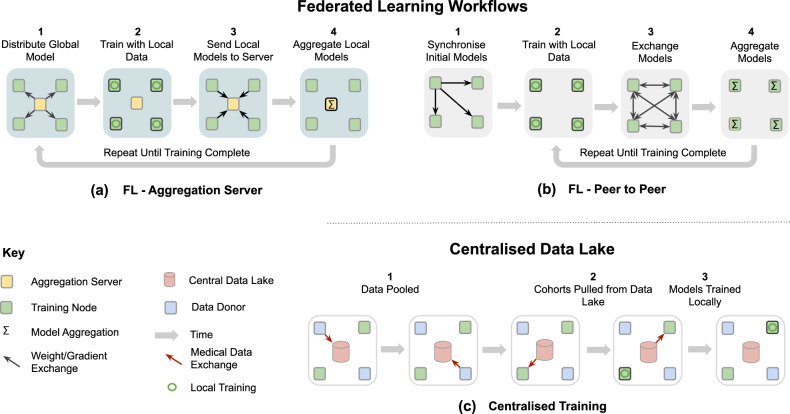
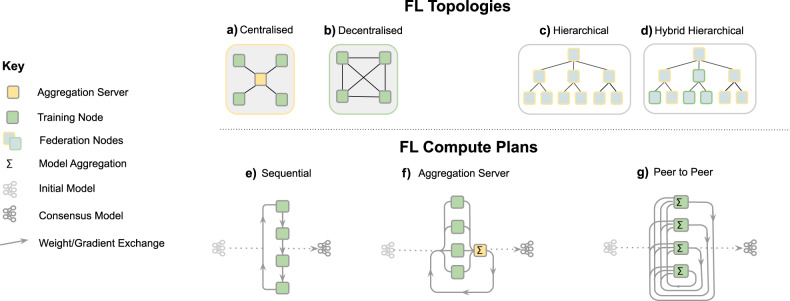
- The text describes FL workflows, including aggregation-server and peer-to-peer topologies, and discusses mechanisms such as FedAvg, FedProx, domain adaptation, and differential privacy at a conceptual level.
Limitations
- The paper explicitly states that FL does not solve all issues inherent to learning on medical data; success still depends on data quality, bias, and standardization.
- It states that FL does not eliminate privacy risks: models can still memorize information, and gradients/model updates may leak private data through inversion or adversarial attacks.
- Evident from the text: this is a perspective article, so it does not report original experimental results, sample sizes, or statistical testing.
Model-written summary. Check it against the paper before relying on it.
Integrity signals
Registry
Cites
Statistics
Figures
Verification
Claims the paper makes
16 Valid · 0 Not valid · 4 Not checked · 19 Own results and interpretations
The cited sources support only part of this claim — read each source’s verdict below.
In the paper
“Modern DL models feature millions of parameters that need to be learned from sufficiently large curated data sets in order to achieve clinical-grade accuracy, while being safe, fair, equitable and generalising well to unseen data2–5.”
§ The future of digital health with federated learning > Introduction
What the sources say
- Not checked — no full text of the sourcecites [2] Wang F Casalino LP Khullar D Deep learning in medicine—promise, progress, and challenges JAMA Intern. Med. 2019 179 293 294 10.1001/jamainternmed.2018.7117 30556825 source
- Not checked — no full text of the sourcecites [3] Chartrand G Deep learning: a primer for radiologists Radiographics 2017 37 2113 2131 10.1148/rg.2017170077 29131760 source
- Partly supportedcites [4] De Fauw J Clinically applicable deep learning for diagnosis and referral in retinal disease Nat. Med. 2018 24 1342 10.1038/s41591-018-0107-6 30104768 sourceExperimental — accuracy not yet measured
Split into 2 atoms — 0 confirmed, 2 partially supported, 0 disputed, 0 misattributed, 0 unverifiable. Expand the claim to see per-atom verdicts.
- Partly supportedcites [5] Sun, C., Shrivastava, A., Singh, S. & Gupta, A. Revisiting unreasonable effectiveness of data in deep learning era. In Proceedings of the IEEE international conference on computer vision, 843–852 (IEEE, 2017). sourceExperimental — accuracy not yet measured
Split into 2 atoms — 0 confirmed, 2 partially supported, 0 disputed, 0 misattributed, 0 unverifiable. Expand the claim to see per-atom verdicts.
plainstates a cause- Asserted: passes — The authors put it forward as true.
- Checkable: passes — It can be checked against evidence.
- Load-bearing: passes — The paper’s conclusions depend on it.
- Based: passes — The paper gives a reason why it holds.
The cited sources support only part of this claim — read each source’s verdict below.
In the paper
“Existing medical data is not fully exploited by ML primarily because it sits in data silos and privacy concerns restrict access to this data.”
§ The future of digital health with federated learning > Abstract
What the sources say
- Partly supportedcites [6] Van Panhuis WG A systematic review of barriers to data sharing in public health BMC Public Health 2014 14 1144 10.1186/1471-2458-14-1144 25377061 PMC4239377 sourceExperimental — accuracy not yet measured
The Background describes routinely collected public-health data as underused, and Results > Legal barriers says privacy concerns can lead to restrictive data-access policies. Results > Technical barriers describes difficulties integrating datasets. The paper does not establish that machine learning is the affected use or that data silos and privacy are the primary reasons medical data is underexploited. (LLM, conf=0.87)
- Partly supportedcites [7] Rocher L Hendrickx JM De Montjoye Y-A Estimating the success of re-identifications in incomplete datasets using generative models Nat. Commun. 2019 10 1 9 10.1038/s41467-019-10933-3 31337762 PMC6650473 sourceExperimental — accuracy not yet measured
The Introduction (page not provided) says medical and other personal data can advance AI, while privacy concerns affect its collection, use, and sharing. It does not say that medical data sits in silos or that silos and privacy restrictions are the primary reasons ML underuses it. (LLM, conf=0.85)
plainstates a cause- Asserted: passes — The authors put it forward as true.
- Checkable: passes — It can be checked against evidence.
- Load-bearing: passes — The paper’s conclusions depend on it.
- Based: passes — The paper gives a reason why it holds.
- Partly supported
The cited sources support only part of this claim — read each source’s verdict below.
In the paper
“The more rounds of local training are performed, the less it is guaranteed that the overall procedure is minimising (Eq. 1)9,12.”
§ The future of digital health with federated learning > Technical considerations > Federated learning definition
What the sources say
- Partly supportedcites [9] McMahan, B., Moore, E., Ramage, D., Hampson, S. & y Arcas, B. A. Communication-efficient learning of deep networks from decentralized data. In Artificial Intelligence and Statistics, 1273–1282. https://scholar.google.de/scholar?hl=de&as_sdt=0%2C5&q=Communicationefficient+learning+of+deep+networks+from+decentralized+data&btnG= (2017). sourceExperimental — accuracy not yet measured
The Experimental Results (p. 7) report that with very many local epochs, FedAvg can plateau or diverge on the Shakespeare LSTM task. But they also report no significant convergence degradation for large numbers of local epochs on the MNIST CNN, so the paper does not establish a general rule that more local training makes minimisation of the global loss less assured. (LLM, conf=0.86)
- Supportedcites [12] Kairouz, P. et al. Advances and open problems in federated learning. arXiv preprint arXiv:1912.04977 (2019). source
Section 3.2.1 states that more local updates increase divergence between client models and slow convergence of the training loss. Section 3.2.2 also reports more restrictive convergence bounds for local updates with non-IID data. Together, these support the claim that increasing local training weakens convergence assurances for the global loss. (LLM, conf=0.86)
plainstates a cause- Asserted: passes — The authors put it forward as true.
- Checkable: passes — It can be checked against evidence.
- Load-bearing: unclear — It is unclear whether the paper’s conclusions depend on it.
- Based: passes — The paper gives a reason why it holds.
- Partly supported
A conclusion the paper draws from its own results — it cites no other source for it, so there is none to check. The quote shows it is in the paper.
In the paper
“By linking healthcare institutions, not restricted to research centres, FL can have direct clinical impact.”
§ The future of digital health with federated learning > Data-driven medicine requires federated efforts > Current FL efforts for digital health
plainstates a possible cause- Asserted: passes — The authors put it forward as true.
- Checkable: passes — It can be checked against evidence.
- Load-bearing: passes — The paper’s conclusions depend on it.
- Based: passes — The paper gives a reason why it holds.
A conclusion the paper draws from its own results — it cites no other source for it, so there is none to check. The quote shows it is in the paper.
In the paper
“FL enables collaborative research for, even competing, companies.”
§ The future of digital health with federated learning > Data-driven medicine requires federated efforts > Current FL efforts for digital health
plainstates a cause- Asserted: passes — The authors put it forward as true.
- Checkable: passes — It can be checked against evidence.
- Load-bearing: unclear — It is unclear whether the paper’s conclusions depend on it.
- Based: passes — The paper gives a reason why it holds.
14 references still to check
A free account verifies the references that are still open.
- Probably not a substantial claim. 19
- It may state two separate claims as one. 32
- The quote only partly states this claim. 1
Claims other papers make about this one
Each is checked against this paper’s own text: does it say what the citing paper says it does?
The source backs part of the claim, not all of it — or backs it for a different population, condition or comparison.
In the citing paper
“This is currently addressed by sharing multi-site data, but such centralization is challenging/infeasible to scale due to various limitations.”
From Federated learning enables big data for rare cancer boundary detection (2022) · cites this paper as [10]
Experimental — accuracy not yet measuredThe source backs part of the claim, not all of it — or backs it for a different population, condition or comparison.
In the citing paper
“However, these methods often come with trade-offs in accuracy and computational efficiency.”
From The role of multimodality in clinical disease diagnosis: advances, challenges, and opportunities (2026) · cites this paper as [34]
Experimental — accuracy not yet measuredThe source backs part of the claim, not all of it — or backs it for a different population, condition or comparison.
In the citing paper
“The experts in healthcare and life sciences can use FL to solve the unique problem of data governance by training algorithms behind the hospital's firewall and only sharing models so that data remain secure [31].”
From A comprehensive survey on federated learning techniques for healthcare informatics (2023) · cites this paper as [31]
Experimental — accuracy not yet measuredThe source backs part of the claim, not all of it — or backs it for a different population, condition or comparison.
In the citing paper
“It also improves patient privacy and reduces low latency during the collaboration of multiple hospitals/entities [7].”
From Handling privacy-sensitive medical data with federated learning: Challenges and future directions (2023) · cites this paper as [7]
Experimental — accuracy not yet measuredThe source backs part of the claim, not all of it — or backs it for a different population, condition or comparison.
In the citing paper
“Enabling privacy protected data sharing across clinical centers is advocated as an essential pathway to promote collaborations internationally yet underexplored so far6,7.”
From Federated deep learning for detecting COVID-19 lung abnormalities in CT: a privacy-preserving multinational validation study (2021) · cites this paper as [7]
Experimental — accuracy not yet measured
27 more claims about this paper
Create a free account to see every claim other papers make about this one.
Citations
Cites
LeCun, Y., Bengio, Y., & Hinton, G. (2015) · Nature · doi:10.1038/nature14539 · Cited by 84,126
Communication-Efficient Learning of Deep Networks from Decentralized Data
McMahan, H. B., Moore, E., Ramage, D., Hampson, S., & Arcas, B. A. Y. (2016) · arXiv · doi:10.48550/arxiv.1602.05629 · Cited by 14,215
Sudlow, C., Gallacher, J., Allen, N., Beral, V., Burton, P., Danesh, J., Downey, P., Elliott, P., Green, J., Landray, M., et al. (2015) · PLOS Medicine · doi:10.1371/journal.pmed.1001779 · Cited by 12,728 · cited 2×
“Substantial, albeit smaller, initiatives include the Human Connectome25, the UK Biobank26, the Cancer Imaging Archive (TCIA)27, NIH CXR828, NIH DeepLesion29, the Cancer Genome Atlas (TCGA)30, the Alzheimer’s Disease Neuroimaging Initiative (ADNI)31, as well as medical grand challenges32 such as the CAMELYON challenge3…”
BackgroundAdvances and Open Problems in Federated Learning
Kairouz, P., McMahan, H. B., Avent, B., Bellet, A., Bennis, M., Bhagoji, A. N., Bonawitz, K., Charles, Z., Cormode, G., Cummings, R., et al. (2019) · arXiv · doi:10.48550/arxiv.1912.04977 · Cited by 7,857
Advances and Open Problems in Federated Learning
Kairouz, P., & McMahan, H. B. (2021) · Foundations and Trends in Machine Learning · doi:10.1561/2200000083 · Cited by 7,772
The multimodal brain tumor image segmentation benchmark (BRATS)
Menze, B. H., Jakab, A., Bauer, S., Kalpathy-Cramer, J., Farahani, K., Kirby, J., Burren, Y., Porz, N., Slotboom, J., Wiest, R., et al. (2015) · IEEE Transactions on Medical Imaging · doi:10.1109/tmi.2014.2377694 · Cited by 6,781
Deep Learning with Differential Privacy
Abadi, M., Chu, A., Goodfellow, I., McMahan, H. B., Mironov, I., Talwar, K., & Zhang, L. (2016) · Proceedings of the 2016 ACM SIGSAC Conference on Computer and Communications Security · doi:10.1145/2976749.2978318 · Cited by 6,578 · cited 2×
“Countermeasures, such as limiting the granularity of the shared model updates and to add specific noise to ensure differential privacy [34, 12, 57] may be needed and is still an active area of research [14].”
BackgroundMethodFederated Machine Learning: Concept and Applications
Yang, Q., Liu, Y., Chen, T., & Tong, Y. (2019) · ACM Transactions on Intelligent Systems and Technology · doi:10.1145/3298981 · Cited by 6,322 · cited 4×
“d FL approaches are still under development. 3 Technical Considerations FL is perhaps best-known from the work of Konecnˇ y` et al. [36], but various other definitions have been proposed in literature [14, 11, 15, 9]. These approaches can be realised via different communication architectures (see Figure 1) and respecti…”
BackgroundInfluentialFederated learning: Challenges, methods, and future directions
Li, T., Sahu, A. K., Talwalkar, A., & Smith, V. (2020) · IEEE Signal Processing Magazine · doi:10.1109/msp.2020.2975749 · Cited by 6,210 · cited 3×
“However, there is a trade-off in terms of performance and these techniques may affect for example the accuracy of the final model [10].”
BackgroundMethodShin, H.-C., Roth, H. R., Gao, M., Lu, L., Xu, Z., Nogues, I., Yao, J., Mollura, D., & Summers, R. M. (2016) · IEEE Transactions on Medical Imaging · doi:10.1109/tmi.2016.2528162 · Cited by 5,759
Self-citation
Cited by
Items 2,201–2,300 of 3,132
Federated Deep Learning for Privacy Preserving Diagnosis of Skin Diseases using Mobile Devices
Jeniston Moses, J., & Sophia, S. (2025) · International Conference on Intelligent Cyber Physical Systems and Internet of Things (ICoICI) · doi:10.1109/icoici65217.2025.11253919 · Cited by 1
Gradient-Aware Data Augmentation for Federated Stress Detection under Data Incompleteness
Chien, W.-S., Chen, H., & Lee, C.-C. (2025) · Annual International Conference of the IEEE Engineering in Medicine and Biology Society (EMBC) · doi:10.1109/embc58623.2025.11252844
Vasilevschi, A.-M., Coman, C., Ianculescu, M., & Coman, O. A. (2025) · Future Internet · doi:10.3390/fi17120562 · Cited by 3
Uppalapati, K., Yimenicioglu, B., Abdulkareem, S., Eftekhari, A., Uppalapati, B., & Kamath, V. (2025) · doi:10.1109/cises66934.2025.11265234
Shrivastava, S., Thakuria, U., Kinder, S., Nebbia, G., Zebardast, N., Baxter, S. L., Xu, B. Y., AlRyalat, S. A., Kahook, M. Y., Kalpathy–Cramer, J., et al. (2025) · medRxiv · doi:10.64898/2025.12.02.25341485
Dutonde, A., & Sonekar, S. V. (2025) · International Journal of Information Technology · doi:10.1007/s41870-025-02951-w
Nazri-Panjaki, A., Moodi, S., & Daneshvariyan, A. (2025) · Artificial Intelligence in Precision Medicine · doi:10.5812/aipm-166784
Boughdad, Y., Hanifi, M., Hdioud, B., & Thami, R. O. H. (2025) · International Conference on Intelligent Systems: Theories and Applications · doi:10.1109/sita67914.2025.11273582
Yadav, V. (2025) · International Conference on Sustainable Technologies for Humanity and Smart World (HSWTech) · doi:10.1109/hswtech64936.2025.11278156
Survey on Federated Learning in Smart Healthcare
Hammamouche, A., Zamouche, D., Khoukhi, L., & Hamamouche, S. (2025) · Lecture notes in computer science · doi:10.1007/978-3-032-00552-6_2
Federated learning based approaches for edge-enabled networking in healthcare
Kone, S. S., Mulla, R. A., & Swain, C. K. (2025) · Elsevier eBooks · doi:10.1016/b978-0-443-33441-2.00011-2 · Cited by 1
ADFL-DSV: An Adaptive Dynamic Federated Learning Aggregation Based on Shapley Value
Wu, J., Xia, G., Huang, H., Yu, C., Zhang, Y., & Li, H. (2025) · IEEE International Conference on Tools with Artificial Intelligence (ICTAI) · doi:10.1109/ictai66417.2025.00011
Wijaya, W., Setiawan, R., Suryopranoto, F. K., Moniaga, J. V., & Jabar, B. A. (2025) · IEEE International Conference on Internet of Things and Intelligence Systems (IoTaIS) · doi:10.1109/iotais67227.2025.11282096
Selvaraj, V. (2025) · International Conference on Innovative Data Communication Technologies and Application (ICIDCA) · doi:10.1109/icidca66325.2025.11280468
Federated DataOps in FinTech and Retail Enabling Privacy-Preserving AI at Scale
Charla, R. R., Tuniki, R. R., Sonani, R., & Somayajula, R. (2025) · Asian Conference on Innovation in Technology (ASIANCON) · doi:10.1109/asiancon66527.2025.11281099
Optimized Energy-Efficient IoT Healthcare Systems Using Hierarchical Deep Reinforcement Learning
Supraja, B., Kumar., K., V, & Krishna Kumar, N. (2025) · doi:10.1109/acroset66531.2025.11281236
Morovich, E. (2025) · International Journal for Research Publication and Seminars · doi:10.36676/jrps.v16.i4.334
Vermeer, L. (2025) · Innovative Research Thoughts · doi:10.36676/irt.v11.i4.1718
Palavali, D. R., & Pothireddy, S. (2025) · IEEE International Carnahan Conference on Security Technology (ICCST) · doi:10.1109/iccst63435.2025.11293908
Federated Learning and Blockchain for Real-Time Disease Monitoring in Healthcare 4.0 Networks
Choubey, S., Gupta, K., Singh, S., & Sharma, S. (2025) · International Conference on Sustainability, Innovation & Technology (ICSIT) · doi:10.1109/icsit65336.2025.11295175
Reps, J. M., Williams, R. D., Schuemie, M. J., Ryan, P. B., & Rijnbeek, P. R. (2022) · Figshare · doi:10.6084/m9.figshare.19881511
Reps, J. M., Williams, R. D., Schuemie, M. J., Ryan, P. B., & Rijnbeek, P. R. (2022) · Figshare · doi:10.6084/m9.figshare.19881505
Kim, J., Lim, M. H., Kim, K., & Yoon, H.-J. (2024) · Figshare · doi:10.6084/m9.figshare.26689850
Liu, Y., Huang, J., Chen, J.-C., Chen, W., Pan, Y., & Qiu, J. (2024) · Figshare · doi:10.6084/m9.figshare.25980485
Liu, Y., Huang, J., Chen, J.-C., Chen, W., Pan, Y., & Qiu, J. (2024) · Figshare · doi:10.6084/m9.figshare.26730148
Seifu, S. H., & Assefa, B. G. (2025) · IEEE Access · doi:10.1109/access.2025.3589535
Salimi, Y., Domingo-Fernández, D., Bobis-Álvarez, C., Hofmann‐Apitius, M., & Birkenbihl, C. (2022) · Figshare · doi:10.6084/m9.figshare.19817858
Liu, Y., Huang, J., Chen, J.-C., Chen, W., Pan, Y., & Qiu, J. (2024) · Figshare · doi:10.6084/m9.figshare.25980636
Reps, J. M., Williams, R. D., Schuemie, M. J., Ryan, P. B., & Rijnbeek, P. R. (2022) · Figshare · doi:10.6084/m9.figshare.19881502
Introduction to Federated Learning and Its Application in Industry
Gulhane, M., Chauhan, A., Rakesh, N., & Tripathi, Y. (2025) · Studies in systems, decision and control · doi:10.1007/978-3-031-99270-4_1
Federated Learning for HIPAA-Compliant AI in Healthcare: A Decentralized Approach to EDI Compliance
Kaimal, S. V. (2025) · European Modern Studies Journal · doi:10.59573/emsj.9(5).2025.58
Breaking the boundaried and optimizing healthcare in the metaverse through federated learning
Bhattacharya, N., & Bansal, D. (2025) · Elsevier eBooks · doi:10.1016/b978-0-443-33789-5.00021-2
Thomas, C., & John, A. R. (2025) · Elsevier eBooks · doi:10.1016/b978-0-443-33789-5.00003-0
Kunekar, P., Nooji, P., Chaudhari, M., et al. (2025) · Artificial Intelligence in Oncology · doi:10.1007/978-3-031-94302-7_35
Heartify: A Federated Learning-Based Application for Early Heart Disease Detection
Sinciya, P. O., George, S. S., Sajan, S., & Gayathri Devi, S. (2025) · International Conference on Expert Clouds and Applications (ICOECA) · doi:10.1109/icoeca66273.2025.00124
Challenges and Limitations of Computational Methods in Oncology
Baweja, B., Vats, P., Kausik, S., Singh, J., Nema, R., & Yadav, P. (2025) · Springer eBooks · doi:10.1007/978-981-96-9346-7_13 · Cited by 1
Lamba, K., & Rani, S. (2025) · De Gruyter eBooks · doi:10.1515/9783111612034-007
Winter, J., Müller, N., Bartling, T., et al. (2025) · Springer eBooks · doi:10.1007/978-3-658-48573-3_20
Privacy-Preserving Kidney Stone Detection from X-Ray Image Using Federated Learning
Plabon, J. D., Rahaman, M. M., Tonmoy, M. R., Kibriya, M. G., & Ishraq, A. (2025) · Studies in computational intelligence · doi:10.1007/978-981-96-8353-6_4 · Cited by 1
Inteligencia artificial y su uso en neurología: una revisión actualizada
Hernández-Zárate, A. (2025) · Acta Médica Grupo Ángeles · doi:10.35366/121694 · Cited by 1
Shourov, M. A. H., Kaium, A. S. M., Rahman, R., Zhanda, M. M. K., & Rafiq, J. I. (2025) · Studies in computational intelligence · doi:10.1007/978-981-96-8353-6_10
FedFAS: Federated Few-shot Abdominal Organs Segmentation across Heterogeneous Clients
Zhang, Y., Wu, J., Zhao, M., Cheng, X., Zhang, Y., & Shi, F. (2025) · International Joint Conference on Neural Networks (IJCNN) · doi:10.1109/ijcnn64981.2025.11229148
Fatima-Azzahrae, A., Adda, M., Lily, L., & Simon, T. (2025) · Procedia Computer Science · doi:10.1016/j.procs.2025.10.207
Lin, X., & Duan, G. (2025) · Journal of Computer Science and Frontier Technologies · doi:10.63313/jcsft.9030
Dóczi, Z., & Valachis, A. (2025) · ESMO Real World Data and Digital Oncology · doi:10.1016/j.esmorw.2025.100661
A study about the performance of federated learning under out-of-distribution data groups
Wang, M. (2025) · ITM Web of Conferences · doi:10.1051/itmconf/20258001025
Kabir, J. U. Z., Saurav, K. R. H., Rahman, M. S., Hasan, M. I., Barua, C., Alam, K. R., & Rahman, M. M. (2023) · European Journal of Medical and Health Research · doi:10.59324/ejmhr.2023.1(3).24 · Cited by 4
A framework for developing successful academic-industry partnerships for cardiovascular innovations
Steltzer, S. S., Ranella, M., Qemo, I., et al. (2025) · Heart Rhythm O2 · doi:10.1016/j.hroo.2025.12.010
Give me that other image: Machine learning for image-to-image translation
Dalmaz, O., & Çukur, T. (2025) · Advances in magnetic resonance technology and applications · doi:10.1016/b978-0-443-14109-6.00015-8
Scale it up: Large-scale MR data processing
Langner, T. (2025) · Advances in magnetic resonance technology and applications · doi:10.1016/b978-0-443-14109-6.00017-1
The ingredients for machine learning
Küstner, T., Hammernik, K., & Baumgartner, C. F. (2025) · Advances in magnetic resonance technology and applications · doi:10.1016/b978-0-443-14109-6.00002-x
Sudheer, T. M., & Deepak, S. (2025) · International Conference on Power, Instrumentation, Control and Computing (PICC) · doi:10.1109/picc67314.2025.11291556
Tolu-Akinnawo, O. Z., Greek, A., Jaamour, D., Azeez, H. A., Ibekwe, J. P., Adeleke, O. A., Bolarinwa, A. C., Adenuga, O., Jung, J. H., & Awoyemi, T. (2025) · Journal of Cardiovascular Pharmacology · doi:10.1097/fjc.0000000000001788 · Cited by 1
Arif, M., Li, J., Qian, J., Ali, S., & Bilal, S. F. (2025) · Neurocomputing · doi:10.1016/j.neucom.2025.132459 · Cited by 2
Wang, X., Shi, X., Wen, G., & Yu, X. (2025) · IEEE Transactions on Network Science and Engineering · doi:10.1109/tnse.2025.3648495 · Cited by 1
Guleria, T., & Chauhan, N. (2025) · Lecture notes in networks and systems · doi:10.1007/978-981-95-0684-2_19
Veetil, S. K., Haque, P. D., Jain, D., et al. (2025) · Journal of Coloproctology · doi:10.1055/s-0045-1813736
A Survey on Edge-Aware Graph Learning Methods
Junior, W. A., Ramos, F. T., Vieira, A. B., Nacif, J. A. M., & Ferreira, R. S. (2025) · IEEE Transactions on Network Science and Engineering · doi:10.1109/tnse.2025.3649386
Decentralized Privacy-Preserving Federated Learning Using Additive Secret Sharing
Bouamama, J., Benkaouz, Y., & OUZZIF, M. (2025) · International Conference on Wireless Networks and Mobile Communications (WINCOM) · doi:10.1109/wincom65874.2025.11313402
Lee, T., Lee, L., Hu, C., Mélin, N., Bouchez, L. C., & Lee, D. (2025) · IGI Global eBooks · doi:10.4018/979-8-3373-5856-7.ch005
Predictive Analytics for Cardiovascular Disease Risk Using Electronic Health Records (EHRs)
Sudha, M. J., & Rajesh, D. (2026) · Studies in systems, decision and control · doi:10.1007/978-3-032-10016-0_28
AI in Integrating Facial Trauma, Oral Health, and Systemic Diseases
Pham, T. D., Holmes, S., Chatzopoulou, D., & Coulthard, P. (2026) · Springer eBooks · doi:10.1007/978-3-032-11531-7_12
Ethics in Artificial Intelligence and Precision Medicine: A Perspective
Seyhan, A. A., & Carini, C. (2025) · Springer eBooks · doi:10.1007/978-3-032-07649-6_45
FedPCE: Federated Personalized Client Embeddings for Post-training Knowledge Distillation
Hansel, S., Kobler, E., & Effland, A. (2026) · Lecture notes in computer science · doi:10.1007/978-3-032-12840-9_26
Federated learning: A stochastic approximation approach
V., S. P., Paul, A. K., & Bhikkaji, B. (2026) · Signal Processing · doi:10.1016/j.sigpro.2025.110479
Shala, E., Brunner, J. O., Vehreschild, J. J., Heller, A. R., & Bartenschlager, C. C. (2026) · Flexible Services and Manufacturing Journal · doi:10.1007/s10696-025-09646-1 · Cited by 1
Bone Fracture Revolutionizing and Bone Fracture Detection Using Deep Learning
Sathyanarayanan, A. R., Bhagavath, T. S., & Princess, T. G. (2026) · Lecture notes in networks and systems · doi:10.1007/978-981-96-8350-5_38
Medical support platform for melanoma analysis and detection based on federated learning
Laso, S., Herrera, J. L., & Flores-Martin, D. (2026) · Scientific Reports · doi:10.1038/s41598-025-32453-5 · Cited by 1
A Review on Federated Learning Frame work for Medical Image Analysis
A Neela sundari, D. S. S. (2024) · International Journal for Research In Science & Advanced Technologies · doi:10.65726/ijrsat.2024.v24.i02.03
Saxena, A., & Banu, J. S. (2025) · International Conference on Computational Intelligence and Knowledge Economy (ICCIKE) · doi:10.1109/iccike67021.2025.11318165
Meta-FL EHR- Intelligent and Federated System for Transmission of Electronic Health Records
Lakshmaiya, N., Kota, S. R., Dhanasekar, P., Kaliappan, S., & Rajendran, A. (2025) · IEEE International Conference on ICT in Business Industry & Government (ICTBIG) · doi:10.1109/ictbig68706.2025.11323903
Federated and Split Learning with Frugal Labelling and Label Scarcity in Healthcare Datasets
Sello, P., Bagula, A., & Kahenga, F. (2025) · IEEE Symposium on Computers and Communications (ISCC) · doi:10.1109/iscc65549.2025.11325763 · Cited by 1
Building Applied Models From Data: Approaches, Methods, and Challenges
Sharma, M., Malik, N., Chaudhry, R., & Kumar, R. (2026) · IGI Global eBooks · doi:10.4018/979-8-3373-3301-4.ch003
Ibrahim, B. (2026) · Briefings in Bioinformatics · doi:10.1093/bib/bbaf729
Park, J., & Park, S. (2026) · IEEE Access · doi:10.1109/access.2026.3654561
Poisoning Attacks and Defenses Techniques for Federated Learning: A Survey
Shan, X., Rong, Y., Li, J., Quan, A., Yu, M., Ye, Z., Yu, J., & Zhang, J. (2025) · International Conference on Computer Communication and Network Security (CCNS) · doi:10.1109/ccns66849.2025.11338107 · Cited by 1
Birajdar, G., Narawade, V., & Bharne, S. (2025) · International Conference on Applied Artificial Intelligence and Computing (ICAAIC) · doi:10.1109/icaaic64647.2025.11330959
A Federated Learning Framework for Alzheimer's Diagnosis: Evaluating Aggregation Approaches
Mahmood, A., Lohithraman, S., Azzuhri, S. R., & Jaan, P. (2025) · IEEE Symposium on Wireless Technology & Applications (ISWTA) · doi:10.1109/iswta68114.2025.11329972
AI in Pediatric Urology Research: Data Analysis and Discovery
姜, 壮. (2026) · Advances in Clinical Medicine · doi:10.12677/acm.2026.161247
Polisetty, K. B., Ravala, R. K., Lingamallu, V. A., Mishra, S. K., & Puthal, D. (2025) · International Conference on Federated Learning Technologies and Applications (FLTA) · doi:10.1109/flta67013.2025.11336672
Federated Meta-Learning and Explainable AI for Hybrid Multimodal Emotion Recognition
Depuru, S., Reddy, P. J., Sirisala, S., Amala, K., Reddy, A. B., & Vinod, P. (2026) · Lecture notes in networks and systems · doi:10.1007/978-3-032-14044-9_19
Federated Mayfly Optimization for Privacy-Preserving Chronic Kidney Disease Diagnosis
Diab, N., Abdallah, M., & Salam, M. A. (2026) · International Journal of Online and Biomedical Engineering (iJOE) · doi:10.3991/ijoe.v22i01.59629 · Cited by 2
Edge AI for Real-Time Analytics in Smart Healthcare and Wearable Computing Systems
Belagalla, S., Padma, C., Chythanya, K. R., Chakkaravarthy, G. V., Vijayakumar, S., & Akhil, V. (2025) · International Conference on Emerging Applications of Material Science and Technology (ICEAMST) · doi:10.1109/iceamst67459.2025.11335624 · Cited by 1
Closing the Data Divide in Healthcare
Singh, I. (2025) · Harvard Medical Student Review · doi:10.65539/74rfap42
Federated Edge Intelligence for Secure Data Collaboration in Smart Healthcare Ecosystems
Singh, N. K., Mhaske, V., Rao, M. N., et al. (2025) · doi:10.1109/icft66708.2025.11336500
Federated Stacked Selective Distillation for Privacy-Preserving Heart Disease Prediction
Hasan, M. R., & Li, J. (2025) · IEEE International Conference on e-Health Networking, Applications and Services (Healthcom) · doi:10.1109/healthcom60686.2025.11343598
Huang, J., Su, Y., & Zhang, Y. (2025) · International Conference on Bioinformatics and Biomedical Science (ICBBS) · doi:10.1145/3778067.3778080
Multi-Model Federated Learning for Predicting Childbirth Mode
Pathak, A., & Rathor, S. (2025) · International Conference on Information Systems and Computer Networks (ISCON) · doi:10.1109/iscon65210.2025.11341271
Devisri, B., Yuvabharathi, E., Samiappan, D., S, I. G., Nagabalan, U., & parkavi, D. (2025) · IEEE International Conference on Information Technology, Electronics and Intelligent Communication Systems (ICITEICS) · doi:10.1109/iciteics64870.2025.11341102
Mo, F. (2026) · International Journal of Agricultural and Environmental Information Systems · doi:10.4018/ijaeis.398857
Boutos, P., Karakasi, K.-E., Katsanos, G., Antoniadis, N., Kofinas, A., & Tsoulfas, G. (2026) · World Journal of Hepatology · doi:10.4254/wjh.v18.i1.111902 · Cited by 3
Ghosh, S., & Mittal, G. K. (2026) · Frontiers in Artificial Intelligence · doi:10.3389/frai.2025.1697175 · Cited by 5
Khan, S., Khan, F. A., & Srinivasan, S. (2025) · doi:10.1109/icact67549.2025.11351450
Acheampong, E. M., Zhou, S., Yongjian, L., Antwi‐Boasiako, E., Agbley, B. L. Y., & Ayekai, B. J. (2025) · International Computer Conference on Wavelet Active Media Technology and Information Processing (ICCWAMTIP) · doi:10.1109/iccwamtip68645.2025.11352603 · Cited by 1
FedGA: Federated Learning via Gradient Adaptive Aggregation
Hu, C., Tan, M., Gao, Z., Han, T., & Kuang, Z. (2025) · Conference proceedings/Conference proceedings - IEEE International Conference on Systems, Man, and Cybernetics · doi:10.1109/smc58881.2025.11343271
Liu, J., Yang, J. J., Xia, X., Zuo, C., Xu, L., Qu, Y., & Huang, X. (2026) · IEEE Transactions on Dependable and Secure Computing · doi:10.1109/tdsc.2026.3659330 · Cited by 2
Wei, Y., Zou, Y., Su, H., Li, Y., & Du, B. (2025) · IEEE International Conference on Bioinformatics and Biomedicine (BIBM) · doi:10.1109/bibm66473.2025.11356774 · Cited by 2
The GenDAI Cloud-Native Infrastructure and Data Stewardship for Clinical Metagenomic Diagnostics
Tamla, P., Krause, T., Hemmje, M., Monti, F., Luzi, F. D., Mecella, M., Andrade, B., Buono, P., & Molinari, A. (2025) · IEEE International Conference on Bioinformatics and Biomedicine (BIBM) · doi:10.1109/bibm66473.2025.11356811
AI-powered immunopharmacological strategies to combat inflammatory diseases
Chakraborty, A., Banerjee, V., Gantait, K., Ghosh, S., & Mukherjee, S. (2026) · Elsevier eBooks · doi:10.1016/b978-0-443-34059-8.00021-x
Metadata
- Authors
- Rieke, N., Hancox, J., Li, W., Milletarì, F., Roth, H. R., Albarqouni, S., Bakas, S., Galtier, M. N., Landman, B. A., Maier-Hein, K., Ourselin, S., Sheller, M., Summers, R. M., Trask, A., Xu, D., Baust, M., & Cardoso, M. J.
- Affiliations
- Technical University of Munich (DE)
- Nvidia (United Kingdom) (GB)
- Nvidia (United States) (US)
- Imperial College London (GB)
- University of Pennsylvania (US)
- Vanderbilt University (US)
- German Cancer Research Center (DE)
- Intel (United States) (US)
- National Institutes of Health (US)
- University of Oxford (GB)
- King's College London (GB)
- Corresponding author
- Rieke, Nicola
- ORCID
- Venue
- npj Digital Medicine
- Published
- 2020-09-14
- Volume
- 3
- Issue
- 1
- Pages
- 119-119
- ISSN
- 2398-6352 (ISSN-L)
- PMC
- PMC7490367
- OpenAlex
- W3012501605
- Semantic Scholar
- b245c5d36702eaae0ff374fad92848024bc99534
- Cited by
- 4,015
- References
- 38
- Citations by year
- 2026: 1453 · 2025: 921 · 2024: 618 · 2023: 473 · 2022: 353 · 2021: 175 · 2020: 18
- FWCI
- 13.36
- Type
- journal article
- Language
- en
- Open access
- gold
- doi.org
- Licence
- cc-by
- creativecommons.org/licenses/by/4.0 (tdm)
- creativecommons.org/licenses/by/4.0 (vor)
- Locations
- npj Digital Medicine (publishedVersion, cc-by)
- PubMed (publishedVersion)
- arXiv (Cornell University) (submittedVersion, other-oa)
- Informationszentrum Lebenswissenschaften (ZB MED) (submittedVersion, cc-by)
- DOAJ (DOAJ: Directory of Open Access Journals) (submittedVersion, cc-by-sa)
- Research Portal (King's College London) (submittedVersion, other-oa)
- mediaTUM – the media and publications repository of the Technical University Munich (Technical University Munich) (submittedVersion, other-oa)
- arXiv (Cornell University)
- Funders
- U.S. Department of Health and Human Services (R01NS042645, U01CA242871)
- Nvidia
- Wellcome Trust
- UK Research and Innovation
- Bpifrance
- Deutscher Akademischer Austauschdienst
- Bundesministerium für Bildung und Forschung
- National Institutes of Health (1s10od023495-01)
- Engineering and Physical Sciences Research Council ([WT203148/Z/16/Z], WT213038/Z/18/Z)
- Centre For Medical Engineering, King’s College London (WT 203148/Z/16/Z)
- National Cancer Institute (U24CA189523, U01CA242871)
- National Institute of Neurological Disorders and Stroke (R01NS042645)
- NIH Clinical Center
- Topics
- Physical Sciences › Computer Science › Artificial Intelligence › Privacy-Preserving Technologies in Data
- Health Sciences › Medicine › Health Informatics › Artificial Intelligence in Healthcare and Education
- Physical Sciences › Computer Science › Artificial Intelligence › Machine Learning in Healthcare
- Keywords
- federated learning, digital health, medical data privacy, data silos, data-driven machine learning, health information access
About these checks
Registry, retraction, Cites and statistics results are computed, not judged, with one exception: a printed reference that no index lists is read once by a model before it counts as a citation error. Claims are extracted by a model and kept only when their quote appears verbatim in the text; each cited source is then checked, with a model’s help, for whether it says what the claim relies on. Those verdicts can be wrong — read the claim’s quote and the cited source before relying on one.
The claim verdicts this report counts are experimental: their accuracy is not yet measured.
A language model drew the claims from the paper on 2026-10-10, under version 3 of the claim definition (model deepseek-v4.1-flash, prompt extract-v3).
A second model labelled each claim on 2026-10-10 (model jev-1.13-20260917, definition revision gold-guideline-v0.2).
Cited sources are checked with a language model’s help (gpt-6-sol and qwen3.8-omni-flash).
Statistics and arithmetic are recomputed, not judged.
Confidence bands are shown only for fields calibrated on our annotated test set. None is calibrated yet, so no band is shown.
What counts as a claim ›How we measure confidence ›How we check this ›
Are you an author, or do you see a problem with this page? Request a review
Data sources
Bibliographic data: Semantic Scholar, OpenAlex, Crossref.
Contains information from the Semantic Scholar Academic Graph Datasets, made available under the ODC Attribution License (ODC-BY 1.0).
Semantic Scholar’s data is described in: Kinney, R., et al. (2023). The Semantic Scholar Open Data Platform. arXiv:2301.10140.
