

Fusion of medical imaging and electronic health records using deep learning: a systematic review and implementation guidelines
Open accessThe DOI matches its Crossref record; 55 of the 60 references it cites were found in a registry or an index; 38 of the 90 sources its claims cite were checked for support.
Abstract
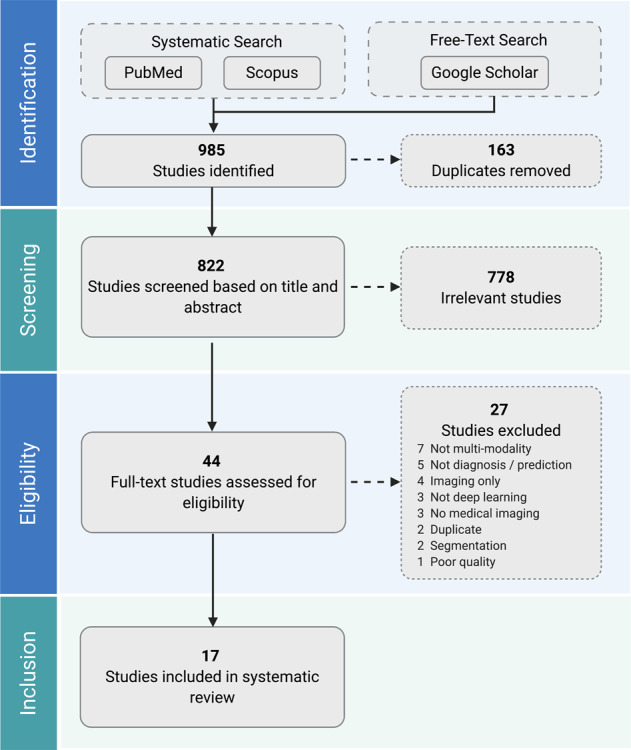
In this paper, we describe different data fusion techniques that can be applied to combine medical imaging with EHR, and systematically review medical data fusion literature published between 2012 and 2020. We conducted a systematic search on PubMed and Scopus for original research articles leveraging deep learning for fusion of multimodality data. In total, we screened 985 studies and extracted data from 17 papers. By means of this systematic review, we present current knowledge, summarize important results and provide implementation guidelines to serve as a reference for researchers interested in the application of multimodal data fusion.
Overview
CoChat Summary
TL;DR
This systematic review consolidates deep learning approaches that fuse medical imaging with electronic health record (EHR) data, defining early, joint, and late fusion strategies and reviewing 17 eligible studies published between 2012 and 2020. It concludes that multimodal fusion generally improves performance over single-modality models, though no single fusion strategy is consistently optimal, and provides implementation guidelines for future work.
Key findings
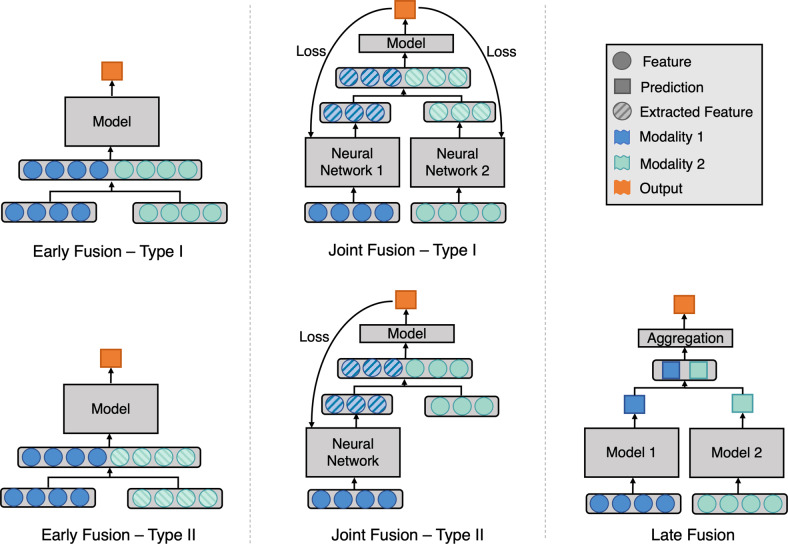
- From 985 screened studies, 44 underwent full-text screening and 17 met eligibility criteria; early fusion was used in 11/17 studies, joint fusion in 4/17, and late fusion in 3/17.
- Across reviewed studies, multimodal fusion generally improved performance over single-modality models, with reported accuracy gains of 1.2–27.7% and AUROC gains of 0.02–0.16.
- No single fusion strategy consistently led to optimal performance across all clinical domains; examples include Kharazmi et al. achieving 91.1% accuracy with fusion versus 84.7% for dermoscopic images and 75.6% for patient profile, and Yala et al. achieving 0.70 AUROC with joint fusion versus 0.68 for mammograms and 0.67 for risk scores.
- Non-imaging EHR data in the included studies were limited, mostly to basic demographics, a narrow range of categorical clinical history, or disease-specific features such as APOE4 or PSA, rather than feature-rich or time-series EHR data.
Methods
- PRISMA-based systematic review with searches in PubMed and Scopus for papers published 2012–2020, using key themes of “deep learning,” “multimodality fusion,” and “medical imaging”; segmentation, registration, and reconstruction terms were exclusion criteria, and preprints were excluded.
- Inclusion required original research applying deep learning for clinical outcome prediction or diagnosis by fusing medical imaging with EHR data; two independent researchers screened records using Covidence, with disagreements resolved by discussion and a third researcher if needed.
- Data extracted from each included study included fusion strategy, year, authors, clinical domain, target outcome, fusion details, imaging modality, non-imaging modality, number of samples, and model performance; AUROC was extracted when reported, otherwise accuracy, using the best-performing fusion experiment.
Limitations
- The paper states that its search excluded pre-2012 papers, that publication bias may overrepresent fusion advantages, that it only covered clinical prediction and diagnosis rather than segmentation or registration, and that heterogeneity across studies prevented meta-analysis; it also notes that some studies lacked independent test sets and that classifying unconventional fusion implementations introduced subjectivity.
- The paper states that the limited number of studies per medical field and heterogeneity made qualitative comparison difficult.
- Evident from the text: the review includes only 17 studies, and the non-imaging EHR data used across those studies were narrow, limiting conclusions about fusion with richer or time-series clinical data.
Model-written summary. Check it against the paper before relying on it.
Integrity signals
Registry
Cites
Statistics
Figures
Verification
Claims the paper makes
19 Valid · 3 Not valid · 15 Not checked · 39 Own results and interpretations
The cited sources support only part of this claim — read each source’s verdict below.
In the paper
“In a survey of radiologists, the majority (87%) stated that clinical information had a significant impact on interpretation3.”
§ Fusion of medical imaging and electronic health records using deep learning: a systematic review and implementation guidelines > Introduction
What the sources say
- Partly supportedcites [3] Boonn WW Langlotz CP Radiologist use of and perceived need for patient data access J. Digit. Imaging 2009 22 357 362 10.1007/s10278-008-9115-2 18459002 PMC3043710 sourceExperimental — accuracy not yet measured
The Results report that more than 87% of surveyed radiologists considered additional clinical information important and said it could change or modify their interpretive report. Table 1 records 87.0% as willing to modify or change a diagnosis based on such information. These are judgments about its potential impact, not reports that it had already significantly affected their interpretations. (LLM, conf=0.82)
plain- Asserted: passes — The authors put it forward as true.
- Checkable: passes — It can be checked against evidence.
- Load-bearing: unclear — It is unclear whether the paper’s conclusions depend on it.
- Based: passes — The paper gives a reason why it holds.
- Partly supported
The cited sources that could be checked couldn’t confirm or dispute this claim.
In the paper
“When the different input modalities have very different numbers of features, predictions might be overly influenced by the most feature-rich modality (e.g., Reda et al.40).”
§ Fusion of medical imaging and electronic health records using deep learning: a systematic review and implementation guidelines > Discussion > Implementation guidelines for fusion models
What the sources say
- Could not verifycites Reda et al.40 Reda I Deep learning role in early diagnosis of prostate cancer Technol. Cancer Res. Treat. 2018 17 153303461877553 10.1177/1533034618775530 PMC5972199 29804518 sourceExperimental — accuracy not yet measured
The Imaging Features and Clinical Biomarkers and Experimental Results sections describe combining low-dimensional PSA data with DW-MRI features through diagnostic probabilities. Neither section says that a modality with more features might disproportionately influence predictions; searches for feature-count imbalance and modality dominance found no such passage. Page numbers were not available in our copy. (LLM, conf=0.73)
hedgedstates a possible cause- Asserted: passes — The authors put it forward as true.
- Checkable: passes — It can be checked against evidence.
- Load-bearing: passes — The paper’s conclusions depend on it.
- Based: passes — The paper gives a reason why it holds.
- Could not verify
Every source the paper cites for this claim was checked and supports it.
In the paper
“Fusion approaches in other less complex clinical applications also improved performance over single modality models, even those in which single modality models have been widely reported to achieve high performance, such as pixel-based models for automated skin cancer detection43.”
§ Fusion of medical imaging and electronic health records using deep learning: a systematic review and implementation guidelines > Discussion
What the sources say
- Supportedcites [43] Esteva A Dermatologist-level classification of skin cancer with deep neural networks Nature 2017 542 115 118 10.1038/nature21056 28117445 PMC8382232 source
Split into 2 atoms — 2 confirmed, 0 partially supported, 0 disputed, 0 misattributed, 0 unverifiable. Expand the claim to see per-atom verdicts.
plainstates a cause- Asserted: passes — The authors put it forward as true.
- Checkable: passes — It can be checked against evidence.
- Load-bearing: unclear — It is unclear whether the paper’s conclusions depend on it.
- Based: passes — The paper gives a reason why it holds.
- Supported
The cited sources support only part of this claim — read each source’s verdict below.
In the paper
“while physicians struggle with accurate and reliable diagnostics even when multimodality is present, as proven by histopathological correlation42.”
§ Fusion of medical imaging and electronic health records using deep learning: a systematic review and implementation guidelines > Discussion
What the sources say
- Partly supportedcites [42] Beach TG Monsell SE Phillips LE Kukull W Accuracy of the Clinical Diagnosis of Alzheimer Disease at National Institute on Aging Alzheimer Disease Centers, 2005–2010 J. Neuropathol. Exp. Neurol. 2012 71 266 273 10.1097/NEN.0b013e31824b211b 22437338 PMC3331862 sourceExperimental — accuracy not yet measured
The Results (Diagnostic Classification Comparison; page unavailable) show imperfect agreement between clinical Alzheimer disease diagnoses and neuropathological findings, supporting the point that clinicians can have difficulty diagnosing AD accurately against a histopathological standard. The Materials and Methods (Analysis Strategy; page unavailable) do not establish that the clinical diagnoses used multiple diagnostic modalities, and the study does not assess diagnostic reliability. Its findings concern AD at participating disease centers, not physicians’ diagnostics generally. (LLM, conf=0.88)
boosted- Asserted: passes — The authors put it forward as true.
- Checkable: passes — It can be checked against evidence.
- Load-bearing: passes — The paper’s conclusions depend on it.
- Based: passes — The paper gives a reason why it holds.
- Partly supported
The sources with a verdict support this claim; the rest weren’t checked yet, have no full text we could read, or their verdicts aren’t rated yet.
In the paper
“The importance of clinical context for accurate interpretation of imaging data is not limited to radiology; instead many other imaging-based medical specialties such as pathology, ophthalmology, and dermatology, also rely on clinical data to guide image interpretation in practice4–6.”
§ Fusion of medical imaging and electronic health records using deep learning: a systematic review and implementation guidelines > Introduction
What the sources say
- Not checked — no full text of the sourcecites [4] Comfere NI Provider-to-provider communication in dermatology and implications of missing clinical information in skin biopsy requisition forms: a systematic review Int. J. Dermatol. 2014 53 549 557 10.1111/ijd.12330 24116717 source
- Supportedcites [5] Comfere NI Dermatopathologists’ concerns and challenges with clinical information in the skin biopsy requisition form: a mixed-methods study: Clinical information in dermatopathology J. Cutan. Pathol. 2015 42 333 345 10.1111/cup.12485 25757028 PMC4701217 source
The Discussion says clinical information is crucial for accurate dermatopathologic interpretation and emphasizes the importance of clinical context. The Results report that most respondents considered the quality of clinical information to have a large impact on diagnostic accuracy. This supports the dermatopathology example to which this source is pertinent. (LLM, conf=0.91)
- Not checked — no full text of the sourcecites [6] Jonas JB Glaucoma The Lancet 2017 390 2183 2193 10.1016/S0140-6736(17)31469-1 28577860 source
plainstates a cause- Asserted: passes — The authors put it forward as true.
- Checkable: passes — It can be checked against evidence.
- Load-bearing: unclear — It is unclear whether the paper’s conclusions depend on it.
- Based: passes — The paper gives a reason why it holds.
38 more claims · 9 with their cited sources checked
Create a free account to see all 76 claims and to verify the 3 references still open.
- It may state two separate claims as one. 20
- Probably not a substantial claim. 17
Claims other papers make about this one
Each is checked against this paper’s own text: does it say what the citing paper says it does?
The source backs part of the claim, not all of it — or backs it for a different population, condition or comparison.
In the citing paper
“Recent studies have proposed increasingly sophisticated fusion architectures, including attention-based models, variational autoencoders, and graph neural networks, often reporting improved predictive performance in complex biomedical and neuroimaging tasks [6,9,45,46,47].”
From Benchmarking Multimodal Deep Fusion Strategies for Heterogeneous Neuroimaging and Cognitive Data Using a Controlled Sex Classification Task (2026) · cites this paper as [9]
Experimental — accuracy not yet measuredThe source backs part of the claim, not all of it — or backs it for a different population, condition or comparison.
In the citing paper
“In contrast, late fusion offers practical robustness for incomplete or asynchronous clinical data through modular development, albeit without modeling inter-modal relationships”
From Multimodal neuroimaging and AI integration in cognitive disorders: advances, challenges, and future directions for precision medicine (2026) · cites this paper as Huang et al., 2020
Experimental — accuracy not yet measuredThe source backs part of the claim, not all of it — or backs it for a different population, condition or comparison.
In the citing paper
“Joint fusion learns a shared embedding space across modalities, which can represent cross-modal relationships beyond those considered in early or late fusion.”
From MoMA: a mixture-of-multimodal-agents architecture for enhancing clinical prediction modelling (2025) · cites this paper as [8]
Experimental — accuracy not yet measuredThe source backs part of the claim, not all of it — or backs it for a different population, condition or comparison.
In the citing paper
“A meta-analysis of fusion strategies for combining imaging and EHR data show that multimodal integration leads to better predictive performance in various clinical tasks41.”
From K-STAMM: a knowledge-enhanced spatial - temporal attention model with multimodal fusion for pneumonia prediction (2026) · cites this paper as [41]
Experimental — accuracy not yet measuredThe cited source says what the claim attributes to it.
In the citing paper
“Training a model on multiple data types may improve the performance of ML systems (14).”
From Mitigating Bias in Radiology Machine Learning: 1. Data Handling (2022) · cites this paper as [14]
5 more claims about this paper
Create a free account to see every claim other papers make about this one.
Citations
Cites
Preferred Reporting Items for Systematic Reviews and Meta-Analyses: the PRISMA statement
Moher, D., Liberati, A., Tetzlaff, J., Altman, D. G., & for the PRISMA Group (2009) · BMJ · doi:10.1136/bmj.b2535 · Cited by 83,823
Preferred Reporting Items for Systematic Reviews and Meta-Analyses: The PRISMA Statement
Moher, D., Liberati, A., Tetzlaff, J., Altman, D. G., & The PRISMA Group (2009) · PLoS Medicine · doi:10.1371/journal.pmed.1000097 · Cited by 64,042
Regularization and Variable Selection Via the Elastic Net
Zou, H., & Hastie, T. (2005) · Journal of the Royal Statistical Society Series B: Statistical Methodology · doi:10.1111/j.1467-9868.2005.00503.x · Cited by 20,957
Wang, G., Ma, R., Qiao, G., Wada, K., Aizawa, Y., & Satoh, T. (2015) · Integrative Medicine International · doi:10.1159/000368408 · Cited by 18,657
Dermatologist-level classification of skin cancer with deep neural networks
Esteva, A., Kuprel, B., Novoa, R. A., Ko, J., Swetter, S. M., Blau, H. M., & Thrun, S. (2017) · Nature · doi:10.1038/nature21056 · Cited by 14,362
Gulshan, V., Peng, L., Coram, M., Stumpe, M. C., Wu, D., Narayanaswamy, A., Venugopalan, S., Widner, K., Madams, T., Cuadros, J., et al. (2016) · JAMA · doi:10.1001/jama.2016.17216 · Cited by 7,697 · cited 1×
“Early applications of CNNs for image analysis in medicine include diabetic retinopathy, skin cancer, and chest X-rays 11 – 18 .”
BackgroundLarge-Scale Video Classification with Convolutional Neural Networks
Karpathy, A., Toderici, G., Shetty, S., Leung, T., Sukthankar, R., & Fei-Fei, L. (2014) · 2014 IEEE Conference on Computer Vision and Pattern Recognition · doi:10.1109/cvpr.2014.223 · Cited by 6,354
(2011) · Cited by 2,752
MIMIC-CXR, a de-identified publicly available database of chest radiographs with free-text reports
Johnson, A. E. W., Pollard, T. J., Berkowitz, S. J., Greenbaum, N. R., Lungren, M. P., Deng, C.-Y., Mark, R. G., & Horng, S. (2019) · Scientific Data · doi:10.1038/s41597-019-0322-0 · Cited by 1,816
Self-citationRajpurkar, P., Irvin, J., Ball, R. L., Zhu, K., Yang, B., Mehta, H., Duan, T., Ding, D., Bagul, A., Langlotz, C. P., et al. (2018) · PLOS Medicine · doi:10.1371/journal.pmed.1002686 · Cited by 1,449 · cited 3×
“The imaging fi ndings on chest X-rays consistent with pneumonia, despite having imaging features that can generally differentiate alternative diagnoses, are nonspeci fi c and accurate diagnosis requires the context of clinical and laboratory data.”
Self-citationJonas, J. B., Aung, T., Bourne, R. R., Bron, A. M., Ritch, R., & Panda-Jonas, S. (2017) · The Lancet · doi:10.1016/s0140-6736(17)31469-1 · Cited by 1,322
Deep multimodal learning: a survey on recent advances and trends
Ramachandram, D., & Taylor, G. W. (2017) · IEEE Signal Processing Magazine · doi:10.1109/msp.2017.2738401 · Cited by 1,139
Beach, T. G., Monsell, S. E., Phillips, L. E., & Kukull, W. (2012) · Journal of Neuropathology & Experimental Neurology · doi:10.1097/nen.0b013e31824b211b · Cited by 1,103 · cited 1×
“Leveraging deep learning fusion techniques consistently showed improvements in performance for Alzheimer ’ s disease diagnosis, while physicians struggle with accurate and reliable diagnostics even when multimodality is present, as proven by histopathological correlation 42 .”
MethodTwo public chest X-ray datasets for computer-aided screening of pulmonary diseases.
(2014) · PubMed Central · doi:10.3978/j.issn.2223-4292.2014.11.20 · Cited by 918
A Deep Learning Mammography-based Model for Improved Breast Cancer Risk Prediction
Yala, A., Lehman, C., Schuster, T., Portnoi, T., & Barzilay, R. (2019) · Radiology · doi:10.1148/radiol.2019182716 · Cited by 758 · cited 1×
“Spasov et al. 36 , Yala et al. 37 , and Yoo et al. 38 implemented CNNs to learn image features and fused these feature representations with clinical features before feeding them into a feed-forward neural network.”
BackgroundDeep Learning—A Technology With the Potential to Transform Health Care
Hinton, G. (2018) · JAMA · doi:10.1001/jama.2018.11100 · Cited by 667 · cited 3×
“The imaging fi ndings on chest X-rays consistent with pneumonia, despite having imaging features that can generally differentiate alternative diagnoses, are nonspeci fi c and accurate diagnosis requires the context of clinical and laboratory data.”
BackgroundSeven-point checklist and skin lesion classification using multitask multimodal neural nets
Kawahara, J., Daneshvar, S., Argenziano, G., & Hamarneh, G. (2019) · IEEE Journal of Biomedical and Health Informatics · doi:10.1109/jbhi.2018.2824327 · Cited by 584 · cited 2×
“Kawahara et al.(39) also used CNNs as feature extractors for imaging modalities but experimented with a unique multimodal multi-task loss function that considers multiple combinations of the input modalities.”
MethodA Review of Feature Reduction Techniques in Neuroimaging
Mwangi, B., Tian, T. S., & Soares, J. C. (2014) · Neuroinformatics · doi:10.1007/s12021-013-9204-3 · Cited by 559 · cited 1×
“This is the so-called “ curse of dimensionality ” in machine learning 52,53 .”
BackgroundMcDonald, R. J., Schwartz, K. M., Eckel, L. J., Diehn, F. E., Hunt, C. H., Bartholmai, B. J., Erickson, B. J., & Kallmes, D. F. (2015) · Academic Radiology · doi:10.1016/j.acra.2015.05.007 · Cited by 460 · cited 1×
“To meet this increased workload demand, an average radiologist may have to interpret an image every 3 – 4 s over an 8-h workday which contributes to fatigue, burnout, and increased error-rate 7 .”
BackgroundModDrop: Adaptive Multi-Modal Gesture Recognition
Neverova, N., Wolf, C., Taylor, G., & Nebout, F. (2016) · IEEE Transactions on Pattern Analysis and Machine Intelligence · doi:10.1109/tpami.2015.2461544 · Cited by 420
CheXpert: A Large Chest Radiograph Dataset with Uncertainty Labels and Expert Comparison
Irvin, J., Rajpurkar, P., Ko, M., Yu, Y., Ciurea-Ilcus, S., Chute, C., Marklund, H., Haghgoo, B., Ball, R., Shpanskaya, K., et al. (2019) · Proceedings of the AAAI Conference on Artificial Intelligence · doi:10.1609/aaai.v33i01.3301590 · Cited by 392
Self-citationCheXpert: A Large Chest Radiograph Dataset with Uncertainty Labels and Expert Comparison
Irvin, J., Rajpurkar, P., Ko, M., Yu, Y., Ciurea-Ilcus, S., Chute, C., Marklund, H., Haghgoo, B., Ball, R., Shpanskaya, K., et al. (2019) · arXiv · doi:10.48550/arxiv.1901.07031 · Cited by 392
Self-citationMultimodal skin lesion classification using deep learning
Yap, J., Yolland, W., & Tschandl, P. (2018) · Experimental Dermatology · doi:10.1111/exd.13777 · Cited by 326
Breaking the Curse of Dimensionality with Convex Neural Networks
Bach, F. (2014) · arXiv (Cornell University) · doi:10.48550/arxiv.1412.8690 · Cited by 295
Majkowska, A., Mittal, S., Steiner, D. F., Reicher, J. J., McKinney, S. M., Duggan, G. E., Eswaran, K., Cameron Chen, P.-H., Liu, Y., Kalidindi, S. R., et al. (2020) · Radiology · doi:10.1148/radiol.2019191293 · Cited by 277 · cited 1×
“As an example consider the “ simple ” task in radiology of identifying pneumonia on a chest radiograph, something that has been achieved by many investigators training deep learning models for automated detection and classi fi cation of pathologies on chest X-rays 19,20 .”
Recurrent Neural Networks for driver activity anticipation via sensory-fusion architecture
Jain, A., Singh, A., Koppula, H. S., Soh, S., & Saxena, A. (2016) · 2016 IEEE International Conference on Robotics and Automation (ICRA) · doi:10.1109/icra.2016.7487478 · Cited by 271 · cited 1×
“While selecting features known to be associated with disease is meaningful, future work may further bene fi t from utilizing large volumes of feature-rich data, as seen in fi elds outside medicine such as autonomous driving 44,45 .”
BackgroundClinical Implications and Challenges of Artificial Intelligence and Deep Learning
Stead, W. W. (2018) · JAMA · doi:10.1001/jama.2018.11029 · Cited by 250
Nie, D., Lu, J., Zhang, H., Adeli, E., Wang, J., Yu, Z., Liu, L., Wang, Q., Wu, J., & Shen, D. (2019) · Scientific Reports · doi:10.1038/s41598-018-37387-9 · Cited by 213 · cited 4×
“The remaining two studies by Liu et al. 30 and Nie et al. 31 applied dimensionality reduction techniques before concatenating the features.”
BackgroundInfluentialAssessment of Convolutional Neural Networks for Automated Classification of Chest Radiographs
Dunnmon, J. A., Yi, D., Langlotz, C. P., Ré, C., Rubin, D. L., & Lungren, M. P. (2019) · Radiology · doi:10.1148/radiol.2018181422 · Cited by 206
Self-citationEnd-to-End Learning of Driving Models with Surround-View Cameras and Route Planners
Hecker, S., Dai, D., & Van Gool, L. (2018) · Lecture Notes in Computer Science · doi:10.1007/978-3-030-01234-2_27 · Cited by 191 · cited 2×
“While selecting features known to be associated with disease is meaningful, future work may further bene fi t from utilizing large volumes of feature-rich data, as seen in fi elds outside medicine such as autonomous driving 44,45 .”
BackgroundMethodHyun, S. H., Ahn, M. S., Koh, Y. W., & Lee, S. J. (2019) · Clinical Nuclear Medicine · doi:10.1097/rlu.0000000000002810 · Cited by 185 · cited 4×
“There were a variety of strategies used to accomplish this; including using manually extracted imaging features or software-generated features 25,32 – 35 .”
BackgroundMethodInfluentialEfficient Large-Scale Multi-Modal Classification
Kiela, D., Grave, E., Joulin, A., & Mikolov, T. (2018) · Proceedings of the AAAI Conference on Artificial Intelligence · doi:10.1609/aaai.v32i1.11945 · Cited by 177
How far have we come? Artificial intelligence for chest radiograph interpretation
Kallianos, K., Mongan, J., Antani, S., Henry, T., Taylor, A., Abuya, J., & Kohli, M. (2019) · Clinical Radiology · doi:10.1016/j.crad.2018.12.015 · Cited by 173
The influence of clinical information on the reporting of CT by radiologists.
Leslie, A., Jones, A. J., & Goddard, P. R. (2000) · The British Journal of Radiology · doi:10.1259/bjr.73.874.11271897 · Cited by 172
Bhagwat, N., Viviano, J. D., Voineskos, A. N., Chakravarty, M. M., & Initiative, A. D. N. (2018) · PLOS Computational Biology · doi:10.1371/journal.pcbi.1006376 · Cited by 157 · cited 4×
“Six of these studies showed an improvement in performance when using fusion 25,26,28,29,31,33 , and the remaining one achieved the same performance but reduced standard deviation 27 , alluding to a model with better stability.”
BackgroundMethodInfluentialDeep Learning Role in Early Diagnosis of Prostate Cancer
Reda, I., Khalil, A., Elmogy, M., Abou El-Fetouh, A., Shalaby, A., Abou El-Ghar, M., Elmaghraby, A., Ghazal, M., & El-Baz, A. (2018) · Technology in Cancer Research & Treatment · doi:10.1177/1533034618775530 · Cited by 119 · cited 4×
“…, a limited range of categorical clinical history such as hypertension or smoking status 32,34 or disease-speci fi c clinical features known to be strongly associated with the disease of interest such as APOE4 for Alzheimer ’ s 25,28,33,36 or PSA blood test for prediction of prostate cancer 40 .”
BackgroundMethodInfluentialQiu, S., Chang, G. H., Panagia, M., Gopal, D. M., Au, R., & Kolachalama, V. B. (2018) · Alzheimer's & Dementia: Diagnosis, Assessment & Disease Monitoring · doi:10.1016/j.dadm.2018.08.013 · Cited by 110 · cited 3×
“Qiu et al. 41 trained three independent imaging models that took as input a single MRI slice, each from a speci fi c anatomical location.”
MethodDean, N. C., Jones, B. E., Jones, J. P., Ferraro, J. P., Post, H., Aronsky, D., Vines, C. G., Allen, T. L., & Haug, P. J. (2015) · Annals of Emergency Medicine · doi:10.1016/j.annemergmed.2015.02.003 · Cited by 110 · cited 1×
“Deep learning in healthcare is proliferating due to the potential for successful automated systems to either augment or of fl oad cognitive work from busy physicians 8 – 10 .”
BackgroundLiu, J., Chen, Y., Lan, L., Lin, B., Chen, W., Wang, M., Li, R., Yang, Y., Zhao, B., Hu, Z., et al. (2018) · European Radiology · doi:10.1007/s00330-017-5300-3 · Cited by 107
Kharazmi, P., Kalia, S., Lui, H., Wang, Z. J., & Lee, T. K. (2018) · Skin Research and Technology · doi:10.1111/srt.12422 · Cited by 83
Li, H., & Fan, Y. (2019) · 2019 IEEE 16th International Symposium on Biomedical Imaging (ISBI 2019) · doi:10.1109/isbi.2019.8759397 · Cited by 83 · cited 4×
“Six of these studies showed an improvement in performance when using fusion 25,26,28,29,31,33 , and the remaining one achieved the same performance but reduced standard deviation 27 , alluding to a model with better stability.”
BackgroundMethodInfluentialBanerjee, I., Sofela, M., Yang, J., Chen, J. H., Shah, N. H., Ball, R., Mushlin, A. I., Desai, M., Bledsoe, J., Amrhein, T., et al. (2019) · JAMA Network Open · doi:10.1001/jamanetworkopen.2019.8719 · Cited by 80
Self-citationA Multi-modal Convolutional Neural Network Framework for the Prediction of Alzheimer’s Disease
Spasov, S. E., Passamonti, L., Duggento, A., Lio, P., & Toschi, N. (2018) · 2018 40th Annual International Conference of the IEEE Engineering in Medicine and Biology Society (EMBC) · doi:10.1109/embc.2018.8512468 · Cited by 73
Comparison of Machine-Learning Classification Models for Glaucoma Management
An, G., Omodaka, K., Tsuda, S., Shiga, Y., Takada, N., Kikawa, T., Nakazawa, T., Yokota, H., & Akiba, M. (2018) · Journal of Healthcare Engineering · doi:10.1155/2018/6874765 · Cited by 72
Yoo, Y., Tang, L. Y. W., Li, D. K. B., Metz, L., Kolind, S., Traboulsee, A. L., & Tam, R. C. (2019) · Computer Methods in Biomechanics and Biomedical Engineering: Imaging & Visualization · doi:10.1080/21681163.2017.1356750 · Cited by 67 · cited 7×
“Yoo et al. 38 took the mean of the predicted probabilities from two single modality models as the fi nal prediction.”
BackgroundMethodInfluentialThung, K.-H., Yap, P.-T., & Shen, D. (2017) · Lecture Notes in Computer Science · doi:10.1007/978-3-319-67558-9_19 · Cited by 63 · cited 7×
“Six of these studies showed an improvement in performance when using fusion 25,26,28,29,31,33 , and the remaining one achieved the same performance but reduced standard deviation 27 , alluding to a model with better stability.”
BackgroundMethodInfluentialRadiologist Use of and Perceived Need for Patient Data Access
Boonn, W. W., & Langlotz, C. P. (2009) · Journal of Digital Imaging · doi:10.1007/s10278-008-9115-2 · Cited by 60
Accuracy of Information on Imaging Requisitions: Does It Matter?
Cohen, M. D. (2007) · Journal of the American College of Radiology · doi:10.1016/j.jacr.2007.02.003 · Cited by 57 · cited 1×
“For example, it has repeatedly been shown that a lack of access to clinical and laboratory data during image interpretation results in lower performance and decreased clinical utility for the referring provider 1,2 .”
BackgroundPurwar, S., Tripathi, R. K., Ranjan, R., & Saxena, R. (2020) · Multimedia Tools and Applications · doi:10.1007/s11042-019-07927-0 · Cited by 46
Multimodal Fusion of Imaging and Genomics for Lung Cancer Recurrence Prediction
Subramanian, V., Do, M. N., & Syeda-Mahmood, T. (2020) · 2020 IEEE 17th International Symposium on Biomedical Imaging (ISBI) · doi:10.1109/isbi45749.2020.9098545 · Cited by 42 · cited 1×
“…to the number of features in the dataset or if some of the input features are sparsely represented, early or late fusion is preferred because they can be implemented with traditional machine learning algorithms (e.g., Lasso and ElasticNet 47 ) that are better suited for this type of data 48 .”
MethodComfere, N. I., Peters, M. S., Jenkins, S., Lackore, K., Yost, K., & Tilburt, J. (2015) · Journal of Cutaneous Pathology · doi:10.1111/cup.12485 · Cited by 40
Deep Learning for Clinical Decision Support Systems: A Review from the Panorama of Smart Healthcare
Kumar, E. S., & Jayadev, P. S. (2019) · Studies in big data · doi:10.1007/978-3-030-33966-1_5 · Cited by 40
Multimodal Fusion Object Detection System for Autonomous Vehicles
Person, M., Jensen, M., Smith, A. O., & Gutierrez, H. (2019) · Journal of Dynamic Systems, Measurement, and Control · doi:10.1115/1.4043222 · Cited by 39 · cited 1×
“As an example, a multimodal fusion detection system for autonomous vehicles, that combines visual features from cameras along with data from Light Detection and Ranging (LiDAR) sensors, is able to achieve signi fi cantly higher accuracy (3.7% improvement) than a single-modal CNN detection model 21 .”
InfluentialComfere, N. I., Sokumbi, O., Montori, V. M., LeBlanc, A., Prokop, L. J., Murad, M. H., & Tilburt, J. C. (2014) · International Journal of Dermatology · doi:10.1111/ijd.12330 · Cited by 32 · cited 1×
“The importance of clinical context for accurate interpretation of imaging data is not limited to radiology; instead many other imaging-based medical specialties such as pathology, ophthalmology, and dermatology, also rely on clinical data to guide image interpretation in practice 4 – 6 .”
BackgroundMultimodal social media video classification with deep neural networks
Trzcinski, T. (2018) · Photonics Applications in Astronomy, Communications, Industry, and High-Energy Physics Experiments 2018 · doi:10.1117/12.2501679 · Cited by 6
Research works printed but not linked: 2
- Liu Mingqian Lan Jun Chen Xu, Yu Guangjun Yang Xiujun Bone age assessment model based on multi-dimensional feature fusion using deep learning Acad. J. Second Mil. Med. Univ. 2018 39 909 916
- Goodfellow, I., Bengio, Y. & Courville, C. Deep Learning (MIT Press, 2017).
Cited by
Rajpurkar, P., Chen, E., Banerjee, O., & Topol, E. J. (2022) · Nature Medicine · doi:10.1038/s41591-021-01614-0 · Cited by 3,212
“Some deep learning models integrate multiple sources of medical data for a multimodal approach 64–68 .”
BackgroundAcosta, J. N., Falcone, G. J., Rajpurkar, P., & Topol, E. J. (2022) · Nature Medicine · doi:10.1038/s41591-022-01981-2 · Cited by 1,365
The Role of AI in Hospitals and Clinics: Transforming Healthcare in the 21st Century
Maleki Varnosfaderani, S., & Forouzanfar, M. (2024) · Bioengineering · doi:10.3390/bioengineering11040337 · Cited by 931
“In the case of complex diseases, AI can combine information from imaging, laboratory tests, and patient histories to provide a more comprehensive diagnostic insight [109].”
BackgroundArtificial intelligence for multimodal data integration in oncology
Lipkova, J., Chen, R. J., Chen, B., Lu, M. Y., Barbieri, M., Shao, D., Vaidya, A. J., Chen, C., Zhuang, L., Williamson, D. F. K., et al. (2022) · Cancer Cell · doi:10.1016/j.ccell.2022.09.012 · Cited by 777
Multimodal machine learning in precision health: A scoping review
Kline, A., Wang, H., Li, Y., Dennis, S., Hutch, M., Xu, Z., Wang, F., Cheng, F., & Luo, Y. (2022) · npj Digital Medicine · doi:10.1038/s41746-022-00712-8 · Cited by 528
Metadata
- Authors
- Huang, S.-C., Pareek, A., Seyyedi, S., Banerjee, I., & Lungren, M. P.
- Affiliations
- Stanford University (US)
- Stanford Medicine (US)
- Emory University (US)
- Corresponding author
- Huang, Shih-Cheng
- Venue
- npj Digital Medicine
- Published
- 2020-10-16
- Volume
- 3
- Issue
- 1
- Pages
- 136-136
- ISSN
- 2398-6352 (ISSN-L)
- PMC
- PMC7567861
- OpenAlex
- W3094595351
- Cited by
- 934
- References
- 60
- Citations by year
- 2026: 250 · 2025: 216 · 2024: 187 · 2023: 154 · 2022: 74 · 2021: 49 · 2020: 4
- FWCI
- 2.41
- Type
- journal article
- Language
- en
- Open access
- gold
- doi.org
- Licence
- cc-by
- creativecommons.org/licenses/by/4.0 (tdm)
- creativecommons.org/licenses/by/4.0 (vor)
- Locations
- npj Digital Medicine (publishedVersion, cc-by)
- PubMed Central (publishedVersion, cc-by)
- PubMed (publishedVersion)
- DOAJ (DOAJ: Directory of Open Access Journals) (submittedVersion, cc-by-sa)
- Funders
- National Institutes of Health
- U.S. National Library of Medicine (R01LM012966)
- Topics
- Physical Sciences › Computer Science › Artificial Intelligence › Machine Learning in Healthcare
- Health Sciences › Medicine › Health Informatics › Artificial Intelligence in Healthcare and Education
- Physical Sciences › Computer Science › Computer Vision and Pattern Recognition › Multimodal Machine Learning Applications
- Keywords
- multimodal fusion, diagnostic imaging, electronic health records, deep learning, clinical context, radiology, implementation guidelines
About these checks
Registry, retraction, Cites and statistics results are computed, not judged, with one exception: a printed reference that no index lists is read once by a model before it counts as a citation error. Claims are extracted by a model and kept only when their quote appears verbatim in the text; each cited source is then checked, with a model’s help, for whether it says what the claim relies on. Those verdicts can be wrong — read the claim’s quote and the cited source before relying on one.
The claim verdicts this report counts are experimental: their accuracy is not yet measured.
A language model drew the claims from the paper on 2026-10-10, under version 3 of the claim definition (model deepseek-v4.1-flash, prompt extract-v3).
A second model labelled each claim on 2026-10-10 (model jev-1.13-20260917, definition revision gold-guideline-v0.2).
Cited sources are checked with a language model’s help (gpt-6-sol).
Statistics and arithmetic are recomputed, not judged.
Confidence bands are shown only for fields calibrated on our annotated test set. None is calibrated yet, so no band is shown.
What counts as a claim ›How we measure confidence ›How we check this ›
Are you an author, or do you see a problem with this page? Request a review
Data sources
Bibliographic data: Semantic Scholar, OpenAlex, Crossref.
Contains information from the Semantic Scholar Academic Graph Datasets, made available under the ODC Attribution License (ODC-BY 1.0).
Semantic Scholar’s data is described in: Kinney, R., et al. (2023). The Semantic Scholar Open Data Platform. arXiv:2301.10140.
