

Deep representation learning of electronic health records to unlock patient stratification at scale
Open accessThe DOI matches its Crossref record; 62 of the 62 references it cites were found in a registry or an index.
Abstract
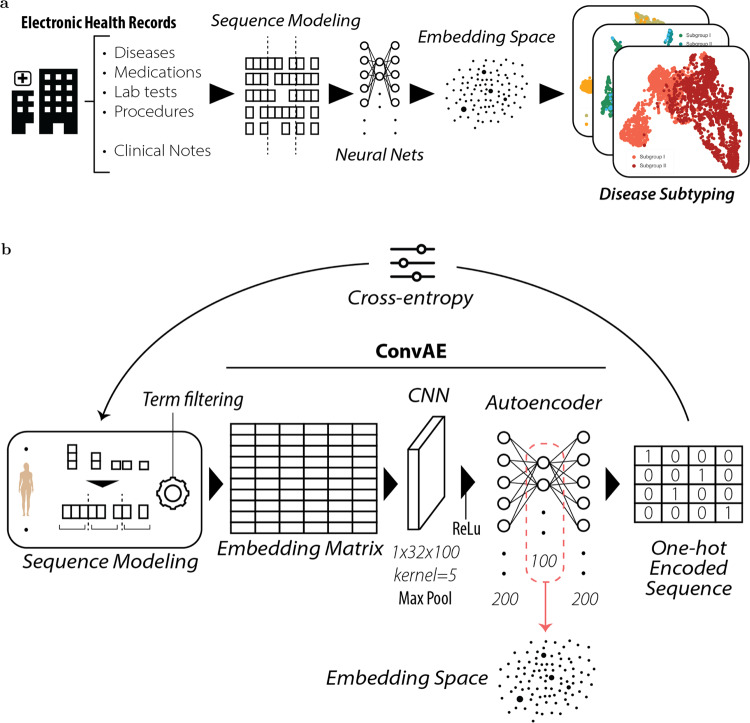
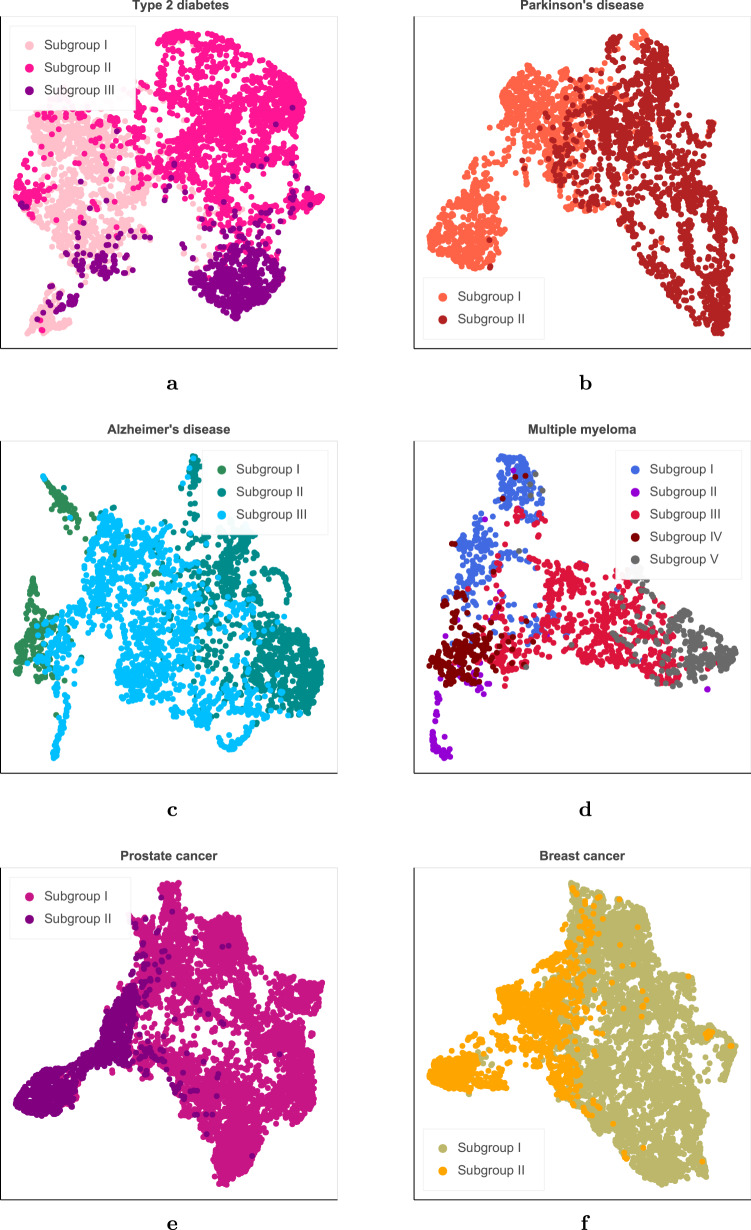
Deriving disease subtypes from electronic health records (EHRs) can guide next-generation personalized medicine. However, challenges in summarizing and representing patient data prevent widespread practice of scalable EHR-based stratification analysis. Here we present an unsupervised framework based on deep learning to process heterogeneous EHRs and derive patient representations that can efficiently and effectively enable patient stratification at scale. We considered EHRs of 1,608,741 patients from a diverse hospital cohort comprising a total of 57,464 clinical concepts. We introduce a representation learning model based on word embeddings, convolutional neural networks, and autoencoders (i.e., ConvAE) to transform patient trajectories into low-dimensional latent vectors. We evaluated these representations as broadly enabling patient stratification by applying hierarchical clustering to different multi-disease and disease-specific patient cohorts. ConvAE significantly outperformed several baselines in a clustering task to identify patients with different complex conditions, with 2.61 entropy and 0.31 purity average scores. When applied to stratify patients within a certain condition, ConvAE led to various clinically relevant subtypes for different disorders, including type 2 diabetes, Parkinson’s disease, and Alzheimer’s disease, largely related to comorbidities, disease progression, and symptom severity. With these results, we demonstrate that ConvAE can generate patient representations that lead to clinically meaningful insights. This scalable framework can help better understand varying etiologies in heterogeneous sub-populations and unlock patterns for EHR-based research in the realm of personalized medicine.
Overview
The claims and statistics of this paper haven’t been checked yet.
Free: it reads the open-access text and checks the first 5 claims that cite a source we can check. Create a free account to check every claim.
Integrity signals
Registry
Cites
Statistics
Figures
Verification
Claims the paper makes
The claims and statistics of this paper haven’t been checked yet.
Free: it reads the open-access text and checks the first 5 claims that cite a source we can check. Create a free account to check every claim.
Claims other papers make about this one
Each is checked against this paper’s own text: does it say what the citing paper says it does?
The check wasn’t confident either way, so it gives no verdict — never disputed.
In the citing paper
“For example, changes in physical activity and movement patterns, driving behavior, sleep patterns, everyday speech, eye tracking, facial expressions, technology use, writing, texting, and keyboard typing dynamics have all been shown to differentiate those with and without neurodegenerative disease.111–119”
From Review of Artificial Intelligence for Clinical Use in Alzheimer's Disease and Related Dementias (2026) · cites this paper as [113]
Experimental — accuracy not yet measured
Self-check
Percentages, sums and reported differences re-computed from the paper’s own numbers.
The self-check needs the paper’s full text.
Citations
Cites
LeCun, Y., Bengio, Y., & Hinton, G. (2015) · Nature · doi:10.1038/nature14539 · Cited by 84,126
Scikit-learn: Machine Learning in Python
Pedregosa, F., Varoquaux, G., Gramfort, A., Michel, V., Thirion, B., Grisel, O., Blondel, M., Müller, A., Nothman, J., Louppe, G., et al. (2012) · arXiv · doi:10.48550/arxiv.1201.0490 · Cited by 71,016 · cited 2×
“2, using scikit-learn and pytorch as machine learning libraries [62, 63].”
Method(2003) · Journal of Machine Learning Research · doi:10.5555/944919.944937 · Cited by 32,337
Efficient Estimation of Word Representations in Vector Space
Mikolov, T., Chen, K., Corrado, G., & Dean, J. (2013) · arXiv · doi:10.48550/arxiv.1301.3781 · Cited by 26,568 · cited 2×
“Adding a semantic modeling component based on, e.g., topic modeling [47] or word embeddings [48], might lead to more clinically meaningful patterns.”
BackgroundMethodRepresentation Learning: A Review and New Perspectives
Bengio, Y., Courville, A., & Vincent, P. (2013) · IEEE Transactions on Pattern Analysis and Machine Intelligence · doi:10.1109/tpami.2013.50 · Cited by 13,001
(2017) · Cited by 11,625
UMAP: Uniform Manifold Approximation and Projection
McInnes, L., Healy, J., Saul, N., & Großberger, L. (2018) · Journal of Open Source Software · doi:10.21105/joss.00861 · Cited by 9,826 · cited 2×
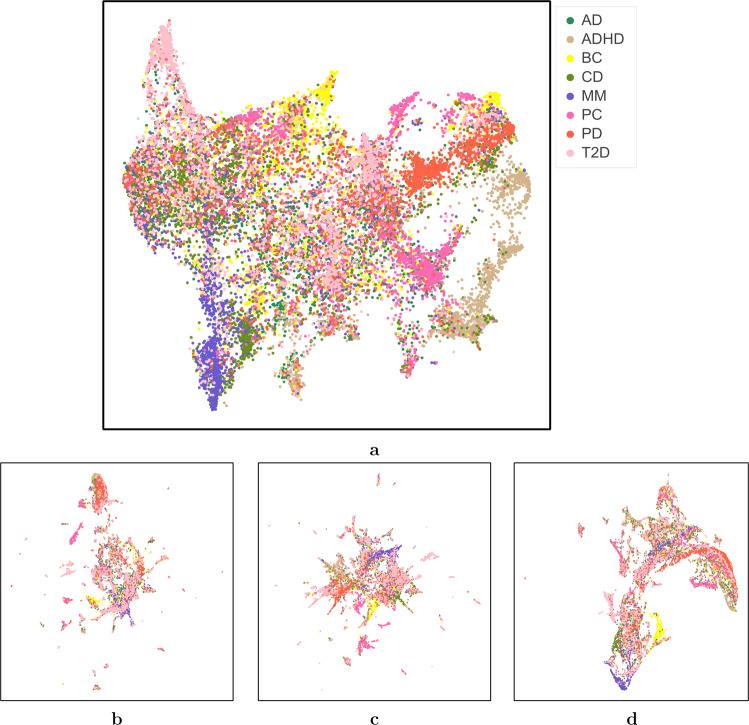
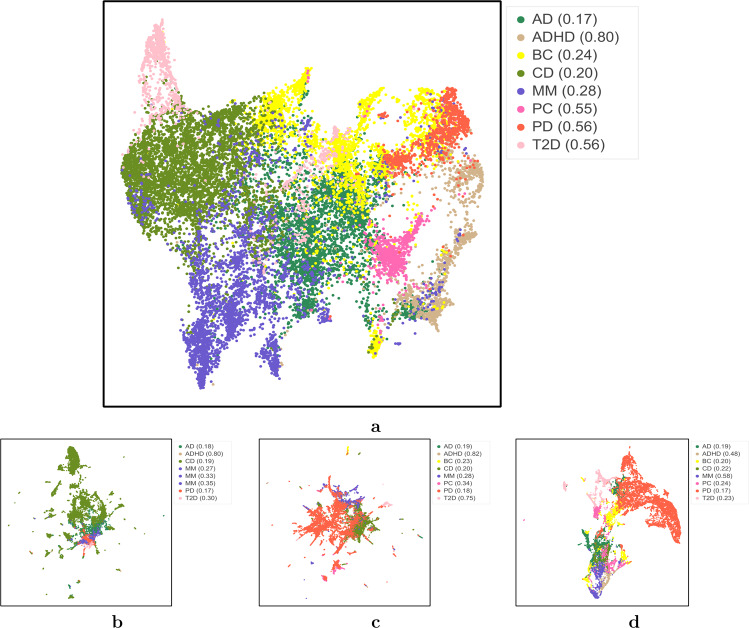
“Figure 2 visualizes the distribution of the different patient representations along with their disease cohort labels obtained using UMAP (Uniform manifold approximation and projection for dimension reduction [25]).”
MethodUMAP: Uniform Manifold Approximation and Projection for Dimension Reduction
McInnes, L., Healy, J., & Melville, J. (2018) · arXiv · doi:10.48550/arxiv.1802.03426 · Cited by 7,101 · cited 1×
“Figure 2 visualizes the distribution of the different patient representations along with their disease cohort labels obtained using UMAP (Uniform Manifold Approximation and Projection for dimension reduction [19]).”
MethodRepeated observation of breast tumor subtypes in independent gene expression data sets
Sørlie, T., Tibshirani, R., Parker, J., Hastie, T., Marron, J. S., Nobel, A., Deng, S., Johnsen, H., Pesich, R., Geisler, S., et al. (2003) · Proceedings of the National Academy of Sciences · doi:10.1073/pnas.0932692100 · Cited by 5,429
Epidemiology of Parkinson's disease
de Lau, L. M., & Breteler, M. M. (2006) · The Lancet Neurology · doi:10.1016/s1474-4422(06)70471-9 · Cited by 4,110 · cited 3×
“, averaged increased prevalence after 60 years of age) [26, 27, 28, 29, 30, 31].”
BackgroundInfluential
Research works printed but not linked: 1
- 64. Kingma, D. & Adam, J. B. Adam: a method for stochastic optimization. In Proc. 3rd International Conference on Learning Representations (eds Bengio, Y. & LeCun, Y.) 1-15, https://dblp.org/db/conf/iclr/iclr2015 (2015).
Cited by
Items 201–227 of 227
Othman, M. A. (2026) · Digital Health · doi:10.1177/20552076261428362
Alsayed, A. R., Al-Darraji, M., Al-Qaiseiah, M., Samara, A., & Al-Bayati, M. (2026) · Technologies · doi:10.3390/technologies14040241
DECA-DiaXEL: An Explainable Ensemble Learning Framework for Early Diabetes Detection in ICU Settings
Jain, A., Jain, S., Singhal, S., & Vishwakarma, D. K. (2026) · Communications in computer and information science · doi:10.1007/978-3-032-16830-6_28
Deep Phenotyping of Obstructive Sleep Apnea Using Multimodal Representation Learning
Coblentz, D., Dong, A.-J., Crivelli, S., Zamora-Resendiz, R., Ayo-Durojaiye, I., & Qian, C. (2026) · International Computer Science Conference · doi:10.1109/icsc67292.2026.00064
“Traditional unsupervised clustering methods such as K-means and Gaussian Mixture Models [5], [6] have been applied for deep phenotyping [4], but these work focused on structured data and their performance is limited by the high dimensionality, sparsity, and heterogeneity of clinical data.”
Dai, Y., Xu, W., Yang, Y., Zhang, W., Loza, M., & Nakai, K. (2026) · BMC Medical Informatics and Decision Making · doi:10.1186/s12911-026-03514-0
“These concerns motivate approaches that make the influence of age explicit while maintaining an interpretable representation of multimodal structure [10, 11].”
Prakeerthi, S., Aara, M. S., Manikanta, T. S. L., Naveen, K., Tumuluru, P., & Burra, L. R. (2026) · International Conference on Smart Electronic Devices and Intelligent Systems (ICSEDIS) · doi:10.1109/icsedis68157.2026.11518276
“Landi et al. [11] introduced deep illustration studying strategies to research big-scale EHR data and pick out patient businesses with similar fitness styles.”
Xian, S., Smoller, J. W., Luo, Y., Walunas, T. L., Liu, C., Khan, A., Weng, C., Kullo, I. J., Wei, W., Jarvik, G. P., et al. (2026) · npj Digital Medicine · doi:10.1038/s41746-026-02913-x
Amadó, C., Guidotti, L., Castañeda-Maldonado, J. I., Viñas, P., Martín, A., Muchová, J., Giménez, N., Clavé, P., & Ortega, O. (2026) · Dysphagia · doi:10.1007/s00455-026-10963-2
From K-means to LLM-augmented pipelines: a critical survey and taxonomy for biomedical big data
Ezugwu, A. E.-S., & Ezugwu, J. O. (2026) · Journal Of Big Data · doi:10.1186/s40537-026-01510-9
Huang, F., Xia, Z., Ma, R., & Cai, T. (2026) · Journal of the American Statistical Association · doi:10.1080/01621459.2026.2704888
“This wealth of information has supported unsupervised representation learning methods that estimate low-dimensional embeddings without labels, enabling tasks such as patient profiling (Li et al., 2022; Landi et al., 2020) and critical event identification (Weatherhead et al., 2022).”
Oishi, K., Adams, R., Nowrangi, M. A., Zandi, P. P., & Lyketsos, C. G. (2026) · International Review of Psychiatry · doi:10.1080/09540261.2026.2714142
García, M. N. M., Vico, A. R., López, V. F., Vicente, M. D. M., & Sánchez-Hernández, F. (2026) · Information · doi:10.3390/info17090821
“The application of machine learning to clinical outcome prediction has evolved considerably in recent years, driven by the increasing availability of electronic health records (EHRs) and advances in predictive modeling [11].”
Phiri, J., Zimba, A., Njovu, C., & Lumpa, M. (2026) · Discover Artificial Intelligence · doi:10.1007/s44163-026-01958-x
Lu, N. (2026) · Drug Discovery Today · doi:10.1016/j.drudis.2026.104795
Learning What Matters in FHIR Graph Generation for Synthetic Patient Trajectories
Bahn, M., Eryılmaz, B., Schafer, H., Idrissi-Yaghir, A., Albahri, M., Hartmann, K., Borys, K., Hosch, R., Lodde, G. C., Livingstone, E., et al. (2026) · IEEE Access · doi:10.1109/access.2026.3730637
“…methods, however, constructs the underlying graph itself through statistical or non-deterministic procedures, similarity metrics, co-occurrence statistics, or learned correlations imposed on otherwise tabular or sequential data [11], [12], [13], [14], [15], [16], [17], [18], [19], [20], [21], [22].”
Meyer, L., Schmid, A., & Braun, S. (2021) · Journal of Health Informatics and Digital Systems · doi:10.68159/o262985102
Unsupervised Discovery of Care-Path Clusters Indicative of Missed Diagnoses in EHRs
Neeralgimath, K., Kulkarni, P., Saqib, M., Deshpande, L. K., & Nandkuma, K. A. (2026) · Lecture notes in networks and systems · doi:10.1007/978-3-032-27711-4_34
Clustering Psychiatric Disorders from EHR Texts Using BERT-Based Representation Learning
Bhasker, A. K., Singh, A., Chandra, G., Yadav, S., & Singh, V. (2026) · Lecture notes in networks and systems · doi:10.1007/978-3-032-30957-0_15
Raja, M., & Reddy, A. J. (2026) · Frontiers in Artificial Intelligence · doi:10.3389/frai.2026.1930437
Huang, J.-L., Yang, C.-H., & Pai, T. (2026) · JMIR Medical Informatics · doi:10.2196/95929
A cell-type-directed drug repurposing framework for Alzheimer's disease subtypes
Li, Y., Tang, X., Serras, C. P., Tang, A., Oskotsky, T., & Sirota, M. (2026) · Acta Pharmaceutica Sinica B · doi:10.1016/j.apsb.2026.10.019
Proios, D., Bornet, A., Vindas, Y., Jia, Y., Quintard, H., Sitek, A., & Teodoro, D. (2026) · doi:10.2196/preprints.112136
Peng, X., Xia, F., Ma, M., 史冬泉, & Yue, L. (2026) · Advanced Orthopaedics · doi:10.1016/j.advop.2026.10.005
Wang, D. (2025) · Digital Commons-TMC (Texas Medical Center)
Desarrollo de baterías verdes para el almacenamiento de energía en proyectos de gestión hídrica
Angeles, H. N. R., Agreda, C. A. C., & Rengifo, R. R. (2026) · REBIOL
Achour, B., El‐Khateeb, E., Sierra, T., Terrier, J., Rostami‐Hodjegan, A., & Polasek, T. M. (2026) · Handbook of experimental pharmacology · doi:10.1007/164_2026_854
Ramachandran, R., Muthusamy, A., Balaji, C., & Gupta, S. K. (2026) · Scientific Reports · doi:10.1038/s41598-026-72522-x
Metadata
- Authors
- Landi, I., Glicksberg, B. S., Lee, H.-C., Cherng, S., Landi, G., Danieletto, M., Dudley, J. T., Furlanello, C., & Miotto, R.
- Affiliations
- University of Trento (IT)
- Icahn School of Medicine at Mount Sinai (US)
- Fondazione Bruno Kessler (IT)
- Corresponding author
- Miotto, Riccardo
- Venue
- npj Digital Medicine
- Published
- 2020-07-17
- Volume
- 3
- Issue
- 1
- Pages
- 96-96
- ISSN
- 2398-6352 (ISSN-L)
- PMC
- PMC7367859
- OpenAlex
- W3042895962
- Semantic Scholar
- f37dce7bdf0a3e9703a2a4f0441910e840f1b879
- Cited by
- 213
- References
- 56
- Citations by year
- 2026: 43 · 2025: 40 · 2024: 36 · 2023: 38 · 2022: 20 · 2021: 31 · 2020: 5
- FWCI
- 9.24
- Type
- journal article
- Language
- en
- Open access
- gold
- doi.org
- Licence
- cc-by
- creativecommons.org/licenses/by/4.0 (tdm)
- creativecommons.org/licenses/by/4.0 (vor)
- Locations
- npj Digital Medicine (publishedVersion, cc-by)
- PubMed Central (publishedVersion, cc-by)
- PubMed (publishedVersion)
- arXiv (Cornell University) (submittedVersion)
- DOAJ (DOAJ: Directory of Open Access Journals) (submittedVersion, cc-by-sa)
- arXiv (Cornell University)
- Funders
- Alzheimer's Drug Discovery Foundation
- Nvidia
- Hasso Plattner Foundation
- Topics
- Physical Sciences › Computer Science › Artificial Intelligence › Machine Learning in Healthcare
- Health Sciences › Health Professions › Health Information Management › Electronic Health Records Systems
- Health Sciences › Medicine › Epidemiology › Chronic Disease Management Strategies
- Keywords
- electronic health records, patient stratification, disease subtypes, deep representation learning, convolutional autoencoder, word embeddings, hierarchical clustering, personalized medicine, comorbidities, type 2 diabetes, Parkinson's disease, Alzheimer's disease, patient trajectories
About these checks
Registry, retraction, Cites and statistics results are computed, not judged, with one exception: a printed reference that no index lists is read once by a model before it counts as a citation error. Claims are extracted by a model and kept only when their quote appears verbatim in the text; each cited source is then checked, with a model’s help, for whether it says what the claim relies on. Those verdicts can be wrong — read the claim’s quote and the cited source before relying on one.
Statistics and arithmetic are recomputed, not judged.
Confidence bands are shown only for fields calibrated on our annotated test set. None is calibrated yet, so no band is shown.
What counts as a claim ›How we measure confidence ›How we check this ›
Are you an author, or do you see a problem with this page? Request a review
Data sources
Bibliographic data: Semantic Scholar, OpenAlex, Crossref.
Contains information from the Semantic Scholar Academic Graph Datasets, made available under the ODC Attribution License (ODC-BY 1.0).
Semantic Scholar’s data is described in: Kinney, R., et al. (2023). The Semantic Scholar Open Data Platform. arXiv:2301.10140.
